Romans 7:9

Greek (Tischendorf 8th ed.) Romans 7:9 appears in the Greek New Testament. The text above is from the Tischendorf 8th edition. Each word links to its Strong’s number and a concise gloss. Click any word for its full Thayer’s Greek Lexicon entry.
Download image
Cite this verse

Romans 7:9 (World English Bible). Public Domain. Lemma interlinear Bible study tool, https://lemma.gebible.app/v/romans/7/9.

Show BibTeX & RIS
BibTeX
RIS
English Translation
I was alive apart from the law once, but when the commandment came, sin revived, and I died.
World English Bible · Public Domain
Download a study sheet

One document with this verse’s original text, its word-by-word gloss line, the meaning frame, cross-references with their text, attributed commentary, and full source and license credits — printable, and it pastes into notes with its structure intact.

This verse Autodidact and up

Study sheet (.html) Plain text (.txt)

A passage Seminary Student

Up to 50 verses in one chapter. A passage sheet keeps up to 6 commentary sources and 12 cross-references per verse, in the order this page ranks them, and says so on the sheet whenever that leaves anything out. Ask for a single verse and you get the Autodidact verse sheet above.

Everything on this page stays free to read, with no account — the sheet is a download of what is already on screen, not access to it.

Want to remove ads? Support Godless Engineer
Compare translations 3

The same verse in 3 English versions, stacked beneath the original-language interlinear above. Click any original word for its lexicon entry.

Each is an independent rendering of the whole verse — the interlinear is not word-aligned to these translations.

Highlighted words mark where these versions differ — a whole-verse word diff, not a word-by-word alignment.

  • World English Bible Public Domain
    I was alive apart from the law once, but when the commandment came, sin revived, and I died.
  • King James Version Public Domain
    For I was alive without the law once: but when the commandment came, sin revived, and I died.
  • unfoldingWord Literal Text CC BY-SA 4.0
    Now at one time I was alive without law, but the commandment having come, sin came to life again,

unfoldingWord Literal Text — © unfoldingWord, licensed CC BY-SA 4.0. Word-aligned USFM3 via Door43 (git.door43.org/unfoldingWord/en_ult).

Versions to compare (up to 4)

3 of 4 selected

Show all 19 translations

Every available English version of this verse, each an independent rendering of the whole verse.

  • World English Bible Public Domain
    I was alive apart from the law once, but when the commandment came, sin revived, and I died.
  • Berean Standard Bible Public Domain
    Once I was alive apart from the law; but when the commandment came, sin sprang to life and I died.
  • Majority Standard Bible Public Domain
    Once I was alive apart from the law; but when the commandment came, sin sprang to life and I died.
  • King James Version Public Domain
    For I was alive without the law once: but when the commandment came, sin revived, and I died.
  • American Standard Version (1901) Public Domain
    And I was alive apart from the law once: but when the commandment came, sin revived, and I died;
  • Revised Version (1885) Public Domain
    And I was alive apart from the law once: but when the commandment came, sin revived, and I died;
  • Geneva Bible (1599) Public Domain
    For I once was aliue, without the Law: but when the commandement came, sinne reuiued,
  • Douay-Rheims (1899) Public Domain
    And I lived some time without the law. But when the commandment came, sin revived,
  • Young's Literal Translation Public Domain
    And I was alive apart from law once, and the command having come, the sin revived, and I died;
  • Literal Standard Version CC BY-SA 4.0
    And I was alive apart from law once, and the command having come, sin revived, and I died;
  • Unlocked Literal Bible CC BY-SA 4.0
    At one time I was alive without the law, but when the commandment came, sin regained life, and I died.
  • unfoldingWord Literal Text CC BY-SA 4.0
    Now at one time I was alive without law, but the commandment having come, sin came to life again,
  • Darby Bible Public Domain
    But *I* was alive without law once; but the commandment having come, sin revived, but *I* died.
  • World Messianic Bible Public Domain
    I was alive apart from the law once, but when the commandment came, sin revived and I died.
  • Webster's Bible Public Domain
    For I was alive without the law once: but when the commandment came, sin revived, and I died.
  • Free Bible Version CC BY-SA 4.0
    I used to live without realizing what the law really meant, but when I understood the implications of that commandment, then sin came back to life, and I died.
  • Bible in Basic English Public Domain
    And there was a time when I was living without the law: but when the law gave its orders, sin came to life and put me to death;
  • Text-Critical English NT CC BY 4.0
    Once I was alive apart from the law, but when the commandment came, sin came to life and I died.
  • Tyndale New Testament (1534) Public Domain
    I once lived with out lawe. But when the commaundement came synne revyved and I was deed.

Literal Standard Version (2020), Covenant Press — licensed CC BY-SA 4.0. Text via the HelloAO Bible API (eBible.org). Unlocked Literal Bible (unfoldingWord) — licensed CC BY-SA 4.0. Text via the HelloAO Bible API (eBible.org). unfoldingWord Literal Text — © unfoldingWord, licensed CC BY-SA 4.0. Word-aligned USFM3 via Door43 (git.door43.org/unfoldingWord/en_ult). Free Bible Version, Dr. Jonathan Gallagher — licensed CC BY-SA 4.0. Text via the HelloAO Bible API (eBible.org).

Word by word

More ways to search: Search by grammar → Find every occurrence → Compare this word →

Practice this passage: Drill this verse → Learn its vocabulary →

ἀνέζησεν
anazáō
G326
“to live again”
Verb, Aorist, Active, Indicative, 3rd person, Singular
Part of Speech
Verb
Tense
Aorist
Voice
Active
Mood
Indicative
Person
3rd person
Number
Singular
Full Thayer's Definition

Origin: from G303 and G2198

TDNT: 16:32,3

1. live again, recover life a. to be restored to a correct life 1. of one who returns to a better moral state b. to revive, regain strength and vigour
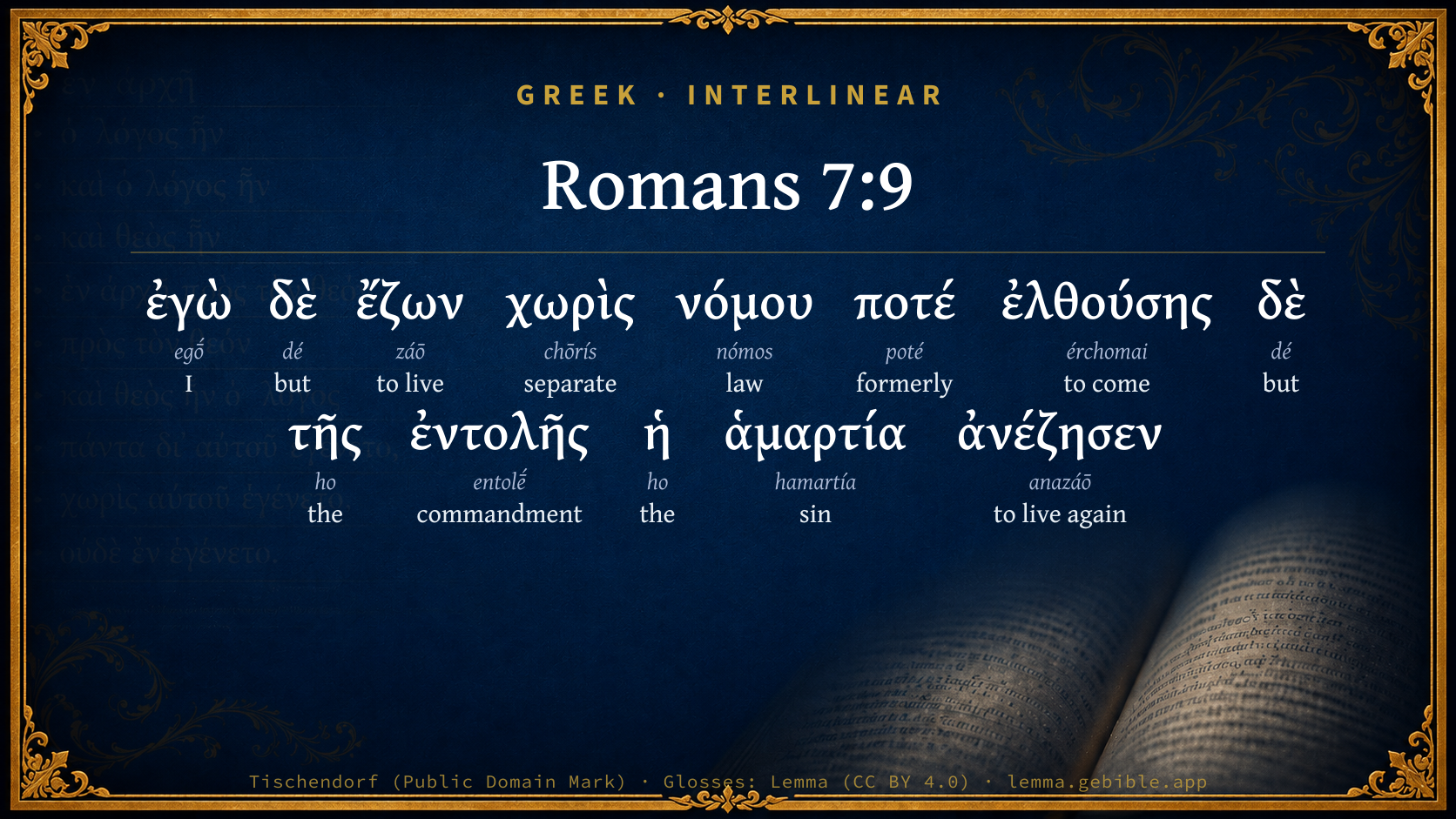
  1. ἐγὼ egṓ G1473 “I” Personal pronoun, 1st person, Nominative, Singular
  2. δὲ dé G1161 “but” Conjunction
  3. ἔζων záō G2198 “to live” Verb, Imperfect, Active, Indicative, 1st person, Singular
  4. χωρὶς chōrís G5565 “separate” Adverb
  5. νόμου nómos G3551 “law” Noun, Genitive, Singular, Masculine
  6. ποτέ poté G4218 “formerly” Particle
  7. ἐλθούσης érchomai G2064 “to come” Verb, Aorist, Active, Participle, Genitive, Singular, Feminine
  8. δὲ dé G1161 “but” Conjunction
  9. τῆς ho G3588 “the” Article, Genitive, Singular, Feminine
  10. ἐντολῆς entolḗ G1785 “commandment” Noun, Genitive, Singular, Feminine
  11. ἡ ho G3588 “the” Article, Nominative, Singular, Feminine
  12. ἁμαρτία hamartía G266 “sin” Noun, Nominative, Singular, Feminine

About this verse

These counts appear in no published source. They are computed here, from the morphology-tagged text and Lemma’s own curated glosses. What Lemma adds →

13
words
11
distinct lemmas
Pauline Epistles
section

Notable vocabulary

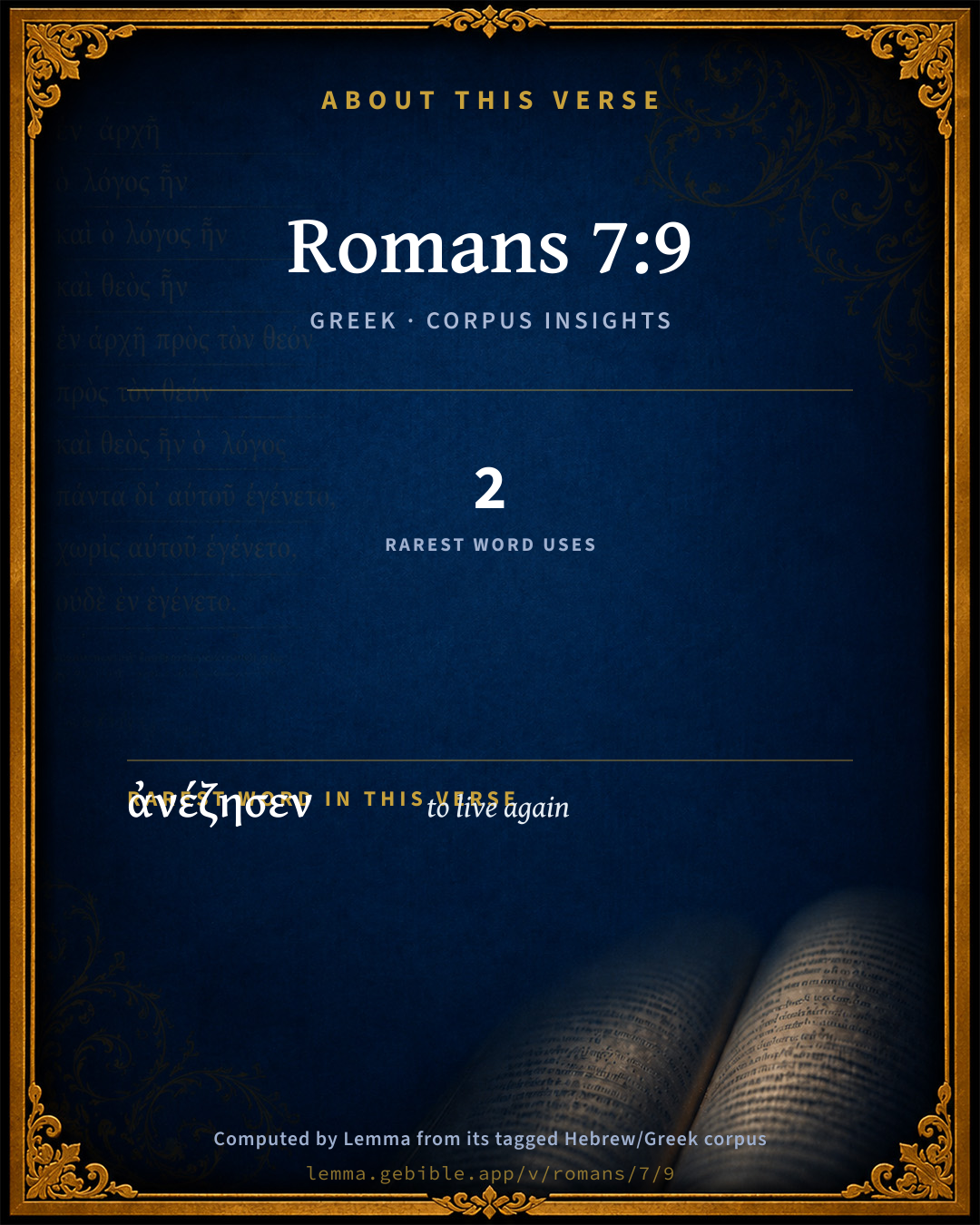
The rarest word here is ἀνέζησεν to live again G326 — appearing just 2 times in the whole Greek New Testament.

Shared distinctive vocabulary

ἀνέζησεν to live again G326 occurs in 2 verses of the Greek New Testament. Also found in:

Repetition

Words recur within this verse:

Cross-references

20

Topical passages linked to Romans 7:9 in the Treasury of Scripture Knowledge — connected by theme and wording, ordered by reader-vote popularity; previews shown in the World English Bible.

  • Galatians 3:10 For as many as are of the works of the law are under a curse. For it is written, "Cursed is everyone who doesn't continue in all things that are written in the book of the law, to do them."
  • Romans 8:7 because the mind of the flesh is hostile towards God; for it is not subject to God's law, neither indeed can it be.
  • Romans 7:4 Therefore, my brothers, you also were made dead to the law through the body of Christ, that you would be joined to another, to him who was raised from the dead, that we might bring forth fruit to God.
  • James 2:10–11 For whoever shall keep the whole law, and yet stumble in one point, he has become guilty of all.
  • Galatians 2:19 For I, through the law, died to the law, that I might live to God.
  • Romans 7:6 But now we have been discharged from the law, having died to that in which we were held; so that we serve in newness of the spirit, and not in oldness of the letter.
  • Romans 7:11 for sin, finding occasion through the commandment, deceived me, and through it killed me.
  • Romans 7:21–23 I find then the law, that, to me, while I desire to do good, evil is present.
  • Romans 10:5 For Moses writes about the righteousness of the law, "The one who does them will live by them."
  • Luke 18:9–12 He spoke also this parable to certain people who were convinced of their own righteousness, and who despised all others.
  • Romans 3:19–20 Now we know that whatever things the law says, it speaks to those who are under the law, that every mouth may be closed, and all the world may be brought under the judgment of God.
  • Philippians 3:5–6 circumcised the eighth day, of the stock of Israel, of the tribe of Benjamin, a Hebrew of Hebrews; concerning the law, a Pharisee;
  • Psalms 40:12 For innumerable evils have surrounded me. My iniquities have overtaken me, so that I am not able to look up. They are more than the hairs of my head. My heart has failed me.
  • Matthew 5:21–26 "You have heard that it was said to the ancient ones, 'You shall not murder;' and 'Whoever shall murder shall be in danger of the judgment.'
  • Matthew 19:20 The young man said to him, "All these things I have observed from my youth. What do I still lack?"
  • Mark 7:8–13 "For you set aside the commandment of God, and hold tightly to the tradition of men--the washing of pitchers and cups, and you do many other such things."
  • Luke 10:25–29 Behold, a certain lawyer stood up and tested him, saying, "Teacher, what shall I do to inherit eternal life?"
  • Luke 15:29 But he answered his father, 'Behold, these many years I have served you, and I never disobeyed a commandment of yours, but you never gave me a goat, that I might celebrate with my friends.
  • Luke 18:21 He said, "I have observed all these things from my youth up."
  • Matthew 15:4–6 For God commanded, 'Honor your father and your mother,' and, 'He who speaks evil of father or mother, let him be put to death.'

Cross-references courtesy of OpenBible.info (CC BY 4.0).

Commentary

Notes on Romans 7:9 from classic Christian and Jewish commentators (each source and its license shown beneath its notes). The classic Christian expositions comment on the surrounding passage and are grouped to its opening verse, so a note may address several verses; the Jewish commentaries on the Tanakh (Rashi and others) are per-verse, so they appear only where the commentator wrote on this verse.

Lemma curates 59 commentaries, every one of them public domain or Creative Commons licensed, each selected and text-cleaned for this edition rather than reprinted as found. About our sources →

Joseph Benson's Commentary

Rom 7:9-11. For I was alive — In my own conceit; without the law — Without the proper knowledge of its spirituality, extent, and obligation. I apprehended myself to be righteous, and in the way to life eternal; but when the commandment came — That is, the law; (a part being put for the whole;) but this expression particularly intimates its compulsive force, which restrains, enjoins, urges, forbids, threatens; — when, in its spiritual meaning, it came to my heart: or, when the spiritual meaning and full extent of the law, condemning desires of evil, was brought home, and closely applied to my conscience by the Spirit of God; sin revived — My conscience was awakened and convinced, and I found myself guilty of many sins, which before I perceived not, and a lively sense of the guilt of them was imprinted on my soul; and I died — My virtue and strength died away, and my former persuasions vanished: for I saw myself to be dead in sin, in a state of condemnation, and liable to death eternal. And the commandment — The law; which was ordained to life — Which promised life to them that kept it, saying, The man that doeth these things shall live in, or by them; and which, if rightly used, would have been a means of increasing spiritual life, and leading to life everlasting. “The law of nature, and its transcript in the moral precepts of the law of Moses, were intended for life; because the threatening of death for every offence, is virtually a promise of life to those who obey perfectly. This appears from the law given to Adam in paradise.” I found to be unto death — To be attended with deadly consequences, both as it consigned me over to destruction for past sin, and occasionally, though not intentionally, proved productive of new guilt and misery. Perfect obedience being impossible, according to the present state of human nature, the law, which threatens death for every offence, necessarily ends in death to the sinner, although it was originally intended to give life to the obedient. For sin, as I said before, (see on Rom 7:8,) taking occasion by the commandment — Prohibiting it under the severest penalties, but affording me no help against it; deceived me — Came upon me unawares, while I was expecting life by the law; and by it slew me — Slew all my hopes, by bringing me under guilt, condemnation, and wrath. In other words, Satan, the grand enemy of mankind, and author of sin, finding a law which threatened death to the transgression of it, takes occasion thence more earnestly to tempt and allure us to the violation of it, that so he may more effectually subject us to condemnation and death upon that account. Thus, when God had forbidden, under the pain of death, the eating of the forbidden fruit, Satan thence took occasion to tempt our first parents to the breach of it, and so slew them, or made them subject to death. Dr. Doddridge paraphrases the verse rather differently, thus: “Sin, taking occasion by the terror and curse of the violated commandment, and representing the great Lawgiver as now become my irreconcileable enemy, deceived me into a persuasion that I could be no worse than I was, and thereby it slew me; it multiplied my mortal wounds, and rendered my case still more desperate.” Instead of sin taking occasion, Dr. Macknight renders αφορμην λαβουσα, taking the opportunity, an expression which he thinks less likely to countenance the idea, that men’s evil desires are owing to the prohibitions of the law; to suppose which, would be to make God the author of sin by his law. “The apostle’s meaning,” says he, “is, that sin took the opportunity of men being under the commandment, first to deceive, and then to kill them.” According to Bengelius, the most approved copies read, not, sin taking occasion or opportunity by the commandment, but, by the commandment deceived and slew me; connecting the commandment, not with the former, but with the latter clause of the verse. In the words, deceived me, there seems to be an allusion to the excuse which Eve made for eating the forbidden fruit. The serpent deceived me, by assuring me that I should not die. “The apostle speaks of a two-fold opportunity taken by sin, while men are under the commandment. The first is, sinful dispositions, deceiving men into the belief that the prohibitions of the law are unreasonable, that the thing forbidden is pleasant or profitable, and that it will not be followed with punishment, persuade them to do it. This was the serpent’s discourse to Eve; and it is what men’s sinful inclinations always suggest to them. The second opportunity which sin takes under the commandment, is that of killing the sinner by the curse annexed to the commandment which he hath broken.”

Joseph Benson's Commentary on the Old and New Testaments (1811–1818) — public domain. Text from a community e-Sword module.

Scofield Reference Notes

C. I. Scofield

when the commandment

The passage (Rom 7:7-25) is autobiographical. Paul’s religious experience was in three strongly marked phases:

(1) He was a godly Jew under the law. That the passage does not refer to that period is clear from his own explicit statements elsewhere. At that time he held himself to be "blameless" as concerned the law Php 3:6. He had "lived in all good conscience" Act 23:1.

(2) With his conversion came new light upon the law itself. He now perceived it to be "spiritual" (Rom 7:14). He now saw that, so far from having kept it, he was condemned by it. He had supposed himself to be "alive," but now the commandment really "came" (Rom 7:9) and he "died." Just when the apostle passed through the experience of Rom 7:7-25 we are not told. Perhaps during the days of physical blindness at Damascus Act 9:9, perhaps in Arabia Gal 1:17.

It is the experience of a renewed man, under the law, and still ignorant of the delivering power of the Holy Spirit Rom 8:2.

(3) With the great revelations afterward embodied in Galatians and Romans, the apostle’s experience entered it third phase. He now knew himself to be "dead to the law by the body of Christ," and, in the power of the indwelling Spirit, "free from the law of sin and death" Rom 8:2 while "the righteousness of the law" was wrought in him (not by him) while he walked after the Spirit Rom 8:4, Romans 7. is the record of past conflicts and defeats experience as a renewed man under law.

sin Sin. (See Scofield "Rom 5:21").

The Scofield Reference Bible (1917 edition), notes by C. I. Scofield — public domain. Text from a community e-Sword module.

Tyndale Open Study Notes

Tyndale Open Resources

7:9 At one time I lived without understanding the law: Paul might be referring to his early childhood, before he came to understand the full demands of the law. • But when I learned the command: Paul’s experience with the law as he grew to maturity exemplifies every person’s experience with it. With the law, we have greater accountability to God, which brings the power of sin to life, and the result is greater judgment (7:10; see 4:15; 5:14, 20).

Tyndale Open Study Notes — © Tyndale Open Resources, licensed CC BY-SA 4.0. Text via the HelloAO Bible API.

Bengel's Gnomon

Johann Albrecht Bengel

Rom 7:9. Ἔζων, I was alive) ζῇν here does not merely signify to pass one’s life, but it is put in direct antithesis to death. This is the pharisaic tone, comp. the following verse. [I seemed to myself indeed to be extremely well, V. g.]—χωρὶς νόμου, without the law) the law being taken out of the way, being kept at a distance, as if it did not exist.—ἐλθούσης) The antithesis to χερὶς—ἐντολῆς, the commandment) ἐντολὴ, a commandment is part of the law, with the addition of a more express idea in it of compulsory power, which restrains, enjoins, urges, prohibits, threatens.—ἀνέζησεν, revived) just as [even as] it had been alive, when it had entered into the world by Adam.

Bengel's Gnomon of the New Testament — English translation (T&T Clark, Edinburgh, 1860) — public domain. Text from a community e-Sword module.

Meyer's Critical & Exegetical Commentary

Heinrich August Wilhelm Meyer

Rom_7:9. But I was once alive without the law. ἐγὼ δὲ, the antithesis of ἁμαρτία; ἔζων, antithesis of νεκρά; νόμου, just as in Rom_7:8.

ἔζων] The sense is, on account of the foregoing (νεκρά) and the following (ἀπέθανον, Rom_7:10) contrast, necessarily (in opposition to Reiche and van Hengel) to be taken as pregnant; but not with the arbitrary alteration, videbar mihi vivere (Augustine, Erasmus, Pareus, Estius), or securus eram, (Luther, Melancthon, Beza, Calvin, Piscator, Calovius, Bengel, and others, including Krummacher), thus representing Paul as glancing at his Pharisaic state, in which the law had not yet alarmed him,a view which is at variance with the words themselves and with the antitheses, and which is certainly quite inadmissible historically in the case of a character like Paul (Gal_1:14; Gal_3:23; Php_3:6), who could testify so truly and vividly of the power of sin and of the curse of the law. No, Paul means the death-free (Rom_7:10) life of childlike innocence (comp. Winzer, p. 11; de Wette and Ewald in loc.; Umbreit in the Stud. u. Krit. 1851, p. 637 f.; Ernesti, Urspr. d. Sünde, I. p. 101; Weiss, bibl. Theol. p. 287; also Delitzsch), whereas this state of life, resembling the condition of our first parents in Paradise, was the bright spot of his own earliest recollectionthe law has not yet come to conscious knowledge, the moral self-determination in respect to it has not yet taken place, and therefore the sin-principle is still lying in the slumber of death. Rightly explained already by Origen: πᾶς γὰρ ἄνθρωπος ἔζη χωρὶς νόμου ποτὲ, ὅτε παιδίον ἦν, and by Augustine, c. duas ep. Pelag. i. 9. This is certainly a status securitatis, but one morally indifferent, not immoral, and not extending beyond the childhood unconscious of the ἐντολή. Hence, in the apostles case, it is neither to be extended till the time of his conversion (Luther, Melancthon, etc.), nor even only till the time of his having perceived that the law demands not merely the outward act, but also the inward inclination (Philippi and Tholuck)which is neither in harmony with the unlimited χωρὶς νόμου (Paul must at least have written χωρὶς τῆς ἐντολῆς), nor psychologically correct, since sin is not dead up to this stage of the moral development. From this very circumstance, it is clear also that the explanation of those is erroneous, who, making Paul speak in the name of his nation, are compelled to think of the purer and more blameless life of the patriarchs and Israelites before the giving of the law (so Grotius, Turretin, Locke, Wetstein, following several Fathers, and recently Reiche; comp. Fritzsche.)

The pregnant import of the ἔζων lies in the fact that, while the sin-principle is dead, man has not yet incurred eternal death (physical death has been incurred by every one through Adams sin, Rom_5:12); this being alive is therefore an analoguethough still unconscious and weak, yet pleasingly presenting itself in the subsequent retrospectof the true and eternal ζωή (comp. Mat_18:3) which Christ (comp. Rom_7:24 f.) has procured through His atoning work. The theory of a pre-mundane life of the pre-existent soul (Hilgenfeld in his Zeitschr. 1871, p. 190 f.) is a Platonism forced on the apostle (comp. Wis_8:20, and Grimm in loc.) in opposition to the entire N. T.

ἐλθούσης δὲ τῆς ἐντολ.] but when the command, namely, the οὐκ ἐπιθυμήσεις of the Mosaic law, had come, i.e. had become present to my consciousness. To the person living still in childlike innocence the ἐντολή was absent; for him it was not yet issued; it had not yet presented itself. Comp. on Gal_3:23. Reiche, consistently with his view of the entire section, explains it, as does also Fritzsche, of the historical Mosaic legislation.

ἀνέζησεν] is by most modern commentators rendered came to life. So Tholuck, Rückert, Fritzsche, Baumgarten-Crusius, de Wette, Maier, and Hofmann. But quite contrary to the usus loquendi (Luk_15:24; Luk_15:32; Rom_14:9; Rev_20:5), in accordance with which it means: came again to life. See also Nonnus, Joh. v. 25: αὖτις ἀναζήσωσιν, where (in opposition to the view of Fritzsche) αὖτις is added according to a well-known pleonasm; comp. ἐπαναζώσει, reviviscet, Dial. Herm. de astrol. i. 10, 42; respecting the case of ἀναβλέπω, usually cited as analogous, see on Joh_9:11. So, too, ἈΝΑΖΩΌΩ in Aquila and Symmachus means reviviscere facio. See Schleusner, Thes. I. p. 219. And also the frequent classical ἀναβιῶ and ἈΝΑΒΙΏΣΚΟΜΑΙ, always mean to come to life again; Plat. Rep. p. 614 B; Polit. p. 272; Lucian, Q. hist. 40: ἀνεβίουν ἀποθανών, Gall. 18. Comp. ἀναβίωσις, 2Ma_7:9. It is therefore linguistically correct to explain it, with the ancients, Bengel, and Philippi: sin lived again (revixit, Vulgate); but this is not to be interpreted, with Bengel, following Augustine and others: sicut vixerat, cum per Adamum intrasset in mundum (comp. Philippi), because that is foreign to the context, inasmuch as Paul sets forth his experience as the expression of the experience of every individual in his relation to the law, not speaking of humanity as a whole. The ἀνέζησεν, which is not to be misinterpreted as pointing to a pre-mundane sin (Hilgenfeld), finds its true explanation, analogously to the ἀναβλέπω in Joh_9:11, in the view that the ἉΜΑΡΤΊΑ, that potentiality of sin in man, is originally and in its nature a living power, but is, before the ἐντολή comes, without expression for its life, ΝΕΚΡΆ; thereupon it resumes its proper living nature, and thus becomes alive again. Comp. van Hengel: e sopore vigorem recuperavit.

Meyer — Critical and Exegetical Commentary on the New Testament — English translation by Peter Christie, edited by Frederick Crombie (T&T Clark, 1880) — public domain. Text from a community e-Sword module.

Expositor's Greek Testament

ed. W. Robertson Nicoll

Rom 7:9 . ἐγὼ δὲ ἔζων χωρὶς νόμου ποτέ : this is ideal biography. There is not really a period in life to which one can look back as the happy time when he had no conscience; the lost paradise in the infancy of men or nations only serves as a foil to the moral conflicts and disorder of maturer years, of which we are clearly conscious. ἐλθούσης δὲ τῆς ἐντολῆς κ . τ . λ . In these words, on the other hand, the most intensely real experience is vividly reproduced. When the commandment came, sin “came to life again”: its dormant energies woke, and “I died”. “There is a deep tragic pathos in the brief and simple statement; it seems to point to some definite period full of painful recollections” (Gifford). To say that “death” here means the loss of immortality (bodily death without the hope of resurrection), as Lipsius, or that it means only “spiritual” death, is to lose touch with the Apostle’s mode of thought. It is an indivisible thing, all doom and despair, too simply felt to be a subject for analysis.

The Expositor's Greek Testament, edited by W. Robertson Nicoll (1897–1910) — public domain. Text from a community e-Sword module.

Godet's Commentaries

Frédéric Louis Godet

Vv. 9, 10a. “And I was alive when I was formerly without law; but when the commandment came, sin revived, and I died;”

Calvin well expresses the rhythm of these verses: “The death of sin is the life of man; and, on the contrary, the life of sin is the death of man.”

The Vatic. reads ἔζην instead of ἔζων: both forms are classical. What is this life which the apostle enjoyed when he was yet without law? Augustine, the Reformers, and some modern commentators (Bengel, Bonnet) think that the time in question is when, sunk in his Pharisaical delusions, filled with self-righteousness, Paul thought himself in possession of the life of God, of true righteousness. They understand the: I was alive, in the sense of: I thought myself alive. This interpretation is in itself forced; but there is more against it. Could Paul really say of himself that, as a Pharisee, he was without law? It was, on the contrary, the time when he was absolutely under the law, ὑπὸ νόμον, according to 1Co 9:20, kept under the charge of the schoolmaster, who was to bring him to Christ, according to Gal 3:24. Then if it was his Pharisee life which he wished to characterize in the words: when I was formerly without law, what would be the time denoted by the following words: when the commandment came? Will it be said: the time of his conversion, when the law took its inmost meaning for him, in Christ, its full spiritual bearing? “Though before his eyes,” says Calvin, when speaking of his life as a Pharisee, “the law did not seriously affect his heart with the conviction of the judgment of God.” It was only by the Spirit of Christ that his eyes were opened, and that the commandment truly humbled and condemned him. But where, then, is this idea of the interposition of Christ, and of the profound crisis of which he speaks elsewhere as a new creation? And was the understanding of the commandment then the sole or even the principal character of this transformation? Certainly, if these words refer to his conversion, some indication or other would not be wanting to designate this transition to a new faith. To discover a period in Paul’s life to which the words: formerly when I was under the law, really apply, we must go back to the days which preceded the awakening of his moral consciousness under the operation of the law. We are thereby led to the period of his childhood, before he was subjected to the Pharisaic ordinances and the exact discipline of the law. From the age of twelve, young Israelites were subjected to the legal institutes, and became, as was said, sons of the law, bené hattorah. This stage of his outward life was undoubtedly for the young Saul the signal of the inward crisis described from Rom 7:7 onward. From the moment he found himself called to apply the prescriptions of the law seriously to his conduct, he was not slow to discover sin within him; for in the depths of his heart he found lust; and not only did the law unveil this evil principle to him, but it intensified its power. The torrent bubbled and boiled on meeting with the obstacle which came in its way. Till then Saul was alive, morally and religiously, which does not mean merely that he thought himself alive; nor does it denote merely the innocent and pure sprightliness of childhood, yet untroubled by any remorse. The word live, when used by Paul, always includes something more profound. It refers here to the state of a young and pious Israelitish child, trained in the knowledge and love of Jehovah, tasting by faith in the promises of His word the blessings of the covenant, awaking and going to sleep in the arms of the God of his fathers, and seeking not to displease Him in his conduct. There was here a real beginning of life in God, a pure flame, which was extinguished no doubt afterward by self-righteousness and by the inward strife inseparable from it, but which burst forth at last magnificently at the breath of faith in Jesus Christ.

The words: when the commandment came, after what precedes, refer simply to the appearance of the commandment, with its holy majesty, in the conscience of young Saul. Then began in him the serious attempt to put it fully into practice. The term commandment is used instead of law, because, as Rom 7:7 shows, it is specially the tenth commandment which is in question. It is by it above all that the work here described is effected in him. This work was, as Paul tells us, to make sin live or revive. The term live forms an antithesis to the other: sin is dead (Rom 7:8). It is a somewhat difficult question which of its two meanings is to be attached to the preposition ἀνά in the composition of the verb ἀναζῆν, that of anew (like our re in revive): recovered life; or whether, according to its strict signification, above, it merely denotes here the transition from the passive to the active state: took life. Meyer, in favor of the first sense, insists on the fact that it is impossible to quote, either in the N. T. or in the classics, a single case in which this verb or its analogues (ἀναβιόω, ἀναβιώσκομαι) signifies anything else than revive (Luk 15:24, for example). This cannot be denied. Nevertheless it is true that many verbs compounded with ἀνά do not at all include the idea of a return to a previous state; thus ἀνατέλλω, to spring (speaking of plants), and to rise (speaking of the stars); ἀναβοάω, to raise the voice, to cry; ἀναζέω, to bubble up. The verb ἀναβλέπω is taken in both senses: to look above (Mat 14:19; Mar 7:34; Luk 19:5), and to see anew (Act 9:12; Act 9:17-18). In Joh 9:11, the meaning is doubtful. If we translate: “recovered life,” what is the previous life of sin present to the mind of the apostle? Origen discovers here his system of the pre-existence of souls, and of a fall anterior to this present life. Hilgenfeld also ascribes this idea to the apostle. But how obscurely would it be expressed, and how would it come about that no other trace of it is found in his writings? Rom 5:12 is anything but favorable to this theory. Augustine and Bengel think of the first appearance of sin in paradise; but this fact is too remote to furnish us with the explanation of the word revive here. It would be better to hold that Paul was thinking of sin as it had lived in his parents before reviving in him. But what is simpler still is to abandon this idea of the renewal of the life of sin, and to explain ἀναζῆν in the sense of: to awake to active life.

The commentators who have applied the preceding words to the Pharisaic epoch of the apostle’s life, are embarrassed by the declaration: Sin revived, and I died (10a). Would such be the terms in which he would characterize his new birth? Impossible! But they apply, it will be said, to the most advanced stage of his Pharisaism. M. Bonnet says in this direction: “Sin, pursued to its last intrenchments, manifested its power by a desperate resistance...; and, on the other hand, the man saw the nothingness of his moral life, and succumbed to the sentence of death executed by the law within the depths of his consciousness.” But where in Paul’s Epistles do we find the evidences of such a crisis? It seems to me more natural to carry it back to the time when his moral consciousness was first developed, and to hold that this state was gradually increasing during the whole time of his Pharisaism.

Rom 7:10 a The transition of sin from its latent state to that of an active force was to Saul a mortal stroke. The internal divorce between God and him was consummated: to infantine liberty there succeeded fear, to filial feeling the revolt of the heart and servile obedience, two equally sure symptoms of death. A weight henceforth repressed the impulse of his soul Godward.

The words which follow serve to bring out the unforeseen character of this effect (Rom 7:10 b), and give the true explanation of it (Rom 7:11).

Vv. 10b, 11. “And the commandment, which should have guided me to life, was found to turn me to death; for sin, taking occasion, deceived me by the commandment, and by it slew me.”

This coming into activity on the part of sin, which Paul felt as if he were the object of a spiritual murder, was occasioned by a gift of God, the commandment; for this was the instrument of it, the commandment which God had given to the faithful Israelite with the words: “This do and thou shalt live” (Lev 18:5)! Instead of guiding him to holiness and peace, or giving life, it did the opposite, by revealing sin to him and increasing its power, it raised a thick wall between God and him, and involved him in death! The feeling of surprise which so unexpected a result produced is expressed by the word εὑρέθη, was found.

Meyer understands the term death (end of the verse) of eternal death, in the sense that the man who passes through such experiences is doomed to final perdition (apart, of course, from redemption). But Paul is speaking of a more immediate result, a separation from God, that spiritual death which he describes himself, Eph 2:1 et seq.

Undoubtedly this description of the effects of the law exhibits only one aspect of the truth, that which had been particularly experienced by Saul the Pharisee. For he then regarded the law as the means of establishing his own righteousness (Rom 10:3), and not as the pathway opened to divine grace. The psalmists frequently describe the effects of the law in a wholly different light (Psalms 19, 119, etc.), and we cannot doubt that Jesus Himself, during the period of His development up to His baptism, found in it the fulness of what God had promised: Doing these things, thou shalt live by them, or what is expressed by the words of Paul: “The commandment which was given me to guide me to life.” Only, if it is to display this beneficent effect, the law must be received either by a heart free from sin, or otherwise by a heart which does not separate the commandment from the grace accompanying the law, a heart which seeks in it not the means of acquiring self-merit and gratifying its pride, but the way of union to the God of the covenant by sacrifice and prayer: as an illustration, let the parable of the Pharisee and the publican serve!

Vv. 11 is intended to explain what really took place. It throws back the blame of the sad experience related, on its true author, sin, as was already done in Rom 7:8, while reproducing this explanation more forcibly after the fuller development of the experience itself in Rom 7:9-10. The word ἡ ἁμαρτία, sin, is placed foremost; for it is the true culprit, not the law; it is this depraved instinct which the commandment encountered, and which caused the latter to produce a result diametrically opposed to that for which it was given.

The words taking occasion refer, as in Rom 7:8, to the external objects corresponding to our various lusts. The commandment, by raising a barrier between these objects and us, makes them appear so much the more desirable; we cannot get rid of the impression that a jealous God takes pleasure in refusing them to us, for the very reason that they would promote our happiness. Such is the mirage which sin produces in us by the commandment itself. The words: deceived me by the commandment, certainly contain an allusion to the part played by the serpent in Genesis 3, where, as we have said, it fills the office here ascribed to sin in relation to man in innocence. It deceives and seduces Eve by ascribing hatred to God, love to itself; and hence murder, separation from God, either by internal revolt or external disobedience.

The repetition of the clause: by the commandment...by it, with each of the two verbs, expresses forcibly how contrary to the nature of the commandment is the part which sin makes it play.

The verb ἐξαπατᾳν includes the two ideas of deceiving, and of thus causing to deviate from the right road (ἐκ, out of). Deception causes to deviate, and deviation leads to death: by it slew me. It is incomprehensible how Calvin should take the liberty of giving a purely logical sense to the terms deceived and slew: “Sin was unveiled by the law as a seducer and murderer (Ergo verbum ἐξεπάτησεν non de re ipsâ, sed de notitiâ exponi debet).”

It remained to conclude by finally formulating the result of this profound psychological analysis contained in the passage Rom 7:7-11. This is what is done in Rom 7:12-13. The ὥστε, so that, Rom 7:12, announces a conclusion.

Frédéric Louis Godet — Commentaries on Luke, John, Romans, and 1 Corinthians — English translation (T&T Clark, Edinburgh, 1870s–1890s) — public domain. Text from a community e-Sword module.

Hodge's Commentary on Romans, Ephesians & First Corinthians

Charles Hodge

Rom_7:9

For I was alive without the law once, etc. The meaning of this clause is necessarily determined by what precedes. If by sin being dead means its lying unnoticed and unknown, then by being alive, Paul must mean that state of security and comparative exemption from the turbulence or manifestation of sin in his heart, which he then experienced. He fancied himself in a happy and desirable condition. He had no dread of punishment, no painful consciousness of sin. But when the commandment came, i.e. came to his knowledge, was revealed to him in its authority and in the extent and spirituality of its demands, sin revived; i.e. it was roused from its torpor. It was revealed in his consciousness by its greater activity; so that the increase of his knowledge of sin was due to an increase in its activity. And I died. As by being alive was meant being at ease in a fancied state of security and goodness, being dead must mean just the opposite, viz. a state of misery arising from a sense of danger and the consciousness of guilt. This interpretation is recommended not only by its agreement with the whole context, but also from its accordance with the common experience of Christians. Every believer can adopt the language of the apostle. He can say he was alive without the law; he was secure and free from any painful consciousness of sin; but when the commandment came, when he was brought to see how holy and how broad is the law of God, sin was aroused and revealed, and all his fancied security and goodness disappeared. He was bowed down under the conviction of his desert of death as a penalty, and under the power of spiritual death in his soul. Mors peccati, says Calvin, vita est hominis; rursum vita peccati mors hominis.

The questions, however When was Paul, or those in whose name he speaks, without the law? In what sense was he then alive? What is meant by the commandment coming? In what sense did sin revive? and, What does Paul mean when he says, he died? are all answered by different commentators in different ways, according to their different views of the context and of the design of the argument. Grotius and others say, that being without the law designates the ante-Mosaic period of the Jewish history, when the people lived in comparative innocence; the law came when it was promulgated from Mount Sinai, and under its discipline they became worse and worse, or at least sin was rendered more and more active among them. Others say, that Paul was without the law in his childhood, when he was in a state of childish innocence; but when he came to years of discretion, and the law was revealed within him, then he died then he fell under the power of sin. These interpretations give a much lower sense than the one above-mentioned, and are not in keeping with the grand design of the passage.

Charles Hodge — Commentary on Romans (1835), First Corinthians (1857), and Ephesians (1856) — public domain. Text from a community e-Sword module.

Geneva Bible (1599)

Geneva Bible translators

He setteth himself before us for an example, in whom all men may behold, first what they are of nature before they earnestly think upon the law of God: to wit, blockish, and ready to sin and wickedness, without all true sense and feeling of sin, then what manner of persons they become, when their conscience is reproved by the testimony of the law, to wit, stubborn, and more inflamed with the desire of sin, than ever they were before.

When I knew not the law, then me thought I lived in deed: for my conscience never troubled me, because it knew not my disease.

When I began to understand the commandment.

Geneva Bible (1599) marginal notes — public domain. Text via Bolls.life.

Jamieson, Fausset & Brown

Robert Jamieson, A. R. Fausset & David Brown

For I was alive without the law once--"In the days of my ignorance, when, in this sense, a stranger to the law, I deemed myself a righteous man, and, as such, entitled to life at the hand of God."

but when the commandment came--forbidding all irregular desire; for the apostle sees in this the spirit of the whole law.

sin revived--"came to life"; in its malignity and strength it unexpectedly revealed itself, as if sprung from the dead.

and I died--"saw myself, in the eye of a law never kept and not to be kept, a dead man."

Jamieson, Fausset & Brown — Commentary Critical and Explanatory on the Whole Bible (1871) — public domain (CC PDM 1.0). Text via the HelloAO Bible API.

Adam Clarke's Commentary

Verse 9. I was alive without the law once] Dr. Whitby paraphrases the verse thus:-"For the seed of Abraham was alive without the law once, before the law was given, I being not obnoxious to death for that to which the law had not threatened death; but when the commandment came, forbidding it under that penalty, sin revived, and I died; i.e. it got strength to draw me to sin, and to condemn me to death. Sin is, in Scripture, represented as an enemy that seeks our ruin and destruction; and takes all occasions to effect it. It is here said to war against the mind, Ro 7:23; elsewhere, to war against the soul, 1Pe 2:11; to surround and beset us, Heb 12:1; to bring us into bondage and subjection, and get the dominion over us, Ro 6:12; to entice us, and so to work our death, Jas 1:14-16; and to do all that Satan, the grand enemy of mankind, doth, by tempting us to the commission of it. Whence Chrysostom, upon those words, Heb 12:4: Ye have not yet resisted unto blood, προς την ἁμαρτιαν ανταγωνιζομενοι, striving against sin; represents sin as an armed and flagrant adversary. When, therefore, it finds a law which threatens death to the violater of it, it takes occasion thence more earnestly to tempt and allure to the violation of it, that so it may more effectually subject us to death and condemnation on that account; for the sting of death is sin, and the strength of sin is the law, condemning us to death for transgressing it. Thus, when God had forbidden, on pain of death, the eating the fruit of the tree of knowledge, Satan thence took occasion to tempt our first parents to transgress, and so slew them, or made them subject to death; εξηπατησε, he deceived them, Ge 3:13; 1Ti 2:14; which is the word used Ro 7:11. The phrase, without the law, sin was dead, means, that sin was then (before the law was given) comparatively dead, as to its power of condemning to death; and this sense the antithesis requires; without the law, ἁμαρτια νεκρα, εγω δε εζων, sin was dead, but I was living; but when the commandment came, (i.e. the law,) sin revived, and I died. How were men living before the law, but because then no law condemned them? Sin, therefore, must be then dead, as to its condemning power. How did they die when the law came but by the law condemning them to death? Sin therefore revived, then, as to its power of condemning, which it received first from the sin of Adam, which brought death into the world; and next, from the law of Moses, which entered that the offence might abound, and reign more unto death, Ro 5:20; Ro 5:21. For though sin was in the world from Adam to Moses, or until the law was given, yet it was not imputed unto death, when there was no law that did threaten death; so that death reigned from that interval by virtue of Adam's sin alone; even over them who had not sinned after the similitude of Adam's transgression, i.e. against a positive law, forbidding it under the penalty of death; which law being delivered by Moses, sin revived; i.e. it had again its force to condemn men as before to death, by virtue of a law which threatened death. And in this sense the apostle seems to say, Ga 3:19, the law was added because of transgressions, to convince us of the wrath and punishment due to them; and that the law, therefore, worketh wrath, because where no law is there is no transgression, Ro 4:15, subjecting us to wrath; or no such sense of the Divine wrath as where a plain Divine law, threatening death and condemnation, is violated." See Whitby, in loco.

Adam Clarke's Commentary on the Bible (1810–1826) — public domain. Text from a community e-Sword/MySword module.

John Calvin's Commentaries

9. For I was alive, etc. He means to intimate that there had been a time when sin was dead to him or in him. But he is not to be understood as though he had been without law at any time, but this word I was alive has a peculiar import; for it was the absence of the law that was the reason why he was alive; that is, why he being inflated with a conceit as to his own righteousness, claimed life to himself while he was yet dead. That the sentence may be more clear, state it thus, “When I was formerly without the law, I was alive.” But I have said that this expression is emphatic; for by imagining himself great, he also laid claim to life. The meaning then is this, “When I sinned, having not the knowledge of the law, the sin, which I did not observe, was so laid to sleep, that it seemed to be dead; on the other hand, as I seemed not to myself to be a sinner, I was satisfied with myself, thinking that I had a life of mine own.” But the death of sin is the life of man, and again the life of sin is the death of man.

It may be here asked, what time was that when through his ignorance of the law, or as he himself says, through the absence of it, he confidently laid claim to life. It is indeed certain, that he had been taught the doctrine of the law from his childhood; but it was the theology of the letter, which does not humble its disciples, for as he says elsewhere, the veil interposed so that the Jews could not see the light of life in the law; so also he himself, while he had his eyes veiled, being destitute of the Spirit of Christ, was satisfied with the outward mask of righteousness. Hence he represents the law as absent, though before his eyes, while it did not really impress him with the consciousness of God’s judgment. Thus the eyes of hypocrites are covered with a veil, that they see not how much that command requires, in which we are forbidden to lust or covet.

But when the commandment came, etc. So now, on the other hand, he sets forth the law as coming when it began to be really understood. It then raised sin as it were from be dead; for it discovered to Paul how great depravity abounded in the recesses of his heart, and at the same time it slew him. We must ever remember that he speaks of that inebriating confidence in which hypocrites settle, while they flatter themselves, because they overlook their sins.

John Calvin's Commentaries (1540-1563) — public domain. Text from the Calvin Translation Society English edition (1840s-50s) via the Christian Classics Ethereal Library (ccel.org). Calvin's coverage is partial (roughly two-thirds of the Bible); uncommented books and verses are honest gaps, never fabricated. The 19th-century editor's footnotes and remarks are omitted so the notes are faithfully Calvin's own voice.

Ellicott's Commentary for English Readers

(9) I was alive.—The state of unconscious morality, uninstructed but as yet uncondemned, may, compared with that state of condemnation, be regarded as a state of “life.”

Revived.—The English version well represents the meaning of the original, which is not that sin “came to life,” but that it “came to life again.” Sin is lurking in the heart from the first, but it is dormant until the Commandment comes; then it “revives.”

I died.—Became subject to the doom of eternal death.

A Bible Commentary for English Readers, edited by Charles John Ellicott (1878–1897) — public domain. Text from a community e-Sword module.

The Cambridge Bible for Schools and Colleges

gen. ed. J. J. S. Perowne

9. For I] The “I” is emphatic. Through this section, as often elsewhere, Sin is quasi-personified, and distinguished from the Self which nevertheless it fatally infects. It is an alien thing, an invasion, which (at the Fall) broke in on Man’s nature created upright. In this representation of Sin, no extenuation of personal guilt is meant: with St Paul “every soul that doeth evil” incurs for itself the Divine wrath. But the separability in thought of Sin and the Self is not only true in fact, but suggests the gracious coming deliverance of the Self from Sin.—We are not to view the Self as a good principle opposed to the evil principle; it is the subject on and in which the evil principle works; but it is not therefore identical with it, and is capable of being worked on and in by the Divine Principle.

was alive] Here the context explains again. Subjectively he was “alive;” unconscious of resistance to God, and alienation from Him, and condemnation. See note on Rom_6:13, (“as those that are alive, &c.,”) where the true “life” (of acceptance) is remarked on. The state here referred to was, as it were, the phantom of that. In this, he took for granted his acceptance before God, or at least did not realize the opposite.

the commandment came] Came home to conscience and will, in the midst of this fancied “life” to God.

revived] Sin is viewed as (1) invading the soul (ideally, in the Fall); then as (2) dormant till the Law crosses it; and now as (3) roused to direct energy.

I died] i.e., “my previous state of consciousness was reversed.” I became subjectively dead; I “found myself” alienated and doomed. Evidently the ideas of “death” and “life” here vary, as applied to Sin and Self. The “death” of sin before its “revival” was torpidity. The “death” of self on that revival of sin was sense of doom.

The Cambridge Bible for Schools and Colleges (gen. ed. J. J. S. Perowne; Cambridge University Press, 1878–1918) — public domain. Text from a community e-Sword module.

John Gill's Exposition

For I was alive without the law once,.... The apostle says this, not in the person of Adam, as some have thought; who lived indeed, in a state of innocence, a perfectly holy and righteous life, but not without the law, which was the rule of his actions, and the measure of his obedience; he had the law of nature written upon his heart, and a positive law respecting the forbidden fruit given him, as a trial of his obedience; and though when he transgressed he became mortal, yet sin could not be said to revive in him, which never lived before; nor does the apostle speak in the person of a Jew, or the whole body of the people of Israel before the law was given on Mount Sinai; before that time the sons of Abraham did not live without a law; for besides the law of nature, which they had in common with others, they were acquainted with other laws of God, as the laws of circumcision, sacrifices, and the several duties of religion; see Gen 18:19; and when the law did come from Mount Sinai, it had not such effects upon them as are here expressed: but the apostle is speaking of himself, and that not as in his state of infancy before he could discern between good and evil, but when grown up, and whilst a Pharisee; who, though he was born under the law, was brought up and more perfectly instructed in it than the common people were, and was a strict observer of it, yet was without the knowledge of the spirituality of it; he, as the rest of the Pharisees, thought it only regarded the outward actions, and did not reach to the spirits or souls of men, the inward thoughts and affections of the mind; the law was as it were at a distance from him, it had not as yet entered into his heart and conscience; and whilst this was his case he was "alive", he did not know that he "was dead in trespasses and sins", Eph 2:1, a truth he afterwards was acquainted with; nor that he was so much as disordered by sin; he thought himself healthful, sound, and whole, when he was diseased and full of wounds, bruises, and sores, from head to foot; he lived in the utmost peace and tranquillity, without the least ruffle and uneasiness, free from any terror or despondency, and in perfect security, being in sure and certain hope of eternal life; and concluded if ever any man went to heaven he certainly should, since, as he imagined, he lived a holy and righteous life, free of all blame, and even to perfection;

but when the commandment came; not to Adam in the garden of Eden; nor to the Israelites on Mount Sinai; but into the heart and conscience of the apostle, with power and light from above:

sin revived; it lift up its monstrous head, and appeared in its ugly shape, exceeding sinful indeed; it grew strong and exerted itself; its strugglings and opposition, its rebellion and corruption were seen and felt, which show that it was not dead before, only seemed to be so; it was in being, and it lived and acted before as now; the difference was not in that, but in the apostle's sense and apprehension of it, who upon sight of it died away:

and I died; he now saw himself a dead man, dead in sin, dead in law, under a sentence of death which he now had within himself; he saw he was deserving of eternal death, and all his hopes of eternal life by his obedience to the law of works died at once; he now experimentally learnt that doctrine he so much insisted afterwards in his ministry, and to the last maintained, that there can be no justification of a sinner by the deeds of the law, since by it is the knowledge of sin.

John Gill's Exposition of the Whole Bible (1746–1763) — public domain (CC PDM 1.0). Text via the HelloAO Bible API.

Trapp's Complete Commentary

John Trapp

9 For I was alive without the law once: but when the commandment came, sin revived, and I died.

Ver. 9. For I was alive] As being without sense of sin, and conscience of duty.

Sin revived] sc. In sense and appearance.

And I died] sc. In pride and self-justice.

John Trapp, A Commentary or Exposition upon All the Books of the Old and New Testament (1647–1656) — public domain. Text from a community e-Sword module.

Albert Barnes' Notes on the Bible

For I - There seems to be no doubt that the apostle here refers to his own past experience. Yet in this he speaks the sentiment of all who are unconverted, and who are depending on their own righteousness.

Was alive - This is opposed to what he immediately adds respecting another state, in which he was when he died. It must mean, therefore, that he had a certain kind of peace; he deemed himself secure; he was free from the convictions of conscience and the agitations of alarm. The state to which he refers here must be doubtless that to which he himself alludes elsewhere, when he deemed himself to be righteous, depending on his own works, and esteeming himself to be blameless, Phi 3:4-6; Act 23:1; Act 26:4-5. It means that he was then free from those agitations and alarms which he afterward experienced when he was brought under conviction for sin. At that time, though he had the Law, and was attempting to obey it, yet he was unacquainted with its spiritual and holy nature. He aimed at external conformity. Its claims on the heart were unfelt. This is the condition of every self-confident sinner, and of everyone who is unawakened.

Without the law - Not that Paul was ever really without the Law, that is, without the Law of Moses; but he means before the Law was applied to his heart in its spiritual meaning, and with power.

But when the commandment came - When it was applied to the heart and conscience. This is the only intelligible sense of the expression; for it cannot refer to the time when the Law was given. When this was, the apostle does not say. But the expression denotes whenever it was so applied; when it was urged with power and efficacy on his conscience, to control, restrain, and threaten him, it produced this effect. We are unacquainted with the early operations of his mind, and with his struggles against conscience and duty. We know enough of him before conversion, however, to be assured that he was proud, impetuous, and unwilling to be restrained; see Acts 8; 9. In the state of his self-confident righteousness and impetuosity of feeling, we may easily suppose that the holy Law of God, which is designed to restrain the passions, to humble the heart, and to rebuke pride, would produce only irritation, and impatience of restraint, and revolt.

Sin revived - Lived again. This means that it was before dormant Rom 7:8, but was now quickened into new life. The word is usually applied to a renewal of life, Rom 14:19; Luk 15:24, Luk 15:32, but here it means substantially the same as the expression in Rom 7:8, “Sin ...wrought in me all manner of concupiscence.” The power of sin, which was before dormant, became quickened and active.

I died - That is, I was by it involved in additional guilt and misery. It stands opposed to “I was alive,” and must mean the opposite of that; and evidently denotes that the effect of the commandment was to bring him under what he calls death, (compare Rom 5:12, Rom 5:14-15;) that is, sin reigned, and raged, and produced its withering and condemning effects; it led to aggravated guilt and misery. It may also include this idea, that before, he was self-confident and secure, but that by the commandment he was stricken down and humbled, his self-confidence was blasted, and his hopes were prostrated in the dust. Perhaps no words would better express the humble, subdued, melancholy, and helpless state of a converted sinner than the expressive phrase “I died.” The essential idea here is, that the Law did not answer the purpose which the Jew would claim for it, to sanctify the soul and to give comfort, but that all its influence on the heart was to produce aggravated, unpardoned guilt and woe.

Albert Barnes' Notes on the Bible (1834–1885) — public domain. Text from a community e-Sword/MySword module.

Haydock's Catholic Bible Commentary

I lived some time without the law; i.e. without the knowledge of the law. This some understand St. Paul in the time of his childhood, before he came to the knowledge of what was forbidden by any law. But the exposition, which agrees with the rest of this chapter, is this; that St. Paul, though he seems to speak of himself, yet represents the condition of any person that lived before the written law was given: but when the commandment came, after that the written law was given, and its precepts came to my knowledge, then sin revived, by giving me a perfect knowledge: and by transgressing those precepts, I became more guilty and without excuse. --- I died: i.e. became guilty by transgression of the known law, and guilty of eternal death: and the commandments or precepts, which were unto life, which were good in themselves, and designed to direct me what I was to do, and what I was to avoid in order to obtain eternal life, were found to be unto death to me, but by my own fault; and occasionally only, from the commandments of the law and the knowledge of them, when with full knowledge I transgressed them. Thus I was seduced by sin, which with it brought death, though the law and the commandment (ver. 12) were in themselves holy, and just, and good. They could not but be good, as St. John Chrysostom says, their author being the true God, and not any evil principle or cause, that was the author of evils, as the impious Manicheans pretended. We might as well, says St. John Chrysostom, find fault with the tree of life [the tree of knowledge of good and evil?] and the forbidden fruit in Paradise, which was not the cause, but only the occasion of our misery, when Adam ate of it. It cannot then be said, that that which was good, (to wit, the law ) was made death to me, or the cause of my death; but sin, and my unresisted sinful inclinations, that it might appear sin, or that it might evidently appear how great an evil sin is, by that which is good, (i.e. by the transgression of the precepts given and known, sin might become sinful above measure. He speaks of sin as it were of a certain person; and the sense is, that sin, which was in my corrupt nature, might become sinful above measure, when it led me into all manner of disorders and excess, which I yielded to. (Witham)

George Leo Haydock (1774–1849), Haydock's Catholic Family Bible and Commentary, 1859 edition — public domain. Excludes Psalms (Douay-Rheims chapter numbering differs from Protestant) and Deuterocanonical books (Catholic canon only).

Matthew Poole's English Annotations

For I was alive without the law once: q.d. Take me, if you please, for an instance. Before I knew the law aright, and understood the Divine and spiritual meaning of it, or whilst the law stood afar off, and was not brought home to my conscience, I was alive, that is, in my own conceit; I thought myself in as good condition as any man living; my conscience never gave me any trouble. So it was with me once, or heretofore, when I was a Pharisee, or in an unregenerate state.

But when the commandment came; i.e. when it came nearer to my conscience; when I came to know and understand the spiritual meaning and extent of it, that it condemned sinful lusts, affections, and inclinations.

Sin revived; i.e. its sinfulness and guilt appeared, and I had a lively sense thereof imprinted upon my soul; or my corruptions began to gather head, and seemed, as it were, to receive new vigour and life.

And I died; i.e. in my own opinion and feeling. I felt my conscience deadly wounded. I was convinced I was in a state of death and damnation. I lost the confidence I formerly had of my good estate.

Matthew Poole's English Annotations on the Holy Bible (1683–1685) — public domain. Text from a community e-Sword/MySword module.

Whedon's Commentary on the Bible

Daniel D. Whedon

9. Alive—Fanciedly alive—alive in my own conceit; not knowing that I was truly a dead man.

Without the law—The law having to me no virtual existence.

Commandment came—Like a new arrival front parts unknown.

Sin revived—A reversal takes place: sin was dead and I alive; but now, law having come, sin is alive and I am dead.

I died—And the question is, Who killed me? The answer is not law; but law waked up sin, and sin killed me.

Daniel D. Whedon (gen. ed.), Commentary on the Old and New Testaments (1874–1909) — public domain. Text from a community e-Sword module.

The Pulpit Commentary

Vers. 9-11. For I was alive without (or, apart from) law once; but when the commandment came, sin revived (or, sprang into life), and I died. And the commandment, which was unto life, this I found to be unto death, For sin, taking occasion, through the commandment deceived me, and through it slew me. If, in saying, "I was alive once," the writer is at all remembering his own experience, the reference may be to the time of the innocence of childhood, before he had any distinct consciousness of the behests of law. Or it may be that he is only imagining a possible state without any consciousness of law, so as to bring out more forcibly the operation of law. On the general drift of ver. 9, Calvin says tersely, "Mors peccati vita est hominis: rursum vita peccati mors hominis." In ver. 11 the conception of sin"s action is the same as in ver. 8; but the verb now used is exhpathse , with obvious reference to Eve"s temptation, which is regarded as representing ours. (cf. 2Co_11:3) The view of the origin of human sin presented to us in Genesis is that man at first lived at peace with God; but that the command ment," Thou shalt not eat of it, lest thou die," was taken advantage of by the "serpent" (answering to personified amartia in the passage before us), inspiring sinful lust; and that so the commandment (i.e. law), though in itself holy, became the occasion of sin, and of death as its consequence; and further, that all this came about through delusion (exhpathse). The thing desired was not really good for man; but the epiyumia inspired by the tempter caused it to seem so. One great purpose of regenerating grace is to dispel this delusion; to bring us back to the true view of things as they are, and so to peace with God. Thus, in part, does the apostle teach us to regard the inscrutable mystery of sin, and the remedy for it in Christ.

The Pulpit Commentary (1880–1919), ed. H.D.M. Spence-Jones & Joseph S. Exell — public domain. Text from a community e-Sword module.

John Wesley's Explanatory Notes

And I was once alive without the law - Without the close application of it. I had much life, wisdom, virtue, strength: so I thought. But when the commandment - That is, the law, a part put for the whole; but this expression particularly intimates its compulsive force, which restrains, enjoins, urges, forbids, threatens. Came - In its spiritual meaning, to my heart, with the power of God. Sin revived, and I died - My inbred sin took fire, and all my virtue and strength died away; and I then saw myself to be dead in sin, and liable to death eternal.

John Wesley, Explanatory Notes Upon the Whole Bible (1754–1765) — public domain. Text via the GEBible commentary corpus.

Burkitt's Expository Notes on the New Testament

William Burkitt

As if the apostle had said, "Formerly, when I lived a Pharisee, and had the law in my hand, but did not consider in my heart what exactness and perfection it required in my life, I contented myself with an outward observation of it, and concluded my state to be good and safe: But when I came to a right understanding of the word and law of God, and to be convinced by it, that the inward lustings and ordinate desires of the heart were sins, then I found myself a guilty creature, obnoxious to wrath, and in a state of death."

Here note, 1. The good opinion the apostle had, and all unregenerate men have of themselves before conversion: I was alive once. By life understand liveliness, confidence and assurance of his good estate and condition; he was full of vain hope; false joy, and presumptuous confidence.

Learn hence, That natural and unregenerate persons are usually very full of groundless confidence and cheerfulness without the least suspicion of their bad estate and sad condition: I was alive without the law once.

Note, 2. The apprehension and opinion which St. Paul had, and others will have of themselves, when they come under the regenerating work of the Spirit, by the ministry of the word and law of God: When the commandment came, I died.

Death here stands opposed to life before, and denotes the sorrows, fears, and tremblings which seized upon his soul, when he was convinced of the badness of his condition: it stabbed all his carnal mirth, joy, and jollity, as the very heart: I died.

Note, 3. The cause and reason or this wonderful alteration and change of judgment in the apostle,; it was the commandment and law of God: When the commandment came, that is, close and home to my heart and conscience with a divine efficacy. The commandment was come before to him by way of promulgation, and he had the literal knowledge to it; but now it came in the convincing power and spiritual application of it. Accordingly sin revived, that is, the sense of sin was more lively imprinted upon his soul; and now he died, all his vain hopes gave up the ghost now, and his sin and guilt stared in the face of his conscience.

Learn hence, That there is mighty efficacy in the word or law of God to kill vain confidence, and quench carnal mirth in the hearts of men, when God sets it home upon their consciences: I was alive without the law once; but when the commandment came, sin revived, and I died.

William Burkitt's Expository Notes on the New Testament (1700–1703) — public domain. Text from a community e-Sword module.

Godbey's Commentary on the New Testament

William B. Godbey

PAUL’S INFANTILE REGENERATION.

9. “But I was alive at one time without law.” We are all generated in Adam the First, spiritually dead (Psa 9:5; 1Co 15:22). The moment soul and body united involve personality, we pass normally into the mediatorial kingdom, where Christ gives life to all. Hence, like the Prodigal Son, we are all born in the kingdom of God, and only get out by sinning out. The old theology holding the justification and not the regeneration of infants is untenable, as these two works, though separate and distinct, the former in heaven canceling condemnation, and the latter in the heart vitalizing the spirit; yet they are always synchronal, the one never existing without the other, the former logically preceding, but instantaneously followed by the latter. Justification disqualifies for hell, and regeneration is indispensable to heaven. Hence the hypothesis that our infants are justified and not vitalized is untenable and clearly refuted by this passage; while Paul affirms his own infantile regeneration, which he retained till he reached responsibility and forfeited it by violating known law. Hence this case clearly confirms the regeneration as well as the justification of infants. Therefore, infants are not sinners, but Christians when they are born into the world, and so remain till they commit actual transgression. Is it possible to bring them up without the forfeiture of their infantile justification and regeneration? Certainly; and this is our imperative duty. In that case, would they need conversion? They would, in order to keep them justified and regenerated. If they are born justified and regenerated by the normal work of Christ, in what would their conversion consist? The word does not mean justification and regeneration (though these graces are indispensable in case of actual conversion, being the antithesis of condemnation and spiritual death), but “a turning,” which all infants need, being born depraved, i. e., with inbred sin in the heart, which so turns them away from God that, if not turned round and introduced to the Savior, will start directly away from Him so soon as they set out in responsible life. Hence, take the infant, turn him round, introduce him to the Savior before he loses infantile justification, and then get him sanctified before he backslides, and you would soon see a giant in the kingdom. “The commandment having come, sin revived,

William B. Godbey, Commentary on the New Testament (1896–1900) — public domain. Text from a community e-Sword module.

McGarvey & Pendleton's Commentaries

J. W. McGarvey

And I was alive apart from the law once: but when the commandment came, sin revived, and I died ;

J. W. McGarvey (with Philip Y. Pendleton), Commentaries on the New Testament (The Fourfold Gospel, 1914; Acts; and the epistles) — public domain. Text from a community e-Sword/MySword module.

The People's New Testament

B. W. Johnson

9. For I was alive once without the law. Without law. It would be much better if the translators would omit the article where Paul did not use it. Paul was alive, that is, was unconscious of condemnation, once. His conscience did not trouble him. He was like the young Ruler who said of the commandments: “All these have I kept from my youth up.” “As touching the righteousness which is of the law, he was “blameless” (Phil. 3:6). But when the commandment came, when he realized that it required a heart service as well as an outward service, then sin revived. The dormant sin was brought to light when restraints came. I died. Realized that I was a sinner; was convicted of sin. It is possible that reference is made to some supreme struggle. Perhaps in the stern persecution of the saints he was struggling for the righteousness of the law. Perhaps it was when Christ said, “I am Jesus of Nazareth, whom thou persecutest,” that he first realized that “Christ was the end of the law,” and he died.

B. W. Johnson's The People's New Testament with Notes (1889–1891) — public domain. Electronic text from the Christian Classics Ethereal Library (CCEL) ThML edition.

unfoldingWord translationNotes

Door43 World Missions Community

sin regained life

This can mean 1) "I realized that I was sinning" or 2) "I strongly desired to sin" (See: Personification)

The commandment that was to bring life turned out to be death for me

Paul speaks of God's condemnation as if it resulted primarily in physical death. AT: "God gave me the commandment so I would live, but it killed me instead" (See: Metaphor)

translationWords

life

law

command

sin

die

unfoldingWord translationNotes — © Distant Shores Media and the Door43 World Missions Community, licensed CC BY-SA 4.0. Source: git.door43.org/Door43/en_tn.

Cambridge Greek Testament for Schools and Colleges

9. ἐγὼ δὲ ἔζων κ.τ.λ. ‘I was living unaffected by law once.’ He goes back to a pre-moral state—not necessarily in actual memory of a completely non-moral experience, but comparatively: his life as a child was untouched by numberless demands of law, which accumulated with his moral development; at that period whole regions of his life were purely impulsive; one after another they came under the touch of law, and with each new pressure of law upon his consciousness the sphere, in which it was possible to sin, was enlarged. It was easy to carry this retrospect one step beyond memory and to see himself living a life of pure impulse before the very first voice of law reached him: and to regard such a stage as a typical stage in the general development of the moral sense in man.

ἀνέζησεν, ‘sprang to life’: only here and Luk 15:24 (= revived), not classical. We should perhaps recognise here an instance of the ‘perfectivising’ function of the preposition; cf. Moulton, p. 112. Both A. and R.V. ‘revived’: but the whole point is that at that moment sin for the first time came to life. For this use of ἀνὰ cf. ἀναβοᾶν, ἀναθυμιᾶσθαι, ἀνακύπτειν, ἀνατέλλειν.

Cambridge Greek Testament for Schools and Colleges (Cambridge University Press, 1896; 21 vols, various authors incl. Carr, Maclear, Plummer, Farrar, Lumby, Moule, M. R. James, Simcox) — public domain. Text from a community e-Sword module.

Alford’s Greek Testament

Henry Alford

9.] It is a great question with Interpreters, of what period Paul here speaks. Those who sink his own personality, and think that he speaks merely as one of mankind, or of the Jews, understand it of the period before the law was given: some, of Adam in Paradise before (?) the prohibition: those who see Paul himself throughout the whole think that he speaks,—some, of his state as a Pharisee: this however would necessitate the understanding the legal death which follows, of his conversion, which cannot well be: some, of his state as a child, before that freedom of the will is asserted which causes rebellion against the law as the will of another: so Meyer, Thol., al. Agreeing in some measure with the last view, I would extend the limits further, and say that he speaks of all that time, be it mere childhood or much more, before the law began its work within him,—before the deeper energies of his moral nature were aroused (see on ἐλθούσης below).

But (ἔζων opposed, but only formally, to νεκρά, and so having δέ: so Meyer and De W.) I was alive (not merely ‘lived,’ ‘went on,’ but emphatic, ‘vivus eram,’ as , i.e. ‘lived and flourished,’—contrasted with ἀπέθανον below) without the law (the law having no recognized place in my moral existence) once; but when the commandment (above, ver. 8) came (purely subjective; not ‘was enacted,’ ‘came in,’—but ‘came to me,’ as we say, ‘came home to me,’ ‘was brought home to me’), sin sprung into life (not ‘revived:’ however true it may be that sin was merely dormant, the idea insisted on here, is, that it was dead and came to life, began to live and flourish:—but this is not to be compared with ἀνέβλεψα in Joh 9:11; see note there),

Henry Alford, The Greek Testament (1849–1861) — public domain. Text from a community e-Sword module.

International Critical Commentary

9. ἔζων (ἔζην B ; ἔζουν 17). St. Paul uses a vivid figurative expression, not of course with the full richness of meaning which he sometimes gives to it (1:17; 8:13, &c.). He is describing the state prior to Law primarily in himself as a child before the consciousness of law has taken hold upon him; but he uses this experience as typical of that both of individuals and nations before they are restrained by express command. The ‘natural man’ flourishes; he does freely and without hesitation all that he has a mind to do; he puts forth all his vitality, unembarrassed by the checks and thwartings of conscience. It is the kind of life which is seen at its best in some of the productions of Greek art. Greek life had no doubt its deeper and more serious side; but this comes out more in its poetry and philosophy: the frieze of the Parthenon is the consummate expression of a life that does not look beyond the morrow and has no inward perplexities to trouble its enjoyment of to-day. See the general discussion below.

ἀνέζησεν: ‘sprang into life’ (T. K. Abbott). Sin at first is there, but dormant; not until it has the help of the Law does it become an active power of mischief.

International Critical Commentary — older volumes (1896–1929), various authors — public domain. Text from a community e-Sword module.

Vincent's Word Studies in the New Testament

Marvin R. Vincent

I was alive - once [εζων ποτε] . Referring to the time of childlike innocence previous to the stimulus imparted to the inactive principle of sin by the coming of the law; when the moral self - determination with respect to the law had not taken place, and the sin - principle was therefore practically dead.

The commandment [εντολης] . The specific injunction "thou shalt not covet." See on Jas 2:8; Joh 13:34.

Revived [ανεζησεν] . Not came to life, but lived again. See Luk 14:24,

Rom 7:32The power of sin is originally and in its nature living; but before the coming of the commandment its life is not expressed. When the commandment comes, it becomes alive again. It lies dormant, like the beast at the door (Gen 4:7), until the law stirs it up.

The tendency of prohibitory law to provoke the will to resistance is frequently recognized in the classics. Thus, Horace : "The human race, presumptuous to endure all things, rushes on through forbidden wickedness" (Ode, 1, 3, 25). Ovid : "The permitted is unpleasing; the forbidden consumes us fiercely" (" Amores, "1, 19, 3)." We strive against the forbidden and ever desire what is denied "(Id., 1, 4, 17). Seneca :" Parricides began with the law, and the punishment showed them the crime "(" De Clementia," 1, 23). Cato, in his speech on the Oppian law; says : "It is safer that a wicked man should even never be accused than that he should be acquitted; and luxury, if it had never been meddled with, would he more tolerable than it will be now, like a wild beast, irritated by having been chained and then let loose" (Livy, 34, 4).

I found to be unto death. The A. V. omits the significant auth this. This very commandment, the aim of which was life, I found unto death. Meyer remarks : "It has tragic emphasis." So Rev., this I found. The surprise at such an unexpected result is expressed by I found, literally, was found [ευρεθη]

Marvin R. Vincent, Word Studies in the New Testament (1887–1900) — public domain. Text from a community e-Sword/MySword module.

Lesson kit

Teaching starters — assembled from the data on this page, not authored interpretation. Every prompt links to the verse data it draws on. Edit before teaching.

Romans, in the Pauline Epistles, opens this verse with 13 words (11 distinct Greek lemmas). Its most distinctive word is anazáō (“to live again”). A historical commentator’s framing appears above. Read the whole chapter for the surrounding context.

Discussion questions

  1. How does “to live again” (anazáō) shape what this verse is saying?
  2. Luke 15:24 shares the word «to live again» with this verse. How do the two illuminate each other?
  3. “but” occurs 2× in this one verse. What is the effect of the repetition?
  4. The translations on this page render this verse differently — a whole-verse word diff, not a word-by-word alignment. What might account for the different wordings?
  5. Reading how Joseph Benson's Commentary and Scofield Reference Notes read this verse, where do the two commentators agree and where do they part?

Things to notice

Reading settings

Reading text

Shown beneath each verse's original-language words.

Old Testament
Old Testament edition

Read the OT as the Masoretic Hebrew (MT) or the Greek Septuagint (LXX).

English shown for the Greek Septuagint (in the Hebrew ↔ Greek comparison).

Comparing translations? Open the Compare panel on any verse page to stack up to four side by side.