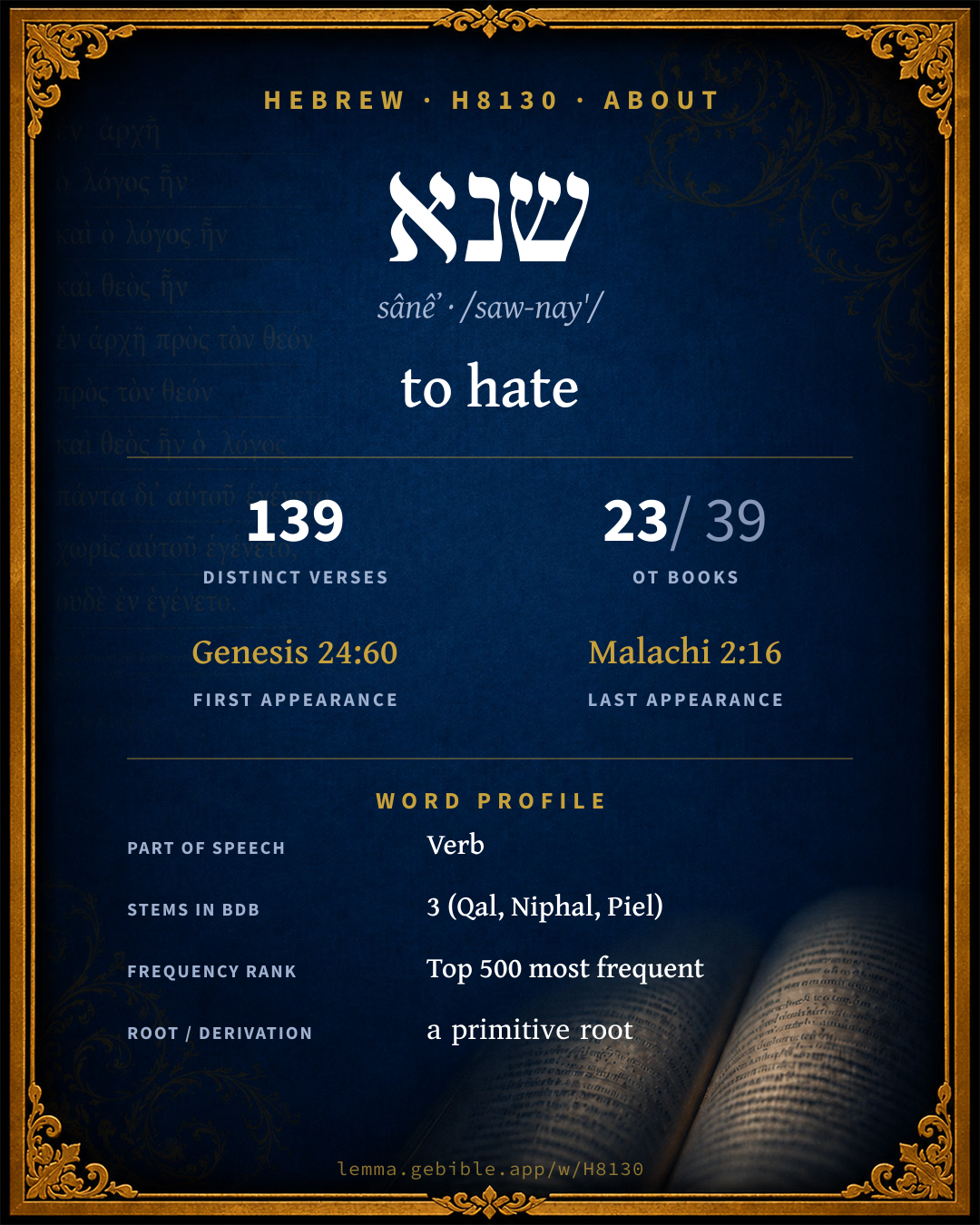
שָׂנֵא
to hate
‘to hate’ is one of 4 main senses fuller range ↓
Full lexicon entry — Brown-Driver-Briggs (BDB)
From Brown-Driver-Briggs (BDB)
Where this word appears
See every Qal verb in the Hebrew Bible →
Grammar key — what these labels mean
Part of speech
- Verb
- An action or state-of-being word.
Stem
- Qal
- The basic, simple active stem — the plain form of the verb (“he wrote”). Here: ‘human’
- Piel
- An intensive or resultative active stem. Here: ‘personal and national’
- Niphal
- Usually the simple passive or reflexive of the Qal (“he was written”).
Form
- Perfect
- A completed action or state — Hebrew marks aspect (completeness) more than strict tense (“he wrote”).
- Participle Active
- A verbal adjective expressing ongoing or characteristic action (“writing / one who writes”).
- Participle Passive
- A verbal adjective expressing action received (“written”).
- Infinitive Construct
- A bound verbal noun, frequently with prepositions (“to write / in writing”).
- Sequential Perfect
- A perfect with prefixed waw continuing a preceding imperfect or command (waw-consecutive perfect).
- Sequential Imperfect
- An imperfect with prefixed waw — the standard past-narrative form (waw-consecutive imperfect).
- Imperfect
- An incomplete, ongoing, or future action (“he will / would write”).
- Imperative
- A direct command (“write!”).
- Infinitive Absolute
- An unbound verbal noun, often intensifying or standing in for a finite verb.
State
- Absolute
- The independent form of a noun, not bound to a following word.
- Construct
- A noun bound to a following noun in a possessive / “of” relationship (the construct chain).
Person
- 1st Person
- The speaker (“I / we”).
- 3rd Person
- The one spoken about (“he / she / it / they”).
- 2nd Person
- The one addressed (“you”).
Gender
- Common
- Either gender — not distinguished for this form.
- Masculine
- Grammatically masculine.
- Feminine
- Grammatically feminine.
Number
- Singular
- One.
- Plural
- More than one (in Hebrew, generally three or more).
Grammatical forms 27 distinct
- Verb, Qal, Participle Active, Masculine, Plural, Construct 33 times (22%)
- Verb, Qal, Perfect, 1st Person, Common, Singular 21 times (14%)
- Verb, Qal, Participle Active, Masculine, Singular, Absolute 16 times (11%)
- Verb, Piel, Participle Active, Masculine, Plural, Construct 13 times (9%)
- Verb, Qal, Participle Passive, Feminine, Singular, Absolute 8 times (5%)
- Verb, Qal, Perfect, 3rd Person, Masculine, Singular 7 times (5%)
- Verb, Qal, Infinitive Construct 7 times (5%)
- Verb, Qal, Perfect, 2nd Person, Masculine, Singular 5 times (3%)
+19 more forms (38 occurrences)
Parsed forms decoded from the imported morphology (morphhb / Westminster Leningrad Codex — WLC text public domain, morphhb tagging CC BY 4.0), counted across 148 parsed occurrences — not distinct verses.
Every verse where H8130 appears — 139 distinct verses across 23 books. Click any verse to open its interlinear word-by-word view. Verse text shown in the World English Bible for context — . Each verse’s Hebrew form is shown with its reference; the English is not keyword-highlighted, since the data carries no word-level English alignment. Use “Compare translations” on any verse to read it across multiple English versions. This concordance covers the Hebrew Bible; Septuagint (Greek Old Testament) occurrences are not indexed here.
Genesis 7 verses
- Genesis 24:60 שֹׂנְאָֽי/ו Qal ptcp.act mp cs + sfx pers 3ms They blessed Rebekah, and said to her, "Our sister, may you be the mother of thousands of ten thousands, and let your seed possess the gate of those who hate them."
- Genesis 26:27 שְׂנֵאתֶ֣ם Qal pf 2mp Isaac said to them, "Why have you come to me, since you hate me, and have sent me away from you?"
- Genesis 29:31 שְׂנוּאָ֣ה Qal ptcp.pass fs Yahweh saw that Leah was hated, and he opened her womb, but Rachel was barren.
- Genesis 29:33 שְׂנוּאָ֣ה Qal ptcp.pass fs She conceived again, and bare a son, and said, "Because Yahweh has heard that I am hated, he has therefore given me this son also." She named him Simeon.
- Genesis 37:4 וַֽ/יִּשְׂנְא֖וּ conj + Qal wimpf 3mp His brothers saw that their father loved him more than all his brothers, and they hated him, and couldn't speak peaceably to him.
- Genesis 37:5 שְׂנֹ֥א Qal inf.cs Joseph dreamed a dream, and he told it to his brothers, and they hated him all the more.
- Genesis 37:8 שְׂנֹ֣א Qal inf.cs His brothers said to him, "Will you indeed reign over us? Or will you indeed have dominion over us?" They hated him all the more for his dreams and for his words.
Exodus 4 verses
- Exodus 1:10 שֹׂ֣נְאֵ֔י/נוּ Qal ptcp.act mp cs + sfx pers 1cp Come, let us deal wisely with them, lest they multiply, and it happen that when any war breaks out, they also join themselves to our enemies, and fight against us, and escape out of the land."
- Exodus 18:21 שֹׂ֣נְאֵי Qal ptcp.act mp cs Moreover you shall provide out of all the people able men, such as fear God: men of truth, hating unjust gain; and place such over them, to be rulers of thousands, rulers of hundreds, rulers of fifties, and rulers of tens.
- Exodus 20:5 לְ/שֹׂנְאָֽ/י prep + Qal ptcp.act mp cs + sfx pers 1cs you shall not bow yourself down to them, nor serve them, for I, Yahweh your God, am a jealous God, visiting the iniquity of the fathers on the children, on the third and on the fourth generation of those who hate me,
- Exodus 23:5 שֹׂנַאֲ/ךָ֗ Qal ptcp.act ms cs + sfx pers 2ms If you see the donkey of him who hates you fallen down under his burden, don't leave him, you shall surely help him with it.
Leviticus 2 verses
- Leviticus 19:17 תִשְׂנָ֥א Qal impf 2ms "'You shall not hate your brother in your heart. You shall surely rebuke your neighbor, and not bear sin because of him.
- Leviticus 26:17 שֹֽׂנְאֵי/כֶ֔ם Qal ptcp.act mp cs + sfx pers 2mp I will set my face against you, and you will be struck before your enemies. Those who hate you will rule over you; and you will flee when no one pursues you.
Numbers 1 verse
Deuteronomy 18 verses
- Deuteronomy 4:42 שֹׂנֵ֥א Qal ptcp.act ms that the manslayer might flee there, who kills his neighbor unawares, and didn't hate him in time past; and that fleeing to one of these cities he might live:
- Deuteronomy 5:9 לְ/שֹׂנְאָֽ/י prep + Qal ptcp.act mp cs + sfx pers 1cs you shall not bow down yourself to them, nor serve them; for I, Yahweh, your God, am a jealous God, visiting the iniquity of the fathers on the children, and on the third and on the fourth generation of those who hate me;
- Deuteronomy 7:10 לְ/שֹׂנְאָ֛י/ו לְ/שֹׂ֣נְא֔/וֹ prep + Qal ptcp.act mp cs + sfx pers 3ms prep + Qal ptcp.act ms cs + sfx pers 3ms and repays those who hate him to their face, to destroy them: he will not be slack to him who hates him, he will repay him to his face.
- Deuteronomy 7:15 שֹׂנְאֶֽי/ךָ Qal ptcp.act mp cs + sfx pers 2ms Yahweh will take away from you all sickness; and none of the evil diseases of Egypt, which you know, will he put on you, but will lay them on all those who hate you.
- Deuteronomy 12:31 שָׂנֵ֗א Qal pf 3ms You shall not do so to Yahweh your God: for every abomination to Yahweh, which he hates, have they done to their gods; for even their sons and their daughters do they burn in the fire to their gods.
- Deuteronomy 16:22 שָׂנֵ֖א Qal pf 3ms Neither shall you set yourself up a pillar; which Yahweh your God hates.
- Deuteronomy 19:4 שֹׂנֵ֥א Qal ptcp.act ms This is the case of the manslayer, that shall flee there and live: whoever kills his neighbor unawares, and didn't hate him in time past;
- Deuteronomy 19:6 שֹׂנֵ֥א Qal ptcp.act ms lest the avenger of blood pursue the manslayer, while his heart is hot, and overtake him, because the way is long, and strike him mortally; whereas he was not worthy of death, inasmuch as he didn't hate him in time past.
- Deuteronomy 19:11 שֹׂנֵ֣א Qal ptcp.act ms But if any man hate his neighbor, and lie in wait for him, and rise up against him, and strike him mortally so that he dies, and he flee into one of these cities;
- Deuteronomy 21:15 שְׂנוּאָ֔ה וְ/הַ/שְּׂנוּאָ֑ה Qal ptcp.pass fs conj + ptcl def.art + Qal ptcp.pass fs If a man have two wives, the one beloved, and the other hated, and they have borne him children, both the beloved and the hated; and if the firstborn son be hers who was hated;
- Deuteronomy 21:16 הַ/שְּׂנוּאָ֖ה ptcl def.art + Qal ptcp.pass fs then it shall be, in the day that he causes his sons to inherit that which he has, that he may not make the son of the beloved the firstborn before the son of the hated, who is the firstborn:
- Deuteronomy 21:17 הַ/שְּׂנוּאָ֜ה ptcl def.art + Qal ptcp.pass fs but he shall acknowledge the firstborn, the son of the hated, by giving him a double portion of all that he has; for he is the beginning of his strength; the right of the firstborn is his.
- Deuteronomy 22:13 וּ/שְׂנֵאָֽ/הּ conj + Qal wpf 3ms + sfx pers 3fs If any man take a wife, and go in to her, and hate her,
- Deuteronomy 22:16 וַ/יִּשְׂנָאֶֽ/הָ conj + Qal wimpf 3ms + sfx pers 3fs and the young lady's father shall tell the elders, I gave my daughter to this man to wife, and he hates her;
- Deuteronomy 24:3 וּ/שְׂנֵאָ/הּ֮ conj + Qal wpf 3ms + sfx pers 3fs If the latter husband hate her, and write her a bill of divorce, and give it in her hand, and send her out of his house; or if the latter husband die, who took her to be his wife;
- Deuteronomy 30:7 שֹׂנְאֶ֖י/ךָ Qal ptcp.act mp cs + sfx pers 2ms Yahweh your God will put all these curses on your enemies, and on those who hate you, who persecuted you.
- Deuteronomy 32:41 וְ/לִ/מְשַׂנְאַ֖/י conj + prep + Piel ptcp.act mp cs + sfx pers 1cs If I whet my glittering sword, My hand take hold on judgment; I will render vengeance to my adversaries, Will recompense those who hate me.
- Deuteronomy 33:11 וּ/מְשַׂנְאָ֖י/ו conj + Piel ptcp.act mp cs + sfx pers 3ms Bless, Yahweh, his substance, Accept the work of his hands: Smite through the loins of those who rise up against him, Of those who hate him, that they not rise again.
Joshua 1 verse
Judges 3 verses
- Judges 11:7 שְׂנֵאתֶ֣ם Qal pf 2mp Jephthah said to the elders of Gilead, Didn't you hate me, and drive me out of my father's house? and why are you come to me now when you are in distress?
- Judges 14:16 שְׂנֵאתַ֨/נִי֙ Qal pf 2ms + sfx pers 1cs Samson's wife wept before him, and said, You do but hate me, and don't love me: you have put forth a riddle to the children of my people, and haven't told it me. He said to her, Behold, I haven't told it my father nor my mother, and shall I tell you?
- Judges 15:2 שָׂנֹ֣א שְׂנֵאתָ֔/הּ Qal inf.abs Qal pf 2ms + sfx pers 3fs Her father said, I most assuredly thought that you had utterly hated her; therefore I gave her to your companion: isn't her younger sister more beautiful than she? Please take her, instead.
2 Samuel 6 verses
- 2 Samuel 5:8 שנאו שְׂנֻאֵ֖י Qal pf 3cp Qal ptcp.pass mp cs David said on that day, Whoever strikes the Jebusites, let him get up to the watercourse, and [strike] the lame and the blind, who are hated of David's soul. Therefore they say, There are the blind and the lame; he can't come into the house.
- 2 Samuel 13:15 וַ/יִּשְׂנָאֶ֣/הָ שְׂנֵאָ֔/הּ conj + Qal wimpf 3ms + sfx pers 3fs Qal pf 3ms + sfx pers 3fs Then Amnon hated her with exceeding great hatred; for the hatred with which he hated her was greater than the love with which he had loved her. Amnon said to her, Arise, be gone.
- 2 Samuel 13:22 שָׂנֵ֤א Qal pf 3ms Absalom spoke to Amnon neither good nor bad; for Absalom hated Amnon, because he had forced his sister Tamar.
- 2 Samuel 19:6 שֹׂ֣נְאֶ֔י/ךָ וְ/לִ/שְׂנֹ֖א Qal ptcp.act mp cs + sfx pers 2ms conj + prep + Qal inf.cs in that you love those who hate you, and hate those who love you. For you have declared this day, that princes and servants are nothing to you: for this day I perceive that if Absalom had lived, and all we had died this day, then it had pleased you well.
- 2 Samuel 22:18 מִ/שֹּׂ֣נְאַ֔/י prep + Qal ptcp.act mp cs + sfx pers 1cs He delivered me from my strong enemy, From those who hated me; for they were too mighty for me.
- 2 Samuel 22:41 מְשַׂנְאַ֖/י Piel ptcp.act mp cs + sfx pers 1cs You have also made my enemies turn their backs to me, That I might cut off those who hate me.
1 Kings 1 verse
2 Chronicles 3 verses
- 2 Chronicles 1:11 שֹׂנְאֶ֔י/ךָ Qal ptcp.act mp cs + sfx pers 2ms God said to Solomon, Because this was in your heart, and you have not asked riches, wealth, or honor, nor the life of those who hate you, neither yet have asked long life; but have asked wisdom and knowledge for yourself, that you may judge my people, over whom I have made you king:
- 2 Chronicles 18:7 שְׂנֵאתִ֗י/הוּ Qal pf 1cs + sfx pers 3ms The king of Israel said to Jehoshaphat, There is yet one man by whom we may inquire of Yahweh: but I hate him; for he never prophesies good concerning me, but always evil: the same is Micaiah the son of Imla. Jehoshaphat said, Don't let the king say so.
- 2 Chronicles 19:2 וּ/לְ/שֹׂנְאֵ֥י conj + prep + Qal ptcp.act mp cs Jehu the son of Hanani the seer went out to meet him, and said to king Jehoshaphat, Should you help the wicked, and love those who hate Yahweh? for this thing wrath is on you from before Yahweh.
Esther 3 verses
- Esther 9:1 בְּ/שֹׂנְאֵי/הֶֽם prep + Qal ptcp.act mp cs + sfx pers 3mp Now in the twelfth month, which is the month Adar, on the thirteenth day of the same, when the king's commandment and his decree drew near to be put in execution, on the day that the enemies of the Jews hoped to have rule over them, (whereas it was turned to the contrary, that the Jews had rule over those who hated them),
- Esther 9:5 בְ/שֹׂנְאֵי/הֶ֖ם prep + Qal ptcp.act mp cs + sfx pers 3mp The Jews struck all their enemies with the stroke of the sword, and with slaughter and destruction, and did what they would to those who hated them.
- Esther 9:16 בְּ/שֹׂ֣נְאֵי/הֶ֔ם prep + Qal ptcp.act mp cs + sfx pers 3mp The other Jews who were in the king's provinces gathered themselves together, and stood for their lives, and had rest from their enemies, and killed of those who hated them seventy-five thousand; but they didn't lay their hand on the spoil.
Job 3 verses
- Job 8:22 שֹׂנְאֶ֥י/ךָ Qal ptcp.act mp cs + sfx pers 2ms Those who hate you shall be clothed with shame. The tent of the wicked shall be no more."
- Job 31:29 מְשַׂנְאִ֑/י Piel ptcp.act ms cs + sfx pers 1cs "If I have rejoiced at the destruction of him who hated me, Or lifted up myself when evil found him;
- Job 34:17 שׂוֹנֵ֣א Qal ptcp.act ms cs Shall even one who hates justice govern? Will you condemn him who is righteous and mighty?--
Psalms 40 verses
- Psalms 5:5 שָׂ֝נֵ֗אתָ Qal pf 2ms The arrogant shall not stand in your sight. You hate all workers of iniquity.
- Psalms 9:13 מִ/שֹּׂנְאָ֑/י prep + Qal ptcp.act mp cs + sfx pers 1cs Have mercy on me, Yahweh. See my affliction by those who hate me, And lift me up from the gates of death;
- Psalms 11:5 שָֽׂנְאָ֥ה Qal pf 3fs Yahweh examines the righteous, But the wicked and him who loves violence his soul hates.
- Psalms 18:17 וּ֝/מִ/שֹּׂנְאַ֗/י conj + prep + Qal ptcp.act mp cs + sfx pers 1cs He delivered me from my strong enemy, From those who hated me; for they were too mighty for me.
- Psalms 18:40 וּ֝/מְשַׂנְאַ֗/י conj + Piel ptcp.act mp cs + sfx pers 1cs You have also made my enemies turn their backs to me, That I might cut off those who hate me.
- Psalms 21:8 שֹׂנְאֶֽי/ךָ Qal ptcp.act mp cs + sfx pers 2ms Your hand will find out all of your enemies. Your right hand will find out those who hate you.
- Psalms 25:19 שְׂנֵאֽוּ/נִי Qal pf 3cp + sfx pers 1cs Consider my enemies, for they are many. They hate me with cruel hatred.
- Psalms 26:5 שָׂ֭נֵאתִי Qal pf 1cs I hate the assembly of evil-doers, And will not sit with the wicked.
- Psalms 31:6 שָׂנֵ֗אתִי Qal pf 1cs I hate those who regard lying vanities, But I trust in Yahweh.
- Psalms 34:21 וְ/שֹׂנְאֵ֖י conj + Qal ptcp.act mp cs Evil shall kill the wicked. Those who hate the righteous shall be condemned.
- Psalms 35:19 שֹׂנְאַ֥/י Qal ptcp.act mp cs + sfx pers 1cs Don't let those who are my enemies wrongfully rejoice over me; Neither let them wink with the eye who hate me without a cause.
- Psalms 36:2 לִ/שְׂנֹֽא prep + Qal inf.cs For he flatters himself in his own eyes, Too much to detect and hate his sin.
- Psalms 38:19 שֹׂנְאַ֣/י Qal ptcp.act mp cs + sfx pers 1cs But my enemies are vigorous and many. Those who hate me without reason are numerous.
- Psalms 41:7 שֹׂנְאָ֑/י Qal ptcp.act mp cs + sfx pers 1cs All who hate me whisper together against me. They imagine the worst for me.
- Psalms 44:7 וּ/מְשַׂנְאֵ֥י/נוּ conj + Piel ptcp.act mp cs + sfx pers 1cp But you have saved us from our adversaries, And have shamed those who hate us.
- Psalms 44:10 וּ֝/מְשַׂנְאֵ֗י/נוּ conj + Piel ptcp.act mp cs + sfx pers 1cp You make us turn back from the adversary. Those who hate us take spoil for themselves.
- Psalms 45:7 וַ/תִּשְׂנָ֫א conj + Qal wimpf 2ms You have loved righteousness, and hated wickedness. Therefore God, your God, has anointed you with the oil of gladness above your fellows.
- Psalms 50:17 שָׂנֵ֣אתָ Qal pf 2ms Seeing you hate instruction, And throw my words behind you?
- Psalms 55:12 מְ֭שַׂנְאִ/י Piel ptcp.act ms cs + sfx pers 1cs For it was not an enemy who insulted me, Then I could have endured it. Neither was it he who hated me who raised himself up against me, Then I would have hid myself from him.
- Psalms 68:1 מְ֝שַׂנְאָ֗י/ו Piel ptcp.act mp cs + sfx pers 3ms Let God arise! Let his enemies be scattered! Let them who hate him also flee before him.
- Psalms 69:4 שֹׂנְאַ֪/י Qal ptcp.act mp cs + sfx pers 1cs Those who hate me without a cause are more than the hairs of my head. Those who want to cut me off, being my enemies wrongfully, are mighty. I have to restore what I didn't take away.
- Psalms 69:14 מִ֝/שֹּֽׂנְאַ֗/י prep + Qal ptcp.act mp cs + sfx pers 1cs Deliver me out of the mire, and don't let me sink. Let me be delivered from those who hate me, and out of the deep waters.
- Psalms 81:15 מְשַׂנְאֵ֣י Piel ptcp.act mp cs The haters of Yahweh would cringe before him, And their punishment would last forever.
- Psalms 83:2 וּ֝/מְשַׂנְאֶ֗י/ךָ conj + Piel ptcp.act mp cs + sfx pers 2ms For, behold, your enemies are stirred up. Those who hate you have lifted up their heads.
- Psalms 86:17 שֹׂנְאַ֣/י Qal ptcp.act mp cs + sfx pers 1cs Show me a sign of your goodness, That those who hate me may see it, and be shamed, Because you, Yahweh, have helped me, and comforted me.
- Psalms 89:23 וּ/מְשַׂנְאָ֥י/ו conj + Piel ptcp.act mp cs + sfx pers 3ms I will beat down his adversaries before him, And strike those who hate him.
- Psalms 97:10 שִׂנְא֫וּ Qal impv 2mp You who love Yahweh, hate evil. He preserves the souls of his saints. He delivers them out of the hand of the wicked.
- Psalms 101:3 שָׂנֵ֑אתִי Qal pf 1cs I will set no vile thing before my eyes. I hate the deeds of faithless men. They will not cling to me.
- Psalms 105:25 לִ/שְׂנֹ֣א prep + Qal inf.cs He turned their heart to hate his people, To conspire against his servants.
- Psalms 106:10 שׂוֹנֵ֑א Qal ptcp.act ms He saved them from the hand of him who hated them, And redeemed them from the hand of the enemy.
- Psalms 106:41 שֹׂנְאֵי/הֶֽם Qal ptcp.act mp cs + sfx pers 3mp He gave them into the hand of the nations. Those who hated them ruled over them.
- Psalms 118:7 בְ/שֹׂנְאָֽ/י prep + Qal ptcp.act mp cs + sfx pers 1cs Yahweh is on my side among those who help me. Therefore I will look in triumph at those who hate me.
- Psalms 119:104 שָׂנֵ֤אתִי Qal pf 1cs Through your precepts, I get understanding; Therefore I hate every false way.
- Psalms 119:113 שָׂנֵ֑אתִי Qal pf 1cs I hate double-minded men, But I love your law.
- Psalms 119:128 שָׂנֵֽאתִי Qal pf 1cs Therefore I consider all of your precepts to be right. I hate every false way.
- Psalms 119:163 שָׂ֭נֵאתִי Qal pf 1cs I hate and abhor falsehood. I love your law.
- Psalms 120:6 שׂוֹנֵ֥א Qal ptcp.act ms cs My soul has had her dwelling too long With him who hates peace.
- Psalms 129:5 שֹׂנְאֵ֥י Qal ptcp.act mp cs Let them be disappointed and turned backward, All those who hate Zion.
- Psalms 139:21 מְשַׂנְאֶ֖י/ךָ אֶשְׂנָ֑א Piel ptcp.act mp cs + sfx pers 2ms Qal impf 1cs Yahweh, don't I hate those who hate you? Am I not grieved with those who rise up against you?
- Psalms 139:22 שְׂנֵאתִ֑י/ם Qal pf 1cs + sfx pers 3mp I hate them with perfect hatred. They have become my enemies.
Proverbs 25 verses
- Proverbs 1:22 יִשְׂנְאוּ Qal impf 3mp "How long, you simple ones, will you love simplicity? How long will mockers delight themselves in mockery, And fools hate knowledge?
- Proverbs 1:29 שָׂ֣נְאוּ Qal pf 3cp Because they hated knowledge, And didn't choose the fear of Yahweh.
- Proverbs 5:12 שָׂנֵ֣אתִי Qal pf 1cs And say, "How I have hated instruction, And my heart despised reproof;
- Proverbs 6:16 שָׂנֵ֣א Qal pf 3ms There are six things which Yahweh hates; Yes, seven which are an abomination to him:
- Proverbs 8:13 שְֽׂנֹ֫את שָׂנֵֽאתִי Qal inf.cs Qal pf 1cs The fear of Yahweh is to hate evil. I hate pride, arrogance, the evil way, and the perverse mouth.
- Proverbs 8:36 מְ֝שַׂנְאַ֗/י Piel ptcp.act mp cs + sfx pers 1cs But he who sins against me wrongs his own soul. All those who hate me love death."
- Proverbs 9:8 יִשְׂנָאֶ֑/ךָּ Qal impf 3ms + sfx pers 2ms Don't reprove a scoffer, lest he hate you. Reprove a wise man, and he will love you.
- Proverbs 11:15 וְ/שֹׂנֵ֖א conj + Qal ptcp.act ms He who is collateral for a stranger will suffer for it, But he who refuses pledges of collateral is secure.
- Proverbs 12:1 וְ/שֹׂנֵ֖א conj + Qal ptcp.act ms Whoever loves correction loves knowledge, But he who hates reproof is stupid.
- Proverbs 13:5 יִשְׂנָ֣א Qal impf 3ms A righteous man hates lies, But a wicked man brings shame and disgrace.
- Proverbs 13:24 שׂוֹנֵ֣א Qal ptcp.act ms One who spares the rod hates his son, But one who loves him is careful to discipline him.
- Proverbs 14:17 יִשָּׂנֵֽא Niphal impf 3ms He who is quick to become angry will commit folly, And a crafty man is hated.
- Proverbs 14:20 יִשָּׂ֣נֵא Niphal impf 3ms The poor person is shunned even by his own neighbor, But the rich person has many friends.
- Proverbs 15:10 שׂוֹנֵ֖א Qal ptcp.act ms There is stern discipline for one who forsakes the way: Whoever hates reproof shall die.
- Proverbs 15:27 וְ/שׂוֹנֵ֖א conj + Qal ptcp.act ms He who is greedy for gain troubles his own house, But he who hates bribes will live.
- Proverbs 19:7 שְֽׂנֵאֻ֗/הוּ Qal pf 3cp + sfx pers 3ms All the relatives of the poor shun him: How much more do his friends avoid him! He pursues them with pleas, but they are gone.
- Proverbs 25:17 וּ/שְׂנֵאֶֽ/ךָ conj + Qal pf 3ms + sfx pers 2ms Let your foot be seldom in your neighbor's house, Lest he be weary of you, and hate you.
- Proverbs 25:21 שֹׂ֭נַאֲ/ךָ Qal ptcp.act ms cs + sfx pers 2ms If your enemy is hungry, give him food to eat; If he is thirsty, give him water to drink:
- Proverbs 26:24 שׂוֹנֵ֑א Qal ptcp.act ms A malicious man disguises himself with his lips, But he harbors evil in his heart.
- Proverbs 26:28 יִשְׂנָ֣א Qal impf 3ms A lying tongue hates those it hurts; And a flattering mouth works ruin.
- Proverbs 27:6 שׂוֹנֵֽא Qal ptcp.act ms Faithful are the wounds of a friend; Although the kisses of an enemy are profuse.
- Proverbs 28:16 שנאי שֹׂ֥נֵא Qal ptcp.act mp cs Qal ptcp.act ms A tyrannical ruler lacks judgment. One who hates ill-gotten gain will have long days.
- Proverbs 29:10 יִשְׂנְאוּ Qal impf 3mp The bloodthirsty hate a man of integrity; And they seek the life of the upright.
- Proverbs 29:24 שׂוֹנֵ֣א Qal ptcp.act ms Whoever is an accomplice of a thief is an enemy of his own soul. He takes an oath, but dares not testify.
- Proverbs 30:23 שְׂ֭נוּאָה Qal ptcp.pass fs For an unloved woman when she is married; And a handmaid who is heir to her mistress.
Ecclesiastes 3 verses
- Ecclesiastes 2:17 וְ/שָׂנֵ֨אתִי֙ conj + Qal pf 1cs So I hated life, because the work that is worked under the sun was grievous to me; for all is vanity and a chasing after wind.
- Ecclesiastes 2:18 וְ/שָׂנֵ֤אתִֽי conj + Qal pf 1cs I hated all my labor in which I labored under the sun, seeing that I must leave it to the man who comes after me.
- Ecclesiastes 3:8 לִ/שְׂנֹ֔א prep + Qal inf.cs A time to love, And a time to hate; A time for war, And a time for peace.
Isaiah 4 verses
- Isaiah 1:14 שָׂנְאָ֣ה Qal pf 3fs My soul hates your New Moons and your appointed feasts; They are a burden to me. I am weary of bearing them.
- Isaiah 60:15 וּ/שְׂנוּאָ֖ה conj + Qal ptcp.pass fs Whereas you have been forsaken and hated, so that no man passed through you, I will make you an eternal excellency, a joy of many generations.
- Isaiah 61:8 שֹׂנֵ֥א Qal ptcp.act ms For I, Yahweh, love justice, I hate robbery with iniquity; and I will give them their recompense in truth, and I will make an everlasting covenant with them.
- Isaiah 66:5 שֹׂנְאֵי/כֶ֜ם Qal ptcp.act mp cs + sfx pers 2mp Hear the word of Yahweh, you who tremble at his word: Your brothers who hate you, who cast you out for my name's sake, have said, Let Yahweh be glorified, that we may see your joy; but it is those who shall be disappointed.
Jeremiah 2 verses
- Jeremiah 12:8 שְׂנֵאתִֽי/הָ Qal pf 1cs + sfx pers 3fs My heritage is become to me as a lion in the forest: she has uttered her voice against me; therefore I have hated her.
- Jeremiah 44:4 שָׂנֵֽאתִי Qal pf 1cs However I sent to you all my servants the prophets, rising up early and sending them, saying, Oh, don't do this abominable thing that I hate.
Ezekiel 4 verses
- Ezekiel 16:27 שֹׂנְאוֹתַ֨יִ/ךְ֙ Qal ptcp.act fp cs + sfx pers 2fs See therefore, I have stretched out my hand over you, and have diminished your ordinary [food], and delivered you to the will of those who hate you, the daughters of the Philistines, who are ashamed of your lewd way.
- Ezekiel 16:37 שָׂנֵ֑את Qal pf 2fs therefore see, I will gather all your lovers, with whom you have taken pleasure, and all those who you have loved, with all those who you have hated; I will even gather them against you on every side, and will uncover your nakedness to them, that they may see all your nakedness.
- Ezekiel 23:28 שָׂנֵ֑את Qal pf 2fs For thus says the Lord Yahweh: Behold, I will deliver you into the hand of them whom you hate, into the hand of them from whom your soul is alienated;
- Ezekiel 35:6 שָׂנֵ֖אתָ Qal pf 2ms therefore, as I live, says the Lord Yahweh, I will prepare you to blood, and blood shall pursue you: since you have not hated blood, therefore blood shall pursue you.
Hosea 1 verse
Amos 4 verses
- Amos 5:10 שָׂנְא֥וּ Qal pf 3cp They hate him who reproves in the gate, And they abhor him who speaks blamelessly.
- Amos 5:15 שִׂנְאוּ Qal impv 2mp Hate evil, love good, And establish justice in the courts. It may be that Yahweh, the God of hosts, will be gracious to the remnant of Joseph."
- Amos 5:21 שָׂנֵ֥אתִי Qal pf 1cs I hate, I despise your feasts, And I can't stand your solemn assemblies.
- Amos 6:8 שָׂנֵ֑אתִי Qal pf 1cs "The Lord Yahweh has sworn by himself," says Yahweh, the God of hosts: "I abhor the pride of Jacob, And detest his fortresses. Therefore I will deliver up the city with all that is in it.
Micah 1 verse
Zechariah 1 verse
Malachi 2 verses
- Malachi 1:3 שָׂנֵ֑אתִי Qal pf 1cs but Esau I hated, and made his mountains a desolation, and gave his heritage to the jackals of the wilderness."
- Malachi 2:16 שָׂנֵ֣א Qal pf 3ms For I hate divorce," says Yahweh, the God of Israel, "and him who covers his garment with violence!' says Yahweh of Hosts. "Therefore take heed to your spirit, that you don't deal treacherously.
About this entry
At a glance — auto-summarized from this page’s data, not written by a person. Every figure links to its source below. This summary describes the numbers; it doesn’t interpret them.
שנא (sânêʼ) is a Hebrew verb most often rendered “to hate.” Debuting at Genesis 24:60, it then recurs through the corpus. With 139 verses in 23 books, it is a common word in the Hebrew Bible. It concentrates in Psalms, which alone accounts for 29% of its uses. Read the stem: it spans 3 stems, including Qal and Niphal. For the data behind this summary, explore the sense tree and the renderings breakdown below.
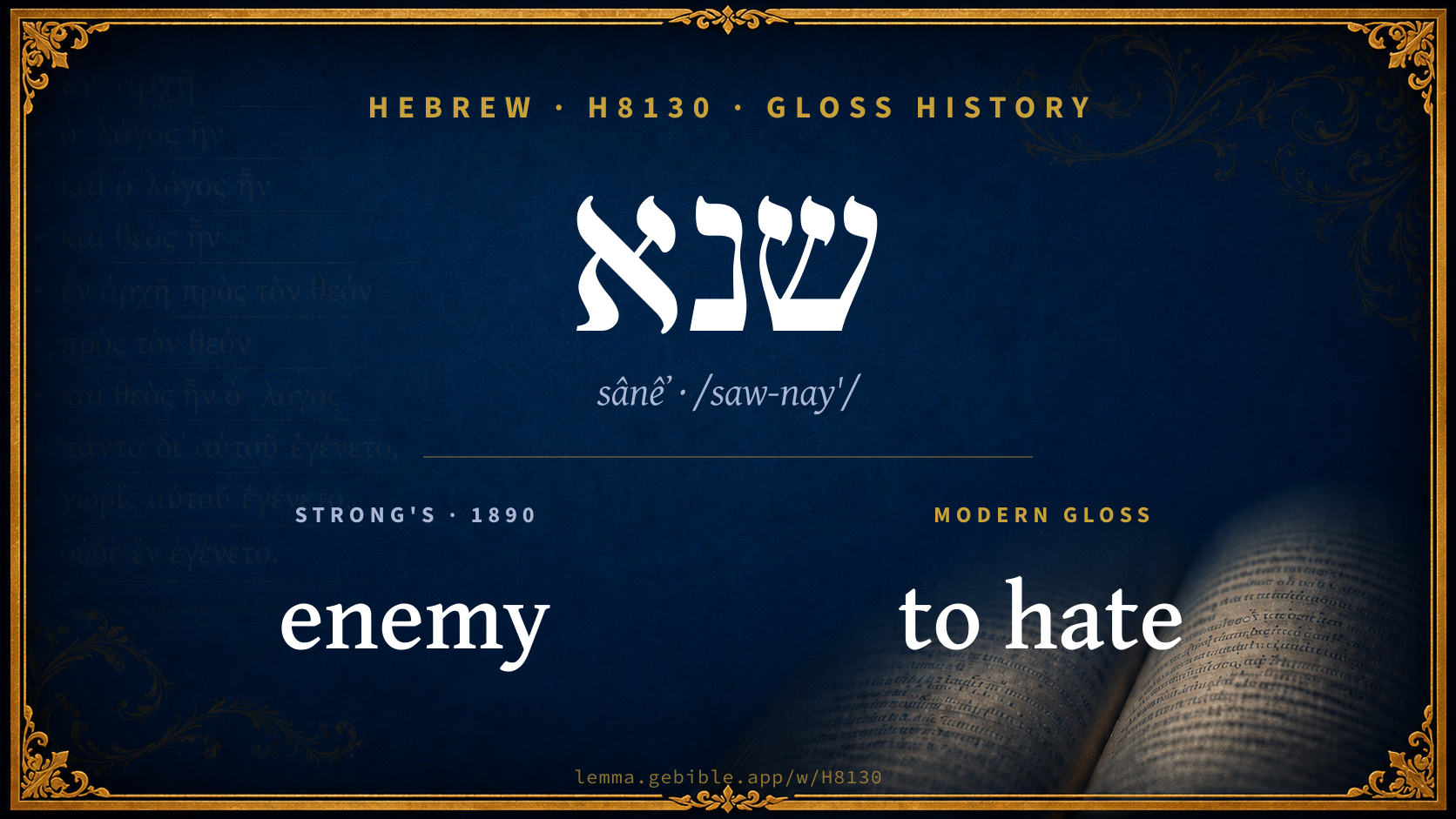
Gloss history
Strong's 1890 vs modern scholarship
About this word
Strong's H8130 catalogs a Hebrew word from the Hebrew Old Testament.
These counts are not copied from any lexicon or concordance. They are computed here, from the morphology-tagged Hebrew Old Testament. What Lemma adds →
- 139
- distinct verses
- The word appears in 139 distinct verses.
- 23 / 39
- OT books
- The word appears in 23 of 39 Old Testament books.
- #304
- by frequency
- Top 500 most frequent Hebrew words (rank 304 of 8,640 Hebrew words by occurrence).
View all 139 occurrences in the concordance →
Most concentrated in
- Psalms 40 verses 29%
- Proverbs 25 verses 18%
- Deuteronomy 18 verses 13%
By section of the Old Testament
By traditional corpus
Conventional, traditional groupings — biblical authorship is debated, so this is a traditional corpus grouping, not an authorship claim. Each share is this word’s portion of its verses in that division of the Hebrew canon. Each figure is a share of the word’s 139 distinct verses.
- Writings (Ketuvim) 77 verses · 55%
- Torah (Pentateuch) 32 verses · 23%
- Prophets (Nevi'im) 30 verses · 22%
How translations render this word
Counts come from each version’s own published word-to-Strong’s tagging or interlinear alignment — an approximate guide to how each version renders this word, not a word-level alignment the data otherwise carries. Because each total is that version’s own tagged count, the per-version totals vary from one another and need not match the appearance or distinct-verse counts above. These counts may also differ from a printed concordance because Lemma counts each distinctly tagged rendering and does not collapse phrase taggings into a single head-word total. This is a fixed set of word-tagged versions (KJV, ASV, BSB, ULT) and does not change with the reading translation you choose elsewhere. Each version’s license is shown beside its name below (and on Sources).
- King James Version: Hate 26×, Hated 17×, Hateth 9×
- American Standard Version: Hate 18×, Hated 17×, I hate 11×
- Berean Standard Bible: Hate 19×, I hate 11×, Hate you 9×
- unfoldingWord Literal Text: Hate 16×, I hate 11×, Hates 9×
King James Version Public Domain
Renders H8130 across 146 tagged occurrences — most commonly:
Plus other, less common renderings. Plus 44 renderings that appear only once — usually multi-word phrases or single function words the recovered tagging swept in, not distinct renderings.
American Standard Version Public Domain
Renders H8130 across 145 tagged occurrences — most commonly:
Plus other, less common renderings. Plus 55 renderings that appear only once — usually multi-word phrases or single function words the recovered tagging swept in, not distinct renderings.
Berean Standard Bible Public Domain
Renders H8130 across 143 tagged occurrences — most commonly:
Plus other, less common renderings. Plus 38 renderings that appear only once — usually multi-word phrases or single function words the recovered tagging swept in, not distinct renderings. Not rendered by a distinct English word in 3 further occurrences.
unfoldingWord Literal Text CC BY-SA 4.0
Renders H8130 across 162 tagged occurrences — most commonly:
Plus other, less common renderings. Plus 41 renderings that appear only once — usually multi-word phrases or single function words the recovered tagging swept in, not distinct renderings.
11 senses and sub-senses in the full BDB
Hebrew verbs can shift meaning by stem (binyan): Qal is the basic action, Niphal is often passive or reflexive, Piel often intensifies or makes it factitive, and Hiphil is typically causative. The senses below are grouped under the stem BDB assigns to each.
What do BDB’s symbols mean?
BDB uses these scholarly abbreviations:
| Symbol | Meaning |
|---|---|
| 𝔊 | the Septuagint (the ancient Greek translation, LXX) |
| 𝔙 | the Vulgate (the Latin translation) |
| 𝔖 | the Syriac version (the Peshitta) |
| 𝔗 | the Targum (the Aramaic translation) |
| ψ | the Psalms |
| √ | root (the underlying root or stem) |
| ‖ | parallel passage (a synonymous or contrasted parallel) |
| † | the dagger: every passage where the word occurs is cited |
The 11 senses and sub-senses the full Brown-Driver-Briggs lexicon distinguishes for this word, in lexicon order (not ranked by frequency), with BDB’s own verbatim wording and sub-sense lettering. Shown in Hebrew script with BDB’s own scholarly abbreviations. The condensed entry is in the Lexicon Entry tab. See also the Forms in the corpus table below.
Qal
- Pf. 3 ms. שׂ׳ Dt 12:31 +, sf. שְׂנֵאָהּ 2 S 13:15 +; 2 ms. שָׂנֵאתָ ψ 5:6 +, sf. שְׂנֵאתַ֫נִי Ju 14:16, etc.; Impf. 3 ms. יִשְׂנָא Pr 13:5; 26:28, sf. יִשְׂנָאֶ֑ךָּ 9:8, etc.; Imv. mpl. שִׂנְאוּ Am 5:15 ψ 97:10; Inf. abs. שָׂנֹא Ju 15:2; cstr. שְׂנֹא Gn 37:5 +, שְׂנֹאת Pr 8:13; Pt. act. שֹׂנֵא Dt 4:42 +, שֹׂנַאֲךָ Ex 23:5 Pr 25:21; pl. cstr. שֹׂנְאֵי Ex 18:21 +, etc.; pass. fs. שְׂנוּאָה Gn 29:31 +; mpl. cstr. שְׂנֻאֵי 2 S 5:8 Qr (> Kt שָֽׂנְאוּ);—hate (often opp. אָהֵב): e.g. Deuteronomy 12:31
- 1. human;
- a. c. acc. pers. Gn 26:27 (J), 37:5, 8 (E), Ju 11:7; 2 S 13:22; Am 5:10 (‖ תֵּעֵב) + 17 times (evil-doers †ψ 26:5; 31:7; 139:21), + (obj. wife) Ju 14:16; 15:2(×2); + pt. pass., of wife, †Gn 29:31(×2) (J), Dt 21:15(×2), 16, 17, cf. Pr 30:23; fig. of Zion Is 60:15 (+ עֲזוּבָה); specif. of sexual revulsion †2 S 13:15(×2) (+ acc. cogn.), Dt 22:13, 16; 24:3; so, obj. man (of Jerus. under fig. of harlot) †Ez 16:37; pass. שְׂנֻאֵי נֶפֶשׁ דָּוִד 2 S 5:8 (but v. obscure); reflex. (acc. נַפְשׁוֹ) †Pr 29:24, abs. †Ec 3:8. e.g. Genesis 26:27
- b. c. acc. rei, Ez 35:6 (but read בְּדָם אָשַׁמְתָּ 𝔊 𝔖 Co Berthol Toy), Ec 2:17, 18, especially evil Ex 18:21 (E), Mi 3:2 ψ 45:7 + 10 times, virtue, etc. Mi 3:2 Pr 1:22 + 4 times e.g. Ezekiel 35:6
- 2. subj. י׳; obj. perverse Isr. †Am 6:8 (its palaces), Ho 9:15 Je 12:8; wickedness ψ 5:6; 11:5; idolatry and evil Am 5:21 Is 1:14; 61:8; Je 44:4; Mal 2:16 + 5 times e.g. Amos 6:8
- 3. Pt.act.54 as adj. Is 66:5 (as vb. c. 1 s. pron. 61:8, 2 supr.); usually subst., Pr 13:24 one hating his son (opp. אֹהֵב); elsewhere = enemy, foe (usually cstr. or c. sf.), sg. and pl. (often ‖ אֹיֵב, sometimes opp. אֹהֵב): foe of man Ex 23:5 (E), Gn 24:60 (J), Lv 26:17 (H) +, nation Ex 1:10 (E), Est 9:1, 5, 16 +, abs. Pr 26:24; 27:6, (c. 31 times in all); + לֹא שֹׂנֵא c. ל pers., a no-hater to one Dt 4:42; 19:4, 6; Jos 20:5, and (without לֹא) Dt 19:11; foe of good Mi 3:2, cf. Jb 34:17 + 3 times, of evil †Ex 18:21; Pr 28:1, cf. 15:27; of suretyship †11:15 (i.e. not giving it); foes of י׳ †Ex 20:5 = Dt 5:9; Dt 7:10(×2); 2 Ch 19:2. e.g. Isaiah 66:5
Niphal
- Impf. 3 ms. יִשָּׂנֵא Pr 14:17 is hated, so v 20 (+ ל pers. by, v. לְ 5 d). e.g. Proverbs 14:17
Piel
- Pt. sf. מְשַׂנְאִי Jb 31:29; ψ 55:13; pl. cstr. מְשַׂנְאֵי 81:16; sf. מְשַׂנְאַי 2 S 22:41 +, etc.;—enemy (Qal 3) ‖ אֹיֵב, צָר, etc.: e.g. Job 31:29
- 1. personal and national, Jb 31:29 Dt 33:11 (poem), 2 S 22:41 = ψ 18:41, ψ 44:8, 11; 55:13; 68:2; 89:24. e.g. Job 31:29
- 2. of י׳ Nu 10:35 (J), Dt 32:41 (poem), ψ 81:16; 83:3; 139:21. e.g. Numbers 10:35
- 3. of wisdom Pr 8:36. e.g. Proverbs 8:36
Senses from the full Brown-Driver-Briggs lexicon (Brown, Driver, Briggs; Oxford 1906 — public domain), digitized via Sefaria, supplemented by the OpenScriptures HebrewLexicon (CC BY 4.0). Full attribution on Sources.
Word origin
vb. hate (NH id.; MI4 שנאי my foes; Sab. שנאם foe Sab.DenkmNo. 12, l, 9 cf. Ib.No. 7, l. 9 CISiv, No. 173, l. 6; Arabic شنأ, شَنَىَٔ, hate; Aramaic סְנָא, ܣܢܳܐ, id., סָנְאָה, ܣܳܢܳܐܐ hater, etc.; Ethiopic hate is ጸልአ: );—
— Brown-Driver-Briggs (Oxford 1906, public domain), digitized via Sefaria, supplemented by the OpenScriptures HebrewLexicon (CC BY 4.0). See Sources.
Origin: a primitive root
Jastrow Dictionary
A second Hebrew/Aramaic lexicon for comparison, covering Aramaic and post-biblical (Talmudic, Targumic, Midrashic) usage that the biblical-Hebrew BDB does not. Matched by lemma rather than by Strong’s number, so a lemma may carry more than one Jastrow headword (shown separately below), and the entries cover usage well beyond the Bible.
שְׁנָא I
- to change, v. שְׁנֵי.
נָא I
- = אֲנָא. Y. Ter. V, 43ᶜ bot. ואוף נא וכ׳ I, too, think so. Y. Ber. IV, beg. 7ᵃ וָנָא אמרית וכ׳ and I gave a reason for it; a. fr.—V. דְּנָה, לֵינָא.—Pl. נַן. Y. B. Kam. II, beg. 2ᵈ מה נן אמרין וכ׳ why do we say &c.; a. fr.
נָא II
- (also adverb)(b. h.;
- 1. hurried, half-done. Pes. 41ᵃ bot. אכלו נא if he ate it (the Passover lamb) half-done. Ib.ᵇ ישנו בבל תאכל נא is subject to the law (Ex. XII, 9) &c. Tosef. Macc. IV (III), 1, contrad. to חַי. Men. 78ᵇ מצה נא, v. הַיָנָא; a. fr. e.g. Exodus 12:9
- 2. slender, fine, brittle. — Pl. נָאִין; f. נָאוֹת. Tosef. Kel. B. Kam. II, 9 [read with R. S. to Kel. III, 2:] הוסקו והנאין (= והן נאין) if the vessels were heated but turned out brittle. B. Bath, 97ᵇ (expl. פיטסות, ib. VI, 2) נאות ומגופרות thin, but lined with pitch; Tosef. ib. VI, 3.
נָא III
- (b. h.) I pray, prithee. Yoma IV, 2; a. fr.—Ber. 9ᵃ, a. e. אין נא אלא וכ׳, v. בַּקָּשָׁה.
נַן
- , pl. of נָא I.
שִׁנָא
- , v. שֵׁינְתָא
שָׂנֵא
- (b. h.) to hate. Pes. 49ᵇ גדולה שנאה ששׂוֹנְאִין וכ׳ great is the hatred with which the ignorant hate the scholar, even greater than that which gentiles bear towards Israel. Ib. 113ᵇ שלשה שׂוֹנְאָן three classes of men does the Lord hate. Ib. שלשה שונאין זה וכ׳ three kinds of creatures hate one another, the dog &c. Ib. מצוה לִשְׂנֹאתוֹ (Var. מותר) it is right (permitted) to hate him. Ib. שִׂנְאוּ את אדניכם hate your masters. Snh. 108ᵇ the raven said to Noah, רבך שׂוֹנְאֵנִי ואתה שְׂנֵאתַנִי thy master (God) hates me, and thou hatest me. Ab. I, 10 אהוב … ושְׂנָא וכ׳ love work and hate office; a. fr.—Part. pass. שָׂנוּא; f. שְׂנוּאָה &c. Kidd. 68ᵃ; Yeb. 23ᵃ (ref. to Deut. XXI, 15) וכי יש ש׳ לפני המקום וכ׳ is there before God a hated one and a beloved one (could it be supposed that the law should allow a discrimination between the children of a favored and of a hated wife)? Ib. ש׳ בנישואיה, v. נִישּׂוּאִין; a. e.—Sifra K’doshim, Par. 3, ch. VIII שָׂנְאוּי. e.g. Deuteronomy 21:15
- to be hated. Num. R. s. 48 הר ס̇ינ̇י שבו נִשְׂנְאוּ וכ׳ it is called Mount Sinai, because on it the gentiles became hateful to the Lord &c. (v. שִׂנְאָה); Yalk. Is. 363 נִשְׂתַּנְּאוּ. Taan. 7ᵇ (ref. to ישנא, Koh. VIII, 1) א"ת ישונא אלא יִשָּׂנֵא read not y’shunne (shall be changed), but yissane (shall be hated). e.g. Ecclesiastes 8:1
- same. Pesik. R. s. 14 (ref. to Koh. l. c.) יְשׂוּנֶּא יְסוּנֶּה בסמ"ך read y’sunne, with Samekh (v. supra).
שְׂנֵא
- , v. סְנֵי
שְׁנָא II
- , year. Targ. Lev. XXV, 53 (O. ed. Vien. שְׁנָה); a. fr.—Constr. שְׁנַת. Ib. 5; a. e.—Pl. שְׁנַיָּא, שְׁנִין, שְׁנֵי, שְׁנָתָא. Ib. 3; 15; 52; a. fr.—Targ. Ps. XC, 10 שְׁנָתָנָא Ms. (ed. שְׁנוֹתָנָא).—R. Hash. 31ᵃ שיתא אלפי ש׳ וכ׳ the world will last six thousand years. Ab. Zar. 9ᵃ. Ib. 9ᵇ sq. ההוא … שית ש׳ יתירתא a document dated six years ahead; a. fr.
שְׁנֵי
- 1. to repeat. Targ. I Sam. XXVI, 8 ed. Wil. (v. תְּנֵי).—Snh. 59ᵃ ולמה לי למִישְׁנֵי בסיני and why is it repeated at Sinai?; a. e.
- 2. to change; to be different. Targ. O. Deut. XXXIV, 7.—Lev. R. s. 22 כל מאי דהוה הדין ש׳ הדין ש׳ as the one (the mosquito) changed, so did the other (Titus) change. Yeb. 21ᵇ או דילמא לא שנא (abbrev. ל"ש) or is there no difference (between the wife of a brother on the mother’s side and that of a brother on the father’s side)? Succ. 29ᵇ ל"ש ביו"ט … ול"ש וכ׳ no difference whether it is the first Holy Day or the second. Ib. 30ᵃ ל"ש לפני וכ׳ no difference whether before &c. Sabb. 6ᵃ הכי נמי ל"ש in this case, too, it is the same; a. v. fr.—Yeb. l. c. מאי ש׳ הני מאי ש׳ הא (abbrev. מ"ש) what difference is there between the former and the latter? Sabb. 4ᵃ ומאי ש׳ and wherein lies the difference? Ib. 2ᵇ מ"ש הכא … ומ"ש התם וכ׳ wherein lies the difference (what reason is there) that the Mishnah says here, ‘two which are four within, and two which are four without’, and there (Shebu. I, 1) only, ‘two which are four’?; a. fr.—Part. שָׁאנֵי it is different. Succ. 21ᵇ ש׳ שוורים הואיל וכ׳ it is different in the case of oxen, because &c. Sabb. 7ᵇ ש׳ צרור וכ׳ it is different with bundles and other objects &c. Ker. 11ᵃ והכא ש׳ but here it is different; a. v. fr.—V. שׁנִיא.
- 1. to change; to act strangely. Targ. Gen. XLI, 14. Targ. Ps. LXXXIX, 35. Ib. XXXIV, 1. Targ. Y. II, Deut. XXXII, 5; a. fr.—[Ib. 41 אישני, read: אישנן, v. שְׁנַן.—Targ. Jud. XX, 16 משנן, read: משגן, v. שְׁגֵי.]—Taan. 24ᵇ שַׁנִּי דוכתיך change thy place; ש׳ דוכתיה he changed his place. Ker. 11ᵃ לישנא דשׁנּוּיֵי, v. חָרַף. Bets. 30ᵃ כמה דאפשר לשנויי מְשַׁנִּינָן וכ׳ as much as it is feasible to change (the mode of doing a thing), we must change on the Holy Day; Sabb. 128ᵇ; ib. 117ᵇ מְשַׁנִּין. Bets. l. c. והא הני נשי … ולא מְשַׁנְּיָין וכ׳ but there are those women that fill their pitchers … without any change, and we say nothing to them (to interfere)! Snh. 96ᵃ top שני נפשך (Rashi אַשְׁנִי) disguise thyself; במאי אִישַׁנֵּי how shall I disguise (myself)?; Yalk. Is. 276; a. fr.
- 2. to reply. Sabb. 7ᵇ זימנין מְשַׁנֵּי לה וכ׳ at times he replied to it (met the objection by saying) &c. Ib. 3ᵇ דמשני לך; Keth. 98ᵇ דשַׁנִּינָן, v. שִׁינּוּיָא. Pes. 20ᵇ ומְשַׁנֵּי שאני התם וכ׳ and he answered, it is different in that case; a. fr.—Shebu. 21ᵃ top כדשני ליה (Rashi כדמשני) as he (Abayi) replied to him (R. Papa, further below).
- to change, act strangely. Targ. Mal. III, 6. Targ. O. a. Y. I Deut. XXXII, 5; a. fr.—[Targ. Ps. LXXI, 17 אשני, read with ed. Lag. אתני.]—Snh. 96ᵃ top, v. supra. e.g. Deuteronomy 32:5
- 1. to be changed. Targ. Deut. l. c. Targ. Lam. IV, 1; a. e.—Snh. 71ᵇ נימא הואיל וא׳ א׳ let us say, because his status has changed, he is a different person (not responsible for acts committed in his previous condition); האי דינו א׳ מיתתו לא א׳ this man’s legal status has changed, but the mode of his execution is not affected thereby. Ib. הואיל וא׳ א׳ … דא׳ לגמרי because a change has taken place (by her becoming of age), she is a different person (and the mode of her execution must be different): so much the more here (in the case of a proselyte) where a complete change has taken place. Ib. 96ᵃ א׳ אפיה והוה וכ׳ his face changed, and he looked like a dog. Sabb. 36ᵃ הני … א׳ שמייהו וכ׳ the names of the following three things have changed since the destruction of the Temple; Succ. 34ᵃ; a. e.
A Dictionary of the Targumim, the Talmud Babli and Yerushalmi, and the Midrashic Literature (Marcus Jastrow; London, Luzac, 1903) — Public Domain. Digitized via Sefaria. Digitized via Sefaria. Full attribution on Sources.
Forms in the corpus
The 124 distinct written forms H8130 takes in the Hebrew Bible, most frequent first — each parse links to that stem’s occurrences in the concordance. Hebrew forms include their vowel points and cantillation, so a single lemma takes many written forms.
The 60 most common forms are shown; 64 rarer forms follow in the full concordance.
Same root — word family
Other BDB entries built from the same root as H8130, grouped by Strong’s listed origin. These share a root / origin per the lexicon — not necessarily a shared meaning. Each links to that word’s own entry.
Derived from this word
Compare all same-root words → They share a root, not necessarily a meaning.
Septuagint verse parallels
This word appears in 122 verses that also exist in the Greek Old Testament (Septuagint), out of the 139 Hebrew verses it occurs in. You can read those verses in Greek by switching the Old Testament edition to the Septuagint.
Read these verses in the Septuagint
- Genesis 24:60
- Exodus 1:10
- Leviticus 19:17
- Numbers 10:35
- Deuteronomy 4:42
- Joshua 20:5
- Judges 11:7
- 2 Samuel 5:8
- 1 Kings 22:8
- 2 Chronicles 1:11
- Esther 9:1
- Job 8:22
This is a verse-level parallel only — the same verses exist in both the Hebrew and Greek Old Testaments. No word-level Hebrew↔Greek correspondence is claimed: the data carries no such alignment, so no Greek word is shown as this Hebrew word’s translation. Coverage is not total — the Septuagint omits the deuterocanon and renumbers the Psalms, so some Hebrew verses have no direct Greek parallel.