
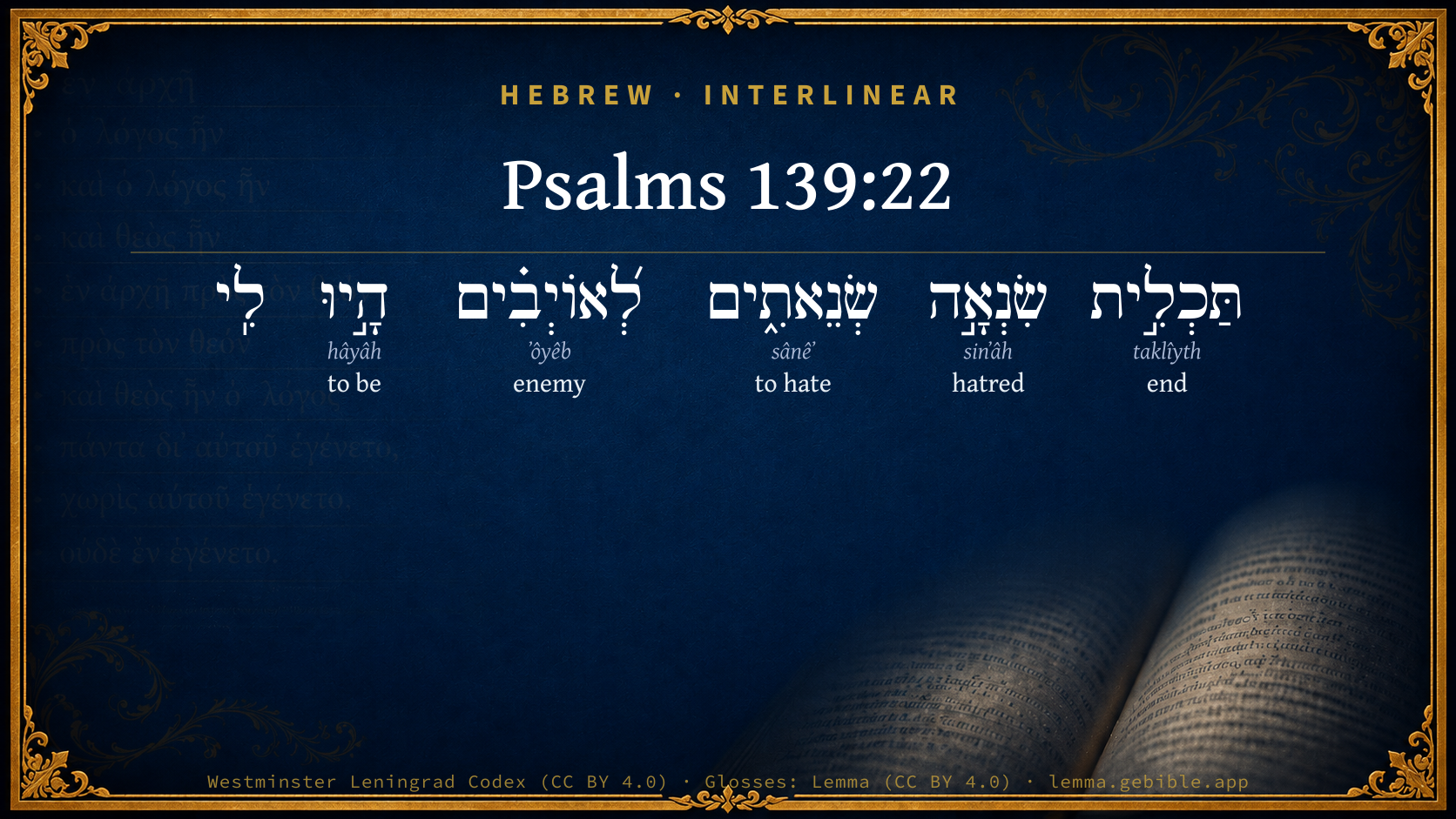
Psalms 139:22

Hebrew (Westminster Leningrad Codex) Psalms 139:22 appears in the Hebrew Old Testament. The text above is from the Westminster Leningrad Codex. Each word links to its Strong’s number, a concise gloss, and parsing drawn from the Open Scriptures Hebrew Bible morphology. Click any word for its full Brown-Driver-Briggs (BDB) entry.
Download image
Cite this verse

Psalms 139:22 (World English Bible). Public Domain. Lemma interlinear Bible study tool, https://lemma.gebible.app/v/psalms/139/22.

Show BibTeX & RIS
BibTeX
RIS
English Translation
I hate them with perfect hatred. They have become my enemies.
World English Bible · Public Domain
Download a study sheet

One document with this verse’s original text, its word-by-word gloss line, the meaning frame, cross-references with their text, attributed commentary, and full source and license credits — printable, and it pastes into notes with its structure intact.

This verse Autodidact and up

Study sheet (.html) Plain text (.txt)

A passage Seminary Student

Up to 50 verses in one chapter. A passage sheet keeps up to 6 commentary sources and 12 cross-references per verse, in the order this page ranks them, and says so on the sheet whenever that leaves anything out. Ask for a single verse and you get the Autodidact verse sheet above.

Everything on this page stays free to read, with no account — the sheet is a download of what is already on screen, not access to it.

Want to remove ads? Support Godless Engineer
Compare translations 3

The same verse in 3 English versions, stacked beneath the original-language interlinear above. Click any original word for its lexicon entry.

Each is an independent rendering of the whole verse — the interlinear is not word-aligned to these translations.

Highlighted words mark where these versions differ — a whole-verse word diff, not a word-by-word alignment.

  • World English Bible Public Domain
    I hate them with perfect hatred. They have become my enemies.
  • King James Version Public Domain
    I hate them with perfect hatred: I count them mine enemies.
  • unfoldingWord Literal Text CC BY-SA 4.0
    a completeness of hatred I hate them; they have become enemies to me.

unfoldingWord Literal Text — © unfoldingWord, licensed CC BY-SA 4.0. Word-aligned USFM3 via Door43 (git.door43.org/unfoldingWord/en_ult).

Versions to compare (up to 4)

3 of 4 selected

Show all 17 translations

Every available English version of this verse, each an independent rendering of the whole verse.

  • World English Bible Public Domain
    I hate them with perfect hatred. They have become my enemies.
  • Berean Standard Bible Public Domain
    I hate them with perfect hatred; I count them as my enemies.
  • Majority Standard Bible Public Domain
    I hate them with perfect hatred; I count them as my enemies.
  • King James Version Public Domain
    I hate them with perfect hatred: I count them mine enemies.
  • American Standard Version (1901) Public Domain
    I hate them with perfect hatred: They are become mine enemies.
  • Revised Version (1885) Public Domain
    I hate them with perfect hatred: I count them mine enemies.
  • Geneva Bible (1599) Public Domain
    I hate them with an vnfained hatred, as they were mine vtter enemies.
  • Young's Literal Translation Public Domain
    `With' perfect hatred I have hated them, Enemies they have become to me.
  • Literal Standard Version CC BY-SA 4.0
    I have hated them [with] perfect hatred, || They have become enemies to me.
  • Unlocked Literal Bible CC BY-SA 4.0
    I hate them completely; they have become my enemies.
  • unfoldingWord Literal Text CC BY-SA 4.0
    a completeness of hatred I hate them; they have become enemies to me.
  • Darby Bible Public Domain
    I hate them with perfect hatred; I account them mine enemies.
  • World Messianic Bible Public Domain
    I hate them with perfect hatred. They have become my enemies.
  • Webster's Bible Public Domain
    I hate them with perfect hatred: I count them my enemies.
  • Free Bible Version CC BY-SA 4.0
    I hate them with absolute hatred—they have become my enemies!
  • Bible in Basic English Public Domain
    My hate for them is complete; my thoughts of them are as if they were making war on me.
  • JPS Tanakh (1917) Public Domain
    I hate them with utmost hatred; I count them mine enemies.

Literal Standard Version (2020), Covenant Press — licensed CC BY-SA 4.0. Text via the HelloAO Bible API (eBible.org). Unlocked Literal Bible (unfoldingWord) — licensed CC BY-SA 4.0. Text via the HelloAO Bible API (eBible.org). unfoldingWord Literal Text — © unfoldingWord, licensed CC BY-SA 4.0. Word-aligned USFM3 via Door43 (git.door43.org/unfoldingWord/en_ult). Free Bible Version, Dr. Jonathan Gallagher — licensed CC BY-SA 4.0. Text via the HelloAO Bible API (eBible.org).

Word by word

More ways to search: Search by grammar → Find every occurrence → Compare this word →

Practice this passage: Drill this verse → Learn its vocabulary →

About this verse

These counts appear in no published source. They are computed here, from the morphology-tagged text and Lemma’s own curated glosses. What Lemma adds →

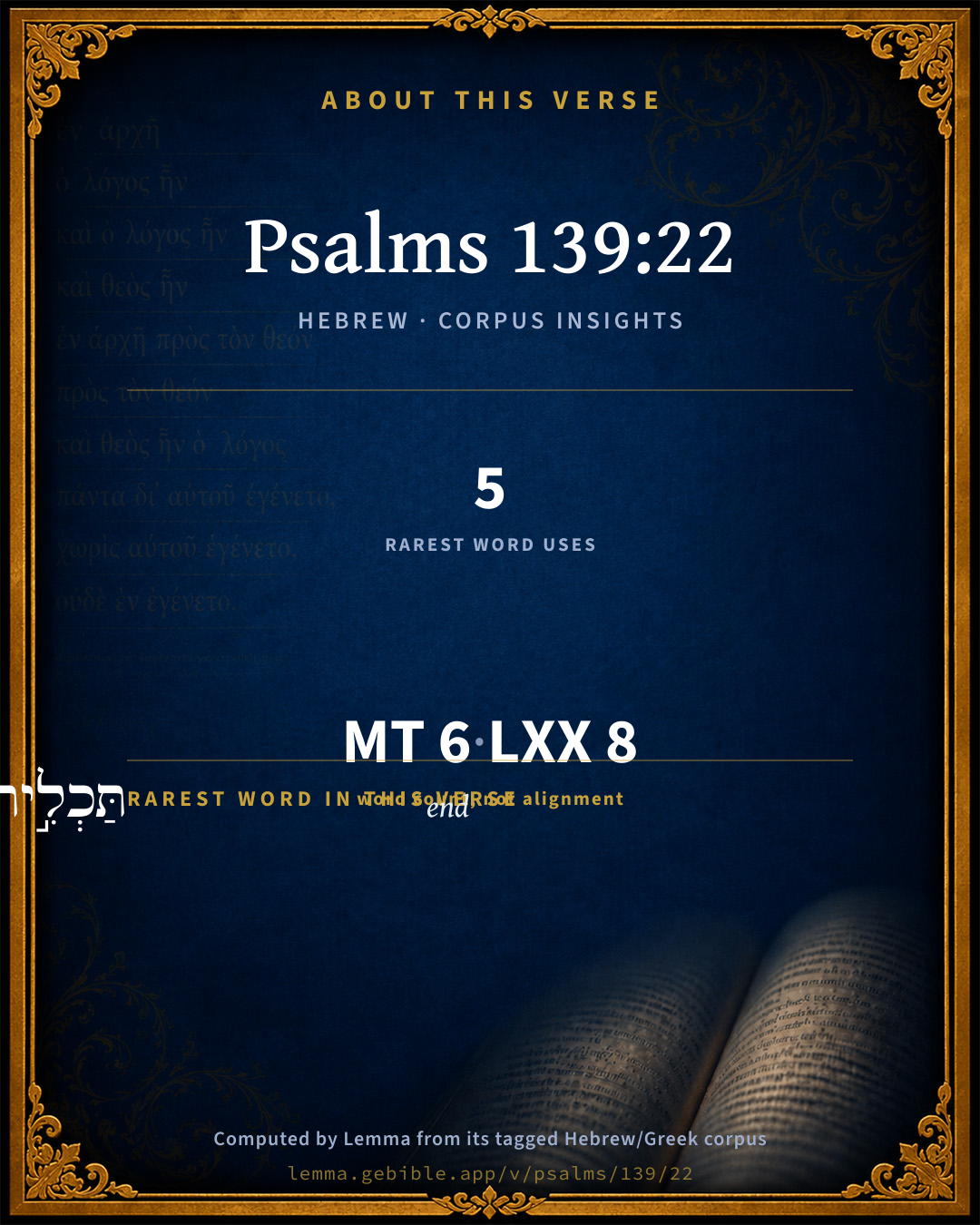
6
words
5
distinct lemmas
Wisdom
section

Notable vocabulary

The rarest word here is תַּכְלִ֣ית end H8503 — appearing just 5 times in the whole Hebrew Bible.

Shared distinctive vocabulary

תַּכְלִ֣ית end H8503 occurs in 5 verses of the Hebrew Bible. Also found in:

Grammatical profile

  • 3 verbs
  • 2 nouns
  • 1 preposition

Verb forms

  • שְׂנֵאתִ֑ים Qal · Perfect
  • לְ֝אוֹיְבִ֗ים Qal · Participle Active
  • הָ֣יוּ Qal · Perfect

Hebrew & Septuagint length

In English translation the verse runs 11 words from the Hebrew and 12 from the Septuagint (LXX English) — closely comparable.

A rough comparison of the two English renderings, which tokenize alike — not a word-level alignment.

Word counts can differ between the Hebrew and the Greek without any difference in meaning — e.g. the Hebrew direct-object marker אֵת has no separate Greek word, and Greek often adds the article ὁ.

In the original languages it is 6 Hebrew tokens and 8 Greek tokens — but the two are counted differently (Hebrew bundles its prefixes and suffixes into one token; the Greek is in lemma form), so that isn’t a like-for-like length.

Cross-references

2

Topical passages linked to Psalms 139:22 in the Treasury of Scripture Knowledge — connected by theme and wording, ordered by reader-vote popularity; previews shown in the World English Bible.

  • Psalms 101:3–8 I will set no vile thing before my eyes. I hate the deeds of faithless men. They will not cling to me.
  • Luke 14:26 "If anyone comes to me, and doesn't hate his own father, mother, wife, children, brothers, and sisters, yes, and his own life also, he can't be my disciple.

Cross-references courtesy of OpenBible.info (CC BY 4.0).

Hebrew and Greek witnesses Masoretic Hebrew ↔ Greek Septuagint

The same verse in the two great witnesses to the Old Testament, shown verse-for-verse.

You’re reading Greek Psalm 138 (Hebrew Psalm 139). The Septuagint counts the superscription, so verse numbers can differ from the Hebrew — chapter-level alignment, not verse-by-verse. Numbering follows Rahlfs.

These are two independent witnesses, not word-aligned to each other, and the Septuagint is shown in lemma (dictionary) form.

Hebrew Psalms 139:22 Masoretic · Westminster Leningrad Codex

תַּכְלִ֣ית שִׂנְאָ֣ה שְׂנֵאתִ֑ים לְ֝אוֹיְבִ֗ים הָ֣יוּ לִֽי

I hate them with perfect hatred. They have become my enemies.

World English Bible · Public Domain

Greek LXX Greek Psalm 138:22 Septuagint · lemma form

τέλειος μῖσος μισέω αὐτός εἰς ἐχθρός γίγνομαι ἐγώ

I have hated them with perfect hatred; they were counted my enemies.

LXX2012 (modern English Septuagint) · Public Domain

Hebrew: Westminster Leningrad Codex (CC BY 4.0). Greek: Septuagint (public domain); English from LXX2012 (modern English Septuagint) (Public Domain). How the Septuagint differs from the Hebrew →

Commentary

Notes on Psalms 139:22 from classic Christian and Jewish commentators (each source and its license shown beneath its notes). The classic Christian expositions comment on the surrounding passage and are grouped to its opening verse, so a note may address several verses; the Jewish commentaries on the Tanakh (Rashi and others) are per-verse, so they appear only where the commentator wrote on this verse.

Lemma curates 59 commentaries, every one of them public domain or Creative Commons licensed, each selected and text-cleaned for this edition rather than reprinted as found. About our sources →

Trapp's Complete Commentary

John Trapp

Psa 139:22 I hate them with perfect hatred: I count them mine enemies.

Ver. 22. I hate them with a perfect hatred] That is, unfeignedly, and with a round heart (saith one), for this only cause, that they are workers of iniquity. It was said of Antony, he hated a tyrant, not tyranny; and of Crassus, he hated a covetous man, not covetousness. It may as truly be said of a hypocrite, he hates sinners, not sins; these he nourisheth, those he censures. David was none such; and yet, as something mistrusting his own heart, he thinks good to add,

John Trapp, A Commentary or Exposition upon All the Books of the Old and New Testament (1647–1656) — public domain. Text from a community e-Sword module.

The Biblical Illustrator

Joseph S. Exell

Psa_139:22

I hate them with perfect hatred; I count them mine enemies.

Righteous hatred

What, then, is a perfect hatred? What may there be which is right, worthy, and fruitful of good, in the perfection of hatred? If we look go the Hebrew psalms for an answer, we notice that such expressions of hatred as occur in them are usually of an official character; they are expressive, that is, not so much of personal feeling as of the kingly consciousness. They are portentous with the indignation of a people against wrong. But even when we read some of the imprecations of the psalms as expressions of a national sense of wrong we cannot always, with our gentler Christian training, prevent the feeling that the royal psalmist did not entirely succeed in his desire to attain to the perfection of hatred. We must look to Him in whom all the moral energies as well as prophetic strivings of the life of the true Israel were fulfilled, if we would learn in what spirit of hatred of all wrong may itself reach perfection. In the light of His life we may say, then--

1. That a perfect hatred of evil proceeds from love. A perfect hatred will be an expression of a tremendous love. It cannot be perfect if it does not proceed from love, as nothing can be right without love. The great hatreds of sin among prophets, reformers and martyrs have always been characterized by this pure flame and passion of love for man. All thought of self was consumed in their intense sense of justice. Because they loved the people, because they loved their city, because they loved their country, they faced the evil, they defied the wrong, they gave their lives in grand protest of their death against the sin of the world. So was it superlatively with the Christ. Because God so loved the world, the Son of His love came from heaven to live a life of daily protest against all its suffering and shame. This, then, is one note and test of any hatred of evil, by which we may search our conduct and purify our passion of righteousness: Does our sense of wrong proceed from love? Does our rebuke of any evil express love?

2. It will be an orderly hatred. Anger, which is to be condemned, is an outburst of feeling, a tumult of words, a violence of deed; but no sign of our disorder of passion ever appeared in the Christs condemnation of sin. His wrath against human wrong was as orderly as His love of the Father. It was the pure calm of a soul at white heat. Herein, then, lies another test for us to use in searching our hearts. Are our judgments outbursts of feeling, or are they revealings of the moral order of our lives? If mere outbreakings of passion, they may belong to the whole company of the powers of confusion in the disorder of our worlds sin; but if really Christlike, there will be in them both the restraint and the power of the moral order of Christs life against the sin of the world,

3. It is a working hatred. This follows both from the motive of it, which is love, and from the orderliness which is always distinctive of the law of love. Christs hatred of sin was a working hatred. He did more self-exhausting work in His three years of life for men and against their sins than any human soul before or since has ever endured. Right hero is the difference too often between us and our Christ. We speak the momentary word of right and do no more. He spoke the word of eternal right, and put the love of His life behind it. We feel the evil and pass on; He felt the sin, and did not pass by on the other side. We express our feeling of moral indignation, and leave the poor world to right itself; He spoke the words of eternal life, and gave Himself to be crucified that the wrong world might be made right.

4. It is a sacrificial hatred of sin. The psalmist had not comprehended this diviner element of it. His Messiah was the Lord coming to judgment, not to bear the cross. But the true Messiah, when He came, was the suffering Son of God. He bore our sins; He suffered in our stead. What is the mightiest protest against wrong ever witnessed in this or any possible world? What but the Cross of Christ. Wherein lies the Divinest condemnation of sin to the eternal ages? In the sufferings of Christ, the just for the unjust. What is the satisfaction of the law by which sin is condemned with a perfect condemnation? Oh, not in punishment, though eternal punishment were its due; but in the infinite pathos of the suffering for it of the Son of Gods love. Thus we come in the end to the same characteristic of perfect hatred which we found at the beginning and motive of it; it ends as it began, in love. It ends in forgiveness, as it began in condemnation; both forgiveness and condemnation being part and process of the same eternal love of God in Christ. We might say with equal truth, God so loved the world, or God so hated the sin of the world, that He gave His only-begotten Son that whosoever believeth in Him might not perish, but have everlasting life. For our God is one God, and in loving righteousness and hating iniquity He is the same God over all, blessed for ever. (Newman Smyth, D. D.)

The Biblical Illustrator, edited by Joseph S. Exell (c. 1880s–1900s) — public domain. Text from a community e-Sword module.

Whedon's Commentary on the Bible

Daniel D. Whedon

22. I hate them with perfect hatred—Not the sinner apart from his sin, but as loving and cleaving to sin. His hatred is not personal, but moral and legal, as the connexion shows. When a man identifies himself with sin he is an enemy of God, and only in this sense can he become our enemy. Compare “thine enemies” and “mine enemies,” Psa_139:20; Psa_139:22

Daniel D. Whedon (gen. ed.), Commentary on the Old and New Testaments (1874–1909) — public domain. Text from a community e-Sword module.

J. A. Alexander on Psalms

Joseph Addison Alexander

22. (Psa 139:22) (With) perfection of hatred do I hate them, as enemies they are to me. Literally they are for enemies, i.e. I so esteem them. As enemies of God, they must be mine.

Joseph Addison Alexander, The Psalms Translated and Explained (1850) — public domain. Text from a community e-Sword module.

Adam Clarke's Commentary

Verse 22. With perfect hatred] Their conduct, their motives, their opposition to thee, their perfidy and idolatrous purposes, I perfectly abhor. With them I have neither part, interest, nor affection.

Adam Clarke's Commentary on the Bible (1810–1826) — public domain. Text from a community e-Sword/MySword module.

John Calvin's Commentaries

22. I hate them with perfect hatred. Literally it is, I hate them with perfection of hatred. He repeats the same truth as formerly, that such was his esteem for God’s glory that he would have nothing’ in common with those who despised him. He means in general that he gave no countenance to the works of darkness, for whoever connives at sin and encourages it through silence, wickedly betrays God’s cause, who has committed the vindication of righteousness into our hands. David’s example should teach us to rise with a lofty and bold spirit above all regard to the enmity of the wicked, when the question concerns the honor of God, and rather to renounce all earthly friendships than falsely pander with flattery to the favor of those who do everything to draw down upon themselves the divine displeasure. We have the more need to attend to this, because the keen sense we have of what concerns our private interest, honor, and convenience, makes us never hesitate to engage in contest when any one injures ourselves, while we are abundantly timid and cowardly in defending the glory of God. Thus, as each of us studies his own interest and advantage, the only thing which incites us to contention, strife, and war, is a desire to avenge our private wrongs; none is affected when the majesty of God is outraged. On the other hand, it is a proof of our having a fervent zeal for God when we have the magnanimity to declare irreconcilable war with the wicked and them who hate God, rather than court their favor at the expense of alienating the divine layout. We are to observe, however, that the hatred of which the Psalmist speaks is directed to the sins rather than the persons of the wicked. We are, so far as lies in us, to study peace with all men; we are to seek the good of all, and, if possible, they are to be reclaimed by kindness and good offices: only so far as they are enemies to God we must strenuously confront their resentment.

John Calvin's Commentaries (1540-1563) — public domain. Text from the Calvin Translation Society English edition (1840s-50s) via the Christian Classics Ethereal Library (ccel.org). Calvin's coverage is partial (roughly two-thirds of the Bible); uncommented books and verses are honest gaps, never fabricated. The 19th-century editor's footnotes and remarks are omitted so the notes are faithfully Calvin's own voice.

Ellicott's Commentary for English Readers

(22) With perfect hatred.—Literally, with perfection of hatred. Comp. Tennyson’s

“Dowered with the hate of hate.”

A Bible Commentary for English Readers, edited by Charles John Ellicott (1878–1897) — public domain. Text from a community e-Sword module.

The Cambridge Bible for Schools and Colleges

gen. ed. J. J. S. Perowne

22. The energy of the Psalmist’s indignation seems to many readers to be a jarring note: yet it is but the limited and imperfect form in which he expresses his intense hatred of evil. “The duty of keeping alive in the human heart the sense of burning indignation against moral evil—against selfishness, against injustice, against untruth, in ourselves as well as in others,—that is as much a part of the Christian as of the Jewish dispensation.” Stanley, Lect. on Jewish Church, 1. p. 216 (Lect. xi), quoted by Kay.

The Cambridge Bible for Schools and Colleges (gen. ed. J. J. S. Perowne; Cambridge University Press, 1878–1918) — public domain. Text from a community e-Sword module.

John Gill's Exposition

Search me, O God, and know my heart,.... He had searched him, and knew his heart thoroughly;

try me, and know my thoughts; he had tried him, and knew every thought in him, Psa 139:1. This therefore is not said for the sake of God; who, though he is the trier of hearts, and the searcher of the reins, is indeed a discerner of the thoughts and intents of the heart at once, and knows immediately what is in man; and needs no testimony of him, nor to make use of any means in order to know him and what is within him: but David said this for his own sake, that God would search and make known to him what was in his heart, and try him by his word, as gold is tried in the fire; or by anything difficult and self-denying, as he tried Abraham; or by any afflictive providence; or in any way he thought fit to make him acquainted thoroughly with himself. His sense is this, that if he knew his own heart and thoughts, and the inward frame and disposition of his soul, it was as he had expressed it; that he was grieved with sinners, and hated those that hated the Lord, even with a perfect hatred, and reckoned them as his enemies; but if it was otherwise, he desired to be searched and tried thoroughly, that it might be discovered: and he might say this also on account of others, who charged him falsely with things he was not conscious of; that never entered into his thoughts, and his heart knew nothing of, and could not accuse him with; and therefore he appeals to the heart searching God, that he would so lay open things that his integrity and innocence might appear to all; see Gen 22:1.

John Gill's Exposition of the Whole Bible (1746–1763) — public domain (CC PDM 1.0). Text via the HelloAO Bible API.

Albert Barnes' Notes on the Bible

I hate them with perfect hatred - With no approval whatever of their conduct; with no sympathy for the evil they do; with no words of apology for their sinful acts; with entire disapprobation.

I count them mine enemies - As they are the enemies of God, so I regard them as my enemies. I do not wish to be associated with them, or to be regarded as one of them.

Albert Barnes' Notes on the Bible (1834–1885) — public domain. Text from a community e-Sword/MySword module.

Matthew Poole's English Annotations

I am no less grieved with their enmity against thee, than if they directed it against myself.

Matthew Poole's English Annotations on the Holy Bible (1683–1685) — public domain. Text from a community e-Sword/MySword module.

The Treasury of David

Charles H. Spurgeon

Ver. 22. I hate them with perfect hatred. He does not leave it a matter of question. He does not occupy a neutral position. His hatred to bad, vicious, blasphemous men is intense, complete, energetic. He is as whole hearted in his hate of wickedness as in his love of goodness.

I count them mine enemies. He makes a personal matter of it. They may have done him no ill, but if they are doing despite to God, to his laws, and to the great principles of truth and righteousness, David proclaims war against them. Wickedness passes men into favour with unrighteous spirits; but it excludes them from the communion of the just. We pull up the drawbridge and man the walls when a man of Belial goes by our castle. His character is a casus belli; we cannot do otherwise than contend with those who contend with God.

Ver. 22. I hate them with perfect hatred. What is "with a perfect hatred"? I hated in them their iniquities, I loved thy creation. This it is to hate with a perfect hatred, that neither on account of the vices thou hate the men, nor on account of the men love the vices. For see what he addeth, "They became my enemies." Not only as God's enemies, but as his own too doth he now describe them. How then will he fulfil in them both his own saying, "Have not I hated those that hated thee, Lord", and the Lord's command, "Love your enemies"? How will he fulfil this, save with that perfect hatred, that he hate in them that they are wicked, and love that they are men? For in the time even of the Old Testament, when the carnal people was restrained by visible punishments, how did Moses, the servant of God, who by understanding belonged to the New Testament, how did he hate sinners when he prayed for them, or how did he not hate them when he slew them, save that he "hated them with a perfect hatred"? For with such perfection did he hate the iniquity which he punished, as to love the manhood for which he prayed. Augustine.

Psalms 139:23*

Charles H. Spurgeon's The Treasury of David (1869–1885) — public domain. Psalms only. Text from a community e-Sword/MySword module.

The Pulpit Commentary

I hate them with perfect hatred; i.e. with pure, absolute, intense hatred a hatred commensurate with the love that he felt towards all God"s saints. I count them mine enemies; i.e. I regard them as my private foes. I have the same feeling towards them as I have towards those who are at open enmity with me, and seek my destruction. The command had not yet been given, "Love your enemies". (Mat_5:44)

The Pulpit Commentary (1880–1919), ed. H.D.M. Spence-Jones & Joseph S. Exell — public domain. Text from a community e-Sword module.

John Wesley's Explanatory Notes

Perfect hatred - See the difference between the Jewish and the Christian spirit!

John Wesley, Explanatory Notes Upon the Whole Bible (1754–1765) — public domain. Text via the GEBible commentary corpus.

Lesson kit

Teaching starters — assembled from the data on this page, not authored interpretation. Every prompt links to the verse data it draws on. Edit before teaching.

Psalms, in the Wisdom, opens this verse with 6 words (5 distinct Hebrew lemmas). Its most distinctive word is taklîyth (“end”). A historical commentator’s framing appears above. Read the whole chapter for the surrounding context.

Discussion questions

  1. What does “end” (taklîyth) contribute to the verse as a whole?
  2. How does Nehemiah 3:21, which shares the word «end», read alongside this verse?
  3. These translations render this verse differently. What is at stake in choosing one wording over another?
  4. «שְׂנֵאתִ֑ים» is a Qal Perfect verb. How does that grammatical form shape the action described?
  5. Compare how Trapp's Complete Commentary and The Biblical Illustrator read this verse. Where do they agree or differ?

Things to notice

Reading settings

Reading text

Shown beneath each verse's original-language words.

Old Testament
Old Testament edition

Read the OT as the Masoretic Hebrew (MT) or the Greek Septuagint (LXX).

English shown for the Greek Septuagint (in the Hebrew ↔ Greek comparison).

Comparing translations? Open the Compare panel on any verse page to stack up to four side by side.