
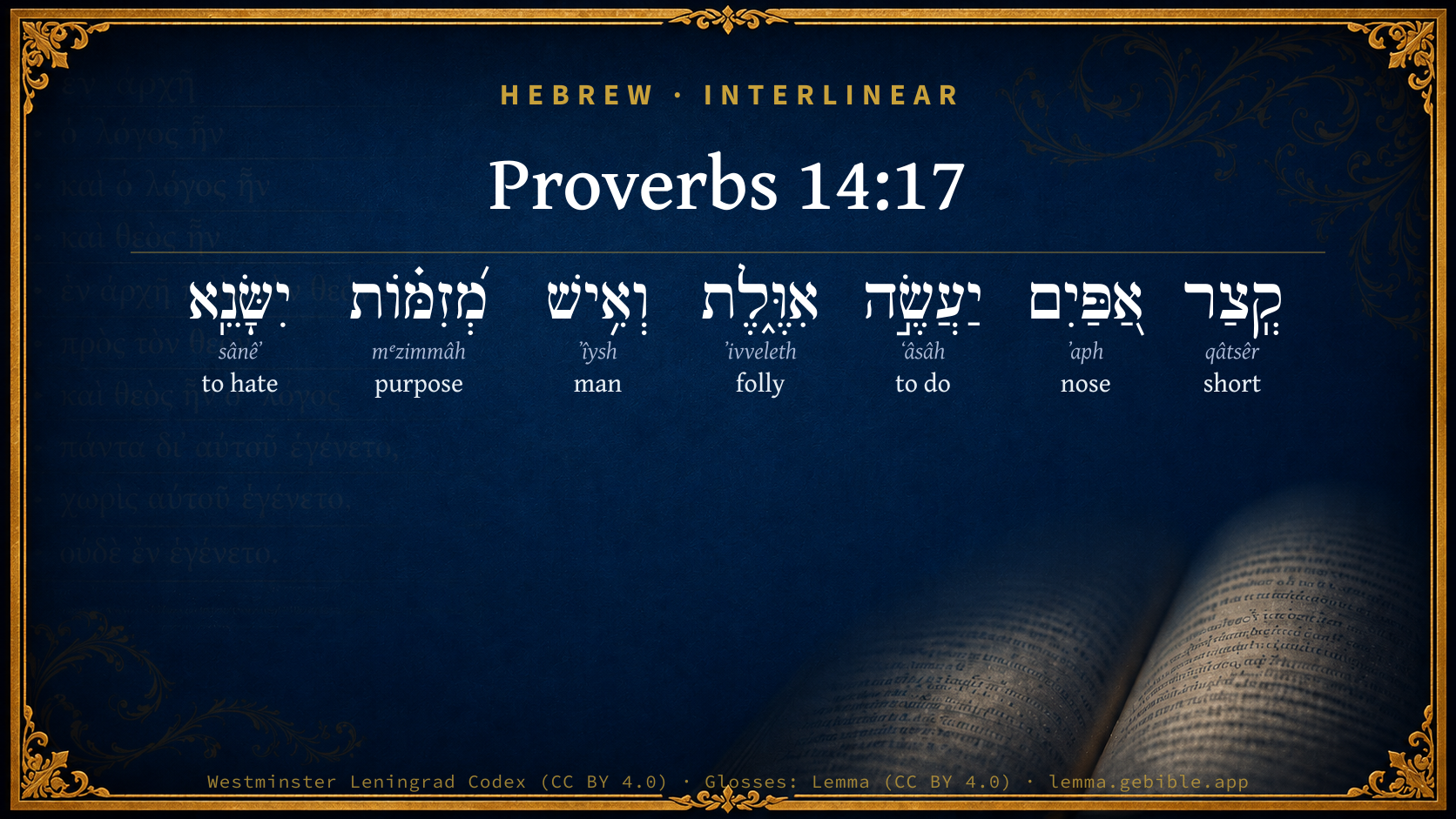
Proverbs 14:17

Hebrew (Westminster Leningrad Codex) Proverbs 14:17 appears in the Hebrew Old Testament. The text above is from the Westminster Leningrad Codex. Each word links to its Strong’s number, a concise gloss, and parsing drawn from the Open Scriptures Hebrew Bible morphology. Click any word for its full Brown-Driver-Briggs (BDB) entry.
Download image
Cite this verse

Proverbs 14:17 (World English Bible). Public Domain. Lemma interlinear Bible study tool, https://lemma.gebible.app/v/proverbs/14/17.

Show BibTeX & RIS
BibTeX
RIS
English Translation
He who is quick to become angry will commit folly, And a crafty man is hated.
World English Bible · Public Domain
Download a study sheet

One document with this verse’s original text, its word-by-word gloss line, the meaning frame, cross-references with their text, attributed commentary, and full source and license credits — printable, and it pastes into notes with its structure intact.

This verse Autodidact and up

Study sheet (.html) Plain text (.txt)

A passage Seminary Student

Up to 50 verses in one chapter. A passage sheet keeps up to 6 commentary sources and 12 cross-references per verse, in the order this page ranks them, and says so on the sheet whenever that leaves anything out. Ask for a single verse and you get the Autodidact verse sheet above.

Everything on this page stays free to read, with no account — the sheet is a download of what is already on screen, not access to it.

Want to remove ads? Support Godless Engineer
Compare translations 3

The same verse in 3 English versions, stacked beneath the original-language interlinear above. Click any original word for its lexicon entry.

Each is an independent rendering of the whole verse — the interlinear is not word-aligned to these translations.

Highlighted words mark where these versions differ — a whole-verse word diff, not a word-by-word alignment.

  • World English Bible Public Domain
    He who is quick to become angry will commit folly, And a crafty man is hated.
  • King James Version Public Domain
    He that is soon angry dealeth foolishly: and a man of wicked devices is hated.
  • unfoldingWord Literal Text CC BY-SA 4.0
    short of nostrils does folly, and a man of schemes is hated.

unfoldingWord Literal Text — © unfoldingWord, licensed CC BY-SA 4.0. Word-aligned USFM3 via Door43 (git.door43.org/unfoldingWord/en_ult).

Versions to compare (up to 4)

3 of 4 selected

Show all 18 translations

Every available English version of this verse, each an independent rendering of the whole verse.

  • World English Bible Public Domain
    He who is quick to become angry will commit folly, And a crafty man is hated.
  • Berean Standard Bible Public Domain
    A quick-tempered man acts foolishly, and a devious man is hated.
  • Majority Standard Bible Public Domain
    A quick-tempered man acts foolishly, and a devious man is hated.
  • King James Version Public Domain
    He that is soon angry dealeth foolishly: and a man of wicked devices is hated.
  • American Standard Version (1901) Public Domain
    He that is soon angry will deal foolishly; And a man of wicked devices is hated.
  • Revised Version (1885) Public Domain
    He that is soon angry will deal foolishly: and a man of wicked devices is hated.
  • Geneva Bible (1599) Public Domain
    He that is hastie to anger, committeth follie, and a busie body is hated.
  • Douay-Rheims (1899) Public Domain
    The impatient man shall work folly: and the crafty man is hateful.
  • Young's Literal Translation Public Domain
    Whoso is short of temper doth folly, And a man of wicked devices is hated.
  • Literal Standard Version CC BY-SA 4.0
    Whoever is short of temper does folly, || And a man of wicked schemes is hated.
  • Unlocked Literal Bible CC BY-SA 4.0
    One who is quick to become angry does foolish things, and a person who makes evil schemes is hated.
  • unfoldingWord Literal Text CC BY-SA 4.0
    short of nostrils does folly, and a man of schemes is hated.
  • Darby Bible Public Domain
    He that is soon angry dealeth foolishly, and a man of mischievous devices is hated.
  • World Messianic Bible Public Domain
    He who is quick to become angry will commit folly, and a crafty man is hated.
  • Webster's Bible Public Domain
    He that is soon angry dealeth foolishly: and a man of wicked devices is hated.
  • Free Bible Version CC BY-SA 4.0
    Quick-tempered people act foolishly, while people who make evil plans are hated.
  • Bible in Basic English Public Domain
    He who is quickly angry will do what is foolish, but the man of good sense will have quiet.
  • JPS Tanakh (1917) Public Domain
    He that is soon angry dealeth foolishly; and a man of wicked devices is hated.

Literal Standard Version (2020), Covenant Press — licensed CC BY-SA 4.0. Text via the HelloAO Bible API (eBible.org). Unlocked Literal Bible (unfoldingWord) — licensed CC BY-SA 4.0. Text via the HelloAO Bible API (eBible.org). unfoldingWord Literal Text — © unfoldingWord, licensed CC BY-SA 4.0. Word-aligned USFM3 via Door43 (git.door43.org/unfoldingWord/en_ult). Free Bible Version, Dr. Jonathan Gallagher — licensed CC BY-SA 4.0. Text via the HelloAO Bible API (eBible.org).

Word by word

More ways to search: Search by grammar → Find every occurrence → Compare this word →

Practice this passage: Drill this verse → Learn its vocabulary →

About this verse

These counts appear in no published source. They are computed here, from the morphology-tagged text and Lemma’s own curated glosses. What Lemma adds →

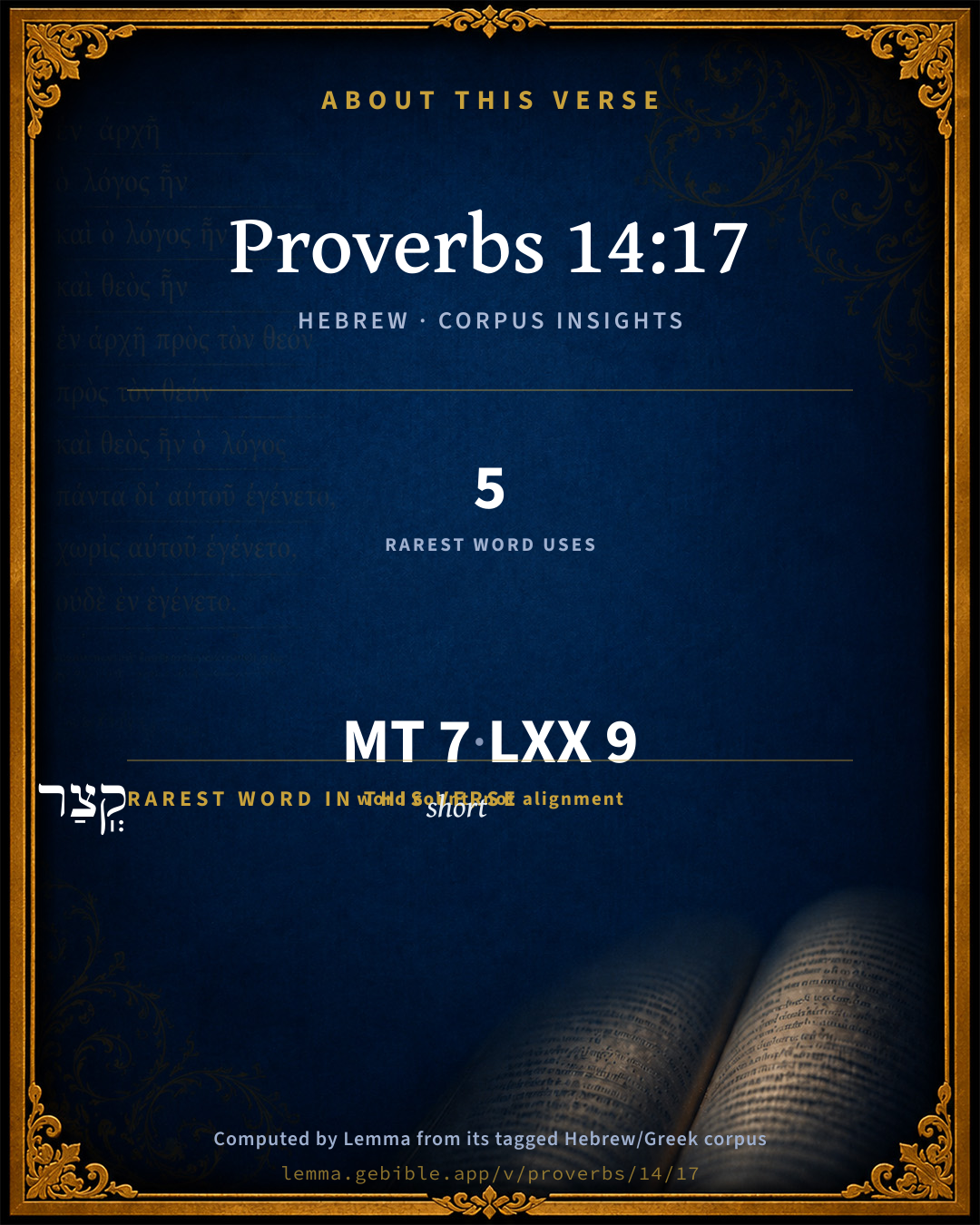
7
words
7
distinct lemmas
Wisdom
section

Notable vocabulary

The rarest word here is קְֽצַר short H7116 — appearing just 5 times in the whole Hebrew Bible.

Shared distinctive vocabulary

קְֽצַר short H7116 occurs in 5 verses of the Hebrew Bible. Also found in:

Grammatical profile

  • 2 verbs
  • 4 nouns
  • 1 adjective

Verb forms

  • יַעֲשֶׂ֣ה Qal · Imperfect
  • יִשָּׂנֵֽא Niphal · Imperfect

Hebrew & Septuagint length

In English translation the verse runs 16 words from the Hebrew and 14 from the Septuagint (LXX English) — closely comparable.

A rough comparison of the two English renderings, which tokenize alike — not a word-level alignment.

Word counts can differ between the Hebrew and the Greek without any difference in meaning — e.g. the Hebrew direct-object marker אֵת has no separate Greek word, and Greek often adds the article ὁ.

In the original languages it is 7 Hebrew tokens and 9 Greek tokens — but the two are counted differently (Hebrew bundles its prefixes and suffixes into one token; the Greek is in lemma form), so that isn’t a like-for-like length.

Cross-references

14

Topical passages linked to Proverbs 14:17 in the Treasury of Scripture Knowledge — connected by theme and wording, ordered by reader-vote popularity; previews shown in the World English Bible.

  • Proverbs 14:29 He who is slow to anger has great understanding, But he who has a quick temper displays folly.
  • Proverbs 29:22 An angry man stirs up strife, And a wrathful man abounds in sin.
  • Ecclesiastes 7:9 Don't be hasty in your spirit to be angry, for anger rests in the bosom of fools.
  • James 1:19 So, then, my beloved brothers, let every man be swift to hear, slow to speak, and slow to anger;
  • Proverbs 15:18 A wrathful man stirs up contention, But one who is slow to anger appeases strife.
  • Proverbs 16:32 One who is slow to anger is better than the mighty; One who rules his spirit, than he who takes a city.
  • Proverbs 22:24 Don't befriend a hot-tempered man, And don't associate with one who harbors anger:
  • Esther 3:6 But he scorned the thought of laying hands on Mordecai alone; for they had made known to him the people of Mordecai: therefore Haman sought to destroy all the Jews who were throughout the whole kingdom of Ahasuerus, even the people of Mordecai.
  • Esther 7:5–6 Then spoke the king Ahasuerus and said to Esther the queen, Who is he, and where is he, that dared presume in his heart to do so?
  • Proverbs 6:18 A heart that devises wicked schemes, Feet that are swift in running to mischief,
  • Proverbs 12:2 A good man shall obtain favor from Yahweh, But he will condemn a man of wicked devices.
  • Proverbs 12:16 A fool shows his annoyance the same day, But one who overlooks an insult is prudent.
  • Isaiah 32:7 The instruments of the churl are evil: he devises wicked devices to destroy the humble with lying words, even when the needy speaks right.
  • Jeremiah 5:26–29 For among my people are found wicked men: they watch, as fowlers lie in wait; they set a trap, they catch men.

Cross-references courtesy of OpenBible.info (CC BY 4.0).

Hebrew and Greek witnesses Masoretic Hebrew ↔ Greek Septuagint

The same verse in the two great witnesses to the Old Testament, shown verse-for-verse.

These are two independent witnesses, not word-aligned to each other, and the Septuagint is shown in lemma (dictionary) form.

Hebrew Proverbs 14:17 Masoretic · Westminster Leningrad Codex

קְֽצַר אַ֭פַּיִם יַעֲשֶׂ֣ה אִוֶּ֑לֶת וְאִ֥ישׁ מְ֝זִמּ֗וֹת יִשָּׂנֵֽא

He who is quick to become angry will commit folly, And a crafty man is hated.

World English Bible · Public Domain

Greek LXX Proverbs 14:17 Septuagint · lemma form

ὀξύθυμος πράσσω μετά ἀβουλία ἀνήρ δέ φρόνιμος πολύς ὑποφέρω

A passionate man acts inconsiderately; but a sensible man bears up under many things.

LXX2012 (modern English Septuagint) · Public Domain

On this verse, Joseph Benson's Commentary discusses the Septuagint’s reading. Read the note in Commentary ↓

Hebrew: Westminster Leningrad Codex (CC BY 4.0). Greek: Septuagint (public domain); English from LXX2012 (modern English Septuagint) (Public Domain). How the Septuagint differs from the Hebrew →

Commentary

Notes on Proverbs 14:17 from classic Christian and Jewish commentators (each source and its license shown beneath its notes). The classic Christian expositions comment on the surrounding passage and are grouped to its opening verse, so a note may address several verses; the Jewish commentaries on the Tanakh (Rashi and others) are per-verse, so they appear only where the commentator wrote on this verse.

Lemma curates 59 commentaries, every one of them public domain or Creative Commons licensed, each selected and text-cleaned for this edition rather than reprinted as found. About our sources →

Trapp's Complete Commentary

John Trapp

Pro 14:17 [He that is] soon angry dealeth foolishly: and a man of wicked devices is hated.

Ver. 17. He that is soon angry dealeth foolishly.] Alexander, in his hot blood, slew his dearest friend, whom he would have revived again with his heart blood.

“ Qui non moderabitur irae

Infectum velit esse dolor quod suaserit, et mens. ”

Rash anger differs from madness, saith Seneca, in nothing but in time only. See my "Common Place of Anger."

And a man of wicked devices is hated,] i.e., He that beareth a grudge intending revenge - as one that only wants, and therefore waits a fit time, as Absalom did for Amnon - this is a dangerous man, and deservedly detested of all. It is counted manhood - indeed it is doghood. The curs of Congo, they say, bite but never bark. Esau threatened Jacob. Tiberius lentus in meditando, ubi prorupisset, tristioribus dictis atrocia facta conungebat. The more he meditated revenge, the more did time and delay sharpen it; and the further off he threatened, the heavier the stroke fell; therefore he was generally hated as an odious miscreant.

John Trapp, A Commentary or Exposition upon All the Books of the Old and New Testament (1647–1656) — public domain. Text from a community e-Sword module.

The Biblical Illustrator

Joseph S. Exell

Pro_14:17

He that is soon angry dealeth foolishly.

Anger restrained

In speaking recently of the power of Gods grace to quell our passions, Mr. Aitken told the story of a gentleman he knew in Liverpool, who, although a follower of the Lord Jesus, was cursed with a hasty and violent temper. It was a source of great grief to him, and in his helplessness he threw himself on the Lords hands to rid him of this demon which was marring his Christian happiness. He occupied a position of trust in the Custom House, and it was his duty each night to see that every door in the building was locked. One evening he had just gone through his work as usual and was well on his way homewards, when a boy came rushing after him and told him a man was locked up in one of the inner rooms of the Custom House. At the moment he felt anger rising in his throat, but, lifting up his heart to God, he returned with the boy. After unlocking room after room he came to the place where the man was, and found the poor fellow standing trembling, no doubt expecting an outburst of that temper which they all knew so well. The Customs officer approached the man smiling, and, stretching out his hand, told him not to mind the trouble he had given him. Thus does Gods grace enable us to quell our worst pensions.

The Biblical Illustrator, edited by Joseph S. Exell (c. 1880s–1900s) — public domain. Text from a community e-Sword module.

Joseph Benson's Commentary

Pro 14:17. He that is soon angry dealeth foolishly — His passion hurries him into many rash and foolish speeches and actions; and a man of wicked devices — One who, it may be, suppresses his passion, but designs and meditates revenge, watching for the fittest opportunities of executing it; is hated — Both by God and men; as being most deeply malicious, and like the devil, and most dangerous and pernicious to human society. The LXX. translate this verse, Οξυθυμος πρασσει μετα αβουλιας, ανηρ δε φρονιμος πολλα υποφερει, A hasty man acteth rashly, but a prudent man endureth many things: to which Houbigant’s translation is similar, He who is soon angry will deal inconsiderately; a considerate man will endure patiently.

Joseph Benson's Commentary on the Old and New Testaments (1811–1818) — public domain. Text from a community e-Sword module.

Tyndale Open Study Notes

Tyndale Open Resources

14:17 Short-tempered people do not anticipate consequences before expressing anger. Schemers reflect, but they, too, are hated because of the evil that they do.

Tyndale Open Study Notes — © Tyndale Open Resources, licensed CC BY-SA 4.0. Text via the HelloAO Bible API.

Geneva Bible (1599)

Geneva Bible translators

Hebrew, the man of imaginations.

Geneva Bible (1599) marginal notes — public domain. Text via Bolls.life.

Matthew Henry's Commentary

Note, 1. Passionate men are justly laughed at. Men who are peevish and touchy, and are soon angry upon every the least provocation, deal foolishly; they say and do that which is ridiculous, and so expose themselves to contempt; they themselves cannot but be ashamed of it when the heat is over. The consideration of this should engage those especially who are in reputation for wisdom and honour with the utmost care to bridle their passion. 2. Malicious men are justly dreaded and detested, for they are much more dangerous and mischievous to all societies: A man of wicked devices, who stifles his resentments till he has an opportunity of being revenged, and is secretly plotting how to wrong his neighbour and to do him an ill turn, as Cain to kill Abel, such a man as this is hated by all mankind. The character of an angry man is pitiable; through the surprise of a temptation he disturbs and disgraces himself, but it is soon over, and he is sorry for it. But that of a spiteful revengeful man is odious; there is no fence against him nor cure for him.

Matthew Henry's Commentary on the Whole Bible (1708–1710) — public domain (CC PDM 1.0). Text via the HelloAO Bible API.

Jamieson, Fausset & Brown

Robert Jamieson, A. R. Fausset & David Brown

He . . . angry--literally, "short of anger" (compare Pro 14:29, opposite idea).

man . . . hated--that is, the deliberate evildoer is more hated than the rash.

Jamieson, Fausset & Brown — Commentary Critical and Explanatory on the Whole Bible (1871) — public domain (CC PDM 1.0). Text via the HelloAO Bible API.

Adam Clarke's Commentary

Verse 17. He that is soon angry] קצר אפים ketsar appayim, "short of nostrils:" because, when a man is angry, his nose is contracted, and drawn up towards his eyes.

Dealeth foolishly] He has no time for reflection; he is hurried on by his passions, speaks like a fool, and acts like a madman.

Adam Clarke's Commentary on the Bible (1810–1826) — public domain. Text from a community e-Sword/MySword module.

Ellicott's Commentary for English Readers

(17) Dealeth foolishly.—Does silly things, and makes himself an object of ridicule, but not of hatred; whereas the “man of (wicked) devices” is hated for his cold-blooded malice.

A Bible Commentary for English Readers, edited by Charles John Ellicott (1878–1897) — public domain. Text from a community e-Sword module.

The Cambridge Bible for Schools and Colleges

gen. ed. J. J. S. Perowne

17. and] Rather, but. The comparison is between hasty anger leading to folly, and deliberate malice provoking hatred.

The Cambridge Bible for Schools and Colleges (gen. ed. J. J. S. Perowne; Cambridge University Press, 1878–1918) — public domain. Text from a community e-Sword module.

John Gill's Exposition

He that is soon angry dealeth foolishly,.... A man that is quick and short, of a hasty spirit, and presently discovers anger and resentment in his face; he says and does many foolish things, which he afterwards is sorry for, and repents, and is ashamed of; and he is to be pitied and forgiven;

and a man of wicked devices is hated; one that hides his anger, covers his resentment, contrives schemes to revenge himself, and waits an opportunity to put them in execution, is justly hateful to God and men.

John Gill's Exposition of the Whole Bible (1746–1763) — public domain (CC PDM 1.0). Text via the HelloAO Bible API.

Albert Barnes' Notes on the Bible

The contrast lies between two forms of evil. Hasty anger acts foolishly, but the “man of wicked devices,” vindictive and insidious, incurs all men’s hatred.

Albert Barnes' Notes on the Bible (1834–1885) — public domain. Text from a community e-Sword/MySword module.

Haydock's Catholic Bible Commentary

Folly. Wrath betrays us into great extravagances. --- Hateful. Hebrew also, "hateth" folly. Septuagint, "the prudent beareth much," Job v. 2. (Calmet)

George Leo Haydock (1774–1849), Haydock's Catholic Family Bible and Commentary, 1859 edition — public domain. Excludes Psalms (Douay-Rheims chapter numbering differs from Protestant) and Deuterocanonical books (Catholic canon only).

Matthew Poole's English Annotations

Dealeth foolishly; his passion hurries him into many rash and foolish speeches and actions.

A man of wicked devices, one who suppresseth his passion, but designeth and meditateth revenge, watching for the fittest methods and opportunities of executing it,

is hated, both by God and men, as being most deeply malicious, and like the devil, and most dangerous and pernicious to human society; whereas men that are soon angry give a man warning, and are quickly pacified, and therefore pitied and pardoned.

Matthew Poole's English Annotations on the Holy Bible (1683–1685) — public domain. Text from a community e-Sword/MySword module.

Whedon's Commentary on the Bible

Daniel D. Whedon

17. Soon angry — קצר אפים, (ketsar-appayim,) short of nostrils; the word primarily means nostrils, but tropically anger. The ancients conceived of anger as conspicuously expressed by the nostrils, the chief external organs of respiration. Thus, “short of nostrils” signified angry, or passionate, and “long of nostrils,” the opposite, slow to anger. The thought of the proverb is, that a passionate man is apt to act foolishly, but men may pity his weakness: whereas a man of deliberate evil intentions — a malicious man — is hated. Comp. Pro_15:1.

Daniel D. Whedon (gen. ed.), Commentary on the Old and New Testaments (1874–1909) — public domain. Text from a community e-Sword module.

The Pulpit Commentary

He that is soon angry dealeth foolishly. The contrast to the irascible, passionate man is seen in the man slow to anger (ver. 29; Pro_15:18). Such a one, in his haste and passion, does things which in calmer moments he must see are foolish and ridiculous. Says Euripides ("Hyp.," Fragm.) Exw gaterov. "Wiser is every man from passion freed.

"Be not angry," says the Talmud, "and you will not sin." Cato, "Dist.," 1:37"Ipse tibi moderare tuis ut parcere possis.

And a man of wicked devices is hated. The contrast is not between the different ways in which the two characters are regarded, as that one is despised and ridiculed, and the other hated; but two kinds of evil are set forth in contradistinction, viz. hasty anger and deliberate plotting against others. Septuagint, "The irascible man (oxuyumov ) acts without deliberation. but the prudent man endureth much." The Hebrew term, "man of devices," being ambiguous, the LXX takes it in a favourable sense, fronimov ; and they have a different reading of the verb.

Vers. 17, 29. See homily on Pro_16:32. C.

The Pulpit Commentary (1880–1919), ed. H.D.M. Spence-Jones & Joseph S. Exell — public domain. Text from a community e-Sword module.

John Wesley's Explanatory Notes

Foolishly - His passion hurries him into foolish speeches and actions. Wicked devices - One who suppresses his passion, but meditates revenge. Hated - Both by God and men.

John Wesley, Explanatory Notes Upon the Whole Bible (1754–1765) — public domain. Text via the GEBible commentary corpus.

Keil & Delitzsch

C. F. Keil & F. Delitzsch

This verse, as if explanatory of מתעבר, connects itself with this interpretation of the contrasts, corresponding to the general usus loquendi, and particularly to the Mishle style.

One who is quick to anger worketh folly,

And a man of intrigues is hated.

Ewald finds here no right contrast. He understands אישׁ מזמּה in a good sense, and accordingly corrects the text, substituting for ישׂנא, ישׁוּא (ישׁוּא), for he translates: but the man of consideration bears (properly smooths, viz., his soul). On the other hand it is also to be remarked, that אישׁ מזמה, when it occurs, is not to be understood necessarily in a good sense, since מזמה is used just like מזמות, at one time in a good and at another in a bad sense, and that we willingly miss the "most complete sense" thus arising, since the proverb, as it stands in the Masoretic text, is good Hebrew, and needs only to be rightly understood to let nothing be missed in completeness. The contrast, as Ewald seeks here to represent it (also Hitzig, who proposes ישׁאן: the man of consideration remains quiet; Syr. ramys, circumspect), we have in Pro 14:29, where the μακρόθυμος stands over against the ὀξύθυμος (אף or אפּים of the breathing of anger through the nose, cf. Theocritus, i. 18: καὶ οἱ ἀεὶ δριμεῖα χολὰ ποτὶ ῥινὶ κάθηται). Here the contrast is different: to the man who is quick to anger, who suddenly gives expression to his anger and displeasure, stands opposed the man of intrigues, who contrives secret vengeance against those with whom he is angry. Such a deceitful man, who contrives evil with calculating forethought and executes it in cold blood (cf. Psa 37:7), is hated; while on the contrary the noisy lets himself rush forward to inconsiderate, mad actions, but is not hated on that account; but if in his folly he injures or disgraces himself, or is derided, or if he even does injury to the body and the life of another, and afterwards with terror sees the evil done in its true light, then he is an object of compassion. Theodotion rightly: (ἀνὴρ δὲ) διαβουλιῶν μισηθήσεται, and Jerome: vir versutus odiosus est (not the Venet. ἀνὴρ βδελυγμῶν, for this signification has only זמּה, and that in the sing.); on the contrary, the lxx, Syr., Targum, and Symmachus incorrectly understand איש מזמות in bonam partem.

Keil & Delitzsch — Biblical Commentary on the Old Testament (1861–1891) — public domain (CC PDM 1.0). Text via the HelloAO Bible API. (Old Testament only.)

Bridges on Proverbs

Charles Bridges

Different gradations of sin are here opposed to each other — the sudden passion and the deliberate purpose; the gust and the continuance of the storm. A hasty temper convicts us of foolishness before our fellow-men. (2Ki 5:11-13 .) What frightful mischief may be the consequence of an angry word! (Jas 3:5 .) How fearfully did the "man after God’s own heart" suffer the fire to burst out! (1Sa 25:21 .) Who then, with this example before us, will dare to relax the watch? But are these sins of temper matters of sorrow and humiliation? Does the remembrance of their cost to our crucified Friend exercise our constant watchfulness, and prayerful resistance? Is not our loving Father’s rod sometimes needful to bring conviction of their guilty foolishness? (Num 20:10-12 .) Oh, for a rich vouchsafement of that "charity, that is not easily provoked!" (1Co 13:5 .) ’Let us give our hearts no rest, until we have purged their gall, and tempered them with the sweetness and gentleness of our Lord and Savior.’†1

But sin grows from weakness to willfulness. ’The first makes a man contemptible; the second abominable.’†2 Wicked devices;†3 cherished malice;†4 one act preparing for another; almost aiming at the uttermost†5 — all this shews the true picture of man, "hateful, and hating one another."†6 Such a man is hated of God, as "an abomination."†7 Man holds him up to his righteous scorn.†8 Absalom’s pillar, the monument of his name, is to this day the object of universal contempt.†9 The hatred of Haman’s wicked devices is perpetuated from generation to generation. (Est 9:23-28 .) Why are these warnings, if we regard them not? Our dignity is our likeness to God! What shame and degradation must there be in this contrariety to him!

Footnotes:

†1 Daille on Col 3:8 . Compare Col 3:13 .

†2 Diodati.

†3 Psa 36:2-4; Psa 64:2-9 . Jer 5:26 .

†4 Gen 4:8; Gen 27:41 .

†5 2Sa 15:2-12 .

†6 Tit 3:3.

†7 Pro 6:16-18.

†8 Psa 52:2-7.

†9 Calmet mentions the habit of passing travelers throwing stones at Absalom’s pillar, to shew their hatred of a son’s rebellion against his father; and that now the accumulation of stones hides the lower part of the monument. This tradition is confirmed by recent travelers.

Charles Bridges, An Exposition of the Book of Proverbs (1846) — public domain. Text from a community e-Sword module.

Kretzmann's Popular Commentary

Paul E. Kretzmann

v. 17. He that is soon angry, losing his temper at the slightest provocation, dealeth foolishly, working only folly, with evil consequences to himself; and a man of wicked devices is hated, since he, with his malicious craft and hypocritical subtlety, is even more dangerous than he who flies into a passion at the slightest provocation.

Paul E. Kretzmann, Popular Commentary of the Bible (1921–1924) — public domain. Text from a community e-Sword module.

unfoldingWord translationNotes

Door43 World Missions Community

is quick to become angry

"becomes angry quickly"

naive

inexperienced or immature

inherit foolishness

Here "inherit" represents having permanent possession of something. (See: Metonymy)

foolishness

The word "foolishness" is an abstract noun that represents foolish thinking and foolish actions.

prudent people

"wise people"

are crowned with knowledge

Here knowledge is spoken of as if it were a beautiful ornament worn on one's head, such as a turban with jewels. AT: "wear knowledge as a turban" (See: Metaphor)

translationWords

anger

fool

evil

inherit

know

unfoldingWord translationNotes — © Distant Shores Media and the Door43 World Missions Community, licensed CC BY-SA 4.0. Source: git.door43.org/Door43/en_tn.

Rashi

Rabbi Shlomo Yitzchaki (Rashi)

A quick tempered man who hastens to avenge his anger.

and a man of sinful plots Thoughts of counsels of evil.

Rashi on the Tanakh — English translations: “The Judaica Press complete Tanach with Rashi, translated by A. J. Rosenberg” (CC BY 4.0); “Pentateuch with Rashi's commentary by M. Rosenbaum and A.M. Silbermann, 1929-1934” (public domain); “The Metsudah Tanach series, Lakewood, N.J” (CC BY 4.0); and “The Book of Joshua, Metsudah Publications, 1997” (CC BY 4.0). Text via Sefaria.

Lesson kit

Teaching starters — assembled from the data on this page, not authored interpretation. Every prompt links to the verse data it draws on. Edit before teaching.

Proverbs, in the Wisdom, opens this verse with 7 words (7 distinct Hebrew lemmas). Its most distinctive word is qâtsêr (“short”). A historical commentator’s framing appears above. Read the whole chapter for the surrounding context.

Discussion questions

  1. What does “short” (qâtsêr) contribute to the verse as a whole?
  2. 2 Kings 19:26 shares the word «short» with this verse. How do the two illuminate each other?
  3. The translations on this page render this verse differently — a whole-verse word diff, not a word-by-word alignment. What might account for the different wordings?
  4. The verb «יַעֲשֶׂ֣ה» is Qal Imperfect. How does its form color the action?
  5. Reading how Trapp's Complete Commentary and The Biblical Illustrator read this verse, where do the two commentators agree and where do they part?

Things to notice

Reading settings

Reading text

Shown beneath each verse's original-language words.

Old Testament
Old Testament edition

Read the OT as the Masoretic Hebrew (MT) or the Greek Septuagint (LXX).

English shown for the Greek Septuagint (in the Hebrew ↔ Greek comparison).

Comparing translations? Open the Compare panel on any verse page to stack up to four side by side.