
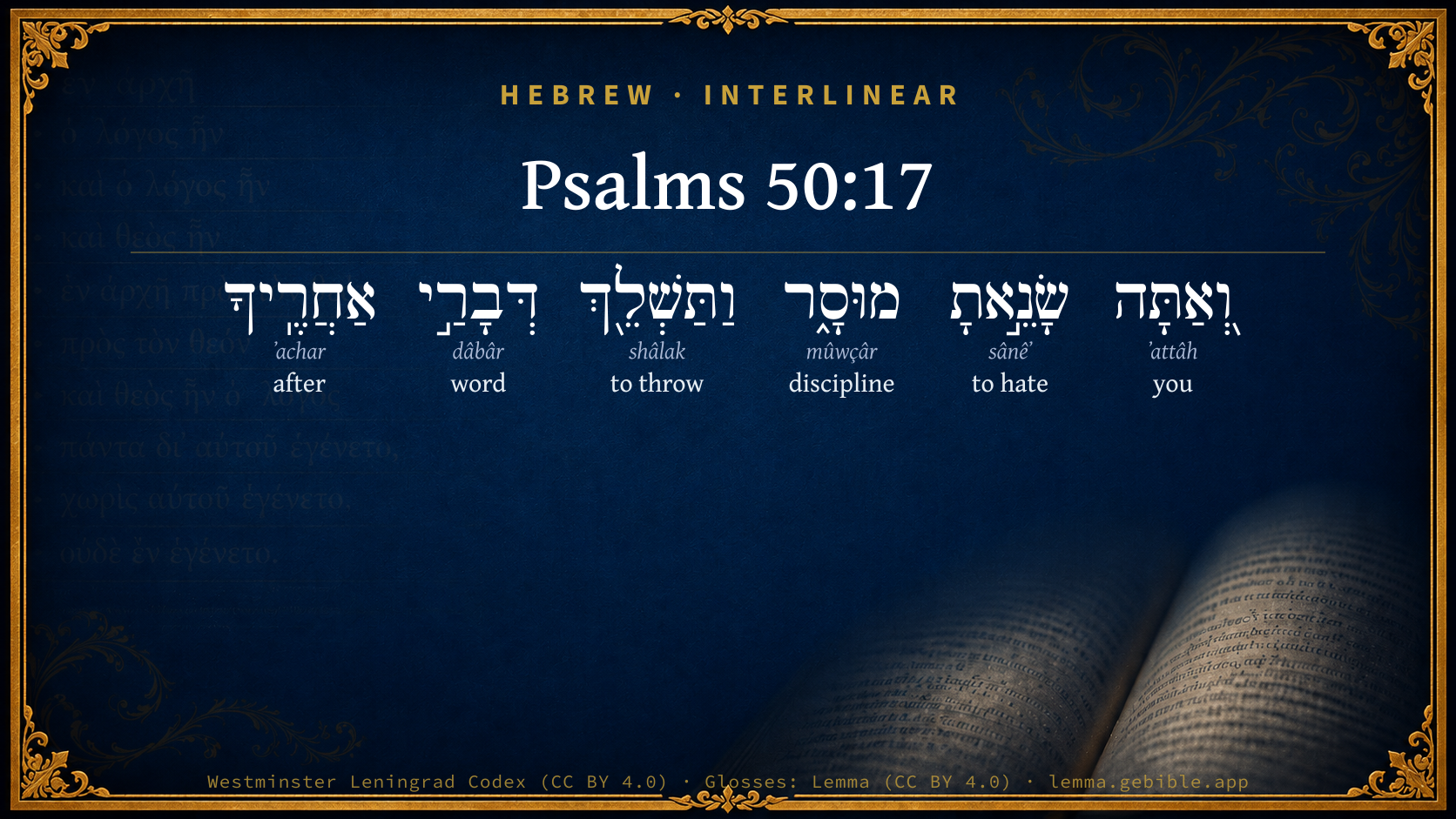
Psalms 50:17

Hebrew (Westminster Leningrad Codex) Psalms 50:17 appears in the Hebrew Old Testament. The text above is from the Westminster Leningrad Codex. Each word links to its Strong’s number, a concise gloss, and parsing drawn from the Open Scriptures Hebrew Bible morphology. Click any word for its full Brown-Driver-Briggs (BDB) entry.
Download image
Cite this verse

Psalms 50:17 (World English Bible). Public Domain. Lemma interlinear Bible study tool, https://lemma.gebible.app/v/psalms/50/17.

Show BibTeX & RIS
BibTeX
RIS
English Translation
Seeing you hate instruction, And throw my words behind you?
World English Bible · Public Domain
Download a study sheet

One document with this verse’s original text, its word-by-word gloss line, the meaning frame, cross-references with their text, attributed commentary, and full source and license credits — printable, and it pastes into notes with its structure intact.

This verse Autodidact and up

Study sheet (.html) Plain text (.txt)

A passage Seminary Student

Up to 50 verses in one chapter. A passage sheet keeps up to 6 commentary sources and 12 cross-references per verse, in the order this page ranks them, and says so on the sheet whenever that leaves anything out. Ask for a single verse and you get the Autodidact verse sheet above.

Everything on this page stays free to read, with no account — the sheet is a download of what is already on screen, not access to it.

Want to remove ads? Support Godless Engineer
Compare translations 3

The same verse in 3 English versions, stacked beneath the original-language interlinear above. Click any original word for its lexicon entry.

Each is an independent rendering of the whole verse — the interlinear is not word-aligned to these translations.

Highlighted words mark where these versions differ — a whole-verse word diff, not a word-by-word alignment.

  • World English Bible Public Domain
    Seeing you hate instruction, And throw my words behind you?
  • King James Version Public Domain
    Seeing thou hatest instruction, and casteth my words behind thee.
  • unfoldingWord Literal Text CC BY-SA 4.0
    For you, you hate instruction, and you cast my words behind you.

unfoldingWord Literal Text — © unfoldingWord, licensed CC BY-SA 4.0. Word-aligned USFM3 via Door43 (git.door43.org/unfoldingWord/en_ult).

Versions to compare (up to 4)

3 of 4 selected

Show all 18 translations

Every available English version of this verse, each an independent rendering of the whole verse.

  • World English Bible Public Domain
    Seeing you hate instruction, And throw my words behind you?
  • Berean Standard Bible Public Domain
    For you hate My instruction and cast My words behind you.
  • Majority Standard Bible Public Domain
    For you hate My instruction and cast My words behind you.
  • King James Version Public Domain
    Seeing thou hatest instruction, and casteth my words behind thee.
  • American Standard Version (1901) Public Domain
    Seeing thou hatest instruction, And castest my words behind thee?
  • Revised Version (1885) Public Domain
    Seeing thou hatest instruction, and castest my words behind thee.
  • Geneva Bible (1599) Public Domain
    Seeing thou hatest to bee reformed, and hast cast my wordes behinde thee?
  • Douay-Rheims (1899) Public Domain
    Seeing thou hast hated discipline: and hast cast my words behind thee.
  • Young's Literal Translation Public Domain
    Yea, thou hast hated instruction, And dost cast My words behind thee.
  • Literal Standard Version CC BY-SA 4.0
    Indeed, you have hated instruction, || And cast My words behind you.
  • Unlocked Literal Bible CC BY-SA 4.0
    since you hate instruction and throw my words away?
  • unfoldingWord Literal Text CC BY-SA 4.0
    For you, you hate instruction, and you cast my words behind you.
  • Darby Bible Public Domain
    Seeing thou hast hated correction and hast cast my words behind thee?
  • World Messianic Bible Public Domain
    since you hate instruction, and throw my words behind you?
  • Webster's Bible Public Domain
    Seeing thou hatest instruction, and castest my words behind thee.
  • Free Bible Version CC BY-SA 4.0
    You hate my discipline, and you toss my words away, leaving them behind you.
  • Bible in Basic English Public Domain
    Seeing that you have no desire for my teaching, turning your back on my words.
  • JPS Tanakh (1917) Public Domain
    Seeing thou hatest instruction, and castest My words behind thee.

Literal Standard Version (2020), Covenant Press — licensed CC BY-SA 4.0. Text via the HelloAO Bible API (eBible.org). Unlocked Literal Bible (unfoldingWord) — licensed CC BY-SA 4.0. Text via the HelloAO Bible API (eBible.org). unfoldingWord Literal Text — © unfoldingWord, licensed CC BY-SA 4.0. Word-aligned USFM3 via Door43 (git.door43.org/unfoldingWord/en_ult). Free Bible Version, Dr. Jonathan Gallagher — licensed CC BY-SA 4.0. Text via the HelloAO Bible API (eBible.org).

Word by word

More ways to search: Search by grammar → Find every occurrence → Compare this word →

Practice this passage: Drill this verse → Learn its vocabulary →

About this verse

These counts appear in no published source. They are computed here, from the morphology-tagged text and Lemma’s own curated glosses. What Lemma adds →

6
words
6
distinct lemmas
Wisdom
section

Shared distinctive vocabulary

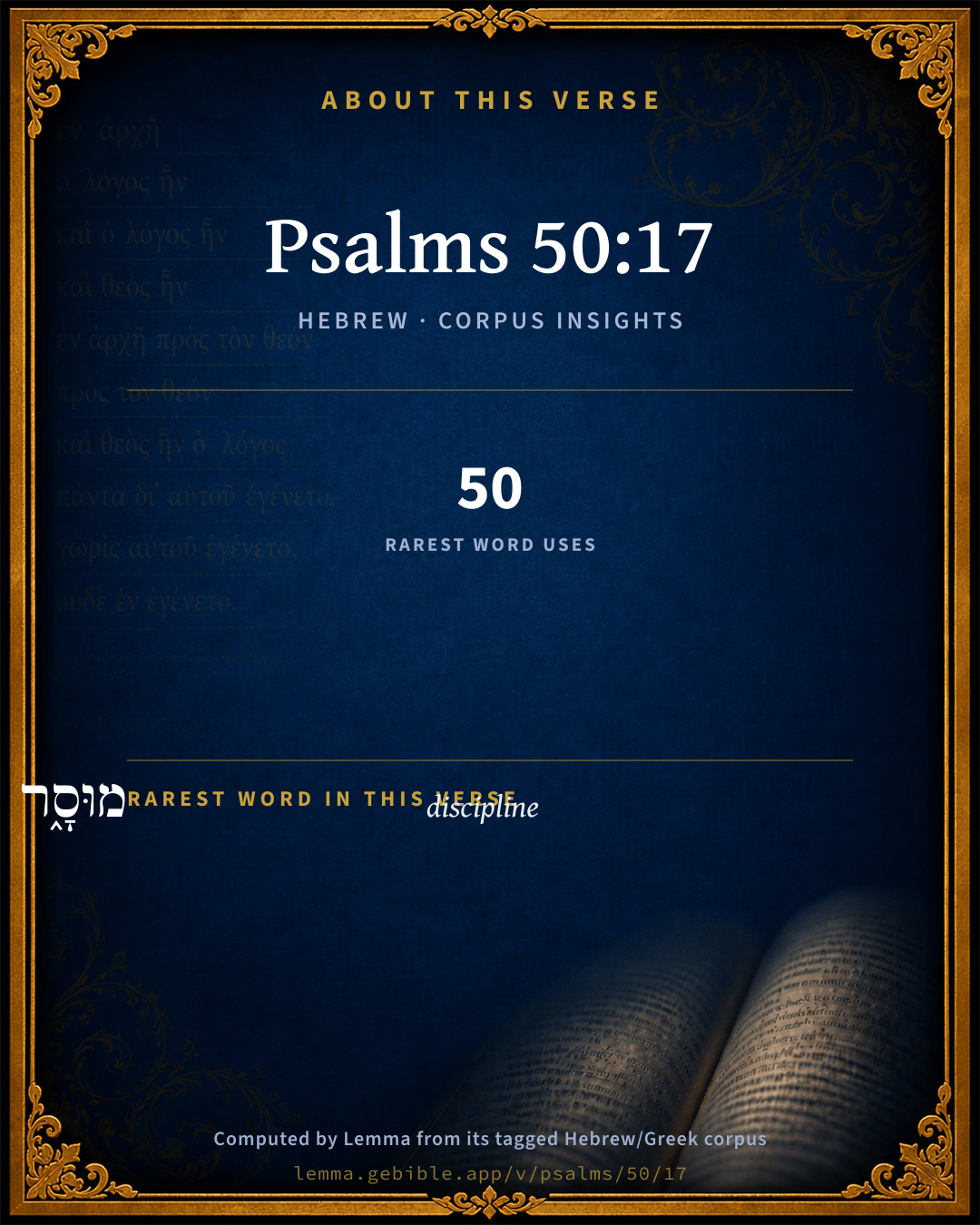
מוּסָ֑ר discipline H4148 occurs in 50 verses of the Hebrew Bible. Also found in:

Grammatical profile

  • 2 verbs
  • 2 nouns
  • 1 pronoun
  • 1 preposition

Verb forms

  • שָׂנֵ֣אתָ Qal · Perfect
  • וַתַּשְׁלֵ֖ךְ Hiphil · Sequential Imperfect

Hebrew & Septuagint length

In English translation the verse runs 10 words from the Hebrew and 12 from the Septuagint (LXX English) — closely comparable.

A rough comparison of the two English renderings, which tokenize alike — not a word-level alignment.

Word counts can differ between the Hebrew and the Greek without any difference in meaning — e.g. the Hebrew direct-object marker אֵת has no separate Greek word, and Greek often adds the article ὁ.

Cross-references

16

Topical passages linked to Psalms 50:17 in the Treasury of Scripture Knowledge — connected by theme and wording, ordered by reader-vote popularity; previews shown in the World English Bible.

  • Nehemiah 9:26 Nevertheless they were disobedient, and rebelled against you, and cast your law behind their back, and killed your prophets that testified against them to turn them again to you, and they committed awful blasphemies.
  • Proverbs 12:1 Whoever loves correction loves knowledge, But he who hates reproof is stupid.
  • 2 Timothy 4:3–4 For the time will come when they will not listen to the sound doctrine, but, having itching ears, will heap up for themselves teachers after their own lusts;
  • Proverbs 1:28–29 Then will they call on me, but I will not answer. They will seek me diligently, but they will not find me;
  • 1 Kings 14:9 but have done evil above all who were before you, and have gone and made you other gods, and molten images, to provoke me to anger, and have cast me behind your back:
  • 2 Thessalonians 2:10–12 and with all deception of wickedness for those who are being lost, because they didn't receive the love of the truth, that they might be saved.
  • Proverbs 1:7 The fear of Yahweh is the beginning of knowledge; But the foolish despise wisdom and instruction.
  • Jeremiah 8:9 The wise men are disappointed, they are dismayed and taken: behold, they have rejected the word of Yahweh; and what manner of wisdom is in them?
  • Romans 1:28 Even as they refused to have God in their knowledge, God gave them up to a reprobate mind, to do those things which are not fitting;
  • Romans 2:21–23 You therefore who teach another, don't you teach yourself? You who preach that a man shouldn't steal, do you steal?
  • Proverbs 5:12–13 And say, "How I have hated instruction, And my heart despised reproof;
  • Proverbs 8:36 But he who sins against me wrongs his own soul. All those who hate me love death."
  • Jeremiah 18:12 But they say, It is in vain; for we will walk after our own devices, and we will do everyone after the stubbornness of his evil heart.
  • John 3:20 For everyone who does evil hates the light, and doesn't come to the light, lest his works would be exposed.
  • Isaiah 5:23 Who acquit the guilty for a bribe, But deny justice for the innocent!
  • Jeremiah 36:23–32 It happened, when Jehudi had read three or four leaves, that [the king] cut it with the penknife, and cast it into the fire that was in the brazier, until all the scroll was consumed in the fire that was in the brazier.

Cross-references courtesy of OpenBible.info (CC BY 4.0).

Hebrew and Greek witnesses Masoretic Hebrew ↔ Greek Septuagint

The same verse in the two great witnesses to the Old Testament, shown verse-for-verse.

You’re reading Greek Psalm 49 (Hebrew Psalm 50). The Septuagint counts the superscription, so verse numbers can differ from the Hebrew — chapter-level alignment, not verse-by-verse. Numbering follows Rahlfs.

These are two independent witnesses, not word-aligned to each other, and the Septuagint is shown in lemma (dictionary) form.

Hebrew Psalms 50:17 Masoretic · Westminster Leningrad Codex

וְ֭אַתָּה שָׂנֵ֣אתָ מוּסָ֑ר וַתַּשְׁלֵ֖ךְ דְּבָרַ֣י אַחֲרֶֽיךָ

Seeing you hate instruction, And throw my words behind you?

World English Bible · Public Domain

Greek LXX Greek Psalm 49:17 Septuagint · lemma form

σύ δέ μισέω παιδεία καί ἐκβάλλω ὁ λόγος ἐγώ εἰς ὁ ὀπίσω

Whereas you have hated instruction, and have cast my words behind you.

LXX2012 (modern English Septuagint) · Public Domain

Hebrew: Westminster Leningrad Codex (CC BY 4.0). Greek: Septuagint (public domain); English from LXX2012 (modern English Septuagint) (Public Domain). How the Septuagint differs from the Hebrew →

Commentary

Notes on Psalms 50:17 from classic Christian and Jewish commentators (each source and its license shown beneath its notes). The classic Christian expositions comment on the surrounding passage and are grouped to its opening verse, so a note may address several verses; the Jewish commentaries on the Tanakh (Rashi and others) are per-verse, so they appear only where the commentator wrote on this verse.

Lemma curates 59 commentaries, every one of them public domain or Creative Commons licensed, each selected and text-cleaned for this edition rather than reprinted as found. About our sources →

Trapp's Complete Commentary

John Trapp

Psa 50:17 Seeing thou hatest instruction, and castest my words behind thee.

Ver. 17. Seeing thou hatest instruction] Or discipline, thou wilt not be brought to live strictly, to exercise godliness; thou refusest to be reformed, hatest to be healed. Bucer and Melancthon framed a form of reformation, with approbation of the peers and states; but the clergy of Cullen rejected it with slander, and said that they would rather live under the Great Turk than under a magistrate that should seek to settle such a reformation (Melch. Adam in Vit. Bucer).

And castest my words behind thee] They are near in thy mouth, but far from thy reins, Jer 12:2; denying in thy life what thou professest with thy lips; Ethiopian like, being white in the mouth only; or as lilies, white, but unsavoury. The Jews at this day show very great respect to the law, which no man may touch but with the right hand, and with a kiss of reverence; no man may carry it behind him, but must lay it next to his heart, in his travel (Schichard). They are enjoined to take up any paper which they see lying on the ground; and the reason is lest haply the name of God be written in the paper, and ignorantly trodden underfoot. Christians, though free from such superstitious curiosity, yet, full of religious care, should observe every tittle in God’s word, lest they should trample upon any. And when corruption boileth (saith a reverend man) think the gospel of Christ, professed by you, lieth prostrate before you; and will ye trample upon that gospel? will ye tread underfoot the blood of the covenant, as if it were a profane thing? Heb 10:29.

John Trapp, A Commentary or Exposition upon All the Books of the Old and New Testament (1647–1656) — public domain. Text from a community e-Sword module.

Joseph Benson's Commentary

Psa 50:17. Seeing thou hatest instruction — Seeing thy practice contradicts thy profession, and makes thee a notorious and impudent liar. For though with thy mouth thou showest much love to my statutes and counsels, yet, in truth, thou hatest them, as they oppose and hinder the gratification of thy beloved lusts, and are the instruments of thy just condemnation, and a manifest reproach to thy conduct. Or, seeing thou hatest reproof as מוסר, musar, is often rendered. And this, above all other parts of God’s word, is most hateful to ungodly men; and, therefore, this is fitly alleged as an evidence of their wickedness. And castest my words behind thee — As men do things which they abhor and despise.

Joseph Benson's Commentary on the Old and New Testaments (1811–1818) — public domain. Text from a community e-Sword module.

J. A. Alexander on Psalms

Joseph Addison Alexander

17. (Psa 50:17) And thou hast hated instruction, and hast cast my words behind thee. The very person who enforces the law, in all its rigour, upon others, refuses to submit to it himself, and treats its precepts not only with neglect but with contempt. This passage seems to have been present to the mind of Paul, in that remarkable series of interrogations, "Thou therefore which teachest another teachest thou not thyself," etc. Rom 2:21-23.

Joseph Addison Alexander, The Psalms Translated and Explained (1850) — public domain. Text from a community e-Sword module.

Tyndale Open Study Notes

Tyndale Open Resources

50:17 my discipline . . . my words: The wicked may observe rituals, but they reject more important matters such as justice, mercy, and faithfulness (cp. Matt 23:23-24).

Tyndale Open Study Notes — © Tyndale Open Resources, licensed CC BY-SA 4.0. Text via the HelloAO Bible API.

Geneva Bible (1599)

Geneva Bible translators

And to live according to my word.

Geneva Bible (1599) marginal notes — public domain. Text via Bolls.life.

Adam Clarke's Commentary

Verse 17. Seeing thou hatest instruction] All these rejected the counsel of God against themselves; and refused to receive the instructions of Christ.

Adam Clarke's Commentary on the Bible (1810–1826) — public domain. Text from a community e-Sword/MySword module.

John Calvin's Commentaries

17. Also thou hatest correction Here hypocrites are challenged with treacherous duplicity in denying, by their life and their works, that godliness which they have professed with the lip. Their contempt of God he proves from their want of reverential deference to his Word; subjection to the Word of God, and cordial submission to his precepts and instructions, being the surest test of religious principle. One way in which hypocrisy usually displays itself is, by the ingenious excuses it invents for evading the duty of obedience. The Psalmist points to this as the mainspring of their ungodliness, that they had cast the Word of God behind their back, while he insinuates that the principle from which all true worship flows is the obedience of faith. He adverts also to the cause of their perversity, which lies in the unwillingness of their corrupt heart to suffer the yoke of God. They have no hesitation in granting that whatever proceeds from the mouth of God is both true and right; this honor they are willing to concede to his Word; but in so far as it proposes to regulate their conduct, and restrain their sinful affections, they dislike and detest it. Our corruption, indisposing us to receive correction, exasperates us against the Word of God; nor is it possible that we can ever listen to it with true docility and meekness of mind, till we have been brought to give ourselves up to be ruled and disciplined by its precepts. The Psalmist next proceeds to specify some of those works of ungodliness, informing us that hypocrites, who were addicted to theft and adultery, mixed up and polluted the holy name of God with their wickedness. By adverting only to some species of vices, he would intimate, in general, that those who have despised correction, and hardened themselves against instruction, are prepared to launch into every excess which corrupt desire or evil example may suggests. He makes mention, first, of thefts; then of adulteries; and, thirdly, of calumnies or false reproaches. Most interpreters render תרף, tirets, to run, although others derive it from רצה, ratsah, rendering it to consent. Either translation agrees sufficiently with the scope of the Psalmist, and the preference may be left to the reader’s own choice. The charge here brought against hypocrites, that they put forth their mouth to evil, may include not merely slander, but all the different kinds of speaking which injure their neighbors, for it immediately follows, my tongue frameth deceit It is well known in what a variety of ways the lying and deceitful tongue may inflict injury and pain. When it is added, Thou sittest, etc., the allusion may be to one who sits for the passing of a formal judgment; as if it had been said, Thou defamest thy brethren under pretext of issuing a just sentence. Or there may be a reference to petty calumny; such as men maliciously indulge in, and in which they pass their time as they sit at ease in their houses. It seems more probable, however, that he refers to the higher crime of accusing the innocent and righteous in open court, and bringing false charges against them. Brethren, and the children of their mother, are mentioned, the more emphatically to express the cruelty of their calumnies, when they are represented as violating the ties of nature, and not even sparing the nearest relations.

John Calvin's Commentaries (1540-1563) — public domain. Text from the Calvin Translation Society English edition (1840s-50s) via the Christian Classics Ethereal Library (ccel.org). Calvin's coverage is partial (roughly two-thirds of the Bible); uncommented books and verses are honest gaps, never fabricated. The 19th-century editor's footnotes and remarks are omitted so the notes are faithfully Calvin's own voice.

The Cambridge Bible for Schools and Colleges

gen. ed. J. J. S. Perowne

17. instruction] Or, correction; the whole discipline of moral education; a word occurring here only in the Psalter, but common in Proverbs, where it is the mark of the fool and the scorner to despise instruction. Cp. Deu_8:5; Deu_11:2.

and castest &c.] Lit., and hast cast, flung them away out of sight and got rid of them. Contrast David’s behaviour, Psa_18:22. My words includes all God’s commandments, but points especially to the ‘ten words’ of the Decalogue (Deu_4:13; cp. Exo_20:1).

The Cambridge Bible for Schools and Colleges (gen. ed. J. J. S. Perowne; Cambridge University Press, 1878–1918) — public domain. Text from a community e-Sword module.

John Gill's Exposition

When thou sawest a thief, then thou consentedst with him,.... Or "didst run with him" (a); joined and agreed with him in the commission of the same things; which was literally true of the Scribes and Pharisees: they devoured widows' houses, and robbed them of their substance, under a pretence of long prayers; they consented to the deeds of Barabbas, a robber, when they preferred him to Jesus Christ; and they joined with the thieves on the cross in reviling him: and, in a spiritual sense, they stole away the word of the Lord, every man from his neighbour; took away the key of knowledge from the people, and put false glosses upon the sacred writings;

and hast been a partaker with adulterers; these teachers of the law were guilty both of theft and adultery, Rom 2:21; they are called by our Lord an adulterous generation, Mat 12:39; and they were so in a literal sense; see Joh 8:4; and in a figurative one, adulterating the word of God, and handling it deceitfully.

(a) , Sept. "currebas cum eo", V. L. sic Eth. Syr. Targum, so Vatablus, Musculus, Piscator, Ainsworth.

John Gill's Exposition of the Whole Bible (1746–1763) — public domain (CC PDM 1.0). Text via the HelloAO Bible API.

Albert Barnes' Notes on the Bible

Seeing thou hatest instruction - That is, He is unwilling himself to be taught. He will not learn the true nature of religion, and yet he presumes to instruct others. Compare the notes at Rom 2:21.

And castest my words behind thee - He treated them with contempt, or as unworthy of attention. He did not regard them as worthy of being “retained,” but threw them contemptuously away.

Albert Barnes' Notes on the Bible (1834–1885) — public domain. Text from a community e-Sword/MySword module.

Matthew Poole's English Annotations

Seeing thy practice contradicts thy profession, and makes thee a notorious and impudent liar. Though with thy mouth thou showest much love (as is said of them, Eze 33:31) to my statutes and counsels, yet in truth thou hatest them, as they are curbs to thy beloved lusts, and instruments of thy just condemnation, and a manifest reproach to thy conversation. Or,

seeing thou hatest reproof, as this word is oft rendered. And this, above all other parts of God’s word, is most hateful to ungodly men, Pro 9:8; Pro 12:1; 15:10,12; Am 5:10. And therefore this is fitly alleged as an evidence of their wickedness.

Castest my words behind thee; as men do things which they abhor or despise.

Matthew Poole's English Annotations on the Holy Bible (1683–1685) — public domain. Text from a community e-Sword/MySword module.

The Treasury of David

Charles H. Spurgeon

Ver. 17. Seeing thou hatest instruction. Profane professors are often too wise to learn, too besotted with conceit to be taught of God. What a monstrosity that men should declare those statutes which with their hearts they do not know, and which in their lives they openly disavow! Woe unto the men who hate the instruction which they take upon themselves to give. And castest my words behind thee. Despising them, throwing them away as worthless, putting them out of sight as obnoxious. Many boasters of the law did this practically; and in these last days there are pickers and choosers of God's words who cannot endure the practical part of Scripture; they are disgusted at duty, they abhor responsibility, they disembowel texts of their plain meanings, they wrest the Scriptures to their own destruction. It is an ill sign when a man dares not look a Scripture in the face, and an evidence of brazen impudence when he tries to make it mean something less condemnatory of his sins, and endeavours to prove it to be less sweeping in its demands. How powerful is the argument that such men have no right to take the covenant of God into their mouths, seeing that its spirit does not regulate their lives!

Ver. 17. And castest my words behind thee. Thou castest away contemptuously, with disgust and detestation, as idols are cast out of a city; or as Moses indignantly dashed to the earth the tables of the law. Martin Geier.

Ver. 17. My words: apparently the ten commandments, accustomed to be called the ten words, by which God is often said to have made his covenant with Israel. Hermann Venema.

Ver. 17.

1. The fatal sign.

1. Hating to be taught.

2. Hating what is taught.

2. What it indicates.

1. Pride.

2. Contempt of God.

3. Indifference to truth.

4. Atheism at heart.

5. Deadness of conscience.

3. What it leads to. See Ps 50:22.

Ver. 17-18. Rejection of salutary instruction leads sooner or later to open transgression. Instances, reasons, inferential warnings.

Psalms 50:18*

Ver. 17-18.

Rejection of salutary instruction leads sooner or later to open transgression. Instances, reasons, inferential warnings.

Psalms 50:19*

Charles H. Spurgeon's The Treasury of David (1869–1885) — public domain. Psalms only. Text from a community e-Sword/MySword module.

Whedon's Commentary on the Bible

Daniel D. Whedon

17. Instruction… words—The first refers to discipline, the last to verbal revelation; the one is designed to nourish and enlighten, the other to govern, the man. Compare “nurture and admonition [instruction and discipline] of the Lord,” Eph_6:4. Both are treated with hatred and contempt by the class now addressed.

Daniel D. Whedon (gen. ed.), Commentary on the Old and New Testaments (1874–1909) — public domain. Text from a community e-Sword module.

The Pulpit Commentary

Seeing thou hatest instruction. (comp. Pro_1:25, Pro_1:29) God, by his Law, teaches men their duties; but many men "hate" to be instructed. And castest my words behind thee. (comp. 1Ki_14:9 Neh_9:26) They proceed from "inward alienation" to "open rejection" of the moral law.

The Pulpit Commentary (1880–1919), ed. H.D.M. Spence-Jones & Joseph S. Exell — public domain. Text from a community e-Sword module.

Lesson kit

Teaching starters — assembled from the data on this page, not authored interpretation. Every prompt links to the verse data it draws on. Edit before teaching.

Psalms, in the Wisdom, opens this verse with 6 words (6 distinct Hebrew lemmas). Its most distinctive word is mûwçâr (“discipline”). A historical commentator’s framing appears above. Read the whole chapter for the surrounding context.

Discussion questions

  1. The word mûwçâr carries the sense “discipline.” How does it shape the verse?
  2. How does Deuteronomy 11:2, which shares the word «discipline», read alongside this verse?
  3. The translations on this page render this verse differently — a whole-verse word diff, not a word-by-word alignment. What might account for the different wordings?
  4. «שָׂנֵ֣אתָ» is a Qal Perfect verb. How does that grammatical form shape the action described?
  5. Compare how Trapp's Complete Commentary and Joseph Benson's Commentary read this verse. Where do they agree or differ?

Things to notice

Reading settings

Reading text

Shown beneath each verse's original-language words.

Old Testament
Old Testament edition

Read the OT as the Masoretic Hebrew (MT) or the Greek Septuagint (LXX).

English shown for the Greek Septuagint (in the Hebrew ↔ Greek comparison).

Comparing translations? Open the Compare panel on any verse page to stack up to four side by side.