Proverbs 8:13

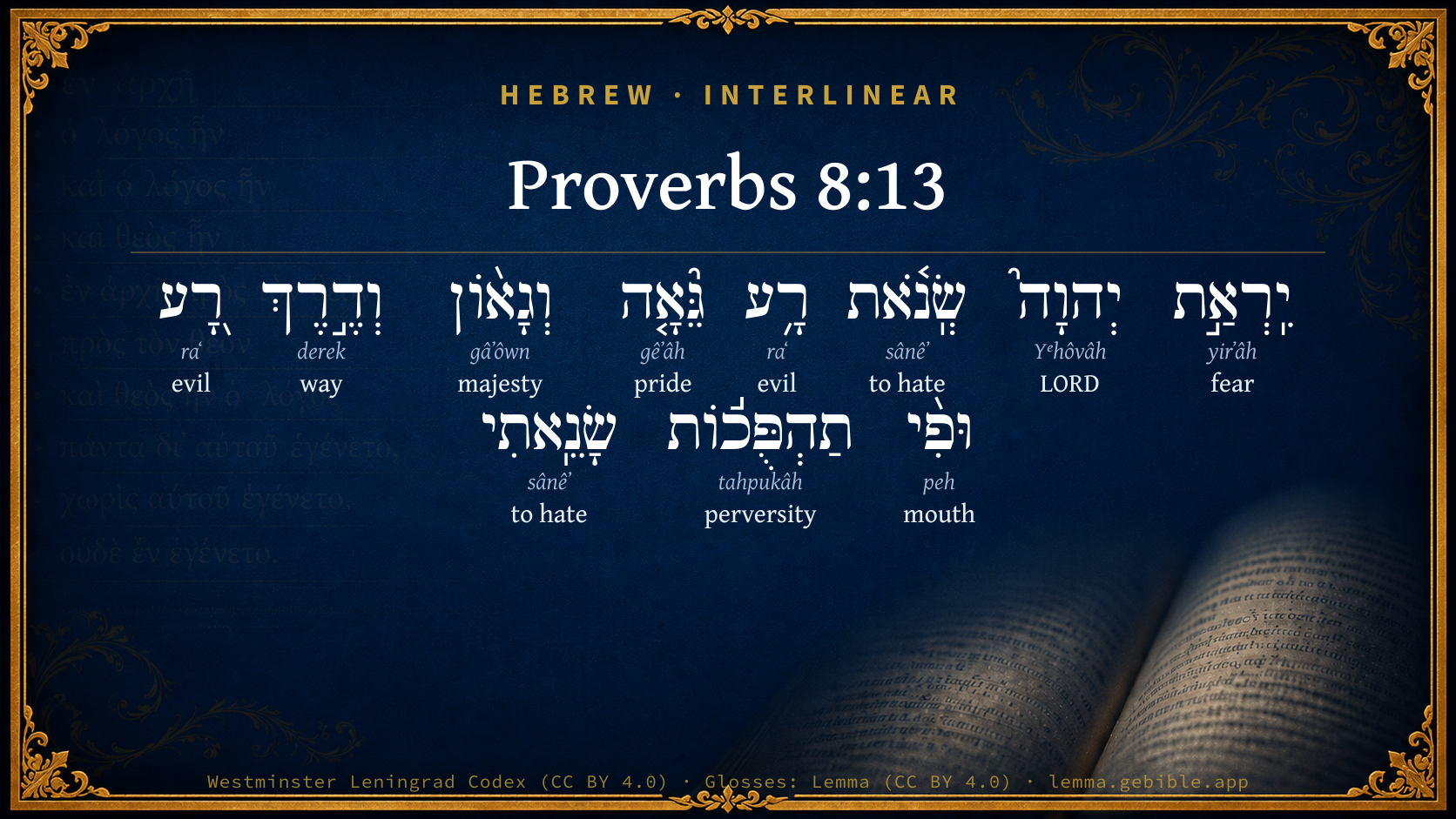
Hebrew (Westminster Leningrad Codex) Proverbs 8:13 appears in the Hebrew Old Testament. The text above is from the Westminster Leningrad Codex. Each word links to its Strong’s number, a concise gloss, and parsing drawn from the Open Scriptures Hebrew Bible morphology. Click any word for its full Brown-Driver-Briggs (BDB) entry.
Download image
Cite this verse

Proverbs 8:13 (World English Bible). Public Domain. Lemma interlinear Bible study tool, https://lemma.gebible.app/v/proverbs/8/13.

Show BibTeX & RIS
BibTeX
RIS
English Translation
The fear of Yahweh is to hate evil. I hate pride, arrogance, the evil way, and the perverse mouth.
World English Bible · Public Domain
Highlights
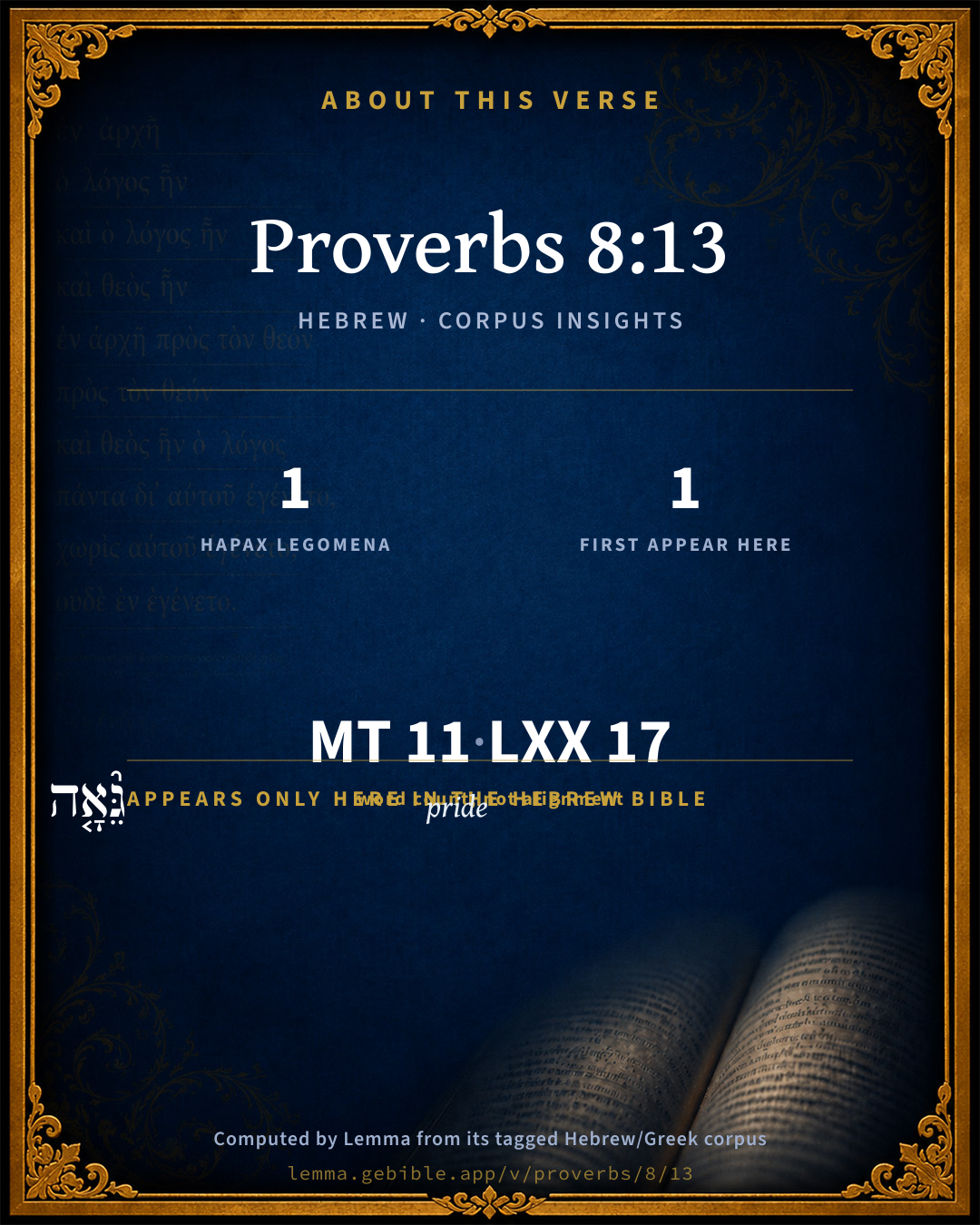
  • 1 hapax legomenon — only here in the Hebrew Bible
  • 1 first appearance in the Hebrew Bible
Full analysis ↓
Download a study sheet

One document with this verse’s original text, its word-by-word gloss line, the meaning frame, cross-references with their text, attributed commentary, and full source and license credits — printable, and it pastes into notes with its structure intact.

This verse Autodidact and up

Study sheet (.html) Plain text (.txt)

A passage Seminary Student

Up to 50 verses in one chapter. A passage sheet keeps up to 6 commentary sources and 12 cross-references per verse, in the order this page ranks them, and says so on the sheet whenever that leaves anything out. Ask for a single verse and you get the Autodidact verse sheet above.

Everything on this page stays free to read, with no account — the sheet is a download of what is already on screen, not access to it.

Want to remove ads? Support Godless Engineer
Compare translations 3

The same verse in 3 English versions, stacked beneath the original-language interlinear above. Click any original word for its lexicon entry.

Each is an independent rendering of the whole verse — the interlinear is not word-aligned to these translations.

Highlighted words mark where these versions differ — a whole-verse word diff, not a word-by-word alignment.

  • World English Bible Public Domain
    The fear of Yahweh is to hate evil. I hate pride, arrogance, the evil way, and the perverse mouth.
  • King James Version Public Domain
    The fear of the LORD is to hate evil: pride, and arrogancy, and the evil way, and the froward mouth, do I hate.
  • unfoldingWord Literal Text CC BY-SA 4.0
    The fear of Yahweh to hate evil. Pride and arrogance and the evil way and the mouth of perverse things I hate.

unfoldingWord Literal Text — © unfoldingWord, licensed CC BY-SA 4.0. Word-aligned USFM3 via Door43 (git.door43.org/unfoldingWord/en_ult).

Versions to compare (up to 4)

3 of 4 selected

Show all 18 translations

Every available English version of this verse, each an independent rendering of the whole verse.

  • World English Bible Public Domain
    The fear of Yahweh is to hate evil. I hate pride, arrogance, the evil way, and the perverse mouth.
  • Berean Standard Bible Public Domain
    To fear the LORD is to hate evil; I hate arrogant pride, evil conduct, and perverse speech.
  • Majority Standard Bible Public Domain
    To fear the LORD is to hate evil; I hate arrogant pride, evil conduct, and perverse speech.
  • King James Version Public Domain
    The fear of the LORD is to hate evil: pride, and arrogancy, and the evil way, and the froward mouth, do I hate.
  • American Standard Version (1901) Public Domain
    The fear of Jehovah is to hate evil: Pride, and arrogancy, and the evil way, And the perverse mouth, do I hate.
  • Revised Version (1885) Public Domain
    The fear of the LORD is to hate evil: pride, and arrogancy, and the evil way, and the froward mouth, do I hate.
  • Geneva Bible (1599) Public Domain
    The feare of the Lord is to hate euill as pride, and arrogancie, and the euill way: and a mouth that speaketh lewde things, I doe hate.
  • Douay-Rheims (1899) Public Domain
    The fear of the Lord hateth evil: I hate arrogance, and pride, and every wicked way, and a mouth with a double tongue.
  • Young's Literal Translation Public Domain
    The fear of Jehovah `is' to hate evil; Pride, and arrogance, and an evil way, And a froward mouth, I have hated.
  • Literal Standard Version CC BY-SA 4.0
    The fear of YHWH [is] to hate evil; Pride, and arrogance, and an evil way, || And a contrary mouth, I have hated.
  • Unlocked Literal Bible CC BY-SA 4.0
    The fear of Yahweh is to hate evil. I hate pride and arrogance, the evil way, and perverted speech. I hate them.
  • unfoldingWord Literal Text CC BY-SA 4.0
    The fear of Yahweh to hate evil. Pride and arrogance and the evil way and the mouth of perverse things I hate.
  • Darby Bible Public Domain
    The fear of Jehovah is to hate evil; pride, and arrogancy, and the evil way, and the froward mouth do I hate.
  • World Messianic Bible Public Domain
    The fear of the LORD is to hate evil. I hate pride, arrogance, the evil way, and the perverse mouth.
  • Webster's Bible Public Domain
    The fear of the LORD is to hate evil: pride, and arrogance, and the evil way, and the froward mouth, do I hate.
  • Free Bible Version CC BY-SA 4.0
    Honoring the Lord means hating evil. So I hate pride and arrogance, wicked behavior and telling lies.
  • Bible in Basic English Public Domain
    The fear of the Lord is seen in hating evil: pride, a high opinion of oneself, the evil way, and the false tongue, are unpleasing to me.
  • JPS Tanakh (1917) Public Domain
    The fear of the LORD is to hate evil; pride, and arrogancy, and the evil way, and the froward mouth, do I hate.

Literal Standard Version (2020), Covenant Press — licensed CC BY-SA 4.0. Text via the HelloAO Bible API (eBible.org). Unlocked Literal Bible (unfoldingWord) — licensed CC BY-SA 4.0. Text via the HelloAO Bible API (eBible.org). unfoldingWord Literal Text — © unfoldingWord, licensed CC BY-SA 4.0. Word-aligned USFM3 via Door43 (git.door43.org/unfoldingWord/en_ult). Free Bible Version, Dr. Jonathan Gallagher — licensed CC BY-SA 4.0. Text via the HelloAO Bible API (eBible.org).

Word by word

More ways to search: Search by grammar → Find every occurrence → Compare this word →

Practice this passage: Drill this verse → Learn its vocabulary →

About this verse

These counts appear in no published source. They are computed here, from the morphology-tagged text and Lemma’s own curated glosses. What Lemma adds →

11
words
9
distinct lemmas
Wisdom
section

Notable vocabulary

1 hapax legomenon — a word that appears only here in the entire Hebrew Bible:

  • גֵּ֘אָ֤ה pride H1344

First appearance in Scripture

This word makes its first canonical appearance in the Hebrew Bible here:

  • גֵּ֘אָ֤ה pride H1344

Shared distinctive vocabulary

תַהְפֻּכ֬וֹת perversity H8419 occurs in 10 verses of the Hebrew Bible. Also found in:

Grammatical profile

  • 2 verbs
  • 7 nouns
  • 2 adjectives

Verb forms

  • שְֽׂנֹ֫את Qal · Infinitive Construct
  • שָׂנֵֽאתִי Qal · Perfect

Repetition

Words recur within this verse — often emphatic in Hebrew:

  • שְֽׂנֹ֫את to hate H8130 ×2
  • רָ֥ע evil H7451 ×2

Hebrew & Septuagint length

In English translation the verse runs 19 words from the Hebrew and 26 from the Septuagint (LXX English) — closely comparable.

A rough comparison of the two English renderings, which tokenize alike — not a word-level alignment.

Word counts can differ between the Hebrew and the Greek without any difference in meaning — e.g. the Hebrew direct-object marker אֵת has no separate Greek word, and Greek often adds the article ὁ.

In the original languages it is 11 Hebrew tokens and 17 Greek tokens — but the two are counted differently (Hebrew bundles its prefixes and suffixes into one token; the Greek is in lemma form), so that isn’t a like-for-like length.

Cross-references

19

Topical passages linked to Proverbs 8:13 in the Treasury of Scripture Knowledge — connected by theme and wording, ordered by reader-vote popularity; previews shown in the World English Bible.

  • Psalms 97:10 You who love Yahweh, hate evil. He preserves the souls of his saints. He delivers them out of the hand of the wicked.
  • Proverbs 16:6 By mercy and truth iniquity is atoned for. By the fear of Yahweh men depart from evil.
  • 1 Samuel 2:3 Talk no more so exceeding proudly; Don't let arrogance come out of your mouth; For Yahweh is a God of knowledge, By him actions are weighed.
  • Proverbs 4:24 Put away from yourself a perverse mouth. Put corrupt lips far from you.
  • 1 Thessalonians 5:22 Abstain from every form of evil.
  • 1 Peter 5:5 Likewise, you younger ones, be subject to the elder. Yes, all of you gird yourselves with humility, to subject yourselves to one another; for "God resists the proud, but gives grace to the humble."
  • Psalms 119:128 Therefore I consider all of your precepts to be right. I hate every false way.
  • Amos 5:15 Hate evil, love good, And establish justice in the courts. It may be that Yahweh, the God of hosts, will be gracious to the remnant of Joseph."
  • Psalms 5:4–5 For you are not a God who has pleasure in wickedness. Evil can't live with you.
  • Proverbs 6:12 A worthless person, a man of iniquity, Is he who walks with a perverse mouth;
  • Proverbs 6:16–19 There are six things which Yahweh hates; Yes, seven which are an abomination to him:
  • Proverbs 16:18 Pride goes before destruction, And a haughty spirit before a fall.
  • Psalms 101:3 I will set no vile thing before my eyes. I hate the deeds of faithless men. They will not cling to me.
  • 2 Timothy 2:19 However God's firm foundation stands, having this seal, "The Lord knows those who are his," and, "Let every one who names the name of the Lord depart from unrighteousness."
  • Psalms 138:6 For though Yahweh is high, yet he looks after the lowly; But the proud, he knows from afar.
  • Zechariah 8:17 and let none of you devise evil in your hearts against his neighbor, and love no false oath: for all these are things that I hate," says Yahweh.
  • Romans 12:9 Let love be without hypocrisy. Abhor that which is evil. Cling to that which is good.
  • Psalms 119:104 Through your precepts, I get understanding; Therefore I hate every false way.
  • Proverbs 10:31 The mouth of the righteous brings forth wisdom, But the perverse tongue will be cut off.

Cross-references courtesy of OpenBible.info (CC BY 4.0).

Hebrew and Greek witnesses Masoretic Hebrew ↔ Greek Septuagint

The same verse in the two great witnesses to the Old Testament, shown verse-for-verse.

These are two independent witnesses, not word-aligned to each other, and the Septuagint is shown in lemma (dictionary) form.

Hebrew Proverbs 8:13 Masoretic · Westminster Leningrad Codex

יִֽרְאַ֣ת יְהוָה֮ שְֽׂנֹ֫את רָ֥ע גֵּ֘אָ֤ה וְגָא֨וֹן וְדֶ֣רֶךְ רָ֭ע וּפִ֨י תַהְפֻּכ֬וֹת שָׂנֵֽאתִי

The fear of Yahweh is to hate evil. I hate pride, arrogance, the evil way, and the perverse mouth.

World English Bible · Public Domain

Greek LXX Proverbs 8:13 Septuagint · lemma form

φόβος κύριος μισέω ἀδικία ὕβρις τε καί ὑπερηφανία καί ὁδός πονηρός μισέω δέ ἐγώ διαστρέφω ὁδός κακός

The fear of the Lord hates unrighteousness, and insolence, and pride, and the ways of wicked men; and I hate the perverse ways of bad men.

LXX2012 (modern English Septuagint) · Public Domain

Hebrew: Westminster Leningrad Codex (CC BY 4.0). Greek: Septuagint (public domain); English from LXX2012 (modern English Septuagint) (Public Domain). How the Septuagint differs from the Hebrew →

Commentary

Notes on Proverbs 8:13 from classic Christian and Jewish commentators (each source and its license shown beneath its notes). The classic Christian expositions comment on the surrounding passage and are grouped to its opening verse, so a note may address several verses; the Jewish commentaries on the Tanakh (Rashi and others) are per-verse, so they appear only where the commentator wrote on this verse.

Lemma curates 59 commentaries, every one of them public domain or Creative Commons licensed, each selected and text-cleaned for this edition rather than reprinted as found. About our sources →

Trapp's Complete Commentary

John Trapp

Pro 8:13 The fear of the LORD [is] to hate evil: pride, and arrogancy, and the evil way, and the froward mouth, do I hate.

Ver. 13. The fear of the Lord.] Which is a high point of heavenly wisdom, {Pro 1:7} to the praise whereof this therefore appertaineth. There are those who make this verse an explanation of the former, thus: I find out the knowledge of witty inventions, such as are the fear of the Lord, the hatred of evil, yea, of inward evils, as pride, arrogancy, &c. Odi fastum istius Ecclesiae. I hate the pride of that Romish Church, said Basil, long since. "I hate vain thoughts; but thy law do I love." {Psa 119:113} "I hate and abhor lying." {Psa 119:163} "Yea, I hate every false way," both in myself and others. {Psa 119:104} "Thou hatest the works of the Nicolaitans, which I also hate." {Rev 2:6} God’s people partake of the Divine nature, and so have God-like both sympathies and antipathies. They not only leave sin, but loathe it, and are at deadly feud with it. They purge themselves - by this clean fear of God {Psa 19:7} - from all pollutions, not of flesh only, worldly lusts, and gross evils, but of spirit also, that lie more up in the heart of the country, as pride, arrogance, &c., so "perfecting holiness in the fear of God." {2Co 7:1} There may be some kind of pride in sincerity, and of humility in hypocrisy. But hypocrisy’s humility is followed with pride, and sincerity’s pride with humility. This latter humility is the better. And here only it is seemly for virtue to come behind vice. Hypocrisy is proud because it is humble; sincerity is humble because it is proud.

And the evil way.] That is, Custom of committing sin. Viam pro frequentatione accipiunt Hebraei. And this the godly man doth, not that he may appear to do so, sed quia aliter facere non potuit - as one {a} falsely and flatteringly said of Cato - but because having his heart seasoned with this holy fear, he can do no otherwise.

{a} Velleius.

John Trapp, A Commentary or Exposition upon All the Books of the Old and New Testament (1647–1656) — public domain. Text from a community e-Sword module.

The Biblical Illustrator

Joseph S. Exell

Pro_8:13

The fear of the Lord to to hate evil.

Hatred of evil

A formal definition of the fear of the Lord. To dread the punishment of sin seems to be the main feature in that religion which, under many forms, springs native in the human heart. This is the mainspring which sets and keeps all the machinery of superstition going. It was a maxim of heathen antiquity, that Fear made God. To fear retribution is not to hate sin. It is a solemn suggestion that ever the religion of dark, unrenewed men is, in its essence, a love of their own sins. Instead of hating sin themselves, their grand regret is that God hates it. If they could be convinced that the Judge would regard it as lightly as the culprit, the fear would collapse like steam under cold water, and all the religious machinery which it drove would stand still. All the false religions that have ever desolated the earth are sparks from the collision of these two hard opposites--Gods hate of sin, and mans love for it. In Christ only may this sore derangement be healed. It is when sin is forgiven that a sinner can hate it. Instead of hating God for His holiness, the forgiven man instinctively loathes the evil of his own heart, and looks with longing for the day when all things in it shall be made new. Such is the blessed fruit of pardon when it comes to a sinner through the blood of Christ. (W. Arnot, D. D.)

A hidden token of the fear towards God

It is not merely in enlightenment of mind that the fear towards God has its result. By the fear of the Lord men depart from evil. This departing from evil is the practical manifestation of a principle; it is habitual practice founded on a strong conviction of duty. In this text, the fear of the Lord is connected with the inward feeling of dislike for evil. Hatred, like love, is of the heart.

I. This fear must not be misunderstood as to its nature. It may be twofold. The alarm that is awakened by the threat of violence, or of immediate privation, is one kind of fear. This is the fear of dread, or terror. The other kind of fear is of respect or reverence, and this can only dwell in the heart of a friend towards a friend, or of a faithful servant towards a master worthy of esteem, or of a dutiful child towards an honoured parent. This is the fear of the Lord. What other fear should God be desirous of receiving and acknowledging at their hands?

II. If there be this fear, there will also be the hatred of evil. The Holy One cannot be so indulgent as to put no difference between godly fear and the love of sin. God hates evil as abhorrent from His holy nature. To require that we hate evil is no more than what the holiness of His own character requires from Himself. This requirement shows that God would draw us nearer to Himself. As He hates evil, He would have us hate it. (J. Rhenius, M. A.)

The Biblical Illustrator, edited by Joseph S. Exell (c. 1880s–1900s) — public domain. Text from a community e-Sword module.

Joseph Benson's Commentary

Pro 8:13. The fear of the Lord — Which he had before said to be the beginning of wisdom; is to hate evil — It consists in a careful abstinence from all sin, and that not from carnal or prudential motives, but from real hatred to it, on account of its contrariety to the divine nature and attributes, its opposition to God’s word and will, its infinite evil in itself, and its eternally destructive consequences; pride — Which he mentions first, as that which is most hateful to God, and most opposite to true wisdom, and to the genuine fear of God, which constantly produces humility; and the evil way — All wicked actions, especially sinful customs and courses; and the froward mouth, do I hate — False doctrines, and bad counsels, and deceits.

Joseph Benson's Commentary on the Old and New Testaments (1811–1818) — public domain. Text from a community e-Sword module.

Tyndale Open Study Notes

Tyndale Open Resources

8:13 Those who choose wisdom, i.e., those who fear the Lord (see 1:7; 9:10), will not speak in ways that harm others or bend the truth.

Tyndale Open Study Notes — © Tyndale Open Resources, licensed CC BY-SA 4.0. Text via the HelloAO Bible API.

Geneva Bible (1599)

Geneva Bible translators

So that he that doth not hate evil, feareth not God.

Geneva Bible (1599) marginal notes — public domain. Text via Bolls.life.

Jamieson, Fausset & Brown

Robert Jamieson, A. R. Fausset & David Brown

For such is the effect of the fear of God, by which hatred to evil preserves from it.

froward mouth--or, "speech" (Pro 2:12; Pro 6:14).

Jamieson, Fausset & Brown — Commentary Critical and Explanatory on the Whole Bible (1871) — public domain (CC PDM 1.0). Text via the HelloAO Bible API.

Adam Clarke's Commentary

Verse 13. The fear of the Lord is to hate evil] As it is impossible to hate evil without loving good; and as hatred to evil will lead a man to abandon the evil way; and love to goodness will lead him to do what is right in the sight of God, under the influence of that Spirit which has given the hatred to evil, and inspired the love of goodness: hence this implies the sum and substance of true religion, which is here termed the fear of the Lord.

Adam Clarke's Commentary on the Bible (1810–1826) — public domain. Text from a community e-Sword/MySword module.

Ellicott's Commentary for English Readers

(13) The fear of the Lord is to hate evil.—Because there can never be any truce between the kingdoms of light and darkness (Mat_6:24), so if we are the friend of one, we must be the enemy of the other.

Pride and arrogancy . . . do I hate.—See above on Pro_6:17.

A Bible Commentary for English Readers, edited by Charles John Ellicott (1878–1897) — public domain. Text from a community e-Sword module.

The Cambridge Bible for Schools and Colleges

gen. ed. J. J. S. Perowne

13. I hate] This quiet identification of herself by Wisdom with the fear of the Lord, in the first clause of the verse, is significant. See Introd., p. 31.

The Cambridge Bible for Schools and Colleges (gen. ed. J. J. S. Perowne; Cambridge University Press, 1878–1918) — public domain. Text from a community e-Sword module.

John Gill's Exposition

The fear of the Lord is to hate evil,.... All evil in general, evil thoughts, evil words, evil actions, evil company, evil worship, and evil doctrines; and by "the fear of the Lord", which shows itself in an hatred of evil, because of the loathsome nature of it, and being contrary to God and his will, and as it appears in the glass of the law, and especially in the glass of pardoning love, is meant not the fear of his judgments and wrath, or a distrust of his grace and goodness, much less an hypocritical fear, or a mere show of devotion; but a reverential affection for him, which is peculiar to children; a filial, godly fear, which is consistent with strong faith, great joy, and true courage; and is opposite to pride and self-confidence, and is accompanied with real holiness; it takes its rise from the grace of God, and is greatly increased and promoted by the discoveries of his love and goodness: this is brought into the account and description of wisdom, to distinguish it from carnal wisdom; to commend wisdom from its holiness; for this the beginning of wisdom, yea, wisdom itself, Job 28:28;

pride and arrogancy, and the evil way, and the froward mouth, do I hate; these are the particulars of evil, which Wisdom, or Christ, declares his hatred of. "Pride", which appears in men in thinking too highly of themselves, in speaking too well of themselves, in despising others, in setting up and trusting to their own righteousness for salvation, and in crying up the purity and power of human nature; this is very contrary to the spirit of the meek and lowly Jesus, and must be hateful to him: "arrogancy" differs little from pride, and the two words in the Hebrew are very much the same, very little differ; it is an ascribing that to a man's self which does not belong to him, whether in things natural, civil, or spiritual; when men attribute their justification and salvation to their own works, it is arrogancy, and must be hateful to Christ; who been at so much pains and expense to bring in everlasting righteousness, and work out salvation for men: it is the height of arrogancy in a man to conceit he a power to regenerate, renew, and convert himself, and, with the haughty Arminian, Grevinchovius, to say, he has made himself to differ from others; this must be hateful to Christ, by whose Spirit and grace this only is done: and it is a piece of arrogancy when men ascribe all the good works done by them to their own power, when without Christ they can do nothing; which therefore must be displeasing to him. "The evil way", as Aben Ezra observes, is an evil custom and course of sinning; a man's own way, which he chooses and delights in, and which leads to destruction: "and the froward mouth" is the mouth that speaks perverse things; things contrary to a man's own heart, contrary to truth, to the rule of the divine word, to the Gospel, to Christ and his people, and to all men; which must be hateful and abominable to him who is truth itself.

John Gill's Exposition of the Whole Bible (1746–1763) — public domain (CC PDM 1.0). Text via the HelloAO Bible API.

Matthew Poole's English Annotations

The fear of the Lord; which he had before noted to be the beginning of wisdom, Pro 1:7.

Is to hate evil; it consists in a careful abstinence from all sin, and that not from carnal or prudential motives, but from a true dislike and hatred of it.

Pride; which he mentions first, as that which is most hateful to God, and most opposite to true wisdom and to the fear of God, which constantly produce humility.

The evil way; all wicked actions, especially sinful custom: and courses.

The froward mouth; false doctrines, and bad counsels and deceits.

Matthew Poole's English Annotations on the Holy Bible (1683–1685) — public domain. Text from a community e-Sword/MySword module.

Whedon's Commentary on the Bible

Daniel D. Whedon

13. The fear of the Lord — JEHOVAH. A phrase equivalent to our term true piety. (See Pro_1:7, and note.)

Is to hate evil — That is, true piety, or true religion, produces a hatred of all evil. This is its essence. Certain forms of evil are then specified.

Pride, and arrogancy — Lofty feelings and lofty thoughts of one’s self.

The evil way — All wicked courses of conduct.

And the froward mouth — All perverse and perverting speech. These four appellations seem to cover the feelings, thoughts, words, and actions. The man of piety, the votary of divine Wisdom, must, like her, hate all manner of evil, and consequently love and practice all manner of good. Compare Pro_1:7; Pro_1:29; Pro_2:5; Pro_3:7; Pro_9:10. On froward, compare Pro_2:12; Pro_10:31.

Daniel D. Whedon (gen. ed.), Commentary on the Old and New Testaments (1874–1909) — public domain. Text from a community e-Sword module.

The Pulpit Commentary

The fear of the Lord is to hate evil. Wisdom here enunciates the proposition which is the foundation of all her teaching, only here, as it were, on the reverse side, net as the beginning of wisdom, (Pro_1:7 Pro_9:10) but as the hatred of evil; she then proceeds to particularize the evil which the Lord hates. Taking the clause in this sense, we have no need to alter the persons and forms of the verbs to "I fear the Lord, I hate evil," as Dathe and others suggest; still less to suppress the whole paragraph as a late insertion. These violent measures are arbitrary and quite unnecessary, the present text allowing a natural and sufficient exposition. There can be no fellowship between light and darkness; he who serves the Lord must renounce the works of the devil. Pride and arrogancy, which are opposed to the sovereign virtue of humility, are the first sins which Wisdom names. These are among the things which the Lord is said to hate. (Pro_6:17, etc.) "Initium omnis peccati est superbia" (Ecc_10:15, Vet. Lat.). The evil way; i.e. sins of conduct, "way" being, as commonly, equivalent to "manner of life." The froward mouth; literally, mouth of perverseness, sins of speech; (see on Pro_2:12; and comp. Pro_10:31) Vulgate, os bilingue.

Hatred of evil.

I RELIGION INCLUDES MORALS. This is the broad lesson of the text. It should be accepted as a self-evident truism. Yet it has been often obscured by dangerous sophisms. Thus some have regarded religion as consisting in correctness of creed or in assiduity of devotion things treated by God as worthless unless accompanied by righteousness of conduct. (Isa_1:10-17) There is a common impression that religious merits may be pleaded as a set off against moral deficiencies. No assumption can be more false, nor can any be more degrading or more injurious. The reverse is true. Religiousness increases the guilt of unrighteousness of life by raising the standard up to which one is supposed to live, and also adds the sin of hypocrisy. True religion is impossible without a proportionate devotion to righteousness. because it consists in the fear of God. But God is holy; to reverence him must involve the adoration of his character the love of goodness and the corresponding detestation of its opposite.

II RELIGION INSPIRES MORALS WITH STRONG EMOTION. Morality is to obey the law. Religion goes further, and hates evil. It is not a matter of outward conduct only. It goes down to the secret springs of action. It rouses the deepest passions of the soul. We cannot accept Mr. M. Arnold"s definition of religion as "morality touched with emotion," because it ignores the foundation of religion in "the fear of the Lord," in devotion to a personal God; but the phrase may serve as an apt description of an essential characteristic of religion. The difficulty we all feel is that, while we know the better way we are often so weak as to choose the worse. A cold, bare exposition of morality will be of little use with this difficulty. What we want is a powerful impulse, and that impulse it is the function of religion to supply. It makes goodness not only visible but beautiful and attractive, and it inspires a hunger and thirst after righteousness, a passion for a God-like life in the love of God, a yearning after the likeness of Christ in devotion of heart to him. It also makes evil appear hideous, detestable, by its horrible opposition to these affections.

III AMONG RELIGIOUS EMOTIONS IS THE PASSION OF HATRED. Religion is not based upon hatred. It begins with" the fear of the Lord," with reverence for God rising up to love. No strong thing can rest on a mere negation. Neither morality nor religion starts from an attitude in regard to evil. But they lead on to this, and they are not perfect without it. The passion of hatred is natural; it has a useful, though a low, place in the array of spiritual forces. It is abused when it is spent upon persons, but it is rightly indulged against evil principles and practices. We are morally defective unless we can feel "the hate of hate, and scorn of scorn." One of the means by which we are helped to resist sin is found in this hatred of it. It is not enough that we disapprove of it. We must loathe and abhor it from the very bottom of our hearts.

IV RELIGIOUS HATRED IS DETESTATION OF EVIL ITSELF, NOT THE MERE DISLIKE OF ITS CONSEQUENCES. When Paley, in his "Moral Philosophy," described the function of religion in aiding morality as the addition of the prospect of future rewards and promises, he expressed a common sense truth, but a very low truth detached from more spiritual ideas and a very partial representation of the case. Religious morality is not simply nor chiefly the fear of God as a Judge who will punish us if we do wrong. It is reverence for a holy Father leading to hatred of all that is displeasing to him. We have no religion till we go beyond the instinctive dislike for pain that follows sin to hatred of sin itself. This is the test of true religion that we love goodness and hate evil for their own sakes. It is interesting to observe that the sin selected for special abhorrence on the part of those who are inspired by "the fear of the Lord" is pride. This is spiritual wickedness of the most fatal character, In its feeling of personal merit and self-sufficiency it excludes both repentance and faith the two fundamental conditions of spiritual religion. Therefore the spirit of the Pharisee and all pride must be hated above all things, and will be hated by those who have true reverence for the great and holy God, and true love for the lowly Christ who promised the kingdom of heaven to the "poor in spirit". (Mat_5:3)

The Pulpit Commentary (1880–1919), ed. H.D.M. Spence-Jones & Joseph S. Exell — public domain. Text from a community e-Sword module.

Keil & Delitzsch

C. F. Keil & F. Delitzsch

Far remote is the idea that 13a is dependent on אמצא (I acquire) (Lwenstein, Bertheau). With this verse begins a new series of thoughts raising themselves on the basis of the fundamental clause 13a. Wisdom says what she hates, and why she hates it:

13 "The fear of Jahve is to hate evil;

Pride and arrogancy, and an evil way

And a deceitful mouth, do I hate."

If the fear of God is the beginning of wisdom (Pro 9:10; Pro 1:7), then wisdom, personally considered, stands before all else that is to be said of her in a relation of homage or reverence toward God corresponding to the fear of God on the part of man; and if, as the premiss 13a shows, the fear of God has as its reverse side the hatred of evil, then there arises what Wisdom says in שׂנאתי (I hate) of herself. Instead of the n. actionis שׂנאת (hatred), formed in the same way with יראת, which, admitting the article, becomes a substantive, the author uses, in order that he might designate the predicate as such (Hitzig), rather the n. actionis שׂנאת as מלאת, Jer 29:10. קראת, Jdg 8:1, is equivalent to שׂנאת like יבּשׁת, the becoming dry, יכלת, the being able; cf. (Arab.) shanat, hating, malât, well-being, ḳarât, reading (Fl.). The evil which Wisdom hates is now particularized as, Pro 6:16-19, the evil which Jahve hates. The virtue of all virtues is humility; therefore Wisdom hates, above all, self-exaltation in all its forms. The paronomasia גּאה וגאון (pride and haughtiness) expresses the idea in the whole of its contents and compass (cf. Isa 15:6; Isa 3:1, and above at Pro 1:27). גּאה (from גּאה, the nominal form), that which is lofty = pride, stands with גּאון, as Job 4:10, גבהּ, that which is high = arrogance. There follows the viam mali, representing the sins of walk, i.e., of conduct, and os fullax (vid., at Pro 2:12), the sins of the mouth. Hitzig rightly rejects the interpunctuation רע, and prefers רע. In consequence of this Dech (Tiphcha init.), וּפי תהפּכת have in Codd. and good editions the servants Asla and Illuj (vid., Baer's Torath Emeth, p. 11); Aben-Ezra and Moses Kimchi consider the Asla erroneously as disjunctive, and explain וּפי by et os = axioma meum, but Asla is conjunctive, and has after it the ת raphatum.

Keil & Delitzsch — Biblical Commentary on the Old Testament (1861–1891) — public domain (CC PDM 1.0). Text via the HelloAO Bible API. (Old Testament only.)

Bridges on Proverbs

Charles Bridges

Such is the holiness of Divine wisdom! She dwells with prudence. But she cannot dwell with evil. Therefore, the fear of the LORD, which is her very nature, is to hate evil. (Pro 3:7 ; Pro 16:6 .) Thus of pride in all its branches — arrogancy of spirit, the evil way and the froward mouth — the Wisdom of God declares without reserve — I hate them. (Pro 6:16-19 ; Pro 16:5 . Psa 45:7 . Zec 8:17 .) How clearly did he mark his hatred in the days of his flesh by the full exhibition of the opposite grace! "The Son of man came not to be ministered unto, but to minister." (Mat 20:28 . Luk 22:27 .) A proud disciple of a lowly Savior! how offensive is this contradiction to our Master! What a cause of stumbling to the world!

Charles Bridges, An Exposition of the Book of Proverbs (1846) — public domain. Text from a community e-Sword module.

Scofield Reference Notes

C. I. Scofield

fear

(See Scofield "Psa 19:9")

The Scofield Reference Bible (1917 edition), notes by C. I. Scofield — public domain. Text from a community e-Sword module.

Rashi

Rabbi Shlomo Yitzchaki (Rashi)

Fear of the Lord is to hate evil This is the discipline that wisdom announces to the people.

Rashi on the Tanakh — English translations: “The Judaica Press complete Tanach with Rashi, translated by A. J. Rosenberg” (CC BY 4.0); “Pentateuch with Rashi's commentary by M. Rosenbaum and A.M. Silbermann, 1929-1934” (public domain); “The Metsudah Tanach series, Lakewood, N.J” (CC BY 4.0); and “The Book of Joshua, Metsudah Publications, 1997” (CC BY 4.0). Text via Sefaria.

Lesson kit

Teaching starters — assembled from the data on this page, not authored interpretation. Every prompt links to the verse data it draws on. Edit before teaching.

Proverbs, in the Wisdom, opens this verse with 11 words (9 distinct Hebrew lemmas). Its most distinctive word is gêʼâh (“pride”). A historical commentator’s framing appears above. Read the whole chapter for the surrounding context.

Discussion questions

  1. The word gêʼâh carries the sense “pride.” How does it shape the verse?
  2. 1 word here appears nowhere else in the Hebrew Bible. Why might the author reach for such rare wording?
  3. This is the first place “pride” appears in Scripture (first appears here). What does its debut here establish?
  4. How does Deuteronomy 32:20, which shares the word «perversity», read alongside this verse?
  5. What does the repetition of “to hate” (2× in this one verse) do in this verse?
  6. The translations on this page render this verse differently — a whole-verse word diff, not a word-by-word alignment. What might account for the different wordings?
  7. «שְֽׂנֹ֫את» is a Qal Infinitive Construct verb. How does that grammatical form shape the action described?
  8. Compare how Trapp's Complete Commentary and The Biblical Illustrator read this verse. Where do they agree or differ?

Things to notice

  • 1 word in this verse appears nowhere else in the Hebrew Bible.
  • 1 word makes its first canonical appearance in Scripture here.
  • This verse counts 11 Hebrew ↔ 17 Greek words.
  • These translations choose different wording for 8 words in this verse.
  • “to hate” occurs 2× in this single verse.

Reading settings

Reading text

Shown beneath each verse's original-language words.

Old Testament
Old Testament edition

Read the OT as the Masoretic Hebrew (MT) or the Greek Septuagint (LXX).

English shown for the Greek Septuagint (in the Hebrew ↔ Greek comparison).

Comparing translations? Open the Compare panel on any verse page to stack up to four side by side.