2 Samuel 13:22

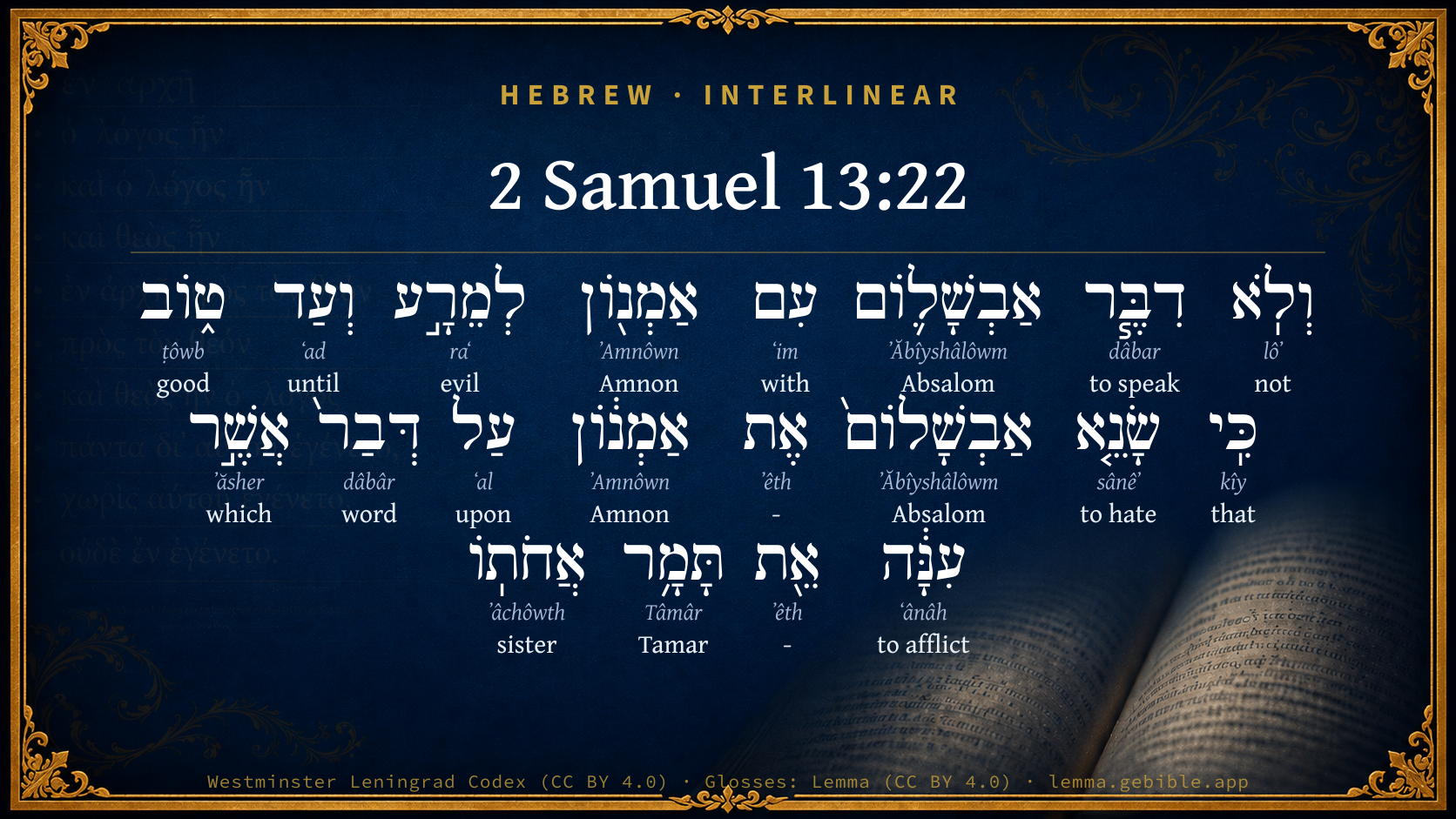
Hebrew (Westminster Leningrad Codex) 2 Samuel 13:22 appears in the Hebrew Old Testament. The text above is from the Westminster Leningrad Codex. Each word links to its Strong’s number, a concise gloss, and parsing drawn from the Open Scriptures Hebrew Bible morphology. Click any word for its full Brown-Driver-Briggs (BDB) entry.
Download image
Cite this verse

2 Samuel 13:22 (World English Bible). Public Domain. Lemma interlinear Bible study tool, https://lemma.gebible.app/v/2-samuel/13/22.

Show BibTeX & RIS
BibTeX
RIS
English Translation
Absalom spoke to Amnon neither good nor bad; for Absalom hated Amnon, because he had forced his sister Tamar.
World English Bible · Public Domain
Download a study sheet

One document with this verse’s original text, its word-by-word gloss line, the meaning frame, cross-references with their text, attributed commentary, and full source and license credits — printable, and it pastes into notes with its structure intact.

This verse Autodidact and up

Study sheet (.html) Plain text (.txt)

A passage Seminary Student

Up to 50 verses in one chapter. A passage sheet keeps up to 6 commentary sources and 12 cross-references per verse, in the order this page ranks them, and says so on the sheet whenever that leaves anything out. Ask for a single verse and you get the Autodidact verse sheet above.

Everything on this page stays free to read, with no account — the sheet is a download of what is already on screen, not access to it.

Want to remove ads? Support Godless Engineer
Compare translations 3

The same verse in 3 English versions, stacked beneath the original-language interlinear above. Click any original word for its lexicon entry.

Each is an independent rendering of the whole verse — the interlinear is not word-aligned to these translations.

Highlighted words mark where these versions differ — a whole-verse word diff, not a word-by-word alignment.

  • World English Bible Public Domain
    Absalom spoke to Amnon neither good nor bad; for Absalom hated Amnon, because he had forced his sister Tamar.
  • King James Version Public Domain
    And Absalom spake unto his brother Amnon neither good nor bad: for Absalom hated Amnon, because he had forced his sister Tamar.
  • unfoldingWord Literal Text CC BY-SA 4.0
    But Absalom did not speak with Amnon to evil or to good, for Absalom hated Amnon for the reason that he had humbled Tamar his sister.

unfoldingWord Literal Text — © unfoldingWord, licensed CC BY-SA 4.0. Word-aligned USFM3 via Door43 (git.door43.org/unfoldingWord/en_ult).

Versions to compare (up to 4)

3 of 4 selected

Show all 18 translations

Every available English version of this verse, each an independent rendering of the whole verse.

  • World English Bible Public Domain
    Absalom spoke to Amnon neither good nor bad; for Absalom hated Amnon, because he had forced his sister Tamar.
  • Berean Standard Bible Public Domain
    And Absalom never said a word to Amnon, either good or bad, because he hated Amnon for disgracing his sister Tamar.
  • Majority Standard Bible Public Domain
    And Absalom never said a word to Amnon, either good or bad, because he hated Amnon for violating his sister Tamar.
  • King James Version Public Domain
    And Absalom spake unto his brother Amnon neither good nor bad: for Absalom hated Amnon, because he had forced his sister Tamar.
  • American Standard Version (1901) Public Domain
    And Absalom spake unto Amnon neither good nor bad; for Absalom hated Amnon, because he had forced his sister Tamar.
  • Revised Version (1885) Public Domain
    And Absalom spake unto Amnon neither good nor bad: for Absalom hated Amnon, because he had forced his sister Tamar.
  • Geneva Bible (1599) Public Domain
    And Absalom sayde vnto his brother Amnon neither good nor bad: for Absalom hated Amnon, because he had forced his sister Tamar.
  • Douay-Rheims (1899) Public Domain
    But Absalom spoke not to Amnon neither good nor evil: for Absalom hated Amnon because he had ravished his sister Thamar.
  • Young's Literal Translation Public Domain
    and Absalom hath not spoken with Amnon either evil or good, for Absalom is hating Amnon, because that he humbled Tamar his sister.
  • Literal Standard Version CC BY-SA 4.0
    and Absalom has not spoken with Amnon either evil or good, for Absalom is hating Amnon, because that he humbled his sister Tamar.
  • Unlocked Literal Bible CC BY-SA 4.0
    Absalom said nothing to Amnon, for Absalom hated him for what he had done to her and how he had disgraced his sister Tamar.
  • unfoldingWord Literal Text CC BY-SA 4.0
    But Absalom did not speak with Amnon to evil or to good, for Absalom hated Amnon for the reason that he had humbled Tamar his sister.
  • Darby Bible Public Domain
    And Absalom spoke to Amnon neither good nor bad; for Absalom hated Amnon, because he had humbled his sister Tamar.
  • World Messianic Bible Public Domain
    Absalom spoke to Amnon neither good nor bad; for Absalom hated Amnon, because he had forced his sister Tamar.
  • Webster's Bible Public Domain
    And Absalom spoke to his brother Amnon neither good nor bad: for Absalom hated Amnon, because he had forced his sister Tamar.
  • Free Bible Version CC BY-SA 4.0
    Absalom didn't talk to Amnon at all because he hated Amnon for raping his sister Tamar.
  • Bible in Basic English Public Domain
    But Absalom said nothing to his brother Amnon, good or bad: for he was full of hate for him, because he had taken his sister Tamar by force.
  • JPS Tanakh (1917) Public Domain
    And Absalom spoke unto Amnon neither good nor bad; for Absalom hated Amnon, because he had forced his sister Tamar.

Literal Standard Version (2020), Covenant Press — licensed CC BY-SA 4.0. Text via the HelloAO Bible API (eBible.org). Unlocked Literal Bible (unfoldingWord) — licensed CC BY-SA 4.0. Text via the HelloAO Bible API (eBible.org). unfoldingWord Literal Text — © unfoldingWord, licensed CC BY-SA 4.0. Word-aligned USFM3 via Door43 (git.door43.org/unfoldingWord/en_ult). Free Bible Version, Dr. Jonathan Gallagher — licensed CC BY-SA 4.0. Text via the HelloAO Bible API (eBible.org).

Word by word

More ways to search: Search by grammar → Find every occurrence → Compare this word →

Practice this passage: Drill this verse → Learn its vocabulary →

תָּמָ֥ר
Tâmâr
H8559
“Tamar”
Noun, Proper
Part of Speech
Noun
Type
Proper
Full BDB Definition

Origin: the same as H8558

TWOT: None

Tamar = "palm-tree" - widow of Er, the son of Judah; fiancee of Shelah, another son of Judah; wife of Judah and mother of Pharez and Zerah (noun proper feminine) - daughter of David by Maacah, sister of Absalom, and rape victim of Amnon her half brother, another son of David (noun proper feminine) - daughter of Absalom (noun proper feminine) - a place on the southern border of Gad (noun proper locative)
  1. וְלֹֽא lôʼ H3808 “and · not” Conjunction + Particle, Negative
  2. דִבֶּ֧ר dâbar H1696 “to speak” Verb, Piel, Perfect, 3rd Person, Masculine, Singular
  3. אַבְשָׁל֛וֹם ʼĂbîyshâlôwm H53 “Absalom” Noun, Proper
  4. עִם ʻim H5973 “with” Preposition
  5. אַמְנ֖וֹן ʼAmnôwn H550 “Amnon” Noun, Proper
  6. לְמֵרָ֣ע raʻ H7451 “to/for · from · evil” Preposition + Preposition + Adjective, Adjective, Masculine, Singular, Absolute
  7. וְעַד ʻad H5704 “and · until” Conjunction + Preposition
  8. ט֑וֹב ṭôwb H2896 “good” Adjective, Adjective, Masculine, Singular, Absolute
  9. כִּֽי kîy H3588 “that” Conjunction
  10. שָׂנֵ֤א sânêʼ H8130 “to hate” Verb, Qal, Perfect, 3rd Person, Masculine, Singular
  11. אַבְשָׁלוֹם֙ ʼĂbîyshâlôwm H53 “Absalom” Noun, Proper
  12. אֶת ʼêth H853 “-” Particle, Direct Object
  13. אַמְנ֔וֹן ʼAmnôwn H550 “Amnon” Noun, Proper
  14. עַל ʻal H5921 “upon” Preposition
  15. דְּבַר֙ dâbâr H1697 “word of” Noun, Common, Masculine, Singular, Construct
  16. אֲשֶׁ֣ר ʼăsher H834 “which” Particle, Relative
  17. עִנָּ֔ה ʻânâh H6031 “to afflict” Verb, Piel, Perfect, 3rd Person, Masculine, Singular
  18. אֵ֖ת ʼêth H853 “-” Particle, Direct Object
  19. אֲחֹתֽוֹ ʼâchôwth H269 “sister · his” Noun, Common, Feminine, Singular, Construct + Suffix, Personal, 3rd Person, Masculine, Singular

About this verse

These counts appear in no published source. They are computed here, from the morphology-tagged text and Lemma’s own curated glosses. What Lemma adds →

20
words
17
distinct lemmas
Historical
section

Notable vocabulary

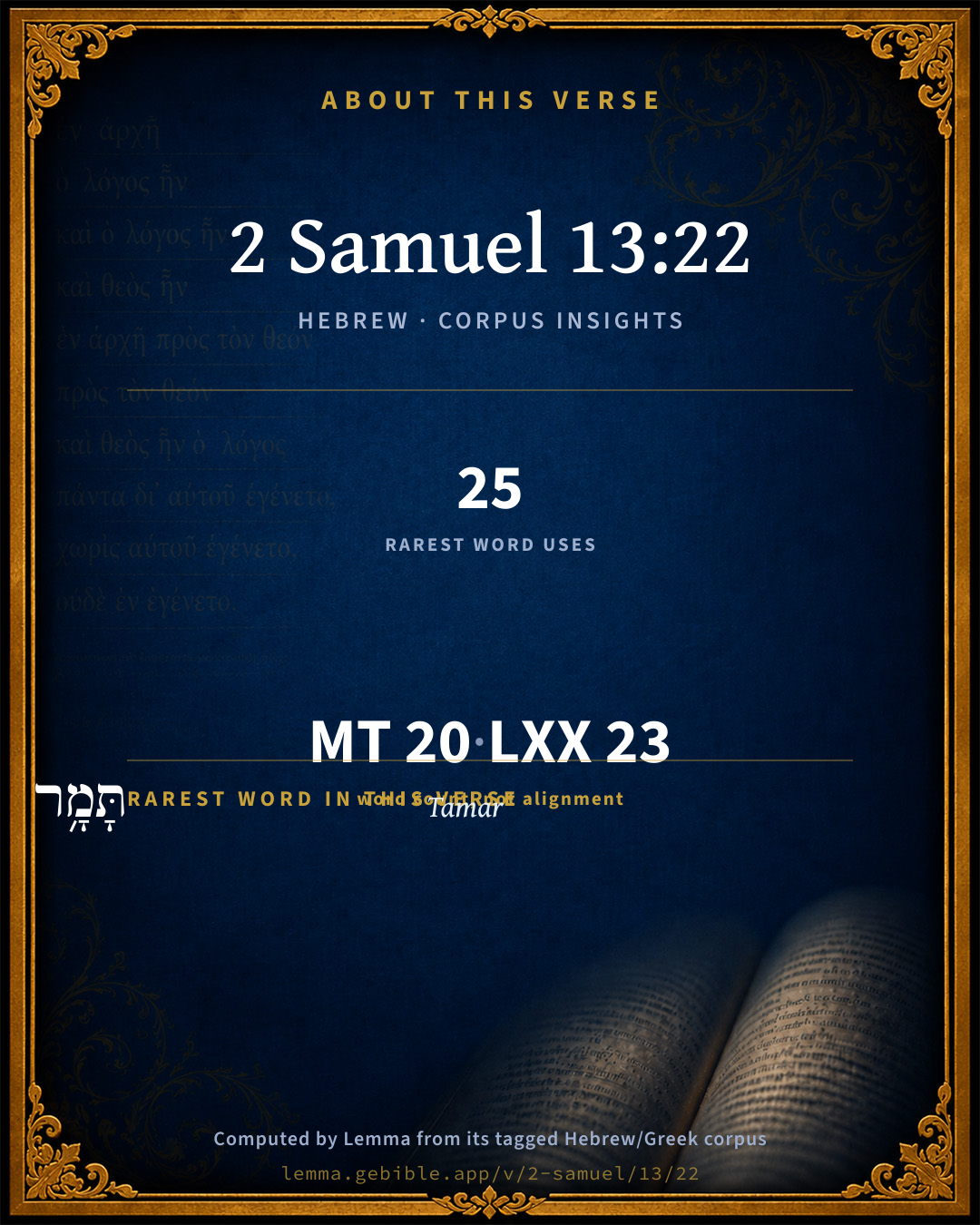
The rarest word here is תָּמָ֥ר Tamar H8559 — appearing just 25 times in the whole Hebrew Bible.

Shared distinctive vocabulary

תָּמָ֥ר Tamar H8559 occurs in 23 verses of the Hebrew Bible. Also found in:

Grammatical profile

  • 3 verbs
  • 7 nouns
  • 2 adjectives
  • 3 prepositions
  • 1 conjunction
  • 4 particles

Verb forms

  • דִבֶּ֧ר Piel · Perfect
  • שָׂנֵ֤א Qal · Perfect
  • עִנָּ֔ה Piel · Perfect

Repetition

Words recur within this verse — often emphatic in Hebrew:

  • אַבְשָׁל֛וֹם Absalom H53 ×2
  • אַמְנ֖וֹן Amnon H550 ×2

Hebrew & Septuagint length

In English translation the verse runs 19 words from the Hebrew and 21 from the Septuagint (LXX English) — closely comparable.

A rough comparison of the two English renderings, which tokenize alike — not a word-level alignment.

Word counts can differ between the Hebrew and the Greek without any difference in meaning — e.g. the Hebrew direct-object marker אֵת has no separate Greek word, and Greek often adds the article ὁ.

In the original languages it is 20 Hebrew tokens and 23 Greek tokens — but the two are counted differently (Hebrew bundles its prefixes and suffixes into one token; the Greek is in lemma form), so that isn’t a like-for-like length.

Cross-references

15

Topical passages linked to 2 Samuel 13:22 in the Treasury of Scripture Knowledge — connected by theme and wording, ordered by reader-vote popularity; previews shown in the World English Bible.

  • Genesis 31:24 God came to Laban, the Syrian, in a dream of the night, and said to him, "Take heed to yourself that you don't speak to Jacob either good or bad."
  • Leviticus 19:17–18 "'You shall not hate your brother in your heart. You shall surely rebuke your neighbor, and not bear sin because of him.
  • Genesis 24:50 Then Laban and Bethuel answered, "The thing proceeds from Yahweh. We can't speak to you bad or good.
  • 1 John 2:11 But he who hates his brother is in the darkness, and walks in the darkness, and doesn't know where he is going, because the darkness has blinded his eyes.
  • 1 John 3:15 Whoever hates his brother is a murderer, and you know that no murderer has eternal life remaining in him.
  • Genesis 31:29 It is in the power of my hand to hurt you, but the God of your father spoke to me last night, saying, 'Take heed to yourself that you don't speak to Jacob either good or bad.'
  • Proverbs 10:18 He who hides hatred has lying lips. He who utters a slander is a fool.
  • Proverbs 25:9 Debate your case with your neighbor, And don't betray the confidence of another;
  • Proverbs 26:24 A malicious man disguises himself with his lips, But he harbors evil in his heart.
  • Proverbs 27:4–6 Wrath is cruel, And anger is overwhelming; But who is able to stand before jealousy?
  • Ecclesiastes 7:9 Don't be hasty in your spirit to be angry, for anger rests in the bosom of fools.
  • Matthew 18:15 "If your brother sins against you, go, show him his fault between you and him alone. If he listens to you, you have gained back your brother.
  • Ephesians 4:26 "Be angry, and don't sin." Don't let the sun go down on your wrath,
  • Ephesians 4:31 Let all bitterness, wrath, anger, outcry, and slander, be put away from you, with all malice.
  • 1 John 2:9 He who says he is in the light and hates his brother, is in the darkness even until now.

Cross-references courtesy of OpenBible.info (CC BY 4.0).

Hebrew and Greek witnesses Masoretic Hebrew ↔ Greek Septuagint

The same verse in the two great witnesses to the Old Testament, shown verse-for-verse.

These are two independent witnesses, not word-aligned to each other, and the Septuagint is shown in lemma (dictionary) form.

Hebrew 2 Samuel 13:22 Masoretic · Westminster Leningrad Codex

וְלֹֽא דִבֶּ֧ר אַבְשָׁל֛וֹם עִם אַמְנ֖וֹן לְמֵרָ֣ע וְעַד ט֑וֹב כִּֽי שָׂנֵ֤א אַבְשָׁלוֹם֙ אֶת אַמְנ֔וֹן עַל דְּבַר֙ אֲשֶׁ֣ר עִנָּ֔ה אֵ֖ת תָּמָ֥ר אֲחֹתֽוֹ

Absalom spoke to Amnon neither good nor bad; for Absalom hated Amnon, because he had forced his sister Tamar.

World English Bible · Public Domain

Greek LXX 2 Samuel 13:22 Septuagint · lemma form

καί οὐ λαλέω αβεσσαλωμ μετά αμνων ἀπό πονηρός ἕως ἀγαθός ὅτι μισέω αβεσσαλωμ ὁ αμνων ἐπί λόγος ὅς ταπεινόω θημαρ ὁ ἀδελφή αὐτός

And Abessalom spoke not to Amnon, good or bad, because Abessalom hated Amnon, on account of his humbling his sister Themar.

LXX2012 (modern English Septuagint) · Public Domain

Hebrew: Westminster Leningrad Codex (CC BY 4.0). Greek: Septuagint (public domain); English from LXX2012 (modern English Septuagint) (Public Domain). How the Septuagint differs from the Hebrew →

Targum (Aramaic paraphrase)

1

The Targum is the ancient Jewish Aramaic paraphrase of the Hebrew Scriptures — an interpretive translation, not the Hebrew text itself. Onkelos (literal) and Pseudo-Jonathan (expansive) render the Torah, and Jonathan the Prophets. Coverage is partial: where no permissively-licensed English translation exists for a verse, only the Aramaic is shown. This is verse-level text, not a word-by-word alignment to the Hebrew.

  1. Targum Jonathan Prophets (Joshua–Malachi)
    וְלָא מַלֵיל אַבְשָׁלוֹם עִם אַמְנוֹן לְמִבִּישׁ וְעַד טַב אֲרֵי סָנֵי אַבְשָׁלוֹם יַת אַמְנוֹן עַל עֵיסַק דְעַנֵי יַת תָּמָר אֲחָתֵיהּ:

    (no public-domain English translation for this verse)

    Targum Jonathan — Aramaic: “Mikraot Gedolot” (public domain). English: “Sefaria Community Translation” (CC0 1.0 (public-domain dedication)); “London "Chaldee Paraphrase," 1871” (public domain). Text via Sefaria.

Commentary

Notes on 2 Samuel 13:22 from classic Christian and Jewish commentators (each source and its license shown beneath its notes). The classic Christian expositions comment on the surrounding passage and are grouped to its opening verse, so a note may address several verses; the Jewish commentaries on the Tanakh (Rashi and others) are per-verse, so they appear only where the commentator wrote on this verse.

Lemma curates 59 commentaries, every one of them public domain or Creative Commons licensed, each selected and text-cleaned for this edition rather than reprinted as found. About our sources →

Trapp's Complete Commentary

John Trapp

2Sa 13:22 And Absalom spake unto his brother Amnon neither good nor bad: for Absalom hated Amnon, because he had forced his sister Tamar.

Ver. 22. And Absalom spake unto his brother Amnon neither good nor bad,] sc., About that abuse done to his sister; but made as if he had digested that injury, and put it up. Nothing is more unsafe to be trusted, than the fair looks of a festered heart.

For Absalom hated Amnon.] With a habit of hatred, wherein is steeped the venom of all other vices. Gunpowder will take and blaze, sooner than lime; yet lime hath more innate heat, and burneth more within; so is it with the malicious resolved upon revenge, and waiting their opportunity. Beware of such.

Because he had forced his sister Tamar.] This was the great grudge, the ground of that inveterate hatred. Now if Absalom, though wicked and unnatural, could not endure the wrong done his sister: if Jacob’s sons fell so foul upon the Shechemites for the rape of Dinah, how will the Lord Christ, think we, take the misusages done to his sister, his spouse, the Church, and her members, by those that seek to turn her glory into shame?

John Trapp, A Commentary or Exposition upon All the Books of the Old and New Testament (1647–1656) — public domain. Text from a community e-Sword module.

Joseph Benson's Commentary

2Sa 13:22. Absalom spake, &c. — Though he hated Amnon in his heart, yet he never expressed the least resentment, nor said any thing to him at all about that business. He neither debated it with him, nor threatened him for it, but seemed willing to pass it by with brotherly kindness. Not that he forbore all discourse with him on any subject, which would have raised jealousy in his mind, and also in David’s. But by the method Absalom pursued, Amnon was lulled asleep, in a belief that he would give him no trouble for what he had done.

Joseph Benson's Commentary on the Old and New Testaments (1811–1818) — public domain. Text from a community e-Sword module.

The Cambridge Bible for Schools and Colleges

gen. ed. J. J. S. Perowne

22. neither good nor bad] He made no allusion whatever to the matter, in order to quiet Amnon’s suspicions. For the phrase cp. Gen_24:50; Gen_31:24.

The Cambridge Bible for Schools and Colleges (gen. ed. J. J. S. Perowne; Cambridge University Press, 1878–1918) — public domain. Text from a community e-Sword module.

John Gill's Exposition

And Absalom spake unto his brother Amnon neither good nor bad,.... That is, said nothing at all to him about the rape of his sister; not that he was sulky with him, and would not converse with him at all; for then Amnon would have mistrusted that he was meditating revenge, and therefore would have been upon his guard; but on the contrary he talked freely, and in appearance friendly, on other things, the better to conceal his hatred of him, and his design to avenge the injury of his sister:

for Absalom hated Amnon; or, "though" (f) he hated him, yet he behaved in this manner towards him:

because he had forced his sister Tamar: who was so by father and mother's side, and so near and dear unto him, and therefore resented the injury done her.

(f) "quamvis", Junius & Tremellius, Piscator, Pool, & Patrick.

John Gill's Exposition of the Whole Bible (1746–1763) — public domain (CC PDM 1.0). Text via the HelloAO Bible API.

Matthew Poole's English Annotations

Absalom spake unto his brother Amnon neither good nor bad, i. e. he said nothing at all to him, to wit, about that business. It is a synecdochical expression, used in like manner, Gen 31:24. He neither debated it with him, nor threatened him for it; but seemed willing to cover it, and pass it by with brotherly kindness. For if he had wholly forborne all discourse and converse with him, it would have raised great jealousies in Amnon and David, and hindered him in his intended and desired revenge.

For Absalom hated Amnon; or rather, but, or though Absalom, as the Hebrew particle chi commonly signifies; for the following clause is not added as a reason of the former, but by way of exception or opposition. Though he outwardly expressed no dislike of the fact, yet he inwardly hated him.

Matthew Poole's English Annotations on the Holy Bible (1683–1685) — public domain. Text from a community e-Sword/MySword module.

The Pulpit Commentary

Absalom spake neither good nor bad. (On this phrase, see Gen_24:50 Gen_31:24) Absalom"s outward demeanour was one of utter indifference, concealing a cruel determination. It is strange how unlike the son was to the father.

Vers. 22-29. (BAAL-HAZOR.)

The revenge of Absalom.

"Absalom hated Amnon." References:

1. Third son (Chileab, probably, being dead) of David, by Maacab, daughter of Talmai, King of Geshur; born at Hebron, his name ("father of peace") indicating, perhaps, the hope entertained at his birth. (2Sa_3:1-5) "The young handsome hero must have been conspicuous among the soldiers of Israel, and taken his place among the sons of David, who were "chief rulers.

2. Hatred (when about eighteen years old) and murder (after two years).

3. Flight to Geshur (ver. 38) and residence there (three years).

4. Return (2Sa_14:23, 2Sa_14:24) and partial reconciliation (during two years); married about this time, and father of three sons (dying in infancy, (2Sa_14:27 2Sa_18:18) and one daughter (Tamar, named after his sister).

5. Full reconciliation (2Sa_14:33 2Sa_15:1-11) and preparation for revolt (four years).

6. Conspiracy in Hebron. (2Sa_15:12, 2Sa_15:13)

7. Occupation of Jerusalem, (2Sa_15:37 2Sa_16:15-19) possession of the palace, (2Sa_15:20-23) anointed king, (2Sa_19:10) consultations. (2Sa_17:1-14)

8. Pursuit of David, and defeat in battle. (2Sa_17:24-26 2Sa_18:1-8)

9. Slain by Joab. (2Sa_18:9-18) 10. Lamented by David. (2Sa_18:33 2Sa_19:1-4) Revenge is sinful resentment. It is felt, on account of real or supposed injury, toward the person rather than the conduct of the offender; desires his suffering, not his improvement; and seeks it maliciously, deliberately, and unlawfully. "All pain occasioned to another in consequence of an offence or injury received from him, further than what is calculated to procure reparation or promote the just ends of punishment, is so much revenge" (Paley, "Mot. Ph."). It is "a kind of wild justice" (Bacon, "Essays"). Of the spirit of revenge, which was embodied in Absalom, and too often finds a place in others, observe

I ITS SEEMING JUSTIFICATION; for he who indulges it commonly seeks to justify himself therein, (2Sa_14:32) it may be, on account of:

1. The grievous wrong suffered, directly or in the person of another with whom he is closely connected. The more this is brooded over, the greater it appears and the more it incites to wrath.

2. The natural instinct of anger and retaliation, which is

Far, far too dear to every mortal breast, Sweet to the soul as honey to the taste. (Homer. )

But it must be directed, controlled, often completely repressed by justice and love. "The taking vengeance on a foe is honourable," it has been said, "rather than the being reconciled" (Aristotle, "Rhetoric"). True wisdom teaches otherwise (1Sa_11:12, 1Sa_11:13; Pro_20:22 Pro_24:29)

3. The culpable failure of justice, on the part of the civil magistrate, "the minister of God," etc.. (Rom_13:4) It may be a temptation to private vengeance; but it does not warrant any one in taking the law into his own hands; whilst by doing so he becomes a breaker of the law and justly liable to its penalty. "The revenge which he took for the foul wrong that his sister had suffered at the hands of Amnon did not shock the men of Israel as it shocks us. To him, by the feeling of all Oriental nations, belonged the special guardianship of her honour; and subtly as the punishment was inflicted, it was nothing more than the monstrous turpitude of the guilt deserved. Had David been true to his kingly calling, instead of passing the crime over with a weak sorrow and a yet weaker leniency, there would have been no occasion for the vengeance which Absalom felt himself bound to take. The two long years of waiting which followed on his revenge, must have been a time in which disappointment, irritation, bitterness against his father, were gaining, slowly but surely, the mastery over him" (Plumptre).

II ITS SPECIAL CHARACTERISTICS.

1. Enduring and implacable hatred (ver. 23); a malicious purpose formed from the first (as his intimate companion read in his countenance, ver. 32), but concealed that it might be the more effectually accomplished when opportunity served. "A man that studieth revenge keeps his own wounds green, which otherwise would heal and do well" (Bacon).

2. Subtle and deceitful scheming (vers. 24, 26); under pretence of kindness; and taking a base advantage of affection, consideration, and confidence. Ver. 25 is "the first instance history offers of the ruinous cost of royal visits to those who are honoured with them" (Kitto).

3. Pitiless and treacherous cruelty. (ver. 28; 2Sa_11:13) Another instance of indulgence in intoxication (1Sa_25:36, 1Sa_25:37; 2Sa_11:13) "Absalom calls the execution of this base cruelty in his servants, courage and valour; being indeed but treacherous and cowardly murder; which shows that vices are ofttimes coloured with the name of virtues, as drunkenness is called good fellowship, avarice good husbandry, subtlety to deceive wisdom, and pride magnanimity" (Guild). It is not improbable that he wished to get rid of Amnon as an obstacle in the way to the throne. "The wild acts of Absalom"s life may have been to some extent the results of maternal training; they were at least characteristic of the stock from which he sprang" (Smith, "Dict."). "From his father he inherited nothing but his regal pride" (Ewald). "He was a man who could scheme deeply, bide his time patiently, and then strike with decision and daring" (D. Macleod).

III ITS EXCEEDING SINFULNESS.

1. Disbelief in the presence and justice of God, who, though man fails topunish, "will by no means clear the guilty.

2. Insensibility to his forbearance, which should teach the like ( (1Sa_24:13; Mat_5:48)

3. Disobedience to the Divine Law, which is fulfilled in one word," etc., (Gal_5:14) and to many special injunctions (Rom_12:9; Mat_6:15)

4. Fruitfulness in wickedness and crime, (1Jn_3:15) with all their evil consequences to others and to a man himself (vers. 36, 37). "Absalom fled from man, who only could kill the body; but he could not fly from blood guiltiness and an accusing conscience, nor yet from the hand of God"s justice, which did reach him afterwards" (Guild). "It was asked of the sage, "In what one virtue are all the rest comprised?" "Patience," was his answer. "And in what single vice are all others concentrated?" "Vindictiveness (Rabbi Salomon Ibn Gabirol). "Whereas some may be apt to suspect that the patient bearing of one injury may invite another, I believe it will be found quite otherwise, that the revenging of one injury brings on another; the one is like the withdrawing of fuel or combustible matter, which will soon put out the fire, and the other is continually furnishing fresh fuel, mixed with oil and gunpowder and such inflaming materials as are apt to spread the fire of contention, but not to extinguish it" (J. Blair: 1740).

CONCLUSION. How odious is the spirit of revenge! He who gives way to it might as well cherish a venomous serpent in his bosom. "Be not overcome of evil, hut overcome evil with good". D. (Rom_12:21)

The Pulpit Commentary (1880–1919), ed. H.D.M. Spence-Jones & Joseph S. Exell — public domain. Text from a community e-Sword module.

John Wesley's Explanatory Notes

Spake - That is, he said nothing at all to him, about that business. He neither debated it with him, nor threatened him for it; but seemed willing to pass it by with brotherly kindness. If he had wholly forborne all discourse with him, it would have raised jealousies in Amnon and David.

John Wesley, Explanatory Notes Upon the Whole Bible (1754–1765) — public domain. Text via the GEBible commentary corpus.

Lesson kit

Teaching starters — assembled from the data on this page, not authored interpretation. Every prompt links to the verse data it draws on. Edit before teaching.

2 Samuel, in the Historical, opens this verse with 20 words (17 distinct Hebrew lemmas). Its most distinctive word is Tâmâr (“Tamar”). A historical commentator’s framing appears above. Read the whole chapter for the surrounding context.

Discussion questions

  1. What does “Tamar” (Tâmâr) contribute to the verse as a whole?
  2. How does Genesis 38:6, which shares the word «Tamar», read alongside this verse?
  3. What does the repetition of “Absalom” (2× in this one verse) do in this verse?
  4. These translations render this verse differently; the difference is in the English rendering, not the original. What questions does that raise?
  5. «דִבֶּ֧ר» is a Piel Perfect verb. How does that grammatical form shape the action described?
  6. Compare how Trapp's Complete Commentary and Joseph Benson's Commentary read this verse. Where do they agree or differ?

Things to notice

Reading settings

Reading text

Shown beneath each verse's original-language words.

Old Testament
Old Testament edition

Read the OT as the Masoretic Hebrew (MT) or the Greek Septuagint (LXX).

English shown for the Greek Septuagint (in the Hebrew ↔ Greek comparison).

Comparing translations? Open the Compare panel on any verse page to stack up to four side by side.