
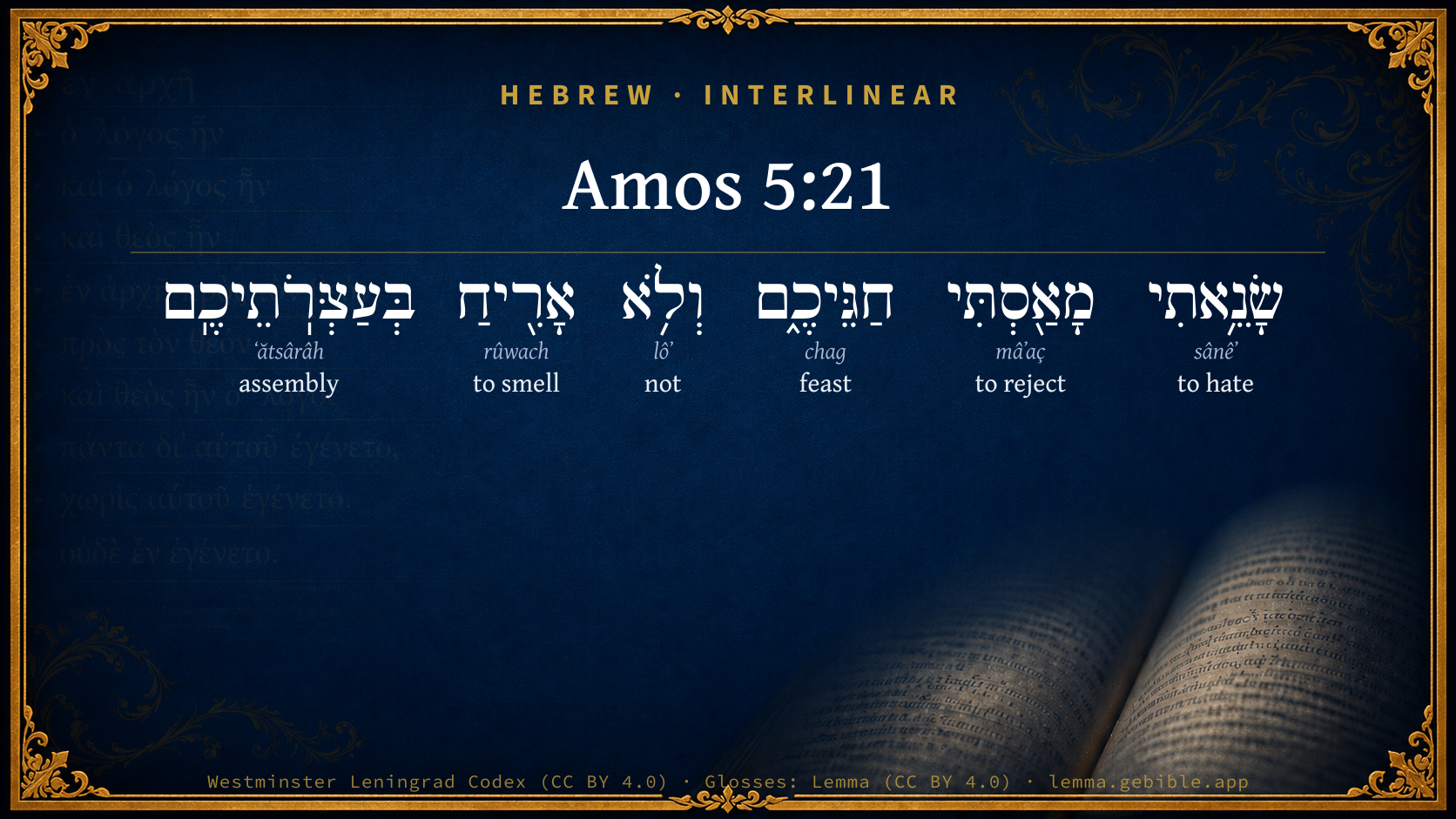
Amos 5:21

Hebrew (Westminster Leningrad Codex) Amos 5:21 appears in the Hebrew Old Testament. The text above is from the Westminster Leningrad Codex. Each word links to its Strong’s number, a concise gloss, and parsing drawn from the Open Scriptures Hebrew Bible morphology. Click any word for its full Brown-Driver-Briggs (BDB) entry.
Download image
Cite this verse

Amos 5:21 (World English Bible). Public Domain. Lemma interlinear Bible study tool, https://lemma.gebible.app/v/amos/5/21.

Show BibTeX & RIS
BibTeX
RIS
English Translation
I hate, I despise your feasts, And I can't stand your solemn assemblies.
World English Bible · Public Domain
Download a study sheet

One document with this verse’s original text, its word-by-word gloss line, the meaning frame, cross-references with their text, attributed commentary, and full source and license credits — printable, and it pastes into notes with its structure intact.

This verse Autodidact and up

Study sheet (.html) Plain text (.txt)

A passage Seminary Student

Up to 50 verses in one chapter. A passage sheet keeps up to 6 commentary sources and 12 cross-references per verse, in the order this page ranks them, and says so on the sheet whenever that leaves anything out. Ask for a single verse and you get the Autodidact verse sheet above.

Everything on this page stays free to read, with no account — the sheet is a download of what is already on screen, not access to it.

Want to remove ads? Support Godless Engineer
Compare translations 3

The same verse in 3 English versions, stacked beneath the original-language interlinear above. Click any original word for its lexicon entry.

Each is an independent rendering of the whole verse — the interlinear is not word-aligned to these translations.

Highlighted words mark where these versions differ — a whole-verse word diff, not a word-by-word alignment.

  • World English Bible Public Domain
    I hate, I despise your feasts, And I can't stand your solemn assemblies.
  • King James Version Public Domain
    I hate, I despise your feast days, and I will not smell in your solemn assemblies.
  • unfoldingWord Literal Text CC BY-SA 4.0
    “I hate, I despise your festivals, I take no delight in your solemn assemblies.

unfoldingWord Literal Text — © unfoldingWord, licensed CC BY-SA 4.0. Word-aligned USFM3 via Door43 (git.door43.org/unfoldingWord/en_ult).

Versions to compare (up to 4)

3 of 4 selected

Show all 18 translations

Every available English version of this verse, each an independent rendering of the whole verse.

  • World English Bible Public Domain
    I hate, I despise your feasts, And I can't stand your solemn assemblies.
  • Berean Standard Bible Public Domain
    “I hate, I despise your feasts! I cannot stand the stench of your solemn assemblies.
  • Majority Standard Bible Public Domain
    “I hate, I despise your feasts! I cannot stand the stench of your solemn assemblies.
  • King James Version Public Domain
    I hate, I despise your feast days, and I will not smell in your solemn assemblies.
  • American Standard Version (1901) Public Domain
    I hate, I despise your feasts, and I will take no delight in your solemn assemblies.
  • Revised Version (1885) Public Domain
    I hate, I despise your feasts, and I will take no delight in your solemn assemblies.
  • Geneva Bible (1599) Public Domain
    I hate and abhorre your feast dayes, and I wil not smelll in your solemne assemblies.
  • Douay-Rheims (1899) Public Domain
    I hate, and have rejected your festivities: and I will not receive the odour of your assemblies.
  • Young's Literal Translation Public Domain
    I have hated -- I have loathed your festivals, And I am not refreshed by your restraints.
  • Literal Standard Version CC BY-SA 4.0
    “I have hated—I have loathed your festivals, || And I am not refreshed by your restraints.
  • Unlocked Literal Bible CC BY-SA 4.0
    “I hate, I despise your festivals, I take no delight in your solemn assemblies.
  • unfoldingWord Literal Text CC BY-SA 4.0
    “I hate, I despise your festivals, I take no delight in your solemn assemblies.
  • Darby Bible Public Domain
    I hate, I despise your feasts, and I will not smell [a sweet odour] in your solemn assemblies.
  • World Messianic Bible Public Domain
    I hate, I despise your feasts, and I can’t stand your solemn assemblies.
  • Webster's Bible Public Domain
    I hate, I despise your feast days, and I will not smell in your solemn assemblies.
  • Free Bible Version CC BY-SA 4.0
    I hate, I despise your festivals and take no delight in your religious assemblies.
  • Bible in Basic English Public Domain
    Your feasts are disgusting to me, I will have nothing to do with them; I will take no delight in your holy meetings.
  • JPS Tanakh (1917) Public Domain
    I hate, I despise your feasts, and I will take no delight in your solemn assemblies.

Literal Standard Version (2020), Covenant Press — licensed CC BY-SA 4.0. Text via the HelloAO Bible API (eBible.org). Unlocked Literal Bible (unfoldingWord) — licensed CC BY-SA 4.0. Text via the HelloAO Bible API (eBible.org). unfoldingWord Literal Text — © unfoldingWord, licensed CC BY-SA 4.0. Word-aligned USFM3 via Door43 (git.door43.org/unfoldingWord/en_ult). Free Bible Version, Dr. Jonathan Gallagher — licensed CC BY-SA 4.0. Text via the HelloAO Bible API (eBible.org).

Word by word

More ways to search: Search by grammar → Find every occurrence → Compare this word →

Practice this passage: Drill this verse → Learn its vocabulary →

About this verse

These counts appear in no published source. They are computed here, from the morphology-tagged text and Lemma’s own curated glosses. What Lemma adds →

6
words
6
distinct lemmas
Prophets
section

Notable vocabulary

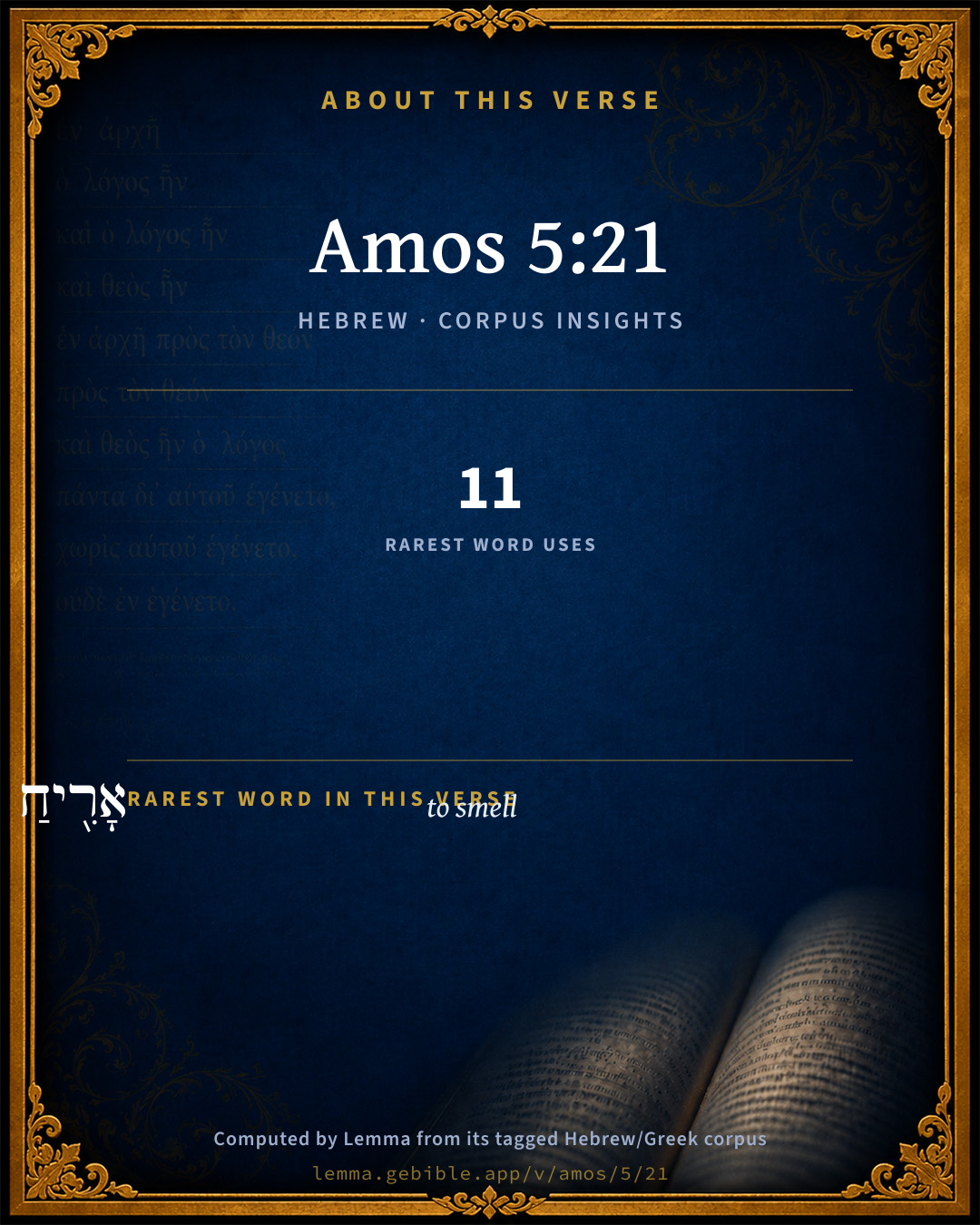
The rarest word here is אָרִ֖יחַ to smell H7306 — appearing just 11 times in the whole Hebrew Bible.

Shared distinctive vocabulary

אָרִ֖יחַ to smell H7306 occurs in 11 verses of the Hebrew Bible. Also found in:

Grammatical profile

  • 3 verbs
  • 2 nouns
  • 1 particle

Verb forms

  • שָׂנֵ֥אתִי Qal · Perfect
  • מָאַ֖סְתִּי Qal · Perfect
  • אָרִ֖יחַ Hiphil · Imperfect

Hebrew & Septuagint length

In English translation the verse runs 13 words from the Hebrew and 17 from the Septuagint (LXX English) — closely comparable.

A rough comparison of the two English renderings, which tokenize alike — not a word-level alignment.

Word counts can differ between the Hebrew and the Greek without any difference in meaning — e.g. the Hebrew direct-object marker אֵת has no separate Greek word, and Greek often adds the article ὁ.

Cross-references

13

Topical passages linked to Amos 5:21 in the Treasury of Scripture Knowledge — connected by theme and wording, ordered by reader-vote popularity; previews shown in the World English Bible.

  • Isaiah 1:11–16 "What are the multitude of your sacrifices to me?," says Yahweh. "I have had enough of the burnt offerings of rams, And the fat of fed animals. I don't delight in the blood of bulls, Or of lambs, Or of male goats.
  • Proverbs 28:9 He who turns away his ear from hearing the law, Even his prayer is an abomination.
  • Leviticus 26:31 I will lay your cities waste, and will bring your sanctuaries to desolation, and I will not take delight in the sweet fragrence of your offerings.
  • Isaiah 66:3 He who kills an ox is as he who kills a man; he who sacrifices a lamb, as he who breaks a dog's neck; he who offers an offering, [as he who offers] pig's blood; he who burns frankincense, as he who blesses an idol. Yes, they have chosen their own ways, and their soul delights in their abominations:
  • Jeremiah 6:20 To what purpose comes there to me frankincense from Sheba, and the sweet cane from a far country? your burnt offerings are not acceptable, nor your sacrifices pleasing to me.
  • Proverbs 15:8 The sacrifice made by the wicked is an abomination to Yahweh, But the prayer of the upright is his delight.
  • Hosea 8:13 As for the sacrifices of my offerings, they sacrifice flesh and eat it; But Yahweh doesn't accept them. Now he will remember their iniquity, And punish their sins. They will return to Egypt.
  • Genesis 8:21 Yahweh smelled the sweet savor. Yahweh said in his heart, "I will not again curse the ground any more for man's sake, because the imagination of man's heart is evil from his youth; neither will I ever again strike everything living, as I have done.
  • Proverbs 21:27 The sacrifice of the wicked is an abomination: How much more, when he brings it with a wicked mind!
  • Matthew 23:13 "Woe to you, scribes and Pharisees, hypocrites! For you devour widows' houses, and as a pretense you make long prayers. Therefore you will receive greater condemnation.
  • Ephesians 5:2 Walk in love, even as Christ also loved you, and gave himself up for us, an offering and a sacrifice to God for a sweet-smelling fragrance.
  • Jeremiah 7:21–23 Thus says Yahweh of Hosts, the God of Israel: Add your burnt offerings to your sacrifices, and eat you flesh.
  • Philippians 4:18 But I have all things, and abound. I am filled, having received from Epaphroditus the things that came from you, a sweet-smelling fragrance, an acceptable and well-pleasing sacrifice to God.

Cross-references courtesy of OpenBible.info (CC BY 4.0).

Hebrew and Greek witnesses Masoretic Hebrew ↔ Greek Septuagint

The same verse in the two great witnesses to the Old Testament, shown verse-for-verse.

These are two independent witnesses, not word-aligned to each other, and the Septuagint is shown in lemma (dictionary) form.

Hebrew Amos 5:21 Masoretic · Westminster Leningrad Codex

שָׂנֵ֥אתִי מָאַ֖סְתִּי חַגֵּיכֶ֑ם וְלֹ֥א אָרִ֖יחַ בְּעַצְּרֹֽתֵיכֶֽם

I hate, I despise your feasts, And I can't stand your solemn assemblies.

World English Bible · Public Domain

Greek LXX Amos 5:21 Septuagint · lemma form

μισέω ἀποὠθέω ἑορτή σύ καί οὐ μή ὀσφραίνομαι ἐν ὁ πανήγυρις σύ

I hate, I reject your feasts, and I will not smell your meat-offerings in your general assemblies.

LXX2012 (modern English Septuagint) · Public Domain

On this verse, Matthew Henry's Commentary discusses the Septuagint’s reading. Read the note in Commentary ↓

Hebrew: Westminster Leningrad Codex (CC BY 4.0). Greek: Septuagint (public domain); English from LXX2012 (modern English Septuagint) (Public Domain). How the Septuagint differs from the Hebrew →

Targum (Aramaic paraphrase)

1

The Targum is the ancient Jewish Aramaic paraphrase of the Hebrew Scriptures — an interpretive translation, not the Hebrew text itself. Onkelos (literal) and Pseudo-Jonathan (expansive) render the Torah, and Jonathan the Prophets. Coverage is partial: where no permissively-licensed English translation exists for a verse, only the Aramaic is shown. This is verse-level text, not a word-by-word alignment to the Hebrew.

  1. Targum Jonathan Prophets (Joshua–Malachi)
    סְגֵיתִי רְחִיקֵת חֲגֵיכוֹן וְלָא אֲקַבֵּל בְּרַעֲוָא קוּרְבַּן כְּנִשַׁתְכוֹן:

    (no public-domain English translation for this verse)

    Targum Jonathan — Aramaic: “Mikraot Gedolot” (public domain). English: “Sefaria Community Translation” (CC0 1.0 (public-domain dedication)); “London "Chaldee Paraphrase," 1871” (public domain). Text via Sefaria.

Commentary

Notes on Amos 5:21 from classic Christian and Jewish commentators (each source and its license shown beneath its notes). The classic Christian expositions comment on the surrounding passage and are grouped to its opening verse, so a note may address several verses; the Jewish commentaries on the Tanakh (Rashi and others) are per-verse, so they appear only where the commentator wrote on this verse.

Lemma curates 59 commentaries, every one of them public domain or Creative Commons licensed, each selected and text-cleaned for this edition rather than reprinted as found. About our sources →

Matthew Henry's Commentary

The scope of these verses is to show how little God valued their shows of devotion, nay, how much he detested them, while they went on in their sins. Observe,

I. How unpleasing, nay, how displeasing, their hypocritical services were to God. They had their feast-days at Bethel, in imitation of those at Jerusalem, in which they pretended to rejoice before God. They had their solemn assemblies for religious worship, in which they put on the gravity of those who come before God as his people come, and sit before him as his people sit. They offered to God burnt-offerings, to the honour of God, together with the meat-offerings which by the law were to be offered with them; they offered the peace-offerings, to implore the favour of God, and they offered them of the fat beasts that they had, Amo 5:21, Amo 5:22. In imitation likewise of the temple-music, they had the noise of their songs and the melody of their viols (Amo 5:23), vocal and instrumental music, with which they praised God. With these services they hoped to make God amends for the sins they had committed, and to obtain leave to go on in sin; and therefore they were so far from being acceptable to God that they were abominable. He hated, he despised, their feast-days, not only despised them as no valuable services done to him, but hated them as an affront and provocation to him, as we hate to see men dissemble with us, pretend a respect for us when really they have none. Nothing more hateful, more despicable, than hypocrisy. He that blesseth his friend with a loud voice, it shall be counted a curse, when it appears that his heart is not with him. God will not smell in their solemn assemblies, for there is nothing in them that is grateful to him, but a great deal that is offensive. Their sacrifices are not to him of a sweet smelling savour, as Noah's was, Gen 8:21. He will not accept them; he will not regard them, will not take any notice of them; he will not hear the melody of their viols; for, when sin is a jar in the harmony, it grates in his ears: "Take it away," says God, "I cannot bear it." Now this intimates, 1. That sacrifice itself is of small account with God in comparison with moral duties; to love God and our neighbour is better than all burnt offering and sacrifice. 2. That the sacrifice of the wicked is really an abomination to him, Pro 15:8. Dissembled piety is double iniquity, and so it will be found when, if any place in hell be hotter than another, that will be the hypocrite's portion.

II. What it was that he required in order to the acceptableness of their sacrifices and without which no sacrifice would be acceptable (Amo 5:24): Let judgment run down as waters, among you, and righteousness as a mighty stream, that is 1. "Let there be a general reformation of manners among you; let religion (God's judgment) and righteousness have their due influence upon you; let your land be watered with it, and let it bear down all the opposition of vice and profaneness; let it run wide as overflowing waters, and yet run strong as might stream." (2.) "In particular, let justice be duly administered by magistrates and rulers; let not the current of it be stopped by partiality and bribery, but let it come freely as waters do, in the natural course; let it be pure as running waters, not muddied with corruption or whatever may pervert justice; let it run like a might stream, and not suffer itself to be obstructed, or its course retarded, by the fear of man; let all have free access to it as a common stream, and have benefit by it as trees planted by the rivers of waters." The great thing laid to Israel's charge was turning judgment into wormwood (Amo 5:7); in that matter therefore they must reform, Zac 7:9. This was what God desired more than sacrifices, Hos 6:6; Sa1 15:22.

III. What little stress God had laid upon the law of sacrifices, though it was his own law, in comparison with the moral precepts (Amo 5:25): "Did you offer unto me sacrifices in the wilderness forty years? No, you did not." For the greatest part of that time sacrifice was very much neglected, because of the unsettledness of their state; after the second year, the passover was not kept till they came into Canaan, and other institutions were in like manner intermitted; and yet, because God will have mercy and not sacrifice, he never imputed the omission to them as their fault, but continued his care of them and kindness to them: it was not that, but their murmuring and unbelief, for which God was displeased with them. He that so owned his people, though they did not sacrifice, when in other things they kept close to him, will certainly disown them, though they do sacrifice, if in other things they depart from him. But, though ritual sacrifices may thus be dispensed with, spiritual sacrifices will not; even justice and honesty will not excuse for the want of prayer and praise, a broken heart and the love of God. Stephen quotes this passage (Act 7:42), to show the Jews that they ought not to think it strange that ceremonial law was repealed when from the beginning it was comparatively made light of. Compare Jer 7:22, Jer 7:23.

II. What little reason they had to expect that their sacrifices should be acceptable to God, when they and their fathers had been all along addicted to the worship of other gods. So some take Amo 5:25, "Did you offer to me sacrifices, that is, to me only? No, and therefore not at all to me acceptably;" for the law of worshipping the Lord our God is, Him only we must serve. "But you have borne the tabernacle of your Moloch (Amo 5:26), little shrines that you made to carry about with you, pocket-idols for your private superstition, when you durst not be seen to do it publicly. You have had the images of your Moloch - your king" (probably representing the sun, that sits king among the heavenly bodies), "and Chiun, or Remphan" (as Stephen calls it, Act 7:43, after the Septuagint), which it is supposed, represented Saturn, the highest of the seven planets. The worship of the sun, moon, and stars, was the most ancient, most general, and most plausible idolatry. They made to themselves the star of their God, some particular star which they took to be their god, or the name of which they gave to their god. This idolatry Israel was from the beginning prone to (Deu 4:19); and those that retain an affection for false gods cannot expect the favour of the true God.

V. What punishment God would inflict upon them for their persisting in idolatry (Amo 5:27): I will cause you to go into captivity beyond Damascus. They were led captive by Satan into idolatry, and therefore God caused them to go into captivity among idolaters, and hurried them into a strange land, since they were so fond of strange gods. They were carried beyond Damascus. Their captivity by the Assyrians was far beyond that by the Syrians; for, if less judgments do not work that for which they were sent, God will send greater. Or the captivity of Israel under Shalmaneser was far beyond that of Damascus under Tiglath-pileser, and much more grievous and destructive, which was foretold Amo 1:5. For, as the sins of God's professing people are greater than the sins of others, so it may be expected that their punishments will be proportionable. We find the spoil of Damascus and that of Samaria carried off together by the king of Assyria, Isa 8:4. Stephen reads it, I will carry you away beyond Babylon (Act 7:43), further than Judah shall be carried, so far further as not to return. And, to make this sentence appear both the more certain and the more dreadful, he that passes it calls himself the Lord, whose name is, The God of hosts, and who is therefore able to execute the sentence, having hosts at command.

Matthew Henry's Commentary on the Whole Bible (1708–1710) — public domain (CC PDM 1.0). Text via the HelloAO Bible API.

Trapp's Complete Commentary

John Trapp

Amo 5:21 I hate, I despise your feast days, and I will not smell in your solemn assemblies.

Ver. 21. I hate, I despise your feast days] Wherewith ye think to stop my mouth and to make me your debtor; saying, as that Roman emperor, when his enemy came against him, Non sic Deos coluimus ut ille nos vinceret, We have not so served the gods that they should serve us no better than to give the enemy the better of us. The feast days and solemn assemblies you so much build upon are yours, and not mine; "I never commanded them" (viz. as you may use them), "neither came they ever into my mind," Jer 32:35. So far am I, therefore, from accepting your sacrifices, as that I hate, I despise, I will not smell: an elegant asyndeton, importing God’s utter distaste of what they did ("The sacrifice of the wicked is abomination: how much more, when he bringeth it with a wicked mind!" Pro 21:27), and assuring a sudden vengeance, as in that quick and smart passage, Go, preach, baptize, "he that believeth not shall be damned," Mar 16:16. Will-worship and outsideness in religion is very odious to the Almighty; and stinks worse in his nostrils than any ill vapour from the vilest dunghill doth in ours: or as those poisonous smells that ascended up once from the five cities of the plain, and brought down from him a counter poison of fire and brimstone. Rome also (that spiritual Sodom) shall be destroyed in like sort, with a terrible fire, Rev 17:16; Rev 18:8-9, for her detestable will-worships, superstitions, and idolatries, which no other nitre can possibly purge. Rev 13:18, the whole "number of the beast," whatsoever is numbered to belong unto him, is but the "number of a man," human inventions and will wisdom; men will have it so; and this is the sum of all Popish religion. When the wit of man will be overpleasing God, with better devices than his own, will needs despite him with seeming honours; it turns to madness, and ends in mischief.

John Trapp, A Commentary or Exposition upon All the Books of the Old and New Testament (1647–1656) — public domain. Text from a community e-Sword module.

The Biblical Illustrator

Joseph S. Exell

Amo_5:21-24

I hate, I despise your feast days.

The Divinely abhorrent and the Divinely demanded

I. The Divinely abhorrent. The same aversion from the ceremonial observances of the insincere and rebellious Israelites which Jehovah here expresses He afterwards employed Isaiah to declare to the Jews (Amo_1:10). The two passages are strikingly parallel, only the latter prophet amplifies what is set forth in a more condensed form by Amos. It is also to be observed, that where Amos introduces the musical accompaniments of the sacrifices, Isaiah substitutes the prayers: both concluding with the Divine words, I will not hear. Take thou away from Me the noise of thy songs; for I will not hear the melody of thy viols. The singing of their psalms was nothing more to God than a wearisome word which was to be brought to an end. Singing and playing on harps was a part of the worship of the temple (1Ch_16:40; 1Ch_23:5; 1Ch_23:25.). Nothing seems more abhorrent to the holy eye and heart of Omniscience than empty ceremony in religion. No sacrifices are acceptable to Him, however costly, unless the offerer has presented himself.

II. The Divinely demanded. Let judgment run down as waters, and righteousness as a mighty stream. We prefer to see justice rolling on like mighty waters, and righteousness as a swelling and ever-flowing stream, to crowded churches. Show me your faith by your works. Show me your worship by your morality; show me your love to God by your devotion to your fellow-men. If we love one another, God dwelleth in us. (Homilist.)

But let judgment run down as waters, and righteousness as a mighty stream.

A prophet of righteousness

This is one of the commonest ideas all through the prophets, but it is the sole idea of Amos.

I. The prophet. Amos is probably the oldest prophet whose writings have come down to us. Once only the Divine inspiration descended on him, and constituted him the messenger of heaven. Amos was the prophet of a single occasion.

II. His prophecy. Amos opened his message in a way that must at once have riveted the attention of the crowd. Be began with a series of brief oracles about the neighbouring nations. He denounces their sins, and announces the punishments that were about to fall on them for their sins. Notice the peculiarity of the sins which this prophet denounces. This is the speciality of Amos. They are not sins against God, but against man. The oppression of the poor is the subject of Amos. The prosperity of the country was only illusory. The righteousness which the righteous God requires is not something in the air. It is not an abstraction, it is conduct between man and mall, and there is no righteousness of any account that does not embrace that. (James Stalker, D. D.)

The Biblical Illustrator, edited by Joseph S. Exell (c. 1880s–1900s) — public domain. Text from a community e-Sword module.

Joseph Benson's Commentary

Amo 5:21-24. I hate and despise your feast-days — This and the three following verses are the same in sense with Isa 1:11-16, and the other texts referred to in the margin, on which the reader is desired to consult the notes. They all show of how little signification the external rites of religion are, unless they be accompanied with living faith in, and sincere love to God, and a universal obedience to his will; or without holiness of heart and life. Take away from me the noise of thy songs — The psalms and hymns sung with vocal and instrumental music, the usual accompaniments of sacrifices among the Jews and heathen. As the worshippers at Beth-el imitated the temple worship in other particulars,

(see Amo 4:4,) so it is likely they did in this part of the public worship: see Amo 8:3. The prophet calls their songs a noise, like that of an untuneful voice, because their melody, not proceeding from a true principle of religion, was not grateful to God. There are great authority and majesty in this passage, Amo 5:21-24; and the grandeur of the image in the following words, with which it closes, must strike every reader. But let judgment run down as waters — Rather, let justice have its free course, so that the meanest persons may feel the benefit of it; and let your benignity be great and universal to your fellow-creatures.

Joseph Benson's Commentary on the Old and New Testaments (1811–1818) — public domain. Text from a community e-Sword module.

The Preacher's Complete Homiletical Commentary

Joseph S. Exell (gen. ed.)

CRITICAL NOTES.]

Amo_5:21.] Festivals and sacrifices will not avert judgments. Your feasts] of human origin, not Divine appointment (Isa_1:10-15); the expression of Divine abhorrence is most emphatic.

Amo_5:23. Noise] as singing is contemptuously called.

HOMILETICS

THE RITUAL WITHOUT THE MORAL.—Amo_5:21-23

The judgments threatened will not be averted by feasts and sacrifices. God expresses his abhorrence to mere ceremonial observances, and will not accept heartless worship. “I hate, I despise,” &c. Notice—

I. Religious assemblies without true worship. Israel had feast days, to abstain from servile work and rejoice in God; solemn assemblies, to worship God and put themselves under some restraint. But in these things they followed their own device, or imitated the worship at Jerusalem; substituted human inventions for Divine institutions; “your feast days,” not mine; and thus prefigured many more who call themselves Christians. Men uphold the means of grace, attend the worship of God, but the name of God they will not adore. They defend religion, appoint ordinances, and put formal for spiritual service. They pervert the times and the places in which they should meet God. Solemn assemblies, social and private prayer, may prove a curse and not a blessing. Outward worship and superior privileges may increase our condemnation, and cause rejection in the sight of God. “I despise your feast days.”

II. Daily sacrifices without true obedience. They offered burnt-offerings, tokens of self-sacrifice; peace-offerings, signs of gratitude, from fat beasts, the best they could get; but they were not regarded. “Hath the Lord as great delight in burnt-offerings and sacrifices as in obeying the voice of the Lord?”

1. Their ritual was external. The grandeur of the gift is nothing without the heart of the giver. Costly offerings are of no value without love. God hates dissembled worship. It is double iniquity. “The sacrifice of the wicked is abomination; how much more when he bringeth it with a wicked mind?”

2. Their conduct was immoral. They despised the poor and neglected judgment; cherished uncharitable feelings, and had no desire to do right. Love to God must be seen in right conduct towards men; true worship, in pure morality; and faith, in good works. God smells not the savour of splendid rituals without consistent lives (Lev_26:31). He may accept the moral without the ritual, but never the ritual without the moral. “To do justice and judgment is more acceptable to the Lord than sacrifice.”

III. Instrumental music without true melody. It was noise, not melody; pleasing to man, but distasteful to God. Church-music is often mere display—intoned with energy, and ending in self. Music is the expression of emotion, the outburst of praise to God. When rightly conducted it will be attractive to man and honouring to God. In times of revival it has elevated the heart and quickened the life. But the best gifts of nature and art may be made instruments of evil. Music is abused when joined with immoral poetry and allurements of sin. When grace is not in the heart we do not sing with the spirit and with the understanding. If the life is not in tune with the lips, God says, “Take thou away from me the noise of thy songs.”

HOMILETIC HINTS AND OUTLINES

Amo_5:21-22. Israel had feasts of solemn joy and the restraint of solemn assemblies. They offered whole burnt-offerings, the token of self-sacrifice, in which the sacrificer retained nothing to himself, but gave them freely to God. They offered also peace-offerings, as tokens of the willing thankfulness of souls at peace with God. What they offered was the best of its kind, fatted beasts. Hymns of praise, full-toned chorus, instrumental music! What was wanting, Israel thought, to secure them the favour of God? Love and obedience. If ye love me, keep my commandments. And so those things, whereby they hoped to propitiate God, were the object of his displeasure [Pusey]. Here is a warning to all who think to please God by elaborate musical services in his house; while they do not take heed to worship him with their hearts, and to obey him in their daily life [Wordsworth].

Amo_5:24. The sound of music, rolling in full chorus, will not profit in a drought of justice and righteousness. “Praise is not seemly in the mouth of a sinner, for it was not sent him of the Lord” (Sir_15:9).

When justice is duly administered it is said to ran down as waters, &c. Now waters and streams run not to one man’s house, or door, but the stream offers itself to every man, it runs down to the poor man’s door as well as to the rich man’s door, it runs by the meanest cottage as well as by the princely palace. Righteousness must run like a stream; it must be a common, a universal good [Caryl].

The first outward step in conversion is to break off sin. He bids them let judgment, which had hitherto been perverted in its course, roll on like a mighty tide of waters, sweeping before it all hindrances, obstructed by no power, turned aside by no bribery, but pouring on in one perpetual flow, reaching all, refreshing all, and righteousness like a mighty (or ceaseless) stream. True righteousness is not fitful, like an intermitting stream, vehement at one time, then disappearing, but continuous, unfailing [Pusey].

ILLUSTRATIONS TO CHAPTER 5

Amo_5:21-23. A man is not what he saith, but what he doeth. To say what we do, and not to do what we say, is but to undo ourselves by doing [Dyer]. Hypocrisy is filling up some radical defect with some shallowy pretence [Binney].

“’Tis mad idolatry

To make the service greater than the God.” [Shakespeare.]

The Preacher's Complete Homiletical Commentary (gen. ed. Joseph S. Exell; Funk & Wagnalls, c. 1892) — public domain (pre-1929). A full-Bible homiletical/sermon-outline anthology covering 65 of 66 books (2 John is absent from the source module). Text from a community e-Sword module.

Keil & Delitzsch

C. F. Keil & F. Delitzsch

This threatening judgment will not be averted by the Israelites, even by their feasts and sacrifices (Amo 5:21, Amo 5:22). The Lord has no pleasure in the feasts which they celebrate. Their outward, heartless worship, does not make them into the people of God, who can count upon His grace. Amo 5:21. "I hate, I despise your feasts, and do not like to smell your holy days. Amo 5:22. For if ye offer me burnt-offerings, and your meat-offerings, I have no pleasure therein; and the thank-offering of your fatted calves I do not regard. Amo 5:23. Put away from me the noise of thy songs; and I do not like to hear the playing of thy harps. Amo 5:24. And let judgment roll like water, and righteousness like an inexhaustible stream." By the rejection of the opus operatum of the feasts and sacrifices, the roots are cut away from the false reliance of the Israelites upon their connection with the people of God. The combination of the words שׂנאתי מאסתּי expresses in the strongest terms the dislike of God to the feasts of those who were at enmity with Him. Chaggı̄m are the great annual feasts; ‛ătsârōth, the meetings for worship at those feasts, inasmuch as a holy meeting took place at the ‛ătsereth of the feast of Passover and feast of Tabernacles (see at Lev 23:36). Rı̄ăch, to smell, is an expression of satisfaction, with an allusion to the ריח ניחוח, which ascended to God from the burning sacrifice (see Lev 26:31). Kı̄, in Amo 5:22, is explanatory: "for," not "yea." The observance of the feast culminated in the sacrificers. God did not like the feasts, because He had no pleasure in the sacrifices. In Amo 5:23 the two kinds of sacrifice, ‛ōlâh and minchâh, are divided between the protasis and apodosis, which gives rise to a certain incongruity. The sentences, if written fully, would read thus: When ye offer me burnt-offerings and meat-offerings, I have no pleasure in your burnt-offerings and meat-offerings. To these two kinds the shelem, the health-offering or peace-offering, is added as a third class in Amo 5:22. מריאים, fattened things, generally mentioned along with bâqâr as one particular species, for fattened calves (see Isa 1:11). In הסר (Amo 5:23) Israel is addressed as a whole. המון שׁריך, the noise of thy songs, answers to the strong expression הסר. The singing of their psalms is nothing more to God than a wearisome noise, which is to be brought to an end. Singing and playing upon harps formed part of the temple worship (vid., Ch1 16:40; Ch1 23:5, and Ch1 23:25). Isaiah (Isa 1:11.) also refuses the heartless sacrifice and worship of the people, who have fallen away from God in their hearts. It is very clear from the sentence which Amos pronounces here, that the worship at Bethel was an imitation of the temple service at Jerusalem. If, therefore, with Amo 6:1 in view, where the careless upon Mount Zion and in Samaria are addressed, we are warranted in assuming that here also the prophet has the worship in Judah in his mind as well; the words apply primarily and chiefly to the worship of the kingdom of the ten tribes, and therefore even in that case they prove that, with regard to ritual, it was based upon the model of the temple service at Jerusalem. Because the Lord has no pleasure in this hypocritical worship, the judgment shall pour like a flood over the land. The meaning of Amo 5:24 is not, "Let justice and righteousness take the place of your sacrifices." Mishpât is not the justice to be practised by men; for "although Jehovah might promise that He would create righteousness in the nation, so that it would fill the land as it were like a flood (Isa 11:9), He only demands righteousness generally, and not actually in floods" (Hitzig). Still less can mishpât ūtsedâqâh be understood as relating to the righteousness of the gospel which Christ has revealed. This thought is a very far-fetched one here, and is only founded upon the rendering given to ויגּל, et revelabitur (Targ., Jerome, = ויגּל), whereas יגּל comes from גּלל, to roll, to roll along. The verse is to be explained according to Isa 10:22, and threatens the flooding of the land with judgment and the punitive righteousness of God (Theod. Mops., Theodoret, Cyr., Kimchi, and others).

Keil & Delitzsch — Biblical Commentary on the Old Testament (1861–1891) — public domain (CC PDM 1.0). Text via the HelloAO Bible API. (Old Testament only.)

Tyndale Open Study Notes

Tyndale Open Resources

5:21-27 Amos again confronts the religious hypocrisy and spiritual unfaithfulness of the Israelites (see 4:4-5; Isa 1:10-20).

Tyndale Open Study Notes — © Tyndale Open Resources, licensed CC BY-SA 4.0. Text via the HelloAO Bible API.

Jamieson, Fausset & Brown

Robert Jamieson, A. R. Fausset & David Brown

I hate, I despise--The two verbs joined without a conjunction express God's strong abhorrence.

your feast days--yours; not Mine; I do not acknowledge them: unlike those in Judah, yours are of human, not divine institution.

I will not smell--that is, I will take no delight in the sacrifices offered (Gen 8:21; Lev 26:31).

in your solemn assemblies--literally, "days of restraint." Isa 1:10-15 is parallel. Isaiah is fuller; Amos, more condensed. Amos condemns Israel not only on the ground of their thinking to satisfy God by sacrifices without obedience (the charge brought by Isaiah against the Jews), but also because even their external ritual was a mere corruption, and unsanctioned by God.

Jamieson, Fausset & Brown — Commentary Critical and Explanatory on the Whole Bible (1871) — public domain (CC PDM 1.0). Text via the HelloAO Bible API.

Adam Clarke's Commentary

Verse 21. I hate, I despise your feast days] I abominate those sacrificial festivals where there is no piety, and I despise them because they pretend to be what they are not. This may refer to the three annual festivals which were still observed in a certain way among the Israelites.

Adam Clarke's Commentary on the Bible (1810–1826) — public domain. Text from a community e-Sword/MySword module.

John Calvin's Commentaries

Here the Prophet, anticipating an objection, shows that the Israelites deceived themselves, for they believed that God was pacified by their sacrifices: he declares all these to be useless; not only, as I think, because they themselves were impure; but because all their sacrifices were mere profanations. We have said elsewhere that sacrifices are often reprehended by the Prophets, when not accompanied by godliness and sincerity: for why did God command sacrifices to be offered to him under the law, except as religious exercises? It was hence necessary that they should be accompanied with penitence and faith. But hypocrites thought, as we have seen, that they thereby discharged their whole duty: it was then a profanation of divine worship. Though the Jews, as to the external form, had not departed from the rule of the law, yet their sacrifices were vicious, and repudiated by God: “I cannot bear them — they are a weariness to me — I repudiate them — I loathe them,” — these are expressions we meet with every where in Isaiah. And yet hypocrites regarded their worship as conformable to the law; but impurity of heart vitiated all their works, and this was the reason that God rejected every thing which the Jews thought available for holiness. But different, as I think, was the design of our Prophet: for it was not only for this reason that he blamed the Israelites, — because they falsely pretended God’s name in their sacrifices, but because they were apostates; for they had departed from the teaching of the law, and built for themselves a spurious temple.

It is yet true that they were deluded with this false notion, that their sins were expiated by sacrifices: but God reproved the Israelites, not only for this gross error, with which the Jews were also infected but for having renounced his true and lawful worship. Hence the external form of their worship deserved to be condemned; for it was not right to offer sacrifices except on mount Zion: but they, without having the ark of the covenant, devised a worship else-where, and even there worshipped the calves. We now understand the design of the Prophet: and this ought to be carefully observed, for interpreters think that the Prophet had nothing else in view, but to condemn a false presumption in the Israelites, because they sought to satisfy God with external sacrifices, while they were yet continuing obstinately in their sins. But the other evil ought to be added, which was, that they had corrupted the true worship of God even in its outward form.

Having now pointed out the prophet’s object, I come to consider his words, I have hated, I have rejected, etc. The word חגג, chegig, means to leap and to dance: hence חג, cheg, signifies a sacrifice as well as a festal day. Some then render the words, “I have rejected your sacrifices,” and those which follow, thus, “I will not smell at your solemnities.” Others render the last word, “assemblies.” עצר, otser, means to restrain, and sometimes to gather: hence עצרה, ostare, means an assembly or a congregation. But עצרת, osteret, means a festal day, because the people, as it is well known, were then restrained from work, and also, because they were detained in the sanctuary. But with respect to the subject itself, it makes but little difference, whether we read assembly or a festal day: we see that what the Prophet meant was this, — that God rejected all the rites, by which the Israelites thought that he was pacified, as though they were the most effectual expiations. He does not simply declare that they were of no account before God; but he speaks much stronger and says, that God despised and abhorred them. I regard, he says, with hatred your festal days. He speaks also of burnt offerings,

John Calvin's Commentaries (1540-1563) — public domain. Text from the Calvin Translation Society English edition (1840s-50s) via the Christian Classics Ethereal Library (ccel.org). Calvin's coverage is partial (roughly two-thirds of the Bible); uncommented books and verses are honest gaps, never fabricated. The 19th-century editor's footnotes and remarks are omitted so the notes are faithfully Calvin's own voice.

Ellicott's Commentary for English Readers

(21, 22) These verses closely resemble the condemnation which Isaiah pronounces (Amo_1:10-15) upon mere ritual, however punctilious, mere profession of orthodoxy, however exacting, which was not accompanied by righteousness and mercy, and was not the expression of inward penitence and purity.

Will not smell in your . . .—A strong expression for “I take no delight in them.” That Baal worship, as well as the worship of the true God, was characterised by similar offerings and sacrificial terms is indicated by a Phœnician tablet inscribed with a code of sacrificial dues, discovered at Marseilles. The word rendered peace offering should be translated as in the margin. The word for “meat offering” is better interpreted “meal offerings,” since it consisted of vegetable products used in food, meal, oil, cakes, &c.

A Bible Commentary for English Readers, edited by Charles John Ellicott (1878–1897) — public domain. Text from a community e-Sword module.

The Cambridge Bible for Schools and Colleges

gen. ed. J. J. S. Perowne

21. I hate, I reject your feast days] your pilgrimages, ḥaggim denoting not feasts or festivals in general, but in particular the three great annual feasts (viz. of Unleavened Cakes, Weeks, and Booths), which were accompanied by a pilgrimage to a sanctuary, and at which, according to the old law, every male was required to appear yearly before Jehovah (Exo_23:14; Exo_23:17; Exo_34:23; Deu_16:16 f.). Ḥag (the sing.) is the same word as the Arab. ḥaj, the name by which the great Meccan pilgrimage is known. Reject, as Jer_2:37; Jer_6:30 al.; cf. on Amo_2:4.

I will not smell in] fig. for take no delight in (R.V.): cf. Lev_26:31 and Isa_11:3.

solemn assemblies] ‘ãẓârâh (or ‘ãẓéreth) means a gathering or assembly (Jer_9:2), especially one held for a religious purpose, πανήγυρις, as 2Ki_10:20 (in honour of Ba‘al): it is used here in a general sense, as Isa_1:13 (where the thought also is parallel), Joe_1:14; Joe_2:15; but it is also used specially (a) of the gathering of pilgrims on the 7th day of the Feast of Unleavened Cakes (Deu_16:8); (b) of the gathering on the 8th or supernumerary day of the Feast of Booths (Lev_25:30; Num_29:35; Neh_8:18; 2Ch_7:9); (c) by the later Jews, of the Feast of Weeks, Jos. Ant. iii. 10, 6 (Ἀσάρθα), and in the Mishna, &c.

21–26. Do you think to win Jehovah’s favour by your religious services? On the contrary, He will have none of them: what He demands is not sacrifice, or even praise, but justice; in the wilderness your ancestors offered no sacrifices, without forfeiting Jehovah’s regard; your mistake is a fatal one, and its end will be exile.

The Cambridge Bible for Schools and Colleges (gen. ed. J. J. S. Perowne; Cambridge University Press, 1878–1918) — public domain. Text from a community e-Sword module.

John Gill's Exposition

I hate, I despise your feast days,.... Kimchi thinks this is said, and what follows, with respect to the kingdom of the house of Judah, which kept the feast the Lord commanded; but it is not necessary so to understand it; for doubtless the ten tribes imitated the worship at Jerusalem, and kept the feasts as the Jews did there, in the observance of which they trusted; but the Lord rejects their vain confidence, and lets them know that these were no ways acceptable to him; and were so far from atoning for their sins, that they were hated, abhorred, and despised by him, being observed in such a manner and with such a view as they were;

and I will not smell in your solemn assemblies; a sweet savour of rest, as in Gen 8:21; take no pleasure in their duties and services performed, in their solemn assemblies convened together for religious purposes, nor accept of them; but, on the contrary, dislike and abhor them; see Isa 1:11.

John Gill's Exposition of the Whole Bible (1746–1763) — public domain (CC PDM 1.0). Text via the HelloAO Bible API.

Albert Barnes' Notes on the Bible

I hate, I despise your feasts - Israel clave to its heart’s sin, the worship of the true God, under the idol-form of the calf; else, it would fain be conscientious and scrupulous. It had its “feasts” of solemn “joy” and the “restraint” of its “solemn assemblies” , which all were constrained to keep, abstaining from all servile work. They offered “whole burnt offerings,” the token of self-sacrifice, in which the sacrificer retained nothing to himself, but gave the whole freely to God. They offered also “peace offerings,” as tokens of the willing thankfulness of souls at peace with God. What they offered, was the best of its kind, “fatted beasts.” Hymns of praise, full-toned chorus, instrumental music! What was missing, Israel thought, to secure them the favor of God? Love and obedience. “If ye love Me, keep My commandments.” And so those things, whereby they hoped to propitiate God, were the object of His displeasure. “I hate, I despise, I will not accept” with good pleasure; “I will not regard,” look toward, “I will not hear, will not smell.” The words, “I will not smell,” reminded them of that threat in the law” Lev 26:31, “I will make your cities waste and bring your sanctuaries unto desolation, and I will not smell the savor of your sweet odors.” In so many ways does God declare that He would not accept or endure, what they all the while were building upon, as grounds of their acceptance. And yet so secure were they, that the only sacrifice which they did not offer, was the sin or trespass offering. Worshiping “nature,” not a holy, Personal, God, they had no sense of unholiness, for which to plead the Atoning Sacrifice to come. Truly each Day of Judgment unveils much self-deceit. How much more the Last!

Albert Barnes' Notes on the Bible (1834–1885) — public domain. Text from a community e-Sword/MySword module.

Haydock's Catholic Bible Commentary

Festivities. Some were still observed, chap. iv. 4.

George Leo Haydock (1774–1849), Haydock's Catholic Family Bible and Commentary, 1859 edition — public domain. Excludes Psalms (Douay-Rheims chapter numbering differs from Protestant) and Deuterocanonical books (Catholic canon only).

Matthew Poole's English Annotations

I hate, I despise your feast days; impure and unholy they are, whatever they seem to be, and therefore the Lord hateth them, they are abomination to him, Pro 15:8; Isa 1:13,14. Worthless and contemptible they are, and as such God rejecteth them, Isa 1:10-12, &c. There is no goodness that I should value in them, there is all that vileness in them which attends deep hypocrisy, for which I do hate them. The apostate Israelites imitated the Jews in many things, amongst which they retained their festivals, in which they multiplied their ceremonial sacrifices; and yet God owns them not as his; but brands them with this, They are yours, therefore unwarrantable, will-worship, and displeasing to God.

I will not smell a savour of rest or delight, I will not accept and be pleased with, Gen 8:21,

your solemn assemblies; appointed, as you think, on very weighty reasons, and by sufficient authority, and celebrated with rich sacrifices, in mighty crowds, and in excellent order; all is yours, not mine.

Matthew Poole's English Annotations on the Holy Bible (1683–1685) — public domain. Text from a community e-Sword/MySword module.

Whedon's Commentary on the Bible

Daniel D. Whedon

21-25. The popular service is an abomination to Jehovah. The prophet represents Jehovah as out of sympathy with and even hostile to the popular worship. In what sense this is to be understood see on Hos_6:6.

Hate,… despise — Exceedingly strong expressions of displeasure. The emphasis throughout is on the pronoun. Their practices are an abomination to Jehovah.

Feast days — See on Hos_2:11.

Will not smell — R.V., “will take no delight.” The metaphor is based upon the primitive material conception that the Deity literally smelled the sweet odor of the sacrifice. He indicated his displeasure by refusing to smell it (compare Gen_8:21; Isa_11:3; Lev_26:31).

Solemn assemblies — See on Joe_1:14; compare on Hos_2:11, where a different Hebrew word is used. The prophet next enumerates the most common and most popular kinds of sacrifice which Jehovah despises.

Burnt offerings — See on Hos_6:6.

Meat offerings — R.V., “meal offerings.” See on Joe_1:9 (compare Lev_2:1 ff.; Num_15:1 ff).

Peace offerings — Margin, “thank offerings.” Not the same word as in Amo_4:5. They are the offerings prompted by a desire to restore peace, to renew intimate fellowship with God, after, in some manner, it had become interrupted (Lev_3:1 ff; Lev_7:15 ff.).

Fat beasts — Only the choicest animals were used for sacrifice. The joyful music accompanying the sacrifices also was displeasing to Jehovah.

From me — Literally, from upon me. It is oppressing Jehovah like a heavy burden (Isa_1:14).

Noise — The use of this word implies a feeling of disgust. “The best music becomes mere noise when, for any reason, it ceases to appeal to him who hears it.”

Songs — Songs and music were undoubtedly a part of religious celebrations from an early period, but their exact nature among the Hebrews in pre-exilic times is not definitely known.

Viols — Our knowledge of musical instruments in ancient times is very fragmentary. The instrument named here is probably a harp-shaped instrument with strings. Josephus says that in his day it had twelve strings (compare Psa_33:2) and was played with the fingers. Here it represents all musical instruments used in connection with worship (compare Encyclopaedia Biblica, article “Music”).

Amo_5:24 is to be interpreted not as a threat, that the righteous judgment of Jehovah will sweep over the land with the destructiveness of a flood, but as an exhortation. In the place of a meaningless ceremonial Jehovah desires a righteous life (Isa_1:10-17).

Judgment [“justice”]… righteousness — Practiced in the ordinary relations of life (see on Amo_5:7).

Run — R.V., “roll”; literally, roll itself; that is, manifest itself continually.

As waters — Great masses of water; a picture of abundance and continuity.

A mighty stream — R.V. margin, “ever-flowing.” The allusion is to a perennial stream. In nearly all the rivers of Palestine the flow of water is interrupted during the dry season. It is not to be thus with the practice of justice and righteousness; it is to go on unobstructed and uninterrupted forever.

Lack of space will not permit even to enumerate the different views held by commentators concerning Amo_5:25-26. The interpretation suggested here is the one in most complete accord with the context. In Amo_5:25 Amos points out, by the use of a rhetorical question, the absurdity of the people’s attempt to secure the favor of Jehovah by their heartless ceremonial worship; sacrifice is not an essential element in worship at all.

Sacrifices — Animal sacrifices.

Offerings — R.V. margin, “meal offerings.” The same word as in Amo_5:22, here all offerings not consisting of animals. The two cover all forms of sacrifice (Isa_19:21; Psa_40:6).

In the wilderness — During the wanderings preceding the conquest of Canaan (Num_14:33-34; Jos_5:6).

Have ye offered [“Did ye bring”] — The answer expected is an emphatic No! And yet, the prophet would say, during these forty years Jehovah was as near to you as at any time in your history (Amo_2:9-10). If so, his presence and favor cannot depend upon the bringing of numerous sacrifices (Jer_7:22), hence you are mistaken when you expect your present elaborate ritual to secure for you the divine favor. Sacrifice antedates the time of Moses, and that some sacrifices were offered during the desert wanderings cannot be doubted. But this is not a contradiction of the statement of Amos, for his question does not necessarily imply a denial of the bringing of all sacrifice. The demands of the language are satisfied if his words are interpreted as meaning that during the desert wanderings the people did not conform to a ritual as elaborate as that practiced in his own day; and such interpretation satisfies also the demands of his argument.

Daniel D. Whedon (gen. ed.), Commentary on the Old and New Testaments (1874–1909) — public domain. Text from a community e-Sword module.

The Pulpit Commentary

Outward, formal worship will not avert the threatened danger or secure the favour of God in the day of visitation. Your feast days (chaggim); your feasts; your counterfeit worship, the worship of the true God under an idol symbol (compare God"s repudiation of merely formal worship in Isa_1:11-15) I will not smell; ouj mhav (Septuagint). No sweet savour ascends to God from such sacrifices; so the phrase is equivalent to "I will not accept," "I will take no delight in". (comp. Gen_8:21; Exo_29:18; Lev_26:31) Solemn assemblies; panhguresin (Septuagint); atsaroth; the convocations for the keeping of the great festivals.

Vers. 21-23.

The autograph of the unreal.

Wicked Israel, strange to say, was worshipping Israel still. Theirs was sanctimonious sinning. It was done more or less in a religious connection. It was accompanied, and attempted to be covered, by an unstinted dressing of pietistic cant. But it only smelled the more rank to Heaven. Unreal worship is no mitigation, but only an aggravation, of the guilt of unholy living.

I INSINCERITY IS OFTEN SCRUPULOUS ABOUT ALL THE CIRCUMSTANTIALS OF WORSHIP. This is natural. It builds on the form as a substitute for the spirit, and on the observance of the ordinance thus as a substitute for a godly life. Going through religious forms costs nothing in the way of crucifying the flesh. Accordingly, the scrupulosity of Israel seemed to be great in proportion to their hypocrisy.

1. They kept the feasts. "Feasts" (ver. 21) means the annual feasts. There is no hint that these, or any of them, were neglected or overlooked. The routine of celebration went mechanically on. They were observed without purpose and without heart, but they were observed.

2. They performed the acts of worship. "The assemblies" (ver. 21) were probably the meetings for worship (Lev_23:36) appointed to be held at the feasts. These as a class, no exception to which is indicated, are spoken of as having been held. "Then "songs," no doubt of Zion, and inspired by God, were duly sung, and the accompaniment played on harps instruments almost exclusively consecrated to the service of God"(Pusey).

3. They offered the usual gifts. The "burnt offering," the "meat offering," and the "peace offering," which are all voluntary offerings, were regularly made, so far as appears. They were made, moreover, with fatlings beasts the best of their kind, and such as the Law prescribed. So far, therefore, as form went, their worship was scrupulously correct. And the same is generally true of hollow and unspiritual worship. Being purely formal, it will seem excellent in proportion as it is elaborate. The absence of the spirit is attempted to be compensated for by the exaltation of the letter. Worship can no more be appraised by its fulness, and fairness of outward form, than the dietary value of a fruit by its size and colour.

II INSINCERITY IS CHARACTERISTIC NO LESS IN WHAT IT OMITS THAN IN WHAT IT OBSERVES. No mention is made of the "sin offering" or the "trespass offering." Yet these were both compulsory, whereas the three observed were optional. Hence it appears that:

1. To the formalist that is least acceptable which is most Divine. He has no true respect for God"s authority. He is a self-pleaser first of all and most of all, and will find the ordinance most acceptable into the observance of which there enters most of his own will and least of God"s. On this principle the optional in worship will be preferred to the prescribed, (Isa_1:12) and the unauthorized to either. (Mar_7:9) The illustration of this in the countless vagaries of the Romanist and Ritualist is easy to trace. Practical attention to the various details of worship by the unspiritual almost seems to be inversely as their Divine authority.

2. To the formalist that is most distasteful which most closely connects him with his sin. The sin offering was an acknowledgment, and involved a remembrance, of guilt. This is distasteful to the natural heart. Give a sinful man his way, and the last matter he will face will be his own sinfulness. Allow a formalist discretion in worship, and the ordinance that most articulately speaks of sin will be the one least observed. Singing will be preferred to praying, a form of prayer will be preferred to the directness of spontaneous utterance, and preaching, which most distinctly brings face to face with personal responsibility and duty, will be almost crowded out. Worship, in fact, in proportion as it becomes formal, becomes impersonal and indirect.

III SUCH HOLLOW WORSHIP IS UTTERLY OFFENSIVE TO GOD. The degrees of Divine disapprobation run up a graduated scale. "I will not accept;" "I will not take pleasure in;" "I will not regard;" "I hate;" "I despise." In all such worship the moral element, the first element of acceptability, is altogether wanting. The thing is not meant for worship, and cannot be treated as such. It is not observed according to God"s will, nor as God"s appointment at all, but as our own invention or choice. It is not aimed at the God-glorifying, soul saving objects prescribed in Scripture. Gone through without interest or heart, done for fashion, or freak, or gain, it honours neither God nor his command, whilst it calls into play no grace of the religious life whatever. It is a mere performance, not only destitute of moral value, but distasteful to God, and in gratuitous violation of his Law. Hence the vocabulary of condemnation is exhausted on it ($Isa_1:11-15) as the meanest and most hateful thing in the whole spiritual connection.

Vers. 21-23.

Ceremonialism disdained.

Although the Jewish religion prescribed, as is evident especially from the Book of Leviticus, innumerable observances, elaborate ritual, frequent and costly sacrifices, still nowhere are there to be found more disclaimers, more denunciations, of a merely ritual and ceremonial piety than in the Scriptures of the Old Testament. This is but one of many declarations that the true and living God will not accept any tribute of the hands which may be offered in lieu of the homage of the heart.

I THE OUTWARD MANIFESTATIONS OF RELIGION WHICH GOD REJECTS.

1. Sacred assemblies are displeasing to him. He does, indeed, love the gatesof Zion more than all the dwellings of Jacob; yet the prophet is inspired to declare that God hates and despises the gatherings of his own people.

2. Solemn festivals are equally distasteful. These, indeed, have beenprescribed in the Law; they are commemorative of great mercies, great deliverances; their neglect or omission is viewed with displeasure. Yet here God is indignant that these feasts should be celebrated.

3. The same detestation is extended to the burnt offerings, meat offerings,and peace offerings, which the Hebrews were instructed on proper occasions to present to their Divine King.

4. More remarkable still, sacred songs and strains of music are as discordin the ear of God. The very psalms in which the Divine attributes are celebrated and the Divine gifts acknowledged are no longer acceptable to him who inhabiteth the praises of Israel.

II THE GROUNDS UPON WHICH GOD REJECTS THE OUTWARD MANIFESTATIONS OF RELIGION.

1. Not because they are themselves an inappropriate tribute of religiousemotion and religious consecration.

2. But because they are not expressive of sincere worship, gratitude,confidence, and love. "This people," saith the Searcher of hearts, "draweth nigh unto me with their lips, but their hearth far from me." And our Lord Christ has taught us that "God is a Spirit, and they that worship him must worship him in spirit and in truth.

3. And because ceremonial observances may be, and in the cases inquestion are, consistent with an idolatrous and wicked life. The very men who were punctilious in these ceremonies and sacrifices were tampering with the idolatry of surrounding peoples, and were acting with injustice and selfishness in the ordinary relationships of life.

4. Because, further, these manifestations are as a matter of fact substitutedfor those feelings and purposes which they are intended to promote. In fact, seeming religiousness hides the absence of real religion, so that this absence is sometimes unnoticed by the apparent but heartless and formal worshipper. T.

Vers. 21-24.

The divinely abhorrer and the divinely demanded.

hate, I despise your feast days, and I will not smell in your solemn assemblies," etc. Notice

I THE DIVINELY ABHORRENT. What is that? Mere ceremonial religion; empty ritual. "I hate, I despise your feast days, and 1 will not smell in your solemn assemblies," etc. "The same aversion from the ceremonial observances of the insincere and rebellious Israelites which Jehovah here expresses he afterwards employed Isaiah to declare to the. (Isa_1:10, etc.) The two passages are strikingly parallel, only the latter prophet amplifies what is set forth in a more condensed form by Amos. It is also to be observed that where Amos introduces the musical accompaniments of the sacrifices, Isaiah substitutes the prayers; both concluding with the Divine words, "I will not hear." "Take thou away from me the noise of thy songs; for I will not hear the melody of thy viols." The singing of their psalms was nothing more to God than a wearisome round which was to be brought to an end. Singing and playing on harps was a part of the worship of the temple. (1Ch_16:41 1Ch_23:5, 1Ch_23:25) Nothing seems more abhorrent to the holy eye and heart of Omniscience than empty ceremony in religion. No sacrifices are acceptable to him, however costly, unless the offerer has presented himself. I go psalmody is acceptable to his ear but the psalmody of self-oblivious devotion." "God is a Spirit: and they that worship him must worship him in spirit and in truth.

II THE DIVINELY DEMANDED. "Let judgment run down as waters, and righteousness as a mighty stream." While no direction is given respecting the regulation of the sacrifices in order that they may be rendered acceptable, here is a special demand for morality in life, moral rectitude in conduct. Thus God once more expresses the idea that "to obey is better than sacrifice, and to hearken than the fat of rams," The way to worship God acceptably is not by ceremonial observances, not by religious contributions, not in singing psalms, but in doing the right and loving thing towards our fellow men. The true practical expression of our love to God is that of a virtuous and generous conduct towards mankind. Stud your country with fine churches if you like, fill them with aesthetic worshippers and enthusiastic devotees. But all that is abhorrent to God unless you feel and act rightly towards your fellow men in your daily life. We had rather see justice rolling on like mighty waters, and righteousness as a swelling and ever-flowing stream, than crowded churches. "Show me your faith... by your works." Show me your worship by your morality; show me your love to God by your devotion to your fellow men. "If we love one another, God dwelleth in us." "If a man say, I love God, and hateth his brother, he is a liar: for if he loveth not his brother whom he hath seen, how can he love God whom he hath not seen? D.T.

The Pulpit Commentary (1880–1919), ed. H.D.M. Spence-Jones & Joseph S. Exell — public domain. Text from a community e-Sword module.

John Wesley's Explanatory Notes

I hate - Impure and unholy as they are. Will not smell - A savour, of rest or delight, I will not accept and be pleased with.

John Wesley, Explanatory Notes Upon the Whole Bible (1754–1765) — public domain. Text via the GEBible commentary corpus.

unfoldingWord translationNotes

Door43 World Missions Community

I hate, I despise your festivals

The word "despise" is a strong word for "hate." Together the two words emphasize the intensity of Yahweh's hatred for their religious festivals. AT: "I hate your festivals very much" (See: Doublet)

I take no delight in your solemn assemblies

"Your solemn assemblies do not please me at all"

translationWords

festival

assembly

burnt offering

grain offering

sacrifice

fellowship

unfoldingWord translationNotes — © Distant Shores Media and the Door43 World Missions Community, licensed CC BY-SA 4.0. Source: git.door43.org/Door43/en_tn.

Rashi

Rabbi Shlomo Yitzchaki (Rashi)

[the sacrifices of] your assemblies—[Jonathan renders:] The sacrifice of your assemblies; i.e, when you call an assembly.

Rashi on the Tanakh — English translations: “The Judaica Press complete Tanach with Rashi, translated by A. J. Rosenberg” (CC BY 4.0); “Pentateuch with Rashi's commentary by M. Rosenbaum and A.M. Silbermann, 1929-1934” (public domain); “The Metsudah Tanach series, Lakewood, N.J” (CC BY 4.0); and “The Book of Joshua, Metsudah Publications, 1997” (CC BY 4.0). Text via Sefaria.

Lesson kit

Teaching starters — assembled from the data on this page, not authored interpretation. Every prompt links to the verse data it draws on. Edit before teaching.

Amos, in the Prophets, opens this verse with 6 words (6 distinct Hebrew lemmas). Its most distinctive word is rûwach (“to smell”). A historical commentator’s framing appears above. Read the whole chapter for the surrounding context.

Discussion questions

  1. The word rûwach carries the sense “to smell.” How does it shape the verse?
  2. Genesis 8:21 shares the word «to smell» with this verse. How do the two illuminate each other?
  3. These translations render this verse differently. What is at stake in choosing one wording over another?
  4. The verb «שָׂנֵ֥אתִי» is Qal Perfect. How does its form color the action?
  5. Reading how Matthew Henry's Commentary and Trapp's Complete Commentary read this verse, where do the two commentators agree and where do they part?

Things to notice

Reading settings

Reading text

Shown beneath each verse's original-language words.

Old Testament
Old Testament edition

Read the OT as the Masoretic Hebrew (MT) or the Greek Septuagint (LXX).

English shown for the Greek Septuagint (in the Hebrew ↔ Greek comparison).

Comparing translations? Open the Compare panel on any verse page to stack up to four side by side.