Malachi 1:3

Hebrew (Westminster Leningrad Codex) Malachi 1:3 appears in the Hebrew Old Testament. The text above is from the Westminster Leningrad Codex. Each word links to its Strong’s number, a concise gloss, and parsing drawn from the Open Scriptures Hebrew Bible morphology. Click any word for its full Brown-Driver-Briggs (BDB) entry.
Download image
Cite this verse

Malachi 1:3 (World English Bible). Public Domain. Lemma interlinear Bible study tool, https://lemma.gebible.app/v/malachi/1/3.

Show BibTeX & RIS
BibTeX
RIS
English Translation
but Esau I hated, and made his mountains a desolation, and gave his heritage to the jackals of the wilderness."
World English Bible · Public Domain
Download a study sheet

One document with this verse’s original text, its word-by-word gloss line, the meaning frame, cross-references with their text, attributed commentary, and full source and license credits — printable, and it pastes into notes with its structure intact.

This verse Autodidact and up

Study sheet (.html) Plain text (.txt)

A passage Seminary Student

Up to 50 verses in one chapter. A passage sheet keeps up to 6 commentary sources and 12 cross-references per verse, in the order this page ranks them, and says so on the sheet whenever that leaves anything out. Ask for a single verse and you get the Autodidact verse sheet above.

Everything on this page stays free to read, with no account — the sheet is a download of what is already on screen, not access to it.

Want to remove ads? Support Godless Engineer
Compare translations 3

The same verse in 3 English versions, stacked beneath the original-language interlinear above. Click any original word for its lexicon entry.

Each is an independent rendering of the whole verse — the interlinear is not word-aligned to these translations.

Highlighted words mark where these versions differ — a whole-verse word diff, not a word-by-word alignment.

  • World English Bible Public Domain
    but Esau I hated, and made his mountains a desolation, and gave his heritage to the jackals of the wilderness."
  • King James Version Public Domain
    And I hated Esau, and laid his mountains and his heritage waste for the dragons of the wilderness.
  • unfoldingWord Literal Text CC BY-SA 4.0
    but Esau I hated. And I made his mountains a desolation and his inheritance for the jackals of the wilderness.”

unfoldingWord Literal Text — © unfoldingWord, licensed CC BY-SA 4.0. Word-aligned USFM3 via Door43 (git.door43.org/unfoldingWord/en_ult).

Versions to compare (up to 4)

3 of 4 selected

Show all 18 translations

Every available English version of this verse, each an independent rendering of the whole verse.

  • World English Bible Public Domain
    but Esau I hated, and made his mountains a desolation, and gave his heritage to the jackals of the wilderness."
  • Berean Standard Bible Public Domain
    but Esau I have hated, and I have made his mountains a wasteland and left his inheritance to the desert jackals.”
  • Majority Standard Bible Public Domain
    but Esau I have hated, and I have made his mountains a wasteland and left his inheritance to the desert jackals.”
  • King James Version Public Domain
    And I hated Esau, and laid his mountains and his heritage waste for the dragons of the wilderness.
  • American Standard Version (1901) Public Domain
    but Esau I hated, and made his mountains a desolation, and `gave' his heritage to the jackals of the wilderness.
  • Revised Version (1885) Public Domain
    but Esau I hated, and made his mountains a desolation, and gave his heritage to the jackals of the wilderness.
  • Geneva Bible (1599) Public Domain
    And I hated Esau, and made his mountaines wast, and his heritage a wildernes for dragons.
  • Douay-Rheims (1899) Public Domain
    But have hated Esau? and I have made his mountains a wilderness, and given his inheritance to the dragons of the desert.
  • Young's Literal Translation Public Domain
    Is not Esau Jacob's brother? -- an affirmation of Jehovah, And I love Jacob, and Esau I have hated, And I make his mountains a desolation, And his inheritance for dragons of a wilderness.
  • Literal Standard Version CC BY-SA 4.0
    Is not Esau Jacob’s brother?” A declaration of YHWH, || “And I love Jacob, and Esau I have hated, || And I make his mountains a desolation, || And his inheritance for dragons of a wilderness.
  • Unlocked Literal Bible CC BY-SA 4.0
    but Esau I have hated. I have made his mountains an abandoned devastation, and I have made his inheritance a place for the jackals of the wilderness.”
  • unfoldingWord Literal Text CC BY-SA 4.0
    but Esau I hated. And I made his mountains a desolation and his inheritance for the jackals of the wilderness.”
  • Darby Bible Public Domain
    and I hated Esau; and made his mountains a desolation, and [gave] his inheritance to the jackals of the wilderness.
  • World Messianic Bible Public Domain
    but Esau I hated, and made his mountains a desolation, and gave his heritage to the jackals of the wilderness.”
  • Webster's Bible Public Domain
    And I hated Esau, and laid his mountains and his heritage waste for the dragons of the wilderness.
  • Free Bible Version CC BY-SA 4.0
    and despised Esau. I have made Esau's mountain homeland into a wasteland, and turned his inheritance into a desert for jackals.
  • Bible in Basic English Public Domain
    And Esau was hated, and I sent destruction on his mountains, and gave his heritage to the beasts of the waste land.
  • JPS Tanakh (1917) Public Domain
    But Esau I hated, and made his mountains a desolation, and gave his heritage to the jackals of the wilderness.

Literal Standard Version (2020), Covenant Press — licensed CC BY-SA 4.0. Text via the HelloAO Bible API (eBible.org). Unlocked Literal Bible (unfoldingWord) — licensed CC BY-SA 4.0. Text via the HelloAO Bible API (eBible.org). unfoldingWord Literal Text — © unfoldingWord, licensed CC BY-SA 4.0. Word-aligned USFM3 via Door43 (git.door43.org/unfoldingWord/en_ult). Free Bible Version, Dr. Jonathan Gallagher — licensed CC BY-SA 4.0. Text via the HelloAO Bible API (eBible.org).

Word by word

More ways to search: Search by grammar → Find every occurrence → Compare this word →

Practice this passage: Drill this verse → Learn its vocabulary →

לְתַנּ֥וֹת
tannâh
H8568
“to/for · jackals of”
Preposition + Noun, Common, Both, Plural, Construct
Part of Speech
Preposition + Noun
Type
Common
Gender
Both
Number
Plural
State
Construct
Full BDB Definition

Origin: probably fem. of H8565

TWOT: 2528b

habitations, jackals, (TWOT) dragon, (TWOT) sea monster - meaning uncertain
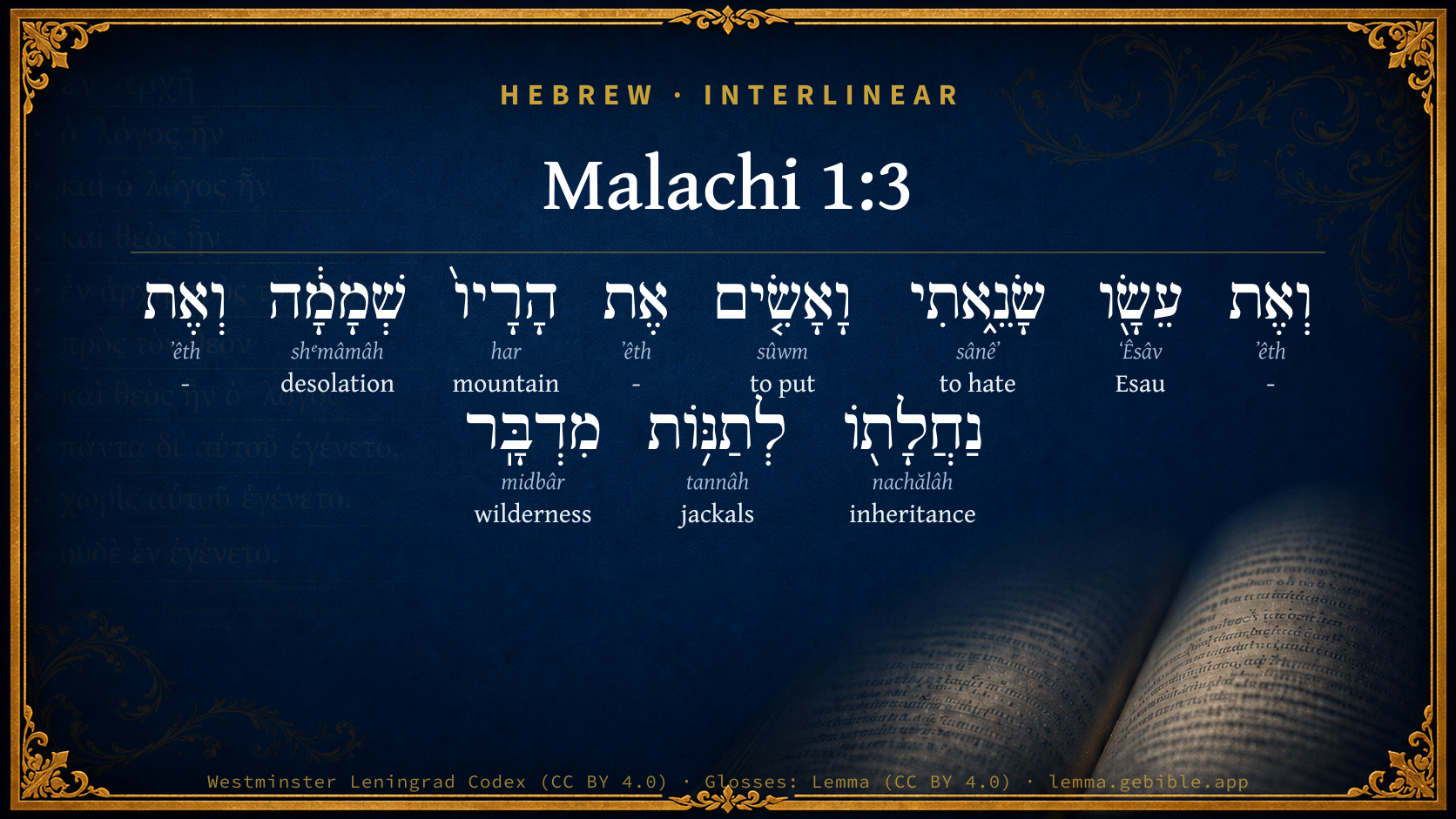
  1. וְאֶת ʼêth H853 “and · -” Conjunction + Particle, Direct Object
  2. עֵשָׂ֖ו ʻÊsâv H6215 “Esau” Noun, Proper
  3. שָׂנֵ֑אתִי sânêʼ H8130 “to hate” Verb, Qal, Perfect, 1st Person, Common, Singular
  4. וָאָשִׂ֤ים sûwm H7760 “and · to put” Conjunction + Verb, Qal, Sequential Imperfect, 1st Person, Common, Singular
  5. אֶת ʼêth H853 “-” Particle, Direct Object
  6. הָרָיו֙ har H2022 “mountains · his” Noun, Common, Masculine, Plural, Construct + Suffix, Personal, 3rd Person, Masculine, Singular
  7. שְׁמָמָ֔ה shᵉmâmâh H8077 “desolation” Noun, Common, Feminine, Singular, Absolute
  8. וְאֶת ʼêth H853 “and · -” Conjunction + Particle, Direct Object
  9. נַחֲלָת֖וֹ nachălâh H5159 “inheritance · his” Noun, Common, Feminine, Singular, Construct + Suffix, Personal, 3rd Person, Masculine, Singular
  10. מִדְבָּֽר midbâr H4057 “wilderness” Noun, Common, Masculine, Singular, Absolute

About this verse

These counts appear in no published source. They are computed here, from the morphology-tagged text and Lemma’s own curated glosses. What Lemma adds →

11
words
9
distinct lemmas
Prophets
section

Notable vocabulary

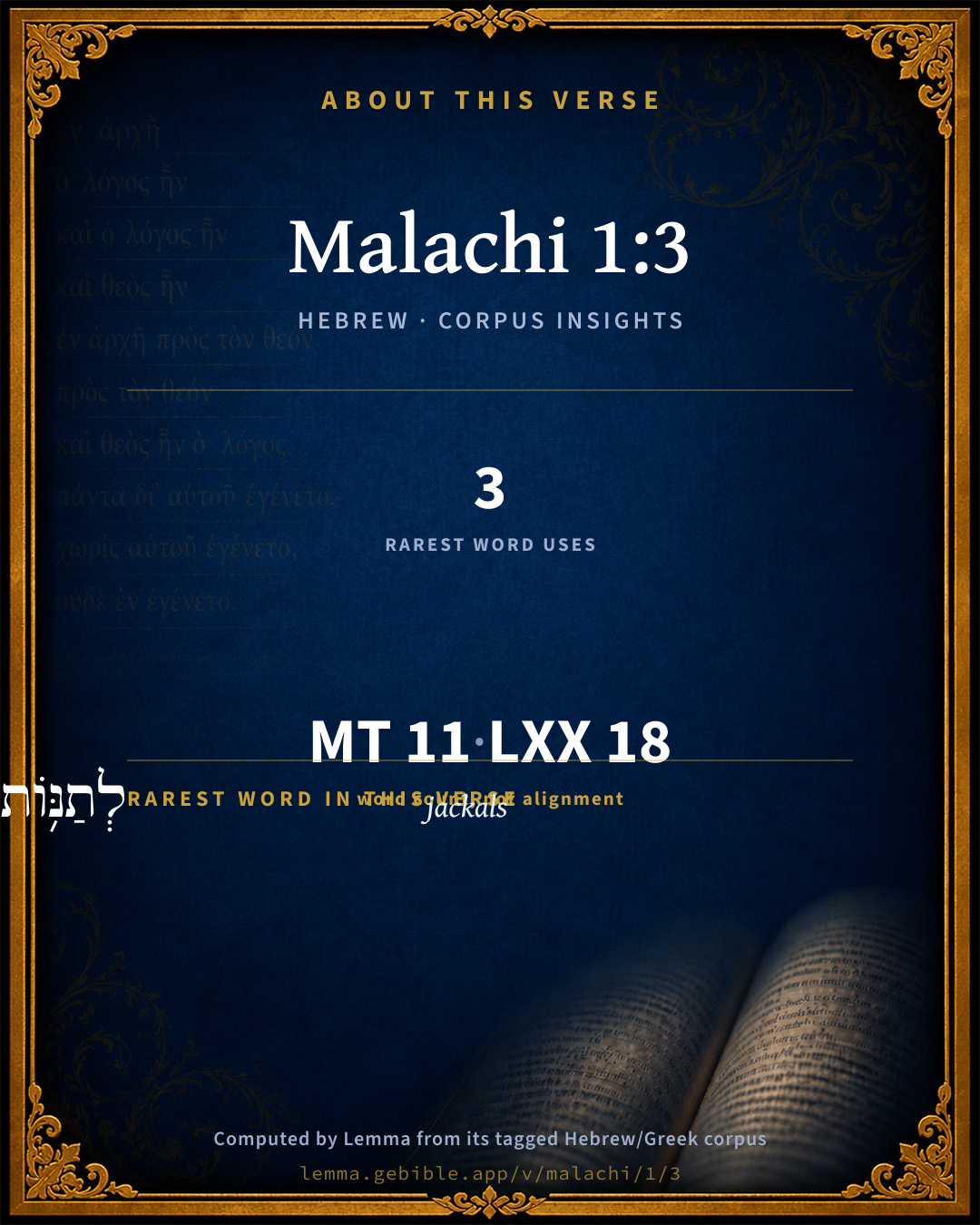
The rarest word here is לְתַנּ֥וֹת jackals H8568 — appearing just 3 times in the whole Hebrew Bible.

Shared distinctive vocabulary

לְתַנּ֥וֹת jackals H8568 occurs in 2 verses of the Hebrew Bible. Also found in:

Grammatical profile

  • 2 verbs
  • 6 nouns
  • 3 particles

Verb forms

  • שָׂנֵ֑אתִי Qal · Perfect
  • וָאָשִׂ֤ים Qal · Sequential Imperfect

Hebrew & Septuagint length

In English translation the verse runs 20 words from the Hebrew and 17 from the Septuagint (LXX English) — closely comparable.

A rough comparison of the two English renderings, which tokenize alike — not a word-level alignment.

Word counts can differ between the Hebrew and the Greek without any difference in meaning — e.g. the Hebrew direct-object marker אֵת has no separate Greek word, and Greek often adds the article ὁ.

In the original languages it is 11 Hebrew tokens and 18 Greek tokens — but the two are counted differently (Hebrew bundles its prefixes and suffixes into one token; the Greek is in lemma form), so that isn’t a like-for-like length.

Cross-references

20

Topical passages linked to Malachi 1:3 in the Treasury of Scripture Knowledge — connected by theme and wording, ordered by reader-vote popularity; previews shown in the World English Bible.

  • Joel 3:19 Egypt will be a desolation, And Edom will be a desolate wilderness, For the violence done to the children of Judah, Because they have shed innocent blood in their land.
  • Obadiah 1:10 For the violence done to your brother Jacob, shame will cover you, and you will be cut off forever.
  • Jeremiah 49:16–18 As for your terror, the pride of your heart has deceived you, O you who dwell in the clefts of the rock, who hold the height of the hill: though you should make your nest as high as the eagle, I will bring you down from there, says Yahweh.
  • Ezekiel 35:3–4 and tell it, Thus says the Lord Yahweh: Behold, I am against you, Mount Seir, and I will stretch out my hand against you, and I will make you a desolation and an astonishment.
  • Genesis 29:30–31 He went in also to Rachel, and he loved also Rachel more than Leah, and served with him yet seven other years.
  • Isaiah 13:21–22 But wild animals of the desert shall lie there; and their houses shall be full of doleful creatures; and ostriches shall dwell there, and wild goats shall dance there.
  • Isaiah 34:9–14 The streams of [Edom] shall be turned into pitch, and the dust of it into sulfur, and the land of it shall become burning pitch.
  • Isaiah 35:7 The glowing sand shall become a pool, and the thirsty ground springs of water: in the habitation of jackals, where they lay, shall be grass with reeds and rushes.
  • Jeremiah 9:11 I will make Jerusalem heaps, a dwelling-place of jackals; and I will make the cities of Judah a desolation, without inhabitant.
  • Jeremiah 49:10 But I have made Esau bare, I have uncovered his secret places, and he shall not be able to hide himself: his seed is destroyed, and his brothers, and his neighbors; and he is no more.
  • Jeremiah 51:37 Babylon shall become heaps, a dwelling-place for jackals, an astonishment, and a hissing, without inhabitant.
  • Ezekiel 25:13–14 therefore thus says the Lord Yahweh, I will stretch out my hand on Edom, and will cut off man and animal from it; and I will make it desolate from Teman; even to Dedan shall they fall by the sword.
  • Ezekiel 36:3–4 therefore prophesy, and say, Thus says the Lord Yahweh: Because, even because they have made you desolate, and swallowed you up on every side, that you might be a possession to the residue of the nations, and you are taken up in the lips of talkers, and the evil report of the people;
  • Ezekiel 36:7 therefore thus says the Lord Yahweh: I have sworn, [saying], Surely the nations that are round about you, they shall bear their shame.
  • Ezekiel 36:9 For, behold, I am for you, and I will turn into you, and you shall be tilled and sown;
  • Ezekiel 36:14–15 therefore you shall devour men no more, neither bereave your nation any more, says the Lord Yahweh;
  • Obadiah 1:18–21 The house of Jacob will be a fire, the house of Joseph a flame, and the house of Esau for stubble. They will burn among them, and devour them. There will not be any remaining to the house of Esau." Indeed, Yahweh has spoken.
  • Luke 14:26 "If anyone comes to me, and doesn't hate his own father, mother, wife, children, brothers, and sisters, yes, and his own life also, he can't be my disciple.
  • Deuteronomy 21:15–16 If a man have two wives, the one beloved, and the other hated, and they have borne him children, both the beloved and the hated; and if the firstborn son be hers who was hated;
  • Ezekiel 35:7–8 Thus will I make Mount Seir an astonishment and a desolation; and I will cut off from it him who passes through and him who returns.

Cross-references courtesy of OpenBible.info (CC BY 4.0).

Hebrew and Greek witnesses Masoretic Hebrew ↔ Greek Septuagint

The same verse in the two great witnesses to the Old Testament, shown verse-for-verse.

These are two independent witnesses, not word-aligned to each other, and the Septuagint is shown in lemma (dictionary) form.

Hebrew Malachi 1:3 Masoretic · Westminster Leningrad Codex

וְאֶת עֵשָׂ֖ו שָׂנֵ֑אתִי וָאָשִׂ֤ים אֶת הָרָיו֙ שְׁמָמָ֔ה וְאֶת נַחֲלָת֖וֹ לְתַנּ֥וֹת מִדְבָּֽר

but Esau I hated, and made his mountains a desolation, and gave his heritage to the jackals of the wilderness."

World English Bible · Public Domain

Greek LXX Malachi 1:3 Septuagint · lemma form

ὁ δέ ησαυ μισέω καί τάσσω ὁ ὅριον αὐτός εἰς ἀφανισμός καί ὁ κληρονομία αὐτός εἰς δόμα ἔρημος

and hated Esau and laid waste his borders, and made his heritage as dwellings of the wilderness?

LXX2012 (modern English Septuagint) · Public Domain

On this verse, John Gill's Exposition discusses the Septuagint’s reading. Read the note in Commentary ↓

Hebrew: Westminster Leningrad Codex (CC BY 4.0). Greek: Septuagint (public domain); English from LXX2012 (modern English Septuagint) (Public Domain). How the Septuagint differs from the Hebrew →

Targum (Aramaic paraphrase)

1

The Targum is the ancient Jewish Aramaic paraphrase of the Hebrew Scriptures — an interpretive translation, not the Hebrew text itself. Onkelos (literal) and Pseudo-Jonathan (expansive) render the Torah, and Jonathan the Prophets. Coverage is partial: where no permissively-licensed English translation exists for a verse, only the Aramaic is shown. This is verse-level text, not a word-by-word alignment to the Hebrew.

  1. Targum Jonathan Prophets (Joshua–Malachi)
    וְיַת עֵשָׂו רְחִיקֵית וְשַׁוֵיתִי יַת טוּרוֹהִי לְצָדוּ וְיַת אַחְסַנְתֵּיהּ לְצָדוּת מַדְבְּרָא:

    (no public-domain English translation for this verse)

    Targum Jonathan — Aramaic: “Mikraot Gedolot” (public domain). English: “Sefaria Community Translation” (CC0 1.0 (public-domain dedication)); “London "Chaldee Paraphrase," 1871” (public domain). Text via Sefaria.

Commentary

Notes on Malachi 1:3 from classic Christian and Jewish commentators (each source and its license shown beneath its notes). The classic Christian expositions comment on the surrounding passage and are grouped to its opening verse, so a note may address several verses; the Jewish commentaries on the Tanakh (Rashi and others) are per-verse, so they appear only where the commentator wrote on this verse.

Lemma curates 59 commentaries, every one of them public domain or Creative Commons licensed, each selected and text-cleaned for this edition rather than reprinted as found. About our sources →

John Gill's Exposition

And I hated Esau,.... Or, "rejected" him, as the Targum; did not love him as Jacob: this was a negative, not positive hatred; it is true of him, personally considered; not only by taking away the birthright and blessing from him, which he despised; but by denying him his special grace, leaving him in his sins, and to his lusts, so that he became a profane person; shared not in the grace of God here, and had no part in the eternal inheritance with the saints in light; and likewise it is true of his posterity, as the following instances show:

and laid his mountains and his heritage waste; which, according to Grotius, was done by Nebuchadnezzar, five years after the captivity of the Jews, in fulfilment of the prophecy of Jeremiah, Jer 49:7 but this was done by the Nabatheans (n): Mount Seir was the famous mountain that Esau dwelt in, Gen 36:8 there might be more in his country; or this might have many tops, and therefore called "mountains"; and to this account of the waste and desolate state of this country agrees what is at present related of it, by a late traveller (o) in those parts:

"if (says he) we leave Palestine and Egypt behind us, and pursue our physical observations into the land of Edom, we shall be presented with a variety of prospects, quite different from those we have lately met with in the land of Canaan, or in the field of Zoan; for we cannot here be entertained with pastures clothed with flocks, or with valleys standing thick with corn, or with brooks of water, or fountains, or depths that spring out of valleys and hills, Deu 8:7 here is no place of seed, or of figs, or of vines, or pomegranates, Num 20:5 but the whole is an "evil place", a lonesome desolate wilderness; no otherwise diversified than by plains covered with sand, and by mountains made up of naked rocks and precipices, Mal 1:3 neither is this country ever (unless sometimes at the equinoxes) refreshed with rain; but the few hardy vegetables it produces are stunted by a perpetual drought; and the nourishment which the dews contribute to them in the night, is sufficiently impaired by the powerful heat of the sun in the day:''

Though this country seems to have been originally more fruitful, and better cultivated, as may be concluded from Gen 27:39 but is become so through the judgments of God upon it:

for the dragons of the wilderness; so called to distinguish them from sea dragons, or the dragon fish; such as whales and crocodiles, which are sometimes expressed by the same word here used, Gen 1:21 and these land dragons are no other than serpents of an enormous size. In the Indies they used to be distinguished into three sorts; such as were found in the mountains; such as were bred in caves, or in the flat country; and such as were found in fens and marshes. The first is the largest of all, and are covered with scales as resplendent as polished gold; these have a kind of beard hanging from their lower jaw; their eyebrows large, and very exactly arched; their aspect the most frightful that can be imagined; and their cry loud and shrill; their crest of a bright yellow; and a protuberance on their heads of the colour of a burning coal. Those of the flat country differ from the former in nothing but having their scales of a silver colour, and in their frequenting rivers, to which the former never come. Those that live in marshes and fens are of a dark colour, approaching to a black, move slowly, have no crest, or any rising on their heads (p); these creatures commonly inhabit desert places. So Diodorus Siculus (q), speaking of Ethiopia, says, it is reported that various kinds of serpents, and of an incredible size, are seen near the desert, had in places inhabited by wild beasts; and Aelianus (r) describes the dragon as dwelling in woods, and living on poisonous herbs; and preferring a desolate place to cities, and the habitations of men; and when in Scripture it is predicted of countries and cities that they shall become desolate, it is usually observed, that they shall be the dwelling places of dragons, as in Isa 13:22 so here it is foretold that it should be the case of Edom, as it has been, and still continues to be, as appears from the above traveller (s); who, passing through some part of this country, says of it,

"vipers, especially in the wilderness of Sin, which might be very properly called "the inheritance of dragons", were very dangerous and troublesome; not only our camels, but the Arabs who attended them, running every moment the risk of being bitten;''

so that, according to the prediction, it is now a place for such creatures. A learned Jew (t) is of opinion, that not serpents, but jackals, are here meant, which are a sort of wild howling beasts, that live abroad in desolate places; See Gill on Mic 1:8 but whether they be the one, or the other, it makes for the same purpose, to denote what a desert place Edom would become; since it should be inhabited by such creatures to dwell in, which denotes the utter desolation made. So the Targum renders it, "into the wasteness of the desert"; or into a waste desert, where none but such sort of animals inhabit. The Septuagint and Syriac versions render it, "into the houses", or "cottages, of the desert": and now, though this was the case of Judea, that it was left desolate, yet it was but for a while; at the end of seventy years the Jews returned to their own land, and dwelt in it; but so did not the Edomites, as appears by the following words; which shows the regard God had to the posterity of Jacob, and not to the posterity of Esau.

(n) See Prideanx's Connexion, par. 2. B. 3. p. 199. (o) Dr. Shaw's Travels, p. 438. Ed. 2. (p) Harris's Voyages and Travels, vol. 1. p. 474. (q) Bibliothec. l. 3. p. 169. (r) De Animal. l. 6. c. 63. (s) Dr. Shaw Travels, p. 448. Ed. 2. (t) Tanchum apud Pocock in loc.

John Gill's Exposition of the Whole Bible (1746–1763) — public domain (CC PDM 1.0). Text via the HelloAO Bible API.

Trapp's Complete Commentary

John Trapp

Mal 1:3 And I hated Esau, and laid his mountains and his heritage waste for the dragons of the wilderness.

Ver. 3. And I hated Esau] i.e. I loved him not as I did Jacob; I passed him by, and let him alone, to perish in his corruption and for his sin. And for his posterity, whereas they were carried captives by Nebuchadnezzar (as Israel also was), I have not turned again their captivity, but laid their land desolate; rased and harassed their cities and castles, made them a habitation of dragons and devils; and all this as an argument of my deep hatred and utter detestation of them. True it is, that Judea lay utterly waste during the seventy years of their captivity; the land kept her sabbaths, resting from tillage. Upon the slaughter of Gedaliah all the Jews that were left in the land fled to Egypt: and God kept the place empty, and free from the invasion of foreigners, until the return of the natives out of Babylon. Now it was far otherwise with Idumea, the desolation whereof is here described to be both total and perpetual, according to that foretold by Eze 35:7; Eze 35:15, O mount Seir, I will make thee to be most desolate, or (as the Hebrew hath it, emphatically and eloquently) wasteness, and wasteness extreme and irrecoverable. A πανολεθρια, or utter, ruin, befell that country, being part of Arabia Petrea (hence mention of their mountains), and abounding naturally with serpents, or dragons; it being in the wilderness of this country of Edom where the Israelites were so stung with these fiery serpents, Num 21:6 : hence it became afterwards a very den of dragons lurking there.

John Trapp, A Commentary or Exposition upon All the Books of the Old and New Testament (1647–1656) — public domain. Text from a community e-Sword module.

Tyndale Open Study Notes

Tyndale Open Resources

1:3 rejected (literally hated, the antonym of loved in 1:2): Love and hate form a polar word pair in Old Testament legal and prophetic texts (see Deut 7:9-10; Amos 5:15), often used to describe the alienation of a broken covenant relationship. Here, God says that he rejected Esau (and his descendants, the Edomites). Esau had despised and rejected covenant relationship with the Lord (see Gen 25:34; 26:34-35). • Esau was the ancestor of the Edomite nation, and his inheritance, the territory of Edom, was located on the southeastern rim of the Dead Sea. The mention of Jacob and Esau calls to mind the twin brothers’ rivalry (Gen 25:23-26).

Tyndale Open Study Notes — © Tyndale Open Resources, licensed CC BY-SA 4.0. Text via the HelloAO Bible API.

Geneva Bible (1599)

Geneva Bible translators

For beside here the signs of mine hatred appeared even when he was made servant unto his younger brother, being yet in his mother’s belly, and also afterward in that he was put from his birthright, yet even now before your eyes the signs hereof are evident, in that that his country lieth waste and he shall never return to inhabit.

Whereas ye my people, whom the enemy hated more than them, are by my grace and love toward you delivered, read Rom. 9:13.

Geneva Bible (1599) marginal notes — public domain. Text via Bolls.life.

Jamieson, Fausset & Brown

Robert Jamieson, A. R. Fausset & David Brown

hated--not positively, but relatively; that is, did not choose him out to be the object of gratuitous favor, as I did Jacob (compare Luk 14:26, with Mat 10:37; Gen 29:30-31; Deu 21:15-16).

laid his mountains . . . waste--that is, his territory which was generally mountainous. Israel was, it is true, punished by the Chaldeans, but Edom has been utterly destroyed; namely, either by Nebuchadnezzar [ROSENMULLER], or by the neighboring peoples, Egypt, Ammon, and Moab [JOSEPHUS, Antiquities, 10.9,7; MAURER], (Jer 49:18).

dragons--jackals [MOORE] (compare Isa 34:13). MAURER translates, "Abodes of the wilderness," from an Arabic root "to stop," or "to abide." English Version is better.

Jamieson, Fausset & Brown — Commentary Critical and Explanatory on the Whole Bible (1871) — public domain (CC PDM 1.0). Text via the HelloAO Bible API.

Adam Clarke's Commentary

Verse 3. And I hated Esau] I have shown him less love; Ge 29:30-31. I comparatively hated him by giving him an inferior lot. And now, I have not only laid waste the dwelling-place of the Edomites, by the incursions of their enemies; but (Mal 1:4) they shall remain the perpetual monuments of my vengeance. On the subject of loving Jacob and hating Esau, see the notes on Ge 27:21-46, and Ro 9:13. Let it be remembered,

1. That there is not a word spoken here concerning the eternal state of either Jacob or Esau.

2. That what is spoken concerns merely their earthly possessions. And,

3. That it does not concern the two brothers at all, but the posterity of each.

Adam Clarke's Commentary on the Bible (1810–1826) — public domain. Text from a community e-Sword/MySword module.

John Calvin's Commentaries

We now see what I have just referred to, — that the Jews are reminded of God’s gratuitous covenant, that they might cease to excuse their wickedness in having misused this singular favor. He does not then upbraid them here, because they had been as other men created by God, because God caused his sun to shine on them, because they were supplied with food from the earth; but he says, that they had been preferred to other people, not on account of their own merit, but because it had pleased God to choose their father Jacob. He might have here adduced Abraham as an example; but as Jacob and Esau proceeded from Abraham, with whom God had made the covenant, his favor was the more remarkable, inasmuch as though Abraham had been alone chosen by God, and other nations were passed by, yet from the very family which the Lord had adopted, one had been chosen while the other was rejected. When a comparison is made between Esau and Jacob, we must bear in mind that they were brothers; but there are other circumstances to be noticed, which though not expressed here by the Prophet, are yet well known: for all the Jews knew that Esau was the first-born; and that hence Jacob had obtained the right of primogeniture contrary to the order of nature. As then this was commonly known, the Prophet was content to use only this one sentence, Esau was Jacob’s brother

But he says that Jacob was chosen by God, and that his brother, the first-born, was rejected. If the reason be asked, it is not to be found in their descent, for they were twin brothers; and they had not come forth from the womb when the Lord by an oracle testified that Jacob would be the greater. We hence see that the origin of all the excellency which belonged to the posterity of Abraham, is here ascribed to the gratuitous love of God, according to what Moses often said, “Not because ye excelled other nations, or were more in number, has God honored you with so many benefits; but because he loved your fathers.” The Jews then had always been reminded, that they were not to seek for the cause of their adoption but in the gratuitous favor of God; he had been pleased to choose them — this was the source of their salvation. We now understand the Prophet’s design when he says, that Esau was Jacob’s brother, and yet was not loved by God.

We must at the same time bear in mind what I have already said — that this singular favor of God towards the children of Jacob is referred to, in order to make them ashamed of their ingratitude, inasmuch as God had set his love on objects so unworthy. For had they been deserving, they might have boasted that a reward was rendered to them; but as the Lord had gratuitously and of his own good pleasure conferred this benefit on them, their impiety was the less excusable. This baseness then is what our Prophet now reprobates.

Then follows a proof of hatred as to Esau, the Lord made his mountain a desolation, and his inheritance a desert where serpents dwelt. Esau, we know, when driven away by his own shame, or by his father’s displeasure, came to Mount Seir; and the whole region where his posterity dwelt was rough and enclosed by many mountains. But were any to object and say, that this was no remarkable token of hatred, as it might on the other hand be said, that the love of God towards Jacob was not much shown, because he dwelt in the land of Canaan, since the Chaldeans inhabited a country more pleasant and more fruitful, and the Egyptians also were very wealthy; to this the answer is — that the land of Canaan was a symbol of God’s love, not only on account of its fruitfulness, but because the Lord had consecrated it to himself and to his chosen people. So Jerusalem was not superior to other cities of the land, either to Samaria or Bethlehem, or other towns, on account of its situation, for it stood, as it is well known, in a hilly country, and it had only the spring of Siloam, fiom which flowed a small stream; and the view was not so beautiful, nor its fertility great; at the same time it excelled in other things. for God had chosen it as his sanctuary; and the same must be said of the whole land. As then the land of Canaan was, as it were, a pledge of an eternal inheritance to the children of Abraham, the scripture on this account greatly extols it, and speaks of it in magnificent terms. If Mount Seir was very wealthy and replenished with everything delightful, it must have been still a sad exile to the Idumeans, because it was a token of their reprobation; for Esau, when he left his father’s house, went there; and he became as it were an alien, having deprived himself of the celestial inheritance, as he had sold his birthright to his brother Jacob. This is the reason why God declares here that Esau was dismissed as it were to the mountains, and deprived of the Holy Land which God had destined to his chosen people.

But the Prophet also adds another thing, — that God’s hatred as manifested when the posterity of Esau became extinct. For though the Assyrians and Chaldeans had no less cruelly raged against the Jews than against the Edomites, yet the issue was very different; for after seventy years the Jews returned to their own country, as Jeremiah had promised: yet Idumea was not to be restored, but the tokens of God’s dreadful wrath had ever appeared there in its sad desolations. Since then there had been no restoration as to Idumea, the Prophet shows that by this fact the love of God towards Jacob and his hatred towards Esau had been proved; for it had not been through the contrivance of men that the Jews had liberty given them, and that they were allowed to build the temple; but because God had chosen them in the person of Jacob, and designed them to be a peculiar and holy people to himself.

But as to the Edomites, it became then only more evident that they had been rejected in the person of Esau, since being once laid waste they saw that they were doomed to perpetual destruction. This is then the import of the Prophet’s words when he says, that the possession of Esau had been given to serpents. For, as I have already said, though for a time the condition of Judea and of Idumea had not been unlike, yet when Jerusalem began to rise and to be repaired, then God clearly showed that that land had not been in vain given to his chosen people. But when the neighboring country was not restored, while yet the posterity of Esau might with less suspicion have repaired their houses, it became hence sufficiently evident that the curse of God was upon them.

John Calvin's Commentaries (1540-1563) — public domain. Text from the Calvin Translation Society English edition (1840s-50s) via the Christian Classics Ethereal Library (ccel.org). Calvin's coverage is partial (roughly two-thirds of the Bible); uncommented books and verses are honest gaps, never fabricated. The 19th-century editor's footnotes and remarks are omitted so the notes are faithfully Calvin's own voice.

The Cambridge Bible for Schools and Colleges

gen. ed. J. J. S. Perowne

3. for the dragons] Rather, jackals. The unusual form of the word here (fem. instead of masc. as elsewhere) has led many to render, dwellings (LXX. δώματα ἐρήμου; and Syr.). But the derivation and meaning are not satisfactory. Rather, with R.V., I made his mountains a desolation, and gave his heritage to the jackals of the wilderness. Unless indeed we neglect the accents and adopt a third rendering, which seems still better to preserve the parallelism, I made his mountains a desolation, and his heritage a wilderness for jackals.

The desolation of Edom here referred to was in all probability caused by Nebuchadnezzar, in fulfilment of the prophecy of Jeremiah (Jer_49:17-22. Comp. Jer_27:3-6). See Obadiah, Introd. pp. 20, 22, in this Series.

The Cambridge Bible for Schools and Colleges (gen. ed. J. J. S. Perowne; Cambridge University Press, 1878–1918) — public domain. Text from a community e-Sword module.

Albert Barnes' Notes on the Bible

And I made his mountains a waste, and his heritage for the jackals of the wilderness - o

Malachi attests the first stage of fulfillment of Joel’s prophecy (Joe 3:19, vol. i. pp. 214, 215), “Edom shall be a desolate wilderness.” In temporal things, Esau’s blessing was identical with Jacob’s; “the fatness of the earth and of the dew of heaven from above;” and the rich soil on the terraces of its mountain-sides, though yielding nothing now except a wild beautiful vegetation, and its deep glens, attest what they once must have been, when artificially watered and cultivated. The first desolation must have been through Nebuchadnezzar , in his expedition against Egypt, when he subdued Moab and Ammon; and Edom lay in his way, as Jeremiah had foretold Jer 25:9, Jer 25:21.

Albert Barnes' Notes on the Bible (1834–1885) — public domain. Text from a community e-Sword/MySword module.

Haydock's Catholic Bible Commentary

Esau, perceiving the evil which was already in him, and would appear afterwards; (St. Jerome and Theodoret) or rather he was a figure of the reprobate, though not of course one himself. (St. Augustine) --- A person is said to hate what he loves less. Esau’s privileges were transferred to his brother, who enjoyed a much finer country, and was chosen for God’s peculiar inheritance. (Calmet) --- Temporal blessings are here specified. --- Dragons. Septuagint, "houses;" so that they shall be deserted. (Haydock) --- Edom was ravaged by Nabuchodonosor. The people retired into the cities, from which the Jews were driven. Yet afterwards they rebuilt their own habitations.

George Leo Haydock (1774–1849), Haydock's Catholic Family Bible and Commentary, 1859 edition — public domain. Excludes Psalms (Douay-Rheims chapter numbering differs from Protestant) and Deuterocanonical books (Catholic canon only).

Matthew Poole's English Annotations

I hated; I loved not Esau or his posterity as I loved Jacob and his posterity: this not loving, comparatively, is a hating, God showed not the same kindness to the twin brothers; the one was more enriched with the fruits of God’s love, and had cause to be thankful; the other had no cause to complain, for God did him no wrong.

Esau; containing his posterity with him; for though the hatred or lesser love began towards Esau’s person, yet the effects of it appeared more manifestly in Esau’s posterity.

His mountains and his heritage; Mount Seir with the neighbouring mountains given to Esau Deu 2:5; Jos 24:4 for inheritance, as here it is said, and which he and his posterity did enjoy about one thousand two hundred years.

Waste, by Nebuchadnezzar’s arms five years after the sacking of Jerusalem, as foretold by Ezekiel, Eze 35. The people were slain or captivated, or forced to lice from the sword of the enemy, their cities taken, plundered, and burnt. It is possible that they might meet with worse usage than the Jews met with herein; however, their state seems equal, and here is no token of unequal hatred; but what follows doth manifestly discover it, for whereas Jacob’s captivity returned, and their cities were rebuilt, Esau’s never were.

For the dragons; or jackals, or owls, for the word is so used and explained by some; or all these with dragons doleful creatures, which delight in desolate places; by which the utter desolation, and the perpetuity of the desolation, of Esau is signified.

Matthew Poole's English Annotations on the Holy Bible (1683–1685) — public domain. Text from a community e-Sword/MySword module.

The Pulpit Commentary

And I hated Esau. St. Paul quotes these words (Rom_9:13) in order to illustrate his position, "that the purpose of God according to election might stand, not of works, but of him that calleth." Even before his birth Jacob was the chosen one, and Esau, the elder, was to serve the younger. This mystery of Divine election has seemed to some to be stated so harshly that they have thought that the words of the text need to be softened, or to be modified by their explanation. Thus they give the glosses, "I have preferred Jacob to Esau;" "I have loved Esau less than Jacob;" or they have limited the terms "love" end "hatred" to the bestowing or withholding of temporal blessings; or they have affirmed that Esau was hated because God foresaw his unworthiness, and Jacob was beloved owing to his foreseen piety and faithfulness. The whole question is discussed by Augustine, "De Div. Quint. ad Simplic.," 1:18 (11:433). He ends by saying, "Deus odit impietatem: in aliis etiam punit per damnationem, in aliis adimit per justificationem." But Malachi is not speaking of the predestination of the one brother and the reprobation of the other; he is contrasting the histories of the two peoples represented by them; as Jerome puts it, "In Jacob vos dilexi, in Esau Idumaeos odio habui." Both nations sinned; both are punished; but Israel by God"s free mercy was forgiven and restored, while Edom was left in the misery which it had brought upon itself by its own iniquity. Thus is proved God"s love for the Israelites (Knabenbauer). That it is of the two nations that the prophet speaks, rather than of the two brothers, is seen by what follows. Laid his mountains... waste. While the Israelites were repeopling and cultivating their land, and their cities were rising from their ruins, and the temple and the capital were rebuilt, Edom, which had suffered at the hand of the same enemies, had never recovered from the blow, and still lay a scene of desolation and ruin. It seems that Nebuchadnezzar attacked and conquered Edom some few years after he had taken Jerusalem. This event happened during one of his expeditions against Egypt, one of which took place in the thirty-seventh year of his reign, as we learn from a record lately deciphered (see "Transact. of Soc. of Bibl. Archaeology," 7:210, etc.). (For Edom and its history, see the Introduction to Obadiah.) Dragons; rather, jackals; (Mic_1:8) Septuagint, eiv dwmata erhmou , "for habitations of the desert;" Vulgate, dracones deserti, whence the Authorized Version.

The Pulpit Commentary (1880–1919), ed. H.D.M. Spence-Jones & Joseph S. Exell — public domain. Text from a community e-Sword module.

John Wesley's Explanatory Notes

I hated - I loved not Esau's posterity as I loved Jacob's. His heritage - Mount Seir with the neighbouring mountains. Waste - By Nebuchadnezzar's arms five years after the sacking of Jerusalem, and whereas Jacob's captivity returned, and their cities were rebuilt, Esau's never were. The dragons - Creatures which delight in desolate places, by which the utter desolation of Esau is signified.

John Wesley, Explanatory Notes Upon the Whole Bible (1754–1765) — public domain. Text via the GEBible commentary corpus.

Rashi

Rabbi Shlomo Yitzchaki (Rashi)

And I hated Esau to push him off to a land because of Jacob, his brother. Now it is customary in the world that, if one has two sons, he selects a beautiful portion for the firstborn.

and I made his mountains desolate They do not compare to the mountains of Israel.

for the jackals of the desert A den of jackals.

Rashi on the Tanakh — English translations: “The Judaica Press complete Tanach with Rashi, translated by A. J. Rosenberg” (CC BY 4.0); “Pentateuch with Rashi's commentary by M. Rosenbaum and A.M. Silbermann, 1929-1934” (public domain); “The Metsudah Tanach series, Lakewood, N.J” (CC BY 4.0); and “The Book of Joshua, Metsudah Publications, 1997” (CC BY 4.0). Text via Sefaria.

Lesson kit

Teaching starters — assembled from the data on this page, not authored interpretation. Every prompt links to the verse data it draws on. Edit before teaching.

Malachi, in the Prophets, opens this verse with 11 words (9 distinct Hebrew lemmas). Its most distinctive word is tannâh (“jackals”). A historical commentator’s framing appears above. Read the whole chapter for the surrounding context.

Discussion questions

  1. How does “jackals” (tannâh) shape what this verse is saying?
  2. How does Lamentations 4:3, which shares the word «jackals», read alongside this verse?
  3. These translations render this verse differently; the difference is in the English rendering, not the original. What questions does that raise?
  4. «שָׂנֵ֑אתִי» is a Qal Perfect verb. How does that grammatical form shape the action described?
  5. Compare how John Gill's Exposition and Trapp's Complete Commentary read this verse. Where do they agree or differ?

Things to notice

Reading settings

Reading text

Shown beneath each verse's original-language words.

Old Testament
Old Testament edition

Read the OT as the Masoretic Hebrew (MT) or the Greek Septuagint (LXX).

English shown for the Greek Septuagint (in the Hebrew ↔ Greek comparison).

Comparing translations? Open the Compare panel on any verse page to stack up to four side by side.