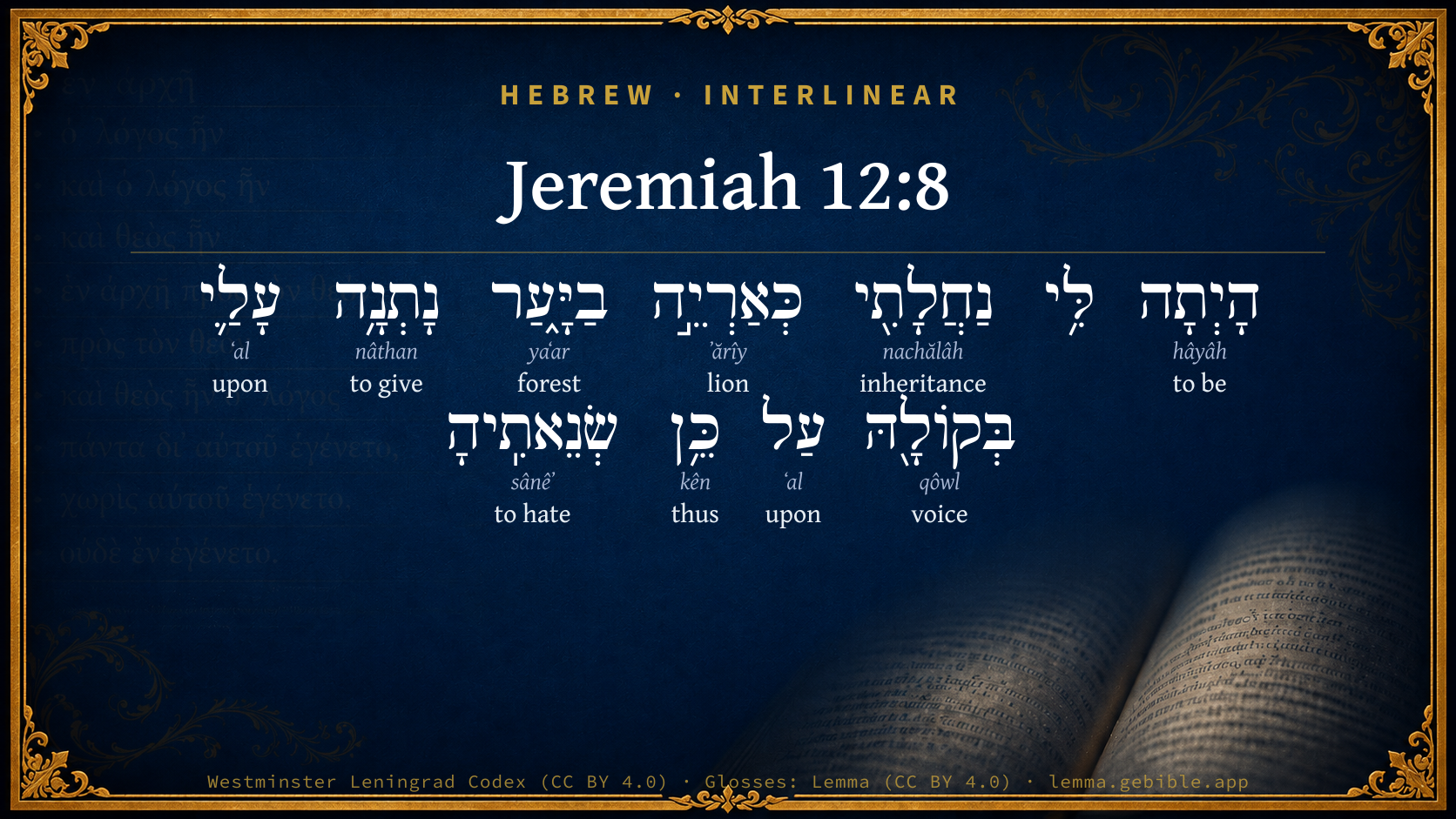
Jeremiah 12:8

Hebrew (Westminster Leningrad Codex) Jeremiah 12:8 appears in the Hebrew Old Testament. The text above is from the Westminster Leningrad Codex. Each word links to its Strong’s number, a concise gloss, and parsing drawn from the Open Scriptures Hebrew Bible morphology. Click any word for its full Brown-Driver-Briggs (BDB) entry.
Download image
Cite this verse

Jeremiah 12:8 (World English Bible). Public Domain. Lemma interlinear Bible study tool, https://lemma.gebible.app/v/jeremiah/12/8.

Show BibTeX & RIS
BibTeX
RIS
English Translation
My heritage is become to me as a lion in the forest: she has uttered her voice against me; therefore I have hated her.
World English Bible · Public Domain
Download a study sheet

One document with this verse’s original text, its word-by-word gloss line, the meaning frame, cross-references with their text, attributed commentary, and full source and license credits — printable, and it pastes into notes with its structure intact.

This verse Autodidact and up

Study sheet (.html) Plain text (.txt)

A passage Seminary Student

Up to 50 verses in one chapter. A passage sheet keeps up to 6 commentary sources and 12 cross-references per verse, in the order this page ranks them, and says so on the sheet whenever that leaves anything out. Ask for a single verse and you get the Autodidact verse sheet above.

Everything on this page stays free to read, with no account — the sheet is a download of what is already on screen, not access to it.

Want to remove ads? Support Godless Engineer
Compare translations 3

The same verse in 3 English versions, stacked beneath the original-language interlinear above. Click any original word for its lexicon entry.

Each is an independent rendering of the whole verse — the interlinear is not word-aligned to these translations.

Highlighted words mark where these versions differ — a whole-verse word diff, not a word-by-word alignment.

  • World English Bible Public Domain
    My heritage is become to me as a lion in the forest: she has uttered her voice against me; therefore I have hated her.
  • King James Version Public Domain
    Mine heritage is unto me as a lion in the forest; it crieth out against me: therefore have I hated it.
  • unfoldingWord Literal Text CC BY-SA 4.0
    My inheritance has become to me like a lion in the forest, she uttered against me with her voice, therefore I hate her.

unfoldingWord Literal Text — © unfoldingWord, licensed CC BY-SA 4.0. Word-aligned USFM3 via Door43 (git.door43.org/unfoldingWord/en_ult).

Versions to compare (up to 4)

3 of 4 selected

Show all 18 translations

Every available English version of this verse, each an independent rendering of the whole verse.

  • World English Bible Public Domain
    My heritage is become to me as a lion in the forest: she has uttered her voice against me; therefore I have hated her.
  • Berean Standard Bible Public Domain
    My inheritance has become to Me like a lion in the forest. She has roared against Me; therefore I hate her.
  • Majority Standard Bible Public Domain
    My inheritance has become to Me like a lion in the forest. She has roared against Me; therefore I hate her.
  • King James Version Public Domain
    Mine heritage is unto me as a lion in the forest; it crieth out against me: therefore have I hated it.
  • American Standard Version (1901) Public Domain
    My heritage is become unto me as a lion in the forest: she hath uttered her voice against me; therefore I have hated her.
  • Revised Version (1885) Public Domain
    Mine heritage is become unto me as a lion in the forest: she hath uttered her voice against me; therefore I have hated her.
  • Geneva Bible (1599) Public Domain
    Mine heritage is vnto mee, as a lion in the forest: it crieth out against mee, therefore haue I hated it.
  • Douay-Rheims (1899) Public Domain
    My inheritance is become to me as a lion in the wood: is hath cried out against me, therefore have I hated it.
  • Young's Literal Translation Public Domain
    Mine inheritance hath been to Me as a lion in a forest, She gave forth against Me with her voice, Therefore I have hated her.
  • Literal Standard Version CC BY-SA 4.0
    My inheritance has been to Me as a lion in a forest, || She gave forth against Me with her voice, || Therefore I have hated her.
  • Unlocked Literal Bible CC BY-SA 4.0
    My inheritance has become to me like a lion in a thicket; she sets herself against me with her own voice, so I hate her.
  • unfoldingWord Literal Text CC BY-SA 4.0
    My inheritance has become to me like a lion in the forest, she uttered against me with her voice, therefore I hate her.
  • Darby Bible Public Domain
    My heritage is become unto me as a lion in the forest; it hath raised its voice against me: therefore have I hated it.
  • World Messianic Bible Public Domain
    My heritage has become to me as a lion in the forest. She has uttered her voice against me. Therefore I have hated her.
  • Webster's Bible Public Domain
    My heritage is to me as a lion in the forest; it crieth out against me: therefore have I hated it.
  • Free Bible Version CC BY-SA 4.0
    They've turned into a wild lion, roaring at me—that's why I hate them.
  • Bible in Basic English Public Domain
    My heritage has become like a lion in the woodland to me; her voice has been loud against me; so I have hate for her.
  • JPS Tanakh (1917) Public Domain
    My heritage is become unto Me as a lion in the forest; she hath uttered her voice against Me; therefore have I hated her.

Literal Standard Version (2020), Covenant Press — licensed CC BY-SA 4.0. Text via the HelloAO Bible API (eBible.org). Unlocked Literal Bible (unfoldingWord) — licensed CC BY-SA 4.0. Text via the HelloAO Bible API (eBible.org). unfoldingWord Literal Text — © unfoldingWord, licensed CC BY-SA 4.0. Word-aligned USFM3 via Door43 (git.door43.org/unfoldingWord/en_ult). Free Bible Version, Dr. Jonathan Gallagher — licensed CC BY-SA 4.0. Text via the HelloAO Bible API (eBible.org).

Word by word

More ways to search: Search by grammar → Find every occurrence → Compare this word →

Practice this passage: Drill this verse → Learn its vocabulary →

בַיָּ֑עַר
yaʻar
H3293
“in/at the · forest”
Preposition, Determined + Noun, Common, Masculine, Singular, Absolute
Part of Speech
Preposition + Noun
Type
Common
Gender
Masculine
Number
Singular
State
Absolute
Full BDB Definition

Origin: from an unused root probably meaning to thicken with verdure

TWOT: 888 , 889

forest, wood, thicket, wooded height
  1. הָיְתָה hâyâh H1961 “to be” Verb, Qal, Perfect, 3rd Person, Feminine, Singular
  2. נַחֲלָתִ֖י nachălâh H5159 “inheritance · my” Noun, Common, Feminine, Singular, Construct + Suffix, Personal, 1st Person, Common, Singular
  3. כְּאַרְיֵ֣ה ʼărîy H738 “like/as · lion” Preposition + Noun, Common, Masculine, Singular, Absolute
  4. נָתְנָ֥ה nâthan H5414 “to give” Verb, Qal, Perfect, 3rd Person, Feminine, Singular
  5. עָלַ֛י ʻal H5921 “upon · me” Preposition + Suffix, Personal, 1st Person, Common, Singular
  6. בְּקוֹלָ֖הּ qôwl H6963 “in/at · voice · her” Preposition + Noun, Common, Masculine, Singular, Construct + Suffix, Personal, 3rd Person, Feminine, Singular
  7. עַל ʻal H5921 “upon” Preposition
  8. כֵּ֥ן kên H3651 “thus” Particle, Demonstrative
  9. שְׂנֵאתִֽיהָ sânêʼ H8130 “to hate · her” Verb, Qal, Perfect, 1st Person, Common, Singular + Suffix, Personal, 3rd Person, Feminine, Singular

About this verse

These counts appear in no published source. They are computed here, from the morphology-tagged text and Lemma’s own curated glosses. What Lemma adds →

11
words
9
distinct lemmas
Prophets
section

Shared distinctive vocabulary

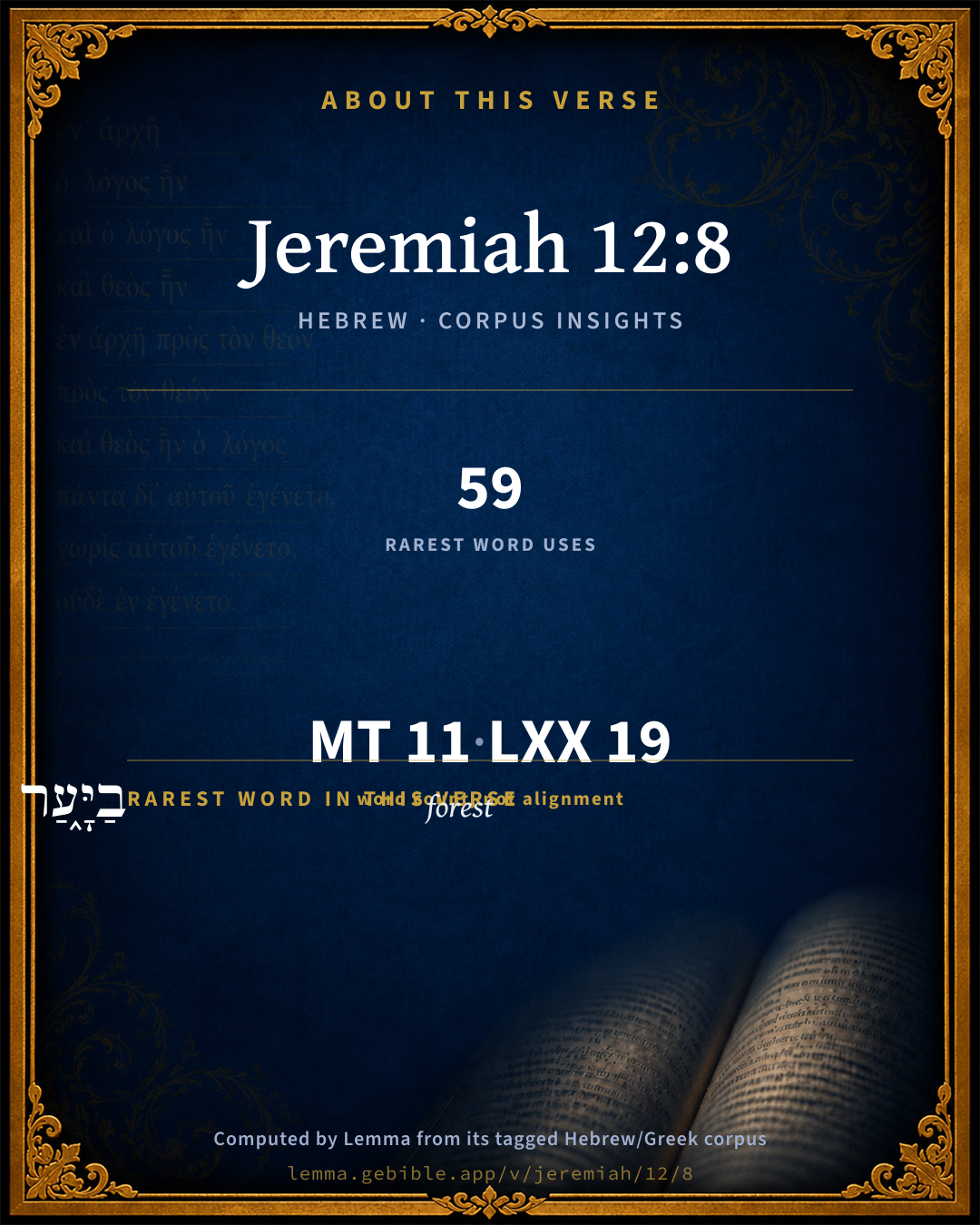
בַיָּ֑עַר forest H3293 occurs in 59 verses of the Hebrew Bible. Also found in:

Grammatical profile

  • 3 verbs
  • 4 nouns
  • 3 prepositions
  • 1 particle

Verb forms

  • הָיְתָה Qal · Perfect
  • נָתְנָ֥ה Qal · Perfect
  • שְׂנֵאתִֽיהָ Qal · Perfect

Repetition

A word recurs within this verse — often emphatic in Hebrew:

  • עָלַ֛י upon H5921 ×2

Hebrew & Septuagint length

In the original languages it is 11 Hebrew tokens and 19 Greek tokens — but the two are counted differently (Hebrew bundles its prefixes and suffixes into one token; the Greek is in lemma form), so that isn’t a like-for-like length.

Cross-references

5

Topical passages linked to Jeremiah 12:8 in the Treasury of Scripture Knowledge — connected by theme and wording, ordered by reader-vote popularity; previews shown in the World English Bible.

  • Amos 6:8 "The Lord Yahweh has sworn by himself," says Yahweh, the God of hosts: "I abhor the pride of Jacob, And detest his fortresses. Therefore I will deliver up the city with all that is in it.
  • Hosea 9:15 "All their wickedness is in Gilgal; For there I hated them. Because of the wickedness of their deeds I will drive them out of my house! I will love them no more. All their princes are rebels.
  • Zechariah 11:8 I cut off the three shepherds in one month; for my soul was weary of them, and their soul also loathed me.
  • Jeremiah 2:15 The young lions have roared on him, and yelled; and they have made his land waste: his cities are burned up, without inhabitant.
  • Jeremiah 51:38 They shall roar together like young lions; they shall growl as lions' cubs.

Cross-references courtesy of OpenBible.info (CC BY 4.0).

Hebrew and Greek witnesses Masoretic Hebrew ↔ Greek Septuagint

The same verse in the two great witnesses to the Old Testament, shown verse-for-verse.

These are two independent witnesses, not word-aligned to each other, and the Septuagint is shown in lemma (dictionary) form.

Hebrew Jeremiah 12:8 Masoretic · Westminster Leningrad Codex

הָיְתָה לִּ֥י נַחֲלָתִ֖י כְּאַרְיֵ֣ה בַיָּ֑עַר נָתְנָ֥ה עָלַ֛י בְּקוֹלָ֖הּ עַל כֵּ֥ן שְׂנֵאתִֽיהָ

My heritage is become to me as a lion in the forest: she has uttered her voice against me; therefore I have hated her.

World English Bible · Public Domain

Greek LXX Structure differs

In the Septuagint, Jeremiah is about an eighth shorter than the Hebrew and arranges its material differently — the Oracles Against the Nations (Hebrew chapters 46–51) appear in the middle of the Greek book, after 25:13. Because the chapter and verse boundaries do not line up, a verse-for-verse comparison with the Hebrew is not shown.

A verse-for-verse comparison isn’t shown here because the chapters and verses don’t line up. Switch to the LXX edition with the MT / LXX toggle above to read the Greek directly.

Hebrew: Westminster Leningrad Codex (CC BY 4.0). Greek: Septuagint (public domain); English from a public-domain English Septuagint. How the Septuagint differs from the Hebrew →

Targum (Aramaic paraphrase)

1

The Targum is the ancient Jewish Aramaic paraphrase of the Hebrew Scriptures — an interpretive translation, not the Hebrew text itself. Onkelos (literal) and Pseudo-Jonathan (expansive) render the Torah, and Jonathan the Prophets. Coverage is partial: where no permissively-licensed English translation exists for a verse, only the Aramaic is shown. This is verse-level text, not a word-by-word alignment to the Hebrew.

  1. Targum Jonathan Prophets (Joshua–Malachi)
    הֲוַת קֳדָמַי אַחֲסַנְתִּי כְּאַרְיָא בְּחוּרְשָׁא סְלֵיקַת עֲלַי אִתְרְגוּשְׁתָּהּ עַל כֵּן רְחֵיקְתָּהּ:

    (no public-domain English translation for this verse)

    Targum Jonathan — Aramaic: “Mikraot Gedolot” (public domain). English: “Sefaria Community Translation” (CC0 1.0 (public-domain dedication)); “London "Chaldee Paraphrase," 1871” (public domain). Text via Sefaria.

Commentary

Notes on Jeremiah 12:8 from classic Christian and Jewish commentators (each source and its license shown beneath its notes). The classic Christian expositions comment on the surrounding passage and are grouped to its opening verse, so a note may address several verses; the Jewish commentaries on the Tanakh (Rashi and others) are per-verse, so they appear only where the commentator wrote on this verse.

Lemma curates 59 commentaries, every one of them public domain or Creative Commons licensed, each selected and text-cleaned for this edition rather than reprinted as found. About our sources →

Trapp's Complete Commentary

John Trapp

Jer 12:8 Mine heritage is unto me as a lion in the forest; it crieth out against me: therefore have I hated it.

Ver. 8. Mine heritage is unto me as a lion in the forest.] Roaring against me, and revelling in the ruin of my messengers. Ubi affectus augetur in antithesi verborum; haereditas mea, et contra me; sheep they were wont to be, now they are become lions.

John Trapp, A Commentary or Exposition upon All the Books of the Old and New Testament (1647–1656) — public domain. Text from a community e-Sword module.

Joseph Benson's Commentary

Jer 12:8-9. My heritage is unto me as a lion in the forest — Those that were my lambs and sheep, following me, their chief shepherd, and the guidance of those prophets and pastors whom I set over them, are become like lions in the forest roaring against me, and rending and tearing the prophets whom I send unto them, and who speak to them in my name. It — My heritage; crieth out against me — They blaspheme my name, oppose my authority, and bid defiance to my justice. Therefore have I hated it — My disposition and conduct are changed toward them, and my heart is alienated from them, because their temper and behaviour are altered, and their hearts and ways alienated from me. My heritage is unto me as a speckled bird — Colorata, id est, fœdata sanguine, died or sprinkled with the blood of her prey. So R. Salomon interprets the words עישׂ צבוע, here used. Or, as some read it, Avis digitata, a bird with talons: so the margin; that is, a ravenous bird, uncis unguibus in prædam volans, says Buxtorf, flying on its prey with crooked claws. The meaning is, My people are become wild and savage, and, like a speckled, rapacious bird, are only fit for prey and deeds of violence. And as all the rest of the birds flock about such a one, and are ready to pull it in pieces; so have I stirred up all the enemies of my people to annoy them on every side; compared, in the next clause, to so many beasts of prey. See Jer 2:15; Isa 56:9.

Joseph Benson's Commentary on the Old and New Testaments (1811–1818) — public domain. Text from a community e-Sword module.

Geneva Bible (1599)

Geneva Bible translators

Ever ramping and raging against me and my Prophets.

Geneva Bible (1599) marginal notes — public domain. Text via Bolls.life.

Jamieson, Fausset & Brown

Robert Jamieson, A. R. Fausset & David Brown

is unto me--is become unto Me: behaves towards Me as a lion which roars against a man, so that he withdraws from the place where he hears it: so I withdrew from My people, once beloved, but now an object of abhorrence because of their rebellious cries against Me.

Jamieson, Fausset & Brown — Commentary Critical and Explanatory on the Whole Bible (1871) — public domain (CC PDM 1.0). Text via the HelloAO Bible API.

Adam Clarke's Commentary

Verse 8. Mine heritage is unto me as a lion] The people are enraged against me; they roar like a furious lion against their God. They have proceeded to the most open acts of the most flagrant iniquity.

Adam Clarke's Commentary on the Bible (1810–1826) — public domain. Text from a community e-Sword/MySword module.

John Calvin's Commentaries

God now shews the reason why he resolved to cast away the people; for it might appear at the first view very inconsistent, that God’s covenant, which he had made with Abraham and his seed, should become void. Hence he shews here that he was not too rigid in heavily punishing the Jews, and that he could not be accused of levity or inconstancy in rejecting or repudiating them.

Mine heritage, he says, has become like a lion in the forest; that is, they have not only acted insolently towards me, but they have even dared furiously to attack me, like a lion who roars against men in the forest. God then here complains of their contempt, and then he declares how furious was their impiety: for the Jews, as though seized by the rage of a wild beast, dared to make a violent attack on him. And the words, as they are connected, render the sin the more atrocious, My heritage, he says, has become to me as a lion in the forest: one’s heritage and patrimony, we know, is his delight; and then, they who possess small tenements live much more quietly than those who occupy large ones. God now shews that he was in his own heritage as though he was in a vast and wild forest, and also, that the fields which ought to have been his delight, and also his vineyards and meadows, were become places of the greatest horror, as though a lion were roaring and raging against unhappy men.

He says further, that it had sent forth its voice By these words he accuses the people of extreme wantonness; and such is to be found in the world at this day; for how audaciously do the Papists vomit forth their blasphemies against God? The unprincipled and the dregs of society hesitate not with a full mouth to be insolent towards God; and courtiers also and epicures, and those who admire themselves for their splendor and wealth, with what haughtiness do they rise up against; him; and how disdainfully do they reject every truth that is set before them! We therefore in this miserable age experience the very same thing which the Prophet deplores in the men of his own time, — that they raised their voices against God himself.

He therefore comes to this conclusion, — that he hated his own heritage. “Since then,” he says, “the Jews are become to me as lions in a forest, since they have rendered themselves a horror instead of a delight to me, what am I to do with them? Can I treat them as my patrimony and heritage? But they have put me to flight by their treachery, yea, by their diabolical fury. It is therefore nothing strange that I hate them, though they have been my heritage.” Thus the Prophet shews, that it availed the Jews nothing that they had been of old adopted, since they had repudiated themselves and had become alienated from God their Father.

Let us also hence learn, that whatever honor hypocrites at this day possess in the Church, they yet boast in vain; for though they may for a time be counted as the heritage of God, they are at the same time hated by God, inasmuch as they are within full of wickedness and of perverseness towards him; and then, when urged and pressed, they hesitate not to vomit forth their insolence. It follows: —

John Calvin's Commentaries (1540-1563) — public domain. Text from the Calvin Translation Society English edition (1840s-50s) via the Christian Classics Ethereal Library (ccel.org). Calvin's coverage is partial (roughly two-thirds of the Bible); uncommented books and verses are honest gaps, never fabricated. The 19th-century editor's footnotes and remarks are omitted so the notes are faithfully Calvin's own voice.

Ellicott's Commentary for English Readers

(8) As a lion in the forest.—i.e., fierce, wild, untamed, uttering its sharp yells of passion. That mood was utterly unlovable, and therefore, speaking after the manner of men, the love which Jehovah had once felt for it was turned to hatred.

A Bible Commentary for English Readers, edited by Charles John Ellicott (1878–1897) — public domain. Text from a community e-Sword module.

The Cambridge Bible for Schools and Colleges

gen. ed. J. J. S. Perowne

8. as a lion] The open hostility of the people towards the Lord is likened by Him to the angry roar and fierce attack of a lion ranging the forest. He therefore withdraws and leaves it as some savage beast to the solitude that it has made for itself.

The Cambridge Bible for Schools and Colleges (gen. ed. J. J. S. Perowne; Cambridge University Press, 1878–1918) — public domain. Text from a community e-Sword module.

John Gill's Exposition

Mine heritage is unto me as a lion in the forest,.... Which roars, and terrifies passengers from going that way; and which rends and tears in pieces all it meets with. This expresses the clamours of these people against God and his providences, and their rage, fierceness, and cruelty, against his prophets, sent in his name.

It crieth out against me; this is to be understood not of the cry of the oppressed through violence, for this is a cry to God, and not against him; or of idolaters to idols, as Baal's prophets to him, in the time of their service; which senses are mentioned by Kimchi: but either of their charging God with inequality and injustice, in the ways of his providence; or their blaspheming his name, and speaking ill of his ministry

Therefore have I hated it; which he showed by leaving his house, forsaking his heritage, and delivering his people into the hands of their enemies; the reason of which was not in himself, but them; the fault was not his, but theirs; this is all to be understood of the change in the dispensation of the divine Providence towards them; otherwise the love of God to his chosen in Christ is unchangeable; it is never turned into hatred, but remains invariably the same, as it did to those, among these people; who belonged to the election of grace; for, as the love before expressed to this people in general only respects external favours and privileges, which they were indulged with above all people; so this hatred of them signifies the taking away of such favours, and leaving them to become a prey to their enemies.

John Gill's Exposition of the Whole Bible (1746–1763) — public domain (CC PDM 1.0). Text via the HelloAO Bible API.

Matthew Poole's English Annotations

That is, the reason why my heart is alienated from them, is because they are altered; those that were as my sheep, following me their chief Shepherd, and the guidance of those prophets and pastors which I set over them, are become like lions in the forest roaring against me, and rending and tearing the prophets which I sent unto them.

Matthew Poole's English Annotations on the Holy Bible (1683–1685) — public domain. Text from a community e-Sword/MySword module.

Whedon's Commentary on the Bible

Daniel D. Whedon

8. As a lion — Fierce and uncontrollable, roaring against him with rage and blasphemy.

Daniel D. Whedon (gen. ed.), Commentary on the Old and New Testaments (1874–1909) — public domain. Text from a community e-Sword module.

The Pulpit Commentary

The reason why Jehovah has given up his people. Israel (or, more strictly, Judah) has proceeded to open hostility against his God. He is unto me or rather, has become unto meas a lion in the forest; a familiar circumstance. (comp. on Ver. 5 and Jer_4:7) Therefore have I hated it. "To hate" is a strong expression for the withdrawal of love, shown by the giving up of Israel into the power of his enemies, as Mal_1:3 (Keil).

The Pulpit Commentary (1880–1919), ed. H.D.M. Spence-Jones & Joseph S. Exell — public domain. Text from a community e-Sword module.

John Wesley's Explanatory Notes

As a lion - Those that were my sheep, are become like lions.

John Wesley, Explanatory Notes Upon the Whole Bible (1754–1765) — public domain. Text via the GEBible commentary corpus.

Rashi

Rabbi Shlomo Yitzchaki (Rashi)

she raised her voice against Me The cry of her violent deeds has ascended before Me.

Rashi on the Tanakh — English translations: “The Judaica Press complete Tanach with Rashi, translated by A. J. Rosenberg” (CC BY 4.0); “Pentateuch with Rashi's commentary by M. Rosenbaum and A.M. Silbermann, 1929-1934” (public domain); “The Metsudah Tanach series, Lakewood, N.J” (CC BY 4.0); and “The Book of Joshua, Metsudah Publications, 1997” (CC BY 4.0). Text via Sefaria.

Lesson kit

Teaching starters — assembled from the data on this page, not authored interpretation. Every prompt links to the verse data it draws on. Edit before teaching.

Jeremiah, in the Prophets, opens this verse with 11 words (9 distinct Hebrew lemmas). Its most distinctive word is yaʻar (“forest”). A historical commentator’s framing appears above. Read the whole chapter for the surrounding context.

Discussion questions

  1. How does “forest” (yaʻar) shape what this verse is saying?
  2. Deuteronomy 19:5 shares the word «forest» with this verse. How do the two illuminate each other?
  3. “upon” occurs 2× in this one verse. What is the effect of the repetition?
  4. The translations on this page render this verse differently — a whole-verse word diff, not a word-by-word alignment. What might account for the different wordings?
  5. The verb «הָיְתָה» is Qal Perfect. How does its form color the action?
  6. Reading how Trapp's Complete Commentary and Joseph Benson's Commentary read this verse, where do the two commentators agree and where do they part?

Things to notice

Reading settings

Reading text

Shown beneath each verse's original-language words.

Old Testament
Old Testament edition

Read the OT as the Masoretic Hebrew (MT) or the Greek Septuagint (LXX).

English shown for the Greek Septuagint (in the Hebrew ↔ Greek comparison).

Comparing translations? Open the Compare panel on any verse page to stack up to four side by side.