
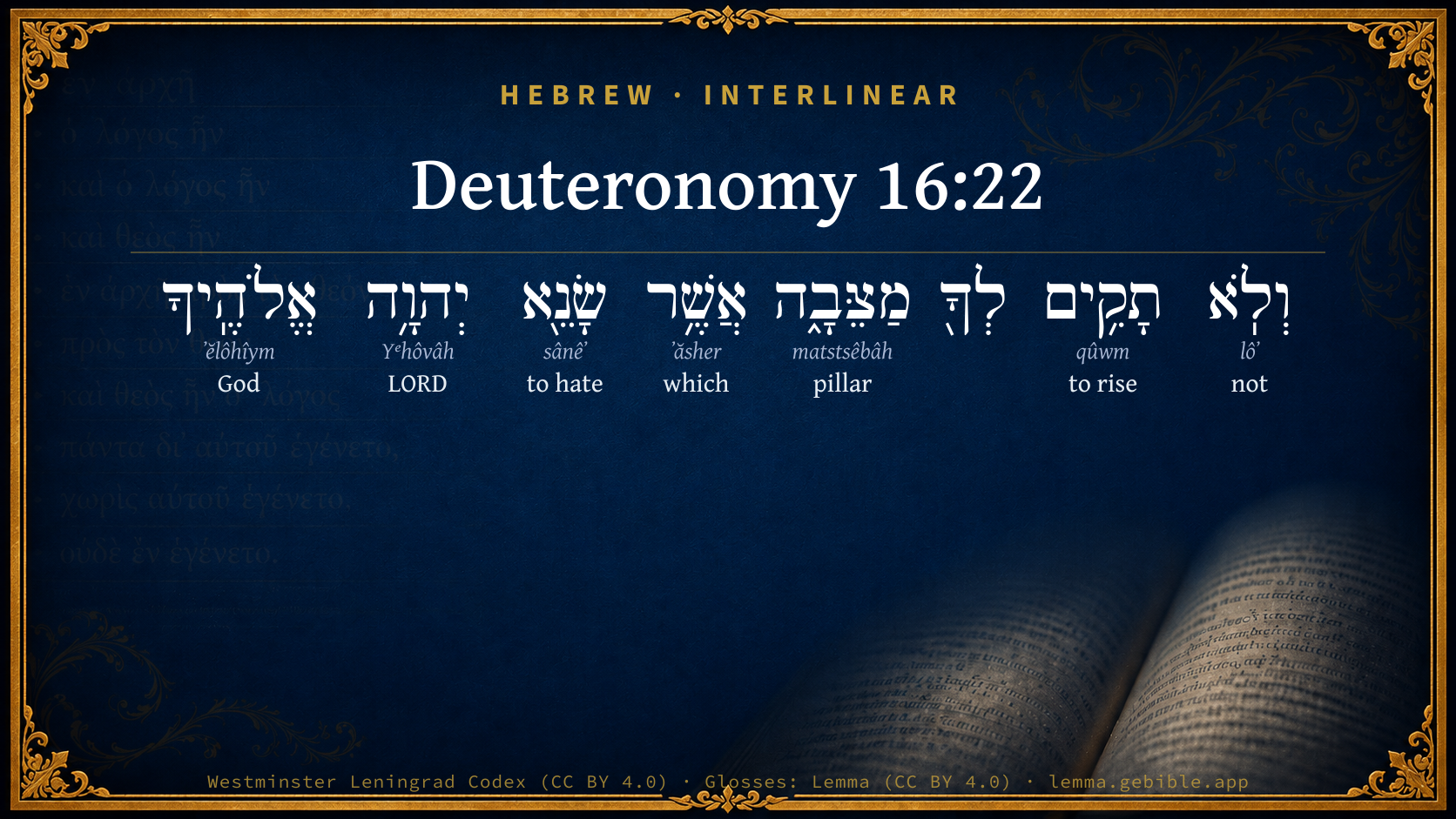
Deuteronomy 16:22

Hebrew (Westminster Leningrad Codex) Deuteronomy 16:22 appears in the Hebrew Old Testament. The text above is from the Westminster Leningrad Codex. Each word links to its Strong’s number, a concise gloss, and parsing drawn from the Open Scriptures Hebrew Bible morphology. Click any word for its full Brown-Driver-Briggs (BDB) entry.
Download image
Cite this verse

Deuteronomy 16:22 (World English Bible). Public Domain. Lemma interlinear Bible study tool, https://lemma.gebible.app/v/deuteronomy/16/22.

Show BibTeX & RIS
BibTeX
RIS
English Translation
Neither shall you set yourself up a pillar; which Yahweh your God hates.
World English Bible · Public Domain
Download a study sheet

One document with this verse’s original text, its word-by-word gloss line, the meaning frame, cross-references with their text, attributed commentary, and full source and license credits — printable, and it pastes into notes with its structure intact.

This verse Autodidact and up

Study sheet (.html) Plain text (.txt)

A passage Seminary Student

Up to 50 verses in one chapter. A passage sheet keeps up to 6 commentary sources and 12 cross-references per verse, in the order this page ranks them, and says so on the sheet whenever that leaves anything out. Ask for a single verse and you get the Autodidact verse sheet above.

Everything on this page stays free to read, with no account — the sheet is a download of what is already on screen, not access to it.

Want to remove ads? Support Godless Engineer
Compare translations 3

The same verse in 3 English versions, stacked beneath the original-language interlinear above. Click any original word for its lexicon entry.

Each is an independent rendering of the whole verse — the interlinear is not word-aligned to these translations.

Highlighted words mark where these versions differ — a whole-verse word diff, not a word-by-word alignment.

  • World English Bible Public Domain
    Neither shall you set yourself up a pillar; which Yahweh your God hates.
  • King James Version Public Domain
    Neither shalt thou set thee up any image; which the LORD thy God hateth.
  • unfoldingWord Literal Text CC BY-SA 4.0
    And you shall not erect for yourself a pillar, which Yahweh your God hates.

unfoldingWord Literal Text — © unfoldingWord, licensed CC BY-SA 4.0. Word-aligned USFM3 via Door43 (git.door43.org/unfoldingWord/en_ult).

Versions to compare (up to 4)

3 of 4 selected

Show all 18 translations

Every available English version of this verse, each an independent rendering of the whole verse.

  • World English Bible Public Domain
    Neither shall you set yourself up a pillar; which Yahweh your God hates.
  • Berean Standard Bible Public Domain
    and do not set up for yourselves a sacred pillar, which the LORD your God hates.
  • Majority Standard Bible Public Domain
    and do not set up for yourselves a sacred pillar, which the LORD your God hates.
  • King James Version Public Domain
    Neither shalt thou set thee up any image; which the LORD thy God hateth.
  • American Standard Version (1901) Public Domain
    Neither shalt thou set thee up a pillar; which Jehovah thy God hateth.
  • Revised Version (1885) Public Domain
    Neither shalt thou set thee up a pillar; which the LORD thy God hateth.
  • Geneva Bible (1599) Public Domain
    Thou shalt set thee vp no pillar, which thing the Lord thy God hateth.
  • Douay-Rheims (1899) Public Domain
    Neither shalt thou make nor set up to thyself a statue: which things the Lord thy God hateth.
  • Young's Literal Translation Public Domain
    and thou dost not raise up to thee any standing image which Jehovah thy God is hating.
  • Literal Standard Version CC BY-SA 4.0
    and you do not raise up any standing image for yourself which your God YHWH is hating.”
  • Unlocked Literal Bible CC BY-SA 4.0
    Neither must you set up for yourself any sacred stone pillar, which Yahweh your God hates.
  • unfoldingWord Literal Text CC BY-SA 4.0
    And you shall not erect for yourself a pillar, which Yahweh your God hates.
  • Darby Bible Public Domain
    Neither shalt thou set thee up a statue, which Jehovah thy God hateth.
  • World Messianic Bible Public Domain
    Neither shall you set yourself up a sacred stone which the LORD your God hates.
  • Webster's Bible Public Domain
    Neither shalt thou set thee up any image; which the LORD thy God hateth.
  • Free Bible Version CC BY-SA 4.0
    and don't make for yourselves an idolatrous stone pillar, which the Lord your God hates.
  • Bible in Basic English Public Domain
    You are not to put up stone pillars, for they are hated by the Lord your God.
  • JPS Tanakh (1917) Public Domain
    Neither shalt thou set thee up a pillar, which the LORD thy God hateth.

Literal Standard Version (2020), Covenant Press — licensed CC BY-SA 4.0. Text via the HelloAO Bible API (eBible.org). Unlocked Literal Bible (unfoldingWord) — licensed CC BY-SA 4.0. Text via the HelloAO Bible API (eBible.org). unfoldingWord Literal Text — © unfoldingWord, licensed CC BY-SA 4.0. Word-aligned USFM3 via Door43 (git.door43.org/unfoldingWord/en_ult). Free Bible Version, Dr. Jonathan Gallagher — licensed CC BY-SA 4.0. Text via the HelloAO Bible API (eBible.org).

Word by word

More ways to search: Search by grammar → Find every occurrence → Compare this word →

Practice this passage: Drill this verse → Learn its vocabulary →

About this verse

These counts appear in no published source. They are computed here, from the morphology-tagged text and Lemma’s own curated glosses. What Lemma adds →

8
words
7
distinct lemmas
Pentateuch
section

Shared distinctive vocabulary

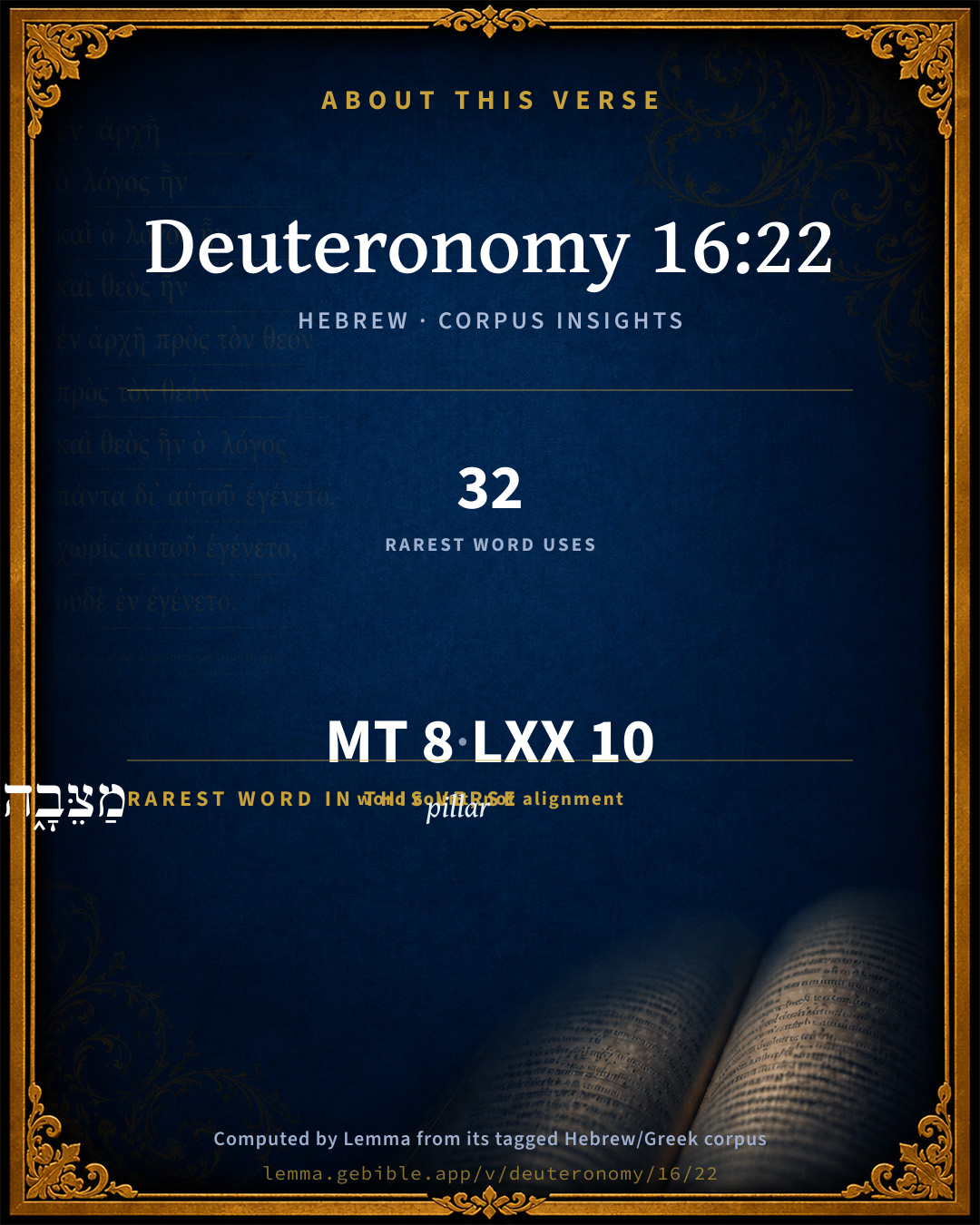
מַצֵּבָ֑ה pillar H4676 occurs in 31 verses of the Hebrew Bible. Also found in:

Grammatical profile

  • 2 verbs
  • 3 nouns
  • 1 preposition
  • 2 particles

Verb forms

  • תָקִ֥ים Hiphil · Imperfect
  • שָׂנֵ֖א Qal · Perfect

Hebrew & Septuagint length

In English translation the verse runs 13 words from the Hebrew and 15 from the Septuagint (LXX English) — closely comparable.

A rough comparison of the two English renderings, which tokenize alike — not a word-level alignment.

Word counts can differ between the Hebrew and the Greek without any difference in meaning — e.g. the Hebrew direct-object marker אֵת has no separate Greek word, and Greek often adds the article ὁ.

In the original languages it is 8 Hebrew tokens and 10 Greek tokens — but the two are counted differently (Hebrew bundles its prefixes and suffixes into one token; the Greek is in lemma form), so that isn’t a like-for-like length.

Cross-references

7

Topical passages linked to Deuteronomy 16:22 in the Treasury of Scripture Knowledge — connected by theme and wording, ordered by reader-vote popularity; previews shown in the World English Bible.

  • Leviticus 26:1 "'You shall make for yourselves no idols, neither shall you raise up an engraved image or a pillar, neither shall you place any figured stone in your land, to bow down to it: for I am Yahweh your God.
  • Exodus 20:4 "You shall not make for yourselves an idol, nor any image of anything that is in the heavens above, or that is in the earth beneath, or that is in the water under the earth:
  • Deuteronomy 12:31 You shall not do so to Yahweh your God: for every abomination to Yahweh, which he hates, have they done to their gods; for even their sons and their daughters do they burn in the fire to their gods.
  • Jeremiah 44:4 However I sent to you all my servants the prophets, rising up early and sending them, saying, Oh, don't do this abominable thing that I hate.
  • Zechariah 8:17 and let none of you devise evil in your hearts against his neighbor, and love no false oath: for all these are things that I hate," says Yahweh.
  • Revelation 2:6 But this you have, that you hate the works of the Nicolaitans, which I also hate.
  • Revelation 2:15 So you also have some who hold to the teaching of the Nicolaitans likewise.

Cross-references courtesy of OpenBible.info (CC BY 4.0).

Hebrew and Greek witnesses Masoretic Hebrew ↔ Greek Septuagint

The same verse in the two great witnesses to the Old Testament, shown verse-for-verse.

These are two independent witnesses, not word-aligned to each other, and the Septuagint is shown in lemma (dictionary) form.

Hebrew Deuteronomy 16:22 Masoretic · Westminster Leningrad Codex

וְלֹֽא תָקִ֥ים לְךָ֖ מַצֵּבָ֑ה אֲשֶׁ֥ר שָׂנֵ֖א יְהוָ֥ה אֱלֹהֶֽיךָ

Neither shall you set yourself up a pillar; which Yahweh your God hates.

World English Bible · Public Domain

Greek LXX Deuteronomy 16:22 Septuagint · lemma form

οὐ ἵστημι σεαυτοῦ στήλη ὅς μισέω κύριος ὁ θεός σύ

You shall not set up for yourself a pillar, which the Lord your God hates.

LXX2012 (modern English Septuagint) · Public Domain

Hebrew: Westminster Leningrad Codex (CC BY 4.0). Greek: Septuagint (public domain); English from LXX2012 (modern English Septuagint) (Public Domain). How the Septuagint differs from the Hebrew →

Targum (Aramaic paraphrase)

2

The Targum is the ancient Jewish Aramaic paraphrase of the Hebrew Scriptures — an interpretive translation, not the Hebrew text itself. Onkelos (literal) and Pseudo-Jonathan (expansive) render the Torah, and Jonathan the Prophets. Coverage is partial: where no permissively-licensed English translation exists for a verse, only the Aramaic is shown. This is verse-level text, not a word-by-word alignment to the Hebrew.

  1. Targum Onkelos Torah (Genesis–Deuteronomy)
    וְלָא תְקִים לָךְ קָמָא דִי סָנֵי יְיָ אֱלָהָךְ

    (no public-domain English translation for this verse)

    Targum Onkelos — Aramaic: “Onkelos Genesis” (public domain); “Onkelos Exodus” (public domain); “Onkelos Leviticus” (public domain); “Onkelos Numbers” (public domain); “Onkelos Deuteronomy” (public domain). English: “Sefaria Community Translation” (CC0 1.0 (public-domain dedication)); “J.W. Etheridge. The Targums of Onkelos and Jonathan Ben Uzziel on the Pentateuch. London: Longmans, Green, 1862” (public domain). Text via Sefaria.

  2. Targum Pseudo-Jonathan Torah (Genesis–Deuteronomy)
    וְהֵיכְמָא דְלֵיתֵיכוֹן רְשָׁאִין לְמִקְמָא קָמָא הֵיכְדֵין לֵיתֵיכוֹן רַשָּׁאִין לְמַנָאָה לְפַרְנָסָא גַּבְרָא זִידְנָא דְרַחֲקֵיהּ יְיָ אֱלָהָכוֹן

    As it is not for you to erect a statue, so are you not to appoint to be a governor a proud man, whom the Lord your God doth abhor.

    Targum Pseudo-Jonathan — Aramaic: “Targum Jonathan on Genesis” (public domain); “Targum Jonathan on Exodus” (public domain); “Targum Jonathan on Leviticus” (public domain); “Targum Jonathan on Numbers” (public domain); “Targum Jonathan on Deuteronomy” (public domain). English: “The Targum of Jonathan ben Uzziel, trans. J. W. Etheridge, London, 1862” (public domain). Text via Sefaria.

Commentary

Notes on Deuteronomy 16:22 from classic Christian and Jewish commentators (each source and its license shown beneath its notes). The classic Christian expositions comment on the surrounding passage and are grouped to its opening verse, so a note may address several verses; the Jewish commentaries on the Tanakh (Rashi and others) are per-verse, so they appear only where the commentator wrote on this verse.

Lemma curates 59 commentaries, every one of them public domain or Creative Commons licensed, each selected and text-cleaned for this edition rather than reprinted as found. About our sources →

Geneva Bible (1599)

Geneva Bible translators

Or, image

Geneva Bible (1599) marginal notes — public domain. Text via Bolls.life.

Jamieson, Fausset & Brown

Robert Jamieson, A. R. Fausset & David Brown

Neither shalt thou set thee up any image--erroneously rendered so for "pillar"; pillars of various kinds, and materials of wood or stone were erected in the neighborhood of altars. Sometimes they were conical or oblong, at other times they served as pedestals for the statues of idols. A superstitious reverence was attached to them, and hence they were forbidden.

Next: Deuteronomy Chapter 17

Jamieson, Fausset & Brown — Commentary Critical and Explanatory on the Whole Bible (1871) — public domain (CC PDM 1.0). Text via the HelloAO Bible API.

Ellicott's Commentary for English Readers

(22) Image.—Explained by Rashi of a single stone, whether statue or pillar.

A Bible Commentary for English Readers, edited by Charles John Ellicott (1878–1897) — public domain. Text from a community e-Sword module.

Haydock's Catholic Bible Commentary

CHAPTER XVI.

Statue. Hebrew matseba, means also a pillar, monument, heap of stones, image, title, &c., Genesis xxviii. --- Hateth, when they are designed for superstitious purposes. On other occasions, statues and pictures may be very instructive and commendable. (Haydock) --- The patriarchs set up pillars, altars, &c., as did also the Israelites, (Josue xxii. 10.) Samuel, &c., even after this prohibition, and without any offence. The Rabbins allow, that the proselytes of justice do well in erecting such monuments of religion, provided they be not intended for false worship. (Selden, Jur. ii. 6.) (Calmet) --- How blind then must be our dissenting brethren, who cannot make this easy and obvious distinction, but indiscriminately condemn all Catholics as guilty of idolatry, because they make and keep in their chapels, and bow down before images of the saints. This trifling objection is pressed with great vigour by J. Wesley, the founder of the Methodists. "The Papists," says he, "set up their idols in their churches---they worship the picture of the Queen of heaven---they idolize a dead man or woman." To whom Dr. Parker, a Protestant bishop, replies: (Disc. for the Abrog. of the Test.) "Yet, after all, we have no other ground for the bold conceit, than some crude and rash assertions of some popular divines, who have no other measures of truth and zeal, but their hatred to popery....As to the use of images in the worship of God, I cannot but admire at the confidence of these men, to make so bold a charge against them in general, when the images of the cherubim were commanded by God himself, Exodus xxv. 22. They were the most solemn and sacred part of the Jewish religion, and therefore, though images, so far from idolatry, that God made them the seat of his presence, and from between them delivered his oracles. This instance is so plain and obvious to every reader,....that it is a much greater wonder to me that those men, who advance the objection of idolatry so groundlessly, (against the greater part of Christendom, as he observed before) can so slightly rid themselves of so pregnant a proof against it." See an answer to the Rev. J. Wesley’s Misrepresentations, &c., by the Rev. N. G. published at Whitby, 1811, where some of the variations in doctrine of the pillars of Methodism, are also briefly noticed, as well as the absurdity of a man setting up for a reformer of religion, who at the time did not believe in Christ, (Journal ii. p. 102-3,) and for forty-two years afterwards preached a doctrine either Popish (Jour. for 1739) or Antinomian, than which, to use the words of his own recantation, "nothing could be more false." (Minutes of a conference, 1770.) It may not be improper to observe, that in the last great deluge of error, the Methodist Society began, 1st May, 1738, at London, though it had a more obscure beginning at Oxford, 1729, and another at Havannah, 1736. Yet even when this third grand attempt was made to spread it wider, and to rectify former mistakes, the author acknowledges that he was not converted, no not till many days afterwards, when, being in a Lutheran society! (26th May) "an assurance, says he, was given me, that Christ had taken away my sins, even mine;" (Journal) and still, in the year 1770, he had to "review the whole affair." Such is the man who has deluded so many thousands! Out of thy own mouth will I condemn thee. Surely those who wilfully follow such blind guides, deserve to fall into the ditch. What confidence now can the Methodists have in the interpretations which Wesley has given them of the Scriptures, since he stumbled in broad daylight; and even preached for above thirty years together, that the observance of God’s law is not only unnecessary, but sinful, an error to which he was forced, at last, to open his eyes by the scandalous immoralities of several of his deluded admirers, whom he had been all along foolishly flattering with the assurance that faith alone would insure their salvation. Strange it may appear, that he should not be put on his guard by the fall of Luther, who split against the same rock, and scrupled not to condemn the Epistle of St. James as not worth a straw, stramineam epistolam, an expression for which he is said afterwards to have been sorry, as Wesley was for the doctrine which he had been delivering for so many years. But the evil was then done. Multitudes had been deceived by these arch impostors. Their surviving followers might, however, if they would, derive this lesson from their tardy repentance and recantation, to examine with more caution their other doctrines, which they have delivered with the like confidence; and as they have reason to fear the yielding of an implicit belief to such innovators, so they may be induced to flee to the ark, the true Catholic Church, that they may be protected from the contradiction of tongues, Psalm xxx. 21. (St. Augustine, ibid.) "After Christ and the gospel, we have no farther inquiry to make." (Tertullian) --- We know that novelty in religion is a sure mark of falsehood, as no one can place any other foundation besides that which has been fixed by the beginner and finisher of our faith. From the written and unwritten Word of God, we learn what He has taught, and among the rest, we are authorized to keep holy pictures with respect. This is not an attempt against the worship of God, but designed to promote it. We do not make them to ourselves, without a divine authority. The same things which we are not allowed to adore, we must not make. Yet Methodists have and make pictures. We have God’s will clearly expressed to us by his Church, which he has commanded us to hear and obey. If we be led astray by so doing, we may at least plead that we did, to the best of our judgment, as we were ordered by God; which those, who choose for themselves, cannot do. If this Church, so strongly recommended to us in Scripture, be capable of deceiving us in an affair of so great consequence as in that of idolatry, to what article of the Christian revelation can we yield our assent with safety? So, on the other hand, if Luther and Wesley have grossly imposed on their followers, by teaching them to believe that Catholics are idolaters, and that faith alone is necessary for salvation, as they are self-convicted in the latter point, how can their disciples forget the old proverb, "A liar is not believed even when he speaks the truth;" and consequently, how can they take up their faith on their bare word, though they may pretend to ground their doctrine on the word of God? They confessedly misapplied that sacred word, with respect to faith alone, and they shut their eyes to the obvious meaning of the texts which forbid graven things. Ought not, therefore, the unlearned and the unstable to dread lest they may have wrested the other Scriptures to their own perdition? (2 Peter iii. 16.) See Exodus xx. This subject is of such vast importance, the accusation of idolatry is of so black a nature, that it deserves to be accurately and frequently refuted. It is not an accusation brought only by a few obscure individuals, who have not the power to do any great harm to it; the most exalted dignitaries of the Protestant church, such as Dr. Shute, of Durham, in two charges to his clergy, the most famous modern reformers, like Wesley, &c., have not scrupled to repeat the calumny; and the Legislature has, for many years, been actuated by what they perhaps have thought a pious zeal, to exterminate the imitators of the Chanaanites! They may have listened too attentively to the intolerant institutor of the love-feasts, (who seems, nevertheless, to threaten the overthrow of the established church) and who, in the excess of his zeal, exclaims, "I insist upon it that no government, not Roman Catholic, ought to tolerate men of the Roman Catholic persuasion." (Letter written 1780, a short time before the riots.) They must then be murdered, banished, or forced into the church, that little society which began in the evening of the 1st of May, 1738, in Fetter-lane; (Journal i.) for Methodists assert, that the God of this world has hitherto triumphed over every revival of true religion, (Dedic. prefixed to the Life of J. Wesley, by Drs. Coke and Moore) and consequently over the reformed Church of England; so that they can hardly insist, that we should embrace her doctrine, and thus increase the triumph of the devil. We have therefore no alternative left, but either to abandon our country or our religion. These are the apostles, worthy of Mahomet, who would have us believe that they are inspired by the Holy Ghost, and divinely commissioned to raise another holy temple out of the scattered lively stones of that once beautiful building, which was erected by Jesus Christ, against which they say (Ibid.) the gates of hell have never wholly prevailed. These are the teachers whom they have heaped up to themselves, having itching ears, 2 Timothy iv. 3. These are the interpreters of the sacred oracles. Both Wesley and Coke have, at least, acquired great celebrity with their adherents, by their labours in this way; but how much their explication may be depended upon, we may form some judgment from the preceding remarks. The character of bishop, which Dr. Coke extorted from the hands of his great master, 10th of Sept. 1784, at Bristol, will not give us any higher idea of the sagacity of either. It disgusted all thinking men, as a similar action of Luther, a fallen priest, consecrating a bishop had done long before. Mr. Charles Wesley upon hearing of his brother having ordained a bishop, being but a presbyter himself, is said to have exclaimed, "So easily are bishops made, by man’s or woman’s whim;

Wesley his hands on Coke has laid---but who laid hands on him?

See Nightingale, &c., for further information on Methodism, which now makes such a noise, though its novelty, variations, acknowledged mistakes, calumnies, spirit of persecution, want of lawful pastors, &c., here briefly instanced, might suffice to put people upon their guard. (Haydock)

George Leo Haydock (1774–1849), Haydock's Catholic Family Bible and Commentary, 1859 edition — public domain. Excludes Psalms (Douay-Rheims chapter numbering differs from Protestant) and Deuterocanonical books (Catholic canon only).

Matthew Poole's English Annotations

Heb. statue, whether with a picture or representation, or without it, as the idolaters used to worship smoothed and polished stones or pillars without any image upon them.

Matthew Poole's English Annotations on the Holy Bible (1683–1685) — public domain. Text from a community e-Sword/MySword module.

Whedon's Commentary on the Bible

Daniel D. Whedon

22. Neither… set up any image — The Hebrew word means a pillar or obelisk set up in honour of some deity. In some passages it is applied to a statue of Baal. 2Ki_3:2. In Gen_28:18, the term is used for the stone which Jacob set up as a pillar.

Daniel D. Whedon (gen. ed.), Commentary on the Old and New Testaments (1874–1909) — public domain. Text from a community e-Sword module.

The Pulpit Commentary

Any image; any pillar, etc. The Hebrew word (hbxem, mazzebah) denotes generally any pillar or stone that is set up, whether as a memorial, (Gen_28:18) or as a sign (Exo_24:4; Isa_19:19) or for purposes of utility or ornament. (Jer_43:13) Here, as in other passages, it is a pillar or statue set up as an object of worship (2Ki_3:2 2Ki_10:26; Hos_10:1; Mic_5:12)

The Pulpit Commentary (1880–1919), ed. H.D.M. Spence-Jones & Joseph S. Exell — public domain. Text from a community e-Sword module.

Keil & Delitzsch

C. F. Keil & F. Delitzsch

They were also to abstain from setting up any mazzebah, i.e., any memorial stone, or stone pillar dedicated to Baal (see at Exo 23:24).

Keil & Delitzsch — Biblical Commentary on the Old Testament (1861–1891) — public domain (CC PDM 1.0). Text via the HelloAO Bible API. (Old Testament only.)

Rashi

Rabbi Shlomo Yitzchaki (Rashi)

ולא תקים לך מצבה NEITHER SHALT THOU RAISE ANY MONUMENT — i.e. a monument of one stone (cf. Rashi on Deuteronomy 12:3), not even in order to sacrifice on it to Heaven (to God).

אשר שנא WHICH [THE LORD THY GOD] HATETH — An altar of stones and an altar of earth He has commanded you to make; this, however, He hates, because it was a religious ordinance amongst the Canaanites. And although it was pleasing to Him in the days of our Patriarchs (cf. Genesis 28:18), now He hates it because these (Canaanites) made it an ordinance of an idolatrous character (cf. Sifrei Devarim 146).

Rashi on the Tanakh — English translations: “The Judaica Press complete Tanach with Rashi, translated by A. J. Rosenberg” (CC BY 4.0); “Pentateuch with Rashi's commentary by M. Rosenbaum and A.M. Silbermann, 1929-1934” (public domain); “The Metsudah Tanach series, Lakewood, N.J” (CC BY 4.0); and “The Book of Joshua, Metsudah Publications, 1997” (CC BY 4.0). Text via Sefaria.

Ramban (Nachmanides)

Rabbi Moshe ben Nachman (Ramban / Nachmanides)

NEITHER SHALT THOU SET THEE UP A PILLAR — “a pillar of one stone, even for the purpose of sacrificing to Heaven upon it. WHICH THE ETERNAL THY G-D HATETH. An altar of earth and an altar of stones, Verse 22. has He commanded you to make, but He hates this [one-stone pillar] because it was an ordinance of the Canaanites [for idol-worship]. Although it was pleasing to Him at the time of the patriarchs, He hates it now, because these [Canaanites] have made it an ordinance in the worship of the idols.” This is Rashi’s language. If so, Scripture prohibited [the planting of] an asheirah [anywhere], it enjoined against planting [trees] on the Temple mount although the intent be to Heaven, and it prohibited a pillar [erected] for Heaven — both [prohibitions, against trees and against pillars,] on account of the ordinances of the Canaanites. But I have not understood this ordinance, for the Canaanites used altars as well as pillars since Scripture states, And ye shall break down their altars, and dash in pieces their pillars; for ye shall break down their altars, and dash in pieces their pillars and similarly in all places; [hence all altars should have been prohibited even for the worship of G-d]! Perhaps we may say that the Canaanites were primarily devoted to pillars, and they had no idolatrous temple without a pillar upon which to sacrifice and pour oil upon its top, similar to what is stated with reference to Baal, And they brought forth the pillars that were in the house of Baal. However, only a few of their temples also had altars upon which to sacrifice [hence Scripture did not prohibit altars built to be used for Heaven].It appears to me that the Canaanites, who were engrossed in idolatry, used to make in all temples of their gods an altar on which to bring sacrifices, erected a large stone at the entrance of the temple for the priests to stand upon, and planted a tree outside it to point the way for those who come there. They still do so to this day. Now the Glorious Name hates and despises all their deeds and He prohibited the pillar and the asheirah. He left only the altar because it is a necessity for the offerings concerning which He commanded. They were a source of pleasure before Him — because He ordained them and His Will was done — even prior to the existence of idol-worship on earth.

WHICH THE ETERNAL THY G-D HATETH. The purport thereof is that he is explaining that G-d had commanded, an altar of earth shalt thou make unto Me, And if thou make Me an altar of stones, Verse 22. and so, Moses explained, He desires these [altars] excluding the pillar. He hates it because, all their deeds being detestable before Him, He commanded Israel not to copy their deeds. In the days of Jacob, however, the prohibition Neither shall ye walk in their statutes had not yet been ordained and he, therefore, used the pillar in worshipping G-d as was the custom of those who worshipped [the True G-d in the days of Jacob]. This commandment is thus understood as proceeding from the verse, And if thou make Me an altar of stones., Verse 22. But what He said in the Torah, Neither shall ye erect a graven image, or a pillar, 26:1. refers to a graven image and a pillar in order to place the graven image upon the pedestal for idol-worship, for there Scripture is speaking of idol-worship. He says [there], however, Neither shall ye place any figured stone in your Land to bow down unto it, 26:1. — even to Heaven, because he would appear to worship the mosaics themselves, for the same reason that an asheirah [is prohibited], because it is among the [idolatrous] statutes of the peoples.Know that an altar is a high structure of stones having four horns, a base, and a circuit above its base, and offerings are burnt between its horns. A pillar is a single large stone which they raise up upon which to burn [incense] or bring offerings, or for the priests to stand upon. A bamah (a high place) is like a mountain — they make it of assembled earth and, upon it, an altar is built upon which to sacrifice. Everything which is lofty and high is so named: I will ascend above ‘bamathei’ (the heights of) the clouds; upon ‘bamathei’ (the high places of) the earth. The back of a human being is also called bamah, as it is said, upon ‘bamatheimo’ thou shalt tread., 33:29. See in Megillah 16a where this verse is used when Mordecai stepped upon Haman in order to mount the king’s horse. Similarly Scripture states, And the king [Solomon] went to Gibeon to sacrifice there; for that was the great ‘bamah’ (high place); a thousand burnt-offerings did Solomon offer upon that altar. is distinguished from an altar, for, as explained above, an altar was erected on “the high place (bamah).”

Ramban (Nachmanides) on the Tanakh — English translation: “Commentary on the Torah by Ramban (Nachmanides). Translated and annotated by Charles B. Chavel. New York, Shilo Pub. House, 1971-1976” (CC BY 4.0). Text via Sefaria.

Lesson kit

Teaching starters — assembled from the data on this page, not authored interpretation. Every prompt links to the verse data it draws on. Edit before teaching.

Deuteronomy, in the Pentateuch, opens this verse with 8 words (7 distinct Hebrew lemmas). Its most distinctive word is matstsêbâh (“pillar”). A historical commentator’s framing appears above. Read the whole chapter for the surrounding context.

Discussion questions

  1. How does “pillar” (matstsêbâh) shape what this verse is saying?
  2. Genesis 28:18 shares the word «pillar» with this verse. How do the two illuminate each other?
  3. These translations render this verse differently; the difference is in the English rendering, not the original. What questions does that raise?
  4. The verb «תָקִ֥ים» is Hiphil Imperfect. How does its form color the action?
  5. Reading how Geneva Bible (1599) and Jamieson, Fausset & Brown read this verse, where do the two commentators agree and where do they part?

Things to notice

Reading settings

Reading text

Shown beneath each verse's original-language words.

Old Testament
Old Testament edition

Read the OT as the Masoretic Hebrew (MT) or the Greek Septuagint (LXX).

English shown for the Greek Septuagint (in the Hebrew ↔ Greek comparison).

Comparing translations? Open the Compare panel on any verse page to stack up to four side by side.