Psalms 86:17

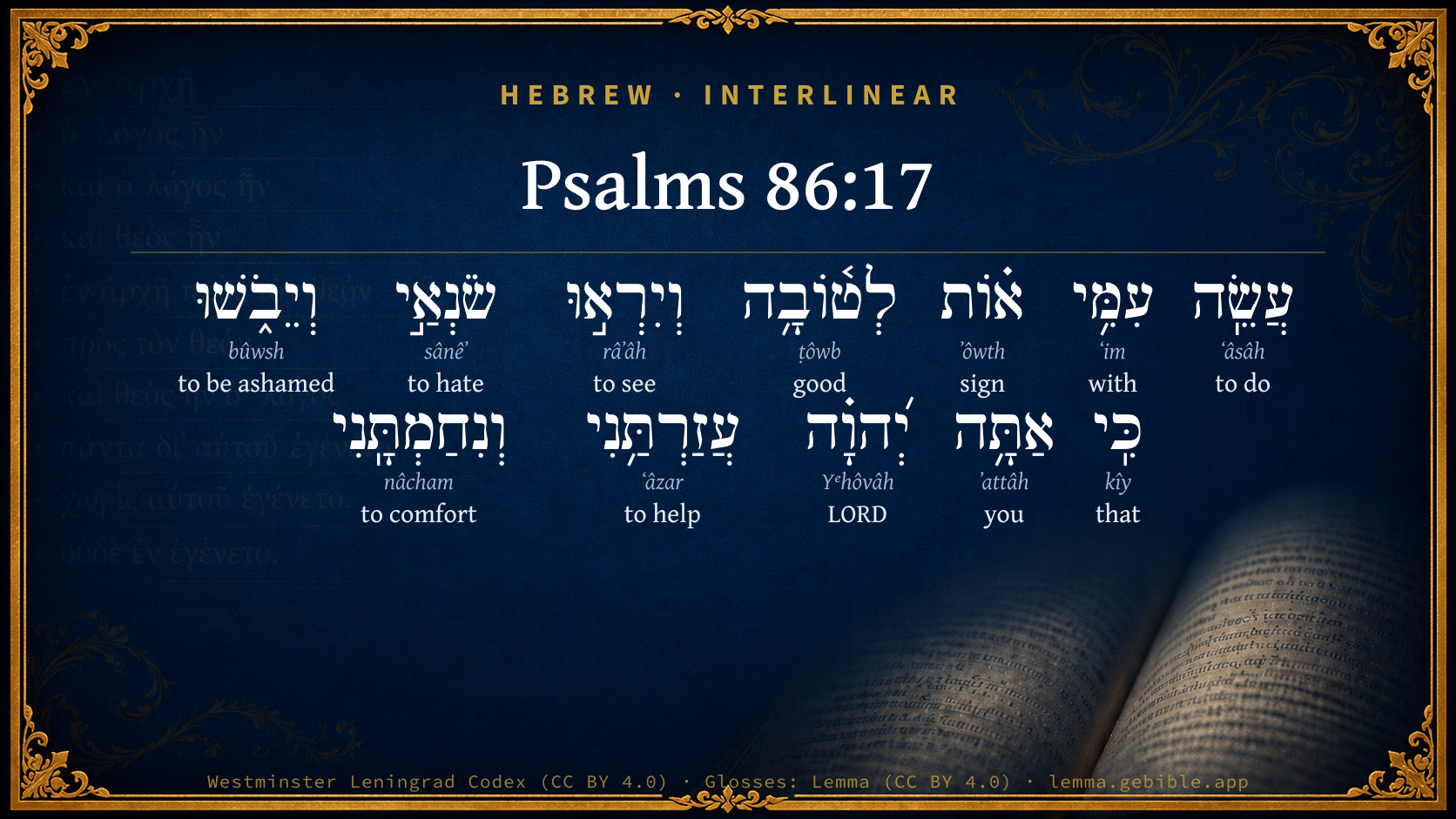
Hebrew (Westminster Leningrad Codex) Psalms 86:17 appears in the Hebrew Old Testament. The text above is from the Westminster Leningrad Codex. Each word links to its Strong’s number, a concise gloss, and parsing drawn from the Open Scriptures Hebrew Bible morphology. Click any word for its full Brown-Driver-Briggs (BDB) entry.
Download image
Cite this verse

Psalms 86:17 (World English Bible). Public Domain. Lemma interlinear Bible study tool, https://lemma.gebible.app/v/psalms/86/17.

Show BibTeX & RIS
BibTeX
RIS
English Translation
Show me a sign of your goodness, That those who hate me may see it, and be shamed, Because you, Yahweh, have helped me, and comforted me.
World English Bible · Public Domain
Download a study sheet

One document with this verse’s original text, its word-by-word gloss line, the meaning frame, cross-references with their text, attributed commentary, and full source and license credits — printable, and it pastes into notes with its structure intact.

This verse Autodidact and up

Study sheet (.html) Plain text (.txt)

A passage Seminary Student

Up to 50 verses in one chapter. A passage sheet keeps up to 6 commentary sources and 12 cross-references per verse, in the order this page ranks them, and says so on the sheet whenever that leaves anything out. Ask for a single verse and you get the Autodidact verse sheet above.

Everything on this page stays free to read, with no account — the sheet is a download of what is already on screen, not access to it.

Want to remove ads? Support Godless Engineer
Compare translations 3

The same verse in 3 English versions, stacked beneath the original-language interlinear above. Click any original word for its lexicon entry.

Each is an independent rendering of the whole verse — the interlinear is not word-aligned to these translations.

Highlighted words mark where these versions differ — a whole-verse word diff, not a word-by-word alignment.

  • World English Bible Public Domain
    Show me a sign of your goodness, That those who hate me may see it, and be shamed, Because you, Yahweh, have helped me, and comforted me.
  • King James Version Public Domain
    Shew me a token for good; that they which hate me may see it, and be ashamed: because thou, LORD, hast holpen me, and comforted me.
  • unfoldingWord Literal Text CC BY-SA 4.0
    Work for me a sign for good, that the ones hating me may see and have shame, for you, Yahweh, you help me and comfort me.

unfoldingWord Literal Text — © unfoldingWord, licensed CC BY-SA 4.0. Word-aligned USFM3 via Door43 (git.door43.org/unfoldingWord/en_ult).

Versions to compare (up to 4)

3 of 4 selected

Show all 18 translations

Every available English version of this verse, each an independent rendering of the whole verse.

  • World English Bible Public Domain
    Show me a sign of your goodness, That those who hate me may see it, and be shamed, Because you, Yahweh, have helped me, and comforted me.
  • Berean Standard Bible Public Domain
    Show me a sign of Your goodness, that my enemies may see and be ashamed; for You, O LORD, have helped me and comforted me.
  • Majority Standard Bible Public Domain
    Show me a sign of Your goodness, that my enemies may see and be ashamed; for You, O LORD, have helped me and comforted me.
  • King James Version Public Domain
    Shew me a token for good; that they which hate me may see it, and be ashamed: because thou, LORD, hast holpen me, and comforted me.
  • American Standard Version (1901) Public Domain
    Show me a token for good, That they who hate me may see it, and be put to shame, Because thou, Jehovah, hast helped me, and comforted me. Psalm 87 A Psalm of the sons of Korah; a Song.
  • Revised Version (1885) Public Domain
    Shew me a token for good; that they which hate me may see it, and be ashamed, because thou, LORD, hast holpen me, and comforted me,
  • Geneva Bible (1599) Public Domain
    Shew a token of thy goodnes towarde me, that they which hate me, may see it, and be ashamed, because thou, O Lord, hast holpen me and comforted me.
  • Douay-Rheims (1899) Public Domain
    Shew me a token for good: that they who hate me may see, and be confounded, because thou, O Lord, hast helped me and hast comforted me.
  • Young's Literal Translation Public Domain
    Do with me a sign for good, And those hating me see and are ashamed, For Thou, O Jehovah, hast helped me, Yea, Thou hast comforted me!
  • Literal Standard Version CC BY-SA 4.0
    Do with me a sign for good, || And those hating me see and are ashamed, || For You, O YHWH, have helped me, || Indeed, You have comforted me!
  • Unlocked Literal Bible CC BY-SA 4.0
    Show me a sign of your favor. Then those who hate me will see it and be put to shame because you, Yahweh, have helped me and comforted me.
  • unfoldingWord Literal Text CC BY-SA 4.0
    Work for me a sign for good, that the ones hating me may see and have shame, for you, Yahweh, you help me and comfort me.
  • Darby Bible Public Domain
    Shew me a token for good, that they which hate me may see it, and be ashamed; for thou, Jehovah, hast helped me and comforted me.
  • World Messianic Bible Public Domain
    Show me a sign of your goodness, that those who hate me may see it, and be shamed, because you, LORD, have helped me, and comforted me.
  • Webster's Bible Public Domain
    Show me a token for good; that they who hate me may see it, and be ashamed: because thou, LORD, hast helped me, and comforted me.
  • Free Bible Version CC BY-SA 4.0
    Show me a sign that you approve of me! Those who hate me will see it, and they will be ashamed because you, Lord, have helped me.
  • Bible in Basic English Public Domain
    Give me a sign for good; so that my haters may see it and be shamed; because you, Lord, have been my help and comfort.
  • JPS Tanakh (1917) Public Domain
    Work in my behalf a sign for good; that they that hate me may see it, and be put to shame, because Thou, LORD, hast helped me, and comforted me.

Literal Standard Version (2020), Covenant Press — licensed CC BY-SA 4.0. Text via the HelloAO Bible API (eBible.org). Unlocked Literal Bible (unfoldingWord) — licensed CC BY-SA 4.0. Text via the HelloAO Bible API (eBible.org). unfoldingWord Literal Text — © unfoldingWord, licensed CC BY-SA 4.0. Word-aligned USFM3 via Door43 (git.door43.org/unfoldingWord/en_ult). Free Bible Version, Dr. Jonathan Gallagher — licensed CC BY-SA 4.0. Text via the HelloAO Bible API (eBible.org).

Word by word

More ways to search: Search by grammar → Find every occurrence → Compare this word →

Practice this passage: Drill this verse → Learn its vocabulary →

א֗וֹת
ʼôwth
H226
“sign”
Noun, Common, Both, Singular, Absolute
Part of Speech
Noun
Type
Common
Gender
Both
Number
Singular
State
Absolute
Full BDB Definition

Origin: probably from H225 (in the sense of appearing)

TWOT: 41a

sign, signal - a distinguishing mark - banner - remembrance - miraculous sign - omen - warning - token, ensign, standard, miracle, proof
  1. עֲשֵֽׂה ʻâsâh H6213 “do” Verb, Qal, Imperative, 2nd Person, Masculine, Singular
  2. עִמִּ֥י ʻim H5973 “with · me” Preposition + Suffix, Personal, 1st Person, Common, Singular
  3. לְט֫וֹבָ֥ה ṭôwb H2896 “to/for · good” Preposition + Adjective, Adjective, Feminine, Singular, Absolute
  4. וְיִרְא֣וּ râʼâh H7200 “and · to see” Conjunction + Verb, Qal, Imperfect, 3rd Person, Masculine, Plural
  5. שֹׂנְאַ֣י sânêʼ H8130 “hating · me” Verb, Qal, Participle Active, Masculine, Plural, Construct + Suffix, Personal, 1st Person, Common, Singular
  6. וְיֵבֹ֑שׁוּ bûwsh H954 “and · to be ashamed” Conjunction + Verb, Qal, Imperfect, 3rd Person, Masculine, Plural
  7. כִּֽי kîy H3588 “that” Conjunction
  8. אַתָּ֥ה ʼattâh H859 “you” Pronoun, Personal, 2nd Person, Masculine, Singular
  9. יְ֝הוָ֗ה Yᵉhôvâh H3068 “LORD” Noun, Proper
  10. עֲזַרְתַּ֥נִי ʻâzar H5826 “to help · me” Verb, Qal, Perfect, 2nd Person, Masculine, Singular + Suffix, Personal, 1st Person, Common, Singular
  11. וְנִחַמְתָּֽנִי nâcham H5162 “and · to comfort · me” Conjunction + Verb, Piel, Perfect, 2nd Person, Masculine, Singular + Suffix, Personal, 1st Person, Common, Singular

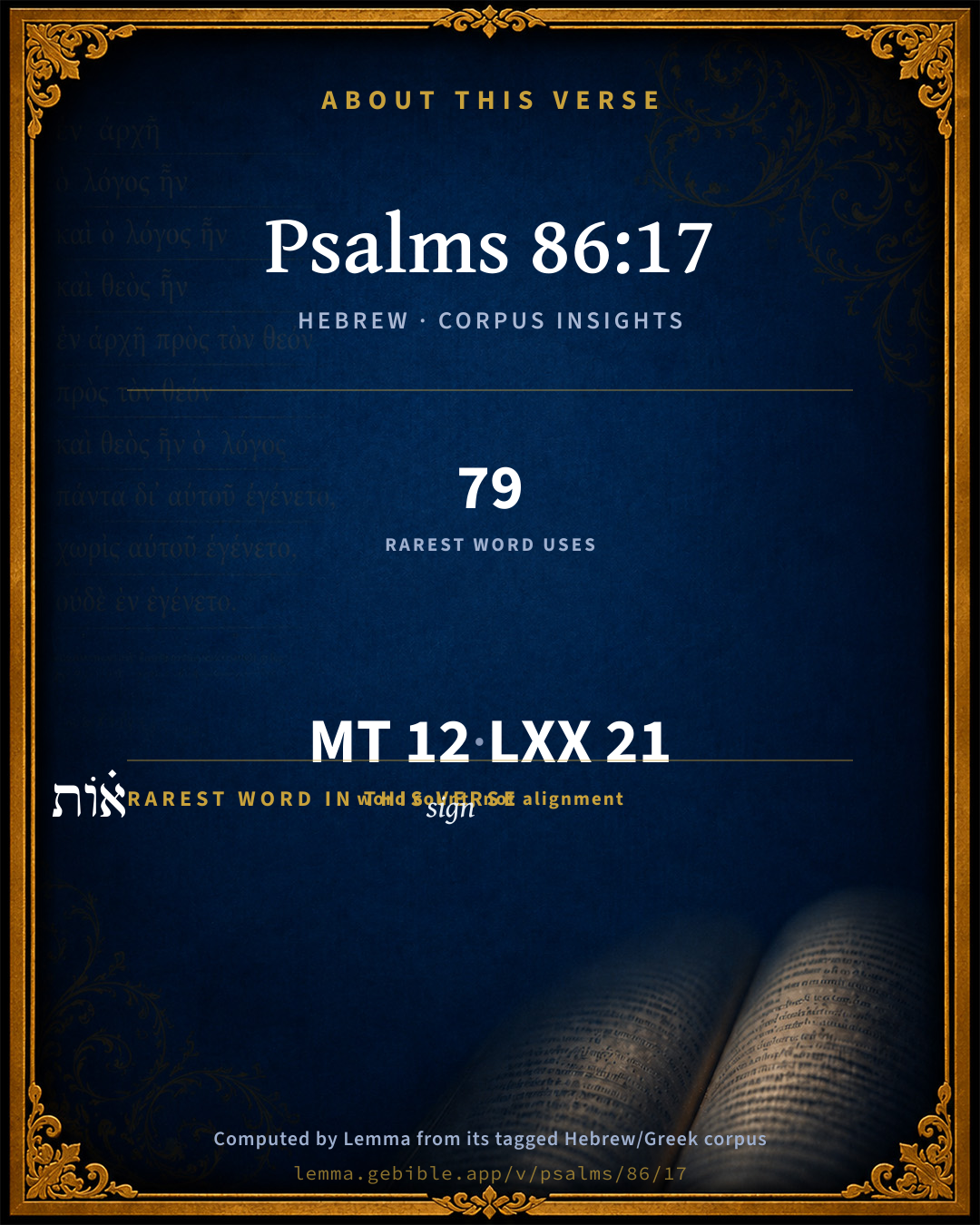
About this verse

These counts appear in no published source. They are computed here, from the morphology-tagged text and Lemma’s own curated glosses. What Lemma adds →

12
words
12
distinct lemmas
Wisdom
section

Grammatical profile

  • 6 verbs
  • 2 nouns
  • 1 adjective
  • 1 pronoun
  • 1 preposition
  • 1 conjunction

Verb forms

  • עֲשֵֽׂה Qal · Imperative
  • וְיִרְא֣וּ Qal · Imperfect
  • שֹׂנְאַ֣י Qal · Participle Active
  • וְיֵבֹ֑שׁוּ Qal · Imperfect
  • עֲזַרְתַּ֥נִי Qal · Perfect
  • וְנִחַמְתָּֽנִי Piel · Perfect

Hebrew & Septuagint length

In English translation the verse runs 27 words from the Hebrew and 28 from the Septuagint (LXX English) — closely comparable.

A rough comparison of the two English renderings, which tokenize alike — not a word-level alignment.

Word counts can differ between the Hebrew and the Greek without any difference in meaning — e.g. the Hebrew direct-object marker אֵת has no separate Greek word, and Greek often adds the article ὁ.

In the original languages it is 12 Hebrew tokens and 21 Greek tokens — but the two are counted differently (Hebrew bundles its prefixes and suffixes into one token; the Greek is in lemma form), so that isn’t a like-for-like length.

Cross-references

10

Topical passages linked to Psalms 86:17 in the Treasury of Scripture Knowledge — connected by theme and wording, ordered by reader-vote popularity; previews shown in the World English Bible.

  • Psalms 41:10–11 But you, Yahweh, have mercy on me, and raise me up, That I may repay them.
  • Judges 6:17 He said to him, If now I have found favor in your sight, then show me a sign that it is you who talk with me.
  • Psalms 71:20–21 You, who have shown us many and bitter troubles, You will let me live. You will bring us up again from the depths of the earth.
  • Psalms 40:1 I waited patiently for Yahweh. He turned to me, and heard my cry.
  • Psalms 71:9–13 Don't reject me in my old age. Don't forsake me when my strength fails.
  • Micah 7:8–10 Don't rejoice against me, my enemy. When I fall, I will arise. When I sit in darkness, Yahweh will be a light to me.
  • Psalms 109:29 Let my adversaries be clothed with dishonor. Let them cover themselves with their own shame as with a robe.
  • 1 Corinthians 5:5 are to deliver such a one to Satan for the destruction of the flesh, that the spirit may be saved in the day of the Lord Jesus.
  • Isaiah 38:22 Hezekiah also had said, What is the sign that I shall go up to the house of Yahweh?
  • Psalms 74:9 We see no miraculous signs. There is no longer any prophet, Neither is there among us anyone who knows how long.

Cross-references courtesy of OpenBible.info (CC BY 4.0).

Hebrew and Greek witnesses Masoretic Hebrew ↔ Greek Septuagint

The same verse in the two great witnesses to the Old Testament, shown verse-for-verse.

You’re reading Greek Psalm 85 (Hebrew Psalm 86). The Septuagint counts the superscription, so verse numbers can differ from the Hebrew — chapter-level alignment, not verse-by-verse. Numbering follows Rahlfs.

These are two independent witnesses, not word-aligned to each other, and the Septuagint is shown in lemma (dictionary) form.

Hebrew Psalms 86:17 Masoretic · Westminster Leningrad Codex

עֲשֵֽׂה עִמִּ֥י א֗וֹת לְט֫וֹבָ֥ה וְיִרְא֣וּ שֹׂנְאַ֣י וְיֵבֹ֑שׁוּ כִּֽי אַתָּ֥ה יְ֝הוָ֗ה עֲזַרְתַּ֥נִי וְנִחַמְתָּֽנִי

Show me a sign of your goodness, That those who hate me may see it, and be shamed, Because you, Yahweh, have helped me, and comforted me.

World English Bible · Public Domain

Greek LXX Greek Psalm 85:17 Septuagint · lemma form

ποιέω μετά ἐγώ σημεῖον εἰς ἀγαθός καί ὁράω ὁ μισέω ἐγώ καί αἰσχύνω ὅτι σύ κύριος βοηθέω ἐγώ καί παρακαλέω ἐγώ

Establish with me a token for good; and let them that hate me see it and be ashamed; because you, O Lord, have helped me, and comforted me.

LXX2012 (modern English Septuagint) · Public Domain

Hebrew: Westminster Leningrad Codex (CC BY 4.0). Greek: Septuagint (public domain); English from LXX2012 (modern English Septuagint) (Public Domain). How the Septuagint differs from the Hebrew →

Commentary

Notes on Psalms 86:17 from classic Christian and Jewish commentators (each source and its license shown beneath its notes). The classic Christian expositions comment on the surrounding passage and are grouped to its opening verse, so a note may address several verses; the Jewish commentaries on the Tanakh (Rashi and others) are per-verse, so they appear only where the commentator wrote on this verse.

Lemma curates 59 commentaries, every one of them public domain or Creative Commons licensed, each selected and text-cleaned for this edition rather than reprinted as found. About our sources →

Adam Clarke's Commentary

Verse 17. Show me a token for good] עשה עמי אוה aseh immi oth, "Make with me a sign." Fix the honourabie mark of thy name upon me, that I may be known to be thy servant. There seems to be an allusion here to the marking of a slave, to ascertain whose property he was. The Anglo-Saxon, [A. S.] on [A. S.], "do with me a token in good.' Old Psalter: Do with me signe in gude. From [A. S.] tacn we have our word token, which signifies a sign, mark, or remembrancer of something beyond itself; a pledge that something, then specified, shall be done or given. Give me, from the influence of thy Spirit in my heart, a pledge that the blessings which I now ask shall be given in due time. But he wished for such a sign as his enemies might see; that they might know God to be his helper, and be confounded when they sought his destruction.

ANALYSIS OF THE EIGHTY-SIXTH PSALM

This Psalm is a continued prayer, and may be divided into four parts: -

I. The first part is a petition for safety, drawn from his own person, Ps 86:1-4.

II. The second, a quickening of the same petition, drawn from the person and nature of God, Ps 86:5-13.

III. The third, taken from the quality of his adversaries, Ps 86:14.

IV. The fourth, a conjunction of all these three; the first, Ps 86:15; the second, Ps 86:16; the third, Ps 86:17.

I. The reasons of his petition, drawn from himself.

1. "Bow down thine ear." Reason: "I am poor and needy," Ps 86:1.

2. "Preserve my soul." Reason: "I am holy," or merciful, Ps 86:2.

3. "Save thy servant." Reason: "He puts his trust in thee," Ps 86:3.

4. "Be merciful unto me." Reason: "I cry unto thee daily," Ps 86:4.

5. "Rejoice the soul of thy servant." Reason: "For unto thee do I lift up my soul," Ps 86:4.

II. A quickening of the petition, drawn from the nature of God.

1. "For thou, Lord, art good," c., Ps 86:5-6.

2. "I will call upon thee: for thou wilt answer me," Ps 86:7.

3. "There is none like unto thee," Ps 86:8.

4. "Nor any works like unto thy works," Ps 86:8. This shall be amply proved: for

5. "All nations," now worshipping idols, "shall be converted to thee," Ps 86:9.

6. "Because thou art great, and doest wondrous things," Ps 86:10.

On this reason, that there is none like God, -

1. He begs to be governed by his word and Spirit, Ps 86:11.

2. Promises to praise him for his great mercy, Ps 86:12-13.

III. He presses another argument taken from his enemies.

1. They were proud: "The proud are risen against me."

2. They were powerful: "The assemblies of violent men."

3. They were ungodly: "They did not set thee before them," Ps 86:14.

IV. He amplifies his former argument.

1. From the nature of God: "Thou art full of compassion," &c., Ps 86:15.

2. From his own condition: "Turn unto me and have mercy upon me," Ps 86:16.

3. From the quality of his adversaries: "Show me a token - that they which hate me may be ashamed," Ps 86:17.

Adam Clarke's Commentary on the Bible (1810–1826) — public domain. Text from a community e-Sword/MySword module.

Trapp's Complete Commentary

John Trapp

Psa 86:17 Shew me a token for good; that they which hate me may see [it], and be ashamed: because thou, LORD, hast holpen me, and comforted me.

Ver. 17. Show me a token for good] Make me king, as thou hast promised; and meanwhile so deliver me, that my greatest adversaries may be convinced of their malice and madness. At the death of some of the martyrs strange tokens were shown, as they had foretold: Latimer, Hauks, Smith, Samuel, &c., for instance. Son of God, shine upon me, said Hunter at the stake, and the sun shone out of a dark cloud so full, that he was forced to look another way (Acts and Mon. 1544, 1547, 1398).

John Trapp, A Commentary or Exposition upon All the Books of the Old and New Testament (1647–1656) — public domain. Text from a community e-Sword module.

The Biblical Illustrator

Joseph S. Exell

Psa_86:17

Show me a token for good, that they which hate me may see it, and be ashamed; because Thou, Lord, hast holpen me, and comforted me.

Tokens for good

At the outset note--

1. How this man in the hour of conflict looks to his Divine protector. Not to men but to God does he cry, And observe--

2. That his troubles drove him to God. Too often they drive men away from God.

3. We look to God along. We may not set up a rival with God in the temple of our trust. What is it that thou wouldst yoke with God? Oh to be cut clear of all visible supports, and props, and holdfasts! You have seen a balloon well filled struggling to rise: what kept it downy What hindered it? The ropes which bound it to earth. Cut clear the ropes, and then see how it mounts! With a spring it leaps upward while we are gazing into the open sky. Oh for such a clearance and such a mounting for our spirits! Alas, we are hindered and hampered, and those bonds which detain us are our visible supports and reliances. My soul, wait thou only upon God. The Lord bring us into this high state of spiritual emancipation. Now, let us notice the request David puts up. If we are in his state of mind when we put up a like prayer, this asking for a token will do us no harm: otherwise such desire may be very hurtful to us.

I. This request for a token. It was to be from God and according to Gods will, and asked in faith, not in unbelief. For we have no right to say we will not believe unless God give us a token. We are bound to believe Him whether He gives us a token or not. And tokens that men have had, or thought they had, they have come to question about after a while. Peter, though he had seen our Lords transfiguration, declares that he had the more sure word of prophecy. Yet may we ask for tokens in a subordinate sense, when we are willing to believe God without them: we may ask for them as confirmatory signs and seals. Several such are named in this psalm.

1. We may long for answer to prayer (Cf. 5:1, 6). If we have received such answers (and have we not?), we may take them as tokens for good.

2. Then, preservation of character is another token (Psa_86:2). If amid much trial and temptation we have been able to maintain an unblemished reputation, then you need not envy any among the sons of men.

3. Deliverance in trouble is another such (Psa_86:2). And there is another form of token which must never be overlooked, and that is--

4. A sense of pardoned sin (Psa_86:3; Psa_86:5). Before this all ills disappear. And--

5. Support under trial. If God gives you this, if you are able to say to all God sends you, Thy will be done, take comfort from that.

6. Cheering visits from Christ, and fresh anointings of the Holy Spirit are also most sure tokens for good. They are implied in Psa_86:4; Psa_86:11; Psa_86:16; and in our text.

II. The result of such tokens. Our enemies are abashed before them, The most malicious adversaries of Gods people have stood in awe of them.

III. Conclusion. What an unhappy state must those be in who have troubles, but have no God to go to: enemies, but no defender; darkness, but no star of hole. Your friends, and, still less, yourself, are to be trusted in such times. What can they do? Oh, seek the Saviours face. (C. H. Spurgeon.)

Tokens for good

Webster defines a token thus: Something intended to represent or indicate another thing or event. The rainbow was the token to Noah that a second flood would not destroy the world (Gen_9:1-17). The blood on the doorposts of the Israelites was a token that their firstborn would be spared when the destroying angel passed over the land (Exo_12:13). The going down of the shadow on the sun-dial of Ahaz, ten degrees backward, was a token or sign that fifteen additional years would be added to Hezekiahs life (Isa_38:7-8). God grants to His people tokens for good.

1. A deep sense of sin is a token for good--the precursor of salvation. Sinners must be made sorrowful for their sins, or they cannot be saved.

2. Prayerfulness. Do you feel a strong impulse to pray for the prosperity of the Church, or for one of its individual members; for your family, or for your personal growth in the Divine life? It is a token for good, the work of the Spirit within you, a sure precursor of some blessing which God has in store for you.

3. A spirit of inquiry into the meaning of Gods Word. Luther received a token for good when reading an ancient manuscript in his cell. He saw what a treasure of light and life there was in the Bible compared with the traditions of the Papacy. He discovered the doctrine of justification by faith, which he calls the test of a standing or falling Church. He also found that millions of people were ready to receive its blessed light.

4. In the prosecution of our work God gives tokens for good. A preacher saw no good done, and resolved to quit the scene of his labours, but he was encouraged by the dream of a man with a small hammer striking a large head, which after a long time flew into a thousand pieces.

5. Dark and distressing dispensations of Providence are often a token for good. Health decays: business fails. Temporal loss often leads to spiritual gain. If God takes away one blessing He confers another more fitted to promote our well-being than that of which He deprived us. The drying up of the streams of earthly comfort lead men to seek the water of life. (H. Woodcock.)

God our helper

I like this Saxon word holpen. There is something substantial in the appearance of it and hearty in the sound of it. When associated with certain adverbs and prepositions its meaning comes out in full force. Help forward, onward, out, over, off, to, up. Thou, Lord, hast holpen me. We have cause to say this every birthday, and when completing each stage of life. Have we not reason to say it at the end of decades of years, as we pass from childhood to youth and from youth to manhood? In truth this is a suitable utterance at the end of every day. (Samuel Martin.)

Comfort

To what shall we liken comfort? It is like copious and heavy dew to withering flowers. It is like rain to the parched and thirsty earth. It is like an anodyne to sharp pain. It is like the sight of coast and harbour to the mariner, when the sea is rough and the sky is stormy. It is like the appearance of the moon after hours of thick, black, dark cloudiness. It is like the mothers voice to a terrified child, and like the mothers arms to a fretful babe. Comfort is a word which we interpret by our feelings. A mothers lap and bosom, and a birds nest, are embodiments of Gods idea of comfort. (Samuel Martin.)

.

Psa_87:1-7

The Biblical Illustrator, edited by Joseph S. Exell (c. 1880s–1900s) — public domain. Text from a community e-Sword module.

J. A. Alexander on Psalms

Joseph Addison Alexander

17. (Psa 86:17) Shew me a token for good, and (then) my haters shall see and be shamed, because thou, Jehovah, hast helped me and comforted me. The phrase translated shew me strictly means do with me, and is here used because the sign or token asked is neither a verbal declaration nor a miracle, but a practical or providential indication of God's favour, furnished by his dealings with him. The word translated good is the one used in Psa 16:2, where, as here, it has the sense of physical good, welfare, happiness. A token for good is a pledge of its possession and enjoyment. The obliqueconstruction, that my haters may see, is really included in the direct future. Shamed, surprised, disappointed, and confounded. The preterites in the last clause have reference to the time when this effect shall be produced upon the enemy, and when the divine help and consolation shall have been already granted.

Joseph Addison Alexander, The Psalms Translated and Explained (1850) — public domain. Text from a community e-Sword module.

John Calvin's Commentaries

The last verse contains an additional confirmation of the statement, that he was in a manner forsaken of God. He would not have desired to be favored with some token of the divine favor, had he not been on all sides driven to despair, and had not the divine favor been hidden from him to try his patience. It was a proof of no ordinary steadfastness to maintain the conflict with this temptation, and to do this so successfully, as not to cease to descry light in the midst of darkness. He desires that his enemies may be put to shame, because they assailed his simplicity with mockery and scoffing, as if he had acted a foolish part by trusting in God. The miserable and distressing condition in which the Church was placed after the Babylonish captivity, might be apt to sink the minds of the godly into despondency; and, accordingly, the Holy Spirit here promises her restoration in a wonderful and incredible manner, so that nothing would be more desirable than to be reckoned among the number of her members.

John Calvin's Commentaries (1540-1563) — public domain. Text from the Calvin Translation Society English edition (1840s-50s) via the Christian Classics Ethereal Library (ccel.org). Calvin's coverage is partial (roughly two-thirds of the Bible); uncommented books and verses are honest gaps, never fabricated. The 19th-century editor's footnotes and remarks are omitted so the notes are faithfully Calvin's own voice.

Ellicott's Commentary for English Readers

(17) A token for good—i.e., some sign of continued or renewed providential care and love, such, indeed, as an Israelite under the old covenant saw, and every pious heart under the new sees, in what to others is an every-day occurrence. The expression for good is a favourite one with Nehemiah (Neh_5:19; Neh_13:31) and Jeremiah (Jer_24:5-6, and comp. Rom_8:28. &c).

A Bible Commentary for English Readers, edited by Charles John Ellicott (1878–1897) — public domain. Text from a community e-Sword module.

The Cambridge Bible for Schools and Colleges

gen. ed. J. J. S. Perowne

17. a token for good] Some visible and unmistakable sign of Thy favour towards me. Cp. Jer_24:6; Ezr_8:22; Neh_5:19; Neh_13:31.

that they &c.] That they which hate me may be ashamed when they see that thou &c. Cp. Psa_40:3; Psa_6:10; Psa_35:4 : and for holpen … comforted, Isa_49:8; Isa_49:13.

The Cambridge Bible for Schools and Colleges (gen. ed. J. J. S. Perowne; Cambridge University Press, 1878–1918) — public domain. Text from a community e-Sword module.

John Gill's Exposition

Show me a token for good,.... Not only one by which he might know that his sins were pardoned, and his person accepted with God, and that he should be saved; but one visible to others, even to his enemies, by which they might know that God was on his side, and would verily do him good: Kimchi interprets it of the kingdom; and his being raised to the throne of Israel was a token of the Lord's goodness to him, and showed that he had a delight in him, and meant to do him good:

that they which hate me may see it, and be ashamed; of their envy of him, their combinations and conspiracies against him, and of all their efforts to distress him, to hinder him of the kingdom, or deprive him of it, or make him uncomfortable in it:

because thou, Lord, hast holpen me, and comforted me; he comforted him by helping him against his enemies, and out of his troubles; and, by doing both, showed him a token for good, and filled his enemies with shame and confusion.

Next: Psalms Chapter 87

John Gill's Exposition of the Whole Bible (1746–1763) — public domain (CC PDM 1.0). Text via the HelloAO Bible API.

Albert Barnes' Notes on the Bible

Shew me a token for good ... - Hebrew, “Make me a sign for good;” that is, Do that for me in my trouble which will be an evidence that thou dost favor me, and wilt save me. Let there be such a manifest interposition in my behalf that others may see it, and may be convinced that thou art God, and that thou art the Protector and Friend of those who put their trust in thee. We need not suppose that the psalmist refers here to a miracle in his behalf. Any interposition which would save him from the hands of his enemies - which would defeat their purposes - which would rescue him when there seemed to be no help, would be such an evidence that they could not doubt that he was the friend of God. Thus they would be made “ashamed” of their purposes; that is, they would be disappointed and confounded; and there would be furnished a new proof that God was the protector of all who put their trust in him.

Albert Barnes' Notes on the Bible (1834–1885) — public domain. Text from a community e-Sword/MySword module.

Matthew Poole's English Annotations

Vouchsafe unto me some evident and eminent token of lay good will to me, for the conviction of mine enemies, and mine own comfort.

Matthew Poole's English Annotations on the Holy Bible (1683–1685) — public domain. Text from a community e-Sword/MySword module.

The Treasury of David

Charles H. Spurgeon

Ver. 17. Shew to me a token for good. Let me be assured of thy mercy by being delivered out of trouble.

That they which hate me may see it, and be ashamed.

"Some token of thy favour show,

Some sign which all my foes may see;

And filled with blank confusion know,

My comfort and my help in thee."

What bodes good to me shall make them quail and blush. Disappointed and defeated, the foes of the good man would feel ashamed of what they had designed. "Because thou, LORD, hast holpen me, and comforted me." God doth nothing by halves, those whom he helps he also consoles, and so makes them not merely safe but joyful. This makes the foes of the righteous exceedingly displeased, but it brings to the Lord double honour. Lord, deal thou thus with us evermore, so will we glorify thee, world without end. Amen.

Ver. 17. Shew me a token for good. These words do not, as some think, necessarily imply David's asking for some specific or miraculous token; he regards deliverance itself as a token. We ask whether it be not true, that in the same measnre as we recognise the mysteriously governing influence of God in every day events, we regard those things as signs and miracles, which to others appear common place? Augustus F. Tholuck.

Ver. 17. Perhaps, the token for good means that spiritual joy which he asked for in the beginning of the Psalm, when he said, "Rejoice the soul of thy servant" for such joy to a holy soul in tribulation is the clearest sign of the grace of God, and on the sight of it all manner of persecutors are confounded; and then the meaning would be, "shew me a token for good"; give me the grace of that spiritual joy that will appear exteriorily in my countenance, "that they which hate me may see" such calmness and tranquillity of soul, "and be confounded"; for thou, O Lord, hast helped me in the struggle, consoled me in my sorrow, and hast already converted my sadness into interior joy and gladness. Robert Bellarmine.

Ver. 17. Shew me a token for good, may be rendered "make me a sign for good." Weiss paraphrases it, "make of me such a sign or monument of good that all my enemies may be arrested by it, and be daunted at injuring a man so assisted by the Lord."

Ver. 17. Hast holpen me, in struggle; and comforted me, in sorrow. Augustine.

Ver. 17. What inward feelings and outward providences are "tokens for good."

Charles H. Spurgeon's The Treasury of David (1869–1885) — public domain. Psalms only. Text from a community e-Sword/MySword module.

Whedon's Commentary on the Bible

Daniel D. Whedon

17. Token for good—Such a turn of affairs as shall prove to my enemies, not only that I am successful against all their power and strategy, but that my prosperity is of God. It was not enough to succeed against the conspiracy, but it must appear that God was on his side. This alone could restore public order, give sanction to law, and re-establish his authority.

Comforted me—A beautiful instance of David’s deep heart and real piety. The verb denotes such consolation as flows from true sympathy. It was not a demonstration of the divine power simply that he asked, but of the divine sympathy also. Let my enemies see that thou hast consoled me, as one that heartily and lovingly enters into the righteousness of my cause and the depth of my afflictions. The past tense of the verbs is delicately put for the present by the lively anticipations of faith.

Daniel D. Whedon (gen. ed.), Commentary on the Old and New Testaments (1874–1909) — public domain. Text from a community e-Sword module.

The Pulpit Commentary

Show me a token for good; i.e. give me some sign not necessarily a miraculous one that thou art dealing with me, not for evil, but "for good", (Jer_24:6) and that thou wilt grant me that which I have requested of thee. That they which hate me may see it. A visible token is therefore requested, not a mere inward conviction or assurance. (see 2Ki_20:8 Isa_7:11) And be ashamed. (comp. Psa_6:10 Psa_56:1-7 Psa_119:78, etc.) Because thou, Lord, hast holpen me, and comforted me. The psalmist"s deliverance would be his enemies" shame; it would show that God was on his side, and against them.

Tokens for good.

We remark upon the prayer contained in this verse

I THAT SUCH PRAYER MAY BE AN IMPROPER ONE. Our Lord said to the people of his day, "Except ye see signs and wonders, ye will not believe." And how many today are like these people! Now, such request for tokens is wrong:

1. When we presume to select tokens for ourselves. God may allow this, as he did to Gideon in connection with the fleece of wool; but it is very improper for us to be stipulating for specific signs. With how many their religion is one dependent on their feelings, and varies as they do! Naaman "turned, and went away in a rage", (2Ki 5) because God"s prophet did not fulfil his idea as to the way in which be should be healed.

2. When we trust to a token more than we do to the Word of testimony. St. Peter, though he had seen the glorious vision on the Transfiguration mount a token for good, if ever there was one is yet careful to add, "But we have the more sure word of prophecy." And of all our tokens, as well as all our opinions, we are bound to bring them "to the Law, and to the testimony," and there test them; for "if they be not according to this word, it is because there is no truth in them." And not a few of men"s fancied tokens have turned out to have no truth in them.

3. When we withhold faith till we have some token which we think will justify it. (See Luk_1:18) And when the Jews demanded a sign from heaven, as they were perpetually doing, it was refused them, as such requests ever will be. (cf. Luk_1:18)

II SUCH PRAYER IS NEVER ONE WHOSE ANSWER IS ESSENTIAL. For without any such special tokens as we might wish for, there is no child of God but has tokens for good in abundance.

1. There is the Lord Jesus Christ. Is he not God"s great and eternal token for good to us?

2. And the fact that God has created us, brought us into being. Would he have done that had he meant evil to us? "Known unto God are all his works.

3. And the further fact that we have come to Christ, are trusting him now, and the Holy Spirit is doing his blessed work in us still.

4. All the promises of God, so exceeding great and precious, are not all these tokens for good? Assuredly they are.

III BUT IT IS, AT TIMES, A PERMISSIBLE ONE. It was so in the case of the psalmist. For in spite of all difficulties he looked to God; his troubles drove him to God, and to God only, and not to the help of men. Such a man was not one who would arbitrarily select some given token, or who would trust it more than the Word of God, or who would withhold his belief until it was given. But he desired it for the convincement and discomfiture of his enemies, as well as for the confirmation of his own faith.

IV AND GOD HAS OFTEN GIVEN SUCH TOKENS. Moses and the rod; Gideon with the fleece; Hezekiah with his dial. And he gives the like still, in answers to prayer, in providential help, in support under trial, in unlooked for events.

V THE RESULTS WHICH HAVE FOLLOWED. God"s enemies have been ashamed. See in, Israel"s history when. God gave them such tokens, how we read of their enemies having "no more spirit in them." And still, when God visibly sustains his people, unbelievers look on and are silent, in fear, because conscious of the presence of God. But let us remember that we are never without tokens for good. S.C.

The cheer of God"s tokens.

It is a subject of inquiry that we find God sometimes granting, and sometimes refusing to grant, signs and tokens. The reason of his various dealing appears to be this he is willing to help weak faith; he is unwilling to give opportunities to unbelief. These points may be illustrated from Old and New Testament narrative; e.g. to Gideon God granted the sign or token of the "fleece," because Gideon wanted to believe, but needed help to believing. The scribes and Pharisees who sought a sign, or token, of the Messiahship of Jesus were refused, because they had no intention of allowing themselves to be persuaded by it, but meant to turn it to account in intensifying their prejudice against Jesus. A pious man may always freely ask God for a token; but whether one is given to him will entirely depend upon the attitude and mood of his mind, and upon the Divine judgment that a token will be a real good to him. Withholding the tokens for which we long and pray is sometimes a form of Divine discipline. What is referred to by the psalmist here is not a miraculous sign, such as Gideon had, but some evident striking proof, in ordinary daily relations, of God"s good will to him. Tholuck says, "Is it not the fact that the more we recognize in every daily occurrence God"s secret inspiration guiding and controlling us, the more will all which to others wears a common, everyday aspect to us prove a sign and a wondrous work.

I THE DESIRE FOR TOKENS OF GOD"S GOOD WILL. Those reconciled to God want to keep up the sense of reconciliation. Modern tokens may be expected in two ways.

1. In an evident ordering and controlling of our outward circumstances. We may see the "good hand of our God, upon us for good." Doors opened. Ways made plain. Hindrances taken out of the way.

2. In the comfortable sense of God"s love in our souls; the inward communications of Divine grace.

II THE PURPOSE FOR WHICH THE DESIRE WAS CHERISHED. That God"s service might be commended to others. And that the proofs of Divine favour might so influence the foes of the psalmist, that the strain of their enmity might be relieved. He felt that those who were bitter against him would change their ways if they saw, by some plain sign, that God was on his side. R.T.

The Pulpit Commentary (1880–1919), ed. H.D.M. Spence-Jones & Joseph S. Exell — public domain. Text from a community e-Sword module.

Rashi

Rabbi Shlomo Yitzchaki (Rashi)

Grant me a sign for good so it may be apparent to others that You have forgiven me.

and let my enemies see the sign and be ashamed. But the Holy One, blessed be He, did not listen to him to grant the sign during his lifetime. Instead, [it came] in his son Solomon’s lifetime when the gates clung to each other and did not open until he said (II Chron. 6:42): “Do not turn back the face of Your anointed; remember the kind deeds of David Your servant.”

Rashi on the Tanakh — English translations: “The Judaica Press complete Tanach with Rashi, translated by A. J. Rosenberg” (CC BY 4.0); “Pentateuch with Rashi's commentary by M. Rosenbaum and A.M. Silbermann, 1929-1934” (public domain); “The Metsudah Tanach series, Lakewood, N.J” (CC BY 4.0); and “The Book of Joshua, Metsudah Publications, 1997” (CC BY 4.0). Text via Sefaria.

Lesson kit

Teaching starters — assembled from the data on this page, not authored interpretation. Every prompt links to the verse data it draws on. Edit before teaching.

Psalms, in the Wisdom, opens this verse with 12 words (12 distinct Hebrew lemmas). Its most distinctive word is ʼôwth (“sign”). A historical commentator’s framing appears above. Read the whole chapter for the surrounding context.

Discussion questions

  1. What does “sign” (ʼôwth) contribute to the verse as a whole?
  2. Psalms 41:10–11 shares this passage’s theme. How do the two illuminate each other?
  3. The translations on this page render this verse differently — a whole-verse word diff, not a word-by-word alignment. What might account for the different wordings?
  4. The verb «עֲשֵֽׂה» is Qal Imperative. How does its form color the action?
  5. Reading how Adam Clarke's Commentary and Trapp's Complete Commentary read this verse, where do the two commentators agree and where do they part?

Things to notice

Reading settings

Reading text

Shown beneath each verse's original-language words.

Old Testament
Old Testament edition

Read the OT as the Masoretic Hebrew (MT) or the Greek Septuagint (LXX).

English shown for the Greek Septuagint (in the Hebrew ↔ Greek comparison).

Comparing translations? Open the Compare panel on any verse page to stack up to four side by side.