
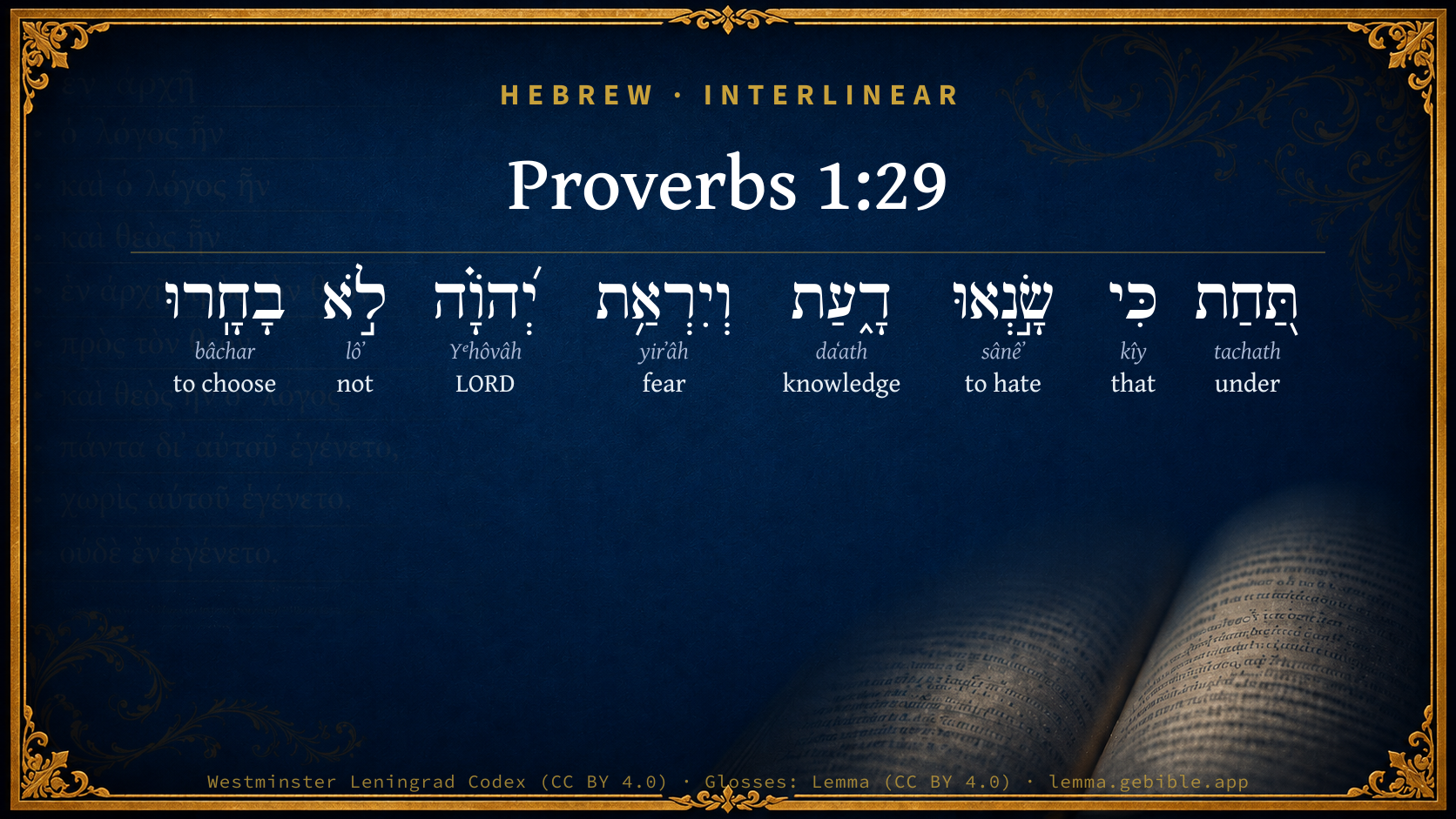
Proverbs 1:29

Hebrew (Westminster Leningrad Codex) Proverbs 1:29 appears in the Hebrew Old Testament. The text above is from the Westminster Leningrad Codex. Each word links to its Strong’s number, a concise gloss, and parsing drawn from the Open Scriptures Hebrew Bible morphology. Click any word for its full Brown-Driver-Briggs (BDB) entry.
Download image
Cite this verse

Proverbs 1:29 (World English Bible). Public Domain. Lemma interlinear Bible study tool, https://lemma.gebible.app/v/proverbs/1/29.

Show BibTeX & RIS
BibTeX
RIS
English Translation
Because they hated knowledge, And didn't choose the fear of Yahweh.
World English Bible · Public Domain
Download a study sheet

One document with this verse’s original text, its word-by-word gloss line, the meaning frame, cross-references with their text, attributed commentary, and full source and license credits — printable, and it pastes into notes with its structure intact.

This verse Autodidact and up

Study sheet (.html) Plain text (.txt)

A passage Seminary Student

Up to 50 verses in one chapter. A passage sheet keeps up to 6 commentary sources and 12 cross-references per verse, in the order this page ranks them, and says so on the sheet whenever that leaves anything out. Ask for a single verse and you get the Autodidact verse sheet above.

Everything on this page stays free to read, with no account — the sheet is a download of what is already on screen, not access to it.

Want to remove ads? Support Godless Engineer
Compare translations 3

The same verse in 3 English versions, stacked beneath the original-language interlinear above. Click any original word for its lexicon entry.

Each is an independent rendering of the whole verse — the interlinear is not word-aligned to these translations.

Highlighted words mark where these versions differ — a whole-verse word diff, not a word-by-word alignment.

  • World English Bible Public Domain
    Because they hated knowledge, And didn't choose the fear of Yahweh.
  • King James Version Public Domain
    For that they hated knowledge, and did not choose the fear of the LORD:
  • unfoldingWord Literal Text CC BY-SA 4.0
    for the reason that they hate knowledge and the fear of Yahweh they did not choose,

unfoldingWord Literal Text — © unfoldingWord, licensed CC BY-SA 4.0. Word-aligned USFM3 via Door43 (git.door43.org/unfoldingWord/en_ult).

Versions to compare (up to 4)

3 of 4 selected

Show all 18 translations

Every available English version of this verse, each an independent rendering of the whole verse.

  • World English Bible Public Domain
    Because they hated knowledge, And didn't choose the fear of Yahweh.
  • Berean Standard Bible Public Domain
    For they hated knowledge and chose not to fear the LORD.
  • Majority Standard Bible Public Domain
    For they hated knowledge and chose not to fear the LORD.
  • King James Version Public Domain
    For that they hated knowledge, and did not choose the fear of the LORD:
  • American Standard Version (1901) Public Domain
    For that they hated knowledge, And did not choose the fear of Jehovah:
  • Revised Version (1885) Public Domain
    For that they hated knowledge, and did not choose the fear of the LORD:
  • Geneva Bible (1599) Public Domain
    Because they hated knowledge, and did not chuse the feare of the Lord.
  • Douay-Rheims (1899) Public Domain
    Because they have hated instruction and received not the fear of the Lord,
  • Young's Literal Translation Public Domain
    Because that they have hated knowledge, And the fear of Jehovah have not chosen.
  • Literal Standard Version CC BY-SA 4.0
    Because that they have hated knowledge, || And have not chosen the fear of YHWH.
  • Unlocked Literal Bible CC BY-SA 4.0
    Because they hate knowledge and did not choose the fear of Yahweh,
  • unfoldingWord Literal Text CC BY-SA 4.0
    for the reason that they hate knowledge and the fear of Yahweh they did not choose,
  • Darby Bible Public Domain
    Because they hated knowledge, and did not choose the fear of Jehovah;
  • World Messianic Bible Public Domain
    because they hated knowledge, and didn’t choose the fear of the LORD.
  • Webster's Bible Public Domain
    For that they hated knowledge, and did not choose the fear of the LORD:
  • Free Bible Version CC BY-SA 4.0
    Why?—because they hated knowledge, and they didn't choose to respect the Lord.
  • Bible in Basic English Public Domain
    For they were haters of knowledge, and did not give their hearts to the fear of the Lord:
  • JPS Tanakh (1917) Public Domain
    For that they hated knowledge, and did not choose the fear of the LORD;

Literal Standard Version (2020), Covenant Press — licensed CC BY-SA 4.0. Text via the HelloAO Bible API (eBible.org). Unlocked Literal Bible (unfoldingWord) — licensed CC BY-SA 4.0. Text via the HelloAO Bible API (eBible.org). unfoldingWord Literal Text — © unfoldingWord, licensed CC BY-SA 4.0. Word-aligned USFM3 via Door43 (git.door43.org/unfoldingWord/en_ult). Free Bible Version, Dr. Jonathan Gallagher — licensed CC BY-SA 4.0. Text via the HelloAO Bible API (eBible.org).

Word by word

More ways to search: Search by grammar → Find every occurrence → Compare this word →

Practice this passage: Drill this verse → Learn its vocabulary →

About this verse

These counts appear in no published source. They are computed here, from the morphology-tagged text and Lemma’s own curated glosses. What Lemma adds →

8
words
8
distinct lemmas
Wisdom
section

Shared distinctive vocabulary

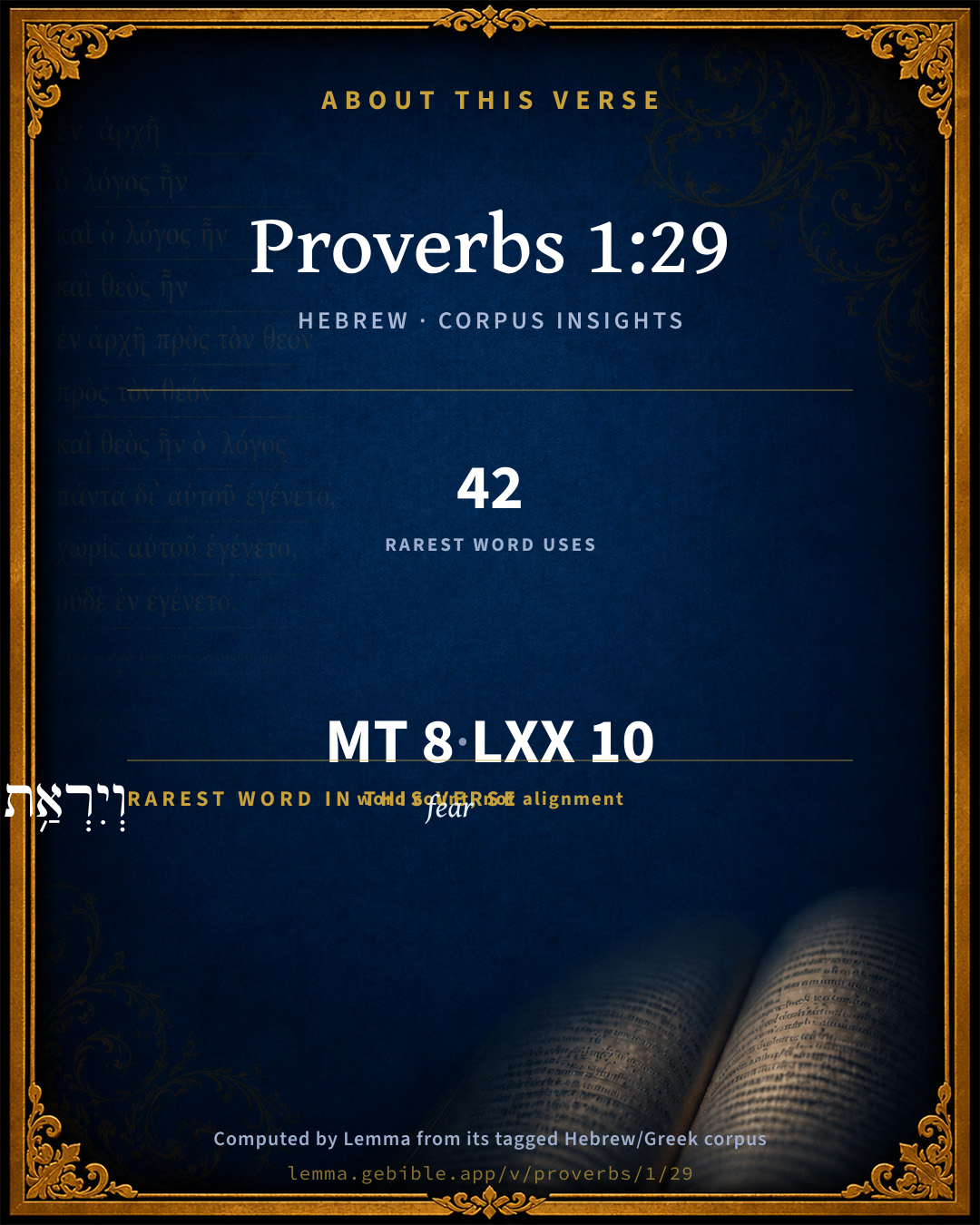
וְיִרְאַ֥ת fear H3374 occurs in 42 verses of the Hebrew Bible. Also found in:

Grammatical profile

  • 2 verbs
  • 3 nouns
  • 1 preposition
  • 1 conjunction
  • 1 particle

Verb forms

  • שָׂ֣נְאוּ Qal · Perfect
  • בָחָֽרוּ Qal · Perfect

Hebrew & Septuagint length

In English translation the verse runs 11 words from the Hebrew and 13 from the Septuagint (LXX English) — closely comparable.

A rough comparison of the two English renderings, which tokenize alike — not a word-level alignment.

Word counts can differ between the Hebrew and the Greek without any difference in meaning — e.g. the Hebrew direct-object marker אֵת has no separate Greek word, and Greek often adds the article ὁ.

In the original languages it is 8 Hebrew tokens and 10 Greek tokens — but the two are counted differently (Hebrew bundles its prefixes and suffixes into one token; the Greek is in lemma form), so that isn’t a like-for-like length.

Cross-references

11

Topical passages linked to Proverbs 1:29 in the Treasury of Scripture Knowledge — connected by theme and wording, ordered by reader-vote popularity; previews shown in the World English Bible.

  • Proverbs 6:23 For the commandment is a lamp, And the law is light. Reproofs of instruction are the way of life,
  • Job 21:14–15 They tell God, 'Depart from us, For we don't want to know about your ways.
  • Proverbs 1:22 "How long, you simple ones, will you love simplicity? How long will mockers delight themselves in mockery, And fools hate knowledge?
  • Isaiah 27:11 When the boughs of it are withered, they shall be broken off; the women shall come, and set them on fire; for it is a people of no understanding: therefore he who made them will not have compassion on them, and he who formed them will show them no favor.
  • Hebrews 11:25 choosing rather to share ill treatment with God's people, than to enjoy the pleasures of sin for a time;
  • Psalms 50:16–17 But to the wicked God says, "What right do you have to declare my statutes, That you have taken my covenant on your lips,
  • Proverbs 5:12 And say, "How I have hated instruction, And my heart despised reproof;
  • Luke 10:42 but one thing is needed. Mary has chosen the good part, which will not be taken away from her."
  • John 3:20 For everyone who does evil hates the light, and doesn't come to the light, lest his works would be exposed.
  • Acts 7:51–54 "You stiff-necked and uncircumcised in heart and ears, you always resist the Holy Spirit! As your fathers did, so you do.
  • Isaiah 30:9–12 For it is a rebellious people, lying children, children who will not hear the law of Yahweh;

Cross-references courtesy of OpenBible.info (CC BY 4.0).

Hebrew and Greek witnesses Masoretic Hebrew ↔ Greek Septuagint

The same verse in the two great witnesses to the Old Testament, shown verse-for-verse.

These are two independent witnesses, not word-aligned to each other, and the Septuagint is shown in lemma (dictionary) form.

Hebrew Proverbs 1:29 Masoretic · Westminster Leningrad Codex

תַּ֭חַת כִּי שָׂ֣נְאוּ דָ֑עַת וְיִרְאַ֥ת יְ֝הֹוָ֗ה לֹ֣א בָחָֽרוּ

Because they hated knowledge, And didn't choose the fear of Yahweh.

World English Bible · Public Domain

Greek LXX Proverbs 1:29 Septuagint · lemma form

μισέω γάρ σοφία ὁ δέ φόβος ὁ κύριος οὐ προαἱρέω

For they hated wisdom, and did not choose the word of the Lord:

LXX2012 (modern English Septuagint) · Public Domain

On this verse, The Pulpit Commentary discusses the Septuagint’s reading. Read the note in Commentary ↓

Hebrew: Westminster Leningrad Codex (CC BY 4.0). Greek: Septuagint (public domain); English from LXX2012 (modern English Septuagint) (Public Domain). How the Septuagint differs from the Hebrew →

Commentary

Notes on Proverbs 1:29 from classic Christian and Jewish commentators (each source and its license shown beneath its notes). The classic Christian expositions comment on the surrounding passage and are grouped to its opening verse, so a note may address several verses; the Jewish commentaries on the Tanakh (Rashi and others) are per-verse, so they appear only where the commentator wrote on this verse.

Lemma curates 59 commentaries, every one of them public domain or Creative Commons licensed, each selected and text-cleaned for this edition rather than reprinted as found. About our sources →

Trapp's Complete Commentary

John Trapp

Pro 1:29 For that they hated knowledge, and did not choose the fear of the LORD:

Ver. 29. For that they hated knowledge.] These are the worst sort of sinners, {Pro 1:22} that not only slight knowledge, but hate it, as thieves do a torch in the night; curse it, as Ethiopians do the scorching sun; fly against it, as bats do against the light. {a} "This is the condemnation"; {Joh 3:19-20} this is hell aforehand.

And did not choose.] Aρετη, quasi αιρετη: Aγαθον, quasi αγαν θεατον. "Refuse the evil, and choose the good." {Isa 7:16} "Choose the things that please God"; {Isa 56:4} "that wherein he delights." {Isa 65:12} Such a choice made Moses; {Heb 11:25} and Joshua; {Jos 24:15} and Mary. {Luk 10:42}

{a} Herodot.

John Trapp, A Commentary or Exposition upon All the Books of the Old and New Testament (1647–1656) — public domain. Text from a community e-Sword module.

Joseph Benson's Commentary

Pro 1:29-32. For that they hated knowledge — Hated the light of divine truth, because it discovered to them the evil of their ways, Joh 3:20; or, hated the practical knowledge of God, and of their duty to him, and did not choose — That is, heartily approve of and love, the fear of the Lord — But chose to walk in the way of their own heart, and in the sight of their own eyes. They would none of my counsel — Refused to be guided by my counsels and precepts. Therefore shall they eat, &c. — Their wages shall be according to their work, and they shall reap as they sowed, Gal 6:7-8. They shall receive punishment answerable to their sins; and be filled with their own devices — Shall be surfeited, as Dr. Waterland renders the word, with the fruits and effects of their wicked devices. The sin, which was sweet in their mouths, shall be bitterness in their bellies, and that destruction which they plotted against others shall fall upon themselves. For the turning away — From God, and his counsels and ways; (opposed to hearkening unto God, Pro 1:33;) of the simple — Of the weak and foolish, who are easily deceived and persuaded, shall slay them — The evil example of such shall mislead them, and prove their ruin. But the Hebrew משׁובת פתים, rather means, the quiet, repose, or ease, (as it is rendered in the margin,) that is, the apparent happiness of the simple; of the men who have neglected my instruction, and have been so void of reason as to deliver themselves up to follow the example and advice of the wicked; shall slay them — Shall be fatal to them; a sense which accords with, and is further explained by, the next clause. And the prosperity of fools shall destroy them — It shall be the occasion of their ruin, by making them presumptuous and secure, worldly and proud, and forgetful of God and of their own eternal happiness, whereby they will provoke God’s wrath, and bring upon themselves swift and certain destruction. Thus he answers the common objection against the fear of God, taken from the present impunity and prosperity of ungodly men.

Joseph Benson's Commentary on the Old and New Testaments (1811–1818) — public domain. Text from a community e-Sword module.

Tyndale Open Study Notes

Tyndale Open Resources

1:29-30 they hated knowledge: There is no middle ground in the language of Proverbs. One either loves and embraces Wisdom or hates and rejects her.

Tyndale Open Study Notes — © Tyndale Open Resources, licensed CC BY-SA 4.0. Text via the HelloAO Bible API.

Jamieson, Fausset & Brown

Robert Jamieson, A. R. Fausset & David Brown

The sinner's infatuated rejection brings his ruin.

Jamieson, Fausset & Brown — Commentary Critical and Explanatory on the Whole Bible (1871) — public domain (CC PDM 1.0). Text via the HelloAO Bible API.

Adam Clarke's Commentary

Verse 29. They hated knowledge] This argues the deepest degree of intellectual and moral depravity.

Adam Clarke's Commentary on the Bible (1810–1826) — public domain. Text from a community e-Sword/MySword module.

John Gill's Exposition

For that they hated knowledge,.... Spiritual and evangelical; the knowledge of the Scriptures, of the promises and prophecies of them respecting the Messiah, though they were called upon and exhorted to "search" them; the knowledge of the Messiah, his person, offices, and grace; the knowledge of his Gospel, and the doctrines of it; see Pro 1:22;

and did not choose the fear of the Lord; which is the beginning of knowledge, Pro 1:7; instead of choosing, they cast off the fear of the Lord; and by their rejection of the Messiah, and their usage of him, it plainly appeared that the fear of God was not before their eyes nor upon their hearts; nor did they choose or care for the pure, spiritual, and evangelical worship of God, introduced in the Gospel dispensation; the ordinances of Christ they did not choose to submit to; and would neither go into he kingdom of God or Gospel church state themselves, nor suffer those that were entering to go in, Mat 23:13; but rather chose their superstition and will worship, according to the tradition of the elders, by which they made the word and worship of God of none effect.

John Gill's Exposition of the Whole Bible (1746–1763) — public domain (CC PDM 1.0). Text via the HelloAO Bible API.

Albert Barnes' Notes on the Bible

This is no arbitrary sentence. The fault was all along their own. The fruit of their own ways is death.

Albert Barnes' Notes on the Bible (1834–1885) — public domain. Text from a community e-Sword/MySword module.

Matthew Poole's English Annotations

Hated knowledge, to wit, the practical knowledge of God, and of their duty to him, as it is explained in the following clause.

Did not choose; not heartily approve of it and love it, but only made some show of it.

Matthew Poole's English Annotations on the Holy Bible (1683–1685) — public domain. Text from a community e-Sword/MySword module.

Whedon's Commentary on the Bible

Daniel D. Whedon

29. For that — Because connecting with the preceding; or, as others think, more closely with what follows. Observe, again, how knowledge, all useful knowledge, and the fear of the Lord, are intimately associated. See on Pro_1:7. Note the change of person here. Wisdom turns away from them, and speaks of them, not to them.

Daniel D. Whedon (gen. ed.), Commentary on the Old and New Testaments (1874–1909) — public domain. Text from a community e-Sword module.

The Pulpit Commentary

Vers. 29 and 30 belong to ver. 28, and are not the antecedent clauses to ver. 31, as Zochler remarks. They recapitulate the charges already made against the sinners in vers. 22 and 25, and now set them forth as the ground or reason why Wisdom, on her part, turns a deaf ear to their entreatries. Wisdom will disregard the n because they have previously disregatded her. The connection is denoted in the LXX by gar , for the Hebrew takbath ki, equivalent to because," and in the Authorized Version by the punctuation. Did not choose the fear of the Lord. The verb "to choose" (rjB, bakhar) combines in itself the meanings of eligere and diligere (Fleischer), and therefore signifies here not only choice of, but also the fuller sense of love for, the fear of the Lord. They despised; i.e. rejected the reproof with scorn or derision, sneered or turned up their noses at it (mukthrizein , LXX), disparaged it (detrahere, Vulgate), or, more strongly, as Gejerus says, execrated it. Their rejection of reproof is stigmatized in stronger terms than in ver. 25.

The Pulpit Commentary (1880–1919), ed. H.D.M. Spence-Jones & Joseph S. Exell — public domain. Text from a community e-Sword module.

John Wesley's Explanatory Notes

Knowledge - The practical knowledge of God and of their duty.

John Wesley, Explanatory Notes Upon the Whole Bible (1754–1765) — public domain. Text via the GEBible commentary corpus.

Scofield Reference Notes

C. I. Scofield

fear

Also; Pro 1:7. (See Scofield "Psa 19:9").

The Scofield Reference Bible (1917 edition), notes by C. I. Scofield — public domain. Text from a community e-Sword module.

Lesson kit

Teaching starters — assembled from the data on this page, not authored interpretation. Every prompt links to the verse data it draws on. Edit before teaching.

Proverbs, in the Wisdom, opens this verse with 8 words (8 distinct Hebrew lemmas). Its most distinctive word is yirʼâh (“fear”). A historical commentator’s framing appears above. Read the whole chapter for the surrounding context.

Discussion questions

  1. What does “fear” (yirʼâh) contribute to the verse as a whole?
  2. How does Genesis 20:11, which shares the word «fear», read alongside this verse?
  3. These translations render this verse differently; the difference is in the English rendering, not the original. What questions does that raise?
  4. «שָׂ֣נְאוּ» is a Qal Perfect verb. How does that grammatical form shape the action described?
  5. Compare how Trapp's Complete Commentary and Joseph Benson's Commentary read this verse. Where do they agree or differ?

Things to notice

Reading settings

Reading text

Shown beneath each verse's original-language words.

Old Testament
Old Testament edition

Read the OT as the Masoretic Hebrew (MT) or the Greek Septuagint (LXX).

English shown for the Greek Septuagint (in the Hebrew ↔ Greek comparison).

Comparing translations? Open the Compare panel on any verse page to stack up to four side by side.