
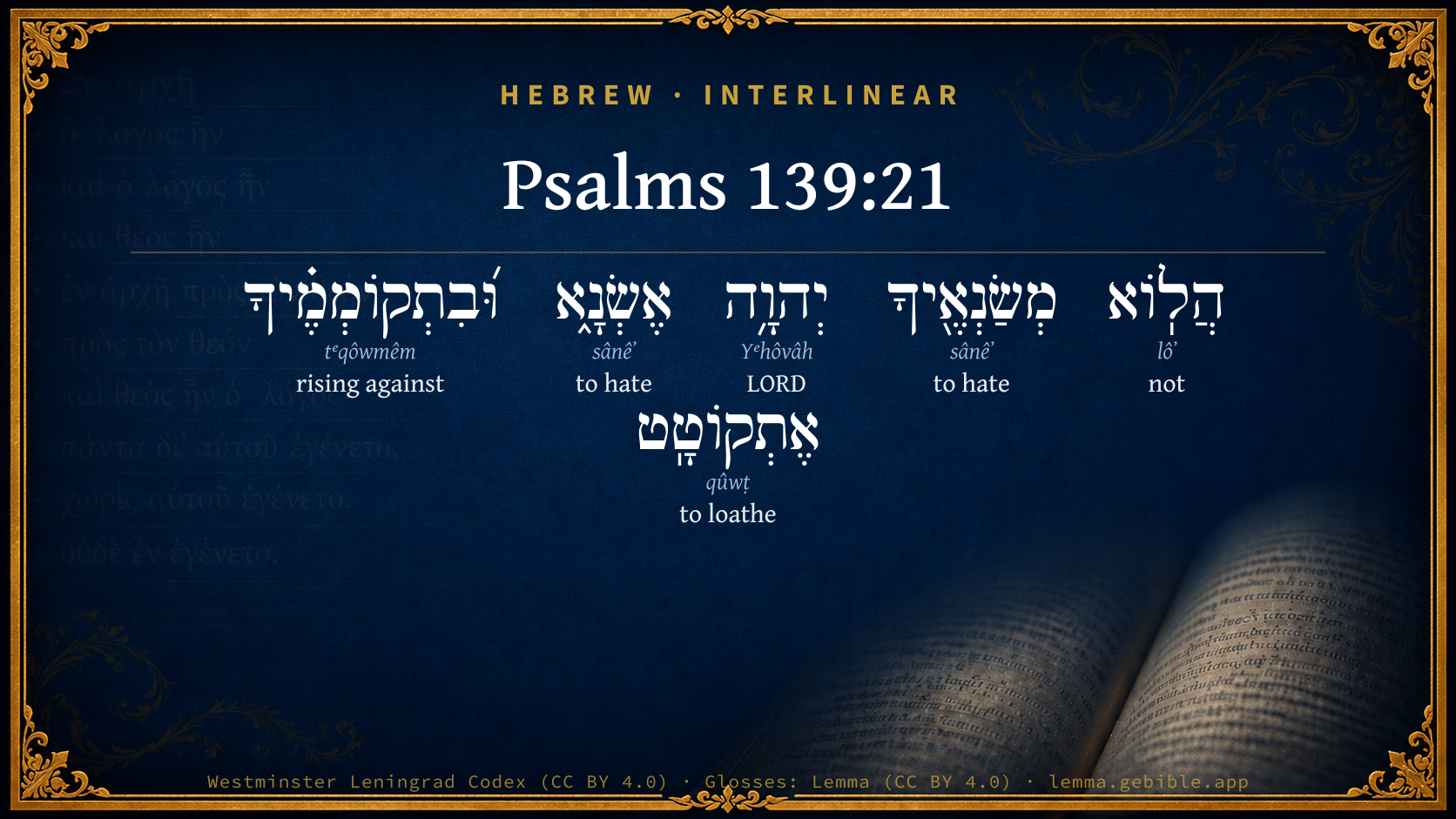
Psalms 139:21

Hebrew (Westminster Leningrad Codex) Psalms 139:21 appears in the Hebrew Old Testament. The text above is from the Westminster Leningrad Codex. Each word links to its Strong’s number, a concise gloss, and parsing drawn from the Open Scriptures Hebrew Bible morphology. Click any word for its full Brown-Driver-Briggs (BDB) entry.
Download image
Cite this verse

Psalms 139:21 (World English Bible). Public Domain. Lemma interlinear Bible study tool, https://lemma.gebible.app/v/psalms/139/21.

Show BibTeX & RIS
BibTeX
RIS
English Translation
Yahweh, don't I hate those who hate you? Am I not grieved with those who rise up against you?
World English Bible · Public Domain
Highlights
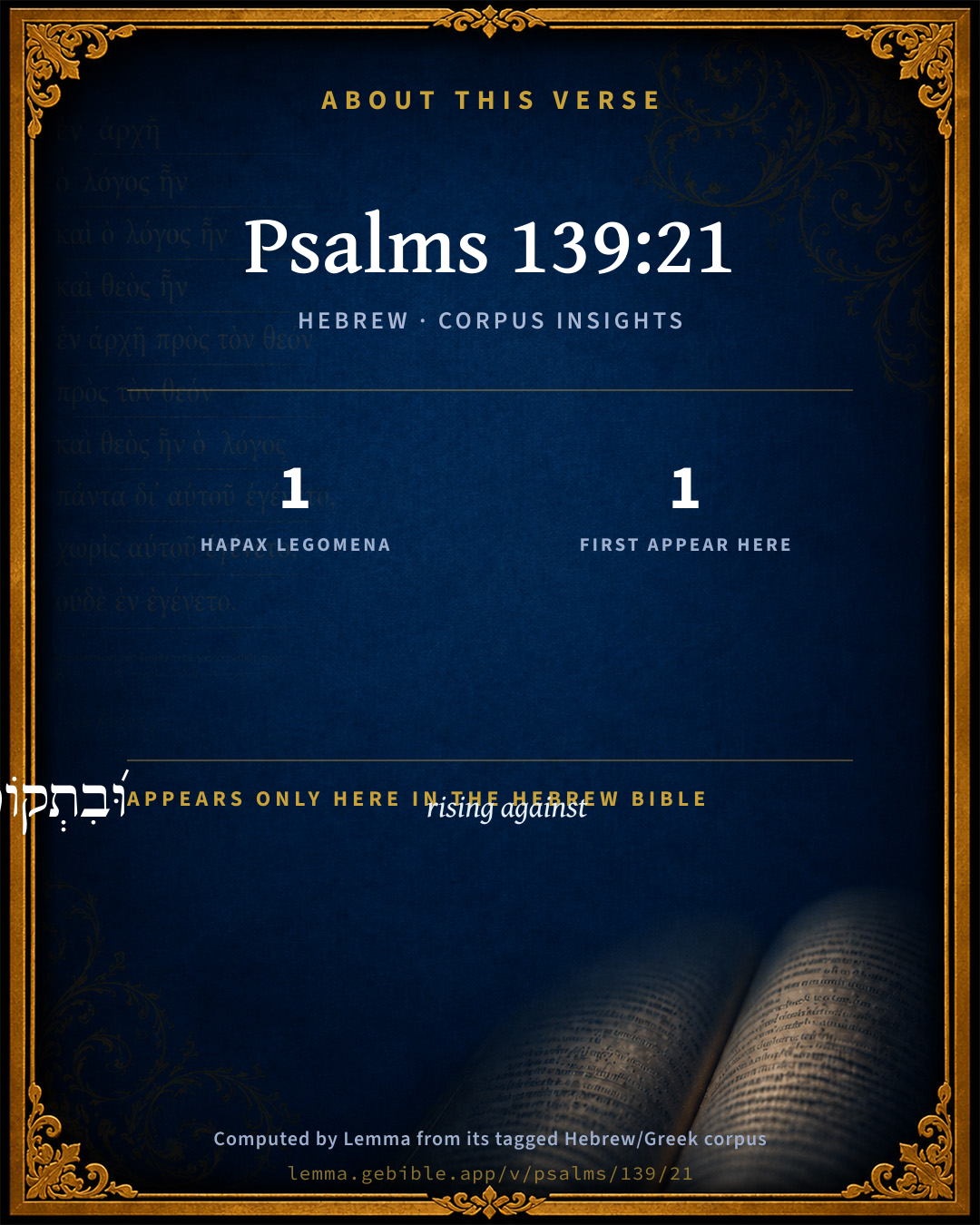
  • 1 hapax legomenon — only here in the Hebrew Bible
  • 1 first appearance in the Hebrew Bible
Full analysis ↓
Download a study sheet

One document with this verse’s original text, its word-by-word gloss line, the meaning frame, cross-references with their text, attributed commentary, and full source and license credits — printable, and it pastes into notes with its structure intact.

This verse Autodidact and up

Study sheet (.html) Plain text (.txt)

A passage Seminary Student

Up to 50 verses in one chapter. A passage sheet keeps up to 6 commentary sources and 12 cross-references per verse, in the order this page ranks them, and says so on the sheet whenever that leaves anything out. Ask for a single verse and you get the Autodidact verse sheet above.

Everything on this page stays free to read, with no account — the sheet is a download of what is already on screen, not access to it.

Want to remove ads? Support Godless Engineer
Compare translations 3

The same verse in 3 English versions, stacked beneath the original-language interlinear above. Click any original word for its lexicon entry.

Each is an independent rendering of the whole verse — the interlinear is not word-aligned to these translations.

Highlighted words mark where these versions differ — a whole-verse word diff, not a word-by-word alignment.

  • World English Bible Public Domain
    Yahweh, don't I hate those who hate you? Am I not grieved with those who rise up against you?
  • King James Version Public Domain
    Do not I hate them, O LORD, that hate thee? and am not I grieved with those that rise up against thee?
  • unfoldingWord Literal Text CC BY-SA 4.0
    Do I not hate the ones hating you, Yahweh? And do I not loathe the ones rising up against you?

unfoldingWord Literal Text — © unfoldingWord, licensed CC BY-SA 4.0. Word-aligned USFM3 via Door43 (git.door43.org/unfoldingWord/en_ult).

Versions to compare (up to 4)

3 of 4 selected

Show all 17 translations

Every available English version of this verse, each an independent rendering of the whole verse.

  • World English Bible Public Domain
    Yahweh, don't I hate those who hate you? Am I not grieved with those who rise up against you?
  • Berean Standard Bible Public Domain
    Do I not hate those who hate You, O LORD, and detest those who rise against You?
  • Majority Standard Bible Public Domain
    Do I not hate those who hate You, O LORD, and detest those who rise against You?
  • King James Version Public Domain
    Do not I hate them, O LORD, that hate thee? and am not I grieved with those that rise up against thee?
  • American Standard Version (1901) Public Domain
    Do not I hate them, O Jehovah, that hate thee? And am not I grieved with those that rise up against thee?
  • Revised Version (1885) Public Domain
    Do not I hate them, O LORD, that hate thee? and am not I grieved with those that rise up against thee?
  • Geneva Bible (1599) Public Domain
    Doe not I hate them, O Lord, that hate thee? and doe not I earnestly contend with those that rise vp against thee?
  • Young's Literal Translation Public Domain
    Do not I hate, Jehovah, those hating Thee? And with Thy withstanders grieve myself?
  • Literal Standard Version CC BY-SA 4.0
    Do I not hate, YHWH, those hating You? And grieve myself with Your withstanders?
  • Unlocked Literal Bible CC BY-SA 4.0
    Do I not hate those, Yahweh, who hate you? Do I not despise those who rise up against you?
  • unfoldingWord Literal Text CC BY-SA 4.0
    Do I not hate the ones hating you, Yahweh? And do I not loathe the ones rising up against you?
  • Darby Bible Public Domain
    Do not I hate them, O Jehovah, that hate thee? and do not I loathe them that rise up against thee?
  • World Messianic Bible Public Domain
    LORD, don’t I hate those who hate you? Am I not grieved with those who rise up against you?
  • Webster's Bible Public Domain
    Do not I hate them, O LORD, that hate thee? and am not I grieved with those that rise up against thee?
  • Free Bible Version CC BY-SA 4.0
    Lord, don't I hate those who hate you? I despise those who rebel against you!
  • Bible in Basic English Public Domain
    Are not your haters hated by me, O Lord? are not those who are lifted up against you a cause of grief to me?
  • JPS Tanakh (1917) Public Domain
    Do not I hate them, O LORD, that hate Thee? And do not I strive with those that rise up against Thee?

Literal Standard Version (2020), Covenant Press — licensed CC BY-SA 4.0. Text via the HelloAO Bible API (eBible.org). Unlocked Literal Bible (unfoldingWord) — licensed CC BY-SA 4.0. Text via the HelloAO Bible API (eBible.org). unfoldingWord Literal Text — © unfoldingWord, licensed CC BY-SA 4.0. Word-aligned USFM3 via Door43 (git.door43.org/unfoldingWord/en_ult). Free Bible Version, Dr. Jonathan Gallagher — licensed CC BY-SA 4.0. Text via the HelloAO Bible API (eBible.org).

Word by word

More ways to search: Search by grammar → Find every occurrence → Compare this word →

Practice this passage: Drill this verse → Learn its vocabulary →

About this verse

These counts appear in no published source. They are computed here, from the morphology-tagged text and Lemma’s own curated glosses. What Lemma adds →

6
words
5
distinct lemmas
Wisdom
section

Notable vocabulary

1 hapax legomenon — a word that appears only here in the entire Hebrew Bible:

  • וּ֝בִתְקוֹמְמֶ֗יךָ rising against H8618

First appearance in Scripture

This word makes its first canonical appearance in the Hebrew Bible here:

  • וּ֝בִתְקוֹמְמֶ֗יךָ rising against H8618

Shared distinctive vocabulary

אֶתְקוֹטָֽט to loathe H6962 occurs in 6 verses of the Hebrew Bible. Also found in:

Grammatical profile

  • 3 verbs
  • 2 nouns
  • 1 particle

Verb forms

  • מְשַׂנְאֶ֖יךָ Piel · Participle Active
  • אֶשְׂנָ֑א Qal · Imperfect
  • אֶתְקוֹטָֽט Hithpolel · Imperfect

Repetition

A word recurs within this verse — often emphatic in Hebrew:

  • מְשַׂנְאֶ֖יךָ to hate H8130 ×2

Hebrew & Septuagint length

In English translation the verse runs 19 words from the Hebrew and 17 from the Septuagint (LXX English) — closely comparable.

A rough comparison of the two English renderings, which tokenize alike — not a word-level alignment.

Word counts can differ between the Hebrew and the Greek without any difference in meaning — e.g. the Hebrew direct-object marker אֵת has no separate Greek word, and Greek often adds the article ὁ.

Cross-references

12

Topical passages linked to Psalms 139:21 in the Treasury of Scripture Knowledge — connected by theme and wording, ordered by reader-vote popularity; previews shown in the World English Bible.

  • Psalms 119:158 I look at the faithless with loathing, Because they don't observe your word.
  • Psalms 31:6 I hate those who regard lying vanities, But I trust in Yahweh.
  • Revelation 2:2 "I know your works, and your toil and perseverance, and that you can't tolerate evil men, and have tested those who call themselves apostles, and they are not, and found them false.
  • 2 Chronicles 19:2 Jehu the son of Hanani the seer went out to meet him, and said to king Jehoshaphat, Should you help the wicked, and love those who hate Yahweh? for this thing wrath is on you from before Yahweh.
  • Psalms 26:5 I hate the assembly of evil-doers, And will not sit with the wicked.
  • Revelation 2:6 But this you have, that you hate the works of the Nicolaitans, which I also hate.
  • Psalms 15:4 In whose eyes a vile man is despised, But who honors those who fear Yahweh; He who keeps an oath even when it hurts, and doesn't change;
  • Psalms 119:136 Streams of tears run down my eyes, Because they don't observe your law.
  • Jeremiah 13:17 But if you will not hear it, my soul shall weep in secret for [your] pride; and my eye shall weep sore, and run down with tears, because Yahweh's flock is taken captive.
  • Mark 3:5 When he had looked around at them with anger, being grieved at the hardening of their hearts, he said to the man, "Stretch out your hand." He stretched it out, and his hand was restored as healthy as the other.
  • Luke 19:41 When he drew near, he saw the city and wept over it,
  • Romans 9:1–3 I tell the truth in Christ. I am not lying, my conscience testifying with me in the Holy Spirit,

Cross-references courtesy of OpenBible.info (CC BY 4.0).

Hebrew and Greek witnesses Masoretic Hebrew ↔ Greek Septuagint

The same verse in the two great witnesses to the Old Testament, shown verse-for-verse.

You’re reading Greek Psalm 138 (Hebrew Psalm 139). The Septuagint counts the superscription, so verse numbers can differ from the Hebrew — chapter-level alignment, not verse-by-verse. Numbering follows Rahlfs.

These are two independent witnesses, not word-aligned to each other, and the Septuagint is shown in lemma (dictionary) form.

Hebrew Psalms 139:21 Masoretic · Westminster Leningrad Codex

הֲלֽוֹא מְשַׂנְאֶ֖יךָ יְהוָ֥ה אֶשְׂנָ֑א וּ֝בִתְקוֹמְמֶ֗יךָ אֶתְקוֹטָֽט

Yahweh, don't I hate those who hate you? Am I not grieved with those who rise up against you?

World English Bible · Public Domain

Greek LXX Greek Psalm 138:21 Septuagint · lemma form

οὐ ὁ μισέω σύ κύριος μισέω καί ἐπί ὁ ἐχθρός σύ ἐκτήκω

Have I not hated them, O Lord, that hate you? and wasted away because of your enemies?

LXX2012 (modern English Septuagint) · Public Domain

Hebrew: Westminster Leningrad Codex (CC BY 4.0). Greek: Septuagint (public domain); English from LXX2012 (modern English Septuagint) (Public Domain). How the Septuagint differs from the Hebrew →

Commentary

Notes on Psalms 139:21 from classic Christian and Jewish commentators (each source and its license shown beneath its notes). The classic Christian expositions comment on the surrounding passage and are grouped to its opening verse, so a note may address several verses; the Jewish commentaries on the Tanakh (Rashi and others) are per-verse, so they appear only where the commentator wrote on this verse.

Lemma curates 59 commentaries, every one of them public domain or Creative Commons licensed, each selected and text-cleaned for this edition rather than reprinted as found. About our sources →

Trapp's Complete Commentary

John Trapp

Psa 139:21 Do not I hate them, O LORD, that hate thee? and am not I grieved with those that rise up against thee?

Ver. 21. Do not I hate them, O Lord] And therefore hate them because they hate thee? This the Hebrews understand of heretics and apostates. See a like zeal in that angel of Ephesus, Rev 2:2.

And am not I grieved] Or, irked, made ready to vomit at (as at some loathsome spectacle), fretted, vexed.

John Trapp, A Commentary or Exposition upon All the Books of the Old and New Testament (1647–1656) — public domain. Text from a community e-Sword module.

Joseph Benson's Commentary

Psa 139:21-22. Do not I hate them that hate thee? — I appeal to thee, the omnipresent and omniscient God, whether I do not perfectly hate them, (that is, hate their ways,) so far as they are enemies to thee and goodness. Am I not grieved — With the folly and sin of those that rise up against thee? — That act in open hostility against thy authority. I am grieved to see their wickedness, and to foresee the ruin in which it will certainly end. I count them mine enemies — I am no less grieved with their enmity against thee than if they directed it against myself. “A faithful servant hath the same interests, the same friends, the same enemies, with his Master, whose cause and honour he is, upon all occasions, in duty bound to support and maintain. A good man hates, as God himself doth; he hates not the persons of men, but their sins; not what God made them, but what they have made themselves. We are neither to hate the men on account of the vices they practise, nor love the vices for the sake of the men who practise them. He who observes invariably this distinction, fulfils the perfect law of charity, and hath the love of God and of his neighbour abiding in him.” — Horne.

Joseph Benson's Commentary on the Old and New Testaments (1811–1818) — public domain. Text from a community e-Sword module.

J. A. Alexander on Psalms

Joseph Addison Alexander

21. (Psa 139:21) Thy haters, O Jehovah, shall not I hate, and with thine assailants be disgusted? The simple future in the first clause comprehends several distinct shades of meaning. Do I not, may I not, must I not, hate those hating thee? Hate them, not as man hates, but as God hates. See above, on Psa 5:5. The construction of the verb and preposition in the last clause is the same in Hebrew and in English. Be disgusted, literally sicken or disgust myself, abhor, or loathe. Thine assailants, those rising up against thee, as rebellious enemies. The Hebrew word is a noun formed from the participle used above, Psa 17:7; Psa 59:1.

Joseph Addison Alexander, The Psalms Translated and Explained (1850) — public domain. Text from a community e-Sword module.

Tyndale Open Study Notes

Tyndale Open Resources

139:21 I hate: Rejection of evil is a mark of wisdom (see 1:1; 5:4-6).

Tyndale Open Study Notes — © Tyndale Open Resources, licensed CC BY-SA 4.0. Text via the HelloAO Bible API.

Geneva Bible (1599)

Geneva Bible translators

He teacheth us boldly to contemn all the hatred of the wicked, and friendship of the world, when they would let us to serve God sincerely.

Geneva Bible (1599) marginal notes — public domain. Text via Bolls.life.

Adam Clarke's Commentary

Verse 21. Do not I hate them] I hold their conduct in abomination.

Adam Clarke's Commentary on the Bible (1810–1826) — public domain. Text from a community e-Sword/MySword module.

John Calvin's Commentaries

21. Shall I not hold in hatred those that hate thee? He proceeds to mention how greatly he had profited by the meditation upon God into which he had been led, for, as the effect, of his having realized his presence before God’s bar, and reflected upon the impossibility of escaping the eye of him who searches all deep places, he now lays down his resolution to lead a holy and pious life. In declaring his hatred of those who despised God, he virtually asserts thereby his own integrity, not as being free from all sin, but as being devoted to godliness, so that he detested in his heart everything which was contrary to it. Our attachment to godliness must be inwardly defective, if it do not generate an abhorrence of sin, such as David here speaks of. If that zeal for the house of the Lord, which he mentions elsewhere, (Psalm 69:9,) burn in our hearts, it would be an unpardonable indifference silently to look on when his righteous law was violated, nay, when his holy name was trampled upon by the wicked. As to the last word in the verse, קוט, kut, means to dispute with, or contend, and may be understood as here retaining’ the same sense in the Hithpael conjugation, unless we consider David to have more particularly meant, that he inflamed himself so as to stir up his mind to contend with them. We thus see that he stood forward strenuously in defense of the glory of God, regardless of the hatred of the whole world, and waged war with all the workers of iniquity.

John Calvin's Commentaries (1540-1563) — public domain. Text from the Calvin Translation Society English edition (1840s-50s) via the Christian Classics Ethereal Library (ccel.org). Calvin's coverage is partial (roughly two-thirds of the Bible); uncommented books and verses are honest gaps, never fabricated. The 19th-century editor's footnotes and remarks are omitted so the notes are faithfully Calvin's own voice.

Ellicott's Commentary for English Readers

(21) Do not I . . .—Better—

“Must I not hate thy haters, Jehovah,

And feel loathing for thy assailants?”

A Bible Commentary for English Readers, edited by Charles John Ellicott (1878–1897) — public domain. Text from a community e-Sword module.

The Cambridge Bible for Schools and Colleges

gen. ed. J. J. S. Perowne

21. am not I grieved with] Do not I loathe, as in Psa_119:158.

The Cambridge Bible for Schools and Colleges (gen. ed. J. J. S. Perowne; Cambridge University Press, 1878–1918) — public domain. Text from a community e-Sword module.

John Gill's Exposition

I hate them with perfect hatred,.... Heartily and really; not in word only, but in deed and in truth; "odio vatiniano", with consummate hatred: this is an answer to his own question;

I count them mine enemies; being the enemies of God: the friends of God were David's friends, as angels and good men, and God's enemies were his; their friends and enemies, were common; so closely allied and attached were they to each other, as God and all good men are.

John Gill's Exposition of the Whole Bible (1746–1763) — public domain (CC PDM 1.0). Text via the HelloAO Bible API.

Albert Barnes' Notes on the Bible

Do not I hate them, O Lord, that hate thee? - This is in the consciousness of the psalmist a proof of his own real piety, as derived from his feelings toward those who were the enemies of God. The word hate here, as applied to them, must be understood in the sense that he disapproved of their conduct; that he did not desire to be associated with them; that he wished to avoid their society, and to find his friends among men of a different character. See the notes at Psa 1:1. Compare Isa 5:5.

And am not I grieved with those that rise up against thee? - The expression here - “grieved” - explains the meaning of the word “hate” in the former member of the verse. It is not that hatred which is followed by malignity or ill-will; it is that which is accompanied with grief - pain of heart - pity - sorrow. So the Saviour looked on people: Mar 3:5 : “And when he had looked round about on them with “anger,” being “grieved” for the hardness of their hearts.” The Hebrew word used here, however, contains “also” the idea of being disgusted with; of loathing; of nauseating. See the notes at Psa 119:158. The feeling referred to is anger - conscious disgust - at such conduct; and grief, pain, sorrow, that people should evince such feelings toward their Maker.

Albert Barnes' Notes on the Bible (1834–1885) — public domain. Text from a community e-Sword/MySword module.

Matthew Poole's English Annotations

I appeal to thee, the omnipresent and omniscient God, whether I do not perfectly hate them so far as they are enemies to God and goodness.

That rise up against thee, in open hostility and rebellion against thine authority.

Matthew Poole's English Annotations on the Holy Bible (1683–1685) — public domain. Text from a community e-Sword/MySword module.

The Treasury of David

Charles H. Spurgeon

Ver. 21. Do not I hate them, O LORD, that hate thee? He was a good hater, for he hated only those who hated good. Of this hatred he is not ashamed, but he sets it forth as a virtue to which he would have the Lord bear testimony. To love all men with benevolence is our duty; but to love any wicked man with complacency would be a crime. To hate a man for his own sake, or for any evil done to us, would be wrong; but to hate a man because he is the foe of all goodness and the enemy of all righteousness, is nothing more nor less than an obligation. The more we love God the more indignant shall we grow with those who refuse him their affection. "If any man love not the Lord Jesus Christ let him be Anathema Maranatha." Truly, "jealousy is cruel as the grave." The loyal subject must not be friendly to the traitor.

And am not I grieved with those that rise up against thee? He appeals to heaven that he took no pleasure in those who rebelled against the Lord; but, on the contrary, he was made to mourn by a sight of their ill behaviour. Since God is everywhere, he knows our feelings towards the profane and ungodly, and he knows that so far from approving such characters the very sight of them is grievous to our eyes.

Ver. 21. Do not I hate them, O Lord, that hate thee? The simple future in the first clause comprehends several distinct shades of meaning. Do I not, may I not, must I not, hate those hating thee? Hate them, not as man hates, but as God hates. Joseph Addison Alexander.

Ver. 21. Do not I hate them, O LORD, that hate thee? Can he who thinks good faith the holiest thing in life, avoid being an enemy to that man who, as quaestor, dared to despoil, desert, and betray? Can he who wishes to pay due honours to the immortal gods, by any means avoid being an enemy to that man who has plundered all their temples? Cicero.

Ver. 21. And am not I grieved with those that rise up against thee? The expression here"grieved" explains the meaning of the word "hate" in the former member of the verse. It is not that hatred which is followed by malignity or ill will; it is that which is accompanied with grief, pain of heart, pity, sorrow. So the Saviour looked on men: Mr 3:5: "And when he had looked round about on them with anger, being grieved for the hardness of their hearts." The Hebrew word used here, however, contains also the idea of being disgusted with; of loathing; of nauseating. The feeling referred to is angerconscious disgustat such conduct; grief, pain, sorrow, that men should evince such feelings towards their Maker. Albert Barnes.

Ver. 21. Am not I grieved? etc. Acted upon by mingled feelings of sorrow for them, and loathing at their evil practices. Thus our Lord "looked round about on them with anger, being grieved for the hardness of their hearts": Mr 3:5. French and Skinner.

Ver. 21. It is said that Adam Smith disliked nothing more than that moral apathythat obtuseness of moral perceptionwhich prevents man from not only seeing clearly, but feeling strongly, the broad distinction between virtue and vice, and which, under the pretext of liberality, is all indulgent even to the blackest crimes. At a party at Dalkeith Palace, where Mr. , in his mawkish way, was finding palliations for some villainous transactions, the doctor waited in patient silence until he was gone, then exclaimed: "Now I can breathe more freely. I cannot bear that man; he has no indignation in him."

Ver. 21-22. A faithful servant hath the same interests, the same friends, the same enemies, with his master, whose cause and honour he is, upon all occasions, in duty bound to support and maintain. A good man hates, as God himself doth; he hates not the persons of men, but their sins; not what God made them, but what they have made themselves. We are neither to hate the men, on account of the vices they practise; nor to love the vices, for the sake of the men who practise them. He who observeth invariably this distinction, fulfils the perfect law of charity, and hath the love of God and of his neighbour abiding in him. George Horne.

Ver. 21-22. First, we must hate the company and society of manifest and obstinate sinners, who will not be reclaimed. Secondly, all their sins, not communicating with any man in his sin, we must have no fellowship (as with the workers so) with the unfruitful works of darkness. Thirdly, all occasions and inducements unto these sins. Fourthly, all appearances of wickedness (1Th 5:22), that is, which men in common judgment account evil; and all this must proceed from a good ground, even from a good heart hating sin perfectly, that is all sin, as David, "I hate them with perfect hatred", and not as some, who can hate some sin, but cleave to some other: as many can hate pride, but love covetousness or some other darling sin: but we must attain to the hatred of all, before we can come to the practice of this precept (Jude 1:23); besides that, all sins are hateful even in themselves. William Perkins, 1558-1602.

Ver. 21, 24. The temper of mourning for public sins, for the sins of others, is the greatest note of sincerity. When all other signs of righteousness may have their exceptions, this temper is the utmost term, which we cannot go beyond in our self examination. The utmost prospect David had of his sincerity, when he was upon a diligent enquiry after it, was his anger and grief for the sin of others. When he had reached so far, he was at a stand, and knew not what more to add "Am not I grieved with those that rise up against thee? I hate them with perfect hatred: I count them mine enemies. Search me, O God, and know my heart: try me, and know my thoughts: and see if there be any wicked way in me." If there be anything that better can evidence my sincerity than this, Lord, acquaint me with it; "know my heart", i.e., make me to know it. He whose sorrow is only for matter confined within his own breast, or streams with it in his life, has reason many times to question the truth of it; but when a man cannot behold sin as sin in another without sensible regret, it is a sign he hath savingly felt the bitterness of it in his own soul. It is a high pitch and growth, and a consent between the Spirit of God and the soul of a Christian, when he can lament those sins in others whereby the Spirit is grieved; when he can rejoice with the Spirit rejoicing, and mourn with the Spirit mourning. This is a clear testimony that we have not self ends in the service of God; that we take not up religion to serve a turn; that God is our aim, and Christ our beloved. Stephen Charnock.

Ver. 21-22.

1. Such hatred one need not be ashamed of.

2. Such hatred one should be able to define: "grieved."

3. Such hatred one must labour to keep right. "Perfect hatred" is a form of hate consistent with all the virtues.

Psalms 139:22*

Charles H. Spurgeon's The Treasury of David (1869–1885) — public domain. Psalms only. Text from a community e-Sword/MySword module.

The Pulpit Commentary

Do not I hate them, O Lord, that hate thee? and am not I grieved with those that rise up against thee? Those who love God must hate God"s enemies. The psalmist claims to be of this number.

The Pulpit Commentary (1880–1919), ed. H.D.M. Spence-Jones & Joseph S. Exell — public domain. Text from a community e-Sword module.

unfoldingWord translationNotes

Door43 World Missions Community

Do I not hate those, Yahweh, who hate you? Do I not despise those who rise up against you?

These two sentences have similar meanings. The second one strengthens the thought in the first. Both of these questions actually make statements. AT: "Yahweh, I hate those who hate you! I despise those who rise up against you!" (See: Parallelism and Rhetorical Question)

rise up against

rebel against

translationWords

raise

unfoldingWord translationNotes — © Distant Shores Media and the Door43 World Missions Community, licensed CC BY-SA 4.0. Source: git.door43.org/Door43/en_tn.

Lesson kit

Teaching starters — assembled from the data on this page, not authored interpretation. Every prompt links to the verse data it draws on. Edit before teaching.

Psalms, in the Wisdom, opens this verse with 6 words (5 distinct Hebrew lemmas). Its most distinctive word is tᵉqôwmêm (“rising against”). A historical commentator’s framing appears above. Read the whole chapter for the surrounding context.

Discussion questions

  1. The word tᵉqôwmêm carries the sense “rising against.” How does it shape the verse?
  2. This verse holds 1 word here found nowhere else in the Hebrew Bible. What might the rare word draw attention to?
  3. The word “rising against” first appears here in Scripture. What is being introduced at this debut?
  4. Psalms 95:10 shares the word «to loathe» with this verse. How do the two illuminate each other?
  5. “to hate” occurs 2× in this one verse. What is the effect of the repetition?
  6. The translations on this page render this verse differently — a whole-verse word diff, not a word-by-word alignment. What might account for the different wordings?
  7. The verb «מְשַׂנְאֶ֖יךָ» is Piel Participle Active. How does its form color the action?
  8. Reading how Trapp's Complete Commentary and Joseph Benson's Commentary read this verse, where do the two commentators agree and where do they part?

Things to notice

  • 1 word in this verse appears nowhere else in the Hebrew Bible.
  • 1 word makes its first canonical appearance in Scripture here.
  • These translations choose different wording for 14 words in this verse.
  • “to hate” occurs 2× in this single verse.
  • 5 distinct Hebrew lemmas span 6 words in this verse.

Reading settings

Reading text

Shown beneath each verse's original-language words.

Old Testament
Old Testament edition

Read the OT as the Masoretic Hebrew (MT) or the Greek Septuagint (LXX).

English shown for the Greek Septuagint (in the Hebrew ↔ Greek comparison).

Comparing translations? Open the Compare panel on any verse page to stack up to four side by side.