
Psalms 118:7

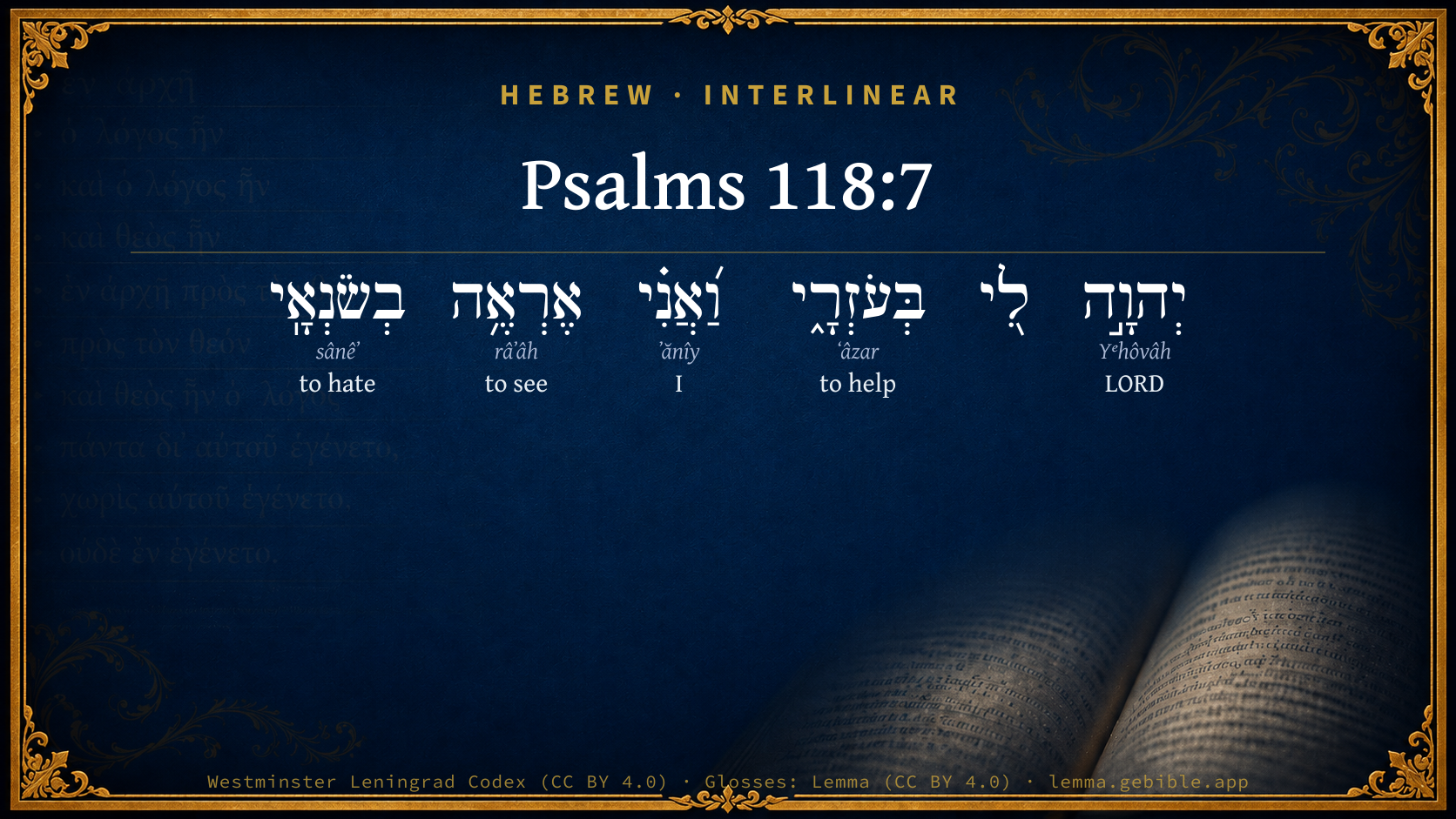
Hebrew (Westminster Leningrad Codex) Psalms 118:7 appears in the Hebrew Old Testament. The text above is from the Westminster Leningrad Codex. Each word links to its Strong’s number, a concise gloss, and parsing drawn from the Open Scriptures Hebrew Bible morphology. Click any word for its full Brown-Driver-Briggs (BDB) entry.
Download image
Cite this verse

Psalms 118:7 (World English Bible). Public Domain. Lemma interlinear Bible study tool, https://lemma.gebible.app/v/psalms/118/7.

Show BibTeX & RIS
BibTeX
RIS
English Translation
Yahweh is on my side among those who help me. Therefore I will look in triumph at those who hate me.
World English Bible · Public Domain
Download a study sheet

One document with this verse’s original text, its word-by-word gloss line, the meaning frame, cross-references with their text, attributed commentary, and full source and license credits — printable, and it pastes into notes with its structure intact.

This verse Autodidact and up

Study sheet (.html) Plain text (.txt)

A passage Seminary Student

Up to 50 verses in one chapter. A passage sheet keeps up to 6 commentary sources and 12 cross-references per verse, in the order this page ranks them, and says so on the sheet whenever that leaves anything out. Ask for a single verse and you get the Autodidact verse sheet above.

Everything on this page stays free to read, with no account — the sheet is a download of what is already on screen, not access to it.

Want to remove ads? Support Godless Engineer
Compare translations 3

The same verse in 3 English versions, stacked beneath the original-language interlinear above. Click any original word for its lexicon entry.

Each is an independent rendering of the whole verse — the interlinear is not word-aligned to these translations.

Highlighted words mark where these versions differ — a whole-verse word diff, not a word-by-word alignment.

  • World English Bible Public Domain
    Yahweh is on my side among those who help me. Therefore I will look in triumph at those who hate me.
  • King James Version Public Domain
    The LORD taketh my part with them that help me: therefore shall I see my desire upon them that hate me.
  • unfoldingWord Literal Text CC BY-SA 4.0
    Yahweh for me as my helper, and I, I will gaze on the haters of me.

unfoldingWord Literal Text — © unfoldingWord, licensed CC BY-SA 4.0. Word-aligned USFM3 via Door43 (git.door43.org/unfoldingWord/en_ult).

Versions to compare (up to 4)

3 of 4 selected

Show all 18 translations

Every available English version of this verse, each an independent rendering of the whole verse.

  • World English Bible Public Domain
    Yahweh is on my side among those who help me. Therefore I will look in triumph at those who hate me.
  • Berean Standard Bible Public Domain
    The LORD is on my side; He is my helper. Therefore I will look in triumph on those who hate me.
  • Majority Standard Bible Public Domain
    The LORD is on my side; He is my helper. Therefore I will look in triumph on those who hate me.
  • King James Version Public Domain
    The LORD taketh my part with them that help me: therefore shall I see my desire upon them that hate me.
  • American Standard Version (1901) Public Domain
    Jehovah is on my side among them that help me: Therefore shall I see `my desire' upon them that hate me.
  • Revised Version (1885) Public Domain
    The LORD is on my side among them that help me: therefore shall I see my desire upon them that hate me.
  • Geneva Bible (1599) Public Domain
    The Lord is with mee among them that helpe me: therefore shall I see my desire vpon mine enemies.
  • Douay-Rheims (1899) Public Domain
    The Lord is my helper: and I will look over my enemies.
  • Young's Literal Translation Public Domain
    Jehovah `is' for me among my helpers, And I -- I look on those hating me.
  • Literal Standard Version CC BY-SA 4.0
    YHWH [is] for me among my helpers, || And I look on those hating me.
  • Unlocked Literal Bible CC BY-SA 4.0
    Yahweh is on my side as my helper; I will look in triumph on those who hate me.
  • unfoldingWord Literal Text CC BY-SA 4.0
    Yahweh for me as my helper, and I, I will gaze on the haters of me.
  • Darby Bible Public Domain
    Jehovah is for me among them that help me; and I shall see [my desire] upon them that hate me.
  • World Messianic Bible Public Domain
    The LORD is on my side among those who help me. Therefore I will look in triumph at those who hate me.
  • Webster's Bible Public Domain
    The LORD taketh my part with them that help me: therefore shall I see my desire upon them that hate me.
  • Free Bible Version CC BY-SA 4.0
    The Lord is with me, he will help me. I will see those who hate me defeated.
  • Bible in Basic English Public Domain
    The Lord is my great helper: I will see my desire against my haters.
  • JPS Tanakh (1917) Public Domain
    The LORD is for me as my helper; and I shall gaze upon them that hate me.

Literal Standard Version (2020), Covenant Press — licensed CC BY-SA 4.0. Text via the HelloAO Bible API (eBible.org). Unlocked Literal Bible (unfoldingWord) — licensed CC BY-SA 4.0. Text via the HelloAO Bible API (eBible.org). unfoldingWord Literal Text — © unfoldingWord, licensed CC BY-SA 4.0. Word-aligned USFM3 via Door43 (git.door43.org/unfoldingWord/en_ult). Free Bible Version, Dr. Jonathan Gallagher — licensed CC BY-SA 4.0. Text via the HelloAO Bible API (eBible.org).

Word by word

More ways to search: Search by grammar → Find every occurrence → Compare this word →

Practice this passage: Drill this verse → Learn its vocabulary →

בְּעֹזְרָ֑י
ʻâzar
H5826
“in/at · helping · me”
Preposition + Verb, Qal, Participle Active, Masculine, Plural, Construct + Suffix, Personal, 1st Person, Common, Singular
Part of Speech
Preposition + Verb
Stem
Qal
Form
Participle Active
Gender
Masculine
Number
Plural
State
Construct
Full BDB Definition

Origin: a primitive root

TWOT: 1598

to help, succour, support - (Qal) to help - (Niphal) to be helped - (Hiphil) to help
  1. יְהוָ֣ה Yᵉhôvâh H3068 “LORD” Noun, Proper
  2. וַ֝אֲנִ֗י ʼănîy H589 “and · I” Conjunction + Pronoun, Personal, 1st Person, Common, Singular
  3. אֶרְאֶ֥ה râʼâh H7200 “to see” Verb, Qal, Imperfect, 1st Person, Common, Singular
  4. בְשֹׂנְאָֽי sânêʼ H8130 “in/at · hating · me” Preposition + Verb, Qal, Participle Active, Masculine, Plural, Construct + Suffix, Personal, 1st Person, Common, Singular

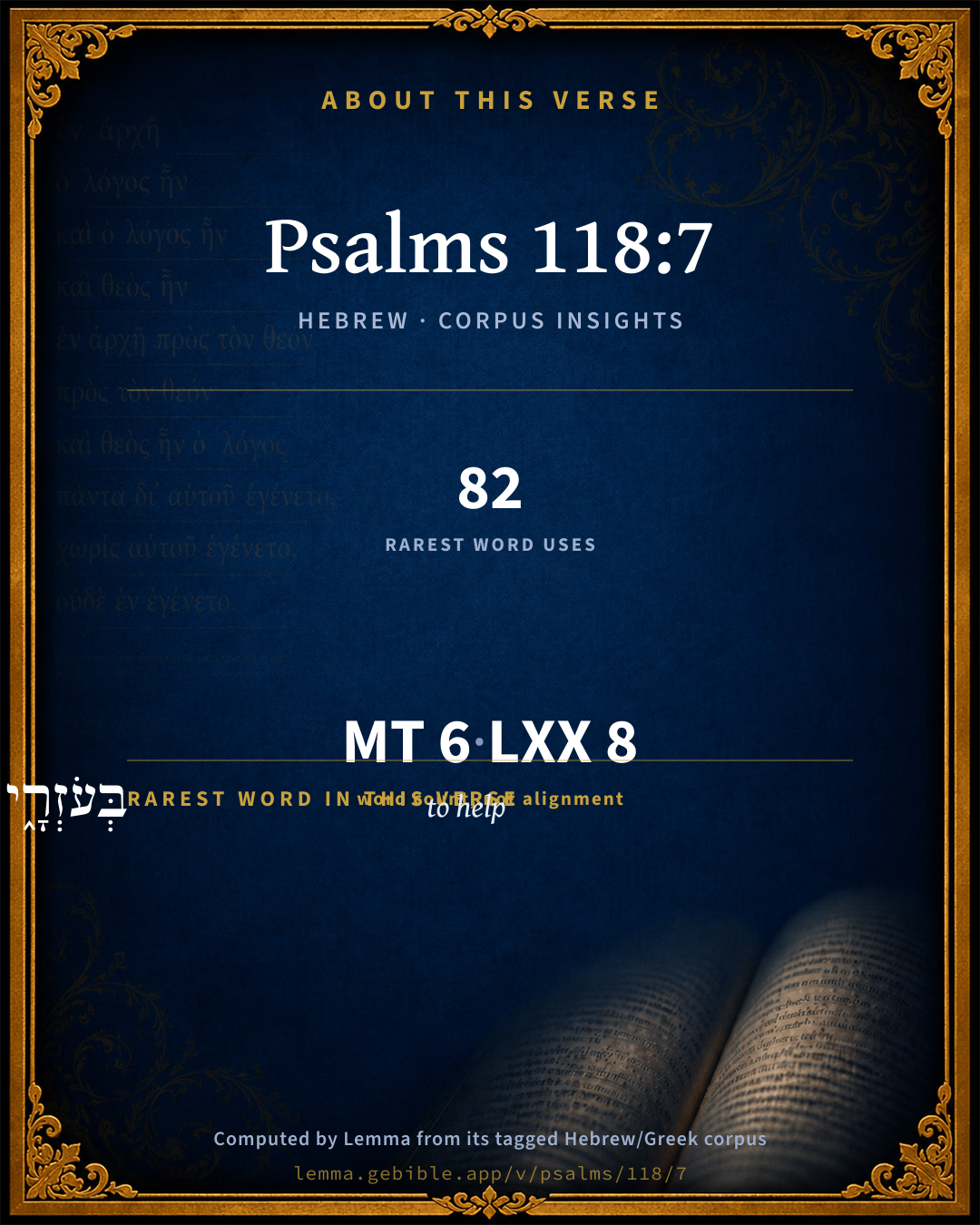
About this verse

These counts appear in no published source. They are computed here, from the morphology-tagged text and Lemma’s own curated glosses. What Lemma adds →

6
words
5
distinct lemmas
Wisdom
section

Grammatical profile

  • 3 verbs
  • 1 noun
  • 1 pronoun
  • 1 preposition

Verb forms

  • בְּעֹזְרָ֑י Qal · Participle Active
  • אֶרְאֶ֥ה Qal · Imperfect
  • בְשֹׂנְאָֽי Qal · Participle Active

Hebrew & Septuagint length

In English translation the verse runs 21 words from the Hebrew and 14 from the Septuagint (LXX English) — closely comparable.

A rough comparison of the two English renderings, which tokenize alike — not a word-level alignment.

Word counts can differ between the Hebrew and the Greek without any difference in meaning — e.g. the Hebrew direct-object marker אֵת has no separate Greek word, and Greek often adds the article ὁ.

In the original languages it is 6 Hebrew tokens and 8 Greek tokens — but the two are counted differently (Hebrew bundles its prefixes and suffixes into one token; the Greek is in lemma form), so that isn’t a like-for-like length.

Cross-references

7

Topical passages linked to Psalms 118:7 in the Treasury of Scripture Knowledge — connected by theme and wording, ordered by reader-vote popularity; previews shown in the World English Bible.

  • Psalms 59:10 My God will go before me with his loving kindness. God will let me look at my enemies in triumph.
  • Psalms 54:4 Behold, God is my helper. The Lord is the one who sustains my soul.
  • Psalms 54:7 For he has delivered me out of all trouble. My eye has seen triumph over my enemies.
  • Psalms 55:18 He has redeemed my soul in peace from the battle that was against me, Although there are many who oppose me.
  • Psalms 92:11 My eye has also seen my enemies. My ears have heard of the wicked enemies who rise up against me.
  • Psalms 112:8 His heart is established. He will not be afraid in the end when he sees his adversaries.
  • 1 Chronicles 12:18 Then the Spirit came on Amasai, who was chief of the thirty, [and he said], "We are yours, David, and on your side, you son of Jesse: peace, peace be to you, and peace be to your helpers; for your God helps you." Then David received them, and made them captains of the band.

Cross-references courtesy of OpenBible.info (CC BY 4.0).

Hebrew and Greek witnesses Masoretic Hebrew ↔ Greek Septuagint

The same verse in the two great witnesses to the Old Testament, shown verse-for-verse.

You’re reading Greek Psalm 117 (Hebrew Psalm 118). The Septuagint counts the superscription, so verse numbers can differ from the Hebrew — chapter-level alignment, not verse-by-verse. Numbering follows Rahlfs.

These are two independent witnesses, not word-aligned to each other, and the Septuagint is shown in lemma (dictionary) form.

Hebrew Psalms 118:7 Masoretic · Westminster Leningrad Codex

יְהוָ֣ה לִ֭י בְּעֹזְרָ֑י וַ֝אֲנִ֗י אֶרְאֶ֥ה בְשֹׂנְאָֽי

Yahweh is on my side among those who help me. Therefore I will look in triumph at those who hate me.

World English Bible · Public Domain

Greek LXX Greek Psalm 117:7 Septuagint · lemma form

κύριος ἐγώ βοηθός καΐἐγώ ἐπιὁράω ὁ ἐχθρός ἐγώ

The Lord is my helper; and I shall see my desire upon my enemies.

LXX2012 (modern English Septuagint) · Public Domain

On this verse, Albert Barnes' Notes on the Bible discusses the Septuagint’s reading. Read the note in Commentary ↓

Hebrew: Westminster Leningrad Codex (CC BY 4.0). Greek: Septuagint (public domain); English from LXX2012 (modern English Septuagint) (Public Domain). How the Septuagint differs from the Hebrew →

Commentary

Notes on Psalms 118:7 from classic Christian and Jewish commentators (each source and its license shown beneath its notes). The classic Christian expositions comment on the surrounding passage and are grouped to its opening verse, so a note may address several verses; the Jewish commentaries on the Tanakh (Rashi and others) are per-verse, so they appear only where the commentator wrote on this verse.

Lemma curates 59 commentaries, every one of them public domain or Creative Commons licensed, each selected and text-cleaned for this edition rather than reprinted as found. About our sources →

Trapp's Complete Commentary

John Trapp

Psa 118:7 The LORD taketh my part with them that help me: therefore shall I see [my desire] upon them that hate me.

Ver. 7. The Lord taketh my part with them that help me] Not only as one of my helpers, but instead of all, and more than all. How many reckon ye me at? said that general to his soldiers, who were afraid of their enemy’s numbers; Cui adhaereo praeest, He whom I take part with must needs prevail.

John Trapp, A Commentary or Exposition upon All the Books of the Old and New Testament (1647–1656) — public domain. Text from a community e-Sword module.

J. A. Alexander on Psalms

Joseph Addison Alexander

7. (Psa 118:7) Jehovah, is for me, among my helpers, and I shall look upon my haters. Here again, the first clause may be rendered, Jehovah is to me (or I have Jehovah) among or with my helpers. With this last expression compare Psa 45:9; Psa 99:6. The construction in the last clause is the idiomatic one meaning to see with joy or triumph, or to see their punishment and subjugation. See above, on Psa 54:7, and with the whole verse compare Psa 54:4. As the ideal speaker is the ancient church or chosen people, the haters or enemies here meant are primarily heathen persecutors and oppressors.

Joseph Addison Alexander, The Psalms Translated and Explained (1850) — public domain. Text from a community e-Sword module.

Adam Clarke's Commentary

Verse 7. The Lord taketh my part with them that help me] Literally, The Lord is to me among my helpers. Therefore shall I see my desire upon them that hate me. Literally, And I shall look among them that hate me. As God is on my side, I fear not to look the whole of them in the face. I shall see them defeated.

Adam Clarke's Commentary on the Bible (1810–1826) — public domain. Text from a community e-Sword/MySword module.

Ellicott's Commentary for English Readers

(7) Made up of Psa_54:4-7, where see Notes.

A Bible Commentary for English Readers, edited by Charles John Ellicott (1878–1897) — public domain. Text from a community e-Sword module.

The Cambridge Bible for Schools and Colleges

gen. ed. J. J. S. Perowne

7. Jehovah is on my side as my helper] Cp. Psa_54:4. The expression is an idiomatic one. It denotes not merely among my helpers, as one among many, but ‘in the character or capacity of my helpers,’ ‘as a host of helpers.’ “He sums up in Himself the qualities of a class, viz. the class of helpers” (Cheyne).

therefore shall I see &c.] Or, do I see, a general truth. Cp. Psa_54:7 b, and note; Psa_59:10; Psa_92:11.

The Cambridge Bible for Schools and Colleges (gen. ed. J. J. S. Perowne; Cambridge University Press, 1878–1918) — public domain. Text from a community e-Sword module.

John Gill's Exposition

It is better to trust in the Lord,.... The Targum is,

"in the Word of the Lord.''

This is repeated for the sake of what follows:

than to put confidence in princes; who have greater ability to help, and whose honour should engage them to keep their word; and yet it is better to trust in the Lord than in them; see Psa 146:3. Two different words being used in this verse and Psa 118:8; for trust and confidence, Jarchi has observed, that the one signifies a lesser, the other a stronger confidence; as if the sense was this, "It is better lightly to trust in the Lord than to put the strongest confidence in men and princes." But the observation is scarcely solid enough.

John Gill's Exposition of the Whole Bible (1746–1763) — public domain (CC PDM 1.0). Text via the HelloAO Bible API.

Albert Barnes' Notes on the Bible

The Lord taketh my part with them that help me - The psalmist had friends. There were those who stood by him. He relied, indeed, on their aid, but not on their aid without God. He felt that even their help was valuable to him only as God was with them. There was direct dependence on God in reference to himself; and there was the same sense of dependence in respect to all who were engaged in his defense. This might be rendered, however, simply “for my help,” and is so rendered by DeWette. The Septuagint and Latin Vulgate render it, “The Lord is my helper.”

Therefore shall I see my desire upon them that hate me - literally, “I shall see upon those that hate me;” that is, I shall look upon them according to my wish; I shall see them overthrown and subdued. See the notes at Psa 54:7. Compare Psa 92:11; Psa 112:8.

Albert Barnes' Notes on the Bible (1834–1885) — public domain. Text from a community e-Sword/MySword module.

Matthew Poole's English Annotations

The Lord taketh my part with them that help me; he is one of the number of my helpers, and enables them to defend me.

Matthew Poole's English Annotations on the Holy Bible (1683–1685) — public domain. Text from a community e-Sword/MySword module.

The Treasury of David

Charles H. Spurgeon

Ver. 7. The LORD taketh my part with them that help me. Jehovah condescended to be in alliance with the good man and his comrades; his God was not content to look on, but he took part in the struggle. What a consolatory fact it is that the Lord takes our part, and that when he raises up friends for us he does not leave them to fight for us alone, but he himself as our chief defender deigns to come into the battle and wage war on our behalf. David mentioned those that helped him, he was not unmindful of his followers; there is a long record of David's mighty men in the book of Chronicles, and this teaches us that we are not to disdain or think little of the generous friends who rally around us; but still our great dependence and our grand confidence must be fixed upon the Lord alone. Without him the strong helpers fail; indeed, apart from him in the sons of men there is no help; but when our gracious Jehovah is pleased to support and strengthen those who aid us, they become substantial helpers to us.

Therefore shall I see my desire upon them that hate me. The words, "my desire, "are added by the translators; the Psalmist said, "I shall look upon my haters: I shall look upon them in the face, I shall make them cease from their contempt, I shall myself look down upon them instead of their looking down upon me. I shall see their defeat, I shall see the end of them." Our Lord Jesus does at this moment look down upon his adversaries, his enemies are his footstool; he shall look upon them at his second coming, and at the glance of his eyes they shall flee before him, not being able to endure that look with which he shall read them through and through.

Ver. 7.

1. The value of true friends.

2. The greater value of help from above.

Psalms 118:8*

Charles H. Spurgeon's The Treasury of David (1869–1885) — public domain. Psalms only. Text from a community e-Sword/MySword module.

Whedon's Commentary on the Bible

Daniel D. Whedon

7. See my desire, etc.—Hebrew, I shall look on those that hate me; an idiomatic form for I shall triumph over them, I shall behold their downfall. This every man hopes for, not in the spirit of revenge, but as a triumph of justice and truth. See Psa_54:7; Psa_59:10; Psa_112:8. How can the righteous triumph but by the downfall of the impenitent wicked?

Daniel D. Whedon (gen. ed.), Commentary on the Old and New Testaments (1874–1909) — public domain. Text from a community e-Sword module.

The Pulpit Commentary

The Lord taketh my part with them that help me; literally, the Lord is on my side among my helpers. (comp. Psa_54:4) Therefore shall I see my desire upon them that hate me. (comp. Psa_54:7 Psa_59:10)

The Pulpit Commentary (1880–1919), ed. H.D.M. Spence-Jones & Joseph S. Exell — public domain. Text from a community e-Sword module.

Lesson kit

Teaching starters — assembled from the data on this page, not authored interpretation. Every prompt links to the verse data it draws on. Edit before teaching.

Psalms, in the Wisdom, opens this verse with 6 words (5 distinct Hebrew lemmas). Its most distinctive word is ʻâzar (“to help”). A historical commentator’s framing appears above. Read the whole chapter for the surrounding context.

Discussion questions

  1. The word ʻâzar carries the sense “to help.” How does it shape the verse?
  2. How does Psalms 59:10, which shares this passage’s theme, read alongside this verse?
  3. These translations render this verse differently. What is at stake in choosing one wording over another?
  4. «בְּעֹזְרָ֑י» is a Qal Participle Active verb. How does that grammatical form shape the action described?
  5. Compare how Trapp's Complete Commentary and J. A. Alexander on Psalms read this verse. Where do they agree or differ?

Things to notice

Reading settings

Reading text

Shown beneath each verse's original-language words.

Old Testament
Old Testament edition

Read the OT as the Masoretic Hebrew (MT) or the Greek Septuagint (LXX).

English shown for the Greek Septuagint (in the Hebrew ↔ Greek comparison).

Comparing translations? Open the Compare panel on any verse page to stack up to four side by side.