

Psalms 41:7

Hebrew (Westminster Leningrad Codex) Psalms 41:7 appears in the Hebrew Old Testament. The text above is from the Westminster Leningrad Codex. Each word links to its Strong’s number, a concise gloss, and parsing drawn from the Open Scriptures Hebrew Bible morphology. Click any word for its full Brown-Driver-Briggs (BDB) entry.
Download image
Cite this verse

Psalms 41:7 (World English Bible). Public Domain. Lemma interlinear Bible study tool, https://lemma.gebible.app/v/psalms/41/7.

Show BibTeX & RIS
BibTeX
RIS
English Translation
All who hate me whisper together against me. They imagine the worst for me.
World English Bible · Public Domain
Download a study sheet

One document with this verse’s original text, its word-by-word gloss line, the meaning frame, cross-references with their text, attributed commentary, and full source and license credits — printable, and it pastes into notes with its structure intact.

This verse Autodidact and up

Study sheet (.html) Plain text (.txt)

A passage Seminary Student

Up to 50 verses in one chapter. A passage sheet keeps up to 6 commentary sources and 12 cross-references per verse, in the order this page ranks them, and says so on the sheet whenever that leaves anything out. Ask for a single verse and you get the Autodidact verse sheet above.

Everything on this page stays free to read, with no account — the sheet is a download of what is already on screen, not access to it.

Want to remove ads? Support Godless Engineer
Compare translations 3

The same verse in 3 English versions, stacked beneath the original-language interlinear above. Click any original word for its lexicon entry.

Each is an independent rendering of the whole verse — the interlinear is not word-aligned to these translations.

Highlighted words mark where these versions differ — a whole-verse word diff, not a word-by-word alignment.

  • World English Bible Public Domain
    All who hate me whisper together against me. They imagine the worst for me.
  • King James Version Public Domain
    All that hate me whisper together against me: against me do they devise my hurt.
  • unfoldingWord Literal Text CC BY-SA 4.0
    Together against me all my haters whisper; against me they plan evil to me.

unfoldingWord Literal Text — © unfoldingWord, licensed CC BY-SA 4.0. Word-aligned USFM3 via Door43 (git.door43.org/unfoldingWord/en_ult).

Versions to compare (up to 4)

3 of 4 selected

Show all 18 translations

Every available English version of this verse, each an independent rendering of the whole verse.

  • World English Bible Public Domain
    All who hate me whisper together against me. They imagine the worst for me.
  • Berean Standard Bible Public Domain
    All who hate me whisper against me; they imagine the worst for me:
  • Majority Standard Bible Public Domain
    All who hate me whisper against me; they imagine the worst for me:
  • King James Version Public Domain
    All that hate me whisper together against me: against me do they devise my hurt.
  • American Standard Version (1901) Public Domain
    All that hate me whisper together against me; Against me do they devise my hurt.
  • Revised Version (1885) Public Domain
    All that hate me whisper together against me: against me do they devise my hurt.
  • Geneva Bible (1599) Public Domain
    All they that hate me, whisper together against me: euen against me do they imagine mine hurt.
  • Douay-Rheims (1899) Public Domain
    And if he came in to see me, he spoke vain things: his heart gathered together iniquity to itself. He went out and spoke to the same purpose.
  • Young's Literal Translation Public Domain
    All hating me whisper together against me, Against me they devise evil to me:
  • Literal Standard Version CC BY-SA 4.0
    All hating me whisper together against me, || Against me they devise evil to me:
  • Unlocked Literal Bible CC BY-SA 4.0
    All who hate me whisper together against me; against me they hope for my hurt.
  • unfoldingWord Literal Text CC BY-SA 4.0
    Together against me all my haters whisper; against me they plan evil to me.
  • Darby Bible Public Domain
    All that hate me whisper together against me; against me do they devise my hurt.
  • World Messianic Bible Public Domain
    All who hate me whisper together against me. They imagine the worst for me.
  • Webster's Bible Public Domain
    \\41:6\\And if he cometh to see me, he speaketh vanity: his heart gathereth iniquity to itself; when he goeth abroad, he telleth it.
  • Free Bible Version CC BY-SA 4.0
    All who hate me talk in whispers about my condition, hoping for the worst.
  • Bible in Basic English Public Domain
    All my haters are talking secretly together against me; they are designing my downfall.
  • JPS Tanakh (1917) Public Domain
    (41-8) All that hate me whisper together against me, against me do they devise my hurt:

Literal Standard Version (2020), Covenant Press — licensed CC BY-SA 4.0. Text via the HelloAO Bible API (eBible.org). Unlocked Literal Bible (unfoldingWord) — licensed CC BY-SA 4.0. Text via the HelloAO Bible API (eBible.org). unfoldingWord Literal Text — © unfoldingWord, licensed CC BY-SA 4.0. Word-aligned USFM3 via Door43 (git.door43.org/unfoldingWord/en_ult). Free Bible Version, Dr. Jonathan Gallagher — licensed CC BY-SA 4.0. Text via the HelloAO Bible API (eBible.org).

Word by word

More ways to search: Search by grammar → Find every occurrence → Compare this word →

Practice this passage: Drill this verse → Learn its vocabulary →

About this verse

These counts appear in no published source. They are computed here, from the morphology-tagged text and Lemma’s own curated glosses. What Lemma adds →

9
words
7
distinct lemmas
Wisdom
section

Notable vocabulary

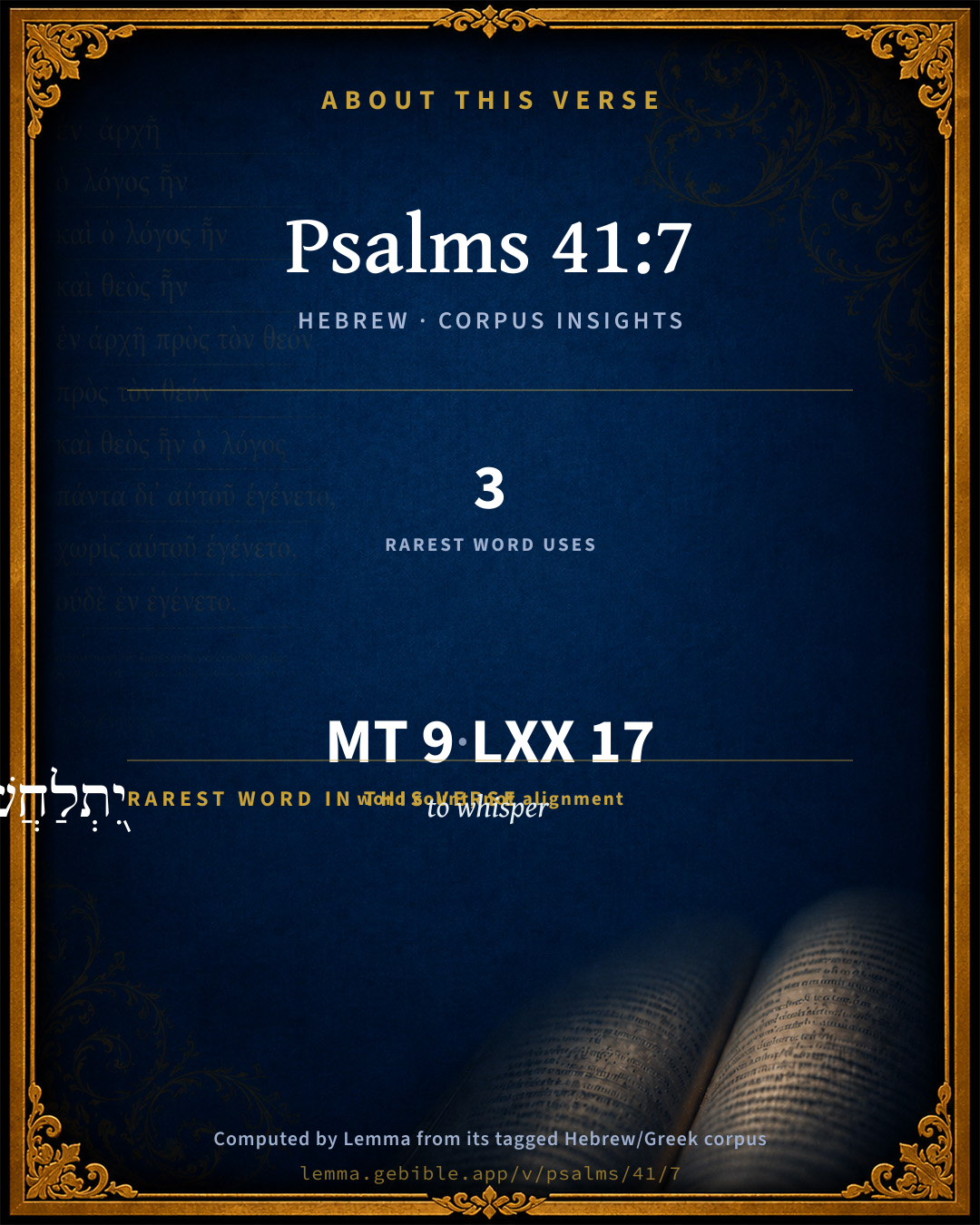
The rarest word here is יִ֭תְלַחֲשׁוּ to whisper H3907 — appearing just 3 times in the whole Hebrew Bible.

Shared distinctive vocabulary

יִ֭תְלַחֲשׁוּ to whisper H3907 occurs in 3 verses of the Hebrew Bible. Also found in:

Grammatical profile

  • 3 verbs
  • 2 nouns
  • 3 prepositions
  • 1 adverb

Verb forms

  • יִ֭תְלַחֲשׁוּ Hithpael · Imperfect
  • שֹׂנְאָ֑י Qal · Participle Active
  • יַחְשְׁב֖וּ Qal · Imperfect

Repetition

A word recurs within this verse — often emphatic in Hebrew:

  • עָלַ֣י upon H5921 ×2

Hebrew & Septuagint length

In English translation the verse runs 14 words from the Hebrew and 12 from the Septuagint (LXX English) — closely comparable.

A rough comparison of the two English renderings, which tokenize alike — not a word-level alignment.

Word counts can differ between the Hebrew and the Greek without any difference in meaning — e.g. the Hebrew direct-object marker אֵת has no separate Greek word, and Greek often adds the article ὁ.

In the original languages it is 9 Hebrew tokens and 17 Greek tokens — but the two are counted differently (Hebrew bundles its prefixes and suffixes into one token; the Greek is in lemma form), so that isn’t a like-for-like length.

Cross-references

8

Topical passages linked to Psalms 41:7 in the Treasury of Scripture Knowledge — connected by theme and wording, ordered by reader-vote popularity; previews shown in the World English Bible.

  • Proverbs 16:28 A perverse man stirs up strife. A whisperer separates close friends.
  • Psalms 56:5–6 All day long they twist my words. All their thoughts are against me for evil.
  • Matthew 22:15 Then the Pharisees went and took counsel how they might entrap him in his talk.
  • Matthew 26:3–4 Then the chief priests, the scribes, and the elders of the people were gathered together in the court of the high priest, who was called Caiaphas.
  • Psalms 31:13 For I have heard the slander of many, terror on every side, While they conspire together against me, They plot to take away my life.
  • Proverbs 26:20 For lack of wood a fire goes out; Without gossip, a quarrel dies down.
  • Romans 1:29 being filled with all unrighteousness, sexual immorality, wickedness, covetousness, maliciousness; full of envy, murder, strife, deceit, evil habits, secret slanderers,
  • 2 Corinthians 12:20 For I am afraid that by any means, when I come, I might find you not the way I want to, and that I might be found by you as you don't desire; that by any means there would be strife, jealousy, outbursts of anger, factions, slander, whisperings, proud thoughts, riots;

Cross-references courtesy of OpenBible.info (CC BY 4.0).

Hebrew and Greek witnesses Masoretic Hebrew ↔ Greek Septuagint

The same verse in the two great witnesses to the Old Testament, shown verse-for-verse.

You’re reading Greek Psalm 40 (Hebrew Psalm 41). The Septuagint counts the superscription, so verse numbers can differ from the Hebrew — chapter-level alignment, not verse-by-verse. Numbering follows Rahlfs.

These are two independent witnesses, not word-aligned to each other, and the Septuagint is shown in lemma (dictionary) form.

Hebrew Psalms 41:7 Masoretic · Westminster Leningrad Codex

יַ֗חַד עָלַ֣י יִ֭תְלַחֲשׁוּ כָּל שֹׂנְאָ֑י עָלַ֓י יַחְשְׁב֖וּ רָעָ֣ה לִֽי

All who hate me whisper together against me. They imagine the worst for me.

World English Bible · Public Domain

Greek LXX Greek Psalm 40:7 Septuagint · lemma form

καί εἰ εἰςπορεύομαι ὁ ὁράω μάτην λαλέω ὁ καρδία αὐτός συνἄγω ἀνομία ἑαυτοῦ ἐκπορεύομαι ἔξω καί λαλέω

All my enemies whispered against me; against me they devised my hurt.

LXX2012 (modern English Septuagint) · Public Domain

On this verse, Keil & Delitzsch discusses the Septuagint’s reading. Read the note in Commentary ↓

Hebrew: Westminster Leningrad Codex (CC BY 4.0). Greek: Septuagint (public domain); English from LXX2012 (modern English Septuagint) (Public Domain). How the Septuagint differs from the Hebrew →

Commentary

Notes on Psalms 41:7 from classic Christian and Jewish commentators (each source and its license shown beneath its notes). The classic Christian expositions comment on the surrounding passage and are grouped to its opening verse, so a note may address several verses; the Jewish commentaries on the Tanakh (Rashi and others) are per-verse, so they appear only where the commentator wrote on this verse.

Lemma curates 59 commentaries, every one of them public domain or Creative Commons licensed, each selected and text-cleaned for this edition rather than reprinted as found. About our sources →

Trapp's Complete Commentary

John Trapp

Psa 41:7 All that hate me whisper together against me: against me do they devise my hurt.

Ver. 7. All that hate me, whisper together against me] Heb. Mussitant, they mutter, as charmers use to do. These whisperers are dangerous fellows, Rom 1:29, like the wind that creepeth in by chinks in a wall or cracks in a window. A vento percolato, et iuimico reconciliato, libera nos, Domine, saith the Italian.

Against me do they devise] Cogitant quasi coagitant.

John Trapp, A Commentary or Exposition upon All the Books of the Old and New Testament (1647–1656) — public domain. Text from a community e-Sword module.

J. A. Alexander on Psalms

Joseph Addison Alexander

8. (Psa 41:7). Together against me they will whisper all (those) hating me; against me they will meditate—injury to me. The collocation in the first clause is like that in Psa 40:15-17, (14-16), the action being first described, and then the actors. The future has the same force as in the first clause of Psa 40:6-7 (5, 6). They will certainly persist in doing as they now do. The substitution of the present in translation conveys only half of this idea. The last word in Hebrew is omitted in most versions, though expressed in the margin of the English Bible. It defines the evil meditated, not as evil in the abstract or in general, but as evil to the sufferer, i.e. injury, which is the usual meaning of the Hebrew word, a modified form, used in Psa 41:6 (5) to denote moral evil: The last words area kind of after-thought. —Against me they will meditate or plot, is a complete proposition in itself, which is then made more explicit by mentioning the object of their plots, namely, evil (or injury) to me. This form of the sentence may have been adopted to render the resemblance in the structure of the clauses more complete.

Joseph Addison Alexander, The Psalms Translated and Explained (1850) — public domain. Text from a community e-Sword module.

Jamieson, Fausset & Brown

Robert Jamieson, A. R. Fausset & David Brown

So of others, all act alike.

Jamieson, Fausset & Brown — Commentary Critical and Explanatory on the Whole Bible (1871) — public domain (CC PDM 1.0). Text via the HelloAO Bible API.

Adam Clarke's Commentary

Verse 7. All that hate me whisper together against me] This is in consequence of the information given by the hypocritical friend, who came to him with the lying tongue, and whose heart gathereth iniquity to itself, which, when he went abroad, he told to others as ill-minded as himself, and they also drew their wicked inferences.

Adam Clarke's Commentary on the Bible (1810–1826) — public domain. Text from a community e-Sword/MySword module.

John Calvin's Commentaries

7. All they that hate me whisper together against me. Here he seems generally to include both classes of his enemies; those who sought to oppress him in an open manner, and in the character of avowed enemies; and those who, under the pretense of friendship, attempted to do the same thing by deceit and stratagem. Accordingly, he says that all of them took counsel together about his destruction, just as we know that wicked men hold much secret consultation respecting their intended deeds of treachery, and whisper to one another concerning them. Hence he adds the words to meditate, or plot, which he employs to denote their base conspiracies and sinful consultations.

John Calvin's Commentaries (1540-1563) — public domain. Text from the Calvin Translation Society English edition (1840s-50s) via the Christian Classics Ethereal Library (ccel.org). Calvin's coverage is partial (roughly two-thirds of the Bible); uncommented books and verses are honest gaps, never fabricated. The 19th-century editor's footnotes and remarks are omitted so the notes are faithfully Calvin's own voice.

The Cambridge Bible for Schools and Colleges

gen. ed. J. J. S. Perowne

7. The scene outside the house is graphically depicted. We see the associates waiting, eager for news. With a transparent pretence of secrecy they whisper together, and divert themselves with anticipating the worst.

do they devise my hurt] Or, imagine evil for me, indulging in uncharitable speculations as to the cause of his illness (cp. Job_22:5 ff.), and hoping for a fatal issue of it. The next verse is a summary of their malevolent conversation.

The Cambridge Bible for Schools and Colleges (gen. ed. J. J. S. Perowne; Cambridge University Press, 1878–1918) — public domain. Text from a community e-Sword module.

John Gill's Exposition

All that hate me whisper together against me,.... That is, they privately conspired against him; see Mat 22:15;

against me do they devise my hurt; not only to take away his name and credit, but his life.

John Gill's Exposition of the Whole Bible (1746–1763) — public domain (CC PDM 1.0). Text via the HelloAO Bible API.

Albert Barnes' Notes on the Bible

All that hate me whisper together against me - They talk the matter over where they suppose that no one can hear; they endeavonr to collect and arrange all that can be said against me; they place all that they can say or think as individuals, all that they have separately known or suspected, into “common stock,” and make use of it against me. There is a conspiracy against me - a purpose to do me all the evil that they can. This shows that, in the apprehension of the sufferer, the one who came to see for himself Psa 41:6 came as one of a company - as one deputed or delegated to find some new occasion for a charge against him, and that he had not to suffer under the single malignity of one, but under the combined malignity of many.

Against me do they devise my hurt - Margin, as in Hebrew: “evil to me.” That is, they devise some report, the truth of which they endeavor to confirm by something that they may observe in my sickness which will be injurious to me, and which will prove to the world that I am a bad man - a man by whose death the world would be benefited. The slanderous report on which they seemed to agree is mentioned in the following verse - that he was suffering under a disease which was directly and manifestly the result of a sinful life, and that it must be fatal.

Albert Barnes' Notes on the Bible (1834–1885) — public domain. Text from a community e-Sword/MySword module.

Matthew Poole's English Annotations

Whisper together against me, i.e. secretly defame me, and closely plot against me.

Matthew Poole's English Annotations on the Holy Bible (1683–1685) — public domain. Text from a community e-Sword/MySword module.

The Treasury of David

Charles H. Spurgeon

Ver. 7. All that hate me whisper together against me. The spy meets his comrades in conclave and sets them all a whispering. Why could they not speak out? Were they afraid of the sick warrior? Or were their designs so treacherous that they must needs be hatched in secrecy? Mark the unanimity of the wickedall. How heartily the dogs unite to hunt the stag! Would God we were half as united in holy labour as persecutors in their malicious projects, and were half as wise as they are crafty, for their whispering was craft as well as cowardice, the conspiracy must not be known till all is ready. Against me do they devise my hurt. They lay their heads together, and scheme and plot. So did Ahithophel and the rest of Absalom's counsellors, so also did the chief priests and Pharisees. Evil men are good at devising; they are given to meditation, they are deep thinkers, but the mark they aim at is evermore the hurt of the faithful. Snakes in the grass are never there for a good end.

None.

Ver. 7-12. On a sick bed a man discovers not only his enemies and his friends, but himself and his God, more intimately.

Psalms 41:8*

Ver. 7-12. On a sick bed a man discovers not only his enemies and his friends, but himself and his God, more intimately.

Psalms 41:9*

Ver. 7-12. On a sick bed a man discovers not only his enemies and his friends, but himself and his God, more intimately.

Ver. 7-12. On a sick bed a man discovers not only his enemies and his friends, but himself and his God, more intimately.

Psalms 41:11*

Ver. 7-12. On a sick bed a man discovers not only his enemies and his friends, but himself and his God, more intimately.

Ver. 7-12. On a sick bed a man discovers not only his enemies and his friends, but himself and his God, more intimately.

Charles H. Spurgeon's The Treasury of David (1869–1885) — public domain. Psalms only. Text from a community e-Sword/MySword module.

Whedon's Commentary on the Bible

Daniel D. Whedon

7. Whisper together—The conspiracy was conducted with the utmost privacy.

Daniel D. Whedon (gen. ed.), Commentary on the Old and New Testaments (1874–1909) — public domain. Text from a community e-Sword module.

The Pulpit Commentary

All that hate me whisper together against me; i.e. gather themselves into knots, and hold whispered conversations about me as conspirators are apt to do. Against me do they devise my hurt; literally, hurt to me.

The Pulpit Commentary (1880–1919), ed. H.D.M. Spence-Jones & Joseph S. Exell — public domain. Text from a community e-Sword module.

Keil & Delitzsch

C. F. Keil & F. Delitzsch

(Heb.: 41:8-10) Continuation of the description of the conduct of the enemies and of the false friend. התלחשׁ, as in Sa2 12:19, to whisper to one another, or to whisper among themselves; the Hithpa. sometimes (cf. Gen 42:1) has a reciprocal meaning like the Niphal. The intelligence brought out by hypocritical visitors of the invalid concerning his critical condition is spread from mouth to mouth by all who wish him ill as satisfactory news; and in fact in whispers, because at that time caution was still necessary. עלי stands twice in a prominent position in the sense of contra me. רעה לּי belong together: they maliciously invent what will be the very worst for him (going beyond what is actually told them concerning him). In this connection there is a feeling in favour of בּליּעל being intended of an evil fate, according to Psa 18:5, and not according to Psa 101:3 (cf. Deu 15:9) of pernicious or evil thought and conduct. And this view is also supported by the predicate יצוּק בּו: "a matter of destruction, an incurable evil (Hitzig) is poured out upon him," i.e., firmly cast upon him after the manner of casting metal (Job 41:15.), so that he cannot get free from it, and he that has once had to lie down will not again rise up. Thus do we understand אשׁר in Psa 41:9; there is no occasion to take it as an accusative by departing from the most natural sense, as Ewald does, or as a conjunction, as Hitzig does. Even the man of his peace, or literally of his harmonious relationship (אישׁ שׁלום as in Oba 1:7, Jer 20:10; Jer 38:22), on whom he has depended with fullest confidence, who did eat his bread, i.e., was his messmate (cf. Psa 55:15), has made his heel great against him, lxx ἐμεγάλυνεν ἐπ ̓ ἐμὲ πτερνισμόν. The combination הגדּיל עקב is explained by the fact that עקב is taken in the sense of a thrust with the heel, a kick: to give a great kick, i.e., with a good swing of the foot.

Keil & Delitzsch — Biblical Commentary on the Old Testament (1861–1891) — public domain (CC PDM 1.0). Text via the HelloAO Bible API. (Old Testament only.)

unfoldingWord translationNotes

Door43 World Missions Community

against me they hope for my hurt

Possible meanings are 1) "they hope that very bad things will happen to me" or 2) "they are planning to hurt me."

An evil disease ... to him

His enemies speak of "disease" as if it were a person who has captured him. AT: "He is sick with a fatal disease" (See: Personification and Metaphor)

An evil disease

Possible meanings are 1) "A fatal disease" or 2) "Something evil"

now that he is lying down, he will rise up no more

Here the words "lying down" refer to lying in bed because of illness. That he will not "rise up" means that he will continue to lie down, which is a euphemism for death. AT: "now that he is sick in bed, he will die there" (See: Assumed Knowledge and Implicit Information and Euphemism)

has lifted up his heel against me

This is an idiom that means his friend betrayed him. AT: "has betrayed me" or "has turned against me" (See: Idiom)

translationWords

hope

evil

raise

trust

bread

unfoldingWord translationNotes — © Distant Shores Media and the Door43 World Missions Community, licensed CC BY-SA 4.0. Source: git.door43.org/Door43/en_tn.

Rashi

Rabbi Shlomo Yitzchaki (Rashi)

he speaks falsely He pretends to be troubled, and when he sits before me, his heart gathers thoughts of violence to himself, [of] what evil he will speak when he leaves, and when he goes outside, he speaks of it.

Rashi on the Tanakh — English translations: “The Judaica Press complete Tanach with Rashi, translated by A. J. Rosenberg” (CC BY 4.0); “Pentateuch with Rashi's commentary by M. Rosenbaum and A.M. Silbermann, 1929-1934” (public domain); “The Metsudah Tanach series, Lakewood, N.J” (CC BY 4.0); and “The Book of Joshua, Metsudah Publications, 1997” (CC BY 4.0). Text via Sefaria.

Lesson kit

Teaching starters — assembled from the data on this page, not authored interpretation. Every prompt links to the verse data it draws on. Edit before teaching.

Psalms, in the Wisdom, opens this verse with 9 words (7 distinct Hebrew lemmas). Its most distinctive word is lâchash (“to whisper”). A historical commentator’s framing appears above. Read the whole chapter for the surrounding context.

Discussion questions

  1. The word lâchash carries the sense “to whisper.” How does it shape the verse?
  2. 2 Samuel 12:19 shares the word «to whisper» with this verse. How do the two illuminate each other?
  3. “upon” occurs 2× in this one verse. What is the effect of the repetition?
  4. The translations on this page render this verse differently — a whole-verse word diff, not a word-by-word alignment. What might account for the different wordings?
  5. The verb «יִ֭תְלַחֲשׁוּ» is Hithpael Imperfect. How does its form color the action?
  6. Reading how Trapp's Complete Commentary and J. A. Alexander on Psalms read this verse, where do the two commentators agree and where do they part?

Things to notice

Reading settings

Reading text

Shown beneath each verse's original-language words.

Old Testament
Old Testament edition

Read the OT as the Masoretic Hebrew (MT) or the Greek Septuagint (LXX).

English shown for the Greek Septuagint (in the Hebrew ↔ Greek comparison).

Comparing translations? Open the Compare panel on any verse page to stack up to four side by side.