
Psalms 89:23

Hebrew (Westminster Leningrad Codex) Psalms 89:23 appears in the Hebrew Old Testament. The text above is from the Westminster Leningrad Codex. Each word links to its Strong’s number, a concise gloss, and parsing drawn from the Open Scriptures Hebrew Bible morphology. Click any word for its full Brown-Driver-Briggs (BDB) entry.
Download image
Cite this verse

Psalms 89:23 (World English Bible). Public Domain. Lemma interlinear Bible study tool, https://lemma.gebible.app/v/psalms/89/23.

Show BibTeX & RIS
BibTeX
RIS
English Translation
I will beat down his adversaries before him, And strike those who hate him.
World English Bible · Public Domain
Download a study sheet

One document with this verse’s original text, its word-by-word gloss line, the meaning frame, cross-references with their text, attributed commentary, and full source and license credits — printable, and it pastes into notes with its structure intact.

This verse Autodidact and up

Study sheet (.html) Plain text (.txt)

A passage Seminary Student

Up to 50 verses in one chapter. A passage sheet keeps up to 6 commentary sources and 12 cross-references per verse, in the order this page ranks them, and says so on the sheet whenever that leaves anything out. Ask for a single verse and you get the Autodidact verse sheet above.

Everything on this page stays free to read, with no account — the sheet is a download of what is already on screen, not access to it.

Want to remove ads? Support Godless Engineer
Compare translations 3

The same verse in 3 English versions, stacked beneath the original-language interlinear above. Click any original word for its lexicon entry.

Each is an independent rendering of the whole verse — the interlinear is not word-aligned to these translations.

Highlighted words mark where these versions differ — a whole-verse word diff, not a word-by-word alignment.

  • World English Bible Public Domain
    I will beat down his adversaries before him, And strike those who hate him.
  • King James Version Public Domain
    And I will beat down his foes before his face, and plague them that hate him.
  • unfoldingWord Literal Text CC BY-SA 4.0
    And I will crush his adversaries from his face, and I will strike down the ones hating him.

unfoldingWord Literal Text — © unfoldingWord, licensed CC BY-SA 4.0. Word-aligned USFM3 via Door43 (git.door43.org/unfoldingWord/en_ult).

Versions to compare (up to 4)

3 of 4 selected

Show all 18 translations

Every available English version of this verse, each an independent rendering of the whole verse.

  • World English Bible Public Domain
    I will beat down his adversaries before him, And strike those who hate him.
  • Berean Standard Bible Public Domain
    I will crush his foes before him and strike down those who hate him.
  • Majority Standard Bible Public Domain
    I will crush his foes before him and strike down those who hate him.
  • King James Version Public Domain
    And I will beat down his foes before his face, and plague them that hate him.
  • American Standard Version (1901) Public Domain
    And I will beat down his adversaries before him, And smite them that hate him.
  • Revised Version (1885) Public Domain
    And I will beat down his adversaries before him, and smite them that hate him.
  • Geneva Bible (1599) Public Domain
    But I will destroy his foes before his face, and plague them that hate him.
  • Douay-Rheims (1899) Public Domain
    The enemy shall have no advantage over him: nor the son of iniquity have power to hurt him.
  • Young's Literal Translation Public Domain
    And I have beaten down before him his adversaries, And those hating him I plague,
  • Literal Standard Version CC BY-SA 4.0
    And I have beaten down his adversaries before him, || And I plague those hating him,
  • Unlocked Literal Bible CC BY-SA 4.0
    I will crush his enemies before him; I will kill those who hate him.
  • unfoldingWord Literal Text CC BY-SA 4.0
    And I will crush his adversaries from his face, and I will strike down the ones hating him.
  • Darby Bible Public Domain
    But I will beat down his adversaries before his face, and will smite them that hate him.
  • World Messianic Bible Public Domain
    I will beat down his adversaries before him, and strike those who hate him.
  • Webster's Bible Public Domain
    \\89:22\\The enemy shall not exact upon him; nor the son of wickedness afflict him.
  • Free Bible Version CC BY-SA 4.0
    I will wipe out his enemies before him; I will strike down those who hate him.
  • Bible in Basic English Public Domain
    I will have those who are against him broken before his face, and his haters will be crushed under my blows.
  • JPS Tanakh (1917) Public Domain
    (89-24) And I will beat to pieces his adversaries before him, and smite them that hate him.

Literal Standard Version (2020), Covenant Press — licensed CC BY-SA 4.0. Text via the HelloAO Bible API (eBible.org). Unlocked Literal Bible (unfoldingWord) — licensed CC BY-SA 4.0. Text via the HelloAO Bible API (eBible.org). unfoldingWord Literal Text — © unfoldingWord, licensed CC BY-SA 4.0. Word-aligned USFM3 via Door43 (git.door43.org/unfoldingWord/en_ult). Free Bible Version, Dr. Jonathan Gallagher — licensed CC BY-SA 4.0. Text via the HelloAO Bible API (eBible.org).

Word by word

More ways to search: Search by grammar → Find every occurrence → Compare this word →

Practice this passage: Drill this verse → Learn its vocabulary →

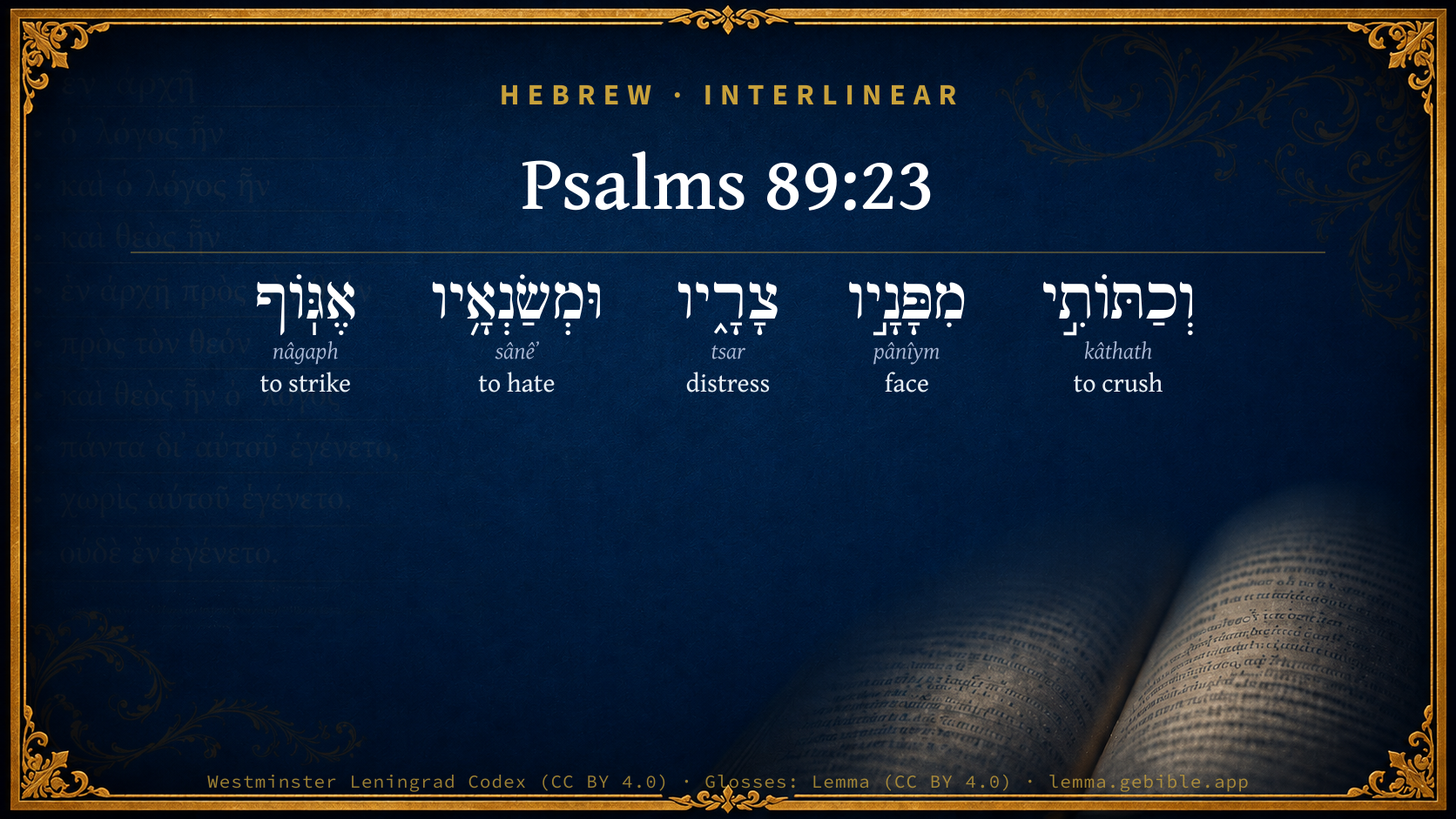
וְכַתּוֹתִ֣י
kâthath
H3807
“and · to crush”
Conjunction + Verb, Qal, Perfect, 1st Person, Common, Singular
Part of Speech
Conjunction + Verb
Stem
Qal
Form
Perfect
Person
1st Person
Gender
Common
Number
Singular
Full BDB Definition

Origin: a primitive root

TWOT: 1062

to beat, crush by beating, crush to pieces, crush fine - (Qal) - to beat or crush fine - to beat, hammer - (Piel) - to beat or crush fine - to beat, hammer - (Pual) to be beaten - (Hiphil) to beat in pieces, shatter - (Hophal) to be beaten, be crushed
  1. מִפָּנָ֣יו pânîym H6440 “from · face(s) · his” Preposition + Noun, Common, Both, Plural, Construct + Suffix, Personal, 3rd Person, Masculine, Singular
  2. צָרָ֑יו tsar H6862 “distresses · his” Noun, Common, Masculine, Plural, Construct + Suffix, Personal, 3rd Person, Masculine, Singular
  3. וּמְשַׂנְאָ֥יו sânêʼ H8130 “and · hating · him” Conjunction + Verb, Piel, Participle Active, Masculine, Plural, Construct + Suffix, Personal, 3rd Person, Masculine, Singular
  4. אֶגּֽוֹף nâgaph H5062 “to strike” Verb, Qal, Imperfect, 1st Person, Common, Singular

About this verse

These counts appear in no published source. They are computed here, from the morphology-tagged text and Lemma’s own curated glosses. What Lemma adds →

5
words
5
distinct lemmas
Wisdom
section

Notable vocabulary

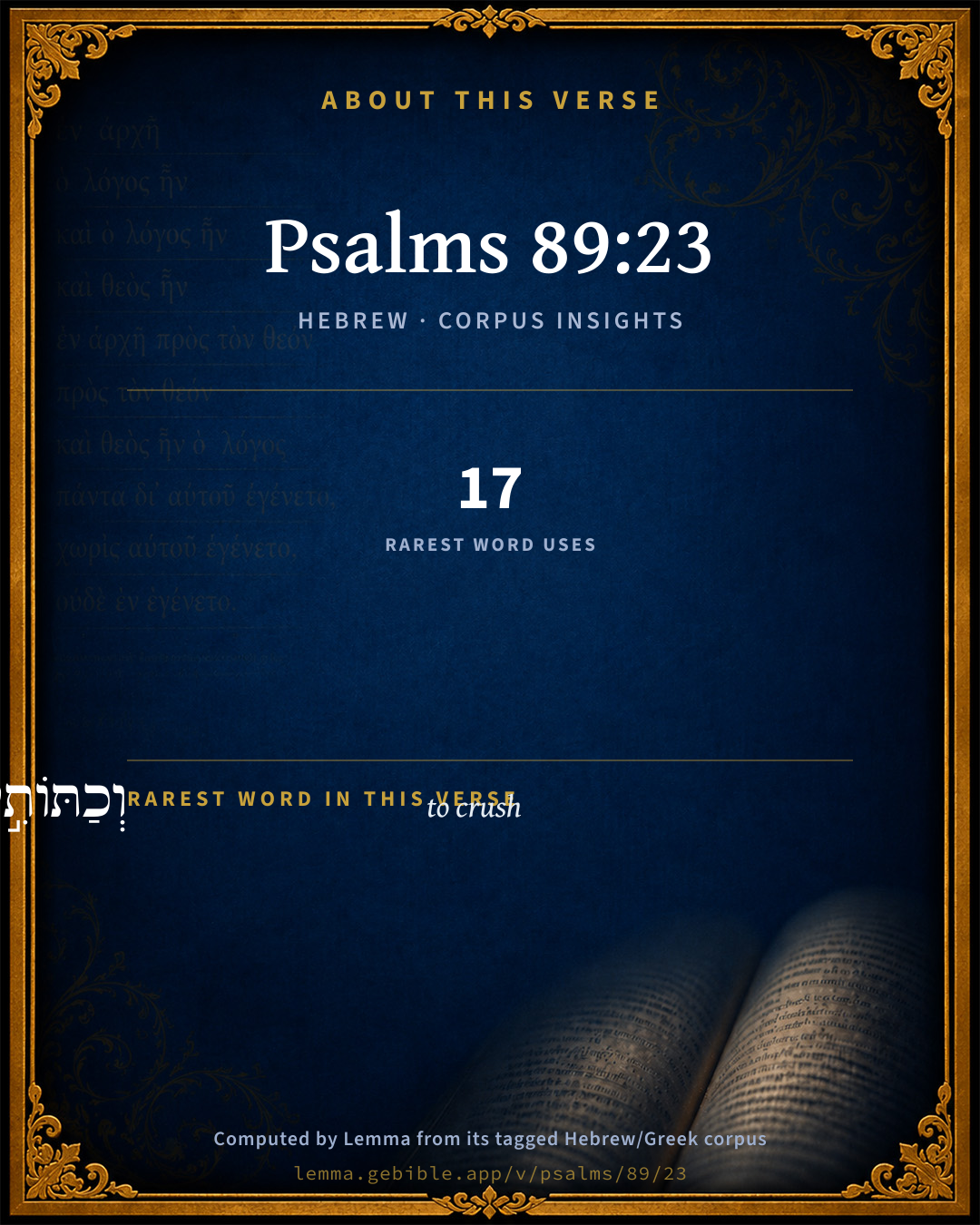
The rarest word here is וְכַתּוֹתִ֣י to crush H3807 — appearing just 17 times in the whole Hebrew Bible.

Shared distinctive vocabulary

וְכַתּוֹתִ֣י to crush H3807 occurs in 17 verses of the Hebrew Bible. Also found in:

Grammatical profile

  • 3 verbs
  • 2 nouns

Verb forms

  • וְכַתּוֹתִ֣י Qal · Perfect
  • וּמְשַׂנְאָ֥יו Piel · Participle Active
  • אֶגּֽוֹף Qal · Imperfect

Hebrew & Septuagint length

In English translation the verse runs 14 words from the Hebrew and 17 from the Septuagint (LXX English) — closely comparable.

A rough comparison of the two English renderings, which tokenize alike — not a word-level alignment.

Word counts can differ between the Hebrew and the Greek without any difference in meaning — e.g. the Hebrew direct-object marker אֵת has no separate Greek word, and Greek often adds the article ὁ.

Cross-references

12

Topical passages linked to Psalms 89:23 in the Treasury of Scripture Knowledge — connected by theme and wording, ordered by reader-vote popularity; previews shown in the World English Bible.

  • 2 Samuel 7:9 and I have been with you wherever you went, and have cut off all your enemies from before you; and I will make you a great name, like the name of the great ones who are in the earth.
  • 2 Samuel 3:1 Now there was long war between the house of Saul and the house of David: and David grew stronger and stronger, but the house of Saul grew weaker and weaker.
  • 2 Samuel 7:1 It happened, when the king lived in his house, and Yahweh had given him rest from all his enemies round about,
  • 2 Samuel 22:40–44 For you have girded me with strength to the battle; You have subdued under me those who rose up against me.
  • Psalms 18:40 You have also made my enemies turn their backs to me, That I might cut off those who hate me.
  • Psalms 21:8–9 Your hand will find out all of your enemies. Your right hand will find out those who hate you.
  • Psalms 132:18 I will clothe his enemies with shame, But on himself, his crown will be resplendant."
  • John 15:23 He who hates me, hates my Father also.
  • Psalms 2:1–6 Why do the nations rage, And the peoples plot a vain thing?
  • Psalms 109:3–110:1 They have also surrounded me with words of hatred, And fought against me without a cause.
  • Luke 19:14 But his citizens hated him, and sent an envoy after him, saying, 'We don't want this man to reign over us.'
  • Luke 19:27 But bring those enemies of mine who didn't want me to reign over them here, and kill them before me.'"

Cross-references courtesy of OpenBible.info (CC BY 4.0).

Hebrew and Greek witnesses Masoretic Hebrew ↔ Greek Septuagint

The same verse in the two great witnesses to the Old Testament, shown verse-for-verse.

You’re reading Greek Psalm 88 (Hebrew Psalm 89). The Septuagint counts the superscription, so verse numbers can differ from the Hebrew — chapter-level alignment, not verse-by-verse. Numbering follows Rahlfs.

These are two independent witnesses, not word-aligned to each other, and the Septuagint is shown in lemma (dictionary) form.

Hebrew Psalms 89:23 Masoretic · Westminster Leningrad Codex

וְכַתּוֹתִ֣י מִפָּנָ֣יו צָרָ֑יו וּמְשַׂנְאָ֥יו אֶגּֽוֹף

I will beat down his adversaries before him, And strike those who hate him.

World English Bible · Public Domain

Greek LXX Greek Psalm 88:23 Septuagint · lemma form

οὐ ὠφελέω ἐχθρός ἐν αὐτός καί υἱός ἀνομία οὐ προςτίθημι ὁ κακόω αὐτός

And I will hew down his foes before him, and put to flight those that hate him.

LXX2012 (modern English Septuagint) · Public Domain

Hebrew: Westminster Leningrad Codex (CC BY 4.0). Greek: Septuagint (public domain); English from LXX2012 (modern English Septuagint) (Public Domain). How the Septuagint differs from the Hebrew →

Commentary

Notes on Psalms 89:23 from classic Christian and Jewish commentators (each source and its license shown beneath its notes). The classic Christian expositions comment on the surrounding passage and are grouped to its opening verse, so a note may address several verses; the Jewish commentaries on the Tanakh (Rashi and others) are per-verse, so they appear only where the commentator wrote on this verse.

Lemma curates 59 commentaries, every one of them public domain or Creative Commons licensed, each selected and text-cleaned for this edition rather than reprinted as found. About our sources →

Trapp's Complete Commentary

John Trapp

Psa 89:23 And I will beat down his foes before his face, and plague them that hate him.

Ver. 23. And I will beat down his foes, &c.] Victory over enemies is of the Lord; he may better say than any mortal monarch, Cui adhaereo, praeest, He whom I take part with is sure to prevail.

That hate hint] That secretly malign him, though they can do him no mischief.

John Trapp, A Commentary or Exposition upon All the Books of the Old and New Testament (1647–1656) — public domain. Text from a community e-Sword module.

J. A. Alexander on Psalms

Joseph Addison Alexander

24. (Psa 89:23) And I will crush before him his foes, and his haters I will smite. The last verb is especially applied to strokes inflicted by the hand of God.

Joseph Addison Alexander, The Psalms Translated and Explained (1850) — public domain. Text from a community e-Sword module.

Geneva Bible (1599)

Geneva Bible translators

Though there shall be evermore enemies against God’s kingdom, yet he promiseth to overcome them.

Geneva Bible (1599) marginal notes — public domain. Text via Bolls.life.

Ellicott's Commentary for English Readers

(23) Beat down.—Probably bray, as in a mortar.

Plague.—Or, smite.

A Bible Commentary for English Readers, edited by Charles John Ellicott (1878–1897) — public domain. Text from a community e-Sword module.

The Cambridge Bible for Schools and Colleges

gen. ed. J. J. S. Perowne

23. But I will beat down his adversaries before him,

And smite them that hate him.

The Cambridge Bible for Schools and Colleges (gen. ed. J. J. S. Perowne; Cambridge University Press, 1878–1918) — public domain. Text from a community e-Sword module.

John Gill's Exposition

But my faithfulness and my mercy shall be with him,.... The "faithfulness" of God was and is with Christ, in performing promises made to him respecting his work, and strength to do it, as man, and the glory that should follow; and also those made to his people in him, relating to grace here, and happiness hereafter: and though there was no "mercy" shown to Christ, as the surety of his people, but he was dealt with in strict justice; yet, as Mediator of the covenant, the special mercy of God is with him, even every blessing of it, called "the sure mercies of David"; and is only communicated through him; he is the mercy seat, from whence mercy is dispensed, and the propitiation through whom God is merciful to men; the words may be rendered, "my truth and my grace" (e), as they are by the Targum; and both are with Christ, the truth of doctrine, and all the fulness of grace, justifying, sanctifying, pardoning, adopting, and persevering grace, Joh 1:14,

and in my name shall his horn be exalted, or "his glory", as the Targum; his power and dominion, of which the horn is an emblem; and his glory is displayed in having the same name his Father has: his name is expressive of his nature, being, and perfections, the name Jehovah; and his name of title and office "King of Kings, and Lord of lords"; or his name the Word of God, as the Targum; who, as such, is the brightness of his Father's glory: or the sense is, that, by the power of God, he should be raised from the dead, and have glory given him, and be exalted at his right hand, and made Lord and Christ; or by means of the Gospel, which is the name of the Lord, Joh 17:6, his kingdom and dominion should be spread in the world; see Sa1 2:10.

(e) "et veritas mea, et gratia mea", Cocceius, Gejerus, Michaelis.

John Gill's Exposition of the Whole Bible (1746–1763) — public domain (CC PDM 1.0). Text via the HelloAO Bible API.

Albert Barnes' Notes on the Bible

And I will beat down his foes before his face - I will crush them, or destroy them: showing that the power of doing this was not his own, but was the power of God exerted in his behalf.

And plague them that hate him - His enemies. I will bring “plagues” upon them: calamities, judgments, afflictions. The word is commonly used to denote those judgments which come directly from the hand of God - as famine, pestilence, wasting sickness, the plague, or the “plagues” of Egypt. Exo 12:13; Exo 30:12; Num 8:19; Num 17:11-12. These are all in the hand of God, and can be employed at his pleasure, as storms and tempests may be, in executing his purposes.

Albert Barnes' Notes on the Bible (1834–1885) — public domain. Text from a community e-Sword/MySword module.

The Treasury of David

Charles H. Spurgeon

Ver. 23. And I will beat down his foes before his face crushing them and their plans. God himself thus fights the battles of his Son, and effectually overturns his foes.

And plague them that hate him, or smite his haters. May none of us learn the terror of this threatening, which is surely being fulfilled upon all those unbelievers who have rejected the Son of God, and died in the hardness of their hearts. The prophecy is also having another fulfilment in the overthrow of systems of error, and the vexation caused to their promoters. There is no such plague to bad men as the prosperity of the cause of Jesus.

Psalms 89:24*

Charles H. Spurgeon's The Treasury of David (1869–1885) — public domain. Psalms only. Text from a community e-Sword/MySword module.

The Pulpit Commentary

And I will beat down his foes before his face, and plague them that hate him. (comp. 2Sa_7:9)

The Pulpit Commentary (1880–1919), ed. H.D.M. Spence-Jones & Joseph S. Exell — public domain. Text from a community e-Sword module.

Keil & Delitzsch

C. F. Keil & F. Delitzsch

What is promised in Psa 89:26 is a world-wide dominion, not merely dominion within the compass promised in the primeval times (Gen 15:18; Ch2 9:26), in which case it ought to have been said ובנהר (of the Euphrates). Nor does the promise, however, sound so definite and boundless here as in Psa 72:8, but it is indefinite and universal, without any need for our asking what rivers are intended by נהרות. נתן יד בּ, like שׁלח (in Isa 11:14, of a giving and taking possession. With אף־אני (with retreated tone, as in Psa 119:63, Psa 119:125) God tells with what He will answer David's filial love. Him who is the latest-born among the sons of Jesse, God makes the first-born (בּכור from בּכר, to be early, opp. לקשׁ, to be late, vid., Job 2:1-13 :21), and therefore the most favoured of the "sons of the Most High," Psa 82:6. And as, according to Deu 28:1, Israel is to be high (עליון) above all nations of the earth, so David, Israel's king, in whom Israel's national glory realizes itself, is made as the high one (עליון) with respect to the kings, i.e., above the kings, of the earth. In the person of David his seed is included; and it is that position of honour which, after having been only prelusively realized in David and Solomon, must go on being fulfilled in his seed exactly as the promise runs. The covenant with David is, according to Psa 89:29, one that shall stand for ever. David is therefore, as Psa 89:30 affirms, eternal in his seed; God will make David's seed and throne לעד, into eternal, i.e., into such as will abide for ever, like the days of heaven, everlasting. This description of eternal duration is, as also in Sir. 45:15, Bar. 1:11, Taken from Deu 11:21; the whole of Psa 89:30 is a poetic reproduction of Sa2 7:16.

Keil & Delitzsch — Biblical Commentary on the Old Testament (1861–1891) — public domain (CC PDM 1.0). Text via the HelloAO Bible API. (Old Testament only.)

Rashi

Rabbi Shlomo Yitzchaki (Rashi)

No enemy will exact from him No enemy will overwhelm him to become as his creditor.

Rashi on the Tanakh — English translations: “The Judaica Press complete Tanach with Rashi, translated by A. J. Rosenberg” (CC BY 4.0); “Pentateuch with Rashi's commentary by M. Rosenbaum and A.M. Silbermann, 1929-1934” (public domain); “The Metsudah Tanach series, Lakewood, N.J” (CC BY 4.0); and “The Book of Joshua, Metsudah Publications, 1997” (CC BY 4.0). Text via Sefaria.

Lesson kit

Teaching starters — assembled from the data on this page, not authored interpretation. Every prompt links to the verse data it draws on. Edit before teaching.

Psalms, in the Wisdom, opens this verse with 5 words (5 distinct Hebrew lemmas). Its most distinctive word is kâthath (“to crush”). A historical commentator’s framing appears above. Read the whole chapter for the surrounding context.

Discussion questions

  1. The word kâthath carries the sense “to crush.” How does it shape the verse?
  2. Leviticus 22:24 shares the word «to crush» with this verse. How do the two illuminate each other?
  3. These translations render this verse differently; the difference is in the English rendering, not the original. What questions does that raise?
  4. The verb «וְכַתּוֹתִ֣י» is Qal Perfect. How does its form color the action?
  5. Reading how Trapp's Complete Commentary and J. A. Alexander on Psalms read this verse, where do the two commentators agree and where do they part?

Things to notice

Reading settings

Reading text

Shown beneath each verse's original-language words.

Old Testament
Old Testament edition

Read the OT as the Masoretic Hebrew (MT) or the Greek Septuagint (LXX).

English shown for the Greek Septuagint (in the Hebrew ↔ Greek comparison).

Comparing translations? Open the Compare panel on any verse page to stack up to four side by side.