
Psalms 119:128

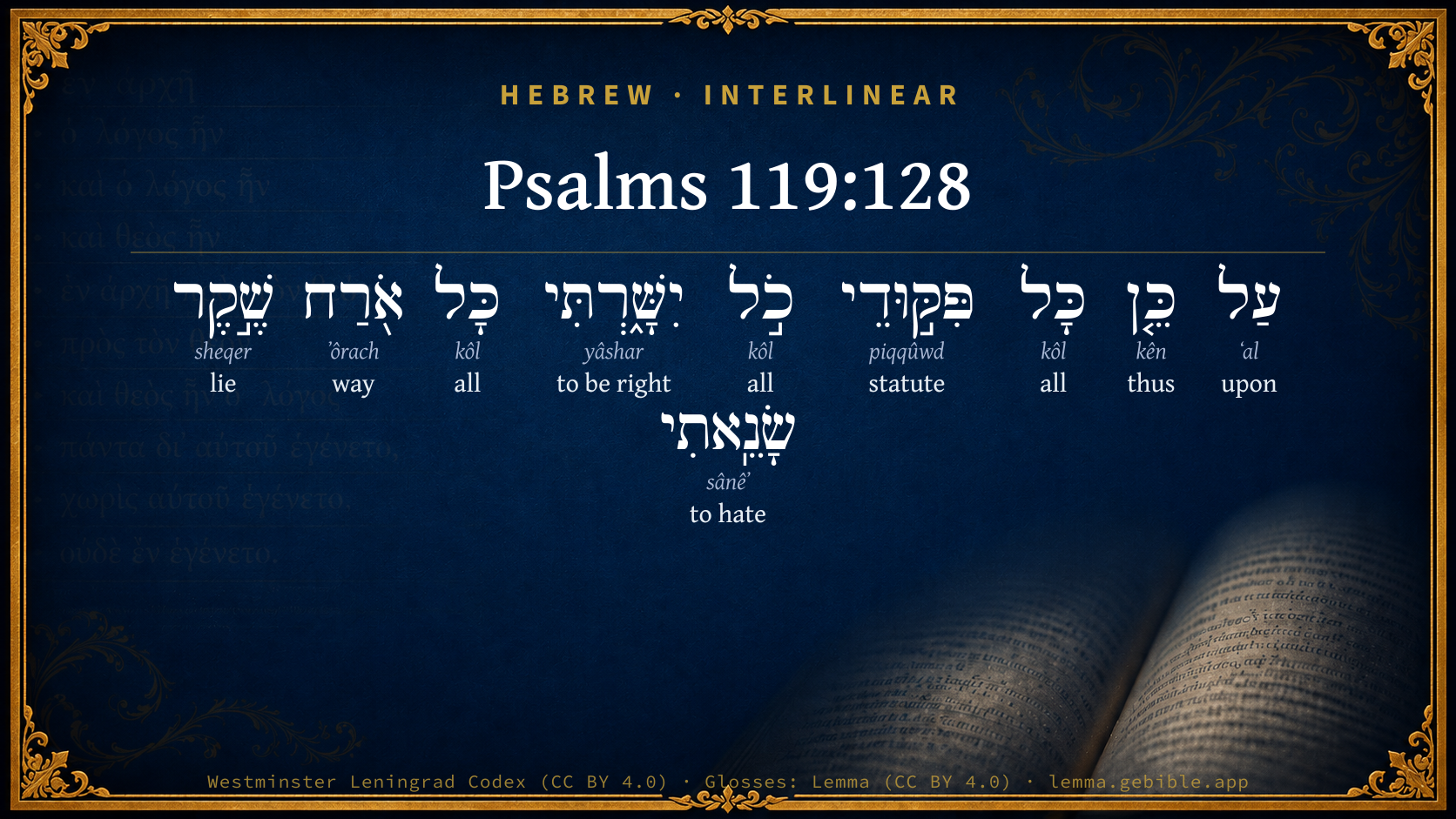
Hebrew (Westminster Leningrad Codex) Psalms 119:128 appears in the Hebrew Old Testament. The text above is from the Westminster Leningrad Codex. Each word links to its Strong’s number, a concise gloss, and parsing drawn from the Open Scriptures Hebrew Bible morphology. Click any word for its full Brown-Driver-Briggs (BDB) entry.
Download image
Cite this verse

Psalms 119:128 (World English Bible). Public Domain. Lemma interlinear Bible study tool, https://lemma.gebible.app/v/psalms/119/128.

Show BibTeX & RIS
BibTeX
RIS
English Translation
Therefore I consider all of your precepts to be right. I hate every false way.
World English Bible · Public Domain
Download a study sheet

One document with this verse’s original text, its word-by-word gloss line, the meaning frame, cross-references with their text, attributed commentary, and full source and license credits — printable, and it pastes into notes with its structure intact.

This verse Autodidact and up

Study sheet (.html) Plain text (.txt)

A passage Seminary Student

Up to 50 verses in one chapter. A passage sheet keeps up to 6 commentary sources and 12 cross-references per verse, in the order this page ranks them, and says so on the sheet whenever that leaves anything out. Ask for a single verse and you get the Autodidact verse sheet above.

Everything on this page stays free to read, with no account — the sheet is a download of what is already on screen, not access to it.

Want to remove ads? Support Godless Engineer
Compare translations 3

The same verse in 3 English versions, stacked beneath the original-language interlinear above. Click any original word for its lexicon entry.

Each is an independent rendering of the whole verse — the interlinear is not word-aligned to these translations.

Highlighted words mark where these versions differ — a whole-verse word diff, not a word-by-word alignment.

  • World English Bible Public Domain
    Therefore I consider all of your precepts to be right. I hate every false way.
  • King James Version Public Domain
    Therefore I esteem all thy precepts concerning all things to be right; and I hate every false way.
  • unfoldingWord Literal Text CC BY-SA 4.0
    Therefore, all the precepts of everything I carefully observe; every path of falsehood I hate. PE

unfoldingWord Literal Text — © unfoldingWord, licensed CC BY-SA 4.0. Word-aligned USFM3 via Door43 (git.door43.org/unfoldingWord/en_ult).

Versions to compare (up to 4)

3 of 4 selected

Show all 17 translations

Every available English version of this verse, each an independent rendering of the whole verse.

  • World English Bible Public Domain
    Therefore I consider all of your precepts to be right. I hate every false way.
  • Berean Standard Bible Public Domain
    Therefore I admire all Your precepts and hate every false way.
  • Majority Standard Bible Public Domain
    Therefore I admire all Your precepts and hate every false way.
  • King James Version Public Domain
    Therefore I esteem all thy precepts concerning all things to be right; and I hate every false way.
  • American Standard Version (1901) Public Domain
    Therefore I esteem all `thy' precepts concerning all `things' to be right; `And' I hate every false way.
  • Revised Version (1885) Public Domain
    Therefore I esteem all thy precepts concerning all things to be right; and I hate every false way.
  • Geneva Bible (1599) Public Domain
    Therefore I esteeme all thy precepts most iust, and hate all false wayes.
  • Young's Literal Translation Public Domain
    Therefore all my appointments I have declared wholly right, Every path of falsehood I have hated!
  • Literal Standard Version CC BY-SA 4.0
    Therefore all my appointments I have declared wholly right, || I have hated every path of falsehood!
  • Unlocked Literal Bible CC BY-SA 4.0
    Therefore I carefully follow all your instructions, and I hate every path of falsehood.
  • unfoldingWord Literal Text CC BY-SA 4.0
    Therefore, all the precepts of everything I carefully observe; every path of falsehood I hate. PE
  • Darby Bible Public Domain
    Therefore I regard all [thy] precepts concerning all things to be right: I hate every false path.
  • World Messianic Bible Public Domain
    Therefore I consider all of your precepts to be right. I hate every false way. PE
  • Webster's Bible Public Domain
    Therefore I esteem all thy precepts concerning all things to be right; and I hate every false way.
  • Free Bible Version CC BY-SA 4.0
    All of your rules are right in every way, and so I hate any way of life that's just a lie. Pe
  • Bible in Basic English Public Domain
    Because of it I keep straight in all things by your orders; and I am a hater of every false way.
  • JPS Tanakh (1917) Public Domain
    Therefore I esteem all Thy precepts concerning all things to be right; every false way I hate.

Literal Standard Version (2020), Covenant Press — licensed CC BY-SA 4.0. Text via the HelloAO Bible API (eBible.org). Unlocked Literal Bible (unfoldingWord) — licensed CC BY-SA 4.0. Text via the HelloAO Bible API (eBible.org). unfoldingWord Literal Text — © unfoldingWord, licensed CC BY-SA 4.0. Word-aligned USFM3 via Door43 (git.door43.org/unfoldingWord/en_ult). Free Bible Version, Dr. Jonathan Gallagher — licensed CC BY-SA 4.0. Text via the HelloAO Bible API (eBible.org).

Word by word

More ways to search: Search by grammar → Find every occurrence → Compare this word →

Practice this passage: Drill this verse → Learn its vocabulary →

About this verse

These counts appear in no published source. They are computed here, from the morphology-tagged text and Lemma’s own curated glosses. What Lemma adds →

10
words
8
distinct lemmas
Wisdom
section

Notable vocabulary

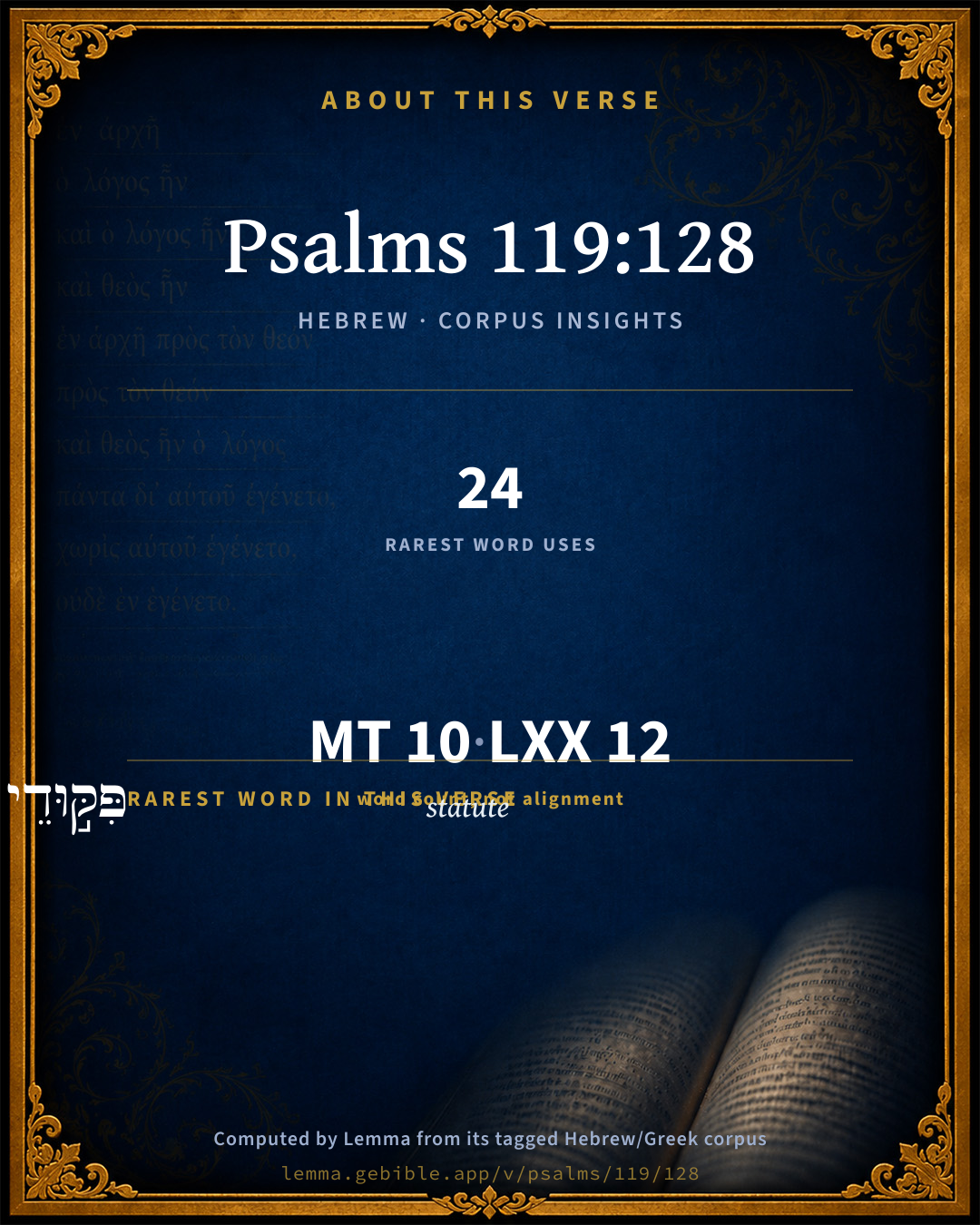
The rarest word here is פִּקּ֣וּדֵי statute H6490 — appearing just 24 times in the whole Hebrew Bible.

Shared distinctive vocabulary

פִּקּ֣וּדֵי statute H6490 occurs in 24 verses of the Hebrew Bible. Also found in:

Grammatical profile

  • 2 verbs
  • 6 nouns
  • 1 preposition
  • 1 particle

Verb forms

  • יִשָּׁ֑רְתִּי Piel · Perfect
  • שָׂנֵֽאתִי Qal · Perfect

Repetition

A word recurs within this verse — often emphatic in Hebrew:

Hebrew & Septuagint length

In English translation the verse runs 15 words from the Hebrew and 15 from the Septuagint (LXX English) — the same length.

A rough comparison of the two English renderings, which tokenize alike — not a word-level alignment.

Word counts can differ between the Hebrew and the Greek without any difference in meaning — e.g. the Hebrew direct-object marker אֵת has no separate Greek word, and Greek often adds the article ὁ.

In the original languages it is 10 Hebrew tokens and 12 Greek tokens — but the two are counted differently (Hebrew bundles its prefixes and suffixes into one token; the Greek is in lemma form), so that isn’t a like-for-like length.

Cross-references

11

Topical passages linked to Psalms 119:128 in the Treasury of Scripture Knowledge — connected by theme and wording, ordered by reader-vote popularity; previews shown in the World English Bible.

  • Psalms 119:104 Through your precepts, I get understanding; Therefore I hate every false way.
  • Romans 7:22 For I delight in God's law after the inward man,
  • Psalms 19:7–8 Yahweh's law is perfect, restoring the soul. Yahweh's testimony is sure, making wise the simple.
  • Psalms 119:6 Then I wouldn't be disappointed, When I consider all of your commandments.
  • Proverbs 30:5 "Every word of God is flawless. He is a shield to those who take refuge in him.
  • Deuteronomy 4:8 What great nation is there, that has statutes and ordinances so righteous as all this law, which I set before you this day?
  • Job 33:27 He sings before men, and says, 'I have sinned, and perverted that which was right, And it didn't profit me.
  • Romans 7:16 But if what I don't desire, that I do, I consent to the law that it is good.
  • Psalms 119:118 You reject all those who stray from your statutes, For their deceit is in vain.
  • Romans 7:12 Therefore the law indeed is holy, and the commandment holy, and righteous, and good.
  • Romans 7:14 For we know that the law is spiritual, but I am fleshly, sold under sin.

Cross-references courtesy of OpenBible.info (CC BY 4.0).

Hebrew and Greek witnesses Masoretic Hebrew ↔ Greek Septuagint

The same verse in the two great witnesses to the Old Testament, shown verse-for-verse.

You’re reading Greek Psalm 118 (Hebrew Psalm 119). The Septuagint counts the superscription, so verse numbers can differ from the Hebrew — chapter-level alignment, not verse-by-verse. Numbering follows Rahlfs.

These are two independent witnesses, not word-aligned to each other, and the Septuagint is shown in lemma (dictionary) form.

Hebrew Psalms 119:128 Masoretic · Westminster Leningrad Codex

עַל כֵּ֤ן כָּל פִּקּ֣וּדֵי כֹ֣ל יִשָּׁ֑רְתִּי כָּל אֹ֖רַח שֶׁ֣קֶר שָׂנֵֽאתִי

Therefore I consider all of your precepts to be right. I hate every false way.

World English Bible · Public Domain

Greek LXX Greek Psalm 118:128 Septuagint · lemma form

διά οὗτος πρός πᾶς ὁ ἐντολή σύ καταὀρθόω πᾶς ὁδός ἄδικος μισέω

Therefore I directed myself according to all your commandments: I have hated every unjust way.

LXX2012 (modern English Septuagint) · Public Domain

On this verse, Ellicott's Commentary for English Readers discusses the Septuagint’s reading. Read the note in Commentary ↓

Hebrew: Westminster Leningrad Codex (CC BY 4.0). Greek: Septuagint (public domain); English from LXX2012 (modern English Septuagint) (Public Domain). How the Septuagint differs from the Hebrew →

Commentary

Notes on Psalms 119:128 from classic Christian and Jewish commentators (each source and its license shown beneath its notes). The classic Christian expositions comment on the surrounding passage and are grouped to its opening verse, so a note may address several verses; the Jewish commentaries on the Tanakh (Rashi and others) are per-verse, so they appear only where the commentator wrote on this verse.

Lemma curates 59 commentaries, every one of them public domain or Creative Commons licensed, each selected and text-cleaned for this edition rather than reprinted as found. About our sources →

Trapp's Complete Commentary

John Trapp

Psa 119:128 Therefore I esteem all [thy] precepts [concerning] all [things to be] right; [and] I hate every false way.

Ver. 128. Therefore I esteem all thy precepts concerning all things to be right] "Therefore," from the same ground again as before, by a holy antiperistasis.

I esteem, &c.] Rectificavi, I have declared them to be right in every part and point, against those that wrangle and wrest them to a wrong sense. I esteem every parcel of truth precious, and am an utter enemy to every heterodoxy. The many "alls" in this verse used (not unlike that in Eze 44:30) showeth the integrity and universality of his obedience. "All" is but a little word, but of large extent.

I hate every false way] Whether in point of opinion or practice; all sinful deviations and prevarications. Hatred is ever against the whole kind of a thing, saith Aristotle (Rhet. lib. 2.)

John Trapp, A Commentary or Exposition upon All the Books of the Old and New Testament (1647–1656) — public domain. Text from a community e-Sword module.

J. A. Alexander on Psalms

Joseph Addison Alexander

128. (Psa 119:128) Therefore all (thy) precepts (as to) all (things) I think right; every way of falsehood do I hate. The therefore is co-ordinate with that in the preceding verse, and to be explained in the same manner. Both were probably occasioned by the alphabetical arrangement here requiring an initial ayin. Precepts of course mean those of God, as word means his word in Psa 119:49. The construction here is very foreign from our idiom, and by no means easily translated into it. The literal meaning of the words is, all precepts of all, which some understand to mean of all kinds, as in ver. 14 and Ps. cxviii. 10. But others deny that all has this sense, even in the places cited, and explain it here to mean concerning all, on all subjects. The clause is then condemnatory of all partial distinctions between God's commandments, which may be the way of falsehood specially intended in the last clause. Compare Mat 5:17-19. The verb in the first clause always elsewhere means to make straight, to go straight, or to direct aright; but the best interpreters agree in making it here mean, to think right or approve. It is worthy of remark, that as to all these points, the true sense of this difficult clause seems to be given in the English Bible. With the last clause compare Psa 119:104. In the sixteenth stanza, which here closes, two of the verses begin with therefore, and two with different forms of the verb which means to do.

Joseph Addison Alexander, The Psalms Translated and Explained (1850) — public domain. Text from a community e-Sword module.

Geneva Bible (1599)

Geneva Bible translators

That is, whatsoever dissenteth from the purity of thy word.

Geneva Bible (1599) marginal notes — public domain. Text via Bolls.life.

Adam Clarke's Commentary

Verse 128. All thy precepts concerning all things to be right] There are too many supplied words here to leave the text unsuspected. All the ancient versions, except the Chaldee, seem to have omitted the second כל col, ALL and read the text thus: "Therefore I have walked straight in all thy precepts." I go straight on in all thy precepts, hating every false way. I neither turn to the right hand nor to the left; the false ways are crooked; thy way is straight. I am going to heaven, and that way lies straight before me. To walk in the way of falsity I cannot, because I hate it; and I hate such ways because God hates them.

ANALYSIS OF LETTER AIN. - Sixteenth Division

In this part the psalmist,

I. Makes a profession of his integrity.

II. Prays for protection against his enemies.

III. Resolves to walk in the right way.

I. He makes a profession of his integrity: -

1. "I have done judgment and justice."

2. Though he had done so, yet he was not free from calumny and oppression. He commends, therefore, his righteous cause to God: "Leave me not to mine oppressors."

3. "Be surety for thy servant:" give me an assurance that thou wilt stand by me.

4. "Let not the proud oppress me." For miserable are the destitute when they fall into such hands.

II. He shows us how he had prayed against his enemies, and for God's salvation.

"Mine eyes fail." My faith is almost gone, and the eye of my mind become dim.

2. It was the salvation of God he had in view: "For thy salvation."

3. The ground on which he prayed was the word of God's righteousness.

He proceeds in his prayer; and begs God to deal with him as a needy servant, and also an ignorant scholar.

1. "Deal with thy servant." I am ready to do thy will; but treat me in thy mercy.

2. "Teach me thy statutes." I wish to learn what thy will is; and when I know it, faithfully to do it.

He urges the same request, with nearly the same reasons for it: "I am thy servant." I am no stranger to thee. I have frequently come to thee to get grace to enable me to serve thee. I am one of thy domestics, a member of thy Church.

He comes now with his complaint.

1. "It is time for thee to work." Thy enemies are strong, and thy people weak.

2. "They have made void thy law." They have entirely trampled it under foot.

III. The zeal of the psalmist increased as the love of many waxed cold.

1. "Therefore," because they despise thy word, ordinances, and people.

2. "I love thy commandments." As they hate, so I love. When we love God's commandments, it is a sign that we have not received the grace of God in vain.

3. To show the greatness of his love, he says, I love thy commandments "above gold; yea, above fine gold." My love is greater to thy law, than that of the miser is to his bags.

4. He received all God's precepts to be right; and he takes not some, but the whole of them.

5. Whatever gain idolatry and time-serving might hold out to him, he abominated it, because he hated every false way. His love of God, his law, and holiness, was greater than his love of life.

Adam Clarke's Commentary on the Bible (1810–1826) — public domain. Text from a community e-Sword/MySword module.

John Calvin's Commentaries

128. Therefore I have esteemed all thy commandments to be altogether right Durell translates this verse — “For, as much as I esteem all thy precepts, etc., therefore I hate,” etc.

“All the precepts of everything, i.e., all precepts concerning all things. I embrace thy revealed Word, without any exceptions. The Psalmist states, that he had most diligently applied his mind to the consideration of all God’s commandments, the circumstances and occasions on which they were given, and he observed that they abounded in justice and holiness. Since, therefore, they are all equally just and holy, whatsoever is contrary to them he regarded as unjust, impure, false and detestable. Hammond remarks, that ‘the reduplication of the universal particle כל is emphatic all, even all;’ and so the plain rendering is most current, all thy commandments, even all, have I approved.” — Phillips.

John Calvin's Commentaries (1540-1563) — public domain. Text from the Calvin Translation Society English edition (1840s-50s) via the Christian Classics Ethereal Library (ccel.org). Calvin's coverage is partial (roughly two-thirds of the Bible); uncommented books and verses are honest gaps, never fabricated. The 19th-century editor's footnotes and remarks are omitted so the notes are faithfully Calvin's own voice.

Ellicott's Commentary for English Readers

(128) Therefore I esteem.—As the text stands, this verse literally runs, Therefore all precepts of all I make straight. Every path of falsehood I hate. The LXX. and Vulg. have, “Therefore to all Thy commandments I was being directed. Every unjust path I hated,” which only necessitates a slight change in the reading of one word. It is true that the expression, all precepts of all, may be explained as a strengthened form of all precepts—as we say, “all and every”—though the passages (Eze_44:30; Num_8:16) generally adduced are not strictly analogous. But the Lexicons supply no authority for taking the verb yâshar in the sense of “esteem right,” and the figure of the path in the next clause seems here plainly to fix its meaning. Translate, therefore, Therefore after all Thy precepts I direct (my way). Every false way I detest.

A Bible Commentary for English Readers, edited by Charles John Ellicott (1878–1897) — public domain. Text from a community e-Sword module.

The Cambridge Bible for Schools and Colleges

gen. ed. J. J. S. Perowne

128. I esteem all thy precepts concerning all things to be right] The Heb. of the Mass. text is most awkward and is almost certainly corrupt. We must read either I esteem all thy precepts to be right (Syr., R.V. marg.; cp. P.B.V.), or with LXX (Vulg.), Jer. according to all thy precepts I direct my goings (cp. Pro_11:5; Pro_15:21), which gives a good contrast to the following line, with which cp. Psa_119:29; Psa_119:104.

The Cambridge Bible for Schools and Colleges (gen. ed. J. J. S. Perowne; Cambridge University Press, 1878–1918) — public domain. Text from a community e-Sword module.

John Gill's Exposition

Look thou upon me,.... Not as in himself; a sinful creature will not bear looking upon by the Lord, especially with the strict eye of justice; but as in Christ, and clothed with his righteousness; and so not merely in a providential way, though that is a favour, but in a way of special grace and mercy. It may be rendered, "turn unto me" (r); as it is in Psa 25:16; the Lord had turned from him, and had hid his face, which had given him trouble; and therefore he desires he would turn again to him, and show him his face and favour;

and be merciful unto me; in forgiving his sins, and admitting him to communion with him: he pleads mercy, and not merit and this shows it was not any look but a look of grace and mercy he prays for;

as thou usest to do unto those that love thy name; that is, himself: such as love the Lord have favours shown them; he shows mercy to thousands of them that love him; he loves them that love him; he manifests his love to them, and admits them to great nearness to himself. David was one of these; he loved him in sincerity, and above all others and could appeal to him for the truth of it, and desires no other nor better usage than such had; and indeed a man need not desire better, since all things work for their good now, and it is not to be conceived what God has prepared for them hereafter.

(r) "convertere ad me", Michaelis; "turn the face unto me", Ainsworth.

John Gill's Exposition of the Whole Bible (1746–1763) — public domain (CC PDM 1.0). Text via the HelloAO Bible API.

Albert Barnes' Notes on the Bible

Therefore I esteem all thy precepts concerning all things to be right - literally, “Therefore all the commandments of all I regard as right.” The idea seems to be, that he regarded as right and just all the commandments of God pertaining to “every” thing and “every” person; all, considered in every way; all, wherever the law extended, and whomsoever it embraced; all the law pertaining to duty toward God and toward man. He saw in the “violation” of the laws of God Psa 119:126 a reason for approving “all” law; all that would restrain people from sin, and that would bind them to duty and to virtue. The effect had been to lead him to reflect on the worth of law as law, and he had come to the conclusion that all the laws of God were to be approved and loved, inasmuch as they would, in their observance, prevent the wrongs and sorrows which he saw to be consequent on their violation.

And I hate every false way - Every course of life not based on truth, or on a right view of things. All just law is based on a perception of what is true; on the reality of things; on what is required in the nature of the case; on what will tend to promote the best interests of society. Compare the notes at Psa 119:104.

Albert Barnes' Notes on the Bible (1834–1885) — public domain. Text from a community e-Sword/MySword module.

Matthew Poole's English Annotations

Therefore, for the reasons now mentioned, I do not make void all thy precepts, as they did, Psa 119:126, nor yet am I partial in my approbation of them, as others are, who reject all such as are opposite to their lusts and interests; but I approve all of them without any exception, and that not only in my judgment, but in my heart and life, as appears by that hatred of sin which is opposed to it in the next clause.

Matthew Poole's English Annotations on the Holy Bible (1683–1685) — public domain. Text from a community e-Sword/MySword module.

The Treasury of David

Charles H. Spurgeon

Ver. 128. Therefore I esteem all thy precepts concerning all things to be right. Because the ungodly found fault with the precepts of God, therefore David was all the more sure of their being right. The censure of the wicked is a certificate of merit; that which they sanction we may justly suspect, but that which they abominate we may ardently, admire. The good man's delight in God's law is unreserved, he believes in all God's precepts concerning all things.

And I hate every false way. Love to truth begat hatred of falsehood. This godly man was not indifferent to anything, but that which he did not love he hated. He was no chip in the porridge without flavour; he was a good lover or a good hater, but he was never a waverer. He knew what he felt, and expressed it. He was no Gallio, caring for none of the things. His detestation was as unreserved as his affection; he had not a good word for any practice which would not bear the light of truth. The fact that such large multitudes follow the broad road had no influence upon this holy mail, except to make him more determined to avoid every form of error and sin. May the Holy Spirit so rule in our hearts that our affections may be in the same decided condition towards the precepts of the word.

Ver. 128. I esteem all thy precepts concerning all things to be right. It is no compromising testimony to the integrity and value of the Lord's precepts with which the Psalmist concludes, "I esteem all thy precepts concerning all things to be right" every command, however hard; every injunction, however distasteful; every precept, however severe; even cut off thy right hand, pluck out thy right eye; forget thine own people and thy father's house; take up thy cross daily; sell all that thou hast yea, Lord, even so, "all thy precepts concerning all things are right." What a blessed truth to arrive at, and find comfort in! Barton Bouchier.

Ver. 128. I esteem all thy precepts, etc. We must not only respect all God's commandments, but also respect them all alike, and give them all the like respect. Obedience must be universal. R. Mayhew, in "The death of Death in the Death of Christ, " 1679.

Ver. 128. All. The many "alls" in this verse used (not unlike that in Eze 44:30) showeth the integrity and universality of his obedience. "All" is but a little word, but of large extent. John Trapp.

Ver. 128. All thy precepts concerning all things to be right. He had a high estimate of God's precepts; he thought them just in all things; just, because they prescribe nothing but that which is exactly just; and just, because they bring a just punishment on the transgressors, and a reward to the righteous. William Nicholson.

Ver. 128. The upright man squares all his actions by a right rule: carnal reason cannot bias him, corrupt practice cannot sway him, but God's sacred word directs him. Hence it is that his respect is universal to all divine precepts, avoiding all evil, performing all good without exception. Thus David's upright man here esteems God's precepts concerning all things to be right, and therefore is careful to observe them. Hence it is, that he is the same man at all times, in all places; because at all times, and in all societies, he acts by one and the same rule. It is a good saying of S. Cyprian, "ea non est religio, sed dissimulatio, quce per omnia non constat sibi", that is not piety, but hypocrisy, that is not in all things like itself, since the upright man measures every action by the straight line of divine prescript. Abraham Wright.

Ver. 128. I hate every false way. The best trial of our love to God and his word is the contrary hatred of sin and impiety: "Ye that love the Lord, hate evil." He that loves a tree, hates the worm that consumes it; he that loves a garment, hates the moth that eats it; he that loveth life, abhorreth death; and he that loves the Lord hates every thing that offends him. Let men take heed to this, who are in love of their sins: how can the love of God be in them?

Religion binds us not only to hate one way of falsehood, but all the ways of it. As there is nothing good, but in some measure a godly man loves it; so is there nothing evil, but in some measure he hates it. And this is the perfection of the children of God; a perfection not of degrees; for we neither love good, nor hate evil as we should; but a perfection of parts; because we love every good, and we hate every evil in some measure. William Cowper.

Ver. 128. And I hate. The Being who loves the good with infinite intensity must hate evil with the same intensity. So far from any incompatibility between this love and this hatred, they are the counterparts of each other, opposite poles of the same moral emotion. John W. Haley, in "A Examination of the alleged

Discrepancies of the Bible, "1875.

Ver. 128. I hate every false way. If Satan get a grip of thee by any one sin, is it not enough to carry thee to damnation? As the butcher carries the beast to the slaughter, sometime bound by all the four feet, and sometime by one only; so it is with Satan. Though thou be not a slave to all sin; if thou be a slave to one, the grip he hath of thee, by that one sinful affection, is sufficient to captive thee. William Cowper.

Ver. 128 (first clause). This view should be taken of all divine precepts in their bearing,

1. Toward Christ.

2. Toward Self.

3. Toward the World.

4. Toward the Church.

5. Toward Heaven. W.J.

Ver. 128. The Bible right.

1. Its science is correct.

2. Its history is true.

3. Its promises are genuine.

4. Its morality is perfect.

5. Its doctrines are divine. W.J.

Ver. 128. Learn four lessons,

1. It is a good thing when wicked men do not praise the truth they cannot love.

2. It is a suspicious circumstance when they are found speaking well of any part of it; it is a Judas' kiss in order to betray its interests.

3. It must be right to accept and love what the wicked oppose.

4. It is always safe to be on the opposite side to them. J.F.

Psalms 119:129*

Ver. 129 Thy commands are wonderful. Full of wonderful revelations, commands and promises. Wonderful in their nature, as being free from all error, and bearing within themselves overwhelming self evidence of their truth; wonderful in their effects as instructing, elevating, strengthening, and comforting the soul. Jesus the eternal Word is called Wonderful, and all the uttered words of God are wonderful in their degree. Those who know them best wonder at them most. It is wonderful that God should have borne testimony at all to sinful men, and more wonderful still that his testimony should be of such a character, so clear, so full, so gracious, so mighty.

Therefore doth my soul keep them. Their wonderful character so impressed itself upon his mind that he kept them in his memory: their wonderful excellence so charmed his heart that he kept them in his life. Some men wonder at the words of God, and use them for their speculation; but David was always practical, and the more he wondered the more he obeyed. Note that his religion was soul work; not with head and hand alone did he keep the testimonies; but his soul, his truest and most real self, held fast to them.

Charles H. Spurgeon's The Treasury of David (1869–1885) — public domain. Psalms only. Text from a community e-Sword/MySword module.

The Pulpit Commentary

Therefore I esteem all thy precepts concerning all things to be right. I do not pick and choose among thy commandments which I will neglect and which I will obey, but esteem them all as perfect, and obey them all. "Eclecticism of every kind in reference to the Word of God is rejected" (Hengstenberg). And I hate every false way (comp. vers. 104, 163). All ways are "false" except the way of God"s commandments.

The self-willed treatment of God"s Word.

"Therefore hold I straight all thy commandments" (Prayer-book Version). "In the word "therefore" there is a peculiar beauty. The violation of God"s Law by the wicked only brings out more intensely in his servants the sense of its preciousness, and the enthusiasm of devotion to it." It is not so much the wickedness of the wicked that is in the psalmist"s mind, as the wrong and unworthy ways in which they twist and turn God"s Word, so that it shall either excuse their wickedness or seem to have nothing to do with it. He "hates every false way," every way of dealing with God"s way which is not genuine and straightforward; and for himself he will persist in "holding straight" all the command-melts, dealing honestly and sincerely with them.

I SELF-WILL SELECTS FROM GOD"S WORD WHAT SUITS IT. It is true that every one does and must select from God"s Word what is most helpful; and that all Bible-readers find different parts and portions helpful in different moods and circumstances. The Bible of each individual is a much smaller book than the Bible God has provided for the world. But the good man

(1) recognizes the value and authority of all;

(2) seeks relativity to his passing spiritual needs; and

(3) depends on Divine illumination and guidance for the parts he finds; giving due heed to them, whether he likes them or not.

The self-willed man takes out only what he likes or what will serve his ends, and consequently his Bible is his own; it is not God"s.

II SELF-WILL DISTORTS EVEN WHAT IT GETS. Only the sincere, God-honoring mind sees in the Word what God put there. If a man brings his own ideas to the Word, looking in it for what he wants to find, the mere language will easily take shape that satisfies him. He will loudly assert what it says, in entire indifference to what it means. This self-willed distortion of God"s Word to support preconceived doctrinal ideas is the treacherous basis on which all sectarianism rests. But it is more important to rebuke the distortion of God"s Word which is made to support practical unrighteousness. It has even been made the minister, and the excuser, of man"s sin. R.T.

The Pulpit Commentary (1880–1919), ed. H.D.M. Spence-Jones & Joseph S. Exell — public domain. Text from a community e-Sword module.

Rashi

Rabbi Shlomo Yitzchaki (Rashi)

Because I considered all precepts of all things upright All precepts, everything that You commanded in your Torah.

I considered upright Heb. ישרתי. They were upright in my eyes, and I said about them that they are upright. Because of this, I deserve that You forgive me and favor me.

Rashi on the Tanakh — English translations: “The Judaica Press complete Tanach with Rashi, translated by A. J. Rosenberg” (CC BY 4.0); “Pentateuch with Rashi's commentary by M. Rosenbaum and A.M. Silbermann, 1929-1934” (public domain); “The Metsudah Tanach series, Lakewood, N.J” (CC BY 4.0); and “The Book of Joshua, Metsudah Publications, 1997” (CC BY 4.0). Text via Sefaria.

Lesson kit

Teaching starters — assembled from the data on this page, not authored interpretation. Every prompt links to the verse data it draws on. Edit before teaching.

Psalms, in the Wisdom, opens this verse with 10 words (8 distinct Hebrew lemmas). Its most distinctive word is piqqûwd (“statute”). A historical commentator’s framing appears above. Read the whole chapter for the surrounding context.

Discussion questions

  1. The word piqqûwd carries the sense “statute.” How does it shape the verse?
  2. Psalms 19:8 shares the word «statute» with this verse. How do the two illuminate each other?
  3. “all” occurs 3× in this one verse. What is the effect of the repetition?
  4. These translations render this verse differently; the difference is in the English rendering, not the original. What questions does that raise?
  5. The verb «יִשָּׁ֑רְתִּי» is Piel Perfect. How does its form color the action?
  6. Reading how Trapp's Complete Commentary and J. A. Alexander on Psalms read this verse, where do the two commentators agree and where do they part?

Things to notice

Reading settings

Reading text

Shown beneath each verse's original-language words.

Old Testament
Old Testament edition

Read the OT as the Masoretic Hebrew (MT) or the Greek Septuagint (LXX).

English shown for the Greek Septuagint (in the Hebrew ↔ Greek comparison).

Comparing translations? Open the Compare panel on any verse page to stack up to four side by side.