
Proverbs 5:12

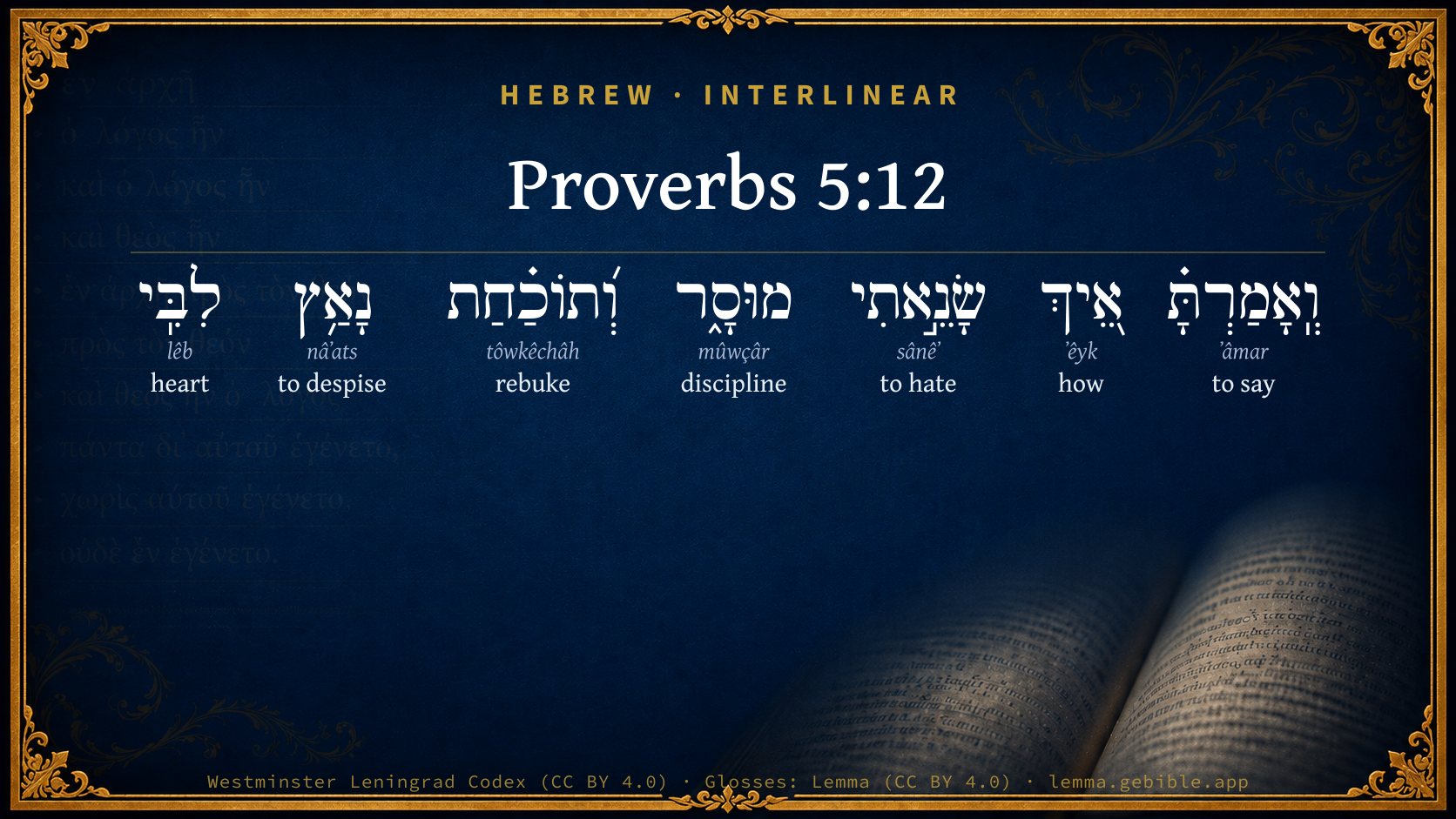
Hebrew (Westminster Leningrad Codex) Proverbs 5:12 appears in the Hebrew Old Testament. The text above is from the Westminster Leningrad Codex. Each word links to its Strong’s number, a concise gloss, and parsing drawn from the Open Scriptures Hebrew Bible morphology. Click any word for its full Brown-Driver-Briggs (BDB) entry.
Download image
Cite this verse

Proverbs 5:12 (World English Bible). Public Domain. Lemma interlinear Bible study tool, https://lemma.gebible.app/v/proverbs/5/12.

Show BibTeX & RIS
BibTeX
RIS
English Translation
And say, "How I have hated instruction, And my heart despised reproof;
World English Bible · Public Domain
Download a study sheet

One document with this verse’s original text, its word-by-word gloss line, the meaning frame, cross-references with their text, attributed commentary, and full source and license credits — printable, and it pastes into notes with its structure intact.

This verse Autodidact and up

Study sheet (.html) Plain text (.txt)

A passage Seminary Student

Up to 50 verses in one chapter. A passage sheet keeps up to 6 commentary sources and 12 cross-references per verse, in the order this page ranks them, and says so on the sheet whenever that leaves anything out. Ask for a single verse and you get the Autodidact verse sheet above.

Everything on this page stays free to read, with no account — the sheet is a download of what is already on screen, not access to it.

Want to remove ads? Support Godless Engineer
Compare translations 3

The same verse in 3 English versions, stacked beneath the original-language interlinear above. Click any original word for its lexicon entry.

Each is an independent rendering of the whole verse — the interlinear is not word-aligned to these translations.

Highlighted words mark where these versions differ — a whole-verse word diff, not a word-by-word alignment.

  • World English Bible Public Domain
    And say, "How I have hated instruction, And my heart despised reproof;
  • King James Version Public Domain
    And say, How have I hated instruction, and my heart despised reproof;
  • unfoldingWord Literal Text CC BY-SA 4.0
    And you will say, “How I hated correction, and my heart despised rebuke!

unfoldingWord Literal Text — © unfoldingWord, licensed CC BY-SA 4.0. Word-aligned USFM3 via Door43 (git.door43.org/unfoldingWord/en_ult).

Versions to compare (up to 4)

3 of 4 selected

Show all 18 translations

Every available English version of this verse, each an independent rendering of the whole verse.

  • World English Bible Public Domain
    And say, "How I have hated instruction, And my heart despised reproof;
  • Berean Standard Bible Public Domain
    and you will say, “How I hated discipline, and my heart despised reproof!
  • Majority Standard Bible Public Domain
    and you will say, “How I hated discipline, and my heart despised reproof!
  • King James Version Public Domain
    And say, How have I hated instruction, and my heart despised reproof;
  • American Standard Version (1901) Public Domain
    And say, How have I hated instruction, And my heart despised reproof;
  • Revised Version (1885) Public Domain
    And say, How have I hated instruction, and my heart despised reproof;
  • Geneva Bible (1599) Public Domain
    And say, How haue I hated instruction, and mine heart despised correction!
  • Douay-Rheims (1899) Public Domain
    Why have I hated instruction, and my heart consented not to reproof,
  • Young's Literal Translation Public Domain
    And hast said, `How have I hated instruction, And reproof hath my heart despised,
  • Literal Standard Version CC BY-SA 4.0
    And have said, “How I have hated instruction, || And my heart has despised reproof,
  • Unlocked Literal Bible CC BY-SA 4.0
    You will say, “How I hated instruction and my heart despised correction!
  • unfoldingWord Literal Text CC BY-SA 4.0
    And you will say, “How I hated correction, and my heart despised rebuke!
  • Darby Bible Public Domain
    and thou say, How have I hated instruction, and my heart despised reproof!
  • World Messianic Bible Public Domain
    and say, “How I have hated instruction, and my heart despised reproof.
  • Webster's Bible Public Domain
    And say, How have I hated instruction, and my heart despised reproof;
  • Free Bible Version CC BY-SA 4.0
    You'll say, “How I used to hate discipline, and my mind rebelled against being corrected!
  • Bible in Basic English Public Domain
    And you will say, How was teaching hated by me, and my heart put no value on training;
  • JPS Tanakh (1917) Public Domain
    And say: 'How have I hated instruction, and my heart despised reproof;

Literal Standard Version (2020), Covenant Press — licensed CC BY-SA 4.0. Text via the HelloAO Bible API (eBible.org). Unlocked Literal Bible (unfoldingWord) — licensed CC BY-SA 4.0. Text via the HelloAO Bible API (eBible.org). unfoldingWord Literal Text — © unfoldingWord, licensed CC BY-SA 4.0. Word-aligned USFM3 via Door43 (git.door43.org/unfoldingWord/en_ult). Free Bible Version, Dr. Jonathan Gallagher — licensed CC BY-SA 4.0. Text via the HelloAO Bible API (eBible.org).

Word by word

More ways to search: Search by grammar → Find every occurrence → Compare this word →

Practice this passage: Drill this verse → Learn its vocabulary →

About this verse

These counts appear in no published source. They are computed here, from the morphology-tagged text and Lemma’s own curated glosses. What Lemma adds →

7
words
7
distinct lemmas
Wisdom
section

Notable vocabulary

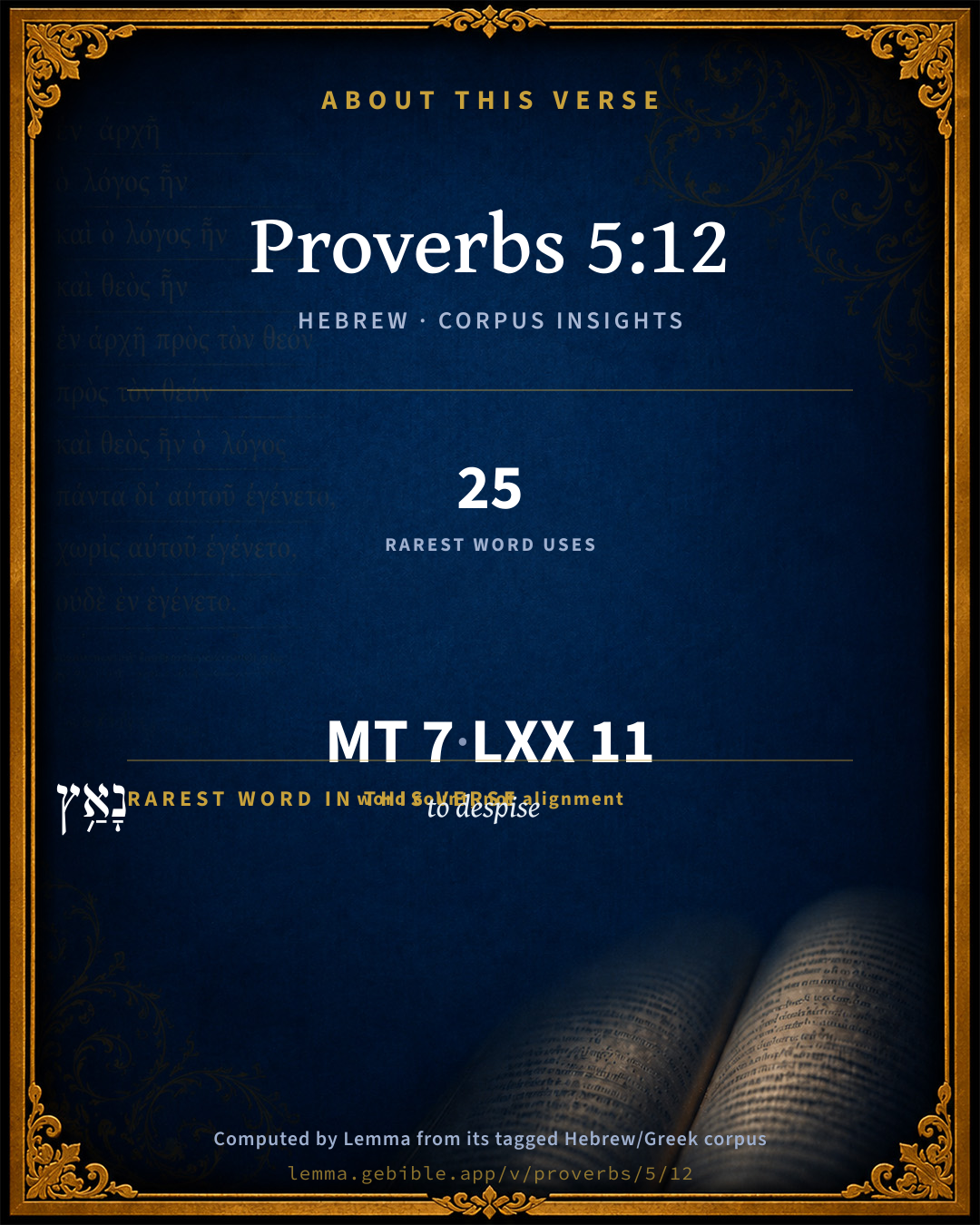
The rarest word here is נָאַ֥ץ to despise H5006 — appearing just 25 times in the whole Hebrew Bible.

Shared distinctive vocabulary

נָאַ֥ץ to despise H5006 occurs in 24 verses of the Hebrew Bible. Also found in:

Grammatical profile

  • 3 verbs
  • 3 nouns
  • 1 particle

Verb forms

  • וְֽאָמַרְתָּ֗ Qal · Sequential Perfect
  • שָׂנֵ֣אתִי Qal · Perfect
  • נָאַ֥ץ Qal · Perfect

Hebrew & Septuagint length

In English translation the verse runs 12 words from the Hebrew and 14 from the Septuagint (LXX English) — closely comparable.

A rough comparison of the two English renderings, which tokenize alike — not a word-level alignment.

Word counts can differ between the Hebrew and the Greek without any difference in meaning — e.g. the Hebrew direct-object marker אֵת has no separate Greek word, and Greek often adds the article ὁ.

In the original languages it is 7 Hebrew tokens and 11 Greek tokens — but the two are counted differently (Hebrew bundles its prefixes and suffixes into one token; the Greek is in lemma form), so that isn’t a like-for-like length.

Cross-references

20

Topical passages linked to Proverbs 5:12 in the Treasury of Scripture Knowledge — connected by theme and wording, ordered by reader-vote popularity; previews shown in the World English Bible.

  • Proverbs 12:1 Whoever loves correction loves knowledge, But he who hates reproof is stupid.
  • Proverbs 1:7 The fear of Yahweh is the beginning of knowledge; But the foolish despise wisdom and instruction.
  • Proverbs 1:22 "How long, you simple ones, will you love simplicity? How long will mockers delight themselves in mockery, And fools hate knowledge?
  • Proverbs 1:25 But you have ignored all my counsel, And wanted none of my reproof;
  • Proverbs 15:5 A fool despises his father's correction, But he who heeds reproof shows prudence.
  • Exodus 2:13–14 He went out the second day, and, behold, two men of the Hebrews were fighting with each other. He said to him who did the wrong, "Why do you strike your fellow?"
  • Psalms 50:17 Seeing you hate instruction, And throw my words behind you?
  • Proverbs 13:18 Poverty and shame come to him who refuses discipline, But he who heeds correction shall be honored.
  • Jeremiah 44:4 However I sent to you all my servants the prophets, rising up early and sending them, saying, Oh, don't do this abominable thing that I hate.
  • Zechariah 1:4–6 Don't you be like your fathers, to whom the former prophets proclaimed, saying: Thus says Yahweh of hosts, 'Return now from your evil ways, and from your evil doings;' but they did not hear, nor listen to me, says Yahweh.
  • John 3:19–20 This is the judgment, that the light has come into the world, and men loved the darkness rather than the light; for their works were evil.
  • Genesis 19:9 They said, "Stand back!" They said, "This one fellow came in to live as a foreigner, and he appoints himself a judge. Now will we deal worse with you, than with them!" They pressed hard on the man, even Lot, and drew near to break the door.
  • 2 Chronicles 24:20–22 The Spirit of God came on Zechariah the son of Jehoiada the priest; and he stood above the people, and said to them, Thus says God, Why disobey you the commandments of Yahweh, so that you can't prosper? because you have forsaken Yahweh, he has also forsaken you.
  • 2 Chronicles 25:16 It happened, as he talked with him, that [the king] said to him, Have we made you of the king's counsel? Stop! Why should you be struck down? Then the prophet stopped, and said, I know that God has determined to destroy you, because you have done this, and have not listened to my counsel.
  • 2 Chronicles 33:10–11 Yahweh spoke to Manasseh, and to his people; but they gave no heed.
  • 2 Chronicles 36:16 but they mocked the messengers of God, and despised his words, and scoffed at his prophets, until the wrath of Yahweh arose against his people, until there was no remedy.
  • Psalms 73:22 I was so senseless and ignorant. I was a brute beast before you.
  • Zechariah 7:11–14 But they refused to listen, and turned their backs, and stopped their ears, that they might not hear.
  • Proverbs 1:29–30 Because they hated knowledge, And didn't choose the fear of Yahweh.
  • Proverbs 6:23 For the commandment is a lamp, And the law is light. Reproofs of instruction are the way of life,

Cross-references courtesy of OpenBible.info (CC BY 4.0).

Hebrew and Greek witnesses Masoretic Hebrew ↔ Greek Septuagint

The same verse in the two great witnesses to the Old Testament, shown verse-for-verse.

These are two independent witnesses, not word-aligned to each other, and the Septuagint is shown in lemma (dictionary) form.

Hebrew Proverbs 5:12 Masoretic · Westminster Leningrad Codex

וְֽאָמַרְתָּ֗ אֵ֭יךְ שָׂנֵ֣אתִי מוּסָ֑ר וְ֝תוֹכַ֗חַת נָאַ֥ץ לִבִּֽי

And say, "How I have hated instruction, And my heart despised reproof;

World English Bible · Public Domain

Greek LXX Proverbs 5:12 Septuagint · lemma form

καί εἶπον πῶς μισέω παιδεία καί ἔλεγχος ἐκκλίνω ὁ καρδία ἐγώ

and you shall say, How have I hated instruction, and my heart avoided reproofs!

LXX2012 (modern English Septuagint) · Public Domain

Hebrew: Westminster Leningrad Codex (CC BY 4.0). Greek: Septuagint (public domain); English from LXX2012 (modern English Septuagint) (Public Domain). How the Septuagint differs from the Hebrew →

Commentary

Notes on Proverbs 5:12 from classic Christian and Jewish commentators (each source and its license shown beneath its notes). The classic Christian expositions comment on the surrounding passage and are grouped to its opening verse, so a note may address several verses; the Jewish commentaries on the Tanakh (Rashi and others) are per-verse, so they appear only where the commentator wrote on this verse.

Lemma curates 59 commentaries, every one of them public domain or Creative Commons licensed, each selected and text-cleaned for this edition rather than reprinted as found. About our sources →

Trapp's Complete Commentary

John Trapp

Pro 5:12 And say, How have I hated instruction, and my heart despised reproof;

Ver. 12. And say, How have I hated, &c.] When cast out with the prodigal, and hath nothing left him but a diseased body, a distressed soul, then, all too late, he fills the air with doleful complaints of his former folly, and cries out, as he did, Totum vitae meae tempus perdidi, quia perdite vixi. {a} Oh, what a wretch, what a beast, what a maddened devil was I, so woefully to waste the fat and marrow of my dear and precious time, the flower of mine age, the strength of my body, the vigour of my spirits, the whole of mine estate, in sinful pleasures and sensual delights! Lo, here is a kind of repentance which, though late, yet, if it were true, would be accepted, {b} The mole, they say, begins to see when he dies, and not till then. Oculos incipit aperire moriendo, quos clausos habuit vivendo. {c} But it is a rare thing, and seldom seen, that any whoremonger doth truly repent. "One such man among a thousand have I found," saith Solomon - perhaps he meant himself - "but a woman among all those have I not found." {Ecc 7:28} And yet Scultetus tells us that Dr Speiser, minister of Ansborough, in Germany, preached there so powerfully, that the common harlots, there tolerated, left their filthy trade of life, and became very honest women. {d}

And my heart despised reproof] Experience shows that they that are once given up to this sin are more graceless, profane, and incorrigible than others, deriders and contemners of all good counsel, having lost even the very light of nature, and so set in their sin, and so wedded and wedged to their wicked ways, as that they cannot be removed but by an extraordinary touch from the hand of Heaven.

{a} Bernard.

{b} Nunquam sero si serio.

{c} Tostat. ex Plinio.

{d} Anno 1523. Scultet., Annal. p. 118.

John Trapp, A Commentary or Exposition upon All the Books of the Old and New Testament (1647–1656) — public domain. Text from a community e-Sword module.

The Biblical Illustrator

Joseph S. Exell

Pro_5:12

And say, How have I hated instruction, and my heart despised reproof.

Conscience as an instrument of punishment

These are supposed to be the words of a young man whose dissolute life had induced disease and want and infamy. He stands out upon the dim verge of life, a beacon light to all who live without God. Remorse, like a fierce vulture, had clutched upon his soul, and despair had cast the shadows of a cheerless night around him. It was from his moral reflections that his keenest anguish arose.

I. The natural authority of conscience, and its consequent power to inflict punishment.

1. If we would appreciate the capacity of the soul to suffer through the morbid action of the moral feelings, we must first understand its internal structure, its several faculties and powers. Man is endowed with various powers of reason, of sensibility, and of action. Of the principles of action, some are mechanical, as instinct and habit; some are animal, as the appetites and some of the desires and affections; and others rational, arising from a knowledge of his relations to other beings, and from a foresight of the proper consequences of his acts. He thus combines in his nature those laws which govern the brute creation with those which declare him to be made in the image of God, and suit him to a state of moral discipline. With this complex nature he is endowed with the power of self-government, which implies the due exercise of all the properties of his being, under the direction and control of one supreme authority. This authority is conscience, which God has enthroned in the human breast with all the attributes of sovereignty. The brute animal rushes on to the gratification of its desires without a thought beyond the immediate object in pursuit. Man brings under his eye the just relations of universal being, chooses and pursues.

2. Consider what a monitor conscience is. It teaches us to perform in good faith, as being right, that which we do; but it does not of itself supply an independent rule of right.

3. The government of conscience is not like that of the animal appetites. Its voice is gentle and persuasive, often drowned in the clamour of passion, or unheeded in the eager pursuit of forbidden pleasure.

4. If conscience is supreme, according to the original constitution of our nature, then, whatever may be the occasional, temporary abuse it may receive from the usurpation of the animal propensities, it must upon the whole, and taking all the range of our existence into the account, possess an ascendant power over man.

5. Go where you will, the natural dread of an accusing conscience will be found to have been the rod of terror to the guilty of all ages. No man will long abide the direct action of self-reproach. The restlessness of the soul, under the action of self-reproach, has displayed itself upon a wide scale in the cumbrous and often sanguinary superstitions of the heathen. We have seen the distress and anguish which a sense of guilt produces in the breast of the awakened sinner.

II. The nature and extent of the punitive action of conscience. In relation to God, a consciousness of guilt is accompanied--

1. With a sense of the loss of Divine favour and fellowship.

2. A sense of guilt is accompanied with an apprehension of punishment. In the breast of every man there exists a belief that this world is under a providential government, from the just awards of which he has something to hope or to fear in a future state of being. In relation to other moral beings, a sense of guilt is accompanied with--

(1) A loss of the confidence and esteem of the holy.

(2) A consciousness of guilt awakens remorse, a complex emotion, consisting of simple regret and moral disapprobation of ones self; in other words, it is moral regret.

Practical considerations:

1. How delusive is that hope of future happiness which, though it is built upon the natural goodness of God, manifested through a Mediator, makes no necessary reckoning of a holy life. It is not in the province of Omnipotence to produce moral happiness in a polluted soul.

2. We here perceive the reasonableness as well as certainty of future punishment. (Freeborn C. Hibbard, M.A.)

Womans lamentation over a wasted life

Women outnumber men in the family, in the Church, in the State, A God-loving, God-fearing womanhood will make a God-loving, God-fearing nationality.

1. A young woman who omits her opportunity of making home happy.

2. A young woman who spends her whole life, or wastes her young womanhood, in selfish display.

3. A young woman who wastes her opportunity of doing good.

4. A young woman who loses her opportunity of personal salvation. Opportunity gone, is gone for ever. Privileges wasted, wasted for ever. The soul lost, lost for ever. (T. De Witt Talmage.)

Self-condemnations

I. Sensualists will be self-condemned in the end.

1. Because of the issue of sin in general, which must come to a self-condemnation.

2. Because of the strength of their sorrow arising out of their troubles.

3. Because of the force of truth, which will overcome all in the end.

4. Because of the power of conscience.

II. That which lies sorest upon the spirits of gross sinners in the end is, slighting instruction.

1. Because it is a great mercy for God to afford teachers.

2. Because not hearkening to instruction is the way to fall into sin, and not hearkening to reproof the way to abide in it.

III. Wicked men heartily hate instruction and slight reproof.

1. Because they are contrary to their corrupt affections and wicked lusts.

2. It appears that they heartily hate them by the malice they bear to the reprovers of their sins, which is vehement and deadly. Their lusts are so strong on them that they hate and slight all reproofs. (Francis Taylor, B.D.)

The Biblical Illustrator, edited by Joseph S. Exell (c. 1880s–1900s) — public domain. Text from a community e-Sword module.

Jamieson, Fausset & Brown

Robert Jamieson, A. R. Fausset & David Brown

The ruined sinner vainly laments his neglect of warning and his sad fate in being brought to public disgrace.

Jamieson, Fausset & Brown — Commentary Critical and Explanatory on the Whole Bible (1871) — public domain (CC PDM 1.0). Text via the HelloAO Bible API.

Ellicott's Commentary for English Readers

(12) How have I hated instruction.—The last stage of misery is the remorse which comes too late. (Comp. Mat_25:30.)

A Bible Commentary for English Readers, edited by Charles John Ellicott (1878–1897) — public domain. Text from a community e-Sword module.

John Gill's Exposition

And say, how have I hated instruction,.... To live virtuously, and avoid the adulterous woman; this he says, as wondering at his stupidity, folly, and madness, that he should hate and abhor that which was so much his interest to have observed. Gersom interprets it of the instruction of the law; but it is much better to understand it of the instruction of the Gospel; which the carnal mind of man is enmity unto, and which they are so stupid as to abhor; when it is of so much usefulness to preserve from error and heresy, superstition, will worship, and idolatry;

and my heart despised reproof; for following the whorish woman; and which was secretly despised in the heart, and heartily too, if not expressed with the mouth: it is one part of the Gospel ministry to reprove for false doctrine and false worship, though it generally falls under the contempt of the erroneous and idolatrous.

John Gill's Exposition of the Whole Bible (1746–1763) — public domain (CC PDM 1.0). Text via the HelloAO Bible API.

Albert Barnes' Notes on the Bible

More bitter than slavery, poverty, disease, will be the bitterness of self-reproach, the hopeless remorse that worketh death.

Albert Barnes' Notes on the Bible (1834–1885) — public domain. Text from a community e-Sword/MySword module.

Matthew Poole's English Annotations

How have I hated instruction! oh what a mad beast have I been, to hate and slight the fair warnings which were given me, and against mine own knowledge, to run headlong into this pit of destruction! which are not the words of a true penitent mourning for and turning from his sin, but only of a man who is grieved for the sad effects of his delightful lusts, and tormented with the horror of his own guilty conscience.

My heart despised reproof; I did with my whole heart abhor all admonitions.

Matthew Poole's English Annotations on the Holy Bible (1683–1685) — public domain. Text from a community e-Sword/MySword module.

Whedon's Commentary on the Bible

Daniel D. Whedon

12, 13. How have I — The repentance and lamentation here exhibited are of the bitterest kind. “In the line of my duty,” says Dr. A. Clarke, “I have often been called to the deathbeds of such persons, whose groans and shrieks were incessant through the jaculating pains in their bones and flesh.” Let youth beware; once entered on this foul course, recovery is almost hopeless.

Daniel D. Whedon (gen. ed.), Commentary on the Old and New Testaments (1874–1909) — public domain. Text from a community e-Sword module.

The Pulpit Commentary

Self-reproach accompanies the unavailable groaning. And say, How have I hated instruction, and my heart despised reproof! i.e. how could it ever come to pass that I have acted in such a senseless and inexcusable manner, that I have hated instruction (musar, disciplina, paideia ), the warning voice which dissuaded me from going with the harlot, and in my heart despised, i.e. rejected inwardly, whatever my outward demeanour may have been, the reproof which followed after I had been with her! Despised (naats), as in Pro_1:30; comp. also Pro_15:5, "A fool despiseth his father"s instructions."

The Pulpit Commentary (1880–1919), ed. H.D.M. Spence-Jones & Joseph S. Exell — public domain. Text from a community e-Sword module.

Keil & Delitzsch

C. F. Keil & F. Delitzsch

The poet now tells those whom he warns to hear how the voluptuary, looking back on his life-course, passes sentence against himself.

12 And thou sayest, "Why have I then hated correction,

And my heart despised instruction!

13 And I have not listened to the voice of my teachers,

Nor lent mine ear to my instructors?

14 I had almost fallen into every vice

In the midst of the assembly and the congregation!"

The question 12a (here more an exclamation than a question) is the combination of two: How has it become possible for me? How could it ever come to it that.... Thus also one says in Arab.: Kyf f'alat hadhâ (Fl.). The regimen of איך in 12b is becoming faint, and in 13b has disappeared. The Kal נאץ (as Pro 1:30; Pro 15:5) signifies to despise; the Piel intensively, to contemn and reject (R. נץ, pungere).

Pro 5:13

שׁמע בּ signifies to cleave to anything in hearing, as ראה ב is to do so in seeing; שׁמע ל yet more closely corresponds with the classic ἐπακούειν, obedire, e.g., Psa 81:9; שׁמע בּקול is the usual phrase for "hearken!"

Pro 5:14

כּמעט with the perf. following is equivalent to: it wanted but a little that this or that should happen, e.g., Gen 26:10. It is now for the most part thus explained: it wanted but a little, and led astray by that wicked companionship I would have been drawn away into crime, for which I would then have been subjected to open punishment (Fl.). Ewald understands רע directly of punishment in its extreme form, stoning; and Hitzig explains כל־רע by "the totality of evil," in so far as the disgraceful death of the criminal comprehends in it all other evils that are less. But בּכל־רע means, either, into every evil, misfortune, or into every wickedness; and since רע, in contradistinction to לב (Hitzig compares Eze 36:5), is a conception of a species, then the meaning is equivalent to in omni genere mali. The reference to the death-punishment of the adulteress is excluded thereby, though it cannot be denied that it might be thought of at the same time, if he who too late comes to consider his ways were distinctly designated in the preceding statements as an adulterer. But it is on the whole a question whether בכל־רע is meant of the evil which follows sin as its consequence. The usage of the language permits this, cf. Sa2 16:8; Exo 5:19; Ch1 7:23; Psa 10:6, but no less the reference to that which is morally bad, cf. Exo 32:22 (where Keil rightly compares with Jo1 5:19); and הייתי (for which in the first case one expected נפלתּי, I fell into, vid., Pro 13:17; Pro 17:20; Pro 28:14) is even more favourable to the latter reference. Also בּתוך קהל ועדה (cf. on the heaping together of synonyms under 11b), this paraphrase of the palam ac publice, with its בּתוך (cf. Psa 111:1; Ch2 20:14), looks rather to a heightening of the moral self-accusation. He found himself in all wickedness, living and moving therein in the midst of the congregation, and thereby giving offence to it, for he took part in the external worship and in the practices of the congregation, branding himself thereby as a hypocrite. That by the one name the congregation is meant in its civil aspect, and by the other in its ecclesiastical aspect, is not to be supposed: in the congregation of the people of the revealed law, the political and the religious sides are not so distinguished. It is called without distinction קהל and עדה (from יעד). Rather we would say that קהל is the whole ecclesia, and עדה the whole of its representatives; but also the great general council bears sometimes the one name (Exo 12:3, cf. 21) and sometimes the other (Deu 31:30, cf. 28) - the placing of them together serves thus only to strengthen the conception.

Keil & Delitzsch — Biblical Commentary on the Old Testament (1861–1891) — public domain (CC PDM 1.0). Text via the HelloAO Bible API. (Old Testament only.)

Lesson kit

Teaching starters — assembled from the data on this page, not authored interpretation. Every prompt links to the verse data it draws on. Edit before teaching.

Proverbs, in the Wisdom, opens this verse with 7 words (7 distinct Hebrew lemmas). Its most distinctive word is nâʼats (“to despise”). A historical commentator’s framing appears above. Read the whole chapter for the surrounding context.

Discussion questions

  1. What does “to despise” (nâʼats) contribute to the verse as a whole?
  2. How does Numbers 14:11, which shares the word «to despise», read alongside this verse?
  3. The translations on this page render this verse differently — a whole-verse word diff, not a word-by-word alignment. What might account for the different wordings?
  4. «וְֽאָמַרְתָּ֗» is a Qal Sequential Perfect verb. How does that grammatical form shape the action described?
  5. Compare how Trapp's Complete Commentary and The Biblical Illustrator read this verse. Where do they agree or differ?

Things to notice

Reading settings

Reading text

Shown beneath each verse's original-language words.

Old Testament
Old Testament edition

Read the OT as the Masoretic Hebrew (MT) or the Greek Septuagint (LXX).

English shown for the Greek Septuagint (in the Hebrew ↔ Greek comparison).

Comparing translations? Open the Compare panel on any verse page to stack up to four side by side.