
Ezekiel 35:6

Hebrew (Westminster Leningrad Codex) Ezekiel 35:6 appears in the Hebrew Old Testament. The text above is from the Westminster Leningrad Codex. Each word links to its Strong’s number, a concise gloss, and parsing drawn from the Open Scriptures Hebrew Bible morphology. Click any word for its full Brown-Driver-Briggs (BDB) entry.
Download image
Cite this verse

Ezekiel 35:6 (World English Bible). Public Domain. Lemma interlinear Bible study tool, https://lemma.gebible.app/v/ezekiel/35/6.

Show BibTeX & RIS
BibTeX
RIS
English Translation
therefore, as I live, says the Lord Yahweh, I will prepare you to blood, and blood shall pursue you: since you have not hated blood, therefore blood shall pursue you.
World English Bible · Public Domain
Download a study sheet

One document with this verse’s original text, its word-by-word gloss line, the meaning frame, cross-references with their text, attributed commentary, and full source and license credits — printable, and it pastes into notes with its structure intact.

This verse Autodidact and up

Study sheet (.html) Plain text (.txt)

A passage Seminary Student

Up to 50 verses in one chapter. A passage sheet keeps up to 6 commentary sources and 12 cross-references per verse, in the order this page ranks them, and says so on the sheet whenever that leaves anything out. Ask for a single verse and you get the Autodidact verse sheet above.

Everything on this page stays free to read, with no account — the sheet is a download of what is already on screen, not access to it.

Want to remove ads? Support Godless Engineer
Compare translations 3

The same verse in 3 English versions, stacked beneath the original-language interlinear above. Click any original word for its lexicon entry.

Each is an independent rendering of the whole verse — the interlinear is not word-aligned to these translations.

Highlighted words mark where these versions differ — a whole-verse word diff, not a word-by-word alignment.

  • World English Bible Public Domain
    therefore, as I live, says the Lord Yahweh, I will prepare you to blood, and blood shall pursue you: since you have not hated blood, therefore blood shall pursue you.
  • King James Version Public Domain
    Therefore, as I live, saith the Lord GOD, I will prepare thee unto blood, and blood shall pursue thee: sith thou hast not hated blood, even blood shall pursue thee.
  • unfoldingWord Literal Text CC BY-SA 4.0
    Therefore, as I live—this is the Lord Yahweh’s declaration—I will prepare you for bloodshed, and bloodshed will pursue you! Since you did not hate bloodshed, bloodshed will pursue you.

unfoldingWord Literal Text — © unfoldingWord, licensed CC BY-SA 4.0. Word-aligned USFM3 via Door43 (git.door43.org/unfoldingWord/en_ult).

Versions to compare (up to 4)

3 of 4 selected

Show all 18 translations

Every available English version of this verse, each an independent rendering of the whole verse.

  • World English Bible Public Domain
    therefore, as I live, says the Lord Yahweh, I will prepare you to blood, and blood shall pursue you: since you have not hated blood, therefore blood shall pursue you.
  • Berean Standard Bible Public Domain
    therefore as surely as I live, declares the Lord GOD, I will give you over to bloodshed and it will pursue you. Since you did not hate bloodshed, it will pursue you.
  • Majority Standard Bible Public Domain
    therefore as surely as I live, declares the Lord GOD, I will give you over to bloodshed and it will pursue you. Since you did not hate bloodshed, it will pursue you.
  • King James Version Public Domain
    Therefore, as I live, saith the Lord GOD, I will prepare thee unto blood, and blood shall pursue thee: sith thou hast not hated blood, even blood shall pursue thee.
  • American Standard Version (1901) Public Domain
    therefore, as I live, saith the Lord Jehovah, I will prepare thee unto blood, and blood shall pursue thee: since thou hast not hated blood, therefore blood shall pursue thee.
  • Revised Version (1885) Public Domain
    therefore, as I live, saith the Lord GOD, I will prepare thee unto blood, and blood shall pursue thee: sith thou hast not hated blood, therefore blood shall pursue thee.
  • Geneva Bible (1599) Public Domain
    Therefore as I liue, sayth the Lord God, I wil prepare thee vnto blood, and blood shall pursue thee: except thou hate blood, euen blood shall pursue thee.
  • Douay-Rheims (1899) Public Domain
    Therefore as I live, saith the Lord God, I will deliver thee up to blood, and blood shall pursue thee: and whereas thou hast hated blood, blood shall pursue thee.
  • Young's Literal Translation Public Domain
    Therefore, I live -- an affirmation of the Lord Jehovah, Surely for blood I do appoint thee, And blood doth pursue thee, If blood thou hast not hated, Blood also doth pursue thee.
  • Literal Standard Version CC BY-SA 4.0
    Therefore, [as] I live—a declaration of Lord YHWH, || Surely I appoint you for blood, || And blood pursues you, || If you have not hated blood, || Blood also pursues you.
  • Unlocked Literal Bible CC BY-SA 4.0
    Therefore, as I live—this is the Lord Yahweh's declaration—I will prepare you for bloodshed, and bloodshed will pursue you! Since you did not hate bloodshed, bloodshed will pursue you.
  • unfoldingWord Literal Text CC BY-SA 4.0
    Therefore, as I live—this is the Lord Yahweh’s declaration—I will prepare you for bloodshed, and bloodshed will pursue you! Since you did not hate bloodshed, bloodshed will pursue you.
  • Darby Bible Public Domain
    therefore, [as] I live, saith the Lord Jehovah, I will certainly appoint thee unto blood, and blood shall pursue thee; since thou hast not hated blood, blood shall pursue thee.
  • World Messianic Bible Public Domain
    therefore, as I live,” says the Lord GOD, “I will prepare you for blood, and blood will pursue you. Since you have not hated blood, therefore blood will pursue you.
  • Webster's Bible Public Domain
    Therefore, as I live, saith the Lord GOD, I will prepare thee to blood, and blood shall pursue thee: since thou hast not hated blood, even blood shall pursue thee.
  • Free Bible Version CC BY-SA 4.0
    So as I live, declares the Lord God, I will let you be violently attacked and chased down. Since you did not hate bloodshed, bloodshed will come after you.
  • Bible in Basic English Public Domain
    For this cause, by my life, says the Lord, because you have been sinning through blood, blood will come after you.
  • JPS Tanakh (1917) Public Domain
    therefore, as I live, saith the Lord GOD, I will prepare thee unto blood, and blood shall pursue thee; surely thou hast hated thine own blood, therefore blood shall pursue thee.

Literal Standard Version (2020), Covenant Press — licensed CC BY-SA 4.0. Text via the HelloAO Bible API (eBible.org). Unlocked Literal Bible (unfoldingWord) — licensed CC BY-SA 4.0. Text via the HelloAO Bible API (eBible.org). unfoldingWord Literal Text — © unfoldingWord, licensed CC BY-SA 4.0. Word-aligned USFM3 via Door43 (git.door43.org/unfoldingWord/en_ult). Free Bible Version, Dr. Jonathan Gallagher — licensed CC BY-SA 4.0. Text via the HelloAO Bible API (eBible.org).

Word by word

More ways to search: Search by grammar → Find every occurrence → Compare this word →

Practice this passage: Drill this verse → Learn its vocabulary →

יִרְדֲּפֶ֑ךָ
râdaph
H7291
“to pursue · you”
Verb, Qal, Imperfect, 3rd Person, Masculine, Singular + Suffix, Personal, 2nd Person, Masculine, Singular
Part of Speech
Verb
Stem
Qal
Form
Imperfect
Person
3rd Person
Gender
Masculine
Number
Singular
Full BDB Definition

Origin: a primitive root

TWOT: 2124

to be behind, follow after, pursue, persecute, run after - (Qal) - to pursue, put to flight, chase, dog, attend closely upon - to persecute, harass (figuratively) - to follow after, aim to secure (figuratively) - to run after (a bribe) (figuratively) - (Niphal) - to be pursued - one pursued (participle) - (Piel) to pursue ardently, aim eagerly to secure, pursue - (Pual) to be pursued, be chased away - (Hiphil) to pursue, chase
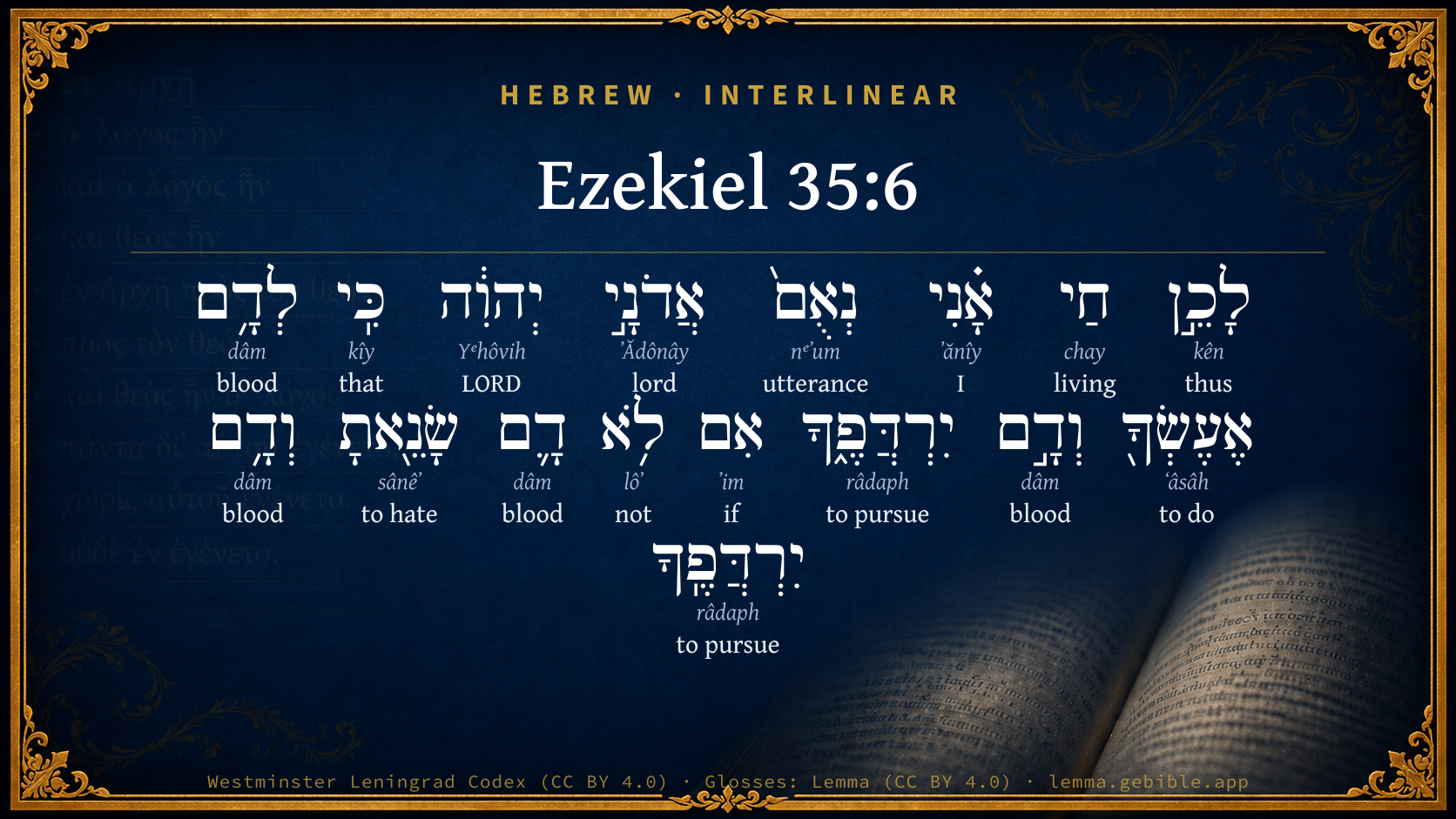
  1. לָכֵ֣ן kên H3651 “to/for · thus” Preposition + Adverb
  2. חַי chay H2416 “living” Adjective, Adjective, Masculine, Singular, Absolute
  3. אָ֗נִי ʼănîy H589 “I” Pronoun, Personal, 1st Person, Common, Singular
  4. נְאֻם֙ nᵉʼum H5002 “utterance of” Noun, Common, Masculine, Singular, Construct
  5. אֲדֹנָ֣י ʼĂdônây H136 “Lord · my” Noun, Common, Masculine, Plural, Construct + Suffix, Personal, 1st Person, Common, Singular
  6. יְהוִ֔ה Yᵉhôvih H3069 “LORD” Noun, Proper
  7. כִּֽי kîy H3588 “that” Conjunction
  8. לְדָ֥ם dâm H1818 “to/for · blood” Preposition + Noun, Common, Masculine, Singular, Absolute
  9. אֶעֶשְׂךָ֖ ʻâsâh H6213 “to do · you” Verb, Qal, Imperfect, 1st Person, Common, Singular + Suffix, Personal, 2nd Person, Masculine, Singular
  10. וְדָ֣ם dâm H1818 “and · blood” Conjunction + Noun, Common, Masculine, Singular, Absolute
  11. אִם ʼim H518 “if” Conjunction
  12. לֹ֥א lôʼ H3808 “not” Particle, Negative
  13. דָ֛ם dâm H1818 “blood” Noun, Common, Masculine, Singular, Absolute
  14. שָׂנֵ֖אתָ sânêʼ H8130 “to hate” Verb, Qal, Perfect, 2nd Person, Masculine, Singular
  15. וְדָ֥ם dâm H1818 “and · blood” Conjunction + Noun, Common, Masculine, Singular, Absolute
  16. יִרְדֲּפֶֽךָ râdaph H7291 “to pursue · you” Verb, Qal, Imperfect, 3rd Person, Masculine, Singular + Suffix, Personal, 2nd Person, Masculine, Singular

About this verse

These counts appear in no published source. They are computed here, from the morphology-tagged text and Lemma’s own curated glosses. What Lemma adds →

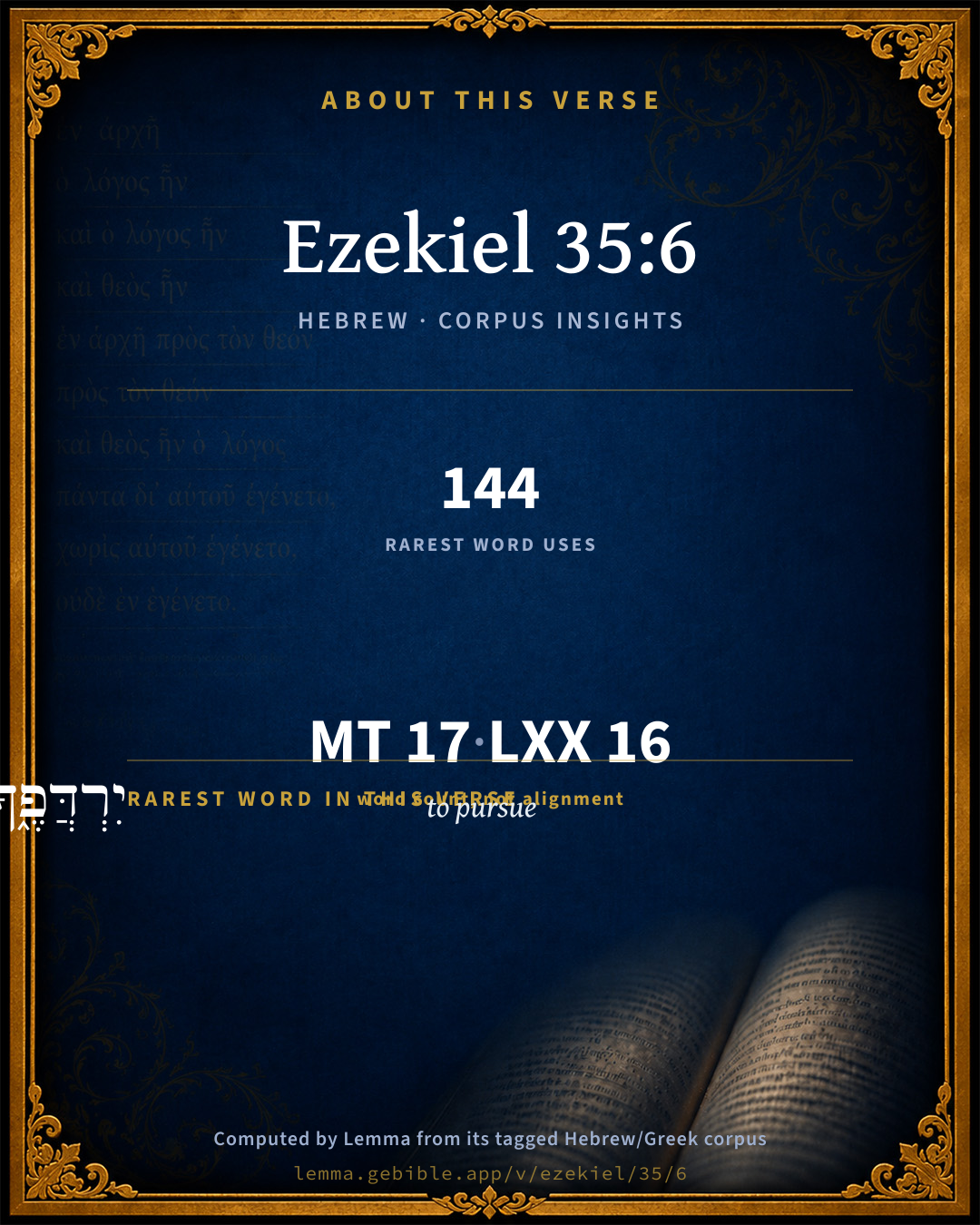
17
words
13
distinct lemmas
Prophets
section

Grammatical profile

  • 4 verbs
  • 7 nouns
  • 1 adjective
  • 1 pronoun
  • 2 conjunctions
  • 1 adverb
  • 1 particle

Verb forms

  • אֶעֶשְׂךָ֖ Qal · Imperfect
  • יִרְדֲּפֶ֑ךָ Qal · Imperfect
  • שָׂנֵ֖אתָ Qal · Perfect
  • יִרְדֲּפֶֽךָ Qal · Imperfect

Repetition

Words recur within this verse — often emphatic in Hebrew:

  • לְדָ֥ם blood H1818 ×4
  • יִרְדֲּפֶ֑ךָ to pursue H7291 ×2

Hebrew & Septuagint length

In English translation the verse runs 30 words from the Hebrew and 20 from the Septuagint (LXX English) — the Septuagint runs noticeably shorter here. See the side-by-side →

A rough comparison of the two English renderings, which tokenize alike — not a word-level alignment.

Word counts can differ between the Hebrew and the Greek without any difference in meaning — e.g. the Hebrew direct-object marker אֵת has no separate Greek word, and Greek often adds the article ὁ.

In the original languages it is 17 Hebrew tokens and 16 Greek tokens — but the two are counted differently (Hebrew bundles its prefixes and suffixes into one token; the Greek is in lemma form), so that isn’t a like-for-like length.

Cross-references

8

Topical passages linked to Ezekiel 35:6 in the Treasury of Scripture Knowledge — connected by theme and wording, ordered by reader-vote popularity; previews shown in the World English Bible.

  • Isaiah 63:2–6 Why are you red in your clothing, and your garments like him who treads in the wine vat?
  • Obadiah 1:15 For the day of Yahweh is near all the nations! As you have done, it will be done to you. Your deeds will return upon your own head.
  • Revelation 18:24 In her was found the blood of prophets and of saints, and of all who have been slain on the earth."
  • Psalms 109:16–17 Because he didn't remember to show kindness, But persecuted the poor and needy man, The broken in heart, to kill them.
  • Matthew 7:2 For with whatever judgment you judge, you will be judged; and with whatever measure you measure, it will be measured to you.
  • Revelation 16:5–7 I heard the angel of the waters saying, "You are righteous, who are and who were, you Holy One, because you have judged these things.
  • Revelation 18:6 Return to her just as she returned, and repay her double as she did, and according to her works. In the cup which she mixed, mix to her double.
  • Revelation 19:2–3 for true and righteous are his judgments. For he has judged the great prostitute, who corrupted the earth with her sexual immorality, and he has avenged the blood of his servants at her hand."

Cross-references courtesy of OpenBible.info (CC BY 4.0).

Hebrew and Greek witnesses Masoretic Hebrew ↔ Greek Septuagint

The same verse in the two great witnesses to the Old Testament, shown verse-for-verse.

Here the Septuagint runs noticeably shorter than the Hebrew — LXX2012 (modern English Septuagint) 20 words vs World English Bible 30. A rough length comparison of the two English translations, not a word-level alignment — read both below.

These are two independent witnesses, not word-aligned to each other, and the Septuagint is shown in lemma (dictionary) form.

Hebrew Ezekiel 35:6 Masoretic · Westminster Leningrad Codex

לָכֵ֣ן חַי אָ֗נִי נְאֻם֙ אֲדֹנָ֣י יְהוִ֔ה כִּֽי לְדָ֥ם אֶעֶשְׂךָ֖ וְדָ֣ם יִרְדֲּפֶ֑ךָ אִם לֹ֥א דָ֛ם שָׂנֵ֖אתָ וְדָ֥ם יִרְדֲּפֶֽךָ

therefore, as I live, says the Lord Yahweh, I will prepare you to blood, and blood shall pursue you: since you have not hated blood, therefore blood shall pursue you.

World English Bible · Public Domain

Greek LXX Ezekiel 35:6 Septuagint · lemma form

διά οὗτος ζάω ἐγώ λέγω κύριος κύριος εἰ μήν εἰς αἷμα ἁμαρτάνω καί αἷμα σύ διώκω

Therefore, as I live, says the Lord God, verily you have sinned even to blood, therefore blood shall pursue you.

LXX2012 (modern English Septuagint) · Public Domain

On this verse, The Cambridge Bible for Schools and Colleges discusses the Septuagint’s reading. Read the note in Commentary ↓

Hebrew: Westminster Leningrad Codex (CC BY 4.0). Greek: Septuagint (public domain); English from LXX2012 (modern English Septuagint) (Public Domain). How the Septuagint differs from the Hebrew →

Targum (Aramaic paraphrase)

1

The Targum is the ancient Jewish Aramaic paraphrase of the Hebrew Scriptures — an interpretive translation, not the Hebrew text itself. Onkelos (literal) and Pseudo-Jonathan (expansive) render the Torah, and Jonathan the Prophets. Coverage is partial: where no permissively-licensed English translation exists for a verse, only the Aramaic is shown. This is verse-level text, not a word-by-word alignment to the Hebrew.

  1. Targum Jonathan Prophets (Joshua–Malachi)
    בְּכֵן קַיָם אֲנָא אֲמַר יְיָ אֱלֹהִים אֲרֵי לִקְטוֹל אַעְבְּדִינָךְ וּדְקַטְלִין בְּחַרְבָּא יִרְדְפוּנָךְ אִם לָא דְמָא יִרְדְפוּנָךְ:

    (no public-domain English translation for this verse)

    Targum Jonathan — Aramaic: “Mikraot Gedolot” (public domain). English: “Sefaria Community Translation” (CC0 1.0 (public-domain dedication)); “London "Chaldee Paraphrase," 1871” (public domain). Text via Sefaria.

Commentary

Notes on Ezekiel 35:6 from classic Christian and Jewish commentators (each source and its license shown beneath its notes). The classic Christian expositions comment on the surrounding passage and are grouped to its opening verse, so a note may address several verses; the Jewish commentaries on the Tanakh (Rashi and others) are per-verse, so they appear only where the commentator wrote on this verse.

Lemma curates 59 commentaries, every one of them public domain or Creative Commons licensed, each selected and text-cleaned for this edition rather than reprinted as found. About our sources →

Trapp's Complete Commentary

John Trapp

Eze 35:6 Therefore, [as] I live, saith the Lord GOD, I will prepare thee unto blood, and blood shall pursue thee: sith thou hast not hated blood, even blood shall pursue thee.

Ver. 6. I will prepare thee unto blood.] Thou shalt have blood thy bellyful, which thou hast so greedily sought and sucked. Satiabis te sanguine quem sitiisti, cuiusque insatiabilis semper fuisti, as the Scythian queen said to Cyrus’s head.

Even blood shall pursue thee.] As a bloodhound. It shall, it shall, believe me it shall.

John Trapp, A Commentary or Exposition upon All the Books of the Old and New Testament (1647–1656) — public domain. Text from a community e-Sword module.

Geneva Bible (1599)

Geneva Bible translators

Except thou repent thy former cruelty.

Geneva Bible (1599) marginal notes — public domain. Text via Bolls.life.

Jamieson, Fausset & Brown

Robert Jamieson, A. R. Fausset & David Brown

I will prepare thee unto blood--I will expose thee to slaughter.

sith--old English for "seeing that" or "since."

thou hast not hated blood--The Hebrew order is, "thou hast hated not blood"; that is, thou couldst not bear to live without bloodshed [GROTIUS]. There is a play on similar sounds in the Hebrew; Edom resembling dam, the Hebrew for "blood"; as "Edom" means "red," the transition to "blood" is easy. Edom, akin to blood in name, so also in nature and acts; "blood therefore shall pursue thee." The measure which Edom meted to others should be meted to himself (Psa 109:17; Mat 7:2; Mat 26:52).

Jamieson, Fausset & Brown — Commentary Critical and Explanatory on the Whole Bible (1871) — public domain (CC PDM 1.0). Text via the HelloAO Bible API.

Adam Clarke's Commentary

Verse 6. Blood shall pursue thee] Thou lovest blood, and thou shalt have blood. It is said that Cyrus and two hundred thousand men were slain in an ambush by Thomyris, queen of the Scythians, and that she cut off his head, and threw it into a vessel filled with blood, with this severe sarcasm: -

Satia te sanguine quem sitisti, Cyre.

"O Cyrus, now satisfy thyself with blood."

Hence, the figure: -

"Sarcasmus, with this biting taunt doth kill:

Cyrus, thy thirst was blood, now drink thy fill."

Adam Clarke's Commentary on the Bible (1810–1826) — public domain. Text from a community e-Sword/MySword module.

Ellicott's Commentary for English Readers

(6) I will prepare thee unto blood.—Rather, I will make thee blood. There is here a play upon the name of Edom in the original: I will make thee dom (=blood); Edom itself means red. The latter part of the verse brings out, as frequently, the congruity of the punishment: violence shall come upon him who has loved (“not hated “) violence.

A Bible Commentary for English Readers, edited by Charles John Ellicott (1878–1897) — public domain. Text from a community e-Sword module.

The Cambridge Bible for Schools and Colleges

gen. ed. J. J. S. Perowne

6. prepare thee unto blood] make thee blood (cf. Eze_16:38, and on Eze_34:26), i.e. all blood—give thee over to universal slaughter. The clause “I will … pursue thee” is wanting in LXX.

sith thou hast not hated] The words might mean: surely thou hast hated (hatest) blood, and blood shall …, a sense not very clear, but probably similar to Eze_11:8, “Ye fear the sword, and I will bring the sword.” LXX. reads: ye have sinned even unto blood (Eze_22:4).

The Cambridge Bible for Schools and Colleges (gen. ed. J. J. S. Perowne; Cambridge University Press, 1878–1918) — public domain. Text from a community e-Sword module.

John Gill's Exposition

Therefore, as I live, saith the Lord God,.... The form of an oath; the Lord swears by himself, because he could swear by no greater; and which he never does but in matters of importance, and for the confirmation of them, as the following is:

I will prepare thee unto blood; prepare them for war, which will issue in slaughter and blood, such as the battle at Armageddon, Rev 16:14, or, "I will make thee blood" (w); nothing else but blood; a mere "Aceldama", a field of blood; turn thee into blood, as the sea, rivers, and fountains will be, at the pouring out the second and third vials, Rev 16:3,

and blood shall pursue thee; the guilt and vengeance of blood; or the avengers of the blood of the saints; the angels that shall pour out the vials of wrath on Rome; the ten kings that shall hate the whore. So the Targum;

"they that slay with the sword shall pursue thee;''

or the shedders of blood, as Ben Melech:

saith thou hast not hated blood; Jarchi reads it; "hast hated blood": which he interprets of the blood of the sacrifices; as others, mentioned by him, of the blood of circumcision; and others, of his brother, who was his flesh and blood, and hated by him; but it is a figurative phrase, by which less is expressed than is intended. The sense is, thou hast loved blood; thou hast delighted in shedding blood; hast thirsted after it, and drank plentifully of it, and even been drunk with it, as the whore of Rome is said to be, Rev 17:5,

even blood shall pursue thee; this is repeated for the confirmation of it; and this was measure for measure; a just retaliation; having shed blood, it was but right that blood should pursue, and be given, Rev 16:5.

(w) "in sanguinem redigam te", Munster; "in sanguinem faciam te", Grotius; "sanguinem faciam te", Coceeius, Starckius.

John Gill's Exposition of the Whole Bible (1746–1763) — public domain (CC PDM 1.0). Text via the HelloAO Bible API.

Haydock's Catholic Bible Commentary

Blood. The Machabees sprung from the same stock. Pursue the Idumeans, and force them to receive circumcision, 1 Machabees iv. 15.

George Leo Haydock (1774–1849), Haydock's Catholic Family Bible and Commentary, 1859 edition — public domain. Excludes Psalms (Douay-Rheims chapter numbering differs from Protestant) and Deuterocanonical books (Catholic canon only).

Matthew Poole's English Annotations

As I live: God is true and constant to his threats against hardened sinners, and will be so as sure as he lives.

Prepare thee unto blood; I will dispose all things for war against thee, for a bloody war, in which thy blood shall be shed.

Blood, thy guilt and my just revenges of innocent blood, shall pursue thee, never leave till thou die for it.

Hast not hated blood; hast loved, rather than hated, bloodshed; therefore vengeance for it follows thee.

Matthew Poole's English Annotations on the Holy Bible (1683–1685) — public domain. Text from a community e-Sword/MySword module.

The Pulpit Commentary

I will prepare thee unto blood. This peculiar expression was probably selected because of the suggestion of the name Edom ("red") contained in the term dam ("blood") though Smend doubts this and designed to intimate that Edom"s name would eventually be verified in Edom"s fate. And blood shall pursue thee. "As blood-guiltiness invariably pursues a murderer, cries for vengeance, and delivers him up to punishment" (Havernick), so should blood follow in the steps of Edom. The translation of Ewald, who reads instead of "And because thy inclination is after blood, therefore blood shall pursue thee," is hardly an improvement, and is besides unnecessary. Sith thou hast not hated blood . So render Ewald, Keil, Kliefoth, Havernick, Schroder, Plumptre, and the Revised Version, meaning that Edom had loved bloodshed. Kimchi, Hitzig, Hengstenberg, Smend, and Fairbairn regard aloAmai as a particle of strong affirmation, equivalent to "forsooth," "verily," and understand the prophet to say that "Edom had hated blood. As to the precise import of this rendering, diversity of sentiment prevails. Some, with Theodoret, explain "blood" as an allusion to the blood-relationship of Esau and Jacob, Edom and Israel, and hold the charge to be that Edom had hated his "brother" Israel. Others, with Hengstenberg, take the blood Edom hated to be the blood he had shed. Hitzig and Fairbairn suppose the sense to be that Edom hated the idea of his own blood being shed. Even better, therefore (Revised Version)blood shall pursue thee. A parallel to this expression is supplied by Deu_28:22, Deu_28:45. According to the first or commonly accepted exposition of thepreceding clause, the sense is that Edom would ultimately fall beneath the great law of retribution, and reap as she had sown blood for blood; according to the second, the allusion is to the fact that what Edom now most dreaded, the shedding of his own blood, would be that which should ultimately overtake him. (cf. Eze_11:8; Job_3:25)

The Pulpit Commentary (1880–1919), ed. H.D.M. Spence-Jones & Joseph S. Exell — public domain. Text from a community e-Sword module.

John Wesley's Explanatory Notes

And blood - Thy guilt, and my just revenge of innocent blood. Hast not hated - Thou hast loved, rather than hated, blood-shed; therefore vengeance for it follows thee.

John Wesley, Explanatory Notes Upon the Whole Bible (1754–1765) — public domain. Text via the GEBible commentary corpus.

Rashi

Rabbi Shlomo Yitzchaki (Rashi)

I shall make you into blood falling by the sword.

you hated blood You despised the birthright, for its sacrificial service was handed over to them (sic), but “you hated” to filthy yourself with the blood of sacrificial offerings in worship of Me. And the filth of the blood of the slain will pursue you. Others say: You hated the blood of circumcision (Gen. Rabbah 63:13). Others say: You fear murderers just as anyone else, and murderers will pursue you. Others say: “You hated blood,” [meaning that you hated] your brother, who is your flesh and blood.

Rashi on the Tanakh — English translations: “The Judaica Press complete Tanach with Rashi, translated by A. J. Rosenberg” (CC BY 4.0); “Pentateuch with Rashi's commentary by M. Rosenbaum and A.M. Silbermann, 1929-1934” (public domain); “The Metsudah Tanach series, Lakewood, N.J” (CC BY 4.0); and “The Book of Joshua, Metsudah Publications, 1997” (CC BY 4.0). Text via Sefaria.

Lesson kit

Teaching starters — assembled from the data on this page, not authored interpretation. Every prompt links to the verse data it draws on. Edit before teaching.

Ezekiel, in the Prophets, opens this verse with 17 words (13 distinct Hebrew lemmas). Its most distinctive word is râdaph (“to pursue”). The Greek Septuagint runs shorter here. A historical commentator’s framing appears above. Read the whole chapter for the surrounding context.

Discussion questions

  1. How does “to pursue” (râdaph) shape what this verse is saying?
  2. How does Isaiah 63:2–6, which shares this passage’s theme, read alongside this verse?
  3. What does the repetition of “blood” (4× in this one verse) do in this verse?
  4. The Septuagint runs shorter here than the Hebrew. What might account for the difference?
  5. These translations render this verse differently; the difference is in the English rendering, not the original. What questions does that raise?
  6. «אֶעֶשְׂךָ֖» is a Qal Imperfect verb. How does that grammatical form shape the action described?
  7. Compare how Trapp's Complete Commentary and Geneva Bible (1599) read this verse. Where do they agree or differ?

Things to notice

Reading settings

Reading text

Shown beneath each verse's original-language words.

Old Testament
Old Testament edition

Read the OT as the Masoretic Hebrew (MT) or the Greek Septuagint (LXX).

English shown for the Greek Septuagint (in the Hebrew ↔ Greek comparison).

Comparing translations? Open the Compare panel on any verse page to stack up to four side by side.