
Deuteronomy 22:13

Hebrew (Westminster Leningrad Codex) Deuteronomy 22:13 appears in the Hebrew Old Testament. The text above is from the Westminster Leningrad Codex. Each word links to its Strong’s number, a concise gloss, and parsing drawn from the Open Scriptures Hebrew Bible morphology. Click any word for its full Brown-Driver-Briggs (BDB) entry.
Download image
Cite this verse

Deuteronomy 22:13 (World English Bible). Public Domain. Lemma interlinear Bible study tool, https://lemma.gebible.app/v/deuteronomy/22/13.

Show BibTeX & RIS
BibTeX
RIS
English Translation
If any man take a wife, and go in to her, and hate her,
World English Bible · Public Domain
Download a study sheet

One document with this verse’s original text, its word-by-word gloss line, the meaning frame, cross-references with their text, attributed commentary, and full source and license credits — printable, and it pastes into notes with its structure intact.

This verse Autodidact and up

Study sheet (.html) Plain text (.txt)

A passage Seminary Student

Up to 50 verses in one chapter. A passage sheet keeps up to 6 commentary sources and 12 cross-references per verse, in the order this page ranks them, and says so on the sheet whenever that leaves anything out. Ask for a single verse and you get the Autodidact verse sheet above.

Everything on this page stays free to read, with no account — the sheet is a download of what is already on screen, not access to it.

Want to remove ads? Support Godless Engineer
Compare translations 3

The same verse in 3 English versions, stacked beneath the original-language interlinear above. Click any original word for its lexicon entry.

Each is an independent rendering of the whole verse — the interlinear is not word-aligned to these translations.

Highlighted words mark where these versions differ — a whole-verse word diff, not a word-by-word alignment.

  • World English Bible Public Domain
    If any man take a wife, and go in to her, and hate her,
  • King James Version Public Domain
    If any man take a wife, and go in unto her, and hate her,
  • unfoldingWord Literal Text CC BY-SA 4.0
    If a man takes a wife, and he goes in to her and hates her

unfoldingWord Literal Text — © unfoldingWord, licensed CC BY-SA 4.0. Word-aligned USFM3 via Door43 (git.door43.org/unfoldingWord/en_ult).

Versions to compare (up to 4)

3 of 4 selected

Show all 18 translations

Every available English version of this verse, each an independent rendering of the whole verse.

  • World English Bible Public Domain
    If any man take a wife, and go in to her, and hate her,
  • Berean Standard Bible Public Domain
    Suppose a man marries a woman, has relations with her, and comes to hate her,
  • Majority Standard Bible Public Domain
    Suppose a man marries a woman, has relations with her, and comes to hate her,
  • King James Version Public Domain
    If any man take a wife, and go in unto her, and hate her,
  • American Standard Version (1901) Public Domain
    If any man take a wife, and go in unto her, and hate her,
  • Revised Version (1885) Public Domain
    If any man take a wife, and go in unto her, and hate her,
  • Geneva Bible (1599) Public Domain
    If a man take a wife, and when he hath lyen with her, hate her,
  • Douay-Rheims (1899) Public Domain
    If a man marry a wife, and afterwards hate her,
  • Young's Literal Translation Public Domain
    `When a man taketh a wife, and hath gone in unto her, and hated her,
  • Literal Standard Version CC BY-SA 4.0
    When a man takes a wife, and has gone in to her, and hated her,
  • Unlocked Literal Bible CC BY-SA 4.0
    Suppose a man takes a wife, sleeps with her, and then hates her,
  • unfoldingWord Literal Text CC BY-SA 4.0
    If a man takes a wife, and he goes in to her and hates her
  • Darby Bible Public Domain
    If a man take a wife, and go in unto her and hate her,
  • World Messianic Bible Public Domain
    If any man takes a wife, and goes in to her, hates her,
  • Webster's Bible Public Domain
    If any man shall take a wife, and go in to her, and hate her,
  • Free Bible Version CC BY-SA 4.0
    It may happen that a man marries a woman and sleeps with her, but ends up hating her,
  • Bible in Basic English Public Domain
    If any man takes a wife, and having had connection with her, has no delight in her,
  • JPS Tanakh (1917) Public Domain
    If any man take a wife, and go in unto her, and hate her,

Literal Standard Version (2020), Covenant Press — licensed CC BY-SA 4.0. Text via the HelloAO Bible API (eBible.org). Unlocked Literal Bible (unfoldingWord) — licensed CC BY-SA 4.0. Text via the HelloAO Bible API (eBible.org). unfoldingWord Literal Text — © unfoldingWord, licensed CC BY-SA 4.0. Word-aligned USFM3 via Door43 (git.door43.org/unfoldingWord/en_ult). Free Bible Version, Dr. Jonathan Gallagher — licensed CC BY-SA 4.0. Text via the HelloAO Bible API (eBible.org).

Word by word

More ways to search: Search by grammar → Find every occurrence → Compare this word →

Practice this passage: Drill this verse → Learn its vocabulary →

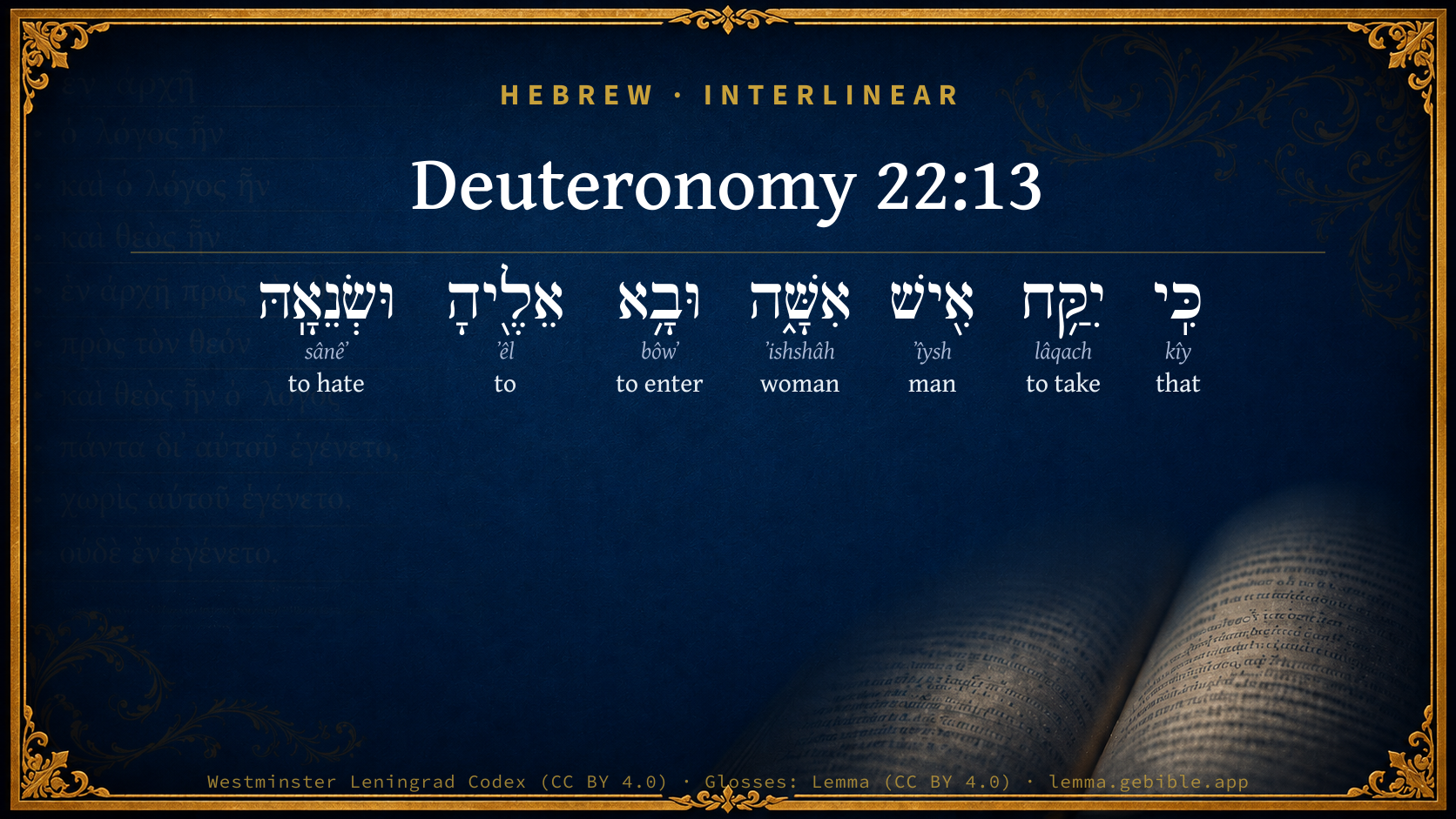
וּשְׂנֵאָֽהּ
sânêʼ
H8130
“and · to hate · her”
Conjunction + Verb, Qal, Sequential Perfect, 3rd Person, Masculine, Singular + Suffix, Personal, 3rd Person, Feminine, Singular
Part of Speech
Conjunction + Verb
Stem
Qal
Form
Sequential Perfect
Person
3rd Person
Gender
Masculine
Number
Singular
Full BDB Definition

Origin: a primitive root

TWOT: 2272

to hate, be hateful - (Qal) to hate - of man - of God - hater, one hating, enemy (participle) (substantive) - (Niphal) to be hated - (Piel) hater (participle) - of persons, nations, God, wisdom
  1. כִּֽי kîy H3588 “that” Conjunction
  2. יִקַּ֥ח lâqach H3947 “to take” Verb, Qal, Imperfect, 3rd Person, Masculine, Singular
  3. אִ֖ישׁ ʼîysh H376 “man” Noun, Common, Masculine, Singular, Absolute
  4. אִשָּׁ֑ה ʼishshâh H802 “woman” Noun, Common, Feminine, Singular, Absolute
  5. וּבָ֥א bôwʼ H935 “and · to enter” Conjunction + Verb, Qal, Sequential Perfect, 3rd Person, Masculine, Singular
  6. אֵלֶ֖יהָ ʼêl H413 “to · her” Preposition + Suffix, Personal, 3rd Person, Feminine, Singular

About this verse

These counts appear in no published source. They are computed here, from the morphology-tagged text and Lemma’s own curated glosses. What Lemma adds →

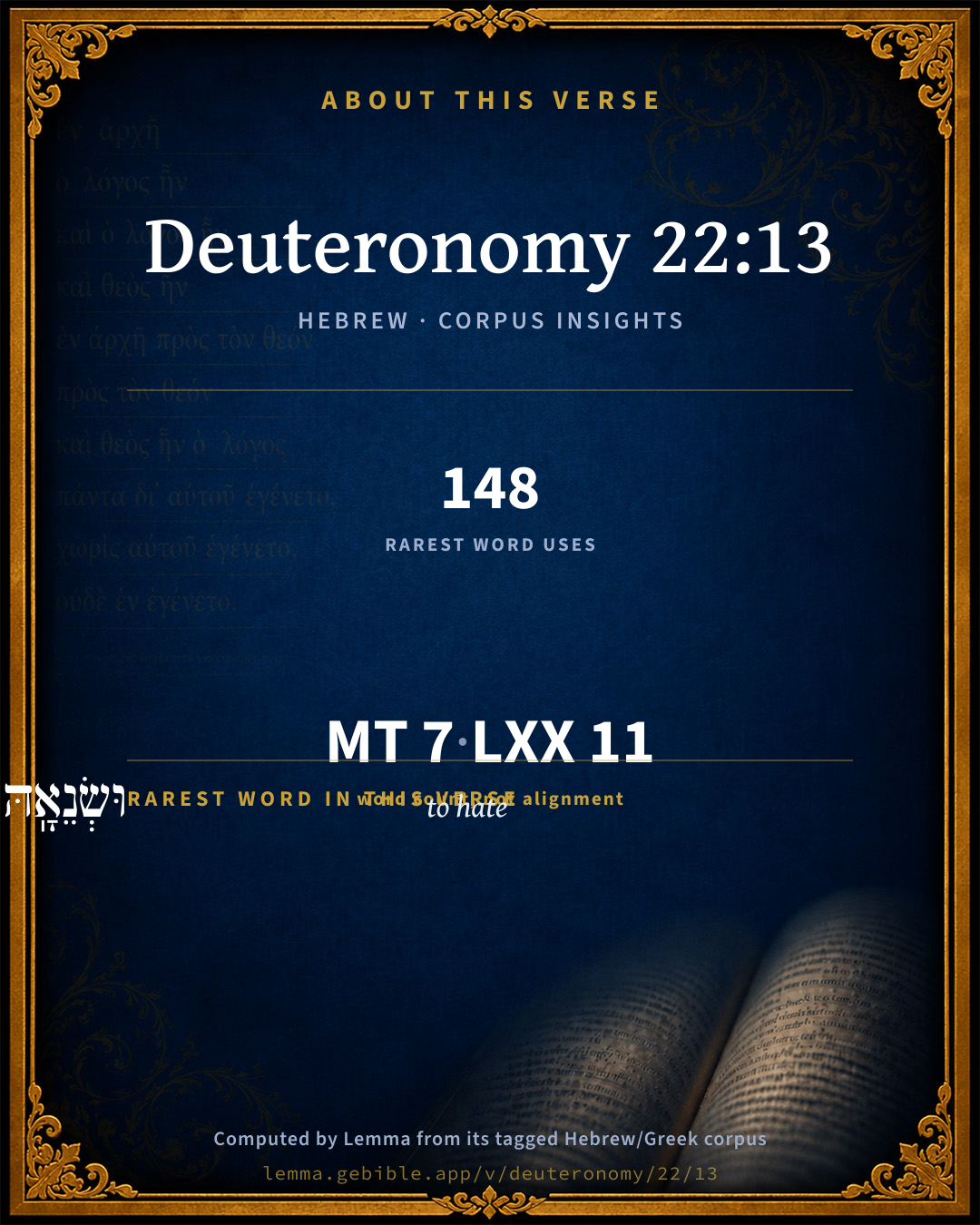
7
words
7
distinct lemmas
Pentateuch
section

Grammatical profile

  • 3 verbs
  • 2 nouns
  • 1 preposition
  • 1 conjunction

Verb forms

  • יִקַּ֥ח Qal · Imperfect
  • וּבָ֥א Qal · Sequential Perfect
  • וּשְׂנֵאָֽהּ Qal · Sequential Perfect

Hebrew & Septuagint length

In English translation the verse runs 14 words from the Hebrew and 15 from the Septuagint (LXX English) — closely comparable.

A rough comparison of the two English renderings, which tokenize alike — not a word-level alignment.

Word counts can differ between the Hebrew and the Greek without any difference in meaning — e.g. the Hebrew direct-object marker אֵת has no separate Greek word, and Greek often adds the article ὁ.

In the original languages it is 7 Hebrew tokens and 11 Greek tokens — but the two are counted differently (Hebrew bundles its prefixes and suffixes into one token; the Greek is in lemma form), so that isn’t a like-for-like length.

Cross-references

6

Topical passages linked to Deuteronomy 22:13 in the Treasury of Scripture Knowledge — connected by theme and wording, ordered by reader-vote popularity; previews shown in the World English Bible.

  • Genesis 29:21 Jacob said to Laban, "Give me my wife, for my days are fulfilled, that I may go in to her."
  • Genesis 29:23 It happened in the evening, that he took Leah his daughter, and brought her to him. He went in to her.
  • Genesis 29:31 Yahweh saw that Leah was hated, and he opened her womb, but Rachel was barren.
  • Deuteronomy 24:1 When a man takes a wife, and marries her, then it shall be, if she find no favor in his eyes, because he has found some unseemly thing in her, that he shall write her a bill of divorce, and give it in her hand, and send her out of his house.
  • Judges 15:1–2 But it happened after a while, in the time of wheat harvest, that Samson visited his wife with a kid; and he said, I will go in to my wife into the chamber. But her father wouldn't allow him to go in.
  • Ephesians 5:28–29 Even so ought husbands also to love their own wives as their own bodies. He who loves his own wife loves himself.

Cross-references courtesy of OpenBible.info (CC BY 4.0).

Hebrew and Greek witnesses Masoretic Hebrew ↔ Greek Septuagint

The same verse in the two great witnesses to the Old Testament, shown verse-for-verse.

These are two independent witnesses, not word-aligned to each other, and the Septuagint is shown in lemma (dictionary) form.

Hebrew Deuteronomy 22:13 Masoretic · Westminster Leningrad Codex

כִּֽי יִקַּ֥ח אִ֖ישׁ אִשָּׁ֑ה וּבָ֥א אֵלֶ֖יהָ וּשְׂנֵאָֽהּ

If any man take a wife, and go in to her, and hate her,

World English Bible · Public Domain

Greek LXX Deuteronomy 22:13 Septuagint · lemma form

ἐάν δέ τις λαμβάνω γυνή καί συνοἰκέω αὐτός καί μισέω αὐτός

And if any one should take a wife, and dwell with her, and hate her,

LXX2012 (modern English Septuagint) · Public Domain

On this verse, The Cambridge Bible for Schools and Colleges discusses the Septuagint’s reading. Read the note in Commentary ↓

Hebrew: Westminster Leningrad Codex (CC BY 4.0). Greek: Septuagint (public domain); English from LXX2012 (modern English Septuagint) (Public Domain). How the Septuagint differs from the Hebrew →

Targum (Aramaic paraphrase)

2

The Targum is the ancient Jewish Aramaic paraphrase of the Hebrew Scriptures — an interpretive translation, not the Hebrew text itself. Onkelos (literal) and Pseudo-Jonathan (expansive) render the Torah, and Jonathan the Prophets. Coverage is partial: where no permissively-licensed English translation exists for a verse, only the Aramaic is shown. This is verse-level text, not a word-by-word alignment to the Hebrew.

  1. Targum Onkelos Torah (Genesis–Deuteronomy)
    אֲרֵי יִסַב גְבַר אִתְּתָא וְיֵעוּל לְוָתַהּ וְיִסְנִנַהּ

    (no public-domain English translation for this verse)

    Targum Onkelos — Aramaic: “Onkelos Genesis” (public domain); “Onkelos Exodus” (public domain); “Onkelos Leviticus” (public domain); “Onkelos Numbers” (public domain); “Onkelos Deuteronomy” (public domain). English: “Sefaria Community Translation” (CC0 1.0 (public-domain dedication)); “J.W. Etheridge. The Targums of Onkelos and Jonathan Ben Uzziel on the Pentateuch. London: Longmans, Green, 1862” (public domain). Text via Sefaria.

  2. Targum Pseudo-Jonathan Torah (Genesis–Deuteronomy)
    אֲרוּם יִסַּב אֵינַשׁ אִיתָא בְּתוּלְתָּא וְיֵיעוֹל עֲלָהּ וּמִבָּתַר כְּדֵין יִסְנִינָהּ

    If a man take a wife or virgin and go unto her, but afterwards dislike her,

    Targum Pseudo-Jonathan — Aramaic: “Targum Jonathan on Genesis” (public domain); “Targum Jonathan on Exodus” (public domain); “Targum Jonathan on Leviticus” (public domain); “Targum Jonathan on Numbers” (public domain); “Targum Jonathan on Deuteronomy” (public domain). English: “The Targum of Jonathan ben Uzziel, trans. J. W. Etheridge, London, 1862” (public domain). Text via Sefaria.

Commentary

Notes on Deuteronomy 22:13 from classic Christian and Jewish commentators (each source and its license shown beneath its notes). The classic Christian expositions comment on the surrounding passage and are grouped to its opening verse, so a note may address several verses; the Jewish commentaries on the Tanakh (Rashi and others) are per-verse, so they appear only where the commentator wrote on this verse.

Lemma curates 59 commentaries, every one of them public domain or Creative Commons licensed, each selected and text-cleaned for this edition rather than reprinted as found. About our sources →

Matthew Henry's Commentary

These laws relate to the seventh commandment, laying a restraint by laying a penalty upon those fleshly lusts which war against the soul.

I. If a man, lusting after another woman, to get rid of his wife slander her and falsely accuse her, as not having the virginity she pretended to when he married her, upon the disproof of his slander he must be punished, Deu 22:13-19. What the meaning of that evidence is by which the husband's accusation was to be proved false the learned are not agreed, nor is it at all necessary to enquire - those for whom this law was intended, no doubt, understood it: it is sufficient for us to know that this wicked husband, who had thus endeavoured to ruin the reputation of his own wife, was to be scourged, and fined, and bound out from ever divorcing the wife he had thus abused, Deu 22:18, Deu 22:19. Upon his dislike of her he might have divorced her if he had pleased, by the permission of the law (Deu 24:1), but then he must have given her her dowry: if therefore to save that, and to do her the greater mischief, he would thus destroy her good name, it was fit that he should be severely punished for it, and for ever after forfeit the permission to divorce her. Observe, 1. The nearer any are in relation to us the greater sin it is to belie them and blemish their reputation. It is spoken of as a crime of the highest nature to slander thy own mother's son (Psa 50:20), who is next to thyself, much more to slander thy own wife, or thy own husband, that is thyself: it is an ill bird indeed that defiles its own nest. 2. Chastity is honour as well as virtue, and that which gives occasion for the suspicion of it is as great a reproach and disgrace as any whatsoever: in this matter therefore, above any thing, we should be highly tender both of our own good name and that of others. 3. Parents must look upon themselves as concerned to vindicate the reputation of their children, for it is a branch of their own.

II. If the woman that was married as a virgin was not found to be one she was to be stoned to death at her father's door, Deu 22:20, Deu 22:21. If the uncleanness had been committed before she was betrothed it would not have been punished as a capital crime; but she must die for the abuse she put upon him whom she married, being conscious to herself of being defiled, while she made him believe her to be a chaste and modest woman. But some think that her uncleanness was punished with death only in case it was committed after she was betrothed, supposing there were few come to maturity but what were betrothed, though not yet married. Now, 1. This gave a powerful caution to young women to flee fornication, since, however concealed before, so as not to mar their marriage, it would very likely be discovered afterwards, to their perpetual infamy and utter ruin. 2. It is intimated to parents that they must by all means possible preserve their children's chastity, by giving them good advice and admonition, setting them good examples, keeping them from bad company, praying for them, and laying them under needful restraints, because, if the children committed lewdness, the parents must have the grief and shame of the execution at their own door. That phrase of folly wrought in Israel was used concerning this very crime in the case of Dinah, Gen 34:7. All sin is folly, uncleanness especially; but, above all, uncleanness in Israel, by profession a holy people.

III. If any man, single or married, lay with a married woman, they were both to be put to death, Deu 22:22. This law we had before, Lev 20:10. For a married man to lie with a single woman was not a crime of so high a nature, nor was it punished with death, because not introducing a spurious brood into families under the character of legitimate children.

IV. If a damsel were betrothed and not married, she was from under the eye of her intended husband, and therefore she and her chastity were taken under the special protection of the law. 1. If her chastity were violated by her own consent, she was to be put to death, and her adulterer with her, Deu 22:23, Deu 22:24. And it shall be presumed that she consented if it were done in the city, or in any place where, had she cried out, help might speedily have come in to prevent the injury offered her. Qui tacet, consentire videtur - Silence implies consent. Note, It may be presumed that those willingly yield to a temptation (whatever they pretend) who will not use the means and helps they might be furnished with to avoid and overcome it. Nay, her being found in the city, a place of company and diversion, when she should have kept under the protection of her father's house, was an evidence against her that she had not that dread of the sin and the danger of it which became a modest woman. Note, Those that needlessly expose themselves to temptation justly suffer for the same, if, ere they are aware, they be surprised and caught by it. Dinah lost her honour to gratify her curiosity with a sight of the daughters of the land. By this law the Virgin Mary was in danger of being made a public example, that is, of being stoned to death, but that God, by an angel, cleared the matter to Joseph. 2. If she were forced, and never consented, he that committed the rape was to be put to death, but the damsel was to be acquitted, Deu 22:24-27. Now if it were done in the field, out of the hearing of neighbours, it shall be presumed that she cried out, but there was none to save her; and, besides, her going into the field, a place of solitude, did not so much expose her. Now by this law it is intimated to us, (1.) That we shall suffer only for the wickedness we do, not for that which is done to us. That is no sin which has not more or less of the will in it. (2.) That we must presume the best concerning all persons, unless the contrary do appear; not only charity, but equity teaches us to do so. Though none heard her cry, yet, because none could hear it if she did, it shall be taken for granted that she did. This rule we should go by in judging of persons and actions: believe all things, and hope all things. (3.) That our chastity should be as dear to us as our life when that is assaulted, it is not at all improper to cry murder, murder, for, as when a man riseth against his neighbour and slayeth him, even so is this matter. (4.) By way of allusion to this, see what we are to do when Satan sets upon us with his temptations: wherever we are, let us cry aloud to heaven for help (Succurre, Domine, vim patior - Help me, O Lord, for I suffer violence), and there we may be sure to be heard, and answered, as Paul was, My grace is sufficient for thee.

V. If a damsel not betrothed were thus abused by violence, he that abused her should be fined, the father should have the fine, and, if he and the damsel did consent, he should be bound to marry her, and never to divorce her, how much soever she was below him, and how unpleasing soever she might afterwards be to him, as Tamar was to Amnon after he had forced her, Deu 22:28, Deu 22:29. This was to deter men from such vicious practices, which it is a shame that we are necessitated to read and write of.

VI. The law against a man's marrying his father's widow, or having any undue familiarity with his father's wife, is here repeated (Deu 22:30) from Lev 18:8. And, probably, it is intended (as bishop Patrick notes) for a short memorandum to them carefully to observe all the laws there made against incestuous marriages, that being specified which is the most detestable of all; it is that of which the apostle says, It is not so much as named among the Gentiles, Co1 5:1.

Matthew Henry's Commentary on the Whole Bible (1708–1710) — public domain (CC PDM 1.0). Text via the HelloAO Bible API.

Ellicott's Commentary for English Readers

Deu_22:13-30. LAWS OF CONJUGAL FIDELITY.

(13-21) Virginity.—The law in these verses will be best appreciated by considering its effects. The maidens in Israel would be compelled to guard their maidenliness and innocence, as they valued their lives. Jealousy and caprice on the part of the husbands, in view of this law, would be avoided as likely to incur discredit and serious penalties. A fine of 100 shekels (as in Deu_22:19), or 50 (as in Deu_22:29), was no light matter for a nation who found a quarter shekel sufficient for a present to a great man (1Sa_9:8), and half a shekel too much for a poll-tax on the men of military age (1Ch_21:3, and Exo_30:15; Neh_10:32). The law of the jealousy offering in Num_5:12-31, must also be taken into consideration, as guarding the fidelity of the wife. It would be most unadvisable for either man or woman so to act as to bring themselves under the penalties here described. The tendency of these laws would be to make all men watchful and careful for the honour of their families.

(21) She hath wrought folly in Israel.—This expression should be noticed. It appears for the first time in Gen_34:7, very shortly after the bestowal of the name Israel (Genesis 32). It would almost appear that the name entailed a higher standard of behaviour upon Jacob’s family, after the hand of the Holy One had been laid upon their father. A separate code of rules were binding upon the chosen people from the very beginning of their history. Hardly any point is made of more importance, from the birth of Isaac downwards, than the purity of the chosen seed.

(22) Adultery.—See Lev_20:10. “Moses in the Law commanded us that such should be stoned.” It was not disputed by our Saviour (Joh_8:5).

A Bible Commentary for English Readers, edited by Charles John Ellicott (1878–1897) — public domain. Text from a community e-Sword module.

The Cambridge Bible for Schools and Colleges

gen. ed. J. J. S. Perowne

13. If any man, etc.] For this opening cp. Deu_21:15; Deu_21:18; Deu_21:22. Take a wife, Deu_21:11, etc.

and hate her] Note this feature in the case; the man had entered on marriage merely for the satisfaction of his passions, and when this was achieved turned against his wife by a revulsion of feeling known in such characters.

13–21. Charges against a Bride. He who, from a base motive, falsely accuses his wife of unchastity before marriage shall after solemn rebuke from the elders be fined 100 silver-pieces and have his right of divorce withdrawn (Deu_22:13-19); but if such a charge be true she shall be stoned to death (Deu_22:20 f.).—No direct address to Israel except in the closing formula which is Sg.

The physical evidence, on which the woman is acquitted, was regarded as essential by many ancient races and is still called for and displayed (not only in judicial cases but after all marriages) by certain tribes in Syria, Egypt and Morocco (see further Driver’s note; Westermarck, Hist. of Human Marriage, 123 f.); but its absence is by no means conclusive proof of a woman’s previous unchastity, nor is it certain that the original form of this law so regarded it (see on Deu_22:20). Musil (Ethn. Ber. 208 ff.) gives differing instances of the treatment of this case among the fellahin and Arabs. With the former the man at once puts his bride away; if her relatives repay him the bride-price he must be silent; if he speaks and the bride has really been guilty, they kill her; if she is innocent he is killed. A jury of matrons decides but the production required above Deu_22:17 is not demanded. With the Sharari the man returns the bride to her family. With the Terâbîn, if the man accuses his bride he has to flee before her relatives, and put himself under the protection of a strong man, who opens up communication with them. The bride’s representative applies for a ‘Minshâd’ decision ‘that thereby he may make white my honour which he has blackened,’ which is given only by the representatives of certain clans, to whom each party pays 1000 piasters. If the judge finds the charge false the man pays the father of the bride 100 lira, but if he accepts not the decision he is dishonoured and no one may protect him. If the bride is guilty, her punishment depends on her relatives, and compensation is made to the man, who can however still keep her. The innocent party receive back their 1000 piasters.

13–30. Six Laws on Cases of Unchastity

Of these the first five prescribe the procedure in criminal cases:—1st. Of a Husband’s Charges against His Bride (Deu_22:13-21); 2nd. Of Adultery (Deu_22:22); 3rd. Of Dishonouring a Betrothed Virgin with her consent (Deu_22:23 f.); 4th. Of the Same without her consent (Deu_22:25-27); 5th. Of Dishonouring an Unbetrothed Virgin (Deu_22:28 f.); while the 6th forbids Marriage with a Father’s Wife (30 [Deu_23:1]). Of the first five each opens similarly to each of the group Deu_21:15-23, i.e. with an if, and differently from those of the group Deu_22:1-12, and they share with the former group and with Deu_19:1-13, and other laws, these marks:—the elders are the public authority, Deu_22:15 ff., cp. Deu_19:12, Deu_21:3; Deu_21:19 f.; neighbour (not brother, characteristic of the Sg. passages) is used, Deu_22:24; Deu_22:26, cp. Deu_19:4 f., Deu_19:11; Deu_19:14; field (sadeh) in its wider sense, Deu_22:25; Deu_22:27, cp. Deu_21:1; and sin worthy of death (ḥeṭ’-maweth), Deu_22:26, cp. Deu_19:6, Deu_21:22. The direct address to Israel is seldom used, and the form varies. In the closing formulas, Deu_22:21-22; Deu_22:24, it is Sg. and Sg. also in the body of the 4th law, Deu_22:24 (unless this be editorial), but Sam. LXX have Pl. In the body of the 3rd law, Deu_22:24, it is Pl.

In considering these plain-spoken laws it is just to remember that with all their imperfections they represent an advance in social ethics; an upward stage in the struggle against debasing practices and the animal passions of men. That we do not need some of them to-day is due to the fact that their enforcement under religious sanction was needed at the time of their origin. It is only ignorance or ingratitude which can cavil at their spirit or their form.

The Cambridge Bible for Schools and Colleges (gen. ed. J. J. S. Perowne; Cambridge University Press, 1878–1918) — public domain. Text from a community e-Sword module.

Joseph Benson's Commentary

Deu 22:13. If any man take a wife — And afterward falsely accuse her. What the meaning of that evidence is, by which the accusation was proved false, the learned are not agreed. Nor is it necessary for us to know: they for whom this law was intended, undoubtedly understood it.

Joseph Benson's Commentary on the Old and New Testaments (1811–1818) — public domain. Text from a community e-Sword module.

Keil & Delitzsch

C. F. Keil & F. Delitzsch

Laws of Chastity and Marriage. - Higher and still holier than the order of nature stands the moral order of marriage, upon which the well-being not only of domestic life, but also of the civil commonwealth of nations, depends. Marriage must be founded upon fidelity and chastity on the part of those who are married. To foster this, and secure it against outbreaks of malice and evil lust, was the design and object of the laws which follow. The first (Deu 22:13-21) relates to the chastity of a woman on entering into the married state, which might be called in question by her husband, either from malice or with justice. The former case is that which Moses treats of first of all. If a man took a wife, and came to her, and hated her, i.e., turned against her after gratifying his carnal desires (like Amnon, for example, Sa2 13:15), and in order to get rid of her again, attributed "deeds or things of words" to her, i.e., things which give occasion for words or talk, and so brought an evil name upon her, saying, that on coming to her he did not find virginity in her. בּתוּלים, virginity, here the signs of it, viz., according to Deu 22:17, the marks of a first intercourse upon the bed-clothes or dress.

Keil & Delitzsch — Biblical Commentary on the Old Testament (1861–1891) — public domain (CC PDM 1.0). Text via the HelloAO Bible API. (Old Testament only.)

Lange's Commentary on the Holy Scriptures

The Ninth Commandment

Deu_22:13-21

13If any man take a wife, and go into unto her, and hate her [after that], 14And give occasions of speech against her, and bring up an evil name upon her, and say, I took this woman, and when I came to her, I found her not a maid [not virginity in her]: 15Then shall the father of the damsel,2 and her mother, take and bring forth the tokens of the damsel’s virginity unto the elders of the city in the gate: 16And the damsel’s father shall say unto the elders, I gave my daughter unto this Man_1:-15 wife, and he hateth her, And lo, he hath given occasions of speech [lays deeds of words] against her, saying, I found not thy daughter a maid [with respect to her, or in her virginity]; and yet these are the tokens of my daughter’s virginity. And they shall spread the cloth before the elders of the city. 18And the elders of that city shall take that man and chastise him; 19And they shall amerce him in an hundred shekels of silver, and give them unto the father of the damsel, because he hath brought up an evil name upon a virgin of Israel: and she shall be his wife; he may not put her away all his days. 20But if this thing be true [truth is this word], and the tokens of virginity be not found for the damsel: 21Then they shall bring out the damsel to the door of her father’s house, and the men of her city shall stone her with stones that she die; because she hath wrought folly in Israel, to play the whore in her father’s house: so shalt thou put evil away from among you.

EXEGETICAL AND CRITICAL

Witness-bearing generally, and especially false witness, has been treated already, Deu_19:15 sq., from the stand-point of the sixth command; and Moses therefore now speaks briefly as to the ninth commandment. It is rather as a supplement, corresponding entirely with the supplementary existence of the woman, and in connection with what precedes, since the wife is regarded as the property, possession, of the husband. But the ninth command goes down here—and this is the progress—from the judicial witness-bearing (Deu_19:15 sq.) to the social declaration, to slander, and this with respect to a case both disgraceful and dangerous. Deu_22:13. And go, as Deu_21:13. After the affection, at least manifested, the aversion (2Sa_13:15) breaking out through occasions of speech, literally, deeds (עלילה from עלל the completed, finished) of words, i.e., actions with words, in that he says, or: things which exist only in words, and his words,—or: facts which occasion the words, report, scandal. Deu_22:14. (Mat_1:19). בתולים (בתל to separate, separated from close intimacy with men) abstract noun: virginity as it was supposed distinguishable (Sept. παρθἑνεια τὰ παρθἑνια). The parents (Deu_22:15) for the sake of their child, and for the honor of their training, their household; after them came the first-born brother as the head of the family. נער, literally, the one thrust out, of the fruit of the human body, hence: the young, as the maiden passes into the young woman. That which they take and bring out of the house (Deu_14:28) as a proof of the virginity of their daughter, is, according to Deu_22:17, the piece of clothing with the distinctive blood stains, the cloth which they had thus in preservation. Comp. further Deu_21:19. Deu_22:16. The accusation, which in this case was limited truly and designedly to the mere report, in order that the parents should quietly take back their daughter, they bring with the motive of the slander, before the public forum. Deu_22:17. (Comp. Deu_22:14). The exhibition of the slander in words, its refutation by facts. Deu_22:18. Comp. Deu_21:18. The Jews understand bodily punishment with thirty-nine stripes, which is not expressed in the words, and is scarcely supposable in the case. He was not punished as a legal witness (Deu_19:18 sq.) but as a slanderer, and of his own honor in respect to his wife. Hence the chastisement, instruction, is first of all in place. The punishment, Deu_22:19, consists in the money to be paid to the slandered father [in other cases (see Deu_22:29; Exo_22:15-16) the fine was only fifty shekels; the Rabbins hold that if the woman were an orphan the fine came to herself,—A. G.], and in his loss for life of the right of divorce. [The distinction in the punishment here attached to the slanderer of his wife, and the penalty for false-witness, Deu_19:10 sq., is not to be explained upon the assumption “of the low position and estimation of the woman under the law,” (Bib. Com.), but by the fact above referred to that the case here is not strictly of false witness. The punishment was designed apparently to meet the motives in which the slander originated, “either a wanton desire for another marriage, or an avaricious desire for the maiden’s dowry.”—A. G.]. Deu_22:20-21. Connected with the foregoing, but the very opposite, and as to the penalty, literally a case belonging to the seventh command, where the man brings his case before the elders of the city and establishes it by the whole unmaidenly conduct of the bride generally, and not only by the fact that the proofs (Deu_22:17) could not be found. (Comp. Deu_13:15; Deu_17:4). To the slander, now follows the deceit. Deu_22:21. They, either the elders (Deu_22:18 sq.), or one shall, sq., out of the deceived husband’s house, or from some other place, but only to, before the door of the father’s house for a testimony against it, so far as it was a participant in the guilt through defective discipline, oversight, perhaps even in the deceit, in any case to suit the punishment to the guilt: the sin went out across this threshold, etc.נְבָלָה presumptuousness, shamelessness, godlessness, especially of unchastity (Gen_34:7), which is not compatible with Israel’s dignity, and which thus concerns the body of the people in its spiritual character (1Co_6:13; 1Co_6:15 sq.; Mat_5:32). Further comp. Deu_13:6.

DOCTRINAL AND ETHICAL

1. Slander is the act, with reference to our neighbor, introduced through falsehood; here touches the neighbor next to his own life, i.e., touches his own wife, where indeed even nature requires truthfulness. Thus nature vindicates itself against the lying, slanderous husband: the nature of the maiden, and the natural protection of father and mother, become her legal representatives and defence.

2. The method of proof in this case rests essentially upon the ground that nature will not deceive, much less lie. It appears as it is; it conceals nothing; it does not even deface anything when it presents itself to view.

3. Man who deceives may lie, but should not. The veracity of a man as to himself is in the thought, his inward recognition of the truth; as to others, in word and deed, his external confession of the truth. Thus appear, Deu_22:14, deeds of words.

4. Man is free only as he maintains veracity; the lie destroys his true freedom. The Israelite should learn this with respect to the freedom of divorce from his wife granted to him (Mat_19:8), forfeiting it in the case of the lie, the slander, against his wife.

5. Where love is presupposed, as here in the relations of man and wife, it demands first entire truthfulness. It is only lust which is followed by hatred, and thus the slander is begotten.

6. Israel must put away evil from among them, as here with respect to the deceitful and false betrothed. The Scripture elsewhere identifies the lie and evil. Here her own conscience must have been imposed upon and hardened before she represented herself to others as being what she was not.

HOMILETICAL AND PRACTICAL

Deu_22:13. Cramer: “We should never bring any one into reproach, nor cover them, or impose upon them with groundless suspicions.” Deu_22:15. The same: “Parents should not only care for the support, but the good name of their children, and should cheerfully defend it.” Deu_22:18. Starke: “God is the enemy of deceivers and liars, and will punish them.” Deu_22:19. Schultz: “Moses must have held a different view of unions in the face of great aversion than that prevalent among us.” Herxheimer: “In any case the great disgrace and severe punishment must have awakened in the parents great care in the preservation of modesty and purity.”

Lange's Commentary on the Holy Scriptures (Critical, Doctrinal, and Homiletical), ed. John Peter Lange, English translation edited by Philip Schaff (1864–1880) — public domain. Text from a community e-Sword module.

Jamieson, Fausset & Brown

Robert Jamieson, A. R. Fausset & David Brown

If a man take a wife, &c.--The regulations that follow might be imperatively needful in the then situation of the Israelites; and yet, it is not necessary that we should curiously and impertinently inquire into them. So far was it from being unworthy of God to leave such things upon record, that the enactments must heighten our admiration of His wisdom and goodness in the management of a people so perverse and so given to irregular passions. Nor is it a better argument that the Scriptures were not written by inspiration of God to object that this passage, and others of a like nature, tend to corrupt the imagination and will be abused by evil-disposed readers, than it is to say that the sun was not created by God, because its light may be abused by wicked men as an assistant in committing crimes which they have meditated [HORNE].

Next: Deuteronomy Chapter 23

Jamieson, Fausset & Brown — Commentary Critical and Explanatory on the Whole Bible (1871) — public domain (CC PDM 1.0). Text via the HelloAO Bible API.

John Gill's Exposition

If any man take a wife, and go in unto her, and hate her. That is, marries a wife, and cohabits with her as man and wife, and after some time dislikes her, and is desirous of parting with her, and therefore takes the following wicked method to obtain it: this is to be understood of a virgin taken to wife, as the Targum of Jonathan explains it; and what follows confirms it.

If any man take a wife, and go in unto her, and hate her. That is, marries a wife, and cohabits with her as man and wife, and after some time dislikes her, and is desirous of parting with her, and therefore takes the following wicked method to obtain it: this is to be understood of a virgin taken to wife, as the Targum of Jonathan explains it; and what follows confirms it.

Deuteronomy 22:14

deu 22:14

deu 22:14

deu 22:14And give occasions of speech against her,.... Among her neighbours, who by his behaviour towards her, and by what he says of her, will be led in all company and conversation to traduce her character, and speak of her as a very bad woman:

and bring up an evil name upon her; take away her good name, and give her a bad one; defame her, and make her appear scandalous and reproachful to all that know her: though the Jews understand this not of private slander, but of bringing an action against her in a public court of judicature, the substance of which follows: "and say, I took this woman, and when I came to her, I found her not a maid"; the sense is, that he had married her, and when he came to cohabit with her as man and wife, it appeared to him that she was vitiated, and not a pure virgin. This is the charge in court against her, the action laid by him; so Jarchi observes, a man might not say this but before a magistrate, in a court of judicature, which is thus represented by Maimonides (p);"a man comes to the sanhedrim, and says, this young woman I married, and I did not find her virginities; and when I inquired into the matter, it appeared to me that she had played the whore under me, after I had betrothed her; and these are my witnesses that she played the whore before them.''

(p) Hilchot Naarah Betulah, c. 3. sect. 6.

John Gill's Exposition of the Whole Bible (1746–1763) — public domain (CC PDM 1.0). Text via the HelloAO Bible API.

Matthew Poole's English Annotations

Go in unto her, i.e. hath had carnal knowledge of her.

Matthew Poole's English Annotations on the Holy Bible (1683–1685) — public domain. Text from a community e-Sword/MySword module.

Whedon's Commentary on the Bible

Daniel D. Whedon

13-29. If any man take a wife, etc. — This section relates to purity in reference to marriage. The wellbeing of the family and of the state depends upon strict observance of the laws of purity in the relation of husband and wife. If a husband unjustly accused his newly married wife of unchastity before marriage he was punished with stripes by the elders of the city, and further punished by a fine, to be paid to the father of the traduced wife. And as it was possible the charge might have arisen from the desire of the husband to contract another marriage, he was not allowed to put away his wife. But if the charge against the chastity of the wife was proved she was to be put to death. Adultery was to be punished with death, the death of both guilty parties. The sanctity of the marriage relation was most strictly protected. The woman betrothed was regarded in the same light as the married woman. The violation of the law required the death penalty. Both the man and the woman were to be put to death. In Deu_22:25-27 violence is supposed on the part of the man. In this case the man suffers the penalty of death. The case supposed in Deu_22:28-29, is similar to that mentioned in Exo_22:16.

Daniel D. Whedon (gen. ed.), Commentary on the Old and New Testaments (1874–1909) — public domain. Text from a community e-Sword module.

The Pulpit Commentary

Vers. 13-29. The laws in this section have the design of fostering purity and fidelity in the relation of the sexes, and also of protecting the female against the malice of sated lust and the violence of brutal lust. (For the case supposed in ver. 13, of 2Sa_13:15. On the whole section see Michaelis, "Laws of Moses," pt. 2. Niebuhr, "Description de l"Arabie," Deuteronomy 8.; Burckhardt, "Bedwins," p. 214.)

Vers. 13-30. Chastity.

The Mosaic Law is strict and stern in its requirement of purity in all that pertains to the marriage relation. Its strictness, however, is united with a fine sense of justice, and its shield is, as usual, extended for the protection of the innocent.

I THE DEFAMED WIFE. (Vers. 13-19.) No act can be conceived more cruel or dastardly than that of a man who groundlessly assails his wife"s character, accusing her of ante-nuptial unchastity. As the matter was one proof of which was not directly possible, and the man"s word was all that could be adduced on his side, the Law threw the onus of clearing herself upon the woman through her parents, and indicated the mode of doing so. The "forty stripes save one" was a punishment not too heavy for this sort of false accusation.

II THE UNCHASTE WIFE. (Vers. 20-24.) Three cases are distinguished, each punishable with death.

1. A woman found to be unchaste at time of marriage (vers. 20, 21).

2. Adultery after marriage (ver. 22).

3. A betrothed woman ravished with her implied consent (vers. 23, 24).

In the last two cases, the partner in guilt dies also. In the first, he only escapes, because he is unknown. Yet that unknown seducer, the cause of the woman"s fall a fall which shame subsequently tempted her to conceal was not lost to the eye of him who sees secret crime, and will repay it. Little do such seducers think of the life-long shame and sin and misery to which they may be dooming the unfortunate victims of their wiles. God knows it, and will bring them to account. The severe penalties attached to conjugal unfaithfulness place in a startling light the gravity of the offence in the Divine esteem, and form a striking contrast to the light tone adopted about such matters in society.

III THE WOMAN RAVISHED. (Vers. 25-29.) The cases specified are those of rape.

1. If the woman was betrothed, and could not save herself, she was to be held innocent, but her violator was to be punished with death.

2. If she was not betrothed, the man who had injured her was heavily fined, and was compelled to take her to wife, with no right of subsequent divorce. Possibly our own law might fitly imitate that of ver. 29. J.O.

Vers. 13-30. Expedients to secure purity.

We have here various wise expedients to control the licentiousness of the people, and secure, so far as possible, social purity.

I DEFAMATION OF CHARACTER WAS SEVERELY PUNISHED. A husband could not, with impunity, defame a newly married wife; for should there be proof forthcoming that his charge was false, he was to be publicly chastised, to pay a fine of one hundred shekels of silver to his father-in-law, whoso good name and peace he had threatened, and to be bound to his wife all his days.

II WHOREDOM WAS MADE A CAPITAL CRIME. If the charge made against his wife prove true, then she is to be stoned to death for her sin. Immorality was really treason towards the Divine King, it was incompatible with his kingdom, and so was put into the category of capital crimes. The morale of the theocracy was really higher in idea than that of any other kingdom then or now existing.

III ADULTERY WAS ALSO A CRIME FOR WHICH BOTH OFFENDERS MUST SUFFER DEATH. Here the two parties are criminals against the theocracy, and such a flagrant crime cannot be tolerated within it. The morality is severe and wholesome.

IV ADULTERY COMMITTED WITH A BETROTHED DAMSEL IS TREATED JUST AS ADULTERY WITH A MARRIED WOMAN, FOR SHE IS AS GOOD AS MARRIED. Both parties in this case also must pay the penalty of death. Such severe measures were the wisest expedients in the end.

V IN CASE OF ADVANTAGE BEING TAKEN OF A BETROTHED DAMSEL, THE RUFFIAN IS TO PAY THE PENALTY OF DEATH. If the taking away of life is justly punished with death, so should the murder of virtue. As a rule, our laws are too lenient towards ruffians that ruin women. Were a few of them sent to the gallows it would be no more than they deserve.

VI IN CASE OF A VIRGIN THAT IS NOT BETROTHED, THE MAN WHO TAKES ADVANTAGE OF HER IS COMPELLED TO MARRY HER, AND TO PAY TO HER FATHER A SUBSTANTIAL FINE. The case thus dealt with is different from the preceding. It proceeds upon inquiry. The man is not carried by his passion into an act of great wrong towards one whom he can never hope to have as his wife, which was the last case; but he takes the case into his own hand, where no previous betrothal bars the way. He can make reparation, and he is compelled to do so. Again we say that our laws would be greatly improved if a spice of the severity of the Jewish law went to make the cowardly ruffians who disgrace society suffer more severely for their deeds.

VII INCEST WAS FORBIDDEN. There is no mincing of matters, since all these abominations abounded among the Canaanites, and must be checked in Israel.

VIII PURITY IS THUS SEEN TO BE GOD"S AIM. "Be ye holy; for I am holy," is God"s direction. We must be as chaste virgins" presented unto Christ. The social purity of Israel was only to reflect their spiritual purity as towards God. Our own lesson in these regulations is clear. We must not even in the slightest thought prove unfaithful to our Savior and Lord. He is the Husband of the Church, and requires a faithful wife. R.M.E.

Vers. 13-21. Slander, unchastity, and fraud.

No blame can lie against the Scriptures because they legislate on such detestable matters. The blame must lie at the door of depraved humanity, which perpetrates such deeds and makes Divine legislation necessary. The obscenity appertains to the vices, only praise belongs to the remedy.

I A WOMAN"S CHASTITY IS HER MAIN DOWRY FOR LIFE. If she possess not this virtue, she is worse than worthless; she is a plague and a pest a moral dunghill. Apart from chastity, she can fill no proper place in society. Her true function is ended. She is only a discredit to the human name. Her light is dense darkness. The streams of life are polluted. The fountain of bliss is corrupted at its source. Rottenness is at the core of society. No language can exaggerate the evil.

II SLANDER AGAINST A WIFE"S CHASTITY IS THE BLACKEST OF SINS. In proportion to the vileness of the sin and the severity of the penalty, is the baseness and guilt of the man who makes the accusation falsely. This is a climax of sins of speech, which nothing can surpass. Slander of any sort is heinous sin, and slander against an intimate friend is more heinous yet; but slander against one"s wife and against her chastity is most heinous of all. Fines and scourging are lenient punishment forsuch a monster.

III THE PENALTIES OF SIN ARE IN PROPORTION TO INJURY DONE. On the principle laid down in a previous law, the penalty for false accusation was fixed according to the nature of the deed falsely alleged to be done. In this case, the slanderer well deserved such a result. But then the injured wife would be injured all the more. In the dread penalty imposed on him, she would have to share. Hence, for her sake, the husband"s life is spared. To calculate all the effects produced by one act of sin is impossible to the finite mind of man; yet (unless pardon, full and complete, be enjoyed) in proportion to these perpetuated effects will be the penalty meted out to the sinner. We may well "stand in awe. D.

The Pulpit Commentary (1880–1919), ed. H.D.M. Spence-Jones & Joseph S. Exell — public domain. Text from a community e-Sword module.

John Wesley's Explanatory Notes

If any man take a wife - And afterward falsely accuse her- What the meaning of that evidence is, by which the accusation was proved false, the learned are not agreed. Nor is it necessary for us to know: they for whom this law was intended, undoubtedly understood it.

John Wesley, Explanatory Notes Upon the Whole Bible (1754–1765) — public domain. Text via the GEBible commentary corpus.

Kretzmann's Popular Commentary

Paul E. Kretzmann

Various Sins Against the Sanctity of Holy Wedlock

v. 13. If any man take a wife and go in unto her, in the act which God restricts to the married estate, and hate her, regard her with loathing after the gratification of his fleshly lust, 2Sa 13:15,

v. 14. and give occasions of speech against her, literally, "set upon her deeds of words," that is, reports without foundation, scandal, and bring up an evil name upon her, and say, I took this woman, and when I came to her, I found her not a maid, an unpolluted virgin,

v. 15. then shall the father of the damsel, the designation leaving the matter of a probable guilt open, and her mother, the parents being very decidedly concerned in this accusation, take and bring forth the tokens of the damsel’s virginity, as it was supposed distinguishable by spots of blood, unto the elders of the-city in the gate, for it was the custom to save this evidence for just such an event;

v. 16. and the damsel’s father shall say unto the elders, I gave my daughter unto this man to wife, and he hateth her;

v. 17. and, lo, he hath given occasions of speech against her, saying, I found not thy daughter a maid; and yet these are the tokens of my daughter’s virginity. And they shall spread the cloth before the elders of the city, as proof positive that the accusation was a lie.

v. 18. And the elders of that city shall take that man and chastise him, pronounce upon him the judgment of punishment by whipping;

v. 19. and they shall amerce him, sentence him to pay money, in an hundred shekels of silver (about $64), and give them unto the father of the damsel, to atone, in a way, for the slander brought upon that family, because he hath brought up an evil name upon a virgin of Israel; and she shall be his wife; he may not put her away all his days, the right of divorce was taken from him.

v. 20. But if this thing be true, and the tokens of virginity be not found for the damsel, when the supposed proofs of her virginity could not be produced;

v. 21. then they shall bring out the damsel to the door of her father’s house, for a testimony against it, because the parents were considered as participants in the guilt through defective discipline, oversight, and, perhaps, even deliberate deceit, and the men of her city shall stone her with stones that she die, because she hath wrought folly in Israel, the shamelessness of unchastity, to play the whore in her father’s house; so shalt thou put evil away from among you. So much Israel’s dignity, its character as the holy people of God, demanded.

v. 22. If a man be found lying with a woman married to an husband, under his rule, restricted to him in fleshly intercourse, then they shall both of them die, both the man that lay with the woman and the woman, for it was a plain case of deliberate adultery; so shalt thou put away evil from Israel.

v. 23. If a damsel that is a virgin be betrothed unto an husband, in a rightful betrothal, as it was customary among the Jews, where the consent of the parents on either side and that of the girl had been secured, and a man find her in the city and lie with her,

v. 24. then ye shall bring them both out unto the gate of that city, and ye shall stone them with stones that they die; the damsel, because she cried not, being in the city, did not call for help, for such cries would certainly have been heard in the city, whence it followed that she consented to the act; and the man, because he hath humbled his neighbor’s wife, for a betrothed woman is a married wife in the eyes of God; so thou shalt put away evil from among you, by the summary punishment of the offenders against! the holiness of marriage.

v. 25. But if a man find a betrothed damsel in the field, and the man force her, overcome her by main strength, and lie with her, then the man only that lay with her shall die;

v. 26. but unto the damsel thou shalt do nothing; there is in the damsel no sin worthy of death, the penalty should not be carried out where it was not deserved; for as when a man riseth against his neighbor and slayeth him, violently takes his life, even so is this matter;

v. 27. for he found her in the field, and the betrothed damsel cried, called for help, and there was none to save her. It was a plain case of rape.

v. 28. If a man find a damsel that is a virgin, which is not betrothed, and lay hold on her, and lie with her, and they be found,

v. 29. then the man that lay with her shall give unto the damsel’s father fifty shekels of silver (about $32), as an atonement for the disgrace inflicted by his act, and she shall be his wife; because he hath humbled her, he may not put her away all his days. Cf Exo 22:15-16. of course, the father had the right to deny his daughter to the man in such a case.

v. 30. A man shall not take his father’s wife, his stepmother, nor discover (uncover) his father’s skirt. Incestuous lust is self-injury and a transgression also against the father, by the defiling of his bed. Cf Lev 18:6; Eze 16:8; Deu 27:20. The Lord wants only such servants as are pure and unspotted before Him, members of a people consecrated to His holiness.

Paul E. Kretzmann, Popular Commentary of the Bible (1921–1924) — public domain. Text from a community e-Sword module.

unfoldingWord translationNotes

Door43 World Missions Community

General Information:

Moses continues speaking to the people of Israel.

then accuses her of shameful things

"then accuses her of having slept with someone before she was married"

puts a bad reputation on her

The abstract noun "reputation" can be translated as a verb phrase. AT: "makes other people think she is a bad person" (See: Abstract Nouns)

but when I came near to her

This is a polite way of saying "to have sexual relations with someone." AT: "but when I slept with her" (See: Euphemism)

I found no proof of virginity in her

The abstract noun "proof" can be translated as a verb phrase. AT: "she could not prove to me that she was a virgin"

translationWords

had relations with

accuse

shame

virgin

unfoldingWord translationNotes — © Distant Shores Media and the Door43 World Missions Community, licensed CC BY-SA 4.0. Source: git.door43.org/Door43/en_tn.

Rashi

Rabbi Shlomo Yitzchaki (Rashi)

ובא אליה ושנאה [IF ANY MAN TAKE A WIFE] AND COME UNTO HER AND HATE HER, the end will be,

Rashi on the Tanakh — English translations: “The Judaica Press complete Tanach with Rashi, translated by A. J. Rosenberg” (CC BY 4.0); “Pentateuch with Rashi's commentary by M. Rosenbaum and A.M. Silbermann, 1929-1934” (public domain); “The Metsudah Tanach series, Lakewood, N.J” (CC BY 4.0); and “The Book of Joshua, Metsudah Publications, 1997” (CC BY 4.0). Text via Sefaria.

Ramban (Nachmanides)

Rabbi Moshe ben Nachman (Ramban / Nachmanides)

IF ANY MAN ‘YIKACH’ (TAKE) A WIFE, AND COME UNTO HER. The meaning thereof is as follows: When a man will take a wife through the means sanctioned by the Torah which is betrothal with money — this being “the betrothed” he [Moses] mentions [further in Verse 23] — and after some time he came unto her, and hate her because she was not pleasant to him in conjugal relation, and so he arose early in the morning and came before the court claiming that he did not find her to be a virgin. Now this person intends to divorce her without the dowry of virgins, which is the kethubah (marriage contract) that he wrote her. And because she became betrothed to him under the presumption of virginity, he accuses her of having committed adultery after her betrothal to him. Therefore Scripture states, But if this thing be true as the husband said, they shall stone her., Verse 21. The truth cannot be known except by the testimony of two witnesses. And because, concerning the illicit relations of virgins, Scripture will clarify, Verses 23-24; 28-29. that if she were betrothed she is stoned, and if she were not betrothed she is absolved from punishment, it was unnecessary to explain here “But if this thing be true that she was unchaste while betrothed, and [what is more] she so acted willingly [with anyone other than her lawful spouse] they shall stone her.” And instead it says by allusion because she has done a base deed in Israel, to play the harlot in her father’s house, Verse 21. the base deed being that she did so voluntarily.

The expression to play the harlot signifies when a wife being under husband, goeth aside, for an unbetrothed maiden is not termed “a harlot” if she lies with one of the people, but the betrothed one is espoused to him [her future husband and therefore she is termed “a harlot” if she commits adultery with another man].

Ramban (Nachmanides) on the Tanakh — English translation: “Commentary on the Torah by Ramban (Nachmanides). Translated and annotated by Charles B. Chavel. New York, Shilo Pub. House, 1971-1976” (CC BY 4.0). Text via Sefaria.

Lesson kit

Teaching starters — assembled from the data on this page, not authored interpretation. Every prompt links to the verse data it draws on. Edit before teaching.

Deuteronomy, in the Pentateuch, opens this verse with 7 words (7 distinct Hebrew lemmas). Its most distinctive word is sânêʼ (“to hate”). A historical commentator’s framing appears above. Read the whole chapter for the surrounding context.

Discussion questions

  1. How does “to hate” (sânêʼ) shape what this verse is saying?
  2. How does Genesis 29:21, which shares this passage’s theme, read alongside this verse?
  3. These translations render this verse differently; the difference is in the English rendering, not the original. What questions does that raise?
  4. «יִקַּ֥ח» is a Qal Imperfect verb. How does that grammatical form shape the action described?
  5. Compare how Matthew Henry's Commentary and Ellicott's Commentary for English Readers read this verse. Where do they agree or differ?

Things to notice

Reading settings

Reading text

Shown beneath each verse's original-language words.

Old Testament
Old Testament edition

Read the OT as the Masoretic Hebrew (MT) or the Greek Septuagint (LXX).

English shown for the Greek Septuagint (in the Hebrew ↔ Greek comparison).

Comparing translations? Open the Compare panel on any verse page to stack up to four side by side.