
Proverbs 28:16

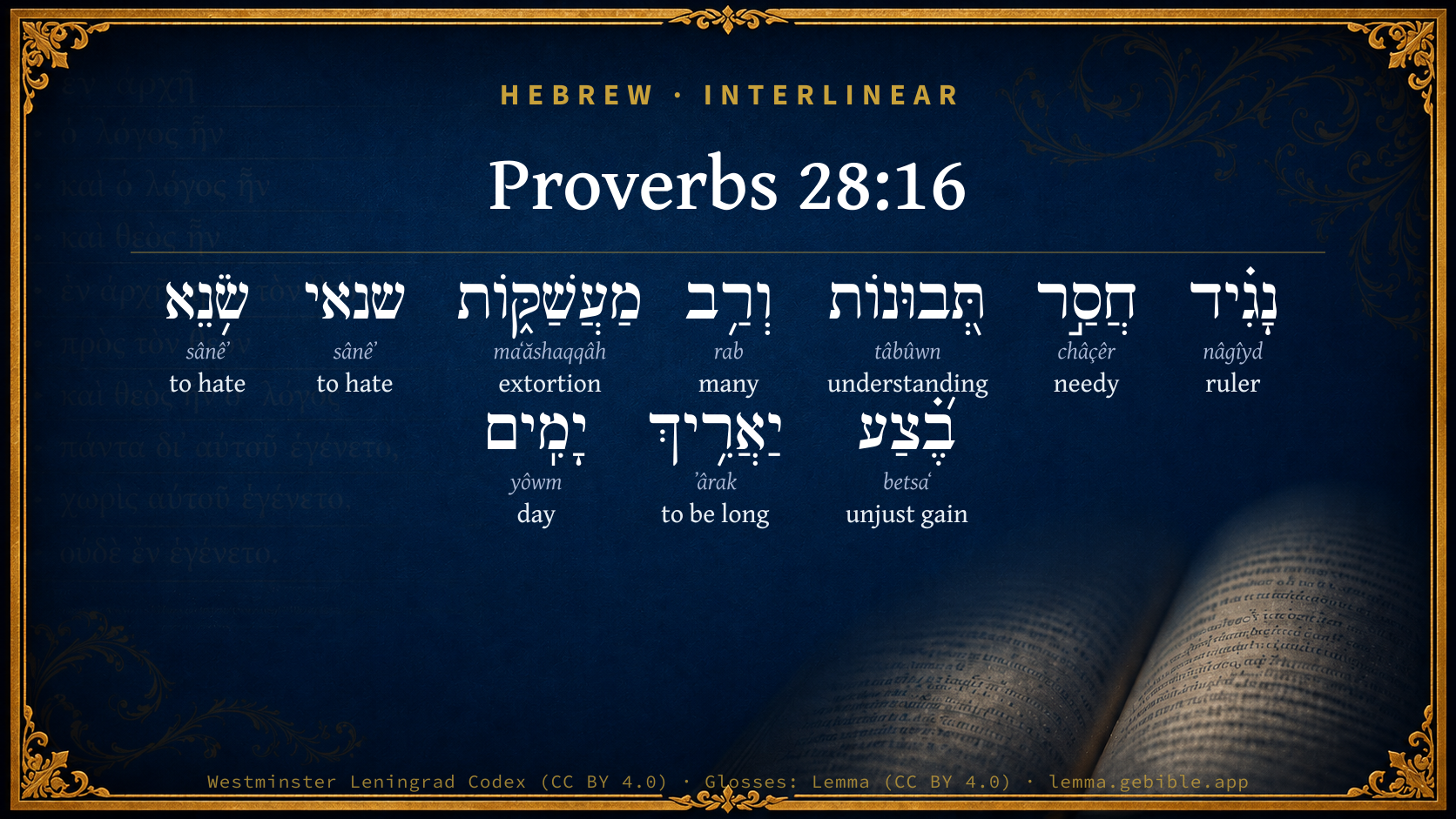
Hebrew (Westminster Leningrad Codex) Proverbs 28:16 appears in the Hebrew Old Testament. The text above is from the Westminster Leningrad Codex. Each word links to its Strong’s number, a concise gloss, and parsing drawn from the Open Scriptures Hebrew Bible morphology. Click any word for its full Brown-Driver-Briggs (BDB) entry.
Download image
Cite this verse

Proverbs 28:16 (World English Bible). Public Domain. Lemma interlinear Bible study tool, https://lemma.gebible.app/v/proverbs/28/16.

Show BibTeX & RIS
BibTeX
RIS
English Translation
A tyrannical ruler lacks judgment. One who hates ill-gotten gain will have long days.
World English Bible · Public Domain
Highlights Full analysis ↓
Download a study sheet

One document with this verse’s original text, its word-by-word gloss line, the meaning frame, cross-references with their text, attributed commentary, and full source and license credits — printable, and it pastes into notes with its structure intact.

This verse Autodidact and up

Study sheet (.html) Plain text (.txt)

A passage Seminary Student

Up to 50 verses in one chapter. A passage sheet keeps up to 6 commentary sources and 12 cross-references per verse, in the order this page ranks them, and says so on the sheet whenever that leaves anything out. Ask for a single verse and you get the Autodidact verse sheet above.

Everything on this page stays free to read, with no account — the sheet is a download of what is already on screen, not access to it.

Want to remove ads? Support Godless Engineer
Compare translations 3

The same verse in 3 English versions, stacked beneath the original-language interlinear above. Click any original word for its lexicon entry.

Each is an independent rendering of the whole verse — the interlinear is not word-aligned to these translations.

Highlighted words mark where these versions differ — a whole-verse word diff, not a word-by-word alignment.

  • World English Bible Public Domain
    A tyrannical ruler lacks judgment. One who hates ill-gotten gain will have long days.
  • King James Version Public Domain
    The prince that wanteth understanding is also a great oppressor: but he that hateth covetousness shall prolong his days.
  • unfoldingWord Literal Text CC BY-SA 4.0
    A leader lacking of understanding also abundant of oppressions; one hating unjust gain will lengthen days.

unfoldingWord Literal Text — © unfoldingWord, licensed CC BY-SA 4.0. Word-aligned USFM3 via Door43 (git.door43.org/unfoldingWord/en_ult).

Versions to compare (up to 4)

3 of 4 selected

Show all 18 translations

Every available English version of this verse, each an independent rendering of the whole verse.

  • World English Bible Public Domain
    A tyrannical ruler lacks judgment. One who hates ill-gotten gain will have long days.
  • Berean Standard Bible Public Domain
    A leader who lacks judgment is also a great oppressor, but he who hates dishonest profit will prolong his days.
  • Majority Standard Bible Public Domain
    A leader who lacks judgment is also a great oppressor, but he who hates dishonest profit will prolong his days.
  • King James Version Public Domain
    The prince that wanteth understanding is also a great oppressor: but he that hateth covetousness shall prolong his days.
  • American Standard Version (1901) Public Domain
    The prince that lacketh understanding is also a great oppressor; `But' he that hateth covetousness shall prolong his days.
  • Revised Version (1885) Public Domain
    The prince that lacketh understanding is also a great oppressor: but he that hateth covetousness shall prolong his days.
  • Geneva Bible (1599) Public Domain
    A prince destitute of vnderstanding, is also a great oppressour: but hee that hateth couetousnes, shall prolong his dayes.
  • Douay-Rheims (1899) Public Domain
    A prince void of prudence shall oppress many by calumny: but he that hateth covetousness, shall prolong his days.
  • Young's Literal Translation Public Domain
    A leader lacking understanding multiplieth oppressions, Whoso is hating dishonest gain prolongeth days.
  • Literal Standard Version CC BY-SA 4.0
    A leader lacking understanding multiplies oppressions, || Whoever is hating dishonest gain prolongs days.
  • Unlocked Literal Bible CC BY-SA 4.0
    The ruler who lacks understanding is a cruel oppressor, but the one who hates dishonesty will prolong his days.
  • unfoldingWord Literal Text CC BY-SA 4.0
    A leader lacking of understanding also abundant of oppressions; one hating unjust gain will lengthen days.
  • Darby Bible Public Domain
    The prince void of intelligence is also a great oppressor: he that hateth covetousness shall prolong [his] days.
  • World Messianic Bible Public Domain
    A tyrannical ruler lacks judgment. One who hates ill-gotten gain will have long days.
  • Webster's Bible Public Domain
    The prince that wanteth understanding is also a great oppressor: but he that hateth covetousness shall prolong his days.
  • Free Bible Version CC BY-SA 4.0
    An unwise ruler thoroughly extorts his people, but one who refuses to profit illegally will live long.
  • Bible in Basic English Public Domain
    The prince who has no sense is a cruel ruler; but he who has no desire to get profit for himself will have long life.
  • JPS Tanakh (1917) Public Domain
    The prince that lacketh understanding is also a great oppressor; but he that hateth covetousness shall prolong his days.

Literal Standard Version (2020), Covenant Press — licensed CC BY-SA 4.0. Text via the HelloAO Bible API (eBible.org). Unlocked Literal Bible (unfoldingWord) — licensed CC BY-SA 4.0. Text via the HelloAO Bible API (eBible.org). unfoldingWord Literal Text — © unfoldingWord, licensed CC BY-SA 4.0. Word-aligned USFM3 via Door43 (git.door43.org/unfoldingWord/en_ult). Free Bible Version, Dr. Jonathan Gallagher — licensed CC BY-SA 4.0. Text via the HelloAO Bible API (eBible.org).

Word by word

More ways to search: Search by grammar → Find every occurrence → Compare this word →

Practice this passage: Drill this verse → Learn its vocabulary →

About this verse

These counts appear in no published source. They are computed here, from the morphology-tagged text and Lemma’s own curated glosses. What Lemma adds →

10
words
9
distinct lemmas
Wisdom
section

Notable vocabulary

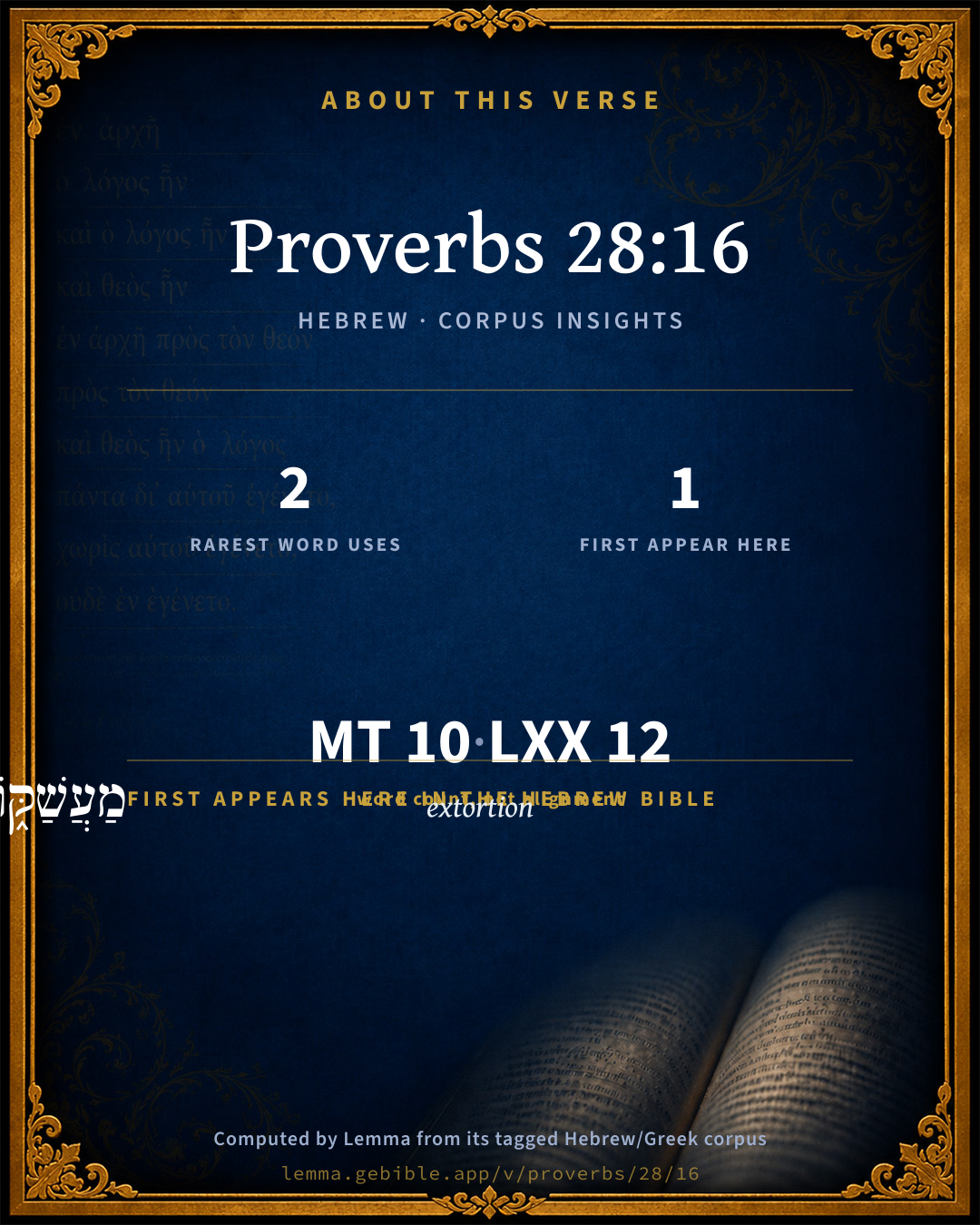
The rarest word here is מַעֲשַׁקּ֑וֹת extortion H4642 — appearing just 2 times in the whole Hebrew Bible.

First appearance in Scripture

This word makes its first canonical appearance in the Hebrew Bible here:

  • מַעֲשַׁקּ֑וֹת extortion H4642

Shared distinctive vocabulary

מַעֲשַׁקּ֑וֹת extortion H4642 occurs in 2 verses of the Hebrew Bible. Also found in:

Grammatical profile

  • 3 verbs
  • 5 nouns
  • 2 adjectives

Verb forms

  • שנאי Qal · Participle Active
  • שֹׂ֥נֵא Qal · Participle Active
  • יַאֲרִ֥יךְ Hiphil · Imperfect

Repetition

A word recurs within this verse — often emphatic in Hebrew:

  • שנאי to hate H8130 ×2

Hebrew & Septuagint length

In English translation the verse runs 14 words from the Hebrew and 20 from the Septuagint (LXX English) — the Septuagint runs noticeably longer here. See the side-by-side →

A rough comparison of the two English renderings, which tokenize alike — not a word-level alignment.

Word counts can differ between the Hebrew and the Greek without any difference in meaning — e.g. the Hebrew direct-object marker אֵת has no separate Greek word, and Greek often adds the article ὁ.

In the original languages it is 10 Hebrew tokens and 12 Greek tokens — but the two are counted differently (Hebrew bundles its prefixes and suffixes into one token; the Greek is in lemma form), so that isn’t a like-for-like length.

Cross-references

9

Topical passages linked to Proverbs 28:16 in the Treasury of Scripture Knowledge — connected by theme and wording, ordered by reader-vote popularity; previews shown in the World English Bible.

  • Exodus 18:21 Moreover you shall provide out of all the people able men, such as fear God: men of truth, hating unjust gain; and place such over them, to be rulers of thousands, rulers of hundreds, rulers of fifties, and rulers of tens.
  • 1 Kings 12:10 The young men who had grown up with him spoke to him, saying, Thus shall you tell this people who spoke to you, saying, Your father made our yoke heavy, but make you it lighter to us; thus shall you speak to them, My little finger is thicker than my father's loins.
  • 1 Kings 12:14 and spoke to them after the counsel of the young men, saying, My father made your yoke heavy, but I will add to your yoke: my father chastised you with whips, but I will chastise you with scorpions.
  • Nehemiah 5:15 But the former governors who were before me were chargeable to the people, and took of them bread and wine, besides forty shekels of silver; yes, even their servants bore rule over the people: but I didn't do so, because of the fear of God.
  • Ecclesiastes 4:1 Then I returned and saw all the oppressions that are done under the sun: and, behold, the tears of those who were oppressed, and they had no comforter; and on the side of their oppressors there was power; but they had no comforter.
  • Isaiah 3:12 As for my people, children are their oppressors, And women rule over them. My people, those who lead you cause you to err, And destroy the way of your paths.
  • Isaiah 33:15–16 He who walks righteously, and speaks blamelessly; he who despises the gain of oppressions, who shakes his hands from taking a bribe, who stops his ears from hearing of blood, and shuts his eyes from looking on evil:
  • Jeremiah 22:15–17 Shall you reign, because you strive to excel in cedar? Didn't your father eat and drink, and do justice and righteousness? then it was well with him.
  • Amos 4:1 Listen to this word, you cows of Bashan, who are on the mountain of Samaria, who oppress the poor, who crush the needy, who tell their lords, "Bring, and let us drink."

Cross-references courtesy of OpenBible.info (CC BY 4.0).

Hebrew and Greek witnesses Masoretic Hebrew ↔ Greek Septuagint

The same verse in the two great witnesses to the Old Testament, shown verse-for-verse.

Here the Septuagint runs noticeably longer than the Hebrew — LXX2012 (modern English Septuagint) 20 words vs World English Bible 14. A rough length comparison of the two English translations, not a word-level alignment — read both below.

These are two independent witnesses, not word-aligned to each other, and the Septuagint is shown in lemma (dictionary) form.

Hebrew Proverbs 28:16 Masoretic · Westminster Leningrad Codex

נָגִ֗יד חֲסַ֣ר תְּ֭בוּנוֹת וְרַ֥ב מַעֲשַׁקּ֑וֹת שנאי שֹׂ֥נֵא בֶ֝֗צַע יַאֲרִ֥יךְ יָמִֽים

A tyrannical ruler lacks judgment. One who hates ill-gotten gain will have long days.

World English Bible · Public Domain

Greek LXX Proverbs 28:16 Septuagint · lemma form

βασιλεύς ἐνδεής πρόσοδος μέγας συκοφάντης ὁ δέ μισέω ἀδικία μακρός χρόνος ζάω

A king in need of revenues is a great oppressor: but he that hates injustice shall live a long time.

LXX2012 (modern English Septuagint) · Public Domain

On this verse, Haydock's Catholic Bible Commentary discusses the Septuagint’s reading. Read the note in Commentary ↓

Hebrew: Westminster Leningrad Codex (CC BY 4.0). Greek: Septuagint (public domain); English from LXX2012 (modern English Septuagint) (Public Domain). How the Septuagint differs from the Hebrew →

Commentary

Notes on Proverbs 28:16 from classic Christian and Jewish commentators (each source and its license shown beneath its notes). The classic Christian expositions comment on the surrounding passage and are grouped to its opening verse, so a note may address several verses; the Jewish commentaries on the Tanakh (Rashi and others) are per-verse, so they appear only where the commentator wrote on this verse.

Lemma curates 59 commentaries, every one of them public domain or Creative Commons licensed, each selected and text-cleaned for this edition rather than reprinted as found. About our sources →

Trapp's Complete Commentary

John Trapp

Pro 28:16 The prince that wanteth understanding [is] also a great oppressor: [but] he that hateth covetousness shall prolong [his] days.

Ver. 16. The prince that wanteth understanding.] As every tyrant doth, {Psa 14:4} though they think they deal wisely, as Pharaoh, {Exo 1:10} for they usually come to untimely ends, {a} as most of the Caesars till Constantine, and as our Richard III and Queen Mary, whose reigns are the shortest of all the kings since the Conquest. "Bloody and deceitful men live not half their days," or if they do, it is for a further evil unto them. {Isa 65:20}

But he that hateth covetousness.] Covetousness in the original hath its name from piercing or wounding, and fitly, both in respect of others, {Pro 1:19} and himself. {1Ti 6:10}

{a} Ad generum Cereris sine caede, &c.

John Trapp, A Commentary or Exposition upon All the Books of the Old and New Testament (1647–1656) — public domain. Text from a community e-Sword module.

Joseph Benson's Commentary

Pro 28:16. The prince that wanteth understanding, &c. — The tyranny or oppression of a prince is a manifest sign of great folly, because it alienates from him the hearts of his people, in possessing which his honour, safety, and riches consist; and often causes the shortening of his days, either through God’s cutting him off by some sudden stroke, or through the violence of men who have been injured by him, and are exasperated against him. But he that hateth covetousness — Which is the chief cause of all oppression and unjust practices; shall prolong his days — By God’s favour, the peace and satisfaction of his own mind, and the hearty love of his people, which induces them to pray fervently to God to preserve his life, and makes them willing to hazard their estates and lives in his defence.

Joseph Benson's Commentary on the Old and New Testaments (1811–1818) — public domain. Text from a community e-Sword module.

Matthew Henry's Commentary

Two things are here intimated to be the causes of the mal-administration of princes: - 1. The love of money, that root of all evil; for hating covetousness here stands opposed to oppression, according to Moses's character of good magistrates, men fearing God and hating covetousness (Exo 18:21), not only not being covetous, but hating it, and shaking the hands from the holding of bribes. A ruler that is covetous will neither do justly nor love mercy, but the people under him shall be bought and sold. 2. Want of consideration: He that hates covetousness shall prolong his government and peace, shall be happy in the affections of his people and the blessing of his God. It is as much the interest as the duty of princes to reign in righteousness. Oppressors therefore and tyrants are the greatest fools in the world; they want understanding; they do not consult their own honour, ease, and safety, but sacrifice all to their ambition of an absolute and arbitrary power. They might be much happier in the hearts of their subjects than in their necks or estates.

Matthew Henry's Commentary on the Whole Bible (1708–1710) — public domain (CC PDM 1.0). Text via the HelloAO Bible API.

Jamieson, Fausset & Brown

Robert Jamieson, A. R. Fausset & David Brown

The prince . . . understanding--that is, He does not perceive that oppression jeopards his success. Covetousness often produces oppression, hence the contrast.

Jamieson, Fausset & Brown — Commentary Critical and Explanatory on the Whole Bible (1871) — public domain (CC PDM 1.0). Text via the HelloAO Bible API.

Adam Clarke's Commentary

Verse 16. The prince that wanteth understanding] A weak prince will generally have wicked ministers, for his weakness prevents him from making a proper choice; and he is apt to prefer them who flatter him, and minister most to his pleasures. The quantum of the king's intellect may be always appreciated by the mildness or oppressiveness of his government. He who plunges his people into expensive wars, to support which they are burdened with taxes, is a prince without understanding. He does not know his own interest, and does not regard that of his people. But these things, though general truths, apply more particularly to those despotic governments which prevail in Asiatic countries.

Adam Clarke's Commentary on the Bible (1810–1826) — public domain. Text from a community e-Sword/MySword module.

Ellicott's Commentary for English Readers

(16) A prince that wanteth understanding is also a great oppressor.—Thereby losing the love of his people, and at the same time impoverishing them; thus killing the goose that laid the golden eggs. He also by his misdeeds draws down upon himself God’s anger in the shape of an early death. Comp. the woe pronounced upon Jehoiakim (Jer_22:13, sqq.).

A Bible Commentary for English Readers, edited by Charles John Ellicott (1878–1897) — public domain. Text from a community e-Sword module.

The Cambridge Bible for Schools and Colleges

gen. ed. J. J. S. Perowne

16. The prince &c.] Lit. A prince that lacketh understanding and a great oppressor! i.e. the two are identical. There is no particle of connection or contrast between the two clauses of the verse, and R.V. marg. adopts the view that the whole verse is a continuous address or admonition: O prince that lackest understanding and art a great oppressor, he that, &c.

The Cambridge Bible for Schools and Colleges (gen. ed. J. J. S. Perowne; Cambridge University Press, 1878–1918) — public domain. Text from a community e-Sword module.

John Gill's Exposition

The prince that wanteth understanding is also a great oppressor,.... Or, "much in oppressions" (o); he multiplies them, and abounds in them; he distresses his subjects in a variety of ways and methods he uses to extort money from them by which he shows his want of understanding: he is a wise prince that uses gentle methods, and gains the affections of his people, and who cheerfully supports his crown and government with honour and glory; but he is a foolish prince that uses them with rigour. It may be rendered, "and a prince that wanteth understanding, and is much", or "abounds, in oppressions"; in laying heavy burdens and taxes on his people, in an arbitrary manner; "shall shorten, and not prolong his days" (p), as it may be supplied from the next clause; either his subjects will rise up against him, and dethrone him, and destroy him; or God, in mercy to them, and in judgment to him, will remove him by death;

but he that hateth covetousness shall prolong his days; to hate covetousness is a good qualification of a civil magistrate, prince, or ruler, Exo 18:21. This sin is the cause of a wicked prince oppressing his subjects; but where it is hated, which is seen by moderation in government, and easing of the people as much as possible; such a prince, as he has the hearts of his subjects, is well pleasing to God, by whom he reigns; and such an one, through the prayers of the people for him, and the goodness of God unto him, lives long, and reigns prosperously; and dies, as David, in a good old age, full of days, riches, and honour.

(o) "multus oppressionibus", Montanus, Junius & Tremeilius, Piscator, Mercerus, Baynus, Michaelis, Schultens. (p) So Junius & Tremellius, Piscator, Gejerus, and some Jewish writers in Vatablus.

John Gill's Exposition of the Whole Bible (1746–1763) — public domain (CC PDM 1.0). Text via the HelloAO Bible API.

Haydock's Catholic Bible Commentary

Prudence. Septuagint, "riches." Poverty is a great temptation to people in authority, more than avarice itself. (Calmet)

George Leo Haydock (1774–1849), Haydock's Catholic Family Bible and Commentary, 1859 edition — public domain. Excludes Psalms (Douay-Rheims chapter numbering differs from Protestant) and Deuterocanonical books (Catholic canon only).

Matthew Poole's English Annotations

The tyranny or oppression of a prince, though by some accounted wisdom, is in truth a manifest act and sign of great folly, because it alienateth from him the hearts of his people, in which his honour, and safety, and riches consist, and ofttimes causeth the shortening of his days, either from God, who cuts him off by some sudden judgment, or from men, who are injured by him, and exasperated against him.

Covetousness is the chief cause of all oppressions and unjust practices.

Shall prolong his days, by God’s favour, the peace and satisfaction of his own mind, and the hearty love of his people, which makes them careful to preserve his life by their fervent prayers to God for him, by willingly hazarding their own estates and lives for him, when occasion requires it, and by all other possible means.

Matthew Poole's English Annotations on the Holy Bible (1683–1685) — public domain. Text from a community e-Sword/MySword module.

Whedon's Commentary on the Bible

Daniel D. Whedon

16. Prince that wanteth understanding — It is not a wicked ruler only that oppresses his people, but a weak one also; one who is himself both incapable of governing well and of selecting good advisers. He will probably prefer weak men, like himself, or wicked men, who flatter him and give him evil counsel. Witness the case of Rehoboam, given in 1 Kings.

Hateth covetousness shall prolong his days — The ruler that is a hater of rapine and plunder shall prolong the days of his reign, and probably also of his life.

Daniel D. Whedon (gen. ed.), Commentary on the Old and New Testaments (1874–1909) — public domain. Text from a community e-Sword module.

The Pulpit Commentary

The prince that wanteth understanding is also a great oppressor; literally, and rich in oppression. Ewald, Delitzsch, Nowack, and others take the verse, not as a statement, but as a warning addressed to the ruler, as we have so many addressed to a son, and as the author of the Book of Wisdom calls upon the judges of the earth to listen to his admonitions. They therefore render thus: "O prince, void of understanding, but rich in oppression!" The wording and accentuation of the passage confirm this view. Caher renders, "A prince that wants understanding increases his exactions." The want of intelligence makes a prince cruel and tyrannical and callous to suffering: not possessing the wisdom and prudence necessary for right government, he defrauds his subjects, treats them unjustly, and causes great misery. See the prophet"s denunciation of Shallum and Jehoiakim for these very crimes. (Jer_22:13-19) Septuagint, "A king wanting revenues is a great oppresser (sukofanthv )." He that hateth covetousness shall prolong his days. (Pro_15:27) The prince addressed is thus warned that his oppressive acts will be visited upon him judicially; that only a ruler who deals with his subjects liberally and equitably can attain to old age, and that his conduct will shorten his life. An early death is reckoned as a token of God"s indignation. The second hemistich Caher translates, "But he who hates lucre shall reign long." Septuagint, "He who hateth iniquity shall live a long time." (For "covetousness" (betsa), see on Pro_1:19)

The Pulpit Commentary (1880–1919), ed. H.D.M. Spence-Jones & Joseph S. Exell — public domain. Text from a community e-Sword module.

John Wesley's Explanatory Notes

Oppressor - The tyranny of a prince, is a manifest sign of folly. Prolong - By God's favour, the peace and satisfaction of his own mind, and the hearty love of his people.

John Wesley, Explanatory Notes Upon the Whole Bible (1754–1765) — public domain. Text via the GEBible commentary corpus.

Keil & Delitzsch

C. F. Keil & F. Delitzsch

Another proverb of the king:

O prince devoid of understanding and rich in oppression!

He that hateth unrighteous gain continueth long.

The old interpreters from the lxx interpret מעשׁקּות רבו as pred. (as also Fleischer: princeps qui intelligentiae habet parum idem oppressionis exercet multum); but why did not the author use the word הוּא or והוּא instead of this ambiguous inconvenient ו? Hitzig regards the first term as a nominative absolute, which does not assume a suffix in the second line. But examples such as 27a, Pro 27:7, are altogether of a different sort; there occurs a reference that is in reality latent, and only finds not expression; the clause following the nominative is related to it as its natural predicate, but here 15b is an independent clause standing outside of any syntactical relation to 15a. Heidenheim has acknowledged that here there lies before us a proverb not in the form of a mere declaration, but of a warning address, and thus also it is understood by Ewald, Bertheau, Elster, and Zckler. The accentuation seems to proceed on the same supposition. It is the only passage in the Book of Proverbs where נגיד, of the supreme ruler of the people, and where the plur. תּבוּנות, occur; it is not therefore at all strange if the proverb also has something strange in its formation. Often enough, proverbs are in the form of an address to a son, and generally to their reader; why not also one at least to the king? It is a proverb as when I say: Oh thou reckless, merry fellow! he who laughs much will sometimes weep long. Thus here the address is directed to the prince who is devoid of all wisdom and intelligence, which are necessary for a prince; but on this account the more earnest in exhortation to say to him that only one who hates defrauding the people attains an old age; thus that a prince who plunders the people wantonly shortens his life as a man, and his position as a ruler (cf. שׁניהם, Pro 24:22). The Kerı̂ שׂנא has the tone thrown back on the penult., as the Chethı̂b שׂנאי would also have it, cf. למצאי, Pro 8:9. The relation of a plur. subj. to a sing. pred. is as at Pro 27:16. Regarding בּצע, vid., under Pro 1:19. A confirmation of this proverb directing itself to princes if found in Jer 22:13-19, the woe pronounced upon Jehoiakim. And a glance at the woe pronounced in Hab 2:12, shows how easily Pro 28:17 presents itself in connection.

Keil & Delitzsch — Biblical Commentary on the Old Testament (1861–1891) — public domain (CC PDM 1.0). Text via the HelloAO Bible API. (Old Testament only.)

Rashi

Rabbi Shlomo Yitzchaki (Rashi)

who lacks understanding As he lacks understanding, he is a great oppressor because he does not give any thought to his life. [Therefore,] he oppresses excessively, for one who hates unlawful gain will live long. [Consequently, he who oppresses others will die young.]

Rashi on the Tanakh — English translations: “The Judaica Press complete Tanach with Rashi, translated by A. J. Rosenberg” (CC BY 4.0); “Pentateuch with Rashi's commentary by M. Rosenbaum and A.M. Silbermann, 1929-1934” (public domain); “The Metsudah Tanach series, Lakewood, N.J” (CC BY 4.0); and “The Book of Joshua, Metsudah Publications, 1997” (CC BY 4.0). Text via Sefaria.

Lesson kit

Teaching starters — assembled from the data on this page, not authored interpretation. Every prompt links to the verse data it draws on. Edit before teaching.

Proverbs, in the Wisdom, opens this verse with 10 words (9 distinct Hebrew lemmas). Its most distinctive word is maʻăshaqqâh (“extortion”). The Greek Septuagint runs longer here. A historical commentator’s framing appears above. Read the whole chapter for the surrounding context.

Discussion questions

  1. How does “extortion” (maʻăshaqqâh) shape what this verse is saying?
  2. The word “extortion” first appears here in Scripture. What is being introduced at this debut?
  3. Isaiah 33:15 shares the word «extortion» with this verse. How do the two illuminate each other?
  4. “to hate” occurs 2× in this one verse. What is the effect of the repetition?
  5. Compared with the Hebrew, the Septuagint runs longer here. What questions does that raise?
  6. The translations on this page render this verse differently — a whole-verse word diff, not a word-by-word alignment. What might account for the different wordings?
  7. The verb «שנאי» is Qal Participle Active. How does its form color the action?
  8. Reading how Trapp's Complete Commentary and Joseph Benson's Commentary read this verse, where do the two commentators agree and where do they part?

Things to notice

Reading settings

Reading text

Shown beneath each verse's original-language words.

Old Testament
Old Testament edition

Read the OT as the Masoretic Hebrew (MT) or the Greek Septuagint (LXX).

English shown for the Greek Septuagint (in the Hebrew ↔ Greek comparison).

Comparing translations? Open the Compare panel on any verse page to stack up to four side by side.