
Genesis 29:31

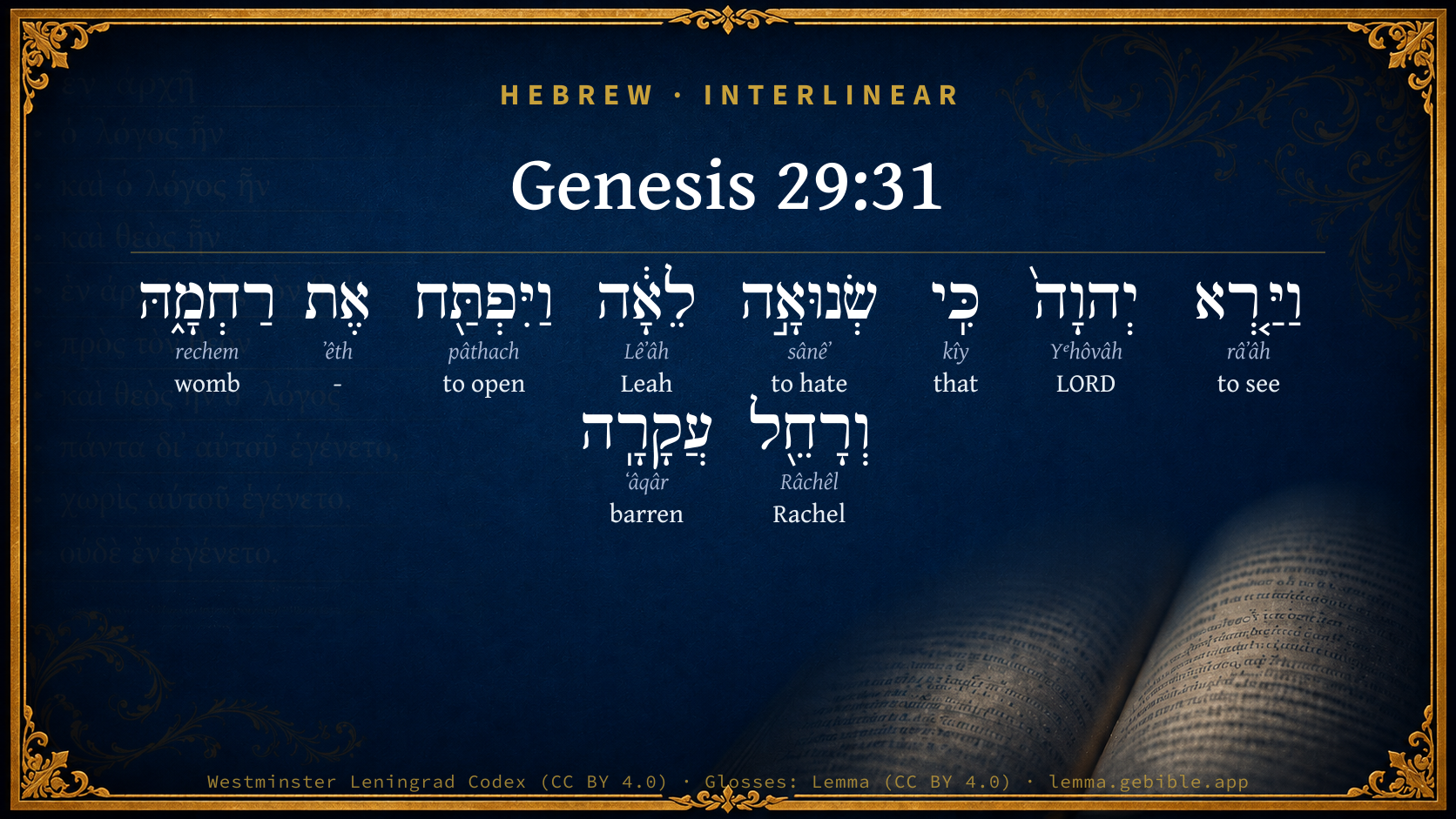
Hebrew (Westminster Leningrad Codex) Genesis 29:31 appears in the Hebrew Old Testament. The text above is from the Westminster Leningrad Codex. Each word links to its Strong’s number, a concise gloss, and parsing drawn from the Open Scriptures Hebrew Bible morphology. Click any word for its full Brown-Driver-Briggs (BDB) entry.
Download image
Cite this verse

Genesis 29:31 (World English Bible). Public Domain. Lemma interlinear Bible study tool, https://lemma.gebible.app/v/genesis/29/31.

Show BibTeX & RIS
BibTeX
RIS
English Translation
Yahweh saw that Leah was hated, and he opened her womb, but Rachel was barren.
World English Bible · Public Domain
Download a study sheet

One document with this verse’s original text, its word-by-word gloss line, the meaning frame, cross-references with their text, attributed commentary, and full source and license credits — printable, and it pastes into notes with its structure intact.

This verse Autodidact and up

Study sheet (.html) Plain text (.txt)

A passage Seminary Student

Up to 50 verses in one chapter. A passage sheet keeps up to 6 commentary sources and 12 cross-references per verse, in the order this page ranks them, and says so on the sheet whenever that leaves anything out. Ask for a single verse and you get the Autodidact verse sheet above.

Everything on this page stays free to read, with no account — the sheet is a download of what is already on screen, not access to it.

Want to remove ads? Support Godless Engineer
Compare translations 3

The same verse in 3 English versions, stacked beneath the original-language interlinear above. Click any original word for its lexicon entry.

Each is an independent rendering of the whole verse — the interlinear is not word-aligned to these translations.

Highlighted words mark where these versions differ — a whole-verse word diff, not a word-by-word alignment.

  • World English Bible Public Domain
    Yahweh saw that Leah was hated, and he opened her womb, but Rachel was barren.
  • King James Version Public Domain
    And when the LORD saw that Leah was hated, he opened her womb: but Rachel was barren.
  • unfoldingWord Literal Text CC BY-SA 4.0
    Now Yahweh saw that Leah was hated, so he opened her womb, but Rachel barren.

unfoldingWord Literal Text — © unfoldingWord, licensed CC BY-SA 4.0. Word-aligned USFM3 via Door43 (git.door43.org/unfoldingWord/en_ult).

Versions to compare (up to 4)

3 of 4 selected

Show all 18 translations

Every available English version of this verse, each an independent rendering of the whole verse.

  • World English Bible Public Domain
    Yahweh saw that Leah was hated, and he opened her womb, but Rachel was barren.
  • Berean Standard Bible Public Domain
    When the LORD saw that Leah was unloved, He opened her womb; but Rachel was barren.
  • Majority Standard Bible Public Domain
    When the LORD saw that Leah was unloved, He opened her womb; but Rachel was barren.
  • King James Version Public Domain
    And when the LORD saw that Leah was hated, he opened her womb: but Rachel was barren.
  • American Standard Version (1901) Public Domain
    And Jehovah saw that Leah was hated, and he opened her womb. But Rachel was barren.
  • Revised Version (1885) Public Domain
    And the LORD saw that Leah was hated, and he opened her womb: but Rachel was barren.
  • Geneva Bible (1599) Public Domain
    When the Lord saw that Leah was despised, he made her fruitful: but Rahel was barren.
  • Douay-Rheims (1899) Public Domain
    And the Lord seeing that he despised Lia, opened her womb, but her sister remained barren.
  • Young's Literal Translation Public Domain
    And Jehovah seeth that Leah `is' the hated one, and He openeth her womb, and Rachel `is' barren;
  • Literal Standard Version CC BY-SA 4.0
    And YHWH sees that Leah [is] the hated one, and He opens her womb, and Rachel [is] barren;
  • Unlocked Literal Bible CC BY-SA 4.0
    Yahweh saw that Leah was not loved, so he opened her womb, but Rachel was childless.
  • unfoldingWord Literal Text CC BY-SA 4.0
    Now Yahweh saw that Leah was hated, so he opened her womb, but Rachel barren.
  • Darby Bible Public Domain
    And when Jehovah saw that Leah was hated, he opened her womb; but Rachel was barren.
  • World Messianic Bible Public Domain
    The LORD saw that Leah was hated, and he opened her womb, but Rachel was barren.
  • Webster's Bible Public Domain
    And when the LORD saw that Leah was hated, he made her fruitful: but Rachel was barren.
  • Free Bible Version CC BY-SA 4.0
    When the Lord saw that Leah wasn't loved he helped Leah to have children, but not Rachel.
  • Bible in Basic English Public Domain
    Now the Lord, seeing that Leah was not loved, gave her a child; while Rachel had no children.
  • JPS Tanakh (1917) Public Domain
    And the LORD saw that Leah was hated, and he opened her womb; but Rachel was barren.

Literal Standard Version (2020), Covenant Press — licensed CC BY-SA 4.0. Text via the HelloAO Bible API (eBible.org). Unlocked Literal Bible (unfoldingWord) — licensed CC BY-SA 4.0. Text via the HelloAO Bible API (eBible.org). unfoldingWord Literal Text — © unfoldingWord, licensed CC BY-SA 4.0. Word-aligned USFM3 via Door43 (git.door43.org/unfoldingWord/en_ult). Free Bible Version, Dr. Jonathan Gallagher — licensed CC BY-SA 4.0. Text via the HelloAO Bible API (eBible.org).

Word by word

More ways to search: Search by grammar → Find every occurrence → Compare this word →

Practice this passage: Drill this verse → Learn its vocabulary →

About this verse

These counts appear in no published source. They are computed here, from the morphology-tagged text and Lemma’s own curated glosses. What Lemma adds →

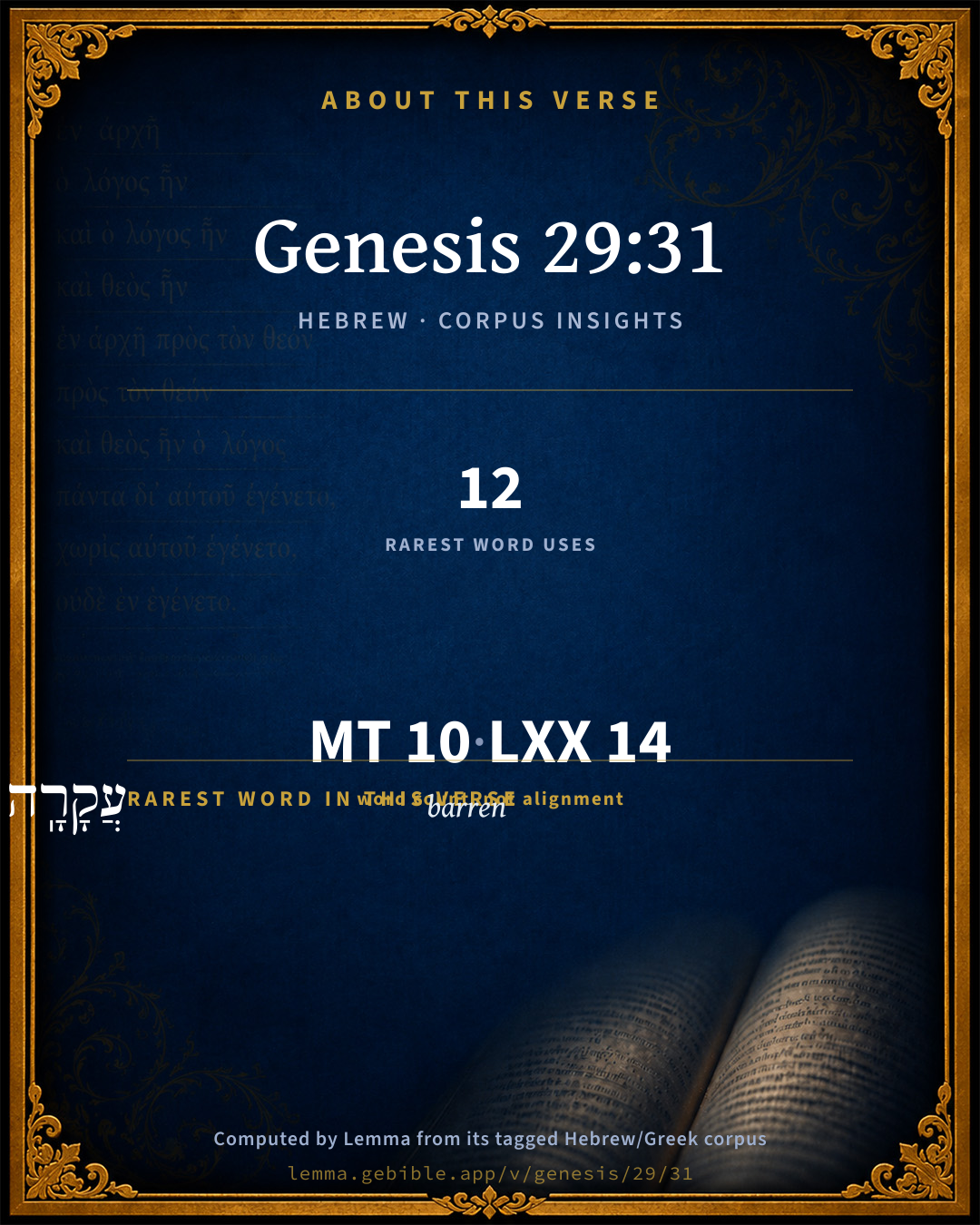
10
words
10
distinct lemmas
Pentateuch
section

Notable vocabulary

The rarest word here is עֲקָרָֽה barren H6135 — appearing just 12 times in the whole Hebrew Bible.

Shared distinctive vocabulary

עֲקָרָֽה barren H6135 occurs in 11 verses of the Hebrew Bible. Also found in:

Grammatical profile

  • 3 verbs
  • 4 nouns
  • 1 adjective
  • 1 conjunction
  • 1 particle

Verb forms

  • וַיַּ֤רְא Qal · Sequential Imperfect
  • שְׂנוּאָ֣ה Qal · Participle Passive
  • וַיִּפְתַּ֖ח Qal · Sequential Imperfect

Hebrew & Septuagint length

In English translation the verse runs 15 words from the Hebrew and 18 from the Septuagint (LXX English) — closely comparable.

A rough comparison of the two English renderings, which tokenize alike — not a word-level alignment.

Word counts can differ between the Hebrew and the Greek without any difference in meaning — e.g. the Hebrew direct-object marker אֵת has no separate Greek word, and Greek often adds the article ὁ.

In the original languages it is 10 Hebrew tokens and 14 Greek tokens — but the two are counted differently (Hebrew bundles its prefixes and suffixes into one token; the Greek is in lemma form), so that isn’t a like-for-like length.

Cross-references

21

Topical passages linked to Genesis 29:31 in the Treasury of Scripture Knowledge — connected by theme and wording, ordered by reader-vote popularity; previews shown in the World English Bible.

  • 1 Samuel 2:21 Yahweh visited Hannah, and she conceived, and bore three sons and two daughters. The child Samuel grew before Yahweh.
  • Psalms 127:3 Behold, children are a heritage of Yahweh. The fruit of the womb is his reward.
  • Genesis 20:18–21:2 For Yahweh had closed up tight all the wombs of the house of Abimelech, because of Sarah, Abraham's wife.
  • Genesis 30:1–2 When Rachel saw that she bore Jacob no children, Rachel envied her sister. She said to Jacob, "Give me children, or else I will die."
  • Deuteronomy 21:15 If a man have two wives, the one beloved, and the other hated, and they have borne him children, both the beloved and the hated; and if the firstborn son be hers who was hated;
  • 1 Samuel 1:5 but to Hannah he gave a double portion; for he loved Hannah, but Yahweh had shut up her womb.
  • Matthew 10:37 He who loves father or mother more than me is not worthy of me; and he who loves son or daughter more than me isn't worthy of me.
  • Genesis 29:30 He went in also to Rachel, and he loved also Rachel more than Leah, and served with him yet seven other years.
  • Exodus 3:7 Yahweh said, "I have surely seen the affliction of my people who are in Egypt, and have heard their cry because of their taskmasters, for I know their sorrows.
  • Judges 13:2–3 There was a certain man of Zorah, of the family of the Danites, whose name was Manoah; and his wife was barren, and didn't bear.
  • Luke 1:7 But they had no child, because Elizabeth was barren, and they both were well advanced in years.
  • Genesis 25:21 Isaac entreated Yahweh for his wife, because she was barren. Yahweh was entreated by him, and Rebekah his wife conceived.
  • Genesis 27:41 Esau hated Jacob because of the blessing with which his father blessed him. Esau said in his heart, "The days of mourning for my father are at hand. Then I will kill my brother Jacob."
  • Genesis 30:22 God remembered Rachel, and God listened to her, and opened her womb.
  • Malachi 1:3 but Esau I hated, and made his mountains a desolation, and gave his heritage to the jackals of the wilderness."
  • Luke 14:26 "If anyone comes to me, and doesn't hate his own father, mother, wife, children, brothers, and sisters, yes, and his own life also, he can't be my disciple.
  • John 12:25 He who loves his life will lose it. He who hates his life in this world will keep it to eternal life.
  • 1 Samuel 1:20 It happened, when the time was come about, that Hannah conceived, and bore a son; and she named him Samuel, [saying], Because I have asked him of Yahweh.
  • 1 Samuel 1:27 For this child I prayed; and Yahweh has given me my petition which I asked of him:
  • Matthew 6:24 "No one can serve two masters, for either he will hate the one and love the other; or else he will be devoted to one and despise the other. You can't serve both God and Mammon.
  • Genesis 16:1 Now Sarai, Abram's wife, bore him no children. She had a handmaid, an Egyptian, whose name was Hagar.

Cross-references courtesy of OpenBible.info (CC BY 4.0).

Hebrew and Greek witnesses Masoretic Hebrew ↔ Greek Septuagint

The same verse in the two great witnesses to the Old Testament, shown verse-for-verse.

These are two independent witnesses, not word-aligned to each other, and the Septuagint is shown in lemma (dictionary) form.

Hebrew Genesis 29:31 Masoretic · Westminster Leningrad Codex

וַיַּ֤רְא יְהוָה֙ כִּֽי שְׂנוּאָ֣ה לֵאָ֔ה וַיִּפְתַּ֖ח אֶת רַחְמָ֑הּ וְרָחֵ֖ל עֲקָרָֽה

Yahweh saw that Leah was hated, and he opened her womb, but Rachel was barren.

World English Bible · Public Domain

Greek LXX Genesis 29:31 Septuagint · lemma form

ὁράω δέ κύριος ὅτι μισέω λεια ἀναοἴγω ὁ μήτρα αὐτός ραχηλ δέ εἰμί στεῖρα

And when the Lord God saw that Lea was hated, he opened her womb; but Rachel was barren.

LXX2012 (modern English Septuagint) · Public Domain

Hebrew: Westminster Leningrad Codex (CC BY 4.0). Greek: Septuagint (public domain); English from LXX2012 (modern English Septuagint) (Public Domain). How the Septuagint differs from the Hebrew →

Targum (Aramaic paraphrase)

2

The Targum is the ancient Jewish Aramaic paraphrase of the Hebrew Scriptures — an interpretive translation, not the Hebrew text itself. Onkelos (literal) and Pseudo-Jonathan (expansive) render the Torah, and Jonathan the Prophets. Coverage is partial: where no permissively-licensed English translation exists for a verse, only the Aramaic is shown. This is verse-level text, not a word-by-word alignment to the Hebrew.

  1. Targum Onkelos Torah (Genesis–Deuteronomy)
    וַחֲזָא יְיָ אֲרֵי שְׂנִיאֲתָא לֵאָה וִיהַב לַהּ עִדּוּי וְרָחֵל עַקְרָא

    (no public-domain English translation for this verse)

    Targum Onkelos — Aramaic: “Onkelos Genesis” (public domain); “Onkelos Exodus” (public domain); “Onkelos Leviticus” (public domain); “Onkelos Numbers” (public domain); “Onkelos Deuteronomy” (public domain). English: “Sefaria Community Translation” (CC0 1.0 (public-domain dedication)); “J.W. Etheridge. The Targums of Onkelos and Jonathan Ben Uzziel on the Pentateuch. London: Longmans, Green, 1862” (public domain). Text via Sefaria.

  2. Targum Pseudo-Jonathan Torah (Genesis–Deuteronomy)
    וּגְלֵי קֳדָם יְיָ אֲרוּם לָא הֲוַת לֵאָה רְחִימְתָּא בְּאַנְפֵּי יַעֲקב וַאֲמַר בְּמֵימְרֵיה לְמִיתַּן לָהּ בְּנִין וְרָחֵל הֲוַת עַקְרָה

    And it was revealed before the Lord that Leah was not loved in the sight of Jakob; and He said in His Word that sons should be given her, and that Rahel should be barren.

    Targum Pseudo-Jonathan — Aramaic: “Targum Jonathan on Genesis” (public domain); “Targum Jonathan on Exodus” (public domain); “Targum Jonathan on Leviticus” (public domain); “Targum Jonathan on Numbers” (public domain); “Targum Jonathan on Deuteronomy” (public domain). English: “The Targum of Jonathan ben Uzziel, trans. J. W. Etheridge, London, 1862” (public domain). Text via Sefaria.

Commentary

Notes on Genesis 29:31 from classic Christian and Jewish commentators (each source and its license shown beneath its notes). The classic Christian expositions comment on the surrounding passage and are grouped to its opening verse, so a note may address several verses; the Jewish commentaries on the Tanakh (Rashi and others) are per-verse, so they appear only where the commentator wrote on this verse.

Lemma curates 59 commentaries, every one of them public domain or Creative Commons licensed, each selected and text-cleaned for this edition rather than reprinted as found. About our sources →

Matthew Henry's Commentary

We have here the birth of four of Jacob's sons, all by Leah. Observe, 1. That Leah, who was less beloved, was blessed with children, when Rachel was denied that blessing, Gen 29:31. See how Providence, in dispensing its gifts, observes a proportion, to keep the balance even, setting crosses and comforts one over-against another, that none may be either too much elevated or too much depressed. Rachel wants children, but she is blessed with her husband's love; Leah wants that, but she is fruitful. Thus it was between Elkana's two wives (Sa1 1:5); for the Lord is wise and righteous. When the Lord saw that Leah was hated, that is, loved less than Rachel, in which sense it is required that we hate father and mother, in comparison with Christ (Luk 14:26), then the Lord granted her a child, which was a rebuke to Jacob, for making so great a difference between those that he was equally related to, - a check to Rachel, who perhaps insulted over her sister upon that account, - and a comfort to Leah, that she might not be overwhelmed with the contempt put upon her: thus God giveth abundant honour to that which lacked, Co1 12:24. 2. The names she gave her children were expressive of her respectful regards both to God and to her husband. (1.) She appears very ambitious of her husband's love: she reckoned the want of it her affliction (Gen 29:32); not upbraiding him with it as his fault, nor reproaching him for it, and so making herself uneasy to him, but laying it to heart as her grief, which yet she had reason to bear with the more patience because she herself was consenting to the fraud by which she became his wife; and we may well bear that trouble with patience which we bring upon ourselves by our own sin and folly. She promised herself that the children she bore him would gain her the interest she desired in his affections. She called her first-born Reuben (see a son), with this pleasant thought, Now will my husband love me; and her third son Levi (joined), with this expectation, Now will my husband by joined unto me, Gen 29:34. Mutual affection is both the duty and comfort of that relation; and yoke-fellows should study to recommend themselves to each other, Co1 7:33, Co1 7:34. (2.) She thankfully acknowledges the kind providence of God in it: The Lord hath looked upon my affliction, Gen 29:32. "The Lord hath heard, that is, taken notice of it, that I was hated (for our afflictions, as they are before God's eyes, so they have a cry in his ears), he has therefore given me this son." Note, Whatever we have that contributes either to our support and comfort under our afflictions or to our deliverance from them, God must be owned in it, especially his pity and tender mercy. Her fourth she called Judah (praise), saying, Now will I praise the Lord, Gen 29:35. And this was he of whom, as concerning the flesh, Christ came. Note, [1.] Whatever is the matter of our rejoicing ought to be the matter of our thanksgiving. Fresh favours should quicken us to praise God for former favours. Now will I praise the Lord more and better than I have done. [2.] All our praises must centre in Christ, both as the matter of them and as the Mediator of them. He descended from him whose name was praise, for he is our praise. Is Christ formed in my heart? Now will I praise the Lord.

Matthew Henry's Commentary on the Whole Bible (1708–1710) — public domain (CC PDM 1.0). Text via the HelloAO Bible API.

The Cambridge Bible for Schools and Colleges

gen. ed. J. J. S. Perowne

31. hated] By this is meant that Jacob had less affection for Leah than for Rachel. Cf. Deu_21:15, “if a man have two wives, the one beloved and the other hated.” In order to prevent the evil effects of jealousy, the marriage by one man of two sisters is forbidden in Lev_18:18. See, also, Mal_1:2-3, “I loved Jacob, but Esau I hated.”

Gen_29:31 to Gen_30:24. Birth of Jacob’s Children

31–35 (J); Gen_30:1-24 (J, E and P)

In this section is narrated the account of the birth of eleven sons and one daughter. Six of the sons, viz. Reuben, Simeon, Levi, Judah, Issachar and Zebulun, and the daughter Dinah, are the children of Leah; Gad and Asher are the sons of Zilpah, Leah’s handmaid; Dan and Naphtali are the sons of Bilhah, Rachel’s handmaid; and Joseph is the son of Rachel. These are all born to Jacob in Haran. The only son born in Canaan is Benjamin (see Gen_35:16-19).

It has been conjectured that this account not only furnishes the popular etymology of the names of the tribes of Israel, but may also symbolize, under the terms of family life, the growth of Israelite clans into a united, though composite, people in the land of Mesopotamia, before the migration into Canaan.

The explanation of the meaning of the names is of the usual popular kind, based upon resemblances of sound. The fact that in some cases more than one etymology is given reflects the composite nature of the narrative (cf. Gen_30:16; Gen_30:18; Gen_30:20; Gen_30:23-24).

The Cambridge Bible for Schools and Colleges (gen. ed. J. J. S. Perowne; Cambridge University Press, 1878–1918) — public domain. Text from a community e-Sword module.

Trapp's Complete Commentary

John Trapp

Gen 29:31 And when the LORD saw that Leah [was] hated, he opened her womb: but Rachel [was] barren.

Ver. 31. When the Lord saw that Leah was hated.] That is, less loved and respected. So God hated Esau; and accounts the neglects of wife or husband, no better than hatred. {Eph 5:25}

But Rachel was barren.] God commonly crosseth men’s preposterous affections, that he may draw all love to himself. Jonah loseth his gourd, and we our dearest delights, by overloving them.

John Trapp, A Commentary or Exposition upon All the Books of the Old and New Testament (1647–1656) — public domain. Text from a community e-Sword module.

Joseph Benson's Commentary

Gen 29:31. When the Lord saw that Leah was hated — That is, loved less than Rachel, in which sense it is required that we hate father and mother, in comparison with Christ, Luk 14:26, then the Lord granted her a child, which was a rebuke to Jacob for making so great a difference between those he was equally related to; a check to Rachel, who, perhaps, insulted over her sister upon that account; and a comfort to Leah, that she might not be overwhelmed with the contempt put upon her.

Joseph Benson's Commentary on the Old and New Testaments (1811–1818) — public domain. Text from a community e-Sword module.

Whedon's Commentary on the Bible

Daniel D. Whedon

LEAH’S FIRST FOUR SONS, Gen_29:31-35.

Rachel was barren — This would appear like a chastisement for Jacob’s partiality, (Gen_29:30,) and an intimation that the blessing of posterity was “not of him that willeth, but of God that showeth mercy.”

Daniel D. Whedon (gen. ed.), Commentary on the Old and New Testaments (1874–1909) — public domain. Text from a community e-Sword module.

The Pulpit Commentary

CHAPTER 29:31-35

And when the Lord saw literally, and Jehovah saw. As Eve"s son was obtained from Jehovah, (Gen_4:1) and Jehovah visited Sarah, (Gen_21:1) and was entreated for Rebekah, (Gen_25:21) so here he again interposes in connection with the onward development of the holy seed by giving children to Jacob s wives. The present section (vers. 31-35) is by Davidson, Kalisch, and others assigned to the Jehovist, by Tuch left undetermined, and by Colenso in several parts ascribed to the Elohist. Kalisch thinks the contents of this section must have found a place in the earlier of the two documentsthat Leah was hated, i.e. less loved (cf. Mal_1:3) he opened her womb: (cf. 1Sa_1:5, 1Sa_1:6; Psa_127:3) but Rachel was barren as Sarai. (Gen_11:30) and Rebekah (Gen_25:21) had been. The fruitfulness of Leah and the sterility of Rachel were designed not so much to equalize the conditions of the sisters, the one having beauty and the other children (Lange), or to punish Jacob for his partiality (Keil), or to discourage the admiration of mere beauty (Kalisch), but to prove that "the origin of Israel was to be a work not of nature, but of grace" (Keil).

HOMILETICS.

Vers. 31-35.

Leah and Rachel, or the two wives.

I RACHEL THE BELOVED. "Jacob loved Rachel more than Leah." That Leah was not hated in the sense of being regarded with aversion, the numerous family she bore to Jacob proves; that she occupied a lower place than Rachel in her husband"s affections is explicitly declared. This preference of Rachel to Leah was

1. Natural in Jacob. Rachel had been his heart"s choice from the first, while Leah had been thrust upon him against his inclination. But even had this been otherwise, as no man can serve two masters, so can no husband love two wives equally an argument against polygamy.

2. Painful to Leah. Had Leah loved Jacob less than she manifestly did, it is doubtful if the undue regard shown to Rachel would not have inflicted a grievous wound upon her wifely heart; but, entertaining towards him an affection strong and tender, she yearned for a larger share of his esteem, and at each successive child"s birth gave utterance to a hope that he would yet be joined to her. No heavier blow can be dealt by a husband to the tender heart of a loving wife than to withdraw from her his love, or even to be cold and indifferent in its expression.

3. Sinful in the sight of God. Though not so beautiful as Rachel, Leah was yet entitled to an equal share with her in Jacob"s affection. Equally with Rachel she was Jacob"s wife. It was Jacob"s sin that he had married her at all when he did not either love or desire her. On detecting the fraud he should have instantly repudiated the engagement. But having publicly ratified the contract with Leah by fulfilling her week, he owed to Leah a full share of his affection as a husband. Nay, though not the wife his inclination had selected, there is reason for believing that Leah, rather than Rachel, was the bride God had chosen (Leah was the ancestress of the Savior); hence doubly was Jacob bound to love Leah equally with Rachel.

II LEAH THE FRUITFUL. While Rachel enjoyed the highest place in Jacob"s affection, she was "barren a grievous affliction to one who might possibly be the mother of the promised Seed. The fruitfulness of Leah was

1. Expressly caused by God. The Lord, who had decreed temporary barrenness for Rachel the fair, opened the womb of Leah the despised; neither to compensate Leah for the loss of Jacob"s love, nor to punish Jacob for his sinful partiality; but to manifest his power, to show that children are the heritage of the Lord, to vindicate his sovereignty, to attest that God giveth families to whomsoever he will, and to suggest that the line of promise was designed to be not the fruit of nature, but the gift of grace.

2. Thankfully acknowledged by Leah. While cherishing the hope that her children would eventually unite Jacob"s heart to her own, she delightedly recognized her exceptional fruitfulness as a special mark of Jehovah"s favor, and gave expression to her gratitude in the naming of her sons: Reuben, see, a son! Simeon, hearing; Levi, joined; Judah, praise.

3. Enviously beheld by Rachel. This appears from the opening statement in the ensuing chapter; and this, though perhaps as natural as Leah"s sense of pain at Rachel"s preference by Jacob, was yet as sinful as Jacob"s excessive partiality towards herself.

Learn

1. The sinfulness and sorrow of having more wives at once than one.

2. The wickedness of wedding where one does not love.

3. The sovereignty of God in giving and withholding children.

4. The cruelty and criminality of showing partiality towards those who possess an equal claim on our affections.

5. The duty and profit of remembering and acknowledging family mercies.

The Pulpit Commentary (1880–1919), ed. H.D.M. Spence-Jones & Joseph S. Exell — public domain. Text from a community e-Sword module.

Keil & Delitzsch

C. F. Keil & F. Delitzsch

Leah's First Sons. - Jacob's sinful weakness showed itself even after his marriage, in the fact that he loved Rachel more than Leah; and the chastisement of God, in the fact that the hated wife was blessed with children, whilst Rachel for a long time remained unfruitful. By this it was made apparent once more, that the origin of Israel was to be a work not of nature, but of grace. Leah had four sons in rapid succession, and gave them names which indicated her state of mind: (1) Reuben, "see, a son!" because she regarded his birth as a pledge that Jehovah had graciously looked upon her misery, for now her husband would love her; (2) Simeon, i.e., "hearing," for Jehovah had heard, i.e., observed that she was hated; (3) Levi, i.e., attachment, for she hoped that this time, at least, after she had born three sons, her husband would become attached to her, i.e., show her some affection; (4) Judah (יהוּדה, verbal, of the fut. hoph. of ידה), i.e., praise, not merely the praised one, but the one for whom Jehovah is praised. After this fourth birth there was a pause (Gen 29:31), that she might not be unduly lifted up by her good fortune, or attribute to the fruitfulness of her own womb what the faithfulness of Jehovah, the covenant God had bestowed upon her.

Keil & Delitzsch — Biblical Commentary on the Old Testament (1861–1891) — public domain (CC PDM 1.0). Text via the HelloAO Bible API. (Old Testament only.)

Tyndale Open Study Notes

Tyndale Open Resources

29:31–30:24 The rivalry between these sisters explains much of the later rivalry among their sons, and then among the tribes, just as the rivalry between Jacob and Laban foreshadowed conflict between Israel and the Arameans of Damascus (2 Sam 8:5-6; 10:8-19; 1 Kgs 20:1-34; 2 Kgs 5:1–8:29; 13:1-25; Isa 7:1-9). • God champions the cause of the poor and oppressed; he exalted Leah, the despised first wife, as the first to become a mother. Judah’s kingly tribe and Levi’s priestly line came through her despite Jacob’s favoritism for Rachel and her children. Despite the tension and jealousy resulting from Laban’s treachery and Jacob’s favoritism, God still built Jacob’s family and brought about the births of the tribal ancestors.

29:31-35 Leah’s first four sons were born in rapid succession, but Rachel could not conceive. She was barren, like Sarah and Rebekah (cp. 16:1; 25:21; see also 1 Sam 1:1-28; Luke 1:5-25). • Each name is a memorable wordplay on Leah’s experience and hopes.

Tyndale Open Study Notes — © Tyndale Open Resources, licensed CC BY-SA 4.0. Text via the HelloAO Bible API.

Geneva Bible (1599)

Geneva Bible translators

This declareth that oft times they which are despised of men, are favored of God.

Hebrew, opened her womb.

Geneva Bible (1599) marginal notes — public domain. Text via Bolls.life.

Jamieson, Fausset & Brown

Robert Jamieson, A. R. Fausset & David Brown

Leah . . . hated--that is, not loved so much as she ought to have been. Her becoming a mother ensured her rising in the estimation both of her husband and of society.

Jamieson, Fausset & Brown — Commentary Critical and Explanatory on the Whole Bible (1871) — public domain (CC PDM 1.0). Text via the HelloAO Bible API.

Adam Clarke's Commentary

Verse 31. The Lord saw that Leah was hated] From this and the preceding verse we get the genuine meaning of the word שנא sane, to hate, in certain disputed places in the Scriptures. The word simply signifies a less degree of love; so it is said, Ge 29:30: "Jacob loved Rachel more than Leah," i.e., he loved Leah less than Rachel; and this is called hating in Ge 29:31: When the Lord saw that Leah was hated-that she had less affection shown to her than was her due, as one of the legitimate wives of Jacob, he opened her womb-he blessed her with children. Now the frequent intercourse of Jacob with Leah (see the following verses) sufficiently proves that he did not hate her in the sense in which this term is used among us; but he felt and showed less affection for her than for her sister. So Jacob have I loved, but Esau have I hated, simply means, I have shown a greater degree of affection for Jacob and his posterity than I have done for Esau and his descendants, by giving the former a better earthly portion than I have given to the latter, and by choosing the family of Jacob to be the progenitors of the Messiah. But not one word of all this relates to the eternal states of either of the two nations. Those who endeavour to support certain peculiarities of their creed by such scriptures as these, do greatly err, not knowing the Scripture, and not properly considering either the sovereignty or the mercy of God.

Adam Clarke's Commentary on the Bible (1810–1826) — public domain. Text from a community e-Sword/MySword module.

John Calvin's Commentaries

31. And when the Lord saw. Moses here shows that Jacob’s extravagant love was corrected by the Lord; as the affections of the faithful, when they become inordinate, are wont to be tamed by the rod. Rachel is loved, not without wrong to her sister, to whom due honor is not given. The Lord, therefore, interposes as her vindicator, and, by a suitable remedy, turns the mind of Jacob into that direction, to which it had been most averse. This passage teaches us, that offspring is a special gift of God; since the power of rendering one fertile, and of cursing the womb of the other with barrenness, is expressly ascribed to him. We must observe further, that the bringing forth of offspring tends to conciliate husbands to their wives. Whence also the ancients have called children by the name of pledges; because they avail, in no slight degree, to increase and to cherish mutual love. When Moses asserts that Leah was hated, his meaning is, that she was not loved so much as she ought to have been. For she was not intolerable to Jacob, neither did he pursue her with hatred; but Moses, by the use of this word, amplifies his fault, in not having discharged the duty of a husband, and in not having treated her who was his first wife with adequate kindness and honor. It is of importance carefully to notice this, because many think they fulfill their duty if they do not break out into mortal hatred. But we see that the Holy Spirit pronounces those as hated who are not sufficiently loved; and we know, that men were created for this end, that they should love one another. Therefore, none will be counted guiltless of the crime of hatred before God, but he who embraces his neighbors with love. For not only will a secret displeasure be accounted as hatred, but even that neglect of brethren, and that cold charity which ever reigns in the world. But in proportion as any one is more closely connected with another, must be the endeavor to adhere to each other in a more sacred bond of affection. Moreover, with respect to married persons, though they may not openly disagree, yet if they are cold in their affection towards each other, this disgust is not far removed from hatred.

John Calvin's Commentaries (1540-1563) — public domain. Text from the Calvin Translation Society English edition (1840s-50s) via the Christian Classics Ethereal Library (ccel.org). Calvin's coverage is partial (roughly two-thirds of the Bible); uncommented books and verses are honest gaps, never fabricated. The 19th-century editor's footnotes and remarks are omitted so the notes are faithfully Calvin's own voice.

Ellicott's Commentary for English Readers

BIRTH OF JACOB’S ELEVEN SONS, AND HIS DAUGHTER.

(31) Leah was hated.—We must not soften this down too much; for plainly Leah was not the object of love at all. It was her fruitfulness which gave her value in her husband’s eyes, and when this ceased, Jacob utterly neglected her (Gen_30:15).

A Bible Commentary for English Readers, edited by Charles John Ellicott (1878–1897) — public domain. Text from a community e-Sword module.

John Gill's Exposition

And Leah conceived, and bare a son, and she called his name Reuben,.... That is, "see the son", as if she by this name called upon her husband, her friends, and all about her, to look at him, and view him; perhaps hoping and imagining he might be the famous son, the promised seed, the Messiah that was to spring to Abraham, in the line of Jacob; but if she so thought, she was greatly mistaken; for this son of hers proved unstable, and did not excel; or rather God hath seen or provided a son, as Hillerus (w) gives the signification of the name, which seems better to agree with what follows:

for she said, surely the Lord hath looked on my affliction; being deceived by her father, not so much loved by her husband as her sister was, and perhaps slighted by her:

now therefore my husband will love me: more than he has done, and equally as my sister, having bore him a son.

(w) Onomastic. Sacr. p. 918.

John Gill's Exposition of the Whole Bible (1746–1763) — public domain (CC PDM 1.0). Text via the HelloAO Bible API.

Haydock's Catholic Bible Commentary

Despised, or loved less; so Christ orders us to hate father, &c., Matthew x. 17. (Calmet)

George Leo Haydock (1774–1849), Haydock's Catholic Family Bible and Commentary, 1859 edition — public domain. Excludes Psalms (Douay-Rheims chapter numbering differs from Protestant) and Deuterocanonical books (Catholic canon only).

Matthew Poole's English Annotations

Leah was hated comparatively to Rachel, less loved, slighted. So that word is oft used, as Deu 21:15; Mat 6:24; 10:37, compared with Luk 14:26; Joh 12:25. Thus variously doth God distribute his favours, that all may be contented and none despised.

Matthew Poole's English Annotations on the Holy Bible (1683–1685) — public domain. Text from a community e-Sword/MySword module.

John Wesley's Explanatory Notes

When the Lord saw that Leah was hated - That is, loved less than Rachel, in which sense it is required that we hate father and mother, in comparison with Christ, Luke xiv, 26, then the Lord granted her a child, which was a rebuke to Jacob for making so great a difference between those he was equally related to; a check to Rachel, who, perhaps insulted over her sister upon that account; and a comfort to Leah, that she might not be overwhelmed with the contempt put upon her.

John Wesley, Explanatory Notes Upon the Whole Bible (1754–1765) — public domain. Text via the GEBible commentary corpus.

Kretzmann's Popular Commentary

Paul E. Kretzmann

The First Sons of Leah

v. 31. And when the Lord saw that Leah was hated, that is, that she was loved less than Rachel, he opened her womb and thus prepared her for bearing children, which are His blessing. But Rachel was barren, also by God’s dispensation.

v. 32. And Leah conceived, and bare a son, and she called his name Reuben (Behold, a son!); for she said, Surely the Lord hath looked upon my affliction; now, therefore, my husband will love me. Since children were so particularly desirable at the time of the patriarchs, Leah, whose love for Jacob was so deep and strong that she had even consented to Laban’s deception, hoped to have her husband’s affection turn to her also.

v. 33. And she conceived again, and bare a son; and said, Because the Lord hath heard that I was hated, he hath therefore given me this son also; and she called his name Simeon (hearing). God had heard her prayer for another son, and she believed this to be a guarantee that her husband would eventually love her also.

v. 34. And she conceived again, and bare a son, and said, Now this time will my husband be joined unto me, because I have born him three sons; therefore was his name called Levi (attachment). From her earlier hope of gaining the full love of her husband and of being on an equality with Rachel before him she now drew back to the hope that he would at least remain attached to her in constant affection.

v. 35. And she conceived again, and bare a son; and she said, Now will I praise the Lord; therefore she called his name Judah (praise of God, one for whom one praises God); and left bearing. Leah now turned entirely away from herself to Jehovah, who now also stopped her bearing for a time, lest she begin to trust in herself. The lesson that all good gifts come down from God and are given by His merciful goodness cannot be learned too well.

Paul E. Kretzmann, Popular Commentary of the Bible (1921–1924) — public domain. Text from a community e-Sword module.

unfoldingWord translationNotes

Door43 World Missions Community

Leah was not loved

This can be stated in active form. AT: "Jacob did not love Leah" (See: Active or Passive)

not loved

This is an exaggeration to emphasize that Jacob loved Rachel more than Leah. AT: "loved less than Rachel" (See: Hyperbole and Generalization)

so he opened her womb

God causing Leah to be able to become pregnant is spoken of as if God is opening her womb. (See: Metaphor)

was childless

"was not able to become pregnant"

Leah conceived and bore a son

"Leah became pregnant and gave birth to a son"

she called his name Reuben

Translators may also add a footnote that says: "The name Reuben means 'See, a son.'" (See: How to Translate Names)

Yahweh has looked upon my affliction

Leah was experiencing emotional pain because Jacob had rejected her. The abstract noun "affliction" can be stated as a verb. AT: "Yahweh saw that I was suffering" (See: Abstract Nouns)

translationWords

Yahweh

love

womb

conceive

Reuben

afflicted

unfoldingWord translationNotes — © Distant Shores Media and the Door43 World Missions Community, licensed CC BY-SA 4.0. Source: git.door43.org/Door43/en_tn.

Ramban (Nachmanides)

Rabbi Moshe ben Nachman (Ramban / Nachmanides)

AND THE ETERNAL SAW THAT LEAH WAS HATED. Now Leah had deceived her sister and also Jacob. For even if we were to say that she showed respect for her father, who took her and brought her in to him and she was not rebellious against him, she should have by word or sign indicated that she was Leah. All the more is this so since she feigned herself all night to be another, which was the reason why Jacob did not recognize her until he saw her in the morning. It was for this reason that Jacob hated her. But G-d, knowing that she did so in order to be married to the righteous one, had compassion upon her. And so the Rabbis said in Bereshith Rabbah: “When Jacob saw the deeds by which Leah had deceived her sister, he decided to divorce her. But when the Holy One, blessed be He, remembered her by giving her children, Jacob said, ‘Shall I divorce the mother of these children?’” This is the meaning of the expression, And the Eternal saw: He had compassion upon her so that Jacob should not leave her. But there are some scholars who say that in the case of two wives, one of whom is loved exceedingly, the second one, who is the less beloved, is called “hated” relative to the first, just as Scripture said, And he loved Rachel more than Leah, but not that he hated her. Leah however was ashamed of the matter and so G-d saw her affliction.

Ramban (Nachmanides) on the Tanakh — English translation: “Commentary on the Torah by Ramban (Nachmanides). Translated and annotated by Charles B. Chavel. New York, Shilo Pub. House, 1971-1976” (CC BY 4.0). Text via Sefaria.

Radak

Rabbi David Kimhi (Radak)

וירא ה' כי שנואה לאה, Yaakov did not hate her; in fact he loved her. However, seeing that he loved Rachel better it appeared as if he hated Leah. We find a similar situation in Deuteronomy 21,15 where the Torah speaks about a husband “hating” one of his two wives. The meaning there is also relative to the wife he prefers. G’d, Who knew the true state of affairs, i.e. what Leah’s perception of her husband’s feelings toward were,

ויפתח את רחמה, seeing that the Torah describes her womb as needing to be “opened,” it is clear that she had been barren before.

ורחל עקרה, but Rachel remained barren, as she had been. We already explained on 25,20 why the matriarchs were basically all barren until G’d intervened visibly.

Radak on the Tanakh — English translations: “Sefaria Community Translation” (CC0 1.0 (public-domain dedication)); “Eliyahu Munk, HaChut Hameshulash” (CC BY 4.0); “Rabbi Mike Feuer, Jerusalem Anthology” (CC BY 4.0); and “R. David Kimhi on the first book of Psalms, Translated by R.G. Finch, London, 1919” (public domain). Text via Sefaria.

Lesson kit

Teaching starters — assembled from the data on this page, not authored interpretation. Every prompt links to the verse data it draws on. Edit before teaching.

Genesis, in the Pentateuch, opens this verse with 10 words (10 distinct Hebrew lemmas). Its most distinctive word is ʻâqâr (“barren”). A historical commentator’s framing appears above. Read the whole chapter for the surrounding context.

Discussion questions

  1. The word ʻâqâr carries the sense “barren.” How does it shape the verse?
  2. How does Genesis 11:30, which shares the word «barren», read alongside this verse?
  3. These translations render this verse differently. What is at stake in choosing one wording over another?
  4. «וַיַּ֤רְא» is a Qal Sequential Imperfect verb. How does that grammatical form shape the action described?
  5. Compare how Matthew Henry's Commentary and The Cambridge Bible for Schools and Colleges read this verse. Where do they agree or differ?

Things to notice

Reading settings

Reading text

Shown beneath each verse's original-language words.

Old Testament
Old Testament edition

Read the OT as the Masoretic Hebrew (MT) or the Greek Septuagint (LXX).

English shown for the Greek Septuagint (in the Hebrew ↔ Greek comparison).

Comparing translations? Open the Compare panel on any verse page to stack up to four side by side.