
Proverbs 26:28

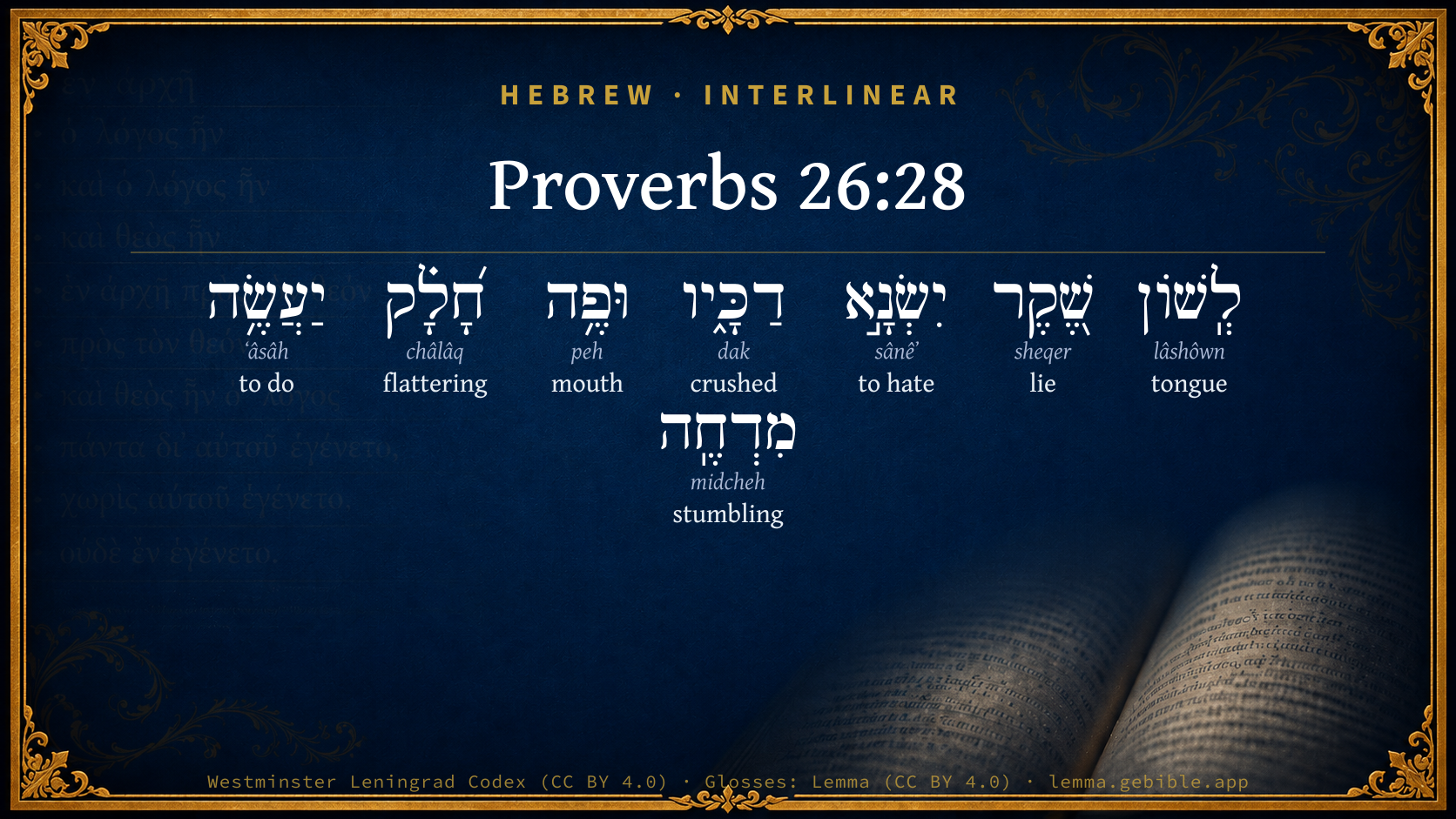
Hebrew (Westminster Leningrad Codex) Proverbs 26:28 appears in the Hebrew Old Testament. The text above is from the Westminster Leningrad Codex. Each word links to its Strong’s number, a concise gloss, and parsing drawn from the Open Scriptures Hebrew Bible morphology. Click any word for its full Brown-Driver-Briggs (BDB) entry.
Download image
Cite this verse

Proverbs 26:28 (World English Bible). Public Domain. Lemma interlinear Bible study tool, https://lemma.gebible.app/v/proverbs/26/28.

Show BibTeX & RIS
BibTeX
RIS
English Translation
A lying tongue hates those it hurts; And a flattering mouth works ruin.
World English Bible · Public Domain
Highlights
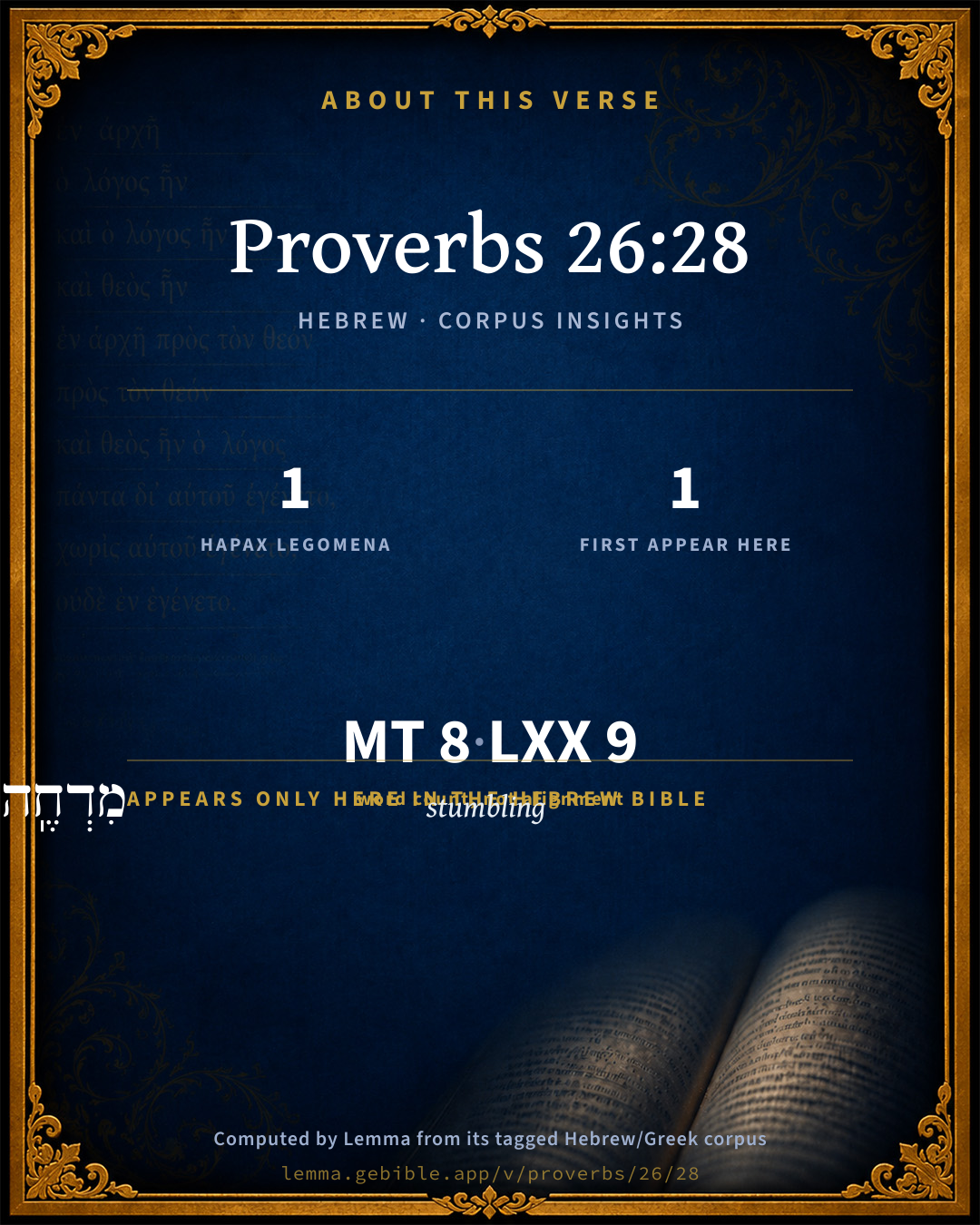
  • 1 hapax legomenon — only here in the Hebrew Bible
  • 1 first appearance in the Hebrew Bible
Full analysis ↓
Download a study sheet

One document with this verse’s original text, its word-by-word gloss line, the meaning frame, cross-references with their text, attributed commentary, and full source and license credits — printable, and it pastes into notes with its structure intact.

This verse Autodidact and up

Study sheet (.html) Plain text (.txt)

A passage Seminary Student

Up to 50 verses in one chapter. A passage sheet keeps up to 6 commentary sources and 12 cross-references per verse, in the order this page ranks them, and says so on the sheet whenever that leaves anything out. Ask for a single verse and you get the Autodidact verse sheet above.

Everything on this page stays free to read, with no account — the sheet is a download of what is already on screen, not access to it.

Want to remove ads? Support Godless Engineer
Compare translations 3

The same verse in 3 English versions, stacked beneath the original-language interlinear above. Click any original word for its lexicon entry.

Each is an independent rendering of the whole verse — the interlinear is not word-aligned to these translations.

Highlighted words mark where these versions differ — a whole-verse word diff, not a word-by-word alignment.

  • World English Bible Public Domain
    A lying tongue hates those it hurts; And a flattering mouth works ruin.
  • King James Version Public Domain
    A lying tongue hateth those that are afflicted by it; and a flattering mouth worketh ruin.
  • unfoldingWord Literal Text CC BY-SA 4.0
    A tongue of falsehood hates its oppressed ones, and a smooth mouth makes calamity.

unfoldingWord Literal Text — © unfoldingWord, licensed CC BY-SA 4.0. Word-aligned USFM3 via Door43 (git.door43.org/unfoldingWord/en_ult).

Versions to compare (up to 4)

3 of 4 selected

Show all 18 translations

Every available English version of this verse, each an independent rendering of the whole verse.

  • World English Bible Public Domain
    A lying tongue hates those it hurts; And a flattering mouth works ruin.
  • Berean Standard Bible Public Domain
    A lying tongue hates those it crushes, and a flattering mouth causes ruin.
  • Majority Standard Bible Public Domain
    A lying tongue hates those it crushes, and a flattering mouth causes ruin.
  • King James Version Public Domain
    A lying tongue hateth those that are afflicted by it; and a flattering mouth worketh ruin.
  • American Standard Version (1901) Public Domain
    A lying tongue hateth those whom it hath wounded; And a flattering mouth worketh ruin.
  • Revised Version (1885) Public Domain
    A lying tongue hateth those whom it hath wounded; and a flattering mouth worketh ruin.
  • Geneva Bible (1599) Public Domain
    A false tongue hateth the afflicted, and a flattering mouth causeth ruine.
  • Douay-Rheims (1899) Public Domain
    A deceitful tongue loveth not truth: and a slippery mouth worketh ruin.
  • Young's Literal Translation Public Domain
    A lying tongue hateth its bruised ones, And a flattering mouth worketh an overthrow!
  • Literal Standard Version CC BY-SA 4.0
    A lying tongue hates its bruised ones, || And a flattering mouth works an overthrow!
  • Unlocked Literal Bible CC BY-SA 4.0
    A lying tongue hates the people it crushes and a flattering mouth brings about ruin.
  • unfoldingWord Literal Text CC BY-SA 4.0
    A tongue of falsehood hates its oppressed ones, and a smooth mouth makes calamity.
  • Darby Bible Public Domain
    A lying tongue hateth those that are injured by it, and a flattering mouth worketh ruin.
  • World Messianic Bible Public Domain
    A lying tongue hates those it hurts; and a flattering mouth works ruin.
  • Webster's Bible Public Domain
    A lying tongue hateth those that are afflicted by it; and a flattering mouth worketh ruin.
  • Free Bible Version CC BY-SA 4.0
    If you tell lies, you show you hate your victims; if you flatter people, you cause disaster.
  • Bible in Basic English Public Domain
    A false tongue has hate for those who have clean hearts, and a smooth mouth is a cause of falling.
  • JPS Tanakh (1917) Public Domain
    A lying tongue hateth those that are crushed by it; and a flattering mouth worketh ruin.

Literal Standard Version (2020), Covenant Press — licensed CC BY-SA 4.0. Text via the HelloAO Bible API (eBible.org). Unlocked Literal Bible (unfoldingWord) — licensed CC BY-SA 4.0. Text via the HelloAO Bible API (eBible.org). unfoldingWord Literal Text — © unfoldingWord, licensed CC BY-SA 4.0. Word-aligned USFM3 via Door43 (git.door43.org/unfoldingWord/en_ult). Free Bible Version, Dr. Jonathan Gallagher — licensed CC BY-SA 4.0. Text via the HelloAO Bible API (eBible.org).

Word by word

More ways to search: Search by grammar → Find every occurrence → Compare this word →

Practice this passage: Drill this verse → Learn its vocabulary →

About this verse

These counts appear in no published source. They are computed here, from the morphology-tagged text and Lemma’s own curated glosses. What Lemma adds →

8
words
8
distinct lemmas
Wisdom
section

Notable vocabulary

1 hapax legomenon — a word that appears only here in the entire Hebrew Bible:

  • מִדְחֶֽה stumbling H4072

First appearance in Scripture

This word makes its first canonical appearance in the Hebrew Bible here:

  • מִדְחֶֽה stumbling H4072

Shared distinctive vocabulary

דַכָּ֑יו crushed H1790 occurs in 4 verses of the Hebrew Bible. Also found in:

Grammatical profile

  • 2 verbs
  • 4 nouns
  • 2 adjectives

Verb forms

  • יִשְׂנָ֣א Qal · Imperfect
  • יַעֲשֶׂ֥ה Qal · Imperfect

Hebrew & Septuagint length

In English translation the verse runs 13 words from the Hebrew and 12 from the Septuagint (LXX English) — closely comparable.

A rough comparison of the two English renderings, which tokenize alike — not a word-level alignment.

Word counts can differ between the Hebrew and the Greek without any difference in meaning — e.g. the Hebrew direct-object marker אֵת has no separate Greek word, and Greek often adds the article ὁ.

In the original languages it is 8 Hebrew tokens and 9 Greek tokens — but the two are counted differently (Hebrew bundles its prefixes and suffixes into one token; the Greek is in lemma form), so that isn’t a like-for-like length.

Cross-references

9

Topical passages linked to Proverbs 26:28 in the Treasury of Scripture Knowledge — connected by theme and wording, ordered by reader-vote popularity; previews shown in the World English Bible.

  • John 8:44–49 You are of your Father, the devil, and you want to do the desires of your father. He was a murderer from the beginning, and doesn't stand in the truth, because there is no truth in him. When he speaks a lie, he speaks on his own; for he is a liar, and the father of it.
  • Luke 20:20–21 They watched him, and sent out spies, who pretended to be righteous, that they might trap him in something he said, so as to deliver him up to the power and authority of the governor.
  • Proverbs 6:24 To keep you from the immoral woman, From the flattery of the wayward wife's tongue.
  • Proverbs 7:5 That they may keep you from the strange woman, From the foreigner who flatters with her words.
  • Proverbs 7:21–23 With persuasive words, she led him astray. With the flattering of her lips, she seduced him.
  • Proverbs 29:5 A man who flatters his neighbor, Spreads a net for his feet.
  • John 10:32–33 Jesus answered them, "I have shown you many good works from my Father. For which of those works do you stone me?"
  • John 8:40 But now you seek to kill me, a man who has told you the truth, which I heard from God. Abraham didn't do this.
  • John 15:22–24 If I had not come and spoken to them, they would not have had sin; but now they have no excuse for their sin.

Cross-references courtesy of OpenBible.info (CC BY 4.0).

Hebrew and Greek witnesses Masoretic Hebrew ↔ Greek Septuagint

The same verse in the two great witnesses to the Old Testament, shown verse-for-verse.

These are two independent witnesses, not word-aligned to each other, and the Septuagint is shown in lemma (dictionary) form.

Hebrew Proverbs 26:28 Masoretic · Westminster Leningrad Codex

לְֽשׁוֹן שֶׁ֭קֶר יִשְׂנָ֣א דַכָּ֑יו וּפֶ֥ה חָ֝לָ֗ק יַעֲשֶׂ֥ה מִדְחֶֽה

A lying tongue hates those it hurts; And a flattering mouth works ruin.

World English Bible · Public Domain

Greek LXX Proverbs 26:28 Septuagint · lemma form

γλῶσσα ψευδής μισέω ἀλήθεια στόμα δέ ἄστεγος ποιέω ἀκαταστασία

A lying tongue hates the truth; and an unguarded mouth causes tumults.

LXX2012 (modern English Septuagint) · Public Domain

On this verse, The Pulpit Commentary discusses the Septuagint’s reading. Read the note in Commentary ↓

Hebrew: Westminster Leningrad Codex (CC BY 4.0). Greek: Septuagint (public domain); English from LXX2012 (modern English Septuagint) (Public Domain). How the Septuagint differs from the Hebrew →

Commentary

Notes on Proverbs 26:28 from classic Christian and Jewish commentators (each source and its license shown beneath its notes). The classic Christian expositions comment on the surrounding passage and are grouped to its opening verse, so a note may address several verses; the Jewish commentaries on the Tanakh (Rashi and others) are per-verse, so they appear only where the commentator wrote on this verse.

Lemma curates 59 commentaries, every one of them public domain or Creative Commons licensed, each selected and text-cleaned for this edition rather than reprinted as found. About our sources →

Trapp's Complete Commentary

John Trapp

Pro 26:28 A lying tongue hateth [those that are] afflicted by it; and a flattering mouth worketh ruin.

Ver. 28. A lying tongue hateth those that are addicted by it.] False love proves to be true hatred, by the evil consequent of its ruin and destruction to the party flattered, and betrayed by a smooth supparasitation. There are those who thus read the text. The false tongue hateth those that smite it, &c. Truth breeds hatred, as the fair nymphs did the ill-favoured fauns and satyrs.

John Trapp, A Commentary or Exposition upon All the Books of the Old and New Testament (1647–1656) — public domain. Text from a community e-Sword module.

The Biblical Illustrator

Joseph S. Exell

Pro_26:28

A flattering mouth worketh ruin.

How may we best cure the love of being flattered

I. What flattery is. Solomon calls it a mouth that flatters. All that comes from the flatterer is complaisant, only heartiness and sincerity are wanting. All that appears is a fair semblance, but very falsehood. The actor in this tragedy never forgets himself and his own advantage, stripping the novice he hath coaxed, and living on him whom he deceived. There are two kinds of flattery: a self-flattery, and a flattery from others. As to the qualities of flattery, it may be hellish, revengeful, servile, cowardly, covetous, or envious. Love to be flattered is a disease of human nature. It is an immoderate desire of praise. When this desire prevails, we believe what the flatterer saith; set the value on ourselves by what such affirm of us. Another branch of love to be flattered is an affected seeking to ourselves, or giving unto others unnecessary occasions of setting forth the worth of our persons, actions, and qualifications, according to the standard of flatterers; a well-pleasedness to hear the great and good things by dissembling flatterers ascribed to us which either we never did, or did in manner much below what they report them. But--

II. Love of undue praise is pernicious. It destroys virtuous principles, natural inclinations to good, estates, reputation, safety and life, the soul and its happiness.

III. What may best effect its cure?

1. Consider the bad name that flattery hath ever had.

2. View the deplorable miseries it hath filled the world with.

3. Suspect all who come to you with undue praise.

4. Reject the friendship of the man who turns due praises into flattery.

5. Look on flattery, and your love for it, as diametrically opposed to God in the truth of all His Word.

6. Cultivate generous and pure love to all that is good.

7. Get and keep the humble frame of heart. Undue love of the praise of men is sacrilegious robbery of God. (Henry Hurst, M. A.)

The flatterer

As to the flatterer, he is the most dangerous of characters. He attacks at points where men are naturally most successfully assailable; where they are most in danger of being thrown off their guard and giving him admission. And when by his flatteries he has thus got the mastery, then follows the execution of the end for which they were employed--worketh ruin. The expression is strong, but not stronger than experience justifies. It even works ruin to the most interesting characters--characters admired and worthy of the admiration--by infusing a principle that spoils the whole, the principle of vanity and self-conceit. They thus lose their loveliest and most engaging attraction. And whatever be the selfish object of the flatterer, his selfishness obtains its gratification by the ruin of him whom his flatteries have deceived. (R. Wardlaw, D. D.)

Flattery worketh ruin

The stem of the ivy is furnished with root-like suckers which insinuate their spurs into the bark of trees or on the surface of a wall. Who has not seen with regret some noble ash-tree covered with ivy, in whose embrace it rapidly yields up its life? Surely the root is draining the tree of its sap, and transferring it to its own veins. Thus does a sycophant gradually extend his influence over a patron until the manliness of that patron succumbs to his ascendancy. The hero is ruined, and the flatterer flourishes in his place. Beware of the insinuating aptitudes of the parasite! Let him, like ivy on a wall, keep his proper situation. Protect a noble nature from his advances. (Scientific Illustrations.)

Flattery cannot compensate for the damage it works

Parasitic plants send their roots into the substance of another plant, and derive their food from its juices; but though, like some of the human kind, they live upon their neighbours bounty, it must be admitted that they sometimes reward their benefactor by adorning it with their beautiful flowers. The Rafflesia Arnoldi, for example, whose flower is three feet across, and whose cup will contain several pints of fluid, grows attached to the stem of a climbing cistus in Sumatra. The mistletoe also, whose silvery berries adorn the oak. Whether these offerings of the parasite bear any reasonable proportion to the amount of damage done by it must be a question open to doubt. Certain it is that the offerings of the social parasite to his benefactor, consisting as they do of subservience, flattery, and petty traits, are no real benefit to anybody; whilst, on the other hand, the injury which the parasite does to honesty and manliness is most unmistakable. On the whole, we are inclined to think that all the productions of parasites, whether vegetable or human, are not sufficient to make us value the producers very highly. (Scientific Illustrations.)

.

The Biblical Illustrator, edited by Joseph S. Exell (c. 1880s–1900s) — public domain. Text from a community e-Sword module.

Joseph Benson's Commentary

Pro 26:28. A lying tongue hateth, &c. — That is, he who slanders others hates those whom he slanders, because, by his calumnies, he hath made them his enemies. For “it is common for men to hate those to whom they have done evil: thus Tacitus, Proprium humani ingenii est, odisse quem læseris, ‘It is natural to man to hate one whom he hath injured;’ and this aversion is always strong in proportion to the greatness and injustice of the wrong which has been done.” See Calmet. And a flattering mouth worketh ruin — Though it be more smooth and plausible than a slandering mouth, yet it is, in truth, no less pernicious, betraying others either to sin, or to danger and calamity.

Joseph Benson's Commentary on the Old and New Testaments (1811–1818) — public domain. Text from a community e-Sword module.

Matthew Henry's Commentary

There are two sorts of lies equally detestable: - 1. A slandering lie, which avowedly hates those it is spoken of: A lying tongue hates those that are afflicted by it; it afflicts them by calumnies and reproaches because it hates them, and can thus smite them secretly where they are without defence; and it hates them because it has afflicted them and made them its enemies. The mischief of this is open and obvious; it afflicts, it hates, and owns it, and every body sees it. 2. A flattering lie, which secretly works the ruin of those it is spoken to. In the former the mischief is plain, and men guard against it as well as they can, but in this it is little suspected, and men betray themselves by being credulous of their own praises and the compliments that are passed upon them. A wise man therefore will be more afraid of a flatterer that kisses and kills than of a slanderer that proclaims war.

Matthew Henry's Commentary on the Whole Bible (1708–1710) — public domain (CC PDM 1.0). Text via the HelloAO Bible API.

Jamieson, Fausset & Brown

Robert Jamieson, A. R. Fausset & David Brown

Men hate those they injure.

A lying tongue--"lips" for the persons (compare Pro 4:24; Psa 12:3).

Next: Proverbs Chapter 27

Jamieson, Fausset & Brown — Commentary Critical and Explanatory on the Whole Bible (1871) — public domain (CC PDM 1.0). Text via the HelloAO Bible API.

Adam Clarke's Commentary

Verse 28. A lying tongue hateth those that are afflicted by it] He that injures another hates him in proportion to the injury he has done him; and, strange to tell, in proportion to the innocence of the oppressed. The debtor cannot bear the sight of his creditor; nor the knave, of him whom he has injured.

Adam Clarke's Commentary on the Bible (1810–1826) — public domain. Text from a community e-Sword/MySword module.

Ellicott's Commentary for English Readers

(28) A lying tongue hateth those that are afflicted by it.—As the remembrance of them calls up his own wickedness to the mind of the offender. This is one reason why “the carnal mind is enmity against God” (Rom_8:7), as being conscious of having rejected God’s love, and so hating to be reminded of Him.

A Bible Commentary for English Readers, edited by Charles John Ellicott (1878–1897) — public domain. Text from a community e-Sword module.

The Cambridge Bible for Schools and Colleges

gen. ed. J. J. S. Perowne

28. Comp. “Proprium humani ingenii est odisse quem læseris.” Tacitus, Agric., cap. 42.

The Cambridge Bible for Schools and Colleges (gen. ed. J. J. S. Perowne; Cambridge University Press, 1878–1918) — public domain. Text from a community e-Sword module.

Albert Barnes' Notes on the Bible

The lying tongue hates its victims.

Albert Barnes' Notes on the Bible (1834–1885) — public domain. Text from a community e-Sword/MySword module.

Haydock's Catholic Bible Commentary

CHAPTER XXVI.

George Leo Haydock (1774–1849), Haydock's Catholic Family Bible and Commentary, 1859 edition — public domain. Excludes Psalms (Douay-Rheims chapter numbering differs from Protestant) and Deuterocanonical books (Catholic canon only).

Matthew Poole's English Annotations

Hateth those that are afflicted by it, because by his calumnies he hath made them his enemies.

A flattering mouth; which, though it be more smooth and plausible than a slandering mouth, yet is in truth no less pernicious, betraying others either to sin, or to danger and mischief.

Matthew Poole's English Annotations on the Holy Bible (1683–1685) — public domain. Text from a community e-Sword/MySword module.

Whedon's Commentary on the Bible

Daniel D. Whedon

28. A lying tongue… and a flattering mouth — These terms, according to Hebrew usage, stand for persons with these qualities. The rendering of the first clause is not entirely satisfactory. We prefer, as more coherent with the latter member, to follow Bate: “The lying tongue shall hate (repent) its bruisings, (calumnies;) for the flattering mouth shall work its own destruction.” The proverb may be regarded as complementary to the preceding one, and as a suitable finale to the whole subject of lying, flattery, and deception presented in Pro_26:23-28. Nevertheless, it is fair to say that the larger number of critics substantially accord with our Authorized Version, and take the first clause as corresponding with the saying of Tacitus: “It is natural to man to hate one whom he has injured.”

Daniel D. Whedon (gen. ed.), Commentary on the Old and New Testaments (1874–1909) — public domain. Text from a community e-Sword module.

The Pulpit Commentary

A lying tongue hateth those that are afflicted by it; or, those whom it crusheth. (Pro_25:15) There is a consensus of the Vulgate, Septuagint, Syriac, and Targum to translate wykd "truth," thinking apparently of the Aramaean aykd "that which is pure." But the hemistich would thus state the baldest truism, and modern commentators unite in assigning to the word some such sense as that given above in the Authorized Version. A liar shows his want of charity by slandering his neighbour; and that men dislike those whom they have injured is a common experience. "It is a characteristic of human nature," says Tacitus ("Agric.," 42), "to hate those whom one has injured." Seneca, "De Ira," 2:83, "Hoe habent pessimum animi magna fortuna insolentes, quos laeserunt, et oderunt." A flattering mouth worketh ruin; brings destruction on those who succumb to its seductive words. Vulgate, Os lubricum operatur ruinas; Septuagint, "A mouth uncovered (astegon ) causeth tumults." (For "the smooth mouth," comp. Pro_5:3 Psa_12:3 Psa_55:21 Isa_30:10) The word for "tumults" is akatastasiav , which does not occur elsewhere in the Septuagint, but is common in the New Testament; e.g. Luk_21:9 1Co_14:33.

The Pulpit Commentary (1880–1919), ed. H.D.M. Spence-Jones & Joseph S. Exell — public domain. Text from a community e-Sword module.

Keil & Delitzsch

C. F. Keil & F. Delitzsch

28 The lying tongue hateth those whom it bruiseth;

And a flattering mouth causeth ruin.

The lxx, Jerome, the Targ., and Syr. render ישׂנא דכיו in the sense of non amat veritatem; they appear by דכיו to have thought of the Aram. דכיא, that which is pure; and thus they gain nothing else but an undeniable plain thought. Many Jewish interpreters gloss: מוכיחיו, also after the Aram.: דּכּיו = מדכּיו; but the Aram. דּכּי does not mean pure in the sense of being right, therefore Elia Wilna understands him who desires to justify himself, and this violent derivation from the Aram. thus does not lead to the end. Luther, translating: "a false tongue hates those who punish it," explains, as also Gesenius, conterentes = castigantes ipsam; but דּך signifies, according to the usage of the language before us, "bruised" (vid., Psa 9:10), not: bruising; and the thought that the liar hates him who listens to him, leads ad absurdum; but that he does not love him who bruises (punishes) him, is self-evident. Kimchi sees in דּכּיו another form of דּכּא; and Meri, Jona Gerundi in his ethical work (שׁערי תשׁובה = The gates of Repentance), and others, accordingly render דכיו in the sense of ענו (עניו): the lying tongue hates - as Lwenstein translates - the humble [pious]; also that for דכּיו, by the omission of ו, דכּי = זכּי may be read, is supposable; but this does not harmonize with the second half of the proverb, according to which לשׁון שׁקר must be the subject, and ישׂנא דכיו must express some kind of evil which proceeds from such a tongue. Ewald: "the lying tongue hates its master (אדניו)," but that is not in accordance with the Heb. style; the word in that case should have been בּעליו. Hitzig countenances this אדניו, with the remark that the tongue is here personified; but personified, the tongue certainly means him who has it (Psa 120:3). Bttcher's conjecture ישׁנּא דכיו, "confounds their talk," is certainly a curiosity. Spoken of the sea, those words would mean, "it changes its surge." But is it then at all necessary to uncover first the meaning of 28a? Rashi, Arama, and others refer דכּיו to דּכּים = נדכּאים (מדכּים). Thus also perhaps the Venet., which translates τοὺς ἐπιτριμμοὺς (not: ἐπιτετριμμένους) αὐτῆς. C. B. Michaelis: Lingua falsitatis odio habet contritos suos, h. e. eos quos falsitate ac mendacio laedit contritosque facit. Hitzig objects that it is more correct to say: conterit perosos sibi. And certainly this lay nearer, on which account Fleischer remarks: in 28a there is to be supposed a poetic transposition of the ideas (Hypallage): homo qui lingua ad calumnias abutitur conterit eos quos odit. The poet makes ישׂנא the main conception, because it does not come to him so readily to say that the lying tongue bruises those against whom it is directed, as that it is hatred, which is active in this. To say this was by no means superfluous. There are men who find pleasure in repeating and magnifying scandalously that which is depreciatory and disadvantageous to their neighbour unsubstantiated, without being at all conscious of any particular ill-will or personal enmity against him; but this proverb says that such untruthful tongue-thrashing proceeds always from a transgression of the commandment, "Thou shalt not hate thy brother," Lev 19:17, and not merely from the want of love, but from a state of mind which is the direct opposite of love (vid., Pro 10:18). Ewald finds it incongruous that 28a speaks of that which others have to suffer from the lying tongue, whereas the whole connection of this proverb requires that the tongue should here be regarded as bringing ruin upon its owner himself. But of the destruction which the wicked tongue prepares for others many proverbs also speak, e.g., Pro 12:13, cf. Pro 17:4, לשׁון הוּת; and 28b does not mention that the smooth tongue (written וּפה־חלק with Makkeph) brings injury upon itself (an idea which must be otherwise expressed; cf. Pro 14:32), but that it brings injury and ruin on those who have pleasure in its flatteries (חלקות, Psa 12:3; Isa 30:10), and are befooled thereby: os blandiloquum (blanditiis dolum tegens) ad casum impellit, sc. alios (Fleischer).

Keil & Delitzsch — Biblical Commentary on the Old Testament (1861–1891) — public domain (CC PDM 1.0). Text via the HelloAO Bible API. (Old Testament only.)

Bridges on Proverbs

Charles Bridges

Rarely do we see a solitary sin. One sin begets another. Lying and malice are here linked together. The lying tongue against our Lord was the fruit of hateful malice. (Joh 8:44, with Joh 8:40 .) The slander against Stephen originated from the same source. The tacit reproach of his godly profession was intolerable. (Act 6:9, Act 6:14 .) If men afflict because they hate; much more do they hate them whom they have afflicted, and thus made their enemies. Amnon, having afflicted his sister Tamar, hated her with greater hatred than his former love, as the witness against his own shame.†1

But again and again — watch against the flatterer. Alas! where is he not welcomed as a friend? From some favorable position he presents an attractive face. But a nearer view shews him as a subtle, murderous enemy, working ruin. (Psa 5:9 ; Psa 10:7-10 .) His great advantage is, that he has a friend in his own bosom. The sweet song of our own praises lulls us to sleep, and in the moment of security the net is too successfully spread. (Pro 29:5 .) The flattering tongue worketh the ruin of the world. The temptation — "Ye shall be as gods" — proved irresistible.†2 And still in the path of sin,†3 in the determinate indulgence of the wayward will,†4 flattering is the snare; ruin is the end.

What then should be our treatment of the flatterer? Homer puts it into his hero’s heart to regard him as a fiend of hell.†5 Our safety then is in flight,†6 or at least in frowning resistance. (Compare Pro 25:23 .) ’Be as much troubled’ — said a godly man — ’by unjust praises, as by unjust slanders.’†7 Shew plainly that they please us least, who praise us most. Give timely warning, that the repetition of the offense threatens the disruption of friendship. Cherish the deepest views of native corruption, such as will at once belie any fair picture of ourselves that may be presented to us. Pray for wisdom to discover the snare; for gracious principles to raise us above vain praises; for self-denial to be content, and even thankful without them. This will be our security.

All these Scriptures strongly teach, how hateful to a God of truth is the attempt to deceive. All warn us against the common habit of slight deviations from truth, and of any want of sincerity of expression, as totally inconsistent with a Christian profession, a breach of the law of love, and often leading to habitual deceit.†8

Footnotes:

†1 2Sa 13:5-15 . ’Humani est animi odisse quem læseris.’ — Tacitus in Agricola.

†2 Gen 3:5.

†3 Pro 2:16; Pro 5:3 ; Pro 7:5, Pro 7:21-23 .

†4 1Ki 22:6, 1Ki 22:11-12 . Jer 5:31 ; Jer 14:14-16 .

†5 Iliad, i. 312, 313.

†6 Pro 20:19.

†7 Philip Henry’s Life, Proverbs 10.

†8 See the wise caution, Sir 19:1 .

Charles Bridges, An Exposition of the Book of Proverbs (1846) — public domain. Text from a community e-Sword module.

Rashi

Rabbi Shlomo Yitzchaki (Rashi)

hates those crushed under him He who accepts slander hates those crushed under him, for Saul pursued David because of slander and slew Nob.

and a smooth mouth A mouth of flattery.

effects rejection It makes him rejected, for it rejects the one who accepts it from upon the Holy One, blessed be He.

Rashi on the Tanakh — English translations: “The Judaica Press complete Tanach with Rashi, translated by A. J. Rosenberg” (CC BY 4.0); “Pentateuch with Rashi's commentary by M. Rosenbaum and A.M. Silbermann, 1929-1934” (public domain); “The Metsudah Tanach series, Lakewood, N.J” (CC BY 4.0); and “The Book of Joshua, Metsudah Publications, 1997” (CC BY 4.0). Text via Sefaria.

Lesson kit

Teaching starters — assembled from the data on this page, not authored interpretation. Every prompt links to the verse data it draws on. Edit before teaching.

Proverbs, in the Wisdom, opens this verse with 8 words (8 distinct Hebrew lemmas). Its most distinctive word is midcheh (“stumbling”). A historical commentator’s framing appears above. Read the whole chapter for the surrounding context.

Discussion questions

  1. The word midcheh carries the sense “stumbling.” How does it shape the verse?
  2. 1 word here appears nowhere else in the Hebrew Bible. Why might the author reach for such rare wording?
  3. This is the first place “stumbling” appears in Scripture (first appears here). What does its debut here establish?
  4. How does Psalms 9:9, which shares the word «crushed», read alongside this verse?
  5. These translations render this verse differently. What is at stake in choosing one wording over another?
  6. «יִשְׂנָ֣א» is a Qal Imperfect verb. How does that grammatical form shape the action described?
  7. Compare how Trapp's Complete Commentary and The Biblical Illustrator read this verse. Where do they agree or differ?

Things to notice

Reading settings

Reading text

Shown beneath each verse's original-language words.

Old Testament
Old Testament edition

Read the OT as the Masoretic Hebrew (MT) or the Greek Septuagint (LXX).

English shown for the Greek Septuagint (in the Hebrew ↔ Greek comparison).

Comparing translations? Open the Compare panel on any verse page to stack up to four side by side.