Proverbs 19:7

Hebrew (Westminster Leningrad Codex) Proverbs 19:7 appears in the Hebrew Old Testament. The text above is from the Westminster Leningrad Codex. Each word links to its Strong’s number, a concise gloss, and parsing drawn from the Open Scriptures Hebrew Bible morphology. Click any word for its full Brown-Driver-Briggs (BDB) entry.
Download image
Cite this verse

Proverbs 19:7 (World English Bible). Public Domain. Lemma interlinear Bible study tool, https://lemma.gebible.app/v/proverbs/19/7.

Show BibTeX & RIS
BibTeX
RIS
English Translation
All the relatives of the poor shun him: How much more do his friends avoid him! He pursues them with pleas, but they are gone.
World English Bible · Public Domain
Download a study sheet

One document with this verse’s original text, its word-by-word gloss line, the meaning frame, cross-references with their text, attributed commentary, and full source and license credits — printable, and it pastes into notes with its structure intact.

This verse Autodidact and up

Study sheet (.html) Plain text (.txt)

A passage Seminary Student

Up to 50 verses in one chapter. A passage sheet keeps up to 6 commentary sources and 12 cross-references per verse, in the order this page ranks them, and says so on the sheet whenever that leaves anything out. Ask for a single verse and you get the Autodidact verse sheet above.

Everything on this page stays free to read, with no account — the sheet is a download of what is already on screen, not access to it.

Want to remove ads? Support Godless Engineer
Compare translations 3

The same verse in 3 English versions, stacked beneath the original-language interlinear above. Click any original word for its lexicon entry.

Each is an independent rendering of the whole verse — the interlinear is not word-aligned to these translations.

Highlighted words mark where these versions differ — a whole-verse word diff, not a word-by-word alignment.

  • World English Bible Public Domain
    All the relatives of the poor shun him: How much more do his friends avoid him! He pursues them with pleas, but they are gone.
  • King James Version Public Domain
    All the brethren of the poor do hate him: how much more do his friends go far from him? he pursueth them with words, yet they are wanting to him.
  • unfoldingWord Literal Text CC BY-SA 4.0
    All the brothers of one who is poor hate him; how much more do his friends go far away from him! He pursues words; they not.

unfoldingWord Literal Text — © unfoldingWord, licensed CC BY-SA 4.0. Word-aligned USFM3 via Door43 (git.door43.org/unfoldingWord/en_ult).

Versions to compare (up to 4)

3 of 4 selected

Show all 18 translations

Every available English version of this verse, each an independent rendering of the whole verse.

  • World English Bible Public Domain
    All the relatives of the poor shun him: How much more do his friends avoid him! He pursues them with pleas, but they are gone.
  • Berean Standard Bible Public Domain
    All the brothers of a poor man hate him—how much more do his friends avoid him! He may pursue them with pleading, but they are nowhere to be found.
  • Majority Standard Bible Public Domain
    All the brothers of a poor man hate him—how much more do his friends avoid him! He may pursue them with pleading, but they are nowhere to be found.
  • King James Version Public Domain
    All the brethren of the poor do hate him: how much more do his friends go far from him? he pursueth them with words, yet they are wanting to him.
  • American Standard Version (1901) Public Domain
    All the brethren of the poor do hate him: How much more do his friends go far from him! He pursueth `them with' words, `but' they are gone.
  • Revised Version (1885) Public Domain
    All the brethren of the poor do hate him: how much more do his friends go far from him! he pursueth them with words, but they are gone.
  • Geneva Bible (1599) Public Domain
    All the brethren of the poore doe hate him: howe much more will his friends depart farre from him? though hee be instant with wordes, yet they will not.
  • Douay-Rheims (1899) Public Domain
    The brethren of the poor man hate him: moreover also his friends have departed far from him. He that followeth after words only, shall have nothing.
  • Young's Literal Translation Public Domain
    All the brethren of the poor have hated him, Surely also his friends have been far from him, He is pursuing words -- they are not!
  • Literal Standard Version CC BY-SA 4.0
    All the brothers of the poor have hated him, || Surely his friends have also been far from him, || He is pursuing words—they are not!
  • Unlocked Literal Bible CC BY-SA 4.0
    All the brothers of a poor man hate him; how much more do his friends who go far away from him! He calls out to them, but they are gone.
  • unfoldingWord Literal Text CC BY-SA 4.0
    All the brothers of one who is poor hate him; how much more do his friends go far away from him! He pursues words; they not.
  • Darby Bible Public Domain
    All the brethren of a poor [man] hate him; how much more do his friends go far from him: he pursueth [them] with words, -- they are not [to be found].
  • World Messianic Bible Public Domain
    All the relatives of the poor shun him; how much more do his friends avoid him! He pursues them with pleas, but they are gone.
  • Webster's Bible Public Domain
    All the brethren of the poor do hate him: how much more do his friends go far from him? he pursueth them with words, yet they are wanting to him.
  • Free Bible Version CC BY-SA 4.0
    If a poor man's relatives can't stand him, how much more will his friends avoid him! He tries to talk with them but they don't listen.
  • Bible in Basic English Public Domain
    All the brothers of the poor man are against him: how much more do his friends go far from him!...
  • JPS Tanakh (1917) Public Domain
    All the brethren of the poor do hate him; how much more do his friends go far from him! He that pursueth words, they turn against him.

Literal Standard Version (2020), Covenant Press — licensed CC BY-SA 4.0. Text via the HelloAO Bible API (eBible.org). Unlocked Literal Bible (unfoldingWord) — licensed CC BY-SA 4.0. Text via the HelloAO Bible API (eBible.org). unfoldingWord Literal Text — © unfoldingWord, licensed CC BY-SA 4.0. Word-aligned USFM3 via Door43 (git.door43.org/unfoldingWord/en_ult). Free Bible Version, Dr. Jonathan Gallagher — licensed CC BY-SA 4.0. Text via the HelloAO Bible API (eBible.org).

Word by word

More ways to search: Search by grammar → Find every occurrence → Compare this word →

Practice this passage: Drill this verse → Learn its vocabulary →

מְ֭רֵעֵהוּ
mêrêaʻ
H4828
“friend · his”
Noun, Common, Masculine, Singular, Construct + Suffix, Personal, 3rd Person, Masculine, Singular
Part of Speech
Noun
Type
Common
Gender
Masculine
Number
Singular
State
Construct
Full BDB Definition

Origin: from H7462 in the sense of companionship

TWOT: 2186f

companion, friend, confidential friend
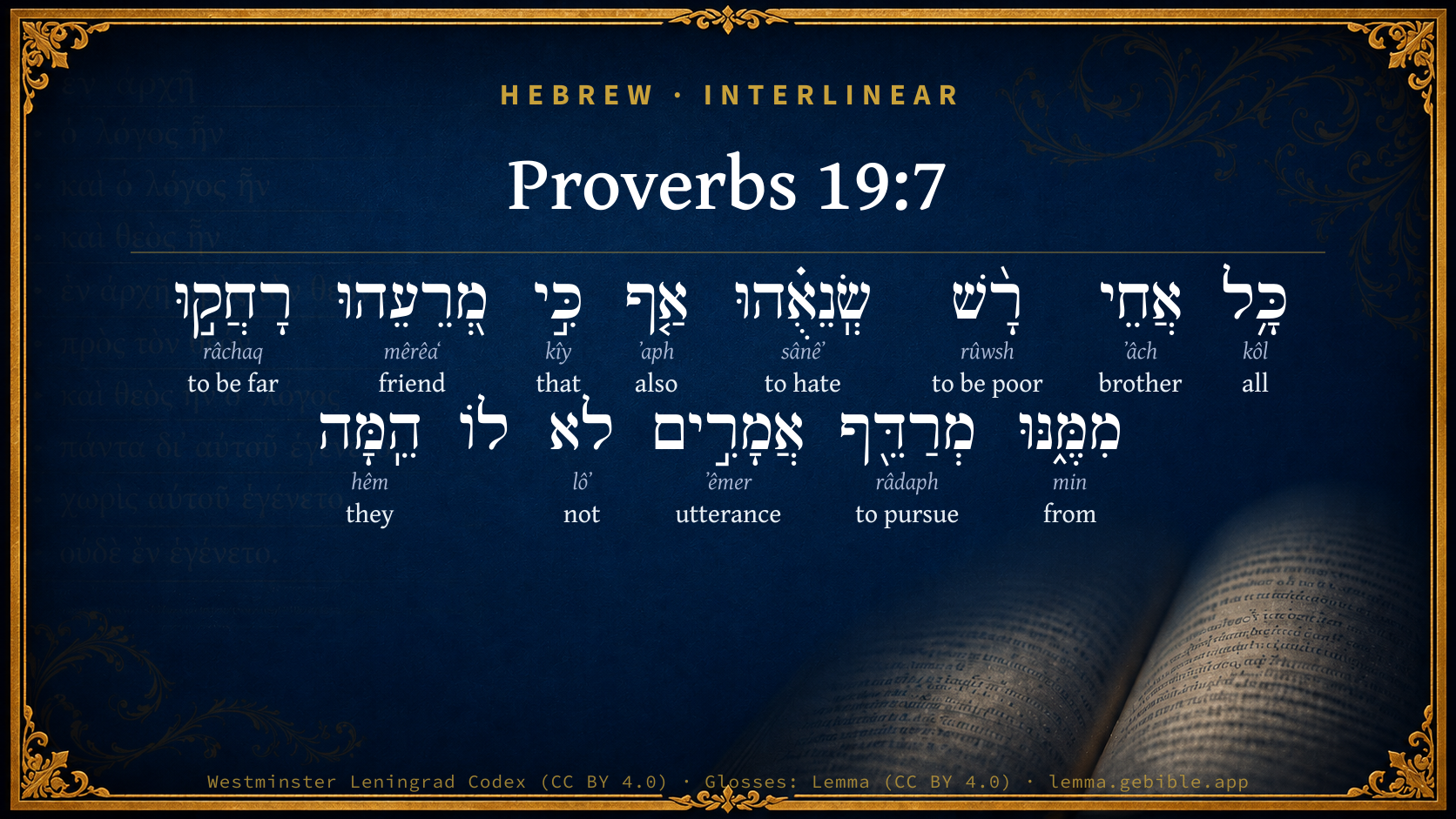
  1. כָּ֥ל kôl H3605 “all of” Noun, Common, Masculine, Singular, Construct
  2. אֲחֵי ʼâch H251 “brothers of” Noun, Common, Masculine, Plural, Construct
  3. רָ֨שׁ rûwsh H7326 “being poor” Verb, Qal, Participle Active, Masculine, Singular, Absolute
  4. שְֽׂנֵאֻ֗הוּ sânêʼ H8130 “to hate · him” Verb, Qal, Perfect, 3rd Person, Common, Plural + Suffix, Personal, 3rd Person, Masculine, Singular
  5. אַ֤ף ʼaph H637 “also” Particle, Accusative
  6. כִּ֣י kîy H3588 “that” Conjunction
  7. רָחֲק֣וּ râchaq H7368 “to be far” Verb, Qal, Perfect, 3rd Person, Common, Plural
  8. מִמֶּ֑נּוּ min H4480 “from · us” Preposition + Suffix, Personal, 1st Person, Common, Plural
  9. מְרַדֵּ֖ף râdaph H7291 “pursuing” Verb, Piel, Participle Active, Masculine, Singular, Absolute
  10. אֲמָרִ֣ים ʼêmer H561 “utterances” Noun, Common, Masculine, Plural, Absolute
  11. לא lôʼ H3808 “not” Particle, Negative
  12. הֵֽמָּה hêm H1992 “they” Pronoun, Personal, 3rd Person, Masculine, Plural

About this verse

These counts appear in no published source. They are computed here, from the morphology-tagged text and Lemma’s own curated glosses. What Lemma adds →

14
words
13
distinct lemmas
Wisdom
section

Notable vocabulary

The rarest word here is מְ֭רֵעֵהוּ friend H4828 — appearing just 7 times in the whole Hebrew Bible.

Shared distinctive vocabulary

מְ֭רֵעֵהוּ friend H4828 occurs in 7 verses of the Hebrew Bible. Also found in:

Grammatical profile

  • 4 verbs
  • 4 nouns
  • 1 pronoun
  • 2 prepositions
  • 1 conjunction
  • 2 particles

Verb forms

  • רָ֨שׁ Qal · Participle Active
  • שְֽׂנֵאֻ֗הוּ Qal · Perfect
  • רָחֲק֣וּ Qal · Perfect
  • מְרַדֵּ֖ף Piel · Participle Active

Hebrew & Septuagint length

In English translation the verse runs 25 words from the Hebrew and 46 from the Septuagint (LXX English) — the Septuagint runs noticeably longer here. See the side-by-side →

A rough comparison of the two English renderings, which tokenize alike — not a word-level alignment.

Word counts can differ between the Hebrew and the Greek without any difference in meaning — e.g. the Hebrew direct-object marker אֵת has no separate Greek word, and Greek often adds the article ὁ.

Cross-references

12

Topical passages linked to Proverbs 19:7 in the Treasury of Scripture Knowledge — connected by theme and wording, ordered by reader-vote popularity; previews shown in the World English Bible.

  • Psalms 88:8 You have taken my friends from me. You have made me an abomination to them. I am confined, and I can't escape.
  • Psalms 38:11 My lovers and my friends stand aloof from my plague. My kinsmen stand far away.
  • Proverbs 18:23 The poor plead for mercy, But the rich answer harshly.
  • Proverbs 19:4 Wealth adds many friends, But the poor is separated from his friend.
  • James 2:15–16 And if a brother or sister is naked and in lack of daily food,
  • 1 John 3:17–18 But whoever has the world's goods, and sees his brother in need, and closes his heart of compassion against him, how does the love of God remain in him?
  • Psalms 88:18 You have put lover and friend far from me, And my friends into darkness.
  • Proverbs 21:13 Whoever stops his ears at the cry of the poor, He will also cry out, but shall not be heard.
  • Ecclesiastes 9:15–16 Now a poor wise man was found in it, and he by his wisdom delivered the city; yet no man remembered that same poor man.
  • Proverbs 14:20 The poor person is shunned even by his own neighbor, But the rich person has many friends.
  • Luke 18:38–40 He cried out, "Jesus, you son of David, have mercy on me!"
  • James 2:6 But you have dishonored the poor man. Don't the rich oppress you, and personally drag you before the courts?

Cross-references courtesy of OpenBible.info (CC BY 4.0).

Hebrew and Greek witnesses Masoretic Hebrew ↔ Greek Septuagint

The same verse in the two great witnesses to the Old Testament, shown verse-for-verse.

Here the Septuagint runs noticeably longer than the Hebrew — LXX2012 (modern English Septuagint) 46 words vs World English Bible 25. A rough length comparison of the two English translations, not a word-level alignment — read both below.

These are two independent witnesses, not word-aligned to each other, and the Septuagint is shown in lemma (dictionary) form.

Hebrew Proverbs 19:7 Masoretic · Westminster Leningrad Codex

כָּ֥ל אֲחֵי רָ֨שׁ שְֽׂנֵאֻ֗הוּ אַ֤ף כִּ֣י מְ֭רֵעֵהוּ רָחֲק֣וּ מִמֶּ֑נּוּ מְרַדֵּ֖ף אֲמָרִ֣ים לא לוֹ הֵֽמָּה

All the relatives of the poor shun him: How much more do his friends avoid him! He pursues them with pleas, but they are gone.

World English Bible · Public Domain

Greek LXX Proverbs 19:7 Septuagint · lemma form

πᾶς ὅς ἀδελφός πτωχός μισέω καί φιλία μακράν εἰμί ἔννοια ἀγαθός ὁ ὁράω αὐτός ἐγγίζω ἀνήρ δέ φρόνιμος εὑρίσκω αὐτός ὁ πολύς κακοποιέω τελεσιουργέω κακία ὅς δέ ἐρεθίζω λόγος οὐ σώζω

Every one who hates his poor brother shall also be far from friendship. Good understanding will draw near to them that know it, and a sensible man will find it. He that does much harm perfects mischief; and he that used provoking words shall not escape.

LXX2012 (modern English Septuagint) · Public Domain

On this verse, Keil & Delitzsch discusses the Septuagint’s reading. Read the note in Commentary ↓

Hebrew: Westminster Leningrad Codex (CC BY 4.0). Greek: Septuagint (public domain); English from LXX2012 (modern English Septuagint) (Public Domain). How the Septuagint differs from the Hebrew →

Commentary

Notes on Proverbs 19:7 from classic Christian and Jewish commentators (each source and its license shown beneath its notes). The classic Christian expositions comment on the surrounding passage and are grouped to its opening verse, so a note may address several verses; the Jewish commentaries on the Tanakh (Rashi and others) are per-verse, so they appear only where the commentator wrote on this verse.

Lemma curates 59 commentaries, every one of them public domain or Creative Commons licensed, each selected and text-cleaned for this edition rather than reprinted as found. About our sources →

Trapp's Complete Commentary

John Trapp

Pro 19:7 All the brethren of the poor do hate him: how much more do his friends go far from him? he pursueth [them with] words, [yet] they [are] wanting [to him].

Ver. 7. All the brethren of the poor do hate him.] How much more then his hired friends? These are like crows to a dead carcase, which if they flock to it, it is not to defend but to devour it; and no sooner have they bared the bones, but they are gone. {See Trapp on "Pro 14:20"}

John Trapp, A Commentary or Exposition upon All the Books of the Old and New Testament (1647–1656) — public domain. Text from a community e-Sword module.

The Biblical Illustrator

Joseph S. Exell

Pro_19:7

He pursueth them with words, yet they are wanting to him.

Coercing men of ill principles

This verse prescribes a different method of proceeding against known offenders, according to their different characters. The scorner, who makes a jest of everything sacred, and professes an open contempt of religion, is to be treated with great severity. As to sinners who have not resolved to shut their eyes against the light of truth, we are directed to apply ourselves to them in a more easy, gentle, and humane method of reproof.

I. The reasonableness of employing the secular arm against the scorner. A sense of religion is the great basis upon which all government stands. The scorner is, therefore, an enemy to the state. The scorner who laughs at the very name and pretence of conscience itself has no claim on the toleration of the state.

II. The obligations we are under to the duty of fraternal reproof.

1. The obligation of a just concern for the honour and interests of religion. The sins and impieties of men bring a scandal and discredit upon religion. To admonish and reprove them for such sins and impieties is a proper means to prevent that scandal and promote the interests of religion. This is one of the methods which the wisdom of God Himself has appointed in order to reclaim sinners from the evil of their ways. As the wisdom of God has directed this method, societies have been formed by men to concert how it may be most effectually pursued.

2. From the charity we owe to our neighbour. It is to a good man one of the greatest pleasures of this life to do good; then what an exceeding pleasure it must be to be instrumental in recovering a lost soul.

(1) Great tenderness and compassion must be used, to give our reproof the greater force and efficacy.

(2) Our reproofs must be modest, and free from all hypocritical ostentations.

(3) Avoid exposing the offender as much as the rule of charity will admit.

(4) Do not give admonitions to superiors the air of reproof.

(5) Take care that reproof is seasonable.

If this be a duty of so great a nicety, we ought not rashly and unadvisedly to take it in hand, but to consider well whether we be in any good measure qualified for it. Those who find themselves really qualified for it ought not to be discouraged from performing it, though it sometimes expose them to inconvenience or make them incur the odium of those with whom they take so unacceptable a freedom. Let us resolve to discharge a good conscience, and leave the consequences of doing our duty to the disposal of God. (R. Fiddes, D. D.)

The Biblical Illustrator, edited by Joseph S. Exell (c. 1880s–1900s) — public domain. Text from a community e-Sword module.

Keil & Delitzsch

C. F. Keil & F. Delitzsch

7ab. We thus first confine our attention to these two lines -

All the brethren of the poor hate him;

How much more do his friends withdraw themselves from him?

Regarding אף כּי, quanto magis, vid., at Pro 11:31; Pro 15:11; Pro 17:7. In a similar connection Pro 14:20 spake of hatred, i.e., the cooling of love, and the manifesting of this coldness. The brethren who thus show themselves here, unlike the friend who has become a brother, according to Pro 17:17, are brothers-german, including kindred by blood relation. כּל has Mercha, and is thus without the Makkeph, as at Psa 35:10 (vid., the Masora in Baer's Liber Psalmorum, 1861, p. 133). Kimchi (Michlol 205a), Norzi, and others think that cāl (with קמץ רחב) is to be read as at Isa 40:12, where כּלו is a verb. But that is incorrect. The case is the same as with את, Pro 3:12; Psa 47:5; Psa 60:2. As here ě with Mercha remains, so ǒ with Mercha in that twice occurring כּלו; that which is exceptional is this, that the accentuated כל is written thus twice, not as the usual כּל, but as כּל with the Makkeph. The ground of the exception lies, as with other peculiarities, in the special character of metrical accentuation; the Mercha represents the place of the Makkeph, and ā thus remains in the unchanged force of a Kametz-Chatuph. The plur. רחקוּ does not stamp מרעהוּ as the defectively written plur.; the suffix ēhu is always sing., and the sing. is thus, like הרע, 6b, meant collectively, or better: generally (in the sense of kind), which is the linguistic usage of these two words, Sa1 30:26; Job 42:10. But it is worthy of notice that the Masoretic form here is not מרעהוּ, but mמרעהוּ, with Sheva. The Masora adds to it the remark לית, and accordingly the word is thus written with Sheva by Kimchi (Michlol 202a and Lex. under the word רעה), in Codd., and older editions. The Venet., translating by ἀπὸ τοῦ φίλου αὐτοῦ, has not noticed that. But how? Does the punctuation מרעהו mean that the word is here to be derived from מרע, maleficus? Thus understood, it does not harmonize with the line of thought. From this it is much more seen that the punctuation of the inflected מרע, amicus, fluctuates. This word מרע is a formation so difficult of comprehension, that one might almost, with Olshausen, 210; Bttcher, 794; and Lagarde, regard the מ as the partitive מן, like the French des amis (cf. Eurip. Med. 560: πένητα φεύγει πᾶς τις ἐκποδὼν φίλος), or: something of friend, a piece of friend, while Ewald and others regard it as possible that מרע is abbreviated from מרעה. The punctuation, since it treats the Tsere in מרעהו, 4b

(Note: In vol. i. p. 266, we have acknowledged מרעהו, from מרע, friend, only for Pro 19:7, but at Pro 19:4 we have also found amicus ejus more probable than ab amico suo (= מן רעהו).) and elsewhere, as unchangeable, and here in מרעהו as changeable, affords proof that in it also the manner of the formation of the word was incomprehensible.

Seeking after words which are vain.

7c. If now this line belongs to this proverb, then מרדּף must be used of the poor, and לא־המּה, or לו־המּה (vid., regarding the 15 Kers, לּו for לא, at Psa 100:3), must be the attributively nearer designation of the אמרים. The meaning of the Kerı̂ would be: he (the poor man) hunts after mere words, which - but no actions corresponding to them - are for a portion to him. This is doubtful, for the principal matter, that which is not a portion to him, remains unexpressed, and the לו־המּה eht [to him they belong] affords only the service of guarding one against understanding by the אמרים the proper words of the poor. This service is not in the same way afforded by לא המּה they are not; but this expression characterizes the words as vain, so that it is to be interpreted according to such parallels as Hos 12:2 : words which are not, i.e., which have nothing in reality corresponding to them, verba nihili, i.e., the empty assurances and promises of his brethren and friends (Fl.). The old translators all

(Note: Lagarde erroneously calls Theodotion's ῥήσεις οὐκ αὐτῷ a translation of the Kerı̂; οὐκ is, however, לא, and instead of αὐτῷ the expression αὐτῶν, which is the translation of המה, is also found.)

read לא, and the Syr. and Targ. translate not badly: מלּוי לא שׁריר; Symmachus, ῥήσεσιν ἀνυπάρκτοις. The expression is not to be rejected: לא היה sometimes means to come to לא, i.e., to nothing, Job 6:21; Eze 21:32, cf. Isa 15:6; and לא הוּא, he is not = has no reality, Jer 5:12, אמרים לא־המה, may thus mean words which are nothing (vain). But how can it be said of the poor whom everything forsakes, that one dismisses him with words behind which there is nothing, and now also that he pursues such words? The former supposes always a sympathy, though it be a feigned one, which is excluded by שׂנאהוּ [they hate him] and רחקוּ [withdraw themselves]; and the latter, spoken of the poor, would be unnatural, for his purposed endeavour goes not out after empty talk, but after real assistance. So 7c: pursuing after words which (are) nothing, although in itself not falling under critical suspicion, yet only of necessity is connected with this proverb regarding the poor. The lxx, however, has not merely one, but even four lines, and thus two proverbs following 7b. The former of these distichs is: Ἔννοια ἀγαθὴ τοῖς εἰδόσιν αὐτὴν ἐγγιεῖ, ἀνὴρ δὲ φρόνιμος εὑρήσει αὐτήν; it is translated from the Hebr. (ἔννοια ἀγαθή, Pro 5:2 = מזמּות), but it has a meaning complete in itself, and thus has nothing to do with the fragment 7c. The second distich is: Ὁ πολλὰ κακοποιῶν τελεσιουργεῖ κακίαν, ὃ δὲ ἐρεθίζει λόγους οὐ σωθήσεται. This ὃς δὲ ἐρεθίζει λόγους is, without doubt, a translation of מרדף אמרים (7c); λόγους is probably a corruption of λόγοις (thus the Complut.), not, he who pursueth words, but he who incites by words, as Homer (Il. iv. 5f.) uses the expression ἐρεθιζέμεν ἐπέεσσι. The concluding words, οὐ σωθήσεται, are a repetition of the Heb. לא ימלט (cf. lxx 19:5 with 28:26), perhaps only a conjectural emendation of the unintelligible לא המה. Thus we have before us in that ὁ πολλὰ κακοποιῶν, κ.τ.λ., the line lost from the Heb. text; but it is difficult to restore it to the Heb. We have attempted it, vol. i, p. 15. Supposing that the lxx had before them לא המה, then the proverb is -

"He that hath many friends is rewarded with evil,

Hunting after words which are nothing;"

i.e., since this his courting the friendship of as many as possible is a hunting after words which have nothing after them and come to nothing.

Keil & Delitzsch — Biblical Commentary on the Old Testament (1861–1891) — public domain (CC PDM 1.0). Text via the HelloAO Bible API. (Old Testament only.)

Geneva Bible (1599)

Geneva Bible translators

To have comfort of them.

Geneva Bible (1599) marginal notes — public domain. Text via Bolls.life.

Adam Clarke's Commentary

Verse 7. Do hate him] They shun him as they do the person they hate. They neither hate him positively, nor love him: they disregard him; they will have nothing to do with him. שנא sana signifies not only to hate, but to show a less degree of love to one than another. So Jacob loved Rachel, but hated Leah-showed her less affection than he did to Rachel.

Adam Clarke's Commentary on the Bible (1810–1826) — public domain. Text from a community e-Sword/MySword module.

Ellicott's Commentary for English Readers

(7) He pursueth them with words, yet they are wanting to Him.—The first half of a verse has apparently dropped out here. The sense may be, that the poor man hunts after words—i.e., seeks to get promises of help from his friends, and these end in nothing—mere talk.

A Bible Commentary for English Readers, edited by Charles John Ellicott (1878–1897) — public domain. Text from a community e-Sword module.

The Cambridge Bible for Schools and Colleges

gen. ed. J. J. S. Perowne

7. pursueth them with words] sc. of persuasion and entreaty. The R.V. marg. renders, He pursueth after words which are nought, i.e. after the fair but false promises of his friends.

wanting to him] Rather, are gone, R.V., desert him in his time of need.

The fact that this is the only example in this division of the Book of a proverb, which is a tristich, or consists of three clauses, leaves little doubt that the last clause of this verse properly belongs to another proverb, of which one member has fallen out of our present text. This conclusion is in some measure confirmed by the appearance in the LXX. of two complete distichs, though the whole verse is there confused and apparently corrupt, and does not help to the restoration of the original Heb. text.

The Cambridge Bible for Schools and Colleges (gen. ed. J. J. S. Perowne; Cambridge University Press, 1878–1918) — public domain. Text from a community e-Sword module.

John Gill's Exposition

All the brethren of the poor do hate him,.... They despise him on account of his poverty; they neglect him, and do not take care of him; they reckon him a reproach unto them, and do not choose to own him; all which may be interpreted an hatred of him;

how much more do his friends go far from him? or "his friend", every one of his friends; or "his neighbour" (l): for if his brethren, who are his own flesh and blood, show so much disrespect unto him; much more will those who are only his neighbours, or were in friendship with him while in prosperity; these wilt stand at a distance from him, and not come near him, now he is poor and in distress; see Job 19:13;

he pursueth them with words; yet they are wanting to him; or, "they are not" (m); he presses them with earnest entreaties to relieve him; he urges their own words and promises, and fetches arguments from them, and uses them as far as they will go; but all signifies nothing; his own words and petitions are to no purpose; and their words and promises are all smoke and vapour, vain and empty. Some understand this, as Gersom, not of the poor man that follows vain words (n) and empty promises, and buoys himself up with them that such an one and such an one has promised to be his friend, of which nothing comes; but of the friend that separates from the poor man, and pursues him with words of accusation, charging it on him as hit own fault that he is poor; which accusations are not true. This is one of the fifteen places observed by the Masoretes, in which it is written "not", and read "to him": both may be retained, and read, "they are not to him" (o); not profitable to him; either his own words, his petitions; or the words of others, their promises.

(l) "amicus ejus", Vatablus; "ominis amicus", Cocceius; i.e. "quisque amicorum ejus", Michaelis. (m) "non sunt ii", Junius & Tremillius; "et non sunt, Mercerus. (n) "Nihil illa", Cocceius, Schultens. (o) Vid. Amamae Antibarb. Bibl. l. 3. p. 742.

John Gill's Exposition of the Whole Bible (1746–1763) — public domain (CC PDM 1.0). Text via the HelloAO Bible API.

Albert Barnes' Notes on the Bible

It seems best to follow the Vulgate in taking the last clause as a separate maxim, He who pursues words, nought are they; i. e., the fair speeches and promises of help come to nothing. A various reading in the Hebrew gives, “he pursues after words, and these he shall have” - i. e., these, and nothing else.

This and other like maxims do not in reality cast scorn and shame on a state which Christ has pronounced “blessed.” Side by side with them is Pro 19:1, setting forth the honor of an upright poverty. But as there is an honorable poverty, so there is one which is altogether inglorious, caused by sloth and folly, leading to shame and ignominy, and it is well that the man who wishes to live rightly should avoid this. The teaching of Christ is, of course, higher than that of the Book of Proverbs, being based upon a fuller revelation of the divine will, pointing to a higher end and a nobler standard of duty, and transcending the common motives and common facts of life.

Albert Barnes' Notes on the Bible (1834–1885) — public domain. Text from a community e-Sword/MySword module.

Haydock's Catholic Bible Commentary

Only. Hebrew has lo, and the margin lu, with the Vulgate. (Calmet) --- The former word intimates that the words have no solidity, and the latter that they shall be his only portion who is so foolish as to trust in them. Sequens dicta non ispa; (Montanus) or ei ipsa, if we follow the margin. (Haydock)

George Leo Haydock (1774–1849), Haydock's Catholic Family Bible and Commentary, 1859 edition — public domain. Excludes Psalms (Douay-Rheims chapter numbering differs from Protestant) and Deuterocanonical books (Catholic canon only).

Matthew Poole's English Annotations

Brethren; his nearest and dearest relations, who are oft called brethren in Scripture, by a common synecdoche.

Hate him, i.e. despise and shun him, as men do any thing which they hate, and as the following words explain it.

His friends; his former companions, who in his prosperity professed friendship to him.

He pursueth them with words, earnestly imploring their pity; or, he urgeth (Heb. pursueth) their words, i.e. allegeth their former promises and professions of friendship. Or, without any supplement, he seeketh words, as the preacher sought to find out acceptable words, Ecc 12:10, wherewith he might prevail or move them to pity.

They are wanting to him, Heb. they are not; either,

1. His friends are not, to wit, what they pretended to be, friends to him. Or,

2. Their words are vain, and without effect; there is no reality in them.

Matthew Poole's English Annotations on the Holy Bible (1683–1685) — public domain. Text from a community e-Sword/MySword module.

Whedon's Commentary on the Bible

Daniel D. Whedon

7. The brethren of the poor — This is probably to be understood as applying particularly to such of his brethren as are in better worldly circumstances than himself.

Hate him — Not literally, but in effect; they do not care for him.

His friends — Literally, his companions.

Go far from him — These also keep out of the way of helping him.

He pursueth them with words — Or, he is a pursuer of words; that is, promises.

They are wanting to him — Literally, they are not. The latter clauses are elliptical and obscure, and the exact sense is difficult to obtain. Besides, there is a various reading, which some prefer. Thus Conant: “He follows after words — these he has.” The other reading, however, is generally accepted. The Douay, after the Vulgate, makes the last clause separate, thus: “He that followeth after words only shall have nothing.”

Daniel D. Whedon (gen. ed.), Commentary on the Old and New Testaments (1874–1909) — public domain. Text from a community e-Sword module.

The Pulpit Commentary

This is one of the few tristichs in the book, and probably contains the mutilated remains of two distichs. The third line, corrected by the Septuagint, which has an addition here, runs into two clauses (Cheyne). All the brethren of the poor do hate him. Even his own brothers, children of the same parents, hate and shun a poor man. (Pro_14:20) Much more do his friends go far from him. There should be no interrogation. We have the expression (aph-ki) in Pro_11:31 Pro_15:11, etc. Euripides, "Medea," 561 Penhta feugei pav tiv ekpodwlov . "Each single friend far from the poor man flies.

Septuagint. "Every one who hateth a poor brother will be also far from friendship." Then follows an addition not found m the Hebrew, "Good thought draweth nigh to those who know it, and a prudent man will find it. He who doeth much evil brings malice to perfection (telesiourgei kakian ); and he who rouses words to anger shall not be safe." He pursueth them with words, yet they are wanting to him; or, they are gone. He makes a pathetic appeal to his quondam friends, but they hearken not to him. But the sense is rather, "He pursueth after, craves for, words of kindness or promises of help, and there is naught, or he gets words only and no material aid.

Wordsworth quotes Catullus, "Carm.," 38:5"Quem tu, quod minimum facillimumque est, Qua solatus es adlocutione? Irascor tibi. Sic meos amores?

Vulgate, Qui tantum verba sectatur, nihil habebit, "He who pursues words only shall have naught." The Hebrew is literally, "Seeking words, they are not" This is according to the Khetib; the Keri, instead of the negation al, reads wl, which makes the clause signify, "He who pursues words, they are to him;" i.e. he gets words and nothing else. Delitzsch and others, supplying the lost member from the Septuagint, read the third line thus: "He that hath many friends, or the friend of every one, is requited with evil; and he that seeketh (fair) speeches shall not be delivered." Cheyne also makes a distich of this line, taking the Septuagint as representing the original reading, "He that does much evil perfects mischief: He that provokes with words shall not escape." That something has fallen out of the Hebrew text is evident; it seems that there are no examples of tristichs in this part of our book, though they are not unknown in the first and third divisions. The Vulgate surmounts the difficulty by connecting this third line with the following verse, which thus is made to form the antithesis, Qui tantum verba sectatur, nihil habebit; Qui autem possessor est mentis, diligit animam suam, et custos prudentiae inveniet bona."

The Pulpit Commentary (1880–1919), ed. H.D.M. Spence-Jones & Joseph S. Exell — public domain. Text from a community e-Sword module.

John Wesley's Explanatory Notes

Brethren - His nearest relations. Hate - Despise and shun him. Pursueth - Earnestly imploring their pity.

John Wesley, Explanatory Notes Upon the Whole Bible (1754–1765) — public domain. Text via the GEBible commentary corpus.

Kretzmann's Popular Commentary

Paul E. Kretzmann

v. 7. All the brethren of the poor do hate him, his own relatives treating him with an utter want of charity; how much more do his friends go far from him! for his acquaintances are not even bound by the ties of relationship and therefore withdraw with less compunction. He pursueth them with words, eager to hear at least some words of encouragement and friendly interest, yet they are wanting to him, that is, no one cheers him with words of kindness; even so much is denied him.

Paul E. Kretzmann, Popular Commentary of the Bible (1921–1924) — public domain. Text from a community e-Sword module.

unfoldingWord translationNotes

Door43 World Missions Community

how much more do his friends who go far away from him!

This phrase is an exclamation to show that this is more likely than the previous phrase. AT: "therefore his friends will certainly hate him and go far away from him!" (See: Assumed Knowledge and Implicit Information)

loves his own life

Here the person is referred to by his "life" to emphasize himself being alive. AT: "loves himself" (See: Metonymy)

keeps understanding

"has understanding"

translationWords

brother

wise

love

unfoldingWord translationNotes — © Distant Shores Media and the Door43 World Missions Community, licensed CC BY-SA 4.0. Source: git.door43.org/Door43/en_tn.

Rashi

Rabbi Shlomo Yitzchaki (Rashi)

All the kinsmen of a poor man lit. the brothers, the kinsmen.

surely his friends distance themselves Surely his friends, his companions, and his lovers.

he pursues statements that are fit for him He says, “So-and-so and so-and-so are my relatives. So-and-so and so-and-so are my friends.” And all are words of futility. This can be interpreted as concerning one who is poor in Torah and in good deeds.

he pursues statements which are futile He seeks to promulgate the halachah, but it is not in his possession. The midrash interprets it as concerning Joseph, who spread slander about his brothers. He would say to his father that they were suspected of [eating] limbs from a living animal. Therefore, they hated him, and he was called a poor man because he would spread false rumors about them and look for statements that were not true (לא המה). We read לו, “to him,” for he would pursue statements for his own benefit, and in Joseph’s matter, they were his, because his slander returned upon him. He would say that they ate limbs from a living animal, but Scripture testifies about them that even in the time of sin, they would slaughter a kid, as it is said: (Gen. 37:31) “and they slaughtered a kid.” He would say that they degraded the sons of the maidservants. Therefore, Joseph was sold as a slave. He would say that they gazed upon the women of the land. Said the Holy One, blessed be He, “By your life, I will incite a bear upon you.” Therefore, (ibid. 39:7) “his master’s wife lifted, etc.” [This appears] in Genesis Rabbah [see 84:7].

Rashi on the Tanakh — English translations: “The Judaica Press complete Tanach with Rashi, translated by A. J. Rosenberg” (CC BY 4.0); “Pentateuch with Rashi's commentary by M. Rosenbaum and A.M. Silbermann, 1929-1934” (public domain); “The Metsudah Tanach series, Lakewood, N.J” (CC BY 4.0); and “The Book of Joshua, Metsudah Publications, 1997” (CC BY 4.0). Text via Sefaria.

Lesson kit

Teaching starters — assembled from the data on this page, not authored interpretation. Every prompt links to the verse data it draws on. Edit before teaching.

Proverbs, in the Wisdom, opens this verse with 14 words (13 distinct Hebrew lemmas). Its most distinctive word is mêrêaʻ (“friend”). The Greek Septuagint runs longer here. A historical commentator’s framing appears above. Read the whole chapter for the surrounding context.

Discussion questions

  1. What does “friend” (mêrêaʻ) contribute to the verse as a whole?
  2. Genesis 26:26 shares the word «friend» with this verse. How do the two illuminate each other?
  3. Compared with the Hebrew, the Septuagint runs longer here. What questions does that raise?
  4. The translations on this page render this verse differently — a whole-verse word diff, not a word-by-word alignment. What might account for the different wordings?
  5. The verb «רָ֨שׁ» is Qal Participle Active. How does its form color the action?
  6. Reading how Trapp's Complete Commentary and The Biblical Illustrator read this verse, where do the two commentators agree and where do they part?

Things to notice

Reading settings

Reading text

Shown beneath each verse's original-language words.

Old Testament
Old Testament edition

Read the OT as the Masoretic Hebrew (MT) or the Greek Septuagint (LXX).

English shown for the Greek Septuagint (in the Hebrew ↔ Greek comparison).

Comparing translations? Open the Compare panel on any verse page to stack up to four side by side.