
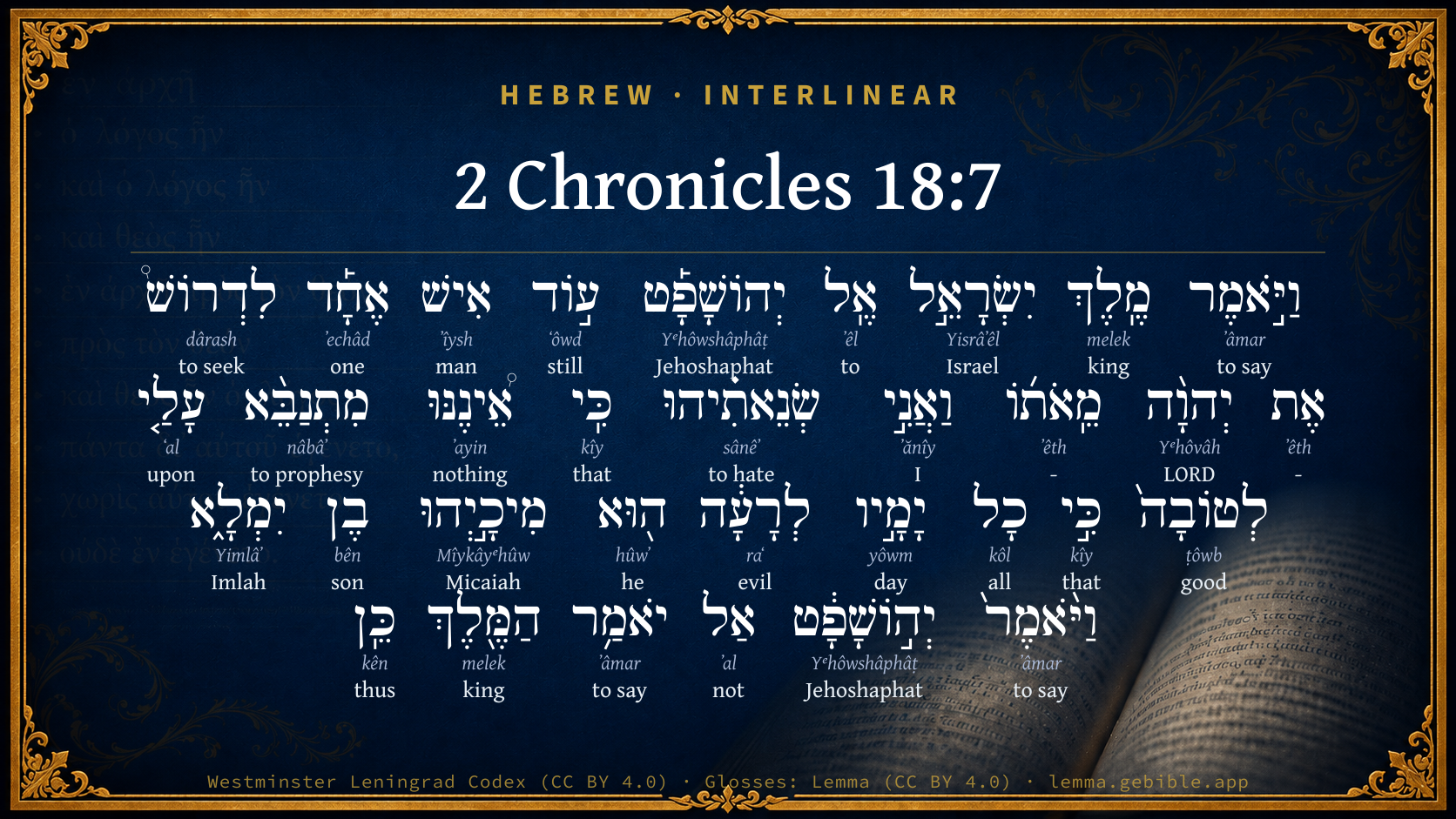
2 Chronicles 18:7

Hebrew (Westminster Leningrad Codex) 2 Chronicles 18:7 appears in the Hebrew Old Testament. The text above is from the Westminster Leningrad Codex. Each word links to its Strong’s number, a concise gloss, and parsing drawn from the Open Scriptures Hebrew Bible morphology. Click any word for its full Brown-Driver-Briggs (BDB) entry.
Download image
Cite this verse

2 Chronicles 18:7 (World English Bible). Public Domain. Lemma interlinear Bible study tool, https://lemma.gebible.app/v/2-chronicles/18/7.

Show BibTeX & RIS
BibTeX
RIS
English Translation
The king of Israel said to Jehoshaphat, There is yet one man by whom we may inquire of Yahweh: but I hate him; for he never prophesies good concerning me, but always evil: the same is Micaiah the son of Imla. Jehoshaphat said, Don't let the king say so.
World English Bible · Public Domain
Download a study sheet

One document with this verse’s original text, its word-by-word gloss line, the meaning frame, cross-references with their text, attributed commentary, and full source and license credits — printable, and it pastes into notes with its structure intact.

This verse Autodidact and up

Study sheet (.html) Plain text (.txt)

A passage Seminary Student

Up to 50 verses in one chapter. A passage sheet keeps up to 6 commentary sources and 12 cross-references per verse, in the order this page ranks them, and says so on the sheet whenever that leaves anything out. Ask for a single verse and you get the Autodidact verse sheet above.

Everything on this page stays free to read, with no account — the sheet is a download of what is already on screen, not access to it.

Want to remove ads? Support Godless Engineer
Compare translations 3

The same verse in 3 English versions, stacked beneath the original-language interlinear above. Click any original word for its lexicon entry.

Each is an independent rendering of the whole verse — the interlinear is not word-aligned to these translations.

Highlighted words mark where these versions differ — a whole-verse word diff, not a word-by-word alignment.

  • World English Bible Public Domain
    The king of Israel said to Jehoshaphat, There is yet one man by whom we may inquire of Yahweh: but I hate him; for he never prophesies good concerning me, but always evil: the same is Micaiah the son of Imla. Jehoshaphat said, Don't let the king say so.
  • King James Version Public Domain
    And the king of Israel said unto Jehoshaphat, There is yet one man, by whom we may enquire of the LORD: but I hate him; for he never prophesied good unto me, but always evil: the same is Micaiah the son of Imla. And Jehoshaphat said, Let not the king say so.
  • unfoldingWord Literal Text CC BY-SA 4.0
    And the king of Israel said to Jehoshaphat, “Still one man to seek Yahweh from him. But I myself hate him for nothing does he prophesy about me that is good, but all his days evil. He is Micaiah the son of Imlah.” And Jehoshaphat said, “Let not the king say thus.”

unfoldingWord Literal Text — © unfoldingWord, licensed CC BY-SA 4.0. Word-aligned USFM3 via Door43 (git.door43.org/unfoldingWord/en_ult).

Versions to compare (up to 4)

3 of 4 selected

Show all 18 translations

Every available English version of this verse, each an independent rendering of the whole verse.

  • World English Bible Public Domain
    The king of Israel said to Jehoshaphat, There is yet one man by whom we may inquire of Yahweh: but I hate him; for he never prophesies good concerning me, but always evil: the same is Micaiah the son of Imla. Jehoshaphat said, Don't let the king say so.
  • Berean Standard Bible Public Domain
    The king of Israel answered, “There is still one man who can ask the LORD, but I hate him because he never prophesies anything good for me, but only bad. He is Micaiah son of Imlah.” “The king should not say that!” Jehoshaphat replied.
  • Majority Standard Bible Public Domain
    The king of Israel answered, “There is still one man through whom we can inquire of the LORD, but I hate him because he never prophesies anything good for me, but only bad. He is Micaiah son of Imlah.” “The king should not say that!” Jehoshaphat replied.
  • King James Version Public Domain
    And the king of Israel said unto Jehoshaphat, There is yet one man, by whom we may enquire of the LORD: but I hate him; for he never prophesied good unto me, but always evil: the same is Micaiah the son of Imla. And Jehoshaphat said, Let not the king say so.
  • American Standard Version (1901) Public Domain
    And the king of Israel said unto Jehoshaphat, There is yet one man by whom we may inquire of Jehovah: but I hate him; for he never prophesieth good concerning me, but always evil: the same is Micaiah the son of Imla. And Jehoshaphat said, Let not the king say so.
  • Revised Version (1885) Public Domain
    And the king of Israel said unto Jehoshaphat, There is yet one man by whom we may inquire of the LORD: but I hate him; for he never prophesieth good concerning me, but always evil: the same is Micaiah the son of Imla. And Jehoshaphat said, Let not the king say so.
  • Geneva Bible (1599) Public Domain
    And the King of Israel sayd vnto Iehoshaphat, There is yet one man, by whome wee may aske counsell of the Lord, but I hate him: for he doeth not prophesie good vnto me, but alway euil: it is Michaiah the sonne of Imla. Then Iehoshaphat said, Let not the King say so.
  • Douay-Rheims (1899) Public Domain
    And the king of Israel said to Josaphat: There is one man, of whom we may ask the will of the Lord: but I hate him, for he never prophesieth good to me, but always evil: and it is Micheas the son of Jemla. And Josaphat said: Speak not thus, O king.
  • Young's Literal Translation Public Domain
    And the king of Israel saith unto Jehoshaphat, `Still -- one man to seek Jehovah from him, and I -- I have hated him, for he is not prophesying concerning me of good, but all his days of evil, he `is' Micaiah son of Imlah;' and Jehoshaphat saith, `Let not the king say so.'
  • Literal Standard Version CC BY-SA 4.0
    And the king of Israel says to Jehoshaphat, “[There is] still one man to seek YHWH from him, and I have hated him, for he is not prophesying of good concerning me, but of evil [for] all his days, he [is] Micaiah son of Imlah”; and Jehoshaphat says, “Do not let the king say so.”
  • Unlocked Literal Bible CC BY-SA 4.0
    The king of Israel said to Jehoshaphat, “There is still one man by whom we may seek the advice of Yahweh, Micaiah son of Imlah, but I hate him because he never prophesies good concerning me, but always evil.” But Jehoshaphat said, “The king should not say that.”
  • unfoldingWord Literal Text CC BY-SA 4.0
    And the king of Israel said to Jehoshaphat, “Still one man to seek Yahweh from him. But I myself hate him for nothing does he prophesy about me that is good, but all his days evil. He is Micaiah the son of Imlah.” And Jehoshaphat said, “Let not the king say thus.”
  • Darby Bible Public Domain
    And the king of Israel said to Jehoshaphat, There is yet one man by whom we may inquire of Jehovah; but I hate him, for he prophesies no good concerning me, but always evil: [it is] Micah the son of Imlah. And Jehoshaphat said, Let not the king say so.
  • World Messianic Bible Public Domain
    The king of Israel said to Jehoshaphat, “There is yet one man by whom we may inquire of the LORD; but I hate him, for he never prophesies good concerning me, but always evil. He is Micaiah the son of Imla.” Jehoshaphat said, “Don’t let the king say so.”
  • Webster's Bible Public Domain
    And the king of Israel said to Jehoshaphat, There is yet one man, by whom we may inquire of the LORD: but I hate him; for he never prophesieth good to me, but always evil: the same is Micaiah the son of Imla. And Jehoshaphat said, Let not the king say so.
  • Free Bible Version CC BY-SA 4.0
    “Yes, there's another man who could consult the Lord,” the king of Israel replied, “but I don't like him because he never prophesies anything good for me—it's always bad! His name is Micaiah, son of Imlah.” “You shouldn't talk like that,” said Jehoshaphat.
  • Bible in Basic English Public Domain
    And the king of Israel said to Jehoshaphat, There is still one man by whom we may get directions from the Lord, but I have no love for him, because he has never been a prophet of good to me, but only of evil: he is Micaiah, the son of Imla. And Jehoshaphat said, Let not the king say so.
  • JPS Tanakh (1917) Public Domain
    And the king of Israel said unto Jehoshaphat: 'There is yet one man by whom we may inquire of the LORD; but I hate him; for he never prophesieth good concerning me, but always evil; the same is Micaiah the son of Imla.' And Jehoshaphat said: 'Let not the king say so.'

Literal Standard Version (2020), Covenant Press — licensed CC BY-SA 4.0. Text via the HelloAO Bible API (eBible.org). Unlocked Literal Bible (unfoldingWord) — licensed CC BY-SA 4.0. Text via the HelloAO Bible API (eBible.org). unfoldingWord Literal Text — © unfoldingWord, licensed CC BY-SA 4.0. Word-aligned USFM3 via Door43 (git.door43.org/unfoldingWord/en_ult). Free Bible Version, Dr. Jonathan Gallagher — licensed CC BY-SA 4.0. Text via the HelloAO Bible API (eBible.org).

Word by word

More ways to search: Search by grammar → Find every occurrence → Compare this word →

Practice this passage: Drill this verse → Learn its vocabulary →

יִמְלָ֑א
Yimlâʼ
H3229
“Imlah”
Noun, Proper
Part of Speech
Noun
Type
Proper
Full BDB Definition

Origin: from H4390

TWOT: None

Imlah or Imla = "whom God will fill up" - father of Michaiah the prophet
  1. וַיֹּ֣אמֶר ʼâmar H559 “and · to say” Conjunction + Verb, Qal, Sequential Imperfect, 3rd Person, Masculine, Singular
  2. מֶֽלֶךְ melek H4428 “king of” Noun, Common, Masculine, Singular, Construct
  3. יִשְׂרָאֵ֣ל Yisrâʼêl H3478 “Israel” Noun, Proper
  4. אֶֽל ʼêl H413 “to” Preposition
  5. יְהוֹשָׁפָ֡ט Yᵉhôwshâphâṭ H3092 “Jehoshaphat” Noun, Proper
  6. ע֣וֹד ʻôwd H5750 “still” Adverb
  7. אִישׁ ʼîysh H376 “man” Noun, Common, Masculine, Singular, Absolute
  8. אֶחָ֡ד ʼechâd H259 “one” Adjective, Cardinal number, Masculine, Singular, Absolute
  9. לִדְרוֹשׁ֩ dârash H1875 “to seek” Preposition + Verb, Qal, Infinitive Construct
  10. אֶת ʼêth H853 “-” Particle, Direct Object
  11. יְהוָ֨ה Yᵉhôvâh H3068 “LORD” Noun, Proper
  12. מֵֽאֹת֜וֹ ʼêth H853 “from · - · him” Preposition + Particle, Direct Object + Suffix, Personal, 3rd Person, Masculine, Singular
  13. וַאֲנִ֣י ʼănîy H589 “and · I” Conjunction + Pronoun, Personal, 1st Person, Common, Singular
  14. שְׂנֵאתִ֗יהוּ sânêʼ H8130 “to hate · him” Verb, Qal, Perfect, 1st Person, Common, Singular + Suffix, Personal, 3rd Person, Masculine, Singular
  15. כִּֽי kîy H3588 “that” Conjunction
  16. אֵ֠ינֶנּוּ ʼayin H369 “nothing · him” Particle, Negative + Suffix, Personal, 3rd Person, Masculine, Singular
  17. מִתְנַבֵּ֨א nâbâʼ H5012 “prophesying” Verb, Hithpael, Participle Active, Masculine, Singular, Absolute
  18. עָלַ֤י ʻal H5921 “upon · me” Preposition + Suffix, Personal, 1st Person, Common, Singular
  19. לְטוֹבָה֙ ṭôwb H2896 “to/for · good” Preposition + Adjective, Adjective, Feminine, Singular, Absolute
  20. כִּ֣י kîy H3588 “that” Conjunction
  21. כָל kôl H3605 “all of” Noun, Common, Masculine, Singular, Construct
  22. יָמָ֣יו yôwm H3117 “days · his” Noun, Common, Masculine, Plural, Construct + Suffix, Personal, 3rd Person, Masculine, Singular
  23. לְרָעָ֔ה raʻ H7451 “to/for · evil” Preposition + Noun, Common, Masculine, Singular, Absolute
  24. ה֖וּא hûwʼ H1931 “he” Pronoun, Personal, 3rd Person, Masculine, Singular
  25. מִיכָ֣יְהוּ Mîykâyᵉhûw H4321 “Micaiah” Noun, Proper
  26. בֶן bên H1121 “son of” Noun, Common, Masculine, Singular, Construct
  27. וַיֹּ֨אמֶר֙ ʼâmar H559 “and · to say” Conjunction + Verb, Qal, Sequential Imperfect, 3rd Person, Masculine, Singular
  28. יְה֣וֹשָׁפָ֔ט Yᵉhôwshâphâṭ H3092 “Jehoshaphat” Noun, Proper
  29. אַל ʼal H408 “not” Particle, Negative
  30. יֹאמַ֥ר ʼâmar H559 “to say” Verb, Qal, Jussive, 3rd Person, Masculine, Singular
  31. הַמֶּ֖לֶךְ melek H4428 “the · king” Particle, Definite Article + Noun, Common, Masculine, Singular, Absolute
  32. כֵּֽן kên H3651 “thus” Particle, Demonstrative

About this verse

These counts appear in no published source. They are computed here, from the morphology-tagged text and Lemma’s own curated glosses. What Lemma adds →

33
words
27
distinct lemmas
Historical
section

Notable vocabulary

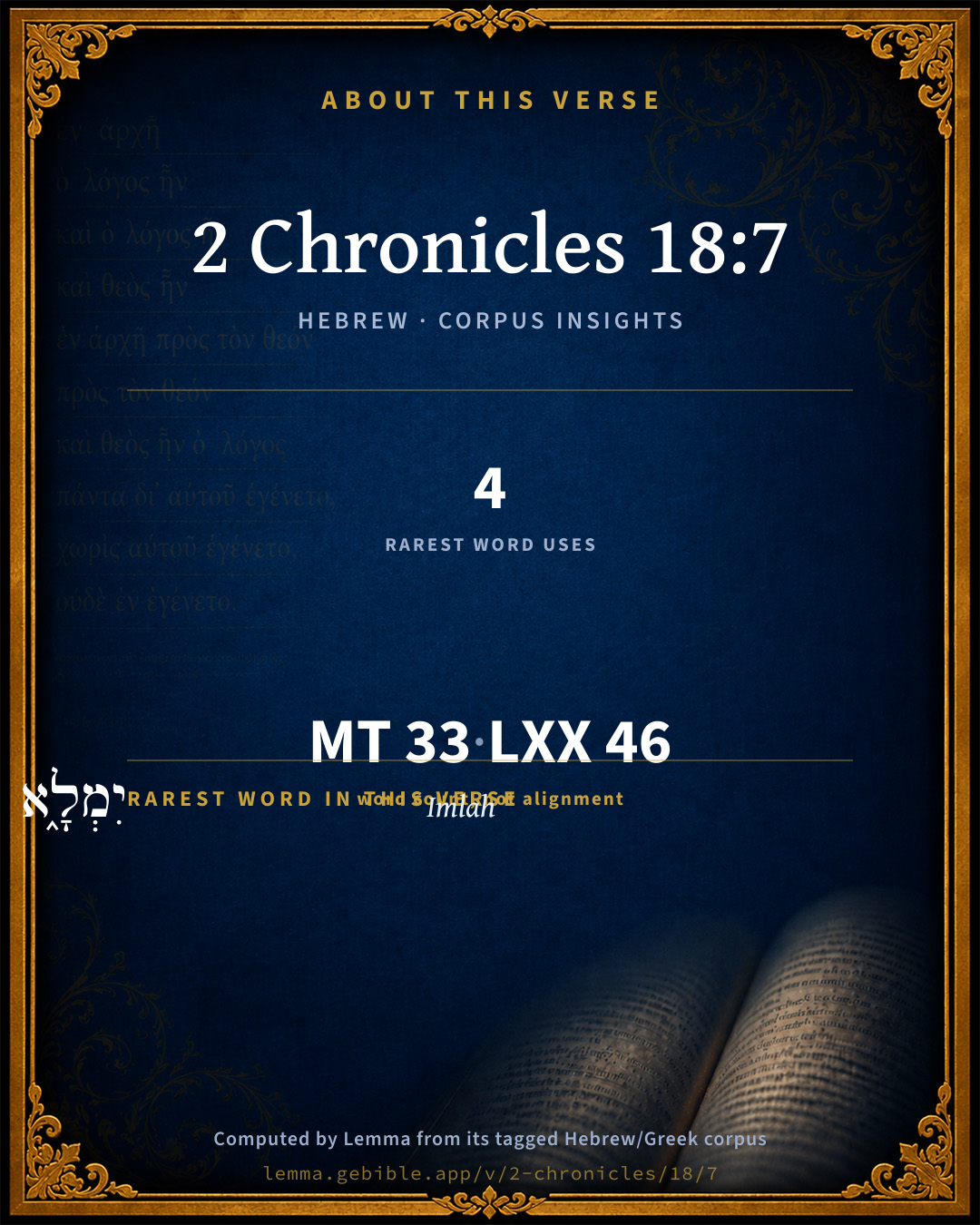
The rarest word here is יִמְלָ֑א Imlah H3229 — appearing just 4 times in the whole Hebrew Bible.

Shared distinctive vocabulary

יִמְלָ֑א Imlah H3229 occurs in 4 verses of the Hebrew Bible. Also found in:

Grammatical profile

  • 6 verbs
  • 13 nouns
  • 2 adjectives
  • 2 pronouns
  • 2 prepositions
  • 2 conjunctions
  • 1 adverb
  • 5 particles

Verb forms

  • וַיֹּ֣אמֶר Qal · Sequential Imperfect
  • לִדְרוֹשׁ֩ Qal · Infinitive Construct
  • שְׂנֵאתִ֗יהוּ Qal · Perfect
  • מִתְנַבֵּ֨א Hithpael · Participle Active
  • וַיֹּ֨אמֶר֙ Qal · Sequential Imperfect
  • יֹאמַ֥ר Qal · Jussive

Repetition

Words recur within this verse — often emphatic in Hebrew:

  • וַיֹּ֣אמֶר to say H559 ×3
  • מֶֽלֶךְ king H4428 ×2
  • יְהוֹשָׁפָ֡ט Jehoshaphat H3092 ×2
  • כִּֽי that H3588 ×2

Hebrew & Septuagint length

In English translation the verse runs 49 words from the Hebrew and 56 from the Septuagint (LXX English) — closely comparable.

A rough comparison of the two English renderings, which tokenize alike — not a word-level alignment.

Word counts can differ between the Hebrew and the Greek without any difference in meaning — e.g. the Hebrew direct-object marker אֵת has no separate Greek word, and Greek often adds the article ὁ.

In the original languages it is 33 Hebrew tokens and 46 Greek tokens — but the two are counted differently (Hebrew bundles its prefixes and suffixes into one token; the Greek is in lemma form), so that isn’t a like-for-like length.

Cross-references

27

Topical passages linked to 2 Chronicles 18:7 in the Treasury of Scripture Knowledge — connected by theme and wording, ordered by reader-vote popularity; previews shown in the World English Bible.

  • Amos 5:10 They hate him who reproves in the gate, And they abhor him who speaks blamelessly.
  • Micah 2:7 Shall it be said, O house of Jacob: "Is the Spirit of Yahweh angry? Are these his doings? Don't my words do good to him who walks blamelessly?"
  • 1 Kings 18:17 It happened, when Ahab saw Elijah, that Ahab said to him, Is it you, you troubler of Israel?
  • 1 Kings 21:20 Ahab said to Elijah, Have you found me, my enemy? He answered, I have found you, because you have sold yourself to do that which is evil in the sight of Yahweh.
  • Isaiah 30:10 who tell the seers, "Don't see;" and to the prophets, "Don't prophesy to us right things, speak to us smooth things, prophesy deceits,
  • Luke 6:22 Blessed are you when men shall hate you, and when they shall exclude and mock you, and throw out your name as evil, for the Son of Man's sake.
  • 1 Kings 18:4 for it was so, when Jezebel cut off the prophets of Yahweh, that Obadiah took one hundred prophets, and hid them by fifty in a cave, and fed them with bread and water.)
  • 1 Kings 19:10 He said, I have been very jealous for Yahweh, the God of hosts; for the children of Israel have forsaken your covenant, thrown down your altars, and slain your prophets with the sword: and I, even I only, am left; and they seek my life, to take it away.
  • 1 Kings 20:42–43 He said to him, Thus says Yahweh, Because you have let go out of your hand the man whom I had devoted to destruction, therefore your life shall go for his life, and your people for his people.
  • 2 Kings 9:22 It happened, when Joram saw Jehu, that he said, Is it peace, Jehu? He answered, What peace, so long as the prostitution of your mother Jezebel and her witchcraft abound?
  • 2 Chronicles 18:13 Micaiah said, As Yahweh lives, what my God says, that will I speak.
  • Psalms 34:21 Evil shall kill the wicked. Those who hate the righteous shall be condemned.
  • Psalms 55:3 Because of the voice of the enemy, Because of the oppression of the wicked. For they bring suffering on me. In anger they hold a grudge against me.
  • Psalms 69:14 Deliver me out of the mire, and don't let me sink. Let me be delivered from those who hate me, and out of the deep waters.
  • Proverbs 9:8 Don't reprove a scoffer, lest he hate you. Reprove a wise man, and he will love you.
  • Proverbs 25:12 As an ear-ring of gold, and an ornament of fine gold, So is a wise reprover to an obedient ear.
  • Proverbs 29:10 The bloodthirsty hate a man of integrity; And they seek the life of the upright.
  • Jeremiah 18:18 Then said they, Come, and let us devise devices against Jeremiah; for the law shall not perish from the priest, nor counsel from the wise, nor the word from the prophet. Come, and let us strike him with the tongue, and let us not give heed to any of his words.
  • Jeremiah 38:4 Then the princes said to the king, Let this man, we pray you, be put to death; because he weakens the hands of the men of war who remain in this city, and the hands of all the people, in speaking such words to them: for this man doesn't seek the welfare of this people, but the hurt.
  • Ezekiel 3:17–19 Son of man, I have made you a watchman to the house of Israel: therefore hear the word at my mouth, and give them warning from me.
  • Mark 6:18–19 For John said to Herod, "It is not lawful for you to have your brother's wife."
  • Mark 6:27 Immediately the king sent out a soldier of his guard, and commanded to bring John's head, and he went and beheaded him in the prison,
  • John 7:7 The world can't hate you, but it hates me, because I testify about it, that its works are evil.
  • John 15:18–19 If the world hates you, you know that it has hated me before it hated you.
  • John 15:24 If I hadn't done among them the works which no one else did, they wouldn't have had sin. But now have they seen and also hated both me and my Father.
  • Acts 20:26–27 Therefore I testify to you this day that I am clean from the blood of all men,
  • Galatians 4:16 So then, have I become your enemy by telling you the truth?

Cross-references courtesy of OpenBible.info (CC BY 4.0).

Hebrew and Greek witnesses Masoretic Hebrew ↔ Greek Septuagint

The same verse in the two great witnesses to the Old Testament, shown verse-for-verse.

These are two independent witnesses, not word-aligned to each other, and the Septuagint is shown in lemma (dictionary) form.

Hebrew 2 Chronicles 18:7 Masoretic · Westminster Leningrad Codex

וַיֹּ֣אמֶר מֶֽלֶךְ יִשְׂרָאֵ֣ל אֶֽל יְהוֹשָׁפָ֡ט ע֣וֹד אִישׁ אֶחָ֡ד לִדְרוֹשׁ֩ אֶת יְהוָ֨ה מֵֽאֹת֜וֹ וַאֲנִ֣י שְׂנֵאתִ֗יהוּ כִּֽי אֵ֠ינֶנּוּ מִתְנַבֵּ֨א עָלַ֤י לְטוֹבָה֙ כִּ֣י כָל יָמָ֣יו לְרָעָ֔ה ה֖וּא מִיכָ֣יְהוּ בֶן יִמְלָ֑א וַיֹּ֨אמֶר֙ יְה֣וֹשָׁפָ֔ט אַל יֹאמַ֥ר הַמֶּ֖לֶךְ כֵּֽן

The king of Israel said to Jehoshaphat, There is yet one man by whom we may inquire of Yahweh: but I hate him; for he never prophesies good concerning me, but always evil: the same is Micaiah the son of Imla. Jehoshaphat said, Don't let the king say so.

World English Bible · Public Domain

Greek LXX 2 Chronicles 18:7 Septuagint · lemma form

καί εἶπον βασιλεύς ἰσραήλ πρός ιωσαφατ ἔτι ἀνήρ εἷς ὁ ζητέω ὁ κύριος διά αὐτός καί ἐγώ μισέω αὐτός ὅτι οὐ εἰμί προφητεύω περί ἐγώ εἰς ἀγαθός ὅτι πᾶς ὁ ἡμέρα αὐτός εἰς κακός οὗτος μιχαιας υἱός ιεμλα καί εἶπον ιωσαφατ μή λαλέω ὁ βασιλεύς οὕτως

And the king of Israel said to Josaphat, There is yet one man by whom to enquire of the Lord; but I hate him, for he does not prophesy concerning me for good, for all his days are for evil: this is Michaias the son of Jembla. And Josaphat said, Let not the king say so.

LXX2012 (modern English Septuagint) · Public Domain

Hebrew: Westminster Leningrad Codex (CC BY 4.0). Greek: Septuagint (public domain); English from LXX2012 (modern English Septuagint) (Public Domain). How the Septuagint differs from the Hebrew →

Commentary

Notes on 2 Chronicles 18:7 from classic Christian and Jewish commentators (each source and its license shown beneath its notes). The classic Christian expositions comment on the surrounding passage and are grouped to its opening verse, so a note may address several verses; the Jewish commentaries on the Tanakh (Rashi and others) are per-verse, so they appear only where the commentator wrote on this verse.

Lemma curates 59 commentaries, every one of them public domain or Creative Commons licensed, each selected and text-cleaned for this edition rather than reprinted as found. About our sources →

Geneva Bible (1599)

Geneva Bible translators

Yet the true ministers of God ought not to cease to do their duty, though the wicked magistrates cannot abide them to speak the truth.

Meaning, that he ought not to refuse to hear any that was of God.

Geneva Bible (1599) marginal notes — public domain. Text via Bolls.life.

Ellicott's Commentary for English Readers

(7) He never prophesied good unto me, but always evil.—Literally, He is not prophesying to me for good, but all his days for evil. Kings: “He prophesieth not to me good but evil.” The chronicler has aggravated the idea of opposition, by adding “all his days;” i.e., throughout his prophetic career. (Comp. Homer, Iliad, i. 106.)

Micaiah.—Heb., Mîkâyĕhû, which presupposes an older Mξkγyγhϋ (“Who like Iahu?”). Iahu is in all probability the oldest form of the Divine Name, Iah being an abridgment of it. Syriac and Arabic, “Micah”—the form in 2Ch_18:14 (Heb.).

Imla.—He is full, or, he filleth; etymologically right.

Let not the king say so.—Jehoshaphat hears in the words a presentiment of evil, and deprecates the omen.

A Bible Commentary for English Readers, edited by Charles John Ellicott (1878–1897) — public domain. Text from a community e-Sword module.

The Cambridge Bible for Schools and Colleges

gen. ed. J. J. S. Perowne

7. prophesied good unto me] R.V. prophesieth good concerning me (similarly 1 Kin.).

The Cambridge Bible for Schools and Colleges (gen. ed. J. J. S. Perowne; Cambridge University Press, 1878–1918) — public domain. Text from a community e-Sword module.

The Pulpit Commentary

The same is Micaiah. This true prophet of the Lord is known only here in recorded history, but it is evident he was otherwise well known to his generation and to Ahab (ver. 25). The outspokenness of Ahab and the sustained courtesy of Jehoshaphat are alike agreeable to notice in this verse.

The Pulpit Commentary (1880–1919), ed. H.D.M. Spence-Jones & Joseph S. Exell — public domain. Text from a community e-Sword module.

Rashi

Rabbi Shlomo Yitzchaki (Rashi)

but always bad For this is what it says (I Kings 20:42): “Because you have released the man whom I designated for destruction, etc.”

Rashi on the Tanakh — English translations: “The Judaica Press complete Tanach with Rashi, translated by A. J. Rosenberg” (CC BY 4.0); “Pentateuch with Rashi's commentary by M. Rosenbaum and A.M. Silbermann, 1929-1934” (public domain); “The Metsudah Tanach series, Lakewood, N.J” (CC BY 4.0); and “The Book of Joshua, Metsudah Publications, 1997” (CC BY 4.0). Text via Sefaria.

Lesson kit

Teaching starters — assembled from the data on this page, not authored interpretation. Every prompt links to the verse data it draws on. Edit before teaching.

2 Chronicles, in the Historical, opens this verse with 33 words (27 distinct Hebrew lemmas). Its most distinctive word is Yimlâʼ (“Imlah”). A historical commentator’s framing appears above. Read the whole chapter for the surrounding context.

Discussion questions

  1. The word Yimlâʼ carries the sense “Imlah.” How does it shape the verse?
  2. 1 Kings 22:8 shares the word «Imlah» with this verse. How do the two illuminate each other?
  3. “to say” occurs 3× in this one verse. What is the effect of the repetition?
  4. These translations render this verse differently; the difference is in the English rendering, not the original. What questions does that raise?
  5. The verb «וַיֹּ֣אמֶר» is Qal Sequential Imperfect. How does its form color the action?
  6. Reading how Geneva Bible (1599) and Ellicott's Commentary for English Readers read this verse, where do the two commentators agree and where do they part?

Things to notice

Reading settings

Reading text

Shown beneath each verse's original-language words.

Old Testament
Old Testament edition

Read the OT as the Masoretic Hebrew (MT) or the Greek Septuagint (LXX).

English shown for the Greek Septuagint (in the Hebrew ↔ Greek comparison).

Comparing translations? Open the Compare panel on any verse page to stack up to four side by side.