Psalms 101:3

Hebrew (Westminster Leningrad Codex) Psalms 101:3 appears in the Hebrew Old Testament. The text above is from the Westminster Leningrad Codex. Each word links to its Strong’s number, a concise gloss, and parsing drawn from the Open Scriptures Hebrew Bible morphology. Click any word for its full Brown-Driver-Briggs (BDB) entry.
Download image
Cite this verse

Psalms 101:3 (World English Bible). Public Domain. Lemma interlinear Bible study tool, https://lemma.gebible.app/v/psalms/101/3.

Show BibTeX & RIS
BibTeX
RIS
English Translation
I will set no vile thing before my eyes. I hate the deeds of faithless men. They will not cling to me.
World English Bible · Public Domain
Download a study sheet

One document with this verse’s original text, its word-by-word gloss line, the meaning frame, cross-references with their text, attributed commentary, and full source and license credits — printable, and it pastes into notes with its structure intact.

This verse Autodidact and up

Study sheet (.html) Plain text (.txt)

A passage Seminary Student

Up to 50 verses in one chapter. A passage sheet keeps up to 6 commentary sources and 12 cross-references per verse, in the order this page ranks them, and says so on the sheet whenever that leaves anything out. Ask for a single verse and you get the Autodidact verse sheet above.

Everything on this page stays free to read, with no account — the sheet is a download of what is already on screen, not access to it.

Want to remove ads? Support Godless Engineer
Compare translations 3

The same verse in 3 English versions, stacked beneath the original-language interlinear above. Click any original word for its lexicon entry.

Each is an independent rendering of the whole verse — the interlinear is not word-aligned to these translations.

Highlighted words mark where these versions differ — a whole-verse word diff, not a word-by-word alignment.

  • World English Bible Public Domain
    I will set no vile thing before my eyes. I hate the deeds of faithless men. They will not cling to me.
  • King James Version Public Domain
    I will set no wicked thing before mine eyes: I hate the work of them that turn aside; it shall not cleave to me.
  • unfoldingWord Literal Text CC BY-SA 4.0
    I will not put a worthless thing before my eyes; I hate to do transgressions; it will not cling to me.

unfoldingWord Literal Text — © unfoldingWord, licensed CC BY-SA 4.0. Word-aligned USFM3 via Door43 (git.door43.org/unfoldingWord/en_ult).

Versions to compare (up to 4)

3 of 4 selected

Show all 18 translations

Every available English version of this verse, each an independent rendering of the whole verse.

  • World English Bible Public Domain
    I will set no vile thing before my eyes. I hate the deeds of faithless men. They will not cling to me.
  • Berean Standard Bible Public Domain
    I will set no worthless thing before my eyes. I hate the work of those who fall away; it shall not cling to me.
  • Majority Standard Bible Public Domain
    I will set no worthless thing before my eyes. I hate the work of those who fall away; it shall not cling to me.
  • King James Version Public Domain
    I will set no wicked thing before mine eyes: I hate the work of them that turn aside; it shall not cleave to me.
  • American Standard Version (1901) Public Domain
    I will set no base thing before mine eyes: I hate the work of them that turn aside; It shall not cleave unto me.
  • Revised Version (1885) Public Domain
    I will set no base thing before mine eyes: I hate the work of them that turn aside; it shall not cleave unto me.
  • Geneva Bible (1599) Public Domain
    I wil set no wicked thing before mine eyes: I hate the worke of them that fall away: it shall not cleaue vnto me.
  • Douay-Rheims (1899) Public Domain
    I did not set before my eyes any unjust thing: I hated the workers of iniquities.
  • Young's Literal Translation Public Domain
    I set not before mine eyes a worthless thing, The work of those turning aside I have hated, It adhereth not to me.
  • Literal Standard Version CC BY-SA 4.0
    I do not set a worthless thing before my eyes, || I have hated the work of those turning aside, || It does not adhere to me.
  • Unlocked Literal Bible CC BY-SA 4.0
    I will not put wrongdoing before my eyes; I hate worthless evil; it will not cling to me.
  • unfoldingWord Literal Text CC BY-SA 4.0
    I will not put a worthless thing before my eyes; I hate to do transgressions; it will not cling to me.
  • Darby Bible Public Domain
    I will set no thing of Belial before mine eyes: I hate the work of them that turn aside; it shall not cleave to me.
  • World Messianic Bible Public Domain
    I will set no vile thing before my eyes. I hate the deeds of faithless men. They will not cling to me.
  • Webster's Bible Public Domain
    I will set no wicked thing before my eyes: I hate the work of them that turn aside; it shall not cleave to me.
  • Free Bible Version CC BY-SA 4.0
    I will not look at anything evil. I hate doing wrong—I won't have anything to do with it.
  • Bible in Basic English Public Domain
    I will not put any evil thing before my eyes; I am against all turning to one side; I will not have it near me.
  • JPS Tanakh (1917) Public Domain
    I will set no base thing before mine eyes; I hate the doing of things crooked; it shall not cleave unto me.

Literal Standard Version (2020), Covenant Press — licensed CC BY-SA 4.0. Text via the HelloAO Bible API (eBible.org). Unlocked Literal Bible (unfoldingWord) — licensed CC BY-SA 4.0. Text via the HelloAO Bible API (eBible.org). unfoldingWord Literal Text — © unfoldingWord, licensed CC BY-SA 4.0. Word-aligned USFM3 via Door43 (git.door43.org/unfoldingWord/en_ult). Free Bible Version, Dr. Jonathan Gallagher — licensed CC BY-SA 4.0. Text via the HelloAO Bible API (eBible.org).

Word by word

More ways to search: Search by grammar → Find every occurrence → Compare this word →

Practice this passage: Drill this verse → Learn its vocabulary →

סֵטִ֥ים
sûwṭ
H7750
“those falling away”
Noun, Common, Masculine, Plural, Absolute
Part of Speech
Noun
Type
Common
Gender
Masculine
Number
Plural
State
Absolute
Full BDB Definition

Origin: a primitive root

TWOT: 2240

to swerve, fall away - (Qal) - to swerve, fall away - those falling away (participle)
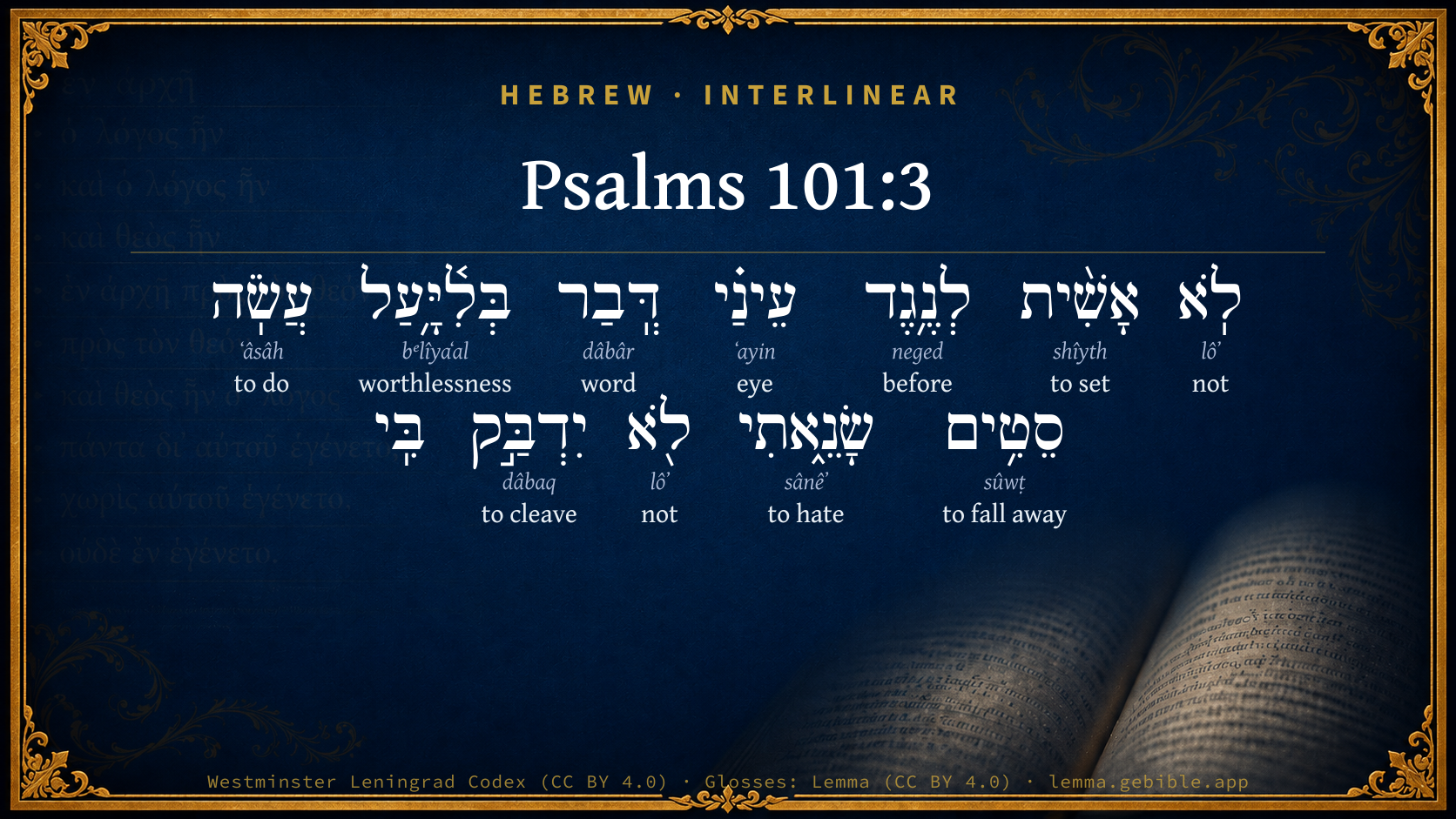
  1. לֹֽא lôʼ H3808 “not” Particle, Negative
  2. אָשִׁ֨ית shîyth H7896 “to set” Verb, Qal, Imperfect, 1st Person, Common, Singular
  3. לְנֶ֥גֶד neged H5048 “to/for · before” Preposition + Preposition
  4. עֵינַ֗י ʻayin H5869 “eyes · my” Noun, Common, Both, Dual, Construct + Suffix, Personal, 1st Person, Common, Singular
  5. דְּֽבַר dâbâr H1697 “word of” Noun, Common, Masculine, Singular, Construct
  6. בְּלִ֫יָּ֥עַל bᵉlîyaʻal H1100 “worthlessness” Noun, Common, Masculine, Singular, Absolute
  7. עֲשֹֽׂה ʻâsâh H6213 “to do” Verb, Qal, Infinitive Construct
  8. שָׂנֵ֑אתִי sânêʼ H8130 “to hate” Verb, Qal, Perfect, 1st Person, Common, Singular
  9. לֹ֖א lôʼ H3808 “not” Particle, Negative
  10. יִדְבַּ֣ק dâbaq H1692 “to cleave” Verb, Qal, Imperfect, 3rd Person, Masculine, Singular

About this verse

These counts appear in no published source. They are computed here, from the morphology-tagged text and Lemma’s own curated glosses. What Lemma adds →

12
words
10
distinct lemmas
Wisdom
section

Notable vocabulary

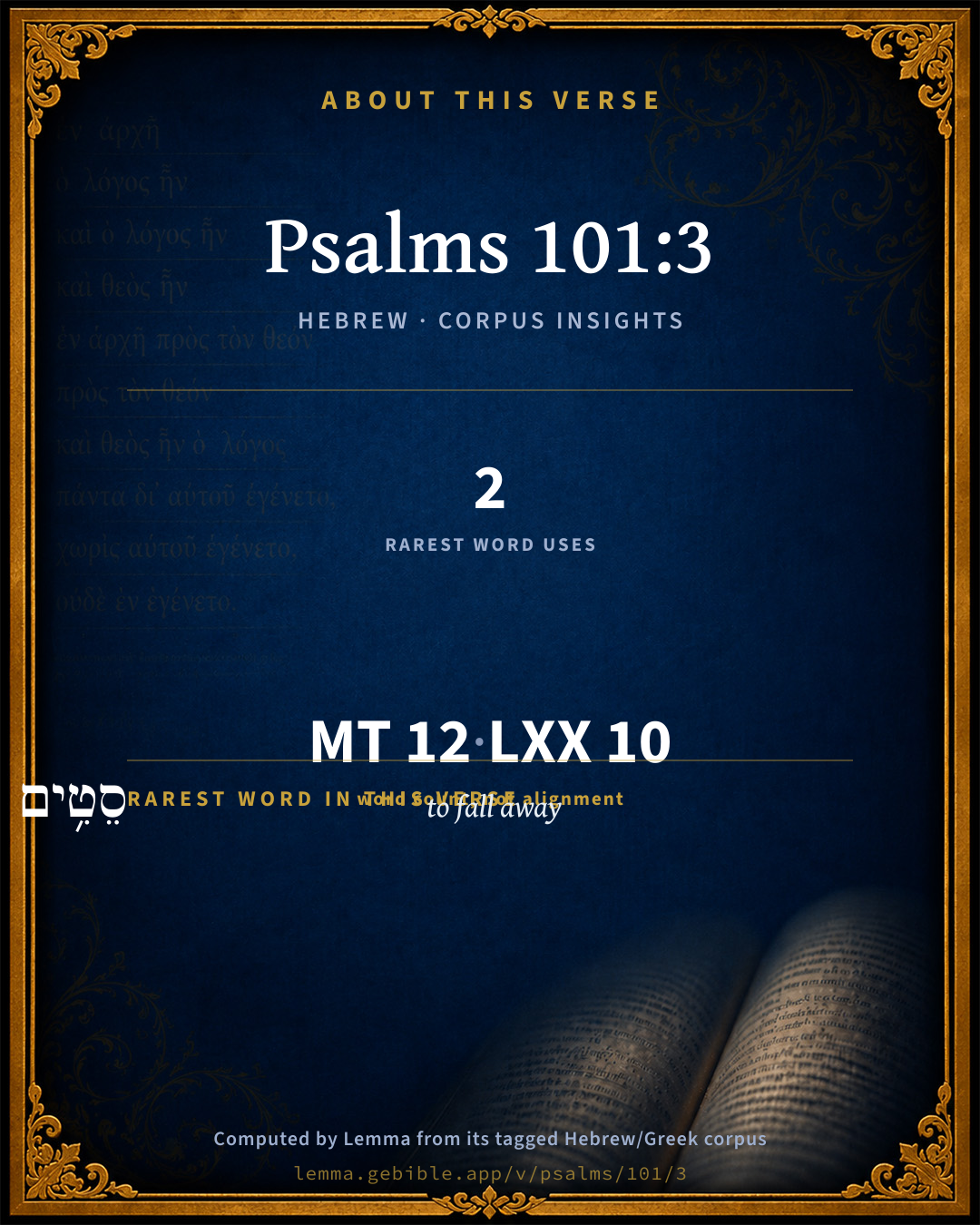
The rarest word here is סֵטִ֥ים to fall away H7750 — appearing just 2 times in the whole Hebrew Bible.

Shared distinctive vocabulary

סֵטִ֥ים to fall away H7750 occurs in 2 verses of the Hebrew Bible. Also found in:

Grammatical profile

  • 4 verbs
  • 4 nouns
  • 2 prepositions
  • 2 particles

Verb forms

  • אָשִׁ֨ית Qal · Imperfect
  • עֲשֹֽׂה Qal · Infinitive Construct
  • שָׂנֵ֑אתִי Qal · Perfect
  • יִדְבַּ֣ק Qal · Imperfect

Repetition

A word recurs within this verse — often emphatic in Hebrew:

Hebrew & Septuagint length

In English translation the verse runs 22 words from the Hebrew and 14 from the Septuagint (LXX English) — closely comparable.

A rough comparison of the two English renderings, which tokenize alike — not a word-level alignment.

Word counts can differ between the Hebrew and the Greek without any difference in meaning — e.g. the Hebrew direct-object marker אֵת has no separate Greek word, and Greek often adds the article ὁ.

In the original languages it is 12 Hebrew tokens and 10 Greek tokens — but the two are counted differently (Hebrew bundles its prefixes and suffixes into one token; the Greek is in lemma form), so that isn’t a like-for-like length.

Cross-references

37

Topical passages linked to Psalms 101:3 in the Treasury of Scripture Knowledge — connected by theme and wording, ordered by reader-vote popularity; previews shown in the World English Bible.

  • Psalms 119:37 Turn my eyes away from looking at worthless things. Revive me in your ways.
  • Job 31:1 "I made a covenant with my eyes, How then should I look lustfully at a young woman?
  • James 1:13–15 Let no man say when he is tempted, "I am tempted by God," for God can't be tempted by evil, and he himself tempts no one.
  • 2 Samuel 11:2–3 It happened at evening, that David arose from off his bed, and walked on the roof of the king's house: and from the roof he saw a woman bathing; and the woman was very beautiful to look on.
  • Proverbs 6:25 Don't lust after her beauty in your heart, Neither let her captivate you with her eyelids.
  • Matthew 5:28 but I tell you that everyone who gazes at a woman to lust after her has committed adultery with her already in his heart.
  • Psalms 40:4 Blessed is the man who makes Yahweh his trust, And doesn't respect the proud, nor such as turn aside to lies.
  • Exodus 20:17 "You shall not covet your neighbor's house. You shall not covet your neighbor's wife, nor his man-servant, nor his maid-servant, nor his ox, nor his donkey, nor anything that is your neighbor's."
  • 1 Samuel 12:20–21 Samuel said to the people, "Don't be afraid; you have indeed done all this evil; yet don't turn aside from following Yahweh, but serve Yahweh with all your heart:
  • Deuteronomy 15:9 Beware that there not be a base thought in your heart, saying, The seventh year, the year of release, is at hand; and your eye be evil against your poor brother, and you give him nothing; and he cry to Yahweh against you, and it be sin to you.
  • Romans 12:9 Let love be without hypocrisy. Abhor that which is evil. Cling to that which is good.
  • Joshua 23:6 Therefore be you very courageous to keep and to do all that is written in the book of the law of Moses, that you not turn aside from it to the right hand or to the left;
  • Ecclesiastes 6:9 Better is the sight of the eyes than the wandering of the desire. This also is vanity and a chasing after wind.
  • Jeremiah 22:17 But your eyes and your heart are not but for your covetousness, and for shedding innocent blood, and for oppression, and for violence, to do it.
  • Galatians 4:9 But now that you have come to know God, or rather to be known by God, why do you turn back again to the weak and miserable elements, to which you desire to be in bondage all over again?
  • Exodus 32:8 They have turned aside quickly out of the way which I commanded them. They have made themselves a molten calf, and have worshiped it, and have sacrificed to it, and said, 'These are your gods, Israel, which brought you up out of the land of Egypt.'"
  • Psalms 26:4–5 I have not sat with deceitful men, Neither will I go in with hypocrites.
  • Psalms 78:41 They turned again and tempted God, And provoked the Holy One of Israel.
  • Hebrews 10:39 But we are not of those who shrink back to destruction, but of those who have faith to the saving of the soul.
  • 2 Peter 2:21 For it would be better for them not to have known the way of righteousness, than, after knowing it, to turn back from the holy commandment delivered to them.
  • Psalms 14:3 They have all gone aside. They have together become corrupt. There is none who does good, no, not one.
  • Psalms 119:113 I hate double-minded men, But I love your law.
  • Isaiah 30:11 get out of the way, turn aside out of the path, cause the Holy One of Israel to cease from before us."
  • Isaiah 33:15 He who walks righteously, and speaks blamelessly; he who despises the gain of oppressions, who shakes his hands from taking a bribe, who stops his ears from hearing of blood, and shuts his eyes from looking on evil:
  • 1 Kings 21:2–29 Ahab spoke to Naboth, saying, Give me your vineyard, that I may have it for a garden of herbs, because it is near to my house; and I will give you for it a better vineyard than it: or, if it seem good to you, I will give you the worth of it in money.
  • Psalms 39:1 I said, "I will watch my ways, so that I don't sin with my tongue. I will keep my mouth with a bridle while the wicked is before me."
  • Psalms 78:57 But turned back, and dealt treacherously like their fathers. They were turned aside like a deceitful bow.
  • Psalms 97:10 You who love Yahweh, hate evil. He preserves the souls of his saints. He delivers them out of the hand of the wicked.
  • Psalms 125:5 But as for those who turn aside to their crooked ways, Yahweh will lead them away with the workers of iniquity. Peace be on Israel.
  • Hosea 7:6–7 For they have made ready their heart like an oven, While they lie in wait. Their baker sleeps all the night. In the morning it burns as a flaming fire.
  • Micah 2:2 They covet fields, and seize them; And houses, and take them away: And they oppress a man and his house, Even a man and his heritage.
  • Zephaniah 1:5–6 those who worship the host of the sky on the housetops, those who worship and swear by Yahweh and also swear by Malcam,
  • Deuteronomy 13:17 There shall cleave nothing of the devoted thing to your hand; that Yahweh may turn from the fierceness of his anger, and show you mercy, and have compassion on you, and multiply you, as he has sworn to your fathers;
  • 1 Samuel 15:11 It repents me that I have set up Saul to be king; for he is turned back from following me, and has not performed my commandments. Samuel was angry; and he cried to Yahweh all night.
  • Psalms 18:20–23 Yahweh has rewarded me according to my righteousness. According to the cleanness of my hands has he recompensed me.
  • Psalms 36:3 The words of his mouth are iniquity and deceit. He has ceased to be wise and to do good.
  • Proverbs 23:31–35 Don't look at the wine when it is red, When it sparkles in the cup, When it goes down smoothly:

Cross-references courtesy of OpenBible.info (CC BY 4.0).

Hebrew and Greek witnesses Masoretic Hebrew ↔ Greek Septuagint

The same verse in the two great witnesses to the Old Testament, shown verse-for-verse.

You’re reading Greek Psalm 100 (Hebrew Psalm 101). The Septuagint counts the superscription, so verse numbers can differ from the Hebrew — chapter-level alignment, not verse-by-verse. Numbering follows Rahlfs.

These are two independent witnesses, not word-aligned to each other, and the Septuagint is shown in lemma (dictionary) form.

Hebrew Psalms 101:3 Masoretic · Westminster Leningrad Codex

לֹֽא אָשִׁ֨ית לְנֶ֥גֶד עֵינַ֗י דְּֽבַר בְּלִ֫יָּ֥עַל עֲשֹֽׂה סֵטִ֥ים שָׂנֵ֑אתִי לֹ֖א יִדְבַּ֣ק בִּֽי

I will set no vile thing before my eyes. I hate the deeds of faithless men. They will not cling to me.

World English Bible · Public Domain

Greek LXX Greek Psalm 100:3 Septuagint · lemma form

οὐ προτίθημι πρό ὀφθαλμός ἐγώ πρᾶγμα παράνομος ποιέω παράβασις μισέω

I have not set before my eyes any unlawful thing; I have hated transgressors.

LXX2012 (modern English Septuagint) · Public Domain

Hebrew: Westminster Leningrad Codex (CC BY 4.0). Greek: Septuagint (public domain); English from LXX2012 (modern English Septuagint) (Public Domain). How the Septuagint differs from the Hebrew →

Commentary

Notes on Psalms 101:3 from classic Christian and Jewish commentators (each source and its license shown beneath its notes). The classic Christian expositions comment on the surrounding passage and are grouped to its opening verse, so a note may address several verses; the Jewish commentaries on the Tanakh (Rashi and others) are per-verse, so they appear only where the commentator wrote on this verse.

Lemma curates 59 commentaries, every one of them public domain or Creative Commons licensed, each selected and text-cleaned for this edition rather than reprinted as found. About our sources →

Trapp's Complete Commentary

John Trapp

Psa 101:3 I will set no wicked thing before mine eyes: I hate the work of them that turn aside; [it] shall not cleave to me.

Ver. 3. I will set no wicked thing (Heb. thing of Belial) before mine eyes] That is, in my thoughts, saith Kimchi; for the thinking faculty is in the forepart of the brain, as are also the eyes. I will not gaze upon forbidden objects, nor venture upon a temptation to or an occasion of sin. I will also be wise and wary in the choice of my servants and under officers. Theodosius’s court was virtutum officina, non vitiorum sentina, saith Pareus. And Archbishop Cranmer’s house was schola vel palaestra pietatis et literarum, saith Tremellius. See above on the title of this psalm.

I hate the work of them that turn aside] Of treacherous men and apostates; such as Constantius Chlorus, the father of Constantine the Great found (by proof made) some of his counsellors and courtiers to be, and therefore turned them off, saying, He cannot be faithful to me who is unfaithful to God; Pietate sublata fides tollitur (Euseb.).

It shall not cleave to me] I will none of them, neither shall any such wickedness hang at my heels, to hinder my progress in piety and good government.

John Trapp, A Commentary or Exposition upon All the Books of the Old and New Testament (1647–1656) — public domain. Text from a community e-Sword module.

Joseph Benson's Commentary

Psa 101:3-4. I will set no wicked thing before mine eyes — Namely, to look upon it with approbation, or design to practise, countenance, or tolerate it. If any ungodly or unjust thing be suggested to me, whatsoever specious pretences it may be covered with, as some reason of state or worldly advantage, I will cast it out of my mind and thoughts with abhorrence, so far will I be from putting it in execution. I hate the work of them that turn aside — From God, and from his laws. It shall not cleave to me —

Namely, such work, or the contagion of such examples. I will neither imitate nor endure such works nor such workers. A froward heart — A man of a corrupt mind and wicked life; shall depart from me — Shall be turned out of my court, lest he should infect the rest of my family, or be injurious, or an occasion of offence to my people. I will not know a wicked person — I will not own nor countenance such a one, but will keep all such at a distance.

Joseph Benson's Commentary on the Old and New Testaments (1811–1818) — public domain. Text from a community e-Sword module.

J. A. Alexander on Psalms

Joseph Addison Alexander

3. (Psa 101:3) I will not set before my eyes a word of Belial; the doing of apostasies I hate, it shall not cleave to me. The positive terms of the preceding verse are now exchanged for negatives. Having said what he will do, he now says what he will not do. See a similar transition, but in the inverse order, Psa 1:1-2. Set before my eyes, as a model to be copied, or as an object of approving contemplation. A word of Belial, as in Psa 41:8, except that word, which there most probably relates to slander or false accusation, may here denote a proposition, and the whole phrase a worthless (i.e. wicked) plan or purpose. Apostasies, departures, deviations from the right course. See the verbal root as used in Ps. x40:4), and a cognate verb in Num 5:12; Num 5:19. Some make the word here used a participle or verbal noun, as in the English Bible, the work of them that turn aside. But its form and the analogy of Hos 5:2, entitle the other construction to the preference. It shall not cleave to me, I will not be concerned or implicated in it; or more emphatically still, it shall not cleave to me as a reproach or stigma. In favour of the former sense is the analogy of Deu 13:17, from which the expression seems to have been borrowed.

Joseph Addison Alexander, The Psalms Translated and Explained (1850) — public domain. Text from a community e-Sword module.

Geneva Bible (1599)

Geneva Bible translators

He showeth that Magistrates do not their duties, except they be enemies to all vice.

Geneva Bible (1599) marginal notes — public domain. Text via Bolls.life.

Adam Clarke's Commentary

Verse 3. I will set no wicked thing before mine eyes] I will undertake no unjust wars; will enter into no sinful alliances; will not oppress my subjects by excessive taxation, to support extravagance in my court. I will not look favourably on things or words of Belial. What is good for nothing or evil in its operation, what is wicked in its principle, and what would lead me away from righteousness and truth, I will never set before my eyes.

Them that turn aside] I shall particularly abominate the conduct of those who apostatize from the true religion, and those who deny its Divine authority, and who live without having their conduct governed by its influence, such shall never he put in a place of political trust or confidence by me.

Adam Clarke's Commentary on the Bible (1810–1826) — public domain. Text from a community e-Sword/MySword module.

John Calvin's Commentaries

3 I will not set a wicked thing before my eyes After having protested, that in leading a private life, he would practice virtue and righteousness, even as it becomes good princes to begin with this, he now adds, that in executing the office of prince, he will be the enemy of all injustice and wickedness. To set a wicked thing before one’s eyes, is equivalent to purposing to do something that is wicked. He therefore declares, that he will turn away from all wickedness; and it is certain, that no man can be a just and an impartial punisher of wrongdoing, but he who abhors it with all his heart. Whence it follows that kings, in order to the performance of their duty, must keep themselves entirely free from all consent to wickedness. Some join to the first sentence the word עשוה, asoh, which we translate work, and supply the letter ל, lamed; as if it had been said, I will not set before my eyes any wickedness to do it, or, nothing wicked will be acceptable to me to execute it. But the other sense is more probable, which is, that David, after having declared that he will not suffer any iniquity before his eyes, immediately adds for the sake of confirmation, that he will be an enemy to all injustice. If the last clause is referred to the persons who turn aside, there is a change of the number. It may, however, be explained of the work itself, implying that he would never have any share in wicked defections from the path of rectitude.

John Calvin's Commentaries (1540-1563) — public domain. Text from the Calvin Translation Society English edition (1840s-50s) via the Christian Classics Ethereal Library (ccel.org). Calvin's coverage is partial (roughly two-thirds of the Bible); uncommented books and verses are honest gaps, never fabricated. The 19th-century editor's footnotes and remarks are omitted so the notes are faithfully Calvin's own voice.

Ellicott's Commentary for English Readers

(3) I will set no. . . . . —Mark the wisdom of the

resolve in a despotic monarch, who has only to speak to effect whatever he has looked on with desire.

Wicked thing.—Thing (or, word) of Belial. (See Note on Psa_41:8.)

I hate the work of them that turn aside.—Or, I hate the doing of false things, according as we take the word in the concrete or abstract.

It shall not cleave to me.—Such conduct shall not be mine.

A Bible Commentary for English Readers, edited by Charles John Ellicott (1878–1897) — public domain. Text from a community e-Sword module.

The Cambridge Bible for Schools and Colleges

gen. ed. J. J. S. Perowne

3. I will set no base thing before mine eyes (R.V.), as an aim to be accomplished, or an example to be imitated. Lit. matter of belial, i.e. worthlessness. Cp. Deu_15:9.

the work of them that turn aside] Or, more probably, the practice of depravities.

it shall not cleave to me] “If it seized on him unawares, he would shake it off as an accursed thing; Deu_13:17” (Kay).

The Cambridge Bible for Schools and Colleges (gen. ed. J. J. S. Perowne; Cambridge University Press, 1878–1918) — public domain. Text from a community e-Sword module.

John Gill's Exposition

I will set no wicked thing before mine eyes, Either the eyes of the body, which are the inlets of lust and are easily caught with objects that inflame the heart, and should be turned aside from beholding vanity; or the eyes of the mind; so the Targum,

"I will not propose to my heart;''

or, as Kimchi,

"in my thought'',

that is, I will not set up an evil thing in my imagination, to dwell upon in my thoughts, and take delight and pleasure in meditating upon it; or set it before me, to imitate as a pattern, to work by, and copy after: Christ did not so; he set the Lord always before him, Psa 16:8, not anything of Belial (k) or Satan, as the phrase here may be rendered; no, he always bid Satan, or anything of his, be gone, and get behind him, Mat 4:10.

I hate the work of them that turn aside; from God, and from his law; from the paths of religion, truth, and virtue; and from the Gospel, and a profession of it; such are not fit for the kingdom of God, and in these God and Christ have no pleasure, Heb 10:38,

it shall not cleave to me; neither the wicked thing, or thing of Belial, nor the work of apostasy; that is, he would have no familiarity nor fellowship with it; not come near it, nor connive at it, but hate and abhor it: the Jews said, an evil disease, or a thing of Belial, "cleaveth fast unto him", Psa 41:8, but they were mistaken.

(k) "verbum Belijahal", Montanus; so Cocceius, Gejerus, Ainsworth.

John Gill's Exposition of the Whole Bible (1746–1763) — public domain (CC PDM 1.0). Text via the HelloAO Bible API.

Albert Barnes' Notes on the Bible

I will set no wicked thing before mine eyes - That is, I will propose no wicked thing to be done; I will have no such object in view; I will employ no one to do that which is wrong. The margin, as the Hebrew, is, “thing of Belial.” See the notes at Psa 41:8. It here means that which is worthless, bad, wicked. He would have no wicked aim; he would not look upon a wicked thing for a moment, or with the least favor.

I hate the work of them that turn aside - All their doings, motives, plans. The word rendered “turn aside” means to turn out of the way; out of the right path: Wanderers - transgressors - those who leave the path of truth and honesty.

It shall not cleave to me - I will have nothing to do with it. It shall not he allowed to attach itself to me. A wicked plan or purpose is thus represented as having a tendency to fasten itself on a man, or to “stick to him” - as pitch, or wax, as a “burn” does.

Albert Barnes' Notes on the Bible (1834–1885) — public domain. Text from a community e-Sword/MySword module.

Matthew Poole's English Annotations

Before mine eyes, to wit, to look upon it with deliberation and design, or with desire and delight, as this phrase here and elsewhere implies. If any ungodly or unjust thing shall be suggested to me, whatsoever specious pretences it may be covered with, as reason of state or worldly advantage, I will cast it out of my mind and thoughts, it, horrency; so far will I be from putting it in execution.

That turn aside from God, and from his laws.

It shall cleave to me, to wit, such work, or the contagion of such examples. I will neither imitate nor endure such works, nor such workers.

Matthew Poole's English Annotations on the Holy Bible (1683–1685) — public domain. Text from a community e-Sword/MySword module.

The Treasury of David

Charles H. Spurgeon

Ver. 3. I will set no wicked thing before mine eyes. I will neither delight in it, aim at it or endure it. If I have wickedness brought before me by others I will turn away from it, I will not gaze upon it with pleasure. The psalmist is very sweeping in his resolve, he declines the least, the most reputable, the most customary form of evilno wicked thing; not only shall it not dwell in his heart, but not even before his eyes, for what fascinates the eye is very apt to gain admission into the heart, even as Eve's apple first pleased her sight and then prevailed over her mind and hand.

I hate the work of them that turn aside. He was warmly against it; he did not view it with indifference, but with utter scorn and abhorrence. Hatred of sin is a good sentinel for the door of virtue. There are persons in courts who walk in a very crooked way, leaving the high road of integrity; and these, by short cuts, and twists, and turns, are often supposed to accomplish work for their masters which simple honest hearts are not competent to undertake; but David would not employ such, he would pay no secret service money, he loathed the practices of men who deviate from righteousness. He was of the same mind as the dying statesman who said, "Corruption wins not more than honesty." It is greatly to be deplored that in after years he did not keep himself clear in this matter in every case, though, in the main he did; but what would he have been if he had not commenced with this resolve, but had followed the usual crooked Policy of Oriental princes? How much do we all need divine keeping! We are no more perfect than David, nay, we fall far short of him in many things; and, like him, we shall find need to write a psalm of penitence very soon after our psalm of good resolution.

It shall not cleave to me. I will disown their ways, I will not imitate their policy: like dirt it may fall upon me, but I will wash it off, and never rest till I am rid of it. Sin, like pitch, is very apt to stick. In the course of our family history crooked things will turn up, for we are all imperfect, and some of those around us are far from being what they should be; it must, therefore, be one great object of our care to disentangle ourselves, to keep clear of transgression, and of all that comes of it: this cannot be done unless the Lord both comes to us, and abides with us evermore.

Ver. 3. Wicked thing. The original hath it, if we will render it word for word, "I will set no word of Belial before mine eyes." But word is figuratively there put for thing; as likewise Ps 41:8; and so is it rendered both by Montanus in the margin, and in the text by Junius; howbeit, in his comment upon this psalm, he precisely follows the original, applying it against sycophants and flatterers, the mice and moths of court. George Hakewill.

Ver. 3. I hate the work of them that turn aside. Mr. Schultens hath shown in his commentary on Pr 7:25 that hjv hath a much stronger and more significant meaning than that of mere turning aside; and that it is used of an unruly horse, that champs upon the bit through his fiery impatience; and when applied to a bad man, denotes one impatient of all restraint, of unbridled passions, and that is headstrong and ungovernable in the gratification of them, trampling on all the obligations of religion and virtue. Such as these are the deserved objects of the hatred of all good men, whose criminal deviations and presumptuous crimes they detest; none of which shall cleave to them; they will not harbour the love of, or inclination to them, nor habitually commit them, or encourage the practice of them. Persons of this character are too frequently about the courts of princes, but it is their honour and interest, as far as ever they can, to discountenance them. Samuel Chandler.

Ver. 3. It shall not cleave to me. A bird may light upon a man's house; but he may choose whether she shall nestle or breed there, or no: and the devil or his instruments may represent a wicked object to a man's sight; but he may choose whether he will entertain or embrace it or no. For a man to set wicked things before his eyes is nothing else but to sin of set purpose, to set himself to sin, or to sell himself to sin, as Ahab did, 1Ki 21:1-29. George Hakewill.

Ver. 3. It shall not cleave to me. A wicked plan or purpose is thus represented as having a tendency to fasten itself on a man, or to "stick to him" as pitch, or wax, or a burr does. Albert Barnes.

Ver. 3.

1. The sight of wickedness is to be avoided: "I will set no wicked thing, "etc.

2. When seen it is to be loathed: "I Hate, "etc.

3. When felt it is to be repudiated. It may touch me, but "it shall not cleave to me."

Psalms 101:4*

Charles H. Spurgeon's The Treasury of David (1869–1885) — public domain. Psalms only. Text from a community e-Sword/MySword module.

Whedon's Commentary on the Bible

Daniel D. Whedon

3. I will set no wicked thing before mine eyes—Literally, No thing of Belial, a designation of worthlessness, lowness, impiety. He would not propose to himself such, as an object of pursuit or desire. His state policy, like his private life, should be upright. With this verse begins especially his plan and vow of kingly conduct, as what precedes more fitly applies to his personal and private life.

Work of them that turn aside—Literally, work of deviations; or, taken in the concrete, (as in Hos_5:2; Psa_40:5,) the work of revolters; men who depart, or diverge from, law and truth. Psa_125:5

Daniel D. Whedon (gen. ed.), Commentary on the Old and New Testaments (1874–1909) — public domain. Text from a community e-Sword module.

The Pulpit Commentary

I will set no wicked thing before mine eyes; or, no base thing (Revised Version); "no villainous thing" (Cheyne, Kay); comp. Deu_15:9. I will set before me nothing of this kind, "as an object either of imitation or of attainment." I hate the work of them that turn aside; literally, the doing of acts that swerve; i.e. "that depart from the right way." It shall not cleave to me. If such a thing "seized on him unawares, he would shake it off as a thing accursed" (Kay); comp. Deu_13:17.

The Pulpit Commentary (1880–1919), ed. H.D.M. Spence-Jones & Joseph S. Exell — public domain. Text from a community e-Sword module.

Rashi

Rabbi Shlomo Yitzchaki (Rashi)

wayward Heb. סטים, an expression of (Num. 5:12): “whose wife strays (תשטה) from the right path,” to turn away from the road, destolemant in Old French, to swerve.

Rashi on the Tanakh — English translations: “The Judaica Press complete Tanach with Rashi, translated by A. J. Rosenberg” (CC BY 4.0); “Pentateuch with Rashi's commentary by M. Rosenbaum and A.M. Silbermann, 1929-1934” (public domain); “The Metsudah Tanach series, Lakewood, N.J” (CC BY 4.0); and “The Book of Joshua, Metsudah Publications, 1997” (CC BY 4.0). Text via Sefaria.

Lesson kit

Teaching starters — assembled from the data on this page, not authored interpretation. Every prompt links to the verse data it draws on. Edit before teaching.

Psalms, in the Wisdom, opens this verse with 12 words (10 distinct Hebrew lemmas). Its most distinctive word is sûwṭ (“to fall away”). A historical commentator’s framing appears above. Read the whole chapter for the surrounding context.

Discussion questions

  1. How does “to fall away” (sûwṭ) shape what this verse is saying?
  2. How does Psalms 40:4, which shares the word «to fall away», read alongside this verse?
  3. What does the repetition of “not” (2× in this one verse) do in this verse?
  4. These translations render this verse differently. What is at stake in choosing one wording over another?
  5. «אָשִׁ֨ית» is a Qal Imperfect verb. How does that grammatical form shape the action described?
  6. Compare how Trapp's Complete Commentary and Joseph Benson's Commentary read this verse. Where do they agree or differ?

Things to notice

Reading settings

Reading text

Shown beneath each verse's original-language words.

Old Testament
Old Testament edition

Read the OT as the Masoretic Hebrew (MT) or the Greek Septuagint (LXX).

English shown for the Greek Septuagint (in the Hebrew ↔ Greek comparison).

Comparing translations? Open the Compare panel on any verse page to stack up to four side by side.