
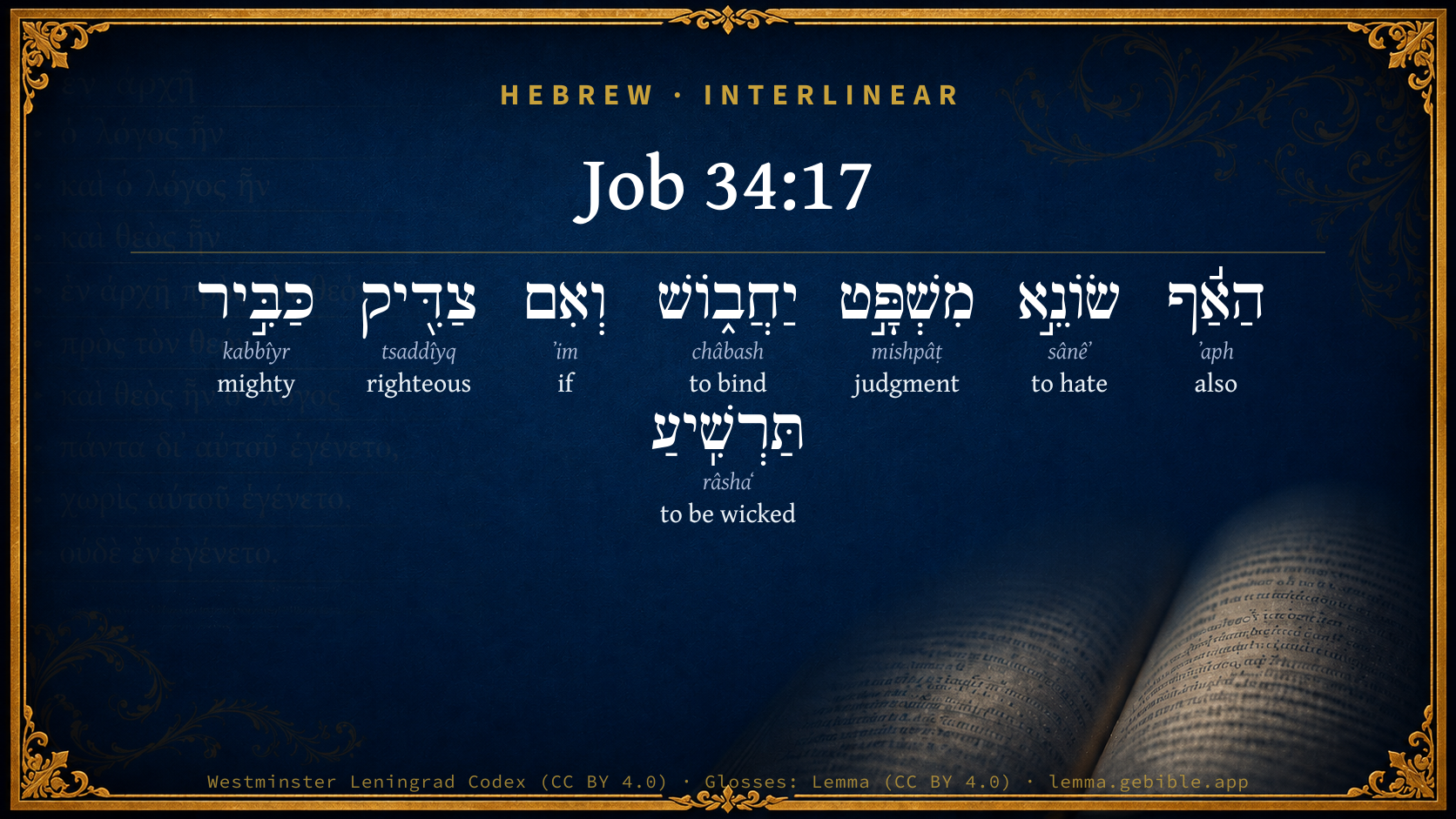
Job 34:17

Hebrew (Westminster Leningrad Codex) Job 34:17 appears in the Hebrew Old Testament. The text above is from the Westminster Leningrad Codex. Each word links to its Strong’s number, a concise gloss, and parsing drawn from the Open Scriptures Hebrew Bible morphology. Click any word for its full Brown-Driver-Briggs (BDB) entry.
Download image
Cite this verse

Job 34:17 (World English Bible). Public Domain. Lemma interlinear Bible study tool, https://lemma.gebible.app/v/job/34/17.

Show BibTeX & RIS
BibTeX
RIS
English Translation
Shall even one who hates justice govern? Will you condemn him who is righteous and mighty?--
World English Bible · Public Domain
Download a study sheet

One document with this verse’s original text, its word-by-word gloss line, the meaning frame, cross-references with their text, attributed commentary, and full source and license credits — printable, and it pastes into notes with its structure intact.

This verse Autodidact and up

Study sheet (.html) Plain text (.txt)

A passage Seminary Student

Up to 50 verses in one chapter. A passage sheet keeps up to 6 commentary sources and 12 cross-references per verse, in the order this page ranks them, and says so on the sheet whenever that leaves anything out. Ask for a single verse and you get the Autodidact verse sheet above.

Everything on this page stays free to read, with no account — the sheet is a download of what is already on screen, not access to it.

Want to remove ads? Support Godless Engineer
Compare translations 3

The same verse in 3 English versions, stacked beneath the original-language interlinear above. Click any original word for its lexicon entry.

Each is an independent rendering of the whole verse — the interlinear is not word-aligned to these translations.

Highlighted words mark where these versions differ — a whole-verse word diff, not a word-by-word alignment.

  • World English Bible Public Domain
    Shall even one who hates justice govern? Will you condemn him who is righteous and mighty?--
  • King James Version Public Domain
    Shall even he that hateth right govern? and wilt thou condemn him that is most just?
  • unfoldingWord Literal Text CC BY-SA 4.0
    Will one hating justice indeed govern? Or if you will condemn the Righteous, the Mighty,

unfoldingWord Literal Text — © unfoldingWord, licensed CC BY-SA 4.0. Word-aligned USFM3 via Door43 (git.door43.org/unfoldingWord/en_ult).

Versions to compare (up to 4)

3 of 4 selected

Show all 18 translations

Every available English version of this verse, each an independent rendering of the whole verse.

  • World English Bible Public Domain
    Shall even one who hates justice govern? Will you condemn him who is righteous and mighty?--
  • Berean Standard Bible Public Domain
    Could one who hates justice govern? Will you condemn the just and mighty One,
  • Majority Standard Bible Public Domain
    Could one who hates justice govern? Will you condemn the just and mighty One,
  • King James Version Public Domain
    Shall even he that hateth right govern? and wilt thou condemn him that is most just?
  • American Standard Version (1901) Public Domain
    Shall even one that hateth justice govern? And wilt thou condemn him that is righteous `and' mighty?-
  • Revised Version (1885) Public Domain
    Shall even one that hateth right govern? and wilt thou condemn him that is just and mighty?
  • Geneva Bible (1599) Public Domain
    Shal he that hateth iudgement, gouerne? and wilt thou iudge him wicked that is most iust?
  • Douay-Rheims (1899) Public Domain
    Can he be healed that loveth not judgment? and how dost thou so far condemn him that is just?
  • Young's Literal Translation Public Domain
    Yea, doth one hating justice govern? Or the Most Just dost thou condemn?
  • Literal Standard Version CC BY-SA 4.0
    Indeed, does one hating justice govern? Or do you condemn the Most Just?
  • Unlocked Literal Bible CC BY-SA 4.0
    Can one who hates justice govern? Will you condemn God, who is righteous and mighty?
  • unfoldingWord Literal Text CC BY-SA 4.0
    Will one hating justice indeed govern? Or if you will condemn the Righteous, the Mighty,
  • Darby Bible Public Domain
    Should he that hateth right indeed govern? and wilt thou condemn the All-just?
  • World Messianic Bible Public Domain
    Should even one who hates justice govern? Will you condemn him who is righteous and mighty,
  • Webster's Bible Public Domain
    Shall even he that hateth right govern? and wilt thou condemn him that is most just?
  • Free Bible Version CC BY-SA 4.0
    Do you really think someone who hated justice could govern? Are you going to condemn Almighty God who always does what is right?
  • Bible in Basic English Public Domain
    How may a hater of right be a ruler? and will you say that the upright Ruler of all is evil?
  • JPS Tanakh (1917) Public Domain
    Shall even one that hateth right govern? And wilt thou condemn Him that is just and mighty —

Literal Standard Version (2020), Covenant Press — licensed CC BY-SA 4.0. Text via the HelloAO Bible API (eBible.org). Unlocked Literal Bible (unfoldingWord) — licensed CC BY-SA 4.0. Text via the HelloAO Bible API (eBible.org). unfoldingWord Literal Text — © unfoldingWord, licensed CC BY-SA 4.0. Word-aligned USFM3 via Door43 (git.door43.org/unfoldingWord/en_ult). Free Bible Version, Dr. Jonathan Gallagher — licensed CC BY-SA 4.0. Text via the HelloAO Bible API (eBible.org).

Word by word

More ways to search: Search by grammar → Find every occurrence → Compare this word →

Practice this passage: Drill this verse → Learn its vocabulary →

About this verse

These counts appear in no published source. They are computed here, from the morphology-tagged text and Lemma’s own curated glosses. What Lemma adds →

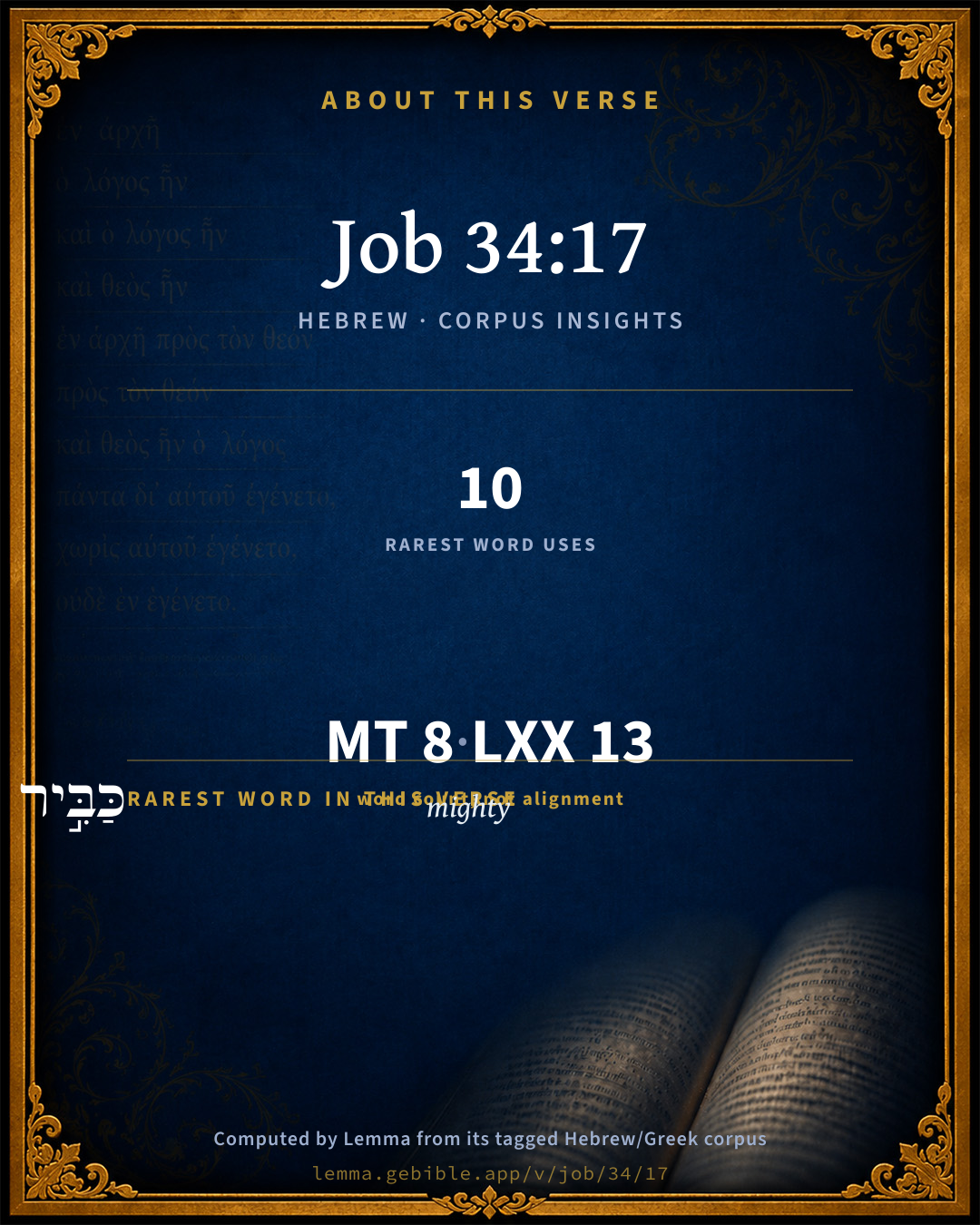
8
words
8
distinct lemmas
Wisdom
section

Notable vocabulary

The rarest word here is כַּבִּ֣יר mighty H3524 — appearing just 10 times in the whole Hebrew Bible.

Shared distinctive vocabulary

כַּבִּ֣יר mighty H3524 occurs in 9 verses of the Hebrew Bible. Also found in:

Grammatical profile

  • 3 verbs
  • 1 noun
  • 2 adjectives
  • 1 conjunction
  • 1 adverb

Verb forms

  • שׂוֹנֵ֣א Qal · Participle Active
  • יַחֲב֑וֹשׁ Qal · Imperfect
  • תַּרְשִֽׁיעַ Hiphil · Imperfect

Hebrew & Septuagint length

In English translation the verse runs 16 words from the Hebrew and 17 from the Septuagint (LXX English) — closely comparable.

A rough comparison of the two English renderings, which tokenize alike — not a word-level alignment.

Word counts can differ between the Hebrew and the Greek without any difference in meaning — e.g. the Hebrew direct-object marker אֵת has no separate Greek word, and Greek often adds the article ὁ.

In the original languages it is 8 Hebrew tokens and 13 Greek tokens — but the two are counted differently (Hebrew bundles its prefixes and suffixes into one token; the Greek is in lemma form), so that isn’t a like-for-like length.

Cross-references

7

Topical passages linked to Job 34:17 in the Treasury of Scripture Knowledge — connected by theme and wording, ordered by reader-vote popularity; previews shown in the World English Bible.

  • Genesis 18:25 Be it far from you to do things like that, to kill the righteous with the wicked, that so the righteous should be as the wicked. May that be far from you. Shouldn't the Judge of all the earth do right?"
  • 2 Samuel 23:3 The God of Israel said, The Rock of Israel spoke to me: One who rules over men righteously, Who rules in the fear of God,
  • Job 40:8 Will you even annul my judgment? Will you condemn me, that you may be justified?
  • Romans 9:14 What shall we say then? Is there unrighteousness with God? May it never be!
  • Romans 3:5–7 But if our unrighteousness commends the righteousness of God, what will we say? Is God unrighteous who inflicts wrath? I speak like men do.
  • Job 1:22 In all this, Job did not sin, nor charge God with wrongdoing.
  • 2 Samuel 19:21 But Abishai the son of Zeruiah answered, Shall Shimei not be put to death for this, because he cursed Yahweh's anointed?

Cross-references courtesy of OpenBible.info (CC BY 4.0).

Hebrew and Greek witnesses Masoretic Hebrew ↔ Greek Septuagint

The same verse in the two great witnesses to the Old Testament, shown verse-for-verse.

These are two independent witnesses, not word-aligned to each other, and the Septuagint is shown in lemma (dictionary) form.

Hebrew Job 34:17 Masoretic · Westminster Leningrad Codex

הַאַ֬ף שׂוֹנֵ֣א מִשְׁפָּ֣ט יַחֲב֑וֹשׁ וְאִם צַדִּ֖יק כַּבִּ֣יר תַּרְשִֽׁיעַ

Shall even one who hates justice govern? Will you condemn him who is righteous and mighty?--

World English Bible · Public Domain

Greek LXX Job 34:17 Septuagint · lemma form

ὁράω σύ ὁ μισέω ἄνομος καί ὁ ὄλλυμι ὁ πονηρός εἰμί αἰώνιος δίκαιος

Behold then the one that hates iniquities, and that destroys the wicked, who is for ever just.

LXX2012 (modern English Septuagint) · Public Domain

On this verse, Haydock's Catholic Bible Commentary discusses the Septuagint’s reading. Read the note in Commentary ↓

Hebrew: Westminster Leningrad Codex (CC BY 4.0). Greek: Septuagint (public domain); English from LXX2012 (modern English Septuagint) (Public Domain). How the Septuagint differs from the Hebrew →

Commentary

Notes on Job 34:17 from classic Christian and Jewish commentators (each source and its license shown beneath its notes). The classic Christian expositions comment on the surrounding passage and are grouped to its opening verse, so a note may address several verses; the Jewish commentaries on the Tanakh (Rashi and others) are per-verse, so they appear only where the commentator wrote on this verse.

Lemma curates 59 commentaries, every one of them public domain or Creative Commons licensed, each selected and text-cleaned for this edition rather than reprinted as found. About our sources →

Trapp's Complete Commentary

John Trapp

Job 34:17 Shall even he that hateth right govern? and wilt thou condemn him that is most just?

Ver. 17. Shall even he that hateth right govern?] Heb. Bind; sc. malefactors, whom magistrates use to hamper? Others take it to be binding up the wounded after the manner of chirurgeons. An qui odit iudicium, chirurgos imitaretur? so the Tigurines translate: Would he who hateth right do as surgeons use to do? Would God, if he were unrighteous, bind up the broken hearted, or receive into favour, as he doth, a sinner that repenteth, doing him good again, as if there never had been a breach between them? It hath been noted, that a king hath his name in the Greek tongue from healing, Aναξ from ακος Medela; and that, Isa 3:7, a governor is called a healer, or binder up; the same word there as here in the text. But how unfit for such an office must he needs be who not only doth not right, but hateth it, as did Nero, Caligula, Commodus, &c.?

And wilt thou condemn him that is most just?] Or, that is strong and just; illumne impietatis sugillabis? (Tigur.) None in his right wits would ever do so; for what else were this but to exalt a man’s self above the Divine Majesty? And yet what do they less than this who grudge at God’s proceedings, and are ready to think that if they had the ordering of things in their hands they could dispose of them a fair deal better? How absurd and unseemly this is in any one is aptly set forth in the next verse, "Is it fit?" &c.

John Trapp, A Commentary or Exposition upon All the Books of the Old and New Testament (1647–1656) — public domain. Text from a community e-Sword module.

Tyndale Open Study Notes

Tyndale Open Resources

34:17 The implied answer was that God could not govern if he hated justice (cp. Rom 3:4-7; 7:7, 13; 9:14; Gal 2:17; 6:14). • Later, God also asked if Job was going to condemn the almighty judge (Job 40:8).

Tyndale Open Study Notes — © Tyndale Open Resources, licensed CC BY-SA 4.0. Text via the HelloAO Bible API.

Geneva Bible (1599)

Geneva Bible translators

If God were not just, how could he govern the world?

Geneva Bible (1599) marginal notes — public domain. Text via Bolls.life.

Jamieson, Fausset & Brown

Robert Jamieson, A. R. Fausset & David Brown

"Can even He who (in thy view) hateth right (justice) govern?" The government of the world would be impossible if injustice were sanctioned. God must be just, because He governs (Sa2 23:3).

govern--literally, "bind," namely, by authority (so "reign," Sa1 9:17, Margin). UMBREIT translates for "govern, repress wrath, namely, against Job for his accusations.

most just--rather, "Him who is at once mighty and just" (in His government of the world).

Jamieson, Fausset & Brown — Commentary Critical and Explanatory on the Whole Bible (1871) — public domain (CC PDM 1.0). Text via the HelloAO Bible API.

Adam Clarke's Commentary

Verse 17. Shall - he that hateth right govern?] Or, Shall he who hateth judgment, lie under obligation? It is preposterous to suppose that he who lives by no rule, should impose rules upon others. God, who is the fountain of all justice and righteousness, binds man by his laws; and wilt thou, therefore, pretend to condemn him who is the sum of righteousness?

Adam Clarke's Commentary on the Bible (1810–1826) — public domain. Text from a community e-Sword/MySword module.

Ellicott's Commentary for English Readers

(17) Shall even he. . . .—The argument is that one who holds such a position of absolute rule cannot be other than most just. He who is fit to rule must be just, and He who is the ultimate ruler must be fit to rule, and must, therefore, be just; but if He is absolutely just, how shall we condemn His government or Him on account of it, even though we cannot explain it all or reconcile it with our view of what is right?

Him that is most just, is rather him that is just and mighty, i.e., not only just, but able also to execute justice because mighty.

A Bible Commentary for English Readers, edited by Charles John Ellicott (1878–1897) — public domain. Text from a community e-Sword module.

The Cambridge Bible for Schools and Colleges

gen. ed. J. J. S. Perowne

17. condemn him that is most just] Or, condemn the just, the mighty One.

The Cambridge Bible for Schools and Colleges (gen. ed. J. J. S. Perowne; Cambridge University Press, 1878–1918) — public domain. Text from a community e-Sword module.

John Gill's Exposition

Is it fit to say to a king, thou art wicked?.... Not even to a bad king; for though he may be reproved for his sins, yet not by any or everyone, but by a fit and proper person: and generally speaking, if not always, the Scriptural instances of reproving such kings are of men that were prophets, and sent in the name of the Lord to do it; and when done by them, was done with decency: and much less should this be said to a good king; as to say to him, Belial, the word here used; or thou art Belial; or a son of Belial, as Shimei said to David, Sa2 16:7; a name given to the worst of men, and is the devil himself; and signifies either one without a yoke, or lawless, which a king is not; or unprofitable, whereas a king is a minister of God for good; is for the punishment of evildoers, and for a praise to them that do well;

and to princes, ye are ungodly? Who have their name from being generous, munificent, and liberal, and therefore should not be treated in such a manner; who are the sons of kings, or subordinate magistrates to them, and execute their will and pleasure, laws and precepts. And if now such language is not to be used to earthly kings and princes, then surely not to the King of kings and Lord of lords; so Jarchi interprets it of God the King of the world; and some Christian interpreters, as Schmidt, understand by "princes" the three Persons in the Godhead; which can hardly be made to bear: though, could the whole be understood of God in the three Persons of the Deity, the connection with Job 34:19 would run more smoothly without the supplement that is made; so Broughton,

"to the King, the King of nobles, that accepteth not,'' &c.

John Gill's Exposition of the Whole Bible (1746–1763) — public domain (CC PDM 1.0). Text via the HelloAO Bible API.

Albert Barnes' Notes on the Bible

Shall even he that hateth right govern? - Margin, as in Hebrew “bind.” That is, shall he bind by laws. The argument in this verse seems to be an appeal to what must be the conviction of mankind, that God, the Great Governor of the universe, could not be unjust. This conviction, Elihu appears to have supposed, was so deep in the human mind, that he might appeal even to Job himself for its truth. The question here asked implies that it would be impossible to believe that one who was unjust could govern the universe. Such a supposition would be at variance with all the convictions of the human soul, and all the indications of the nature of his government to be found in his works.

And wilt thou condemn him that is most just? - The great and holy Ruler of the universe. The argument here is, that Job had in fact placed himself in the attitude of condemning him who, from the fact that he was the Ruler of the universe, must be most just. The impropriety of this he shows in the following verses.

Albert Barnes' Notes on the Bible (1834–1885) — public domain. Text from a community e-Sword/MySword module.

Haydock's Catholic Bible Commentary

Judgment. How can we hope for redress from God, while he condemns his conduct? (Menochius) --- How can we bring Job to a sense of his duty, since he entertains such perverse notions? Hebrew, "Shall he hold dominion, who hates justice?" If God be unjust, does he deserve our adoration? (Calmet) or, "ought not the person to be put in prison, who resists judgment?" (Grotius) "If thou dost not think that He who hates crimes, and destroys the impious, is eternal and just?" (Septuagint) (Haydock)

George Leo Haydock (1774–1849), Haydock's Catholic Family Bible and Commentary, 1859 edition — public domain. Excludes Psalms (Douay-Rheims chapter numbering differs from Protestant) and Deuterocanonical books (Catholic canon only).

Matthew Poole's English Annotations

He that hateth right, i.e. that is unrighteous. But this he expresseth in a most emphatical manner, the reason and weight whereof seems to me to be this: If God be unjust, he is not so from fear of any superior, (as inferior magistrates do many unrighteous things against their consciences to please their prince or chief ruler, or to avoid his displeasure,) but merely from an intrinsical hatred of justice, or love of unrighteousness; which being most absurd to imagine concerning God, therefore he cannot possibly be unjust, or do any unjust action.

Govern; so this word, which properly signifies to bind, is fitly rendered by most interpreters; and so it is used Isa 3:7, because governors have a power to bind their subjects by laws and penalties, and they are as it were the ligaments by which societies are bound and kept together, which without them would be dissolved and broken to pieces. Elihu’s argument here is the same with that of Abraham’s, Gen 18:25, and that of St. Paul’s, Rom 3:5,6, If God be unrighteous, how shall he judge or govern the world? And the argument is undeniable, If God were unjust, there would be nothing but injustice, and confusion, and mischief in the world; whereas we see there is a great deal of justice administered by rulers in the world, and all this must proceed from him who is the fountain and author of all justice, and rule, and authority. And as the psalmist saith, Psa 94:9, He that formed the eye, shall not he see? so say I, He that makes men just, shall he be unjust? Him that is most just, i.e. God, who hath given so many clear and unquestionable evidences of his justice, in giving just and holy laws, in encouraging and rewarding very many righteous persons in this life, and inflicting dreadful and remarkable judgments upon tyrants and oppressors. Or, him that is just and mighty; for the next verse speaks of such, who were generally in those times more considerable for their power and authority than for their justice. So here is a double argument against Job’s censures of God’s justice. He is just, and therefore giveth thee no cause to condemn him; and withal potent, and therefore can punish thee yet far worse for so doing.

Matthew Poole's English Annotations on the Holy Bible (1683–1685) — public domain. Text from a community e-Sword/MySword module.

Whedon's Commentary on the Bible

Daniel D. Whedon

17. Govern — The prime meaning of the Hebrew is “restrain.” Eichhorn, Hitzig, etc., propose to read א as a noun, thus, “restrain wrath;” but the reading of the A.V., even, with which agree Ewald, Dillmann, etc., accords better with the argument of Elihu, notwithstanding the opinion of Umbreit, that the rendering wrath is favoured by the parallelism. Right is equivalent to law, order; wrong means lawlessness, confusion, anarchy. The idea is absurd, so Elihu argues, that a wrongdoer or a hater of the right would govern — “restrain” — (a world.) But God does govern the world, as Elihu proceeds to show; thus establishing his proposition that injustice does not belong to God.

Most just — Literally, the just, the mighty.

Daniel D. Whedon (gen. ed.), Commentary on the Old and New Testaments (1874–1909) — public domain. Text from a community e-Sword module.

The Pulpit Commentary

Shall even he that hateth right govern? Is it conceivable that there can be at the head of the universe, its Ruler and Guide, One who hates justice? The appeal is to the instinctive feeling that in the one God perfect goodness and omnipotence are united. Its spirit is exactly that of Abraham"s question, "Shall not the Judge of all the earth do right?". (see Gen_18:5) And wilt thou condemn him that is most just? rather, him that is both just and strong (see the Revised Version).

The Pulpit Commentary (1880–1919), ed. H.D.M. Spence-Jones & Joseph S. Exell — public domain. Text from a community e-Sword module.

John Wesley's Explanatory Notes

Shall he - That is unrighteous. Govern - Elihu's argument is the same with that of Abraham, Gen. xviii, 25, and that of St. Paul, Rom. iii, 5, 6. If God be unrighteous, how shall he judge or govern the world? And the argument is undeniable: if God were unjust, there would be nothing but injustice and confusion in the world, whereas we see there is a great deal of justice administered in the world, and all this must proceed from him who is the fountain of all justice, and rule, and authority. And he that makes men just, shall he be unjust? Most just - God, who hath given so many clear and unquestionable evidences of his justice, in giving just and holy laws, in encouraging and rewarding righteous persons in this life, and inflicting dreadful judgments upon tyrants and oppressors.

John Wesley, Explanatory Notes Upon the Whole Bible (1754–1765) — public domain. Text via the GEBible commentary corpus.

Rashi

Rabbi Shlomo Yitzchaki (Rashi)

Will...even one who hates judgment Will the Omnipresent heal [even the one who hates the judgment] of the just Judge? If you say that [to do so] is not judgment, for He acted not in accordance with the law, is it possible that you should condemn One Who is very righteous?

very Heb. כביר, an expression denoting “exceedingly.”

Rashi on the Tanakh — English translations: “The Judaica Press complete Tanach with Rashi, translated by A. J. Rosenberg” (CC BY 4.0); “Pentateuch with Rashi's commentary by M. Rosenbaum and A.M. Silbermann, 1929-1934” (public domain); “The Metsudah Tanach series, Lakewood, N.J” (CC BY 4.0); and “The Book of Joshua, Metsudah Publications, 1997” (CC BY 4.0). Text via Sefaria.

Lesson kit

Teaching starters — assembled from the data on this page, not authored interpretation. Every prompt links to the verse data it draws on. Edit before teaching.

Job, in the Wisdom, opens this verse with 8 words (8 distinct Hebrew lemmas). Its most distinctive word is kabbîyr (“mighty”). A historical commentator’s framing appears above. Read the whole chapter for the surrounding context.

Discussion questions

  1. How does “mighty” (kabbîyr) shape what this verse is saying?
  2. Job 8:2 shares the word «mighty» with this verse. How do the two illuminate each other?
  3. These translations render this verse differently. What is at stake in choosing one wording over another?
  4. The verb «שׂוֹנֵ֣א» is Qal Participle Active. How does its form color the action?
  5. Reading how Trapp's Complete Commentary and Tyndale Open Study Notes read this verse, where do the two commentators agree and where do they part?

Things to notice

Reading settings

Reading text

Shown beneath each verse's original-language words.

Old Testament
Old Testament edition

Read the OT as the Masoretic Hebrew (MT) or the Greek Septuagint (LXX).

English shown for the Greek Septuagint (in the Hebrew ↔ Greek comparison).

Comparing translations? Open the Compare panel on any verse page to stack up to four side by side.