
Psalms 44:10

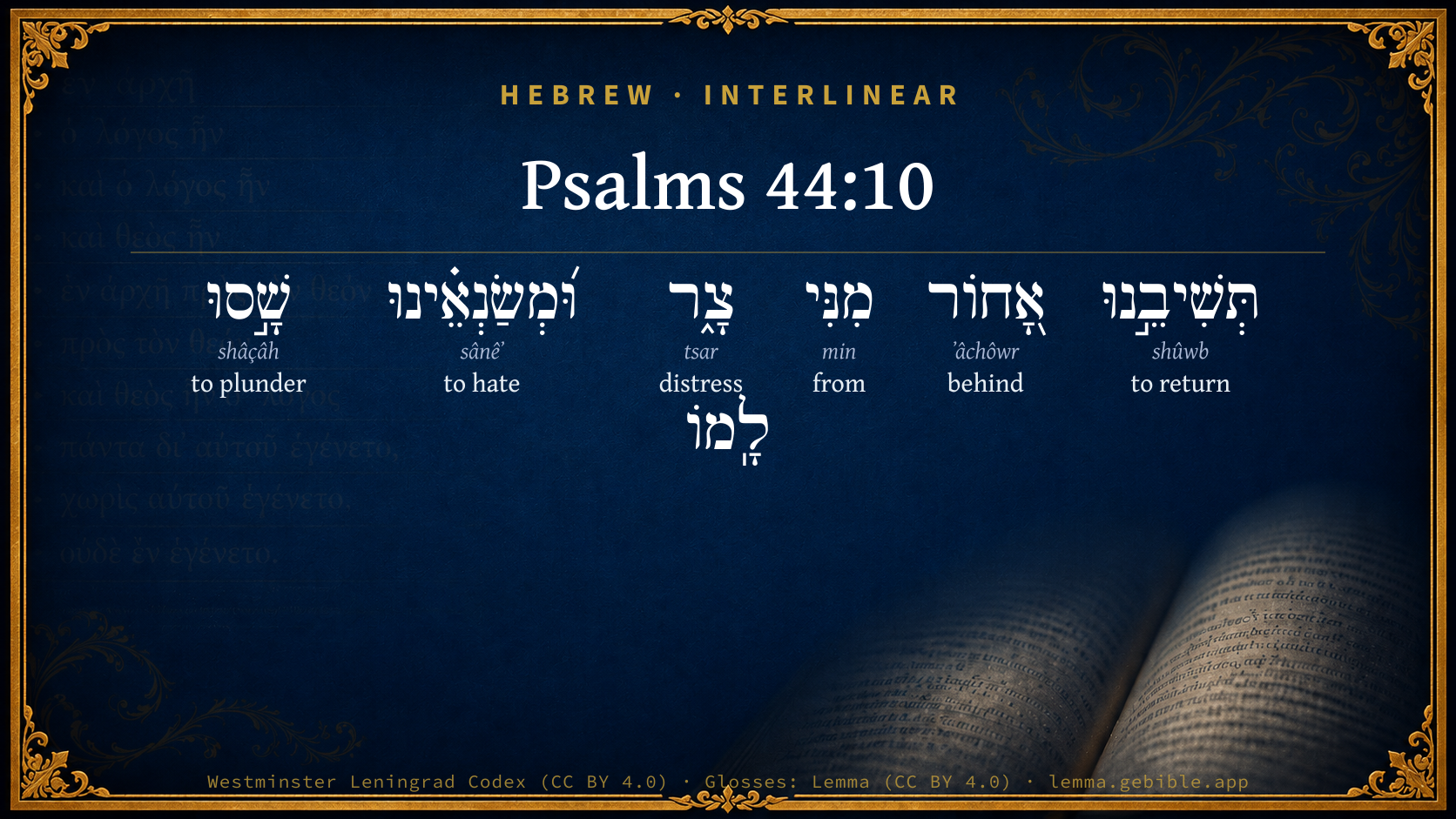
Hebrew (Westminster Leningrad Codex) Psalms 44:10 appears in the Hebrew Old Testament. The text above is from the Westminster Leningrad Codex. Each word links to its Strong’s number, a concise gloss, and parsing drawn from the Open Scriptures Hebrew Bible morphology. Click any word for its full Brown-Driver-Briggs (BDB) entry.
Download image
Cite this verse

Psalms 44:10 (World English Bible). Public Domain. Lemma interlinear Bible study tool, https://lemma.gebible.app/v/psalms/44/10.

Show BibTeX & RIS
BibTeX
RIS
English Translation
You make us turn back from the adversary. Those who hate us take spoil for themselves.
World English Bible · Public Domain
Download a study sheet

One document with this verse’s original text, its word-by-word gloss line, the meaning frame, cross-references with their text, attributed commentary, and full source and license credits — printable, and it pastes into notes with its structure intact.

This verse Autodidact and up

Study sheet (.html) Plain text (.txt)

A passage Seminary Student

Up to 50 verses in one chapter. A passage sheet keeps up to 6 commentary sources and 12 cross-references per verse, in the order this page ranks them, and says so on the sheet whenever that leaves anything out. Ask for a single verse and you get the Autodidact verse sheet above.

Everything on this page stays free to read, with no account — the sheet is a download of what is already on screen, not access to it.

Want to remove ads? Support Godless Engineer
Compare translations 3

The same verse in 3 English versions, stacked beneath the original-language interlinear above. Click any original word for its lexicon entry.

Each is an independent rendering of the whole verse — the interlinear is not word-aligned to these translations.

Highlighted words mark where these versions differ — a whole-verse word diff, not a word-by-word alignment.

  • World English Bible Public Domain
    You make us turn back from the adversary. Those who hate us take spoil for themselves.
  • King James Version Public Domain
    Thou makest us to turn back from the enemy: and they which hate us spoil for themselves.
  • unfoldingWord Literal Text CC BY-SA 4.0
    You make us turn back from the enemy, and the ones hating us plunder for themselves.

unfoldingWord Literal Text — © unfoldingWord, licensed CC BY-SA 4.0. Word-aligned USFM3 via Door43 (git.door43.org/unfoldingWord/en_ult).

Versions to compare (up to 4)

3 of 4 selected

Show all 18 translations

Every available English version of this verse, each an independent rendering of the whole verse.

  • World English Bible Public Domain
    You make us turn back from the adversary. Those who hate us take spoil for themselves.
  • Berean Standard Bible Public Domain
    You have made us retreat from the foe, and those who hate us have plundered us.
  • Majority Standard Bible Public Domain
    You have made us retreat from the foe, and those who hate us have plundered us.
  • King James Version Public Domain
    Thou makest us to turn back from the enemy: and they which hate us spoil for themselves.
  • American Standard Version (1901) Public Domain
    Thou makest us to turn back from the adversary; And they that hate us take spoil for themselves.
  • Revised Version (1885) Public Domain
    Thou makest us to turn back from the adversary: and they which hate us spoil for themselves.
  • Geneva Bible (1599) Public Domain
    Thou makest vs to turne backe from the aduersary, and they, which hate vs, spoile for theselues.
  • Douay-Rheims (1899) Public Domain
    But now thou hast cast us off, and put us to shame: and thou, O God, wilt not go out with our armies.
  • Young's Literal Translation Public Domain
    Thou causest us to turn backward from an adversary, And those hating us, Have spoiled for themselves.
  • Literal Standard Version CC BY-SA 4.0
    You cause us to turn backward from an adversary, || And those hating us, || Have spoiled for themselves.
  • Unlocked Literal Bible CC BY-SA 4.0
    You make us turn back from the adversary; and those who hate us take spoil for themselves.
  • unfoldingWord Literal Text CC BY-SA 4.0
    You make us turn back from the enemy, and the ones hating us plunder for themselves.
  • Darby Bible Public Domain
    Thou hast made us to turn back from the adversary, and they that hate us spoil for themselves;
  • World Messianic Bible Public Domain
    You make us turn back from the adversary. Those who hate us take plunder for themselves.
  • Webster's Bible Public Domain
    \\44:9\\But thou hast cast off, and put us to shame; and goest not forth with our armies.
  • Free Bible Version CC BY-SA 4.0
    You made us run from our enemies, and those who hate us have taken whatever they wanted.
  • Bible in Basic English Public Domain
    Because of this we are turned back by the attacker: those who have hate for us take our goods for themselves.
  • JPS Tanakh (1917) Public Domain
    (44-11) Thou makest us to turn back from the adversary; and they that hate us spoil at their will.

Literal Standard Version (2020), Covenant Press — licensed CC BY-SA 4.0. Text via the HelloAO Bible API (eBible.org). Unlocked Literal Bible (unfoldingWord) — licensed CC BY-SA 4.0. Text via the HelloAO Bible API (eBible.org). unfoldingWord Literal Text — © unfoldingWord, licensed CC BY-SA 4.0. Word-aligned USFM3 via Door43 (git.door43.org/unfoldingWord/en_ult). Free Bible Version, Dr. Jonathan Gallagher — licensed CC BY-SA 4.0. Text via the HelloAO Bible API (eBible.org).

Word by word

More ways to search: Search by grammar → Find every occurrence → Compare this word →

Practice this passage: Drill this verse → Learn its vocabulary →

About this verse

These counts appear in no published source. They are computed here, from the morphology-tagged text and Lemma’s own curated glosses. What Lemma adds →

7
words
6
distinct lemmas
Wisdom
section

Notable vocabulary

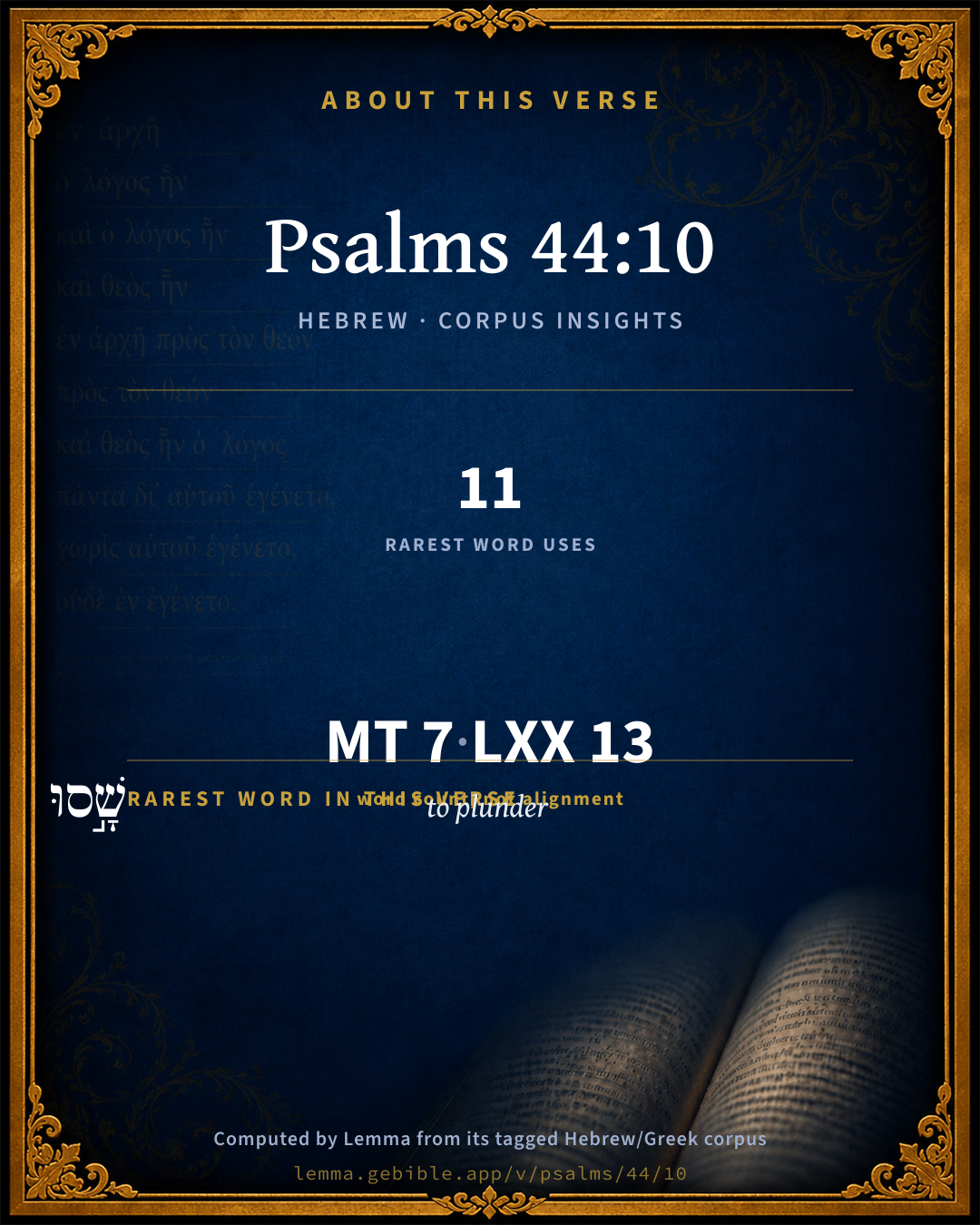
The rarest word here is שָׁ֣סוּ to plunder H8154 — appearing just 11 times in the whole Hebrew Bible.

Shared distinctive vocabulary

שָׁ֣סוּ to plunder H8154 occurs in 11 verses of the Hebrew Bible. Also found in:

Grammatical profile

  • 3 verbs
  • 2 nouns
  • 2 prepositions

Verb forms

  • תְּשִׁיבֵ֣נוּ Hiphil · Imperfect
  • וּ֝מְשַׂנְאֵ֗ינוּ Piel · Participle Active
  • שָׁ֣סוּ Qal · Perfect

Hebrew & Septuagint length

In English translation the verse runs 16 words from the Hebrew and 16 from the Septuagint (LXX English) — the same length.

A rough comparison of the two English renderings, which tokenize alike — not a word-level alignment.

Word counts can differ between the Hebrew and the Greek without any difference in meaning — e.g. the Hebrew direct-object marker אֵת has no separate Greek word, and Greek often adds the article ὁ.

In the original languages it is 7 Hebrew tokens and 13 Greek tokens — but the two are counted differently (Hebrew bundles its prefixes and suffixes into one token; the Greek is in lemma form), so that isn’t a like-for-like length.

Cross-references

13

Topical passages linked to Psalms 44:10 in the Treasury of Scripture Knowledge — connected by theme and wording, ordered by reader-vote popularity; previews shown in the World English Bible.

  • Leviticus 26:17 I will set my face against you, and you will be struck before your enemies. Those who hate you will rule over you; and you will flee when no one pursues you.
  • Joshua 7:8 Oh, Lord, what shall I say, after that Israel has turned their backs before their enemies!
  • Joshua 7:12 Therefore the children of Israel can't stand before their enemies; they turn their backs before their enemies, because they are become accursed: I will not be with you any more, except you destroy the devoted thing from among you.
  • Psalms 89:41 All who pass by the way rob him. He has become a reproach to his neighbors.
  • Deuteronomy 28:25 Yahweh will cause you to be struck before your enemies; you shall go out one way against them, and shall flee seven ways before them: and you shall be tossed back and forth among all the kingdoms of the earth.
  • Isaiah 10:6 I will send him against a profane nation, and against the people of my wrath will I give him a charge, to take the spoil, and to take the prey, and to tread them down like the mire of the streets.
  • Leviticus 26:14 "'But if you will not listen to me, and will not do all these commandments;
  • Leviticus 26:36–37 "'As for those of you who are left, I will send a faintness into their hearts in the lands of their enemies: and the sound of a driven leaf will put them to flight; and they shall flee, as one flees from the sword; and they will fall when no one pursues.
  • 1 Samuel 4:17 He who brought the news answered, Israel is fled before the Philistines, and there has been also a great slaughter among the people, and your two sons also, Hophni and Phinehas, are dead, and the ark of God is taken.
  • 1 Samuel 31:1–7 Now the Philistines fought against Israel: and the men of Israel fled from before the Philistines, and fell down slain on Mount Gilboa.
  • Isaiah 10:14 and my hand has found as a nest the riches of the peoples; and as one gathers eggs that are forsaken, have I gathered all the earth: and there was none that moved the wing, or that opened the mouth, or chirped.
  • Jeremiah 15:13 Your substance and your treasures will I give for a spoil without price, and that for all your sins, even in all your borders.
  • Jeremiah 20:8 For as often as I speak, I cry out; I cry, Violence and destruction! because the word of Yahweh is made a reproach to me, and a derision, all the day.

Cross-references courtesy of OpenBible.info (CC BY 4.0).

Hebrew and Greek witnesses Masoretic Hebrew ↔ Greek Septuagint

The same verse in the two great witnesses to the Old Testament, shown verse-for-verse.

You’re reading Greek Psalm 43 (Hebrew Psalm 44). The Septuagint counts the superscription, so verse numbers can differ from the Hebrew — chapter-level alignment, not verse-by-verse. Numbering follows Rahlfs.

These are two independent witnesses, not word-aligned to each other, and the Septuagint is shown in lemma (dictionary) form.

Hebrew Psalms 44:10 Masoretic · Westminster Leningrad Codex

תְּשִׁיבֵ֣נוּ אָ֭חוֹר מִנִּי צָ֑ר וּ֝מְשַׂנְאֵ֗ינוּ שָׁ֣סוּ לָֽמוֹ

You make us turn back from the adversary. Those who hate us take spoil for themselves.

World English Bible · Public Domain

Greek LXX Greek Psalm 43:10 Septuagint · lemma form

νυνί δέ ἀποὠθέω καί κατααἰσχύνω ἐγώ καί οὐ ἐκἔρχομαι ἐν ὁ δύναμις ἐγώ

You have turned us back before our enemies; and they that hated us spoiled for themselves.

LXX2012 (modern English Septuagint) · Public Domain

Hebrew: Westminster Leningrad Codex (CC BY 4.0). Greek: Septuagint (public domain); English from LXX2012 (modern English Septuagint) (Public Domain). How the Septuagint differs from the Hebrew →

Commentary

Notes on Psalms 44:10 from classic Christian and Jewish commentators (each source and its license shown beneath its notes). The classic Christian expositions comment on the surrounding passage and are grouped to its opening verse, so a note may address several verses; the Jewish commentaries on the Tanakh (Rashi and others) are per-verse, so they appear only where the commentator wrote on this verse.

Lemma curates 59 commentaries, every one of them public domain or Creative Commons licensed, each selected and text-cleaned for this edition rather than reprinted as found. About our sources →

Trapp's Complete Commentary

John Trapp

Psa 44:10 Thou makest us to turn back from the enemy: and they which hate us spoil for themselves.

Ver. 10. Thou makest us to turn back from the enemy] By expectorating our faith and courage, and leaving us to a fearful faint heartedness, that flieth at the sound of a shaken leaf. God strengtheneth or weakeneth the arm of either army, Eze 30:24.

John Trapp, A Commentary or Exposition upon All the Books of the Old and New Testament (1647–1656) — public domain. Text from a community e-Sword module.

J. A. Alexander on Psalms

Joseph Addison Alexander

11. (Psa 44:10). Thou wilt make us turn back from the adversary, and (already) those hating us have plundered for them, i.e. for themselves. Two of the most unwelcome incidents of warfare are here specified, flight and spoliation. Spoiled for themselves, not merely for their own advantage, but at their own will and discretion. Compare 1Sa 14:48; 1Sa 23:1.

Joseph Addison Alexander, The Psalms Translated and Explained (1850) — public domain. Text from a community e-Sword module.

Geneva Bible (1599)

Geneva Bible translators

Or, at their pleasure.

Geneva Bible (1599) marginal notes — public domain. Text via Bolls.life.

Adam Clarke's Commentary

Verse 10. Thou makest us to turn back] This thou didst: and our enemies, profiting by the occasion, finding our strength was departed from us, made us an easy prey, captivated our persons, and spoiled us of our property.

Adam Clarke's Commentary on the Bible (1810–1826) — public domain. Text from a community e-Sword/MySword module.

John Calvin's Commentaries

10. Thou hast made us to turn back from the enemy. Here the people of God still further complain, that he had made them to flee before their enemies, and had given them up as a prey to be devoured by them. As the saints firmly believe that men are strong and valiant only in so far as God upholds them by his secret power, they also conclude, that when men flee, and are seized with trembling, it is God who strikes them with terror, so that the poor wretched creatures are deprived of reason, and both their skill and courage fail them. The expression here used is taken from the Law, Deuteronomy 32:30, where Moses says,

“How should one chase a thousand, and two put ten thousand to flight, except their Rock had sold them, and the Lord had shut them up?”

The faithful, fully persuaded of this truth, do not ascribe to fortune the change which had passed over them, that those who were wont vigorously and fearlessly to assail their enemies, were now terrified by their very appearance; but they feel assured that it was by the appointment of heaven that they were thus discomfited, and made to flee before their enemies. And as they formerly confessed that the strength which they had hitherto possessed was the gift of God, so, on the other hand, they also acknowledge that the fear by which they are now actuated was inflicted upon them as a punishment by God. And when God thus deprived them of courage, they say that they are exposed to the will of their enemies; for in this sense I interpret the word למו, lamo, which I have rendered, for themselves, namely, that their enemies destroyed them at their pleasure and without any resistance, as their prey.

John Calvin's Commentaries (1540-1563) — public domain. Text from the Calvin Translation Society English edition (1840s-50s) via the Christian Classics Ethereal Library (ccel.org). Calvin's coverage is partial (roughly two-thirds of the Bible); uncommented books and verses are honest gaps, never fabricated. The 19th-century editor's footnotes and remarks are omitted so the notes are faithfully Calvin's own voice.

Ellicott's Commentary for English Readers

(10) For themselves—i.e., at their own will, an expression denoting the completeness of the overthrow of the Jews; they lie absolutely at their enemies’ pleasure.

A Bible Commentary for English Readers, edited by Charles John Ellicott (1878–1897) — public domain. Text from a community e-Sword module.

The Cambridge Bible for Schools and Colleges

gen. ed. J. J. S. Perowne

10. the enemy] R.V., the adversary.

spoil for themselves] Or, plunder at their will.

The Cambridge Bible for Schools and Colleges (gen. ed. J. J. S. Perowne; Cambridge University Press, 1878–1918) — public domain. Text from a community e-Sword module.

John Gill's Exposition

Thou makest us to turn back from the enemy,.... In the times of Eli, according to Arama; but may he understood of some of the visible members of the church, and professors of religion, not being valiant for the truth, and deserting the cause of God and Christ, by reason of tribulation and persecution arising because of the word;

and they which hate us spoil for themselves; by seizing on the goods and substance of those they persecuted; enriching themselves by confiscating their estates and possessions to their own use; or by spoiling others of them, they deceived with their corrupt doctrines and soul destroying principles, whereby they became slaves to the antichristian party; this may respect the same wars as before.

John Gill's Exposition of the Whole Bible (1746–1763) — public domain (CC PDM 1.0). Text via the HelloAO Bible API.

Albert Barnes' Notes on the Bible

Thou makest us to turn back from the enemy - Instead of giving us the victory. That is, we are defeated.

And they which hate us spoil for themselves - They plunder us; they take our property as spoil, and carry it away. That this was done at the time referred to in the introduction as the time of the composition of the psalm, is apparent from the narrative in the Book of Chronicles. 2Ch 36:7, “Nebuchadnezzar also carried of the vessels of the house of the Lord to Babylon, and put them in his temple at Babylon.” Compare 2Ki 23:33; 2Ki 24:13-16; 2Ki 25:13-17.

Albert Barnes' Notes on the Bible (1834–1885) — public domain. Text from a community e-Sword/MySword module.

Matthew Poole's English Annotations

Thou makest us to turn back from the enemy, by withdrawing thy help and our courage, according to thy threatenings, Lev 26:36.

Spoil for themselves, i.e. take away our estates to their own use, and for their only benefit, not in compliance with thy will, which was to punish us for our sins, nor for thy service and glory. They minded nothing but their own advantage.

Matthew Poole's English Annotations on the Holy Bible (1683–1685) — public domain. Text from a community e-Sword/MySword module.

The Treasury of David

Charles H. Spurgeon

Ver. 10. Thou makest us to turn back from the enemy. The humiliating consciousness that the Lord has left them soon makes men cowards. Flight closes the fight of those who have not the Lord in the van. And they which hate us spoil for themselves. After defeat and retreat, comes spoliation. The poor, vanquished nation paid a terrible penalty for being overcome; plunder and murder desolated the conquered land, and the invaders loaded themselves with every precious thing which they could carry away. In spiritual experience we know what it is to be despoiled by our enemies; doubts and fears rob us of our comforts, and terrible forebodings spoil us of our hopes; and all because the Lord, for wise purposes, sees fit to leave us to ourselves. Alas! for the deserted soul; no calamity can equal the sorrow of being left of God, though it be but for a small moment.

None.

None.

Psalms 44:11*

Charles H. Spurgeon's The Treasury of David (1869–1885) — public domain. Psalms only. Text from a community e-Sword/MySword module.

The Pulpit Commentary

Thou makest us to turn back from the enemy. Thou bringest it to pass that we turn our backs in shameful flight from the enemy, either making a feeble resistance or none at all. And they which hate us spoil for themselves. Spoil us of our arms and ornaments, which they seize and appropriate.

The Pulpit Commentary (1880–1919), ed. H.D.M. Spence-Jones & Joseph S. Exell — public domain. Text from a community e-Sword module.

Rashi

Rabbi Shlomo Yitzchaki (Rashi)

Even if You have forsaken us and put us to shame Even if You put us to shame, we will forever thank Your name.

Rashi on the Tanakh — English translations: “The Judaica Press complete Tanach with Rashi, translated by A. J. Rosenberg” (CC BY 4.0); “Pentateuch with Rashi's commentary by M. Rosenbaum and A.M. Silbermann, 1929-1934” (public domain); “The Metsudah Tanach series, Lakewood, N.J” (CC BY 4.0); and “The Book of Joshua, Metsudah Publications, 1997” (CC BY 4.0). Text via Sefaria.

Lesson kit

Teaching starters — assembled from the data on this page, not authored interpretation. Every prompt links to the verse data it draws on. Edit before teaching.

Psalms, in the Wisdom, opens this verse with 7 words (6 distinct Hebrew lemmas). Its most distinctive word is shâçâh (“to plunder”). A historical commentator’s framing appears above. Read the whole chapter for the surrounding context.

Discussion questions

  1. What does “to plunder” (shâçâh) contribute to the verse as a whole?
  2. How does Judges 2:14, which shares the word «to plunder», read alongside this verse?
  3. These translations render this verse differently; the difference is in the English rendering, not the original. What questions does that raise?
  4. «תְּשִׁיבֵ֣נוּ» is a Hiphil Imperfect verb. How does that grammatical form shape the action described?
  5. Compare how Trapp's Complete Commentary and J. A. Alexander on Psalms read this verse. Where do they agree or differ?

Things to notice

Reading settings

Reading text

Shown beneath each verse's original-language words.

Old Testament
Old Testament edition

Read the OT as the Masoretic Hebrew (MT) or the Greek Septuagint (LXX).

English shown for the Greek Septuagint (in the Hebrew ↔ Greek comparison).

Comparing translations? Open the Compare panel on any verse page to stack up to four side by side.