
Zechariah 10:2

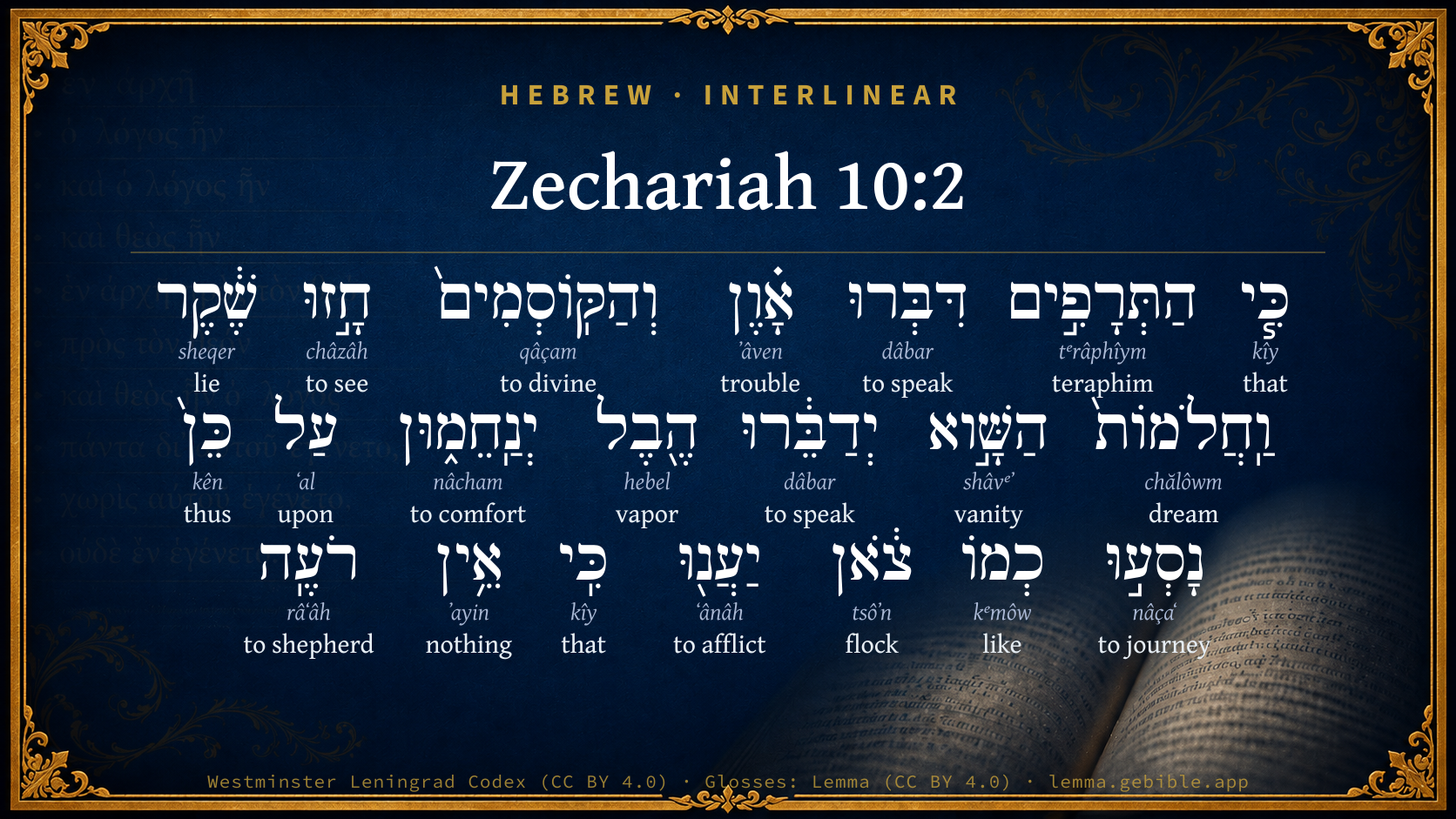
Hebrew (Westminster Leningrad Codex) Zechariah 10:2 appears in the Hebrew Old Testament. The text above is from the Westminster Leningrad Codex. Each word links to its Strong’s number, a concise gloss, and parsing drawn from the Open Scriptures Hebrew Bible morphology. Click any word for its full Brown-Driver-Briggs (BDB) entry.
Download image
Cite this verse

Zechariah 10:2 (World English Bible). Public Domain. Lemma interlinear Bible study tool, https://lemma.gebible.app/v/zechariah/10/2.

Show BibTeX & RIS
BibTeX
RIS
English Translation
For the teraphim have spoken vanity, and the diviners have seen a lie; And they have told false dreams. They comfort in vain. Therefore they go their way like sheep. They are oppressed, because there is no shepherd.
World English Bible · Public Domain
Download a study sheet

One document with this verse’s original text, its word-by-word gloss line, the meaning frame, cross-references with their text, attributed commentary, and full source and license credits — printable, and it pastes into notes with its structure intact.

This verse Autodidact and up

Study sheet (.html) Plain text (.txt)

A passage Seminary Student

Up to 50 verses in one chapter. A passage sheet keeps up to 6 commentary sources and 12 cross-references per verse, in the order this page ranks them, and says so on the sheet whenever that leaves anything out. Ask for a single verse and you get the Autodidact verse sheet above.

Everything on this page stays free to read, with no account — the sheet is a download of what is already on screen, not access to it.

Want to remove ads? Support Godless Engineer
Compare translations 3

The same verse in 3 English versions, stacked beneath the original-language interlinear above. Click any original word for its lexicon entry.

Each is an independent rendering of the whole verse — the interlinear is not word-aligned to these translations.

Highlighted words mark where these versions differ — a whole-verse word diff, not a word-by-word alignment.

  • World English Bible Public Domain
    For the teraphim have spoken vanity, and the diviners have seen a lie; And they have told false dreams. They comfort in vain. Therefore they go their way like sheep. They are oppressed, because there is no shepherd.
  • King James Version Public Domain
    For the idols have spoken vanity, and the diviners have seen a lie, and have told false dreams; they comfort in vain: therefore they went their way as a flock, they were troubled, because there was no shepherd.
  • unfoldingWord Literal Text CC BY-SA 4.0
    For household idols speak falsely; the diviners envision a lie; they tell deceitful dreams and give empty comfort, so wander like sheep and suffer because no shepherd.

unfoldingWord Literal Text — © unfoldingWord, licensed CC BY-SA 4.0. Word-aligned USFM3 via Door43 (git.door43.org/unfoldingWord/en_ult).

Versions to compare (up to 4)

3 of 4 selected

Show all 18 translations

Every available English version of this verse, each an independent rendering of the whole verse.

  • World English Bible Public Domain
    For the teraphim have spoken vanity, and the diviners have seen a lie; And they have told false dreams. They comfort in vain. Therefore they go their way like sheep. They are oppressed, because there is no shepherd.
  • Berean Standard Bible Public Domain
    For idols speak deceit and diviners see illusions; they tell false dreams and offer empty comfort. Therefore the people wander like sheep, oppressed for lack of a shepherd.
  • Majority Standard Bible Public Domain
    For idols speak deceit and diviners see illusions; they tell false dreams and offer empty comfort. Therefore the people wander like sheep, oppressed for lack of a shepherd.
  • King James Version Public Domain
    For the idols have spoken vanity, and the diviners have seen a lie, and have told false dreams; they comfort in vain: therefore they went their way as a flock, they were troubled, because there was no shepherd.
  • American Standard Version (1901) Public Domain
    For the teraphim have spoken vanity, and the diviners have seen a lie; and they have told false dreams, they comfort in vain: therefore they go their way like sheep, they are afflicted, because there is no shepherd.
  • Revised Version (1885) Public Domain
    For the teraphim have spoken vanity, and the diviners have seen a lie; and they have told false dreams, they comfort in vain: therefore they go their way like sheep, they are afflicted, because there is no shepherd.
  • Geneva Bible (1599) Public Domain
    Surely the idols haue spoken vanitie, and the southsayers haue seene a lye, and the dreamers haue tolde a vaine thing: they comfort in vaine: therefore they went away as sheepe: they were troubled, because there was no shepheard.
  • Douay-Rheims (1899) Public Domain
    For the idols have spoken what was unprofitable, and the diviners have seen a lie, and the dreamers have spoken vanity: they comforted in vain: therefore they were led away as a dock: they shall be afflicted, because they have no shepherd.
  • Young's Literal Translation Public Domain
    Because the teraphim did speak iniquity, And the diviners have seen a falsehood, And dreams of the vanity they speak, `With' vanity they give comfort, Therefore they have journeyed as a flock, They are afflicted, for there is no shepherd.
  • Literal Standard Version CC BY-SA 4.0
    Because the teraphim spoke iniquity, || And the diviners have seen a falsehood, || And dreams of the vanity they speak, || [With] vanity they give comfort, || Therefore they have journeyed as a flock, || They are afflicted, for there is no shepherd.
  • Unlocked Literal Bible CC BY-SA 4.0
    For household idols speak falsely; the diviners envision a lie; they tell deceitful dreams and give empty comfort, so they wander like sheep and suffer because there is no shepherd.
  • unfoldingWord Literal Text CC BY-SA 4.0
    For household idols speak falsely; the diviners envision a lie; they tell deceitful dreams and give empty comfort, so wander like sheep and suffer because no shepherd.
  • Darby Bible Public Domain
    For the teraphim have spoken vanity, and the diviners have seen a lie, and have told false dreams: they comfort in vain. Therefore they have gone away as a flock, they are in distress, because there is no shepherd.
  • World Messianic Bible Public Domain
    For the teraphim have spoken vanity, and the diviners have seen a lie; and they have told false dreams. They comfort in vain. Therefore they go their way like sheep. They are oppressed, because there is no shepherd.
  • Webster's Bible Public Domain
    For the idols have spoken vanity, and the diviners have seen a lie, and have told false dreams; they comfort in vain: therefore they went their way as a flock, they were troubled because there was no shepherd.
  • Free Bible Version CC BY-SA 4.0
    Household idols give worthless answers, fortune-tellers tell lies, while interpreters of dreams just make things up and offer only false hope. As a result, people wander aimlessly like sheep, suffering because there is no shepherd.
  • Bible in Basic English Public Domain
    For the images have said what is not true, and the readers of signs have seen deceit; they have given accounts of false dreams, they give comfort to no purpose: so they go out of the way like sheep, they are troubled because they have no keeper.
  • JPS Tanakh (1917) Public Domain
    For the teraphim have spoken vanity, and the diviners have seen a lie, and the dreams speak falsely, they comfort in vain; therefore they go their way like sheep, they are afflicted, because there is no shepherd.

Literal Standard Version (2020), Covenant Press — licensed CC BY-SA 4.0. Text via the HelloAO Bible API (eBible.org). Unlocked Literal Bible (unfoldingWord) — licensed CC BY-SA 4.0. Text via the HelloAO Bible API (eBible.org). unfoldingWord Literal Text — © unfoldingWord, licensed CC BY-SA 4.0. Word-aligned USFM3 via Door43 (git.door43.org/unfoldingWord/en_ult). Free Bible Version, Dr. Jonathan Gallagher — licensed CC BY-SA 4.0. Text via the HelloAO Bible API (eBible.org).

Word by word

More ways to search: Search by grammar → Find every occurrence → Compare this word →

Practice this passage: Drill this verse → Learn its vocabulary →

הַתְּרָפִ֣ים
tᵉrâphîym
H8655
“the · teraphim”
Particle, Definite Article + Noun, Common, Masculine, Plural, Absolute
Part of Speech
Particle + Noun
Type
Common
Gender
Masculine
Number
Plural
State
Absolute
Full BDB Definition

Origin: pl. from H7495

TWOT: 2545

idolatry, idols, image(s), teraphim, family idol - a kind of idol used in household shrine or worship
  1. כִּ֧י kîy H3588 “that” Conjunction
  2. דִּבְּרוּ dâbar H1696 “to speak” Verb, Piel, Perfect, 3rd Person, Common, Plural
  3. אָ֗וֶן ʼâven H205 “trouble” Noun, Common, Masculine, Singular, Absolute
  4. וְהַקּֽוֹסְמִים֙ qâçam H7080 “and · the · divining” Conjunction + Particle, Definite Article + Verb, Qal, Participle Active, Masculine, Plural, Absolute
  5. חָ֣זוּ châzâh H2372 “to see” Verb, Qal, Perfect, 3rd Person, Common, Plural
  6. שֶׁ֔קֶר sheqer H8267 “lie” Noun, Common, Masculine, Singular, Absolute
  7. וַֽחֲלֹמוֹת֙ chălôwm H2472 “and · dreams of” Conjunction + Noun, Common, Masculine, Plural, Construct
  8. הַשָּׁ֣וא shâvᵉʼ H7723 “the · vanity” Particle, Definite Article + Noun, Common, Masculine, Singular, Absolute
  9. יְדַבֵּ֔רוּ dâbar H1696 “to speak” Verb, Piel, Imperfect, 3rd Person, Masculine, Plural
  10. הֶ֖בֶל hebel H1892 “vapor” Noun, Common, Masculine, Singular, Absolute
  11. יְנַֽחֵמ֑וּן nâcham H5162 “to comfort” Verb, Piel, Imperfect, 3rd Person, Masculine, Plural + Suffix, n
  12. עַל ʻal H5921 “upon” Preposition
  13. כֵּן֙ kên H3651 “thus” Particle, Demonstrative
  14. נָסְע֣וּ nâçaʻ H5265 “to journey” Verb, Qal, Perfect, 3rd Person, Common, Plural
  15. כְמוֹ kᵉmôw H3644 “like” Preposition
  16. צֹ֔אן tsôʼn H6629 “flock” Noun, Common, Both, Singular, Absolute
  17. יַעֲנ֖וּ ʻânâh H6031 “to afflict” Verb, Qal, Imperfect, 3rd Person, Masculine, Plural
  18. כִּֽי kîy H3588 “that” Conjunction
  19. אֵ֥ין ʼayin H369 “nothing” Particle, Negative
  20. רֹעֶֽה râʻâh H7462 “shepherding” Verb, Qal, Participle Active, Masculine, Singular, Absolute

About this verse

These counts appear in no published source. They are computed here, from the morphology-tagged text and Lemma’s own curated glosses. What Lemma adds →

21
words
19
distinct lemmas
Prophets
section

Notable vocabulary

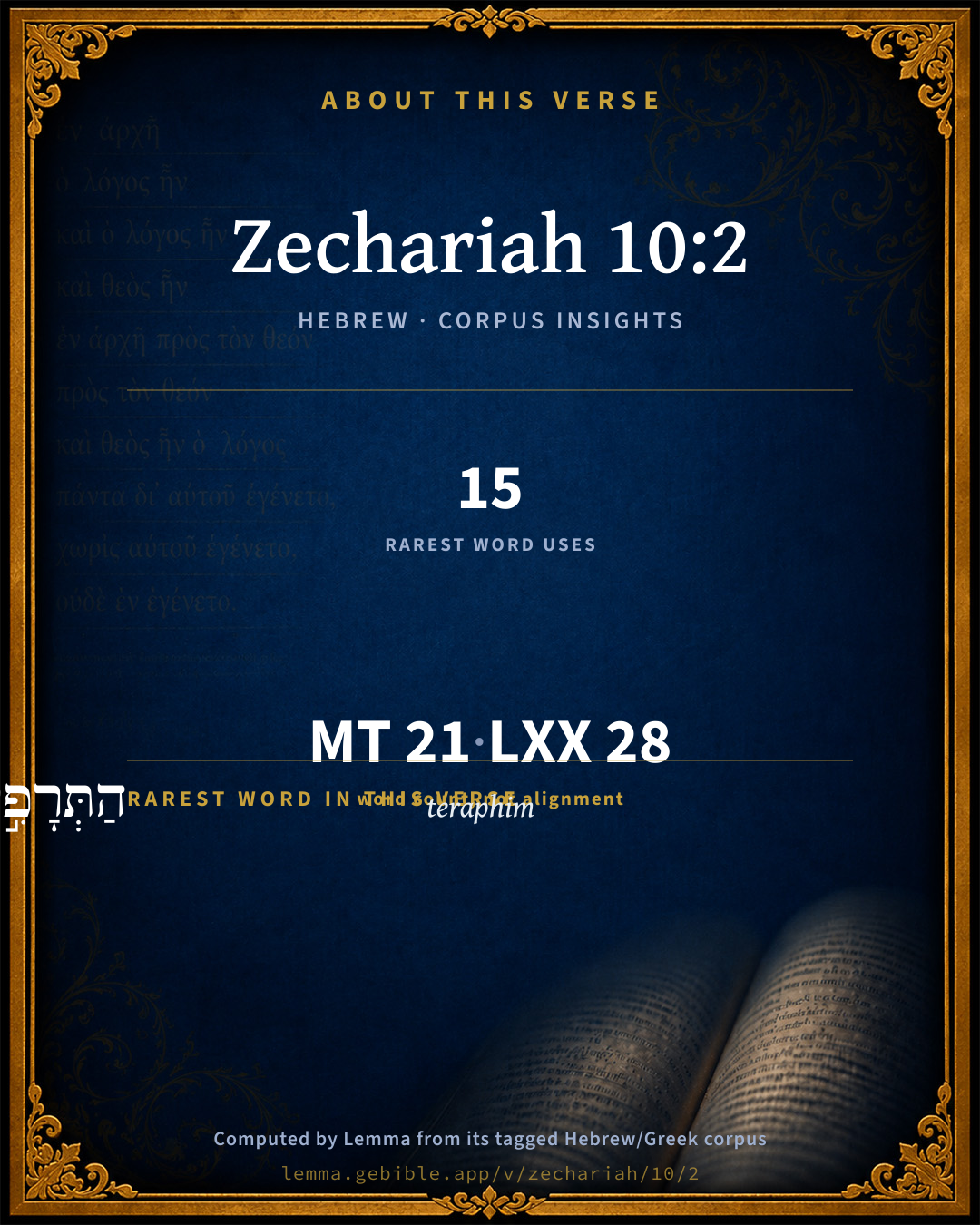
The rarest word here is הַתְּרָפִ֣ים teraphim H8655 — appearing just 15 times in the whole Hebrew Bible.

Shared distinctive vocabulary

הַתְּרָפִ֣ים teraphim H8655 occurs in 15 verses of the Hebrew Bible. Also found in:

Grammatical profile

  • 8 verbs
  • 7 nouns
  • 2 prepositions
  • 2 conjunctions
  • 2 particles

Verb forms

  • דִּבְּרוּ Piel · Perfect
  • וְהַקּֽוֹסְמִים֙ Qal · Participle Active
  • חָ֣זוּ Qal · Perfect
  • יְדַבֵּ֔רוּ Piel · Imperfect
  • יְנַֽחֵמ֑וּן Piel · Imperfect
  • נָסְע֣וּ Qal · Perfect
  • יַעֲנ֖וּ Qal · Imperfect
  • רֹעֶֽה Qal · Participle Active

Repetition

Words recur within this verse — often emphatic in Hebrew:

  • דִּבְּרוּ to speak H1696 ×2
  • כִּ֧י that H3588 ×2

Hebrew & Septuagint length

In English translation the verse runs 38 words from the Hebrew and 40 from the Septuagint (LXX English) — closely comparable.

A rough comparison of the two English renderings, which tokenize alike — not a word-level alignment.

Word counts can differ between the Hebrew and the Greek without any difference in meaning — e.g. the Hebrew direct-object marker אֵת has no separate Greek word, and Greek often adds the article ὁ.

In the original languages it is 21 Hebrew tokens and 28 Greek tokens — but the two are counted differently (Hebrew bundles its prefixes and suffixes into one token; the Greek is in lemma form), so that isn’t a like-for-like length.

Cross-references

36

Topical passages linked to Zechariah 10:2 in the Treasury of Scripture Knowledge — connected by theme and wording, ordered by reader-vote popularity; previews shown in the World English Bible.

  • Matthew 9:36 But when he saw the multitudes, he was moved with compassion for them, because they were harassed and scattered, like sheep without a shepherd.
  • Jeremiah 27:9 But as for you, don't you listen to your prophets, nor to your diviners, nor to your dreams, nor to your soothsayers, nor to your sorcerers, who speak to you, saying, You shall not serve the king of Babylon:
  • Genesis 31:19 Now Laban had gone to shear his sheep: and Rachel stole the teraphim that were her father's.
  • Ezekiel 34:5 They were scattered, because there was no shepherd; and they became food to all the animals of the field, and were scattered.
  • Ezekiel 34:8 As I live, says the Lord Yahweh, surely because my sheep became a prey, and my sheep became food to all the animals of the field, because there was no shepherd, neither did my shepherds search for my sheep, but the shepherds fed themselves, and didn't feed my sheep;
  • Hosea 3:4 For the children of Israel shall abide many days without king, and without prince, and without sacrifice, and without sacred stone, and without ephod or idols.
  • Habakkuk 2:18 "What value does the engraved image have, that its maker has engraved it; the molten image, even the teacher of lies, that he who fashions its form trusts in it, to make mute idols?
  • Numbers 27:17 who may go out before them, and who may come in before them, and who may lead them out, and who may bring them in; that the congregation of Yahweh not be as sheep which have no shepherd.
  • Judges 18:14 Then the five men who went to spy out the country of Laish answered, and said to their brothers, Do you know that there is in these houses an ephod, and teraphim, and an engraved image, and a molten image? now therefore consider what you have to do.
  • 1 Kings 22:17 He said, I saw all Israel scattered on the mountains, as sheep that have no shepherd: and Yahweh said, These have no master; let them return every man to his house in peace.
  • Job 13:4 But you are forgers of lies. You are all physicians of no value.
  • Job 21:34 So how can you comfort me with nonsense, Seeing that in your answers there remains only falsehood?"
  • Isaiah 44:9 Those who fashion an engraved image are all of them vanity; and the things that they delight in shall not profit; and their own witnesses don't see, nor know: that they may be disappointed.
  • Isaiah 46:5 To whom will you liken me, and make me equal, and compare me, that we may be like?
  • Jeremiah 6:14 They have healed also the hurt of my people slightly, saying, Peace, peace; when there is no peace.
  • Jeremiah 8:11 They have healed the hurt of the daughter of my people slightly, saying, Peace, peace; when there is no peace.
  • Jeremiah 10:8 But they are together brutish and foolish: the instruction of idols! it is but a stock.
  • Jeremiah 13:17–20 But if you will not hear it, my soul shall weep in secret for [your] pride; and my eye shall weep sore, and run down with tears, because Yahweh's flock is taken captive.
  • Jeremiah 14:13 Then said I, Ah, Lord Yahweh! behold, the prophets tell them, You shall not see the sword, neither shall you have famine; but I will give you assured peace in this place.
  • Jeremiah 14:22 Are there any among the vanities of the nations that can cause rain? or can the sky give showers? Aren't you he, Yahweh our God? therefore we will wait for you; for you have made all these things.
  • Jeremiah 23:17 They say continually to those who despise me, Yahweh has said, You shall have peace; and to everyone who walks in the stubbornness of his own heart they say, No evil shall come on you.
  • Jeremiah 23:25–27 I have heard what the prophets have said, who prophesy lies in my name, saying, I have dreamed, I have dreamed.
  • Jeremiah 28:4–6 and I will bring again to this place Jeconiah the son of Jehoiakim, king of Judah, with all the captives of Judah, who went to Babylon, says Yahweh; for I will break the yoke of the king of Babylon.
  • Jeremiah 28:15 Then said the prophet Jeremiah to Hananiah the prophet, Hear now, Hananiah: Yahweh has not sent you; but you make this people to trust in a lie.
  • Jeremiah 29:8 For thus says Yahweh of hosts, the God of Israel: Don't let your prophets who are in the midst of you, and your diviners, deceive you; neither listen you to your dreams which you cause to be dreamed.
  • Jeremiah 29:21–22 Thus says Yahweh of Hosts, the God of Israel, concerning Ahab the son of Kolaiah, and concerning Zedekiah the son of Maaseiah, who prophesy a lie to you in my name: Behold, I will deliver them into the hand of Nebuchadrezzar king of Babylon; and he shall kill them before your eyes;
  • Jeremiah 37:19 Where now are your prophets who prophesied to you, saying, The king of Babylon shall not come against you, nor against this land?
  • Jeremiah 50:17 Israel is a hunted sheep; the lions have driven him away: first, the king of Assyria devoured him; and now at last Nebuchadrezzar king of Babylon has broken his bones.
  • Jeremiah 51:23 and with you will I break in pieces the shepherd and his flock; and with you will I break in pieces the farmer and his yoke [of oxen]; and with you will I break in pieces governors and deputies.
  • Lamentations 2:14 Your prophets have seen for you false and foolish visions; They have not uncovered your iniquity, to bring back your captivity, But have seen for you false oracles and causes of banishment.
  • Ezekiel 13:6–16 They have seen falsehood and lying divination, who say, Yahweh says; but Yahweh has not sent them: and they have made men to hope that the word would be confirmed.
  • Ezekiel 13:22–23 Because with lies you have grieved the heart of the righteous, whom I have not made sad; and strengthened the hands of the wicked, that he should not return from his wicked way, and be saved alive:
  • Ezekiel 21:21 For the king of Babylon stood at the parting of the way, at the head of the two ways, to use divination: he shook the arrows back and forth, he consulted the teraphim, he looked in the liver.
  • Ezekiel 21:29 while they see for you false visions, while they divine lies to you, to lay you on the necks of the wicked who are deadly wounded, whose day is come in the time of the iniquity of the end.
  • Micah 2:12 I will surely assemble, Jacob, all of you; I will surely gather the remnant of Israel; I will put them together as the sheep of Bozrah, As a flock in the midst of their pasture; They will swarm with people.
  • Micah 3:6–11 "Therefore night is over you, with no vision, And it is dark to you, that you may not divine; And the sun will go down on the prophets, And the day will be black over them.

Cross-references courtesy of OpenBible.info (CC BY 4.0).

Hebrew and Greek witnesses Masoretic Hebrew ↔ Greek Septuagint

The same verse in the two great witnesses to the Old Testament, shown verse-for-verse.

These are two independent witnesses, not word-aligned to each other, and the Septuagint is shown in lemma (dictionary) form.

Hebrew Zechariah 10:2 Masoretic · Westminster Leningrad Codex

כִּ֧י הַתְּרָפִ֣ים דִּבְּרוּ אָ֗וֶן וְהַקּֽוֹסְמִים֙ חָ֣זוּ שֶׁ֔קֶר וַֽחֲלֹמוֹת֙ הַשָּׁ֣וא יְדַבֵּ֔רוּ הֶ֖בֶל יְנַֽחֵמ֑וּן עַל כֵּן֙ נָסְע֣וּ כְמוֹ צֹ֔אן יַעֲנ֖וּ כִּֽי אֵ֥ין רֹעֶֽה

For the teraphim have spoken vanity, and the diviners have seen a lie; And they have told false dreams. They comfort in vain. Therefore they go their way like sheep. They are oppressed, because there is no shepherd.

World English Bible · Public Domain

Greek LXX Zechariah 10:2 Septuagint · lemma form

διότι ὁ ἀποφθέγγομαι λαλέω κόπος καί ὁ μάντις ὅρασις ψευδής καί ὁ ἐνύπνιον ψευδής λαλέω μάταιος παρακαλέω διά οὗτος ἐκαἴρω ὡς πρόβατον καί ἐκκακόω διότι οὐ εἰμί ἴασις

For the speakers have uttered grievous things, and the diviners have seen false visions, and they have spoken false dreams, they have given vain comfort: therefore have they fallen away like sheep, and been afflicted, because there was no healing.

LXX2012 (modern English Septuagint) · Public Domain

On this verse, Ellicott's Commentary for English Readers discusses the Septuagint’s reading. Read the note in Commentary ↓

Hebrew: Westminster Leningrad Codex (CC BY 4.0). Greek: Septuagint (public domain); English from LXX2012 (modern English Septuagint) (Public Domain). How the Septuagint differs from the Hebrew →

Targum (Aramaic paraphrase)

1

The Targum is the ancient Jewish Aramaic paraphrase of the Hebrew Scriptures — an interpretive translation, not the Hebrew text itself. Onkelos (literal) and Pseudo-Jonathan (expansive) render the Torah, and Jonathan the Prophets. Coverage is partial: where no permissively-licensed English translation exists for a verse, only the Aramaic is shown. This is verse-level text, not a word-by-word alignment to the Hebrew.

  1. Targum Jonathan Prophets (Joshua–Malachi)
    אֲרֵי פָלְחֵי צַלְמַיָא מְמַלְלִין אוֹנָס וְקוֹסְמַיָא מִתְנַבָּן שְׁקַר וּנְבִיֵי שִׁקְרָא בִּנְבוּאַת שִׁקְרֵיהוֹן שִׁקְרָא מְמַלְלִין לָא מִדָעַם מְנַחֲמִין עַל כֵּן אִתְבַּדָרוּ כְּבַדוּר עָנָא גְלוֹ אֲרֵי לֵית מְלַךְ:

    (no public-domain English translation for this verse)

    Targum Jonathan — Aramaic: “Mikraot Gedolot” (public domain). English: “Sefaria Community Translation” (CC0 1.0 (public-domain dedication)); “London "Chaldee Paraphrase," 1871” (public domain). Text via Sefaria.

Commentary

Notes on Zechariah 10:2 from classic Christian and Jewish commentators (each source and its license shown beneath its notes). The classic Christian expositions comment on the surrounding passage and are grouped to its opening verse, so a note may address several verses; the Jewish commentaries on the Tanakh (Rashi and others) are per-verse, so they appear only where the commentator wrote on this verse.

Lemma curates 59 commentaries, every one of them public domain or Creative Commons licensed, each selected and text-cleaned for this edition rather than reprinted as found. About our sources →

Trapp's Complete Commentary

John Trapp

Zec 10:2 For the idols have spoken vanity, and the diviners have seen a lie, and have told false dreams; they comfort in vain: therefore they went their way as a flock, they were troubled, because [there was] no shepherd.

Ver. 2. For the idols have spoken vanity] q.d. Therefore ask good things at God’s hands, as rain, food, and all necessary provision; because idols and soothsayers cannot help you to these things. If they promise you (as they will), believe them not; for they lie as fast as once Rabshakeh did for his master, when he promised the people a land of corn and wine, a land of bread and vineyards, Isa 36:17. And they will finally serve you as Absalom’s mule served her master; whom she left at his greatest need, to hang between heaven and earth, as rejected of both. Lo such are all creaturecomforts, golden delusions, lying vanities, apples of Sodom, nec vera, nec vestra, neither true nor yours, the fashion of this world, saith Paul, 1Co 7:31; the fantasies of men’s brain, saith Luke, Act 25:23, the semblances and empty shows of good, without any reality or solid consistency, saith Solomon often. They are, saith our prophet here, a wicked deceit and fraudulence. An arrant lie, a false dream, a vain or empty comfort, that utterly deceiveth a man’s confidence, and maketh him, in the fulness of his conceited sufficience, to be in straits. These here for instance; viz. the Jews that had been carried captives as a flock without a guide, sheep without a shepherd, and yet had not (till after some while at least) renounced their idols, Jer 44:22 Eze 8:10

Therefore they went their way as a flock] Driven by the butcher to the slaughter house. Idolatry is a land desolating sin; as besides these Jews (the more ingenuous of them at this day confess that in all their punishments there is still an ounce of the golden calf made by them in the wilderness) the Greek Church was undone by it. The worshipping of images they defended with tooth and nail (as they say), and established it in the second Council of Nice; not long before the Turk took Nice, and made it the seat of his empire, in opposition to Constantinople, which at length he took also; and brought in Mahometanism, that foul impiety, which quickly overspread the whole East and South, like as Popish idolatry did the West and North. But this iniquity will be their ruin. Babylon the great is fallen, is fallen (επεσεν, επεσεν). She hath fallen culpably, she shall therefore fall penally. And why? She is become the habitation of devils, that is, of idols. See Rev 9:20 1Co 10:20.

John Trapp, A Commentary or Exposition upon All the Books of the Old and New Testament (1647–1656) — public domain. Text from a community e-Sword module.

The Biblical Illustrator

Joseph S. Exell

Zec_10:2

The idols have spoken vanity

The worlds oracles

There are not many who think for themselves; and even those who are reckoned to do so, depend for the materials of thinking upon what they hear, or see, or touch.

In the things of God this must be so, much more than in others. Gods place is to speak, and ours to listen. He expects us to listen, for He has a right to speak. But it is irksome to be always in the attitude of listeners; at least, of listeners to God. We prefer guessing, or speculating, or reasoning. If we find that we must have recourse to some authority beyond ourselves, we betake ourselves to any pretender to wisdom,--and above all, to any one who professes to be the representative of the invisible God, and to speak in His name. Hence the Gentiles resorted to their oracles, and the apostate Jews to their witchcrafts, and to the household gods or teraphim. These are the idols referred to by Zechariah. They whom you consult as the depositories of Divine wisdom, who pretend to guide you, and to utter truth, have spoken vanity; they have cheated you with lies. Such was Israels history. They trusted in faithless oracles. They became the dupes of these to whom they had come for guidance in the day of perplexity. Their teraphim spoke vanity. This has been mans history too, as well as Israels. He has chosen another counsellor, instead, of God; it may be the Church, or reason, or public opinion. The worlds teraphim have not been few; nor has their authority been either weak or transient. There is public opinion, that mysterious oracle, whose shrine is nowhere, but the echo of whose voice is everywhere. There is the standard of established custom--schools of literature, and philosophy, or theology. There is what is called the spirit of the times. There is the idol of personal friendships, or of admired authors, or of revered teachers. Mark on what points these teraphim mislead us. They misrepresent the real end and aim of life, assuring us that the glory of the God who made us cannot be that end, inasmuch as that is something quite transcendental, something altogether, beyond our reach, or our reason, or our sympathies. Why are men thus misled and befooled? They have no confidence in God Himself; nor have they learned to say, Let God be tree, and every man a liar. They seek not the Holy Spirit, nor submit themselves to Him as their teacher. Men do not like the teaching that they get from God and His Word; it does not suit their tastes. Hence they choose the prophets of smooth things, the teraphim that utter lies and vanity. But how do these teraphim speak their vanities? They do not need to do so by uttering gross error. They mingle the true and the false together; so that the true is neutralised by the false, and the false is adorned and recommended by the true. And why do these oracles speak thus? They are fond of speaking, and they like to be listened to. It is a great thing to be consulted as an oracle, and to be quoted as an authority. They have no high and sure standard of their own, and hence they can only speak according to their own foolishness. It is as the angel of light that Satan is now the worlds oracle, or rather, the inspirer of its oracles. He has changed his voice as well as his garb and aspect. He has hidden his grossness, and modified his language to suit the change. There are those who cleverly substitute philosophy for faith, reason for revelation, mans wisdom for Gods; who prove to us that, though the Bible may contain the thoughts of God, it does not speak His words; who artfully would reason us into the belief that sin is not guilt, but only a disease; a mere moral epidemic; who maintain, with the philosophic Buddhist, that incarnation, not death, is the basis of Divine reconciliation; that the tendencies of creaturehood are all upward, not downward. As an angel of light, all his snares and sophistries partake, more or less, of light. He instructs his oracles to appeal to mans natural humanity; to our intuitions of virtue and uprightness. The illumination coming from the Sun of Righteousness is one thing, and that proceeding from Satan, as an angel of light, is quite another. Shun the idols that speak vanity. Listen to no voice, however pleasant, save that which is entirely in harmony with Gods. (H. Bonar, D. D.)

The Biblical Illustrator, edited by Joseph S. Exell (c. 1880s–1900s) — public domain. Text from a community e-Sword module.

Joseph Benson's Commentary

Zec 10:2. For the idols have spoken vanity — What I have said will certainly be verified when, with sincere and pious minds, you apply to God in prayer for his blessing on you and your land; but the case was quite otherwise when your fathers asked for any thing of idols; the priests, who answered in the names of the idols, could only give vain answers, which were not fulfilled by the events according to their promises. And the diviners have seen a lie — Those who pretended to divine, or predict future things, have uttered falsehoods. They comfort in vain — Rather, they comfort vainly, or with vain words. This they certainly did, because they promised prosperity to the people though they continued in their sins. Therefore they went their way as a flock — They were carried into captivity, and brought into great distress, as sheep are driven away and scattered, when there is no one to guide or take care of them. Because there was no shepherd — No ecclesiastical or civil governors, that would faithfully do their duty.

Joseph Benson's Commentary on the Old and New Testaments (1811–1818) — public domain. Text from a community e-Sword module.

The Annotated Bible

Arno C. Gaebelein

CHAPTER 10:1-12

1. The apostasy of Israel in the last days (Zec 10:2-4)

2. The victory over the enemies (Zec 10:5-7)

3. Deliverance and restoration (Zec 10:8-12)

Zec 10:1-4. Idolatry was the great sin of both Judah and Israel. They practiced the occult things of heathendom and worshipped their false gods; they had teraphim used for divination. On account of this the wrath fell upon the former generations, and the Lord’s anger was kindled against their leaders, the shepherds, and they were dispersed. We have called attention before to Mat 12:43-45, the passage in which the Lord Jesus announces that the unbelieving part of the nation will return in the last days to the unclean spirit of idolatry, only in a worse form than before. Many of the unbelievers amongst the Jews in our days turn to the witchery of Christian Science; they adopt also that Satanic system known as Spiritism. But the apostates will go beyond that. They will finally accept the Devil’s master production, the man of sin, and worship him 2Th 2:1-17; Rev 13:1-18; Dan 9:27. Then the Lord will punish these goats. At the same time there is a remnant which will stand aside from these future idolatries; they will fear the Lord and not enter into a covenant with the beast (see annotations Dan 9:27. The second half of the third verse in this chapter belongs to this remnant: “The LORD of hosts visits His flock, the house of Judah, and makes it like His state-horse in the war.” He will use them and finally deliver them.

The fourth verse (Zec 10:4) is of much interest. “From him will be the cornerstone, from him the nail, from him the battle-bow, from him every ruler goeth forth at once” (corrected translation). The nail in the oriental house is a large pin, often very beautifully ornamented, and the most costly things are hanged thereupon. “And I will fasten him as a nail in a sure place and he shall be for a glorious throne to his father’s house. And they shall hang upon him all the glory of his father’s house” Isa 22:23-25. The Shemoth rabbah, a Jewish interpretation, says on this verse, “this is King David; as it is said, the stone which the builders rejected is become the chief cornerstone.” Some say it is spoken concerning the Lord, that He is the cornerstone and the nail. It refers to Him, no doubt, but what is spoken of Him finds also a fulfillment in restored Israel. Thus Israel is yet to be the cornerstone upon which everything rests in the earth, and the nail upon which hangs the glory.

Zec 10:5-7. The great final victory is announced in this section. They shall fight and conquer, for the LORD of hosts is with them as of old. They will be saved out of the time of Jacob’s trouble, “For I have mercy upon them; and they shall be as though I had not cast them off; for I am the LORD their God, and I will hear them.” Ephraim will be there, the restored ten tribes.

Zec 10:8-12. They will be delivered in that day, redeemed and restored. Let us notice that the eleventh verse (Zec 10:11) must be applied to the Lord. He is with them in the sea of affliction, as He was with them in Egypt and went before them in the pillar of cloud.

Arno C. Gaebelein, The Annotated Bible (1913–1922) — public domain. Text from a community e-Sword module.

Tyndale Open Study Notes

Tyndale Open Resources

10:2 Household gods might refer to ancestor statues used in rituals of necromancy (conjuring up the spirits of the dead); consultation with the dead was a widespread practice in the ancient world, but God’s law made it taboo for the Hebrews (see Lev 20:27; Deut 18:10-11).

Tyndale Open Study Notes — © Tyndale Open Resources, licensed CC BY-SA 4.0. Text via the HelloAO Bible API.

Geneva Bible (1599)

Geneva Bible translators

He calleth to remembrance God’s punishments in times past, because they trusted not in him, but in their idols and sorcerers who ever deceived them.

That is, the Jews went into captivity.

Geneva Bible (1599) marginal notes — public domain. Text via Bolls.life.

Jamieson, Fausset & Brown

Robert Jamieson, A. R. Fausset & David Brown

idols--literally, "the teraphim," the household gods, consulted in divination (see on Hos 3:4). Derived by GESENIUS from an Arabic root, "comfort," indicating them as the givers of comfort. Or an Ethiopian root, "relics." Herein Zechariah shows that the Jews by their own idolatry had stayed the grace of God heretofore, which otherwise would have given them all those blessings, temporal and spiritual, which they are now (Zac 10:1) urged to "ask" for.

diviners--who gave responses to consulters of the teraphim: opposed to Jehovah and His true prophets.

seen a lie--pretending to see what they saw not in giving responses.

comfort in vain--literally, "give vapor for comfort"; that is, give comforting promises to consulters which are sure to come to naught (Job 13:4; Job 16:2; Job 21:34).

therefore they went their way--that is, Israel and Judah were led away captive.

as a flock . . . no shepherd--As sheep wander and are a prey to every injury when without a shepherd, so the Jews had been while they were without Jehovah, the true shepherd; for the false prophets whom they trusted were no shepherds (Eze 34:5). So now they are scattered, while they know not Messiah their shepherd; typified in the state of the disciples, when they had forsaken Jesus and fled (Mat 26:56; compare Zac 13:7).

Jamieson, Fausset & Brown — Commentary Critical and Explanatory on the Whole Bible (1871) — public domain (CC PDM 1.0). Text via the HelloAO Bible API.

Adam Clarke's Commentary

Verse 2. The idols have spoken vanity] This is spoken of the Jews, and must refer to their idolatry practised before the captivity, for there were no idols after.

Therefore they went their way] They were like a flock that had no shepherd, shifting from place to place, and wandering about in the wilderness, seeking for pasture, wherever they might find it. Some think that the idols and diviners were those of the Seleucidae Greeks, who excited their masters with promises of success against the Maccabees. Others think that the Babylonish captivity is foretold; for a determined future event is frequently spoken of by the prophets as past.

Adam Clarke's Commentary on the Bible (1810–1826) — public domain. Text from a community e-Sword/MySword module.

John Calvin's Commentaries

Here the Prophet, as I have said, confirms the truth, that the blame justly belonged to the Jews that God did not deal more liberally with them; for he shows that they had fallen into superstitions, and had thus turned away the favor of God, which was already certain and nigh to them. Zechariah does not here condemn foreign nations given to superstitions; but, on the contrary, he reproves the Jews themselves for leaving the true God, and for retaking themselves to idols, to soothsayers, and diviners, and for having thus preferred to feed on their own delusions, rather than to open the door to the favor of God, who had freely promised that he would suffer them to want nothing. As then God had kindly invited the Jews to himself, as he had showed himself ready to do them good, was it not the basest ingratitude in them to turn away to idols and to attend to magical delusions? for they might have safely acquiesced in God’s word. They would not have been deprived of their hope, had they been firmly persuaded that God had spoken the truth to them. As then they had done so grievous a wrong to God, as to run after idols, and after the crafts and impostures of Satan, the Prophet here deservedly condemns them for this wickedness.

Images, he says, have spoken vanity, and diviners have seen falsehood, and have told dreams of vanity. He means, in short, that whatever means unbelieving men may try, they can attain nothing, and they will at length find that they have been miserably deceived by Satan. They have recourse to various expedients, for unbelief is full of bustle and fervor: “O! this will not succeed, I will try something else.” Thus the unbelieving wander, and resort to many and various expedients. But the Prophet teaches this general truth — that when men turn away from God, they have recourse to vain things; for there is no truth without God.

He afterwards adds, that on account of idols, as well as of diviners and magicians, consolation was given in vain; and this he confirms by the event, and says, that they had wandered as sheep, that they had been distressed, because there was no shepherd. The Prophet no doubt refers here to the time of exile, that the Jews might learn to be wise, at least by the teaching of experience; for they had known to their great loss, that without God there is no real and solid comfort: nor does he without reason upbraid them with the punishment which their fathers had suffered, for he saw that they were walking in their steps. Since then the Jews were imitating the depraved inquisitiveness of their fathers, the Prophet justly charges them, that they did not acknowledge what, by the event itself, was well known to all; for the common proverb is, that experience is the teacher of fools. Since they did not become wise even when smitten, their stupidity was more than proved. We now then perceive what the Prophet means.

But we must first notice, that when he bids them to ask rain of the Lord, he speaks of the kingdom of Christ, as all the Prophets are wont to do; for since the Redeemer, promised to the Jews, was to be the author of all blessings, whenever the Prophets speak of his coming, they also promise abundance of corn, and plentiful provisions, and peace, and everything necessary for the well-being of the present life. And Zechariah now follows the same course, when he declares that it was not owing to anything in God that he did not kindly supply the Jews with whatever they might have wished, but that the fault was with themselves; for they had by their unbelief, as it has been said, closed the door against his favor. We must yet ever remember what we stated yesterday — that whatever the Prophets have said concerning a blessed life, ought to be judged of according to the nature of the kingdom of Christ. It is a strained interpretation to say that rain is heavenly doctrine; and I do not say that Zechariah spoke allegorically, but he describes under this common figure the kingdom of Christ — even that God will fill his elect with all good things, so that they shall not thirst, nor labor under any want.

But at the same time we must bear in mind the exhortation of Christ —

“Seek ye first the kingdom of God; other things,” he says, “shall afterwards be added.” (Matthew 6:33.)

He then is strangely wrong who thinks that abundance of food was alone promised to the Jews; for God intended to lead them by degrees to things higher. The Prophet then no doubt includes here, under one kind, all things necessary for a happy life; for it is not the will of God to fill his faithful people in this world as though they were swine; but his design is to give them, by means of earthly things, a taste of the spiritual life. Hence the happiness of which Zechariah now speaks is really spiritual; for as godliness has the promises of the present as well as of the future life, (1 Timothy 4:8,) so the purpose of God was to consult the weakness of his ancient people, and to set forth the felicity of the spiritual life by means of earthly blessings.

It ought further to be carefully noticed, that the Jews are here exposed to derision, because they wandered after their own devices, when God was yet not far from them, and ready to aid them. Since God then showed himself inclined to kindness, it was a double wickedness in them that they chose to run after idols, magical arts, and the illusions of Satan, rather than to acquiesce in God’s word. And similar is the upbraiding we meet with in Jeremiah, when God complains that he was forsaken, while yet he was the fountain of living water, and that the people dug out for themselves cisterns, dry and full of holes. (Jeremiah 2:13.) But as this evil is very common, let us know that we are here warned to plant our foot firm on God’s word, where he promises that he will take care of us, provided we be satisfied with his favor; nor let us thoughtlessly run after our own imaginations; for however our own counsels may delight us, and though some success may sometimes appear, yet the end will ever show us that most true is what Zechariah teaches us here — that whatever we may attempt will be useless and injurious too, for God will take vengeance on our ingratitude.

We must now also observe, that since Zechariah adduces an example of God’s vengeance, by which the Jews had found that they had foolishly sought vain consolations, we ought to take heed, lest we forget those punishments with which God may have visited us in order to restore us to himself: let us remember what we ourselves have experienced, and what has happened to our fathers, even before we were born. Thus then ought the faithful to apply their minds so as to recount the judgments of God, that they may derive profit from his scourges. He afterwards adds —

John Calvin's Commentaries (1540-1563) — public domain. Text from the Calvin Translation Society English edition (1840s-50s) via the Christian Classics Ethereal Library (ccel.org). Calvin's coverage is partial (roughly two-thirds of the Bible); uncommented books and verses are honest gaps, never fabricated. The 19th-century editor's footnotes and remarks are omitted so the notes are faithfully Calvin's own voice.

Ellicott's Commentary for English Readers

(2) Idols.—Better, as in margin, teraphim. (See on Jdg_17:5.) Against the post-exilian origin of this passage, and of 13:2, it has been objected that idols and false prophets harmonise only with a time prior to the exile. It is true that after the captivity idolatry was not the sin to which the people were especially inclined, as they were in former times. Still, even if the prophet was not speaking of sins of the past, rather than those of his own day, it must be remembered that the marriage with heathen women, which is so often spoken of after the captivity, must have been, as was the case with Solomon, a continual source of danger in that respect. Moreover, idolatry, soothsaying, &c., were actually practised up to the time of the destruction of Jerusalem by Titus. Thus we read of false prophets who opposed Nehemiah (Neh_6:10-14), and of “sorcerers” in Mal_3:5, and so, too, of false prophets in Act_5:36-37; Act_13:6, &c., and at the destruction of Jerusalem (Josephus, Bel. Jud. vi. 5, §§ 2, 3). And in the wars of the Maccabees we read (2Ma_12:40), “under the coats of every one that was slain they found things consecrated to the idols of the Jannites, which is forbidden the Jews by their law.”

And have told false dreams.—Better, and dreams tell that which is vain. The prophet had, doubtless, in mind the words of Jer_14:22 : “Are there any among the vanities of the Gentiles that can cause rain? or can the heavens give showers? Art not thou He, O Lord our God? therefore, we wait upon thee; for thou hast made all these things.” Zechariah refers here chiefly to those sins which had in former times caused their captivity. But such passages as Ezra 9; Neh_13:23; Neh_6:10; Neh_6:12; Neh_6:14, show that even after the restoration the people were in danger of falling into idolatry, and of being deceived by false prophets. (Comp. also Zec_13:2, and Note on Mal_3:5.)

Went their way.—Better, migrated—viz., into captivity.

Troubled.—Or, humbled.

No shepherd.—i.e., none to guide and lead them aright. This is the interpretation which the context seems to require, and is in accordance with the use of the expression in Eze_34:5; Eze_34:8, as it is also our Lord’s application of the idea (Mat_9:36; Mar_6:34); but some take “shepherd” here to mean native king. The paraphrase of the LXX., “because they had no healer” (meaning probably “because the True Shepherd of Israel had ceased to guide and protect them”) might possibly be defended.

A Bible Commentary for English Readers, edited by Charles John Ellicott (1878–1897) — public domain. Text from a community e-Sword module.

The Cambridge Bible for Schools and Colleges

gen. ed. J. J. S. Perowne

2. idols] Lit. teraphim. They were of human form, whether busts or full-length figures, and were apparently sometimes (1Sa_19:13), if not always (Gen_31:19), of life size. Compare, for the use of them in divination, as here, Eze_21:21.

they comfort in vain] when they promise rain and fruitful seasons. Comp. Jer_14:22.

therefore they went their way] therefore (because they have had recourse to idols and diviners) they (the Israelites) wander and stray about to their hurt, like sheep without a shepherd.

The Cambridge Bible for Schools and Colleges (gen. ed. J. J. S. Perowne; Cambridge University Press, 1878–1918) — public domain. Text from a community e-Sword module.

John Gill's Exposition

For the idols have spoken vanity,.... The vanities of the Gentiles cannot give rain; if they promise it, they speak vain things; God only can give it, and therefore it must, be asked of him, Jer 14:22. The word for idols is "teraphim", the same as in Gen 31:19 and here signifies worshippers of idols, as the Targum interprets it; and may be understood of the idolatrous Papists who worship idols of gold, silver, brass, and wood, Rev 9:20 and who speak lies in hypocrisy, great swelling words of vanity, and even blasphemy against God, his name, his tabernacle, and them that dwell in heaven, Ti1 4:1. Jarchi on Kg2 23:24, says, the teraphim are images that speak by sorcerers or sorceries; and to such evils the followers of the man of sin are addicted, Rev 9:21 and the Jews (l) have a notion that those images were so formed, that they were capable of speaking and talking with men; see Hos 3:4 they seem to confound them with the "talisman":

and the diviners have seen a lie; delivered it out, and others believed it, being given up to judicial blindness, because they received not the love of the truth, Th2 2:10. The Targum is,

"the diviners prophesy falsehood;''

or preach false doctrine, as the Romish clergy do, who are meant by the diviners:

and have told false dreams; about transubstantiation, purgatory, &c. which are visionary things; false doctrines are compared to dreams, Jer 23:25,

they comfort in vain; by works of supererogation, by selling pardons, and praying souls out of purgatory:

therefore they went their way as a flock; as a flock of sheep straying from the fold. The Targum is,

"they are scattered as sheep are scattered;''

that is, the Jews, being hardened against the Christian religion, by the idolatry, lies, and dreams of the Papists, wander about in their mistakes and errors concerning the Messiah; which is their case to this day, and will be until the man of sin is destroyed:

they were troubled, because there was no shepherd; or, "no king", as the Targum paraphrases it; that is, the King Messiah, according to them, is not yet come; which is their affliction and trouble, that they are as sheep without a shepherd: or, "they answered", that there "is no shepherd" (m); they replied to the diviners, the tellers of false dreams and idolaters, and affirmed that the Messiah is not come, and that the pope of Rome is not the shepherd and bishop of souls.

(l) Targum Jon. in Gen. xxxi. 19. R. Eliezer Pirke, c. 36. fol. 40. 1. (m) "testificati sunt nullum fuisse pastorem", Junius & Tremellius, Heb.; "responderunt", Piscator; "respondebunt quod non sit pastor", Burkius.

John Gill's Exposition of the Whole Bible (1746–1763) — public domain (CC PDM 1.0). Text via the HelloAO Bible API.

Albert Barnes' Notes on the Bible

For the teraphim have spoken vanity - Rather, “spake vanity.” He appeals to their former experience. Their father had sought of idols, not of God; therefore they went into captivity. The “teraphim” were used as instruments of divination. They are united with the “ephod,” as forbidden, over against the allowed, means of enquiry as to the future, in Hosea, “without an ephod and without teraphim” Hos 3:4; they were united in the mingled worship of Micah Jdg 17:5; Jdg 18:14, Jdg 18:17-18, Jdg 18:20; Josiah “put” them “away” together with the “workers with familiar spirits and the wizards” 2Ki 23:24, to which are added, “the idols.” It was probably, a superstition of Eastern origin. Rachel brought them with her from her father’s house, and Nebuchadnezzar used them for divination. Eze 21:21. Samuel speaks of them, apparently, as things which Saul himself condemned. “Rebellion is as the sin of divination, and stubbornness as iniquity or idolatry, and teraphim” 1Sa 15:23. For it was probably in those his better days, that “Saul had put away those that had familiar spirits and wizards out of the land” 1Sa 28:3. Samuel then seems to tell him, that the sins to which he clave were as evil as those which he had, in an outward zeal, like Jehu, condemned. Anyhow, the “teraphim” stand united with the “divination” which was expressly condemned by the law Deu 18:13-14. The use of the teraphim by Rachel Gen 31:19, Gen 31:34-35 and Michal 1Sa 19:13, 1Sa 19:16 (for whatever purpose) implies that it was some less offensive form of false worship, though they were probably the “strange gods” Gen 35:2, Gen 35:4 which Jacob bade his household to put away, or, anyhow, among them, since Laban calls them, “my gods” Gen 31:30, Gen 31:32.

Zechariah uses anew the words of Jeremiah and Ezekiel, “Hearken ye not to your prophets, nor to your diviners, nor to your dreamers, nor to your enchanters, nor to your sorcerers” Jer 27:9; and, “let not your prophets and your diviners, that be in the midst of you, deceive you, neither hearken to your dreams, which ye cause to be dreamed” Jer 29:8; and Ezekiel, “While they see vanity unto thee, while they divine a lie unto thee” (Eze 21:29; add Eze 22:28). The words not only joined on the prophet’s warning with the past, but reminded them of the sentence which followed on their neglect. The echo of the words of the former prophets came to them, floating, as it were, over the ruins of the former temple.

Therefore they went their way as a flock - Which, having no shepherd, or only such as would mislead them, removed, but into captivity. “They were troubled.” The trouble lasted on, though the captivity ended at the appointed time. Nehemiah speaks of the exactions of former governors, “The former governors which were before me, laid heavy weights upon the people, and took from them in bread and wine, after forty shekels of silver; also their servants used dominion over the people; and I did not so, because of the fear of God” Neh 5:15.

Because there was no shepherd - As Ezekiel said of those times, “They were scattered, because there is no shepherd; and they became meat to all the beasts of the field, when they were scattered: My flock was scattered upon all the face of the earth; and none did search or seek after them” Eze 34:5-6.

Albert Barnes' Notes on the Bible (1834–1885) — public domain. Text from a community e-Sword/MySword module.

Haydock's Catholic Bible Commentary

Vanity. Jason prevailed on many to imitate the Gentiles, 1 Machabees i. 12.

George Leo Haydock (1774–1849), Haydock's Catholic Family Bible and Commentary, 1859 edition — public domain. Excludes Psalms (Douay-Rheims chapter numbering differs from Protestant) and Deuterocanonical books (Catholic canon only).

Matthew Poole's English Annotations

The idols; images which before the captivity they venerated, and at them consulted their idols about plenty er barrenness, and concerning future events, Jdg 10:14; Isa 19:3.

Have spoken vanity; their predictions were vain, nothing of certainty in them.

The diviners, soothsayers, and consulters with familiar spirits, have seen a lie; foretold good, when all issued in evil, no good came.

And have told false dreams; they pretended a revelation from heaven, but it was a dream of their own head, or a cheat put on them by the father of lies.

They comfort in vain; their lies for the present comfort the deceived, but the vanity of these comforts soon appears in the disappointment which followeth.

Therefore they; either they that consulted, or those who sent them, indeed almost all the Jews were thus foolish in consulting and believing these liars, and so, confounded at last, fell into all the misery, they thought to escape.

Went their way; they went int captivity into Babylon.

They were troubled, miserably oppressed and afflicted, because there was no shepherd; without guide or protection; without ecclesiastical or civil governors, that would faithfully do their duty; and this was one reason that they were so afflicted and captivated.

Matthew Poole's English Annotations on the Holy Bible (1683–1685) — public domain. Text from a community e-Sword/MySword module.

Whedon's Commentary on the Bible

Daniel D. Whedon

2. The exhortation to appeal to Jehovah is supported by a reference to the inability of the idols to help those who put their trust in them (compare Hos_2:5 ff.; Amo_2:4).

Idols — Better, R.V., “teraphim.” See on Hos_3:4.

Have spoken vanity — In promising rain and fertility which they could not give.

Diviners — The men who claimed to be able, by the use of various illegitimate means, to determine the will of the deity. The mass of the people seemed to be unable to distinguish between the true prophet and the fraudulent diviner, and at times the latter appears to have been exceedingly popular (Isa_2:6; Isa_3:2).

Have seen a lie — In the visions in which they claimed to have received the divine revelation.

False dreams — Dreams were a second means of divine revelation (Num_12:6) which was imitated by the diviners; they gave instructions which they claimed had come to them from God in dreams.

They comfort in vain — Their words are powerless; they remain unfulfilled, and therefore do not help the people in their distress. That the prophet, when speaking of the helplessness of the idols, is thinking of past experiences of the nation is made plain by the rest of the verse, though R.V. uses present tenses.

Therefore — Because the people appealed to teraphim and diviners rather than to Jehovah.

They — The Israelites.

Went their way as a flock — Literally, pulled up their stakes. The metaphor is taken from the pulling up of the stakes of a tent or sheepfold. The reference appears to be to the exile. The verb form indicates that the act itself took place in the past but that its effects continue to the present (G.-K., 106g.).

Were troubled — R.V., “afflicted”; or, oppressed; by the hostile powers. The form of the verb is not the same as the preceding; it expresses continuity of action; they were oppressed continually.

Because there was no shepherd — The last word is equivalent to ruler (see p. 603). There was no ruler strong enough to guard and care for the people (Num_27:17; Hos_10:3; Hos_10:15; Hos_13:10-11; compare Jer_23:4), or to ward off the calamity. The use of the term shepherd prepares the way for the next oracle.

Daniel D. Whedon (gen. ed.), Commentary on the Old and New Testaments (1874–1909) — public domain. Text from a community e-Sword module.

The Pulpit Commentary

For. The prophet supports his exhortation to pray to Jehovah by showing the worthlessness of trust in idols. Idols; teraphim. What these were is not known for certain. They seem to have been images of human form and sometimes of life size, corresponding in some degree to the lares or penates of the Romans. (Gen_31:19 1Sa_19:13) They were supposed to be capable of bestowing temporal blessings and giving oracles. (Jud_1:17:5 18:5, 24 Eze_21:21) Have spoken vanity. Gave worthless, misleading responses. The mention of teraphim in this passage is thought to indicate a date anterior to the Captivity; but the prophet is speaking of past events, of the results of these base superstitions in former, not present, time. Three kinds of superstition are mentioned. Septuagint, oi apofyeggomenoi , "speaking" images. These are the first. Secondly come the soothsayers, the diviners, persons who pretended to predict the future. (Jer_27:9 Jer_29:8 Eze_21:21 Hab_2:18) Have told false dreams; Vulgate, somniatores locuti sunt frustra; LXX, ta enupnia qeudh elaloun , "spake false dreams." The Vulgate seems to be correct, "dreams, i.e. dreamers, spake deceit." This is the third class among the practisers of superstitious observances. They comfort in vain, when they promise temporal blessings. (Job_21:34) Therefore they went their way as a flock. Because they trusted in these vain superstitions, the Israelites had to leave their own place, were led into exile like a flock of sheep driven away for sale or slaughter. (Jer_1:17) They were troubled. They were and are still oppressed by the heathen. Because there was (is) no shepherd. Because they had no king to guard and lead them, they fell under the power of foreign rulers, who ill treated and oppressed them. (Eze_34:5 Neh_5:15)

The Pulpit Commentary (1880–1919), ed. H.D.M. Spence-Jones & Joseph S. Exell — public domain. Text from a community e-Sword module.

John Wesley's Explanatory Notes

Vanity - Their predictions were vain. They went - They went into captivity. Troubled - Oppressed and afflicted. No shepherd - No ecclesiastical or civil governors, that would faithfully do their duty.

John Wesley, Explanatory Notes Upon the Whole Bible (1754–1765) — public domain. Text via the GEBible commentary corpus.

Rashi

Rabbi Shlomo Yitzchaki (Rashi)

For the teraphim, etc., and the soothsayers envisioned lies, and dreamers who misled your forefathers, saying, “I dreamt.” They would encourage [your forefathers] to rebel against the Holy One, blessed be He. They spoke futility, and they spoke vanity, saying “peace” - but there was no peace.

Therefore, they traveled. I, however, am a true prophet for them.

they were humbled “to humble yourself before Me.” An expression of humility.

Rashi on the Tanakh — English translations: “The Judaica Press complete Tanach with Rashi, translated by A. J. Rosenberg” (CC BY 4.0); “Pentateuch with Rashi's commentary by M. Rosenbaum and A.M. Silbermann, 1929-1934” (public domain); “The Metsudah Tanach series, Lakewood, N.J” (CC BY 4.0); and “The Book of Joshua, Metsudah Publications, 1997” (CC BY 4.0). Text via Sefaria.

Lesson kit

Teaching starters — assembled from the data on this page, not authored interpretation. Every prompt links to the verse data it draws on. Edit before teaching.

Zechariah, in the Prophets, opens this verse with 21 words (19 distinct Hebrew lemmas). Its most distinctive word is tᵉrâphîym (“teraphim”). A historical commentator’s framing appears above. Read the whole chapter for the surrounding context.

Discussion questions

  1. What does “teraphim” (tᵉrâphîym) contribute to the verse as a whole?
  2. Genesis 31:19 shares the word «teraphim» with this verse. How do the two illuminate each other?
  3. “to speak” occurs 2× in this one verse. What is the effect of the repetition?
  4. The translations on this page render this verse differently — a whole-verse word diff, not a word-by-word alignment. What might account for the different wordings?
  5. The verb «דִּבְּרוּ» is Piel Perfect. How does its form color the action?
  6. Reading how Trapp's Complete Commentary and The Biblical Illustrator read this verse, where do the two commentators agree and where do they part?

Things to notice

Reading settings

Reading text

Shown beneath each verse's original-language words.

Old Testament
Old Testament edition

Read the OT as the Masoretic Hebrew (MT) or the Greek Septuagint (LXX).

English shown for the Greek Septuagint (in the Hebrew ↔ Greek comparison).

Comparing translations? Open the Compare panel on any verse page to stack up to four side by side.