
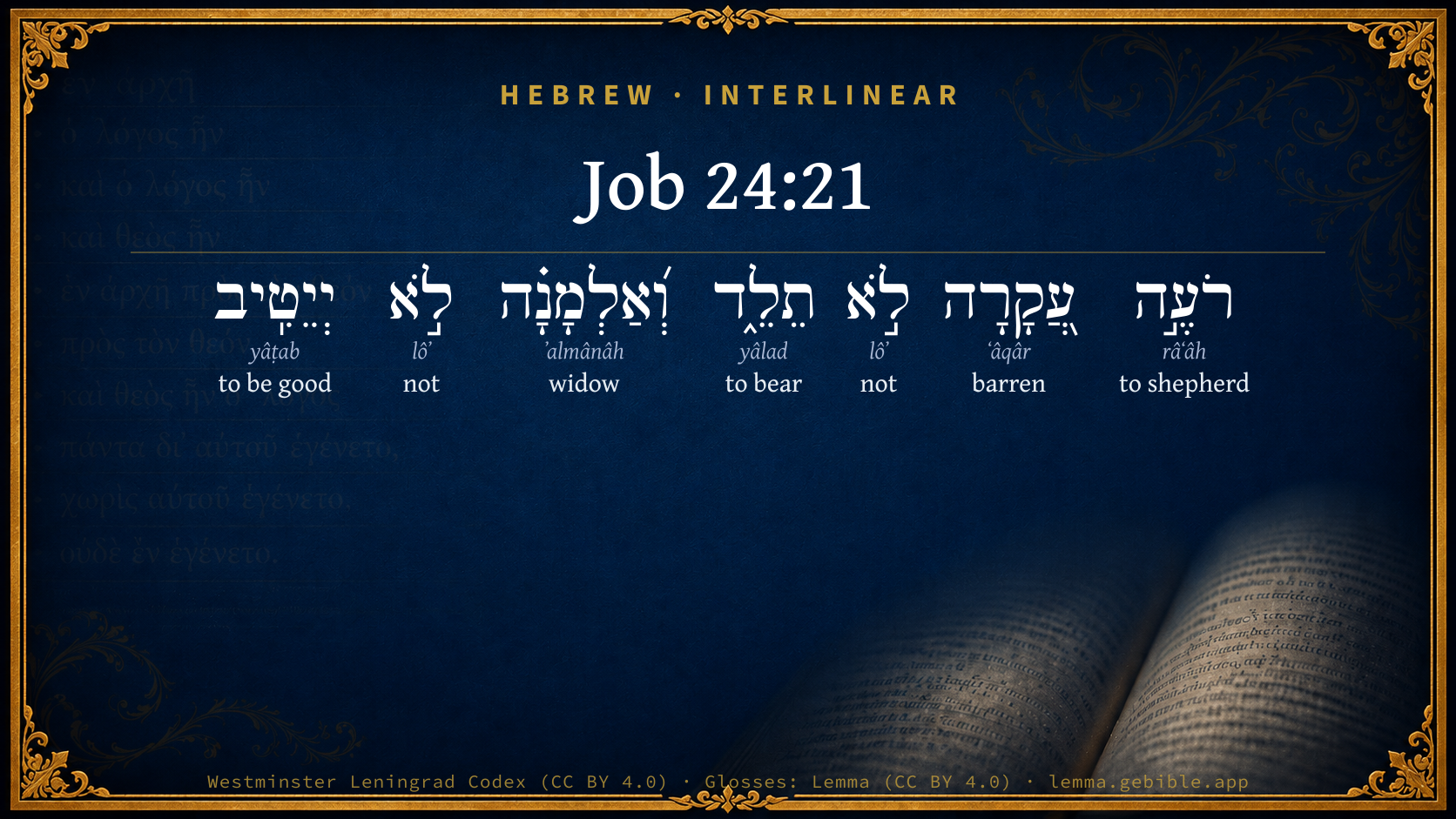
Job 24:21

Hebrew (Westminster Leningrad Codex) Job 24:21 appears in the Hebrew Old Testament. The text above is from the Westminster Leningrad Codex. Each word links to its Strong’s number, a concise gloss, and parsing drawn from the Open Scriptures Hebrew Bible morphology. Click any word for its full Brown-Driver-Briggs (BDB) entry.
Download image
Cite this verse

Job 24:21 (World English Bible). Public Domain. Lemma interlinear Bible study tool, https://lemma.gebible.app/v/job/24/21.

Show BibTeX & RIS
BibTeX
RIS
English Translation
He devours the barren who don't bear. He shows no kindness to the widow.
World English Bible · Public Domain
Download a study sheet

One document with this verse’s original text, its word-by-word gloss line, the meaning frame, cross-references with their text, attributed commentary, and full source and license credits — printable, and it pastes into notes with its structure intact.

This verse Autodidact and up

Study sheet (.html) Plain text (.txt)

A passage Seminary Student

Up to 50 verses in one chapter. A passage sheet keeps up to 6 commentary sources and 12 cross-references per verse, in the order this page ranks them, and says so on the sheet whenever that leaves anything out. Ask for a single verse and you get the Autodidact verse sheet above.

Everything on this page stays free to read, with no account — the sheet is a download of what is already on screen, not access to it.

Want to remove ads? Support Godless Engineer
Compare translations 3

The same verse in 3 English versions, stacked beneath the original-language interlinear above. Click any original word for its lexicon entry.

Each is an independent rendering of the whole verse — the interlinear is not word-aligned to these translations.

Highlighted words mark where these versions differ — a whole-verse word diff, not a word-by-word alignment.

  • World English Bible Public Domain
    He devours the barren who don't bear. He shows no kindness to the widow.
  • King James Version Public Domain
    He evil entreateth the barren that beareth not: and doeth not good to the widow.
  • unfoldingWord Literal Text CC BY-SA 4.0
    the one devouring the barren, who has not borne, and he does not do good the widow.

unfoldingWord Literal Text — © unfoldingWord, licensed CC BY-SA 4.0. Word-aligned USFM3 via Door43 (git.door43.org/unfoldingWord/en_ult).

Versions to compare (up to 4)

3 of 4 selected

Show all 18 translations

Every available English version of this verse, each an independent rendering of the whole verse.

  • World English Bible Public Domain
    He devours the barren who don't bear. He shows no kindness to the widow.
  • Berean Standard Bible Public Domain
    They prey on the barren and childless, and show no kindness to the widow.
  • Majority Standard Bible Public Domain
    They prey on the barren and childless, and show no kindness to the widow.
  • King James Version Public Domain
    He evil entreateth the barren that beareth not: and doeth not good to the widow.
  • American Standard Version (1901) Public Domain
    He devoureth the barren that beareth not, And doeth not good to the widow.
  • Revised Version (1885) Public Domain
    He devoureth the barren that beareth not; and doeth not good to the widow.
  • Geneva Bible (1599) Public Domain
    He doth euil intreat ye barren, that doeth not beare, neither doeth he good to the widowe.
  • Douay-Rheims (1899) Public Domain
    For he hath fed the barren that beareth not, and to the widow he hath done no good.
  • Young's Literal Translation Public Domain
    Treating evil the barren `who' beareth not, And `to' the widow he doth no good,
  • Literal Standard Version CC BY-SA 4.0
    Treating evil the barren [who] does not bear, || And he does no good [to] the widow,
  • Unlocked Literal Bible CC BY-SA 4.0
    The wicked one devours the barren women who have not borne children; he does no good to the widow.
  • unfoldingWord Literal Text CC BY-SA 4.0
    the one devouring the barren, who has not borne, and he does not do good the widow.
  • Darby Bible Public Domain
    He that despoileth the barren that beareth not, and doeth not good to the widow:
  • World Messianic Bible Public Domain
    He devours the barren who don’t bear. He shows no kindness to the widow.
  • Webster's Bible Public Domain
    He oppresseth the barren that beareth not: and doeth not good to the widow.
  • Free Bible Version CC BY-SA 4.0
    They mistreat childless women and are mean to widows.
  • Bible in Basic English Public Domain
    He is not kind to the widow, and he has no pity for her child.
  • JPS Tanakh (1917) Public Domain
    He devoureth the barren that beareth not; and doeth not good to the widow.

Literal Standard Version (2020), Covenant Press — licensed CC BY-SA 4.0. Text via the HelloAO Bible API (eBible.org). Unlocked Literal Bible (unfoldingWord) — licensed CC BY-SA 4.0. Text via the HelloAO Bible API (eBible.org). unfoldingWord Literal Text — © unfoldingWord, licensed CC BY-SA 4.0. Word-aligned USFM3 via Door43 (git.door43.org/unfoldingWord/en_ult). Free Bible Version, Dr. Jonathan Gallagher — licensed CC BY-SA 4.0. Text via the HelloAO Bible API (eBible.org).

Word by word

More ways to search: Search by grammar → Find every occurrence → Compare this word →

Practice this passage: Drill this verse → Learn its vocabulary →

About this verse

These counts appear in no published source. They are computed here, from the morphology-tagged text and Lemma’s own curated glosses. What Lemma adds →

7
words
6
distinct lemmas
Wisdom
section

Notable vocabulary

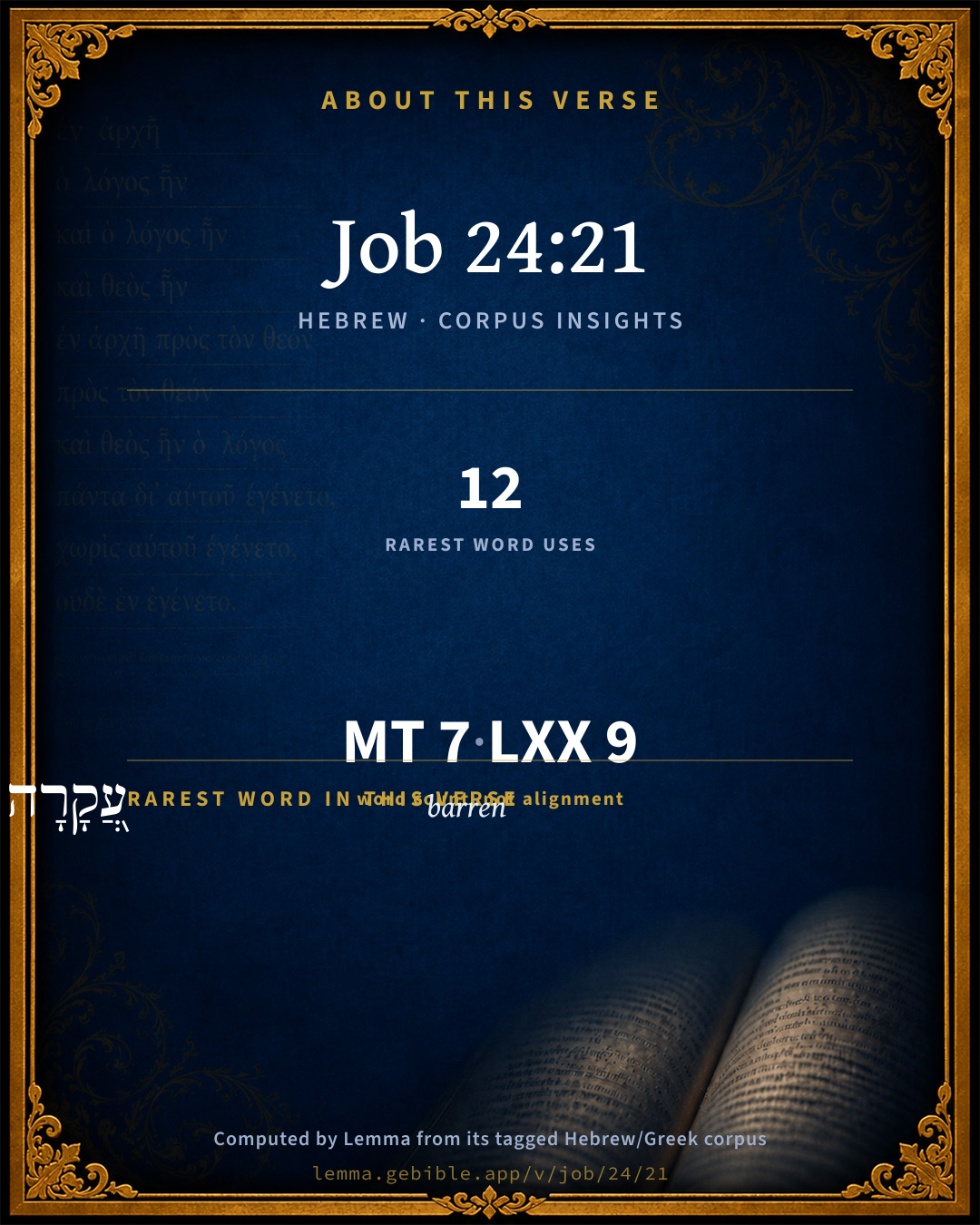
The rarest word here is עֲ֭קָרָה barren H6135 — appearing just 12 times in the whole Hebrew Bible.

Shared distinctive vocabulary

עֲ֭קָרָה barren H6135 occurs in 11 verses of the Hebrew Bible. Also found in:

Grammatical profile

  • 3 verbs
  • 1 noun
  • 1 adjective
  • 2 particles

Verb forms

  • רֹעֶ֣ה Qal · Participle Active
  • תֵלֵ֑ד Qal · Imperfect
  • יְיֵטִֽיב Hiphil · Imperfect

Repetition

A word recurs within this verse — often emphatic in Hebrew:

Hebrew & Septuagint length

In English translation the verse runs 14 words from the Hebrew and 18 from the Septuagint (LXX English) — closely comparable.

A rough comparison of the two English renderings, which tokenize alike — not a word-level alignment.

Word counts can differ between the Hebrew and the Greek without any difference in meaning — e.g. the Hebrew direct-object marker אֵת has no separate Greek word, and Greek often adds the article ὁ.

In the original languages it is 7 Hebrew tokens and 9 Greek tokens — but the two are counted differently (Hebrew bundles its prefixes and suffixes into one token; the Greek is in lemma form), so that isn’t a like-for-like length.

Cross-references

5

Topical passages linked to Job 24:21 in the Treasury of Scripture Knowledge — connected by theme and wording, ordered by reader-vote popularity; previews shown in the World English Bible.

  • 1 Samuel 1:6–7 Her rival provoked her sore, to make her fret, because Yahweh had shut up her womb.
  • Job 22:9 You have sent widows away empty, And the arms of the fatherless have been broken.
  • Job 29:13 The blessing of him who was ready to perish came on me, And I caused the widow's heart to sing for joy.
  • Job 24:3 They drive away the donkey of the fatherless, And they take the widow's ox for a pledge.
  • Job 31:16–18 "If I have withheld the poor from their desire, Or have caused the eyes of the widow to fail,

Cross-references courtesy of OpenBible.info (CC BY 4.0).

Hebrew and Greek witnesses Masoretic Hebrew ↔ Greek Septuagint

The same verse in the two great witnesses to the Old Testament, shown verse-for-verse.

These are two independent witnesses, not word-aligned to each other, and the Septuagint is shown in lemma (dictionary) form.

Hebrew Job 24:21 Masoretic · Westminster Leningrad Codex

רֹעֶ֣ה עֲ֭קָרָה לֹ֣א תֵלֵ֑ד וְ֝אַלְמָנָ֗ה לֹ֣א יְיֵטִֽיב

He devours the barren who don't bear. He shows no kindness to the widow.

World English Bible · Public Domain

Greek LXX Job 24:21 Septuagint · lemma form

στεῖρα γάρ οὐ εὖ ποιέω καί γύναιον οὐ ἐλεέω

For he has not treated the barren woman well, and has had no pity on a feeble woman.

LXX2012 (modern English Septuagint) · Public Domain

On this verse, Haydock's Catholic Bible Commentary discusses the Septuagint’s reading. Read the note in Commentary ↓

Hebrew: Westminster Leningrad Codex (CC BY 4.0). Greek: Septuagint (public domain); English from LXX2012 (modern English Septuagint) (Public Domain). How the Septuagint differs from the Hebrew →

Commentary

Notes on Job 24:21 from classic Christian and Jewish commentators (each source and its license shown beneath its notes). The classic Christian expositions comment on the surrounding passage and are grouped to its opening verse, so a note may address several verses; the Jewish commentaries on the Tanakh (Rashi and others) are per-verse, so they appear only where the commentator wrote on this verse.

Lemma curates 59 commentaries, every one of them public domain or Creative Commons licensed, each selected and text-cleaned for this edition rather than reprinted as found. About our sources →

Trapp's Complete Commentary

John Trapp

Job 24:21 He evil entreateth the barren [that] beareth not: and doeth not good to the widow.

Ver. 21. He evil entreateth the barren that beareth not] Who had more need to be comforted than further afflicted. But homo homini daemon. Jacob and Elkanah loved and comforted their wives under this cross. The Vulgate rendereth it, He hath fed the barren, whereupon some expound it of wicked men’s feeding whores, and maintaining them for their pleasure; keeping them barren, that they may keep their beauty.

And doeth not good to the widow] i.e. Doth her much hurt; for not to do good is to do evil, Mar 3:4. He hath afflicted his barren wife, and evilly intreated the poor desolate widow, his mother. What marvel than if the womb forget him, &c., if his wife bewail not so unkind a husband, nor his mother so unnatural a son, as Mar 3:30 : thus Beza here.

John Trapp, A Commentary or Exposition upon All the Books of the Old and New Testament (1647–1656) — public domain. Text from a community e-Sword module.

Joseph Benson's Commentary

Job 24:21. He evil-entreateth the barren — Job here returns to the declaration of his further acts of wickedness, the causes of these judgments; that heareth not — Barrenness was esteemed a curse and reproach; and so it is mentioned as an instance of this man’s wickedness, that he added affliction to the afflicted, whom he should have pitied and helped; but because the barren had no children, and the widows no husbands to defend or avenge their cause, he exercised cruelty upon them.

Joseph Benson's Commentary on the Old and New Testaments (1811–1818) — public domain. Text from a community e-Sword module.

Geneva Bible (1599)

Geneva Bible translators

He showeth why the wicked shall not be lamented, because he did not pity others.

Geneva Bible (1599) marginal notes — public domain. Text via Bolls.life.

Jamieson, Fausset & Brown

Robert Jamieson, A. R. Fausset & David Brown

The reason given by the friends why the sinner deserves such a fate.

barren--without sons, who might have protected her.

widow--without a husband to support her.

Jamieson, Fausset & Brown — Commentary Critical and Explanatory on the Whole Bible (1871) — public domain (CC PDM 1.0). Text via the HelloAO Bible API.

Adam Clarke's Commentary

Verse 21. He evil entreateth the barren] I believe the original word ולה should be translated he feedeth, and so the Vulgate understood the word: Pavit enim sterilem. He has been kind to the barren woman; but he has done no good to the widow. He has shown no mercy to large families; he has been an enemy to the procreation of children. Though he may, for particular reasons, have provided for a barren woman; yet the widow he has not comforted, she being old or infirm, or such as might not suit his purpose.

Adam Clarke's Commentary on the Bible (1810–1826) — public domain. Text from a community e-Sword/MySword module.

The Cambridge Bible for Schools and Colleges

gen. ed. J. J. S. Perowne

21. This verse is closely connected with the last clause of the preceding.

And wickedness shall be broken like a tree—

Even he that devoureth the barren that beareth not,

And doeth not good unto the widow.

The “tree” is a frequent object of comparison, e.g. ch. Job_19:10, “removed or plucked up like a tree,” here “broken” like a tree. The “barren that beareth not” is she that is lonely, having no sons to uphold her right, Psa_127:3, cf. Isa_51:18. Pleading for, or upholding the cause of the widow is often enjoined, as in Isa_1:17, and the Lord Himself is said to be her “judge,” Psa_68:5.

The broad and somewhat exaggerated colours of the preceding picture (Job_24:18-21) indicate that it is either actually in part the work of a popular hand, or that it is a parody after the popular manner by Job himself.

The Cambridge Bible for Schools and Colleges (gen. ed. J. J. S. Perowne; Cambridge University Press, 1878–1918) — public domain. Text from a community e-Sword module.

John Gill's Exposition

He evil entreateth the barren, that beareth not,.... Here Job returns, to give some further account of the sins of some wicked men, who prosper in this world, and go through it with impunity; and speaks of such that use their wives ill because they are barren, upbraid them with it, and are churlish to them on account of it; or use them ill that they may be barren, and bear no children, having no pleasure in them, as not in vineyards, before, Job 24:18; and some interpret this of deflowering virgins, who never bore children, and of using methods to make them abortive, when with child; the word we translate "evil entreateth" sometimes signifies joining to, or being a companion of others, as in Pro 13:20; hence various senses are given; some, he joins himself to a barren woman, that he may have no children, being not desirous of any; others, he, joins himself to, and is a companion of harlots, who are commonly barren: and like the prodigal, spends his substance among them. Some interpreters take this verse and Job 24:22; as expressive of the punishment of wicked men: so Mr. Broughton renders the words, "he adjoineth the barren" (d), and gives the sense of them thus; God sends after him a barren wife, that he shall have no help by children; but, though a numerous offspring has been reckoned an outward happiness, and not to have any an infelicity, yet it has been the case of many good men and women to be childless; wherefore love and hatred are not known hereby: besides, such a sense is contrary to the scope and design of Job, which is to prove that wicked men often go unpunished in this life; wherefore, rather the meaning is, that a wicked man uses ill such, who having not only lost their husbands, but having been barren, and so childless, have none to take their part, and to protect and defend them from the abuses of such men; the Targum renders the word, "he breaketh", and so some understand it (e); he breaketh the barren, tears them to pieces, ruins and destroys them, as to their outward substance, because they have no children to help them; with which agrees what follows,

and doth not good to the widow; does not make her glad and cheerful, as Job did, who made the widow's heart to sing for joy, Job 29:13; does not relieve and assist her when in distress, either by counsel and advice, or by administering to her necessities; but, on the contrary, afflicts and oppresses her; takes her ox, or her raiment, for a pledge, and plunders her house, and devours the substance of it; for more is intended than is expressed.

(d) "consociat ei sterilem", Junius & Tremellius. (e) Pagninus, Montanus, Bolducius, Piscator, Mercerus, Drusius.

John Gill's Exposition of the Whole Bible (1746–1763) — public domain (CC PDM 1.0). Text via the HelloAO Bible API.

Albert Barnes' Notes on the Bible

He evil entreateth the barren - The woman who has no children to comfort or support her. He increases her calamity by acts of cruelty and oppression. To be without children, as is well known, was regarded, in the patriarchal ages, as a great calamity.

And doeth not good to the widow - See the notes at Job 24:3. Notwithstanding all this, he is permitted to live in prosperity, and to die without any visible tokens of the divine displeasure.

Albert Barnes' Notes on the Bible (1834–1885) — public domain. Text from a community e-Sword/MySword module.

Haydock's Catholic Bible Commentary

Fed the barren. That is, the harlot. Or else, he hath fed; that is, he hath fed upon the barren; that is, the poor and desolate. (Challoner) --- He has not had posterity, but pleasure, in view, when he married. (Rabbins) --- Septuagint agree with the Vulgate. (Haydock) --- But most explain the Hebrew, "He hath oppressed the barren;" which may denote those whose husband and children have been slain. (Calmet) --- No good, but even dealt with them dishonestly. (Cajetan)

George Leo Haydock (1774–1849), Haydock's Catholic Family Bible and Commentary, 1859 edition — public domain. Excludes Psalms (Douay-Rheims chapter numbering differs from Protestant) and Deuterocanonical books (Catholic canon only).

Matthew Poole's English Annotations

He; either,

1. God, who is oft understood, who having cut off his person, and brought him to his grave, continues his judgments upon his wife or widow, and family. Or rather,

2. The oppressor, who is the principal subject of almost all that is said in this chapter; whose great and manifold wickedness Job described from Job 24:2-18, where he proceeds to relate the judgments of God upon him for his sins; which having done, Job 24:18-20, he here returns to the declaration of his further wickednesses, the cause of these judgments.

Evil entreateth; or feedeth upon, or devoureth, or breaketh in pieces; for all these the word signifieth, and all come to one and the same thing.

The barren that beareth not: barrenness was esteemed a curse and reproach; and so he added affliction to the afflicted, whom he should have pitied and helped; but because such had no children, and the widows no husbands, to defend or avenge their cause, he exercised cruelty upon them.

Doeth not good: either,

1. He did her much wrong and harm, it being usual in Scripture under such negative expressions to contain the affirmation of the contrary; as Exo 20:7; Pro 17:21; 28:21. And so this branch answers to the former, of evil entreating. Or,

2. He afforded her no help, or advice, or comfort in her distresses; and so he intimateth the greatness of omission sins, and that the common neglect or contempt of plain and positive duties, whether of piety to God, or of charity to men, is to be reckoned among high and heinous crimes.

Matthew Poole's English Annotations on the Holy Bible (1683–1685) — public domain. Text from a community e-Sword/MySword module.

Whedon's Commentary on the Bible

Daniel D. Whedon

21. He evil entreateth — Better, He who evil entreated. The sterile woman, having no son to defend her, is taken for a type of feebleness. (Renan.)

Doeth not good — An inscription in a tomb at Benihassan says of a ruler, “He injured no little child, he oppressed no widow… he treated the widow as a woman with a husband to protect her.” — BUNSEN, Egypt, 5:726-729.

Daniel D. Whedon (gen. ed.), Commentary on the Old and New Testaments (1874–1909) — public domain. Text from a community e-Sword module.

The Pulpit Commentary

He evil entreateth the barren that beareth not. Oppressors of another class are perhaps here spoken of, or perhaps there is a mere return to the idea with which Job"s enumeration opened (ver. 3), which was the oppression of the weaker and more defenceless classes. As barrenness in women was considered the greatest possible misfortune, (1Sa_1:5-8 1Sa_3:1-10) so oppressing one that was barren indicated extreme cruelty. And doeth not good to the widow; i.e. neglects to vindicate her cause an admitted part of man"s duty. (see Job_22:9 Job_29:13 Job_31:16)

The Pulpit Commentary (1880–1919), ed. H.D.M. Spence-Jones & Joseph S. Exell — public domain. Text from a community e-Sword module.

John Wesley's Explanatory Notes

He - He here returns to the declaration of his farther wickednesses, the cause of these judgments. Barren - Barrenness was esteemed a curse and reproach; and so he added affliction to the afflicted.

John Wesley, Explanatory Notes Upon the Whole Bible (1754–1765) — public domain. Text via the GEBible commentary corpus.

Rashi

Rabbi Shlomo Yitzchaki (Rashi)

He feeds the barren woman who will not bear so was their custom: One would marry two wives, one for coitus and one for children. The one intended for coitus he would give a potion of roots to drink in order that she should never give birth, and he would feed her delicacies, bathe her, and adorn her, so that she should appear beautiful. The one intended for children he would dress in widow’s garments and starve. This is the meaning of his statement that the barren woman who will not give birth he would feed and adorn, but the “widow,” who was intended for children, he would not adorn.

Rashi on the Tanakh — English translations: “The Judaica Press complete Tanach with Rashi, translated by A. J. Rosenberg” (CC BY 4.0); “Pentateuch with Rashi's commentary by M. Rosenbaum and A.M. Silbermann, 1929-1934” (public domain); “The Metsudah Tanach series, Lakewood, N.J” (CC BY 4.0); and “The Book of Joshua, Metsudah Publications, 1997” (CC BY 4.0). Text via Sefaria.

Lesson kit

Teaching starters — assembled from the data on this page, not authored interpretation. Every prompt links to the verse data it draws on. Edit before teaching.

Job, in the Wisdom, opens this verse with 7 words (6 distinct Hebrew lemmas). Its most distinctive word is ʻâqâr (“barren”). A historical commentator’s framing appears above. Read the whole chapter for the surrounding context.

Discussion questions

  1. The word ʻâqâr carries the sense “barren.” How does it shape the verse?
  2. Genesis 11:30 shares the word «barren» with this verse. How do the two illuminate each other?
  3. “not” occurs 2× in this one verse. What is the effect of the repetition?
  4. These translations render this verse differently. What is at stake in choosing one wording over another?
  5. The verb «רֹעֶ֣ה» is Qal Participle Active. How does its form color the action?
  6. Reading how Trapp's Complete Commentary and Joseph Benson's Commentary read this verse, where do the two commentators agree and where do they part?

Things to notice

Reading settings

Reading text

Shown beneath each verse's original-language words.

Old Testament
Old Testament edition

Read the OT as the Masoretic Hebrew (MT) or the Greek Septuagint (LXX).

English shown for the Greek Septuagint (in the Hebrew ↔ Greek comparison).

Comparing translations? Open the Compare panel on any verse page to stack up to four side by side.