
Jeremiah 25:34

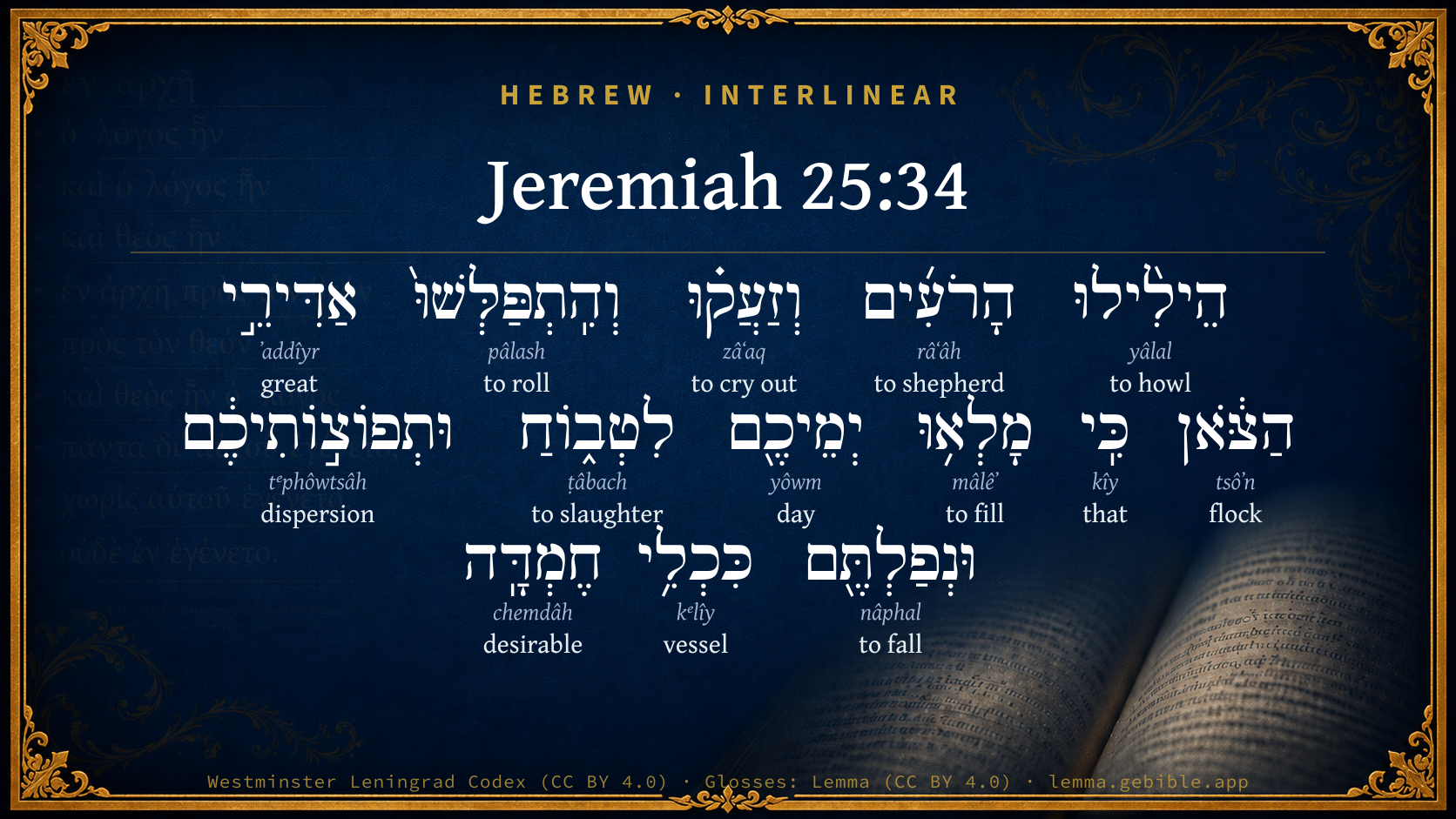
Hebrew (Westminster Leningrad Codex) Jeremiah 25:34 appears in the Hebrew Old Testament. The text above is from the Westminster Leningrad Codex. Each word links to its Strong’s number, a concise gloss, and parsing drawn from the Open Scriptures Hebrew Bible morphology. Click any word for its full Brown-Driver-Briggs (BDB) entry.
Download image
Cite this verse

Jeremiah 25:34 (World English Bible). Public Domain. Lemma interlinear Bible study tool, https://lemma.gebible.app/v/jeremiah/25/34.

Show BibTeX & RIS
BibTeX
RIS
English Translation
Wail, you shepherds, and cry; and wallow [in ashes], you principal of the flock; for the days of your slaughter and of your dispersions are fully come, and you shall fall like a goodly vessel.
World English Bible · Public Domain
Highlights
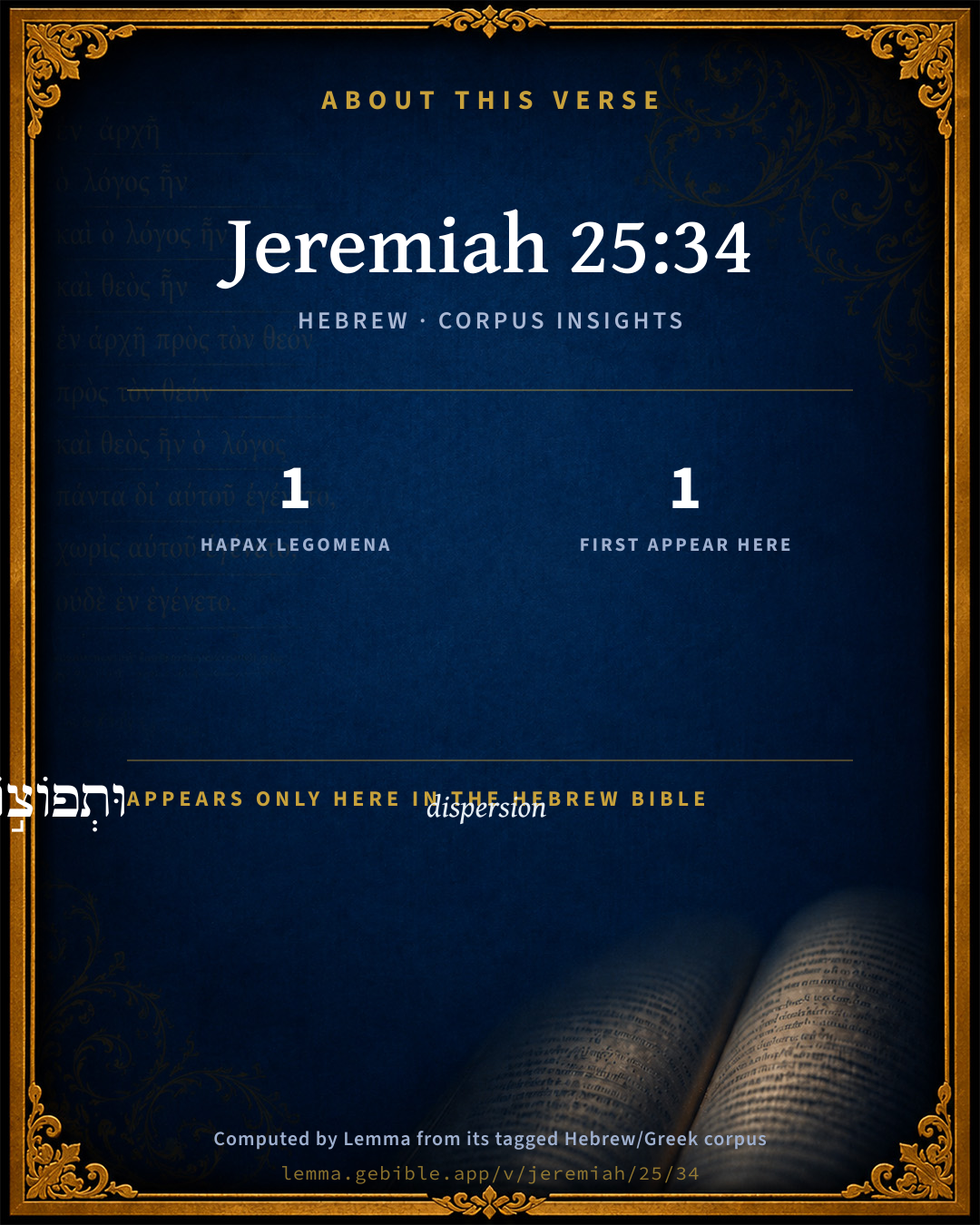
  • 1 hapax legomenon — only here in the Hebrew Bible
  • 1 first appearance in the Hebrew Bible
Full analysis ↓
Download a study sheet

One document with this verse’s original text, its word-by-word gloss line, the meaning frame, cross-references with their text, attributed commentary, and full source and license credits — printable, and it pastes into notes with its structure intact.

This verse Autodidact and up

Study sheet (.html) Plain text (.txt)

A passage Seminary Student

Up to 50 verses in one chapter. A passage sheet keeps up to 6 commentary sources and 12 cross-references per verse, in the order this page ranks them, and says so on the sheet whenever that leaves anything out. Ask for a single verse and you get the Autodidact verse sheet above.

Everything on this page stays free to read, with no account — the sheet is a download of what is already on screen, not access to it.

Want to remove ads? Support Godless Engineer
Compare translations 3

The same verse in 3 English versions, stacked beneath the original-language interlinear above. Click any original word for its lexicon entry.

Each is an independent rendering of the whole verse — the interlinear is not word-aligned to these translations.

Highlighted words mark where these versions differ — a whole-verse word diff, not a word-by-word alignment.

  • World English Bible Public Domain
    Wail, you shepherds, and cry; and wallow [in ashes], you principal of the flock; for the days of your slaughter and of your dispersions are fully come, and you shall fall like a goodly vessel.
  • King James Version Public Domain
    Howl, ye shepherds, and cry; and wallow yourselves in the ashes, ye principal of the flock: for the days of your slaughter and of your dispersions are accomplished; and ye shall fall like a pleasant vessel.
  • unfoldingWord Literal Text CC BY-SA 4.0
    Wail, you shepherds, and cry out, and roll in dust, you nobles of the flock, for your days for slaughter and your dispersions have been fulfilled, and you shall fall like a vessel of delight.

unfoldingWord Literal Text — © unfoldingWord, licensed CC BY-SA 4.0. Word-aligned USFM3 via Door43 (git.door43.org/unfoldingWord/en_ult).

Versions to compare (up to 4)

3 of 4 selected

Show all 18 translations

Every available English version of this verse, each an independent rendering of the whole verse.

  • World English Bible Public Domain
    Wail, you shepherds, and cry; and wallow [in ashes], you principal of the flock; for the days of your slaughter and of your dispersions are fully come, and you shall fall like a goodly vessel.
  • Berean Standard Bible Public Domain
    Wail, you shepherds, and cry out; roll in the dust, you leaders of the flock. For the days of your slaughter have come; you will fall and be shattered like fine pottery.
  • Majority Standard Bible Public Domain
    Wail, you shepherds, and cry out; roll in the dust, you leaders of the flock. For the days of your slaughter have come; you will fall and be shattered like fine pottery.
  • King James Version Public Domain
    Howl, ye shepherds, and cry; and wallow yourselves in the ashes, ye principal of the flock: for the days of your slaughter and of your dispersions are accomplished; and ye shall fall like a pleasant vessel.
  • American Standard Version (1901) Public Domain
    Wail, ye shepherds, and cry; and wallow `in ashes', ye principal of the flock; for the days of your slaughter and of your dispersions are fully come, and ye shall fall like a goodly vessel.
  • Revised Version (1885) Public Domain
    Howl, ye shepherds, and cry; and wallow yourselves in ashes, ye principal of the flock: for the days of your slaughter are fully come, and I will break you in pieces, and ye shall fall like a pleasant vessel.
  • Geneva Bible (1599) Public Domain
    Howle, ye shepherdes, and crie, and wallowe your selues in the ashes, ye principall of the flocke: for your dayes of slaughter are accomplished, and of your dispersion, and ye shall fall like precious vessels.
  • Douay-Rheims (1899) Public Domain
    Howl, ye shepherds, and cry: and sprinkle yourselves with ashes, ye leaders of the flock: for the days of your slaughter and your dispersion are accomplished, and you shall fall like precious vessels.
  • Young's Literal Translation Public Domain
    Howl, ye shepherds, and cry, And roll yourselves, ye honourable of the flock, For full have been your days, For slaughtering, and `for' your scatterings, And ye have fallen as a desirable vessel.
  • Literal Standard Version CC BY-SA 4.0
    Howl, you shepherds, and cry, || And roll yourselves, you majestic of the flock, || For your days have been full || For slaughtering, and [for] your scatterings, || And you have fallen as a desirable vessel.
  • Unlocked Literal Bible CC BY-SA 4.0
    Wail, shepherds, and shout for help! Roll about in the dust, you leaders of the flock, for the days of your slaughter have come; you will be scattered when you fall like fine pottery.
  • unfoldingWord Literal Text CC BY-SA 4.0
    Wail, you shepherds, and cry out, and roll in dust, you nobles of the flock, for your days for slaughter and your dispersions have been fulfilled, and you shall fall like a vessel of delight.
  • Darby Bible Public Domain
    Howl, ye shepherds, and cry; and wallow yourselves [in the dust], noble ones of the flock: for the days of your slaughter are accomplished, and I will disperse you; and ye shall fall like a precious vessel.
  • World Messianic Bible Public Domain
    Wail, you shepherds, and cry. Wallow in dust, you leader of the flock; for the days of your slaughter and of your dispersions have fully come, and you will fall like fine pottery.
  • Webster's Bible Public Domain
    Howl, ye shepherds, and cry; and wallow yourselves in the ashes, ye principal of the flock: for the days of your slaughter and of your dispersions are accomplished; and ye shall fall like a pleasant vessel.
  • Free Bible Version CC BY-SA 4.0
    Cry out and weep, you shepherds! Roll around on the ground mourning, you leaders of the flock. The time for you to be killed has come; you will fall, smashed like the finest pottery.
  • Bible in Basic English Public Domain
    Give cries of grief, you keepers of sheep; give cries for help, rolling yourselves in the dust, you chiefs of the flock: for the days of your destruction have fully come, and I will send you in all directions, and your fall will be like that of the males of the flock.
  • JPS Tanakh (1917) Public Domain
    Wail, ye shepherds, and cry; and wallow yourselves in the dust, ye leaders of the flock; for the days of your slaughter are fully come, and I will break you in pieces, and ye shall fall like a precious vessel.

Literal Standard Version (2020), Covenant Press — licensed CC BY-SA 4.0. Text via the HelloAO Bible API (eBible.org). Unlocked Literal Bible (unfoldingWord) — licensed CC BY-SA 4.0. Text via the HelloAO Bible API (eBible.org). unfoldingWord Literal Text — © unfoldingWord, licensed CC BY-SA 4.0. Word-aligned USFM3 via Door43 (git.door43.org/unfoldingWord/en_ult). Free Bible Version, Dr. Jonathan Gallagher — licensed CC BY-SA 4.0. Text via the HelloAO Bible API (eBible.org).

Word by word

More ways to search: Search by grammar → Find every occurrence → Compare this word →

Practice this passage: Drill this verse → Learn its vocabulary →

וּתְפוֹצ֣וֹתִיכֶ֔ם
tᵉphôwtsâh
H8600
“and · dispersions · your”
Conjunction + Noun, Common, Feminine, Plural, Construct + Suffix, Personal, 2nd Person, Masculine, Plural
Part of Speech
Conjunction + Noun
Type
Common
Gender
Feminine
Number
Plural
State
Construct
Full BDB Definition

Origin: from H6327

TWOT: 1745b

dispersion
  1. הֵילִ֨ילוּ yâlal H3213 “howl” Verb, Hiphil, Imperative, 2nd Person, Masculine, Plural
  2. הָרֹעִ֜ים râʻâh H7462 “the · shepherding” Particle, Definite Article + Verb, Qal, Participle Active, Masculine, Plural, Absolute
  3. וְזַעֲק֗וּ zâʻaq H2199 “and · cry out” Conjunction + Verb, Qal, Imperative, 2nd Person, Masculine, Plural
  4. וְהִֽתְפַּלְּשׁוּ֙ pâlash H6428 “and · roll” Conjunction + Verb, Hithpael, Imperative, 2nd Person, Masculine, Plural
  5. אַדִּירֵ֣י ʼaddîyr H117 “great of” Adjective, Adjective, Masculine, Plural, Construct
  6. הַצֹּ֔אן tsôʼn H6629 “the · flock” Particle, Definite Article + Noun, Common, Both, Singular, Absolute
  7. כִּֽי kîy H3588 “that” Conjunction
  8. מָלְא֥וּ mâlêʼ H4390 “to fill” Verb, Qal, Perfect, 3rd Person, Common, Plural
  9. יְמֵיכֶ֖ם yôwm H3117 “days · your” Noun, Common, Masculine, Plural, Construct + Suffix, Personal, 2nd Person, Masculine, Plural
  10. לִטְב֑וֹחַ ṭâbach H2873 “to slaughter” Preposition + Verb, Qal, Infinitive Construct
  11. וּנְפַלְתֶּ֖ם nâphal H5307 “and · to fall” Conjunction + Verb, Qal, Sequential Perfect, 2nd Person, Masculine, Plural
  12. כִּכְלִ֥י kᵉlîy H3627 “like/as · vessel of” Preposition + Noun, Common, Masculine, Singular, Construct
  13. חֶמְדָּֽה chemdâh H2532 “desirable” Noun, Common, Feminine, Singular, Absolute

About this verse

These counts appear in no published source. They are computed here, from the morphology-tagged text and Lemma’s own curated glosses. What Lemma adds →

14
words
14
distinct lemmas
Prophets
section

Notable vocabulary

1 hapax legomenon — a word that appears only here in the entire Hebrew Bible:

  • וּתְפוֹצ֣וֹתִיכֶ֔ם dispersion H8600

First appearance in Scripture

This word makes its first canonical appearance in the Hebrew Bible here:

  • וּתְפוֹצ֣וֹתִיכֶ֔ם dispersion H8600

Shared distinctive vocabulary

וְהִֽתְפַּלְּשׁוּ֙ to roll H6428 occurs in 4 verses of the Hebrew Bible. Also found in:

Grammatical profile

  • 7 verbs
  • 5 nouns
  • 1 adjective
  • 1 conjunction

Verb forms

  • הֵילִ֨ילוּ Hiphil · Imperative
  • הָרֹעִ֜ים Qal · Participle Active
  • וְזַעֲק֗וּ Qal · Imperative
  • וְהִֽתְפַּלְּשׁוּ֙ Hithpael · Imperative
  • מָלְא֥וּ Qal · Perfect
  • לִטְב֑וֹחַ Qal · Infinitive Construct
  • וּנְפַלְתֶּ֖ם Qal · Sequential Perfect

Cross-references

26

Topical passages linked to Jeremiah 25:34 in the Treasury of Scripture Knowledge — connected by theme and wording, ordered by reader-vote popularity; previews shown in the World English Bible.

  • Jeremiah 6:26 Daughter of my people, gird you with sackcloth, and wallow yourself in ashes: make you mourning, as for an only son, most bitter lamentation; for the destroyer shall suddenly come on us.
  • 2 Chronicles 36:10 At the return of the year king Nebuchadnezzar sent, and brought him to Babylon, with the goodly vessels of the house of Yahweh, and made Zedekiah his brother king over Judah and Jerusalem.
  • Psalms 2:9 You shall break them with a rod of iron. You shall dash them in pieces like a potter's vessel."
  • Isaiah 2:16 For all the ships of Tarshish, And for all pleasant imagery.
  • Isaiah 10:12 Therefore it shall happen that, when the Lord has performed his whole work on Mount Zion and on Jerusalem, I will punish the fruit of the stout heart of the king of Assyria, and the glory of his high looks.
  • Isaiah 30:14 He shall break it as a potter's vessel is broken, breaking it in pieces without sparing; so that there shall not be found among the pieces of it a broken piece with which to take fire from the hearth, or to dip up water out of the cistern."
  • Isaiah 33:1 Woe to you who destroy, and you weren't destroyed; and deal treacherously, and they didn't deal treacherously with you! When you have ceased to destroy, you shall be destroyed; and when you have made an end of dealing treacherously, they shall deal treacherously with you.
  • Isaiah 34:6 The sword of Yahweh is filled with blood, it is made fat with fatness, with the blood of lambs and goats, with the fat of the kidneys of rams; for Yahweh has a sacrifice in Bozrah, and a great slaughter in the land of Edom.
  • Jeremiah 3:19 But I said, How I will put you among the children, and give you a pleasant land, a goodly heritage of the hosts of the nations! and I said, You shall call me My Father, and shall not turn away from following me.
  • Jeremiah 4:8–9 For this gird you with sackcloth, lament and wail; for the fierce anger of Yahweh hasn't turned back from us.
  • Jeremiah 19:10–12 Then shall you break the bottle in the sight of the men who go with you,
  • Jeremiah 22:28 Is this man Coniah a despised broken vessel? is he a vessel in which none delights? why are they cast out, he and his seed, and are cast into the land which they don't know?
  • Jeremiah 25:12 It shall happen, when seventy years are accomplished, that I will punish the king of Babylon, and that nation, says Yahweh, for their iniquity, and the land of the Chaldeans; and I will make it desolate forever.
  • Jeremiah 25:23 Dedan, and Tema, and Buz, and all who have the corners [of their hair] cut off;
  • Jeremiah 25:36 A voice of the cry of the shepherds, and the wailing of the principal of the flock! for Yahweh lays waste their pasture.
  • Jeremiah 27:7 All the nations shall serve him, and his son, and his son's son, until the time of his own land come: and then many nations and great kings shall make him their bondservant.
  • Jeremiah 48:26 Make you him drunken; for he magnified himself against Yahweh: and Moab shall wallow in his vomit, and he also shall be in derision.
  • Jeremiah 50:27 Kill all her bulls; let them go down to the slaughter: woe to them! for their day is come, the time of their visitation.
  • Jeremiah 51:20–26 You are my battle-axe and weapons of war: and with you will I break in pieces the nations; and with you will I destroy kingdoms;
  • Lamentations 4:21 Rejoice and be glad, daughter of Edom, that dwell in the land of Uz: The cup shall pass through to you also; you shall be drunken, and shall make yourself naked.
  • Ezekiel 27:30–31 and shall cause their voice to be heard over you, and shall cry bitterly, and shall cast up dust on their heads, they shall wallow themselves in the ashes:
  • Ezekiel 34:16–17 I will seek that which was lost, and will bring back that which was driven away, and will bind up that which was broken, and will strengthen that which was sick: but the fat and the strong I will destroy; I will feed them in justice.
  • Ezekiel 34:20 Therefore thus says the Lord Yahweh to them: Behold, I, even I, will judge between the fat sheep and the lean sheep.
  • Daniel 11:8 Also their gods, with their molten images, [and] with their goodly vessels of silver and of gold, shall he carry captive into Egypt; and he shall refrain some years from the king of the north.
  • Amos 5:11 Forasmuch therefore as you trample on the poor, And take taxes from him of wheat: You have built houses of hewn stone, But you will not dwell in them. You have planted pleasant vineyards, But you shall not drink their wine.
  • James 5:1–2 Come now, you rich, weep and howl for your miseries that are coming on you.

Cross-references courtesy of OpenBible.info (CC BY 4.0).

Hebrew and Greek witnesses Masoretic Hebrew ↔ Greek Septuagint

The same verse in the two great witnesses to the Old Testament, shown verse-for-verse.

These are two independent witnesses, not word-aligned to each other, and the Septuagint is shown in lemma (dictionary) form.

Hebrew Jeremiah 25:34 Masoretic · Westminster Leningrad Codex

הֵילִ֨ילוּ הָרֹעִ֜ים וְזַעֲק֗וּ וְהִֽתְפַּלְּשׁוּ֙ אַדִּירֵ֣י הַצֹּ֔אן כִּֽי מָלְא֥וּ יְמֵיכֶ֖ם לִטְב֑וֹחַ וּתְפוֹצ֣וֹתִיכֶ֔ם וּנְפַלְתֶּ֖ם כִּכְלִ֥י חֶמְדָּֽה

Wail, you shepherds, and cry; and wallow [in ashes], you principal of the flock; for the days of your slaughter and of your dispersions are fully come, and you shall fall like a goodly vessel.

World English Bible · Public Domain

Greek LXX Structure differs

In the Septuagint, Jeremiah is about an eighth shorter than the Hebrew and arranges its material differently — the Oracles Against the Nations (Hebrew chapters 46–51) appear in the middle of the Greek book, after 25:13. Because the chapter and verse boundaries do not line up, a verse-for-verse comparison with the Hebrew is not shown.

A verse-for-verse comparison isn’t shown here because the chapters and verses don’t line up. Switch to the LXX edition with the MT / LXX toggle above to read the Greek directly.

On this verse, Jamieson, Fausset & Brown discusses the Septuagint’s reading. Read the note in Commentary ↓

Hebrew: Westminster Leningrad Codex (CC BY 4.0). Greek: Septuagint (public domain); English from a public-domain English Septuagint. How the Septuagint differs from the Hebrew →

Targum (Aramaic paraphrase)

1

The Targum is the ancient Jewish Aramaic paraphrase of the Hebrew Scriptures — an interpretive translation, not the Hebrew text itself. Onkelos (literal) and Pseudo-Jonathan (expansive) render the Torah, and Jonathan the Prophets. Coverage is partial: where no permissively-licensed English translation exists for a verse, only the Aramaic is shown. This is verse-level text, not a word-by-word alignment to the Hebrew.

  1. Targum Jonathan Prophets (Joshua–Malachi)
    אֱלִילוּ מַלְכַיָא וּצְוָחוּ וְחוּפוּ רֵישֵׁיכוֹן בְּקִטְמָא תַּקִיפֵי עַמָא אֲרֵי שְׁלִימוּ יוֹמֵיכוֹן לְקַטְלָא וְתִתְבַּדְרוּן וְתִפְּלוּן דַהֲוֵיתוּן רְגִיגִין כְּמָנֵי חֶמְדָתָא:

    (no public-domain English translation for this verse)

    Targum Jonathan — Aramaic: “Mikraot Gedolot” (public domain). English: “Sefaria Community Translation” (CC0 1.0 (public-domain dedication)); “London "Chaldee Paraphrase," 1871” (public domain). Text via Sefaria.

Commentary

Notes on Jeremiah 25:34 from classic Christian and Jewish commentators (each source and its license shown beneath its notes). The classic Christian expositions comment on the surrounding passage and are grouped to its opening verse, so a note may address several verses; the Jewish commentaries on the Tanakh (Rashi and others) are per-verse, so they appear only where the commentator wrote on this verse.

Lemma curates 59 commentaries, every one of them public domain or Creative Commons licensed, each selected and text-cleaned for this edition rather than reprinted as found. About our sources →

Trapp's Complete Commentary

John Trapp

Jer 25:34 Howl, ye shepherds, and cry; and wallow yourselves [in the ashes], ye principal of the flock: for the days of your slaughter and of your dispersions are accomplished; and ye shall fall like a pleasant vessel.

Ver. 34. Howl, ye shepherds.] Ululate, volulate. Shriek and roll. This is spoken to the governors and grandees; for in public calamities such usually suffer more than meaner men. The corks swim, saith one, when the plummets sink. If a tree have thick and large boughs, it lieth more open to lopping.

And ye shall fall like a pleasant vessel,] i.e., Irremediably. Like as a crystal glass or China dish once broken cannot be pieced again.

John Trapp, A Commentary or Exposition upon All the Books of the Old and New Testament (1647–1656) — public domain. Text from a community e-Sword module.

Joseph Benson's Commentary

Jer 25:34-35. Howl, ye shepherds, and cry — The imperative is here also put for the future: see Jer 25:27. Shepherds are here the same with kings, princes, or generals. In pursuance of the same metaphor, by the principal of the flock are meant the great and rich men of each nation. Though such are wont to be the most courageous and secure, yet of these it is foretold, that their hearts should so fail them that they should howl, and cry, and wallow in ashes. Seeing themselves utterly unable to make head against the enemy, and seeing their country, which they had the charge of, and for the protection and prosperity of which they were concerned, inevitably ruined, they should abandon themselves to despair, sorrow, and lamentation. For the days of your slaughter, &c., are accomplished — The time fixed in the divine counsel for the slaughter of some, and the dispersion of the rest, is fully come. And ye shall fall like a pleasant vessel — Ye shall be utterly destroyed, as a crystal glass when it is dashed against the ground. The shepherds shall have no way to flee, &c. — The enemy will be so numerous, so furious, so sedulous, and the extent of their army so vast, that it will be impossible to avoid falling into their hands.

Joseph Benson's Commentary on the Old and New Testaments (1811–1818) — public domain. Text from a community e-Sword module.

Tyndale Open Study Notes

Tyndale Open Resources

25:34-35 The earth’s evil shepherds were vicious tyrants who ruled the nations. • Roll in the dust: A sign of distress.

Tyndale Open Study Notes — © Tyndale Open Resources, licensed CC BY-SA 4.0. Text via the HelloAO Bible API.

Geneva Bible (1599)

Geneva Bible translators

Which are most easily broken.

Ye that are chief rulers, and governors.

Geneva Bible (1599) marginal notes — public domain. Text via Bolls.life.

Jamieson, Fausset & Brown

Robert Jamieson, A. R. Fausset & David Brown

shepherds--princes (Jer 22:22). Here he returns to the Jews and their rulers, using the same image as in Jer 25:30, "pasture" (see on Jer 25:30).

wallow yourselves--Cover yourselves as thickly with ashes, in token of sorrow, as one who rolls in them (Jer 6:26; Eze 27:30) [MAURER].

principal--leaders. The Septuagint translates "rams," carrying out the image (compare Isa 14:9, Margin; Zac 10:3).

days of your slaughter . . . of . . . dispersions--rather, "your days for slaughter (that is, the time of your being slain), and your dispersions (not 'of your dispersions'), are accomplished (are come)."

pleasant vessel--Ye were once a precious vessel, but ye shall fall, and so be a broken vessel (see on Jer 22:28). "Your past excellency shall not render you safe now. I will turn to your ignominy whatever glory I conferred on you" [CALVIN].

Jamieson, Fausset & Brown — Commentary Critical and Explanatory on the Whole Bible (1871) — public domain (CC PDM 1.0). Text via the HelloAO Bible API.

Adam Clarke's Commentary

Verse 34. Howl, ye shepherds] Ye kings and chiefs of the people.

Ye shall fall like a pleasant vessel.] As a fall will break and utterly ruin a precious vessel of crystal, agate, &c., so your overthrow will be to you irreparable ruin.

Adam Clarke's Commentary on the Bible (1810–1826) — public domain. Text from a community e-Sword/MySword module.

John Calvin's Commentaries

I doubt not but that the Prophet now turns his discourse especially to his own nation, which interpreters have not observed, and hence have not understood the meaning of the Prophet. He prophesied of God’s judgments, that the Jews might know that they in vain looked for impunity, as the Lord would not pardon the ignorant and destitute of all true knowledge, who might have pretended their ignorance as an excuse; and also that this comfort might support the minds of the godly, that the heathens, involved in the same guilt, would be subjected to the same judgment; and lastly, that knowing the difference between them and other nations, they might flee to God’s mercy and be encouraged to repent by entertaining a hope of pardon. After having then treated this general subject, he now returns to the people over whom he was appointed a teacher. He might indeed have declared from an eminence what was to take place through the whole earth; for so extensive was the office of a herald which God had conferred on him. He might then by the virtue of his office have denounced ruin on all nations; but he ought not to neglect his special care for the chosen people. And so I explain this passage; for he now again directs his discourse to the Jews.

Hence he says, Howl, ye pastors, and cry, etc. By pastors he means the king and his counsellors, the priests and other rulers; and by the choice of the flock he seems to understand the rich, whose condition was better than that of the common people. Some in a more refined manner consider the choice of the flock to have been those void of knowledge, unlike the scribes and priests and the king’s counsellors; but this view seems not to be well-founded. I therefore adopt what is more probable, — that the choice of the flock were those who were rich and high in public esteem, and yet held no office of authority in the commonwealth or in the Church. However this may be, the Prophet shews, that as soon as God began to put forth his hand to punish the Jews, there would be no ranks of men exempt from lamentation, for he would begin with the pastors and the choice of the flock.

He adds that their days were fulfilled Here he indirectly condemns that wicked security which had for a long time hardened them, so that they despised all threatenings; for God had now for many years called on them, and had sent his Prophets one after another; when they saw the execution of judgment suspended over them, they considered it only as a bugbear, “Well, let the prophets continue to pronounce their terrors, if they will do so, but nothing will come of them.” Thus the ungodly turned God’s forbearance into an occasion for their obstinacy. As then this evil was common among the Jews, the Prophet now says, by way of anticipation, that their days were fulfilled For there is to be understood this contrast, that God had spared them, not that he had his eyes closed, or that he had not observed their wicked deeds, but that he wished to give them time to repent; but when he saw that their wickedness was unhealable, he now says that their days were completed. And he adds, to be killed or slain. I wonder that learned interpreters render this, “that they may slay one another.” There is no need of adding anything, for the Prophet meant to express no such sentiment, nor to restrict what he denounces here on the Jews, to intestine or domestic wars; on the contrary, we know that they were slain by aliens, even by the Chaldeans. This sense then is forced, and is also inconsistent with history. It is added, and your dispersions also are fulfilled, or your breakings. The verb פוף, puts, means to scatter or to dissipate, and also to afflict, to tear; and the sense of tearing or breaking is what I prefer here. And he adds, And ye shall fall as a precious vessel This simile appears not to be very appropriate, for why should he not rather compare them to an earthen vessel, which is of no value and easily broken? But his object was to point out the difference in their two conditions, that though God had honored them with singular privileges, yet all their excellency would not keep them safe; for it often happens that a vessel, however precious, is broken. And he speaks not of gold or silver vessels, but of fragile vessels, once in great esteem. That he might then more grievously wound them, he says that they had been hitherto precious vessels, or a precious vessel; for he speaks of them all in the singular number, and that they were to be broken; and thus he confirms what I said on the last verse, that hypocrites in vain trusted in their present fortune, or in the superior blessings of God, for he could turn to shame whatever glory he had conferred on them. It follows, —

John Calvin's Commentaries (1540-1563) — public domain. Text from the Calvin Translation Society English edition (1840s-50s) via the Christian Classics Ethereal Library (ccel.org). Calvin's coverage is partial (roughly two-thirds of the Bible); uncommented books and verses are honest gaps, never fabricated. The 19th-century editor's footnotes and remarks are omitted so the notes are faithfully Calvin's own voice.

Ellicott's Commentary for English Readers

(34) Howl, ye shepherds.—The idea of the flock suggested in the “habitation” or “pasture” of Jer_25:30 is here expanded. The “shepherds” are, as usual, the rulers of the people (Jer_10:21; Jer_22:22, et al.).

Wallow yourselves in the ashes.—The words in italics have probably been added to bring the passage into conformity with Jer_6:26, but they are not needed, and the interpretation is unauthorised. Better, therefore, roll on the ground. By some interpreters the word is rendered “sprinkle yourselves.” The “principal of the flock” are the “strong ones,” i.e., the best and fattest of the rams, denoting figuratively the princes and captains of the people.

And of your dispersions.—The Hebrew text seems faulty, and a slight alteration, now generally accepted, gives, and I will scatter you.

Like a pleasant vessel.—The sudden change of metaphor is somewhat startling, as judged by our rules of rhetoric; but the poets and prophets of Israel wrote without the fear of criticism, and used each image that presented itself, if it was fit for its immediate purpose, without caring much for continuity. The thought of the scattered flock suggested the idea of a dispersion or breaking-up of another kind, even that of the “pleasant vessel” (literally, the vessel of desire, i.e., a vase made as for kingly and honourable uses), falling with a crash and shivered into fragments, which Jeremiah had presented to the people in his acted parable and spoken words in Jer_19:10-11, and in Jer_22:28. The LXX. translators give like the chosen rams, as if anxious to avoid the mixed metaphor, and venturing on a conjectural emendation of the text.

A Bible Commentary for English Readers, edited by Charles John Ellicott (1878–1897) — public domain. Text from a community e-Sword module.

The Cambridge Bible for Schools and Colleges

gen. ed. J. J. S. Perowne

34. wallow yourselves in ashes] rather, sprinkle yourselves. See on Jer_6:26. The words “in ashes” are added in E.VV. only because they occur in the Hebrew of the other passage.

principal of the flock] not equivalent to “shepherds,” but rather, chief among the sheep, i.e. wealthy ones of the people, whose rank and riches avail nothing now.

and I will break you in pieces] mg. (less well) and I will disperse you. Aq. Symm. Theod. Vulg. read, and your dispersions. The Hebrew is difficult in point of grammar.

like a pleasant vessel] By altering one Hebrew consonant, we can render with LXX like choice rams. But the reading “rams” might easily arise through the influence of “principal of the flock” just before, and to this we may add that the figure of a vessel in such a connexion has been already used by Jeremiah (Jer_22:28). Cp. also 2Ch_32:27; 2Ch_36:10; Hos_13:15; Nah_2:9.

The Cambridge Bible for Schools and Colleges (gen. ed. J. J. S. Perowne; Cambridge University Press, 1878–1918) — public domain. Text from a community e-Sword module.

John Gill's Exposition

And the shepherds shall have no way to flee,.... Or, "and flight shall perish from the shepherds" (u); though they may attempt it, they shall not be able to accomplish it; neither the dignity of their persons, the greatness of their power, or the abundance of their riches, would make a way for them; their enemies being so numerous, powerful, and watchful:

nor the principal of the flock to escape; this was particularly verified in Zedekiah and his princes, Jer 39:4. The Targum is,

"and the house of fugitives shall perish from the kings, and deliverance from the mighty of the people.''

(u) "et peribit fuga a pastoribus", V. L. "effugiumperibit", Schmidt; "perfugium", Cocceius.

John Gill's Exposition of the Whole Bible (1746–1763) — public domain (CC PDM 1.0). Text via the HelloAO Bible API.

Albert Barnes' Notes on the Bible

Principal of the flock - i. e., noble ones.

Wallow yourselves in the ashes - Rather, roll yourselves on the ground.

For ... - Read; “for your days for being slaughtered are accomplished, and I will scatter you” (or, (dash you in pieces).

Fall like a pleasant vessel - The comparison suggests the idea of change from a thing of value into worthless fragments.

Jer 25:36

Hath spoiled - Or, spoileth.

Albert Barnes' Notes on the Bible (1834–1885) — public domain. Text from a community e-Sword/MySword module.

Haydock's Catholic Bible Commentary

Leaders. Septuagint, "rams." He addresses the princes. --- Vessels. Septuagint, "chosen rams," fattened for slaughter.

George Leo Haydock (1774–1849), Haydock's Catholic Family Bible and Commentary, 1859 edition — public domain. Excludes Psalms (Douay-Rheims chapter numbering differs from Protestant) and Deuterocanonical books (Catholic canon only).

Matthew Poole's English Annotations

Shepherds, and the

principal of the flock, are in this place of the same significancy, by both he means the civil rulers; so the word is used Jer 22:22; 23:1. These he calls aforehand to bewail their fate; for the days were now come when they should be slain and scattered. And he tells them their fall should be like the fall of a crystal glass, or some delicate tender vessel, which when it falleth breaketh in pieces, and cannot again be set together.

Matthew Poole's English Annotations on the Holy Bible (1683–1685) — public domain. Text from a community e-Sword/MySword module.

Whedon's Commentary on the Bible

Daniel D. Whedon

34. Howl, ye shepherds — Thrown into consternation by both the lion and the storm.

Wallow yourselves — Roll yourselves.

Daniel D. Whedon (gen. ed.), Commentary on the Old and New Testaments (1874–1909) — public domain. Text from a community e-Sword module.

The Pulpit Commentary

Wallow yourselves in the ashes. Supply rather, in the dust, (Mic_1:10) as more suitable to the figure. (see on Jer_6:26) The shepherds, and the principal (or, noble ones) of the flock, are, of course, merely different forms of expression for the rulers. The days of your slaughter and of your dispersions are accomplished; rather, your days for being slaughtered are fulfilled; and I will scatter you (or, dash you in pieces). This is the reading of an old and valuable manuscript at St. Petersburg, and is partly favored by the pointing; it is adopted by most modern critics, the form in the text being ungrammatical. Pleasant; or, precious. (comp. Dan_11:8, Authorized Version) Compare the figure in Jer_22:28.

Vers. 34-38. Howling shepherds.

In the general calamity of the nation the shepherds are especially called upon to howl and cry and wallow in the dust. The shepherds are the leaders of the people. These leaders, therefore, are not to be exempt from the distresses of the common people; on the contrary, trouble is to fall upon them in an aggravated degree.

I HIGH RANK IS NO SECURITY AGAINST TROUBLE. It may free a man from many annoyances, it cannot defend him from all kinds of calamity. It is chiefly a safeguard against the smaller vexations of life; the more serious troubles sweep over it unchecked. It is like a small breakwater that will keep back the little waves of a fresh sea, but is overwhelmed in the storm. When it is most needed it is of least use. Rank is no protection against disease and death, against general human calamities, such as the desolation of an earthquake, the ravages of a plague, the devastation of a war. Nevertheless men do trust to rank unreasonably, and find it a snare when their false confidence is exposed.

II LEADERS OF MEN SUFFER FROM THE TROUBLES THAT FALL UPON THEIR FOLLOWERS. The shepherd suffers with his flock. The patron is dependent on his clients. The king is great with the greatness of his people, and brought into trouble by his nation"s distress. This is more than sharing a general calamity. It is experiencing a trouble that is directly caused by the distress of dependants. History has proved the mistake of those tyrants who have thought to secure their own grandeur by the brutal degradation, the bondage and misery of their subjects. The truly prosperous sovereign is net the Pharaoh reigning in lonely magnificence over a nation of slaves, but the beloved ruler of a free and enlightened people.

III PERSONS IN EXALTED POSITIONS ARE LIABLE TO PECULIAR TROUBLES FROM WHICH ORDINARY MEN ARE EXEMPT. Not only are they not free from the common distresses of mankind, not only are they directly affected by the distresses of those beneath them; they are also subject to special dangers arising from their high and prominent position.

1. They are burdened with a responsibility that is proportionate to their elevation. If much has been given to them, much is expected of them. Every eye is upon them. Any mistake of theirs which might pass unnoticed in obscure men, is dragged into the full blaze of jealous criticism. If such men abuse a great trust they may expect to be visited with a great judgment.

2. They are liable to special attacks of animosity. Like officers in the field, they are picked out by opponents. Kings have dangers of assassination which obscure men need never fear. The highest tree catches the fiercest blast of the gale, while humble shrubs grow at peace in sheltered nooks.

3. They feel the blow of trouble most acutely. They who stand highest can fall lowest. Poverty is not the calamity to a born pauper that it proves itself to a bankrupt prince.

The Pulpit Commentary (1880–1919), ed. H.D.M. Spence-Jones & Joseph S. Exell — public domain. Text from a community e-Sword module.

John Wesley's Explanatory Notes

Shepherds - Shepherds and the principal of the flock, in this place mean civil rulers. A pleasant vessel - Like a crystal glass, or some delicate vessel, which breaks in pieces and cannot again be set together.

John Wesley, Explanatory Notes Upon the Whole Bible (1754–1765) — public domain. Text via the GEBible commentary corpus.

unfoldingWord translationNotes

Door43 World Missions Community

shepherds

Yahweh speaks of the leaders of Israel as if they were shepherds who are responsible for protecting and caring for the people, who, implicitly, are spoken of as if they are the sheep. (See: Metaphor)

Roll about in the dust

This is a sign of sorrow, mourning or distress. (See: Symbolic Action)

you leaders of the flock

This phrase also refers to the leaders of Israel who are responsible to care for the people, who are spoken of as if they were a flock of sheep. AT: "you leaders of the people" (See: Metaphor)

for the days of your slaughter have come

Usually it is the sheep that are slaughtered, but here Yahweh says that he will slaughter the shepherds. The word "slaughter" can be translated with a verbal phrase. AT: "for the time has come for me to slaughter you" (See: Irony and Abstract Nouns)

you will be scattered when you fall like fine pottery

Yahweh speaks of the leaders of Israel being destroyed as if they are pieces of pottery that shatter when they fall to the ground. This can be stated in active form. AT: "you will fall like fine pottery and your shattered pieces will scatter on the ground" (See: Metaphor and Active or Passive)

Yahweh is destroying their pastures

Yahweh speaks of the nation in which the leaders think that they live peacefully as if it were the "pastures" in which they care for the sheep (See: Metaphor)

translationWords

shepherd

flocks

slaughter

ewe

refuge

Yahweh

unfoldingWord translationNotes — © Distant Shores Media and the Door43 World Missions Community, licensed CC BY-SA 4.0. Source: git.door43.org/Door43/en_tn.

Rashi

Rabbi Shlomo Yitzchaki (Rashi)

Howl an expression of יְלָלָה, howling.

and roll i.e., roll in the dust (se vautrer in French).

and your scatterings This is a short verse; i.e., to say: and your scatterings shall come near.

like a precious vessel That is to say: If you say, “We are important,” there are many precious glass vessels that fall, break, and are lost.

Rashi on the Tanakh — English translations: “The Judaica Press complete Tanach with Rashi, translated by A. J. Rosenberg” (CC BY 4.0); “Pentateuch with Rashi's commentary by M. Rosenbaum and A.M. Silbermann, 1929-1934” (public domain); “The Metsudah Tanach series, Lakewood, N.J” (CC BY 4.0); and “The Book of Joshua, Metsudah Publications, 1997” (CC BY 4.0). Text via Sefaria.

Lesson kit

Teaching starters — assembled from the data on this page, not authored interpretation. Every prompt links to the verse data it draws on. Edit before teaching.

Jeremiah, in the Prophets, opens this verse with 14 words (14 distinct Hebrew lemmas). Its most distinctive word is tᵉphôwtsâh (“dispersion”). A historical commentator’s framing appears above. Read the whole chapter for the surrounding context.

Discussion questions

  1. How does “dispersion” (tᵉphôwtsâh) shape what this verse is saying?
  2. 1 word here appears nowhere else in the Hebrew Bible. Why might the author reach for such rare wording?
  3. This is the first place “dispersion” appears in Scripture (first appears here). What does its debut here establish?
  4. How does Jeremiah 6:26, which shares the word «to roll», read alongside this verse?
  5. These translations render this verse differently; the difference is in the English rendering, not the original. What questions does that raise?
  6. «הֵילִ֨ילוּ» is a Hiphil Imperative verb. How does that grammatical form shape the action described?
  7. Compare how Trapp's Complete Commentary and Joseph Benson's Commentary read this verse. Where do they agree or differ?

Things to notice

  • 1 word in this verse appears nowhere else in the Hebrew Bible.
  • 1 word makes its first canonical appearance in Scripture here.
  • These translations choose different wording for 20 words in this verse.
  • 14 distinct Hebrew lemmas span 14 words in this verse.

Reading settings

Reading text

Shown beneath each verse's original-language words.

Old Testament
Old Testament edition

Read the OT as the Masoretic Hebrew (MT) or the Greek Septuagint (LXX).

English shown for the Greek Septuagint (in the Hebrew ↔ Greek comparison).

Comparing translations? Open the Compare panel on any verse page to stack up to four side by side.