
Jeremiah 51:23

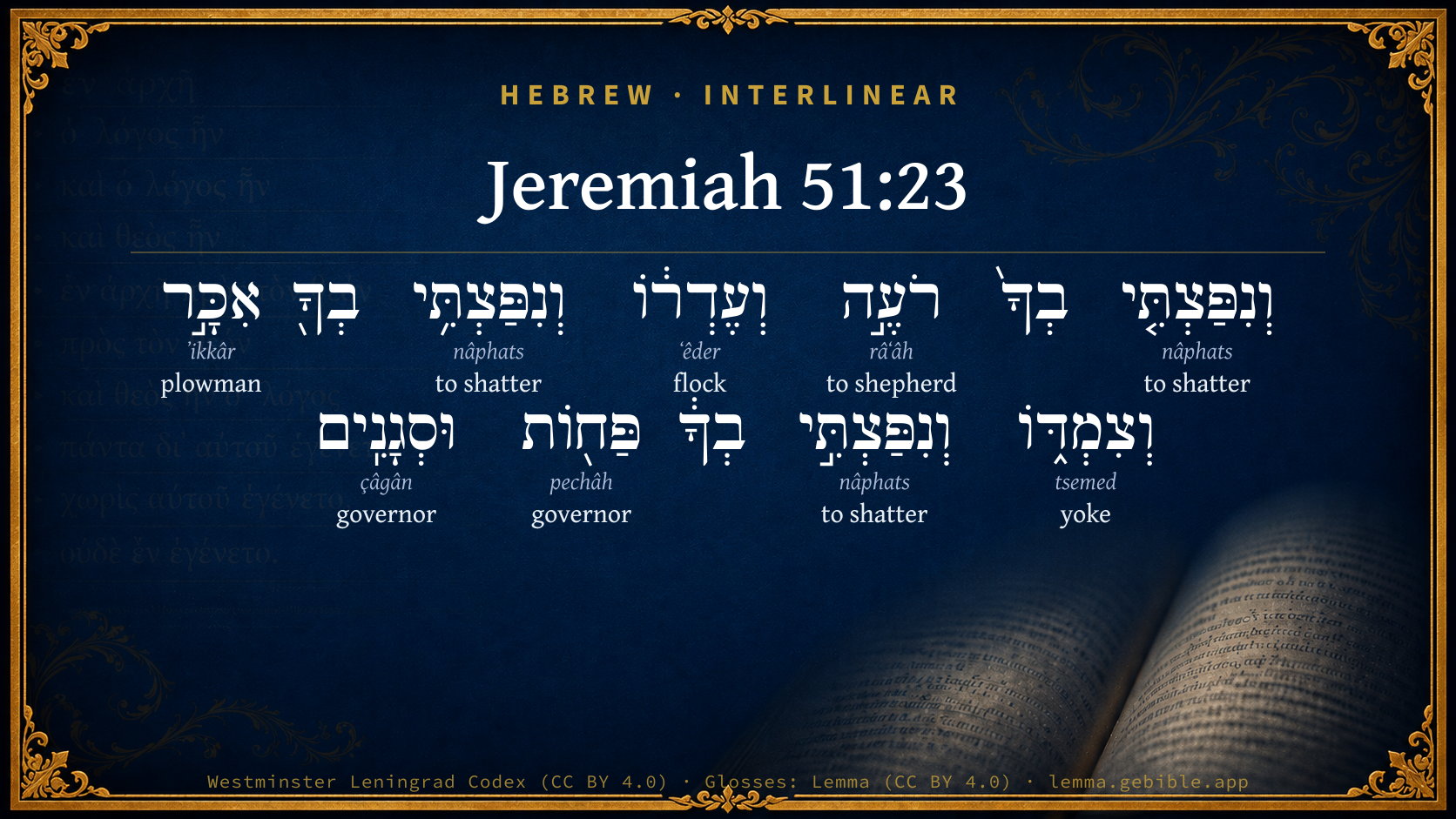
Hebrew (Westminster Leningrad Codex) Jeremiah 51:23 appears in the Hebrew Old Testament. The text above is from the Westminster Leningrad Codex. Each word links to its Strong’s number, a concise gloss, and parsing drawn from the Open Scriptures Hebrew Bible morphology. Click any word for its full Brown-Driver-Briggs (BDB) entry.
Download image
Cite this verse

Jeremiah 51:23 (World English Bible). Public Domain. Lemma interlinear Bible study tool, https://lemma.gebible.app/v/jeremiah/51/23.

Show BibTeX & RIS
BibTeX
RIS
English Translation
and with you will I break in pieces the shepherd and his flock; and with you will I break in pieces the farmer and his yoke [of oxen]; and with you will I break in pieces governors and deputies.
World English Bible · Public Domain
Download a study sheet

One document with this verse’s original text, its word-by-word gloss line, the meaning frame, cross-references with their text, attributed commentary, and full source and license credits — printable, and it pastes into notes with its structure intact.

This verse Autodidact and up

Study sheet (.html) Plain text (.txt)

A passage Seminary Student

Up to 50 verses in one chapter. A passage sheet keeps up to 6 commentary sources and 12 cross-references per verse, in the order this page ranks them, and says so on the sheet whenever that leaves anything out. Ask for a single verse and you get the Autodidact verse sheet above.

Everything on this page stays free to read, with no account — the sheet is a download of what is already on screen, not access to it.

Want to remove ads? Support Godless Engineer
Compare translations 3

The same verse in 3 English versions, stacked beneath the original-language interlinear above. Click any original word for its lexicon entry.

Each is an independent rendering of the whole verse — the interlinear is not word-aligned to these translations.

Highlighted words mark where these versions differ — a whole-verse word diff, not a word-by-word alignment.

  • World English Bible Public Domain
    and with you will I break in pieces the shepherd and his flock; and with you will I break in pieces the farmer and his yoke [of oxen]; and with you will I break in pieces governors and deputies.
  • King James Version Public Domain
    I will also break in pieces with thee the shepherd and his flock; and with thee will I break in pieces the husbandman and his yoke of oxen; and with thee will I break in pieces captains and rulers.
  • unfoldingWord Literal Text CC BY-SA 4.0
    With you I will smash the shepherds and their flocks; with you I will smash the plowmen and their teams. With you I will smash the governors and officials.

unfoldingWord Literal Text — © unfoldingWord, licensed CC BY-SA 4.0. Word-aligned USFM3 via Door43 (git.door43.org/unfoldingWord/en_ult).

Versions to compare (up to 4)

3 of 4 selected

Show all 18 translations

Every available English version of this verse, each an independent rendering of the whole verse.

  • World English Bible Public Domain
    and with you will I break in pieces the shepherd and his flock; and with you will I break in pieces the farmer and his yoke [of oxen]; and with you will I break in pieces governors and deputies.
  • Berean Standard Bible Public Domain
    With you I shatter the shepherd and his flock; with you I shatter the farmer and his oxen; with you I shatter the governors and officials.
  • Majority Standard Bible Public Domain
    With you I shatter the shepherd and his flock; with you I shatter the farmer and his oxen; with you I shatter the governors and officials.
  • King James Version Public Domain
    I will also break in pieces with thee the shepherd and his flock; and with thee will I break in pieces the husbandman and his yoke of oxen; and with thee will I break in pieces captains and rulers.
  • American Standard Version (1901) Public Domain
    and with thee will I break in pieces the shepherd and his flock; and with thee will I break in pieces the husbandman and his yoke `of oxen'; and with thee will I break in pieces governors and deputies.
  • Revised Version (1885) Public Domain
    and with thee will I break in pieces the shepherd and his flock; and with thee will I break in pieces the husbandman and his yoke of oxen; and with thee will I break in pieces governors and deputies.
  • Geneva Bible (1599) Public Domain
    I wil also breake by thee the shepheard and his flocke, and by thee will I breake the husband man and his yoke of oxen, and by thee will I breake the dukes and princes.
  • Douay-Rheims (1899) Public Domain
    And with thee I will break in pieces the shepherd and his dock, and with thee I will break in pieces the husbandman and his yoke of oxen, and with thee I will break in pieces captains and rulers.
  • Young's Literal Translation Public Domain
    And I have broken in pieces by thee shepherd and his drove, And I have broken in pieces by thee husbandman and his team, And I have broken in pieces by thee governors and prefects.
  • Literal Standard Version CC BY-SA 4.0
    And I have broken in pieces shepherd and his drove by you, || And I have broken in pieces farmer and his team by you, || And I have broken in pieces governors and prefects by you.
  • Unlocked Literal Bible CC BY-SA 4.0
    With you I will smash the shepherds and their flocks; with you I will smash the plowmen and their teams. With you I will smash the governors and officials.
  • unfoldingWord Literal Text CC BY-SA 4.0
    With you I will smash the shepherds and their flocks; with you I will smash the plowmen and their teams. With you I will smash the governors and officials.
  • Darby Bible Public Domain
    and with thee will I break in pieces the shepherd and his flock; and with thee will I break in pieces the husbandman and his yoke of oxen; and with thee will I break in pieces governors and rulers.
  • World Messianic Bible Public Domain
    With you I will break in pieces the shepherd and his flock. With you I will break in pieces the farmer and his yoke. With you I will break in pieces governors and deputies.
  • Webster's Bible Public Domain
    I will also break in pieces with thee the shepherd and his flock; and with thee will I break in pieces the husbandman and his yoke of oxen; and with thee will I break in pieces captains and rulers.
  • Free Bible Version CC BY-SA 4.0
    I use you to destroy shepherds and their flocks; I use you to destroy farmers and their cattle; I use you to destroy rulers and state officials.
  • Bible in Basic English Public Domain
    With you the keeper of sheep with his flock will be broken, and with you the farmer and his oxen will be broken, and with you captains and rulers will be broken.
  • JPS Tanakh (1917) Public Domain
    And with thee will I shatter the shepherd and his flock, and with thee will I shatter the husbandman and his yoke of oxen, and with thee will I shatter governors and deputies.

Literal Standard Version (2020), Covenant Press — licensed CC BY-SA 4.0. Text via the HelloAO Bible API (eBible.org). Unlocked Literal Bible (unfoldingWord) — licensed CC BY-SA 4.0. Text via the HelloAO Bible API (eBible.org). unfoldingWord Literal Text — © unfoldingWord, licensed CC BY-SA 4.0. Word-aligned USFM3 via Door43 (git.door43.org/unfoldingWord/en_ult). Free Bible Version, Dr. Jonathan Gallagher — licensed CC BY-SA 4.0. Text via the HelloAO Bible API (eBible.org).

Word by word

More ways to search: Search by grammar → Find every occurrence → Compare this word →

Practice this passage: Drill this verse → Learn its vocabulary →

אִכָּ֣ר
ʼikkâr
H406
“plowman”
Noun, Common, Masculine, Singular, Absolute
Part of Speech
Noun
Type
Common
Gender
Masculine
Number
Singular
State
Absolute
Full BDB Definition

Origin: from an unused root meaning to dig

TWOT: 88a

plowman, husbandman, farmer - working the land, yet not owning any of it
  1. וְנִפַּצְתִּ֤י nâphats H5310 “and · to shatter” Conjunction + Verb, Piel, Sequential Perfect, 1st Person, Common, Singular
  2. רֹעֶ֣ה râʻâh H7462 “shepherding” Verb, Qal, Participle Active, Masculine, Singular, Absolute
  3. וְעֶדְר֔וֹ ʻêder H5739 “and · flock · his” Conjunction + Noun, Common, Masculine, Singular, Construct + Suffix, Personal, 3rd Person, Masculine, Singular
  4. וְנִפַּצְתִּ֥י nâphats H5310 “and · to shatter” Conjunction + Verb, Piel, Sequential Perfect, 1st Person, Common, Singular
  5. וְצִמְדּ֑וֹ tsemed H6776 “and · yoke · his” Conjunction + Noun, Common, Masculine, Singular, Construct + Suffix, Personal, 3rd Person, Masculine, Singular
  6. וְנִפַּצְתִּ֣י nâphats H5310 “and · to shatter” Conjunction + Verb, Piel, Sequential Perfect, 1st Person, Common, Singular
  7. פַּח֖וֹת pechâh H6346 “governors” Noun, Common, Masculine, Plural, Absolute
  8. וּסְגָנִֽים çâgân H5461 “and · governors” Conjunction + Noun, Common, Masculine, Plural, Absolute

About this verse

These counts appear in no published source. They are computed here, from the morphology-tagged text and Lemma’s own curated glosses. What Lemma adds →

12
words
7
distinct lemmas
Prophets
section

Notable vocabulary

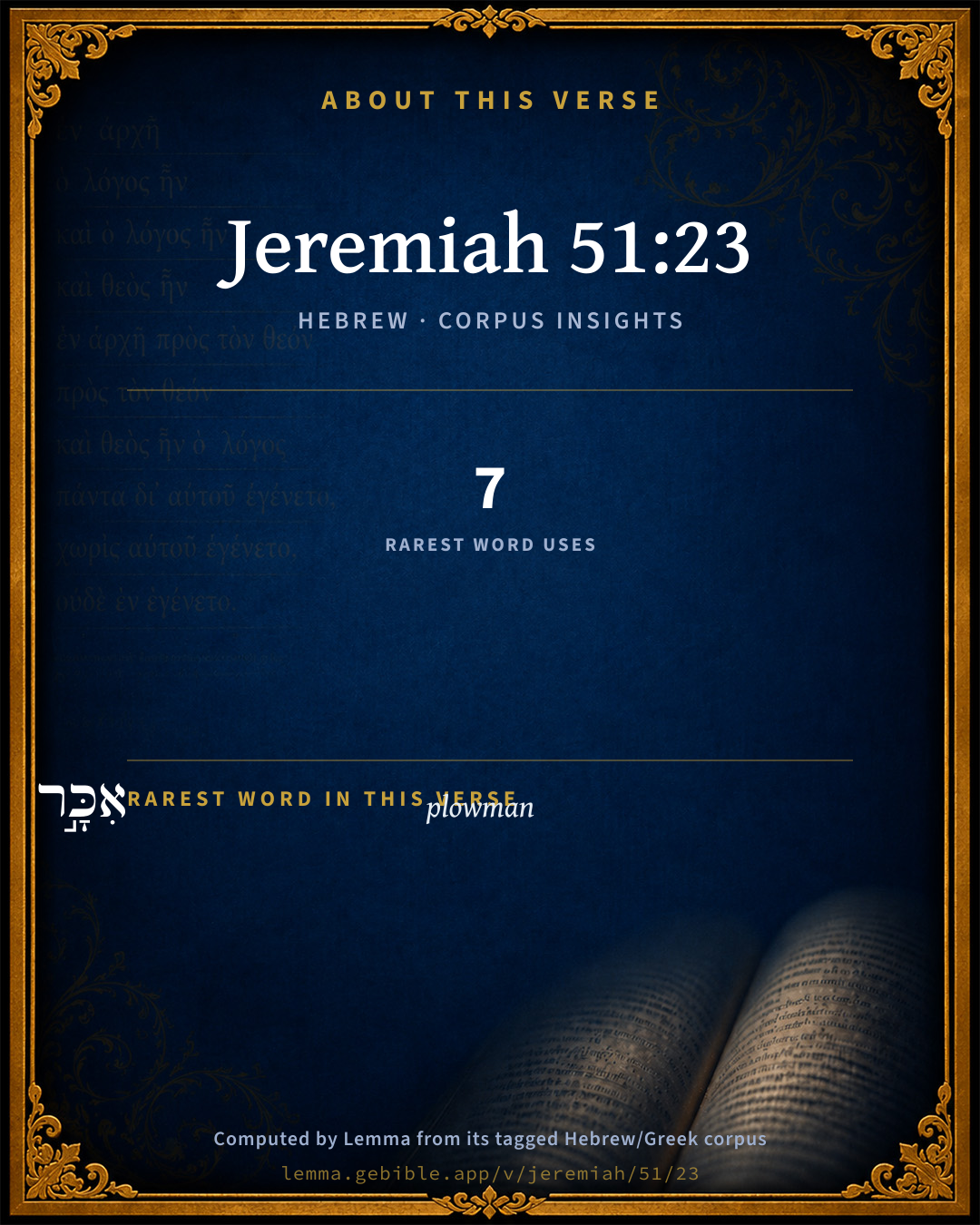
The rarest word here is אִכָּ֣ר plowman H406 — appearing just 7 times in the whole Hebrew Bible.

Shared distinctive vocabulary

אִכָּ֣ר plowman H406 occurs in 7 verses of the Hebrew Bible. Also found in:

Grammatical profile

  • 4 verbs
  • 5 nouns
  • 3 prepositions

Verb forms

  • וְנִפַּצְתִּ֤י Piel · Sequential Perfect
  • רֹעֶ֣ה Qal · Participle Active
  • וְנִפַּצְתִּ֥י Piel · Sequential Perfect
  • וְנִפַּצְתִּ֣י Piel · Sequential Perfect

Repetition

A word recurs within this verse — often emphatic in Hebrew:

  • וְנִפַּצְתִּ֤י to shatter H5310 ×3

Cross-references

1

Topical passages linked to Jeremiah 51:23 in the Treasury of Scripture Knowledge — connected by theme and wording, ordered by reader-vote popularity; previews shown in the World English Bible.

  • Jeremiah 51:57 I will make drunk her princes and her wise men, her governors and her deputies, and her mighty men; and they shall sleep a perpetual sleep, and not wake up, says the King, whose name is Yahweh of Hosts.

Cross-references courtesy of OpenBible.info (CC BY 4.0).

Hebrew and Greek witnesses Masoretic Hebrew ↔ Greek Septuagint

The same verse in the two great witnesses to the Old Testament, shown verse-for-verse.

These are two independent witnesses, not word-aligned to each other, and the Septuagint is shown in lemma (dictionary) form.

Hebrew Jeremiah 51:23 Masoretic · Westminster Leningrad Codex

וְנִפַּצְתִּ֤י בְךָ֙ רֹעֶ֣ה וְעֶדְר֔וֹ וְנִפַּצְתִּ֥י בְךָ֖ אִכָּ֣ר וְצִמְדּ֑וֹ וְנִפַּצְתִּ֣י בְךָ֔ פַּח֖וֹת וּסְגָנִֽים

and with you will I break in pieces the shepherd and his flock; and with you will I break in pieces the farmer and his yoke [of oxen]; and with you will I break in pieces governors and deputies.

World English Bible · Public Domain

Greek LXX Structure differs

In the Septuagint, Jeremiah is about an eighth shorter than the Hebrew and arranges its material differently — the Oracles Against the Nations (Hebrew chapters 46–51) appear in the middle of the Greek book, after 25:13. Because the chapter and verse boundaries do not line up, a verse-for-verse comparison with the Hebrew is not shown.

A verse-for-verse comparison isn’t shown here because the chapters and verses don’t line up. Switch to the LXX edition with the MT / LXX toggle above to read the Greek directly.

Hebrew: Westminster Leningrad Codex (CC BY 4.0). Greek: Septuagint (public domain); English from a public-domain English Septuagint. How the Septuagint differs from the Hebrew →

Targum (Aramaic paraphrase)

1

The Targum is the ancient Jewish Aramaic paraphrase of the Hebrew Scriptures — an interpretive translation, not the Hebrew text itself. Onkelos (literal) and Pseudo-Jonathan (expansive) render the Torah, and Jonathan the Prophets. Coverage is partial: where no permissively-licensed English translation exists for a verse, only the Aramaic is shown. This is verse-level text, not a word-by-word alignment to the Hebrew.

  1. Targum Jonathan Prophets (Joshua–Malachi)
    וַאֲבַדַר בָּךְ רַעֲיָא וְעֶדְרֵיהּ וַאֲבַדַר בָּךְ אִכַּר וּפַדְנֵיהּ וַאֲבַדַר בָּךְ שִׁלְטוֹנִין וְטוּרְנִין:

    (no public-domain English translation for this verse)

    Targum Jonathan — Aramaic: “Mikraot Gedolot” (public domain). English: “Sefaria Community Translation” (CC0 1.0 (public-domain dedication)); “London "Chaldee Paraphrase," 1871” (public domain). Text via Sefaria.

Commentary

Notes on Jeremiah 51:23 from classic Christian and Jewish commentators (each source and its license shown beneath its notes). The classic Christian expositions comment on the surrounding passage and are grouped to its opening verse, so a note may address several verses; the Jewish commentaries on the Tanakh (Rashi and others) are per-verse, so they appear only where the commentator wrote on this verse.

Lemma curates 59 commentaries, every one of them public domain or Creative Commons licensed, each selected and text-cleaned for this edition rather than reprinted as found. About our sources →

Trapp's Complete Commentary

John Trapp

Jer 51:23 I will also break in pieces with thee the shepherd and his flock; and with thee will I break in pieces the husbandman and his yoke of oxen; and with thee will I break in pieces captains and rulers.

Ver. 23. The shepherd and his flock, the husbandman and his yoke, &c.] This particular enumeration is very emphatic. {so Jer 50:35; Jer 50:37-38}

John Trapp, A Commentary or Exposition upon All the Books of the Old and New Testament (1647–1656) — public domain. Text from a community e-Sword module.

Ellicott's Commentary for English Readers

(23) With thee will I break in pieces captains and rulers.—The exhausting of all sorts and conditions of men culminates in the ruling caste. The Hebrew word for “captain” (Pekha) is interesting as connected with the Arabic, with which we are now familiar in the form Pacha (Fürst, Lex.).

A Bible Commentary for English Readers, edited by Charles John Ellicott (1878–1897) — public domain. Text from a community e-Sword module.

The Cambridge Bible for Schools and Colleges

gen. ed. J. J. S. Perowne

23. governors [mg. lieutenants] and deputies] Cp. Jer_51:28; Jer_51:57; also Eze_23:6; Eze_23:12-23. The names in the original are not Heb. but Assyrian, and are often found in inscriptions in that language. The former is applied to Tattenai (Ezr_5:6), Nehemiah (Neh_5:14), and Zerubbabel (Hag_1:1).

The Cambridge Bible for Schools and Colleges (gen. ed. J. J. S. Perowne; Cambridge University Press, 1878–1918) — public domain. Text from a community e-Sword module.

John Gill's Exposition

Behold, I am against thee, O destroying mountain, saith the Lord, which destroyest all the earth,.... Babylon is called a mountain, though situated in a plain, because of its high walls, lofty towers, and hanging gardens, which made it look at a distance like a high mountain, as Lebanon, and others: or because it was a strong fortified city; so the Targum renders it, O destroying city: or because of its power and grandeur as a monarchy, it being usual to compare monarchies to mountains; see Isa 2:2; here called a "destroying" one for a reason given, because it destroyed all the earth, all the nations and kingdoms of it: the same character is given of mystical Babylon and its inhabitants, Rev 11:18,

and I will stretch out mine hand upon thee: in a way of vindictive wrath, pouring it out upon her, and inflicting his judgments on her; laying hold on and seizing her in a furious manner, as a man does his enemy, when he has found him:

and roll them down from the rocks; towers and fortresses in Babylon, which looked like rocks, but should be now demolished:

and will make thee a burnt mountain: reduced to cinders and ashes by the conflagration of it: or, "a burning mountain": like Etna and Vesuvius; we never read of the burning of literal Babylon, but we do of mystical Babylon: see Rev 18:8; and with this compare Rev 8:8. The Targum renders it, a burnt city.

John Gill's Exposition of the Whole Bible (1746–1763) — public domain (CC PDM 1.0). Text via the HelloAO Bible API.

Albert Barnes' Notes on the Bible

Captains ... rulers - Jer 51:28. Pashas and Sagans. The prophet dwells at length upon Babylon’s destructiveness.

Albert Barnes' Notes on the Bible (1834–1885) — public domain. Text from a community e-Sword/MySword module.

Matthew Poole's English Annotations

The sense of all three verse is the same, viz. that God had made use of, and was still making use of the Babylonians to waste and impoverish much people, wasting their goods, routing their armies, killing all sorts of their inhabitants.

Matthew Poole's English Annotations on the Holy Bible (1683–1685) — public domain. Text from a community e-Sword/MySword module.

The Pulpit Commentary

Captains; rather, governors. It is the Hebraized form (pekhah) of the official name of an Assyrian or Babylonian governor (Pahhat). rulers; rather, viceroys; Hebrew, segamin (plural). The singular, sagan, is Hebraized from the Assyrian sakun, Babylonian sagun.

The Pulpit Commentary (1880–1919), ed. H.D.M. Spence-Jones & Joseph S. Exell — public domain. Text from a community e-Sword module.

John Wesley's Explanatory Notes

Break in pieces - The sense of all these three verses is the same; that God had made use, and was still making use of the Babylonians to destroy many nations, to spoil much people, wasting their goods, routing their armies, killing all sorts of their inhabitants.

John Wesley, Explanatory Notes Upon the Whole Bible (1754–1765) — public domain. Text via the GEBible commentary corpus.

Lesson kit

Teaching starters — assembled from the data on this page, not authored interpretation. Every prompt links to the verse data it draws on. Edit before teaching.

Jeremiah, in the Prophets, opens this verse with 12 words (7 distinct Hebrew lemmas). Its most distinctive word is ʼikkâr (“plowman”). A historical commentator’s framing appears above. Read the whole chapter for the surrounding context.

Discussion questions

  1. How does “plowman” (ʼikkâr) shape what this verse is saying?
  2. 2 Chronicles 26:10 shares the word «plowman» with this verse. How do the two illuminate each other?
  3. “to shatter” occurs 3× in this one verse. What is the effect of the repetition?
  4. These translations render this verse differently. What is at stake in choosing one wording over another?
  5. The verb «וְנִפַּצְתִּ֤י» is Piel Sequential Perfect. How does its form color the action?
  6. Reading how Trapp's Complete Commentary and Ellicott's Commentary for English Readers read this verse, where do the two commentators agree and where do they part?

Things to notice

  • These translations choose different wording for 20 words in this verse.
  • “to shatter” occurs 3× in this single verse.
  • 7 distinct Hebrew lemmas span 12 words in this verse.

Reading settings

Reading text

Shown beneath each verse's original-language words.

Old Testament
Old Testament edition

Read the OT as the Masoretic Hebrew (MT) or the Greek Septuagint (LXX).

English shown for the Greek Septuagint (in the Hebrew ↔ Greek comparison).

Comparing translations? Open the Compare panel on any verse page to stack up to four side by side.