
Psalms 80:13

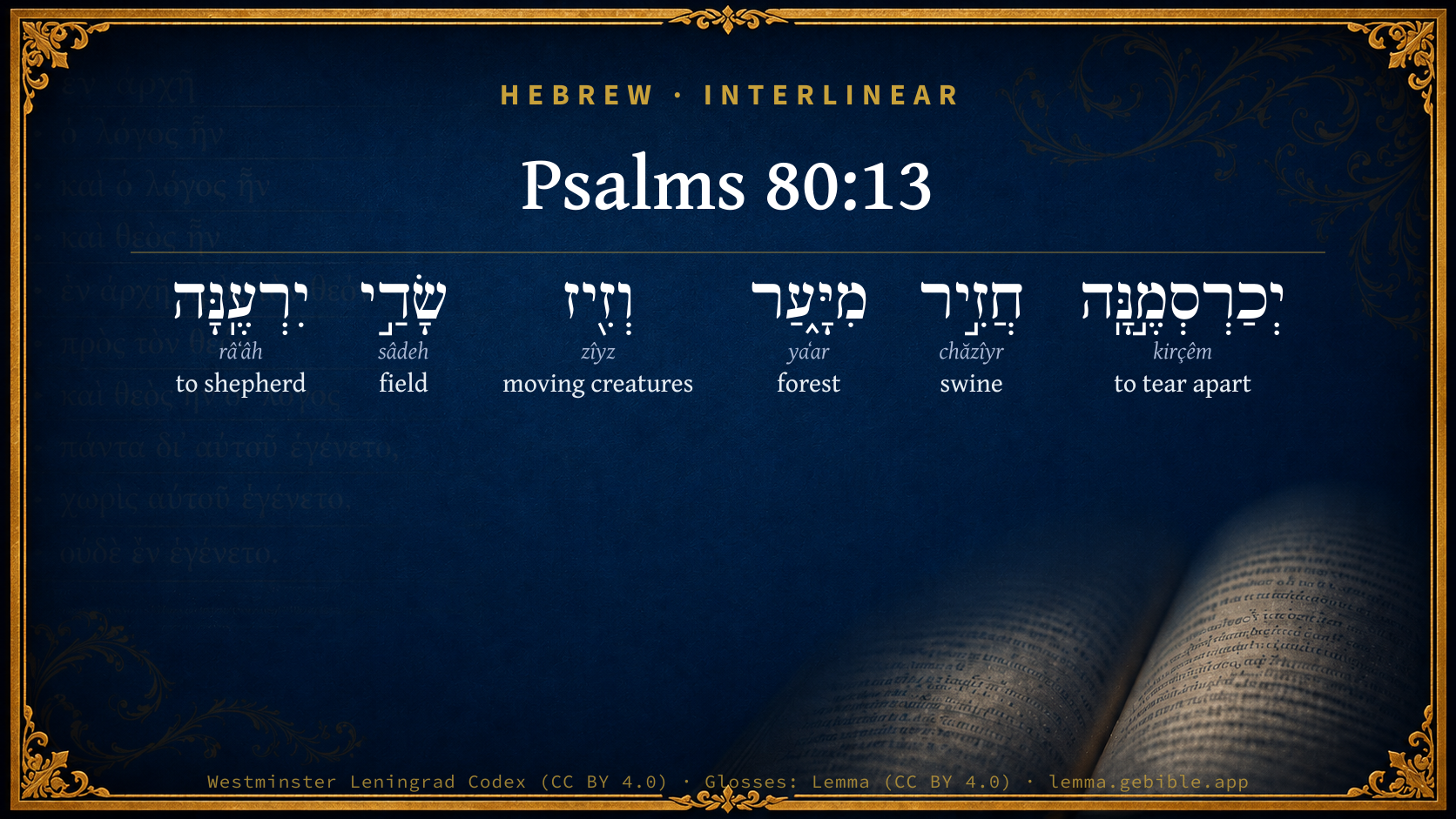
Hebrew (Westminster Leningrad Codex) Psalms 80:13 appears in the Hebrew Old Testament. The text above is from the Westminster Leningrad Codex. Each word links to its Strong’s number, a concise gloss, and parsing drawn from the Open Scriptures Hebrew Bible morphology. Click any word for its full Brown-Driver-Briggs (BDB) entry.
Download image
Cite this verse

Psalms 80:13 (World English Bible). Public Domain. Lemma interlinear Bible study tool, https://lemma.gebible.app/v/psalms/80/13.

Show BibTeX & RIS
BibTeX
RIS
English Translation
The boar out of the wood ravages it. The wild animals of the field feed on it.
World English Bible · Public Domain
Highlights
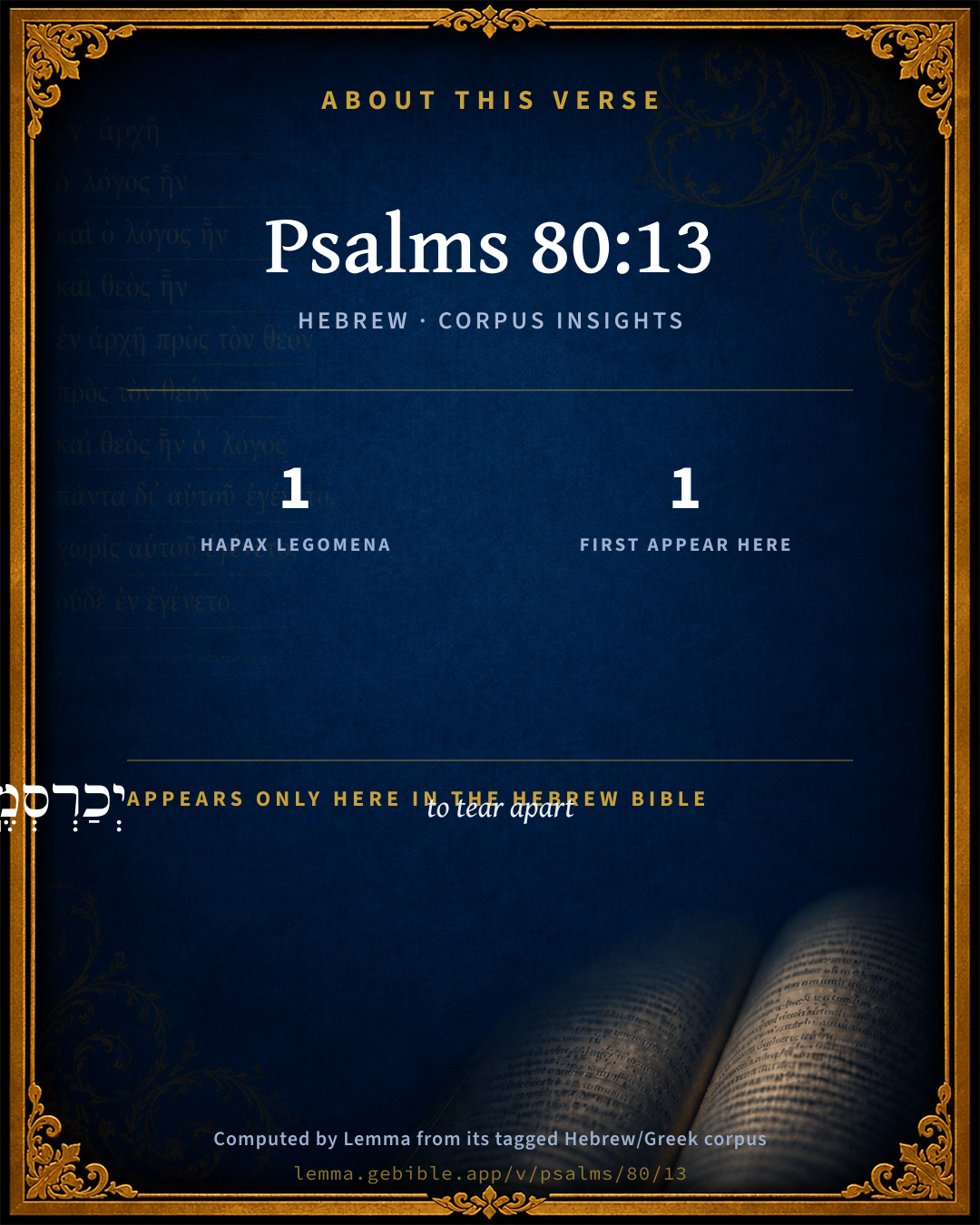
  • 1 hapax legomenon — only here in the Hebrew Bible
  • 1 first appearance in the Hebrew Bible
Full analysis ↓
Download a study sheet

One document with this verse’s original text, its word-by-word gloss line, the meaning frame, cross-references with their text, attributed commentary, and full source and license credits — printable, and it pastes into notes with its structure intact.

This verse Autodidact and up

Study sheet (.html) Plain text (.txt)

A passage Seminary Student

Up to 50 verses in one chapter. A passage sheet keeps up to 6 commentary sources and 12 cross-references per verse, in the order this page ranks them, and says so on the sheet whenever that leaves anything out. Ask for a single verse and you get the Autodidact verse sheet above.

Everything on this page stays free to read, with no account — the sheet is a download of what is already on screen, not access to it.

Want to remove ads? Support Godless Engineer
Compare translations 3

The same verse in 3 English versions, stacked beneath the original-language interlinear above. Click any original word for its lexicon entry.

Each is an independent rendering of the whole verse — the interlinear is not word-aligned to these translations.

Highlighted words mark where these versions differ — a whole-verse word diff, not a word-by-word alignment.

  • World English Bible Public Domain
    The boar out of the wood ravages it. The wild animals of the field feed on it.
  • King James Version Public Domain
    The boar out of the wood doth waste it, and the wild beast of the field doth devour it.
  • unfoldingWord Literal Text CC BY-SA 4.0
    The boar from the forest ravages it, and the creature of the field grazes on it.

unfoldingWord Literal Text — © unfoldingWord, licensed CC BY-SA 4.0. Word-aligned USFM3 via Door43 (git.door43.org/unfoldingWord/en_ult).

Versions to compare (up to 4)

3 of 4 selected

Show all 18 translations

Every available English version of this verse, each an independent rendering of the whole verse.

  • World English Bible Public Domain
    The boar out of the wood ravages it. The wild animals of the field feed on it.
  • Berean Standard Bible Public Domain
    The boar from the forest ravages it, and the creatures of the field feed upon it.
  • Majority Standard Bible Public Domain
    The boar from the forest ravages it, and the creatures of the field feed upon it.
  • King James Version Public Domain
    The boar out of the wood doth waste it, and the wild beast of the field doth devour it.
  • American Standard Version (1901) Public Domain
    The boar out of the wood doth ravage it, And the wild beasts of the field feed on it.
  • Revised Version (1885) Public Domain
    The boar out of the wood doth ravage it, and the wild beasts of the field feed on it.
  • Geneva Bible (1599) Public Domain
    The wilde bore out of the wood hath destroyed it, and the wilde beastes of the fielde haue eaten it vp.
  • Douay-Rheims (1899) Public Domain
    Why hast thou broken down the hedge thereof, so that all they who pass by the way do pluck it?
  • Young's Literal Translation Public Domain
    A boar out of the forest doth waste it, And a wild beast of the fields consumeth it.
  • Literal Standard Version CC BY-SA 4.0
    A boar out of the forest tears it, || And a wild beast of the fields grazes it.
  • Unlocked Literal Bible CC BY-SA 4.0
    The boars out of the forest ruin it, and the beasts of the field feed on it.
  • unfoldingWord Literal Text CC BY-SA 4.0
    The boar from the forest ravages it, and the creature of the field grazes on it.
  • Darby Bible Public Domain
    The boar out of the forest doth waste it, and the beast of the field doth feed off it.
  • World Messianic Bible Public Domain
    The boar out of the wood ravages it. The wild animals of the field feed on it.
  • Webster's Bible Public Domain
    \\80:12\\Why hast thou then broke down her hedges, so that all they who pass by the way do pluck her?
  • Free Bible Version CC BY-SA 4.0
    Wild pigs from the forest eat it, wild animals feed on it.
  • Bible in Basic English Public Domain
    It is uprooted by the pigs from the woods, the beasts of the field get their food from it.
  • JPS Tanakh (1917) Public Domain
    (80-14) The boar out of the wood doth ravage it, that which moveth in the field feedeth on it.

Literal Standard Version (2020), Covenant Press — licensed CC BY-SA 4.0. Text via the HelloAO Bible API (eBible.org). Unlocked Literal Bible (unfoldingWord) — licensed CC BY-SA 4.0. Text via the HelloAO Bible API (eBible.org). unfoldingWord Literal Text — © unfoldingWord, licensed CC BY-SA 4.0. Word-aligned USFM3 via Door43 (git.door43.org/unfoldingWord/en_ult). Free Bible Version, Dr. Jonathan Gallagher — licensed CC BY-SA 4.0. Text via the HelloAO Bible API (eBible.org).

Word by word

More ways to search: Search by grammar → Find every occurrence → Compare this word →

Practice this passage: Drill this verse → Learn its vocabulary →

About this verse

These counts appear in no published source. They are computed here, from the morphology-tagged text and Lemma’s own curated glosses. What Lemma adds →

6
words
6
distinct lemmas
Wisdom
section

Notable vocabulary

1 hapax legomenon — a word that appears only here in the entire Hebrew Bible:

  • יְכַרְסְמֶ֣נָּֽה to tear apart H3765

First appearance in Scripture

This word makes its first canonical appearance in the Hebrew Bible here:

  • יְכַרְסְמֶ֣נָּֽה to tear apart H3765

Shared distinctive vocabulary

וְזִ֖יז moving creatures H2123 occurs in 3 verses of the Hebrew Bible. Also found in:

Grammatical profile

  • 2 verbs
  • 4 nouns

Verb forms

  • יְכַרְסְמֶ֣נָּֽה Piel · Imperfect
  • יִרְעֶֽנָּה Qal · Imperfect

Hebrew & Septuagint length

In English translation the verse runs 17 words from the Hebrew and 17 from the Septuagint (LXX English) — the same length.

A rough comparison of the two English renderings, which tokenize alike — not a word-level alignment.

Word counts can differ between the Hebrew and the Greek without any difference in meaning — e.g. the Hebrew direct-object marker אֵת has no separate Greek word, and Greek often adds the article ὁ.

Cross-references

10

Topical passages linked to Psalms 80:13 in the Treasury of Scripture Knowledge — connected by theme and wording, ordered by reader-vote popularity; previews shown in the World English Bible.

  • Jeremiah 4:7 A lion is gone up from his thicket, and a destroyer of nations; he is on his way, he is gone forth from his place, to make your land desolate, that your cities be laid waste, without inhabitant.
  • Jeremiah 5:6 Therefore a lion out of the forest shall kill them, a wolf of the evenings shall destroy them, a leopard shall watch against their cities; everyone who goes out there shall be torn in pieces; because their transgressions are many, [and] their backsliding is increased.
  • 2 Kings 18:1–19 Now it happened in the third year of Hoshea son of Elah king of Israel, that Hezekiah the son of Ahaz king of Judah began to reign.
  • 2 Kings 24:1–20 In his days Nebuchadnezzar king of Babylon came up, and Jehoiakim became his servant three years: then he turned and rebelled against him.
  • 2 Chronicles 32:1–33 After these things, and this faithfulness, Sennacherib king of Assyria came, and entered into Judah, and encamped against the fortified cities, and thought to win them for himself.
  • 2 Chronicles 36:1–23 Then the people of the land took Jehoahaz the son of Josiah, and made him king in his father's place in Jerusalem.
  • Jeremiah 39:1–3 It happened when Jerusalem was taken, (in the ninth year of Zedekiah king of Judah, in the tenth month, came Nebuchadrezzar king of Babylon and all his army against Jerusalem, and besieged it;
  • Jeremiah 51:34 Nebuchadrezzar the king of Babylon has devoured me, he has crushed me, he has made me an empty vessel, he has, like a monster, swallowed me up, he has filled his maw with my delicacies; he has cast me out.
  • Jeremiah 52:7 Then a breach was made in the city, and all the men of war fled, and went forth out of the city by night by the way of the gate between the two walls, which was by the king's garden; (now the Chaldeans were against the city round about;) and they went toward the Arabah.
  • Jeremiah 52:12–14 Now in the fifth month, in the tenth day of the month, which was the nineteenth year of king Nebuchadrezzar, king of Babylon, came Nebuzaradan the captain of the guard, who stood before the king of Babylon, into Jerusalem:

Cross-references courtesy of OpenBible.info (CC BY 4.0).

Hebrew and Greek witnesses Masoretic Hebrew ↔ Greek Septuagint

The same verse in the two great witnesses to the Old Testament, shown verse-for-verse.

You’re reading Greek Psalm 79 (Hebrew Psalm 80). The Septuagint counts the superscription, so verse numbers can differ from the Hebrew — chapter-level alignment, not verse-by-verse. Numbering follows Rahlfs.

These are two independent witnesses, not word-aligned to each other, and the Septuagint is shown in lemma (dictionary) form.

Hebrew Psalms 80:13 Masoretic · Westminster Leningrad Codex

יְכַרְסְמֶ֣נָּֽה חֲזִ֣יר מִיָּ֑עַר וְזִ֖יז שָׂדַ֣י יִרְעֶֽנָּה

The boar out of the wood ravages it. The wild animals of the field feed on it.

World English Bible · Public Domain

Greek LXX Greek Psalm 79:13 Septuagint · lemma form

ἵνα τίς κατααἱρέω ὁ φραγμός αὐτός καί τρυγάω αὐτός πᾶς ὁ παραπορεύομαι ὁ ὁδός

The boar out of the wood has laid it waste, and the wild beast has devoured it.

LXX2012 (modern English Septuagint) · Public Domain

Hebrew: Westminster Leningrad Codex (CC BY 4.0). Greek: Septuagint (public domain); English from LXX2012 (modern English Septuagint) (Public Domain). How the Septuagint differs from the Hebrew →

Commentary

Notes on Psalms 80:13 from classic Christian and Jewish commentators (each source and its license shown beneath its notes). The classic Christian expositions comment on the surrounding passage and are grouped to its opening verse, so a note may address several verses; the Jewish commentaries on the Tanakh (Rashi and others) are per-verse, so they appear only where the commentator wrote on this verse.

Lemma curates 59 commentaries, every one of them public domain or Creative Commons licensed, each selected and text-cleaned for this edition rather than reprinted as found. About our sources →

Trapp's Complete Commentary

John Trapp

Psa 80:13 The boar out of the wood doth waste it, and the wild beast of the field doth devour it.

Ver. 13. The boar out of the wood] All swine (but wild ones especially) are vitibus inimici, saith Theodoret, destructions to vines. And Melancthon thinks that therefore God forbad the Jews to eat swine’s flesh, Eo quod sues omnia sursum deorsum vertant vastentque, because they turn up all, rooting things up by the roots, as the word here signifieth, Exvineavit, ελυμηνατο αυτην (Sept.). Austin understands it of Vespasian, others of Antiochus, or Antichrist.

And the wild beast] The soldiers, 2Ch 25:18.

John Trapp, A Commentary or Exposition upon All the Books of the Old and New Testament (1647–1656) — public domain. Text from a community e-Sword module.

The Biblical Illustrator

Joseph S. Exell

Psa_80:13

The boar out of the wood doth waste it, and the wild beast of the field doth devour it.

People to be feared

By this homely but expressive figure, the text sets forth the bad influences which in olden time broke in upon Gods heritage, as with swines foot trampling, and as with swines snout uprooting the vineyards of prosperity. What was true then is true now. There have been enough trees of righteousness planted to overshadow the whole earth, had it not been for the axemen who hewed them down.

I. I propose to point out to you those whom I consider to be the uprooting and devouring classes of society.

1. First, the public criminals. What is the fire that burns your store down compared with the conflagration which consumes your morals? What is the theft of the gold and silver from your money safe compared with the theft of your childrens virtue?

2. Again: in this class of uprooting and devouring population are untrustworthy officials (Ecc_10:16). It is a great calamity to a city when bad men get into public authority. Too great leniency to criminals is too great severity to society.

3. Again: among the uprooting and devouring classes in our midst, are the idle. When the French nobleman was asked why he kept busy when he had so large a property, he said: I keep on engraving so I may not hang myself. I do not care who the man is, you cannot afford to be idle. It is from the idle classes that the criminal classes are made up. Character, like water, gets putrid if it stands still too long.

4. Again: among the uprooting classes I place the oppressed poor. While there is no excuse for criminality, even in oppression, I state it as a simple fact that much of the scoundrelism of the community is consequent upon ill-treatment. There are many men and women battered and bruised, and stung until the hour of despair has come, and they stand with the ferocity of a wild beast, which, pursued until it can run no longer, turns round, foaming and bleeding, to fight the hounds. I want you to know who are the uprooting classes of society.

II. Because I want you to be more discriminating in your charities. Because I want your hearts open with generosity, and your hands open with charity. Because I want you to be made the sworn friends of all city evangelization, and all newsboys lodging houses, and all Howard missions, and Childrens Aid Societies. But more than that, I have preached the sermon because I thought in the contrast you would see how very kindly God had dealt with you, and I thought that you would go to-day to your comfortable homes, and sit at your well-filled tables, and look at the round faces of your children, and that then you would burst into tears at the review of Gods goodness to you, and that you would go to your room and lock the door; and kneel down, and say: O Lord, I have been an ingrate; make me Thy child. (T. De Witt Talmage.)

Ecclesiastical ruins

Whatever may have been the period when this psalm was written, it is a remarkable fact that it has been suitable for every age, from the days of the Judges until now, and been found expressive of the prayer and outlook of the people of the Lord. Failure has ever attended the ecclesiastical systems of earth. The theocracy which Joshua left was soon in ruins. The magnificent and well-ordered temple ritual organized by David and established by Solomon did not continue in its glory for one generation. Again and again it was restored by reforms, but grew worse and worse till the Lord Christ came. Then followed the Christian Church; but as that slowly rose into power it became a degenerate vine, and Catholicism grew to be such a curse that one-third of the Christian world rose in open protest, and the revolt of another third was stifled with blood. Then came the Reformed Churches. For a while they flourish, but full soon when the Master looks for fruit they bring forth wild grapes. The holiest souls in each to-day are crying, as they have through all the ages, The forest boar rends it, and the wild beast feeds upon it. This continued failure is solemn and instructive. As yet every religious system has sooner or later degenerated. Its fence has been broken down and wayfarers have mocked. Man was not made for ecclesiastical organization, but ecclesiastical organization for man. The work of the Holy Spirit of God is upon separate souls, and sometimes ecclesiastical failure drives the soul into closer communion with the true God. Grand spirits, like Asaph, are developed amidst Church disorder. Let the psalmists and the prophets, let the heroes of successive reformations, Columba and Patrick, Wickliffle and Luther, Wesley and Whitfield bear testimony to this. (J. H. Cooke.)

The Biblical Illustrator, edited by Joseph S. Exell (c. 1880s–1900s) — public domain. Text from a community e-Sword module.

J. A. Alexander on Psalms

Joseph Addison Alexander

14. (Psa 80:13) The boar out of the wood doth waste it, and the beast of the field feeds upon it. For the precise sense of the word translated beast, see above, on Psa 50:11, the only other place where it occurs in such an application, being thus peculiar to the psalms which bear the name of Asaph. The essential idea conveyed by the figures of this verse is that of fierce and greedy enemies. If any more specific explanation be admissible, the wild boar may denote the Assyrian power, and the parallel term its allies and dependents. Feeds upon it, as a sheep upon its pasture. See above, on Psa 37:3.

Joseph Addison Alexander, The Psalms Translated and Explained (1850) — public domain. Text from a community e-Sword module.

Tyndale Open Study Notes

Tyndale Open Resources

80:13 The surrounding nations were ceremonially unclean, like a wild boar or vicious wild animals.

Tyndale Open Study Notes — © Tyndale Open Resources, licensed CC BY-SA 4.0. Text via the HelloAO Bible API.

Geneva Bible (1599)

Geneva Bible translators

That is, as well they that hate our religion, as they that hate our persons.

Geneva Bible (1599) marginal notes — public domain. Text via Bolls.life.

Adam Clarke's Commentary

Verse 13. The boar out of the wood] Nebuchadnezzar, king of Babylon, who was a fierce and cruel sovereign. The allusion is plain. The wild hogs and buffaloes make sad havoc in the fields of the Hindoos, and in their orchards: to keep them out, men are placed at night on covered stages in the fields.

Adam Clarke's Commentary on the Bible (1810–1826) — public domain. Text from a community e-Sword/MySword module.

Ellicott's Commentary for English Readers

(13) Boar.—This is the sole mention of the wild boar in Scripture. But it must not therefore be inferred that it was rare in Palestine. (See Tristram’s Nat. Hist. Bib., p. 54.) The writer gives a sad picture of the ravage a herd of them will make in a single night. Comp.—

“In vengeance of neglected sacrifice,

On Oencus’ fields she sent a monstrous boar,

That levell’d harvests and whole forests tore.”

HOMER: Iliad (Pope’s Trans.).

Wild beast.—It seems natural, at first, to take this beast as the emblem of some particular power or oppressor, as the crocodile is of Egypt, the lion of Assyria, &c. But the general term—literally, that moving in the field (see Ps. 1:11)—makes against such an identification.

A Bible Commentary for English Readers, edited by Charles John Ellicott (1878–1897) — public domain. Text from a community e-Sword module.

The Cambridge Bible for Schools and Colleges

gen. ed. J. J. S. Perowne

13. The boar out of the forest doth ravage it,

And the wild beasts of the field feed on it.

“Under Hermon,” says Dr Tristram, “in the vineyard districts, we heard grievous lamentations of the damage done to the vines by the boars, which not only devour the grapes, but also munch up the bearing shoots.” Nat. Hist. of Bible, p. 56. Israel’s land is laid waste by remorseless enemies.

The Cambridge Bible for Schools and Colleges (gen. ed. J. J. S. Perowne; Cambridge University Press, 1878–1918) — public domain. Text from a community e-Sword module.

John Gill's Exposition

Return, we beseech thee, O God of hosts,.... The Lord had been with his vine, the people of Israel, when he brought them out of Egypt, and planted and settled them in the land of Canaan, and made them a flourishing people; but had departed from them when he suffered the hedges about them to be broken down, and the boar and wild beast to enter and devour them; and here he is entreated to return and restore them to their former prosperity. So the Lord sometimes departs from his church and people, and hides his face from them; and may be said to return, when he manifests himself, shows his face and his favour again, and grants his gracious presence, than which nothing is more desirable; and if he, the Lord of hosts and armies, above and below, is with his people, none can be against them to their hurt; they have nothing to fear from any enemy:

look down from heaven: the habitation of his holiness, the high and holy place where he dwells, and his throne is, from whence he takes a survey of men and things; where he now was at a distance from his people, being returned to his place in resentment, and covered himself with a cloud from their sight; and from whence it would be a condescension in him to look on them on earth, so very undeserving of a look of love and mercy from him:

and behold; the affliction and distress his people were in, as he formerly beheld the affliction of Israel in Egypt, and sympathized with them, and brought them out of it:

and visit this vine; before described, for whom he had done such great things, and now was in such a ruinous condition; the visit desired is in a way of mercy and kind providence; so the Targum,

"and remember in mercies this vine;''

so the Lord visits his chosen people by the mission and incarnation of his Son, and by the redemption of them by him, and by the effectual calling of them by his Spirit and grace through the ministration of the Gospel; and which perhaps may, in the mystical sense, be respected here; see Luk 1:68.

John Gill's Exposition of the Whole Bible (1746–1763) — public domain (CC PDM 1.0). Text via the HelloAO Bible API.

Albert Barnes' Notes on the Bible

The boar out of the wood - Men come in and ravage the land, whose character may be compared with the wild boar. The word rendered boar means simply swine. The addition of the phrase “out of the wood” determines its meaning here, and shows that the reference is to wild or untamed swine; swine that roam the woods - an animal always extremely fierce and savage.

Doth waste it - The word used here occurs nowhere else. It means to cut down or cut off; to devour; to lay waste.

And the wild beast of the field - Of the unenclosed field; or, that roams at large - such as lions, panthers, tigers, wolves. The word here used - זיז zı̂yz - occurs besides only in Psa 50:11; and Isa 66:11. In Isa 66:11, it is rendered abundance.

Doth devour it - So the people from abroad consumed all that the land produced, or thus they laid it waste.

Albert Barnes' Notes on the Bible (1834–1885) — public domain. Text from a community e-Sword/MySword module.

Matthew Poole's English Annotations

The wood; where boars use to lodge, as it is noted by many authors; by which he understands their fierce and furious enemies.

Matthew Poole's English Annotations on the Holy Bible (1683–1685) — public domain. Text from a community e-Sword/MySword module.

The Treasury of David

Charles H. Spurgeon

Ver. 13. The boar out of the wood doth waste it. Such creatures are famous for rending and devouring vines. Babylon, like a beast from the marshes of the Euphrates, came up and wasted Judah and Israel. Fierce peoples, comparable to wild swine of the forest, warred with the Jewish nation, until it was gored and torn like a vine destroyed by greedy hogs.

And the wild beast of the field doth devour it. First one foe and then another wreaked vengeance on the nation, neither did God interpose to chase them away. Ruin followed ruin; the fox devoured the young shoots which had been saved from the damage wrought by the boar. Alas, poor land. How low wast thou brought! An oak or cedar might have been crushed by such ravages, but how canst thou endure it, O weak and tender vine? See what evils follow in the train of sin, and how terrible a thing it is for a people to be forsaken of their God.

Ver. 13. The boar out of the wood doth waste it. The very boar that laid her waste is a singular wild beast. Singular, because proud. For thus saith every proud one, It is I, it is I, and no other. Augustine.

Ver. 13. The boar out of the wood doth waste it. No image of a destructive enemy could be more appropriate than that which is used. We have read of the little foxes that spoil the vines, but the wild boar is a much more destructive enemy, breaking its way through fences, rooting up the ground, tearing down the vines themselves, and treading them under its feet. A single party of these animals will sometimes destroy an entire vineyard in a single night. We can well imagine the damage that would be done to a vineyard even by the domesticated swine, but the wild boar is infinitely more destructive. It is of a very great size, often resembling a donkey rather than a boar, and is swift and active beyond conception. The wild boar is scarcely recognizable as the very near relation of the domestic species. It runs with such speed, that a high bred horse finds some difficulty in overtaking it, while an indifferent steed would be left hopelessly behind. Even on level ground the hunter has hard work to overtake it; and if it can get upon broken or hilly ground, no horse can catch it. The wild boar can leap to a considerable distance, and can wheel and turn when at full speed, with an agility that makes it a singularly dangerous foe. Indeed, the inhabitants of countries where the wild boar flourishes would as soon face a lion as one of these animals, the stroke of whose razor like tusks is made with lightning swiftness, and which is sufficient to rip up a horse, and cut a dog nearly asunder. J. G. Wood, in "Bible Animals." 1869.

Ver. 13. The boar.

In vengeance of neglected sacrifice,

On Aneus' fields she sent a monstrous boar,

That levelled harvests and whole forests tore. Pope's Homer's Iliad.

Ver. 13. The wood. Or rather marsh; that is, a moist marshy piece of ground, where trees and plants flourish, and which wild beasts delight in. Such is the neighbourhood of the river Jordan, thus described by Maundrell: "After having descended to the outermost banks, you go about a furlong upon a level strand, before you come to the immediate bank of the river. The second bank is so beset with bushes and trees, such as tamarisks, willows, oleanders, and the like, that you can see no water till you have made your way through them. In this thicket anciently (and the same is reported of it to this day), several sorts of wild beasts were wont to harbour themselves." ...In these places, according to the same author, live many wild boars. Bp. Pococke in particular observed very large herds of them on the other side of Jordan, where it flows out of the Sea of Tiberias; and several of them on the same side on which he was, lying among the reeds by the sea. Richard Mant.

Ver. 13. According to the Talmud, the middle letter of the word rendered wood, in this verse, is the middle letter of the Hebrew Psalter. Daniel Cresswell.

Ver. 13. What are the greatest enemies of the Church? Where do they come from? How shall we defeat them?

Psalms 80:14*

Charles H. Spurgeon's The Treasury of David (1869–1885) — public domain. Psalms only. Text from a community e-Sword/MySword module.

Whedon's Commentary on the Bible

Daniel D. Whedon

13. The boar out of the wood doth waste it—Wild hogs are numerous in the East, and their destructiveness a terror to the husbandman and vine-dresser. They go in herds, led by old boars, and move with great speed and fierceness. No ordinary fence will resist them, and they soon devastate a garden, or turn up a plot or field of turf to get the roots. They are very ferocious, never hesitating to attack a man or beast if obstructed. They still inhabit northern Palestine. The wild “boar” in the text may fitly point to Tiglath-pileser, the Assyrian king, who had already “wasted” Israel, and carried away numerous captives. 2Ki_15:29; 1Ch_5:26. See note on the title of the psalm. The moral application of the figure is easily seen.

Daniel D. Whedon (gen. ed.), Commentary on the Old and New Testaments (1874–1909) — public domain. Text from a community e-Sword module.

The Pulpit Commentary

The boar out of the wood doth waste it. The "boar out of the wood," i.e. the wild boar is probably Tiglath-pileser, (2Ki_15:29) or the Assyrian power generally. And the wild beast of the field doth devour it. Other beasts, i.e. other enemies of Israel, join in and share in the plundering. (see above, ver. 6, and comp. Jer_5:6)

The Pulpit Commentary (1880–1919), ed. H.D.M. Spence-Jones & Joseph S. Exell — public domain. Text from a community e-Sword module.

Rashi

Rabbi Shlomo Yitzchaki (Rashi)

Why now?

have You breached its fences of that vineyard?

so that all wayfarers have plucked its fruit וארוה. All who came plucked it, as (Song 5:1): “I gathered (אריתי) my myrrh with my spices.” Similarly, in the language of the Mishnah (Shevi’ith 1:2): “as much space as is required by a picker (אורה) and his basket.”

Rashi on the Tanakh — English translations: “The Judaica Press complete Tanach with Rashi, translated by A. J. Rosenberg” (CC BY 4.0); “Pentateuch with Rashi's commentary by M. Rosenbaum and A.M. Silbermann, 1929-1934” (public domain); “The Metsudah Tanach series, Lakewood, N.J” (CC BY 4.0); and “The Book of Joshua, Metsudah Publications, 1997” (CC BY 4.0). Text via Sefaria.

Lesson kit

Teaching starters — assembled from the data on this page, not authored interpretation. Every prompt links to the verse data it draws on. Edit before teaching.

Psalms, in the Wisdom, opens this verse with 6 words (6 distinct Hebrew lemmas). Its most distinctive word is kirçêm (“to tear apart”). A historical commentator’s framing appears above. Read the whole chapter for the surrounding context.

Discussion questions

  1. How does “to tear apart” (kirçêm) shape what this verse is saying?
  2. This verse holds 1 word here found nowhere else in the Hebrew Bible. What might the rare word draw attention to?
  3. The word “to tear apart” first appears here in Scripture. What is being introduced at this debut?
  4. Psalms 50:11 shares the word «moving creatures» with this verse. How do the two illuminate each other?
  5. The translations on this page render this verse differently — a whole-verse word diff, not a word-by-word alignment. What might account for the different wordings?
  6. The verb «יְכַרְסְמֶ֣נָּֽה» is Piel Imperfect. How does its form color the action?
  7. Reading how Trapp's Complete Commentary and The Biblical Illustrator read this verse, where do the two commentators agree and where do they part?

Things to notice

  • 1 word in this verse appears nowhere else in the Hebrew Bible.
  • 1 word makes its first canonical appearance in Scripture here.
  • These translations choose different wording for 12 words in this verse.
  • 6 distinct Hebrew lemmas span 6 words in this verse.

Reading settings

Reading text

Shown beneath each verse's original-language words.

Old Testament
Old Testament edition

Read the OT as the Masoretic Hebrew (MT) or the Greek Septuagint (LXX).

English shown for the Greek Septuagint (in the Hebrew ↔ Greek comparison).

Comparing translations? Open the Compare panel on any verse page to stack up to four side by side.