
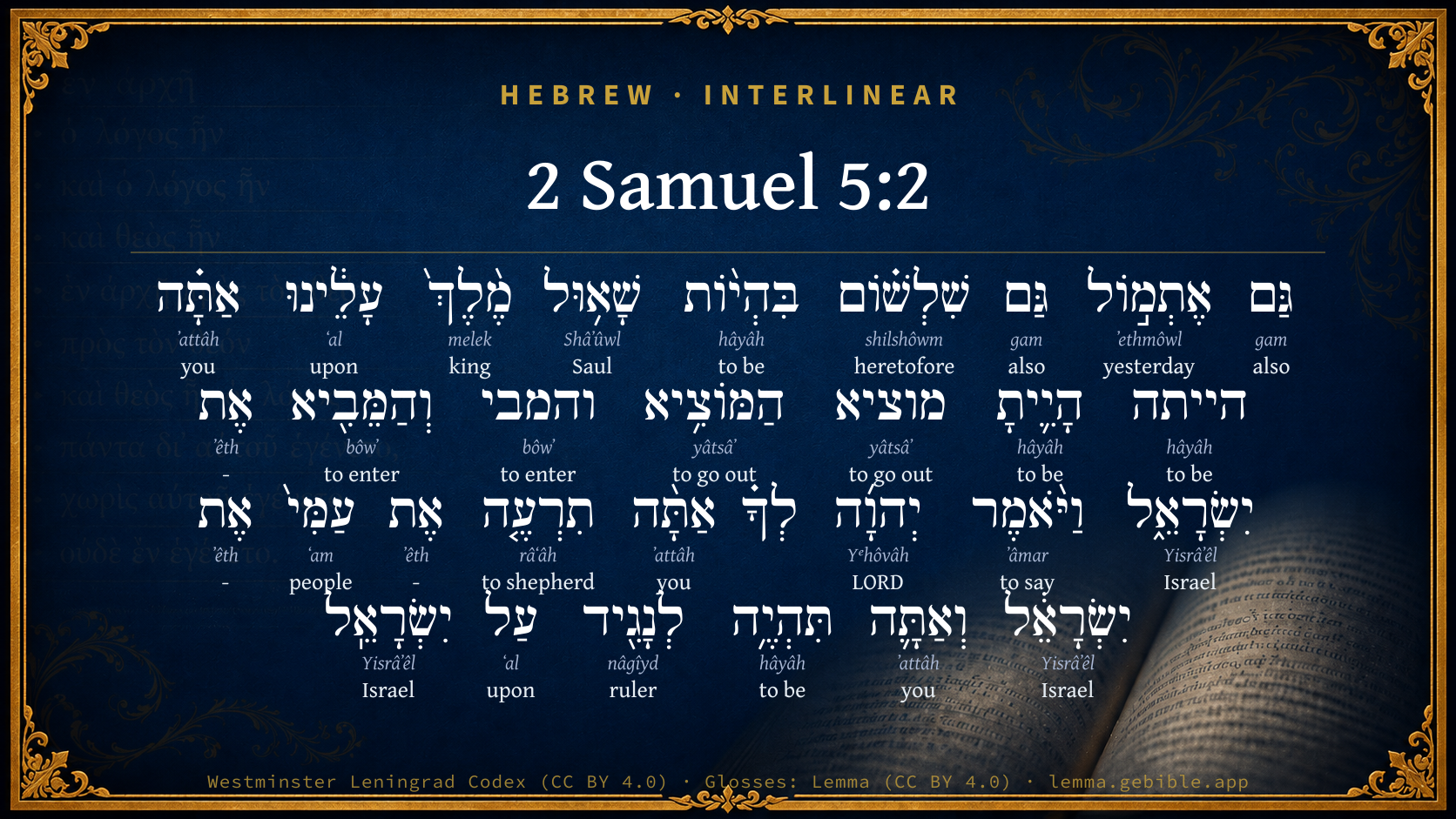
2 Samuel 5:2

Hebrew (Westminster Leningrad Codex) 2 Samuel 5:2 appears in the Hebrew Old Testament. The text above is from the Westminster Leningrad Codex. Each word links to its Strong’s number, a concise gloss, and parsing drawn from the Open Scriptures Hebrew Bible morphology. Click any word for its full Brown-Driver-Briggs (BDB) entry.
Download image
Cite this verse

2 Samuel 5:2 (World English Bible). Public Domain. Lemma interlinear Bible study tool, https://lemma.gebible.app/v/2-samuel/5/2.

Show BibTeX & RIS
BibTeX
RIS
English Translation
In times past, when Saul was king over us, it was you who led out and brought in Israel: and Yahweh said to you, You shall be shepherd of my people Israel, and you shall be prince over Israel.
World English Bible · Public Domain
Download a study sheet

One document with this verse’s original text, its word-by-word gloss line, the meaning frame, cross-references with their text, attributed commentary, and full source and license credits — printable, and it pastes into notes with its structure intact.

This verse Autodidact and up

Study sheet (.html) Plain text (.txt)

A passage Seminary Student

Up to 50 verses in one chapter. A passage sheet keeps up to 6 commentary sources and 12 cross-references per verse, in the order this page ranks them, and says so on the sheet whenever that leaves anything out. Ask for a single verse and you get the Autodidact verse sheet above.

Everything on this page stays free to read, with no account — the sheet is a download of what is already on screen, not access to it.

Want to remove ads? Support Godless Engineer
Compare translations 3

The same verse in 3 English versions, stacked beneath the original-language interlinear above. Click any original word for its lexicon entry.

Each is an independent rendering of the whole verse — the interlinear is not word-aligned to these translations.

Highlighted words mark where these versions differ — a whole-verse word diff, not a word-by-word alignment.

  • World English Bible Public Domain
    In times past, when Saul was king over us, it was you who led out and brought in Israel: and Yahweh said to you, You shall be shepherd of my people Israel, and you shall be prince over Israel.
  • King James Version Public Domain
    Also in time past, when Saul was king over us, thou wast he that leddest out and broughtest in Israel: and the LORD said to thee, Thou shalt feed my people Israel, and thou shalt be a captain over Israel.
  • unfoldingWord Literal Text CC BY-SA 4.0
    Both yesterday and the third day, when Saul was king over us, you, you were the one bringing out and bringing in Israel. And Yahweh said to you, ‘You, you will shepherd my people Israel, and you, you will become the ruler over Israel.’”

unfoldingWord Literal Text — © unfoldingWord, licensed CC BY-SA 4.0. Word-aligned USFM3 via Door43 (git.door43.org/unfoldingWord/en_ult).

Versions to compare (up to 4)

3 of 4 selected

Show all 17 translations

Every available English version of this verse, each an independent rendering of the whole verse.

  • World English Bible Public Domain
    In times past, when Saul was king over us, it was you who led out and brought in Israel: and Yahweh said to you, You shall be shepherd of my people Israel, and you shall be prince over Israel.
  • Berean Standard Bible Public Domain
    Even in times past, while Saul was king over us, you were the one who led Israel out and brought them back. And to you the LORD said, ‘You will shepherd My people Israel, and you will be ruler over them.’”
  • Majority Standard Bible Public Domain
    Even in times past, while Saul was king over us, you were the one who led Israel out and brought them back. And to you the LORD said, ‘You will shepherd My people Israel, and you will be ruler over them.’”
  • King James Version Public Domain
    Also in time past, when Saul was king over us, thou wast he that leddest out and broughtest in Israel: and the LORD said to thee, Thou shalt feed my people Israel, and thou shalt be a captain over Israel.
  • American Standard Version (1901) Public Domain
    In times past, when Saul was king over us, it was thou that leddest out and broughtest in Israel: and Jehovah said to thee, Thou shalt be shepherd of my people Israel, and thou shalt be prince over Israel.
  • Revised Version (1885) Public Domain
    In times past, when Saul was king over us, it was thou that leddest out and broughtest in Israel: and the LORD said to thee, Thou shalt feed my people Israel, and thou shalt be prince over Israel.
  • Geneva Bible (1599) Public Domain
    And in time past when Saul was our King, thou leddest Israel in and out: and the Lord hath sayde to thee, Thou shalt feede my people Israel, and thou shalt be a captaine ouer Israel.
  • Young's Literal Translation Public Domain
    also heretofore, in Saul's being king over us, thou hast been he who is bringing out and bringing in Israel, and Jehovah saith to thee, Thou dost feed My people Israel, and thou art for leader over Israel.'
  • Literal Standard Version CC BY-SA 4.0
    also thus far, in Saul’s being king over us, you have been he who is bringing out and bringing in Israel, and YHWH says to you, You feed My people Israel, and you are for leader over Israel.”
  • Unlocked Literal Bible CC BY-SA 4.0
    In the recent past, when Saul was king over us, it was you who led the Israelite army. Yahweh said to you, 'You will shepherd my people Israel, and you will become ruler over Israel.'”
  • unfoldingWord Literal Text CC BY-SA 4.0
    Both yesterday and the third day, when Saul was king over us, you, you were the one bringing out and bringing in Israel. And Yahweh said to you, ‘You, you will shepherd my people Israel, and you, you will become the ruler over Israel.’”
  • Darby Bible Public Domain
    Even aforetime, when Saul was king over us, thou wast he that leddest out and broughtest in Israel; and Jehovah said to thee, Thou shalt feed my people Israel, and thou shalt be prince over Israel.
  • World Messianic Bible Public Domain
    In times past, when Saul was king over us, it was you who led Israel out and in. The LORD said to you, ‘You will be shepherd of my people Israel, and you will be prince over Israel.’”
  • Webster's Bible Public Domain
    Also in time past, when Saul was king over us, thou wast he that leddest out and broughtest in Israel: and the LORD said to thee, Thou shalt feed my people Israel, and thou shalt be a captain over Israel.
  • Free Bible Version CC BY-SA 4.0
    Previously when Saul was our king, you were the one who led the Israelite army into battle. The Lord told you, ‘You will be the shepherd of my people Israel, and you will be their ruler.’”
  • Bible in Basic English Public Domain
    In the past when Saul was king over us, it was you who went at the head of Israel when they went out or came in: and the Lord said to you, You are to be the keeper of my people Israel and their ruler.
  • JPS Tanakh (1917) Public Domain
    In times past, when Saul was king over us, it was thou that didst lead out and bring in Israel; and the LORD said to thee: Thou shalt feed My people Israel, and thou shalt be prince over Israel.'

Literal Standard Version (2020), Covenant Press — licensed CC BY-SA 4.0. Text via the HelloAO Bible API (eBible.org). Unlocked Literal Bible (unfoldingWord) — licensed CC BY-SA 4.0. Text via the HelloAO Bible API (eBible.org). unfoldingWord Literal Text — © unfoldingWord, licensed CC BY-SA 4.0. Word-aligned USFM3 via Door43 (git.door43.org/unfoldingWord/en_ult). Free Bible Version, Dr. Jonathan Gallagher — licensed CC BY-SA 4.0. Text via the HelloAO Bible API (eBible.org).

Word by word

More ways to search: Search by grammar → Find every occurrence → Compare this word →

Practice this passage: Drill this verse → Learn its vocabulary →

אֶתְמ֣וֹל
ʼethmôwl
H865
“yesterday”
Noun, Common, Masculine, Singular, Absolute
Part of Speech
Noun
Type
Common
Gender
Masculine
Number
Singular
State
Absolute
Full BDB Definition

Origin: probably from H853 or H854 and H4136

TWOT: 2521

yesterday, recently, formerly - yesterday - formerly (figuratively) - from yesterday, already (in phrase) - (TWOT +) before, before that time, before the time, heretofore, of late, of old, these days, time(s) past
  1. גַּם gam H1571 “also” Particle, Accusative
  2. גַּם gam H1571 “also” Particle, Accusative
  3. שִׁלְשׁ֗וֹם shilshôwm H8032 “heretofore” Noun, Common, Masculine, Singular, Absolute
  4. בִּהְי֨וֹת hâyâh H1961 “in/at · to be” Preposition + Verb, Qal, Infinitive Construct
  5. שָׁא֥וּל Shâʼûwl H7586 “Saul” Noun, Proper
  6. מֶ֨לֶךְ֙ melek H4428 “king” Noun, Common, Masculine, Singular, Absolute
  7. עָלֵ֔ינוּ ʻal H5921 “upon · us” Preposition + Suffix, Personal, 1st Person, Common, Plural
  8. אַתָּ֗ה ʼattâh H859 “you” Pronoun, Personal, 2nd Person, Masculine, Singular
  9. הייתה hâyâh H1961 “to be” Verb, Qal, Perfect, 2nd Person, Masculine, Singular
  10. הָיִ֛יתָ hâyâh H1961 “to be” Verb, Qal, Perfect, 2nd Person, Masculine, Singular
  11. מוציא yâtsâʼ H3318 “going out” Verb, Hiphil, Participle Active, Masculine, Singular, Absolute
  12. הַמּוֹצִ֥יא yâtsâʼ H3318 “the · going out” Particle, Definite Article + Verb, Hiphil, Participle Active, Masculine, Singular, Absolute
  13. והמבי bôwʼ H935 “and · the · entering” Conjunction + Particle, Definite Article + Verb, Hiphil, Participle Active, Masculine, Singular, Absolute
  14. וְהַמֵּבִ֖יא bôwʼ H935 “and · the · entering” Conjunction + Particle, Definite Article + Verb, Hiphil, Participle Active, Masculine, Singular, Absolute
  15. אֶת ʼêth H853 “-” Particle, Direct Object
  16. יִשְׂרָאֵ֑ל Yisrâʼêl H3478 “Israel” Noun, Proper
  17. וַיֹּ֨אמֶר ʼâmar H559 “and · to say” Conjunction + Verb, Qal, Sequential Imperfect, 3rd Person, Masculine, Singular
  18. יְהוָ֜ה Yᵉhôvâh H3068 “LORD” Noun, Proper
  19. אַתָּ֨ה ʼattâh H859 “you” Pronoun, Personal, 2nd Person, Masculine, Singular
  20. תִרְעֶ֤ה râʻâh H7462 “to shepherd” Verb, Qal, Imperfect, 2nd Person, Masculine, Singular
  21. אֶת ʼêth H853 “-” Particle, Direct Object
  22. עַמִּי֙ ʻam H5971 “people · my” Noun, Common, Masculine, Singular, Construct + Suffix, Personal, 1st Person, Common, Singular
  23. אֶת ʼêth H853 “-” Particle, Direct Object
  24. יִשְׂרָאֵ֔ל Yisrâʼêl H3478 “Israel” Noun, Proper
  25. וְאַתָּ֛ה ʼattâh H859 “and · you” Conjunction + Pronoun, Personal, 2nd Person, Masculine, Singular
  26. תִּהְיֶ֥ה hâyâh H1961 “to be” Verb, Qal, Imperfect, 2nd Person, Masculine, Singular
  27. לְנָגִ֖יד nâgîyd H5057 “to/for · ruler” Preposition + Noun, Common, Masculine, Singular, Absolute
  28. עַל ʻal H5921 “upon” Preposition
  29. יִשְׂרָאֵֽל Yisrâʼêl H3478 “Israel” Noun, Proper

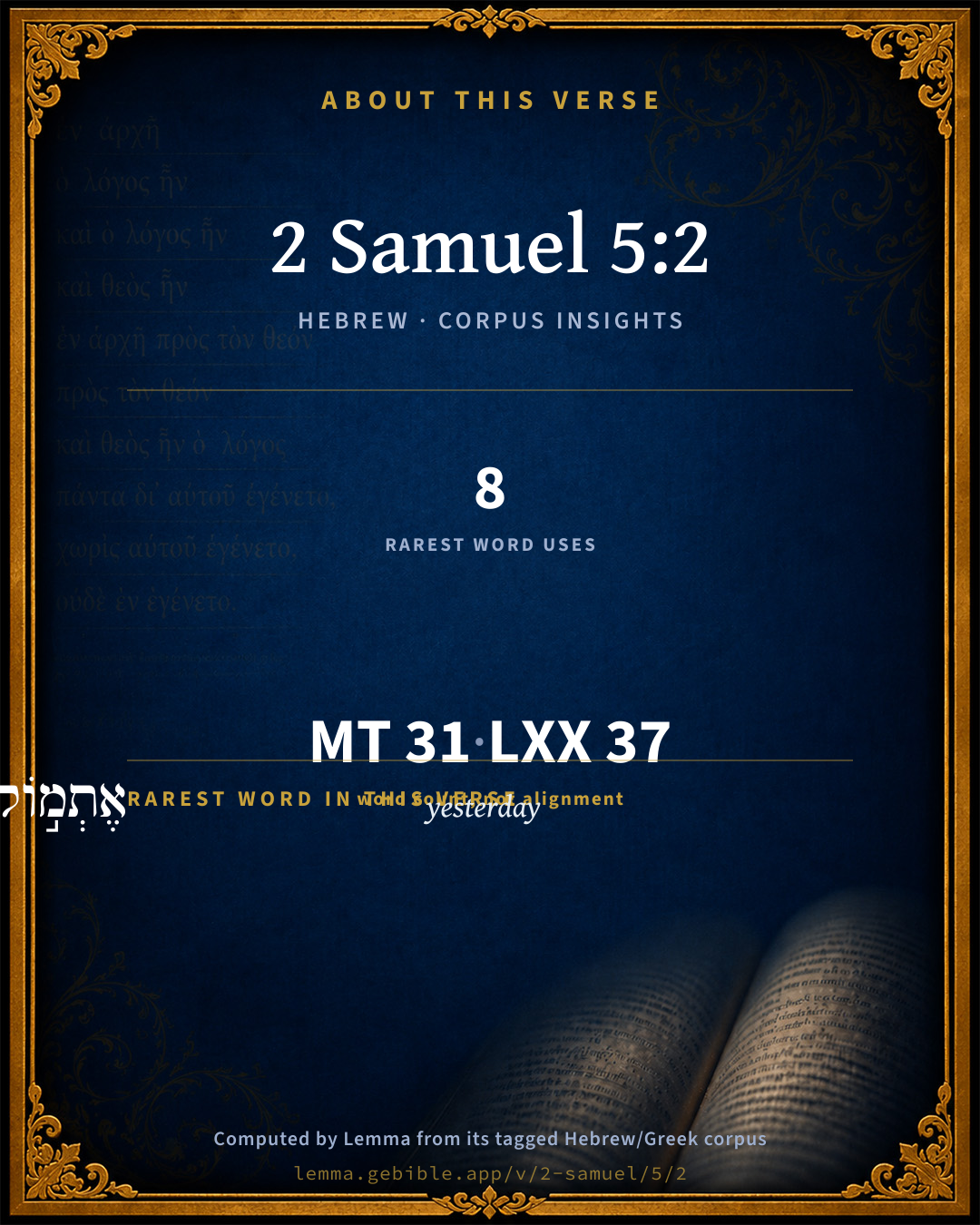
About this verse

These counts appear in no published source. They are computed here, from the morphology-tagged text and Lemma’s own curated glosses. What Lemma adds →

31
words
17
distinct lemmas
Historical
section

Notable vocabulary

The rarest word here is אֶתְמ֣וֹל yesterday H865 — appearing just 8 times in the whole Hebrew Bible.

Shared distinctive vocabulary

אֶתְמ֣וֹל yesterday H865 occurs in 8 verses of the Hebrew Bible. Also found in:

Grammatical profile

  • 10 verbs
  • 10 nouns
  • 3 pronouns
  • 3 prepositions
  • 5 particles

Verb forms

  • בִּהְי֨וֹת Qal · Infinitive Construct
  • הייתה Qal · Perfect
  • הָיִ֛יתָ Qal · Perfect
  • מוציא Hiphil · Participle Active
  • הַמּוֹצִ֥יא Hiphil · Participle Active
  • והמבי Hiphil · Participle Active
  • וְהַמֵּבִ֖יא Hiphil · Participle Active
  • וַיֹּ֨אמֶר Qal · Sequential Imperfect
  • תִרְעֶ֤ה Qal · Imperfect
  • תִּהְיֶ֥ה Qal · Imperfect

Repetition

Words recur within this verse — often emphatic in Hebrew:

  • בִּהְי֨וֹת to be H1961 ×4
  • יִשְׂרָאֵ֑ל Israel H3478 ×3
  • גַּם also H1571 ×2
  • עָלֵ֔ינוּ upon H5921 ×2
  • מוציא to go out H3318 ×2
  • והמבי to enter H935 ×2
  • אַתָּ֗ה you H859 ×3

Hebrew & Septuagint length

In English translation the verse runs 39 words from the Hebrew and 41 from the Septuagint (LXX English) — closely comparable.

A rough comparison of the two English renderings, which tokenize alike — not a word-level alignment.

Word counts can differ between the Hebrew and the Greek without any difference in meaning — e.g. the Hebrew direct-object marker אֵת has no separate Greek word, and Greek often adds the article ὁ.

In the original languages it is 31 Hebrew tokens and 37 Greek tokens — but the two are counted differently (Hebrew bundles its prefixes and suffixes into one token; the Greek is in lemma form), so that isn’t a like-for-like length.

Cross-references

22

Topical passages linked to 2 Samuel 5:2 in the Treasury of Scripture Knowledge — connected by theme and wording, ordered by reader-vote popularity; previews shown in the World English Bible.

  • Matthew 2:6 'You Bethlehem, land of Judah, Are in no way least among the princes of Judah: For out of you shall come forth a governor, Who shall shepherd my people, Israel.'"
  • Micah 5:4 He shall stand, and shall shepherd in the strength of Yahweh, In the majesty of the name of Yahweh his God: And they will live, for then he will be great to the ends of the earth.
  • Ezekiel 34:23 I will set up one shepherd over them, and he shall feed them, even my servant David; he shall feed them, and he shall be their shepherd.
  • Ezekiel 37:24–25 My servant David shall be king over them; and they all shall have one shepherd: they shall also walk in my ordinances, and observe my statutes, and do them.
  • John 10:11 I am the good shepherd. The good shepherd lays down his life for the sheep.
  • 2 Samuel 7:7 In all places in which I have walked with all the children of Israel, spoke I a word with any of the tribes of Israel, whom I commanded to be shepherd of my people Israel, saying, Why have you not built me a house of cedar?
  • Isaiah 40:11 He will feed his flock like a shepherd, he will gather the lambs in his arm, and carry them in his bosom, [and] will gently lead those who have their young.
  • 1 Samuel 25:30 It shall come to pass, when Yahweh shall have done to my lord according to all the good that he has spoken concerning you, and shall have appointed you prince over Israel,
  • 1 Samuel 16:1 Yahweh said to Samuel, How long will you mourn for Saul, seeing I have rejected him from being king over Israel? fill your horn with oil, and go: I will send you to Jesse the Bethlehemite; for I have provided me a king among his sons.
  • Psalms 78:70–72 He also chose David his servant, And took him from the sheepfolds;
  • Isaiah 55:4 Behold, I have given him for a witness to the peoples, a leader and commander to the peoples.
  • John 10:3–4 The gatekeeper opens the gate for him, and the sheep listen to his voice. He calls his own sheep by name, and leads them out.
  • 1 Samuel 16:12–13 He sent, and brought him in. Now he was ruddy, and withal of a beautiful face, and goodly to look on. Yahweh said, Arise, anoint him; for this is he.
  • 1 Samuel 18:13 Therefore Saul removed him from him, and made him his captain over a thousand; and he went out and came in before the people.
  • Numbers 27:17 who may go out before them, and who may come in before them, and who may lead them out, and who may bring them in; that the congregation of Yahweh not be as sheep which have no shepherd.
  • 1 Samuel 18:5 David went out wherever Saul sent him, [and] behaved himself wisely: and Saul set him over the men of war, and it was good in the sight of all the people, and also in the sight of Saul's servants.
  • 1 Samuel 18:16 But all Israel and Judah loved David; for he went out and came in before them.
  • Hebrews 2:10 For it became him, for whom are all things, and through whom are all things, in bringing many children to glory, to make the author of their salvation perfect through sufferings.
  • 1 Samuel 9:16 Tomorrow about this time I will send you a man out of the land of Benjamin, and you shall anoint him to be prince over my people Israel; and he shall save my people out of the hand of the Philistines: for I have looked on my people, because their cry is come to me.
  • 1 Samuel 13:14 But now your kingdom shall not continue: Yahweh has sought him a man after his own heart, and Yahweh has appointed him to be prince over his people, because you have not kept that which Yahweh commanded you.
  • 1 Samuel 25:28 Please forgive the trespass of your handmaid: for Yahweh will certainly make my lord a sure house, because my lord fights the battles of Yahweh; and evil shall not be found in you all your days.
  • 2 Kings 20:5 Turn back, and tell Hezekiah the prince of my people, Thus says Yahweh, the God of David your father, I have heard your prayer, I have seen your tears: behold, I will heal you; on the third day you shall go up to the house of Yahweh.

Cross-references courtesy of OpenBible.info (CC BY 4.0).

Hebrew and Greek witnesses Masoretic Hebrew ↔ Greek Septuagint

The same verse in the two great witnesses to the Old Testament, shown verse-for-verse.

These are two independent witnesses, not word-aligned to each other, and the Septuagint is shown in lemma (dictionary) form.

Hebrew 2 Samuel 5:2 Masoretic · Westminster Leningrad Codex

גַּם אֶתְמ֣וֹל גַּם שִׁלְשׁ֗וֹם בִּהְי֨וֹת שָׁא֥וּל מֶ֨לֶךְ֙ עָלֵ֔ינוּ אַתָּ֗ה הייתה הָיִ֛יתָ מוציא הַמּוֹצִ֥יא והמבי וְהַמֵּבִ֖יא אֶת יִשְׂרָאֵ֑ל וַיֹּ֨אמֶר יְהוָ֜ה לְךָ֗ אַתָּ֨ה תִרְעֶ֤ה אֶת עַמִּי֙ אֶת יִשְׂרָאֵ֔ל וְאַתָּ֛ה תִּהְיֶ֥ה לְנָגִ֖יד עַל יִשְׂרָאֵֽל

In times past, when Saul was king over us, it was you who led out and brought in Israel: and Yahweh said to you, You shall be shepherd of my people Israel, and you shall be prince over Israel.

World English Bible · Public Domain

Greek LXX 2 Samuel 5:2 Septuagint · lemma form

καί ἐχθές καί τρίτος εἰμί σαούλ βασιλεύς ἐπί ἐγώ σύ εἰμί ὁ ἐκἄγω καί εἰςἄγω ὁ ἰσραήλ καί εἶπον κύριος πρός σύ σύ ποιμαίνω ὁ λαός ἐγώ ὁ ἰσραήλ καί σύ εἰμί εἰς ἡγέομαι ἐπί ὁ ἰσραήλ

And heretofore Saul being king over us, you were he that did lead out and bring in Israel: and the Lord said to you, You shall feed my people Israel, and you shall be for a leader to my people Israel.

LXX2012 (modern English Septuagint) · Public Domain

On this verse, The Cambridge Bible for Schools and Colleges discusses the Septuagint’s reading. Read the note in Commentary ↓

Hebrew: Westminster Leningrad Codex (CC BY 4.0). Greek: Septuagint (public domain); English from LXX2012 (modern English Septuagint) (Public Domain). How the Septuagint differs from the Hebrew →

Targum (Aramaic paraphrase)

1

The Targum is the ancient Jewish Aramaic paraphrase of the Hebrew Scriptures — an interpretive translation, not the Hebrew text itself. Onkelos (literal) and Pseudo-Jonathan (expansive) render the Torah, and Jonathan the Prophets. Coverage is partial: where no permissively-licensed English translation exists for a verse, only the Aramaic is shown. This is verse-level text, not a word-by-word alignment to the Hebrew.

  1. Targum Jonathan Prophets (Joshua–Malachi)
    אַף מֵאִתְמָלֵי אַף מִדְקָמוֹהִי כַּד הֲוָה שָׁאוּל מַלְכָּא עֲלָנָא אַתְּ הֲוֵיתָא נָפֵיק וְעָלֵיל בְּרֵישׁ יִשְׂרָאֵל וַאֲמַר יְיָ לָךְ אַתְּ תְּפַרְנֵס יַת עַמִי יַת ישְׂרָאֵל וְאַתְּ תֶּהֱוֵי לְמַלְכָּא עַל יִשְׂרָאֵל:

    (no public-domain English translation for this verse)

    Targum Jonathan — Aramaic: “Mikraot Gedolot” (public domain). English: “Sefaria Community Translation” (CC0 1.0 (public-domain dedication)); “London "Chaldee Paraphrase," 1871” (public domain). Text via Sefaria.

Commentary

Notes on 2 Samuel 5:2 from classic Christian and Jewish commentators (each source and its license shown beneath its notes). The classic Christian expositions comment on the surrounding passage and are grouped to its opening verse, so a note may address several verses; the Jewish commentaries on the Tanakh (Rashi and others) are per-verse, so they appear only where the commentator wrote on this verse.

Lemma curates 59 commentaries, every one of them public domain or Creative Commons licensed, each selected and text-cleaned for this edition rather than reprinted as found. About our sources →

Trapp's Complete Commentary

John Trapp

2Sa 5:2 Also in time past, when Saul was king over us, thou wast he that leddest out and broughtest in Israel: and the LORD said to thee, Thou shalt feed my people Israel, and thou shalt be a captain over Israel.

Ver. 2. That leddest out and broughtest in.] Educebas et reducebas.

And the Lord said to thee,] viz., When thou wast first anointed by Samuel, {1Sa 16:13} then was this word added to that sign; though for brevity’s sake it is not there mentioned. So when Christ was baptized, there came a voice from heaven. {Mat 3:16-17} And so still he sanctifieth and cleanseth his Church "with the washing of water by the word." {Eph 5:26-27}

John Trapp, A Commentary or Exposition upon All the Books of the Old and New Testament (1647–1656) — public domain. Text from a community e-Sword module.

The Biblical Illustrator

Joseph S. Exell

2Sa_5:2

Thou wast he that leddest out and broughtest in Israel.

Divine appointment and mans doing

There are both sides of the great division in evangelical theology--Arminianism and Calvinism: mans doing, and Gods planning. The Lord said that David should lead Israel; and David did lead Israel. And the people of Israel gave a fair prominence to both sides of the question. They saw that David could do what the Lord had said he should do; and they knew that the Lord had said that David should do what they saw he could do. As a practical matter, these two sides of the truth have to be considered by all of the Lords people, in all their doing and in all their judging. If a man is called of God to a special work, the man must show by his doing that he is the very man whom God has called, and who was the man to be called of God. And in judging of anothers fitness for his work, it is right for us to consider the call of God to that man, as well as that mans apparent success in his work. If the man is clearly out of the place to which he was called of God, all his ability and apparent fitness for this other place must be counted insufficient to inspire confidence in him for permanent success here. It has been well said, as to a Christians personal duty in Gods service, that he ought to work in his appointed sphere as if everything, depended on his own exertions, while he ought to trust as if everything depended on Gods strength as given to him in that sphere. (H. Clay Trumbull.)

The Biblical Illustrator, edited by Joseph S. Exell (c. 1880s–1900s) — public domain. Text from a community e-Sword module.

Joseph Benson's Commentary

2Sa 5:2. The Lord said, Thou shalt feed my people Israel — The learned Bishop Patrick very justly observes here, that this is the first time we meet with any ruler, or governor of a people, characterized under the idea of a shepherd; and it cannot but be thought remarkable that the first man so characterized was at first in fact a shepherd; and when we find him, after his advancement to the throne, still characterized by God himself under the same idea, what can be a clearer inference, than that God’s raising him to be a king was but exalting him to a nobler office of the same nature with his first? How fine a document is this to princes, that they are not, in the intention of Providence, the tyrants, but the guardians of their people! that their business is the preservation and well-being of the flock, from the duty they owe to the great Lord and owner thereof! And how fully is this document confirmed to us, when we find bad princes set forth, in the prophetic style, under the characters of roaring lions, hungry bears, and devouring wolves. It was a truly noble and princely maxim of Cyrus, that “every man that aspired to the government of others should take care to be a better man than those he ruled.” — Delaney.

Joseph Benson's Commentary on the Old and New Testaments (1811–1818) — public domain. Text from a community e-Sword module.

Tyndale Open Study Notes

Tyndale Open Resources

5:2 you were the one: In the ancient world, a covenant relationship (a suzerain-vassal treaty) was sometimes formed between subjects (the vassals) and a ruler (the suzerain) because of past aid, often rescue from enemies (see Judg 8:22, Gideon; Judg 11:8-11, Jephthah; 1 Sam 11:1-15, Saul). This type of relationship is the background for the covenant concept in Scripture: God was Israel’s covenant Lord because he had freed them from Egypt (cp. Exod 19:4; 20:1-2). • the Lord told you: Israel was already aware of God’s selection of David (cp. 2 Sam 3:9). • shepherd of my people Israel: This phrase is quoted in Matt 2:6 when King Herod asks the leading priests about the prophecies concerning the Messiah.

Tyndale Open Study Notes — © Tyndale Open Resources, licensed CC BY-SA 4.0. Text via the HelloAO Bible API.

The Cambridge Bible for Schools and Colleges

gen. ed. J. J. S. Perowne

2. thou wast he that leddest out and broughtest in Israel] David had won the good-will of the people as their leader in war. Cp. 1Sa_18:5; 1Sa_18:13; 1Sa_18:16.

the Lord said to thee] See note on ch. 2Sa_3:9.

Thou shalt feed] Lit. “thou shalt shepherd” (LXX. ποιμανεῖς): a natural metaphor to express the ruler’s care for his people. It is used by Greek poets, e.g. Homer, whose regular title for Agamemnon is ποιμὴν λαῶν, “shepherd of the peoples.” But it was especially appropriate in the case of David, who was taken from the sheepfolds of Bethlehem to be the shepherd of Israel (Psa_78:70-72), as the fishers of the Galilean lake were called to become “fishers of men” (Mat_4:19), and (except perhaps in Gen_49:24) it does not appear to be used in the O. T. before his time.

captain] The title given to Saul in 1Sa_9:16, &c., and to David in 1Sa_25:30 (E. V. ruler).

The Cambridge Bible for Schools and Colleges (gen. ed. J. J. S. Perowne; Cambridge University Press, 1878–1918) — public domain. Text from a community e-Sword module.

John Gill's Exposition

Also in time past, when Saul was king over us,.... Even over all the tribes of Israel:

thou wast he that leddest out and broughtest in Israel; that led out the armies of Israel against their enemies, fought their battles for them, obtained victories, and brought the troops under his command home in safety; and the remembrance of these valiant acts of his, which then endeared him to the people, was now another reason for their choosing him king: and another follows, the chiefest of them all:

and the Lord said to thee; when anointed by Samuel; for though what follows is not recorded in so many words, yet the sense of it is expressed in the anointing him to be king, whose office, as such, lay in doing the following things:

thou shalt feed my people Israel; as a shepherd feeds his flock; hence kings were frequently called shepherds, and David particularly, in which he was an eminent type of Christ, see Psa 78:71,

and thou shalt be a captain over Israel; the Targum is,"and thou shalt be king over Israel;''which gives the true sense of the tribes, and which was the chief and prevailing reason with them to make him their king; and which they, at least many of them, would have done before, even immediately upon the death of Saul, but that they were persuaded by Abner to yield obedience to Ishbosheth he set up.

John Gill's Exposition of the Whole Bible (1746–1763) — public domain (CC PDM 1.0). Text via the HelloAO Bible API.

Haydock's Catholic Bible Commentary

Lead out to battle. His experience in war was a great recommendation. (Haydock) --- Feed, as a shepherd, under which character he is first represented. (Haydock) --- Other rulers were afterwards honoured with the same title, (Calmet) particularly the governors of the Church, Acts xx., &c. David’s name is written without i, in the books before the captivity; whence Kennicott would infer, that the canticles were perhaps not the work of Solomon, as the i occurs there; Duid for Dud. (Haydock)

George Leo Haydock (1774–1849), Haydock's Catholic Family Bible and Commentary, 1859 edition — public domain. Excludes Psalms (Douay-Rheims chapter numbering differs from Protestant) and Deuterocanonical books (Catholic canon only).

Matthew Poole's English Annotations

Thou wast our chief commander in our expeditions against the Philistines, and therefore art most fit to be king over us.

The Lord said to thee, to wit, by Samuel, 1Sa 16:11-13; for though the words vary, yet the sense is the same.

Thou shalt feed my people Israel i.e. rule them, and take care of them, as a shepherd doth of his sheep, Psa 78:70,71. This expression he useth to admonish David, that he was not made a king to advance his own glory and interest, but for the good and benefit of his people; and that he ought to rule them with all tenderness, and to watch over them with all diligence.

Matthew Poole's English Annotations on the Holy Bible (1683–1685) — public domain. Text from a community e-Sword/MySword module.

Whedon's Commentary on the Bible

Daniel D. Whedon

2. Thou… leddest — As general of Saul’s forces. See 1Sa_18:5.

Thou shalt feed my people — This prophecy, like that of 2Sa_3:18, is nowhere else recorded, but had probably been uttered by one of the prophets of that age. A keeper of sheep is made the shepherd of the nation, as the fishermen of Galilee were made fishers of men.

Daniel D. Whedon (gen. ed.), Commentary on the Old and New Testaments (1874–1909) — public domain. Text from a community e-Sword module.

The Pulpit Commentary

Thou shalt feed. In biblical language the pastoral office is that of the civil and not of the spiritual ruler. Captain; Hebrew, nagid, prince; so the Revised Version (and see note on. (1Sa_9:16) The word refers not to military matters, but to the civil administration. David had proved himself a competent leader in war when Saul was king. What Jehovah now gives is the government of Israel in time of peace. The Authorized Version renders "captain" from not perceiving that the Divine promise ensured to David far more than a military chieftainship.

Vers. 2, 10, 12 (HEBRON.) (1Ch_11:2, 9 14:2)

The shepherd king.

This is the first occasion on which we find the occupation of a shepherd made use of to describe the office of a king. Jacob, who had "fed Laban"s flocks," spoke of "the Shepherd, the Stone of Israel"; (Gen_49:24 Gen_48:15) Moses, who had "kept the flock of Jethro," prayed that Jehovah would "set a man over the congregation" as his successor, so that they might not be "as sheep having no shepherd"; (Num_27:7) here the elders declare that Jehovah said (through Samuel) to David, who "fed his father"s sheep at Bethlehem," concerning his royal destination, "Thou shalt feed raah, equivalent to "tend," "act as shepherd towards" my people Israel" (2Sa_7:7; Psa_78:70-72; Isa_44:28; Jer_50:5; Eze_34:1, Eze_34:23; Mic_5:4; Zec_13:7, etc.) "The business of a shepherd is a preparation for the office of a king to any one who is destined to preside over that most manageable of all flocks, mankind; for which reason kings are called shepherds of their people, not by way of reproach, but as a most especial and pre-eminent honour" (Philo, "Life of Moses"). "Shepherds are not owners of the sheep; but their office is to feed and govern: no more are kings proprietaries or owners of the people. "The nations," as the Scriptures saith, are "his inheritance;" but the office of kings is to govern, maintain, and protect people. And that is not without a mystery that the first king that was instituted by God, David (for Saul was but an untimely fruit), was translated from a shepherd" (Bacon). What was said to David applies to every king, ruler, magistrate, master, in the sphere over which he has legitimate authority. Consider

I THE DIVINE IDEA OF HIS OFFICE. It is an office in which authority and power:

1. Are entrusted by the ordination of God, the Proprietor, Ruler, Chief Shepherd of the people; not self-derived nor unlimited; yet investing every under shepherd with dignity.

2. Should be exercised according to the will of God, (Ps 101) in affectionate interest in the people; intimate acquaintance with them, guiding them, providing for them, defending them, restoring them, and, generally, seeking their welfare with diligence, considerateness, tenderness, patience, self-denial, and self-sacrifice. "Chrysostom writeth that the shepherds in Cappadocia have such love unto their flock, that sometimes for three days together, in following them, they are overwhelmed with snow, and yet they endure it; and in Lydia, how far they travel with the sheep for a month together in the waste deserts and parching heat of the sun; who herein do teach such as are shepherds of men that they should even not spare their own lives for the common good" (Willet).

3. Must be accounted for, as to their use, before the presence of God. "These sheep, what have they done?". (2Sa_24:17) "A king is a mortal god on earth, unto whom the living God hath lent his own name as a great honour; but withal told him he should die like a man, test he should be proud and flatter himself that God hath with his name imparted unto him his nature also" (Bacon).

II THE DIVINE SOURCE OF HIS PROSPERITY. "And David went on going and growing" after the conquest of the stronghold of Zion, etc. (vers. 6-10), which he achieved as captain, "leader and commander of the people" (as well as their shepherd) "waxed greater and greater" (2Sa_7:9) in power and fame; "and Jehovah the God of hosts" (1Sa_1:3) "was with him". (as his Shepherd, Psa_23:1, and Captain, 2Sa_22:35-37)

1. Approving of the manner in which he devoted himself to his calling. Fidelity is the necessary condition of the special favour of God; which is ever testified in the heart and conscience, and often shown by outward events. (Gen_39:2, Gen_39:21)

2. Assisting him in the performance of the duties of his calling; strengthening, upholding, directing, protecting him.

3. Accomplishing the aim of his endeavours in his calling; for no skill nor effort, without Divine cooperation, can ensure success. "Except the Lord build the house," etc.. (Psa_127:1) While God was with him (1Sa_10:11) Saul prospered; when left to himself he lost his kingdom and his life.

III THE DIVINE PURPOSE OF HIS EXALTATION AND ESTABLISHMENT IN HIS OFFICE. "And David perceived," from the friendly aid of Hiram, the erection of his palace (ver. 11), which he appears to have regarded as a pledge of the stability of his kingdom (Psalm 30., inscription), and his continued prosperity, "that Jehovah had established him," in accordance with his former choice, "king over Israel, and that he had exalted his kingdom" (1Ch_14:2, 1Ch_14:17) "for his people Israel"s sake;" because he had chosen them to be his people, "the sheep of his pasture", (Psa_100:3) and sought their prosperity and exaltation, according to his faithful promises (2Sa_7:23) that through them all nations might be blessed, and the whole earth filled with his glory. A faithful servant recognizes in his successes:

1. An immediate purpose of good toward himself; beholding therein the hand of God and "the kindness and truth" by which it is directed; ascribing his prosperity, not to himself, but to the Lord.

2. An ulterior and larger purpose of good toward others, for whose benefit rather than his own he is exalted. (2Sa_7:8, 2Sa_7:16)

3. A powerful incentive to thankfulness, hopefulness, and fresh consecration to the service of God and his people. "It was the successiveness, the continuity of the steps, in his history, which assured him that God"s hand had been directing the whole of it. Had David, instead of maintaining the crown, which circumstances pointed out to him as his, seized violently that which was not his, he would not have perceived that the Lord had made him King of Israel; he would have felt that he had made himself so, and would have acted upon that persuasion. The government which a man wins for himself he uses for himself; that which he inwardly and practically acknowledges as conferred upon him by a righteous Being cannot be intended for himself. And thus it is that the early and mysterious teaching of David while he was in the sheepfold bore so mightily upon his life after he became king.. The deepest lesson which he had learnt was that he himself was under government; that his heart and will was the inmost circle of that authority which the winds and the sea, the moon and the stars, obeyed" (Maurice).

REMARKS.

1. The lowliest occupation is often a preparation for the highest; and hewho shows fidelity in the least is rewarded with opportunity for its exercise in the greatest.

2. The possession of authority and power severely tests men"s characters,and sometimes proves their destruction.

3. It is a good sign when one who is exalted shows more concern aboutperforming the duties than enjoying the honours of his position.

4. God sends good rulers out of his regard for the welfare of the people.

5. The best rulers are those who sympathize most with the Divinepurposes, and most humbly and faithfully "serve their generation.

6. Even the best are imperfect, and often fail to attain their loftiest aims orfulfil their early promise.

7. In One alone do we behold the perfect Shepherd-King (Joh_10:14; Heb_13:20; 1Pe_5:4; Rev_7:17) D.

The Pulpit Commentary (1880–1919), ed. H.D.M. Spence-Jones & Joseph S. Exell — public domain. Text from a community e-Sword module.

John Wesley's Explanatory Notes

Shalt feed - That is, rule them, and take care of them, as a shepherd doth of his sheep, Psalm lxxviii, 70, 71. This expression, he useth to admonish David, that he was not made a king to advance his own glory, but for the good of his people; whom he ought to rule with all tenderness, and to watch over with all diligence.

John Wesley, Explanatory Notes Upon the Whole Bible (1754–1765) — public domain. Text via the GEBible commentary corpus.

Lesson kit

Teaching starters — assembled from the data on this page, not authored interpretation. Every prompt links to the verse data it draws on. Edit before teaching.

2 Samuel, in the Historical, opens this verse with 31 words (17 distinct Hebrew lemmas). Its most distinctive word is ʼethmôwl (“yesterday”). A historical commentator’s framing appears above. Read the whole chapter for the surrounding context.

Discussion questions

  1. How does “yesterday” (ʼethmôwl) shape what this verse is saying?
  2. 1 Samuel 4:7 shares the word «yesterday» with this verse. How do the two illuminate each other?
  3. “to be” occurs 4× in this one verse. What is the effect of the repetition?
  4. The translations on this page render this verse differently — a whole-verse word diff, not a word-by-word alignment. What might account for the different wordings?
  5. The verb «בִּהְי֨וֹת» is Qal Infinitive Construct. How does its form color the action?
  6. Reading how Trapp's Complete Commentary and The Biblical Illustrator read this verse, where do the two commentators agree and where do they part?

Things to notice

Reading settings

Reading text

Shown beneath each verse's original-language words.

Old Testament
Old Testament edition

Read the OT as the Masoretic Hebrew (MT) or the Greek Septuagint (LXX).

English shown for the Greek Septuagint (in the Hebrew ↔ Greek comparison).

Comparing translations? Open the Compare panel on any verse page to stack up to four side by side.