
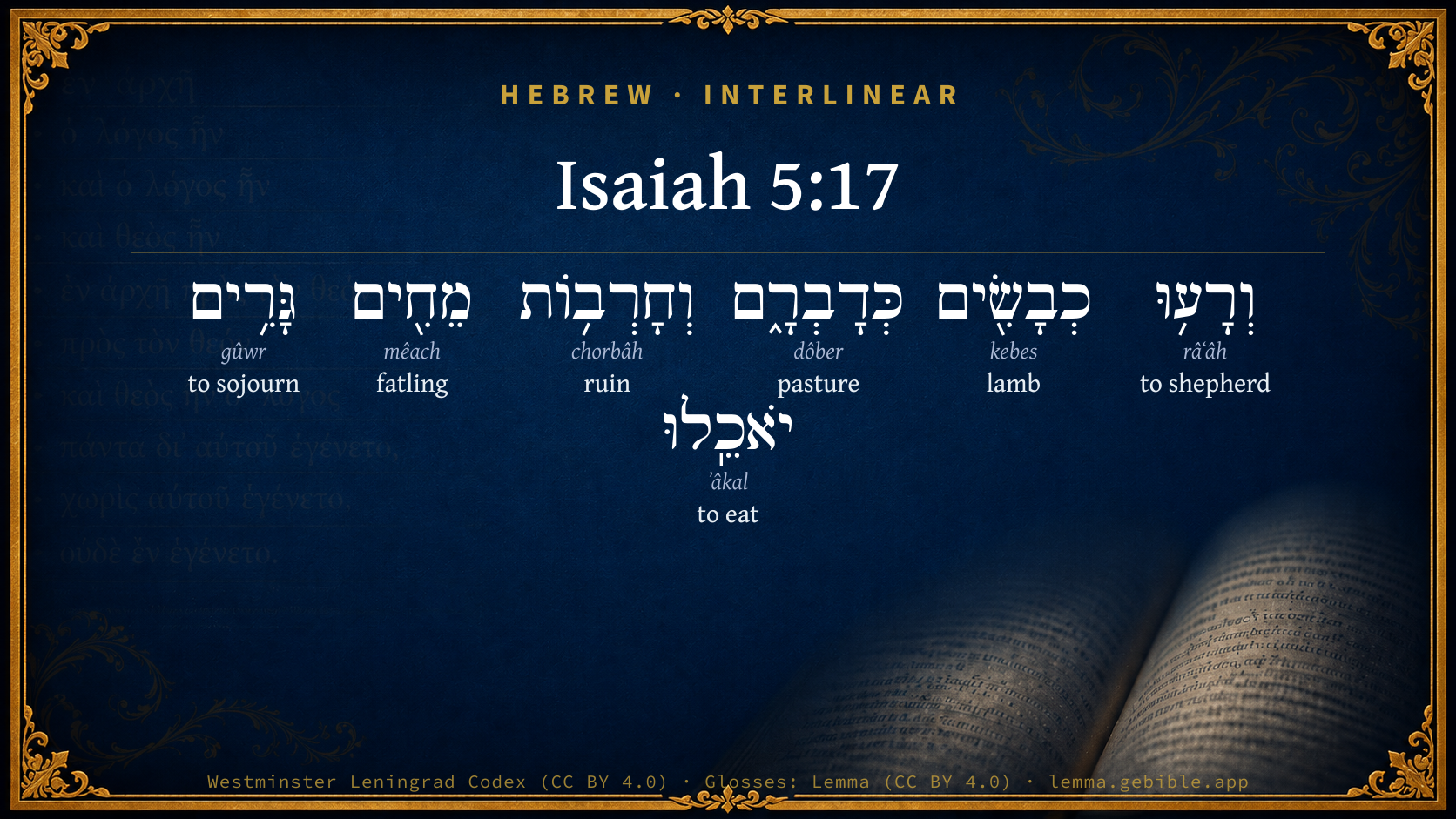
Isaiah 5:17

Hebrew (Westminster Leningrad Codex) Isaiah 5:17 appears in the Hebrew Old Testament. The text above is from the Westminster Leningrad Codex. Each word links to its Strong’s number, a concise gloss, and parsing drawn from the Open Scriptures Hebrew Bible morphology. Click any word for its full Brown-Driver-Briggs (BDB) entry.
Download image
Cite this verse

Isaiah 5:17 (World English Bible). Public Domain. Lemma interlinear Bible study tool, https://lemma.gebible.app/v/isaiah/5/17.

Show BibTeX & RIS
BibTeX
RIS
English Translation
Then the lambs will graze as in their pasture, And strangers will eat the ruins of the rich.
World English Bible · Public Domain
Highlights
  • 1 first appearance in the Hebrew Bible
Full analysis ↓
Download a study sheet

One document with this verse’s original text, its word-by-word gloss line, the meaning frame, cross-references with their text, attributed commentary, and full source and license credits — printable, and it pastes into notes with its structure intact.

This verse Autodidact and up

Study sheet (.html) Plain text (.txt)

A passage Seminary Student

Up to 50 verses in one chapter. A passage sheet keeps up to 6 commentary sources and 12 cross-references per verse, in the order this page ranks them, and says so on the sheet whenever that leaves anything out. Ask for a single verse and you get the Autodidact verse sheet above.

Everything on this page stays free to read, with no account — the sheet is a download of what is already on screen, not access to it.

Want to remove ads? Support Godless Engineer
Compare translations 3

The same verse in 3 English versions, stacked beneath the original-language interlinear above. Click any original word for its lexicon entry.

Each is an independent rendering of the whole verse — the interlinear is not word-aligned to these translations.

Highlighted words mark where these versions differ — a whole-verse word diff, not a word-by-word alignment.

  • World English Bible Public Domain
    Then the lambs will graze as in their pasture, And strangers will eat the ruins of the rich.
  • King James Version Public Domain
    Then shall the lambs feed after their manner, and the waste places of the fat ones shall strangers eat.
  • unfoldingWord Literal Text CC BY-SA 4.0
    And lambs will graze according to their manner, and sojourners will eat the desolations of fatlings. q1

unfoldingWord Literal Text — © unfoldingWord, licensed CC BY-SA 4.0. Word-aligned USFM3 via Door43 (git.door43.org/unfoldingWord/en_ult).

Versions to compare (up to 4)

3 of 4 selected

Show all 18 translations

Every available English version of this verse, each an independent rendering of the whole verse.

  • World English Bible Public Domain
    Then the lambs will graze as in their pasture, And strangers will eat the ruins of the rich.
  • Berean Standard Bible Public Domain
    Lambs will graze as in their own pastures, and strangers will feed in the ruins of the wealthy.
  • Majority Standard Bible Public Domain
    Lambs will graze as in their own pastures, and strangers will feed in the ruins of the wealthy.
  • King James Version Public Domain
    Then shall the lambs feed after their manner, and the waste places of the fat ones shall strangers eat.
  • American Standard Version (1901) Public Domain
    Then shall the lambs feed as in their pasture, and the waste places of the fat ones shall wanderers eat.
  • Revised Version (1885) Public Domain
    Then shall the lambs feed as in their pasture, and the waste places of the fat ones shall wanderers eat.
  • Geneva Bible (1599) Public Domain
    Then shall the lambes feede after their maner, and the strangers shall eate the desolate places of the fat.
  • Douay-Rheims (1899) Public Domain
    And the lambs shall feed according to their order, and strangers shall eat the deserts turned into fruitfulness.
  • Young's Literal Translation Public Domain
    And fed have lambs according to their leading, And waste places of the fat ones Do sojourners consume.
  • Literal Standard Version CC BY-SA 4.0
    And lambs have fed according to their leading, || And sojourners consume wastelands of the fat ones.
  • Unlocked Literal Bible CC BY-SA 4.0
    Then the sheep will feed as in their own pasture, and in the ruins, lambs will graze as foreigners.
  • unfoldingWord Literal Text CC BY-SA 4.0
    And lambs will graze according to their manner, and sojourners will eat the desolations of fatlings. q1
  • Darby Bible Public Domain
    And the lambs shall feed as on their pasture, and the waste places of the fat ones shall strangers eat.
  • World Messianic Bible Public Domain
    Then the lambs will graze as in their pasture, and strangers will eat the ruins of the rich.
  • Webster's Bible Public Domain
    Then shall the lambs feed after their manner, and the waste places of the fat ones shall strangers eat.
  • Free Bible Version CC BY-SA 4.0
    Lambs will graze as in their own pasture; fattened livestock and goats will feed among the ruins of the rich.
  • Bible in Basic English Public Domain
    Then the lambs will get food as in their grass-lands, and the fat cattle will be feasting in the waste places.
  • JPS Tanakh (1917) Public Domain
    Then shall the lambs feed as in their pasture, and the waste places of the fat ones shall wanderers eat.

Literal Standard Version (2020), Covenant Press — licensed CC BY-SA 4.0. Text via the HelloAO Bible API (eBible.org). Unlocked Literal Bible (unfoldingWord) — licensed CC BY-SA 4.0. Text via the HelloAO Bible API (eBible.org). unfoldingWord Literal Text — © unfoldingWord, licensed CC BY-SA 4.0. Word-aligned USFM3 via Door43 (git.door43.org/unfoldingWord/en_ult). Free Bible Version, Dr. Jonathan Gallagher — licensed CC BY-SA 4.0. Text via the HelloAO Bible API (eBible.org).

Word by word

More ways to search: Search by grammar → Find every occurrence → Compare this word →

Practice this passage: Drill this verse → Learn its vocabulary →

About this verse

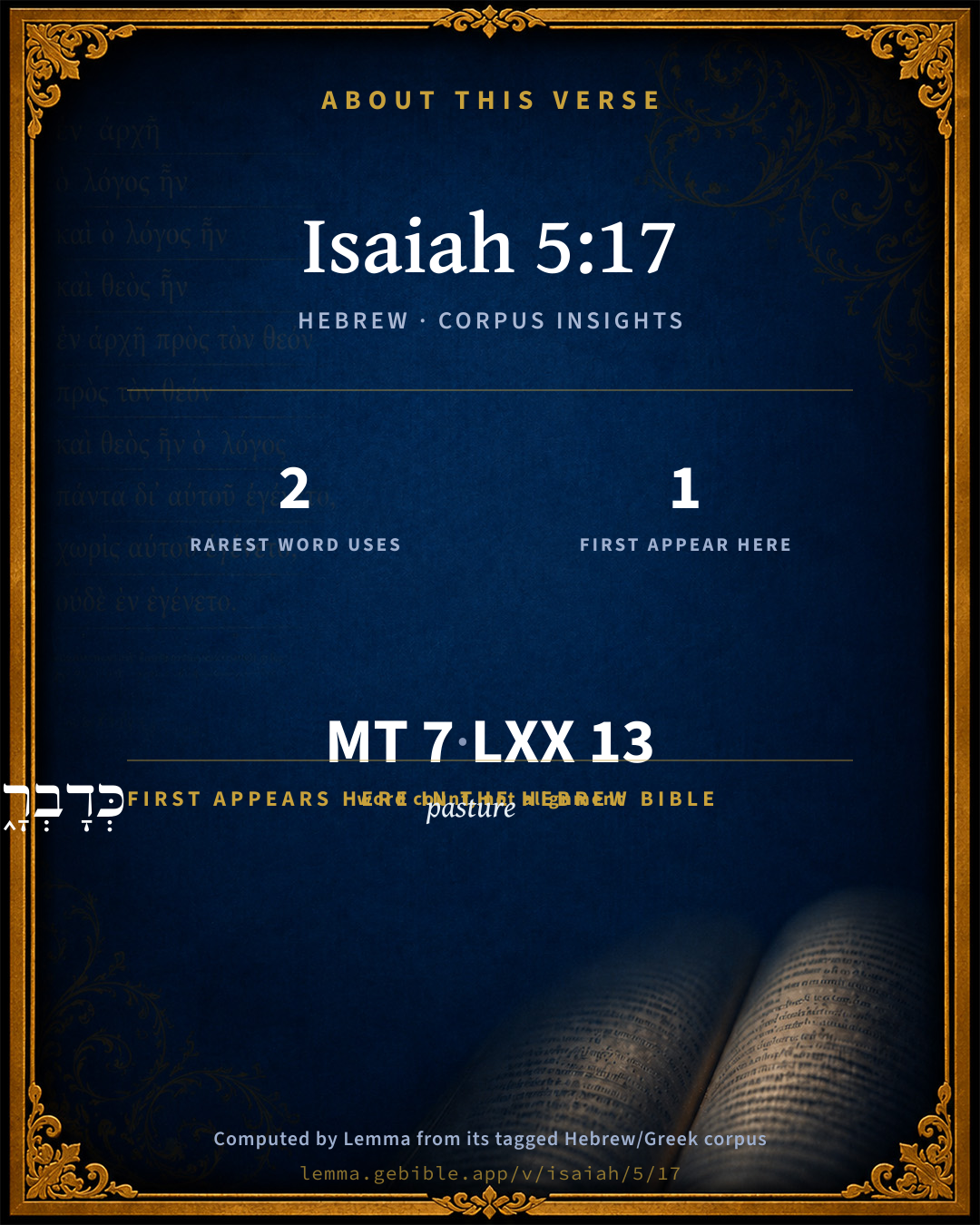
These counts appear in no published source. They are computed here, from the morphology-tagged text and Lemma’s own curated glosses. What Lemma adds →

7
words
7
distinct lemmas
Prophets
section

Notable vocabulary

The rarest word here is מֵחִ֖ים fatling H4220 — appearing just 2 times in the whole Hebrew Bible.

First appearance in Scripture

This word makes its first canonical appearance in the Hebrew Bible here:

  • כְּדָבְרָ֑ם pasture H1699

Shared distinctive vocabulary

מֵחִ֖ים fatling H4220 occurs in 2 verses of the Hebrew Bible. Also found in:

Grammatical profile

  • 3 verbs
  • 4 nouns

Verb forms

  • וְרָע֥וּ Qal · Sequential Perfect
  • גָּרִ֥ים Qal · Participle Active
  • יֹאכֵֽלוּ Qal · Imperfect

Hebrew & Septuagint length

In English translation the verse runs 18 words from the Hebrew and 24 from the Septuagint (LXX English) — closely comparable.

A rough comparison of the two English renderings, which tokenize alike — not a word-level alignment.

Word counts can differ between the Hebrew and the Greek without any difference in meaning — e.g. the Hebrew direct-object marker אֵת has no separate Greek word, and Greek often adds the article ὁ.

In the original languages it is 7 Hebrew tokens and 13 Greek tokens — but the two are counted differently (Hebrew bundles its prefixes and suffixes into one token; the Greek is in lemma form), so that isn’t a like-for-like length.

Cross-references

23

Topical passages linked to Isaiah 5:17 in the Treasury of Scripture Knowledge — connected by theme and wording, ordered by reader-vote popularity; previews shown in the World English Bible.

  • Zephaniah 2:6 The sea coast will be pastures, with cottages for shepherds and folds for flocks.
  • Isaiah 7:25 All the hills that were cultivated with the hoe, you shall not come there for fear of briers and thorns; but it shall be for the sending forth of oxen, and for the treading of sheep."
  • Zephaniah 2:14 Herds will lie down in the midst of her, all the animals of the nations. Both the pelican and the porcupine will lodge in its capitals. Their calls will echo through the windows. Desolation will be in the thresholds, for he has laid bare the cedar beams.
  • Deuteronomy 28:33 The fruit of your ground, and all your labors, shall a nation which you don't know eat up; and you shall be only oppressed and crushed always;
  • Deuteronomy 32:15 But Jeshurun grew fat, and kicked: You have grown fat, you are grown thick, you are become sleek; Then he forsook God who made him, Lightly esteemed the Rock of his salvation.
  • Nehemiah 9:37 It yields much increase to the kings whom you have set over us because of our sins: also they have power over our bodies, and over our cattle, at their pleasure, and we are in great distress.
  • Psalms 17:10 They close up their callous hearts. With their mouth they speak proudly.
  • Psalms 17:14 From men by your hand, Yahweh, From men of the world, whose portion is in this life. You fill the belly of your cherished ones. Your sons have plenty, And they store up wealth for their children.
  • Psalms 73:7 Their eyes bulge with fat. Their minds pass the limits of conceit.
  • Psalms 119:70 Their heart is as callous as the fat, But I delight in your law.
  • Isaiah 1:7 Your country is desolate. Your cities are burned with fire. Strangers devour your land in your presence, And it is desolate, As overthrown by strangers.
  • Isaiah 7:21–22 It shall happen in that day that a man shall keep alive a young cow, and two sheep;
  • Isaiah 10:16 Therefore will the Lord, Yahweh of Hosts, send among his fat ones leanness; and under his glory there shall be kindled a burning like the burning of fire.
  • Isaiah 17:2 The cities of Aroer are forsaken; they shall be for flocks, which shall lie down, and none shall make them afraid.
  • Isaiah 32:14 For the palace shall be forsaken; the populous city shall be deserted; the hill and the watch-tower shall be for dens forever, a joy of wild donkeys, a pasture of flocks;
  • Isaiah 40:11 He will feed his flock like a shepherd, he will gather the lambs in his arm, and carry them in his bosom, [and] will gently lead those who have their young.
  • Isaiah 65:10 Sharon shall be a fold of flocks, and the valley of Achor a place for herds to lie down in, for my people who have sought me.
  • Jeremiah 5:28 They are grew fat, they shine: yes, they overpass in deeds of wickedness; they don't plead the cause, the cause of the fatherless, that they may prosper; and the right of the needy they don't judge.
  • Lamentations 5:2 Our inheritance is turned to strangers, Our houses to aliens.
  • Hosea 8:7 For they sow the wind, And they will reap the whirlwind. He has no standing grain. The stalk will yield no head. If it does yield, strangers will swallow it up.
  • Amos 4:1–3 Listen to this word, you cows of Bashan, who are on the mountain of Samaria, who oppress the poor, who crush the needy, who tell their lords, "Bring, and let us drink."
  • Micah 2:12 I will surely assemble, Jacob, all of you; I will surely gather the remnant of Israel; I will put them together as the sheep of Bozrah, As a flock in the midst of their pasture; They will swarm with people.
  • Luke 21:24 They will fall by the edge of the sword, and will be led captive into all the nations. Jerusalem will be trampled down by the Gentiles, until the times of the Gentiles are fulfilled.

Cross-references courtesy of OpenBible.info (CC BY 4.0).

Hebrew and Greek witnesses Masoretic Hebrew ↔ Greek Septuagint

The same verse in the two great witnesses to the Old Testament, shown verse-for-verse.

These are two independent witnesses, not word-aligned to each other, and the Septuagint is shown in lemma (dictionary) form.

Hebrew Isaiah 5:17 Masoretic · Westminster Leningrad Codex

וְרָע֥וּ כְבָשִׂ֖ים כְּדָבְרָ֑ם וְחָרְב֥וֹת מֵחִ֖ים גָּרִ֥ים יֹאכֵֽלוּ

Then the lambs will graze as in their pasture, And strangers will eat the ruins of the rich.

World English Bible · Public Domain

Greek LXX Isaiah 5:17 Septuagint · lemma form

καί βόσκω ὁ διαἁρπάζω ὡς ταῦρος καί ὁ ἔρημος ὁ ἀπολαμβάνω ἀρνός ἐσθίω

And they that were spoiled shall be fed as bulls, and lambs shall feed on the waste places of them that are taken away.

LXX2012 (modern English Septuagint) · Public Domain

On this verse, Keil & Delitzsch discusses the Septuagint’s reading. Read the note in Commentary ↓

Hebrew: Westminster Leningrad Codex (CC BY 4.0). Greek: Septuagint (public domain); English from LXX2012 (modern English Septuagint) (Public Domain). How the Septuagint differs from the Hebrew →

Targum (Aramaic paraphrase)

1

The Targum is the ancient Jewish Aramaic paraphrase of the Hebrew Scriptures — an interpretive translation, not the Hebrew text itself. Onkelos (literal) and Pseudo-Jonathan (expansive) render the Torah, and Jonathan the Prophets. Coverage is partial: where no permissively-licensed English translation exists for a verse, only the Aramaic is shown. This is verse-level text, not a word-by-word alignment to the Hebrew.

  1. Targum Jonathan Prophets (Joshua–Malachi)
    וְיִתְפַּרְנְסוּן צַדִיקַיָא כְּמָא דַאֲמִיר עֲלֵיהוֹן יִסְגוֹן וְנִכְסֵי רַשִׁיעַיָא צַדִיקַיָא יַחְסְנוּן:

    And the righteous shall be fed, as it is promised concerning them, and they shall multiply; and the substance of the ungodly shall the righteous possess.

    Targum Jonathan — Aramaic: “Mikraot Gedolot” (public domain). English: “Sefaria Community Translation” (CC0 1.0 (public-domain dedication)); “London "Chaldee Paraphrase," 1871” (public domain). Text via Sefaria.

Commentary

Notes on Isaiah 5:17 from classic Christian and Jewish commentators (each source and its license shown beneath its notes). The classic Christian expositions comment on the surrounding passage and are grouped to its opening verse, so a note may address several verses; the Jewish commentaries on the Tanakh (Rashi and others) are per-verse, so they appear only where the commentator wrote on this verse.

Lemma curates 59 commentaries, every one of them public domain or Creative Commons licensed, each selected and text-cleaned for this edition rather than reprinted as found. About our sources →

Trapp's Complete Commentary

John Trapp

Isa 5:17 Then shall the lambs feed after their manner, and the waste places of the fat ones shall strangers eat.

Ver. 17. Then shall the lambs feed after their manner,] i.e., Freely and quietly. By lambs here understand the godly poor - those lambs with golden fleeces - who shall be graciously provided for.

And the waste places of the fat ones.] Medullatorum, of those fat bulls of Bashan, who had oppressed the poor, and laid waste their dwellings, but are now served in like sort by the enemy.

Shall the strangers eat.] Such as had been strangers at home, because held captive in a far country, but are now returned, and repossessed of all.

John Trapp, A Commentary or Exposition upon All the Books of the Old and New Testament (1647–1656) — public domain. Text from a community e-Sword module.

Keil & Delitzsch

C. F. Keil & F. Delitzsch

And when we consider that the Holy Land is at the present time an extensive pasture-ground for Arab shepherds, and that the modern Jerusalem which has arisen from the dust is a Mohammedan city, we may see in this also a literal fulfilment of Isa 5:17 : "And lambs feed as upon their pasture, and nomad shepherds eat the waste places of the fat ones." There is no necessity to supply an object to the verb ורעוּ, as Knobel and others assume, viz., the waste lands mentioned in the second clause; nor is Cedâbrâm to be taken as the object, as Caspari supposes; but the place referred to is determined by the context: in the place where Jerusalem is sunken, there lambs feed after the manner of their own pasture-ground, i.e., just as if they were in their old accustomed pasture (dober, as in Mic 2:12, from dâbar, to drive). The lambs intended are those of the gârim mentioned in the second clause. The gârim themselves are men leading an unsettled, nomad, or pilgrim life; as distinguished from gêrim, strangers visiting, or even settled at a place. The lxx have ἄρνες, so that they must have read either Cârim or gedâim, which Ewald, Knobel, and others adopt. But one feature of the prophecy, which is sustained by the historical fulfilment, is thereby obliterated. Chârboth mêchim are the lands of those that were formerly marrowy, i.e., fat and strutting about in their fulness; which lands had now become waste places. Knobel's statement, that âcăl is out of place in connection with gârim, is overthrown by Isa 1:7, to which he himself refers, though he makes he-goats the subject instead of men. The second woe closes with Isa 5:17. It is the longest of all. This also serves to confirm the fact that luxury was the leading vice of Judah in the time of Uzziah-Jotham, as it was that of Israel under Jeroboam II (see Amo 6:1-14, where the same threat is held out).

Keil & Delitzsch — Biblical Commentary on the Old Testament (1861–1891) — public domain (CC PDM 1.0). Text via the HelloAO Bible API. (Old Testament only.)

Geneva Bible (1599)

Geneva Bible translators

God comforteth the poor lambs of his Church, which had been strangers in other countries, promising that they should dwell in these places again, whereof they had been deprived by the fat and cruel tyrants.

Geneva Bible (1599) marginal notes — public domain. Text via Bolls.life.

Jamieson, Fausset & Brown

Robert Jamieson, A. R. Fausset & David Brown

after their manner--literally, "according to their own word," that is, at will. Otherwise, as in their own pasture [GESENIUS]: so the Hebrew in Mic 2:12. The lands of the Scenite tent dwellers (Jer 35:7). Arab shepherds in the neighborhood shall roam at large, the whole of Judea being so desolate as to become a vast pasturage.

waste . . . fat ones--the deserted lands of the rich ("fat," Psa 22:29), then gone into captivity; "strangers," that is, nomad tribes shall make their flocks to feed on [MAURER]. Figuratively, "the lambs" are the pious, "the fat ones" the impious. So tender disciples of Jesus Christ (Joh 21:15) are called "lambs"; being meek, harmless, poor, and persecuted. Compare Eze 39:18, where the fatlings are the rich and great (Co1 1:26-27). The "strangers" are in this view the "other sheep not of the" the Jewish "fold" (Joh 10:16), the Gentiles whom Jesus Christ shall "bring" to be partakers of the rich privileges (Rom 11:17) which the Jews ("fat ones," Eze 34:16) fell from. Thus "after their (own) manner" will express that the Christian Church should worship God in freedom, released from legal bondage (Joh 4:23; Gal 5:1).

Jamieson, Fausset & Brown — Commentary Critical and Explanatory on the Whole Bible (1871) — public domain (CC PDM 1.0). Text via the HelloAO Bible API.

Adam Clarke's Commentary

Verse 17. The lambs - "And the kids"] גרים gerim, "strangers." The Septuagint read, more agreeably to the design of the prophet, כרים carim, αρνες, "the lambs." גדים gedayim, "the kids," Dr. Durell; nearer to the present reading: and so Archbishop Secker. The meaning is, their luxurious habitations shall be so entirely destroyed as to become a pasture for flocks.

After their manner - "Without restraint"] כדברם kedobram, secundum duetum eorum; i.e. suo ipsorum ductu; as their own will shall lead them.

Adam Clarke's Commentary on the Bible (1810–1826) — public domain. Text from a community e-Sword/MySword module.

Ellicott's Commentary for English Readers

(17) Then shall the lambs feed after their manner.—Better, feed even as on their pasture. The meaning is clear enough. The lands that have been gained by oppression shall, in the day of retribution, become common pasture ground instead of being reserved for the parks and gardens of the rich; and strangers—i.e., invaders, Philistines, Assyrians, or nomadic tribes—shall devour the produce (Isa_1:7). Possibly, however, the “lambs” may stand for the poor and meek, as in contrast with the “fat ones” of the earth. The LXX. version follows a different reading in the second clause, and gives “kids” instead of “strangers.”

A Bible Commentary for English Readers, edited by Charles John Ellicott (1878–1897) — public domain. Text from a community e-Sword module.

The Cambridge Bible for Schools and Colleges

gen. ed. J. J. S. Perowne

17. The obverse of the picture in Isa_5:14. The city, with all its tumult and gaiety, has vanished into the underworld, and now flocks are seen grazing amidst the ruins,—an image of awful desolation rather than of “idyllic peace.”

Then shall the lambs … manner] And lambs shall grate as in their pasture (R.V.). strangers] sojourners—perhaps “nomadic shepherds.” But the reading of the LXX. (ἄρνες = lambs) can be explained by a slight change in the text and is on some grounds to be preferred.

The Cambridge Bible for Schools and Colleges (gen. ed. J. J. S. Perowne; Cambridge University Press, 1878–1918) — public domain. Text from a community e-Sword module.

John Gill's Exposition

Then shall the lambs feed after their manner,.... That is, the people of God, the disciples of Christ, either apostles and ministers of the Gospel, whom he sent forth as lambs among wolves, Luk 10:3 who fed the flock of Christ after their usual manner, and as directed by him; even with knowledge and understanding, by the ministry of the word, and administration of ordinances; or the people of God fed by them, who are comparable to lambs for their harmlessness and innocence; and who feed in green pastures, "according as they are led"; as the word used may be rendered (f); or "according to their word"; the doctrine of the ministers of the Gospel, by whom they are instructed and directed to feed on Christ, as he is held forth in the word and ordinances. The Targum is,

"and the righteous shall be fed as is said of them;''

and so Jarchi and Kimchi interpret it of the righteous:

and the waste places of the fat ones shall strangers eat; that is, the Gentiles, who are aliens from the commonwealth of Israel, and strangers to the covenants of promise; the other sheep that were not of the Jewish fold, Eph 2:12 these shall come in the room of the fat ones of the land of Judea, the rulers, elders, Scribes, and Pharisees; and feed on those pastures which were despised and left desolate by them; enjoy the Gospel they put away from them, and the ordinances of it, which they rejected. The Targum is,

"and they shall be multiplied, and the substance of the ungodly shall the righteous possess.''

(f) "juxta ductum suum", Montanus, Vatablus; "juxta verbum ipsorum", Forerius.

John Gill's Exposition of the Whole Bible (1746–1763) — public domain (CC PDM 1.0). Text via the HelloAO Bible API.

Albert Barnes' Notes on the Bible

Then shall the lambs feed - This verse is very variously interpreted. Most of the Hebrew commentators have followed the Chaldee interpretation, and have regarded it as desired to console the pious part of the people with the assurance of protection in the general calamity. The Chaldee is, ‘Then the just shall feed, as it is said, to them; and they shall be multiplied, and shall possess the property of the inpious.’ By this interpretation, “lambs” are supposed, as is frequently the case in the Scriptures, to represent the people of God. But according to others, the probable design of the prophet is, to denote the state of utter desolation that was coming upon the nation. Its cities, towns, and palaces would be destroyed, so as to become a vast pasturage where the flocks would roam at pleasure.

After their manner - Hebrew, ‘According to their word,’ that is, under their own “command,” or at pleasure. They would go where they pleased without being obstructed by fences.

And the waste places of the fat ones - Most of the ancient interpreters suppose, that the waste places of the fat ones here refer to the desolate habitations of the rich people; in the judgments that should come upon the nation, they would become vacant, and strangers would come in and possess them. This is the sense given by the Chaldee. The Syriac translates it, ‘And foreigners shall devour the ruins which are yet to be restored.’ If this is the sense, then it accords with the “first” interpretation suggested of the previous verse - that the pious should be fed, and that the proud should be desolate, and their property pass into the hands of strangers. By others (Gesenius, etc.), it is supposed to mean that strangers, or foreigners, would come in, and fatten their cattle in the desert places of the nation. The land would be so utterly waste, that they would come there to fatten their cattle in the rank and wild luxuriancy that would spontaneously spring up. This sense will suit the connection of the passage; but there is some difficulty in making it out from the Hebrew. The Hebrew which is rendered ‘the waste places of the fat ones,’ may, however, be translated ‘the deserts that are rich - rank - luxuriant.’ The word “stranger” denotes “foreigners;” or those who are not “permanent” dwellers in the land.

Albert Barnes' Notes on the Bible (1834–1885) — public domain. Text from a community e-Sword/MySword module.

Haydock's Catholic Bible Commentary

Strangers. Ammonites, &c., (Calmet) shall occupy part of the land. (Haydock)

George Leo Haydock (1774–1849), Haydock's Catholic Family Bible and Commentary, 1859 edition — public domain. Excludes Psalms (Douay-Rheims chapter numbering differs from Protestant) and Deuterocanonical books (Catholic canon only).

Matthew Poole's English Annotations

Then; when God shall have finished that work of judgment upon the ungodly, he will extend mercy to a remainder. This is very usual in this prophet, in the midst of his threatenings, to insert something for the support of believers.

The lambs; the poor and harmless people, who shall be left in the land when the rich are carried into captivity, as it fell out, 2Ki 25:12.

Feed after their manner; or, by their fold, as this word is manifestly used, Mic 2:12, the only place of Scripture, except this, in which this word is found. The waste places; the lands left by their owners, who were either slain or carried into captivity.

Of the fat ones; of the rich and great men, so called Psa 22:29; 78:31; Isa 10:16.

Strangers; the poor Israelites, who were left to be vine-dressers and husbandmen, 2Ki 25:12, who are called strangers, because they were so in reference to that land, not being the proper owners of it, nor related to them; as the Israelites of other tribes are called strangers, in opposition to the Levites, as Num 1:51, and elsewhere; yea, and the Levites are so called, in opposition to the seed of Aaron, Num 16:40.

Matthew Poole's English Annotations on the Holy Bible (1683–1685) — public domain. Text from a community e-Sword/MySword module.

Whedon's Commentary on the Bible

Daniel D. Whedon

17. Then — In the day when Jehovah is “sanctified” by Israel.

Lambs — any body’s flocks — (defined in the next parallel member of the verse) shall feed after their manner, that is, at their pleasure, (literally, at or according to their word,) over the fields of restored Israel. In other words, they shall feed as in their own pasture.

Strangers — Nomadic tribes, Gentiles, the present Arabs, and any others who shall be their successors.

The “strangers” are allowed to eat only the waste places of the fat ones of God’s true Israel.

Third woe — upon the energetic and defiant transgressors, 18, 19.

Daniel D. Whedon (gen. ed.), Commentary on the Old and New Testaments (1874–1909) — public domain. Text from a community e-Sword module.

The Pulpit Commentary

Then shall the lambs feed. Dr. Kay takes the "lambs" to be the remnant of Israel that survived the judgment, who will feed freely, cared for by the good Shepherd; but the parallelism so generally affected by Isaiah seems to require a meaning more consonant with the later clause of the verse. Most commentators, therefore, expound the passage literally, "Then shall lambs feed on the desolated estates of the covetous" (see vers. 8-10). After their manner; or, after their own guidance; i.e. at their pleasure, as they list (so Lowth and Rosenm And the waste places of the fat ones shall strangers eat. Goim, i.e. nomad tribes, shall consume the produce of the wasted fields once possessed by the Hebrew grandees. Ewald proposes to make the verse immediately follow ver. 10; but this is not necessary. The occupation of their lands by wandering tribes, Arabs and others, was a part of the punishment that fell on all the nobles, not on those only who accumulated large estates.

The Pulpit Commentary (1880–1919), ed. H.D.M. Spence-Jones & Joseph S. Exell — public domain. Text from a community e-Sword module.

John Wesley's Explanatory Notes

Then - When God shall have finished that work of judgment. The lambs - The poor and harmless people, who shall be left in the land when the rich are carried into captivity. Manner - Or, by their fold, as this word is manifestly used, Micah ii, 12, the only place of scripture, except this, in which this word is found. Waste places - The lands left by their owners. Fat ones - Of the rich and great men. Strangers - The poor Israelites, who were left to be vine-dressers and husbandmen, 2 Kings xxv, 12, who are called strangers, because they were so, in reference to that hand, not being the proper owners of it.

John Wesley, Explanatory Notes Upon the Whole Bible (1754–1765) — public domain. Text via the GEBible commentary corpus.

J. A. Alexander on Isaiah

Joseph Addison Alexander

Having paused, as it were, to show the ultimate effect of these judgments, he now completes the description of the judgments themselves, by predicting the conversion of the lands possessed by the ungodly Jews, into a vast pasture-ground, occupied only by the flocks of wandering shepherds from the neighboring deserts. “And lambs shall feed as (in) their pasture, and the wastes of the fat ones shall sojourners (temporary occupants) devour.”

Joseph Addison Alexander, The Prophecies of Isaiah (1846–1847; New York: Scribner, 1870–1878) — public domain. Text from a community e-Sword module.

Rashi

Rabbi Shlomo Yitzchaki (Rashi)

And lambs shall graze as their wont The righteous who are compared to a flock of ewes.

as their wont Heb. כדברם. According to their habit, with equity and with a measure, guiding their affairs with justice, like these lambs. [Variant reading: According to their habit, with equity and of their own, for there will no longer be wicked people in the world, who will rob them.] Our Rabbis expounded כְּדָבְרָם to mean: According to all that was spoken regarding them, [i.e.,] the consolations spoken for them.

and...the ruins of the fat ones the houses of the wicked, who are fat.

sojourners shall eat The righteous, who are like sojourners, shall eat them.

fat Heb. מֵחִים, meaning “fat,” as (Psalms 66: 15): “Burnt offerings of fatlings will I offer up.”

Rashi on the Tanakh — English translations: “The Judaica Press complete Tanach with Rashi, translated by A. J. Rosenberg” (CC BY 4.0); “Pentateuch with Rashi's commentary by M. Rosenbaum and A.M. Silbermann, 1929-1934” (public domain); “The Metsudah Tanach series, Lakewood, N.J” (CC BY 4.0); and “The Book of Joshua, Metsudah Publications, 1997” (CC BY 4.0). Text via Sefaria.

Ibn Ezra

Rabbi Abraham ibn Ezra

Then shall the lambs feed, etc. Judah will then be desolate, and lambs will feed therein, as if they were driven to be there.

כדברם As if they were driven. Comp. the Chaldee דבר to lead, to drive; and דברת floats (1 Kings 5:25).

מחים Strong lambs, that have marrow (מוח) in their bones; comp. ממוחים things full of marrow (25:6). וחרבות And the waste places of; comp. חרבן destruction. It is the construct state; supply הארץ the land; comp. ושכורת And drunken of SORROW. (51:21). משא ח׳ ל׳ ═ חמר לחם An ass’s LOAD of bread (1 Sam. 16:20). גרים Strangers, that will then dwell there. מחים (Adjective, strong lambs) is the objective case; גרים strangers, the subject.

Ibn Ezra on the Tanakh — English translations: “Sefaria Community Translation” (CC0 1.0 (public-domain dedication)); “Yalkut, Sifsei Chachomim Chumash, Metsudah Publications, 2009” (CC BY 4.0); and “Commentary of Ibn Ezra on Isaiah - trans. by M. Friedlander, 1873” (public domain). Text via Sefaria.

Lesson kit

Teaching starters — assembled from the data on this page, not authored interpretation. Every prompt links to the verse data it draws on. Edit before teaching.

Isaiah, in the Prophets, opens this verse with 7 words (7 distinct Hebrew lemmas). Its most distinctive word is mêach (“fatling”). A historical commentator’s framing appears above. Read the whole chapter for the surrounding context.

Discussion questions

  1. What does “fatling” (mêach) contribute to the verse as a whole?
  2. The word “pasture” first appears here in Scripture. What is being introduced at this debut?
  3. Psalms 66:15 shares the word «fatling» with this verse. How do the two illuminate each other?
  4. The translations on this page render this verse differently — a whole-verse word diff, not a word-by-word alignment. What might account for the different wordings?
  5. The verb «וְרָע֥וּ» is Qal Sequential Perfect. How does its form color the action?
  6. Reading how Trapp's Complete Commentary and Keil & Delitzsch read this verse, where do the two commentators agree and where do they part?

Things to notice

Reading settings

Reading text

Shown beneath each verse's original-language words.

Old Testament
Old Testament edition

Read the OT as the Masoretic Hebrew (MT) or the Greek Septuagint (LXX).

English shown for the Greek Septuagint (in the Hebrew ↔ Greek comparison).

Comparing translations? Open the Compare panel on any verse page to stack up to four side by side.