
Judges 14:20

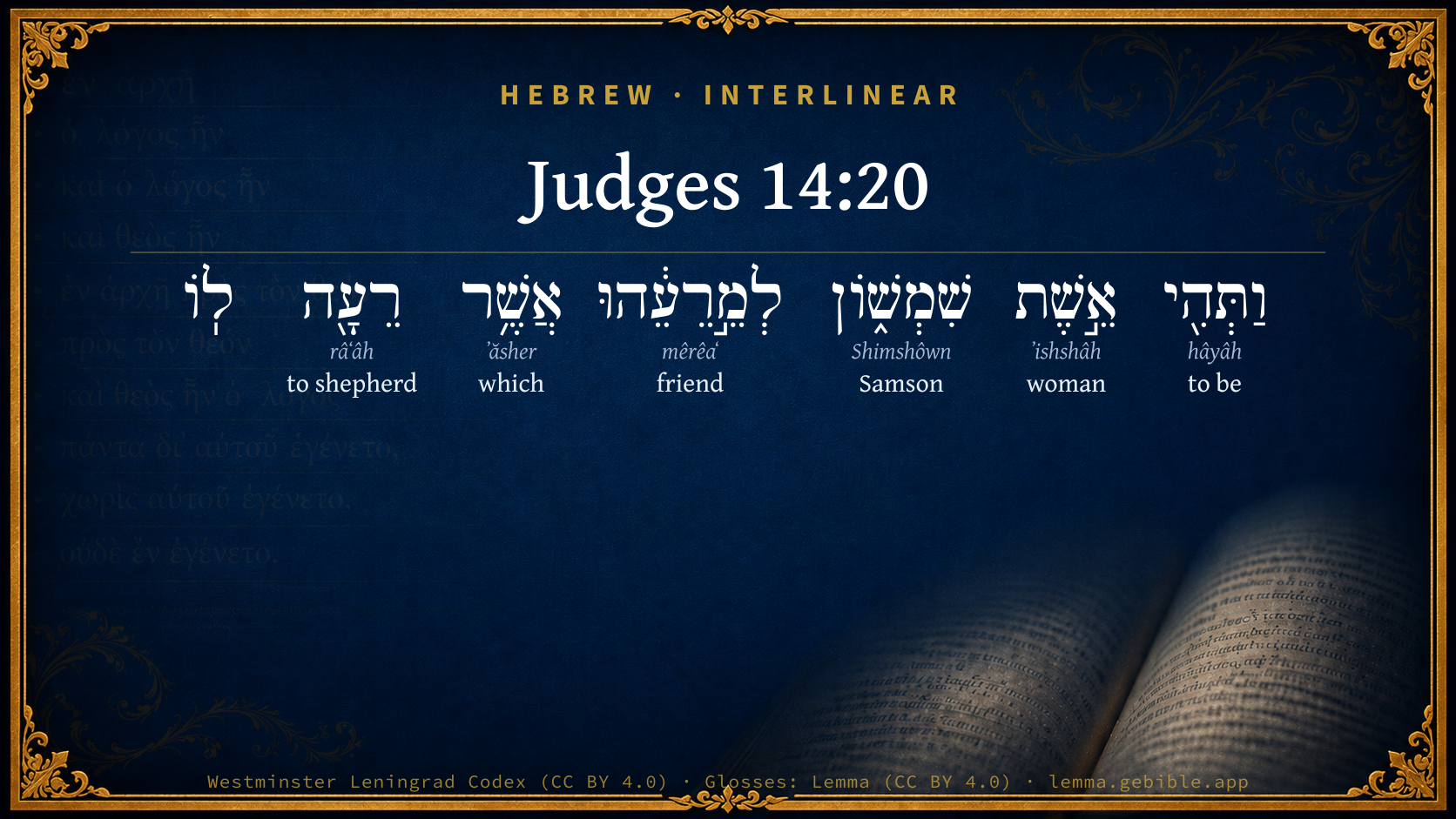
Hebrew (Westminster Leningrad Codex) Judges 14:20 appears in the Hebrew Old Testament. The text above is from the Westminster Leningrad Codex. Each word links to its Strong’s number, a concise gloss, and parsing drawn from the Open Scriptures Hebrew Bible morphology. Click any word for its full Brown-Driver-Briggs (BDB) entry.
Download image
Cite this verse

Judges 14:20 (World English Bible). Public Domain. Lemma interlinear Bible study tool, https://lemma.gebible.app/v/judges/14/20.

Show BibTeX & RIS
BibTeX
RIS
English Translation
But Samson's wife was [given] to his companion, whom he had used as his friend.
World English Bible · Public Domain
Download a study sheet

One document with this verse’s original text, its word-by-word gloss line, the meaning frame, cross-references with their text, attributed commentary, and full source and license credits — printable, and it pastes into notes with its structure intact.

This verse Autodidact and up

Study sheet (.html) Plain text (.txt)

A passage Seminary Student

Up to 50 verses in one chapter. A passage sheet keeps up to 6 commentary sources and 12 cross-references per verse, in the order this page ranks them, and says so on the sheet whenever that leaves anything out. Ask for a single verse and you get the Autodidact verse sheet above.

Everything on this page stays free to read, with no account — the sheet is a download of what is already on screen, not access to it.

Want to remove ads? Support Godless Engineer
Compare translations 3

The same verse in 3 English versions, stacked beneath the original-language interlinear above. Click any original word for its lexicon entry.

Each is an independent rendering of the whole verse — the interlinear is not word-aligned to these translations.

Highlighted words mark where these versions differ — a whole-verse word diff, not a word-by-word alignment.

  • World English Bible Public Domain
    But Samson's wife was [given] to his companion, whom he had used as his friend.
  • King James Version Public Domain
    But Samson's wife was given to his companion, whom he had used as his friend.
  • unfoldingWord Literal Text CC BY-SA 4.0
    And the wife of Samson became to his companion who had accompanied him.

unfoldingWord Literal Text — © unfoldingWord, licensed CC BY-SA 4.0. Word-aligned USFM3 via Door43 (git.door43.org/unfoldingWord/en_ult).

Versions to compare (up to 4)

3 of 4 selected

Show all 18 translations

Every available English version of this verse, each an independent rendering of the whole verse.

  • World English Bible Public Domain
    But Samson's wife was [given] to his companion, whom he had used as his friend.
  • Berean Standard Bible Public Domain
    and his wife was given to one of the men who had accompanied him.
  • Majority Standard Bible Public Domain
    and his wife was given to one of the men who had accompanied him.
  • King James Version Public Domain
    But Samson's wife was given to his companion, whom he had used as his friend.
  • American Standard Version (1901) Public Domain
    But Samson's wife was `given' to his companion, whom he had used as his friend.
  • Revised Version (1885) Public Domain
    But Samson’s wife was given to his companion, whom he had used as his friend.
  • Geneva Bible (1599) Public Domain
    Then Samsons wife was giuen to his companion, whom he had vsed as his friend.
  • Douay-Rheims (1899) Public Domain
    But his wife took one of his friends and bridal companions for her husband.
  • Young's Literal Translation Public Domain
    and Samson's wife becometh his companion's, who `is' his friend.
  • Literal Standard Version CC BY-SA 4.0
    and Samson’s wife becomes his companion’s, who had attended to him.
  • Unlocked Literal Bible CC BY-SA 4.0
    Samson's wife was given to his best friend.
  • unfoldingWord Literal Text CC BY-SA 4.0
    And the wife of Samson became to his companion who had accompanied him.
  • Darby Bible Public Domain
    And Samson's wife was given to his companion, who had been his best man.
  • World Messianic Bible Public Domain
    But Samson’s wife was given to his companion, who had been his friend.
  • Webster's Bible Public Domain
    But Samson's wife was given to his companion, whom he had used as his friend.
  • Free Bible Version CC BY-SA 4.0
    Samson's wife was given to his best man who had accompanied him at the wedding.
  • Bible in Basic English Public Domain
    But Samson's wife was given to the friend who had been his best man.
  • JPS Tanakh (1917) Public Domain
    But Samson's wife was given to his companion, whom he had had for his friend.

Literal Standard Version (2020), Covenant Press — licensed CC BY-SA 4.0. Text via the HelloAO Bible API (eBible.org). Unlocked Literal Bible (unfoldingWord) — licensed CC BY-SA 4.0. Text via the HelloAO Bible API (eBible.org). unfoldingWord Literal Text — © unfoldingWord, licensed CC BY-SA 4.0. Word-aligned USFM3 via Door43 (git.door43.org/unfoldingWord/en_ult). Free Bible Version, Dr. Jonathan Gallagher — licensed CC BY-SA 4.0. Text via the HelloAO Bible API (eBible.org).

Word by word

More ways to search: Search by grammar → Find every occurrence → Compare this word →

Practice this passage: Drill this verse → Learn its vocabulary →

About this verse

These counts appear in no published source. They are computed here, from the morphology-tagged text and Lemma’s own curated glosses. What Lemma adds →

7
words
6
distinct lemmas
Historical
section

Notable vocabulary

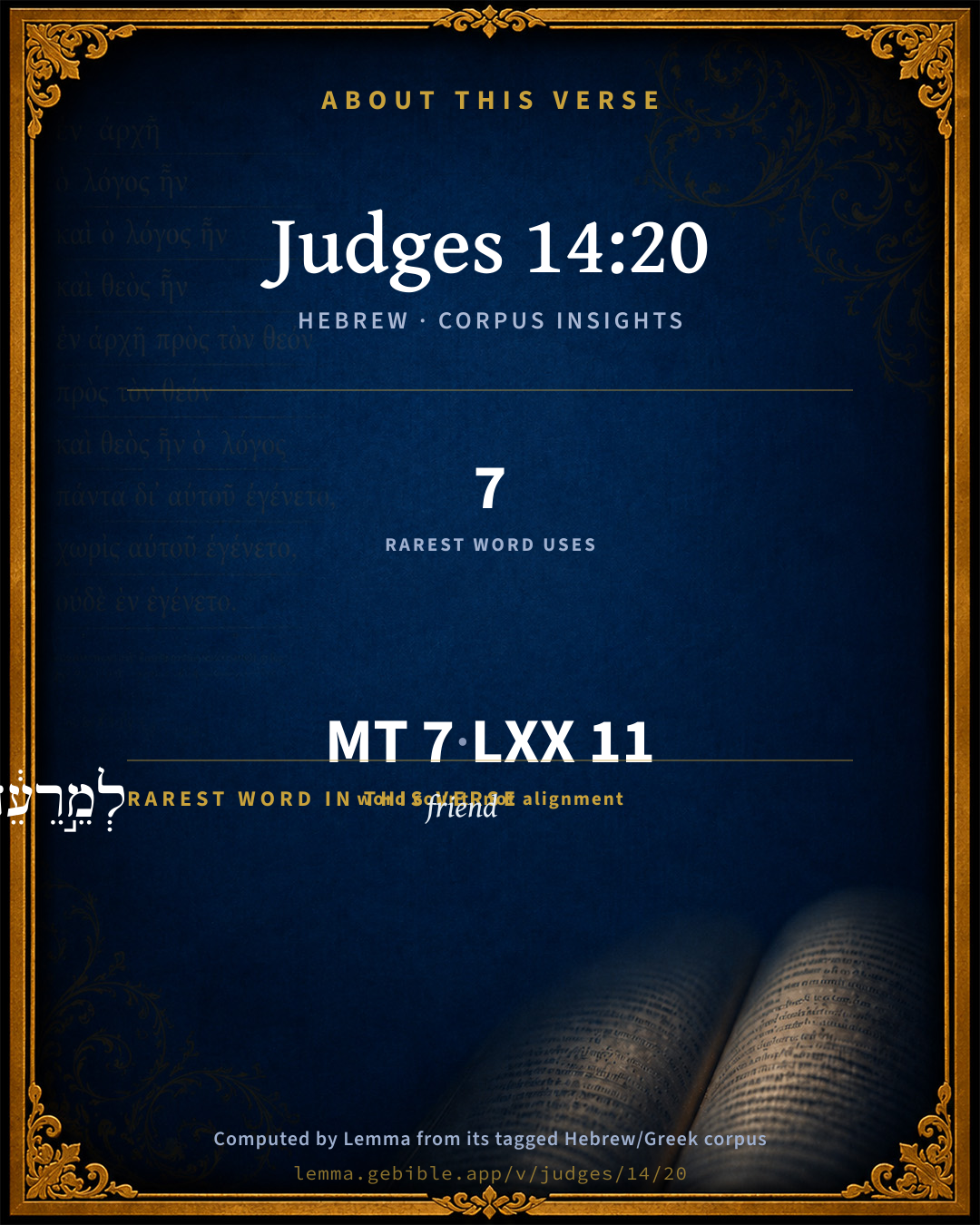
The rarest word here is לְמֵ֣רֵעֵ֔הוּ friend H4828 — appearing just 7 times in the whole Hebrew Bible.

Shared distinctive vocabulary

לְמֵ֣רֵעֵ֔הוּ friend H4828 occurs in 7 verses of the Hebrew Bible. Also found in:

Grammatical profile

  • 2 verbs
  • 3 nouns
  • 1 preposition
  • 1 particle

Verb forms

  • וַתְּהִ֖י Qal · Sequential Imperfect
  • רֵעָ֖ה Piel · Perfect

Hebrew & Septuagint length

In English translation the verse runs 15 words from the Hebrew and 20 from the Septuagint (LXX English) — closely comparable.

A rough comparison of the two English renderings, which tokenize alike — not a word-level alignment.

Word counts can differ between the Hebrew and the Greek without any difference in meaning — e.g. the Hebrew direct-object marker אֵת has no separate Greek word, and Greek often adds the article ὁ.

In the original languages it is 7 Hebrew tokens and 11 Greek tokens — but the two are counted differently (Hebrew bundles its prefixes and suffixes into one token; the Greek is in lemma form), so that isn’t a like-for-like length.

Cross-references

8

Topical passages linked to Judges 14:20 in the Treasury of Scripture Knowledge — connected by theme and wording, ordered by reader-vote popularity; previews shown in the World English Bible.

  • Judges 15:2 Her father said, I most assuredly thought that you had utterly hated her; therefore I gave her to your companion: isn't her younger sister more beautiful than she? Please take her, instead.
  • John 3:29 He who has the bride is the bridegroom; but the friend of the bridegroom, who stands and hears him, rejoices greatly because of the bridegroom's voice. This, my joy, therefore is made full.
  • John 13:18 I don't speak concerning all of you. I know whom I have chosen. But that the Scripture may be fulfilled, 'He who eats bread with me has lifted up his heel against me.'
  • Judges 15:6 Then the Philistines said, Who has done this? They said, Samson, the son-in-law of the Timnite, because he has taken his wife, and given her to his companion. The Philistines came up, and burnt her and her father with fire.
  • Psalms 55:12–13 For it was not an enemy who insulted me, Then I could have endured it. Neither was it he who hated me who raised himself up against me, Then I would have hid myself from him.
  • Jeremiah 9:5 They will deceive everyone his neighbor, and will not speak the truth: they have taught their tongue to speak lies; they weary themselves to commit iniquity.
  • Micah 7:5 Don't trust in a neighbor. Don't put confidence in a friend. With the woman lying in your embrace, Be careful of the words of your mouth!
  • Matthew 26:49–50 Immediately he came to Jesus, and said, "Hail, Rabbi!" and kissed him.

Cross-references courtesy of OpenBible.info (CC BY 4.0).

Hebrew and Greek witnesses Masoretic Hebrew ↔ Greek Septuagint

The same verse in the two great witnesses to the Old Testament, shown verse-for-verse.

These are two independent witnesses, not word-aligned to each other, and the Septuagint is shown in lemma (dictionary) form.

Hebrew Judges 14:20 Masoretic · Westminster Leningrad Codex

וַתְּהִ֖י אֵ֣שֶׁת שִׁמְשׁ֑וֹן לְמֵ֣רֵעֵ֔הוּ אֲשֶׁ֥ר רֵעָ֖ה לֽוֹ

But Samson's wife was [given] to his companion, whom he had used as his friend.

World English Bible · Public Domain

Greek LXX Judges 14:20 Septuagint · lemma form

καί γίγνομαι ὁ γυνή σαμψων εἷς ὁ φίλος αὐτός ὅς φιλιάζω

And the wife of Sampson was given to one of his friends, with whom he was on terms of friendship.

LXX2012 (modern English Septuagint) · Public Domain

On this verse, Ellicott's Commentary for English Readers discusses the Septuagint’s reading. Read the note in Commentary ↓

Hebrew: Westminster Leningrad Codex (CC BY 4.0). Greek: Septuagint (public domain); English from LXX2012 (modern English Septuagint) (Public Domain). How the Septuagint differs from the Hebrew →

Targum (Aramaic paraphrase)

1

The Targum is the ancient Jewish Aramaic paraphrase of the Hebrew Scriptures — an interpretive translation, not the Hebrew text itself. Onkelos (literal) and Pseudo-Jonathan (expansive) render the Torah, and Jonathan the Prophets. Coverage is partial: where no permissively-licensed English translation exists for a verse, only the Aramaic is shown. This is verse-level text, not a word-by-word alignment to the Hebrew.

  1. Targum Jonathan Prophets (Joshua–Malachi)
    וַהֲוַת אִתַּת שִׁמְשׁוֹן לִדְחַבְרֵיהּ דַהֲוָה שׁוֹשְׁבִינֵיהּ:

    (no public-domain English translation for this verse)

    Targum Jonathan — Aramaic: “Mikraot Gedolot” (public domain). English: “Sefaria Community Translation” (CC0 1.0 (public-domain dedication)); “London "Chaldee Paraphrase," 1871” (public domain). Text via Sefaria.

Commentary

Notes on Judges 14:20 from classic Christian and Jewish commentators (each source and its license shown beneath its notes). The classic Christian expositions comment on the surrounding passage and are grouped to its opening verse, so a note may address several verses; the Jewish commentaries on the Tanakh (Rashi and others) are per-verse, so they appear only where the commentator wrote on this verse.

Lemma curates 59 commentaries, every one of them public domain or Creative Commons licensed, each selected and text-cleaned for this edition rather than reprinted as found. About our sources →

Trapp's Complete Commentary

John Trapp

Jdg 14:20 But Samson’s wife was [given] to his companion, whom he had used as his friend.

Ver. 20. But Samson’s wife was given to his companion.] To his Paranymph {a} {Joh 3:29} the first and chief brideman, his bosom friend, who haply had ploughed with this wanton heifer before. Wrongs done by a friend are more unsufferable. "It was thou, my friend," {Psa 55:13} saith David.

{a} Pronubus, Nυμφαγωγος.

John Trapp, A Commentary or Exposition upon All the Books of the Old and New Testament (1647–1656) — public domain. Text from a community e-Sword module.

Joseph Benson's Commentary

Jdg 14:20. Samson’s wife was given, by her father, to his companion, &c. — That is, to the chief of the bride-men, to whom he had shown most respect and kindness. This aggravated the insult that was offered to Samson, in proportion as this person had been more familiar with him, and had been treated by him in a more friendly manner than the rest that afforded him their company. This ungenerous friend might possibly be the man distinguished by the appellation of the friend of the bridegroom. See Joh 3:29.

Joseph Benson's Commentary on the Old and New Testaments (1811–1818) — public domain. Text from a community e-Sword module.

Jamieson, Fausset & Brown

Robert Jamieson, A. R. Fausset & David Brown

Samson's wife was given to his companion, whom he had used as his friend--that is, "the friend of the bridegroom," who was the medium of communicating during the festivities between him and his bride. The acceptance of her hand, therefore, was an act of base treachery, that could not fail to provoke the just resentment of Samson.

Next: Judges Chapter 15

Jamieson, Fausset & Brown — Commentary Critical and Explanatory on the Whole Bible (1871) — public domain (CC PDM 1.0). Text via the HelloAO Bible API.

Adam Clarke's Commentary

Verse 20. But Samson's wife was given to his companion] This was the same kind of person who is called the friend of the bridegroom, Joh 3:29. And it is very likely that she loved this person better than she loved her husband, and went to him as soon as Samson had gone to his father's house at Zorah. She might, however, have thought herself abandoned by him, and therefore took another; this appears to have been the persuasion of her father, Jdg 15:2. But her betraying his secret and his interests to his enemies was a full proof he was not very dear to her; though, to persuade him to the contrary, she shed many crocodile tears; see Jdg 14:16. He could not keep his own secret, and he was fool enough to suppose that another would be more faithful to him than he was to himself. Multitudes complain of the treachery of friends betraying their secrets, &c., never considering that they themselves have been their first betrayers, in confiding to others what they pretend to wish should be a secret to the whole world! If a man never let his secret out of his own bosom, it is impossible that he should ever be betrayed.

Adam Clarke's Commentary on the Bible (1810–1826) — public domain. Text from a community e-Sword/MySword module.

Ellicott's Commentary for English Readers

(20) To his companion, whom he had used as his friend—i.e., to the chief of the paranyraphs (the bride-conductor, LXX.); “the friend of the bride-groom” (Joh_3:29). Hence, even if the suspicion as to the meaning of Samson’s words in Jdg_14:18 be unfounded, it is clear that there was treachery and secret hostility at work. Bunsen renders the phrase, “to his companion, whose friend (amica) she was.”

A Bible Commentary for English Readers, edited by Charles John Ellicott (1878–1897) — public domain. Text from a community e-Sword module.

The Cambridge Bible for Schools and Colleges

gen. ed. J. J. S. Perowne

20. After this violent rupture, and to make up for the disgrace inflicted upon the bride, she was given to his groomsman who had acted as his groom; cf. Jdg_15:2; Jdg_15:6, St Joh_3:29. LXX. cod. A renders by the technical word νυμφαγωγός, the leader of the bride.

The Cambridge Bible for Schools and Colleges (gen. ed. J. J. S. Perowne; Cambridge University Press, 1878–1918) — public domain. Text from a community e-Sword module.

John Gill's Exposition

But Samson's wife was given to his companion,.... By her father, and with her consent, both being affronted and provoked by Samson leaving her, who judged her not only to be injured, but hereby discharged from him, and free to marry another:

and whom he had used as his friend; though there were thirty of them that were his companions, yet there was one of them that was the principal of them, and was the most intimate with him, whom he used in the most friendly manner, and admitted to a more free conversation than the rest, the same that is called the friend of the bridegroom, Joh 3:29 while the others were called the children of the bridechamber, Mat 9:15. It is not unlikely that this person had too much intimacy with Samson's wife before, and so had the secret of the riddle from her, and so very readily married her, as soon as Samson departed; and all this furnished out an occasion and opportunity, which Samson sought for, to be revenged on the Philistines, as in the following chapter.

Next: Judges Chapter 15

John Gill's Exposition of the Whole Bible (1746–1763) — public domain (CC PDM 1.0). Text via the HelloAO Bible API.

Albert Barnes' Notes on the Bible

His companion - Perhaps one of those mentioned in Jdg 14:11. The transaction denotes loose notions of the sanctity of marriage among the Philistines. It should be noted carefully that the practical lesson against ungodly marriages comes out most strongly in this case and that the providential purpose which out of this evil brought discomfiture to the Philistines, has nothing to do with the right or wrong of Samson’s conduct.

Albert Barnes' Notes on the Bible (1834–1885) — public domain. Text from a community e-Sword/MySword module.

Haydock's Catholic Bible Commentary

Companions, the chief friends of the bridegroom, (John iii. 29,) the paranymph. (St. Ambrose) (Calmet) --- Protestants, "But Samson’s wife was given to his companion, whom he had used as his friend." It seems her father had supposed, from Samson’s keeping away for a long time, that he had abandoned her. (Haydock) --- But, though he offered some sort of recompense, (Menochius) he justly fell a victim to the people’s rage, who abhorred adultery, (Calmet) and were irritated at the persecution which he had brought upon them, chap. xv. 2, 6. (Haydock)

George Leo Haydock (1774–1849), Haydock's Catholic Family Bible and Commentary, 1859 edition — public domain. Excludes Psalms (Douay-Rheims chapter numbering differs from Protestant) and Deuterocanonical books (Catholic canon only).

Matthew Poole's English Annotations

Samson’s wife was given, by her father, to the chief of the bridemen, to whom he had showed most respect and kindness.

Matthew Poole's English Annotations on the Holy Bible (1683–1685) — public domain. Text from a community e-Sword/MySword module.

Whedon's Commentary on the Bible

Daniel D. Whedon

20. To his companion — One of the “thirty.” “To treason she adds infidelity. Meanness of disposition gives birth to every thing that is bad. It can neither love nor be faithful; but least of all can it comprehend such a man as Samson was.” — Cassel.

Whom he had used as his friend — Used most confidentially of the thirty, and had intrusted the most delicate matters to his hand. The one who was used for this purpose is called in the New Testament the friend of the bridegroom. Joh_3:29. The father of Samson’s wife understood from his anger that he utterly hated her, (Jdg_15:2,) and renounced all claim to her; but, instead of apologizing, or trying to turn away his wrath, he gave another exhibition of Philistine perfidy by giving her to a rival, and so made the breach utterly irreparable. Here notice how low was this Philistine’s notion of the sanctity of marriage.

Daniel D. Whedon (gen. ed.), Commentary on the Old and New Testaments (1874–1909) — public domain. Text from a community e-Sword module.

The Pulpit Commentary

His companion no doubt his "best man," the "friend of the bridegroom." The parents of the Thimnathite, having no doubt obtained Samson"s dower, and supposing him to have finally broken with his treacherous wife, proceeded to give her in marriage to the Philistine young man who had been Samson"s friend perhaps the man to whom she had told the riddle. The sad end of this unhappy alliance fully justified the opposition of Samson"s parents to it in ver. 3.

How Confidence in wicked men is rewarded.

The world is full of such instances of misplaced trust. The fable of the viper and the husbandman. It is hard to persuade men of the utter folly of worldly friendships and alliances. Only the most severe warnings and painful consequences will suffice to disabuse the mind. At the same time that the carnal nature of God"s servant draws him towards the enemies of his country and his faith, God"s providential dispensations are working out an effectual divorce, and preparing Samson for deadly hostility to his quondam friends.

I THE CONFIDENCE WE PLACE IN THE WICKED WILL CERTAINLY BETRAY US.

II GOD SEEKS BY STERN LESSONS TO SEPARATE HIS PEOPLE FROM THE WORLD.

III NONE ARE SO OPPOSED TO THE CHARACTERS AND PRACTICES OF THE WICKED AS THOSE WHO HAVE BEEN BETRAYED BY THEM. M.

The Pulpit Commentary (1880–1919), ed. H.D.M. Spence-Jones & Joseph S. Exell — public domain. Text from a community e-Sword module.

John Wesley's Explanatory Notes

Was given - By her father. Whom he had used - That is, to the chief of the bride-men, to whom he had shewed most respect and kindness.

John Wesley, Explanatory Notes Upon the Whole Bible (1754–1765) — public domain. Text via the GEBible commentary corpus.

Rashi

Rabbi Shlomo Yitzchaki (Rashi)

To a Friend. To one of the wedding attendants.

Rashi on the Tanakh — English translations: “The Judaica Press complete Tanach with Rashi, translated by A. J. Rosenberg” (CC BY 4.0); “Pentateuch with Rashi's commentary by M. Rosenbaum and A.M. Silbermann, 1929-1934” (public domain); “The Metsudah Tanach series, Lakewood, N.J” (CC BY 4.0); and “The Book of Joshua, Metsudah Publications, 1997” (CC BY 4.0). Text via Sefaria.

Lesson kit

Teaching starters — assembled from the data on this page, not authored interpretation. Every prompt links to the verse data it draws on. Edit before teaching.

Judges, in the Historical, opens this verse with 7 words (6 distinct Hebrew lemmas). Its most distinctive word is mêrêaʻ (“friend”). A historical commentator’s framing appears above. Read the whole chapter for the surrounding context.

Discussion questions

  1. What does “friend” (mêrêaʻ) contribute to the verse as a whole?
  2. How does Genesis 26:26, which shares the word «friend», read alongside this verse?
  3. These translations render this verse differently. What is at stake in choosing one wording over another?
  4. «וַתְּהִ֖י» is a Qal Sequential Imperfect verb. How does that grammatical form shape the action described?
  5. Compare how Trapp's Complete Commentary and Joseph Benson's Commentary read this verse. Where do they agree or differ?

Things to notice

Reading settings

Reading text

Shown beneath each verse's original-language words.

Old Testament
Old Testament edition

Read the OT as the Masoretic Hebrew (MT) or the Greek Septuagint (LXX).

English shown for the Greek Septuagint (in the Hebrew ↔ Greek comparison).

Comparing translations? Open the Compare panel on any verse page to stack up to four side by side.