
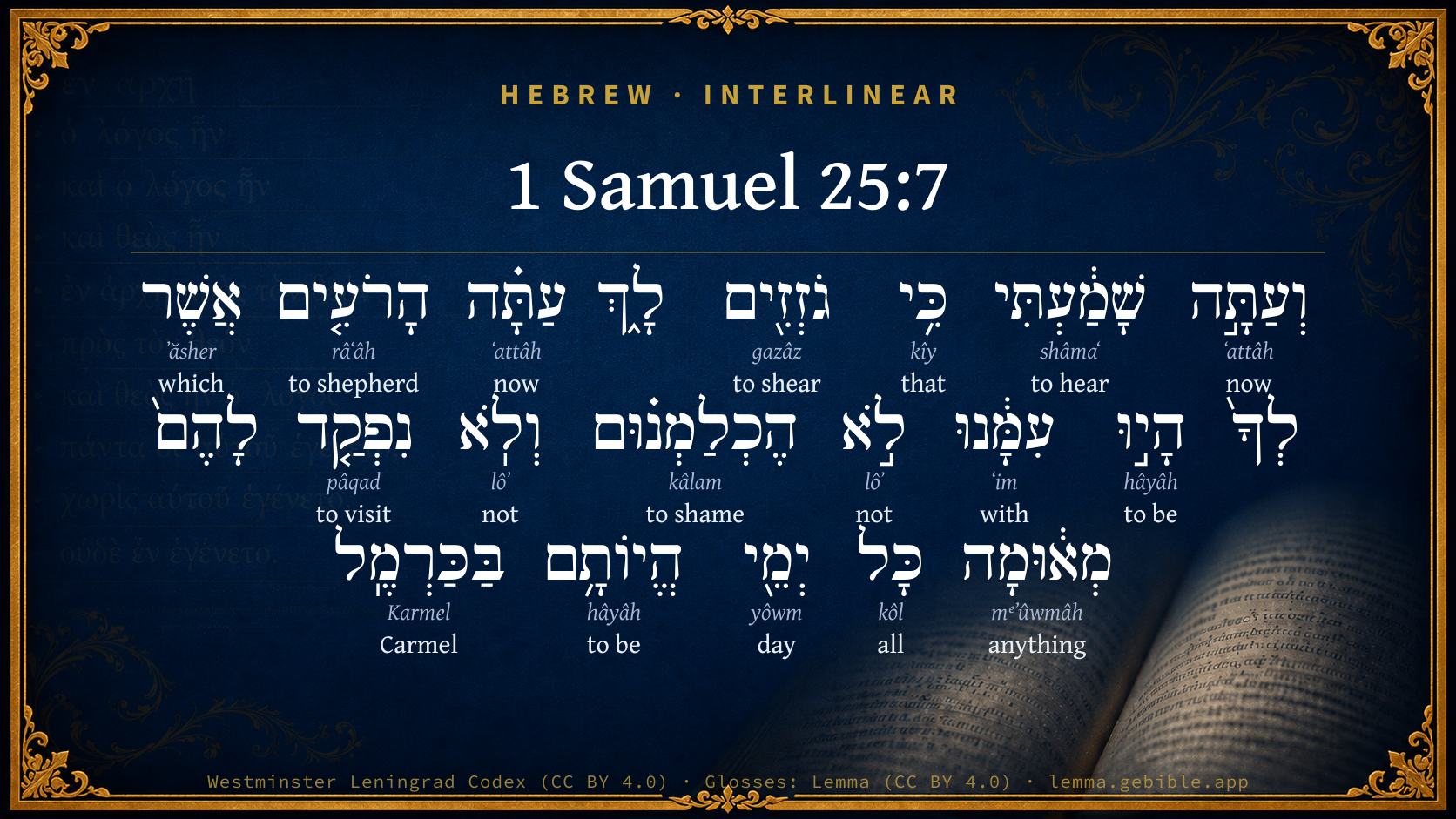
1 Samuel 25:7

Hebrew (Westminster Leningrad Codex) 1 Samuel 25:7 appears in the Hebrew Old Testament. The text above is from the Westminster Leningrad Codex. Each word links to its Strong’s number, a concise gloss, and parsing drawn from the Open Scriptures Hebrew Bible morphology. Click any word for its full Brown-Driver-Briggs (BDB) entry.
Download image
Cite this verse

1 Samuel 25:7 (World English Bible). Public Domain. Lemma interlinear Bible study tool, https://lemma.gebible.app/v/1-samuel/25/7.

Show BibTeX & RIS
BibTeX
RIS
English Translation
Now I have heard that you have shearers: your shepherds have now been with us, and we did them no hurt, neither was there anything missing to them, all the while they were in Carmel.
World English Bible · Public Domain
Download a study sheet

One document with this verse’s original text, its word-by-word gloss line, the meaning frame, cross-references with their text, attributed commentary, and full source and license credits — printable, and it pastes into notes with its structure intact.

This verse Autodidact and up

Study sheet (.html) Plain text (.txt)

A passage Seminary Student

Up to 50 verses in one chapter. A passage sheet keeps up to 6 commentary sources and 12 cross-references per verse, in the order this page ranks them, and says so on the sheet whenever that leaves anything out. Ask for a single verse and you get the Autodidact verse sheet above.

Everything on this page stays free to read, with no account — the sheet is a download of what is already on screen, not access to it.

Want to remove ads? Support Godless Engineer
Compare translations 3

The same verse in 3 English versions, stacked beneath the original-language interlinear above. Click any original word for its lexicon entry.

Each is an independent rendering of the whole verse — the interlinear is not word-aligned to these translations.

Highlighted words mark where these versions differ — a whole-verse word diff, not a word-by-word alignment.

  • World English Bible Public Domain
    Now I have heard that you have shearers: your shepherds have now been with us, and we did them no hurt, neither was there anything missing to them, all the while they were in Carmel.
  • King James Version Public Domain
    And now I have heard that thou hast shearers: now thy shepherds which were with us, we hurt them not, neither was there ought missing unto them, all the while they were in Carmel.
  • unfoldingWord Literal Text CC BY-SA 4.0
    And now, I have heard that shearers to you. Now the shepherds who to you have been with us. We have not hurt them, and anything to them has not been missing all of the days of their being in Carmel.

unfoldingWord Literal Text — © unfoldingWord, licensed CC BY-SA 4.0. Word-aligned USFM3 via Door43 (git.door43.org/unfoldingWord/en_ult).

Versions to compare (up to 4)

3 of 4 selected

Show all 18 translations

Every available English version of this verse, each an independent rendering of the whole verse.

  • World English Bible Public Domain
    Now I have heard that you have shearers: your shepherds have now been with us, and we did them no hurt, neither was there anything missing to them, all the while they were in Carmel.
  • Berean Standard Bible Public Domain
    Now I hear that it is time for shearing. When your shepherds were with us, we did not harass them, and nothing of theirs was missing the whole time they were in Carmel.
  • Majority Standard Bible Public Domain
    Now I hear that it is time for shearing. When your shepherds were with us, we did not harass them, and nothing of theirs was missing the whole time they were in Carmel.
  • King James Version Public Domain
    And now I have heard that thou hast shearers: now thy shepherds which were with us, we hurt them not, neither was there ought missing unto them, all the while they were in Carmel.
  • American Standard Version (1901) Public Domain
    And now I have heard that thou hast shearers: thy shepherds have now been with us, and we did them no hurt, neither was there aught missing unto them, all the while they were in Carmel.
  • Revised Version (1885) Public Domain
    And now I have heard that thou hast shearers: thy shepherds have now been with us, and we did them no hurt, neither was there aught missing unto them, all the while they were in Carmel.
  • Geneva Bible (1599) Public Domain
    Behold, I haue heard, that thou hast sherers: now thy shepherds were with vs, and we did the no hurt, neyther did they misse any thing all the while they were in Carmel.
  • Douay-Rheims (1899) Public Domain
    I heard that thy shepherds that were with us in the desert were shearing: we never molested them, neither was there ought missing to them of the flock at any time, all the while they were with us in Carmel.
  • Young's Literal Translation Public Domain
    and, now, I have heard that thou hast shearers; now, the shepherds whom thou hast have been with us, we have not put them to shame, nor hath anything been looked after by them, all the days of their being in Carmel.
  • Literal Standard Version CC BY-SA 4.0
    And now, I have heard that you have shearers; now, the shepherds whom you have have been with us, we have not put them to shame, nor has anything been looked after by them, all the days of their being in Carmel.
  • Unlocked Literal Bible CC BY-SA 4.0
    I hear that you have shearers. Your shepherds have been with us, and we did them no harm, and they missed nothing the whole time they were in Carmel.
  • unfoldingWord Literal Text CC BY-SA 4.0
    And now, I have heard that shearers to you. Now the shepherds who to you have been with us. We have not hurt them, and anything to them has not been missing all of the days of their being in Carmel.
  • Darby Bible Public Domain
    And now I have heard that thou hast shearers; now thy shepherds who were with us, we hurt them not, neither was there aught missed by them, all the while they were in Carmel.
  • World Messianic Bible Public Domain
    Now I have heard that you have shearers. Your shepherds have now been with us, and we didn’t harm them. Nothing was missing from them all the time they were in Carmel.
  • Webster's Bible Public Domain
    And now I have heard that thou hast shearers: now thy shepherds who were with us, we hurt them not, neither was there aught missing to them, all the while they were in Carmel.
  • Free Bible Version CC BY-SA 4.0
    Now I've heard that you are busy shearing. When your shepherds were with us, we didn't mistreat them, and nothing belonging to them was stolen all the time they were in Carmel.
  • Bible in Basic English Public Domain
    I have had word that you have wool-cutters: now the keepers of your sheep have been with us, and we have done them no evil, and taken nothing of theirs while they were in Carmel.
  • JPS Tanakh (1917) Public Domain
    And now I have heard that thou hast shearers; thy shepherds have now been with us, and we did them no hurt, neither was there aught missing unto them, all the while they were in Carmel.

Literal Standard Version (2020), Covenant Press — licensed CC BY-SA 4.0. Text via the HelloAO Bible API (eBible.org). Unlocked Literal Bible (unfoldingWord) — licensed CC BY-SA 4.0. Text via the HelloAO Bible API (eBible.org). unfoldingWord Literal Text — © unfoldingWord, licensed CC BY-SA 4.0. Word-aligned USFM3 via Door43 (git.door43.org/unfoldingWord/en_ult). Free Bible Version, Dr. Jonathan Gallagher — licensed CC BY-SA 4.0. Text via the HelloAO Bible API (eBible.org).

Word by word

More ways to search: Search by grammar → Find every occurrence → Compare this word →

Practice this passage: Drill this verse → Learn its vocabulary →

גֹזְזִ֖ים
gazâz
H1494
“shearing”
Verb, Qal, Participle Active, Masculine, Plural, Absolute
Part of Speech
Verb
Stem
Qal
Form
Participle Active
Gender
Masculine
Number
Plural
State
Absolute
Full BDB Definition

Origin: a primitive root [akin to H1468 ]

TWOT: 336

to shear, mow - (Qal) - to shear - shearer (participle) - (Niphal) to be cut off, be destroyed
  1. וְעַתָּ֣ה ʻattâh H6258 “and · now” Conjunction + Adverb
  2. שָׁמַ֔עְתִּי shâmaʻ H8085 “to hear” Verb, Qal, Perfect, 1st Person, Common, Singular
  3. כִּ֥י kîy H3588 “that” Conjunction
  4. עַתָּ֗ה ʻattâh H6258 “now” Adverb
  5. הָרֹעִ֤ים râʻâh H7462 “the · shepherding” Particle, Definite Article + Verb, Qal, Participle Active, Masculine, Plural, Absolute
  6. אֲשֶׁר ʼăsher H834 “which” Particle, Relative
  7. הָי֣וּ hâyâh H1961 “to be” Verb, Qal, Perfect, 3rd Person, Common, Plural
  8. עִמָּ֔נוּ ʻim H5973 “with · us” Preposition + Suffix, Personal, 1st Person, Common, Plural
  9. לֹ֣א lôʼ H3808 “not” Particle, Negative
  10. הֶכְלַמְנ֗וּם kâlam H3637 “to shame · them” Verb, Hiphil, Perfect, 1st Person, Common, Plural + Suffix, Personal, 3rd Person, Masculine, Plural
  11. וְלֹֽא lôʼ H3808 “and · not” Conjunction + Particle, Negative
  12. נִפְקַ֤ד pâqad H6485 “to visit” Verb, Niphal, Perfect, 3rd Person, Masculine, Singular
  13. מְא֔וּמָה mᵉʼûwmâh H3972 “anything” Noun, Common, Feminine, Singular, Absolute
  14. כָּל kôl H3605 “all of” Noun, Common, Masculine, Singular, Construct
  15. יְמֵ֖י yôwm H3117 “days of” Noun, Common, Masculine, Plural, Construct
  16. הֱיוֹתָ֥ם hâyâh H1961 “to be · them” Verb, Qal, Infinitive Construct + Suffix, Personal, 3rd Person, Masculine, Plural
  17. בַּכַּרְמֶֽל Karmel H3760 “in/at the · Carmel” Preposition, Determined + Noun, Proper

About this verse

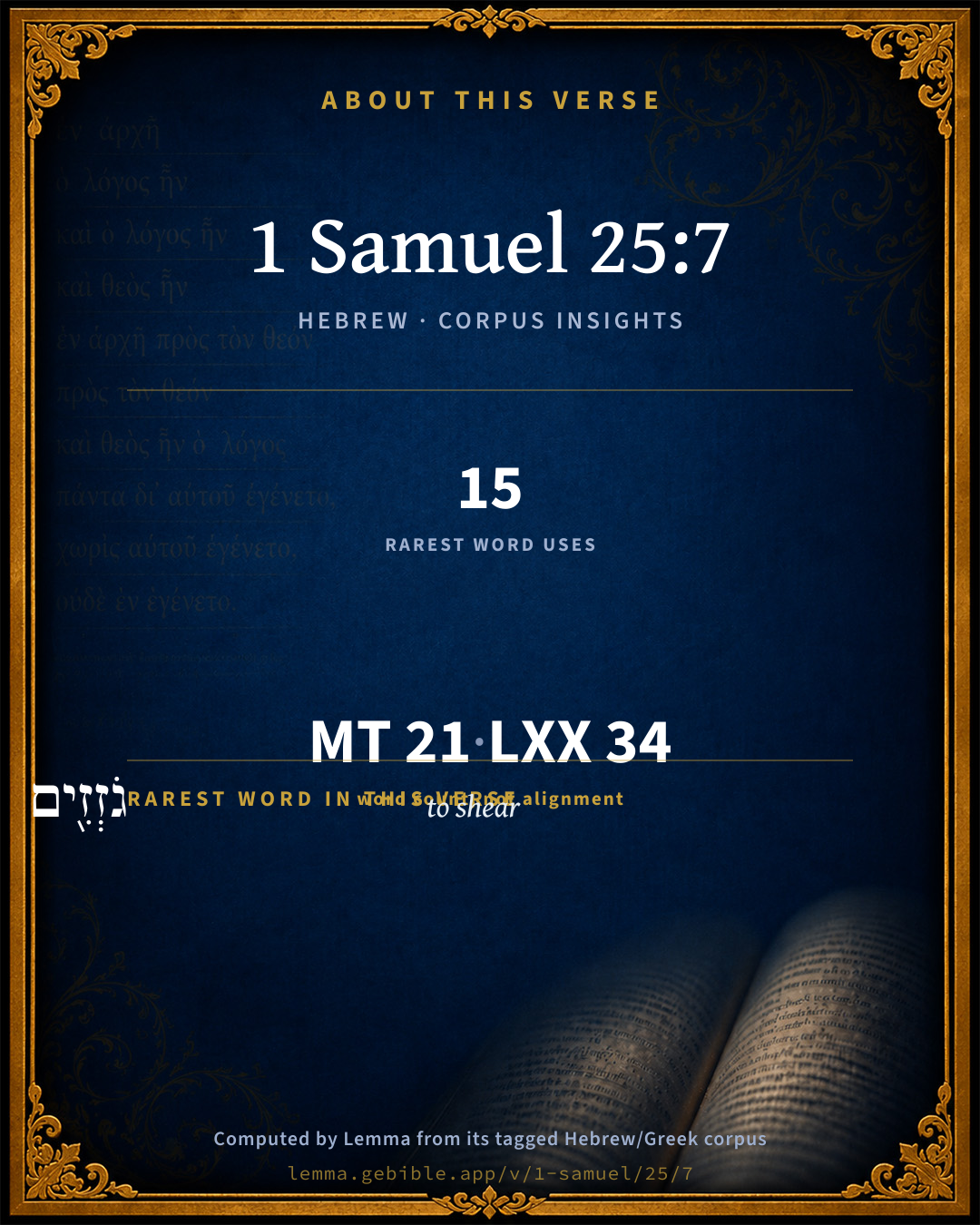
These counts appear in no published source. They are computed here, from the morphology-tagged text and Lemma’s own curated glosses. What Lemma adds →

21
words
15
distinct lemmas
Historical
section

Notable vocabulary

The rarest word here is גֹזְזִ֖ים to shear H1494 — appearing just 15 times in the whole Hebrew Bible.

Shared distinctive vocabulary

גֹזְזִ֖ים to shear H1494 occurs in 15 verses of the Hebrew Bible. Also found in:

Grammatical profile

  • 7 verbs
  • 4 nouns
  • 4 prepositions
  • 1 conjunction
  • 2 adverbs
  • 3 particles

Verb forms

  • שָׁמַ֔עְתִּי Qal · Perfect
  • גֹזְזִ֖ים Qal · Participle Active
  • הָרֹעִ֤ים Qal · Participle Active
  • הָי֣וּ Qal · Perfect
  • הֶכְלַמְנ֗וּם Hiphil · Perfect
  • נִפְקַ֤ד Niphal · Perfect
  • הֱיוֹתָ֥ם Qal · Infinitive Construct

Repetition

Words recur within this verse — often emphatic in Hebrew:

  • וְעַתָּ֣ה now H6258 ×2
  • הָי֣וּ to be H1961 ×2
  • לֹ֣א not H3808 ×2

Hebrew & Septuagint length

In English translation the verse runs 35 words from the Hebrew and 40 from the Septuagint (LXX English) — closely comparable.

A rough comparison of the two English renderings, which tokenize alike — not a word-level alignment.

Word counts can differ between the Hebrew and the Greek without any difference in meaning — e.g. the Hebrew direct-object marker אֵת has no separate Greek word, and Greek often adds the article ὁ.

In the original languages it is 21 Hebrew tokens and 34 Greek tokens — but the two are counted differently (Hebrew bundles its prefixes and suffixes into one token; the Greek is in lemma form), so that isn’t a like-for-like length.

Cross-references

7

Topical passages linked to 1 Samuel 25:7 in the Treasury of Scripture Knowledge — connected by theme and wording, ordered by reader-vote popularity; previews shown in the World English Bible.

  • 1 Samuel 25:21 Now David had said, Surely in vain have I kept all that this fellow has in the wilderness, so that nothing was missed of all that pertained to him: and he has returned me evil for good.
  • 1 Samuel 25:15–16 But the men were very good to us, and we were not hurt, neither missed we anything, as long as we went with them, when we were in the fields:
  • 1 Samuel 22:2 Everyone who was in distress, and everyone who was in debt, and everyone who was discontented, gathered themselves to him; and he became captain over them: and there were with him about four hundred men.
  • Isaiah 11:6–9 The wolf shall dwell with the lamb, and the leopard shall lie down with the kid; and the calf and the young lion and the fattened calf together; and a little child shall lead them.
  • Luke 3:14 Soldiers also asked him, saying, "What about us? What must we do?" He said to them, "Extort from no one by violence, neither accuse anyone wrongfully. Be content with your wages."
  • Philippians 2:15 that you may become blameless and harmless, children of God without blemish in the midst of a crooked and perverse generation, among whom you are seen as lights in the world,
  • Philippians 4:8 Finally, brothers, whatever things are true, whatever things are honorable, whatever things are just, whatever things are pure, whatever things are lovely, whatever things are of good report; if there is any virtue, and if there is any praise, think about these things.

Cross-references courtesy of OpenBible.info (CC BY 4.0).

Hebrew and Greek witnesses Masoretic Hebrew ↔ Greek Septuagint

The same verse in the two great witnesses to the Old Testament, shown verse-for-verse.

These are two independent witnesses, not word-aligned to each other, and the Septuagint is shown in lemma (dictionary) form.

Hebrew 1 Samuel 25:7 Masoretic · Westminster Leningrad Codex

וְעַתָּ֣ה שָׁמַ֔עְתִּי כִּ֥י גֹזְזִ֖ים לָ֑ךְ עַתָּ֗ה הָרֹעִ֤ים אֲשֶׁר לְךָ֙ הָי֣וּ עִמָּ֔נוּ לֹ֣א הֶכְלַמְנ֗וּם וְלֹֽא נִפְקַ֤ד לָהֶם֙ מְא֔וּמָה כָּל יְמֵ֖י הֱיוֹתָ֥ם בַּכַּרְמֶֽל

Now I have heard that you have shearers: your shepherds have now been with us, and we did them no hurt, neither was there anything missing to them, all the while they were in Carmel.

World English Bible · Public Domain

Greek LXX 1 Samuel 25:7 Septuagint · lemma form

καί νῦν ἰδού ἀκούω ὅτι κείρω σύ νῦν ὁ ποιμήν σύ ὅς εἰμί μετά ἐγώ ἐν ὁ ἔρημος καί οὐ ἀποκωλύω αὐτός καί οὐ ἐντέλλομαι αὐτός οὐδείς πᾶς ὁ ἡμέρα εἰμί αὐτός ἐν κάρμηλος

And now, behold, I have heard that your shepherds who were with us in the wilderness are shearing your sheep, and we hindered them not, neither did we demand any thing from them all the time they were in Carmel.

LXX2012 (modern English Septuagint) · Public Domain

Hebrew: Westminster Leningrad Codex (CC BY 4.0). Greek: Septuagint (public domain); English from LXX2012 (modern English Septuagint) (Public Domain). How the Septuagint differs from the Hebrew →

Targum (Aramaic paraphrase)

1

The Targum is the ancient Jewish Aramaic paraphrase of the Hebrew Scriptures — an interpretive translation, not the Hebrew text itself. Onkelos (literal) and Pseudo-Jonathan (expansive) render the Torah, and Jonathan the Prophets. Coverage is partial: where no permissively-licensed English translation exists for a verse, only the Aramaic is shown. This is verse-level text, not a word-by-word alignment to the Hebrew.

  1. Targum Jonathan Prophets (Joshua–Malachi)
    וּכְעַן שְׁמָעִית אֲרֵי גוֹזְזִין לָךְ כְּעַן רָעַיָא דִילָךְ הֲווֹ עִמָנָא לָא אַנְזֵיקִינוּנוּן וְלָא שְׁגָא לְהוֹן מִדַעַם כָּל יוֹמִין דַהֲווֹ בְּכַרְמְלָא:

    (no public-domain English translation for this verse)

    Targum Jonathan — Aramaic: “Mikraot Gedolot” (public domain). English: “Sefaria Community Translation” (CC0 1.0 (public-domain dedication)); “London "Chaldee Paraphrase," 1871” (public domain). Text via Sefaria.

Commentary

Notes on 1 Samuel 25:7 from classic Christian and Jewish commentators (each source and its license shown beneath its notes). The classic Christian expositions comment on the surrounding passage and are grouped to its opening verse, so a note may address several verses; the Jewish commentaries on the Tanakh (Rashi and others) are per-verse, so they appear only where the commentator wrote on this verse.

Lemma curates 59 commentaries, every one of them public domain or Creative Commons licensed, each selected and text-cleaned for this edition rather than reprinted as found. About our sources →

Trapp's Complete Commentary

John Trapp

1Sa 25:7 And now I have heard that thou hast shearers: now thy shepherds which were with us, we hurt them not, neither was there ought missing unto them, all the while they were in Carmel.

Ver. 7. And now I have heard that thou hast shearers.] And makest a feast: so that it will be easy for thee to spare us somewhat, who crave not much, and yet have deserved more. Thus David moveth him by many topical places in rhetoric; sed surdo fabulam, but he lost all his sweet words upon him.

John Trapp, A Commentary or Exposition upon All the Books of the Old and New Testament (1647–1656) — public domain. Text from a community e-Sword module.

Joseph Benson's Commentary

1Sa 25:7-8. We hurt them not, &c. — This, considering the licentiousness of soldiers, and the necessities David and his men were exposed to, was no small favour, which Nabal was bound both in justice and gratitude, and prudence, to requite. We come in a good day — That is, in a day of feasting and rejoicing; when men are most cheerful and liberal; when thou mayest relieve us out of thy abundance without damage to thyself; when thou art receiving the mercies of God, and therefore obliged to pity and relieve distressed and indigent persons. Give, I pray thee, whatsoever cometh to thy hand — Most obliging words, and full of respect, mixed with strong arguments; and they did not desire delicacies, but any thing that was at hand which he could spare.

Joseph Benson's Commentary on the Old and New Testaments (1811–1818) — public domain. Text from a community e-Sword module.

Adam Clarke's Commentary

Verse 7. Thy shepherds which there with us, we hurt them not] It is most evident that David had a claim upon Nabal, for very essential services performed to his herdmen at Carmel. He not only did them no hurt, and took none of their flocks for the supply of his necessities, but he protected them from the rapacity of others; they were a WALL unto us, said Nabal's servants, both by night and day. In those times, and to the present day, wandering hordes of Arabs, under their several chiefs, think they have a right to exact contributions of provisions, c., wherever they come David had done nothing of this kind, but protected them against those who would.

Adam Clarke's Commentary on the Bible (1810–1826) — public domain. Text from a community e-Sword/MySword module.

Ellicott's Commentary for English Readers

(7) Neither was there ought missing unto them.—These words doubtless refer to the protection which David’s armed band had afforded to the herdsmen against the frequent raids of the neighbouring people—the Philistines and other more savage and unscrupulous tribes who dwelt on the borders of Palestine. The request was certainly a fair one, for, as Lange and Ewald remark, “apart from the Eastern custom of giving largely at such great merry-makings, according to which such a request would seem in no way strange, David had a certain right to ask a gift from Nabal’s wealth. He had indirectly no small share in the festal joy of Nabal and his house. Without some part of the superfluity of the inhabitants whom he protected, he could not have maintained himself and his army.”

A Bible Commentary for English Readers, edited by Charles John Ellicott (1878–1897) — public domain. Text from a community e-Sword module.

The Cambridge Bible for Schools and Colleges

gen. ed. J. J. S. Perowne

7. that thou hast shearers] Sheep-shearing was and still is an occasion of festivity. See 2Sa_13:23-24. David’s message was not a demand for black-mail. He had done Nabal real service, by protecting his flocks from roving marauders, and he was entitled to recompence. “On such a festive occasion near a town or village, even in our own time, an Arab Sheikh of the neighbouring desert would hardly fail to put in a word, either in person or by message; and his message, both in form and substance, would be only the transcript of that of David.” Robinson, Bibl. Res. 1. 498.

The Cambridge Bible for Schools and Colleges (gen. ed. J. J. S. Perowne; Cambridge University Press, 1878–1918) — public domain. Text from a community e-Sword module.

John Gill's Exposition

And now I have heard that thou hast shearers,.... Men employed in shearing his sheep, which was a time of feasting and gladness, and therefore David sent his young men to him at this time with his compliments upon it; and in order to obtain what he intended by this message to him, he observes the favours he and his men had done to his servants, and the advantages which they had received from them:

now thy shepherds which were with us; feeding their sheep near the wilderness of Paran, which was not far from Carmel and Maon:

we hurt them not; by taking any of their sheep and lambs from them, or by abusing, beating them, or giving them ill language; or "did not put them to shame" (x), by denying them anything they asked of them, which was in their power to grant, nor mocked and scoffed at them, and jeered them on account of their occupation:

neither was there ought missing unto them; they did not steal a sheep or lamb from them, as was common for soldiers to do; nor did they suffer any of the Arabs, that dwelt in the wilderness of Paran, to rob them, who lived upon plunder, or any of the wild beasts to hurt them, as much as in them lay; so careful were they of them, and were a wall unto them by night and day, as Nabal's servants owned, Sa1 25:16; and this was the case:

all the while they were in Carmel; or in the fields, Sa1 25:15; which were joining to the wilderness of Paran.

(x) "non affecimus verccundia eos", Montanus; so some in Vatablus.

John Gill's Exposition of the Whole Bible (1746–1763) — public domain (CC PDM 1.0). Text via the HelloAO Bible API.

Haydock's Catholic Bible Commentary

Molested them. This deserved some acknowledgment, as they might have done it with impunity. But David had also been of service to Nabal’s men, as one of them told Abigail, ver. 16---21.

George Leo Haydock (1774–1849), Haydock's Catholic Family Bible and Commentary, 1859 edition — public domain. Excludes Psalms (Douay-Rheims chapter numbering differs from Protestant) and Deuterocanonical books (Catholic canon only).

Matthew Poole's English Annotations

Which, considering the licentiousness of soldiers, and the necessities which David and his men were oft exposed to, was no small favour and privilege, which Nabal was bound both ill justice, and gratitude, and prudence to requite.

Matthew Poole's English Annotations on the Holy Bible (1683–1685) — public domain. Text from a community e-Sword/MySword module.

John Wesley's Explanatory Notes

We hurt not - This considering the licentiousness of soldiers, and the necessities David and his men were exposed to, was no small favour, which Nabal was bound both in justice, and gratitude, and prudence to requite.

John Wesley, Explanatory Notes Upon the Whole Bible (1754–1765) — public domain. Text via the GEBible commentary corpus.

unfoldingWord translationNotes

Door43 World Missions Community

you have shearers

"your shearers are working" or "your shearers have sheep to shear." David wants his men to speak so that Nabal understands that his sheep were well because David's men helped guard them.

we did them no harm, and they missed nothing

David is pointing out how he and his men offered protection to Nabal's servants and flocks. This can be stated in positive form. AT: "we kept them and all their property from harm" (See: Litotes)

let my young men find favor in your eyes

Here the eyes represent seeing, and seeing represents thoughts or judgment. AT: "may you be pleased with my young men" or "may you consider my young men favorably" (See: Metaphor)

to your servants

David was expressing respect toward Nabal by calling his men Nabal's servants.

your son David

David spoke as if he were Nabal's son to show that he respected Nabal, who was an older man.

translationWords

shepherd

favor

hand

servant

son

unfoldingWord translationNotes — © Distant Shores Media and the Door43 World Missions Community, licensed CC BY-SA 4.0. Source: git.door43.org/Door43/en_tn.

Rashi

Rabbi Shlomo Yitzchaki (Rashi)

We did not shame them. If they needed us for anything, we did not send them back empty-handed.

Not a thing of theirs was missing. Of your flocks, for we were watching them.

Rashi on the Tanakh — English translations: “The Judaica Press complete Tanach with Rashi, translated by A. J. Rosenberg” (CC BY 4.0); “Pentateuch with Rashi's commentary by M. Rosenbaum and A.M. Silbermann, 1929-1934” (public domain); “The Metsudah Tanach series, Lakewood, N.J” (CC BY 4.0); and “The Book of Joshua, Metsudah Publications, 1997” (CC BY 4.0). Text via Sefaria.

Lesson kit

Teaching starters — assembled from the data on this page, not authored interpretation. Every prompt links to the verse data it draws on. Edit before teaching.

1 Samuel, in the Historical, opens this verse with 21 words (15 distinct Hebrew lemmas). Its most distinctive word is gazâz (“to shear”). A historical commentator’s framing appears above. Read the whole chapter for the surrounding context.

Discussion questions

  1. What does “to shear” (gazâz) contribute to the verse as a whole?
  2. Genesis 31:19 shares the word «to shear» with this verse. How do the two illuminate each other?
  3. “now” occurs 2× in this one verse. What is the effect of the repetition?
  4. These translations render this verse differently; the difference is in the English rendering, not the original. What questions does that raise?
  5. The verb «שָׁמַ֔עְתִּי» is Qal Perfect. How does its form color the action?
  6. Reading how Trapp's Complete Commentary and Joseph Benson's Commentary read this verse, where do the two commentators agree and where do they part?

Things to notice

Reading settings

Reading text

Shown beneath each verse's original-language words.

Old Testament
Old Testament edition

Read the OT as the Masoretic Hebrew (MT) or the Greek Septuagint (LXX).

English shown for the Greek Septuagint (in the Hebrew ↔ Greek comparison).

Comparing translations? Open the Compare panel on any verse page to stack up to four side by side.