
Micah 5:4

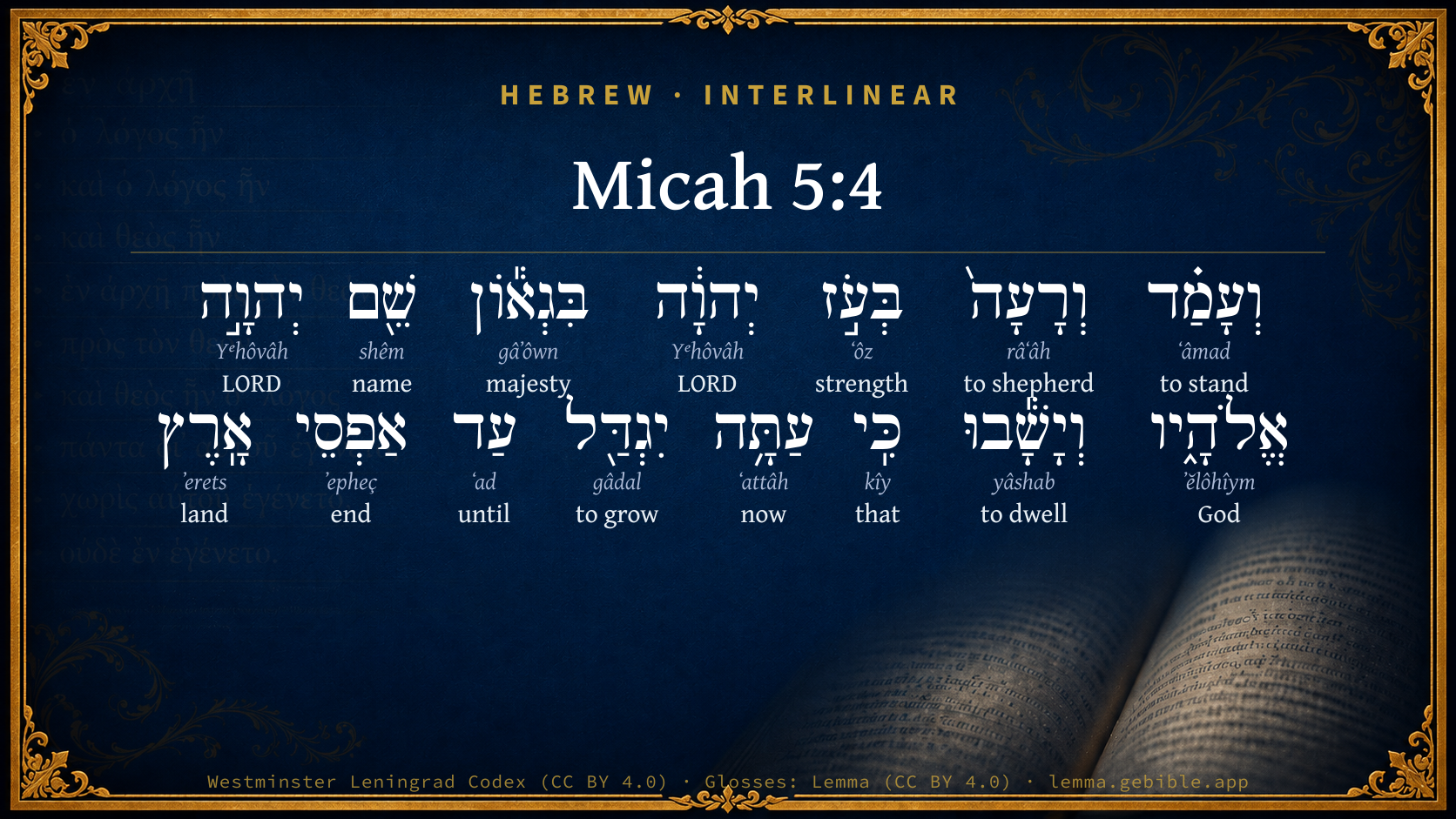
Hebrew (Westminster Leningrad Codex) Micah 5:4 appears in the Hebrew Old Testament. The text above is from the Westminster Leningrad Codex. Each word links to its Strong’s number, a concise gloss, and parsing drawn from the Open Scriptures Hebrew Bible morphology. Click any word for its full Brown-Driver-Briggs (BDB) entry.
Download image
Cite this verse

Micah 5:4 (World English Bible). Public Domain. Lemma interlinear Bible study tool, https://lemma.gebible.app/v/micah/5/4.

Show BibTeX & RIS
BibTeX
RIS
English Translation
He shall stand, and shall shepherd in the strength of Yahweh, In the majesty of the name of Yahweh his God: And they will live, for then he will be great to the ends of the earth.
World English Bible · Public Domain
Download a study sheet

One document with this verse’s original text, its word-by-word gloss line, the meaning frame, cross-references with their text, attributed commentary, and full source and license credits — printable, and it pastes into notes with its structure intact.

This verse Autodidact and up

Study sheet (.html) Plain text (.txt)

A passage Seminary Student

Up to 50 verses in one chapter. A passage sheet keeps up to 6 commentary sources and 12 cross-references per verse, in the order this page ranks them, and says so on the sheet whenever that leaves anything out. Ask for a single verse and you get the Autodidact verse sheet above.

Everything on this page stays free to read, with no account — the sheet is a download of what is already on screen, not access to it.

Want to remove ads? Support Godless Engineer
Compare translations 3

The same verse in 3 English versions, stacked beneath the original-language interlinear above. Click any original word for its lexicon entry.

Each is an independent rendering of the whole verse — the interlinear is not word-aligned to these translations.

Highlighted words mark where these versions differ — a whole-verse word diff, not a word-by-word alignment.

  • World English Bible Public Domain
    He shall stand, and shall shepherd in the strength of Yahweh, In the majesty of the name of Yahweh his God: And they will live, for then he will be great to the ends of the earth.
  • King James Version Public Domain
    And he shall stand and feed in the strength of the LORD, in the majesty of the name of the LORD his God; and they shall abide: for now shall he be great unto the ends of the earth.
  • unfoldingWord Literal Text CC BY-SA 4.0
    And he will stand and shepherd in the strength of Yahweh, in the majesty of the name of Yahweh his God. And they will dwell, for now he will be great to the ends of the earth.

unfoldingWord Literal Text — © unfoldingWord, licensed CC BY-SA 4.0. Word-aligned USFM3 via Door43 (git.door43.org/unfoldingWord/en_ult).

Versions to compare (up to 4)

3 of 4 selected

Show all 18 translations

Every available English version of this verse, each an independent rendering of the whole verse.

  • World English Bible Public Domain
    He shall stand, and shall shepherd in the strength of Yahweh, In the majesty of the name of Yahweh his God: And they will live, for then he will be great to the ends of the earth.
  • Berean Standard Bible Public Domain
    He will stand and shepherd His flock in the strength of the LORD, in the majestic name of the LORD His God. And they will dwell securely, for then His greatness will extend to the ends of the earth.
  • Majority Standard Bible Public Domain
    He will stand and shepherd His flock in the strength of the LORD, in the majestic name of the LORD His God. And they will dwell securely, for then His greatness will extend to the ends of the earth.
  • King James Version Public Domain
    And he shall stand and feed in the strength of the LORD, in the majesty of the name of the LORD his God; and they shall abide: for now shall he be great unto the ends of the earth.
  • American Standard Version (1901) Public Domain
    And he shall stand, and shall feed `his flock' in the strength of Jehovah, in the majesty of the name of Jehovah his God: and they shall abide; for now shall he be great unto the ends of the earth.
  • Revised Version (1885) Public Domain
    And he shall stand, and shall feed his flock in the strength of the LORD, in the majesty of the name of the LORD his God: and they shall abide; for now shall he be great unto the ends of the earth.
  • Geneva Bible (1599) Public Domain
    And he shall stand, and feed in the strength of the Lord, and in the maiestie of the Name of the Lord his God, and they shall dwel still: for now shall he be magnified vnto the ends of the world.
  • Douay-Rheims (1899) Public Domain
    And he shall stand, and feed in the strength of the Lord, in the height of the name of the Lord his God: and they shall be converted, for now shall he be magnified even to the ends of the earth.
  • Young's Literal Translation Public Domain
    And he hath stood and delighted in the strength of Jehovah, In the excellency of the name of Jehovah his God, And they have remained, For now he is great unto the ends of earth.
  • Literal Standard Version CC BY-SA 4.0
    And He has stood and delighted in the strength of YHWH, || In the excellence of the Name of His God YHWH, || And they have remained, || For now He is great to the ends of the earth.
  • Unlocked Literal Bible CC BY-SA 4.0
    He will stand and shepherd his flock in the strength of Yahweh, in the majesty of the name of Yahweh his God. They will remain, for then he will be great to the ends of the earth.
  • unfoldingWord Literal Text CC BY-SA 4.0
    And he will stand and shepherd in the strength of Yahweh, in the majesty of the name of Yahweh his God. And they will dwell, for now he will be great to the ends of the earth.
  • Darby Bible Public Domain
    And he shall stand and feed [his flock] in the strength of Jehovah, in the majesty of the name of Jehovah his God. And they shall abide; for now shall he be great even unto the ends of the earth.
  • World Messianic Bible Public Domain
    He shall stand, and shall shepherd in the strength of the LORD, in the majesty of the name of the LORD his God. They will live, for then he will be great to the ends of the earth.
  • Webster's Bible Public Domain
    \\5:5\\And this man will be the peace, when the Assyrian shall come into our land: and when he shall tread in our palaces, then shall we raise against him seven shepherds, and eight principal men.
  • Free Bible Version CC BY-SA 4.0
    He will stand up and feed his flock in the strength of the Lord, in the majesty of the name of the Lord his God. They will live in safety because his greatness is recognized all over the world.
  • Bible in Basic English Public Domain
    And this will be our peace: when the Assyrian comes into our country and his feet are in our land, then we will put up against him seven keepers of the flocks and eight chiefs among men.
  • JPS Tanakh (1917) Public Domain
    (5-3) And he shall stand, and shall feed his flock in the strength of the LORD, in the majesty of the name of the LORD his God; and they shall abide, for then shall he be great unto the ends of the earth.

Literal Standard Version (2020), Covenant Press — licensed CC BY-SA 4.0. Text via the HelloAO Bible API (eBible.org). Unlocked Literal Bible (unfoldingWord) — licensed CC BY-SA 4.0. Text via the HelloAO Bible API (eBible.org). unfoldingWord Literal Text — © unfoldingWord, licensed CC BY-SA 4.0. Word-aligned USFM3 via Door43 (git.door43.org/unfoldingWord/en_ult). Free Bible Version, Dr. Jonathan Gallagher — licensed CC BY-SA 4.0. Text via the HelloAO Bible API (eBible.org).

Word by word

More ways to search: Search by grammar → Find every occurrence → Compare this word →

Practice this passage: Drill this verse → Learn its vocabulary →

אַפְסֵי
ʼepheç
H657
“ends of”
Noun, Common, Masculine, Plural, Construct
Part of Speech
Noun
Type
Common
Gender
Masculine
Number
Plural
State
Construct
Full BDB Definition

Origin: from H656

TWOT: 147a

ceasing, end, finality
  1. וְעָמַ֗ד ʻâmad H5975 “and · to stand” Conjunction + Verb, Qal, Sequential Perfect, 3rd Person, Masculine, Singular
  2. וְרָעָה֙ râʻâh H7462 “and · to shepherd” Conjunction + Verb, Qal, Sequential Perfect, 3rd Person, Masculine, Singular
  3. בְּעֹ֣ז ʻôz H5797 “in/at · strength of” Preposition + Noun, Common, Masculine, Singular, Construct
  4. יְהוָ֔ה Yᵉhôvâh H3068 “LORD” Noun, Proper
  5. בִּגְא֕וֹן gâʼôwn H1347 “in/at · majesty of” Preposition + Noun, Common, Masculine, Singular, Construct
  6. שֵׁ֖ם shêm H8034 “name of” Noun, Common, Masculine, Singular, Construct
  7. יְהוָ֣ה Yᵉhôvâh H3068 “LORD” Noun, Proper
  8. אֱלֹהָ֑יו ʼĕlôhîym H430 “God(s) · his” Noun, Common, Masculine, Plural, Construct + Suffix, Personal, 3rd Person, Masculine, Singular
  9. וְיָשָׁ֕בוּ yâshab H3427 “and · to dwell” Conjunction + Verb, Qal, Sequential Perfect, 3rd Person, Common, Plural
  10. כִּֽי kîy H3588 “that” Conjunction
  11. עַתָּ֥ה ʻattâh H6258 “now” Adverb
  12. יִגְדַּ֖ל gâdal H1431 “to grow” Verb, Qal, Imperfect, 3rd Person, Masculine, Singular
  13. עַד ʻad H5704 “until” Preposition
  14. אָֽרֶץ ʼerets H776 “land” Noun, Common, Both, Singular, Absolute

About this verse

These counts appear in no published source. They are computed here, from the morphology-tagged text and Lemma’s own curated glosses. What Lemma adds →

15
words
14
distinct lemmas
Prophets
section

Shared distinctive vocabulary

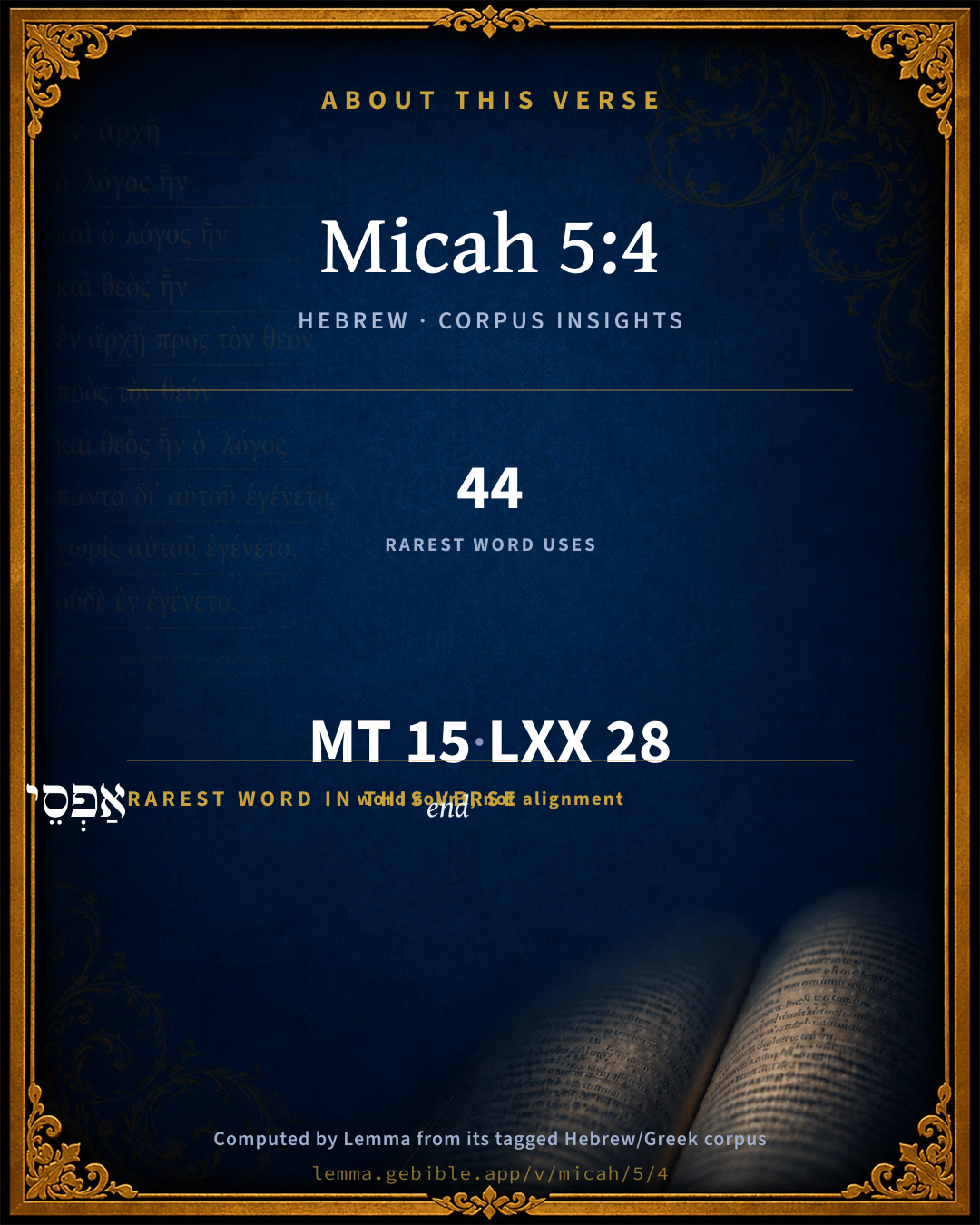
אַפְסֵי end H657 occurs in 43 verses of the Hebrew Bible. Also found in:

Grammatical profile

  • 4 verbs
  • 8 nouns
  • 1 preposition
  • 1 conjunction
  • 1 adverb

Verb forms

  • וְעָמַ֗ד Qal · Sequential Perfect
  • וְרָעָה֙ Qal · Sequential Perfect
  • וְיָשָׁ֕בוּ Qal · Sequential Perfect
  • יִגְדַּ֖ל Qal · Imperfect

Repetition

A word recurs within this verse — often emphatic in Hebrew:

  • יְהוָ֔ה LORD H3068 ×2

Hebrew & Septuagint length

In English translation the verse runs 37 words from the Hebrew and 40 from the Septuagint (LXX English) — closely comparable.

A rough comparison of the two English renderings, which tokenize alike — not a word-level alignment.

Word counts can differ between the Hebrew and the Greek without any difference in meaning — e.g. the Hebrew direct-object marker אֵת has no separate Greek word, and Greek often adds the article ὁ.

In the original languages it is 15 Hebrew tokens and 28 Greek tokens — but the two are counted differently (Hebrew bundles its prefixes and suffixes into one token; the Greek is in lemma form), so that isn’t a like-for-like length.

Cross-references

32

Topical passages linked to Micah 5:4 in the Treasury of Scripture Knowledge — connected by theme and wording, ordered by reader-vote popularity; previews shown in the World English Bible.

  • Isaiah 40:10–11 Behold, the Lord Yahweh will come as a mighty one, and his arm will rule for him: Behold, his reward is with him, and his recompense before him.
  • Psalms 23:1–2 Yahweh is my shepherd: I shall lack nothing.
  • Micah 7:14 Shepherd your people with your staff, The flock of your heritage, Who dwell by themselves in a forest, In the midst of fertile pasture land, let them feed; In Bashan and Gilead, as in the days of old.
  • Luke 1:32 He will be great, and will be called the Son of the Most High. The Lord God will give him the throne of his father, David,
  • John 10:27–30 My sheep hear my voice, and I know them, and they follow me.
  • 1 Peter 1:5 who by the power of God are guarded through faith for a salvation ready to be revealed in the last time.
  • Revelation 11:15 The seventh angel sounded, and great voices in heaven followed, saying, "The kingdom of the world has become the Kingdom of our Lord, and of his Christ. He will reign forever and ever!"
  • 1 Chronicles 29:11–12 Yours, Yahweh, is the greatness, the power, the glory, the victory, and the majesty: for all that is in the heavens and in the earth is yours. Yours is the kingdom, Yahweh, and you are exalted as head above all.
  • Psalms 22:27 All the ends of the earth shall remember and turn to Yahweh. All the relatives of the nations shall worship before you.
  • Psalms 45:3–6 Gird your sword on your thigh, mighty one: Your splendor and your majesty.
  • Psalms 72:8 He shall have dominion also from sea to sea, From the River to the ends of the earth.
  • Psalms 72:19 Blessed be his glorious name forever! Let the whole earth be filled with his glory! Amen and amen.
  • Psalms 93:1 Yahweh reigns! He is clothed with majesty! Yahweh is armed with strength. The world also is established. It can't be moved.
  • Isaiah 52:13 Behold, my servant shall deal wisely, he shall be exalted and lifted up, and shall be very high.
  • Ezekiel 34:13–15 I will bring them out from the peoples, and gather them from the countries, and will bring them into their own land; and I will feed them on the mountains of Israel, by the watercourses, and in all the inhabited places of the country.
  • Ezekiel 34:22–24 therefore will I save my flock, and they shall no more be a prey; and I will judge between sheep and sheep.
  • Zechariah 9:10 I will cut off the chariot from Ephraim, And the horse from Jerusalem; And the battle bow will be cut off; And he will speak peace to the nations: And his dominion will be from sea to sea, And from the River to the ends of the earth.
  • Matthew 2:6 'You Bethlehem, land of Judah, Are in no way least among the princes of Judah: For out of you shall come forth a governor, Who shall shepherd my people, Israel.'"
  • Matthew 25:31 "But when the Son of Man comes in his glory, and all the holy angels with him, then he will sit on the throne of his glory.
  • Exodus 23:21 Pay attention to him, and listen to his voice. Don't provoke him, for he will not pardon your disobedience, for my name is in him.
  • Psalms 98:3 He has remembered his loving kindness and his faithfulness toward the house of Israel. All the ends of the earth have seen the salvation of our God.
  • Psalms 145:12 To make known to the sons of men his mighty acts, The glory of the majesty of his kingdom.
  • Isaiah 49:5 Now says Yahweh who formed me from the womb to be his servant, to bring Jacob again to him, and that Israel be gathered to him (for I am honorable in the eyes of Yahweh, and my God is become my strength);
  • Matthew 16:18 I also tell you that you are Peter, and on this rock I will build my assembly, and the gates of Hades will not prevail against it.
  • John 10:38 But if I do them, though you don't believe me, believe the works; that you may know and believe that the Father is in me, and I in the Father."
  • John 14:9–11 Jesus said to him, "Have I been with you such a long time, and do you not know me, Philip? He who has seen me has seen the Father. How do you say, 'Show us the Father?'
  • John 20:17 Jesus said to her, "Don't touch me, for I haven't yet ascended to my Father; but go to my brothers, and tell them, 'I am ascending to my Father and your Father, to my God and your God.'"
  • Ephesians 1:3 Blessed be the God and Father of our Lord Jesus Christ, who has blessed us with every spiritual blessing in the heavenly places in Christ;
  • Jude 1:1 Jude, a servant of Jesus Christ, and brother of James, to those who are called, sanctified by God the Father, and kept for Jesus Christ:
  • Revelation 1:13–18 And among the lampstands was one like a son of man, clothed with a robe reaching down to his feet, and with a golden sash around his chest.
  • Isaiah 52:10 Yahweh has made bare his holy arm in the eyes of all the nations; and all the ends of the earth have seen the salvation of our God.
  • John 5:22–29 For the Father judges no one, but he has given all judgment to the Son,

Cross-references courtesy of OpenBible.info (CC BY 4.0).

Hebrew and Greek witnesses Masoretic Hebrew ↔ Greek Septuagint

The same verse in the two great witnesses to the Old Testament, shown verse-for-verse.

These are two independent witnesses, not word-aligned to each other, and the Septuagint is shown in lemma (dictionary) form.

Hebrew Micah 5:4 Masoretic · Westminster Leningrad Codex

וְעָמַ֗ד וְרָעָה֙ בְּעֹ֣ז יְהוָ֔ה בִּגְא֕וֹן שֵׁ֖ם יְהוָ֣ה אֱלֹהָ֑יו וְיָשָׁ֕בוּ כִּֽי עַתָּ֥ה יִגְדַּ֖ל עַד אַפְסֵי אָֽרֶץ

He shall stand, and shall shepherd in the strength of Yahweh, In the majesty of the name of Yahweh his God: And they will live, for then he will be great to the ends of the earth.

World English Bible · Public Domain

Greek LXX Micah 5:4 Septuagint · lemma form

καί εἰμί οὗτος εἰρήνη ὅταν ἀσσύριος ἐπιἔρχομαι ἐπί ὁ γῆ σύ καί ὅταν ἐπιβαίνω ἐπί ὁ χώρα σύ καί ἐπιἐγείρω ἐπί αὐτός ἑπτά ποιμήν καί ὀκτώ δῆγμα ἄνθρωπος

And the Lord shall stand, and see, and feed his flock with power, and they shall dwell in the glory of the name of the Lord their God: for now shall they be magnified to the ends of the earth.

LXX2012 (modern English Septuagint) · Public Domain

On this verse, The Pulpit Commentary discusses the Septuagint’s reading. Read the note in Commentary ↓

Hebrew: Westminster Leningrad Codex (CC BY 4.0). Greek: Septuagint (public domain); English from LXX2012 (modern English Septuagint) (Public Domain). How the Septuagint differs from the Hebrew →

Targum (Aramaic paraphrase)

1

The Targum is the ancient Jewish Aramaic paraphrase of the Hebrew Scriptures — an interpretive translation, not the Hebrew text itself. Onkelos (literal) and Pseudo-Jonathan (expansive) render the Torah, and Jonathan the Prophets. Coverage is partial: where no permissively-licensed English translation exists for a verse, only the Aramaic is shown. This is verse-level text, not a word-by-word alignment to the Hebrew.

  1. Targum Jonathan Prophets (Joshua–Malachi)
    וִיהֵי מִבְּכֵן שְׁלָמָא לָנָא אֲתוּרָאָה אֲרֵי יֵעוּל בְּאַרְעָנָא וַאֲרֵי יִדְרוֹךְ בְּבִרְנְיָתָנָא וּנְמַנֵי עֲלָנָא שַׁבְעָא מַלְכִין וּתְמַנְיָא רַבְרְבֵי אֱנָשָׁא:

    (no public-domain English translation for this verse)

    Targum Jonathan — Aramaic: “Mikraot Gedolot” (public domain). English: “Sefaria Community Translation” (CC0 1.0 (public-domain dedication)); “London "Chaldee Paraphrase," 1871” (public domain). Text via Sefaria.

Commentary

Notes on Micah 5:4 from classic Christian and Jewish commentators (each source and its license shown beneath its notes). The classic Christian expositions comment on the surrounding passage and are grouped to its opening verse, so a note may address several verses; the Jewish commentaries on the Tanakh (Rashi and others) are per-verse, so they appear only where the commentator wrote on this verse.

Lemma curates 59 commentaries, every one of them public domain or Creative Commons licensed, each selected and text-cleaned for this edition rather than reprinted as found. About our sources →

Trapp's Complete Commentary

John Trapp

Mic 5:4 And he shall stand and feed in the strength of the LORD, in the majesty of the name of the LORD his God; and they shall abide: for now shall he be great unto the ends of the earth.

Ver. 4. And he shall stand and feed (or rule) in the strength of the Lord] He shall stand, and none shall be able to stir him; there shall be lifting at his government, but it stands firm and fixed. Earthly monarchies have their times and their turns, their ruin as well as their rise. The Roman empire fell under the weight of its own greatness. The Turkish, although it be indeed very strong, yet is it by many probably thought to be on the declining hand. But Christ shall stand when all earthly greatness shall lie in the dust. And he shall feed his flock in the strength of the Lord, neither shall any ravenous lion or grievous wolf pluck them out of his hand, because he and the Father are one, Joh 10:30, and God hath laid help on one that is mighty, Psa 89:19.

And in the majesty of the name of the Lord his God] That is, by the power of God’s word, called his name, Act 9:15, and elsewhere. This word hath a singular majesty in it, whereby it aweth and affecteth men’s consciences, to the propagating of Christ’s kingdom, viz. when it is accompanied with the Spirit of God, called his strength in the former clause. And that these ever go together in all the subjects of Christ’s kingdom, see Isa 59:21 : "As for me, this is my covenant with them, saith the Lord; My spirit that is upon thee, and my words which I have put in thy mouth, shall not depart out of thy mouth, nor out of the mouth of thy seed, nor out of the mouth of thy seed’s seed, saith the Lord, from henceforth and for ever."

For now shall he be great unto the ends of the earth] How, that is, ere long; in God’s due time, which often seems long because we are short, apt to antedate the promises in regard to the accomplishment, to limit the Holy One of Israel, and to set him a time, to set his sun by our dial: Jer 8:20, help they would have that summer at furthest. But as God never fails in his own time, so he seldom comes at ours. We must live by faith, Hab 2:4, and stay God’s leisure, as David did for the kingdom, and those in Esther for deliverance. God’s promises will at length take their way over all Alps of opposition, but we have "need of patience. For yet a little while, and he that shall come will come, and will not tarry," Heb 10:36-37.

John Trapp, A Commentary or Exposition upon All the Books of the Old and New Testament (1647–1656) — public domain. Text from a community e-Sword module.

The Biblical Illustrator

Joseph S. Exell

Mic_5:4

He shall stand and feed in the strength of the Lord

The Mighty Shepherd

I.

His activity and zeal. He shall stand. We read of idle shepherds, who lie down and sleep and neglect their flock. This attitude of standing shows--

1. Dignity. He is the Royal Shepherd.

2. Observation. He who stands can survey all around.

3. Attention. He does not withdraw His eyes. He that keepeth Israel neither slumbers nor sleeps.

II. His regard. He shall feed. The term feed is not confined to providing food. It applies to all the duties of a shepherd. And this office consists of unwearied care, such as--

1. Causing them to rest. The weary child of God must pause, and the wise Shepherd selects the time and place.

2. Leading them. The Eastern shepherd treads the ground before his flock.

3. Restoring the wanderers. There are always the erring and wandering--headstrong, foolish, daring.

4. Healing the wounded.

5. Defending the weak and securing the flock.

III. His ability. In the strength of the Lord. This does not mean borrowed strength; the strength of the Lord is His own. And power is needed. Who can realise the danger and difficulties of the Church on earth, or the trials of a struggling soul?

IV. His dignity. In the majesty of His God. Majesty combined with strength. How majestic was Christ, even in His humiliation! Majesty combined with simplicity; majesty and gentleness. But Christ is terrible in majesty, terrible to His foes. Who shall abide His day? Yea, He is terrible to the foes of His flock. (Homilist.)

The Shepherd and His mission

The testimony of Jesus is the spirit of prophecy. Many other things were predicted in the Scriptures; but incidentally, relatively, subordinately; this testimony was the fixed subject and steady aim of the whole. All the prophets testified of Jesus, though not all in the same way or in the same degree. They did not always understand their own predictions. From this prediction consider--

I. His implied character. It is that of a shepherd. The character of a shepherd now is far less respectable than it was in early ages, and especially in the East. The character of a good shepherd has been applied to a good ruler. Christ is called the Good Shepherd, the Chief Shepherd, the Great Shepherd, and Gods Shepherd. And we are told that both His kindness and His love are unexampled.

II. Observe His work. Stand and feed. The pastures in which He feeds His people are His Word and ordinances. We are not to restrain the work of this Divine Shepherd to feeding only. He affords repose; for His flock need rest as well as provision. A shepherd also guides them. Christ guides His people by His Word, by His Spirit, and by His providence. By His Word He shows them the way in which they should go. By His Spirit He gives them the inclination, and works in them to walk in the way of His pleasure. By His providence He arranges all, and fixes all their circumstances in life for the advancement of His own glory and their real welfare. As a shepherd He restores; for they sometimes, nay often, go astray. As a shepherd He heals their sicknesses. He renders all His ordinances and all His dispensations salutary. As a shepherd He defends them all, else they would be destroyed.

III. How He is to perform His work.

1. He will do this attentively. Stand and feed.

2. Powerfully. In the strength of the Lord.

3. Nobly or gracefully. In the majesty of the . . . name of the Lord His God . . . Power . . . is not always, dignity; authority, when it is not softened by condescension, has in it something harsh and repelling.

Some who feel their strength, think of nothing else. Christ is mild and gentle. He exerted His power mildly, kindly, if you will, majestically.

IV. The safety of the flock. And they shall abide. To abide is to continue, to endure, to be able to withstand any foe, and to go forth against it. There is, however, a difference between the fact and the comfort of it. The believer is often filled with fear, and is ready to suppose that God is going to destroy us. At other times Christians are able to realise this fact by faith.

V. The extension of His own renown. Now shall He be great unto the ends of the earth. In order to this He must be known, and to make Himself known is all that is necessary to this. The more He is known, the more will He be loved and adored. And does He not deserve to be known? The Christians grief is that Christ is so little known and adored. There are, however, two things to console them.

1. That it is not so in the other world.

2. They know that it will not be so always, nor long, even in this world.

They know that He shall have the heathen for His inheritance, and the uttermost parts of the earth for His possession. (William Jay.)

The Biblical Illustrator, edited by Joseph S. Exell (c. 1880s–1900s) — public domain. Text from a community e-Sword module.

Joseph Benson's Commentary

Mic 5:4. And he shall stand and feed — Or rule as the word רעה, here rendered feed, often signifies: that is, he shall go on, he shall continue to rule, or feed, his people. Christ shall diligently perform the office of a shepherd, or governor, over his church. In the strength of the Lord, in the majesty of the name of the Lord — God, or the indwelling Deity, strengthening and exalting his human nature. The expression, the name of the Lord his God, might be intended to signify the Messiah’s acting by commission from the Father, in whose name he came, preached, wrought miracles, and instituted his gospel church. And they shall abide — His church, made up of converted Jews and Gentiles, shall continue; the gates of hell shall not prevail against it. For now shall he be great unto the ends of the earth — Some interpret this as signifying the making the true God known over all the earth: but it seems rather to be intended of the Messiah; for the angel, who foretold his conception to his virgin mother, as is related Luk 1:32-33, seems plainly to allude to this prophecy, saying, He shall be great, and shall be called the Son of the Highest, &c. And he is dignified with such titles as were never given to any creature, as the apostle proves at large, Heb 1:4-14.

Joseph Benson's Commentary on the Old and New Testaments (1811–1818) — public domain. Text from a community e-Sword module.

Tyndale Open Study Notes

Tyndale Open Resources

5:4-5 Following the Exile, Prince Zerubbabel, a descendant of David, was among the returned exiles and became the focus of Israel’s hopes (see Hag 2:20-23). But a greater ruler than Zerubbabel was needed. The leader from Bethlehem would be a source of peace; Isaiah called him the Prince of Peace (Isa 9:6). Only Jesus fits this description.

Tyndale Open Study Notes — © Tyndale Open Resources, licensed CC BY-SA 4.0. Text via the HelloAO Bible API.

Geneva Bible (1599)

Geneva Bible translators

That is, Christ’s kingdom shall be stable and everlasting, and his people as well the Gentiles as the Jews shall dwell in safety.

Geneva Bible (1599) marginal notes — public domain. Text via Bolls.life.

Jamieson, Fausset & Brown

Robert Jamieson, A. R. Fausset & David Brown

he shall stand--that is, persevere: implying the endurance of His kingdom [CALVIN]. Rather, His sedulous care and pastoral circumspection, as a shepherd stands erect to survey and guard His flock on every side (Isa 61:5) [MAURER].

feed--that is, rule: as the Greek word similarly in Mat 2:6, Margin, means both "feed" and "rule" (Isa 40:11; Isa 49:10; Eze 34:23; compare Sa2 5:2; Sa2 7:8).

in the majesty of the name of the Lord--possessing the majesty of all Jehovah's revealed attributes ("name") (Isa 11:2; Phi 2:6, Phi 2:9; Heb 2:7-9).

his God--God is "His God" in a oneness of relation distinct from the sense in which God is our God (Joh 20:17).

they shall abide--the Israelites ("they," namely, the returning remnant and the "children of Israel previously in Canaan) shall dwell in permanent security and prosperity (Mic 4:4; Isa 14:30).

unto the ends of the earth-- (Mic 4:1; Psa 72:8; Zac 9:10).

Jamieson, Fausset & Brown — Commentary Critical and Explanatory on the Whole Bible (1871) — public domain (CC PDM 1.0). Text via the HelloAO Bible API.

Adam Clarke's Commentary

Verse 4. He shall stand and feed] The Messiah shall remain with his followers, supporting and governing them in the strength and majesty of the Lord, with all the miraculous interferences of his power, and all the glories of his grace.

And they shall abide] After this the Jews shall no more go astray, but shall remain one people with the Gentiles, under the one Shepherd and Bishop of all souls.

Newcome translates, "They shall be converted" for instead of וישבו veyashebu, he reads וישובו veyashubu, which gives him the translation above. This is the reading of three MSS. of Kennicott's and De Rossi's, with the Syriac, Chaldee, and Vulgate.

For now shall he be great] The Messiah shall be great, as bringing salvation to the ends of the earth. All nations shall receive his religion, and he shall be universal King.

Adam Clarke's Commentary on the Bible (1810–1826) — public domain. Text from a community e-Sword/MySword module.

John Calvin's Commentaries

There is no doubt but that the Prophet continues here to speak of Christ; and though the Jews shamelessly pervert the whole Scripture, they yet cannot deny that Micah calls here the attention of all the godly to the coming of Christ, yea, of all who hope or desire to obtain salvation. This is certain. Let us now see what the Prophet ascribes to Christ.

He shall stand, he says, and feed in the power of Jehovah The word, stand, designates perseverance, as though he had said, that it would not be for a short time that God would gather by Christ the remnant of the people; that it would not be, as it often happens, when some rays of joy shine, and then immediately vanish. The Prophet shows here that the kingdom of Christ would be durable and permanent. It will then proceed; for Christ will not only rule his Church for a few days, but his kingdom will continue to stand through unbroken series of years and of ages. We nor then understand the Prophet’s object.

He adds in the second place, He shall feed in the strength of Jehovah, in the greatness of the name of Jehovah his God; by which words he means, that there would be sufficient power in Christ to defend his Church. The Church, we know, is in this world subject to various troubles, for it is never without enemies; for Satan always finds those whom he induces, and whose fury he employs to harass the children of God. As then the Church of God is tossed by many tempests, it has need of a strong and invincible defender. Hence this distinction is now ascribed by our Prophet to Christ, — that he shall feed in the strength of Jehovah, and in the majesty of his God. As to the word feed, it no doubt expresses what Christ is to his people, to the flock committed to him and to his care. Christ then rules not in his Church as a dreaded tyrant, who distresses his subjects with fear; but he is a Shepherd who gently deals with his flock. Nothing therefore can exceed the kindness and gentleness of Christ towards the faithful, as he performs the office of a Shepherd: and he prefers to be adorned with this, title, rather than to be called and deemed a kings, or to assume authority to himself. But the Prophet, on the other hand, shows, that the power of Christ would be dreadful to the ungodly and wicked. He shall feed, he says, — with regard to his flock, Christ will put on a character full of gentleness; for nothing, as I have said can imply more kindness than the word shepherd: but as we are on every side surrounded by enemies, the Prophet adds, —

He shall feed in the power of Jehovah and in the majesty of the name of Jehovah; that is as much power as there is in God, so much protection will there be in Christ, whenever it will be necessary to defend and protect the Church against her enemies. Let us hence learn that no less safety is to be expected from Christ, than there is of power in God. Now, since the power of God, as we confess, is immeasurable, and since his omnipotence far surpasses and swallows up all our conceptions, let us hence learn to extend both high and low all our hopes. — Why so? Because we have a King sufficiently powerful, who has undertaken to defend us, and to whose protection the Father has committed us. Since then we have been delivered up to Christ’s care and defense, there is no cause why we should doubt respecting our safety. He is indeed a Shepherd, and for our sake he thus condescended and refused not so mean a name; for in a shepherd there is no pomp nor grandeur. But though Christ, for our sake, put on the character of a Shepherd, and disowns not the office, he is yet endued with infinite power. — How so? Because he governs not the Church after a human manner, but in the majesty of the name of his God

Now, that he subjects Christ to God, he refers to his human nature. Though Christ is God manifested in the flesh, he is yet made subject to God the Father, as our Mediator and the Head of the Church in human nature: he is indeed the middle Person between God and us. This then is the reason why the Prophet now says, that Christ has power, as it were, at the will of another; not that Christ is only man, but as he appears to us in the person of man, he is said to receive power from his Father; and this, as it has been said, with respect to his human nature. There is yet another reason why the Prophet has expressly added this, — that we may know that Christ, as the protector of the Church, cannot be separated from his Father: as then God is God, so Christ is his minister to preserve the Church. In a word, the Prophet means that God is not to be viewed by the faithful, except through the intervening Mediator; and he means also that the Mediator is not to be viewed, except as one who receives supreme power from God himself and who is armed with omnipotence to preserve his people.

He afterwards adds, They shall dwell; for he shall now be magnified to the extremities of the earth He promises a secure habitation to the faithful; for Christ shall be extolled to the utmost regions of the world. We here see that he is promised to foreign nations: for it would have been enough for Christ to exercise his supreme power within the borders of Judea, had only one nation been committed to his safe keeping. But as God the Father intended that he should be the author of salvation to all nations, we hence learn that it was necessary that he should be extolled to the utmost borders of the earth. But with regard to the word dwell, it is explained more fully in the next verse, when the Prophet says—

John Calvin's Commentaries (1540-1563) — public domain. Text from the Calvin Translation Society English edition (1840s-50s) via the Christian Classics Ethereal Library (ccel.org). Calvin's coverage is partial (roughly two-thirds of the Bible); uncommented books and verses are honest gaps, never fabricated. The 19th-century editor's footnotes and remarks are omitted so the notes are faithfully Calvin's own voice.

Ellicott's Commentary for English Readers

(4) He shall stand and feed—i.e., He shall stand with the majesty of an assured sovereignty, uniting the dignity of king with the tenderness of a shepherd’s care—a thought which, underlying the notion of a Jewish monarch (see Psa_78:70-72), becomes a distinguishing attribute of the King Messiah (Isa_40:2; see also Note on Eze_34:2).

His God.—The Messiah was to be subordinate to the Father in heaven—“My Father is greater than I”—and they—i.e., His subjects—shall abide. It is impossible to conceive this prophecy as satisfied by any event short of that which is the foundation of the Christian faith.

A Bible Commentary for English Readers, edited by Charles John Ellicott (1878–1897) — public domain. Text from a community e-Sword module.

The Cambridge Bible for Schools and Colleges

gen. ed. J. J. S. Perowne

4. And he shall stand and feed] viz. his flock, as a shepherd. Over this restored and regenerate people the Messiah shall preside in the plenitude of Divine power. ‘Stand,’ as a shepherd amidst his flock, Isa_61:5.

in the majesty of the name, &c.] This is not at all an otiose feature of the description. The ‘Name’ of Jehovah is an appellation of the self-revealing aspect (one might almost say, Person) of the Godhead. Comp. Isa_30:27, ‘Behold, the Name of Jehovah cometh from far … his lips are full of indignation,’ &c. In fact, the Messiah, who is ‘God the Mighty One,’ may be said to be an incarnation of the Name of Jehovah.

abide] i.e. remain undisturbed in their land.

now shall he be great] ‘Now,’ from the point of view of the fulfilment of the prophecy (instead of ‘then’).

unto the ends of the earth] The Messiah’s kingdom will more than supplant Assyria’s; comp. Psa_2:8; Psa_72:8. Obs. how the Messianic hope developes and gathers strength in the atmosphere of Assyrian conquest.

The Cambridge Bible for Schools and Colleges (gen. ed. J. J. S. Perowne; Cambridge University Press, 1878–1918) — public domain. Text from a community e-Sword module.

John Gill's Exposition

And he shall stand and feed in the strength of the Lord,.... The ruler in Israel, before described and prophesied of; the Messiah, as Kimchi himself interprets it, and other Jewish writers. Kimchi's note is,

"after the affliction, the King Messiah shall stand and feed Israel in the strength of the Lord;''

and so R. Isaac (t) paraphrases the words exactly in the same way: wherefore, as another learned Jew (u) observes, these expressions evince that the ruler here spoken of can be no other than the Messiah; not Zerubbabel, who never attained to this height and happiness. He is both King and Shepherd, and to each of these the act of feeding is ascribed. The same word, in the Greek language, signifies both to rule and to feed and is used by Matthew, Mat 2:6; and kings are often compared to shepherds. Christ feeds his people, his brethren, his flock, his sheep, and lambs all truly converted ones; and this takes in the whole office of a shepherd, and the care he has of his flock; he takes an exact account of them, goes before them, and leads them out into good pastures; sets under shepherds over them; protects them from, all their enemies; looks after what is lost or driven away; heals the sick, strengthens the weak, binds up the broken, and watches over his flock continually: he feeds them with, himself, the bread of life, with his flesh and blood, which are meat and drink indeed; with the doctrines and ordinances of the Gospel; and which are found to be spiritual, savoury, strengthening, satisfying, and soul nourishing food: and he "stands" and does this, being raised from the dead, and possessed of all power in heaven and in earth; which designs not the position of his body, but the ministration of his office, and his alacrity and readiness to perform it, and his constancy in it: and all this "in the strength of the Lord"; in his own strength, as a divine Person, which is the same with the strength of Jehovah; and in the power and strength that is dispensed to him as Mediator; and with his Gospel, the rod of his strength, and in such manner as to defend his flock from all that would devour them:

in the majesty of the name of the Lord his God; Jehovah the Father is the God of Christ, as is Mediator; and his name is in him, even the majesty of it; for, as a divine Person, he has the same nature and perfections with him; and as man, exalted at his right hand, has a name above every name in this world, or that to come; and it is by authority from him, in his office capacity, that he rules and feeds his people, having all judgment committed to him:

and they shall abide; that is, his people, his flock, his sheep fed and ruled by him; these shall continue and persevere under his care and keeping; in him, in whom they are chosen and preserved; in his love, from which they can never be separated; in his hands, out of which none can pluck them; in his church, where they shall ever remain; and so may be considered as a promise of the perseverance of the saints in faith and holiness to the end: or, "they shall sit" (w); quietly and securely, being freed from persecution, with which the Christians were at, ended in the first three centuries: this began to be accomplished in the times of Constantius Chlorus, who helped the Christians in the times of Dioclesian, and with whom the persecutions ended, and peace and prosperity followed:

for now shall he be great unto the ends of the earth; as, he was in the times of Constantine, and will be again. Christ is great in himself, in, his person and offices; and will appear to be so unto all men, even unto the ends of the earth, when his Gospel shall be preached and spread, everywhere; when his kingdom shall be enlarged, and be from sea to sea, and from the river to the ends of the earth; even then shall he appear to be a great King over all the earth, and, the great Shepherd of the sheep, the man, Jehovah's fellow; and to have such a flock, and so large, as never any had; when there will be one fold, and one shepherd; for this prophecy respects the latter day glory. Kimchi's gloss is,

"the name of the Messiah shall be magnified, after the judgment of the wicked.''

(t) Ibid. (Chizzuk Emunah, par. 1. p. 281.) (u) Tanchuma apud Pocock in loc. (w) "sedebunt", Tigurine version, Vatablus, Drusius; "considebunt", Cocceius; so R. Isaac, "they shall sit safely in his time", as is said above, ch. iv. 4. "they shall sit every man", &c. Chizzuk Emunah, ut supra. (par. 1. p. 281.)

John Gill's Exposition of the Whole Bible (1746–1763) — public domain (CC PDM 1.0). Text via the HelloAO Bible API.

Albert Barnes' Notes on the Bible

And He shall stand - The prophet continues to speak of personal acts of this Ruler who was to be born. He was not to pass away, not to rule only by others, but by Himself. To stand is the attitude of a servant, as Jesus, although God and Lord of all, said of Himself, “He shall come forth and serve them” Luk 12:37; “The Son of Man came not to be ministered unto, but to minister” Mat 20:28. “He shall stand” as a Shepherd Isa 61:5, to watch, feed, guard them, day and night; “He shall stand,” as Stephen saw Christ “standing on the Right Hand of God” Act 7:55, “to succor all those who suffer for Him.” : “For to sit belongs to one judging; to stand, to one fighting or helping.” “He shall stand,” as abiding, not to pass from them, as Himself saith, “Lo, I am with you alway, even unto the end of the world” Mat 28:20 : and He shall feed His flock by His Spirit, His Word, His Wisdom and doctrine, His example and life; yea, by His own Body and Blood John 6. They whom He feedeth “lack nothing” Psa 23:1.

In the strength of the Lord - He, who feedeth them with divine tenderness, shall also have divine might, His Father’s and His own, to protect them; as He saith, “My sheep hear My Voice, and I know them and they follow Me, neither shall any man pluck them out of My Hand. My Father Which gave them Me is greater than all, and no man is able to pluck them out of My Father’s Hand. I and My Father are One” Joh 10:27-30. With authority, it is said, “He commandeth even the unclean spirits and they come out” Luk 4:36. His feeding or teaching also was “with authority, and not as the scribes” Mat 7:29.

In the majesty of the name of the Lord His God - As John says, “We beheld His glory, the glory as of the Only-Begotten of His Father” Joh 1:14; and He saith, “All power is given unto Me in heaven and in earth” Mat 28:18; so that the divine glory should shine through the majesty of His teaching, the power of His Grace, upholding His own, and the splendor of the miracles wrought by Him and in His Name. “Of the Name of the Lord;” as He saith again, “Holy Father, keep through Thine own Name those whom Thou hast given Me, that they may be one as We are. While I was with them in the world, I kept them in Thy Name” Joh 17:11-12. : “Whoever then is sent to feed His flock must stand, that is, be firm and unshaken; feed, not sell, nor slay; and feed in might, that is, in Christ.” His God, as our Lord Himself, as Man, saith, “Unto My Father, and your Father, and to My God and your God” .

But that Majesty He Himself wields, as no mere man can; He Himself is invested with it. : “To ordinary kings God is strength Psa 28:7; Psa 140:7, or gives strength 1Sa 2:10; men have strength in God; this Ruler is clad in the strength of the Lord, that same strength, which the Lord hath, whose is strength. Of Him, as Israel’s King, the same is said as of the Lord, as King of the whole earth Psa 93:1; only that the strength of the Messiah is not His own, but the Lord’s. He is invested with the strength of the Lord, because He is Man; as Man, He can be invested with the whole strength of the Lord, only because He is also God.”

And they shall abide - (Literally, sit, dwell) in rest and security and unbroken peace under Christ their Shepherd and their King; they shall not wander to and fro as heretofore “He, their Shepherd, shall stand; they shall sit.” “The word is the more emphatic, because it stands so absolutely. This will be a sitting or dwelling, which will indeed deserve the name. The original promise, so often forfeited by their disobedience should be perfectly fulfilled; “and ye shall dwell in your land safely, and I will give peace in the land, and ye shall lie down, and none shall make you afraid” . So Amos and Micah had before promised . And this is the result of the greatness of the promised Ruler, as the like promise of the Psalm is rested on the immutability of God; “Thou art the Same, and Thy years shall have no end. The children of Thy servants shall dwell, and their seed shall be established before Thee.” Psa 102:27-28. For it follows,”

For now - (In the time which Micah saw as did Abraham with the eye of faith,) “now,” in contrast to that former time of lowliness. His life shall be divided between a life of obscurity, and a life of never-ending greatness.

Shall He be great unto the (very) ends of the earth - embracing them in His rule, (as David and Solomon had foretold ,) and so none shall harm those whom He, the King of all the earth, shall protect. The universality of protection is derived from an universality of power. To David God says, “I have made thee a great name, like the name of the great that are in the earth” 2Sa 7:9. Of Uzziah it is said, “His name went forth far; for he was marvelously helped, until he was strong” (2Ch 26:15, add 2Ch 26:8); but of the Messiah alone it is said, that His power should reach to the ends of the earth; as God prophesies of Himself, that His “Name should be great among the pagan” Mal 1:11, Mal 1:14. So Gabriel said to His Mother, “This,” whom she should bear, “shall be great” .

Albert Barnes' Notes on the Bible (1834–1885) — public domain. Text from a community e-Sword/MySword module.

Haydock's Catholic Bible Commentary

Earth, Christ shall be glorified, governing his Church. The Jews shall be respected as a people singularly favoured.

George Leo Haydock (1774–1849), Haydock's Catholic Family Bible and Commentary, 1859 edition — public domain. Excludes Psalms (Douay-Rheims chapter numbering differs from Protestant) and Deuterocanonical books (Catholic canon only).

Matthew Poole's English Annotations

He, the Ruler born in Bethlehem, the Messiah, shall stand: sometimes this posture denoteth the ministry of a servant, but here it speaks the readiness, cheerfulness, firmness, and stability of both the ruler, his government, and kingdom.

Feed; as a Shepherd that does diligently watch over, guide, preserve, and feed his sheep, or as rulers are called shepherds. Christ is that good Shepherd, Joh 10:14; and he is the righteous and holy Governor, and his government shall have no end, Isa 9:7.

In the strength of the Lord; in the assistance which God shall give him, for Christ-man was carried through this great work, redeeming, setting up, establishing his church by the power of the Father, who was with him, and upheld him, as was promised, Isa 61:1-3. All power in heaven and earth was given to Christ our Mediator, who being eternal God, of equal power with his Father, doth in his own strength overcome all enemies, removeth all difficulties, gathereth and governeth his church, and will do so to the end of the world; such visible, convincing tokens of a Divine power and glory working in him, and with those he sendeth to preach the gospel, I mean apostles, and all managed to the glory of God.

In the majesty of the name; by commission from the Lord, in whose name Christ came, preached, wrought miracles, and instituted his gospel church.

Of the Lord his God, i.e. God the Father.

They shall abide; his sheep, his subjects, his redeemed Israel, his church made up of converted Jews and Gentiles, shall continue, the gates of hell shall not prevail against them.

For; the church is so redeemed and established, that Christ the Messiah might be glorified; God will give him a glorious name, therefore these things are disposed in this manner.

Now, either ere long, or in due time, at the set time,

shall he, Messiah,

be great unto the ends of the earth; whose redeeming grace shall be published to the ends of the earth, said his dominion, his spiritual kingdom, shall be enlarged wide as the world itself. All here spoken in this verse is too great any way to be applied to Zerubbabel, as some Jews themselves confess.

Matthew Poole's English Annotations on the Holy Bible (1683–1685) — public domain. Text from a community e-Sword/MySword module.

The Pulpit Commentary

He shall stand. The Ruler, Messiah, shall stand as a good shepherd, guiding and ordering his flock, watchful and ready to aid and defend. (comp. Eze_34:23Jo Eze_10:11) Septuagint, sthsetai kai oqetai , "shall stand and see." Feed; i.e. his flock. Septuagint, poimanei to poimnion autou . In the strength of the Lord, with which he is invested and which he displays in the care of his people. In the majesty of the Name of the Lord his God. Messiah shall rule in all the power and glory with which God hath revealed himself on earth. (comp. Isa_9:6 Mat_28:18 Joh_1:14) They shall abide; Septuagint, uparxousi "they shall be." The children of Israel shall sit, dwell, in rest and peace in their own land. (Mic_4:4 Lev_26:5, 6 Joe_3:20 Amo_9:14, Amo_9:15) The Vulgate, from a different pointing of the Hebrew, renders, convertentur. With this the Chaldee and Syriac agree. But this idea is already expressed in ver. 3. Now shall he be great. When the prophecy is fulfilled and Messiah is feeding his flock, his dominion shall extend unto the ends of the earth. (comp. Mal_1:11,ps Mal_2:8 Mal 72:8 Luk_1:32)

The ministering Christ.

The whole of this chapter is more or less occupied with graphic descriptions of the Christ of God drawn ages before he appeared, and setting forth his nature, his work, and his influence upon the world and the race. A little child has been called "an unsolved problem," We dare not be so bold as to attempt to forecast the future of any child. This, however, is done here respecting the "Babe of Bethlehem." Distinct Divine pre-intimations were given concerning the destiny of this mighty Child, and to which he has proved himself gloriously true. Here he is presented to us as the ministering Christ. We have predicted here

I THE HOLY MINISTERING LIFE OF THE CHRIST OF GOD. "And he shall stand and feed," etc. (ver. 4). It was thus declared that the very coming of Christ would be a descent with a view to helpfulness. In his advent the lofty would descend to the low, the strong to the feeble, for the express purpose of ministering unto them in order that he might lift up the fallen and restore the erring, and strengthen the weak by his own great might and love, This ministering character of the life of the Christ who was to appear was set forth by this and other Hebrew seers under the figure of a shepherd tending his flock. This was natural in view of the national history. The Jewish people gloried in David as one raised from the sheepfold to the throne, and rejoiced in him as their shepherd king. Hence with appropriateness the prophets referred to "great David"s greater Son" under this simple yet beautiful emblem. The allusions, too, were in harmony with the destined birthplace of the Messiah a locality so thoroughly pastoral in its character, and upon the plains of which district the Eastern shepherds kept constant watch. The emblem is admirably suggestive of the character and work of the Messiah, setting forth:

1. His gentleness; the weak, the tired, the tempted, the erring, being tended by him with patient love. (Isa_40:11)

2. His watchfulness. "He shall stand," etc. (ver. 4); the posture indicating alertness, readiness to protect and defend.

3. His succors. He should "feed" the flock, supplying abundantly the spiritual wants of his people, and fully satisfying the longings and aspirations of their hearts. The records of the evangelists indicate how truly "ministering" in character the life of Christ was, and how that the most trusty shepherd watching over the flock committed to his charge but faintly images his wondrous care. (Mat_20:28) His followers are to emulate his example, and to live ministering lives. (Mat_20:26, Mat_20:27) He, as "the Man Christ Jesus," pursued his course of holy service "in the strength of the Lord, in the majesty of the Name of the Lord his God." And this Divine influence is available to all his servants.

II THE PROSPERITY OF ALL WHO AVAIL THEMSELVES OF HIS MINISTERINGS AND WHO COMMIT THEMSELVES UNTO HIS CARE. "And they shall abide.

1. The thought of rest is suggested. "And they shall abide;" literally, "sit." The idea is the same as in Psa_23:2, "He maketh me to lie down," etc. Delightful repose, rest for the weary. The pastures of sin are dry and parched, and its waters are troubled, and man seeks in vain therein freedom from unrest; but when the heart reposes in Christ, then it knows what it is to lie down on the pastures of tender grass and by the waters of quietness.

2. The thought of security is also suggested. They shall sit without fear of harm overtaking them, because he "stands," their Guardian against all intrusion and invasion, ready as their champion to defend them from all peril, and to maintain their cause. So shall they dwell at rest and in security, and true prosperity be theirs perpetually. "And they shall abide.

III THE HONOUR WITH WHICH THE MINISTERING CHRIST, BY REASON OF HIS CONDESCENDING AND GRACIOUS SERVICE, SHALL BE CROWNED. "For now shall he be great unto: the ends of the earth." "For now." The far distant future was present to the prophet"s gaze as he uttered these words, and he referred to it as though it had already come. His faith had peered beyond the centuries intervening before the advent of the Messiah, and had rendered that event very real to him; and now he took by faith a yet wider range of vision, and locked on to the ages following the advent, and saw the ever-growing, ever-widening influence and honour the Christ should enjoy, and even beheld this as extending to earth"s remotest bounds. Long and weary ages had passed since the prophet of God uttered this prediction; and we today, in the partial fulfilment of his words, have every ground of encouragement to look on to their complete accomplishment. What name is so powerful to inspire within men the holiest emotions, and to move them to devoted consecration, as that of Jesus Christ? He is indeed "great" in the marvellous influence he exerts upon human hearts and lives; and despite all the discouragements which meet us in Christian service, we find this influence widening, and behold cheering signs of the coming of that bright day in which all the ends of the earth shall see his salvation, and the assurance of the angel Gabriel to Mary be fully realized. (Luk_1:32, Luk_1:33) Let us make room for One who comes with such eager gladness to bind up the world"s wounds, and to pour into them the balm of his healing love. Let us yield to his holy and heavenly ministerings, and cast ourselves upon his loving, gentle care. True happiness and peace shall then be ours. The path of usefulness shall open out before us here, and in the day of his complete triumph we shall be sharers with him in his victory, and whoa his glory shall be revealed we also shall be glad with exceeding joy. (1Pe_4:13)

The Pulpit Commentary (1880–1919), ed. H.D.M. Spence-Jones & Joseph S. Exell — public domain. Text from a community e-Sword module.

John Wesley's Explanatory Notes

He - The ruler, the Messiah shall stand. This posture speaks the readiness, chearfulness, and stability of Christ, his government, and kingdom. Feed - As a shepherd that diligently guides, preserves, and feeds his sheep. By the strength - By his own almighty strength. Of the name - By commission from the Father in whose name Christ came, preached, wrought miracles, and instituted his gospel church. They - His church made up of converted Jews and Gentiles, shall continue; the gates of hell shall not prevail against them. For - The church is so redeemed, and established, that Christ the Messiah might be glorified, throughout the world.

John Wesley, Explanatory Notes Upon the Whole Bible (1754–1765) — public domain. Text via the GEBible commentary corpus.

unfoldingWord translationNotes

Door43 World Missions Community

General Information:

These verses continue describing the ruler from Bethlehem.

He will stand and shepherd his flock in the strength of Yahweh

A shepherd, who feeds and protects his sheep, is a metaphor for the ruler, who will provide for and protect the people of Israel. AT: "Yahweh will give him the strength to lead his people" (See: Metaphor)

in the majesty of the name of Yahweh his God

The person's name is a metonym for person's authority. AT: "and people will honor him because Yahweh his God has given him the authority to rule" (See: Metonymy)

They will remain

the people of Israel will remain

remain

"live in safety"

he will be great to the ends of the earth

All people from every nation will give honor to Israel's ruler.

seven shepherds and eight leaders over men

Here "shepherds" is a metonym for "rulers," another way of saying "leaders over men." The phrase "seven ... and eight" is an idiom for "more than enough." AT: "enough, even more than enough, rulers" or "more than enough shepherds and leaders over men" (See: Metaphor and Idiom)

translationWords

shepherd

flocks

Yahweh

majesty

God

earth

peace

Assyria

stronghold

raise

shepherd

unfoldingWord translationNotes — © Distant Shores Media and the Door43 World Missions Community, licensed CC BY-SA 4.0. Source: git.door43.org/Door43/en_tn.

Rashi

Rabbi Shlomo Yitzchaki (Rashi)

And this shall be peace—A complete and permanent peace, without interruption, and it will not resemble the other redemptions after which there were troubles.

should Assyria come Heb כִּי יָבוֹא. This כִּי serves as “if” - If he comes into our land as he comes now.

we will appoint over them seven shepherds and eight—Concerning the seven and eight, our Rabbis enumerated their names in Tractate Sukkah, but I do not know whence they derived them. [referring to Sukkah 52b]

Rashi on the Tanakh — English translations: “The Judaica Press complete Tanach with Rashi, translated by A. J. Rosenberg” (CC BY 4.0); “Pentateuch with Rashi's commentary by M. Rosenbaum and A.M. Silbermann, 1929-1934” (public domain); “The Metsudah Tanach series, Lakewood, N.J” (CC BY 4.0); and “The Book of Joshua, Metsudah Publications, 1997” (CC BY 4.0). Text via Sefaria.

Lesson kit

Teaching starters — assembled from the data on this page, not authored interpretation. Every prompt links to the verse data it draws on. Edit before teaching.

Micah, in the Prophets, opens this verse with 15 words (14 distinct Hebrew lemmas). Its most distinctive word is ʼepheç (“end”). A historical commentator’s framing appears above. Read the whole chapter for the surrounding context.

Discussion questions

  1. What does “end” (ʼepheç) contribute to the verse as a whole?
  2. How does Numbers 13:28, which shares the word «end», read alongside this verse?
  3. What does the repetition of “LORD” (2× in this one verse) do in this verse?
  4. These translations render this verse differently; the difference is in the English rendering, not the original. What questions does that raise?
  5. «וְעָמַ֗ד» is a Qal Sequential Perfect verb. How does that grammatical form shape the action described?
  6. Compare how Trapp's Complete Commentary and The Biblical Illustrator read this verse. Where do they agree or differ?

Things to notice

Reading settings

Reading text

Shown beneath each verse's original-language words.

Old Testament
Old Testament edition

Read the OT as the Masoretic Hebrew (MT) or the Greek Septuagint (LXX).

English shown for the Greek Septuagint (in the Hebrew ↔ Greek comparison).

Comparing translations? Open the Compare panel on any verse page to stack up to four side by side.