Jeremiah 23:4

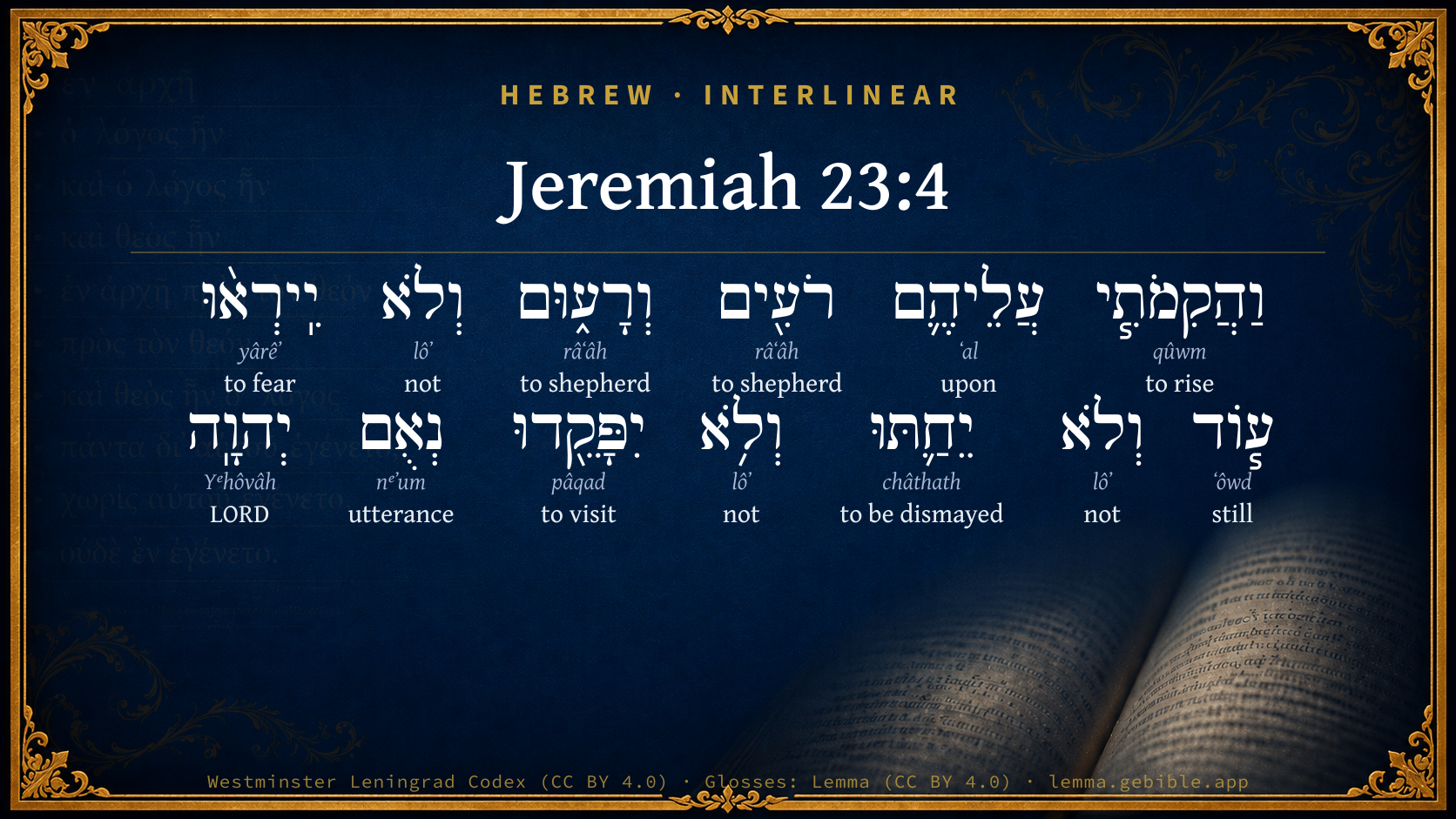
Hebrew (Westminster Leningrad Codex) Jeremiah 23:4 appears in the Hebrew Old Testament. The text above is from the Westminster Leningrad Codex. Each word links to its Strong’s number, a concise gloss, and parsing drawn from the Open Scriptures Hebrew Bible morphology. Click any word for its full Brown-Driver-Briggs (BDB) entry.
Download image
Cite this verse

Jeremiah 23:4 (World English Bible). Public Domain. Lemma interlinear Bible study tool, https://lemma.gebible.app/v/jeremiah/23/4.

Show BibTeX & RIS
BibTeX
RIS
English Translation
I will set up shepherds over them, who shall feed them; and they shall fear no more, nor be dismayed, neither shall any be lacking, says Yahweh.
World English Bible · Public Domain
Download a study sheet

One document with this verse’s original text, its word-by-word gloss line, the meaning frame, cross-references with their text, attributed commentary, and full source and license credits — printable, and it pastes into notes with its structure intact.

This verse Autodidact and up

Study sheet (.html) Plain text (.txt)

A passage Seminary Student

Up to 50 verses in one chapter. A passage sheet keeps up to 6 commentary sources and 12 cross-references per verse, in the order this page ranks them, and says so on the sheet whenever that leaves anything out. Ask for a single verse and you get the Autodidact verse sheet above.

Everything on this page stays free to read, with no account — the sheet is a download of what is already on screen, not access to it.

Want to remove ads? Support Godless Engineer
Compare translations 3

The same verse in 3 English versions, stacked beneath the original-language interlinear above. Click any original word for its lexicon entry.

Each is an independent rendering of the whole verse — the interlinear is not word-aligned to these translations.

Highlighted words mark where these versions differ — a whole-verse word diff, not a word-by-word alignment.

  • World English Bible Public Domain
    I will set up shepherds over them, who shall feed them; and they shall fear no more, nor be dismayed, neither shall any be lacking, says Yahweh.
  • King James Version Public Domain
    And I will set up shepherds over them which shall feed them: and they shall fear no more, nor be dismayed, neither shall they be lacking, saith the LORD.
  • unfoldingWord Literal Text CC BY-SA 4.0
    And I will raise up shepherds over them, and they will shepherd them. And they will no longer fear, and they will not be dismayed, and none will be missing”—the declaration of Yahweh. q1

unfoldingWord Literal Text — © unfoldingWord, licensed CC BY-SA 4.0. Word-aligned USFM3 via Door43 (git.door43.org/unfoldingWord/en_ult).

Versions to compare (up to 4)

3 of 4 selected

Show all 18 translations

Every available English version of this verse, each an independent rendering of the whole verse.

  • World English Bible Public Domain
    I will set up shepherds over them, who shall feed them; and they shall fear no more, nor be dismayed, neither shall any be lacking, says Yahweh.
  • Berean Standard Bible Public Domain
    I will raise up shepherds over them who will tend them, and they will no longer be afraid or dismayed, nor will any go missing, declares the LORD.
  • Majority Standard Bible Public Domain
    I will raise up shepherds over them who will tend them, and they will no longer be afraid or dismayed, nor will any go missing, declares the LORD.
  • King James Version Public Domain
    And I will set up shepherds over them which shall feed them: and they shall fear no more, nor be dismayed, neither shall they be lacking, saith the LORD.
  • American Standard Version (1901) Public Domain
    And I will set up shepherds over them, who shall feed them; and they shall fear no more, nor be dismayed, neither shall any be lacking, saith Jehovah.
  • Revised Version (1885) Public Domain
    And I will set up shepherds over them which shall feed them: and they shall fear no more, nor be dismayed, neither shall any be lacking, saith the LORD.
  • Geneva Bible (1599) Public Domain
    And I will set vp shepheardes ouer them, which shall feede them: and they shall dread no more nor be afraide, neither shall any of them be lacking, saith the Lord.
  • Douay-Rheims (1899) Public Domain
    And I will set up pastors over them, and they shall feed them: they shall fear no more, and they shall not be dismayed: and none shall be wanting of their number, saith the Lord.
  • Young's Literal Translation Public Domain
    And I have raised for them shepherds, And they have fed them, And they fear no more, nor are affrighted, Nor are they lacking -- an affirmation of Jehovah.
  • Literal Standard Version CC BY-SA 4.0
    And I have raised shepherds for them, || And they have fed them, || And they no longer fear, nor are frightened, || Nor are they lacking,” || A declaration of YHWH.
  • Unlocked Literal Bible CC BY-SA 4.0
    Then I will raise up shepherds over them who will shepherd them so they will no longer fear or be shattered. None of them will go missing—this is Yahweh's declaration.
  • unfoldingWord Literal Text CC BY-SA 4.0
    And I will raise up shepherds over them, and they will shepherd them. And they will no longer fear, and they will not be dismayed, and none will be missing”—the declaration of Yahweh. q1
  • Darby Bible Public Domain
    And I will raise up shepherds over them, who shall feed them; and they shall fear no more, nor be dismayed, neither shall any be missing, saith Jehovah.
  • World Messianic Bible Public Domain
    I will set up shepherds over them who will feed them. They will no longer be afraid or dismayed, neither will any be lacking,” says the LORD.
  • Webster's Bible Public Domain
    And I will set shepherds over them who shall feed them: and they shall fear no more, nor be dismayed, neither shall they be lacking, saith the LORD.
  • Free Bible Version CC BY-SA 4.0
    I will put shepherds in charge of them who will take care of them, and they won't be afraid or discouraged anymore, and none of them will be missing, declares the Lord.
  • Bible in Basic English Public Domain
    And I will put over them keepers who will take care of them: never again will they be overcome with fear or be troubled, and there will not be the loss of one of them, says the Lord.
  • JPS Tanakh (1917) Public Domain
    And I will set up shepherds over them, who shall feed them; and they shall fear no more, nor be dismayed, neither shall any be lacking, saith the LORD.

Literal Standard Version (2020), Covenant Press — licensed CC BY-SA 4.0. Text via the HelloAO Bible API (eBible.org). Unlocked Literal Bible (unfoldingWord) — licensed CC BY-SA 4.0. Text via the HelloAO Bible API (eBible.org). unfoldingWord Literal Text — © unfoldingWord, licensed CC BY-SA 4.0. Word-aligned USFM3 via Door43 (git.door43.org/unfoldingWord/en_ult). Free Bible Version, Dr. Jonathan Gallagher — licensed CC BY-SA 4.0. Text via the HelloAO Bible API (eBible.org).

Word by word

More ways to search: Search by grammar → Find every occurrence → Compare this word →

Practice this passage: Drill this verse → Learn its vocabulary →

יֵחַ֛תּוּ
châthath
H2865
“to be dismayed”
Verb, Niphal, Imperfect, 3rd Person, Masculine, Plural
Part of Speech
Verb
Stem
Niphal
Form
Imperfect
Person
3rd Person
Gender
Masculine
Number
Plural
Full BDB Definition

Origin: a primitive root

TWOT: 784

to be shattered, be dismayed, be broken, be abolished, be afraid - (Qal) - to be shattered, be broken - to be dismayed - (Niphal) to be broken, be dismayed - (Piel) to be shattered, be dismayed, be scared - (Hiphil) - to cause to be dismayed - to dismay, terrify - to shatter
  1. וַהֲקִמֹתִ֧י qûwm H6965 “and · to rise” Conjunction + Verb, Hiphil, Sequential Perfect, 1st Person, Common, Singular
  2. עֲלֵיהֶ֛ם ʻal H5921 “upon · them” Preposition + Suffix, Personal, 3rd Person, Masculine, Plural
  3. רֹעִ֖ים râʻâh H7462 “shepherding” Verb, Qal, Participle Active, Masculine, Plural, Absolute
  4. וְרָע֑וּם râʻâh H7462 “and · to shepherd · them” Conjunction + Verb, Qal, Sequential Perfect, 3rd Person, Common, Plural + Suffix, Personal, 3rd Person, Masculine, Plural
  5. וְלֹא lôʼ H3808 “and · not” Conjunction + Particle, Negative
  6. יִֽירְא֨וּ yârêʼ H3372 “to fear” Verb, Qal, Imperfect, 3rd Person, Masculine, Plural
  7. ע֧וֹד ʻôwd H5750 “still” Adverb
  8. וְלֹא lôʼ H3808 “and · not” Conjunction + Particle, Negative
  9. וְלֹ֥א lôʼ H3808 “and · not” Conjunction + Particle, Negative
  10. יִפָּקֵ֖דוּ pâqad H6485 “to visit” Verb, Niphal, Imperfect, 3rd Person, Masculine, Plural
  11. נְאֻם nᵉʼum H5002 “utterance of” Noun, Common, Masculine, Singular, Construct
  12. יְהוָֽה Yᵉhôvâh H3068 “LORD” Noun, Proper

About this verse

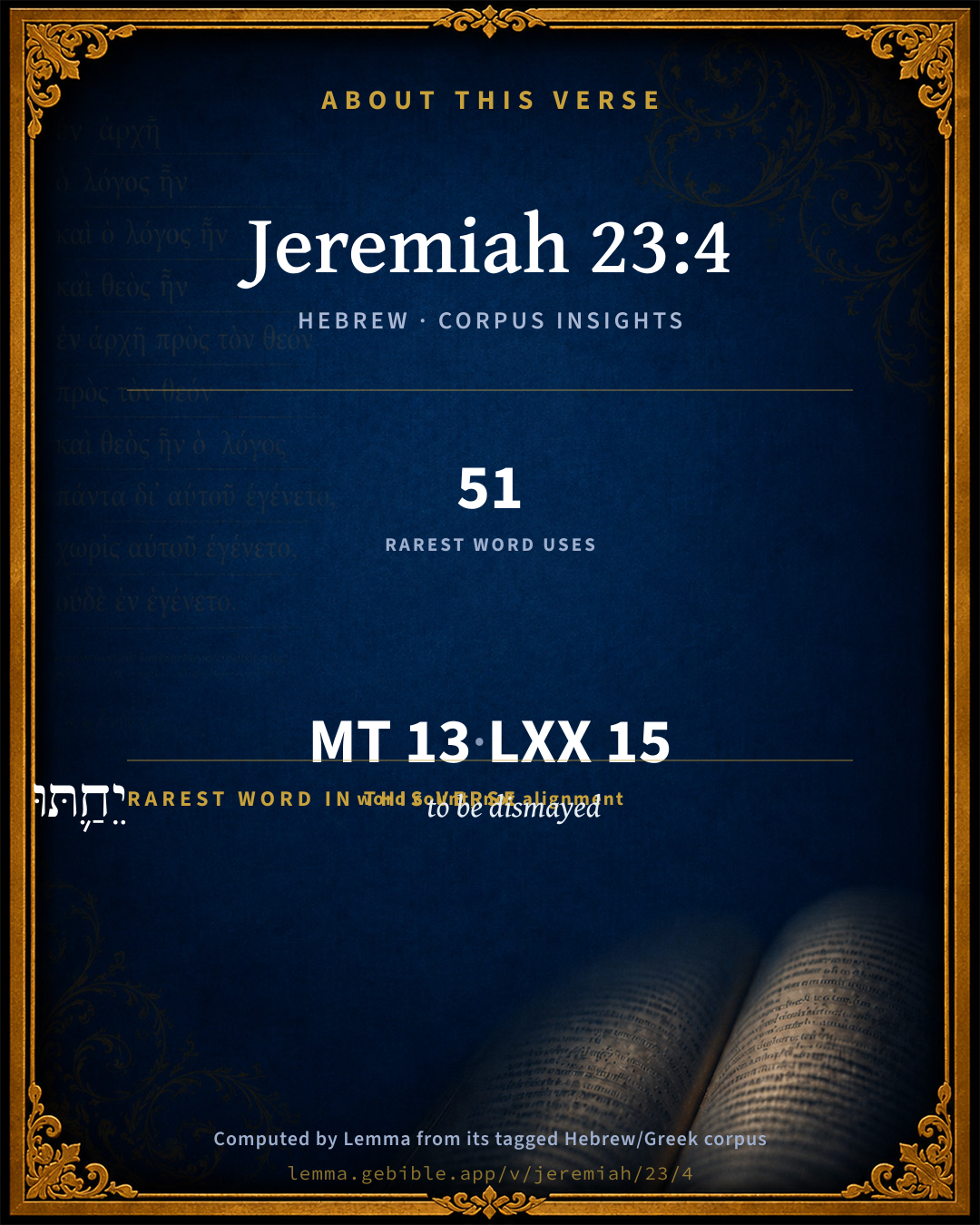
These counts appear in no published source. They are computed here, from the morphology-tagged text and Lemma’s own curated glosses. What Lemma adds →

13
words
10
distinct lemmas
Prophets
section

Shared distinctive vocabulary

יֵחַ֛תּוּ to be dismayed H2865 occurs in 45 verses of the Hebrew Bible. Also found in:

Grammatical profile

  • 6 verbs
  • 2 nouns
  • 1 preposition
  • 1 adverb
  • 3 particles

Verb forms

  • וַהֲקִמֹתִ֧י Hiphil · Sequential Perfect
  • רֹעִ֖ים Qal · Participle Active
  • וְרָע֑וּם Qal · Sequential Perfect
  • יִֽירְא֨וּ Qal · Imperfect
  • יֵחַ֛תּוּ Niphal · Imperfect
  • יִפָּקֵ֖דוּ Niphal · Imperfect

Repetition

Words recur within this verse — often emphatic in Hebrew:

  • רֹעִ֖ים to shepherd H7462 ×2
  • וְלֹא not H3808 ×3

Hebrew & Septuagint length

In the original languages it is 13 Hebrew tokens and 15 Greek tokens — but the two are counted differently (Hebrew bundles its prefixes and suffixes into one token; the Greek is in lemma form), so that isn’t a like-for-like length.

Cross-references

21

Topical passages linked to Jeremiah 23:4 in the Treasury of Scripture Knowledge — connected by theme and wording, ordered by reader-vote popularity; previews shown in the World English Bible.

  • Jeremiah 3:14–15 Return, backsliding children, says Yahweh; for I am a husband to you: and I will take you one of a city, and two of a family, and I will bring you to Zion:
  • 1 Peter 1:5 who by the power of God are guarded through faith for a salvation ready to be revealed in the last time.
  • Acts 20:28–29 Take heed, therefore, to yourselves, and to all the flock, in which the Holy Spirit has made you overseers, to shepherd the assembly of the Lord and God which he purchased with his own blood.
  • Numbers 31:49 and they said to Moses, Your servants have taken the sum of the men of war who are under our charge, and there lacks not one man of us.
  • Psalms 78:70–72 He also chose David his servant, And took him from the sheepfolds;
  • Isaiah 11:11 It shall happen in that day, that the Lord will set his hand again the second time to recover the remnant of his people, who shall remain, from Assyria, and from Egypt, and from Pathros, and from Cush, and from Elam, and from Shinar, and from Hamath, and from the islands of the sea.
  • Jeremiah 30:10 Therefore don't you be afraid, O Jacob my servant, says Yahweh; neither be dismayed, Israel: for, behold, I will save you from afar, and your seed from the land of their captivity; and Jacob shall return, and shall be quiet and at ease, and none shall make him afraid.
  • Jeremiah 31:10 Hear the word of Yahweh, you nations, and declare it in the isles afar off; and say, He who scattered Israel will gather him, and keep him, as shepherd does his flock.
  • Jeremiah 33:26 then will I also cast away the seed of Jacob, and of David my servant, so that I will not take of his seed to be rulers over the seed of Abraham, Isaac, and Jacob: for I will cause their captivity to return, and will have mercy on them.
  • Jeremiah 46:27–28 But don't be afraid you, Jacob my servant, neither be dismayed, Israel: for, behold, I will save you from afar, and your seed from the land of their captivity; and Jacob shall return, and shall be quiet and at ease, and none shall make him afraid.
  • Ezekiel 34:23–31 I will set up one shepherd over them, and he shall feed them, even my servant David; he shall feed them, and he shall be their shepherd.
  • Hosea 3:3–5 I said to her, "You shall stay with me many days. You shall not play the prostitute, and you shall not be with any other man. I will also be so toward you."
  • Micah 5:2 But you, Bethlehem Ephrathah, Being small among the clans of Judah, Out of you one will come forth to me that is to be ruler in Israel; Whose goings forth are from of old, from everlasting.
  • Micah 5:4–5 He shall stand, and shall shepherd in the strength of Yahweh, In the majesty of the name of Yahweh his God: And they will live, for then he will be great to the ends of the earth.
  • John 6:39–40 This is the will of my Father who sent me, that of all he has given to me I should lose nothing, but should raise him up at the last day.
  • John 10:27–30 My sheep hear my voice, and I know them, and they follow me.
  • John 17:12 While I was with them in the world, I kept them in your name. Those whom you have given me I have kept. None of them is lost, except the son of destruction, that the Scripture might be fulfilled.
  • John 18:9 that the word might be fulfilled which he spoke, "Of those whom you have given me, I have lost none."
  • John 21:15–17 So when they had eaten their breakfast, Jesus said to Simon Peter, "Simon, son of Jonah, do you love me more than these?" He said to him, "Yes, Lord; you know that I have affection for you." He said to him, "Feed my lambs."
  • Micah 7:14 Shepherd your people with your staff, The flock of your heritage, Who dwell by themselves in a forest, In the midst of fertile pasture land, let them feed; In Bashan and Gilead, as in the days of old.
  • 1 Peter 5:1–4 I exhort the elders among you, as a fellow elder, and a witness of the sufferings of Christ, and who will also share in the glory that will be revealed.

Cross-references courtesy of OpenBible.info (CC BY 4.0).

Hebrew and Greek witnesses Masoretic Hebrew ↔ Greek Septuagint

The same verse in the two great witnesses to the Old Testament, shown verse-for-verse.

These are two independent witnesses, not word-aligned to each other, and the Septuagint is shown in lemma (dictionary) form.

Hebrew Jeremiah 23:4 Masoretic · Westminster Leningrad Codex

וַהֲקִמֹתִ֧י עֲלֵיהֶ֛ם רֹעִ֖ים וְרָע֑וּם וְלֹא יִֽירְא֨וּ ע֧וֹד וְלֹא יֵחַ֛תּוּ וְלֹ֥א יִפָּקֵ֖דוּ נְאֻם יְהוָֽה

I will set up shepherds over them, who shall feed them; and they shall fear no more, nor be dismayed, neither shall any be lacking, says Yahweh.

World English Bible · Public Domain

Greek LXX Structure differs

In the Septuagint, Jeremiah is about an eighth shorter than the Hebrew and arranges its material differently — the Oracles Against the Nations (Hebrew chapters 46–51) appear in the middle of the Greek book, after 25:13. Because the chapter and verse boundaries do not line up, a verse-for-verse comparison with the Hebrew is not shown.

A verse-for-verse comparison isn’t shown here because the chapters and verses don’t line up. Switch to the LXX edition with the MT / LXX toggle above to read the Greek directly.

On this verse, Haydock's Catholic Bible Commentary discusses the Septuagint’s reading. Read the note in Commentary ↓

Hebrew: Westminster Leningrad Codex (CC BY 4.0). Greek: Septuagint (public domain); English from a public-domain English Septuagint. How the Septuagint differs from the Hebrew →

Targum (Aramaic paraphrase)

1

The Targum is the ancient Jewish Aramaic paraphrase of the Hebrew Scriptures — an interpretive translation, not the Hebrew text itself. Onkelos (literal) and Pseudo-Jonathan (expansive) render the Torah, and Jonathan the Prophets. Coverage is partial: where no permissively-licensed English translation exists for a verse, only the Aramaic is shown. This is verse-level text, not a word-by-word alignment to the Hebrew.

  1. Targum Jonathan Prophets (Joshua–Malachi)
    וַאֲקֵים עֲלֵיהוֹן פַּרְנָסִין וִיפַרְנְסוּנוּן וְלָא יִדַחֲלוּן עוֹד וְלָא יִתַּבְּרוּן וְלָא יְזוּעוּן אֲמַר יְיָ:

    (no public-domain English translation for this verse)

    Targum Jonathan — Aramaic: “Mikraot Gedolot” (public domain). English: “Sefaria Community Translation” (CC0 1.0 (public-domain dedication)); “London "Chaldee Paraphrase," 1871” (public domain). Text via Sefaria.

Commentary

Notes on Jeremiah 23:4 from classic Christian and Jewish commentators (each source and its license shown beneath its notes). The classic Christian expositions comment on the surrounding passage and are grouped to its opening verse, so a note may address several verses; the Jewish commentaries on the Tanakh (Rashi and others) are per-verse, so they appear only where the commentator wrote on this verse.

Lemma curates 59 commentaries, every one of them public domain or Creative Commons licensed, each selected and text-cleaned for this edition rather than reprinted as found. About our sources →

Trapp's Complete Commentary

John Trapp

Jer 23:4 And I will set up shepherds over them which shall feed them: and they shall fear no more, nor be dismayed, neither shall they be lacking, saith the LORD.

Ver. 4. And I will set up shepherds over them.] "Pastors after mine own heart," such as were Zerubbabel, Ezra, Nehemiah, Jehoshua the high priest, Haggai, Zechariah, Malachi, &c. Christian princes and pastors under the gospel, but especially Christ the "chief Shepherd and Bishop of our souls," who is therefore here promised, {Jer 23:5-6} for the comfort of God’s elect, who might well be troubled at that former dreadful denunciation. {Jer 22:29-30}

And they shall fear no more.] But enjoy spiritual security, and be of an invincible courage.

Neither shall they be lacking.] Christ the good Shepherd will see to that, {Joh 10:28-29} his under-shepherds also, whose motto is Praesis ut prosis, will have a care. {a}

{a} Bernard.

John Trapp, A Commentary or Exposition upon All the Books of the Old and New Testament (1647–1656) — public domain. Text from a community e-Sword module.

The Biblical Illustrator

Joseph S. Exell

Jer_23:4

I will set up shepherds over them, which shall feed them.

God-appointed pastors

God, in His wisdom, has most clearly indicated to every man his work. The doer carries within him the fitness for the work to be done. Each has most certainly been made for the other. A law of God brought them face to face at lifes threshold. The same law unites them, when not interfered with, and stamps the union as Divine. As the vessel from the potters hand, so we from the Divine mind. We and our work move along one continuous line till we scale the golden stairway where we end the now and begin the hereafter. The place to be occupied by us may possibly be of the most humble, but man is not estimated because of the place so much as how he filled it. Move along the line of Gods plan and you will tap the fountain of Divine help. Each of Gods intelligent workers has been given a place in the whitened fields, along the line of workers, and no position necessary to the many enterprises of the world has been by the great Creator forgotten. We are not surprised then, in the least, that the children of God should be provided with leaders, and that He would approach His flock and assure them of such provision made in their behalf. The men whom God has touched with a Divine sense of this sacred calling have adaptation to the work. God makes no mistakes in classifying His workers. His divinely appointed shepherds whom He will place over His people carry the evidence of such intention in their physical and spiritual construction. God prepares the shepherd to do the shepherds work, and for him to throw himself out of his Divine gearing is to live an inharmonious life and walk where God could not walk with him, nor furnish him a comforting promise. The world would move as one harmonious whole, if every creature would keep within the laws made to govern him, and wear as his armour the outfit his Creator gave him. Like Moses, many may see from a human standpoint impossibilities in the way; but the same God, now as then, is abundantly able, willing, and ready to remove them. Woe and disappointment have been inevitable to all such as have overpowered this sense of Gods wish, and have sought to follow some idle suggestion which reached the pride of the heart through the lust of the eye. With a shepherds construction, having head, heart, and hand divinely adjusted to so important a calling, how readily each function reaches out, as the petal for the dew, after every nutritious element adapted to its growth. He who is to minister in holy things, early finds his thoughts running along the line of Gods thoughts, and if he will yield to the Spirits sweet influence, will gradually as growth gravitate to within the necessary sources for his equipment. While mental culture and literary discipline are necessary, and a holy familiarity with the doctrines of the Bible, the ministers wall and roof, yet Gods ambassadors are expected to feed the flock of the fruit which comes from the bounty these attainments have led them to. The ministers knowledge should be principally used as the means to the end. Our peculiar gifts must be called into liveliest action and placed well to the forefront, and whatever else we may possess in the line of mental or spiritual gifts should be made to contribute subordinate, but loyal, help. But it is not enough that the doctrine be sound. While truth can be nothing but truth, and sound doctrine nothing less than sound, yet, the effect produced is all the better for having come from pure lips, and a heart known to be sincere. The man of God ordained to the high office of shepherd, whoso business it is to minister in holy things, and preside at His altar, should, as far as it is possible, live along the line of Christs life. Without this he cannot be the safest counsel for the flock entrusted to his care. He should not only know how to instruct, but how to live, so that his doctrine and his life may not antagonise. Like Christ, he must do as well as teach. His should be a life of simplicity, free from exceptional practices and evil habits. Bold and fearless, yet humble and unostentatious. Mingling freely with the people, but in modest, quiet reserve. His language should always be the most chaste. His business relations with all men should be of the pleasantest character. Pulpit brilliancy may fill the pews and produce applause, but often spoils the preacher and cools the church. With an eloquent pulpit the church falls an easy prey to pride and vanity, losing sight of her humble, but dignified, mission, permitting the undershepherd to use the temple of God for self-glory. Bernard, whose power came from his tenderness and simplicity, on one occasion preached a very scholarly sermon. The learned only thanked him and gave applause. The next day he preached plainly and tenderly, as had been his custom, and the good, the humble and the godly gave thanks and invoked blessings upon his head, which some of the scholarly wondered at. Ah! said he, yesterday I preached Bernard, but to-day I preached Christ. Congregations should arise from their pews more impressed with the power of Gospel facts than with well-rounded sentences and lofty flights of oratory. The Christian hearer should be made to feel the need of greater consecration. The sinner should be made to feel the remorse which comes from a correct estimate of a lost soul for which he has nothing to give in exchange. (A. J. Douglas.)

Preachers must feed the people

From the deck of an Austrian gunboat we threw into the Lago Garda a succession of little pieces of bread, and presently small fishes came in shoals, till there seemed to be, as the old proverb puts it, more fish than water. They came to feed, and needed no music. Let the preacher give his people food, and they will flock around him, even if the sounding brass of rhetoric, and the tinkling cymbals of oratory are silent. (C. H. Spurgeon.)

Food attractive

Everybody knows that large flocks of pigeons assemble at the stroke of the great clock in the square of St. Mark: believe me, it is not the music of the bell which attracts them, they can hear that every hour. They come, Mr. Preacher, for food, and no mere sound will long collect them. This is a hint for filling your meeting-house; it must be done not merely by that fine, bell-like voice of yours, but by all the neighbourhoods being assured that spiritual food is to be had when you open your mouth. Barley for pigeons, good sir; and the Gospel for men and women. Try it in earnest, and you cannot fail. (C. H. Spurgeon.)

The Biblical Illustrator, edited by Joseph S. Exell (c. 1880s–1900s) — public domain. Text from a community e-Sword module.

Keil & Delitzsch

C. F. Keil & F. Delitzsch

When the Lord shall gather His people out of the dispersion, then will He raise up shepherds over them who will so feed them that they shall no longer need to fear or to be dismayed before enemies who might be strong enough to subjugate, slay, and carry them captive. The figurative expressions are founded on the idea that the sheep, when they are neglected by the shepherds, are torn and devoured by wild beasts; cf. Eze 34:8. They shall not be lacking; cf. for נפקד with this force, Sa1 25:7; in substance = not be lost. לא יפּקדוּ is chosen with a view to לא פקדתּם אתם (Jer 23:2): because the shepherds did not take charge of the sheep, therefore the sheep are scattered and lost. Hereafter this shall happen no more. The question as to how this promise is to be accomplished is answered by Jer 23:5 and Jer 23:6. The substance of these verses is indeed introduced by the phrase: behold, days come, as something new and important, but not as something not to happen till after the things foretold in Jer 23:4. According to Jeremiah's usage throughout, that phrase does not indicate any progress in time as compared with what precedes, but draws attention to the weightiness of what is to be announced. There is also a suggestion of "the contrast between the hope and the existing condition of affairs, which does not itself justify that hope. However gloomy the present is, yet there is a time coming" (Hgstb.). The promise: I make to arise (raise up) to David a righteous branch, rests upon the promise, Sa2 7:12; Ch1 17:12 : I raise up thy seed after thee, which shall be of thy sons-which the Lord will hereafter fulfil to David. Graf tries to show by many, but not tenable arguments, that צמח has here a collective force. That he is wrong, we may see from the passages Zac 3:8 and Zac 6:12, where the same "branch" foretold by Jeremiah is called the man whose name is צמח; and even without this we may discover the same from the context of the present passage, both from "He shall reign as king," and still more from: they shall call his name Jahveh Tsidkenu. Neither of these sayings can be spoken of a series of kings. Besides, we have the passages Jer 30:9 and Eze 34:23., Eze 37:24, where the servant to be raised up to David by Jahveh is called "my servant David." Although then צמח has a collective force when it means a plant of the field, it by no means follows that "it has always a collective force" in its transferred spiritual signification. And the passage, Jer 33:17, where the promise is explained by: David shall never want a man to sit upon the throne of Israel (cf. Jer 33:21), does not prove that the branch of David is a collective grouping together of all David's future posterity, but only that this one branch of David shall possess the throne for ever, and not, like mortal men, for a series of years only; Sa2 7:16. צמח denotes the Messiah, and this title is formed from צמח, Isa 4:2 (see Del. on this passage). Nor does the mention of shepherds in the plural, Jer 23:4, at all oppose this. An untenable rendering of the sense is: first I will raise up unto you shepherds, then the Messiah; or: better shepherds, inprimis unum, Messiam (Chr. B. Mich.). The two promises are not so to be joined. First we have the raising up of good shepherds, in contrast to the evil shepherds that have destroyed the people; then the promise is further explained to the effect that these good shepherds shall be raised up to David in the "righteous branch," i.e., in the promised "seed" of his sons. The good shepherds are contrasted with the evil shepherds, but are then summed up in the person of the Messiah, as being comprised therein. The relation of the good shepherds to the righteous branch is not so, that the latter is the most pre-eminent of the former, but that in that one branch of David the people should have given to them all the good shepherds needed for their deliverance. The Messiah does not correspond to the series of David's earthly posterity that sit upon his throne, in that He too, as second David, will also have a long series of descendants upon His throne; but in that His kingdom, His dominion, lasts for ever. In the parallel passage, Jer 33:15, where the contrast to the evil shepherds is omitted, we therefore hear only of the one branch of David; so in Ezek 34, where only the one good shepherd, the servant of the Lord, David, stands in contrast to the evil shepherds (Jer 23:23). Hence neither must we seek the fulfilment of our prophecy in the elevation of the Maccabees, who were not even of the race of David, nor understand, as Grot., Zerubbabel to be the righteous branch, but the Messiah, as was rightly understood by the Chald. He is צדּיק in contrast to the then reigning members of the house of David, and as He who will do right and justice in His realm; cf. Jer 22:15, where the same is said of Josiah as contrasted with his ungodly son Jehoiakim. מלך is subjoined to מלך to bespeak His rule as kingship in the fullest sense of the word. Regnabit rex, i.e., magnifice regnabit, ut non tantum appareant aliquae reliquiae pristinae dignitatis, sed ut rex floreat et vigeat et obtineat perfectionem, qualis fuit sub Davide et Salomone ac multo praestantior (Calv.). השׂכּיל, deal prudently, rule wisely, as in Jer 3:15, not: be fortunate, prosperous. Here the context demands the former rendering, the only one justified by usage, since the doing of right and justice is mentioned as the fruit and result of the השׂכיל. These words, too, point back to David, of whom it is in Sa2 8:15 said, that he as king did right and justice to all his people.

Keil & Delitzsch — Biblical Commentary on the Old Testament (1861–1891) — public domain (CC PDM 1.0). Text via the HelloAO Bible API. (Old Testament only.)

Tyndale Open Study Notes

Tyndale Open Resources

23:4 Once the people were back in Judah (23:3), the Lord would appoint responsible shepherds. As good leaders, they would care for the people.

Tyndale Open Study Notes — © Tyndale Open Resources, licensed CC BY-SA 4.0. Text via the HelloAO Bible API.

John Calvin's Commentaries

He confirms the promise, for he would give them faithful and true pastors, who would perform their office as it behoved them; for it would not be enough that the sheep should be restored to their folds, except they were fed. We indeed know that a sheep is a silly animal, and therefore has need of a shepherd to rule and guide it. God then intimates by these words, that after he had collected his flock into the fold it would be the object of his constant care; for he would appoint pastors, who would discharge their office in a far different way from wolves and sacrilegious robbers. He then adds a promise as to their security, which we shall consider tomorrow.

John Calvin's Commentaries (1540-1563) — public domain. Text from the Calvin Translation Society English edition (1840s-50s) via the Christian Classics Ethereal Library (ccel.org). Calvin's coverage is partial (roughly two-thirds of the Bible); uncommented books and verses are honest gaps, never fabricated. The 19th-century editor's footnotes and remarks are omitted so the notes are faithfully Calvin's own voice.

Ellicott's Commentary for English Readers

(4) I will set up shepherds . . .—The words imply, in one sense, a return to the theocracy, the breaking off the hereditary succession of the house of David, and the giving of power to those who, like Ezra and Nehemiah, and, later on in history, the Maccabees, were called to rule because they had the capacity for ruling well. The plural is noticeable, as in Jer_3:15, as not limiting the prophecy to the Christ who is yet the “chief Shepherd” (1Pe_5:4). In the verb for “set up” there is an allusive reference to the names of Jehoiakim and Jehoiachin, into both of which it entered. Jehovah would “raise up” shepherds, but not such as they had proved themselves to be.

Neither shall they be lacking.—i.e., the flock would be so cared for that not one sheep should be lost. Care extending even to every individual member was the true ideal of the Shepherd’s work (Joh_10:3; Joh_17:12), and therefore of the ruler’s.

A Bible Commentary for English Readers, edited by Charles John Ellicott (1878–1897) — public domain. Text from a community e-Sword module.

The Cambridge Bible for Schools and Colleges

gen. ed. J. J. S. Perowne

4. shepherds] The picture is probably that of righteous rulers, such as princes and judges, placed in authority under the ideal king. Cp. Isa_1:26; Isa_32:1.

lacking] missing, like sheep which in the absence of the shepherd have become the prey of wild beasts.

The Cambridge Bible for Schools and Colleges (gen. ed. J. J. S. Perowne; Cambridge University Press, 1878–1918) — public domain. Text from a community e-Sword module.

John Gill's Exposition

And I will set shepherds over them, which shall feed them,.... Good shepherds, rulers and governors, that shall rule them with wholesome laws, and protect and defend them; such as Zerubbabel, Nehemiah, and others, after the captivity: or Christian kings and princes, when the Gospel came to be published and established in many kingdoms and provinces, and the sheep of Christ were gathered out of them. Jerom interprets these shepherds of the apostles of Christ; and it may include other ministers of the Gospel, who feed Christ's sheep with knowledge and understanding; see Jer 3:15;

and they shall fear no more, nor be dismayed; not the shepherds, as Jerom understands it, but the sheep. This looks as if this prophecy had respect to more future times than those immediately following the return from the Babylonish captivity; since the Jews were made to fear, and were dismayed by Sanballat and Tobiah, and, in later times, by the Greeks and Romans; even to the times of Christ, and the Gospel dispensation; in which the saints receive not the spirit of bondage again to fear, but, through the blood, righteousness, and sacrifice, of Christ, have much spiritual peace and boldness of faith, and fear no enemy;

neither shall they be lacking, saith the Lord; not one of the sheep brought back, or of the remnant gathered, shall be missing or lost; this is exactly true of Christ's sheep, Joh 10:28.

John Gill's Exposition of the Whole Bible (1746–1763) — public domain (CC PDM 1.0). Text via the HelloAO Bible API.

Albert Barnes' Notes on the Bible

Shepherds - Men like Ezra, Nehemiah, and the Maccabees, raised up especially by God. It is a revocation of the promise made to David 2Sa 7:12-16 so far as the earthly throne was concerned.

They shall fear no more ... - The effect of good government will be general security.

Neither shall they be lacking - Not one sheep shall be missing or lost.

Albert Barnes' Notes on the Bible (1834–1885) — public domain. Text from a community e-Sword/MySword module.

Haydock's Catholic Bible Commentary

Pastors; Zorobabel, &c., as figures of Christ, and of the pastors of his Church. --- No more, as much as formerly. So many expressions must be understood. --- Branch. Septuagint, "orient." --- Reign. Zorobabel was not chief governor, (Calmet) though at the head of his tribe. (Haydock) --- The kingdom of Christ was not of this world, John xviii. 36. (Calmet) --- He alone imparts justice to others. (Worthington)

George Leo Haydock (1774–1849), Haydock's Catholic Family Bible and Commentary, 1859 edition — public domain. Excludes Psalms (Douay-Rheims chapter numbering differs from Protestant) and Deuterocanonical books (Catholic canon only).

Matthew Poole's English Annotations

And I will set up shepherds over them which shall feed them: some think this prophecy was fulfilled in Nehemiah and Zerobabel, who were pious and good governors, and consulted in their government the good of the people committed to their trust, Neh 2:10; 5:14. Others rather understand it of Christian princes and governors under the gospel.

And they shall fear no more, nor be dismayed; under whom they shall live peaceably and securely.

Neither shall they be lacking; and none of them shall perish. The two last passages of this verse incline interpreters to think that this promise doth not so much refer to their coming out of Babylon, as to their spiritual deliverance by Christ, for after their return out of Babylon they were not secure long, but feared Sanballat and Tobiah, the Grecians, and Romans, and other enemies; besides that the last words exactly agree with Joh 10:28, when Christ saith his sheep should not perish, and it appears Jer 23:6 that the prophet is speaking of a time when not Judah only, but Israel also, should be saved, and the next verse doth manifestly refer unto Christ.

Matthew Poole's English Annotations on the Holy Bible (1683–1685) — public domain. Text from a community e-Sword/MySword module.

Whedon's Commentary on the Bible

Daniel D. Whedon

4. I will set up shepherds — Such men as Zerubbabel, Ezra, and Nehemiah: but the higher fulfilment of this prophetic promise is reserved for Messianic times.

Daniel D. Whedon (gen. ed.), Commentary on the Old and New Testaments (1874–1909) — public domain. Text from a community e-Sword module.

The Pulpit Commentary

And I will set up shepherds; e.g. rulers, not necessarily kings (see on next verse). Which shall feed them. For the evil shepherds "fed themselves, and fed not my flock". (Eze_34:8) And they shall fear no more. Ezekiel again contributes an essential feature to the description. The neglect of the shepherds left the flock exposed to the ravages of wild beasts. (Eze_34:8) Neither shall they be lacking. A speaking phrase. Too many of the sheep had fallen down precipices or been carried off by lions. Yet the context rather favors a slight and palaeographically natural emendation of Hitzig, "Neither shall they be terrified." The Septuagint omits the word altogether, which favors the supposition that they read as Hitzig would read, for they are apt to condense by omitting synonyms.

The Pulpit Commentary (1880–1919), ed. H.D.M. Spence-Jones & Joseph S. Exell — public domain. Text from a community e-Sword module.

Rashi

Rabbi Shlomo Yitzchaki (Rashi)

nor shall [any of them] be missing and they shall not be missing. (Cf. Num. 31:49) “And no one of us was missing (נפקד).”

Rashi on the Tanakh — English translations: “The Judaica Press complete Tanach with Rashi, translated by A. J. Rosenberg” (CC BY 4.0); “Pentateuch with Rashi's commentary by M. Rosenbaum and A.M. Silbermann, 1929-1934” (public domain); “The Metsudah Tanach series, Lakewood, N.J” (CC BY 4.0); and “The Book of Joshua, Metsudah Publications, 1997” (CC BY 4.0). Text via Sefaria.

Lesson kit

Teaching starters — assembled from the data on this page, not authored interpretation. Every prompt links to the verse data it draws on. Edit before teaching.

Jeremiah, in the Prophets, opens this verse with 13 words (10 distinct Hebrew lemmas). Its most distinctive word is châthath (“to be dismayed”). A historical commentator’s framing appears above. Read the whole chapter for the surrounding context.

Discussion questions

  1. How does “to be dismayed” (châthath) shape what this verse is saying?
  2. Deuteronomy 1:21 shares the word «to be dismayed» with this verse. How do the two illuminate each other?
  3. “to shepherd” occurs 2× in this one verse. What is the effect of the repetition?
  4. These translations render this verse differently. What is at stake in choosing one wording over another?
  5. The verb «וַהֲקִמֹתִ֧י» is Hiphil Sequential Perfect. How does its form color the action?
  6. Reading how Trapp's Complete Commentary and The Biblical Illustrator read this verse, where do the two commentators agree and where do they part?

Things to notice

Reading settings

Reading text

Shown beneath each verse's original-language words.

Old Testament
Old Testament edition

Read the OT as the Masoretic Hebrew (MT) or the Greek Septuagint (LXX).

English shown for the Greek Septuagint (in the Hebrew ↔ Greek comparison).

Comparing translations? Open the Compare panel on any verse page to stack up to four side by side.