
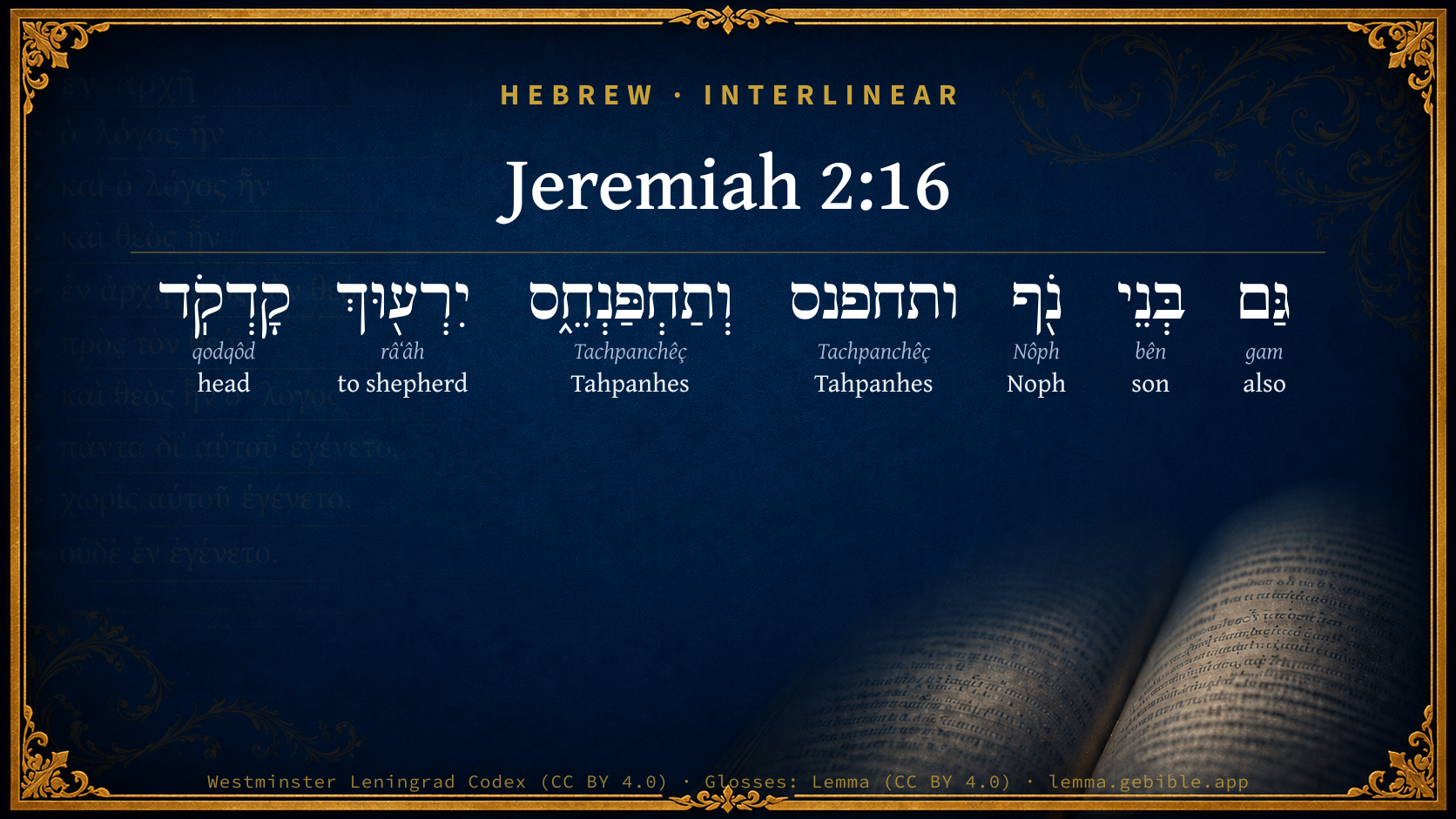
Jeremiah 2:16

Hebrew (Westminster Leningrad Codex) Jeremiah 2:16 appears in the Hebrew Old Testament. The text above is from the Westminster Leningrad Codex. Each word links to its Strong’s number, a concise gloss, and parsing drawn from the Open Scriptures Hebrew Bible morphology. Click any word for its full Brown-Driver-Briggs (BDB) entry.
Download image
Cite this verse

Jeremiah 2:16 (World English Bible). Public Domain. Lemma interlinear Bible study tool, https://lemma.gebible.app/v/jeremiah/2/16.

Show BibTeX & RIS
BibTeX
RIS
English Translation
The children also of Memphis and Tahpanhes have broken the crown of your head.
World English Bible · Public Domain
Highlights
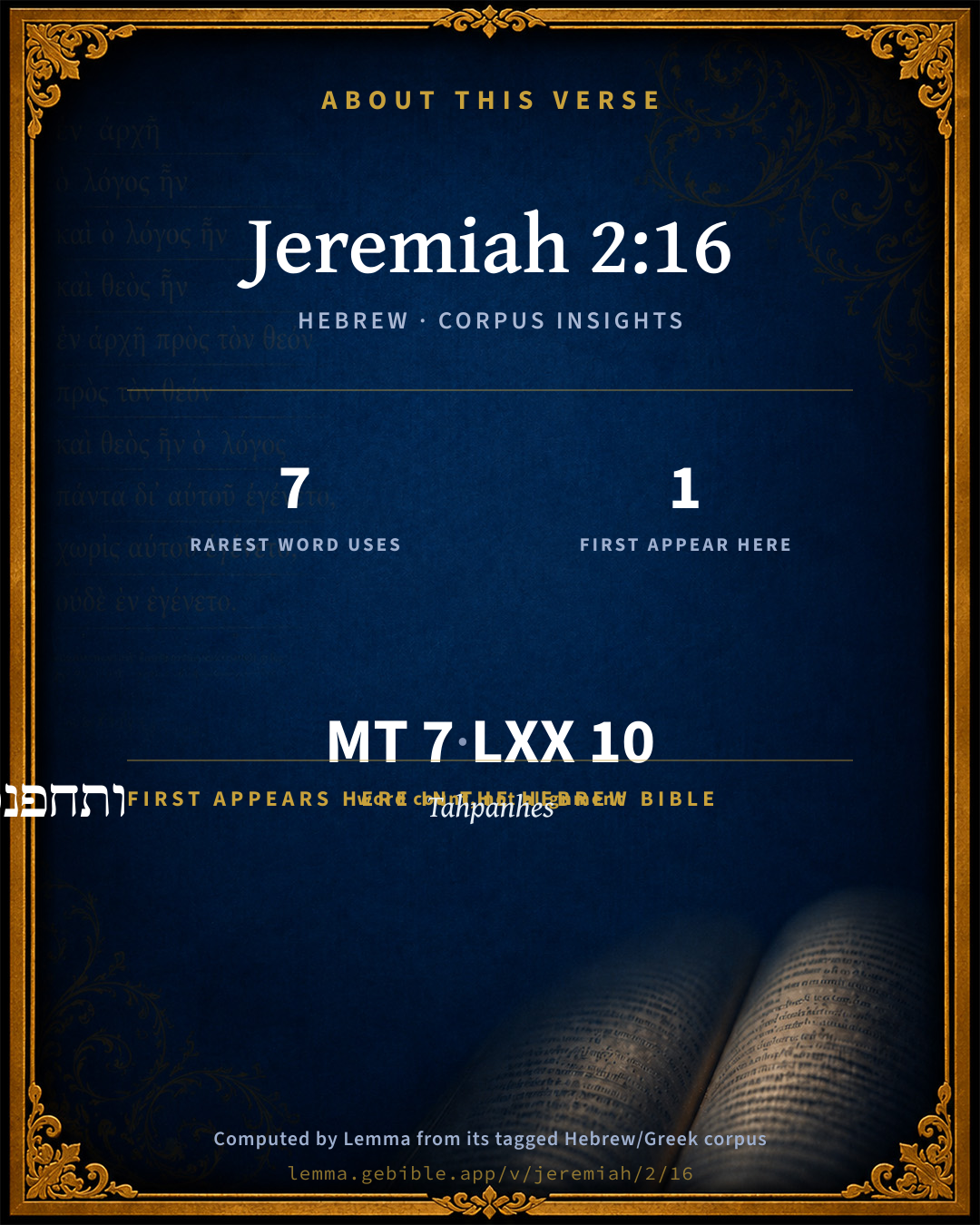
  • 1 first appearance in the Hebrew Bible
Full analysis ↓
Download a study sheet

One document with this verse’s original text, its word-by-word gloss line, the meaning frame, cross-references with their text, attributed commentary, and full source and license credits — printable, and it pastes into notes with its structure intact.

This verse Autodidact and up

Study sheet (.html) Plain text (.txt)

A passage Seminary Student

Up to 50 verses in one chapter. A passage sheet keeps up to 6 commentary sources and 12 cross-references per verse, in the order this page ranks them, and says so on the sheet whenever that leaves anything out. Ask for a single verse and you get the Autodidact verse sheet above.

Everything on this page stays free to read, with no account — the sheet is a download of what is already on screen, not access to it.

Want to remove ads? Support Godless Engineer
Compare translations 3

The same verse in 3 English versions, stacked beneath the original-language interlinear above. Click any original word for its lexicon entry.

Each is an independent rendering of the whole verse — the interlinear is not word-aligned to these translations.

Highlighted words mark where these versions differ — a whole-verse word diff, not a word-by-word alignment.

  • World English Bible Public Domain
    The children also of Memphis and Tahpanhes have broken the crown of your head.
  • King James Version Public Domain
    Also the children of Noph and Tahapanes have broken the crown of thy head.
  • unfoldingWord Literal Text CC BY-SA 4.0
    Also, the sons of Memphis and Tahpanhes have shaved the crown of your head.

unfoldingWord Literal Text — © unfoldingWord, licensed CC BY-SA 4.0. Word-aligned USFM3 via Door43 (git.door43.org/unfoldingWord/en_ult).

Versions to compare (up to 4)

3 of 4 selected

Show all 18 translations

Every available English version of this verse, each an independent rendering of the whole verse.

  • World English Bible Public Domain
    The children also of Memphis and Tahpanhes have broken the crown of your head.
  • Berean Standard Bible Public Domain
    The men of Memphis and Tahpanhes have shaved the crown of your head.
  • Majority Standard Bible Public Domain
    The men of Memphis and Tahpanhes have shaved the crown of your head.
  • King James Version Public Domain
    Also the children of Noph and Tahapanes have broken the crown of thy head.
  • American Standard Version (1901) Public Domain
    The children also of Memphis and Tahpanhes have broken the crown of thy head.
  • Revised Version (1885) Public Domain
    The children also of Noph and Tahpanhes have broken the crown of thy head.
  • Geneva Bible (1599) Public Domain
    Also the children of Noph and Tahapanes haue broken thine head.
  • Douay-Rheims (1899) Public Domain
    The children also of Memphis, and of Taphnes have deflowered thee, even to the crown of the head.
  • Young's Literal Translation Public Domain
    Also sons of Noph and Tahapanes Consume thee -- the crown of the head!
  • Literal Standard Version CC BY-SA 4.0
    Also sons of Noph and Tahapanes || Consume you—the crown of the head!
  • Unlocked Literal Bible CC BY-SA 4.0
    Also, the people of Memphis and Tahpanhes will shave your skull.
  • unfoldingWord Literal Text CC BY-SA 4.0
    Also, the sons of Memphis and Tahpanhes have shaved the crown of your head.
  • Darby Bible Public Domain
    Even the children of Noph and Tahapanes have fed on the crown of thy head.
  • World Messianic Bible Public Domain
    The children also of Memphis and Tahpanhes have broken the crown of your head.
  • Webster's Bible Public Domain
    Also the children of Noph and Tahapanes have broken the crown of thy head.
  • Free Bible Version CC BY-SA 4.0
    The men of Memphis and Tahpanhes have shaved your heads.
  • Bible in Basic English Public Domain
    Even the children of Noph and Tahpanhes have put shame on you.
  • JPS Tanakh (1917) Public Domain
    The children also of Noph and Tahpanhes feed upon the crown of thy head.

Literal Standard Version (2020), Covenant Press — licensed CC BY-SA 4.0. Text via the HelloAO Bible API (eBible.org). Unlocked Literal Bible (unfoldingWord) — licensed CC BY-SA 4.0. Text via the HelloAO Bible API (eBible.org). unfoldingWord Literal Text — © unfoldingWord, licensed CC BY-SA 4.0. Word-aligned USFM3 via Door43 (git.door43.org/unfoldingWord/en_ult). Free Bible Version, Dr. Jonathan Gallagher — licensed CC BY-SA 4.0. Text via the HelloAO Bible API (eBible.org).

Word by word

More ways to search: Search by grammar → Find every occurrence → Compare this word →

Practice this passage: Drill this verse → Learn its vocabulary →

About this verse

These counts appear in no published source. They are computed here, from the morphology-tagged text and Lemma’s own curated glosses. What Lemma adds →

7
words
6
distinct lemmas
Prophets
section

Notable vocabulary

The rarest word here is נֹ֖ף Noph H5297 — appearing just 7 times in the whole Hebrew Bible.

First appearance in Scripture

This word makes its first canonical appearance in the Hebrew Bible here:

  • ותחפנס Tahpanhes H8471

Shared distinctive vocabulary

נֹ֖ף Noph H5297 occurs in 7 verses of the Hebrew Bible. Also found in:

Grammatical profile

  • 1 verb
  • 5 nouns
  • 1 particle

Verb forms

  • יִרְע֖וּךְ Qal · Imperfect

Repetition

A word recurs within this verse — often emphatic in Hebrew:

  • ותחפנס Tahpanhes H8471 ×2

Hebrew & Septuagint length

In the original languages it is 7 Hebrew tokens and 10 Greek tokens — but the two are counted differently (Hebrew bundles its prefixes and suffixes into one token; the Greek is in lemma form), so that isn’t a like-for-like length.

Cross-references

14

Topical passages linked to Jeremiah 2:16 in the Treasury of Scripture Knowledge — connected by theme and wording, ordered by reader-vote popularity; previews shown in the World English Bible.

  • Jeremiah 46:14 Declare you in Egypt, and publish in Migdol, and publish in Memphis and in Tahpanhes: say you, Stand forth, and prepare you; for the sword has devoured round about you.
  • Jeremiah 43:7–9 and they came into the land of Egypt; for they didn't obey the voice of Yahweh: and they came to Tahpanhes.
  • Deuteronomy 33:20 Of Gad he said, Blessed be he who enlarges Gad: He dwells as a lioness, Tears the arm, yes, the crown of the head.
  • Isaiah 19:13 The princes of Zoan are become fools, the princes of Memphis are deceived; they have caused Egypt to go astray, who are the corner-stone of her tribes.
  • Jeremiah 44:1 The word that came to Jeremiah concerning all the Jews who lived in the land of Egypt, who lived at Migdol, and at Tahpanhes, and at Memphis, and in the country of Pathros, saying,
  • Ezekiel 30:16 I will set a fire in Egypt: Sin shall be in great anguish, and No shall be broken up; and Memphis [shall have] adversaries in the day-time.
  • 2 Kings 18:21 Now, behold, you trust on the staff of this bruised reed, even on Egypt; whereon if a man lean, it will go into his hand, and pierce it: so is Pharaoh king of Egypt to all who trust on him.
  • 2 Kings 23:33 Pharaoh Necoh put him in bonds at Riblah in the land of Hamath, that he might not reign in Jerusalem; and put the land to a tribute of one hundred talents of silver, and a talent of gold.
  • Isaiah 1:6–7 From the sole of the foot even to the head there is no soundness in it: Wounds, welts, and open sores. They haven't been closed, neither bandaged, neither soothed with oil.
  • Isaiah 8:8 and it shall sweep onward into Judah; it shall overflow and pass through; it shall reach even to the neck; and the stretching out of its wings shall fill the breadth of your land, Immanuel.
  • Isaiah 30:1–6 Woe to the rebellious children, says Yahweh, who take counsel, but not of me; and who make a league, but not of my Spirit, that they may add sin to sin,
  • Isaiah 31:1–3 Woe to those who go down to Egypt for help, and rely on horses, and trust in chariots because they are many, and in horsemen because they are very strong, but they don't look to the Holy One of Israel, neither seek Yahweh!
  • Jeremiah 46:19 You daughter who dwell in Egypt, furnish yourself to go into captivity; for Memphis shall become a desolation, and shall be burnt up, without inhabitant.
  • Ezekiel 30:13 Thus says the Lord Yahweh: I will also destroy the idols, and I will cause the images to cease from Memphis; and there shall be no more a prince from the land of Egypt: and I will put a fear in the land of Egypt.

Cross-references courtesy of OpenBible.info (CC BY 4.0).

Hebrew and Greek witnesses Masoretic Hebrew ↔ Greek Septuagint

The same verse in the two great witnesses to the Old Testament, shown verse-for-verse.

These are two independent witnesses, not word-aligned to each other, and the Septuagint is shown in lemma (dictionary) form.

Hebrew Jeremiah 2:16 Masoretic · Westminster Leningrad Codex

גַּם בְּנֵי נֹ֖ף ותחפנס וְתַחְפַּנְחֵ֑ס יִרְע֖וּךְ קָדְקֹֽד

The children also of Memphis and Tahpanhes have broken the crown of your head.

World English Bible · Public Domain

Greek LXX Structure differs

In the Septuagint, Jeremiah is about an eighth shorter than the Hebrew and arranges its material differently — the Oracles Against the Nations (Hebrew chapters 46–51) appear in the middle of the Greek book, after 25:13. Because the chapter and verse boundaries do not line up, a verse-for-verse comparison with the Hebrew is not shown.

A verse-for-verse comparison isn’t shown here because the chapters and verses don’t line up. Switch to the LXX edition with the MT / LXX toggle above to read the Greek directly.

On this verse, Ellicott's Commentary for English Readers discusses the Septuagint’s reading. Read the note in Commentary ↓

Hebrew: Westminster Leningrad Codex (CC BY 4.0). Greek: Septuagint (public domain); English from a public-domain English Septuagint. How the Septuagint differs from the Hebrew →

Targum (Aramaic paraphrase)

1

The Targum is the ancient Jewish Aramaic paraphrase of the Hebrew Scriptures — an interpretive translation, not the Hebrew text itself. Onkelos (literal) and Pseudo-Jonathan (expansive) render the Torah, and Jonathan the Prophets. Coverage is partial: where no permissively-licensed English translation exists for a verse, only the Aramaic is shown. This is verse-level text, not a word-by-word alignment to the Hebrew.

  1. Targum Jonathan Prophets (Joshua–Malachi)
    אַף בְּנֵי מֵפִיס וְתַחְפַּנְחֵס יִקְטְלוּן גִבָּרָךְ וְיִבְזוּן נִכְסָךְ:

    (no public-domain English translation for this verse)

    Targum Jonathan — Aramaic: “Mikraot Gedolot” (public domain). English: “Sefaria Community Translation” (CC0 1.0 (public-domain dedication)); “London "Chaldee Paraphrase," 1871” (public domain). Text via Sefaria.

Commentary

Notes on Jeremiah 2:16 from classic Christian and Jewish commentators (each source and its license shown beneath its notes). The classic Christian expositions comment on the surrounding passage and are grouped to its opening verse, so a note may address several verses; the Jewish commentaries on the Tanakh (Rashi and others) are per-verse, so they appear only where the commentator wrote on this verse.

Lemma curates 59 commentaries, every one of them public domain or Creative Commons licensed, each selected and text-cleaned for this edition rather than reprinted as found. About our sources →

Trapp's Complete Commentary

John Trapp

Jer 2:16 Also the children of Noph and Tahapanes have broken the crown of thy head.

Ver. 16. Also the children of Noph and Tahapanes.] Two chief cities of Egypt, the inhabitants whereof were said to be most effeminate and servile fellows; {a} even these shall overtop thee, knock thee down, as an ox by a blow on the brain pan, and make havoc of those things that thou holdest the chiefest and most desirable.

{a} Herodot., lib. ii.

John Trapp, A Commentary or Exposition upon All the Books of the Old and New Testament (1647–1656) — public domain. Text from a community e-Sword module.

Tyndale Open Study Notes

Tyndale Open Resources

2:16 Another enemy, the Egyptians, invaded from the south to pick up the pieces (50:17; 2 Kgs 23:29-37). • Memphis and Tahpanhes, Egypt’s major cities near the mouth of the Nile, were famous for their wealth.

Tyndale Open Study Notes — © Tyndale Open Resources, licensed CC BY-SA 4.0. Text via the HelloAO Bible API.

Geneva Bible (1599)

Geneva Bible translators

Have grievously vexed thee at sundry times.

That is, the Egyptians: for these were two great cities in Egypt.

Geneva Bible (1599) marginal notes — public domain. Text via Bolls.life.

Jamieson, Fausset & Brown

Robert Jamieson, A. R. Fausset & David Brown

Noph . . . Tahapanes--Memphis, capital of Lower Egypt, on the west bank of the Nile, near the pyramids of Gizeh, opposite the site of modern Cairo. Daphne, on the Tanitic branch of the Nile, near Pelusium, on the frontier of Egypt towards Palestine. Isa 30:4 contracts it, Hanes. These two cities, one the capital, the other that with which the Jews came most in contact, stand for the whole of Egypt. Tahapanes takes its name from a goddess, Tphnet [CHAMPOLLION]. Memphis is from Man-nofri, "the abode of good men"; written in Hebrew, Moph (Hos 9:6), or Noph. The reference is to the coming invasion of Judah by Pharaoh-necho of Egypt, on his return from the Euphrates, when he deposed Jehoahaz and levied a heavy tribute on the land (Kg2 23:33-35). Josiah's death in battle with the same Pharaoh is probably included (Kg2 23:29-30).

have broken--rather, shall feed down the crown, &c., that is, affect with the greatest ignominy, such as baldness was regarded in the East (Jer 48:37; Kg2 2:23). Instead of "also," translate, "even" the Egyptians, in whom thou dost trust, shall miserably disappoint thy expectation [MAURER]. Jehoiakim was twice leagued with them (Kg2 23:34-35): when he received the crown from them, and when he revolted from Nebuchadnezzar (Kg2 24:1-2, Kg2 24:7). The Chaldeans, having become masters of Asia, threatened Egypt. Judea, situated between the contending powers, was thus exposed to the inroads of the one or other of the hostile armies; and unfortunately, except in Josiah's reign, took side with Egypt, contrary to God's warnings.

Jamieson, Fausset & Brown — Commentary Critical and Explanatory on the Whole Bible (1871) — public domain (CC PDM 1.0). Text via the HelloAO Bible API.

Adam Clarke's Commentary

Verse 16. The children of Noph and Tahapanes] Noph and Tahapanes were two cities of Egypt, otherwise called Memphis and Daphni. It is well known that the good king was defeated by the Egyptians, and slain in battle. Thus was the crown of Judah's head broken.

Adam Clarke's Commentary on the Bible (1810–1826) — public domain. Text from a community e-Sword/MySword module.

John Calvin's Commentaries

By way of amplification he adds, Also the sons of Noph and of Tephanes shall for thee break the head, or, the crown of the head. We shall hereafter see that the Israelites were wont to seek help from the Egyptians. The particle גם, gam, may be thus explained, “Not only those who have been hitherto professed enemies to thee, but even thy friends, in whose help thou didst confide, shall turn their power against thee and break for thee thy head.” Some think that their degradation is here enhanced, because the Egyptians were an unwarlike people; and ancient historians say that men there followed the occupations of women; but as this is not mentioned in Scripture, and as the Egyptians are not thus spoken of in it, I prefer to follow the usual explanation, that the Egyptians, though confederate with Israel, would yet be adverse to them, and had been so already. By the head, some understand the chief men among the people of Israel: but we may render it thus, they will break for thee the head, as we say in our language, Ils to romperont la tete, or, Ils to frotteront la tete; and this, in my judgment, is the real meaning.

John Calvin's Commentaries (1540-1563) — public domain. Text from the Calvin Translation Society English edition (1840s-50s) via the Christian Classics Ethereal Library (ccel.org). Calvin's coverage is partial (roughly two-thirds of the Bible); uncommented books and verses are honest gaps, never fabricated. The 19th-century editor's footnotes and remarks are omitted so the notes are faithfully Calvin's own voice.

Ellicott's Commentary for English Readers

(16) Also the children of Noph . . .—We pass from the language of poetry to that of history, and the actual enemies of Israel appear on the scene, not as the threatening danger in the north, but in the far south. The words indicate that the prophet set himself from the first, as Isaiah had done (Isa_31:1), against the policy of an Egyptian alliance. The LXX. translators, following, we must believe, an Egyptian tradition, identify the Hebrew Noph with Memphis in northern Egypt; later critics, with Napata in the south. Its conjunction with Tahapanes, the Daphnæ of the Greeks, which was on the Pelusiac mouth of the Nile, and on the frontier, seems in favour of the former view.

Have broken.—More accurately, shall feed on, lay waste, depasture, so as to produce baldness. Baldness among the Jews, as with other -Eastern nations, was a shame and reproach (Isa_3:24; Isa_15:2; Isa_22:12; 2Ki_2:23), and was therefore a natural symbol of the ignominy and ruin of a people.

A Bible Commentary for English Readers, edited by Charles John Ellicott (1878–1897) — public domain. Text from a community e-Sword module.

The Cambridge Bible for Schools and Colleges

gen. ed. J. J. S. Perowne

16. also] even. The sense is, those in whom thou most trustedst.

Noph] Memphis, formerly the capital of Lower (i.e. Northern) Egypt, the word Noph representing some colloquial Semitic or Egyptian pronunciation of the name. Its site was near what is now Cairo.

Tahpanhes] now Tell Defneh, the Greek Daphnae Pelusii, which Herodotus mentions (Jer_2:30) as a town in which a garrison was maintained against the Syrians and Arabians. It bears an important part in the history contained in the later chapters of Jeremiah. Johanan and the other captains went there in spite of the prophet’s directions (Jer_43:7). It was on the eastern branch of the Nile, and commanded the road to Palestine, thus being a frontier post of great importance. The towns of Noph and Tahpanhes would both be well known to the Jews even in Josiah’s day, the former as a capital city, the latter from its position. The two places occur again in conjunction in Jer_44:1, Jer_46:14. The pyramids and extensive necropolis still draw multitudes of visitors to Memphis. The site of Tahpanhes has been excavated by Dr Flinders Petrie with interesting results relating to Ptolemaic and Roman times. See HDB. s.v.

have broken] mg. fed on. The latter rendering represents the sense of the Hebrew verb according to the vowel points assigned it by the Massoretes, but the figure is too strange a one to be easily accepted. That of the text, on the other hand, would require different vocalisation (yĕro‘uk for yir‘uk), but in this case too the figure is over strong for the circumstances; seeing what is meant is nothing more than some affliction coming from Egypt. At any rate it is best to render by a future rather than a present tense. There is however a third way of pointing the word which is far from improbable, though it also involves the transposing of two consonants, viz. yĕ‘aruk, “will shave the crown of your head.” It is true that we must assume the existence of the Hebrew verb in that sense, but the supposition is scarcely a precarious one, as the Hebrew for ‘razor’ is apparently derived from this root. In that case the v. may be paraphrased thus: the Assyrians have ravaged thee. The Egyptians, to whom some of you are looking for help, will presently fleece you (as they did, 2Ki_23:35). A shaven head was the sign of disgrace or of mourning (Jer_47:5, Jer_48:37; Isa_3:17; Isa_3:24; Isa_15:2; Isa_22:12).

The Cambridge Bible for Schools and Colleges (gen. ed. J. J. S. Perowne; Cambridge University Press, 1878–1918) — public domain. Text from a community e-Sword module.

John Gill's Exposition

Hast thou not procured this unto thyself,.... All this desolation and destruction, both from the Egyptians and the Babylonians; their sin was the cause of it, their idolatry and forsaking the Lord their God, as follows: and so the Targum,

"is not this vengeance taken upon thee?''

that is, by the Lord, for their sins and transgressions; he suffered these nations to make them desolate on that account: to which agrees the Septuagint version, "hath not he done these things unto thee?" for what the Egyptians and Babylonians did were done by the will of the Lord, who suffered them for their correction: and the Arabic version renders it, "have not I done these things unto thee?" and the Syriac as a prophecy, as indeed so is the whole, "lo, so it shall be done to thee"; as is predicted in the foregoing verses, and that for the following reason:

in that thou hast forsaken the Lord thy God; as in Jer 2:13; see Gill on Jer 2:13, that is, as the Targum interprets it, the worship of the Lord thy God, his service, his statutes, and his ordinances; and followed after idols, and the worship of them; which is aggravated by the circumstance of time in which this was done:

when he led thee by the way? who showed thee the right way, and thou walkedst not in it, as the Targum; the way in which they should have gone, the way of their duty, and his commandments; and which would have been pleasant and profitable to them, and secured them from ruin and destruction.

John Gill's Exposition of the Whole Bible (1746–1763) — public domain (CC PDM 1.0). Text via the HelloAO Bible API.

Albert Barnes' Notes on the Bible

Noph, i. e., Napata, a town situated in the extreme south of Egypt. Some take it to be Memphis (see Isa 19:13 note).

Tahapanes - Daphne Pelusii, a bordertown toward Palestine.

Have broken the crown of thy head - literally, shall depasture the crown of thy head; i. e., make it bald; baldness was accounted by the Jews a sign of disgrace 2Ki 2:23, and also a mark of mourning Isa 15:2; Isa 22:12. The Egyptians in slaying Josiah, and capturing Jerusalem, brought ruin, disgrace, and sorrow upon the Jews.

Albert Barnes' Notes on the Bible (1834–1885) — public domain. Text from a community e-Sword/MySword module.

Haydock's Catholic Bible Commentary

Taphnes, 16 miles from Pelusium, in Egypt. The nation proved only detrimental to the Jews, by engaging them in their abominations, instead of affording relief.

George Leo Haydock (1774–1849), Haydock's Catholic Family Bible and Commentary, 1859 edition — public domain. Excludes Psalms (Douay-Rheims chapter numbering differs from Protestant) and Deuterocanonical books (Catholic canon only).

Matthew Poole's English Annotations

Noph and Tahapanes; two of the king of Egypt’s principal seats. Concerning Noph, sometimes called Memphis, now Cairo, see on Isa 19:13. Concerning Tahapanes, see Eze 30:18, probably taking its name from Tahpenes, queen of Egypt, 1Ki 11:19; called also Hanes: See Poole "Isa 30:4". And the inhabitants and natives of these cities are called here their children, Isa 37:12. Broken the crown of thy head: they that take the Hebrew word in the notion of breaking understand this of destroying whatever is chief or principal among them, either of persons or things; wounds in the head being most dangerous. Or, defiling the chief of the land, either by their corporal adulteries, and so take the word under the notion of knowing, as Gen 19:5; or spiritual, namely, idolatries, Jer 44:17, or their cruel, tyrannical oppressions, trampling upon all their glory, expressed by riding over their heads, and that universally, in a most insulting manner. But the word may be better taken in the notion of feeding, as the word is used Jer 3:15, i.e. they have fed upon her most fruitful and pleasant, the top and head of all her pastures, that lay in the southern borders towards Egypt; see Jer 13:18-20; thus depriving them of all way of subsistence, Jer 12:10. In short, they shall make havoc of all that is excellent in thee, Isa 28:4. The sum is, Thy league, O Judea, with Egypt against the Chaldeans will be the cause of thy total ruin. For the kings of Judah had not rebelled against the Babylonians, but to gratify the Egyptians, in expectation of help from them.

Matthew Poole's English Annotations on the Holy Bible (1683–1685) — public domain. Text from a community e-Sword/MySword module.

Whedon's Commentary on the Bible

Daniel D. Whedon

16. Noph (see Isa_19:13, and Eze_30:13; Eze_30:16) is an abbreviation of Menoph, which, in the Hebrew of Hos_9:6, takes the other abbreviated form of Moph. This was Memphis, situated on the west bank of the Nile, south of old Cairo. It was the ancient capital of Lower Egypt, and later of the whole kingdom. Tahapanes was situated on the Pelusiac arm of the Nile. The two names taken together are made to represent Egypt.

Have broken the crown — The English version misses the sense. The verb means, not to break, but to feed on. The sense is, They shall depasture the crown of thy head; that is, they shall make it bare, leave it without a covering, a sign of disgrace and of sorrow. Jer_45:5; Jer_48:37.

Daniel D. Whedon (gen. ed.), Commentary on the Old and New Testaments (1874–1909) — public domain. Text from a community e-Sword module.

The Pulpit Commentary

Also the children of Noph, etc. This is the climax of the calamity. Noph, called Moph in the Hebrew text of Hos_9:6, is generally identified with Memphis (after the Septuagint), which was called in the inscriptions Mennufr, or "the good abode," but may possibly be Napata, the Nap of the inscriptions, the residency of the Ethiopian dynasty (De Rouge"). Tahapanes. The Hebrew form is Takhpanes or Tahhpanhhes. This was a fortified frontier town on the Pelusiot arm of the Nile, called in Greek Daphnae (Herod., 2:20), or Taphnae (Septuagint here). Have broken, etc.; rather, shall break, or (for the pointing in the Hebrew Bible requires this change) shall feed off (or depasture). From this verse onwards, Judah is personified as a woman, as appears from the suffixes in the Hebrew. Baldness was a great mark of disgrace. (Jer_48:45) There is a striking parallel to this passage in Isa_7:18-20, where, in punishment of the negotiations of Ahaz with Assyria, the prophet threatens an invasion of Judah both by Assyria and by Egypt: and employs the very. same figure (see ver. 20). So here, the devastation threatened by Jeremiah is the punishment of the unhallowed coquetting with the Egyptian power of which the Jewish rulers had been recently guilty. The fact which corresponds to this prediction is the defeat of Josiah at Megiddo, and the consequent subjugation of Judah. (2Ki_23:29) The abruptness with which ver. 16 follows upon ver. 15 suggests that some words have fallen out of the text.

The Pulpit Commentary (1880–1919), ed. H.D.M. Spence-Jones & Joseph S. Exell — public domain. Text from a community e-Sword module.

John Wesley's Explanatory Notes

Noph, &c. - Two of the kings of Egypt's principal seats. Noph was sometimes called Memphis, now Cairo. Tahapanes probably took its name from Taphanes queen of Egypt, 1 Kings xi, 19, called also Hanes: Isaiah xxx, 4. The inhabitants of these cities are called here their children.

John Wesley, Explanatory Notes Upon the Whole Bible (1754–1765) — public domain. Text via the GEBible commentary corpus.

Rashi

Rabbi Shlomo Yitzchaki (Rashi)

Also the children of Noph and Tahpanhes They are the Egyptians upon whom you trust for aid.

will break your crown They will break your skull. ירעוּך is an expression of breaking (רציצה), as we translate ורצוץ, “and crushed” (Deut. 28:33), וּרעיע.

Rashi on the Tanakh — English translations: “The Judaica Press complete Tanach with Rashi, translated by A. J. Rosenberg” (CC BY 4.0); “Pentateuch with Rashi's commentary by M. Rosenbaum and A.M. Silbermann, 1929-1934” (public domain); “The Metsudah Tanach series, Lakewood, N.J” (CC BY 4.0); and “The Book of Joshua, Metsudah Publications, 1997” (CC BY 4.0). Text via Sefaria.

Lesson kit

Teaching starters — assembled from the data on this page, not authored interpretation. Every prompt links to the verse data it draws on. Edit before teaching.

Jeremiah, in the Prophets, opens this verse with 7 words (6 distinct Hebrew lemmas). Its most distinctive word is Nôph (“Noph”). A historical commentator’s framing appears above. Read the whole chapter for the surrounding context.

Discussion questions

  1. How does “Noph” (Nôph) shape what this verse is saying?
  2. The word “Tahpanhes” first appears here in Scripture. What is being introduced at this debut?
  3. Isaiah 19:13 shares the word «Noph» with this verse. How do the two illuminate each other?
  4. “Tahpanhes” occurs 2× in this one verse. What is the effect of the repetition?
  5. The translations on this page render this verse differently — a whole-verse word diff, not a word-by-word alignment. What might account for the different wordings?
  6. The verb «יִרְע֖וּךְ» is Qal Imperfect. How does its form color the action?
  7. Reading how Trapp's Complete Commentary and Tyndale Open Study Notes read this verse, where do the two commentators agree and where do they part?

Things to notice

Reading settings

Reading text

Shown beneath each verse's original-language words.

Old Testament
Old Testament edition

Read the OT as the Masoretic Hebrew (MT) or the Greek Septuagint (LXX).

English shown for the Greek Septuagint (in the Hebrew ↔ Greek comparison).

Comparing translations? Open the Compare panel on any verse page to stack up to four side by side.