Numbers 14:33

Hebrew (Westminster Leningrad Codex) Numbers 14:33 appears in the Hebrew Old Testament. The text above is from the Westminster Leningrad Codex. Each word links to its Strong’s number, a concise gloss, and parsing drawn from the Open Scriptures Hebrew Bible morphology. Click any word for its full Brown-Driver-Briggs (BDB) entry.
Download image
Cite this verse

Numbers 14:33 (World English Bible). Public Domain. Lemma interlinear Bible study tool, https://lemma.gebible.app/v/numbers/14/33.

Show BibTeX & RIS
BibTeX
RIS
English Translation
Your children shall be wanderers in the wilderness forty years, and shall bear your prostitution, until your dead bodies be consumed in the wilderness.
World English Bible · Public Domain
Highlights
  • 1 first appearance in the Hebrew Bible
Full analysis ↓
Download a study sheet

One document with this verse’s original text, its word-by-word gloss line, the meaning frame, cross-references with their text, attributed commentary, and full source and license credits — printable, and it pastes into notes with its structure intact.

This verse Autodidact and up

Study sheet (.html) Plain text (.txt)

A passage Seminary Student

Up to 50 verses in one chapter. A passage sheet keeps up to 6 commentary sources and 12 cross-references per verse, in the order this page ranks them, and says so on the sheet whenever that leaves anything out. Ask for a single verse and you get the Autodidact verse sheet above.

Everything on this page stays free to read, with no account — the sheet is a download of what is already on screen, not access to it.

Want to remove ads? Support Godless Engineer
Compare translations 3

The same verse in 3 English versions, stacked beneath the original-language interlinear above. Click any original word for its lexicon entry.

Each is an independent rendering of the whole verse — the interlinear is not word-aligned to these translations.

Highlighted words mark where these versions differ — a whole-verse word diff, not a word-by-word alignment.

  • World English Bible Public Domain
    Your children shall be wanderers in the wilderness forty years, and shall bear your prostitution, until your dead bodies be consumed in the wilderness.
  • King James Version Public Domain
    And your children shall wander in the wilderness forty years, and bear your whoredoms, until your carcasses be wasted in the wilderness.
  • unfoldingWord Literal Text CC BY-SA 4.0
    and your sons will be shepherds in the wilderness 40 years, and they will lift up your fornications until the finishing of your corpses in the wilderness.

unfoldingWord Literal Text — © unfoldingWord, licensed CC BY-SA 4.0. Word-aligned USFM3 via Door43 (git.door43.org/unfoldingWord/en_ult).

Versions to compare (up to 4)

3 of 4 selected

Show all 18 translations

Every available English version of this verse, each an independent rendering of the whole verse.

  • World English Bible Public Domain
    Your children shall be wanderers in the wilderness forty years, and shall bear your prostitution, until your dead bodies be consumed in the wilderness.
  • Berean Standard Bible Public Domain
    Your children will be shepherds in the wilderness for forty years, and they will suffer for your unfaithfulness until the last of your bodies lies in the wilderness.
  • Majority Standard Bible Public Domain
    Your children will be shepherds in the wilderness for forty years, and they will suffer for your unfaithfulness until the last of your bodies lies in the wilderness.
  • King James Version Public Domain
    And your children shall wander in the wilderness forty years, and bear your whoredoms, until your carcasses be wasted in the wilderness.
  • American Standard Version (1901) Public Domain
    And your children shall be wanderers in the wilderness forty years, and shall bear your whoredoms, until your dead bodies be consumed in the wilderness.
  • Revised Version (1885) Public Domain
    And your children shall be wanderers in the wilderness forty years, and shall bear your whoredoms, until your carcases be consumed in the wilderness.
  • Geneva Bible (1599) Public Domain
    And your children shall wander in the wildernesse, fourtie yeeres, and shall beare your whoredomes, vntill your carkeises be wasted in the wildernesse.
  • Douay-Rheims (1899) Public Domain
    Your children shall wander in the desert forty years, and shall bear your fornication, until the carcasses of their fathers be consumed ill the desert,
  • Young's Literal Translation Public Domain
    and your sons are evil in the wilderness forty years, and have borne your whoredoms till your carcases are consumed in the wilderness;
  • Literal Standard Version CC BY-SA 4.0
    and your sons are shepherding in the wilderness [for] forty years, and have borne your whoredoms until your carcasses are consumed in the wilderness;
  • Unlocked Literal Bible CC BY-SA 4.0
    Your children will be shepherds in the wilderness for forty years. They must bear the consequences of your acts of rebellion until the end of your corpses in the wilderness.
  • unfoldingWord Literal Text CC BY-SA 4.0
    and your sons will be shepherds in the wilderness 40 years, and they will lift up your fornications until the finishing of your corpses in the wilderness.
  • Darby Bible Public Domain
    And your children shall wander in the wilderness forty years, and bear your whoredoms, until your carcases be wasted in the wilderness.
  • World Messianic Bible Public Domain
    Your children shall be wanderers in the wilderness forty years, and shall bear your prostitution, until your dead bodies are consumed in the wilderness.
  • Webster's Bible Public Domain
    And your children shall wander in the wilderness forty years, and bear your lewd deeds, until your carcasses shall be wasted in the wilderness.
  • Free Bible Version CC BY-SA 4.0
    Your children will wander in the desert for forty years, suffering because of your lack of trust until all your bodies lie buried in the desert.
  • Bible in Basic English Public Domain
    And your children will be wanderers in the waste land for forty years, undergoing punishment for your false ways, till your bodies become dust in the waste land.
  • JPS Tanakh (1917) Public Domain
    And your children shall be wanderers in the wilderness forty years, and shall bear your strayings, until your carcasses be consumed in the wilderness.

Literal Standard Version (2020), Covenant Press — licensed CC BY-SA 4.0. Text via the HelloAO Bible API (eBible.org). Unlocked Literal Bible (unfoldingWord) — licensed CC BY-SA 4.0. Text via the HelloAO Bible API (eBible.org). unfoldingWord Literal Text — © unfoldingWord, licensed CC BY-SA 4.0. Word-aligned USFM3 via Door43 (git.door43.org/unfoldingWord/en_ult). Free Bible Version, Dr. Jonathan Gallagher — licensed CC BY-SA 4.0. Text via the HelloAO Bible API (eBible.org).

Word by word

More ways to search: Search by grammar → Find every occurrence → Compare this word →

Practice this passage: Drill this verse → Learn its vocabulary →

זְנוּתֵיכֶ֑ם
zᵉnûwth
H2184
“harlotries · your”
Noun, Common, Feminine, Plural, Construct + Suffix, Personal, 2nd Person, Masculine, Plural
Part of Speech
Noun
Type
Common
Gender
Feminine
Number
Plural
State
Construct
Full BDB Definition

Origin: from H2181

TWOT: 563b

fornication, harlotry
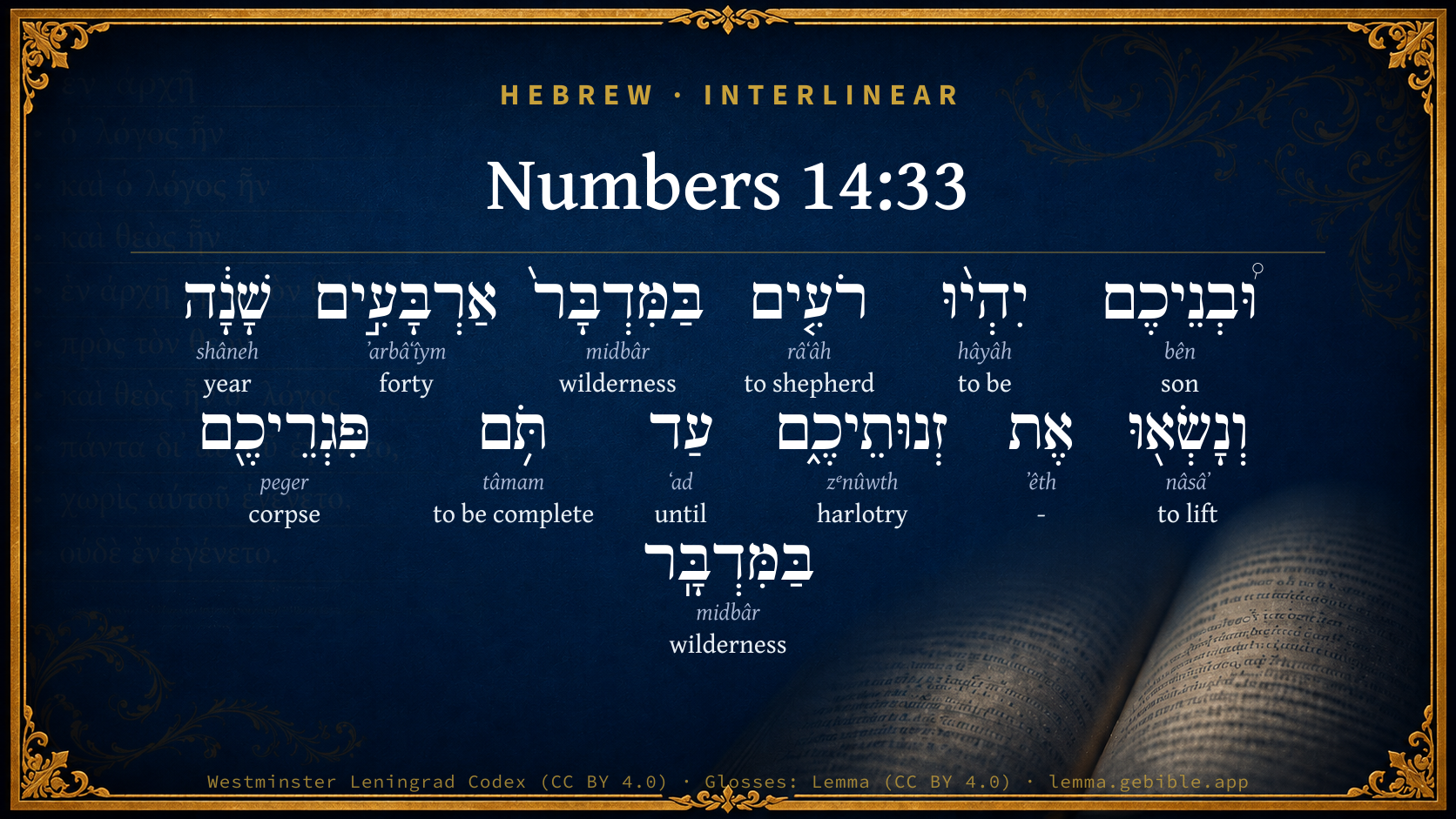
  1. וּ֠בְנֵיכֶם bên H1121 “and · sons · your” Conjunction + Noun, Common, Masculine, Plural, Construct + Suffix, Personal, 2nd Person, Masculine, Plural
  2. יִהְי֨וּ hâyâh H1961 “to be” Verb, Qal, Imperfect, 3rd Person, Masculine, Plural
  3. רֹעִ֤ים râʻâh H7462 “shepherding” Verb, Qal, Participle Active, Masculine, Plural, Absolute
  4. בַּמִּדְבָּר֙ midbâr H4057 “in/at the · wilderness” Preposition, Determined + Noun, Common, Masculine, Singular, Absolute
  5. אַרְבָּעִ֣ים ʼarbâʻîym H705 “forty” Adjective, Cardinal number, Both, Plural, Absolute
  6. שָׁנָ֔ה shâneh H8141 “year” Noun, Common, Feminine, Singular, Absolute
  7. וְנָשְׂא֖וּ nâsâʼ H5375 “and · to lift” Conjunction + Verb, Qal, Sequential Perfect, 3rd Person, Common, Plural
  8. אֶת ʼêth H853 “-” Particle, Direct Object
  9. עַד ʻad H5704 “until” Preposition
  10. תֹּ֥ם tâmam H8552 “to be complete” Verb, Qal, Infinitive Construct
  11. פִּגְרֵיכֶ֖ם peger H6297 “corpses · your” Noun, Common, Masculine, Plural, Construct + Suffix, Personal, 2nd Person, Masculine, Plural
  12. בַּמִּדְבָּֽר midbâr H4057 “in/at the · wilderness” Preposition, Determined + Noun, Common, Masculine, Singular, Absolute

About this verse

These counts appear in no published source. They are computed here, from the morphology-tagged text and Lemma’s own curated glosses. What Lemma adds →

13
words
12
distinct lemmas
Pentateuch
section

Notable vocabulary

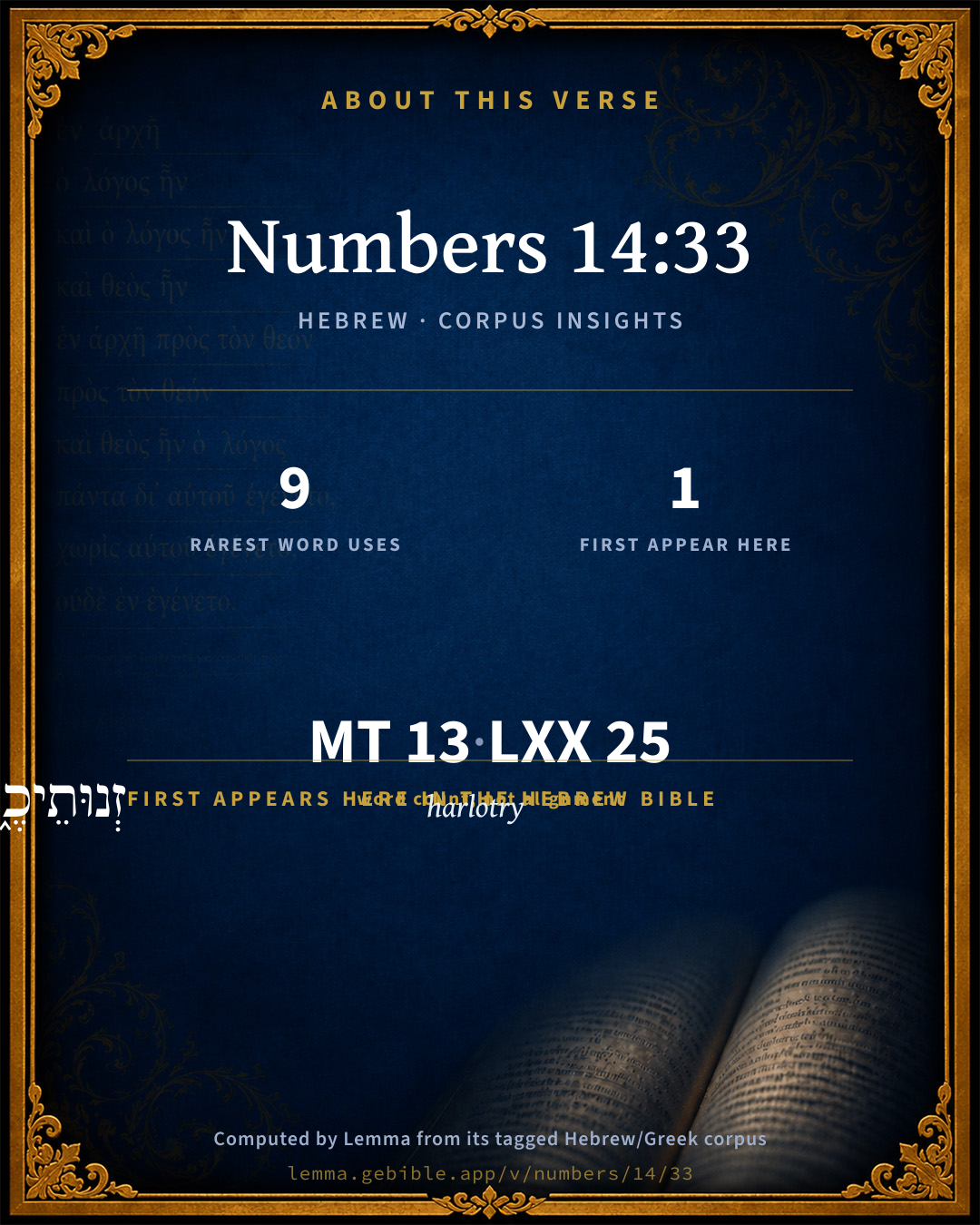
The rarest word here is זְנוּתֵיכֶ֑ם harlotry H2184 — appearing just 9 times in the whole Hebrew Bible.

First appearance in Scripture

This word makes its first canonical appearance in the Hebrew Bible here:

  • זְנוּתֵיכֶ֑ם harlotry H2184

Shared distinctive vocabulary

זְנוּתֵיכֶ֑ם harlotry H2184 occurs in 9 verses of the Hebrew Bible. Also found in:

Grammatical profile

  • 4 verbs
  • 6 nouns
  • 1 adjective
  • 1 preposition
  • 1 particle

Verb forms

  • יִהְי֨וּ Qal · Imperfect
  • רֹעִ֤ים Qal · Participle Active
  • וְנָשְׂא֖וּ Qal · Sequential Perfect
  • תֹּ֥ם Qal · Infinitive Construct

Repetition

A word recurs within this verse — often emphatic in Hebrew:

  • בַּמִּדְבָּר֙ wilderness H4057 ×2

Hebrew & Septuagint length

In English translation the verse runs 24 words from the Hebrew and 25 from the Septuagint (LXX English) — closely comparable.

A rough comparison of the two English renderings, which tokenize alike — not a word-level alignment.

Word counts can differ between the Hebrew and the Greek without any difference in meaning — e.g. the Hebrew direct-object marker אֵת has no separate Greek word, and Greek often adds the article ὁ.

In the original languages it is 13 Hebrew tokens and 25 Greek tokens — but the two are counted differently (Hebrew bundles its prefixes and suffixes into one token; the Greek is in lemma form), so that isn’t a like-for-like length.

Cross-references

12

Topical passages linked to Numbers 14:33 in the Treasury of Scripture Knowledge — connected by theme and wording, ordered by reader-vote popularity; previews shown in the World English Bible.

  • Numbers 32:13 Yahweh's anger was kindled against Israel, and he made them wander back and forth in the wilderness forty years, until all the generation, who had done evil in the sight of Yahweh, was consumed.
  • Ezekiel 23:35 Therefore thus says the Lord Yahweh: Because you have forgotten me, and cast me behind your back, therefore bear you also your lewdness and your prostitution.
  • Deuteronomy 2:14 The days in which we came from Kadesh-barnea, until we were come over the brook Zered, were thirty-eight years; until all the generation of the men of war were consumed from the midst of the camp, as Yahweh swore to them.
  • Psalms 107:40 He pours contempt on princes, And causes them to wander in a trackless waste.
  • Numbers 5:31 The man shall be free from iniquity, and that woman shall bear her iniquity."
  • Numbers 33:38 Aaron the priest went up into Mount Hor at the commandment of Yahweh, and died there, in the fortieth year after the children of Israel were come out of the land of Egypt, in the fifth month, on the first day of the month.
  • Deuteronomy 1:3 It happened in the fortieth year, in the eleventh month, on the first day of the month, that Moses spoke to the children of Israel, according to all that Yahweh had given him in commandment to them;
  • Joshua 14:10 Now, behold, Yahweh has kept me alive, as he spoke, these forty-five years, from the time that Yahweh spoke this word to Moses, while Israel walked in the wilderness: and now, behold, I am this day eighty-five years old.
  • Psalms 107:4 They wandered in the wilderness in a desert way. They found no city to live in.
  • Jeremiah 3:1–2 They say, If a man put away his wife, and she go from him, and become another man's, will he return to her again? Won't that land be greatly polluted? But you have played the prostitute with many lovers; yet return again to me, says Yahweh.
  • Ezekiel 23:45–49 Righteous men, they shall judge them with the judgment of adulteresses, and with the judgment of women who shed blood; because they are adulteresses, and blood is in their hands.
  • Hosea 9:1 Don't rejoice, Israel, to jubilation like the nations; For you were unfaithful to your God. You love the wages of a prostitute at every grain threshing floor.

Cross-references courtesy of OpenBible.info (CC BY 4.0).

Hebrew and Greek witnesses Masoretic Hebrew ↔ Greek Septuagint

The same verse in the two great witnesses to the Old Testament, shown verse-for-verse.

These are two independent witnesses, not word-aligned to each other, and the Septuagint is shown in lemma (dictionary) form.

Hebrew Numbers 14:33 Masoretic · Westminster Leningrad Codex

וּ֠בְנֵיכֶם יִהְי֨וּ רֹעִ֤ים בַּמִּדְבָּר֙ אַרְבָּעִ֣ים שָׁנָ֔ה וְנָשְׂא֖וּ אֶת זְנוּתֵיכֶ֑ם עַד תֹּ֥ם פִּגְרֵיכֶ֖ם בַּמִּדְבָּֽר

Your children shall be wanderers in the wilderness forty years, and shall bear your prostitution, until your dead bodies be consumed in the wilderness.

World English Bible · Public Domain

Greek LXX Numbers 14:33 Septuagint · lemma form

ὁ δέ υἱός σύ εἰμί νέμω ἐν ὁ ἔρημος τεσσαράκοντα ἔτος καί ἀναφέρω ὁ πορνεία σύ ἕως ἄν ἀναἁλίσκω ὁ κῶλον σύ ἐν ὁ ἔρημος

And your sons shall be fed in the wilderness forty years, and they shall bear your fornication, until your carcasses be consumed in the wilderness.

LXX2012 (modern English Septuagint) · Public Domain

On this verse, John Gill's Exposition discusses the Septuagint’s reading. Read the note in Commentary ↓

Hebrew: Westminster Leningrad Codex (CC BY 4.0). Greek: Septuagint (public domain); English from LXX2012 (modern English Septuagint) (Public Domain). How the Septuagint differs from the Hebrew →

Targum (Aramaic paraphrase)

2

The Targum is the ancient Jewish Aramaic paraphrase of the Hebrew Scriptures — an interpretive translation, not the Hebrew text itself. Onkelos (literal) and Pseudo-Jonathan (expansive) render the Torah, and Jonathan the Prophets. Coverage is partial: where no permissively-licensed English translation exists for a verse, only the Aramaic is shown. This is verse-level text, not a word-by-word alignment to the Hebrew.

  1. Targum Onkelos Torah (Genesis–Deuteronomy)
    וּבְנֵיכוֹן יְהוֹן מְאַחֲרִין בְּמַדְבְּרָא אַרְבְּעִין שְׁנִין וִיקַבְּלוּן יָת חוֹבֵיכוֹן עַד דִיסוּפוּן פִגְרֵיכוֹן בְּמַדְבְּרָא

    (no public-domain English translation for this verse)

    Targum Onkelos — Aramaic: “Onkelos Genesis” (public domain); “Onkelos Exodus” (public domain); “Onkelos Leviticus” (public domain); “Onkelos Numbers” (public domain); “Onkelos Deuteronomy” (public domain). English: “Sefaria Community Translation” (CC0 1.0 (public-domain dedication)); “J.W. Etheridge. The Targums of Onkelos and Jonathan Ben Uzziel on the Pentateuch. London: Longmans, Green, 1862” (public domain). Text via Sefaria.

  2. Targum Pseudo-Jonathan Torah (Genesis–Deuteronomy)
    וּבְנֵיכוֹן יְהוֹן טַעֲיָין בְּמַדְבְּרָא אַרְבְּעִין שְׁנִין וִיקַבְּלוּן יַת חוֹבֵיכוֹן עַד זְמַן דִיסוּפוּן פִּגְרֵיכוֹן בְּמַדְבְּרָא

    Yet your children will have to wander in this wilderness forty years, and bear your sins until the time that your carcasses are consumed in the wilderness.

    Targum Pseudo-Jonathan — Aramaic: “Targum Jonathan on Genesis” (public domain); “Targum Jonathan on Exodus” (public domain); “Targum Jonathan on Leviticus” (public domain); “Targum Jonathan on Numbers” (public domain); “Targum Jonathan on Deuteronomy” (public domain). English: “The Targum of Jonathan ben Uzziel, trans. J. W. Etheridge, London, 1862” (public domain). Text via Sefaria.

Commentary

Notes on Numbers 14:33 from classic Christian and Jewish commentators (each source and its license shown beneath its notes). The classic Christian expositions comment on the surrounding passage and are grouped to its opening verse, so a note may address several verses; the Jewish commentaries on the Tanakh (Rashi and others) are per-verse, so they appear only where the commentator wrote on this verse.

Lemma curates 59 commentaries, every one of them public domain or Creative Commons licensed, each selected and text-cleaned for this edition rather than reprinted as found. About our sources →

The Biblical Illustrator

Joseph S. Exell

Num_14:33-34

Each day for a year, shall ye bear your iniquities.

God often punishes sin proportionably

God oftentimes punisheth in proportion, so that the judgment is answerable to the sin. Of what kind the sin is, of the same kind is the punishment (Gen_42:21). God sent upon Sodom a punishment like to the nature of their sin; they burned in unclean and unnatural lust one toward another, and the Lord sent fire from heaven to burn them up.

1. God hath many ways to punish sin, yet it pleaseth Him to send His punishments according to our sins, thereby to strike us with inward remorse and to work a deeper impression in the conscience. For when He punisheth after this manner rather than after any other, the judgment itself doth more effectually force the sufferer to acknowledge Gods justice in plaguing of Him in that sort.

2. This maketh men not only to justify God, whose, judgments are always just, but maketh them also to judge themselves, and thereby they oftentimes prevent the more heavy judgments of God.

3. God hath given a law, and by the law He requireth a proportionable punishment for sin (Lev_24:19). This course will the Lord take (who is the supreme Magistrate) so often as it pleaseth Him, albeit He do not tie Himself to that law.

Uses:

1. This serveth to warrant us that we may lawfully expect judgment from God in proportion upon men for their sins. For the which hath been, may be; and that which the Lord hath done, He will certainly do it again, so that we may promise and persuade ourselves that they shall in the end be paid home to the full, with due proportion of punishment according to their sins.

2. Whensoever we remain under any judgment of Gods hand, let us labour for spiritual wisdom, that we may discern what the sin is which is the cause thereof. For by the manner of the judgment we may oftentimes find out the manner of our sin. This way we shall make the punishment profitable unto us, if we take it and lay it unto the sin, as it were a salve upon the sore. It will work in us a care to judge ourselves, that we be not judged of the Lord (1Co_11:31-32).

3. As God dealeth with men in regard to their sins, so He dealeth oftentimes with His children in good things and for good things. He will reward according to our deeds, blessing with the same blessing, and mercy with the same mercy (2Ti_1:18). (W. Attersoll.)

The Biblical Illustrator, edited by Joseph S. Exell (c. 1880s–1900s) — public domain. Text from a community e-Sword module.

Joseph Benson's Commentary

Num 14:33. Shall wander in the wilderness — Hebrew, יהיו רעים, Jehju rognim, shall feed, shall seek their food from place to place, after the manner of the Arabian shepherds, that were forced to remove their tents from one place to another, that they might find pasture for their flocks. Forty years — Reckoning from the time of their first coming out of Egypt into the wilderness, where they had already wandered a year and a half. And bear your whoredoms — The punishment of your whoredoms, that is, of your idolatries, of your apostacy from, and perfidiousness against the Lord, who was your husband, having espoused you to himself by covenant. Idolatry and apostacy from God’s worship are continually represented under the idea of whoredom in the Scripture. And it appears from Amo 5:25-26, that the Israelites were every now and then falling off to this sin during the whole period of these forty years in the wilderness.

Joseph Benson's Commentary on the Old and New Testaments (1811–1818) — public domain. Text from a community e-Sword module.

Geneva Bible (1599)

Geneva Bible translators

Your infidelity and disobedience against God.

The word signifieth to be shepherds, or to wander like shepherds to and fro.

Geneva Bible (1599) marginal notes — public domain. Text via Bolls.life.

Ellicott's Commentary for English Readers

(33) And your children shall wander.—Better, shall be shepherds, or, shall feed their flocks.

Forty years.—The forty years were reckoned from the exodus, not from the return of the spies to Kadesh. (See Num_14:34 and Note.)

And bear your whoredoms.—The children were doomed to bear the penalty of their fathers’ apostasy. (Comp. Exo_34:16.)

A Bible Commentary for English Readers, edited by Charles John Ellicott (1878–1897) — public domain. Text from a community e-Sword module.

The Cambridge Bible for Schools and Colleges

gen. ed. J. J. S. Perowne

33. your children shall be shepherds] as R.V. marg. They were to continue to rove about with their flocks, instead of settling down to agricultural life in Canaan. The rendering ‘wanderers’ is due to the Vulg. vagi.

and shall bear your whoredoms] Your children, though they will not die in the wilderness, must suffer for your unfaithfulness to God. The metaphor of whoredom, the action of a woman who deserts her husband for another, is frequently applied to Israel. By defiant unbelief (as here), or by the worship of foreign gods (as Hos_2:7; Hos_9:1), or by foreign alliances (as Eze_16:26; Eze_23:1-35), she proved, time after time, unfaithful to Jehovah.

The Cambridge Bible for Schools and Colleges (gen. ed. J. J. S. Perowne; Cambridge University Press, 1878–1918) — public domain. Text from a community e-Sword module.

John Gill's Exposition

After the number of days in which ye searched the land,

even forty days,.... For so long they were searching it, Num 13:25,

each day for a year; reckoning each day for a year, forty days for forty years, as in Eze 4:6,

shall ye bear your iniquities, even forty years: which number is given, being a round one, otherwise it was but thirty eight years and a half ere they were all cut off, and their children entered the land:

and ye shall know my breach of promise; God never makes any breach of promise; his covenant he will not break, nor alter what is gone out of his lips; men break their promises, and transgress the covenant they have made with him, but he never breaks his, Psa 89:34; this should rather be rendered only, "ye shall know my breach"; experience a breach made upon them by him, upon their persons and families by consuming them in the wilderness: the Targum of Jonathan is,"and ye shall know what ye have murmured against me;''this same word is used in the plural in Job 33:10, and is by the Targum rendered "murmurings" or "complaints"; and so the sense is, ye shall know by sad experience the evil of complaining and murmuring against me. The Vulgate Latin version is,"ye shall know my vengeance;''and so the Septuagint,"ye shall know the fury of my anger''which give the sense, though not a literal version of the words.

John Gill's Exposition of the Whole Bible (1746–1763) — public domain (CC PDM 1.0). Text via the HelloAO Bible API.

Albert Barnes' Notes on the Bible

Your whoredoms - Their several rebellions had been so many acts of faithless departure from the Lord who had taken them unto Himself. And as the children of the unchaste have generally to bear in their earthly careers much of the disgrace and the misery which forms the natural penalty of their parents’ transgression; so here the children of the Israelites, although suffered to hope for an eventual entry into Canaan, were yet to endure, through many long years’ wandering, the appropriate punishment of their fathers’ willfulness.

Albert Barnes' Notes on the Bible (1834–1885) — public domain. Text from a community e-Sword/MySword module.

Haydock's Catholic Bible Commentary

Years. Within five days from the departure out of Egypt, (Menochius) and above 38 from this time. Hebrew, "they shall be shepherds," without any fixed dwelling, like the shepherds of that country. --- Consumed. They had complained that Chanaan consumed and devoured its inhabitants. (Calmet) --- Their children underwent a temporal, but salutary, punishment for their sin. (St. Augustine, ep. 75.) (Worthington)

George Leo Haydock (1774–1849), Haydock's Catholic Family Bible and Commentary, 1859 edition — public domain. Excludes Psalms (Douay-Rheims chapter numbering differs from Protestant) and Deuterocanonical books (Catholic canon only).

Matthew Poole's English Annotations

Wander, like sheep, feeding in the deserts; or shall be shepherds, i.e. shall live like the shepherds of Arabia, in tents, and removing from place to place, having no certain dwelling.

Forty years, i.e. so long as to make up the time of your dwelling in the wilderness forty years, as appears from Num 33:8; Deu 1:3 2:14. Compare Amo 5:25. It is manifest that one whole year and part of another were past before this sin or judgment.

Your whoredoms, i.e. the punishment of your whoredoms, to wit, of your apostacy from, and perfidiousness against, your Lord, who was your Husband, and had married you to himself. See Jer 3:14. Whence idolatry is called whoredom.

Matthew Poole's English Annotations on the Holy Bible (1683–1685) — public domain. Text from a community e-Sword/MySword module.

Whedon's Commentary on the Bible

Daniel D. Whedon

33. Bear your whoredoms — Disobedience to God is in the Scriptures often expressed as infidelity to the marriage vow. The highest ideal of spiritual life is that of the bride’s heart-surrender in marriage. The Bible is full of this aspect of consecration, and of warning against the loathsomeness of divided affections. See Lev_17:7; Jdg_2:17, notes. It is one thing for the innocent to bear the natural consequences of others’ guilt, and quite a different thing to bear their punishment. See Exo_20:5; Num_14:18, notes.

Daniel D. Whedon (gen. ed.), Commentary on the Old and New Testaments (1874–1909) — public domain. Text from a community e-Sword module.

The Pulpit Commentary

Your children shall wander. Literally, "shall pasture." Septuagint, esontai nemomenoi . It was not altogether a threat, for it implied that the Lord would be their Shepherd and would provide for their wants in their wanderings. Forty years. This period was made up by counting in the year and a half since the exodus. It was one of those many cases in which the word of God was fulfilled in the meaning and substance of it, but not in the letter. The delay which had already occurred was itself practically due to the same spirit of mutiny which had grown to a head at Kadesh; it was therefore strictly equitable to count it as part of the punishment inflicted. (see on Deu_2:14) And bear your whoredoms. "Whoredom" had been already used (Exo_34:16) as a synonym for idolatry in its aspect of spiritual unfaithfulness, and there is no reason to depart from that well-marked meaning here. That the Jews were guilty of idolatry in the wilderness is distinctly asserted; (cf. Act_7:42, Act_7:43) and these idolatrous practices, carried on no doubt in secret, must have been a sore trial to the generation which grew up amidst them. (cf. Jos_24:14, Jos_24:23)

The Pulpit Commentary (1880–1919), ed. H.D.M. Spence-Jones & Joseph S. Exell — public domain. Text from a community e-Sword module.

John Wesley's Explanatory Notes

Forty years - So long as to make up the time of your dwelling in the wilderness forty years; one whole year and part of another were past before this sin or judgment. Your whoredoms - The punishment of your whoredoms, of your apostacy from, and perfidiousness against your Lord, who was your husband, and had married you to himself.

John Wesley, Explanatory Notes Upon the Whole Bible (1754–1765) — public domain. Text via the GEBible commentary corpus.

Rashi

Rabbi Shlomo Yitzchaki (Rashi)

ארבעים שנה [AND YOUR CHILDREN SHALL WANDER IN THE DESERT] FORTY YEARS — None of them was to die younger than 60 years old (Bava Batra 121b). For this reason a period of forty years was decreed for their wanderings in order that those who were at that time 20 years old (and only those from twenty years old and upwards came under this decree; cf. v. 29) should reach the age of sixty (the average age of man; cf. Moed Katan 28a and Tosefta Yoma 4:10. s. v. ומיתה). The first year that they were in the wilderness was included in the forty although it preceded the sending forth of the spies (which took place in the second year), because from the moment they made the Golden Calf this decree entered the mind of God, but He waited for them (postponed their punishment) until their measure of sin should be full. This is the meaning of what is stated, (Exodus 32:34) “And in the day when I shall visit — viz., at the incident of the spies — I shall visit their sin (that of the Golden Calf) upon them”. And, here, indeed, it states, (v. 34) “ye shall bear your iniquities” (in the plural) suggesting two sins; that of the Calf and that of the murmuring. — In the calculation it (Scripture) regards in the years of their lives a part of the year (of the sixtieth year) as the whole of it, and as soon as they entered their sixtieth year those who were now twenty years old died (Tanchuma 4:4:13).

ונשאו את זנותיכם AND SHALL BEAR YOUR WHOREDOMS — Understand this as the Targum does: and they shall bear your guilt (cf. Targum on ונשא את עונה, Numbers 30:16, and Rashi on that verse).

Rashi on the Tanakh — English translations: “The Judaica Press complete Tanach with Rashi, translated by A. J. Rosenberg” (CC BY 4.0); “Pentateuch with Rashi's commentary by M. Rosenbaum and A.M. Silbermann, 1929-1934” (public domain); “The Metsudah Tanach series, Lakewood, N.J” (CC BY 4.0); and “The Book of Joshua, Metsudah Publications, 1997” (CC BY 4.0). Text via Sefaria.

Lesson kit

Teaching starters — assembled from the data on this page, not authored interpretation. Every prompt links to the verse data it draws on. Edit before teaching.

Numbers, in the Pentateuch, opens this verse with 13 words (12 distinct Hebrew lemmas). Its most distinctive word is zᵉnûwth (“harlotry”). A historical commentator’s framing appears above. Read the whole chapter for the surrounding context.

Discussion questions

  1. The word zᵉnûwth carries the sense “harlotry.” How does it shape the verse?
  2. This is the first place “harlotry” appears in Scripture (first appears here). What does its debut here establish?
  3. How does Jeremiah 3:2, which shares the word «harlotry», read alongside this verse?
  4. What does the repetition of “wilderness” (2× in this one verse) do in this verse?
  5. These translations render this verse differently. What is at stake in choosing one wording over another?
  6. «יִהְי֨וּ» is a Qal Imperfect verb. How does that grammatical form shape the action described?
  7. Compare how The Biblical Illustrator and Joseph Benson's Commentary read this verse. Where do they agree or differ?

Things to notice

Reading settings

Reading text

Shown beneath each verse's original-language words.

Old Testament
Old Testament edition

Read the OT as the Masoretic Hebrew (MT) or the Greek Septuagint (LXX).

English shown for the Greek Septuagint (in the Hebrew ↔ Greek comparison).

Comparing translations? Open the Compare panel on any verse page to stack up to four side by side.