
Ezekiel 34:15

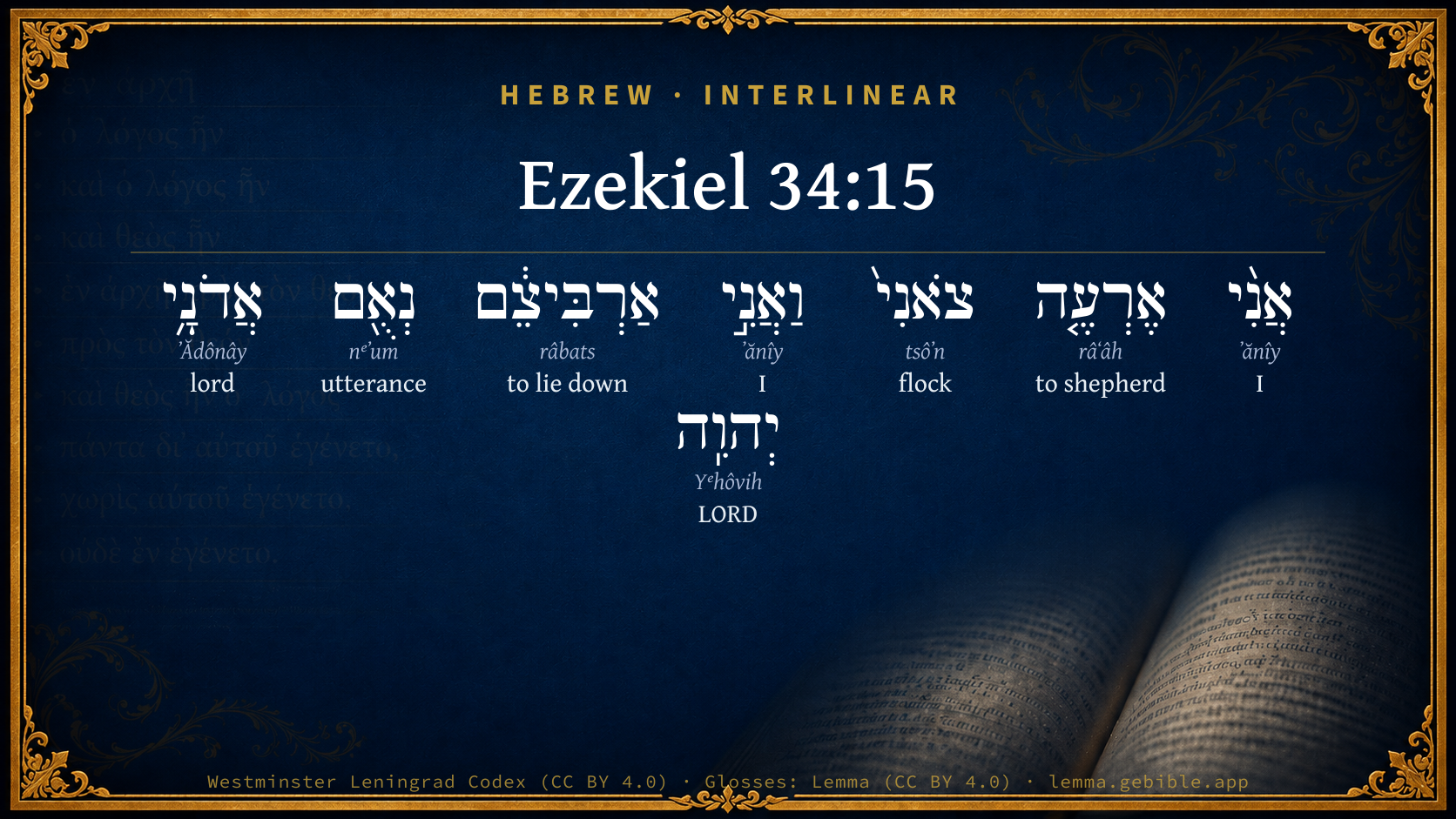
Hebrew (Westminster Leningrad Codex) Ezekiel 34:15 appears in the Hebrew Old Testament. The text above is from the Westminster Leningrad Codex. Each word links to its Strong’s number, a concise gloss, and parsing drawn from the Open Scriptures Hebrew Bible morphology. Click any word for its full Brown-Driver-Briggs (BDB) entry.
Download image
Cite this verse

Ezekiel 34:15 (World English Bible). Public Domain. Lemma interlinear Bible study tool, https://lemma.gebible.app/v/ezekiel/34/15.

Show BibTeX & RIS
BibTeX
RIS
English Translation
I myself will be the shepherd of my sheep, and I will cause them to lie down, says the Lord Yahweh.
World English Bible · Public Domain
Download a study sheet

One document with this verse’s original text, its word-by-word gloss line, the meaning frame, cross-references with their text, attributed commentary, and full source and license credits — printable, and it pastes into notes with its structure intact.

This verse Autodidact and up

Study sheet (.html) Plain text (.txt)

A passage Seminary Student

Up to 50 verses in one chapter. A passage sheet keeps up to 6 commentary sources and 12 cross-references per verse, in the order this page ranks them, and says so on the sheet whenever that leaves anything out. Ask for a single verse and you get the Autodidact verse sheet above.

Everything on this page stays free to read, with no account — the sheet is a download of what is already on screen, not access to it.

Want to remove ads? Support Godless Engineer
Compare translations 3

The same verse in 3 English versions, stacked beneath the original-language interlinear above. Click any original word for its lexicon entry.

Each is an independent rendering of the whole verse — the interlinear is not word-aligned to these translations.

Highlighted words mark where these versions differ — a whole-verse word diff, not a word-by-word alignment.

  • World English Bible Public Domain
    I myself will be the shepherd of my sheep, and I will cause them to lie down, says the Lord Yahweh.
  • King James Version Public Domain
    I will feed my flock, and I will cause them to lie down, saith the Lord GOD.
  • unfoldingWord Literal Text CC BY-SA 4.0
    I myself will shepherd my flock, and I myself will make them lie down—this is the Lord Yahweh’s declaration—

unfoldingWord Literal Text — © unfoldingWord, licensed CC BY-SA 4.0. Word-aligned USFM3 via Door43 (git.door43.org/unfoldingWord/en_ult).

Versions to compare (up to 4)

3 of 4 selected

Show all 18 translations

Every available English version of this verse, each an independent rendering of the whole verse.

  • World English Bible Public Domain
    I myself will be the shepherd of my sheep, and I will cause them to lie down, says the Lord Yahweh.
  • Berean Standard Bible Public Domain
    I will tend My flock and make them lie down, declares the Lord GOD.
  • Majority Standard Bible Public Domain
    I will tend My flock and make them lie down, declares the Lord GOD.
  • King James Version Public Domain
    I will feed my flock, and I will cause them to lie down, saith the Lord GOD.
  • American Standard Version (1901) Public Domain
    I myself will be the shepherd of my sheep, and I will cause them to lie down, saith the Lord Jehovah.
  • Revised Version (1885) Public Domain
    I myself will feed my sheep, and I will cause them to lie down, saith the Lord GOD.
  • Geneva Bible (1599) Public Domain
    I will feede my sheepe, and bring them to their rest, sayth the Lord God.
  • Douay-Rheims (1899) Public Domain
    I will feed my sheep: and I will cause them to lie down, saith the Lord God.
  • Young's Literal Translation Public Domain
    I feed My flock, and cause them to lie down, An affirmation of the Lord Jehovah.
  • Literal Standard Version CC BY-SA 4.0
    I feed My flock, and cause them to lie down, || A declaration of Lord YHWH.
  • Unlocked Literal Bible CC BY-SA 4.0
    I myself will shepherd my flock, and I myself will make them lie down—this is the Lord Yahweh's declaration—
  • unfoldingWord Literal Text CC BY-SA 4.0
    I myself will shepherd my flock, and I myself will make them lie down—this is the Lord Yahweh’s declaration—
  • Darby Bible Public Domain
    I will myself feed my flock, and I will cause them to lie down, saith the Lord Jehovah.
  • World Messianic Bible Public Domain
    I myself will be the shepherd of my sheep, and I will cause them to lie down,” says the Lord GOD.
  • Webster's Bible Public Domain
    I will feed my flock, and I will cause them to lie down, saith the Lord GOD.
  • Free Bible Version CC BY-SA 4.0
    I myself will look after my sheep and give them a place to rest, declares the Lord God.
  • Bible in Basic English Public Domain
    I myself will give food to my flock, and I will give them rest, says the Lord.
  • JPS Tanakh (1917) Public Domain
    I will feed My sheep, and I will cause them to lie down, saith the Lord GOD.

Literal Standard Version (2020), Covenant Press — licensed CC BY-SA 4.0. Text via the HelloAO Bible API (eBible.org). Unlocked Literal Bible (unfoldingWord) — licensed CC BY-SA 4.0. Text via the HelloAO Bible API (eBible.org). unfoldingWord Literal Text — © unfoldingWord, licensed CC BY-SA 4.0. Word-aligned USFM3 via Door43 (git.door43.org/unfoldingWord/en_ult). Free Bible Version, Dr. Jonathan Gallagher — licensed CC BY-SA 4.0. Text via the HelloAO Bible API (eBible.org).

Word by word

More ways to search: Search by grammar → Find every occurrence → Compare this word →

Practice this passage: Drill this verse → Learn its vocabulary →

אַרְבִּיצֵ֔ם
râbats
H7257
“to lie down · them”
Verb, Hiphil, Imperfect, 1st Person, Common, Singular + Suffix, Personal, 3rd Person, Masculine, Plural
Part of Speech
Verb
Stem
Hiphil
Form
Imperfect
Person
1st Person
Gender
Common
Number
Singular
Full BDB Definition

Origin: a primitive root

TWOT: 2109

to stretch oneself out, lie down, lie stretched out - (Qal) to lie down, lie - (Hiphil) to cause to lie down - laying (stones)
  1. אֲנִ֨י ʼănîy H589 “I” Pronoun, Personal, 1st Person, Common, Singular
  2. אֶרְעֶ֤ה râʻâh H7462 “to shepherd” Verb, Qal, Imperfect, 1st Person, Common, Singular
  3. צֹאנִי֙ tsôʼn H6629 “flock · my” Noun, Common, Both, Singular, Construct + Suffix, Personal, 1st Person, Common, Singular
  4. וַאֲנִ֣י ʼănîy H589 “and · I” Conjunction + Pronoun, Personal, 1st Person, Common, Singular
  5. נְאֻ֖ם nᵉʼum H5002 “utterance of” Noun, Common, Masculine, Singular, Construct
  6. אֲדֹנָ֥י ʼĂdônây H136 “Lord · my” Noun, Common, Masculine, Plural, Construct + Suffix, Personal, 1st Person, Common, Singular
  7. יְהוִֽה Yᵉhôvih H3069 “LORD” Noun, Proper

About this verse

These counts appear in no published source. They are computed here, from the morphology-tagged text and Lemma’s own curated glosses. What Lemma adds →

8
words
7
distinct lemmas
Prophets
section

Shared distinctive vocabulary

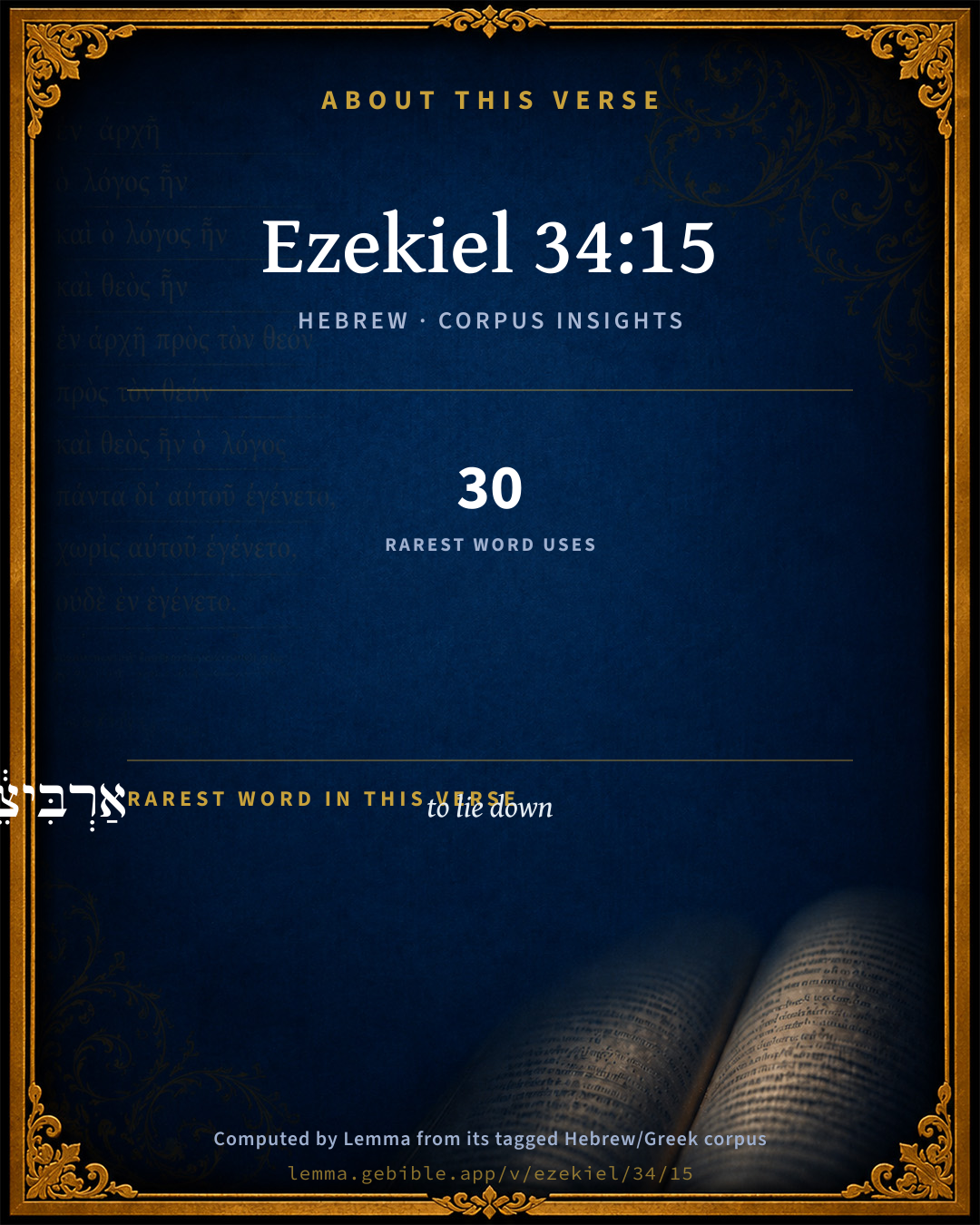
אַרְבִּיצֵ֔ם to lie down H7257 occurs in 30 verses of the Hebrew Bible. Also found in:

Grammatical profile

  • 2 verbs
  • 4 nouns
  • 2 pronouns

Verb forms

  • אֶרְעֶ֤ה Qal · Imperfect
  • אַרְבִּיצֵ֔ם Hiphil · Imperfect

Repetition

A word recurs within this verse — often emphatic in Hebrew:

  • אֲנִ֨י I H589 ×2

Hebrew & Septuagint length

In English translation the verse runs 21 words from the Hebrew and 26 from the Septuagint (LXX English) — closely comparable.

A rough comparison of the two English renderings, which tokenize alike — not a word-level alignment.

Word counts can differ between the Hebrew and the Greek without any difference in meaning — e.g. the Hebrew direct-object marker אֵת has no separate Greek word, and Greek often adds the article ὁ.

Cross-references

10

Topical passages linked to Ezekiel 34:15 in the Treasury of Scripture Knowledge — connected by theme and wording, ordered by reader-vote popularity; previews shown in the World English Bible.

  • Psalms 23:1–2 Yahweh is my shepherd: I shall lack nothing.
  • Jeremiah 3:15 and I will give you shepherds according to my heart, who shall feed you with knowledge and understanding.
  • Ezekiel 34:23 I will set up one shepherd over them, and he shall feed them, even my servant David; he shall feed them, and he shall be their shepherd.
  • John 21:15 So when they had eaten their breakfast, Jesus said to Simon Peter, "Simon, son of Jonah, do you love me more than these?" He said to him, "Yes, Lord; you know that I have affection for you." He said to him, "Feed my lambs."
  • Isaiah 11:6–7 The wolf shall dwell with the lamb, and the leopard shall lie down with the kid; and the calf and the young lion and the fattened calf together; and a little child shall lead them.
  • Zephaniah 3:13 The remnant of Israel will not do iniquity, nor speak lies, neither will a deceitful tongue be found in their mouth, for they will feed and lie down, and no one will make them afraid."
  • Song of Solomon 1:7–8 Tell me, you whom my soul loves, Where you graze your flock, Where you rest them at noon; For why should I be as one who is veiled Beside the flocks of your companions? Lover
  • Isaiah 27:10 For the fortified city is solitary, a habitation deserted and forsaken, like the wilderness: there shall the calf feed, and there shall he lie down, and consume the branches of it.
  • Isaiah 65:9–10 I will bring forth a seed out of Jacob, and out of Judah an inheritor of my mountains; and my chosen shall inherit it, and my servants shall dwell there.
  • Hosea 2:18 In that day I will make a covenant for them with the animals of the field, And with the birds of the sky, And with the creeping things of the ground. I will break the bow, the sword, and the battle out of the land, And will make them lie down safely.

Cross-references courtesy of OpenBible.info (CC BY 4.0).

Hebrew and Greek witnesses Masoretic Hebrew ↔ Greek Septuagint

The same verse in the two great witnesses to the Old Testament, shown verse-for-verse.

These are two independent witnesses, not word-aligned to each other, and the Septuagint is shown in lemma (dictionary) form.

Hebrew Ezekiel 34:15 Masoretic · Westminster Leningrad Codex

אֲנִ֨י אֶרְעֶ֤ה צֹאנִי֙ וַאֲנִ֣י אַרְבִּיצֵ֔ם נְאֻ֖ם אֲדֹנָ֥י יְהוִֽה

I myself will be the shepherd of my sheep, and I will cause them to lie down, says the Lord Yahweh.

World English Bible · Public Domain

Greek LXX Ezekiel 34:15 Septuagint · lemma form

ἐγώ βόσκω ὁ πρόβατον ἐγώ καί ἐγώ ἀναπαύω αὐτός καί γιγνώσκω ὅτι ἐγώ εἰμί κύριος ὅδε λέγω κύριος κύριος

I will feed my sheep, and I will cause them to rest; and they shall know that I am the Lord: thus says the Lord God.

LXX2012 (modern English Septuagint) · Public Domain

On this verse, John Gill's Exposition discusses the Septuagint’s reading. Read the note in Commentary ↓

Hebrew: Westminster Leningrad Codex (CC BY 4.0). Greek: Septuagint (public domain); English from LXX2012 (modern English Septuagint) (Public Domain). How the Septuagint differs from the Hebrew →

Targum (Aramaic paraphrase)

1

The Targum is the ancient Jewish Aramaic paraphrase of the Hebrew Scriptures — an interpretive translation, not the Hebrew text itself. Onkelos (literal) and Pseudo-Jonathan (expansive) render the Torah, and Jonathan the Prophets. Coverage is partial: where no permissively-licensed English translation exists for a verse, only the Aramaic is shown. This is verse-level text, not a word-by-word alignment to the Hebrew.

  1. Targum Jonathan Prophets (Joshua–Malachi)
    אֲנָא אֲפַרְנֵס יַת עַמִי וַאֲנָא אַשְׁרִינוּן לְרוֹחֲצָן אֲמַר יְיָ אֱלֹהִים:

    (no public-domain English translation for this verse)

    Targum Jonathan — Aramaic: “Mikraot Gedolot” (public domain). English: “Sefaria Community Translation” (CC0 1.0 (public-domain dedication)); “London "Chaldee Paraphrase," 1871” (public domain). Text via Sefaria.

Commentary

Notes on Ezekiel 34:15 from classic Christian and Jewish commentators (each source and its license shown beneath its notes). The classic Christian expositions comment on the surrounding passage and are grouped to its opening verse, so a note may address several verses; the Jewish commentaries on the Tanakh (Rashi and others) are per-verse, so they appear only where the commentator wrote on this verse.

Lemma curates 59 commentaries, every one of them public domain or Creative Commons licensed, each selected and text-cleaned for this edition rather than reprinted as found. About our sources →

Trapp's Complete Commentary

John Trapp

Eze 34:15 I will feed my flock, and I will cause them to lie down, saith the Lord GOD.

Ver. 15. I will feed my flock.] Doing all the offices of a good shepherd for them, and charging mine undershepherds to do so too.

And I will cause them to lie down.] By giving rest to their souls, {Mat 11:28} together with many happy halcyons, that they may serve me without fear. {Luk 1:74}

John Trapp, A Commentary or Exposition upon All the Books of the Old and New Testament (1647–1656) — public domain. Text from a community e-Sword module.

John Gill's Exposition

And I will seek that which was lost,.... As all men are in Adam, and through his fall, and by their own actual transgressions; and so the elect of God among the rest; who are lost not with respect to God's knowledge of them, love to them, and care for them; but with respect to their knowledge of him, affection for him, and regard to his will, service, and glory; they are lost to themselves, they know not where they are, what is their state and condition, and how to get out of it; they cannot help themselves, nor can any other creature help them; and they see themselves to be in this lost and undone condition, when they are enlightened by the Spirit of God: but they are not irretrievably lost, for they are preserved in Christ Jesus; and he has been sent to seek and to save them; which he has done by redeeming them from sin, Satan, and the law; and, in the effectual calling, he goes after them, he sends his Gospel to them, and his Spirit unto them, and returns them to himself, the Shepherd and Bishop of souls; and whereas after this they go astray like lost sheep, he seeks and looks them up, and restores their souls, Psa 119:176,

and bring again that which was driven away; through the power and prevalence of unbelief, from holding fast to the head Christ, departing at least partially from the living God; from dealing by faith with his precious person, blood, and righteousness; and from the precious promises, as not belonging to them, and refusing to be comforted by them; but the Lord brings back such again, and causes them to believe: Thomas is a notorious instance of this, Joh 20:24, such also who are driven away through the force of Satan's temptations from the throne of grace; from the word and ordinances; and from private conversation with the saints, being hypocrites, as he suggests unto them; these the Lord brings back, by rebuking the tempter, and delivering out of his temptations: likewise such as are driven out of the right way of truth, and carried away with the error of the wicked, through the influence of bad pastors or false teachers, Jer 23:1, these will he restore again; for it is impossible the elect of God should be finally deceived: moreover, such as are driven away by the force of persecution, and scattered abroad, in God's due time have rest, and return to their folds again; see Jer 50:17,

and will bind up that which was broken; such who have broken hearts, broken with a sense of sin; made truly contrite by the Spirit and grace of God, through the word; which is a hammer to them, that breaks the rocky heart in pieces; to these the Lord has respect; their broken hearts are acceptable to him; he dwells with them, to revive them; he speaks and restores comforts to them; pours in oil and wine into their wounds, like the good Samaritan, and binds them up; see Psa 147:3 and such who have broken bones, who have fallen into sin to the breaking of their bones, to the destroying of their peace, joy, and comfort, as David, Peter, and others have done; he sets their broken bones, and restores the joys of his salvation; and causes the bones which were broken to rejoice; at the discoveries of his pardoning grace and mercy, Psa 51:8,

and will strengthen that which was sick; sick through sin, as all men are; sick of sin, as sensible sinners be; sickly and weak, and ready to die, as fallen professors, backsliders, are; sick of love, through want of the discoveries of it; long after them; cannot be easy without them, as Christ's spouse sometimes is; and sick for want of food, faint and languid for want of spiritual refreshment; as the persons were Christ had compassion on, being as sheep without a shepherd, Mat 9:36 each of these the Lord strengthens with the discoveries and applications of pardoning grace; with the flagons of his love, and apples of his promises; with the food of the Gospel, which strengthens men's hearts; and with grace out of his fulness, whereby they are strengthened against sin, snares, and temptations, and to exercise grace, and do the will of God:

but I will destroy the fat and the strong; that are full of themselves, lifted up with pride, conceited with their riches or righteousness, and despise others, whom they thrust with side and shoulder, and push with their horns, Eze 34:21. So the Targum interprets it of wicked men,

"and I will consume the ungodly and sinners;''

but the Septuagint, Vulgate Latin, Syriac, and Arabic versions, render it, "I will keep the fat and the strong"; in the plight and condition in which they are, and make them still stronger, and more fat and flourishing; so Jerom interprets it of saints and godly persons; and this agrees with the preceding clauses; only the original Hebrew text is against it, which does not admit of a various reading; and this rendering seems to arise in the Septuagint, the others follow, from the mistake of a similar letter: "I will feed them with judgment"; meaning either the whole flock, consisting of fat and lean cattle, making a distinction between them, Eze 34:17, feeding them with discretion, and judging them according to their deserts; or else the fat and the strong ones, by inflicting righteous vengeance on them, feeding them with wormwood and gall; or his own people and sheep only. So the Targum, "I will govern my people with judgment"; in righteousness, goodness, truth, and faithfulness.

John Gill's Exposition of the Whole Bible (1746–1763) — public domain (CC PDM 1.0). Text via the HelloAO Bible API.

Lesson kit

Teaching starters — assembled from the data on this page, not authored interpretation. Every prompt links to the verse data it draws on. Edit before teaching.

Ezekiel, in the Prophets, opens this verse with 8 words (7 distinct Hebrew lemmas). Its most distinctive word is râbats (“to lie down”). A historical commentator’s framing appears above. Read the whole chapter for the surrounding context.

Discussion questions

  1. The word râbats carries the sense “to lie down.” How does it shape the verse?
  2. Genesis 4:7 shares the word «to lie down» with this verse. How do the two illuminate each other?
  3. “I” occurs 2× in this one verse. What is the effect of the repetition?
  4. These translations render this verse differently. What is at stake in choosing one wording over another?
  5. The verb «אֶרְעֶ֤ה» is Qal Imperfect. How does its form color the action?
  6. Reading how Trapp's Complete Commentary and John Gill's Exposition read this verse, where do the two commentators agree and where do they part?

Things to notice

Reading settings

Reading text

Shown beneath each verse's original-language words.

Old Testament
Old Testament edition

Read the OT as the Masoretic Hebrew (MT) or the Greek Septuagint (LXX).

English shown for the Greek Septuagint (in the Hebrew ↔ Greek comparison).

Comparing translations? Open the Compare panel on any verse page to stack up to four side by side.