
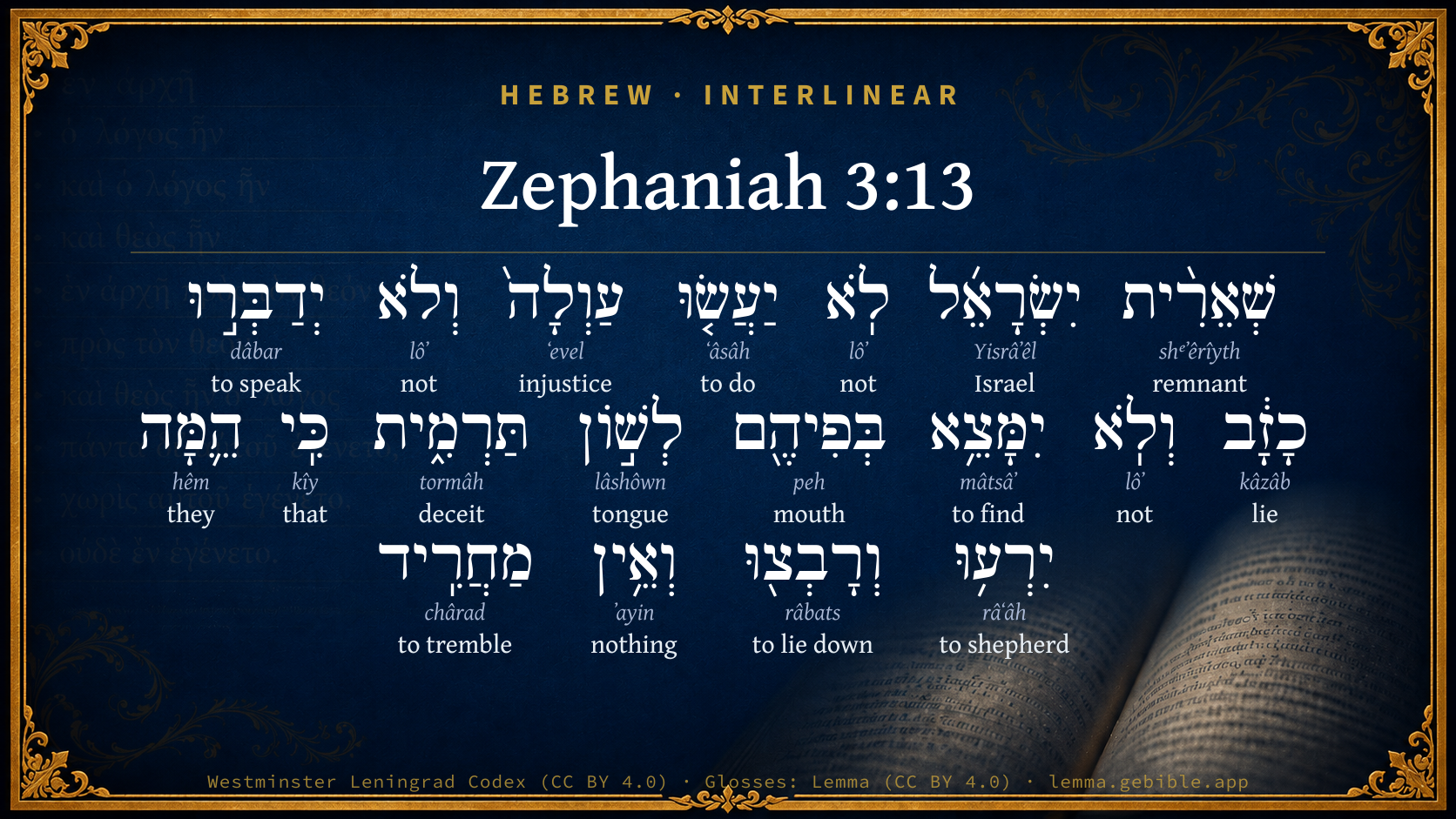
Zephaniah 3:13

Hebrew (Westminster Leningrad Codex) Zephaniah 3:13 appears in the Hebrew Old Testament. The text above is from the Westminster Leningrad Codex. Each word links to its Strong’s number, a concise gloss, and parsing drawn from the Open Scriptures Hebrew Bible morphology. Click any word for its full Brown-Driver-Briggs (BDB) entry.
Download image
Cite this verse

Zephaniah 3:13 (World English Bible). Public Domain. Lemma interlinear Bible study tool, https://lemma.gebible.app/v/zephaniah/3/13.

Show BibTeX & RIS
BibTeX
RIS
English Translation
The remnant of Israel will not do iniquity, nor speak lies, neither will a deceitful tongue be found in their mouth, for they will feed and lie down, and no one will make them afraid."
World English Bible · Public Domain
Download a study sheet

One document with this verse’s original text, its word-by-word gloss line, the meaning frame, cross-references with their text, attributed commentary, and full source and license credits — printable, and it pastes into notes with its structure intact.

This verse Autodidact and up

Study sheet (.html) Plain text (.txt)

A passage Seminary Student

Up to 50 verses in one chapter. A passage sheet keeps up to 6 commentary sources and 12 cross-references per verse, in the order this page ranks them, and says so on the sheet whenever that leaves anything out. Ask for a single verse and you get the Autodidact verse sheet above.

Everything on this page stays free to read, with no account — the sheet is a download of what is already on screen, not access to it.

Want to remove ads? Support Godless Engineer
Compare translations 3

The same verse in 3 English versions, stacked beneath the original-language interlinear above. Click any original word for its lexicon entry.

Each is an independent rendering of the whole verse — the interlinear is not word-aligned to these translations.

Highlighted words mark where these versions differ — a whole-verse word diff, not a word-by-word alignment.

  • World English Bible Public Domain
    The remnant of Israel will not do iniquity, nor speak lies, neither will a deceitful tongue be found in their mouth, for they will feed and lie down, and no one will make them afraid."
  • King James Version Public Domain
    The remnant of Israel shall not do iniquity, nor speak lies; neither shall a deceitful tongue be found in their mouth: for they shall feed and lie down, and none shall make them afraid.
  • unfoldingWord Literal Text CC BY-SA 4.0
    The remnant of Israel will not commit unrighteousness and they will not speak a lie, and a tongue of deceit will not be found in their mouth. But they will graze and lie down, and there will be none frightening.”

unfoldingWord Literal Text — © unfoldingWord, licensed CC BY-SA 4.0. Word-aligned USFM3 via Door43 (git.door43.org/unfoldingWord/en_ult).

Versions to compare (up to 4)

3 of 4 selected

Show all 18 translations

Every available English version of this verse, each an independent rendering of the whole verse.

  • World English Bible Public Domain
    The remnant of Israel will not do iniquity, nor speak lies, neither will a deceitful tongue be found in their mouth, for they will feed and lie down, and no one will make them afraid."
  • Berean Standard Bible Public Domain
    The remnant of Israel will no longer do wrong or speak lies, nor will a deceitful tongue be found in their mouths. But they will feed and lie down, with no one to make them tremble.”
  • Majority Standard Bible Public Domain
    The remnant of Israel will no longer do wrong or speak lies, nor will a deceitful tongue be found in their mouths. But they will feed and lie down, with no one to make them tremble.”
  • King James Version Public Domain
    The remnant of Israel shall not do iniquity, nor speak lies; neither shall a deceitful tongue be found in their mouth: for they shall feed and lie down, and none shall make them afraid.
  • American Standard Version (1901) Public Domain
    The remnant of Israel shall not do iniquity, nor speak lies; neither shall a deceitful tongue be found in their mouth; for they shall feed and lie down, and none shall make them afraid.
  • Revised Version (1885) Public Domain
    The remnant of Israel shall not do iniquity, nor speak lies; neither shall a deceitful tongue be found in their mouth: for they shall feed and lie down, and none shall make them afraid.
  • Geneva Bible (1599) Public Domain
    The remnant of Israel shall do none iniquitie, nor speake lies: neither shall a deceitful tongue be found in their mouth: for they shalbe fed, and lie downe, and none shall make them afraide.
  • Douay-Rheims (1899) Public Domain
    The remnant of Israel shall not do iniquity, nor speak lies, nor shall a deceitful tongue be found in their mouth: for they shall feed, and shall lie down, and there shall be none to make them afraid.
  • Young's Literal Translation Public Domain
    The remnant of Israel do no perversity, nor speak lies, Nor found in their mouth is a deceitful tongue, For they have delight, and have lain down, And there is none troubling.
  • Literal Standard Version CC BY-SA 4.0
    The remnant of Israel does no perversity, nor speaks lies, || Nor is a deceitful tongue found in their mouth, || For they have delight, and have lain down, || And there is none troubling.”
  • Unlocked Literal Bible CC BY-SA 4.0
    The remnant of Israel will no longer commit injustice or speak lies, and no deceitful tongue will be found in their mouth; so they will graze and lie down, and no one will make them afraid.”
  • unfoldingWord Literal Text CC BY-SA 4.0
    The remnant of Israel will not commit unrighteousness and they will not speak a lie, and a tongue of deceit will not be found in their mouth. But they will graze and lie down, and there will be none frightening.”
  • Darby Bible Public Domain
    The remnant of Israel shall not work unrighteousness, nor speak lies; neither shall a deceitful tongue be found in their mouth: but *they* shall feed and lie down, and none shall make them afraid.
  • World Messianic Bible Public Domain
    The remnant of Israel will not do iniquity nor speak lies, neither will a deceitful tongue be found in their mouth, for they will feed and lie down, and no one will make them afraid.”
  • Webster's Bible Public Domain
    The remnant of Israel shall not do iniquity, nor speak lies; neither shall a deceitful tongue be found in their mouth: for they shall feed and lie down, and none shall make them afraid.
  • Free Bible Version CC BY-SA 4.0
    The people of Israel who remain will not act wickedly nor will they tell lies. They will not deceive one another. They will be able to eat in peace and sleep in safety for there will be nothing to frighten them.
  • Bible in Basic English Public Domain
    The rest of Israel will do no evil and say no false words; the tongue of deceit will not be seen in their mouth: for they will take their food and their rest, and no one will be a cause of fear to them.
  • JPS Tanakh (1917) Public Domain
    The remnant of Israel shall not do iniquity, nor speak lies, neither shall a deceitful tongue be found in their mouth; for they shall feed and lie down, and none shall make them afraid.

Literal Standard Version (2020), Covenant Press — licensed CC BY-SA 4.0. Text via the HelloAO Bible API (eBible.org). Unlocked Literal Bible (unfoldingWord) — licensed CC BY-SA 4.0. Text via the HelloAO Bible API (eBible.org). unfoldingWord Literal Text — © unfoldingWord, licensed CC BY-SA 4.0. Word-aligned USFM3 via Door43 (git.door43.org/unfoldingWord/en_ult). Free Bible Version, Dr. Jonathan Gallagher — licensed CC BY-SA 4.0. Text via the HelloAO Bible API (eBible.org).

Word by word

More ways to search: Search by grammar → Find every occurrence → Compare this word →

Practice this passage: Drill this verse → Learn its vocabulary →

תַּרְמִ֑ית
tormâh
H8649
“deceit”
Noun, Common, Feminine, Singular, Absolute
Part of Speech
Noun
Type
Common
Gender
Feminine
Number
Singular
State
Absolute
Full BDB Definition

Origin: from H7411

TWOT: 2169c

treachery, fraud, deceit, deceitfulness
  1. שְׁאֵרִ֨ית shᵉʼêrîyth H7611 “remnant of” Noun, Common, Feminine, Singular, Construct
  2. יִשְׂרָאֵ֜ל Yisrâʼêl H3478 “Israel” Noun, Proper
  3. לֹֽא lôʼ H3808 “not” Particle, Negative
  4. יַעֲשׂ֤וּ ʻâsâh H6213 “to do” Verb, Qal, Imperfect, 3rd Person, Masculine, Plural
  5. עַוְלָה֙ ʻevel H5766 “injustice” Noun, Common, Both, Singular, Absolute
  6. וְלֹא lôʼ H3808 “and · not” Conjunction + Particle, Negative
  7. יְדַבְּר֣וּ dâbar H1696 “to speak” Verb, Piel, Imperfect, 3rd Person, Masculine, Plural
  8. כָזָ֔ב kâzâb H3577 “lie” Noun, Common, Masculine, Singular, Absolute
  9. וְלֹֽא lôʼ H3808 “and · not” Conjunction + Particle, Negative
  10. יִמָּצֵ֥א mâtsâʼ H4672 “to find” Verb, Niphal, Imperfect, 3rd Person, Masculine, Singular
  11. בְּפִיהֶ֖ם peh H6310 “in/at · mouth · their” Preposition + Noun, Common, Masculine, Singular, Construct + Suffix, Personal, 3rd Person, Masculine, Plural
  12. לְשׁ֣וֹן lâshôwn H3956 “tongue of” Noun, Common, Both, Singular, Construct
  13. כִּֽי kîy H3588 “that” Conjunction
  14. הֵ֛מָּה hêm H1992 “they” Pronoun, Personal, 3rd Person, Masculine, Plural
  15. יִרְע֥וּ râʻâh H7462 “to shepherd” Verb, Qal, Imperfect, 3rd Person, Masculine, Plural
  16. וְרָבְצ֖וּ râbats H7257 “and · to lie down” Conjunction + Verb, Qal, Sequential Perfect, 3rd Person, Common, Plural
  17. וְאֵ֥ין ʼayin H369 “and · nothing” Conjunction + Particle, Negative
  18. מַחֲרִֽיד chârad H2729 “trembling” Verb, Hiphil, Participle Active, Masculine, Singular, Absolute

About this verse

These counts appear in no published source. They are computed here, from the morphology-tagged text and Lemma’s own curated glosses. What Lemma adds →

19
words
17
distinct lemmas
Prophets
section

Notable vocabulary

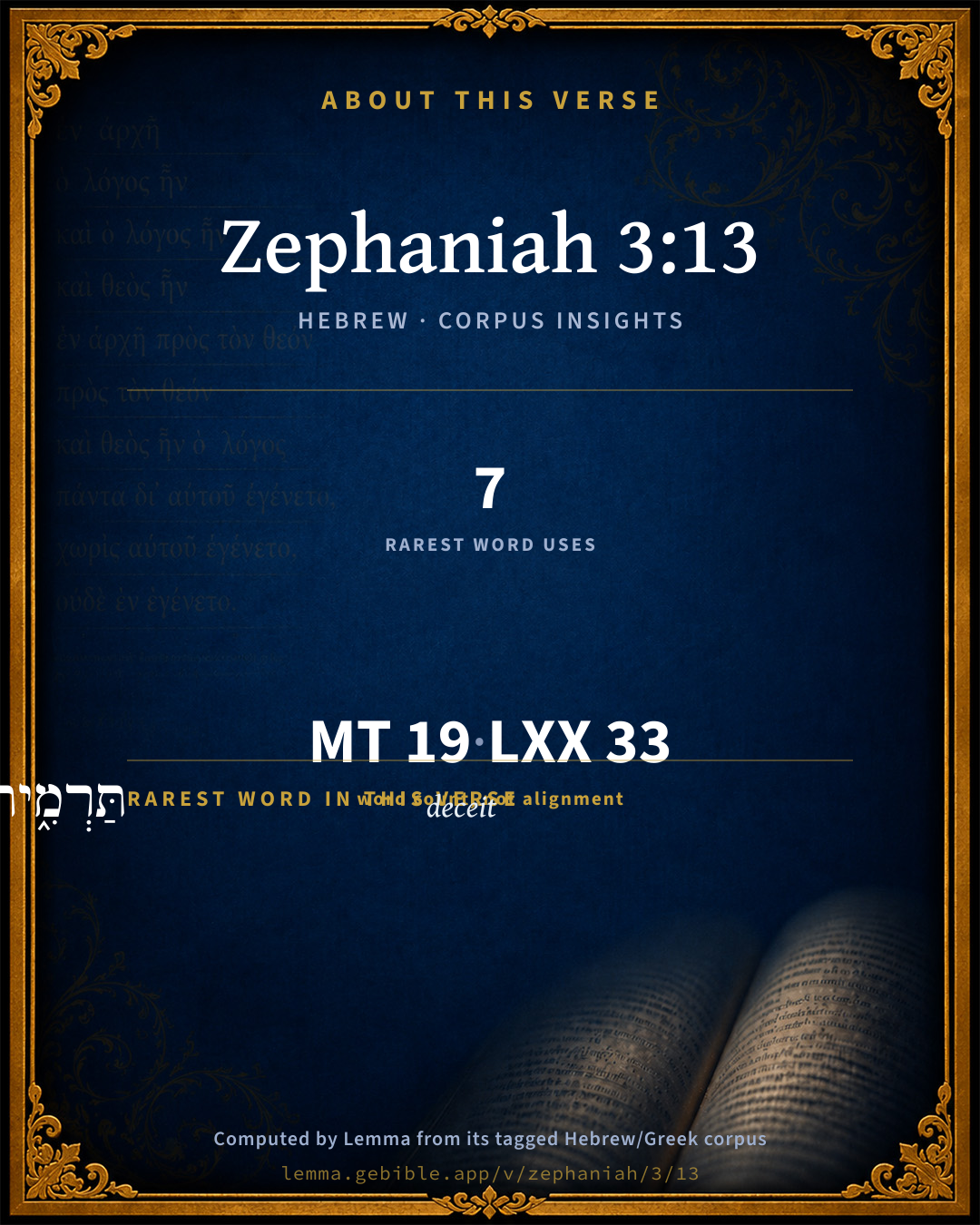
The rarest word here is תַּרְמִ֑ית deceit H8649 — appearing just 7 times in the whole Hebrew Bible.

Shared distinctive vocabulary

תַּרְמִ֑ית deceit H8649 occurs in 6 verses of the Hebrew Bible. Also found in:

Grammatical profile

  • 6 verbs
  • 7 nouns
  • 1 pronoun
  • 1 conjunction
  • 4 particles

Verb forms

  • יַעֲשׂ֤וּ Qal · Imperfect
  • יְדַבְּר֣וּ Piel · Imperfect
  • יִמָּצֵ֥א Niphal · Imperfect
  • יִרְע֥וּ Qal · Imperfect
  • וְרָבְצ֖וּ Qal · Sequential Perfect
  • מַחֲרִֽיד Hiphil · Participle Active

Repetition

A word recurs within this verse — often emphatic in Hebrew:

Hebrew & Septuagint length

In English translation the verse runs 35 words from the Hebrew and 47 from the Septuagint (LXX English) — closely comparable.

A rough comparison of the two English renderings, which tokenize alike — not a word-level alignment.

Word counts can differ between the Hebrew and the Greek without any difference in meaning — e.g. the Hebrew direct-object marker אֵת has no separate Greek word, and Greek often adds the article ὁ.

In the original languages it is 19 Hebrew tokens and 33 Greek tokens — but the two are counted differently (Hebrew bundles its prefixes and suffixes into one token; the Greek is in lemma form), so that isn’t a like-for-like length.

Cross-references

37

Topical passages linked to Zephaniah 3:13 in the Treasury of Scripture Knowledge — connected by theme and wording, ordered by reader-vote popularity; previews shown in the World English Bible.

  • Revelation 14:5 In their mouth was found no lie, for they are blameless.
  • Isaiah 60:21 Your people also shall be all righteous; they shall inherit the land forever, the branch of my planting, the work of my hands, that I may be glorified.
  • Micah 4:7 And I will make that which was lame a remnant, And that which was cast far off a strong nation: And Yahweh will reign over them on Mount Zion from then on, even forever.
  • Zephaniah 2:7 The coast will be for the remnant of the house of Judah. They will find pasture. In the houses of Ashkelon, they will lie down in the evening, for Yahweh, their God, will visit them, and restore them.
  • Ezekiel 34:13–15 I will bring them out from the peoples, and gather them from the countries, and will bring them into their own land; and I will feed them on the mountains of Israel, by the watercourses, and in all the inhabited places of the country.
  • Micah 4:4 But they will sit every man under his vine and under his fig tree; And no one will make them afraid: For the mouth of Yahweh of Hosts has spoken.
  • Isaiah 17:2 The cities of Aroer are forsaken; they shall be for flocks, which shall lie down, and none shall make them afraid.
  • John 1:47 Jesus saw Nathanael coming to him, and said about him, "Behold, an Israelite indeed, in whom is no deceit!"
  • Isaiah 10:20–22 It shall come to pass in that day, that the remnant of Israel, and those who are escaped of the house of Jacob, shall no more again lean on him who struck them, but shall lean on Yahweh, the Holy One of Israel, in truth.
  • Isaiah 54:14 In righteousness shall you be established: you shall be far from oppression, for you shall not be afraid; and from terror, for it shall not come near you.
  • Jeremiah 23:4 I will set up shepherds over them, who shall feed them; and they shall fear no more, nor be dismayed, neither shall any be lacking, says Yahweh.
  • Jeremiah 31:33 But this is the covenant that I will make with the house of Israel after those days, says Yahweh: I will put my law in their inward parts, and in their heart will I write it; and I will be their God, and they shall be my people:
  • Ezekiel 34:23–28 I will set up one shepherd over them, and he shall feed them, even my servant David; he shall feed them, and he shall be their shepherd.
  • Ezekiel 36:25–27 I will sprinkle clean water on you, and you shall be clean: from all your filthiness, and from all your idols, will I cleanse you.
  • Ezekiel 39:26 They shall bear their shame, and all their trespasses by which they have trespassed against me, when they shall dwell securely in their land, and none shall make them afraid;
  • Joel 3:17 "So you will know that I am Yahweh, your God, Dwelling in Zion, my holy mountain. Then Jerusalem will be holy, And no strangers will pass through her any more.
  • Zechariah 14:20–21 In that day there will be on the bells of the horses, "HOLY TO YAHWEH;" and the pots in Yahweh's house will be like the bowls before the altar.
  • Psalms 23:2 He makes me lie down in green pastures. He leads me beside still waters.
  • Psalms 119:3 Yes, they do nothing wrong. They walk in his ways.
  • Isaiah 6:13 If there are yet a tenth in it, It also shall in turn be eaten up: As a terebinth, and as an oak, whose stock remains, when they are felled; So the holy seed is its stock."
  • Isaiah 11:6–9 The wolf shall dwell with the lamb, and the leopard shall lie down with the kid; and the calf and the young lion and the fattened calf together; and a little child shall lead them.
  • Isaiah 35:8 A highway shall be there, and a way, and it shall be called The way of holiness. The unclean shall not pass over it, but is shall be for for him who walks in the Way. Wicked fools will not go there.
  • Isaiah 63:8 For he said, Surely, they are my people, children who will not deal falsely: so he was their Savior.
  • Isaiah 65:10 Sharon shall be a fold of flocks, and the valley of Achor a place for herds to lie down in, for my people who have sought me.
  • Jeremiah 30:10 Therefore don't you be afraid, O Jacob my servant, says Yahweh; neither be dismayed, Israel: for, behold, I will save you from afar, and your seed from the land of their captivity; and Jacob shall return, and shall be quiet and at ease, and none shall make him afraid.
  • Joel 3:21 I will cleanse their blood, That I have not cleansed: For Yahweh dwells in Zion."
  • Micah 5:4–5 He shall stand, and shall shepherd in the strength of Yahweh, In the majesty of the name of Yahweh his God: And they will live, for then he will be great to the ends of the earth.
  • Micah 7:14 Shepherd your people with your staff, The flock of your heritage, Who dwell by themselves in a forest, In the midst of fertile pasture land, let them feed; In Bashan and Gilead, as in the days of old.
  • Matthew 13:41 The Son of Man will send out his angels, and they will gather out of his Kingdom all things that cause stumbling, and those who do iniquity,
  • Romans 11:4–7 But how does God answer him? "I have reserved for myself seven thousand men, who have not bowed the knee to Baal."
  • Colossians 3:9 Don't lie to one another, seeing that you have put off the old man with his doings,
  • 1 Peter 3:14 But even if you should suffer for righteousness' sake, you are blessed. "Don't fear what they fear, neither be troubled."
  • 1 John 3:9–10 Whoever is born of God doesn't commit sin, because his seed remains in him; and he can't sin, because he is born of God.
  • 1 John 5:18 We know that whoever is born of God doesn't sin, but he who was born of God keeps himself, and the evil one doesn't touch him.
  • Revelation 7:15–17 Therefore they are before the throne of God, they serve him day and night in his temple. He who sits on the throne will spread his tent over them.
  • Revelation 21:8 But for the cowardly, unbelieving, sinners, abominable, murderers, sexually immoral, sorcerers, idolaters, and all liars, their part is in the lake that burns with fire and sulfur, which is the second death."
  • Revelation 21:27 There will in no way enter into it anything profane, or one who causes an abomination or a lie, but only those who are written in the Lamb's book of life.

Cross-references courtesy of OpenBible.info (CC BY 4.0).

Hebrew and Greek witnesses Masoretic Hebrew ↔ Greek Septuagint

The same verse in the two great witnesses to the Old Testament, shown verse-for-verse.

These are two independent witnesses, not word-aligned to each other, and the Septuagint is shown in lemma (dictionary) form.

Hebrew Zephaniah 3:13 Masoretic · Westminster Leningrad Codex

שְׁאֵרִ֨ית יִשְׂרָאֵ֜ל לֹֽא יַעֲשׂ֤וּ עַוְלָה֙ וְלֹא יְדַבְּר֣וּ כָזָ֔ב וְלֹֽא יִמָּצֵ֥א בְּפִיהֶ֖ם לְשׁ֣וֹן תַּרְמִ֑ית כִּֽי הֵ֛מָּה יִרְע֥וּ וְרָבְצ֖וּ וְאֵ֥ין מַחֲרִֽיד

The remnant of Israel will not do iniquity, nor speak lies, neither will a deceitful tongue be found in their mouth, for they will feed and lie down, and no one will make them afraid."

World English Bible · Public Domain

Greek LXX Zephaniah 3:13 Septuagint · lemma form

ὁ κατάλοιπος ὁ ἰσραήλ καί οὐ ποιέω ἀδικία καί οὐ λαλέω μάταιος καί οὐ μή εὑρίσκω ἐν ὁ στόμα αὐτός γλῶσσα δόλιος διότι αὐτός νέμω καί κοιτάζομαι καί οὐ εἰμί ὁ ἐκφοβέω αὐτός

and the remnant of Israel shall fear the name of the Lord, and shall do no iniquity, neither shall they speak vanity; neither shall a deceitful tongue be found in their mouth: for they shall feed, and lie down, and there shall be none to terrify them.

LXX2012 (modern English Septuagint) · Public Domain

Hebrew: Westminster Leningrad Codex (CC BY 4.0). Greek: Septuagint (public domain); English from LXX2012 (modern English Septuagint) (Public Domain). How the Septuagint differs from the Hebrew →

Targum (Aramaic paraphrase)

1

The Targum is the ancient Jewish Aramaic paraphrase of the Hebrew Scriptures — an interpretive translation, not the Hebrew text itself. Onkelos (literal) and Pseudo-Jonathan (expansive) render the Torah, and Jonathan the Prophets. Coverage is partial: where no permissively-licensed English translation exists for a verse, only the Aramaic is shown. This is verse-level text, not a word-by-word alignment to the Hebrew.

  1. Targum Jonathan Prophets (Joshua–Malachi)
    שְׁאָרָא דְיִשְׂרָאֵל לָא יַעְבְּדוּן שְׁקַר וְלָא יְמַלְלוּן כַּדְבִין וְלָא יִשְׁתְּכַח בְּפוּמֵיהוֹן לִישַׁן דְנִכְלִין אֲרֵי אִינוּן יִתְפַּרְנְסוּן וְיִשְׁרוֹן וְלֵית דְמָנִיד:

    (no public-domain English translation for this verse)

    Targum Jonathan — Aramaic: “Mikraot Gedolot” (public domain). English: “Sefaria Community Translation” (CC0 1.0 (public-domain dedication)); “London "Chaldee Paraphrase," 1871” (public domain). Text via Sefaria.

Commentary

Notes on Zephaniah 3:13 from classic Christian and Jewish commentators (each source and its license shown beneath its notes). The classic Christian expositions comment on the surrounding passage and are grouped to its opening verse, so a note may address several verses; the Jewish commentaries on the Tanakh (Rashi and others) are per-verse, so they appear only where the commentator wrote on this verse.

Lemma curates 59 commentaries, every one of them public domain or Creative Commons licensed, each selected and text-cleaned for this edition rather than reprinted as found. About our sources →

Trapp's Complete Commentary

John Trapp

Zep 3:13 The remnant of Israel shall not do iniquity, nor speak lies; neither shall a deceitful tongue be found in their mouth: for they shall feed and lie down, and none shall make [them] afraid.

Ver. 13. The remnant of Israel shall not do iniquity] Sanctity and security are here promised to all the citizens of the Church. Being justified by Christ they shall do righteousness and truth: there shall no way of wickedness be found in them, Psa 139:24, they shall be kept from foul flagitious practices, neither shall they wallow or allow themselves in any known sin unrepented of. Their spot, if any, shall be the spot of God’s children, Deu 32:5, involuntary and avoidable informity, such as there is a pardon of course for; only they must sue it out by praying daily, Forgive us our trespasses.

Nor speak lies] For that is a foul fault, and rarely found in a saint, Isa 63:8. For he said, "Surely they are my people, children that will not lie: so he was their Saviour." It was wont to be as current an argument, Christianus est, non mentietur, He is a Christian, he will not lie, as afterwards it was, Hic est frater, ergo mendax, This is a friar, and therefore a liar. Sophronius testifieth of Chrysostom, nunquam eum mentitum fuisse, that he was never heard to tell a lie. Whereas of Pilate Hegesippus telleth us, that he was vir nequam et parvi faciens mendacium, a naughty man, and one that made little conscience of a lie. It may seem so indeed by that scornful question of his, "What is truth?" Joh 18:38.

Neither shall a deceitful tongue be found in their mouth] Their pure lip, Zep 3:9, is not used to the language of hell, their spirit without guile, Psa 32:2, produceth speech without deceit; for out of the abundance of the heart the mouth speaketh, Mat 12:34. {See Trapp on "Mat 12:34"}

For they shall feed and lie down] Shall have all that heart can wish or need require; plenty, safety, security.

And none shall make them afraid] So as to make them do iniquity or speak lies; as very good men when frightened have dared to do; witness Abraham, Isaac, Jacob, but especially David, deeply guilty of this sin, 1Sa 21:2; 1Sa 21:8; 1Sa 27:8; 1Sa 27:10, In the sense of which sin he prayeth, "Remove from me the way of lying," Psa 119:29; we also should pray, "Lead us not into temptation, but deliver us from that evil one," the father of lies. And having the shepherd of Israel to feed us and tend us, we should not fear, Psa 23:2-3, but choosing rather to die than to lie, to suffer than to shift, commit the keeping of our souls to him in well-doing, as unto a faithful Creator, 1Pe 4:19.

John Trapp, A Commentary or Exposition upon All the Books of the Old and New Testament (1647–1656) — public domain. Text from a community e-Sword module.

The Biblical Illustrator

Joseph S. Exell

Zep_3:13

The remnant of Israel shall not do iniquity.

The saved remnant

The remnant is those who are left after the sifting out. God is ever sifting out, and the unworthy fall through the meshes of the mighty sieve. They are swept up and east out, but the worthy remain. He sifted Israel. The Captivity tested them. He sifted the infant Church. Persecution proved its members. The text refers to the blessed privilege of those who shall endure.

I. Their number. Only a remnant It was but a remnant of those people who left Egypt that entered Canaan--only two men. It was only a remnant returned from the Captivity. It is only a remnant of those who hear the Gospel who are saved. Still, there is a remnant. There are always some who fear God. God never leaves Himself without witness of some sort.

II. Their character.

1. They are holy--Shall do no iniquity. But there must be great changes in our natures and circumstances before this promise is fulfilled.

2. They shall be faithful--Not speak lies. This is one branch of holiness, but it is a very important one, and is mentioned particularly in order to show us the thoroughness of their piety.

III. Their privileges. There are three here specified.

1. Provision--They shall feed. That is, have spiritual food. There is such a thing as spiritual starvation.

2. Rest--They shall lie down. There shall be no care, no anxiety, no toil.

3. Protection--None shall make them afraid. It is a blessed thing to endure the Lords sifting. Those who do so shall live for ever. (Homilist.)

The Biblical Illustrator, edited by Joseph S. Exell (c. 1880s–1900s) — public domain. Text from a community e-Sword module.

Jamieson, Fausset & Brown

Robert Jamieson, A. R. Fausset & David Brown

nor speak lies--worshipping God in truth, and towards man having love without dissimulation. The characteristic of the 144,000 sealed of Israel.

none shall make them afraid--either foreign foe, or unjust prince (Zep 3:3), prophet, or priest (Zep 3:4).

Jamieson, Fausset & Brown — Commentary Critical and Explanatory on the Whole Bible (1871) — public domain (CC PDM 1.0). Text via the HelloAO Bible API.

Adam Clarke's Commentary

Verse 13. The remnant of Israel shall not do iniquity] O what a change! And then, how different shall they be from their present selves! Iniquity, lying, and deceit shall not be found among them! A Jew once said to me, "Tere are shome of you Christians who are making wonderful efforts to convert the Tshews (Jews.) Ah, dere ish none but Gott Almighty dat can convert a Tshew." Truly I believe him. Only God can convert any man; and if there be a peculiar difficulty to convert any soul, that difficulty must lie in the conversion of the Jew.

Adam Clarke's Commentary on the Bible (1810–1826) — public domain. Text from a community e-Sword/MySword module.

The Cambridge Bible for Schools and Colleges

gen. ed. J. J. S. Perowne

13. The remnant of Israel] After the great judgment of the day of the Lord, only a remnant shall be left (Joe_2:28-32). The idea that only a remnant shall be saved is common to all the prophets; Isaiah called his son Shear-jashub, “a remnant shall turn,” making him a living sign to king (Isa_7:3) and people of his conviction that a great judgment was impending. Cf. Isa_10:21-23.

shall not do iniquity] Comp. Zep_3:5, where it is said of the Lord “he doeth no iniquity.” In those days the people shall be like their God. His Spirit within them shall rule their life: Eze_36:25-27.

For they shall feed] The figure is the very common one of flocks feeding and lying down in complete security. Cf. Isa_17:2; Eze_34:25; Eze_34:28. The word for does not assign their perfect security from all trouble without as the reason for the righteousness that shall prevail within, though of course security from all external evils would permit and help the peaceable expansion of the community and the growth of religious life among them. The words introduced by for rather restate under another aspect the peaceful and happy condition of the people, already described in Zep_3:12-13 a.

The Cambridge Bible for Schools and Colleges (gen. ed. J. J. S. Perowne; Cambridge University Press, 1878–1918) — public domain. Text from a community e-Sword module.

John Gill's Exposition

The remnant of Israel shall not do iniquity This is the remnant, according to the election of grace, the few the Lord reserved for himself, left in the land, and in his church, for his own glory; who, being truly convinced of sin, and brought to believe in Christ, should leave and forsake their former course of sinning; not that they should be without sin, or none be committed by them; but should not live in it, and be workers of it; make a trade of sinning, and continue therein; or should not commit the sin against the Holy Ghost, as great numbers of the Jews did, in rejecting Jesus as the Messiah, against clear evidence, and the light of their own consciences: nor speak lies; in common talk and conversation; which a child of God, a true believer in Christ, a real Christian, should not and dare not do, ( Isaiah 63:8 ) or doctrinal lies, lies in hypocrisy; such doctrines as are not of the truth of the Gospel, but contrary to it; such as the doctrine of justification by works; atonement by ceremonial sacrifices; acceptance with God, through the merits of their fathers; and keeping the traditions of the elders; and other Jewish lies and fables of the same stamp; but rejected by those who have embraced the truth, as it is in Jesus: neither shall a deceitful tongue be found in their mouth; having clean hearts created and right spirits renewed in them; being Israelites indeed, in whom there is no guile, and true followers of Jesus, in whom nothing of this kind could be found: for they shall feed, like a flock of sheep, to which they may be compared for their innocence and harmlessness, meekness and patience; feed in the fat pastures of the word and ordinances of Christ, under the care and guidance of him the good Shepherd; and so go in and out, and find pasture, food, and fulness of it, in him, his flesh, and blood; in his precious truths, and Gospel provisions made in his house: and lie down; in green pastures of ordinances, beside the still waters of everlasting love and divine grace, and in the good fold of the church; all which is a reason why they do not and cannot sin as others do; nor tell lies, and be guilty of deceit and falsehood; for they are better taught; and the grace of God, in giving them spiritual food and rest, influences and engages them to such a conduct and behaviour: or, "therefore they shall feed" F15 being truly gracious and sincere souls, who cannot indulge themselves in sin, nor act a false and deceitful part: and none shall make [them] afraid; of feeding in those pastures, and lying down in those folds; or shall deter them from an attendance on the word and ordinances; or joining in fellowship with the churches of Christ therein; neither Satan, the roaring lion, nor false teachers, and persecuting tyrants, those grievous wolves, and cruel bears; or so frighten them, that in their fright they shall tell lies, and use deceit. FOOTNOTES: F15 (yk) "ideo", Grotius.

John Gill's Exposition of the Whole Bible (1746–1763) — public domain (CC PDM 1.0). Text via the HelloAO Bible API.

Albert Barnes' Notes on the Bible

The remnant of Israel - The same poor people, the “true Israel” of whom God said, “I leave over” (the word is the same) “a poor people,” few, compared with the rest who were blinded; of whom the Lord said, “I know whom I have chosen” Joh 13:18. These “shall not do iniquity nor speak lies.” Cyril: “This is a spiritual adorning, a most beautiful coronet of glorious virtues. For where meekness and humility are and the desire of righteousness, and the tongue unlearns vain words and sinful speech, and is the instrument of strict truth, there dawns a bright and most perfect virtue. And this beseems those who are in Christ. For the beauty of piety is not seen in the Law, but gleams forth in the power of Evangelic teachings.”

Our Lord said of Nathanael, “Behold an Israelite indeed, in whom is no guile” Joh 1:47, and to the Apostles, “I send you forth as sheep among wolves; be ye therefore wise as serpents and harmless as doves” Mat 10:16; and of the first Christians it is said, “they, continuing daily with one accord in the temple, and breaking bread from house to house did eat their merit with gladness and singleness of heart, praising God and having favor with all the people” Act 2:46-47. This is the character of Christians, as such, and it was at first fulfilled; “whosoever is born of God, doth not commit sin” 1Jo 3:9; “whosoever is born of God sinneth not; but he that is begotten of God keepeth himself, and that wicked one toucheth him not” 1Jo 5:18. An Apologist, at the close of the second century, could appeal to the Roman Emperor , that no Christian was found among their criminals, “unless it be only as a Christian, or, if he be anything else, he is immediately no longer a Christian. We alone then are innocent! What wonder if this be so, of necessity? And truly of necessity it is so. Taught innocence by God, we both know it perfectly, as being revealed by a perfect Master; and we keep it faithfully, as being committed to us by an Observer, Who may not be despised.” : “Being so vast a multitude of men, almost the greater portion of every state, we live silently and modestly, known perhaps more as individuals than as a body, and to be known by no other sign than the reformation of our former sins.”

Now in the Church, which “our earth dimm’d eyes behold,” we can but say, as in regard to the cessation of war under the Gospel, that God’s promises are sure on His part, that still “they that are Christ’s have crucified the flesh with the affections and lusts,” that the Gospel is “a power of God unto salvation” Rom 1:16, that “the preaching of the Cross is, unto us which are saved, the power of God” 1Co 1:18; “unto them that are called, Christ is the power of God and the wisdom of God” 1Co 1:24; that those who will, “are kept by God through faith unto salvation” 1Pe 1:5; but that now too “they are not all Israel, which are of Israel” Rom 9:6, and that “the faithlessness of man does not make the faith of God of none effect” Rom 3:3. : “The Church of God is universally holy in respect of all, by institutions and administrations of sanctity; the same Church is really holy in this world, in relation to all godly persons contained in it, by a real infused sanctity; the same is farther yet at the same time perfectly holy in reference to the saints departed and admitted to the presence of God; and the same Church shall hereafter be most completely holy in the world to come, when all the members, actually belonging to it, shall be at once perfected in holiness and completed in happiness.”

Most fully shall this be fulfilled in the Resurrection. Rup.: “O blessed day of the Resurrection, in whose fullness no one will sin in word or deed! O great and blessed reward to every soul, which, although it hath now “done iniquity” and “spoken falsehood,” yet willeth not to do it further! Great and blessed reward, that he shall now receive such. immovableness, as no longer to be able to do iniquity or speak falsehood, since the blessed soul, through the Spirit of everlasting love inseparably united with God its Creator, shall now no more be capable of an evil will!”

For they shall feed - On the hidden manna, Dionysius: “nourished most delicately by the Holy Spirit with inward delights, and spiritual food, the bread of life.” In the things of the body too was “distribution made unto every man according as he had need” Act 4:35. “And they shall lie down” in the green pastures where He foldeth them; “and none shall make them afraid” 1Pe 1:5, “for they were ready to suffer and to die for the Name of the Lord Jesus” Act 21:13. “They departed from the presence of the council rejoicing that they were counted worthy to suffer shame for His Name” Act 5:41. Before the Resurrection and the sending of the Holy Spirit, how great was the fearfulness, unsteadfastness, weakness of the disciples; how great, after the infusion of the Holy Spirit, was their constancy and imperturbableness, it is delightsome to estimate in their Acts,” when they “bare His Name before the Gentiles and kings, and the children of Israel” Act 9:15, and he who had been afraid of a little maid, said to the high priest, “We ought to obey God rather than men” Act 5:29. Cyril: “When Christ the Good Shepherd Who laid down His life for His sheep, shone upon us, we are fed in gardens and pastured among lilies, and lie down in folds; for we are folded in Churches and holy shrines, no one scaring or spoiling us, no wolf assailing nor lion trampling on us, no robber breaking through, no one invading us, to steal and kill and destroy; but we abide in safety and participation of every good, being in charge of Christ the Saviour of all.”

Albert Barnes' Notes on the Bible (1834–1885) — public domain. Text from a community e-Sword/MySword module.

Haydock's Catholic Bible Commentary

Israel. They shall be more submissive, and afraid of yielding to idolatry. Yet the synagogue was far from the perfection of the primitive Christianity, or even from that of many pious souls in these days of relaxation. --- Afraid. The Jews were not much molested till the time of Epiphanes, nor was the country ravaged as it had been, Micheas ii. 12. This peace is however of a spiritual nature, granted by Christ to those who fight against their passions, John xiv. 27. (Calmet) --- They shall feed on the word of God and on the blessed Eucharist. (Menochius)

George Leo Haydock (1774–1849), Haydock's Catholic Family Bible and Commentary, 1859 edition — public domain. Excludes Psalms (Douay-Rheims chapter numbering differs from Protestant) and Deuterocanonical books (Catholic canon only).

Matthew Poole's English Annotations

The remnant of Israel, preserved in captivity and dispersion, purified in the furnace of affliction, and now returned to their own land, shall not do iniquity; shall not commit the sins they formerly committed, not provoke God with their abominations as before; it is not a prediction of a sinless, but of a reformed state; they shall be righteous, and taught of God, no more idolaters.

Nor speak lies; they shall love truth, and speak truth, or, in a larger sense, shall be honest and upright amongst men.

A deceitful tongue; a false accuser or witness, like Doeg, or Jezebel’s evidences against Naboth; according to that, Psa 15:2; 24:4.

For they shall feed; or, they shall feed also, &c.; so it will be a blessing added as a crown of their piety and truth. Or if you read it,

for they shall feed, & c., it gives you a reason why they shall not by frauds and lies, as formerly, sin against one another; they shall have a sufficiency by honest ways, and from God’s blessing, and shall not be under any great temptation to dishonesty and lying.

None shall make them afraid: frights made David, Abraham, and others to forget truth; here none should fright them, and they should not fear to speak the truth: their lips pure, Zep 3:9; they trust in the Lord, Zep 3:12; therefore shall not lie. Here is a cluster of spiritual promises with the temporal.

Matthew Poole's English Annotations on the Holy Bible (1683–1685) — public domain. Text from a community e-Sword/MySword module.

The Pulpit Commentary

The remnant of Israel (see note on ver. 12). Though they claim no worldly eminence, the true Israelites shall be conspicuous for spiritual graces. Shall not do iniquity. Their acts shall be just and holy; their daily conduct such as becomes the children of God"s election. (1Jn_3:9) Nor speak lies. There shall be no lying prophets there, and all fraud and double-dealing shall be abolished. The proof of their righteous conduct is found in the favour of the Lord and the security in which they shall live. For they shall feed, etc. The remnant is compared to a "little fleck", (Luk_12:32) of which the Lord is the Shepherd. (Mic_7:14) The blessing is that promised to Israel in the Law if she kept the commandments. (Lev_26:5, Lev_26:6)

The Pulpit Commentary (1880–1919), ed. H.D.M. Spence-Jones & Joseph S. Exell — public domain. Text from a community e-Sword module.

John Wesley's Explanatory Notes

Shall feed - Shall enjoy peace and plenty.

John Wesley, Explanatory Notes Upon the Whole Bible (1754–1765) — public domain. Text via the GEBible commentary corpus.

Scofield Reference Notes

C. I. Scofield

remnant

(See Scofield "Jer 15:21")

The Scofield Reference Bible (1917 edition), notes by C. I. Scofield — public domain. Text from a community e-Sword module.

Lesson kit

Teaching starters — assembled from the data on this page, not authored interpretation. Every prompt links to the verse data it draws on. Edit before teaching.

Zephaniah, in the Prophets, opens this verse with 19 words (17 distinct Hebrew lemmas). Its most distinctive word is tormâh (“deceit”). A historical commentator’s framing appears above. Read the whole chapter for the surrounding context.

Discussion questions

  1. How does “deceit” (tormâh) shape what this verse is saying?
  2. How does Judges 9:31, which shares the word «deceit», read alongside this verse?
  3. What does the repetition of “not” (3× in this one verse) do in this verse?
  4. These translations render this verse differently. What is at stake in choosing one wording over another?
  5. «יַעֲשׂ֤וּ» is a Qal Imperfect verb. How does that grammatical form shape the action described?
  6. Compare how Trapp's Complete Commentary and The Biblical Illustrator read this verse. Where do they agree or differ?

Things to notice

Reading settings

Reading text

Shown beneath each verse's original-language words.

Old Testament
Old Testament edition

Read the OT as the Masoretic Hebrew (MT) or the Greek Septuagint (LXX).

English shown for the Greek Septuagint (in the Hebrew ↔ Greek comparison).

Comparing translations? Open the Compare panel on any verse page to stack up to four side by side.