Ezekiel 34:5

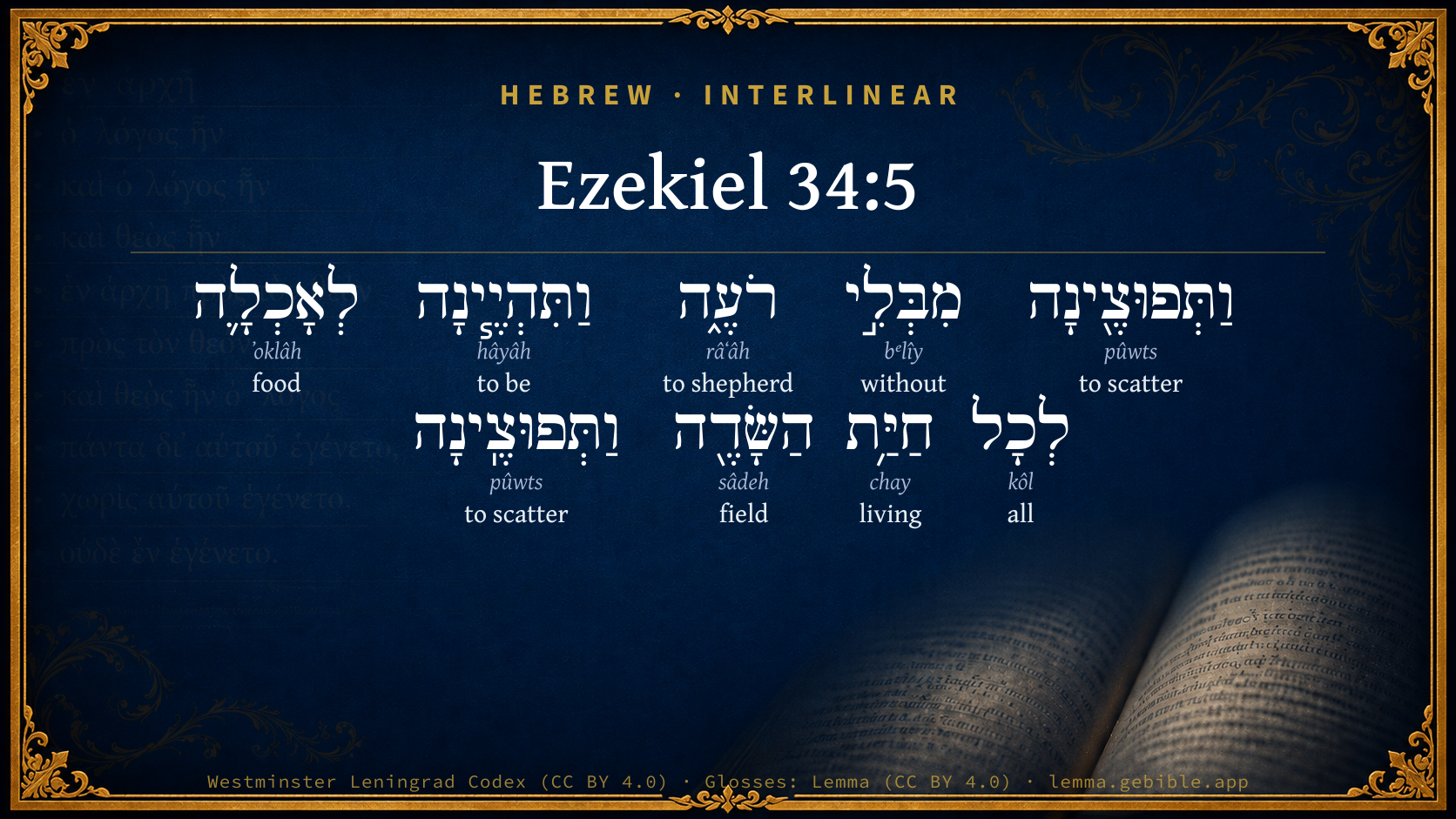
Hebrew (Westminster Leningrad Codex) Ezekiel 34:5 appears in the Hebrew Old Testament. The text above is from the Westminster Leningrad Codex. Each word links to its Strong’s number, a concise gloss, and parsing drawn from the Open Scriptures Hebrew Bible morphology. Click any word for its full Brown-Driver-Briggs (BDB) entry.
Download image
Cite this verse

Ezekiel 34:5 (World English Bible). Public Domain. Lemma interlinear Bible study tool, https://lemma.gebible.app/v/ezekiel/34/5.

Show BibTeX & RIS
BibTeX
RIS
English Translation
They were scattered, because there was no shepherd; and they became food to all the animals of the field, and were scattered.
World English Bible · Public Domain
Download a study sheet

One document with this verse’s original text, its word-by-word gloss line, the meaning frame, cross-references with their text, attributed commentary, and full source and license credits — printable, and it pastes into notes with its structure intact.

This verse Autodidact and up

Study sheet (.html) Plain text (.txt)

A passage Seminary Student

Up to 50 verses in one chapter. A passage sheet keeps up to 6 commentary sources and 12 cross-references per verse, in the order this page ranks them, and says so on the sheet whenever that leaves anything out. Ask for a single verse and you get the Autodidact verse sheet above.

Everything on this page stays free to read, with no account — the sheet is a download of what is already on screen, not access to it.

Want to remove ads? Support Godless Engineer
Compare translations 3

The same verse in 3 English versions, stacked beneath the original-language interlinear above. Click any original word for its lexicon entry.

Each is an independent rendering of the whole verse — the interlinear is not word-aligned to these translations.

Highlighted words mark where these versions differ — a whole-verse word diff, not a word-by-word alignment.

  • World English Bible Public Domain
    They were scattered, because there was no shepherd; and they became food to all the animals of the field, and were scattered.
  • King James Version Public Domain
    And they were scattered, because there is no shepherd: and they became meat to all the beasts of the field, when they were scattered.
  • unfoldingWord Literal Text CC BY-SA 4.0
    Then they were scattered without a shepherd, and they became food for all the living beasts in the fields, after they were scattered.

unfoldingWord Literal Text — © unfoldingWord, licensed CC BY-SA 4.0. Word-aligned USFM3 via Door43 (git.door43.org/unfoldingWord/en_ult).

Versions to compare (up to 4)

3 of 4 selected

Show all 18 translations

Every available English version of this verse, each an independent rendering of the whole verse.

  • World English Bible Public Domain
    They were scattered, because there was no shepherd; and they became food to all the animals of the field, and were scattered.
  • Berean Standard Bible Public Domain
    They were scattered for lack of a shepherd, and when they were scattered they became food for all the wild beasts.
  • Majority Standard Bible Public Domain
    They were scattered for lack of a shepherd, and when they were scattered they became food for all the wild beasts.
  • King James Version Public Domain
    And they were scattered, because there is no shepherd: and they became meat to all the beasts of the field, when they were scattered.
  • American Standard Version (1901) Public Domain
    And they were scattered, because there was no shepherd; and they became food to all the beasts of the field, and were scattered.
  • Revised Version (1885) Public Domain
    And they were scattered, because there was no shepherd: and they became meat to all the beasts of the field, and were scattered.
  • Geneva Bible (1599) Public Domain
    And they were scattered without a shepherde: and when they were dispersed, they were deuoured of all the beastes of the fielde.
  • Douay-Rheims (1899) Public Domain
    And my sheep were scattered, because there was no shepherd: and they became the prey of all the beasts of the field, and were scattered.
  • Young's Literal Translation Public Domain
    And they are scattered from want of a shepherd, And are for food to every beast of the field, Yea, they are scattered.
  • Literal Standard Version CC BY-SA 4.0
    And they are scattered from want of a shepherd, || And are for food to every beast of the field, || Indeed, they are scattered.
  • Unlocked Literal Bible CC BY-SA 4.0
    Then they were scattered without a shepherd, and they became food for all the living beasts in the fields, after they were scattered.
  • unfoldingWord Literal Text CC BY-SA 4.0
    Then they were scattered without a shepherd, and they became food for all the living beasts in the fields, after they were scattered.
  • Darby Bible Public Domain
    And they were scattered because there was no shepherd; and they became meat to all the beasts of the field, and were scattered.
  • World Messianic Bible Public Domain
    They were scattered, because there was no shepherd. They became food to all the animals of the field, and were scattered.
  • Webster's Bible Public Domain
    And they were scattered, because there is no shepherd: and they became food to all the beasts of the field, when they were scattered.
  • Free Bible Version CC BY-SA 4.0
    They were scattered because they didn't have a shepherd. When they scattered they were preyed on by all the wild animals for food.
  • Bible in Basic English Public Domain
    And they were wandering in every direction because there was no keeper: and they became food for all the beasts of the field.
  • JPS Tanakh (1917) Public Domain
    So were they scattered, because there was no shepherd; and they became food to all the beasts of the field, and were scattered.

Literal Standard Version (2020), Covenant Press — licensed CC BY-SA 4.0. Text via the HelloAO Bible API (eBible.org). Unlocked Literal Bible (unfoldingWord) — licensed CC BY-SA 4.0. Text via the HelloAO Bible API (eBible.org). unfoldingWord Literal Text — © unfoldingWord, licensed CC BY-SA 4.0. Word-aligned USFM3 via Door43 (git.door43.org/unfoldingWord/en_ult). Free Bible Version, Dr. Jonathan Gallagher — licensed CC BY-SA 4.0. Text via the HelloAO Bible API (eBible.org).

Word by word

More ways to search: Search by grammar → Find every occurrence → Compare this word →

Practice this passage: Drill this verse → Learn its vocabulary →

לְאָכְלָ֛ה
ʼoklâh
H402
“to/for · food”
Preposition + Noun, Common, Feminine, Singular, Absolute
Part of Speech
Preposition + Noun
Type
Common
Gender
Feminine
Number
Singular
State
Absolute
Full BDB Definition

Origin: from H401

TWOT: 85b

food - food, eating - object of devouring, consuming - by wild beasts (figurative) - in fire - of judgment (figurative)
  1. וַתְּפוּצֶ֖ינָה pûwts H6327 “and · to scatter” Conjunction + Verb, Qal, Sequential Imperfect, 3rd Person, Feminine, Plural
  2. מִבְּלִ֣י bᵉlîy H1097 “from · without of” Preposition + Noun, Common, Masculine, Singular, Construct
  3. רֹעֶ֑ה râʻâh H7462 “shepherding” Verb, Qal, Participle Active, Masculine, Singular, Absolute
  4. וַתִּהְיֶ֧ינָה hâyâh H1961 “and · to be” Conjunction + Verb, Qal, Sequential Imperfect, 3rd Person, Feminine, Plural
  5. לְכָל kôl H3605 “to/for · all of” Preposition + Noun, Common, Masculine, Singular, Construct
  6. חַיַּ֥ת chay H2416 “living of” Noun, Common, Feminine, Singular, Construct
  7. הַשָּׂדֶ֖ה sâdeh H7704 “the · field” Particle, Definite Article + Noun, Common, Masculine, Singular, Absolute
  8. וַתְּפוּצֶֽינָה pûwts H6327 “and · to scatter” Conjunction + Verb, Qal, Sequential Imperfect, 3rd Person, Feminine, Plural

About this verse

These counts appear in no published source. They are computed here, from the morphology-tagged text and Lemma’s own curated glosses. What Lemma adds →

9
words
8
distinct lemmas
Prophets
section

Notable vocabulary

The rarest word here is לְאָכְלָ֛ה food H402 — appearing just 18 times in the whole Hebrew Bible.

Shared distinctive vocabulary

לְאָכְלָ֛ה food H402 occurs in 18 verses of the Hebrew Bible. Also found in:

Grammatical profile

  • 4 verbs
  • 5 nouns

Verb forms

  • וַתְּפוּצֶ֖ינָה Qal · Sequential Imperfect
  • רֹעֶ֑ה Qal · Participle Active
  • וַתִּהְיֶ֧ינָה Qal · Sequential Imperfect
  • וַתְּפוּצֶֽינָה Qal · Sequential Imperfect

Repetition

A word recurs within this verse — often emphatic in Hebrew:

  • וַתְּפוּצֶ֖ינָה to scatter H6327 ×2

Hebrew & Septuagint length

In English translation the verse runs 22 words from the Hebrew and 22 from the Septuagint (LXX English) — the same length.

A rough comparison of the two English renderings, which tokenize alike — not a word-level alignment.

Word counts can differ between the Hebrew and the Greek without any difference in meaning — e.g. the Hebrew direct-object marker אֵת has no separate Greek word, and Greek often adds the article ὁ.

Cross-references

18

Topical passages linked to Ezekiel 34:5 in the Treasury of Scripture Knowledge — connected by theme and wording, ordered by reader-vote popularity; previews shown in the World English Bible.

  • 2 Chronicles 18:16 He said, I saw all Israel scattered on the mountains, as sheep that have no shepherd: and Yahweh said, These have no master; let them return every man to his house in peace.
  • Matthew 9:36 But when he saw the multitudes, he was moved with compassion for them, because they were harassed and scattered, like sheep without a shepherd.
  • Jeremiah 23:2 Therefore thus says Yahweh, the God of Israel, against the shepherds who feed my people: You have scattered my flock, and driven them away, and have not visited them; behold, I will visit on you the evil of your doings, says Yahweh.
  • Ezekiel 34:8 As I live, says the Lord Yahweh, surely because my sheep became a prey, and my sheep became food to all the animals of the field, because there was no shepherd, neither did my shepherds search for my sheep, but the shepherds fed themselves, and didn't feed my sheep;
  • 1 Kings 22:17 He said, I saw all Israel scattered on the mountains, as sheep that have no shepherd: and Yahweh said, These have no master; let them return every man to his house in peace.
  • Isaiah 56:9 All you animals of the field, come to devour, [yes], all you animals in the forest.
  • Jeremiah 50:17 Israel is a hunted sheep; the lions have driven him away: first, the king of Assyria devoured him; and now at last Nebuchadrezzar king of Babylon has broken his bones.
  • Zechariah 10:2–3 For the teraphim have spoken vanity, and the diviners have seen a lie; And they have told false dreams. They comfort in vain. Therefore they go their way like sheep. They are oppressed, because there is no shepherd.
  • Acts 20:29–31 For I know that after my departure, vicious wolves will enter in among you, not sparing the flock.
  • Numbers 27:17 who may go out before them, and who may come in before them, and who may lead them out, and who may bring them in; that the congregation of Yahweh not be as sheep which have no shepherd.
  • Jeremiah 12:9–12 Is my heritage to me as a speckled bird of prey? are the birds of prey against her round about? go you, assemble all the animals of the field, bring them to devour.
  • Jeremiah 50:6–7 My people have been lost sheep: their shepherds have caused them to go astray; they have turned them away on the mountains; they have gone from mountain to hill; they have forgotten their resting-place.
  • Ezekiel 33:21 It happened in the twelfth year of our captivity, in the tenth [month], in the fifth [day] of the month, that one who had escaped out of Jerusalem came to me, saying, The city has been struck.
  • Ezekiel 33:28 I will make the land a desolation and an astonishment; and the pride of her power shall cease; and the mountains of Israel shall be desolate, so that none shall pass through.
  • Ezekiel 34:6 My sheep wandered through all the mountains, and on every high hill: yes, my sheep were scattered on all the surface of the earth; and there was none who searched or sought.
  • Ezekiel 34:28 They shall no more be a prey to the nations, neither shall the animals of the earth devour them; but they shall dwell securely, and none shall make them afraid.
  • Zechariah 13:7 "Awake, sword, against my shepherd, And against the man who is close to me," says Yahweh of Hosts. Strike the shepherd, and the sheep will be scattered; And I will turn my hand against the little ones.
  • John 10:2 But one who enters in by the door is the shepherd of the sheep.

Cross-references courtesy of OpenBible.info (CC BY 4.0).

Hebrew and Greek witnesses Masoretic Hebrew ↔ Greek Septuagint

The same verse in the two great witnesses to the Old Testament, shown verse-for-verse.

These are two independent witnesses, not word-aligned to each other, and the Septuagint is shown in lemma (dictionary) form.

Hebrew Ezekiel 34:5 Masoretic · Westminster Leningrad Codex

וַתְּפוּצֶ֖ינָה מִבְּלִ֣י רֹעֶ֑ה וַתִּהְיֶ֧ינָה לְאָכְלָ֛ה לְכָל חַיַּ֥ת הַשָּׂדֶ֖ה וַתְּפוּצֶֽינָה

They were scattered, because there was no shepherd; and they became food to all the animals of the field, and were scattered.

World English Bible · Public Domain

Greek LXX Ezekiel 34:5 Septuagint · lemma form

καί διασπείρω ὁ πρόβατον ἐγώ διά ὁ μή εἰμί ποιμήν καί γίγνομαι εἰς κατάβρωμα πᾶς ὁ θηρίον ὁ ἀγρός

And my sheep were scattered, because there were no shepherds: and they became meat to all the wild beasts of the field.

LXX2012 (modern English Septuagint) · Public Domain

Hebrew: Westminster Leningrad Codex (CC BY 4.0). Greek: Septuagint (public domain); English from LXX2012 (modern English Septuagint) (Public Domain). How the Septuagint differs from the Hebrew →

Targum (Aramaic paraphrase)

1

The Targum is the ancient Jewish Aramaic paraphrase of the Hebrew Scriptures — an interpretive translation, not the Hebrew text itself. Onkelos (literal) and Pseudo-Jonathan (expansive) render the Torah, and Jonathan the Prophets. Coverage is partial: where no permissively-licensed English translation exists for a verse, only the Aramaic is shown. This is verse-level text, not a word-by-word alignment to the Hebrew.

  1. Targum Jonathan Prophets (Joshua–Malachi)
    וְאִתְבַּדָרוּ מִבְּלִי פַרְנֵס וְאִתְמְסָרוּ לְאִשְׁתֵּיצָאָה לְכָל מַלְכְּוַת עַמְמַיָא וְאִיטַלְטָלוּ:

    (no public-domain English translation for this verse)

    Targum Jonathan — Aramaic: “Mikraot Gedolot” (public domain). English: “Sefaria Community Translation” (CC0 1.0 (public-domain dedication)); “London "Chaldee Paraphrase," 1871” (public domain). Text via Sefaria.

Commentary

Notes on Ezekiel 34:5 from classic Christian and Jewish commentators (each source and its license shown beneath its notes). The classic Christian expositions comment on the surrounding passage and are grouped to its opening verse, so a note may address several verses; the Jewish commentaries on the Tanakh (Rashi and others) are per-verse, so they appear only where the commentator wrote on this verse.

Lemma curates 59 commentaries, every one of them public domain or Creative Commons licensed, each selected and text-cleaned for this edition rather than reprinted as found. About our sources →

Trapp's Complete Commentary

John Trapp

Eze 34:5 And they were scattered, because [there is] no shepherd: and they became meat to all the beasts of the field, when they were scattered.

Ver. 5. And they were scattered, because there is no shepherd.] None but an idol shepherd, {Zec 11:17} a foolish shepherd; {Eze 34:1-5} and the sheep, being a foolish creature, even to a proverb, {a} and apt to wander into harm’s way, will never return to the fold, if not fetched back, but stick in the thorns, or die in a ditch, or run into the wolf’s mouth.

{a} προβατων ηθος; and προβατιου βιον ζην.

John Trapp, A Commentary or Exposition upon All the Books of the Old and New Testament (1647–1656) — public domain. Text from a community e-Sword module.

Joseph Benson's Commentary

Eze 34:5-6. And they were scattered, &c. — Driven into other parts of the land, or into other countries, by the severity, exactions, and oppressions of their rulers. Because there is no shepherd — No one worthy of the name of a shepherd; none that cared for or properly watched over and fed the flock. And they became meat to all the beasts of the field — They were made a prey to, and were spoiled by, their enemies, temporal and spiritual. My sheep wandered through all the mountains — As silly sheep, when there is no one to look after them, wander from one mountain and hill to another; so my thoughtless and infatuated people, disregarded and neglected, or treated with cruelty by those that should have protected and guided them, have manifested their ignorance and folly in following various species of idolatry, and in forming to themselves religions after their own imaginations, full of superstition and impiety. And none did search or seek after them — Their priests and princes were so far from calling them back from these wanderings, that they were the first to follow them; nay, and even to go before, and set them the example.

Joseph Benson's Commentary on the Old and New Testaments (1811–1818) — public domain. Text from a community e-Sword module.

Geneva Bible (1599)

Geneva Bible translators

For lack of good government and doctrine they perished.

Geneva Bible (1599) marginal notes — public domain. Text via Bolls.life.

Jamieson, Fausset & Brown

Robert Jamieson, A. R. Fausset & David Brown

scattered, because . . . no shepherd--that is, none worthy of the name, though there were some called shepherds (Kg1 22:17; Mat 9:36). Compare Mat 26:31, where the sheep were scattered when the true Shepherd was smitten. God calls them "My sheep"; for they were not, as the shepherds treated them, their patrimony whereby to "feed themselves."

meat to all . . . beasts--They became a prey to the Syrians, Ammon, Moab, and Assyria.

Jamieson, Fausset & Brown — Commentary Critical and Explanatory on the Whole Bible (1871) — public domain (CC PDM 1.0). Text via the HelloAO Bible API.

Adam Clarke's Commentary

Verse 5. And they were scattered] There was no discipline kept up; and the flock, the Church, became disorganized, and separated from each other, both in affection and fellowship. And the consequence was, the grievous wolves, false and worldly interested teachers, seized on and made a prey of them. Of the communion of saints such shepherds know nothing, farther than that it makes a part of the common creed.

Adam Clarke's Commentary on the Bible (1810–1826) — public domain. Text from a community e-Sword/MySword module.

Ellicott's Commentary for English Readers

(5) They were scattered, because. . . .—The calamities of the people are attributed to the fault of the rulers, not because the people themselves were free from sin—the contrary has already been abundantly asserted in this book—but because the people’s sins were largely due to the evil example, the idolatries, the oppressions, and the disobedience of their rulers.

A Bible Commentary for English Readers, edited by Charles John Ellicott (1878–1897) — public domain. Text from a community e-Sword module.

The Cambridge Bible for Schools and Colleges

gen. ed. J. J. S. Perowne

5. The allegory is simple enough. Owing to the evil and selfish government of the rulers the people became the prey of all the nations round about them. The figure of the flock indicates, however, the affection of Jehovah for his people and his compassion over their sufferings.

The Cambridge Bible for Schools and Colleges (gen. ed. J. J. S. Perowne; Cambridge University Press, 1878–1918) — public domain. Text from a community e-Sword module.

John Gill's Exposition

And they were scattered because there is no shepherd,.... No good one; there were shepherds, but they were idol shepherds, good for nothing, and it was all one as if there were none: so, in Christ's time, there were the Scribes and Pharisees; yet, since these did not feed the people with wholesome doctrine, they are said to be as sheep without a shepherd, and scattered abroad, as here from the fold, and from one another; dispersed here and there, seeking food, and none, which moved his compassion, Mat 9:36, in the political sense it may refer to their captivity, and their dispersion among the nations, having no king: So the Targum,

"and they were scattered without a governor.''

And they became meat to all beasts of the field when they were scattered; the Targum is,

"and they were delivered to all the kingdoms of the people to be consumed;''

such as the Assyrians, Babylonians, Ammonites, Moabites, and others; and may be applied to false teachers, those grievous wolves, which spare not the flock, into whose hands members of churches, professors of religion, fall, when neglected by their shepherds.

John Gill's Exposition of the Whole Bible (1746–1763) — public domain (CC PDM 1.0). Text via the HelloAO Bible API.

Haydock's Catholic Bible Commentary

Field. The people being neglected, followed false prophets and idols. Their teachers were so far from striving to reclaim them, that they perhaps shewed them the example. (Calmet)

George Leo Haydock (1774–1849), Haydock's Catholic Family Bible and Commentary, 1859 edition — public domain. Excludes Psalms (Douay-Rheims chapter numbering differs from Protestant) and Deuterocanonical books (Catholic canon only).

Matthew Poole's English Annotations

They, my neglected sheep, were scattered, by the inroads and invasions of their enemies, that broke in like devouring beasts.

No shepherd; no vigilant, faithful, good shepherd that loved the flock, and of love studied its welfare.

Became meat; were made a prey of, and devoured by Syrians, Ammonites, Moabites, Edomites, &c., all their neighbours might the devour them.

The beasts, signify men, troops of robbers, and spoilers.

When they were scattered; as sheep scattered are easily devoured by every hungry wolf or fox.

Matthew Poole's English Annotations on the Holy Bible (1683–1685) — public domain. Text from a community e-Sword/MySword module.

The Pulpit Commentary

And they were scattered. The words are an echo of 1Ki_22:17, and are, in their turn, echoed by Mat_9:36. The words that follow paint the sufferings of the exiles who left their homes and were scattered among the heathen in the days of Jehoiachin and Zedekiah. Of these the kings took no heed, and shut themselves up in the luxurious seclusion of their palace.

The Pulpit Commentary (1880–1919), ed. H.D.M. Spence-Jones & Joseph S. Exell — public domain. Text from a community e-Sword module.

John Wesley's Explanatory Notes

No shepherd - No vigilant, faithful shepherd. Became meat - Were made a prey of, and devoured by all their neighbours.

John Wesley, Explanatory Notes Upon the Whole Bible (1754–1765) — public domain. Text via the GEBible commentary corpus.

Lesson kit

Teaching starters — assembled from the data on this page, not authored interpretation. Every prompt links to the verse data it draws on. Edit before teaching.

Ezekiel, in the Prophets, opens this verse with 9 words (8 distinct Hebrew lemmas). Its most distinctive word is ʼoklâh (“food”). A historical commentator’s framing appears above. Read the whole chapter for the surrounding context.

Discussion questions

  1. How does “food” (ʼoklâh) shape what this verse is saying?
  2. How does Genesis 1:29, which shares the word «food», read alongside this verse?
  3. What does the repetition of “to scatter” (2× in this one verse) do in this verse?
  4. These translations render this verse differently; the difference is in the English rendering, not the original. What questions does that raise?
  5. «וַתְּפוּצֶ֖ינָה» is a Qal Sequential Imperfect verb. How does that grammatical form shape the action described?
  6. Compare how Trapp's Complete Commentary and Joseph Benson's Commentary read this verse. Where do they agree or differ?

Things to notice

  • These translations choose different wording for 12 words in this verse.
  • “to scatter” occurs 2× in this single verse.
  • 8 distinct Hebrew lemmas span 9 words in this verse.

Reading settings

Reading text

Shown beneath each verse's original-language words.

Old Testament
Old Testament edition

Read the OT as the Masoretic Hebrew (MT) or the Greek Septuagint (LXX).

English shown for the Greek Septuagint (in the Hebrew ↔ Greek comparison).

Comparing translations? Open the Compare panel on any verse page to stack up to four side by side.