
1 Chronicles 11:2

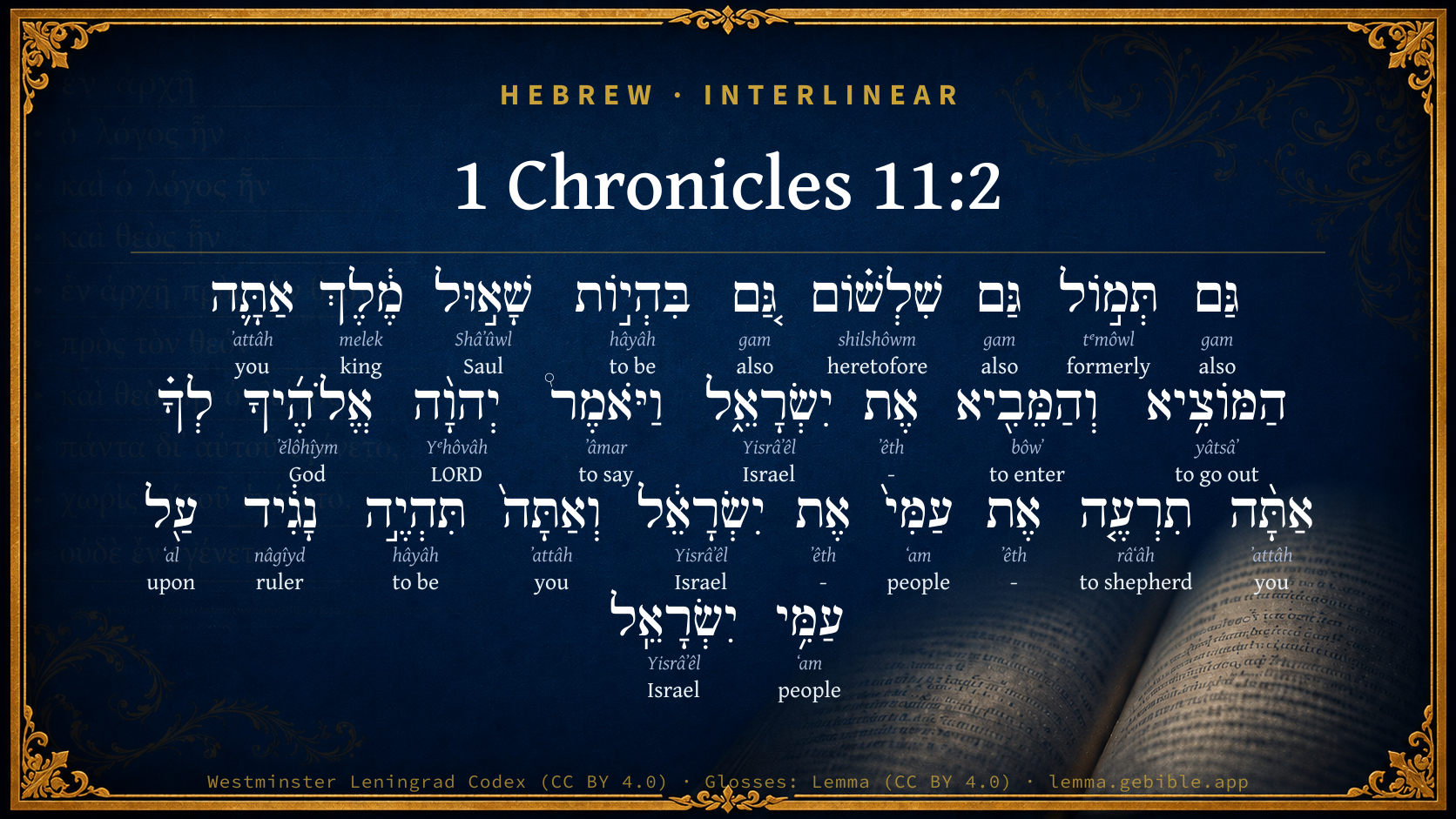
Hebrew (Westminster Leningrad Codex) 1 Chronicles 11:2 appears in the Hebrew Old Testament. The text above is from the Westminster Leningrad Codex. Each word links to its Strong’s number, a concise gloss, and parsing drawn from the Open Scriptures Hebrew Bible morphology. Click any word for its full Brown-Driver-Briggs (BDB) entry.
Download image
Cite this verse

1 Chronicles 11:2 (World English Bible). Public Domain. Lemma interlinear Bible study tool, https://lemma.gebible.app/v/1-chronicles/11/2.

Show BibTeX & RIS
BibTeX
RIS
English Translation
In times past, even when Saul was king, it was you who led out and brought in Israel: and Yahweh your God said to you, You shall be shepherd of my people Israel, and you shall be prince over my people Israel.
World English Bible · Public Domain
Download a study sheet

One document with this verse’s original text, its word-by-word gloss line, the meaning frame, cross-references with their text, attributed commentary, and full source and license credits — printable, and it pastes into notes with its structure intact.

This verse Autodidact and up

Study sheet (.html) Plain text (.txt)

A passage Seminary Student

Up to 50 verses in one chapter. A passage sheet keeps up to 6 commentary sources and 12 cross-references per verse, in the order this page ranks them, and says so on the sheet whenever that leaves anything out. Ask for a single verse and you get the Autodidact verse sheet above.

Everything on this page stays free to read, with no account — the sheet is a download of what is already on screen, not access to it.

Want to remove ads? Support Godless Engineer
Compare translations 3

The same verse in 3 English versions, stacked beneath the original-language interlinear above. Click any original word for its lexicon entry.

Each is an independent rendering of the whole verse — the interlinear is not word-aligned to these translations.

Highlighted words mark where these versions differ — a whole-verse word diff, not a word-by-word alignment.

  • World English Bible Public Domain
    In times past, even when Saul was king, it was you who led out and brought in Israel: and Yahweh your God said to you, You shall be shepherd of my people Israel, and you shall be prince over my people Israel.
  • King James Version Public Domain
    And moreover in time past, even when Saul was king, thou wast he that leddest out and broughtest in Israel: and the LORD thy God said unto thee, Thou shalt feed my people Israel, and thou shalt be ruler over my people Israel.
  • unfoldingWord Literal Text CC BY-SA 4.0
    Both yesterday and the third day, even when Saul was king, you were bringing out and bringing in Israel. And Yahweh your God said to you, ‘You, you will shepherd my people, Israel, and you, you will become the ruler over my people Israel.’”

unfoldingWord Literal Text — © unfoldingWord, licensed CC BY-SA 4.0. Word-aligned USFM3 via Door43 (git.door43.org/unfoldingWord/en_ult).

Versions to compare (up to 4)

3 of 4 selected

Show all 18 translations

Every available English version of this verse, each an independent rendering of the whole verse.

  • World English Bible Public Domain
    In times past, even when Saul was king, it was you who led out and brought in Israel: and Yahweh your God said to you, You shall be shepherd of my people Israel, and you shall be prince over my people Israel.
  • Berean Standard Bible Public Domain
    Even in times past, while Saul was king, you were the one who led Israel out and brought them back. And the LORD your God said, ‘You will shepherd My people Israel, and you will be ruler over them.’”
  • Majority Standard Bible Public Domain
    Even in times past, while Saul was king, you were the one who led Israel out and brought them back. And the LORD your God said, ‘You will shepherd My people Israel, and you will be ruler over them.’”
  • King James Version Public Domain
    And moreover in time past, even when Saul was king, thou wast he that leddest out and broughtest in Israel: and the LORD thy God said unto thee, Thou shalt feed my people Israel, and thou shalt be ruler over my people Israel.
  • American Standard Version (1901) Public Domain
    In times past, even when Saul was king, it was thou that leddest out and broughtest in Israel: and Jehovah thy God said unto thee, Thou shalt be shepherd of my people Israel, and thou shalt be prince over my people Israel.
  • Revised Version (1885) Public Domain
    In times past, even when Saul was king, it was thou that leddest out and broughtest in Israel: and the LORD thy God said unto thee, Thou shalt feed my people Israel, and thou shalt be prince over my people Israel.
  • Geneva Bible (1599) Public Domain
    And in time past, euen when Saul was King, thou leddest Israel out and in: and the Lord thy God sayde vnto thee, Thou shalt feede my people Israel, and thou shalt be captaine ouer my people Israel.
  • Douay-Rheims (1899) Public Domain
    Yesterday also, and the day before when Saul was king, thou wast he that leddest out and broughtest in Israel: for the Lord thy God said to thee: Thou shalt feed my people Israel, and thou shalt; be ruler over them.
  • Young's Literal Translation Public Domain
    even in time past, even in Saul's being king, it is thou who art taking out and bringing in Israel, and Jehovah thy God saith to thee: Thou dost feed My people Israel, and thou art leader over My people Israel.'
  • Literal Standard Version CC BY-SA 4.0
    even in time past, even in Saul’s being king, it is you who are taking out and bringing in Israel, and your God YHWH says to you: You feed My people Israel, and you are leader over My people Israel.”
  • Unlocked Literal Bible CC BY-SA 4.0
    In the recent past, when Saul was king over us, it was you who led the Israelite army. Yahweh your God said to you, 'You will shepherd my people Israel, and you will become a ruler over my people Israel.'”
  • unfoldingWord Literal Text CC BY-SA 4.0
    Both yesterday and the third day, even when Saul was king, you were bringing out and bringing in Israel. And Yahweh your God said to you, ‘You, you will shepherd my people, Israel, and you, you will become the ruler over my people Israel.’”
  • Darby Bible Public Domain
    Even aforetime, even when Saul was king, thou wast he that leddest out and broughtest in Israel; and Jehovah thy God said to thee, Thou shalt feed my people Israel, and thou shalt be prince over my people Israel.
  • World Messianic Bible Public Domain
    In times past, even when Saul was king, it was you who led out and brought in Israel. The LORD your God said to you, ‘You shall be shepherd of my people Israel, and you shall be prince over my people Israel.’”
  • Webster's Bible Public Domain
    And moreover in time past, even when Saul was king, thou wast he that leddest out and broughtest in Israel: and the LORD thy God said to thee, Thou shalt feed my people Israel, and thou shalt be ruler over my people Israel.
  • Free Bible Version CC BY-SA 4.0
    In recent times, even though Saul was king, you were the real leader of Israel. The Lord your God told you, ‘You will be the shepherd of my people, and you will be the leader of my people Israel.’”
  • Bible in Basic English Public Domain
    In the past, when Saul was king, it was you who went at the head of Israel when they went out or came in; and the Lord your God said to you, You are to be the keeper of my people Israel, and their ruler.
  • JPS Tanakh (1917) Public Domain
    In times past, even when Saul was king, it was thou that didst lead out and bring in Israel; and the LORD thy God said unto thee: Thou shalt feed My people Israel, and thou shalt be prince over My people Israel.'

Literal Standard Version (2020), Covenant Press — licensed CC BY-SA 4.0. Text via the HelloAO Bible API (eBible.org). Unlocked Literal Bible (unfoldingWord) — licensed CC BY-SA 4.0. Text via the HelloAO Bible API (eBible.org). unfoldingWord Literal Text — © unfoldingWord, licensed CC BY-SA 4.0. Word-aligned USFM3 via Door43 (git.door43.org/unfoldingWord/en_ult). Free Bible Version, Dr. Jonathan Gallagher — licensed CC BY-SA 4.0. Text via the HelloAO Bible API (eBible.org).

Word by word

More ways to search: Search by grammar → Find every occurrence → Compare this word →

Practice this passage: Drill this verse → Learn its vocabulary →

תְּמ֣וֹל
tᵉmôwl
H8543
“formerly”
Adverb
Part of Speech
Adverb
Full BDB Definition

Origin: probably for H865

TWOT: 2521

before, before that time, beforetime, heretofore, of late, of old, these days, time(s) past, yesterday, day before yesterday, recently, formerly - yesterday - recently, formerly (usual usage) (figuratively) - as formerly, so more recently - from yesterday, already
  1. גַּם gam H1571 “also” Particle, Accusative
  2. גַּם gam H1571 “also” Particle, Accusative
  3. שִׁלְשׁ֗וֹם shilshôwm H8032 “heretofore” Noun, Common, Masculine, Singular, Absolute
  4. גַּ֚ם gam H1571 “also” Particle, Accusative
  5. בִּהְי֣וֹת hâyâh H1961 “in/at · to be” Preposition + Verb, Qal, Infinitive Construct
  6. שָׁא֣וּל Shâʼûwl H7586 “Saul” Noun, Proper
  7. מֶ֔לֶךְ melek H4428 “king” Noun, Common, Masculine, Singular, Absolute
  8. אַתָּ֛ה ʼattâh H859 “you” Pronoun, Personal, 2nd Person, Masculine, Singular
  9. הַמּוֹצִ֥יא yâtsâʼ H3318 “the · going out” Particle, Definite Article + Verb, Hiphil, Participle Active, Masculine, Singular, Absolute
  10. וְהַמֵּבִ֖יא bôwʼ H935 “and · the · entering” Conjunction + Particle, Definite Article + Verb, Hiphil, Participle Active, Masculine, Singular, Absolute
  11. אֶת ʼêth H853 “-” Particle, Direct Object
  12. יִשְׂרָאֵ֑ל Yisrâʼêl H3478 “Israel” Noun, Proper
  13. וַיֹּאמֶר֩ ʼâmar H559 “and · to say” Conjunction + Verb, Qal, Sequential Imperfect, 3rd Person, Masculine, Singular
  14. יְהוָ֨ה Yᵉhôvâh H3068 “LORD” Noun, Proper
  15. אֱלֹהֶ֜יךָ ʼĕlôhîym H430 “God(s) · your” Noun, Common, Masculine, Plural, Construct + Suffix, Personal, 2nd Person, Masculine, Singular
  16. אַתָּ֨ה ʼattâh H859 “you” Pronoun, Personal, 2nd Person, Masculine, Singular
  17. תִרְעֶ֤ה râʻâh H7462 “to shepherd” Verb, Qal, Imperfect, 2nd Person, Masculine, Singular
  18. אֶת ʼêth H853 “-” Particle, Direct Object
  19. עַמִּי֙ ʻam H5971 “people · my” Noun, Common, Masculine, Singular, Construct + Suffix, Personal, 1st Person, Common, Singular
  20. אֶת ʼêth H853 “-” Particle, Direct Object
  21. יִשְׂרָאֵ֔ל Yisrâʼêl H3478 “Israel” Noun, Proper
  22. וְאַתָּה֙ ʼattâh H859 “and · you” Conjunction + Pronoun, Personal, 2nd Person, Masculine, Singular
  23. תִּהְיֶ֣ה hâyâh H1961 “to be” Verb, Qal, Imperfect, 2nd Person, Masculine, Singular
  24. נָגִ֔יד nâgîyd H5057 “ruler” Noun, Common, Masculine, Singular, Absolute
  25. עַ֖ל ʻal H5921 “upon” Preposition
  26. עַמִּ֥י ʻam H5971 “people · my” Noun, Common, Masculine, Singular, Construct + Suffix, Personal, 1st Person, Common, Singular
  27. יִשְׂרָאֵֽל Yisrâʼêl H3478 “Israel” Noun, Proper

About this verse

These counts appear in no published source. They are computed here, from the morphology-tagged text and Lemma’s own curated glosses. What Lemma adds →

29
words
18
distinct lemmas
Historical
section

Notable vocabulary

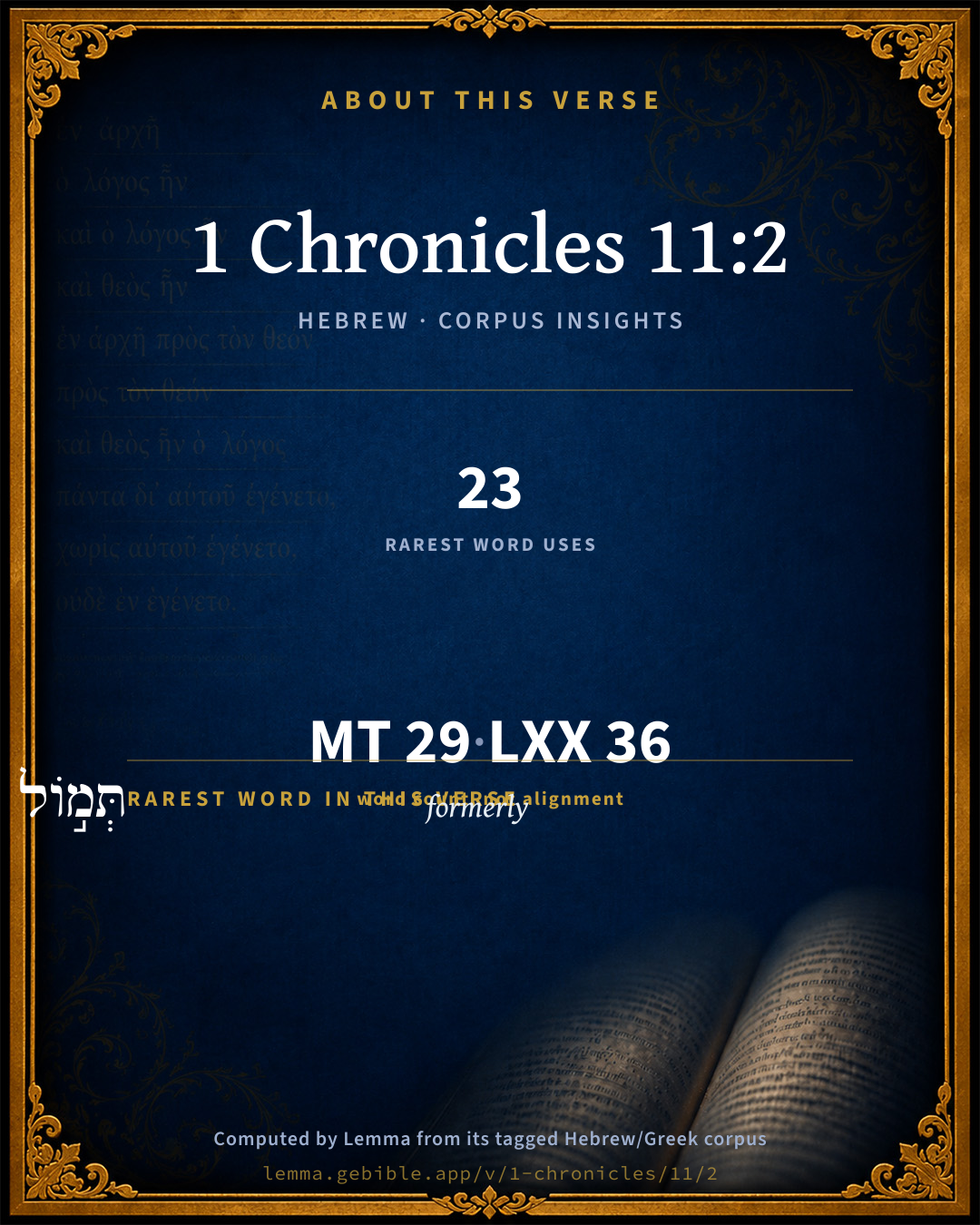
The rarest word here is תְּמ֣וֹל formerly H8543 — appearing just 23 times in the whole Hebrew Bible.

Shared distinctive vocabulary

תְּמ֣וֹל formerly H8543 occurs in 22 verses of the Hebrew Bible. Also found in:

Grammatical profile

  • 6 verbs
  • 11 nouns
  • 3 pronouns
  • 2 prepositions
  • 1 adverb
  • 6 particles

Verb forms

  • בִּהְי֣וֹת Qal · Infinitive Construct
  • הַמּוֹצִ֥יא Hiphil · Participle Active
  • וְהַמֵּבִ֖יא Hiphil · Participle Active
  • וַיֹּאמֶר֩ Qal · Sequential Imperfect
  • תִרְעֶ֤ה Qal · Imperfect
  • תִּהְיֶ֣ה Qal · Imperfect

Repetition

Words recur within this verse — often emphatic in Hebrew:

  • גַּם also H1571 ×3
  • יִשְׂרָאֵ֑ל Israel H3478 ×3
  • בִּהְי֣וֹת to be H1961 ×2
  • עַמִּי֙ people H5971 ×2
  • אַתָּ֛ה you H859 ×3

Hebrew & Septuagint length

In English translation the verse runs 42 words from the Hebrew and 38 from the Septuagint (LXX English) — closely comparable.

A rough comparison of the two English renderings, which tokenize alike — not a word-level alignment.

Word counts can differ between the Hebrew and the Greek without any difference in meaning — e.g. the Hebrew direct-object marker אֵת has no separate Greek word, and Greek often adds the article ὁ.

In the original languages it is 29 Hebrew tokens and 36 Greek tokens — but the two are counted differently (Hebrew bundles its prefixes and suffixes into one token; the Greek is in lemma form), so that isn’t a like-for-like length.

Cross-references

16

Topical passages linked to 1 Chronicles 11:2 in the Treasury of Scripture Knowledge — connected by theme and wording, ordered by reader-vote popularity; previews shown in the World English Bible.

  • 2 Samuel 5:2 In times past, when Saul was king over us, it was you who led out and brought in Israel: and Yahweh said to you, You shall be shepherd of my people Israel, and you shall be prince over Israel.
  • Psalms 78:71 From following the ewes that have their young, He brought him to be the shepherd of Jacob, his people, And Israel, his inheritance.
  • John 10:4 Whenever he brings out his own sheep, he goes before them, and the sheep follow him, for they know his voice.
  • 1 Samuel 16:13 Then Samuel took the horn of oil, and anointed him in the midst of his brothers: and the Spirit of Yahweh came mightily on David from that day forward. So Samuel rose up, and went to Ramah.
  • 1 Samuel 18:13 Therefore Saul removed him from him, and made him his captain over a thousand; and he went out and came in before the people.
  • 2 Samuel 7:7 In all places in which I have walked with all the children of Israel, spoke I a word with any of the tribes of Israel, whom I commanded to be shepherd of my people Israel, saying, Why have you not built me a house of cedar?
  • Matthew 2:6 'You Bethlehem, land of Judah, Are in no way least among the princes of Judah: For out of you shall come forth a governor, Who shall shepherd my people, Israel.'"
  • Numbers 27:17 who may go out before them, and who may come in before them, and who may lead them out, and who may bring them in; that the congregation of Yahweh not be as sheep which have no shepherd.
  • 1 Samuel 16:1 Yahweh said to Samuel, How long will you mourn for Saul, seeing I have rejected him from being king over Israel? fill your horn with oil, and go: I will send you to Jesse the Bethlehemite; for I have provided me a king among his sons.
  • 1 Kings 3:9 Give your servant therefore an understanding heart to judge your people, that I may discern between good and evil; for who is able to judge this your great people?
  • 1 Kings 14:7 Go, tell Jeroboam, Thus says Yahweh, the God of Israel: Because I exalted you from among the people, and made you prince over my people Israel,
  • Isaiah 40:11 He will feed his flock like a shepherd, he will gather the lambs in his arm, and carry them in his bosom, [and] will gently lead those who have their young.
  • Isaiah 55:4 Behold, I have given him for a witness to the peoples, a leader and commander to the peoples.
  • Jeremiah 3:15 and I will give you shepherds according to my heart, who shall feed you with knowledge and understanding.
  • Micah 5:2 But you, Bethlehem Ephrathah, Being small among the clans of Judah, Out of you one will come forth to me that is to be ruler in Israel; Whose goings forth are from of old, from everlasting.
  • Micah 5:4 He shall stand, and shall shepherd in the strength of Yahweh, In the majesty of the name of Yahweh his God: And they will live, for then he will be great to the ends of the earth.

Cross-references courtesy of OpenBible.info (CC BY 4.0).

Hebrew and Greek witnesses Masoretic Hebrew ↔ Greek Septuagint

The same verse in the two great witnesses to the Old Testament, shown verse-for-verse.

These are two independent witnesses, not word-aligned to each other, and the Septuagint is shown in lemma (dictionary) form.

Hebrew 1 Chronicles 11:2 Masoretic · Westminster Leningrad Codex

גַּם תְּמ֣וֹל גַּם שִׁלְשׁ֗וֹם גַּ֚ם בִּהְי֣וֹת שָׁא֣וּל מֶ֔לֶךְ אַתָּ֛ה הַמּוֹצִ֥יא וְהַמֵּבִ֖יא אֶת יִשְׂרָאֵ֑ל וַיֹּאמֶר֩ יְהוָ֨ה אֱלֹהֶ֜יךָ לְךָ֗ אַתָּ֨ה תִרְעֶ֤ה אֶת עַמִּי֙ אֶת יִשְׂרָאֵ֔ל וְאַתָּה֙ תִּהְיֶ֣ה נָגִ֔יד עַ֖ל עַמִּ֥י יִשְׂרָאֵֽל

In times past, even when Saul was king, it was you who led out and brought in Israel: and Yahweh your God said to you, You shall be shepherd of my people Israel, and you shall be prince over my people Israel.

World English Bible · Public Domain

Greek LXX 1 Chronicles 11:2 Septuagint · lemma form

καί ἐχθές καί τρίτος εἰμί σαούλ βασιλεύς σύ εἰμί ὁ ἐκἄγω καί εἰςἄγω ὁ ἰσραήλ καί εἶπον κύριος ὁ θεός σύ σύ σύ ποιμαίνω ὁ λαός ἐγώ ὁ ἰσραήλ καί σύ εἰμί εἰς ἡγέομαι ἐπί ἰσραήλ

And heretofore when Saul was king, you were he that led Israel in and out, and the Lord of Israel said to you, You shall feed my people Israel, and you shall be for a ruler over Israel.

LXX2012 (modern English Septuagint) · Public Domain

Hebrew: Westminster Leningrad Codex (CC BY 4.0). Greek: Septuagint (public domain); English from LXX2012 (modern English Septuagint) (Public Domain). How the Septuagint differs from the Hebrew →

Commentary

Notes on 1 Chronicles 11:2 from classic Christian and Jewish commentators (each source and its license shown beneath its notes). The classic Christian expositions comment on the surrounding passage and are grouped to its opening verse, so a note may address several verses; the Jewish commentaries on the Tanakh (Rashi and others) are per-verse, so they appear only where the commentator wrote on this verse.

Lemma curates 59 commentaries, every one of them public domain or Creative Commons licensed, each selected and text-cleaned for this edition rather than reprinted as found. About our sources →

Trapp's Complete Commentary

John Trapp

1Ch 11:2 And moreover in time past, even when Saul was king, thou [wast] he that leddest out and broughtest in Israel: and the LORD thy God said unto thee, Thou shalt feed my people Israel, and thou shalt be ruler over my people Israel.

Ver. 2. Thou shalt feed,] sc., By procuring for them the wholesome food of the word; by going before them in good example; by driving away the wolf; by tending them, and tendering their good every way.

John Trapp, A Commentary or Exposition upon All the Books of the Old and New Testament (1647–1656) — public domain. Text from a community e-Sword module.

Ellicott's Commentary for English Readers

(2) In time past.—Yesterday, or three days since. A very indefinite phrase, used in Gen_31:2 of a time fourteen years since, and 2Ki_13:5 of more than forty years ago.

Leddest out.—To battle.

Broughtest in.—Of the homeward march. David had thus already discharged kingly functions. (Comp. 1Sa_8:20; 1Sa_18:6; 1Sa_18:13; 1Sa_18:27; 2Sa_3:18.)

The Lord thy God said unto thee.—1Sa_16:13.

Thou shalt feed my people.—Literally, shepherd or tend them. The same term is used of the Lord Himself (Isa_40:11; Psa_80:1). The king then is God’s representative, and as such his right is really Divine (Rom_13:1). The cuneiform documents reveal the interesting fact that the term “shepherd,” as applied to sovereigns, is as old as the pre-Semitic stage of Babylonian civilisation (the second millennium B.C. ).

A Bible Commentary for English Readers, edited by Charles John Ellicott (1878–1897) — public domain. Text from a community e-Sword module.

The Cambridge Bible for Schools and Colleges

gen. ed. J. J. S. Perowne

2. And moreover] Omit these words with R.V.

thou wast he that leddest out] R.V. it was thou that leddest out; cp. 1Sa_18:16.

the Lord thy God said] Cp. 1Ch_11:3; 1Ch_11:10; 1Sa_16:1-13.

ruler] R.V. prince; cp. 1Ch_5:2, note.

The Cambridge Bible for Schools and Colleges (gen. ed. J. J. S. Perowne; Cambridge University Press, 1878–1918) — public domain. Text from a community e-Sword module.

Matthew Poole's English Annotations

God said unto thee, or, concerning thee; for it is apparent that they knew of it; and therefore many of them opposed David hitherto against their own consciences.

Matthew Poole's English Annotations on the Holy Bible (1683–1685) — public domain. Text from a community e-Sword/MySword module.

The Pulpit Commentary

Thou shalt feed my people Israel (so 2Sa_5:2 2Sa_7:7; Psa_78:71) Thus to the servant is condescendingly vouchsafed the same description as the Master takes through the Spirit for himself to the under-shepherd the same as the Chief Shepherd acknowledges; note same psalm, ver. 72; Psa_23:1-4 Psa_100:3; 1Pe_5:4.

Ver. 2.

The vicarious aspects of human life twofold toward man and toward God.

In this verse two leading and very important phases of human life are brought to our remembrance. They may seem of unequal importance, the second being of higher character than the first. Yet, perhaps, they are more closely connected and even interwoven with one another than first thoughts might suppose. And so far-reaching and widespread are the issues of both, that it is needless to insist on much comparison between them to the prejudice of the former. The lesson, also, of both of them, charged though it is with serious responsibility, is, on the whole, of a cheerful, elevating kind. We might do well to separate them sometimes in our private meditation, simply in order to fix a more specific attention upon each. But it is not without valuable suggestion that they stand together here, nor shall they be divorced in the present consideration of them. They remind us

I OF THE VICARIOUS PRINCIPLE THAT ENTERS SO LARGELY INTO HUMAN LIFE, PERVADING IT, ALMOST LEAVENING IT, IN MEN"S MUTUAL RELATIONS. In the illustration of it now before us, it shows itself in the shape and the fact of one enjoying royal name and place, wealth and ease and dignity, while another incurs the risk and does the work without pay of that place. The life that was lived as between Saul and David would no doubt produce many instances and forms of this, but the one mentioned in this verse, and mentioned as it would appear by many consentient voices at the same time, is enough to tell the tale. Those instances commenced from the time that David challenged, defied, and successfully overcame Goliath, the Philistine champion. But as time went on, they became systematized and almost the rule, rather than merely matter of frequent occurrence. The general fact is patent. It grows in the structure, it runs throughout and across the texture of human life and society. It is a phenomenon, often merely as such inviting, often provoking, the deep thoughtful study of those who are but onlookers at any time. But again, it is as a personal keen experience that it most commonly opens the eyes and wakens the aching inquiry of those who have first suffered many a pang and rasping mortification. The real inventor is often a very different man from the nominal one, the real workman another than he who carries off the praise. The hand of one takes the gain of what was wrought by the brain of another; and the smile of one has for its correlative the bleeding heart of another. The temples of the fortune and wealth and splendour of the very few are built on the excessive toil and wrecked health of vast numbers. And even in the natural order of things, the fame of the great rests on the substructure of millions of lives of the humble obscure, whose industry, honesty, endurance, are the staple and the strength of the whole community, and whose head and heart are often of the most superior. The edifice that towers the highest, in fact, must rest on the broadest base. These considerations may guide us to the following conclusions upon the general subject, suggested by the particular instance so naively expressed now before us:

1. There is, beyond doubt, a vast amount of gratuitous, unjust, cruel,vicarious suffering in the world, and found in men"s mutual relations.

2. There is also, beyond doubt, a vast amount of vicarious joy and advantage. The striving, the toil, the genius, the self-sacrifice of one often serve, not the private selfish advantage of some one other, but to a most beneficent degree they serve the advantage and help the joy of very many others.

3. Whether it be in the matter of suffering or of advantage and joy, thispresence is by no means all due to the action, and mournful action, of human selfishness, error, greed. There is Divine design in it, Divine use for it. It is one of the strongest of the cohesive forces that contribute to hold together the conglomerate mass and yet very various fellowship of humanity. The entanglement that results from this unequal system of exchange and substitution (the particular instances of which are so intricate, often so inscrutable, apparently untoward) constitutes probably one of the most ubiquitous and unresting of the mutual attachments and attractions of human society.

4. Even within the experience of the very individual at whose expenseawhile the vicariousness seems to take effect, there are not unfrequently large redeeming and compensating considerations. As for instance here:

(1) David had the opportunity given to him of learning, learning well, the profession of a king, learning it practically, "even when Saul was king" in reality. If he were doing work and encountering risk, which formally did not belong to him, he was deriving untold advantages and the facilities of experience.

(2) He was being divinely permitted to mark himself out for the dignity when it should become vacant, in the eyes of all those with whom, ere long, the decision and gift of it would, under God, rest. How many men, in how many directions, would value just the corresponding opportunity above all things! How much would it be worth to one!

(3) Even during learning, education, and possibly much suffering, David was evidently, to the eye that could see deepest, to the heart that should beat truest, receiving the decoration of real honour. To a great mind, to a pure heart, it is sometimes the highest investment of honour which could be conferred, to be the one divinely selected to do the work, while others take the pay. This is not of man, nor by man, but God"s own chosen children recognize and value above everything else what are also his chosen methods of reward.

II OF THE VICARIOUS PRINCIPLE THAT ENTERS SO LARGELY INTO HUMAN LIFE, IN ITS MOST DIRECT DIVINE RELATIONS. The latter part of the verse before us is of the highest and most precious significance to every Christian man, and certainly not least so to the Christian pastor and minister. "The Lord thy God said unto thee, Thou shalt feed my people Israel, and thou shalt be ruler over my people Israel." Every servant of God from the first was set to be a witness of God and a witness for God, by word and deed before the world. And every Christian is called to be a witness of Jesus Christ and his truth, and a witness for these before the world, in all he says and does. We object to such an appellation as "vicar of Christ," or "viceroy" of Christ, on behalf of the pope or of any other one man exclusively of others. But the description of the latter part of this verse applies accurately to all the pastors the under-shepherds of Christ"s fold and flocks and by inference, in their measure and degree, to all his people whomsoever. All of these have something to say, have much to do, in the stead of Christ." Nor should they repine when they may be called to bear and suffer in the Name and for the sake of Christ. The fact before us is just simply this, that David was entrusted by God and on behalf of God with a great work, which was and could be only the work of God himself in the last resort. The people are emphatically his; none could provide the food but he; (Psa_23:1) none could find the wisdom to rule, "the wisdom profitable to direct," the gift to "rule" but he. And he said, nevertheless, "Thou shalt feed thou shalt be ruler over my people Israel." Out of the one simple but great fact before us we may select some special phases of it.

1. It is a very elevating reality of human life and work that it is not altogether shut off to a drudgery peculiar to itself, but that it is dignified by being called to similar work with that of Christ. The power, the wisdom, the love, the very thought of that work must first come from heavenly source, and be sustained by streams from the heavenly source; but then these should often betray their heavenly origin, and the human worker flash out tokens of the indwelling of Divine principle, gift, grace. It had been quite possible to suppose a hard-and-fast line drawn between the humblest of the Divine work amid men and the very highest of the human. But it is not so. It is far otherwise. And so soon as ever the clear pattern was shown on earth by Jesus himself, of what was to be and to be done, not a very few and a very picked band, but every one of his wide Church, was called to do

2. similar work yes, to do it and to bear the burden of it, and that not with eye-service as to men, but "as the servants of Christ.

3. It is a very elevating and encouraging fact in the renewed life ofhumanity that with such solemn responsibility attaching to it in work to be done, no less than Godlike in character, no less than Christ-like in execution, it is work not severed from Divine co-operation. Let us call it vicarious. Let us the rather prize it as such, and love to have it so. " Yet is it not the cold vicariousness of so large a proportion of our earthly labour unwarmed by the presence, by the help, by the smile, by the reward of at least acknowledgment at the hands of those for whom we both do and bear much. No, indeed. It is work of co-operation, where in those cooperating extremes meet the weakness, the poverty, the ignorance, the finiteness of us men, with the omnipotence, the wealth, the knowledge, and the infiniteness of God the Father; of Christ, the Shepherd of the sheep; of the Spirit of all grace and light. None work for God but his Spirit is with them. None work for Jesus but "lo, he is present in the midst" of their smallest group. Therefore it is plain that God does not so honour us as simply to devolve his work in Christ upon us, but rather to involve us in his doing, and lift us up into his sphere of work. The co-operating of Christ by his Spirit with his servants, when their work and their suffering shall seem most vicarious, is therefore a grand and most noteworthy fact as compared with our labour-relations and our suffering-relations, as fellow-creatures, to one another.

4 . Over and above all other elevating and cheering thoughts suggested bythis fact of God"s calling us to work for him, and yet uniting himself with us therein, there remains such a one as this. It is a token of a certain harmony of plan and thought between human society and the perfection of that above. It is some "shadow of things to come." It is some foreshadowing of Divine goodness. The condescension and the grace are some indications of what shall be. They are not mere fictitious, tempting, beguiling persuasions of the way, for the "pilgrims of the night;" but they are rather snatches and earnests of the temper prevailing in the "city yet to come." It is a large and far from ignoble principle, the vicarious principle cost what it may of smart, occasionally or systematically, amongourselves. But it is an indefinite extension, an immense expansion, it is a very glorification of the principle, when Christ enters on a similar footing and makes the circle henceforth a sacred circle. After doing and suffering all which he has done, "even unto death," for his people, he not simply hallows by his own example the summons to us to work and to suffer for our fellow-creatures and for him, but also favours therein the thought, in its very highest development, of our being "one with him, even as he is one with" the eternal Father. In a word, to work or to suffer in the stead of Christ is some earnest of entering in clue time the society of which he is the Head.

HOMILIES BY J.R. THOMSON Ver. 2.

A true leader.

David"s life was made up of several successive stages; and, as we read his biography and so trace his course, we see clearly what at the time he could not see how one position, one experience, prepared for the next. His youth was a preparation for his manhood, his court life for the throne, exile for power, rule over Judah for sway over united Israel. The seven years during which Saul"s son ruled over the other tribes were the years of David"s reign over Judah. At the close of this period, upon the death of Ishbosheth, the elders of all Israel came to David at Hebron and offered him the crown. This was the occasion upon which they made the acknowledgment, "Even when Saul was king, thou wast he that leddest out and broughtest in Israel." This was a recognition of the inborn qualities of true leadership, called forth by circumstances, and cultivated by responsibility and action.

I HUMAN SOCIETY IS, ACCORDING TO THE APPOINTMENT OF DIVINE PROVIDENCE, COMPOSED OF THE LEADERS AND THE LED. Whilst in government there is much which is artificial, there is a natural foundation for the relationships which subsist. Parents direct the course of their children; elder brothers to some extent that of the younger; the capable, the self-confident, the experienced, are the natural leaders of the timid and submissive. In all human communities there are born leaders of men. If all distinctions were abolished to-day, to-morrow they would be revived in other forms. There is doubtless injustice in many political and social arrangements; but whilst the unjust acquisition and use of authority is of man, the principle of authority is from God.

II LEADERSHIP OFTEN CALLS OUT GREAT QUALITIES. The fact of a man being placed in a position of influence and authority is sure, if he be capable and strong and under the domination of high principle, to elicit his best and most useful qualities. Especially will such a position foster habits of sound judgment and quick decision, habits of self-control and self-reliance, a just discernment of character, and aptness in recognizing ability and trustworthiness in others. Thus it is that a high position is fitted to lead to one yet higher (see this admirably shown in Henry Taylor"s "Philip van Artevelde"). It was leadership which made of the shepherd son of Jesse the warrior and King of Israel. As in other departments of life, so here, exercise promotes strength and development. Let none shrink from the responsibility of guiding others when Providence calls him to this work; strength and wisdom shall be "as his day.

III IT IS FOR THE ADVANTAGE OF THOSE WHO ARE LED WHEN A SUITABLE AND CAPABLE LEADER IS PROVIDED BY THE DIVINE RULER. The power of "use and wont" is very strong. When men have been accustomed to be well led, their confidence in their leader grows with rapidity, and their attachment is consolidated by time. When the throne was vacant, the eyes of all Israel were turned to David. Their experience of his ability and valour, his designation by God"s prophet, were the indications to them that the son of Jesse was the right man to rule over them. Events proved that they were not mistaken. The sway of David made the chosen people one great nation, and fitted them for the work appointed for them by the theocratic governor. There is in this passage a lesson specially suitable to young men of ability, education, and position. For such God in his providence has assuredly a work to do. It is for them quietly and patiently to await the indications of Divine providence, in the persuasion that faithfulness and diligence in present duty are the best preparation for future responsibilities. It is God"s prerogative to train the workman and to provide the work. T.

The Pulpit Commentary (1880–1919), ed. H.D.M. Spence-Jones & Joseph S. Exell — public domain. Text from a community e-Sword module.

Rashi

Rabbi Shlomo Yitzchaki (Rashi)

You shall shepherd My people Concerning this, David said, (Ps. 23:1): “The Lord is my Shepherd, I shall not want.” “You say to me: You shall shepherd. How can I shepherd? The matter does not depend on me, but the Lord is my Shepherd, I shall not want, and I, too, shall not be wanting to you.” A similar instance is found in Samuel (II 21:17): “Then the men of David swore to him, saying, ‘You shall no longer go out with us in battle, so that you extinguish not the lamp of Israel.’” David replied (ibid. 22:29): “For You are my lamp, O Lord; and the Lord does light my darkness.”

Rashi on the Tanakh — English translations: “The Judaica Press complete Tanach with Rashi, translated by A. J. Rosenberg” (CC BY 4.0); “Pentateuch with Rashi's commentary by M. Rosenbaum and A.M. Silbermann, 1929-1934” (public domain); “The Metsudah Tanach series, Lakewood, N.J” (CC BY 4.0); and “The Book of Joshua, Metsudah Publications, 1997” (CC BY 4.0). Text via Sefaria.

Lesson kit

Teaching starters — assembled from the data on this page, not authored interpretation. Every prompt links to the verse data it draws on. Edit before teaching.

1 Chronicles, in the Historical, opens this verse with 29 words (18 distinct Hebrew lemmas). Its most distinctive word is tᵉmôwl (“formerly”). A historical commentator’s framing appears above. Read the whole chapter for the surrounding context.

Discussion questions

  1. The word tᵉmôwl carries the sense “formerly.” How does it shape the verse?
  2. How does Genesis 31:2, which shares the word «formerly», read alongside this verse?
  3. What does the repetition of “also” (3× in this one verse) do in this verse?
  4. These translations render this verse differently; the difference is in the English rendering, not the original. What questions does that raise?
  5. «בִּהְי֣וֹת» is a Qal Infinitive Construct verb. How does that grammatical form shape the action described?
  6. Compare how Trapp's Complete Commentary and Ellicott's Commentary for English Readers read this verse. Where do they agree or differ?

Things to notice

Reading settings

Reading text

Shown beneath each verse's original-language words.

Old Testament
Old Testament edition

Read the OT as the Masoretic Hebrew (MT) or the Greek Septuagint (LXX).

English shown for the Greek Septuagint (in the Hebrew ↔ Greek comparison).

Comparing translations? Open the Compare panel on any verse page to stack up to four side by side.