
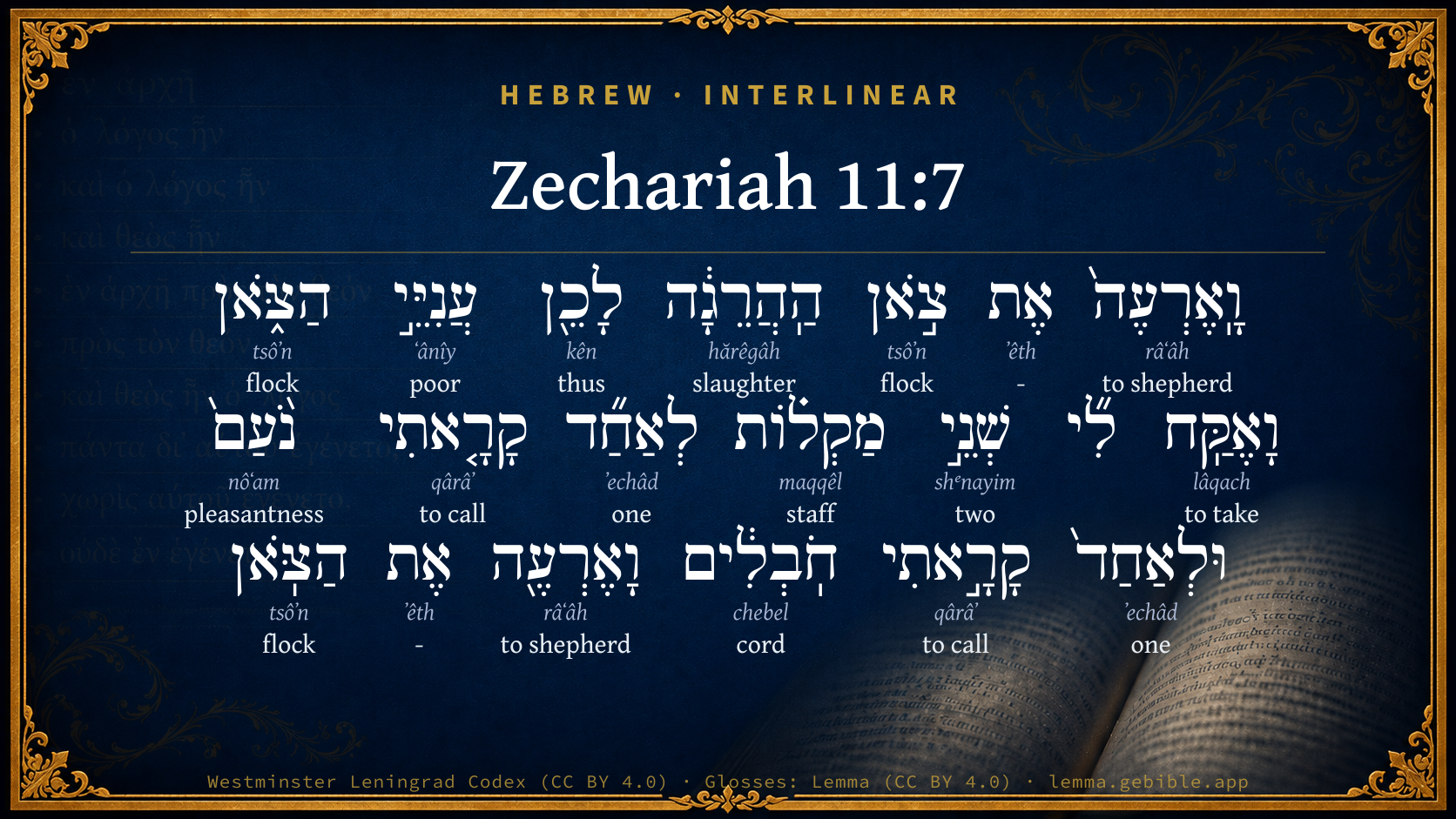
Zechariah 11:7

Hebrew (Westminster Leningrad Codex) Zechariah 11:7 appears in the Hebrew Old Testament. The text above is from the Westminster Leningrad Codex. Each word links to its Strong’s number, a concise gloss, and parsing drawn from the Open Scriptures Hebrew Bible morphology. Click any word for its full Brown-Driver-Briggs (BDB) entry.
Download image
Cite this verse

Zechariah 11:7 (World English Bible). Public Domain. Lemma interlinear Bible study tool, https://lemma.gebible.app/v/zechariah/11/7.

Show BibTeX & RIS
BibTeX
RIS
English Translation
So I fed the flock of slaughter, especially the oppressed of the flock. I took for myself two staffs. The one I called "Favor," and the other I called "Union," and I fed the flock.
World English Bible · Public Domain
Download a study sheet

One document with this verse’s original text, its word-by-word gloss line, the meaning frame, cross-references with their text, attributed commentary, and full source and license credits — printable, and it pastes into notes with its structure intact.

This verse Autodidact and up

Study sheet (.html) Plain text (.txt)

A passage Seminary Student

Up to 50 verses in one chapter. A passage sheet keeps up to 6 commentary sources and 12 cross-references per verse, in the order this page ranks them, and says so on the sheet whenever that leaves anything out. Ask for a single verse and you get the Autodidact verse sheet above.

Everything on this page stays free to read, with no account — the sheet is a download of what is already on screen, not access to it.

Want to remove ads? Support Godless Engineer
Compare translations 3

The same verse in 3 English versions, stacked beneath the original-language interlinear above. Click any original word for its lexicon entry.

Each is an independent rendering of the whole verse — the interlinear is not word-aligned to these translations.

Highlighted words mark where these versions differ — a whole-verse word diff, not a word-by-word alignment.

  • World English Bible Public Domain
    So I fed the flock of slaughter, especially the oppressed of the flock. I took for myself two staffs. The one I called "Favor," and the other I called "Union," and I fed the flock.
  • King James Version Public Domain
    And I will feed the flock of slaughter, even you, O poor of the flock. And I took unto me two staves; the one I called Beauty, and the other I called Bands; and I fed the flock.
  • unfoldingWord Literal Text CC BY-SA 4.0
    So I became the shepherd of the flock marked for slaughter, for those who dealt in sheep. I took two staffs; one staff I called “Favor” and the other I called “Unity.” In this way I shepherded the flock.

unfoldingWord Literal Text — © unfoldingWord, licensed CC BY-SA 4.0. Word-aligned USFM3 via Door43 (git.door43.org/unfoldingWord/en_ult).

Versions to compare (up to 4)

3 of 4 selected

Show all 18 translations

Every available English version of this verse, each an independent rendering of the whole verse.

  • World English Bible Public Domain
    So I fed the flock of slaughter, especially the oppressed of the flock. I took for myself two staffs. The one I called "Favor," and the other I called "Union," and I fed the flock.
  • Berean Standard Bible Public Domain
    So I pastured the flock marked for slaughter, especially the afflicted of the flock. Then I took for myself two staffs, calling one Favor and the other Union, and I pastured the flock.
  • Majority Standard Bible Public Domain
    So I pastured the flock marked for slaughter, especially the afflicted of the flock. Then I took for myself two staffs, calling one Favor and the other Union, and I pastured the flock.
  • King James Version Public Domain
    And I will feed the flock of slaughter, even you, O poor of the flock. And I took unto me two staves; the one I called Beauty, and the other I called Bands; and I fed the flock.
  • American Standard Version (1901) Public Domain
    So I fed the flock of slaughter, verily the poor of the flock. And I took unto me two staves; the one I called Beauty, and the other I called Bands; and I fed the flock.
  • Revised Version (1885) Public Domain
    So I fed the flock of slaughter, verily the poor of the flock. And I took unto me two staves; the one I called Beauty, and the other I called Bands; and I fed the flock.
  • Geneva Bible (1599) Public Domain
    For I fed the sheepe of slaughter, euen the poore of the flocke, and I tooke vnto me two staues: the one I called Beautie, and the other I called Bandes, and I fed the sheepe.
  • Douay-Rheims (1899) Public Domain
    And I will feed the hock of slaughter for this, O ye poor of the dock. And I took unto me two rods, one I called Beauty, and the other I called a Cord, and I fed the flock.
  • Young's Literal Translation Public Domain
    And I feed the flock of slaughter, even you, ye afflicted of the flock; and I take to me two staves, the one I have called Pleasantness, and the other I have called Bands, and I feed the flock.
  • Literal Standard Version CC BY-SA 4.0
    And I feed the flock of slaughter, even you, you afflicted of the flock; and I take two staffs to myself; I have called one Pleasantness, and I have called the other Bands, and I feed the flock.
  • Unlocked Literal Bible CC BY-SA 4.0
    So I became the shepherd of the flock marked for slaughter, for those who dealt in sheep. I took two staffs; one staff I called “Favor” and the other I called “Unity.” In this way I shepherded the flock.
  • unfoldingWord Literal Text CC BY-SA 4.0
    So I became the shepherd of the flock marked for slaughter, for those who dealt in sheep. I took two staffs; one staff I called “Favor” and the other I called “Unity.” In this way I shepherded the flock.
  • Darby Bible Public Domain
    So I fed the flock of slaughter, truly the poor of the flock. And I took unto me two staves; the one I called Beauty, and the other I called Bands; and I fed the flock.
  • World Messianic Bible Public Domain
    So I fed the flock to be slaughtered, especially the oppressed of the flock. I took for myself two staffs. The one I called “Favor” and the other I called “Union”, and I fed the flock.
  • Webster's Bible Public Domain
    And I will feed the flock of slaughter, even you, O poor of the flock. And I took to me two staffs; the one I called Beauty, and the other I called Bands; and I fed the flock.
  • Free Bible Version CC BY-SA 4.0
    So I became a shepherd of the flock marked for slaughter by the sheep merchants. Then I took two staffs, one named Grace, the other named Union, and I shepherded the flock.
  • Bible in Basic English Public Domain
    So I took care of the flock of death, for those who made profit out of the flock; and I took for myself two rods, naming one Beautiful, and the other Bands; and I took care of the flock.
  • JPS Tanakh (1917) Public Domain
    So I fed the flock of slaughter, verily the poor of the flock. And I took unto me two staves; the one I called Graciousness, and the other I called Binders; and I fed the flock.

Literal Standard Version (2020), Covenant Press — licensed CC BY-SA 4.0. Text via the HelloAO Bible API (eBible.org). Unlocked Literal Bible (unfoldingWord) — licensed CC BY-SA 4.0. Text via the HelloAO Bible API (eBible.org). unfoldingWord Literal Text — © unfoldingWord, licensed CC BY-SA 4.0. Word-aligned USFM3 via Door43 (git.door43.org/unfoldingWord/en_ult). Free Bible Version, Dr. Jonathan Gallagher — licensed CC BY-SA 4.0. Text via the HelloAO Bible API (eBible.org).

Word by word

More ways to search: Search by grammar → Find every occurrence → Compare this word →

Practice this passage: Drill this verse → Learn its vocabulary →

הַֽהֲרֵגָ֔ה
hărêgâh
H2028
“the · slaughter”
Particle, Definite Article + Noun, Common, Feminine, Singular, Absolute
Part of Speech
Particle + Noun
Type
Common
Gender
Feminine
Number
Singular
State
Absolute
Full BDB Definition

Origin: from H2027

TWOT: 514b

a killing, slaughter
  1. וָֽאֶרְעֶה֙ râʻâh H7462 “and · to shepherd” Conjunction + Verb, Qal, Sequential Imperfect, 1st Person, Common, Singular
  2. אֶת ʼêth H853 “-” Particle, Direct Object
  3. צֹ֣אן tsôʼn H6629 “flock of” Noun, Common, Both, Singular, Construct
  4. לָכֵ֖ן kên H3651 “to/for · thus” Preposition + Adverb
  5. עֲנִיֵּ֣י ʻânîy H6041 “poor of” Adjective, Adjective, Masculine, Plural, Construct
  6. הַצֹּ֑אן tsôʼn H6629 “the · flock” Particle, Definite Article + Noun, Common, Both, Singular, Absolute
  7. וָאֶקַּֽח lâqach H3947 “and · to take” Conjunction + Verb, Qal, Sequential Imperfect, 1st Person, Common, Singular
  8. שְׁנֵ֣י shᵉnayim H8147 “two” Adjective, Cardinal number, Masculine, Dual, Construct
  9. מַקְל֗וֹת maqqêl H4731 “staves” Noun, Common, Masculine, Plural, Absolute
  10. לְאַחַ֞ד ʼechâd H259 “to/for · one” Preposition + Adjective, Cardinal number, Masculine, Singular, Absolute
  11. קָרָ֤אתִי qârâʼ H7121 “to call” Verb, Qal, Perfect, 1st Person, Common, Singular
  12. נֹ֨עַם֙ nôʻam H5278 “pleasantness” Noun, Common, Masculine, Singular, Absolute
  13. וּלְאַחַד֙ ʼechâd H259 “and · to/for · one” Conjunction + Preposition + Adjective, Cardinal number, Masculine, Singular, Absolute
  14. קָרָ֣אתִי qârâʼ H7121 “to call” Verb, Qal, Perfect, 1st Person, Common, Singular
  15. חֹֽבְלִ֔ים chebel H2256 “cords” Noun, Common, Masculine, Plural, Absolute
  16. וָאֶרְעֶ֖ה râʻâh H7462 “and · to shepherd” Conjunction + Verb, Qal, Sequential Imperfect, 1st Person, Common, Singular
  17. אֶת ʼêth H853 “-” Particle, Direct Object
  18. הַצֹּֽאן tsôʼn H6629 “the · flock” Particle, Definite Article + Noun, Common, Both, Singular, Absolute

About this verse

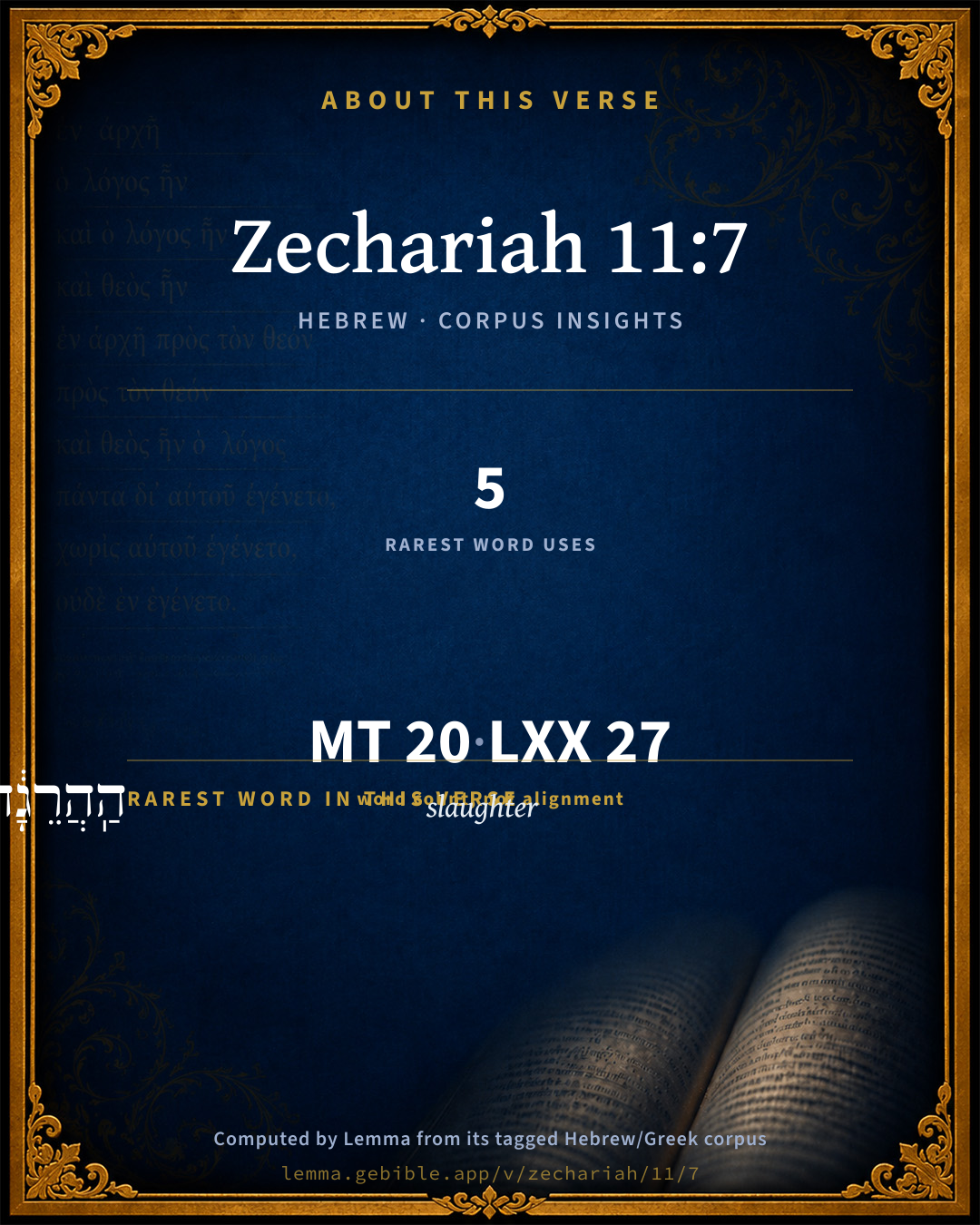
These counts appear in no published source. They are computed here, from the morphology-tagged text and Lemma’s own curated glosses. What Lemma adds →

20
words
13
distinct lemmas
Prophets
section

Notable vocabulary

The rarest word here is הַֽהֲרֵגָ֔ה slaughter H2028 — appearing just 5 times in the whole Hebrew Bible.

Shared distinctive vocabulary

הַֽהֲרֵגָ֔ה slaughter H2028 occurs in 5 verses of the Hebrew Bible. Also found in:

Grammatical profile

  • 5 verbs
  • 7 nouns
  • 4 adjectives
  • 1 preposition
  • 1 adverb
  • 2 particles

Verb forms

  • וָֽאֶרְעֶה֙ Qal · Sequential Imperfect
  • וָאֶקַּֽח Qal · Sequential Imperfect
  • קָרָ֤אתִי Qal · Perfect
  • קָרָ֣אתִי Qal · Perfect
  • וָאֶרְעֶ֖ה Qal · Sequential Imperfect

Repetition

Words recur within this verse — often emphatic in Hebrew:

  • צֹ֣אן flock H6629 ×3
  • וָֽאֶרְעֶה֙ to shepherd H7462 ×2
  • לְאַחַ֞ד one H259 ×2
  • קָרָ֤אתִי to call H7121 ×2

Hebrew & Septuagint length

In English translation the verse runs 35 words from the Hebrew and 38 from the Septuagint (LXX English) — closely comparable.

A rough comparison of the two English renderings, which tokenize alike — not a word-level alignment.

Word counts can differ between the Hebrew and the Greek without any difference in meaning — e.g. the Hebrew direct-object marker אֵת has no separate Greek word, and Greek often adds the article ὁ.

In the original languages it is 20 Hebrew tokens and 27 Greek tokens — but the two are counted differently (Hebrew bundles its prefixes and suffixes into one token; the Greek is in lemma form), so that isn’t a like-for-like length.

Cross-references

20

Topical passages linked to Zechariah 11:7 in the Treasury of Scripture Knowledge — connected by theme and wording, ordered by reader-vote popularity; previews shown in the World English Bible.

  • Isaiah 11:4 but with righteousness shall he judge the poor, and decide with equity for the humble of the earth; and he shall strike the earth with the rod of his mouth; and with the breath of his lips shall he kill the wicked.
  • Zechariah 11:4 Thus says Yahweh my God: "Feed the flock of slaughter.
  • Zechariah 11:14 Then I cut apart my other staff, even Union, that I might break the brotherhood between Judah and Israel.
  • Ezekiel 37:16–23 You, son of man, take one stick, and write on it, For Judah, and for the children of Israel his companions: then take another stick, and write on it, For Joseph, the stick of Ephraim, and [for] all the house of Israel his companions:
  • Psalms 23:4 Even though I walk through the valley of the shadow of death, I will fear no evil, for you are with me. Your rod and your staff, they comfort me.
  • Isaiah 61:1 The Spirit of the Lord Yahweh is on me; because Yahweh has anointed me to preach good news to the humble; he has sent me to bind up the broken-hearted, to proclaim liberty to the captives, and the opening [of the prison] to those who are bound;
  • Zephaniah 3:12 But I will leave in the midst of you an afflicted and poor people, and they will take refuge in the name of Yahweh.
  • Zechariah 11:10–11 I took my staff Favor, and cut it apart, that I might break my covenant that I had made with all the peoples.
  • Ephesians 2:13–16 But now in Christ Jesus you who once were far off are made near in the blood of Christ.
  • Leviticus 27:32 All the tithe of the herds or the flocks, whatever passes under the rod, the tenth shall be holy to Yahweh.
  • 1 Samuel 17:40 He took his staff in his hand, and chose him five smooth stones out of the brook, and put them in the shepherd's bag which he had, even in his wallet; and his sling was in his hand: and he drew near to the Philistine.
  • 1 Samuel 17:43 The Philistine said to David, Am I a dog, that you come to me with sticks? The Philistine cursed David by his gods.
  • Psalms 133:1–3 See how good and how pleasant it is For brothers to live together in unity!
  • Jeremiah 5:4–5 Then I said, Surely these are poor; they are foolish; for they don't know the way of Yahweh, nor the law of their God:
  • Zechariah 13:8–9 It shall happen that in all the land," says Yahweh, Two parts in it will be cut off and die; But the third will be left in it.
  • Matthew 11:5 the blind receive their sight, the lame walk, the lepers are cleansed, the deaf hear, the dead are raised up, and the poor have good news preached to them.
  • Mark 12:37 Therefore David himself calls him Lord, so how can he be his son?" The common people heard him gladly.
  • John 10:16 I have other sheep, which are not of this fold. I must bring them also, and they will hear my voice. They will become one flock with one shepherd.
  • James 2:5 Listen, my beloved brothers. Didn't God choose those who are poor in this world to be rich in faith, and heirs of the Kingdom which he promised to those who love him?
  • John 17:21–23 that they may all be one; even as you, Father, are in me, and I in you, that they also may be one in us; that the world may believe that you sent me.

Cross-references courtesy of OpenBible.info (CC BY 4.0).

Hebrew and Greek witnesses Masoretic Hebrew ↔ Greek Septuagint

The same verse in the two great witnesses to the Old Testament, shown verse-for-verse.

These are two independent witnesses, not word-aligned to each other, and the Septuagint is shown in lemma (dictionary) form.

Hebrew Zechariah 11:7 Masoretic · Westminster Leningrad Codex

וָֽאֶרְעֶה֙ אֶת צֹ֣אן הַֽהֲרֵגָ֔ה לָכֵ֖ן עֲנִיֵּ֣י הַצֹּ֑אן וָאֶקַּֽח לִ֞י שְׁנֵ֣י מַקְל֗וֹת לְאַחַ֞ד קָרָ֤אתִי נֹ֨עַם֙ וּלְאַחַד֙ קָרָ֣אתִי חֹֽבְלִ֔ים וָאֶרְעֶ֖ה אֶת הַצֹּֽאן

So I fed the flock of slaughter, especially the oppressed of the flock. I took for myself two staffs. The one I called "Favor," and the other I called "Union," and I fed the flock.

World English Bible · Public Domain

Greek LXX Zechariah 11:7 Septuagint · lemma form

καί ποιμαίνω ὁ πρόβατον ὁ σφαγή εἰς ὁ χαναανῖτις καί λαμβάνω ἐμαυτοῦ δύο ῥάβδος ὁ εἷς καλέω κάλλος καί ὁ ἕτερος καλέω σχοίνισμα καί ποιμαίνω ὁ πρόβατον

And I will tend the flock of slaughter in the land of Chanaan: and I will take for myself two rods; the one I called Beauty, and the other I called Line; and I will tend the flock.

LXX2012 (modern English Septuagint) · Public Domain

On this verse, Whedon's Commentary on the Bible discusses the Septuagint’s reading. Read the note in Commentary ↓

Hebrew: Westminster Leningrad Codex (CC BY 4.0). Greek: Septuagint (public domain); English from LXX2012 (modern English Septuagint) (Public Domain). How the Septuagint differs from the Hebrew →

Targum (Aramaic paraphrase)

1

The Targum is the ancient Jewish Aramaic paraphrase of the Hebrew Scriptures — an interpretive translation, not the Hebrew text itself. Onkelos (literal) and Pseudo-Jonathan (expansive) render the Torah, and Jonathan the Prophets. Coverage is partial: where no permissively-licensed English translation exists for a verse, only the Aramaic is shown. This is verse-level text, not a word-by-word alignment to the Hebrew.

  1. Targum Jonathan Prophets (Joshua–Malachi)
    וּמַנֵיתִי פַּרְנָסַיָא עַל עַמָא וְאִינוּן שְׁלָטוּ בְהוֹן כְּעָנָא לְנִכְסְתָא מַסְכֵּינוּ וְטַלְטִילוּ יַת עַמִי וְאִתְפְּלִיגוּ קֳדָמַי לְתַרְתֵּין פַּלְגְוָן אִתְפְּלִיגוּ בֵית יִשְׂרָאֵל עַל דְבֵית יְהוּדָה וְקָצוּ בְּמַלְכוּתָא דְבֵית דָוִד דִי בְהוֹן רַעְוָא קֳדָמַי לְמֶהֱוֵי פַּרְנָסִין עַל עַמִי:

    (no public-domain English translation for this verse)

    Targum Jonathan — Aramaic: “Mikraot Gedolot” (public domain). English: “Sefaria Community Translation” (CC0 1.0 (public-domain dedication)); “London "Chaldee Paraphrase," 1871” (public domain). Text via Sefaria.

Commentary

Notes on Zechariah 11:7 from classic Christian and Jewish commentators (each source and its license shown beneath its notes). The classic Christian expositions comment on the surrounding passage and are grouped to its opening verse, so a note may address several verses; the Jewish commentaries on the Tanakh (Rashi and others) are per-verse, so they appear only where the commentator wrote on this verse.

Lemma curates 59 commentaries, every one of them public domain or Creative Commons licensed, each selected and text-cleaned for this edition rather than reprinted as found. About our sources →

Trapp's Complete Commentary

John Trapp

Zec 11:7 And I will feed the flock of slaughter, [even] you, O poor of the flock. And I took unto me two staves; the one I called Beauty, and the other I called Bands; and I fed the flock.

Ver. 7. And will I feed the flock of slaughter, even you, O poor of the flock] Or, as Montanus readeth it, for you, for your sakes, O poor of the flock, i.e. O ye that are poor in spirit, pure in heart, my little flock, as our Saviour’s expression is in Luke. Even for your sakes will I yet for a time spare the reprobate goats, feeding them by my prophets, and provoking them to repentance. The word and sacraments, and all God’s common temporal favours, are, in respect of external participation, communicated to reprobates by way of concomitancy only; because they are intermixed with the elect. Thus tares, mingled among wheat, partake of the fat of the land and moisture of the manure, which was not intended for them.

And I took unto me two staves] viz. That I might therewith do the office of a shepherd; and yet in more than an ordinary manner. For shepherds commonly carry but one staff or crook; or, at most, but a staff on their shoulders and a rod in their hands, as David shows in his pastoral, Psa 23:3. But here are two staves taken; to show, saith Calvin, that God would surpass all the care and pains of men in governing that people.

The one I called Beauty, and the other I called Bands] What these two should mean much ado is made among intrepreters. Some are for the two Covenants; others for the two Testaments; others for the order of Christ’s preaching, sweet and mild at first, terrible and full of threatenings at last, as appeareth in Mat 24:24-25. But what a wild conceit was that of Anthony, Archbishop of Florence, who understood the word of Dominic and his order; construing them thus: I, that is, God, took unto me two staves, viz. Beauty, that is, the order of Preachers, and Bands, that is, the order of Minorites, who are girt with a cord? The sounder sort of expositors make it to be a figure of the two ways which Christ useth at all times in the feeding of his Church; the one by love, guiding them by his word and Spirit; the other by severity, punishing them by the cruel hand of their enemies. See Isa 10:5. Thus Vatablus, Diodati, &c. And that this is the true sense, saith a Lapide, it appeareth: First, because this oracle of the prophet is of the time to come, and not of the time past. Secondly, the event (that best interpreter of prophecies) maketh for it. For first God’s government of the commonwealth of Israel was beautiful and gentle, in the time of the Maccabees and of Christ; and then terrible and destructory, in the time of the Romans, of Nero, Vespasian, Adrian, &c. Thirdly, because a little after the prophet saith that he brake both the staves, that is, he utterly rejected the Jews, and brought his wrath upon them to the utmost, which cannot be meant by any other time than that of Christ, and of Titus. Especially since (in the fourth place) the prophet declareth, Zec 11:13, that the staff of Beauty was broken at the death of Christ, for their unworthy selling and slaughtering of him, as if he had been some slave or base person.

And I fed the flock] q.d. I did my part by them. Thy destruction, therefore, is of thyself, O Israel. England is a mighty animal, saith a politician, which can never die except it kill itself. The same might be much more said of the Jewish commonwealth, which Josephus truly and trimly calleth a Theocratia, or a God government, for the form and first constitution of it; and Moses, in this respect, magnifieth that nation above all other, Deu 4:6-7.

John Trapp, A Commentary or Exposition upon All the Books of the Old and New Testament (1647–1656) — public domain. Text from a community e-Sword module.

Joseph Benson's Commentary

Zec 11:7. And — Or rather, but, I will feed the flock of slaughter, even you — Or, especially you, O poor of the flock — Zechariah here, representing Christ the true shepherd, says, he will enter upon his office, and undertake the care of the flock appointed for the slaughter; even you, O poor of the flock — This clause is explicatory of the former, and by the repetition of it we are shown, that God, in his charge to the prophet, as a type of Christ, and to Christ the antitype, distinguishes clearly between different sorts of people among the Jews; between those that were poor, despised, weak, and humble, and those that were tyrannical, proud, and cruel, and made a prey of their inferiors: these were left out of the pastoral charge; the others were to be taken care of. And I took unto me two staves — These were the proper accoutrements of a shepherd, and these the prophet assumed as a badge of his office, and gave them significant names, which are partly explained, Zec 11:10-14. “The shepherds of old time,” says Lowth, “had two rods, or staves, one turned round at the top, that it might not hurt the sheep: this was for counting them, and separating the sound from the diseased, Lev 27:32; the other had an iron hook at the end of it, to pull in and hold the straying sheep. The psalmist mentions both these, Psa 23:4, Thy rod and thy staff comfort me.” The one I called Beauty — Or, pleasantness, or, delight, as the word נועםmay be rendered, signifying, says Lowth, his favour, gentleness, or kindness toward his people; which was remarkably verified in Christ, whose gracious words, and beneficial works, were conspicuous through the whole course of his life. The other I called Bands — Which the same author interprets of the bond of the new covenant, whereby he intended to unite both the kingdoms of Israel and Judah under himself, as their head and king, Eze 37:22; and then afterward to unite the Jews and the Gentiles into one church, by breaking down the partition wall that was between them. Newcome considers the former, Beauty, as intended to “denote how beautiful and pleasant the land would have been, if its inhabitants had kept their covenant with God.” The other, Bands, “ as signifying the union which ought to have subsisted between Judah and Israel.” Mr. Scott explains “the former word of the honour, privilege, and ornament which the Jews possessed, according to their national covenant, in the oracles, instituted worship, and temple of God; and especially by the ministry of Christ and his apostles, who preached the gospel to them first.” The other, he thinks, means, “the connection of the nation under one government, and the harmony that had, in some measure, hitherto united them, as the flock of God.” Many other interpretations are given of these two names, but as they all are, and must be, in a great measure, founded on conjecture, the reader is not here troubled with them.

Joseph Benson's Commentary on the Old and New Testaments (1811–1818) — public domain. Text from a community e-Sword module.

Whedon's Commentary on the Bible

Daniel D. Whedon

The people’s lack of appreciation, Zec_11:7-8.

The newly appointed shepherd enters upon his tasks with great expectation, but, alas! he is sorely disappointed.

7. Even you, O poor of the flock — R.V., “verily the poor of the flock”; margin, “the most miserable of sheep.” The word translated even you or verily means ordinarily therefore, which gives no sense here. LXX. combines it with the next word into one and reads, “for the Canaanites of the flock”=for the traffickers of the flock (see on Hos_12:7), which would be a reference to the buyers and sellers of Zec_11:5. The divinely appointed shepherd enters upon his tasks with the determination to displace these buyers and sellers who have cruelly abused the flock. LXX.

is probably to be preferred. The means with which the shepherd intended to accomplish his ends are indicated by the two staves which are selected.

Beauty — Margin R.V., “Graciousness.” The staff symbolizes the return of the divine favor to the people. The shepherd meant to emphasize constantly the truth that, in spite of the present suffering, Jehovah is gracious to his people and is ready to shower upon them his blessing, if they will let him.

Bands — Or, union. Zec_11:14 places it beyond doubt that the prophet is thinking of the reunion between the north and south. The promise of such reunion would be an earnest of strength and victory.

Evidently he considers the two staves sufficient to put new life and courage into the ill-treated flock.

I fed — See on Zec_11:4, and reference there.

Daniel D. Whedon (gen. ed.), Commentary on the Old and New Testaments (1874–1909) — public domain. Text from a community e-Sword module.

The Preacher's Complete Homiletical Commentary

Joseph S. Exell (gen. ed.)

CRITICAL NOTES.

Zec_11:7. I] The prophet executed the task committed to him by shepherding a sad (poor) flock. Two staves] “to set forth the kind of double salvation bestowed upon the nation through the care of the Good Shepherd” [Keil]. Beauty] Loveliness or favour (Psa_27:4; Psa_90:17); which Jehovah will give them in protecting them from foes. Bands] Internal union and friendship. Easterns tied a cord or band as a symbol of confederacy (cf. Psa_119:61, marg,).

Zec_11:8.] First act of shepherd. Cut off] Lit. cause to disappear, destroy, or annihilate (Exo_23:23). Three] orders—civil authorities, priests, and prophets (cf. Jer_2:8; Jer_2:18); others, three rulers of Asmonean line—who died by violent death in a short space of time—Hircanus, Alexander, and Antigonus. Loathed] Was straitened for them: “the Divine grief at the misery of his people” [Pusey]. Abhorred] “Nauseated me.”

HOMILETICS

THE TWO STAVES; OR BEAUTY AND BANDS.—Zec_11:7

The two staves are differently explained, indicating, according to some, the double care of Christ for his flock. Henderson takes them as symbols of “the two modes of treatment” which the Jews had experienced “under the guidance and protection of God.” Beauty has been rendered grace or favour. Taken in its connection (Zec_11:10), it means the covenant of God, with all its blessings and special favours. Bands signify unity or brotherhood, which binds men together (Zec_11:14).

I. The staff Beauty. “The one I called Beauty.” This symbolizes—

1. God’s gifts to men. The gifts of pastors, the wisdom of senators, and the power of princes come from God.

2. God’s presence with men. Purity of worship and principle in the nation—holiness in character and usefulness in the Church—are beauties which attract and adorn. The image of God, the beauties of holiness, are most desirable. “Let the beauty of the Lord our God be upon us.”

3. God’s defence of men. God’s covenant was a pledge of defence to them as long as they kept it. Thus God’s favour is better than armies and fleets, wealth and valour, in the protection of a people. This alone beautifies and strengthens. “For God is my defence, and the God of my mercy.”

II. The staff Bands. “The other I called Bands.” Binders symbolize the unity or brotherhood among men.

1. This alone is the gift of God. In the gospel we have a basis of brotherhood, and motives to cement it. The bands of friendship and marriage, the contracts of business, and the treaties of nations may be broken. But in Christ we have a living, universal, and everlasting brotherhood of humanity.

2. How strong art men when thus bound together. Foes without cannot destroy unity within. “Union gives strength and firmness to the humblest aids.”

3. How weak are men when not thus bound together. Factions and civil discords in the nation, divisions in the Church, and discords in the family, will bring ruin. Nothing can beautify or defend a broken people. “Men’s hearts,” says Carlyle, “ought not to be set against one another, but set with one another, and all against the evil thing only.” If you wish to retain strength and beauty, co-operate together, in obedience to the Great Shepherd, and under the rule of Beauty and Bands. “Every kingdom divided against itself is brought to desolation; and every city or house divided against itself shall not stand.”

THE SHEPHERD PROPHET.—Zec_11:7-8

I. The charge. The command was given, “Feed the sheep” (Zec_11:4). Eagerly does the prophet undertake the duty, and become a type of Christ. “Lo, I come to do thy will, O my God.” But notice the condition of the flock.

1. A helpless flock. In the hands of cruel shepherds; bought and sold by strangers, oppressed by native rulers.

2. A miserable flock. “Poor of the flock,” lit. truly miserable sheep. Men may be poor without being miserable. But the Jewish people were reduced to a most unhappy condition. As in the days of Christ, they were harassed and worried (Mat_9:36); lost sheep (Mat_10:36). The poor are not despised, the lost are sought out, and the wounded are healed by the gospel. “I will seek that which was lost, and bring again that which was driven away, and will bind up that which was broken, and will strengthen that which was sick.”

II. The method of executing the charge. “And I fed the flock” (Zec_11:7). He performed, like Christ, the work of a good shepherd to the Jewish nation.

1. He furnished himself with staves. “I took unto me two staves.” He did all he could to bind them together in unity and obedience, and direct them to the grace and favour of God.

2. He destroyed the oppressors of the flock. “I cut off three shepherds.” “These,” says a critic, “were the persons of influence by whom the affairs of the nation were conducted, and to whose wickedness, which reached its culminating point when they crucified the Lord of glory the destruction of the state is to be ascribed.”

3. He was grieved in soul at the condition of the flock. “My soul loathed them.” He witnessed the fearful wickedness of rulers and teachers, He was deeply pained, “vexed from day to day with their unlawful deeds.” This was the feeling of Christ, and will be the feeling of all true shepherds. Sad the wickedness which creates tears of the Saviour! If “every human feeling is greater and larger than the exciting cause,” as Coleridge says, what must be the loathing of him who sees the hearts of all men! “He knew what was in man.”

HOMILETIC HINTS AND SUGGESTIONS

Zec_11:7. I fed the flock. Christ the King of men. The poor in spirit are chosen to be rich in faith, and heirs of his kingdom. “Jehovah in Christ did the work of a Good Shepherd to the Jewish nation during the whole of his earthly ministry (cf. Joh_10:11-14; Joh_14:6; Heb_13:20; 1Pe_2:25)” [Wordsworth].

Zec_11:8. My soul loathed them.

1. Divine compassion. “Loathed,” lit was straitened, the opposite of enlarged towards them, in love and tender compassion (2Co_6:11-12). “His soul was grieved (shortened) for the misery of Israel” (Jdg_10:16).

2. Human abhorrence. “Their soul also abhorred me.” “My soul did not loathe them first, but their soul first despised me, therefore my soul abhorred them.” The soul which drives away God’s good Spirit comes at last to loathe him and the thought and mention of him [Pusey]. No room was left by them for the grace of God, and his favours were rejected [Calvin]. Learn that unbelief creates a mutual distaste between God and the sinner. “Their soul nauseated me” is the real meaning—that alienation from God will lead to God’s withdrawal from men. “I will not feed them” (Zec_11:9).

3. The impenitent flock and the grieved Shepherd. God is infinitely happy and incapable of grief, yet acts as if he felt the sins and miseries of men. “The Good Shepherd lost patience with their perverse impenitence, and they, on the other hand, loathed him for his spirituality and holiness” [Lange]. Christ cannot be rejected with impunity. Even the Jews, who “did it ignorantly in unbelief,” paid a terrible penalty for their crime; how much more terrible will be the punishment of those who have all their unbelief without any of their ignorance [Id.].

ILLUSTRATIONS TO CHAPTER 11

Zec_11:7 (10 and 14). The prophetic narrative which follows differs in its form, in some respects, from the symbolic actions of the prophets, and from Zechariah’s own visions. The symbolic actions of the prophets are actions of their own: this involves acts which it would be impossible to represent, except as a sort of drama. Such are the central points, the feeding of the flock, which yet are intelligent men who understand God’s doings: the cutting off of the three shepherds; the asking for the price; the unworthy price offered; the casting it aside. It differs from Zechariah’s own visions, in that they are for the most part exhibited to the eye, and Zechariah’s own part is simply to inquire their meaning and learn it, and receive further information. Here he himself is the actor, yet representing Another, who alone could cut off shepherds, abandon the people to mutual destruction, annulling the covenant which he had made [Pusey].

The Preacher's Complete Homiletical Commentary (gen. ed. Joseph S. Exell; Funk & Wagnalls, c. 1892) — public domain (pre-1929). A full-Bible homiletical/sermon-outline anthology covering 65 of 66 books (2 John is absent from the source module). Text from a community e-Sword module.

Keil & Delitzsch

C. F. Keil & F. Delitzsch

From Zac 11:7 onwards the feeding of the flock is described. Zac 11:7. "And I fed the slaughtering flock, therewith the wretched ones of the sheep, and took to myself two staves: the one I called Favour, the other I called Bands; and so I fed the flock. Zac 11:8. And I destroyed three of the shepherds in one month." The difficult expression לכן, of which very different renderings have been given (lit., with the so-being), is evidently used here in the same sense as in Isa 26:14; Isa 61:7; Jer 2:33, etc., so as to introduce what occurred eo ipso along with the other event which took place. When the shepherd fed the slaughtering flock, he thereby, or at the same time, fed the wretched ones of the sheep. עניּי הצּאן, not the most wretched of the sheep, but the wretched ones among the sheep, like צעירי הצּאן in Jer 49:20; Jer 50:45, the small, weak sheep. עניּי הצּאן therefore form one portion of the צאן ההרגה, as Hofmann and Kliefoth have correctly explained; whereas, if they were identical, the whole of the appended clause would be very tautological, since the thought that the flock was in a miserable state was already expressed clearly enough in the predicate הרגה, and the explanation of it in Zac 11:5. This view is confirmed by Zac 11:11, where עניּי הצּאן is generally admitted to be simply one portion of the flock. To feed the flock, the prophet takes two shepherds' staves, to which he gives names, intended to point to the blessings which the flock receives through his pastoral activity. The fact that he takes two staves does not arise from the circumstance that the flock consists of two portions, and cannot be understood as signifying that he feeds one portion of the flock with the one staff, and the other portion with the other. According to Zac 11:7, he feeds the whole flock with the first staff; and the destruction to which, according to Zac 11:9, it is to be given up when he relinquishes his office, is only made fully apparent when the two staves are broken. The prophet takes two staves for the simple purpose of setting forth the double kind of salvation which is bestowed upon the nation through the care of the good shepherd. The first staff he calls נעם, i.e., loveliness, and also favour (cf. Psa 90:17, נעם יהוה). It is in the latter sense that the word is used here; for the shepherd's staff shows what Jehovah will thereby bestow upon His people. The second staff he calls חובלים, which is in any case a kal participle of חבל fo elpic. Of the two certain meanings which this verb has in the kal, viz., to bind (hence chebhel, a cord or rope) and to ill-treat (cf. Job 34:31), the second, upon which the rendering staff-woe is founded, does not suit the explanation which is given in Zac 11:14 of the breaking of this staff. The first is the only suitable one, viz., the binding ones, equivalent to the bandage or connection. Through the staff nō‛am (Favour), the favour of God, which protects it from being injured by the heathen nations, is granted to the flock (Zac 11:10); and through the staff chōbhelı̄m the wretched sheep receive the blessing of fraternal unity or binding (Zac 11:14). The repetition of the words וארעה את־הצּאן (end of Zac 11:7) expresses the idea that the feeding is effected with both staves. The first thing which the shepherd appointed by God does for the flock is, according to Zac 11:8, to destroy three shepherds. הכחיד, the hiphil of כּחד, signifies ἀφανίζειν, to annihilate, to destroy (as in Exo 23:23).

את־שׁלשׁת הרעים may be rendered, the three shepherds (τοὺς τρεῖς ποιμένας, lxx), or three of the shepherds, so that the article only refers to the genitive, as in Exo 26:3, Exo 26:9; Jos 17:11; Sa1 20:20; Isa 30:26, and as is also frequently the case when two nouns are connected together in the construct state (see Ges. 111, Anm.). We agree with Koehler in regarding the latter as the only admissible rendering here, because in what precedes shepherds only have been spoken of, and not any definite number of them. The shepherds, of whom three are destroyed, are those who strangled the flock according to Zac 11:5, and who are therefore destroyed in order to liberate the flock from their tyranny. But who are these three shepherds? It was a very widespread and ancient opinion, and one which we meet with in Theodoret, Cyril, and Jerome, that the three classes of Jewish rulers are intended, - namely, princes (or kings), priests, and prophets. But apart from the fact that in the times after the captivity, to which our prophecy refers, prophesying and the prophetic office were extinct, and that in the vision in Zac 4:14 Zechariah only mentions two classes in the covenant nation who were represented by the prince Zerubbabel and the high priest Joshua; apart, I say, from this, such a view is irreconcilable with the words themselves, inasmuch as it requires us to dilute the destruction into a deposition from office, or, strictly speaking, into a counteraction of their influence upon the people; and this is quite sufficient to overthrow it. What Hengstenberg says in vindication of it - namely, that "an actual extermination cannot be intended, because the shepherds appear immediately afterwards as still in existence" - is founded upon a false interpretation of the second half of the verse. So much is unquestionably correct, that we have not to think of the extermination or slaying of three particular individuals,

(Note: The attempts of rationalistic commentators to prove that the three shepherds are three kings of the kingdom of the ten tribes, have completely broken down, inasmuch as of the kings Zechariah, Shallu, and Menahem (Kg2 15:8-14), Shallum alone reigned an entire month, so that not even the ungrammatical explanation of Hitzig, to the effect that בּירח אחד refers to the reign of these kings, and not to their destruction, furnishes a sufficient loophole; whilst Maurer, Bleek, Ewald, and Bunsen felt driven to invent a third king or usurper, in order to carry out their view.)

and that not so much because it cannot be shown that three rulers or heads of the nation were ever destroyed in the space of a month, either in the times before the captivity or in those which followed, as because the persons occurring in this vision are not individuals, but classes of men. As the רעים mentioned in Zac 11:5 as not sparing the flock are to be understood as signifying heathen rulers, so here the three shepherds are heathen liege-lords of the covenant nation. Moreover, as it is unanimously acknowledged by modern commentators that the definite number does not stand for an indefinite plurality, it is natural to think of the three imperial rulers into whose power Israel fell, that is to say, not of three rulers of one empire, but of the rulers of the three empires. The statement as to time, "in one month," which does not affirm that the three were shepherds within one month, as Hitzig supposes, but that the three shepherds were destroyed in one month, may easily be reconciled with this, if we only observe that, in a symbolical transaction, even the distinctions of time are intended to be interpreted symbolically. There can be no doubt whatever that "a month" signifies a comparatively brief space of time. At the same time, it is equally impossible to deny that the assumption that "in a month" is but another way of saying in a very short time, is not satisfactory, inasmuch as it would have been better to say "in a week," if this had been the meaning; and, on the other hand, a year would not have been a long time for the extermination of three shepherds. Nor can Hofmann's view be sustained, - namely, that the one month (= 30 days) is to be interpreted on the basis of Dan 9:24, as a prophetical period of 30 x 7 = 120 years, and that this definition of the time refers to the fact that the Babylonian, Medo-Persian, and Macedonian empires were destroyed within a period of 210 years. For there is no tenable ground for calculating the days of a month according to sabbatical periods, since there is no connection between the yerach of this verse and the שׁבעים of Daniel, to say nothing of the fact that the time which intervened between the conquest of Babylon and the death of Alexander the Great was not 210 years, but 215. The only way in which the expression "in one month" can be interpreted symbolically is that proposed by Kliefoth and Koehler, - namely, by dividing the month as a period of thirty days into three times ten days according to the number of the shepherds, and taking each ten days as the time employed in the destruction of a shepherd. Ten is the number of the completion or the perfection of any earthly act or occurrence. If, therefore, each shepherd was destroyed in ten days, and the destruction of the three was executed in a month, i.e., within a space of three times ten days following one another, the fact is indicated, on the one hand, that the destruction of each of these shepherds followed directly upon that of the other; and, on the other hand, that this took place after the full time allotted for his rule had passed away. The reason why the prophet does not say three times ten days, nor even thirty days, but connects the thirty days together into a month, is that he wishes not only to indicate that the time allotted for the duration of the three imperial monarchies is a brief one, but also to exhibit the unwearied activity of the shepherd, which is done more clearly by the expression "one month" than by "thirty days."

The description of the shepherd's activity is followed, from Zac 11:8 onwards, by a description of the attitude which the flock assumed in relation to the service performed on its behalf. Zac 11:8. "And my soul became impatient over them, and their soul also became weary of me. Zac 11:9. Then I said, I will not feed you any more; what dieth may die, and what perisheth may perish; and those which remain may devour one another's flesh. Zac 11:10. And I took my staff Favour, and broke it in pieces, to destroy my covenant which I had made with all nations. Zac 11:11. And it was destroyed in that day; and so the wretched of the sheep, which gave heed to me, perceived that it was the word of Jehovah." The way in which Zac 11:8 and Zac 11:8 are connected in the Masoretic text, has led the earlier commentators, and even Hengstenberg, Ebrard, and Kliefoth, to take the statement in Zac 11:8 as also referring to the shepherds. But this is grammatically impossible, because the imperfect c. Vav. sonec. ותּקצר in this connection, in which the same verbal forms both before and after express the sequence both of time and thought, cannot be used in the sense of the pluperfect. And this is the sense in which it must be taken, if the words referred to the shepherds, because the prophet's becoming impatient with the shepherds, and the shepherds' dislike to the prophet, must of necessity have preceded the destruction of the shepherds. Again, it is evident from Zac 11:9, as even Hitzig admits, that the prophet "did not become disgusted with the three shepherds, but with his flock, which he resolved in his displeasure to leave to its fate." As the suffix אתכם in Zac 11:9 is taken by all the commentators (except Kliefoth) as referring to the flock, the suffixes בּהם and נפשׁם in Zac 11:8 must also point back to the flock (הצּאן, Zac 11:7). קצרה נפשׁ, to become impatient, as in Num 21:4. בּחך, which only occurs again in Pro 20:21 in the sense of the Arabic bchl, to be covetous, is used here in the sense of the Syriac, to experience vexation or disgust. In consequence of the experience which the shepherd of the Lord had had, according to Zac 11:8, he resolves to give up the feeding of the flock, and relinquish it to its fate, which is described in Zac 11:9 as that of perishing and destroying one another. The participles מתה, נכחדת, and נשׁארות are present participles, that which dies is destroyed (perishes) and remains; and the imperfects תּמוּת, תּכּחד, and תּאכלנה are not jussive, as the form תּמוּת clearly proves, but are expressive of that which can be or may happen (Ewald, 136, d, b).

As a sign of this, the shepherd breaks one staff in pieces, viz., the nō‛am, to intimate that the good which the flock has hitherto received through this staff will be henceforth withdrawn from it; that is to say, that the covenant which God has made with all nations is to be repealed or destroyed. This covenant is not the covenant made with Noah as the progenitor of all men after the flood (Kliefoth), nor a relation entered into by Jehovah with all the nationalities under which each nationality prospered, inasmuch as the shepherd continued again and again to remove its flock-destroying shepherds out of the way (Hofmann, Schriftbeweis, ii. 2, p. 607). For in the covenant with Noah, although the continuance of this earth was promised, and the assurance given that there should be no repetition of a flood to destroy all living things, there was no guarantee of protection from death or destruction, or from civil wars; and history has no record of any covenant made by Jehovah with the nationalities, which secured to the nations prosperity on the one hand, or deliverance from oppressors on the other. The covenant made by God with all nations refers, according to the context of this passage, to a treaty made with them by God in favour of His flock the nation of Israel, and is analogous to the treaty made by God with the beasts, according to Hos 2:20, that they should not injure His people, and the treaty made with the stones and the beasts of the field (Job 5:23, cf. Eze 34:25). This covenant consisted in the fact that God imposed upon the nations of the earth the obligation not to hurt Israel or destroy it, and was one consequence of the favour of Jehovah towards His people. Through the abrogation of this covenant Israel is delivered up to the nations, that they may be able to deal with Israel again in the manner depicted in Zac 11:5. It is true that Israel is not thereby delivered up at once or immediately to that self-immolation which is threatened in Zac 11:9, nor is this threat carried into effect through the breaking in pieces of one staff, but is only to be fully realized when the second staff is broken, whereby the shepherd entirely relinquishes the feeding of the flock. So long as the shepherd continues to feed the flock with the other staff, so long will utter destruction be averted from it, although by the breaking of the staff Favour, protection against the nations of the world is withdrawn from it. Zac 11:11. From the abrogation of this covenant the wretched among the sheep perceived that this was Jehovah's word. כּן, so, i.e., in consequence of this. The wretched sheep are characterized as השּׁמרים אתי, "those which give heed to me." אתי refers to the prophet, who acts in the name of God, and therefore really to the act of God Himself, What is affirmed does not apply to one portion, but to all, עניּי הצּאן, and proves that we are to understand by these the members of the covenant nation who give heed to the word of God. What these godly men recognised as the word of Jehovah, is evident from the context, viz., not merely the threat expressed in Zac 11:9, and embodied in the breaking of the staff Favour, but generally speaking the whole of the prophet's symbolical actions, including both the feeding of the flock with the staves, and the breaking of the one staff. The two together were an embodied word of Jehovah; and the fact that it was so was discerned, i.e., discovered by the righteous, from the effect produced upon Israel by the breaking of the staff Favour, i.e., from the consequences of the removal of the obligation imposed upon the heathen nations to do no hurt to Israel.

Keil & Delitzsch — Biblical Commentary on the Old Testament (1861–1891) — public domain (CC PDM 1.0). Text via the HelloAO Bible API. (Old Testament only.)

Scofield Reference Notes

C. I. Scofield

two staves

The scene belongs to the first advent. Beauty and Bands--literally "graciousness and union"; the first signifying God’s attitude toward His people Israel, in sending His Son Mat 21:37 the second, His purpose to reunite Judah and Ephraim Eze 37:15-22. Christ, at His first advent, came with grace Joh 1:17 to offer union Mat 4:17 and was sold for thirty pieces of silver Zec 11:12; Zec 11:13. "Beauty" (i.e. graciousness) was "cut in sunder" (Zec 8:10; Zec 8:11), signifying that Judah was abandoned to the destruction foretold in Zec 11:1-6 and fulfilled A.D. 70. After the betrayal of the Lord for thirty pieces of silver (Zec 11:12; Zec 11:13) "Bands" (i.e. union) was broken (Zec 11:14), signifying the abandonment, for the time, of the purpose to reunite Judah and Israel. The order of Zechariah 11. is,

(1) the wrath against the land (Zec 11:1-6), fulfilled in the destruction of Jerusalem after the rejection of Christ Luk 19:41-44.

(2) the cause of that wrath in the sale and rejection of Christ vs. (Zec 11:7-14);

(3) the rise of the "idol shepherd," the Beast Dan 7:8; Rev 19:20 and his destruction (Zec 11:15-17).

the one

The O.T. Parables: Summary. A parable is a similitude used to teach or enforce a truth. The O.T. parables fall into three classes:

(1) The story-parable, of which Jdg 9:7-15 is an instance;

(2) parabolic discourses; e.g. Isa 5:1-7

(3) parabolic actions; e.g. Eze 37:16-22

The Scofield Reference Bible (1917 edition), notes by C. I. Scofield — public domain. Text from a community e-Sword module.

Tyndale Open Study Notes

Tyndale Open Resources

11:7 Shepherd’s staffs symbolize leadership and authority. • Favor: This staff symbolized God’s choice of Israel as his people (see Gen 12:1-3) and the promise of a leader like King David (see 2 Sam 7:12-16). • Union: Ezekiel’s staff (Ezek 37:16-17) represented the unity of the Hebrew tribes as a single nation during King David’s reign (2 Sam 5:1-3).

Tyndale Open Study Notes — © Tyndale Open Resources, licensed CC BY-SA 4.0. Text via the HelloAO Bible API.

Geneva Bible (1599)

Geneva Bible translators

God showeth his great benefits toward his people to convince them of greater ingratitude, which would neither be ruled by his most beautiful order of government, neither continue in the bands of brotherly unity, and therefore he breaketh both the one and the other. Some read, for Bands, Destroyers, but in verse 14 the first reading is confirmed.

That is, the small remnant, whom he thought worthy to show mercy unto.

Geneva Bible (1599) marginal notes — public domain. Text via Bolls.life.

Jamieson, Fausset & Brown

Robert Jamieson, A. R. Fausset & David Brown

And--rather, "Accordingly": implying the motive cause which led Messiah to assume the office, namely, the will of the Father (Zac 11:4-5), who pitied the sheep without any true shepherd.

I will feed--"I fed" [CALVIN], which comes to the same thing, as the past tense must in Zechariah's time have referred to the event of Messiah's advent then future: the prophets often speaking of the future in vision as already present. It was not My fault, Jehovah implies, that these sheep were not fed; the fault rests solely with you, because ye rejected the grace of God [CALVIN].

even you, O poor of the flock--rather, "in order that (I might feed, that is, save) the poor (humble; compare Zac 11:11; Zep 3:12; Mat 5:3) of the flock"; literally, not you, but, "therefore (I will feed)" [MOORE]. See Margin, "Verily the poor." It is for the sake of the believing remnant that Messiah took charge of the flock, though He would have saved all, if they would have come to Him. They would not come; therefore, as a nation, they are "the flock of (that is, doomed to) slaughter."

I took . . . two staves--that is, shepherds' staves or rods (Psa 23:4). Symbolizing His assumption of the pastor's office.

Beauty--The Jews' peculiar excellency above other nations (Deu 4:7), God's special manifestation to them (Psa 147:19-20), the glory of the temple ("the beauty of holiness," Psa 29:2; compare Psa 27:4; Psa 90:17; Ch2 20:21), the "pleasantness" of their land (Gen 49:15; Dan 8:9; Dan 11:16), "the glorious land."

Bands--implying the bond of "brotherhood" between Judah and Israel. "Bands," in Psa 119:61, Margin, is used for confederate companies: The Easterns in making a confederacy often tie a cord or band as a symbol of it, and untie it when they dissolve the confederacy [LUDOVICUS DE DIEU]. Messiah would have joined Judah and Israel in the bonds of a common faith and common laws (Zac 11:14), but they would not; therefore in just retribution He broke "His covenant which He had made with all the people." Alexander, Antiochus Epiphanes, and Pompey were all kept from marring utterly the distinctive "beauty" and "brotherhood" of Judah and Israel, which subsisted more or less so long as the temple stood. But when Jehovah brake the staves, not even Titus could save the temple from his own Roman soldiery, nor was Jurian able to restore it.

Jamieson, Fausset & Brown — Commentary Critical and Explanatory on the Whole Bible (1871) — public domain (CC PDM 1.0). Text via the HelloAO Bible API.

Adam Clarke's Commentary

Verse 7. And I wilt feed the flock of slaughter] I showed them what God had revealed to me relative to the evils coming upon the land; and I did this the more especially for the sake of the poor of the flock.

Two staves] Two shepherd's crooks. One I called Beauty-that probably by which they marked the sheep; dipping the end into vermillion, or some red liquid. And this was done when they were to mark every tenth sheep, as it came out of the field, when the tithe was to be set apart for the Lord.

The other I called Bands] Probably that with the hook or crook at the head of it, by which the shepherd was wont to catch the sheep by the horns or legs when he wished to bring any to hand.

And I fed the flock.] These two rods show the beauty and union of the people, while under God as their Shepherd. It was the delight of God to see them in a state of peace and harmony.

Adam Clarke's Commentary on the Bible (1810–1826) — public domain. Text from a community e-Sword/MySword module.

John Calvin's Commentaries

He resumes here the thread of the discourse, which he had shortly before broken off; for he sets forth what had not yet been sufficiently expressed — that the ingratitude of the people, with which obstinacy was especially united, deserved entire ruin, and that now there was no hope of pardon; for the paternal care of God had been most basely and most shamefully repudiated, as well as the kind favor which he had manifested to the people.

God then complains that he fed the flock. Some apply this to Zechariah; but, as I have said, God relates the acts of kindness which he had uniformly showed to the people, until they became wholly unworthy of his favor. Let us however remember that the Prophet speaks of the remnant; for he does not here recount the benefits of God in ancient times, but describes the state of the people after their return from their exile in Babylon. God seemed before to have committed this office to Zechariah — to feed them; but as I have already said, the design of that was no other than to make it evident that the whole fault was in the people; for they had thrust from them the kindness of God, and in a manner carried on war frowardly with God, so as to prevent any access for his favor. There is therefore here an expostulation in God’s name.

I have fed, he says, the flock of slaughter, even the poor of the flock. Some render לכן, on account of; but it may be taken in an explanatory sense: or we may give this rendering — “therefore the poor,” or, especially the poor. With regard to the meaning, God here intimates that he had manifested his care for the whole people, for he had hoped that there were a few sheep yet remaining worthy of having mercy shown to them. As then some poor sheep might have been found among the impure flock, God says, that having this hope, he did not deem it grievous or burdensome to undertake the office of a shepherd in ruling the people. I have then fed the flock of slaughter, even for this reason, he says, because there were some miserable sheep among them: I was therefore unwilling to forsake them, and preferred to try all means rather than to cast away even one little sheep, provided a single one were found in the whole flock.

He says that he took two rods, that he called one נעם, nom, “Beauty,” and that he called the other חבלים, chebelim, “Cords,” rendered “destroyers” by those who adhere to the Hebrew points; but as חבל, both in the singular and plural, has the meaning of a rope or cord, the Prophet, I have no doubt, means by חבלים, chebelim, ropes or bindings. Grammar, indeed, does not allow this; but Zechariah did not set down the points, for they were not then in use. I indeed know with how much care the old scribes contrived the points, when the language had already ceased to be in common use. They then who neglect, or wholly reject the points, are certainly void of all judgment and reason; but yet some discrimination ought to be exercised; for if we read here “destroyers,” there is no meaning; if we read “cords,” there is no letter changed, but only two points are altered. As then the subject itself necessarily demands this meaning, I wonder that interpreters suffer themselves to be servilely constrained, so as not to regard the design of the Prophet.

The Prophet then says, that he had taken two rods, that he might devote himself in a manner not common to the office of a shepherd. Shepherds were satisfied with one crook; for by rods he means here the crook used by shepherds. As then every shepherd carried his own crook, the Prophet says here that he was furnished with two crooks, or pastoral staffs, because the Lord surpassed all men in his solicitude in the office of ruling his people. But the remainder I must defer until tomorrow.

John Calvin's Commentaries (1540-1563) — public domain. Text from the Calvin Translation Society English edition (1840s-50s) via the Christian Classics Ethereal Library (ccel.org). Calvin's coverage is partial (roughly two-thirds of the Bible); uncommented books and verses are honest gaps, never fabricated. The 19th-century editor's footnotes and remarks are omitted so the notes are faithfully Calvin's own voice.

Ellicott's Commentary for English Readers

(7) Will feed.—Correctly, fed. The prophet, acting as God’s representative, performs a symbolical action, figuring thereby God’s treatment of His people.

Beauty.—Or, rather, favour.

Bands.—Or, as in margin, binders. The first staff denotes the return of God’s favour to His people; the second (comp. Eze_37:16-22) the binding together of Judah and Ephraim in “brotherhood,” which latter took place, for the first time since the separation, on the return from Babylon. When He took His flock into favour once more, “He made with them a covenant of peace . . . so that they should no more be a prey to the heathen.” (See Eze_34:25-28.)

A Bible Commentary for English Readers, edited by Charles John Ellicott (1878–1897) — public domain. Text from a community e-Sword module.

The Cambridge Bible for Schools and Colleges

gen. ed. J. J. S. Perowne

7. And I will feed] Rather, So I fed, in accordance with the command given me in Zec_11:4. Comp. “and I fed,” at the end of this verse.

even you] or, therefore: i.e. “So I fed the flock of slaughter: therefore (because I had been commanded to do so, fed I) the poor of the flock.” R. V. adopts A. V. margin: verily the poor of the flock.

two staves] two, instead of one as on becoming shepherd he would naturally have done, to denote, as the names given them imply, that his twofold aim in discharging his office would be to ensure the comeliness and the unity of the flock. The latter name, “Bands,” refers specially to the union between Judah and Israel.

The Cambridge Bible for Schools and Colleges (gen. ed. J. J. S. Perowne; Cambridge University Press, 1878–1918) — public domain. Text from a community e-Sword module.

John Gill's Exposition

And I will feed the flock of slaughter,.... According to the call and commission he had from his divine Father, Zac 11:4 he determines to do as it was enjoined him, and as he had undertook:

even you, O poor of the flock; besides the people of the Jews in general, to whom Christ was sent, and he came to feed, there were a small remnant, according to the election of grace, he had a special regard for; and whom he fed by the word and ordinances with himself, the bread of life; and with the discoveries of his love, and with the covenant of grace, its blessings and promises, the sure mercies of David. These are called "the poor of the flock", because they were the poor of this world, as were the disciples and followers of Christ; "the poor have the Gospel preached unto them"; Mat 11:5 and because they were spiritually poor, or poor in spirit, Mat 5:3 who saw their spiritual poverty, and owned it; who bewailed it, and were humbled under a sense of it; and sought after the true riches; and acknowledged that all they had were owing to the grace of God: and who, as to the frame of their mind, are the meek and humble ones; or, as to their outward state and condition, afflicted ones, as the word (y) may be rendered; who were persecuted, reviled, reproached, and accursed by others, Joh 7:49 and, as to their gifts and graces, the meanest of God's people:

And I took unto me two staves; the one I called Beauty, and the other I called Bands; Jarchi, agreeably to the Targum, interprets this of the division of the kingdom of Israel into two parts, in the times of Rehoboam and Jeroboam. Some think persons are meant. In the Talmud (z) it is explained of the disciples of the wise men in the land of Israel, who make each other pleasant by their doctrines; and of the disciples of the wise men in Babylon that corrupt one another, or object to one another: according to Aben Ezra, Zerubbabel and Nehemiah are intended: others, the good king Josiah, and the bad king Zedekiah: others the priest, and the king, as Abendana observes; and Kimchi explains it of the different manner in which the Lord led the people, according to their behaviour to him; when they behaved well, they had good kings and governors, which led them in a right way, and they were filled with good things; but when they behaved otherwise they had evil kings, and evil befell them. The first of these staves some render "clemency" (a) lenity, kindness, gentleness; and suppose it has respect to the kind and gentle manner in which God dealt with the Jews before the times of Christ, both as to civil and religious things; as to civil things, by bringing them into and settling them in a pleasant land, a land flowing with milk and honey; by giving them wholesome laws, by which they were governed, such as no other nation had; and by setting over them judges, to protect, defend, and deliver them; and kings to rule over them, very wise and good, especially some of them, David, Solomon, &c.: and as to religious things, by giving them a revelation of his mind and will, his word, statutes, and judgments, he did not give to other nations; and by sending prophets to instruct them in them, and stir them up to the observance of them; and by appointing a place of worship, and settling the form of it; setting apart men to the office of priests, and ordering sacrifices to be offered, with the whole of temple service; which were the beauty of the Lord, to be beheld in his sanctuary: and then the latter, called "Bands", which some render destroyers (b), may denote either the destruction of this people, when they sinned against God, either by the Chaldeans or by the Romans; when severity was exercised on them, and wrath came upon them to the uttermost, in the ruin of their nation, city, and temple: and others think these may refer to the different usage of the Roman emperors, with respect to the Jews, who, for the most part, used them kindly, until the times of Nero; but afterwards, by him and other emperors, they were treated very roughly, until they were utterly destroyed by them; but as it plainly appears from the context that this is spoken of no other shepherd but Christ, and of no other feeding but his, they must design the instruments he makes use of, and still continues to make use of, in feeding his people. Shepherds commonly have but one staff, rod, or crook; but Christ has two: so the psalmist makes mention of a "rod" and "staff", when speaking of Christ as a Shepherd, Psa 23:4 and these two staves some interpret of his twofold way of government, lenity to his people, and severity to his enemies; but rather it denotes the very great diligence and care Christ takes of his flock, both in guiding and directing them, and in protecting and defending them from their enemies: he fed his people in his own person when here on earth, with his staff "Beauty", or "clemency"; he was sent, and came to the lost sheep of the house of Israel, and had great compassion on them, as being like sheep without a shepherd; their present shepherds, or who bore that name, being such as are before described: and his tenderness and gentleness towards them appeared in his calling sinners to repentance; in his gracious invitations to come unto him; by his kind reception of them; his affable and courteous deportment towards them; the gentle reproofs and suitable instructions he gave them, and the comfortable truths of the Gospel he delivered to them; and, during his personal ministry, he suffered his disciples to go nowhere else with his Gospel; and, at his resurrection from the dead, ordered them to begin preaching at Jerusalem, and to continue preaching to the Jews first everywhere, as they did, until they rejected the Gospel; and then Christ broke both his staves, or removed the Gospel, and the ordinances of it, which I think are meant by these staves: for these staves are not only ensigns of the shepherd, as instruments of guiding, directing, and protecting the flock; but emblematical, as their names show; and emblems they might be of the stay and staff of food, of the whole stay of bread, and the whole stay of water, Isa 3:1 and we find that Christ's rod and staff, in a mystical sense, are of use to feed, refresh, and comfort, as well as to guide and direct, Psa 23:4 by the staff "Beauty" we are to understand the Gospel, which was preached to the Jews before the destruction of Jerusalem, which is beautiful and pleasant in itself; the doctrines of it are so, such as those of peace, pardon, righteousness, and salvation by Christ; and such are the promises of it, being absolute and unconditional, sure and suitable to the cases of God's people, and likewise its ministers, Isa 52:7 and the ordinances of it comely and lovely; and besides, it sets forth the beauty of Christ, and represents the saints' beautifulness in him; and it is like the shepherd's staff; of great use in feeding the flock, not only by supplying with food, being food itself, milk for babes, and meat for strong men; and by directing to Christ, his covenant and church, where it is to be had; but by setting right such who are going in wrong pastures; pushing forward such as are backward to duty; fetching back such as are driven away, or backslidden, and preserving the whole from wolves and bears: and by the other staff, "Bands", the ordinances of the Gospel are designed, which are of use to keep the saints together, and to direct them to proper food; particularly the ordinance of the Lord's supper, which, as it is a feeding ordinance, and sets forth Christ, as food for faith, his flesh which is meat indeed, and his blood which is drink indeed; so it is a knitting and uniting ordinance, and is fitly expressed by "bands"; is not only a means of knitting the affections to Christ, whose love is so fully expressed in it; but of uniting the hearts of believers to one another, who herein become one bread, and one body, and feed together; and have communion with each other, and maintain their church state in a comfortable manner; and keep the unity of the spirit in the bond of peace; and the ordinances of the Gospel, though they are such bonds as are disagreeable to graceless persons, who are for breaking them asunder; yet they are a yoke that is easy, and a burden light to the people of God, Psa 2:3. It may be observed, that the word for "bands" is rendered "pilots", Eze 27:8 and masters or governors of ships, Jon 1:6 and is so rendered here (c); and as churches may be compared to ships, Rev 8:9 so may ministers of the word to those who have the government and direction of them; and whose business lies in the ministration of the word, and the administration of ordinances, and taking care of the discipline of the Gospel: this seems to be the evangelic sense of these words; and they express the manner in which Christ fed his own dear people in Judea, partly by his own ministry, and partly by the ministry of his apostles, while he had an interest there, until the sins of that nation brought utter ruin upon them. It is a most ridiculous application made of these two staves by Antoninus, archbishop of Florence (d), that Zechariah, being of the Dominican order, took to him in the person of God two staves; the one he called "Beauty", which is the order of the preaching Friars; and the other "Bands", which is the order of the Minors:

and I fed the flock; with the said staves, as he had determined; which includes the doing of the whole office of a shepherd; taking an exact account of his sheep, that none be lost; going before them, and setting them an example in the exercise of grace and discharge of duty; leading them to the still waters of his Father's love; to the fountains and fulness of his own grace; to the rich provisions of his house, and the green pastures of Gospel ordinances; feeding them himself, and with himself, the bread of life, the hidden and heavenly manna; appointing shepherds under him, whom he qualifies to be pastors, gives them to his churches as such, and who receive from him the doctrines of the Gospel to feed them with; and protecting them from all their enemies, the roaring lion, Satan, wolves in sheep's clothing, false teachers, and the world's goats, who thrust with side and shoulder, and push with their horns of power; as well as by seeking that which is lost; bringing back that which is driven, or drawn away; binding up that which is broken; strengthening the weak; healing the sick; and watching over the whole flock night and day, lest any hurt them.

(y) "mites de grege", Grotius; "afflictos pecoris", Montanus; "afflictos gregis", Burkius. (z) T. Bab. Sanhedrin, fol. 24. 1. (a) "clementia", Cocceius. (b) "perditores", Munster; "destructores", Vatablus; "perdentes", Burkius. (c) "Nautae, vel gubernatores", Cocceius. (d) Apud Quistorpium in loc.

John Gill's Exposition of the Whole Bible (1746–1763) — public domain (CC PDM 1.0). Text via the HelloAO Bible API.

Albert Barnes' Notes on the Bible

The prophetic narrative which follows, differs in its form, in some respects, from the symbolical actions of the prophets and from Zechariah’s own visions. The symbolical actions of the prophets are actions of their own: this involves acts, which it would be impossible to represent, except as a sort of drama. Such are the very central points, the feeding of the flock, which are still intelligent people who understand God’s doings: the cutting off of the three shepherds; the asking for the price; the unworthy price offered; the casting it aside. It differs from Zechariah’s own visions, in that they are for the most part exhibited to the eye, and Zechariah’s own part is simply to enquire their meaning and to learn it, and to receive further revelation. In one case only, he himself interposes in the action of the vision Zec 3:1-10 :15; but this too, as asking that it might be done, not, as himself doing it. Here, he is himself the actor, yet as representing Another, who alone could cut off shepherds, abandon the people to mutual destruction, annulling the covenant which He had made. Maimonides, then, seems to say rightly; : “This, “I fed the flock of the slaughter,” to the end of the narrative, where he is said to have asked for his hire, to have received it, and to have cast it into the temple, to the treasurer, all this Zechariah saw in prophetic vision. For the command which he received, and the act which he is said to have done, took place in prophetic vision or dream.” “This,” he adds, “is beyond controversy, as all know, who are able to distinguish the possible from the impossible.”

Osorius: “The actions, presented to the prophets are not always to be understood as actions but as predictions. As when God commands Isaiah, to make the heart of the people dull Isa 6:10 that is, to denounce to the people their future blindness, through which they would, with obstinate mind, reject the mercies of Christ. Or when He says, that He appointed Jeremiah Jer 1:10 to destroy and to build; to root out and to plant. Or when He commanded the same prophet to cause the nations to drink the cup, whereby they should be bereft of their senses (Jer 25:15 ff), Jeremiah did nothing of all this, but asserted that it would be. So here.”

And I will feed the flock of the slaughter - Rather And (our, so) “I fed.” The prophet declares, in the name of our Lord, that He did what the Father commanded Him. He fed the flock, committed to His care by the Father, who, through their own obstinacy, became “the flock of slaughter.” What could be done, He did for them; so that all might see that they perished by their own fault. The symbol of our Lord, as the Good Shepherd, had been made prominent by Isaiah, Jeremiah and Ezekiel, “Behold the Lord will come, as a Mighty One - He shall feed His flock like a shepherd: He shall gather the lambs with His arm and carry them in His bosom: He shall gently lead those that are with young” Isa 40:10-11. And Jeremiah, having declared God’s judgments on the then shepherds Jer 23:2, “I will gather the remnant of My flock out of all countries whither I have driven them, and will bring them again to their fold; and they shall be fruitful and increase. And I will set up shepherds over them which shall feed them. Behold the days come, saith the Lord, that I will raise unto David a righteous Branch, and a king shall reign and prosper - and this is the name whereby He shall be called, the Lord our Righteousness” Jer 23:3-6. And Ezekiel with the like context Ezek. 34:1-21; “Therefore will I save My flock and they shall be no more a prey; and I will judge between cattle and cattle. And I will set One Shepherd over them, and He shall feed them: My servant David, He shall feed them; and He shall be their Shepherd” Eze 34:22-23; and, uniting both offices, “David, My servant, shall be king over them, and they shall all have One Shepherd” Eze 37:24. It was apparent then beforehand, who this Shepherd was to be, to whom God gave the feeding of the flock.

“Even ‘you,’ or ‘for you, ye poor of the flock;’ or, ‘therefore,’ being thus commanded, (fed I) the poor of the flock”. The whole flock was committed to Him to feed. He had to seek out all “the lost sheep of the house of Israel” Mat 10:6; Mat 15:24. Dionysius: “He fed, for the time, the Jews destined to death, until their time should come;” the fruit of His labor was in the “little flock” Luk 12:32, “the faithful Jews who believed in Him, out of the people of the flock aforesaid, or the synagogue, who in the primitive Church despised all earthly things, leading a most pure life.” So He says, “I will feed My flock and I will cause them to lie down, saith the Lord God: I will seek that which was lost, and bring again that which was driven away, and will bind that which was broken, and will strengthen that which was sick: but I will destroy the fat and the strong, I will feed them with judgment” Eze 34:15-16.

The elect are the end of all God’s dispensations. He fed all; yet the fruit of His feeding, His toils, His death, the travail of His soul, was in those only who are saved. So Paul says, “Therefore I endure all things for the elect’s sakes, that they may also obtain the salvation which is in Christ Jesus, with eternal glory” 2Ti 2:10. He fed all; but the “poor of the flock” alone, those who were despised of men, because they would not follow the pride of the high priests and scribes and Pharisees, believed on Him, as they themselves say, “Have any of the rulers or the Pharisees believed on Him?” Joh 12:48, and Paul says, “Not many wise men after the flesh, not many mighty, not many noble are called; but God hath chosen the foolish things of the world to confound the wise; and God hath chosen the weak things of the world to confound the things that are mighty; and base things of the world, and things despised, hath God chosen, yea, and things which are not, to bring to nought things that are” 1Co 1:26-28.

And I took unto Me two - (shepherd’s) staves as David says, “Thy rod and Thy staff they comfort me” Psa 23:4. “The one I called Beauty or Loveliness” , as the Psalmist longs to “behold the beauty or loveliness” of God in His temple Psa 27:4, and says; let “the beauty of the Lord our God be upon us” Psa 90:17.

And the other I called Bands - Literally, “Binders” . The one staff represents the full favor and loving-kindness of God; when this was broken, there yet remained the other, by which they were held together as a people in covenant with God. “And I fed the flock.” This was the use of his staves; He tended them with both, ever putting in exercise toward them the loving beauty and grace of God, and binding them together and with Himself.

Albert Barnes' Notes on the Bible (1834–1885) — public domain. Text from a community e-Sword/MySword module.

Haydock's Catholic Bible Commentary

For this. Christ came to feed his flock. (Calmet) --- But the Jews would not receive him. (Haydock) --- Septuagint read (Calmet) locnani, as [in] ver. 11, "of slaughter into Chanaan, and I," &c. (Haydock) --- Two rods, or shepherds’ staves, meaning the different ways of God’s dealing with his people; the one by sweet means, called the rod of Beauty, the other by bands and punishments, called the Cord. And where both these rods are made of no use or effect by the obstinacy of sinners, the rods are broken, and such sinners are given up to a reprobate sense, as the Jews were. (Challoner) --- The first denotes God’s general providence, as it is most seemly that all should be under him; the second means his particular care of the Jews. (Worthington) --- God uses both the crook and the whip, employing both severity and tenderness. Now all proves in vain.

George Leo Haydock (1774–1849), Haydock's Catholic Family Bible and Commentary, 1859 edition — public domain. Excludes Psalms (Douay-Rheims chapter numbering differs from Protestant) and Deuterocanonical books (Catholic canon only).

Matthew Poole's English Annotations

And, or But, as the Hebrew particle is sometimes read: As for the greatest part, they are so corrupt and obstinately disobedient, I will cast them off;

but I will feed, & c. O therefore, so then, because it is the will of God that the flock of slaughter should. be fed, I will feed, &c.: the French version seems this way inclined. Je me suis done mis a paitre les brebis exposes tuerie: I am sent then to feed the sheep that are exposed to slaughter.

The flock of slaughter; either by the violence of their enemies, or by the monstrous negligence of their shepherds.

O poor of the flock: this is explicatory of the former, and by the ingemination of it shows us that God doth in his charge to the prophet typically, and in his charge to Christ antitype, distinguish clearly between people and people among the Jews, between those that were poor and forlorn, and those that were tyrannical, proud, cruel, and made a prey of them; these are left out of the pastoral charge, the other are taken care of.

I took unto me two staves: thus he enters on the actual exercise of his office, and takes two staves to himself, at the meaning whereof we can but guess. Two, say some, to signify the twofold way of Christ’s governing his people, by lenity and severity. Or, say others, to note his singular care and diligence in his office; when other shepherds content themselves with one, Christ takes two. Or what if hereby Christ would be provided with one to guide the flock, with another to repel such as would slaughter them, to protect against violence and to direct such as are meek. Christ hath his golden sceptre for his loyal and obedient subjects, and his iron rod for refractory rebels and violent enemies.

The one I called Beauty; or pleasantness, sweetness, and loveliness; this lay in the holiness of his precepts, the excellency of his comforts, the glory of his reward. This is the first, and answers to the character of the ways of wisdom, Pro 3:17; they are pleasantness. The ordinances of God, and the enjoyment of them, are the beauty of the Lord, and our beholding it, as David, Psa 27:4.

The other I called Bands; either alluding to the lines wherewith the portion of the Holy Land was meted out to every one according to their lot; or referring to the obligations Christ lays on men to hold together in peace and unity. The beauty of grace and glory, the bands of love and peace.

And I fed the flock; with these in hand the shepherd undertakes to feed and rule this flock.

Matthew Poole's English Annotations on the Holy Bible (1683–1685) — public domain. Text from a community e-Sword/MySword module.

The Pulpit Commentary

And I will feed. Thus the Greek and Latin Versions; but it should be, So I fed. It is the account of what the prophet did in accordance with the command in ver. 4 (see the end of this verse, "and I fed"). Even you, O poor of the flock. There is difficulty about the word rendered "you" (lachen) which may be the personal pronoun, or an adverb meaning "therefore," "therewith," "truly," or a preposition, "on account of;" Vulgate, propter hoc. The best rendering is, I fed the flock therefore the poor among the flock. "Therefore" refers to the previous command. It is also rendered "in sooth." The LXX, arranging the letters differently, translates, Poimanw ta probata thv sfaghv eiv thtin . "I will go and tend the flock of slaughter in the land of Canaan;" some render the last words, "for the merchants." This Jerome interprets to mean that the Lord will nourish the Israelites for slaughter in the land of the Gentiles (but see note on ver. 6). And I took unto me two staves. Executing in vision his commission of feeding the flock, the prophet, as the representative of the Shepherd, took two shepherd"s staves. The two staves intimate the manifold care of God for his flock from the earliest days, and the two blessings which he designed to bestow (as the names of the staves show), favour and unity. Beauty; Kallov (Septuagint); Decorem (Vulgate); "Graciousness" (Revised Version margin). It probably means the favour and grace of God, as in Psa_90:17. Bands; literally, Those that bind; Scoinisma , "Cord;" Vulgate, Funiculum. The name is meant to express the union of all the members of the flock, especially that between Israel and Judah (see ver. 14). These make one flock under one shepherd. I fed the flock. This repetition emphasizes the beginning of the verse, and expresses God"s ears in time past and in time to come also.

Vers. 7-14. A final opportunity.

"And I will feed the flock of slaughter," etc. Although the "flock" of Israel was ripe for "slaughter as we saw in our last there was to be, nevertheless, a certain measure of pause before that slaughter began. (comp. 1Pe_3:20) Israel should hear again, if only once more, an offer of peace. Our present very difficult passage may, perhaps, be understood as describing how such an offer was made to rebellious Israel just previously to that destruction of Jerusalem which seems predicted in the preceding verses by our Lord himself (the good Shepherd) and his apostles. Also it seems to describe to us how that final offer was met. These, accordingly, are the two points on which we would speak; viz.

(1) that momentous offer; and

(2) its momentous results.

I THE NATURE OF THIS FINAL OFFER. This Seems to be represented to us:

1. By the good Shepherd"s resolve. "I will feed the flock I will attend to them carefully; I will offer them all they require. Also:

2. By the good Shepherd"s implements. These are two, we read, called "Beauty" and "Bands," By the one we may, perhaps, understand (see Psa_90:17 Psa_27:4 Zec_9:17, supra; Isa_52:7) the abounding favour and grace and love of the message of Christ. Though he came to a "generation" altogether deserving condemnation and death, (Mat_12:34, 39 23:32, 33 Act_2:40) he came not to condemn, but to save. (Joh_3:17 Joh_12:47 Luk_9:56) By the other we may, perhaps, understand the special limitation of the personal message of Christ; (Mat_15:24) as also, in the first instance, of that of his apostles. (Mat_10:5, 6 Act_13:46) There was especial favour there was almost exclusive favor in this final offer of Christ to "his own". (Joh_1:11, second clause)

II ITS MOMENTOUS RESULTS. These appear to have been of two very different kinds.

1. In the case of the Jewish teachers and people at large they proved to be of a very painful and calamitous kind. On the one hand, these teachers and people contemptuously rejected the gracious offers of Christ. To them there was no degree whatever of "beauty," either in his character or his teaching. (see ver. 8, end; and comp. Isa 53:2Jo Isa_7:12, 13 Mat_26:66 Mat_27:63) By them, therefore, the peculiar favour he offered was utterly scorned; (Joh_19:15 Joh_18:40; and such passages Act_13:45 1Th_2:15, etc.) and he himself, in a certain most remarkable and significant manner, only estimated and valued at the price of a slave. (vers. 12, 13 Mat_26:15 Mat_27:9, 10 Exo_21:32) On the other hand, this being so, both the Saviour"s feelings and conduct towards them became changed. Instead of favour there comes" loathing" (or indignation and grief; see Mar_3:5 Luk_19:41-46); instead of a special offer of mercy, the coming down of special judgment, in a singularly rapid and terrible manner, on the highest persons or classes amongst them ("three shepherds in one month"); instead of deliverance, utter desertion (ver. 9 compared with Mat_19:7 Luk_21:22-24); and instead of the limitation of favour to them, the manifest transference of it from them to the rest of mankind. (Act_13:46 Act_18:6 Act_28:28 Rom_11:11)

2. At the same time, in the case of the less esteemed and less eminent portion of the flock of Israel, there were results of a different kind. In their case the Shepherd"s gracious offer was not only made, but also received. As he resolved ("I will feed even you, O poor of the flock") in their case, so he did. (end of ver. 7; see also Mat_11:5 Luk_4:18 Mar_12:37) In their case, again, the Shepherd"s message was duly honoured and highly prized as being indeed "the Word of the Lord". (ver 11, end; comp. Mat_16:16 Joh_6:68 Joh_16:30) Even that comparative and temporary rejection of the Jews, which we suppose to be described in vers. 8, 9, 10, and 14, contributed greatly among the "poor" of the Gentiles to their establishment in this faith. (see, again, ver. 11, and such passages as Rom_11:11, Rom_11:25, beginning of 28, 30 1Co_1:26)

From this view of the passage or, at any rate, from this review of those undoubted New Testament facts to which we have supposed it to point two concluding reflections seem to arise.

1. How obdurate is mans nature! We have become so familiar with the story of the rejection of Christ by his own people, that it does not always surprise us as it ought. Yet how exceedingly surprising it is! Greater power, greater wisdom, greater goodness, could not possibly have been combined. Should we not also have said, at first, that they could not possibly have been resisted? No wonder the apostle speaks with such evident amazement as he does in Joh 11 (supra); see also Joh_12:11, Joh_12:37.

2. How wonderful are Gods ways! The rejection of Christianity by those to whom it first came has been overruled to furnish its best evidence in the eyes of the rest of mankind. By crucifying their Messiah the Jews crowned him as ours. It reminds us of the words of the poet"From seeming evil still educing good, And better thence again, and better still, In infinite progression.

Vers. 7-14. The true Shepherd.

I GOD"S IDEA OF THE TRUE SHEPHERD. His character and service. Faithful and disinterested. Not a hireling. He is for the sheep, not the sheep for him. If his recompense left to the free will of the people, should be adequate and fair. "The workman is worthy of his hire." But the wage should be given in more than material form. Themselves. " Their trust, sympathy, prayers, and hearty cooperation in all good. "I seek not yours, but you," said Paul.

II MAN"S TREATMENT OF THE TRUE SHEPHERD.

1. Grossly unjust. Remuneration mean and paltry. Not measured by the work done, but doled out by selfish and stupid hands.

2. Basely insulting. Instead of just appreciation, mockery. Put on the level of a slave. Such remuneration worthy of scorn. Away with it.

3. Darkly menacing. Take it or leave it. Nothing to us. Starve if you will. Murder is in their hearts.

4. Reveals the baseness of the heart. Indicates great social degeneracy. Foreshadows the rejection of the Saviour. (Mat_27:9, Mat_27:10) Let us endeavour to be true to God"s idea.

"The Christian pastor, bow"d to earth With thankless toil, and vile esteem"d, Still travailing in second birth Of souls that will not be redeem"d" Yet steadfast set to do his part, And fearing most his own vain heart. (Kebla) F.

Vers. 7-10. The two staves.

Acted parable. May be taken to illustrate the two great blessings of Christ"s kingdom.

I THE FATHERHOOD OF GOD. "Beauty" may indicate the covenant of peace. God"s grace restraining, preserving, governing. Broken. " Sign of judgment and woe. "Ichabod!" But as whole, emblem of the fatherly love and care of God, and the fairness and beneficence of his vile.

II BROTHERHOOD OF MAN. National covenant. Union of Judah and Israel. One people under the rule of Jehovah. Fulfilled in part in the restoration; more perfectly, and in a spiritual sense, under the gospel of Christ. His kingdom is one. In him all the kindreds of the earth shall be blessed. F. (Gal_3:28 Eph_2:14-22)

The Pulpit Commentary (1880–1919), ed. H.D.M. Spence-Jones & Joseph S. Exell — public domain. Text from a community e-Sword module.

John Wesley's Explanatory Notes

Bands - The beauty of grace and glory, the bands of love and peace.

John Wesley, Explanatory Notes Upon the Whole Bible (1754–1765) — public domain. Text via the GEBible commentary corpus.

unfoldingWord translationNotes

Door43 World Missions Community

for those who dealt in sheep

"for those who bought and sold sheep"

Favor

Other versions of the Bible translate this word as "grace," "beauty," or "pleasant."

I became impatient with them,

Possible meanings are 1) "them" refers to the three shepherds or 2) "them" refers to the sheep owners.

the sheep that are being destroyed—let them be destroyed

This can be stated in active form. AT: "the sheep that are perishing—let them perish" or "the sheep that are to wander and get lost—let them get lost" (See: Active or Passive)

translationWords

shepherd

flocks

slaughter

ewe

staff

favor

flesh

neighbor

unfoldingWord translationNotes — © Distant Shores Media and the Door43 World Missions Community, licensed CC BY-SA 4.0. Source: git.door43.org/Door43/en_tn.

Rashi

Rabbi Shlomo Yitzchaki (Rashi)

And I tended the flock of slaughter All these are the words of the Holy One, blessed be He, to the prophet: And I tended them in the early days.

indeed, the poor of the flock Indeed, they were the poor of the flock when I began to tend them.

and I took for Myself two staffs At the end of a period of time, I divided them into two kingdoms because of their iniquity.

one I called Pleasantness Jeroboam promised to lead them gently.

and one I called Destoyers Rehoboam told [his kingdom] that he would flog them with scorpions (I Kings 12:11). [Zechariah] calls their rulers staffs because it is customary to lead flocks with staffs.

Rashi on the Tanakh — English translations: “The Judaica Press complete Tanach with Rashi, translated by A. J. Rosenberg” (CC BY 4.0); “Pentateuch with Rashi's commentary by M. Rosenbaum and A.M. Silbermann, 1929-1934” (public domain); “The Metsudah Tanach series, Lakewood, N.J” (CC BY 4.0); and “The Book of Joshua, Metsudah Publications, 1997” (CC BY 4.0). Text via Sefaria.

Lesson kit

Teaching starters — assembled from the data on this page, not authored interpretation. Every prompt links to the verse data it draws on. Edit before teaching.

Zechariah, in the Prophets, opens this verse with 20 words (13 distinct Hebrew lemmas). Its most distinctive word is hărêgâh (“slaughter”). A historical commentator’s framing appears above. Read the whole chapter for the surrounding context.

Discussion questions

  1. The word hărêgâh carries the sense “slaughter.” How does it shape the verse?
  2. Jeremiah 7:32 shares the word «slaughter» with this verse. How do the two illuminate each other?
  3. “flock” occurs 3× in this one verse. What is the effect of the repetition?
  4. The translations on this page render this verse differently — a whole-verse word diff, not a word-by-word alignment. What might account for the different wordings?
  5. The verb «וָֽאֶרְעֶה֙» is Qal Sequential Imperfect. How does its form color the action?
  6. Reading how Trapp's Complete Commentary and Joseph Benson's Commentary read this verse, where do the two commentators agree and where do they part?

Things to notice

Reading settings

Reading text

Shown beneath each verse's original-language words.

Old Testament
Old Testament edition

Read the OT as the Masoretic Hebrew (MT) or the Greek Septuagint (LXX).

English shown for the Greek Septuagint (in the Hebrew ↔ Greek comparison).

Comparing translations? Open the Compare panel on any verse page to stack up to four side by side.