
Isaiah 65:25

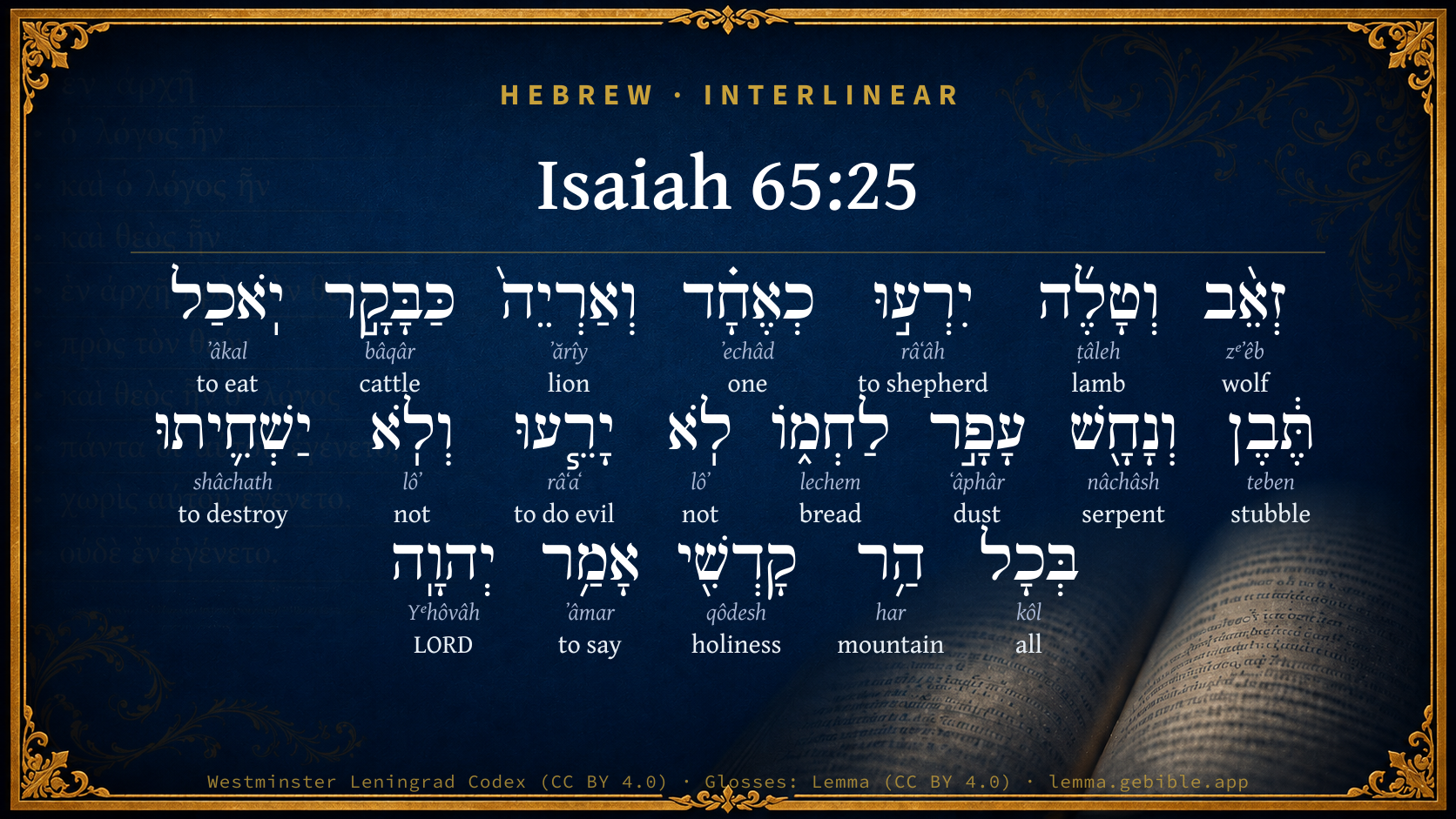
Hebrew (Westminster Leningrad Codex) Isaiah 65:25 appears in the Hebrew Old Testament. The text above is from the Westminster Leningrad Codex. Each word links to its Strong’s number, a concise gloss, and parsing drawn from the Open Scriptures Hebrew Bible morphology. Click any word for its full Brown-Driver-Briggs (BDB) entry.
Download image
Cite this verse

Isaiah 65:25 (World English Bible). Public Domain. Lemma interlinear Bible study tool, https://lemma.gebible.app/v/isaiah/65/25.

Show BibTeX & RIS
BibTeX
RIS
English Translation
The wolf and the lamb shall feed together, and the lion shall eat straw like the ox; and dust shall be the serpent's food. They shall not hurt nor destroy in all my holy mountain, says Yahweh.
World English Bible · Public Domain
Download a study sheet

One document with this verse’s original text, its word-by-word gloss line, the meaning frame, cross-references with their text, attributed commentary, and full source and license credits — printable, and it pastes into notes with its structure intact.

This verse Autodidact and up

Study sheet (.html) Plain text (.txt)

A passage Seminary Student

Up to 50 verses in one chapter. A passage sheet keeps up to 6 commentary sources and 12 cross-references per verse, in the order this page ranks them, and says so on the sheet whenever that leaves anything out. Ask for a single verse and you get the Autodidact verse sheet above.

Everything on this page stays free to read, with no account — the sheet is a download of what is already on screen, not access to it.

Want to remove ads? Support Godless Engineer
Compare translations 3

The same verse in 3 English versions, stacked beneath the original-language interlinear above. Click any original word for its lexicon entry.

Each is an independent rendering of the whole verse — the interlinear is not word-aligned to these translations.

Highlighted words mark where these versions differ — a whole-verse word diff, not a word-by-word alignment.

  • World English Bible Public Domain
    The wolf and the lamb shall feed together, and the lion shall eat straw like the ox; and dust shall be the serpent's food. They shall not hurt nor destroy in all my holy mountain, says Yahweh.
  • King James Version Public Domain
    The wolf and the lamb shall feed together, and the lion shall eat straw like the bullock: and dust shall be the serpent's meat. They shall not hurt nor destroy in all my holy mountain, saith the LORD.
  • unfoldingWord Literal Text CC BY-SA 4.0
    The wolf and the lamb will graze as one, and the lion will eat straw like the ox. But the serpent, dust its bread. They will not harm and they will not destroy on all of the mountain of my holiness,” says Yahweh.

unfoldingWord Literal Text — © unfoldingWord, licensed CC BY-SA 4.0. Word-aligned USFM3 via Door43 (git.door43.org/unfoldingWord/en_ult).

Versions to compare (up to 4)

3 of 4 selected

Show all 18 translations

Every available English version of this verse, each an independent rendering of the whole verse.

  • World English Bible Public Domain
    The wolf and the lamb shall feed together, and the lion shall eat straw like the ox; and dust shall be the serpent's food. They shall not hurt nor destroy in all my holy mountain, says Yahweh.
  • Berean Standard Bible Public Domain
    The wolf and the lamb will feed together, and the lion will eat straw like the ox, but the food of the serpent will be dust. They will neither harm nor destroy on all My holy mountain,” says the LORD.
  • Majority Standard Bible Public Domain
    The wolf and the lamb will feed together, and the lion will eat straw like the ox, but the food of the serpent will be dust. They will neither harm nor destroy on all My holy mountain,” says the LORD.
  • King James Version Public Domain
    The wolf and the lamb shall feed together, and the lion shall eat straw like the bullock: and dust shall be the serpent's meat. They shall not hurt nor destroy in all my holy mountain, saith the LORD.
  • American Standard Version (1901) Public Domain
    The wolf and the lamb shall feed together, and the lion shall eat straw like the ox; and dust shall be the serpent's food. They shall not hurt nor destroy in all my holy mountain, saith Jehovah.
  • Revised Version (1885) Public Domain
    The wolf and the lamb shall feed together, and the lion shall eat straw like the ox: and dust shall be the serpent’s meat. They shall not hurt nor destroy in all my holy mountain, saith the LORD.
  • Geneva Bible (1599) Public Domain
    The wolfe and the lambe shall feede together, and the lyon shall eate strawe like the bullocke: and to the serpent dust shall be his meate. They shall no more hurt nor destroy in all mine holy Mountaine, saith the Lord.
  • Douay-Rheims (1899) Public Domain
    The wolf and the lamb shall feed together; the lion and the ox shall eat straw; and dust shall be the serpent's food: they shall not hurt nor kill in all my holy mountain, saith the Lord.
  • Young's Literal Translation Public Domain
    Wolf and lamb do feed as one, And a lion as an ox eateth straw, As to the serpent -- dust `is' its food, They do no evil, nor destroy, In all My holy mountain, said Jehovah!
  • Literal Standard Version CC BY-SA 4.0
    Wolf and lamb feed as one, || And a lion eats straw as an ox, || As for the serpent—its food [is] dust, || They do no evil, nor destroy, || In all My holy mountain,” said YHWH!
  • Unlocked Literal Bible CC BY-SA 4.0
    The wolf and the lamb will graze together, and the lion will eat straw like the ox; but dust will be the serpent's food. They will no longer hurt nor destroy on all my holy mountain,” says Yahweh.
  • unfoldingWord Literal Text CC BY-SA 4.0
    The wolf and the lamb will graze as one, and the lion will eat straw like the ox. But the serpent, dust its bread. They will not harm and they will not destroy on all of the mountain of my holiness,” says Yahweh.
  • Darby Bible Public Domain
    The wolf and the lamb shall feed together, and the lion shall eat straw like the ox; and dust shall be the serpent's meat. They shall not hurt nor destroy in all my holy mountain, saith Jehovah.
  • World Messianic Bible Public Domain
    The wolf and the lamb will feed together. The lion will eat straw like the ox. Dust will be the serpent’s food. They will not hurt nor destroy in all my holy mountain,” says the LORD.
  • Webster's Bible Public Domain
    The wolf and the lamb shall feed together, and the lion shall eat straw like the bullock: and dust shall be the serpents' food. They shall not hurt nor destroy in all my holy mountain, saith the LORD.
  • Free Bible Version CC BY-SA 4.0
    The wolf and the lamb will eat together. The lion will eat straw like the ox. The snakes will eat dust. Nothing will cause any harm or damage anywhere on my holy mountain.
  • Bible in Basic English Public Domain
    The wolf and the lamb will take their food together, and the lion will make a meal of grass like the ox: but dust will be the snake's food. There will be no cause of pain or destruction in all my holy mountain, says the Lord.
  • JPS Tanakh (1917) Public Domain
    The wolf and the lamb shall feed together, and the lion shall eat straw like the ox; and dust shall be the serpent's food. They shall not hurt nor destroy in all My holy mountain, saith the LORD.

Literal Standard Version (2020), Covenant Press — licensed CC BY-SA 4.0. Text via the HelloAO Bible API (eBible.org). Unlocked Literal Bible (unfoldingWord) — licensed CC BY-SA 4.0. Text via the HelloAO Bible API (eBible.org). unfoldingWord Literal Text — © unfoldingWord, licensed CC BY-SA 4.0. Word-aligned USFM3 via Door43 (git.door43.org/unfoldingWord/en_ult). Free Bible Version, Dr. Jonathan Gallagher — licensed CC BY-SA 4.0. Text via the HelloAO Bible API (eBible.org).

Word by word

More ways to search: Search by grammar → Find every occurrence → Compare this word →

Practice this passage: Drill this verse → Learn its vocabulary →

וְטָלֶ֜ה
ṭâleh
H2924
“and · lamb”
Conjunction + Noun, Common, Masculine, Singular, Absolute
Part of Speech
Conjunction + Noun
Type
Common
Gender
Masculine
Number
Singular
State
Absolute
Full BDB Definition

Origin: by variation for H2922

TWOT: 806a

lamb
  1. זְאֵ֨ב zᵉʼêb H2061 “wolf” Noun, Common, Masculine, Singular, Absolute
  2. יִרְע֣וּ râʻâh H7462 “to shepherd” Verb, Qal, Imperfect, 3rd Person, Masculine, Plural
  3. כְאֶחָ֗ד ʼechâd H259 “like/as · one” Preposition + Adjective, Cardinal number, Masculine, Singular, Absolute
  4. וְאַרְיֵה֙ ʼărîy H738 “and · lion” Conjunction + Noun, Common, Masculine, Singular, Absolute
  5. כַּבָּקָ֣ר bâqâr H1241 “like/as the · cattle” Preposition, Determined + Noun, Common, Both, Singular, Absolute
  6. יֹֽאכַל ʼâkal H398 “to eat” Verb, Qal, Imperfect, 3rd Person, Masculine, Singular
  7. תֶּ֔בֶן teben H8401 “stubble” Noun, Common, Masculine, Singular, Absolute
  8. וְנָחָ֖שׁ nâchâsh H5175 “and · serpent” Conjunction + Noun, Common, Masculine, Singular, Absolute
  9. עָפָ֣ר ʻâphâr H6083 “dust” Noun, Common, Masculine, Singular, Absolute
  10. לַחְמ֑וֹ lechem H3899 “bread · his” Noun, Common, Both, Singular, Construct + Suffix, Personal, 3rd Person, Masculine, Singular
  11. לֹֽא lôʼ H3808 “not” Particle, Negative
  12. יָרֵ֧עוּ râʻaʻ H7489 “to do evil” Verb, Hiphil, Imperfect, 3rd Person, Masculine, Plural
  13. וְלֹֽא lôʼ H3808 “and · not” Conjunction + Particle, Negative
  14. יַשְׁחִ֛יתוּ shâchath H7843 “to destroy” Verb, Hiphil, Imperfect, 3rd Person, Masculine, Plural
  15. בְּכָל kôl H3605 “in/at · all of” Preposition + Noun, Common, Masculine, Singular, Construct
  16. הַ֥ר har H2022 “mountain of” Noun, Common, Masculine, Singular, Construct
  17. קָדְשִׁ֖י qôdesh H6944 “holiness · my” Noun, Common, Masculine, Singular, Construct + Suffix, Personal, 1st Person, Common, Singular
  18. אָמַ֥ר ʼâmar H559 “to say” Verb, Qal, Perfect, 3rd Person, Masculine, Singular
  19. יְהוָֽה Yᵉhôvâh H3068 “LORD” Noun, Proper

About this verse

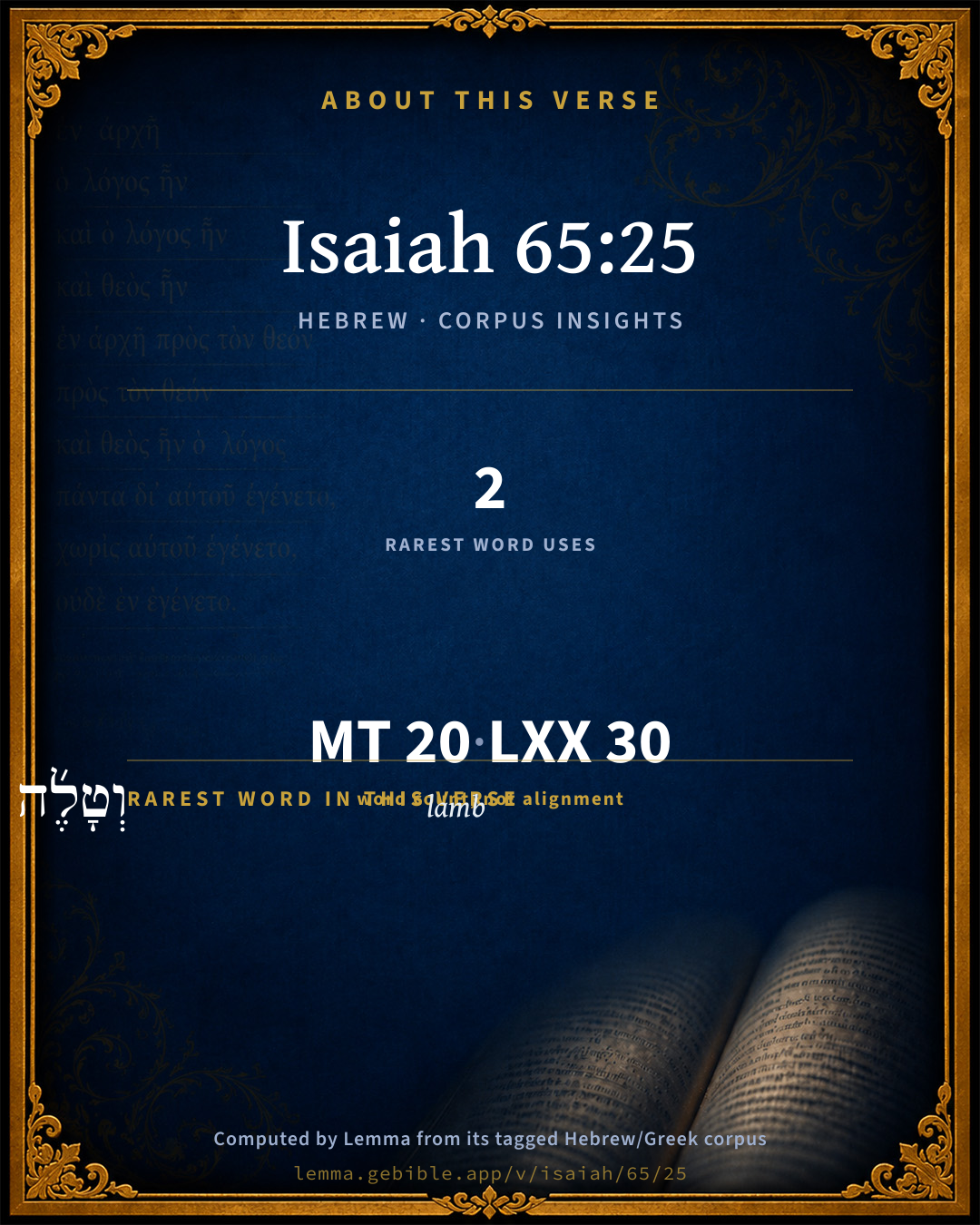
These counts appear in no published source. They are computed here, from the morphology-tagged text and Lemma’s own curated glosses. What Lemma adds →

20
words
19
distinct lemmas
Prophets
section

Notable vocabulary

The rarest word here is וְטָלֶ֜ה lamb H2924 — appearing just 2 times in the whole Hebrew Bible.

Shared distinctive vocabulary

וְטָלֶ֜ה lamb H2924 occurs in 2 verses of the Hebrew Bible. Also found in:

Grammatical profile

  • 5 verbs
  • 12 nouns
  • 1 adjective
  • 2 particles

Verb forms

  • יִרְע֣וּ Qal · Imperfect
  • יֹֽאכַל Qal · Imperfect
  • יָרֵ֧עוּ Hiphil · Imperfect
  • יַשְׁחִ֛יתוּ Hiphil · Imperfect
  • אָמַ֥ר Qal · Perfect

Repetition

A word recurs within this verse — often emphatic in Hebrew:

Hebrew & Septuagint length

In English translation the verse runs 37 words from the Hebrew and 35 from the Septuagint (LXX English) — closely comparable.

A rough comparison of the two English renderings, which tokenize alike — not a word-level alignment.

Word counts can differ between the Hebrew and the Greek without any difference in meaning — e.g. the Hebrew direct-object marker אֵת has no separate Greek word, and Greek often adds the article ὁ.

In the original languages it is 20 Hebrew tokens and 30 Greek tokens — but the two are counted differently (Hebrew bundles its prefixes and suffixes into one token; the Greek is in lemma form), so that isn’t a like-for-like length.

Cross-references

18

Topical passages linked to Isaiah 65:25 in the Treasury of Scripture Knowledge — connected by theme and wording, ordered by reader-vote popularity; previews shown in the World English Bible.

  • Isaiah 11:6–9 The wolf shall dwell with the lamb, and the leopard shall lie down with the kid; and the calf and the young lion and the fattened calf together; and a little child shall lead them.
  • Micah 4:3 And he will judge between many peoples, And will decide concerning strong nations afar off. They will beat their swords into plowshares, And their spears into pruning hooks. Nation will not lift up sword against nation, Neither will they learn war any more.
  • Acts 9:19–21 He took food and was strengthened. Saul stayed several days with the disciples who were at Damascus.
  • Isaiah 35:9 No lion shall be there, nor shall any ravenous animal go up thereon; they shall not be found there; but the redeemed shall walk [there]:
  • Isaiah 65:11 But you who forsake Yahweh, who forget my holy mountain, who prepare a table for Fortune, and who fill up mixed wine to Destiny;
  • Ezekiel 43:11 If they be ashamed of all that they have done, make known to them the form of the house, and the fashion of it, and the exits of it, and the entrances of it, and all the forms of it, and all the ordinances of it, and all the forms of it, and all the laws of it; and write it in their sight; that they may keep the whole form of it, and all the ordinances of it, and do them.
  • Micah 7:17 They will lick the dust like a serpent. Like crawling things of the earth they shall come trembling out of their dens. They will come with fear to Yahweh our God, And will be afraid because of you.
  • Zechariah 8:3 Thus says Yahweh: "I have returned to Zion, and will dwell in the midst of Jerusalem. Jerusalem shall be called 'The City of Truth;' and the mountain of Yahweh of Hosts, 'The Holy Mountain.'"
  • Zechariah 14:20–21 In that day there will be on the bells of the horses, "HOLY TO YAHWEH;" and the pots in Yahweh's house will be like the bowls before the altar.
  • Acts 9:1 But Saul, still breathing threats and slaughter against the disciples of the Lord, went to the high priest,
  • Romans 16:20 And the God of peace will quickly crush Satan under your feet. The grace of our Lord Jesus Christ be with you.
  • 1 Corinthians 6:9–11 Or don't you know that the unrighteous will not inherit the Kingdom of God? Don't be deceived. Neither the sexually immoral, nor idolaters, nor adulterers, nor male prostitutes, nor homosexuals,
  • Titus 3:3–7 For we were also once foolish, disobedient, deceived, serving various lusts and pleasures, living in malice and envy, hateful, and hating one another.
  • Revelation 12:7–9 There was war in the sky. Michael and his angels made war on the dragon. The dragon and his angels made war.
  • Revelation 14:1 I saw, and behold, the Lamb standing on Mount Zion, and with him a number, one hundred forty-four thousand, having his name, and the name of his Father, written on their foreheads.
  • Genesis 3:14–15 Yahweh God said to the serpent, "Because you have done this, cursed are you above all cattle, and above every animal of the field. On your belly shall you go, and you shall eat dust all the days of your life.
  • Isaiah 2:4 He will judge between the nations, And will decide concerning many peoples; And they shall beat their swords into plowshares, And their spears into pruning-hooks. Nation shall not lift up sword against nation, Neither shall they learn war any more.
  • Revelation 20:2–3 He seized the dragon, the old serpent, which is the devil and Satan, who deceives the whole inhabited earth, and bound him for a thousand years,

Cross-references courtesy of OpenBible.info (CC BY 4.0).

Hebrew and Greek witnesses Masoretic Hebrew ↔ Greek Septuagint

The same verse in the two great witnesses to the Old Testament, shown verse-for-verse.

These are two independent witnesses, not word-aligned to each other, and the Septuagint is shown in lemma (dictionary) form.

Hebrew Isaiah 65:25 Masoretic · Westminster Leningrad Codex

זְאֵ֨ב וְטָלֶ֜ה יִרְע֣וּ כְאֶחָ֗ד וְאַרְיֵה֙ כַּבָּקָ֣ר יֹֽאכַל תֶּ֔בֶן וְנָחָ֖שׁ עָפָ֣ר לַחְמ֑וֹ לֹֽא יָרֵ֧עוּ וְלֹֽא יַשְׁחִ֛יתוּ בְּכָל הַ֥ר קָדְשִׁ֖י אָמַ֥ר יְהוָֽה

The wolf and the lamb shall feed together, and the lion shall eat straw like the ox; and dust shall be the serpent's food. They shall not hurt nor destroy in all my holy mountain, says Yahweh.

World English Bible · Public Domain

Greek LXX Isaiah 65:25 Septuagint · lemma form

τότε λύκος καί ἀρνός βόσκω ἅμα καί λέων ὡς βοῦς ἐσθίω ἄχυρον ὄφις δέ γῆ ὡς ἄρτος οὐ ἀδικέω οὐδέ μή λυμαίνω ἐπί ὁ ὄρος ὁ ἅγιος ἐγώ λέγω κύριος

Then wolves and lambs shall feed together, and the lion shall eat chaff like the ox, and the serpent earth as bread. They shall not injure nor destroy in my holy mountain, says the Lord.

LXX2012 (modern English Septuagint) · Public Domain

On this verse, Adam Clarke's Commentary discusses the Septuagint’s reading. Read the note in Commentary ↓

Hebrew: Westminster Leningrad Codex (CC BY 4.0). Greek: Septuagint (public domain); English from LXX2012 (modern English Septuagint) (Public Domain). How the Septuagint differs from the Hebrew →

Targum (Aramaic paraphrase)

1

The Targum is the ancient Jewish Aramaic paraphrase of the Hebrew Scriptures — an interpretive translation, not the Hebrew text itself. Onkelos (literal) and Pseudo-Jonathan (expansive) render the Torah, and Jonathan the Prophets. Coverage is partial: where no permissively-licensed English translation exists for a verse, only the Aramaic is shown. This is verse-level text, not a word-by-word alignment to the Hebrew.

  1. Targum Jonathan Prophets (Joshua–Malachi)
    דֵיבָא וְאִמְרָא יִרְעוּן כַּחֲדָא וְאַרְיָא כְּתוֹרָא יֵיכוּל תִבְנָא וְחִוְיָא עַפְרָא מְזוֹנֵיהּ לָא יִבְאֲשׁוּן וְלָא יְחַבְּלוּן בְּכָל טוּרָא דְקוּדְשִׁי אֲמַר יְיָ:

    The wolf and the lamb shall feed together, and the lion shall eat straw like the bullock: and as for the serpent, dust shall be its food. They shall not hurt nor destroy in all my holy mountain, saith the Lord.

    Targum Jonathan — Aramaic: “Mikraot Gedolot” (public domain). English: “Sefaria Community Translation” (CC0 1.0 (public-domain dedication)); “London "Chaldee Paraphrase," 1871” (public domain). Text via Sefaria.

Commentary

Notes on Isaiah 65:25 from classic Christian and Jewish commentators (each source and its license shown beneath its notes). The classic Christian expositions comment on the surrounding passage and are grouped to its opening verse, so a note may address several verses; the Jewish commentaries on the Tanakh (Rashi and others) are per-verse, so they appear only where the commentator wrote on this verse.

Lemma curates 59 commentaries, every one of them public domain or Creative Commons licensed, each selected and text-cleaned for this edition rather than reprinted as found. About our sources →

Trapp's Complete Commentary

John Trapp

Isa 65:25 The wolf and the lamb shall feed together, and the lion shall eat straw like the bullock: and dust [shall be] the serpent’s meat. They shall not hurt nor destroy in all my holy mountain, saith the LORD.

Ver. 25. The wolf and the lamb shall feed together.] Heb., As one. {a} See Isa 11:6. There shall be a holy harmony of hearts, and all good agreement among Christ’s subjects, when they come to heaven especially.

And dust shall be the serpent’s meat.] He shall be held in to his first condemnation. {Gen 3:14} The devil also, that old serpent, shall be limited to the heel of the saints; the head he shall not touch; he shall be tied up to his own meat - viz., that unquenchable fire prepared for him and his angels from the beginning.

They shall not hurt, &c.] See on Isa 11:9.

{a} Antipathiam in sympathiam convertent. - A Lapide.

John Trapp, A Commentary or Exposition upon All the Books of the Old and New Testament (1647–1656) — public domain. Text from a community e-Sword module.

Joseph Benson's Commentary

Isa 65:25. The wolf and the lamb shall feed together — Concerning the metaphorical sense of these expressions see chap. 11:7, and 35:9. But since the renovation here spoken of extends to the whole creation, the words may imply the correcting the noxious qualities of fierce or venomous creatures.

Joseph Benson's Commentary on the Old and New Testaments (1811–1818) — public domain. Text from a community e-Sword module.

Keil & Delitzsch

C. F. Keil & F. Delitzsch

And all around will peace and harmony prevail, even in the animal world itself. "Wolf and lamb then feed together, and the lion eats chopped straw like the ox, and the serpent-dust is its bread. They will neither do harm not destroy in all my holy mountain, saith Jehovah." We have frequently observed within chapters 40-66 (last of all at Isa 65:12, cf., Isa 66:4), how the prophet repeats entire passages from the earlier portion of his prophecies almost word for word. Here he repeats Isa 11:6-9 with a compendious abridgment. Isa 65:25 refers to the animals just as it does there. But whilst this custom of self-repetition favours the unity of authorship, כּאחד for יחדּו = unâ, which only occurs elsewhere in Ezra and Ecclesiastes (answering to the Chaldee כּחדה), might be adduced as evidence of the opposite. The only thing that is new in the picture as here reproduced, is what is said of the serpent. This will no longer watch for human life, but will content itself with the food assigned it in Gen 3:14. It still continues to wriggle in the dust, but without doing injury to man. The words affirm nothing more than this, although Stier's method of exposition gets more out, or rather puts more in. The assertion of those who regard the prophet speaking here as one later than Isaiah, viz., that Isa 65:25 is only attached quite loosely to what precedes, is unjust and untrue. The description of the new age closes here, as in chapter 11, with the peace of the world of nature, which stands throughout chapters 40-66 in the closest reciprocal relation to man, just as it did in chapters 1-39. If we follow Hahn, and change the animals into men by simply allegorizing, we just throw our exposition back to a standpoint that has been long passed by. But to what part of the history of salvation are we to look for a place for the fulfilment of such prophecies as these of the state of peace prevailing in nature around the church, except in the millennium? A prophet was certainly no fanatic, so that we could say, these are beautiful dreams. And if, what is certainly true, his prophecies are not intended to be interpreted according to the letter, but according to the spirit of the letter; the letter is the sheath of the spirit, as Luther calls it, and we must not give out as the spirit of the letter what is nothing more than a quid-pro-quo of the letter. The prophet here promises a new age, in which the patriarchal measure of human life will return, in which death will no more break off the life that is just beginning to bloom, and in which the war of man with the animal world will be exchanged for peace without danger. And when is all this to occur? Certainly not in the blessed life beyond the grave, to which it would be both absurd and impossible to refer these promises, since they presuppose a continued mixture of sinners with the righteous, and merely a limitation of the power of death, not its utter destruction. But when then? This question ought to be answered by the anti-millenarians. They throw back the interpretation of prophecy to a stage, in which commentators were in the habit of lowering the concrete substance of the prophecies into mere doctrinal loci communes. They take refuge behind the enigmatical character of the Apocalypse, without acknowledging that what the Apocalypse predicts under the definite form of the millennium is the substance of all prophecy, and that no interpretation of prophecy on sound principles is any longer possible from the standpoint of an orthodox antichiliasm, inasmuch as the antichiliasts twist the word in the mouths of the prophets, and through their perversion of Scripture shake the foundation of all doctrines, every one of which rests upon the simple interpretation of the words of revelation. But one objection may be made to the supposition, that the prophet is here depicting the state of things in the millennium; viz., that this description is preceded by an account of the creation of a new heaven and a new earth. The prophet appears, therefore, to refer to that Jerusalem, which is represented in the Apocalypse as coming down from heaven to earth after the transformation of the globe. But to this it may be replied, that the Old Testament prophet was not yet able to distinguish from one another the things which the author of the Apocalypse separates into distinct periods. From the Old Testament point of view generally, nothing was known of a state of blessedness beyond the grave. Hades lay beyond this present life; and nothing was known of a heaven in which men were blessed. Around the throne of God in heaven there were angels and not men. And, indeed, until the risen Saviour ascended to heaven, heaven itself was not open to men, and therefore there was no heavenly Jerusalem whose descent to earth could be anticipated then. Consequently in the prophecies of the Old Testament the eschatological idea of the new Cosmos does unquestionably coincide with the millennium. It is only in the New Testament that the new creation intervenes as a party-wall between this life and the life beyond; whereas the Old Testament prophecy brings down the new creation itself into the present life, and knows nothing of any Jerusalem of the blessed life to come, as distinct from the new Jerusalem of the millennium. We shall meet with a still further illustration in chapter 66 of this Old Testament custom of reducing the things of the life to come within the limits of this present world.

Keil & Delitzsch — Biblical Commentary on the Old Testament (1861–1891) — public domain (CC PDM 1.0). Text via the HelloAO Bible API. (Old Testament only.)

Tyndale Open Study Notes

Tyndale Open Resources

65:25 The snakes represent evil (27:1; Gen 3).

Tyndale Open Study Notes — © Tyndale Open Resources, licensed CC BY-SA 4.0. Text via the HelloAO Bible API.

Geneva Bible (1599)

Geneva Bible translators

Read Isa. 11:6.

Geneva Bible (1599) marginal notes — public domain. Text via Bolls.life.

Jamieson, Fausset & Brown

Robert Jamieson, A. R. Fausset & David Brown

(See on Isa 11:6).

and the lion shall eat straw like the bullock--(See on Isa 11:7).

and dust--rather, "but dust," &c. The curse shall remain on the serpent [HORSLEY], (Gen 3:14; Mic 7:17). "To lick the dust" is figurative of the utter and perpetual degradation of Satan and his emissaries (Isa 49:23; Psa 72:9). Satan fell self-tempted; therefore no atonement was contrived for him, as there was for man, who fell by his temptation (Jde 1:6; Joh 8:44). From his peculiar connection with the earth and man, it has been conjectured that the exciting cause of his rebellion was God's declaration that human nature was to be raised into union with the Godhead; this was "the truth" concerning the person of the Son of God which "he abode not in"; it galled his pride that a lower race was to be raised to that which he had aspired to (Ti1 3:6). How exultingly he might say, when man fell through him, "God would raise manhood into union with Himself; I have brought it down below the beasts by sin!" At that very moment and spot he was told that the seed of the abhorred race, man, should bruise his head (Jo1 3:8). He was raised up for this, to show forth God's glory (Exo 9:16; Rom 9:17). In his unfallen state he may have been God's vicegerent over the earth and the animal kingdom before man: this will account for his assuming the form of a serpent (Gen 3:1). Man succeeded to that office (Gen 2:19-20), but forfeited it by sin, whence Satan became "prince of this world"; Jesus Christ supplants the usurper, and as "Son of man" regains the lost inheritance (Psa 8:4-8). The steps in Satan's overthrow are these: he is cast out, first, from heaven (Rev 12:7-9) on earth; next, he is bound a thousand years (Rev 20:2-3); finally, he is cast into the lake of fire for ever (Rev 20:10).

the serpent's meat--(See on Isa 11:8).

They shall not hurt nor destroy in all my holy mountain--(See on Isa 11:9).

This closing chapter is the summary of Isaiah's prophecies as to the last days, hence the similarity of its sentiments with what went before.

Next: Isaiah Chapter 66

Jamieson, Fausset & Brown — Commentary Critical and Explanatory on the Whole Bible (1871) — public domain (CC PDM 1.0). Text via the HelloAO Bible API.

Adam Clarke's Commentary

Verse 25. The wolf and the lamb, c.] The glorious salvation which Jesus Christ procures is for men, and for men only: fallen spirits must still abide under the curse: "He took not on him the nature of angels, but the seed of Abraham."

Shall feed together] For כאחד keechad, as one, an ancient MS. has יחדו yachdav, together the usual word, to the same sense, but very different in the letters. The Septuagint, Syriac, and Vulgate seem to agree with the MSS. - L.

Adam Clarke's Commentary on the Bible (1810–1826) — public domain. Text from a community e-Sword/MySword module.

Ellicott's Commentary for English Readers

(25) The wolf and the lamb . . .—The words point to what have been called the discords in the harmony of Nature, the pain and death involved, of necessity, in the relation of one whole class of animals to another. In St. Paul’s language, the “whole creation groaneth and travaileth together” (Rom_8:22). In the new heaven and the new earth of the prophet’s vision there would be no such discords. The flesh-eating beasts should change their nature; even the serpent, named, probably, with special reference to Genesis 3, as the starting-point of the discords, shall find food in the dust in which he crawls, and shall be no longer a destroyer. The condition of the ideal Paradise should be restored. The picture finds a parallel, perhaps a replica, in Virgil, Eel. 4. Do the poet and the prophet stand on the same footing? or may we look for a literal fulfilment of the words of the one, though not of the other? The answer must be given in words that are “wary and few.” We dare not, on the one hand, fix times and seasons, or press the letter of prophetic visions as demanding a fulfilment. On the other, the permanence of Israel as a people suggests the possibility of a restored Jerusalem, and modern theories of evolution point to the gradual elimination of the fiercer animals as part of the conquests of humanity.

A Bible Commentary for English Readers, edited by Charles John Ellicott (1878–1897) — public domain. Text from a community e-Sword module.

The Cambridge Bible for Schools and Colleges

gen. ed. J. J. S. Perowne

25. A last feature of the new earth is the peace which shall reign in the animal world. See on ch. Isa_11:6-9, from which this verse is quoted. The second and fourth lines are cited literally from Isa_11:7; Isa_11:9, the first is a condensation of Isa_11:6-7 a. The only clause not represented in the original passage is the third line: and dust shall be the serpent’s meat an allusion to Gen_3:14. Duhm, partly on metrical grounds, rejects these words as a gloss.

The Cambridge Bible for Schools and Colleges (gen. ed. J. J. S. Perowne; Cambridge University Press, 1878–1918) — public domain. Text from a community e-Sword module.

John Gill's Exposition

The wolf and the lamb shall feed together,.... Or, "as one" (k): as if they were one, of the same kind and nature, and lived upon the same food. The people of God are comparable to lambs, for their harmlessness and innocence; and wicked men to wolves, for their fierceness and cruelty; but, by the grace of God, the latter become as mild and as gentle as the former, and live upon the same spiritual food, and join with them in attendance on the word and ordinances, where they find spiritual refreshment and comfort together; such who have been persecutors of the church shall now become members of it; and many instances of this kind, as there were in the first times of the Gospel, so there shall be in the latter day:

and the lions shall eat straw like the bullock, or "ox"; to which creature the ministers of the Gospel are compared for their laboriousness, as wicked persecutors are to lions; and sometimes the latter have been so changed by the grace of God, as to become preachers of it, as Saul was, and very probably many will hereafter; however, there will be no persecution of the church after those days; wolves and lions will have their nature changed, and be in fellowship with the saints, and be better employed than before in persecuting them:

and dust shall be the serpent's meat; the meat of the old serpent, the devil, as was threatened, Gen 3:14 to which he shall now be confined; he shall not be able to bite the saints, being bruised under their feet; he shall only have power over carnal, worldly, earthly minded men; and shall not be able to give the church any trouble, by instigating men to persecute it:

they shall not hurt nor destroy in all my holy mountain, saith the Lord; that is, Satan and his emissaries; wicked men, comparable to lions and wolves, shall no more drink the blood of the saints, or persecute the church of God; after the calling of the Jews, and the bringing in the fulness of the Gentiles, and the destruction of antichrist, there will be no more persecution of the church of Christ, the mountain of God's holiness; he has said it, and we may be assured of the truth of it; See Gill on Isa 11:9.

(This verse may also apply to the Millenial state, in which the effects of the curse on the animals is to be removed. However, from this verse it seems that the curse on snakes is permanent. Editor.)

(k) "sicut unus", Montanus, Musculus, Gataker.

Next: Isaiah Chapter 66

John Gill's Exposition of the Whole Bible (1746–1763) — public domain (CC PDM 1.0). Text via the HelloAO Bible API.

Albert Barnes' Notes on the Bible

The wolf and the lamb shall feed together - (See the notes at Isa. 11.)

And the lion shall eat straw - Shall eat hay or provender like the ox. The food of the lion now is flesh. Changes shall take place as great as if his nature were changed, and he should graze with the herds of the field. See a full illustration of this sentiment from the classic writors in the notes at Isa 11:6.

Like the bullock - Or the ox - the cattle that herd together - for so the Hebrew word (בקר bâqâr) means. The word may be app ied to a bullock, an ox, or a cow.

And dust shall be the serpent’s meat - There is evidently here an allusion to the sentence pronounced on the serpent in Gen 3:14. The meaning of the declaration here is, probably, that dust should continue to be the food of the serpent. The sentence on him should be perpetual. He should not be injurious to man - either by tempting him again, or by the venom of his fangs. The state of security would be as great under the Messiah as if the most deadly and poisonous kinds of reptiles should become wholly innoxious, and should not attempt to prey upon people. It is to be remembered that many of the serpent kind included under the general word used here (נחשׁ nāchâsh), were dangerous to people; and indeed a large portion of them are deadly in their bite. But in future times there will be a state of security as great as if the whole serpent tribe were innocuous and should live on the dust alone. There can be no doubt that the prophet means here to describe the passions and evil propensities of people, which have a strong resemblance to the ferocity of the wolf, or the lion, and the deadly poison of the serpent, and to say that those passions would be subdued, and that peace and concord would prevail on the earth (see the notes at Isa 11:8).

They shall not hurt nor destroy - See this explained in the notes at Isa 11:9. All this is partially realized wherever the gospel prevails, but it will be more fully realized when that gospel shall exert its full power and shall be spread around the world.

Albert Barnes' Notes on the Bible (1834–1885) — public domain. Text from a community e-Sword/MySword module.

Haydock's Catholic Bible Commentary

Straw. People of the most perverse tempers shall become mild by the influence of the gospel, and shall dwell together in perfect concord. (Calmet) --- Food, according to the sentence, Genesis iii. 14. (Menochius) --- The devil’s power is abridged, chap. xi. 6. (Calmet) --- The proudest Gentiles are converted, and adopt the mild manners of Christians, in fasting and mortification. (Worthington)

George Leo Haydock (1774–1849), Haydock's Catholic Family Bible and Commentary, 1859 edition — public domain. Excludes Psalms (Douay-Rheims chapter numbering differs from Protestant) and Deuterocanonical books (Catholic canon only).

Matthew Poole's English Annotations

This verse containeth a promise much like that Isa 11:6,9, and relates to the ceasing of persecution. The people of God for their whiteness and innocency are often compared to lambs and sheep, wicked men to wolves and lions, for their antipathy to the seed of the woman: God here promiseth to take off the fierceness of the spirits of his people’s enemies, so that they shall live quietly and peaceably together. Wicked men are compared to serpents, Mic 7:17, compared with Psa 72:9; God promiseth a time of tranquillity to his church under the metaphor of serpents eating the dust, their proper meat, Gen 3:14, instead of flying upon men: it signifies such a time when wicked men should mind their proper business, and not make it their work to eat up the people of God like bread. For the last phrase, see Isa 11:9, what is there noted. But will some say, When shall these things be? The Scripture gives us no record of any such period of time yet past. And it is very probable that this is a promise yet to be fulfilled, and it is not for us to know the times and seasons, but in the mean time to let our faith and patience be seen. In the mean time, we may learn that it is God’s work to restrain the wolves and serpents of the world, who would else be always doing what they are sometimes doing; and it is a sad sign that God is not yet at peace with that people, where we see wolves devouring lambs, and serpents destroying men instead of licking up dust, nor well-pleased with that part of his holy mountain where there is nothing but hurting and destroying, biting and devouring one another. When God shall be at peace with a people, these things shall not be found amongst them.

Matthew Poole's English Annotations on the Holy Bible (1683–1685) — public domain. Text from a community e-Sword/MySword module.

Whedon's Commentary on the Bible

Daniel D. Whedon

25. The wolf and the lamb shall feed together — Here is an allusion to Isa_11:6-7; Isa_11:9, there connected with the vision of Immanuel, here connected with Isaiah’s closing prophetic message. Here the figures are abridged in number, but they bear a similar, indeed identical, meaning in both, as to the moral state of the world intended in the description in both places. Herein are links binding together the two great sections of a one great prophetic system by one and the same great prophet.

And dust shall be the serpent’s meat — This is a unique addition to the passage in chap.

11, It alludes to the two main features of the earliest promise — the gift of the Seed of the woman and the sentence upon the old serpent. Gen_3:14-15. The allegory has this meaning: While all untamed natures among human souls blend together in harmony and peace under Messiah’s rule, the primeval curse shall rest with ever-increasing weight upon Satan — figured as a serpent — and he become at length completely vanquished, wriggling powerless and harmless, biting only the dust on which he helplessly affects to crawl.

Daniel D. Whedon (gen. ed.), Commentary on the Old and New Testaments (1874–1909) — public domain. Text from a community e-Sword module.

The Pulpit Commentary

The wolf and the lamb shall feed together. (comp. Isa_11:6-8 Hos_2:18) The portraiture here is far less elaborate than in the earlier chapter, to which the present passage may be regarded as a refer-once. (For the sense in which the entire picture is to be understood, see the comment upon Isa_11:6-9) Dust shall be the serpent"s meat. Here we have a new feature, not contained in the earlier description. Serpents shall become harmless, anal instead of preying upon beasts, or birds, or reptiles, shall be content with the food assigned them in the primeval decree, "Upon thy belly shalt thou go, and dust shalt thou eat all the days of thy life". (Gen_3:14) Mr. Cheyne appositely notes that much dust is the food of the shades in the Assyrio-Babylonian Hades" (see the "Legend of Ishtar" in the "Records of the Past," vol. 1. p. 143, line 8). They shall not hurt nor destroy. Repeated from Isa_11:9, word for word. In neither case should we regard the subject of the sentence as limited to the animals only. The meaning is that there shall be no violence of any kind, done either by man or beast, in the happy period described.

The Pulpit Commentary (1880–1919), ed. H.D.M. Spence-Jones & Joseph S. Exell — public domain. Text from a community e-Sword module.

John Wesley's Explanatory Notes

The wolf, &c. - God here promises to take off the fierceness of the spirits of his peoples enemies, so that they shall live quietly and peaceably together. And dust - God promises a time of tranquility to his church under the metaphor of serpents eating the dust, their proper meat, Gen. iii, 14, instead of flying upon men: it signifies such a time, when wicked men shall no more eat up the people of God.

John Wesley, Explanatory Notes Upon the Whole Bible (1754–1765) — public domain. Text via the GEBible commentary corpus.

J. A. Alexander on Isaiah

Joseph Addison Alexander

“The wolf and the lamb shall feed as one, and the lion like the ox shall eat straw, and the serpent dust (for) his food. They shall not hurt and they shall not corrupt (or destroy) in all my holy mountain, saith Jehovah.” The promise of a happy change is wound up in the most appropriate manner by repeating the prophecy in Isa 11:6-9, that all hurtful influences shall forever cease in the holy hill or church of God. Some suppose an allusion to the popular belief that serpents feed on dust because they creep upon the ground, and understand the prophecy to be that they shall henceforth be contented with this food and cease to prey on men or other animals. But this would be too low a promise for the context, since a very small part of the evils which men suffer can arise from this cause. The true sense seems to be that in accordance with the serpent’s ancient doom, he shall be rendered harmless, robbed of his favourite nutriment, and made to bite the dust at the feet of his conqueror (Gen 3:15; Rom 16:20; 1Jn 3:8. Compare Isa 49:24) The last clause resolves the figures of the first. The verbs are therefore to be understood indefinitely, as in Isa 11:9; or if they be referred to the animals previously mentioned, it is only a symbolical or tropical expression of the same idea. The form of expression is the same in either case, except that what begins a verse in the eleventh chapter here concludes one.

Joseph Addison Alexander, The Prophecies of Isaiah (1846–1847; New York: Scribner, 1870–1878) — public domain. Text from a community e-Sword module.

Rashi

Rabbi Shlomo Yitzchaki (Rashi)

shall eat straw and will not have to destroy animals.

and a serpent Indeed, dust is his food, which is always available for him. And the Midrash Aggadah explains: And a lion, like cattle, shall eat straw. Since we find that Esau will fall into the hands of the sons of Joseph, as it is said (Obadiah 18): “The house of Esau shall become stubble, and the house of Joseph a flame etc.” But [that they should fall] into the hands of the remaining tribes, who were compared to beasts, we do not find. It is, therefore, stated: “And a lion, like cattle, shall eat straw.” Those tribes that were compared to a lion, such as Judah and Dan, like Joseph, who was compared to an ox, shall devour Esau who was compared to straw.

Rashi on the Tanakh — English translations: “The Judaica Press complete Tanach with Rashi, translated by A. J. Rosenberg” (CC BY 4.0); “Pentateuch with Rashi's commentary by M. Rosenbaum and A.M. Silbermann, 1929-1934” (public domain); “The Metsudah Tanach series, Lakewood, N.J” (CC BY 4.0); and “The Book of Joshua, Metsudah Publications, 1997” (CC BY 4.0). Text via Sefaria.

Ibn Ezra

Rabbi Abraham ibn Ezra

The wolf and the lamb shall feed together. This is a figurative expression for peace will be established. Many imagine this to be done in such a way, that God will deprive the wolf of its natural voracity, as indicated by the words, And the lion shall eat straw like the bullock.

And dust shall be the serpent’s meat, as is its nature; and it will eat nothing else. The meaning of this passage is: it will do no harm.

In all my holy mountain. All these prophecies refer only to Palestine, for it is distinctly said, in all my holy mountain.

Ibn Ezra on the Tanakh — English translations: “Sefaria Community Translation” (CC0 1.0 (public-domain dedication)); “Yalkut, Sifsei Chachomim Chumash, Metsudah Publications, 2009” (CC BY 4.0); and “Commentary of Ibn Ezra on Isaiah - trans. by M. Friedlander, 1873” (public domain). Text via Sefaria.

Lesson kit

Teaching starters — assembled from the data on this page, not authored interpretation. Every prompt links to the verse data it draws on. Edit before teaching.

Isaiah, in the Prophets, opens this verse with 20 words (19 distinct Hebrew lemmas). Its most distinctive word is ṭâleh (“lamb”). A historical commentator’s framing appears above. Read the whole chapter for the surrounding context.

Discussion questions

  1. How does “lamb” (ṭâleh) shape what this verse is saying?
  2. How does 1 Samuel 7:9, which shares the word «lamb», read alongside this verse?
  3. What does the repetition of “not” (2× in this one verse) do in this verse?
  4. The translations on this page render this verse differently — a whole-verse word diff, not a word-by-word alignment. What might account for the different wordings?
  5. «יִרְע֣וּ» is a Qal Imperfect verb. How does that grammatical form shape the action described?
  6. Compare how Trapp's Complete Commentary and Joseph Benson's Commentary read this verse. Where do they agree or differ?

Things to notice

Reading settings

Reading text

Shown beneath each verse's original-language words.

Old Testament
Old Testament edition

Read the OT as the Masoretic Hebrew (MT) or the Greek Septuagint (LXX).

English shown for the Greek Septuagint (in the Hebrew ↔ Greek comparison).

Comparing translations? Open the Compare panel on any verse page to stack up to four side by side.