
Ezekiel 34:14

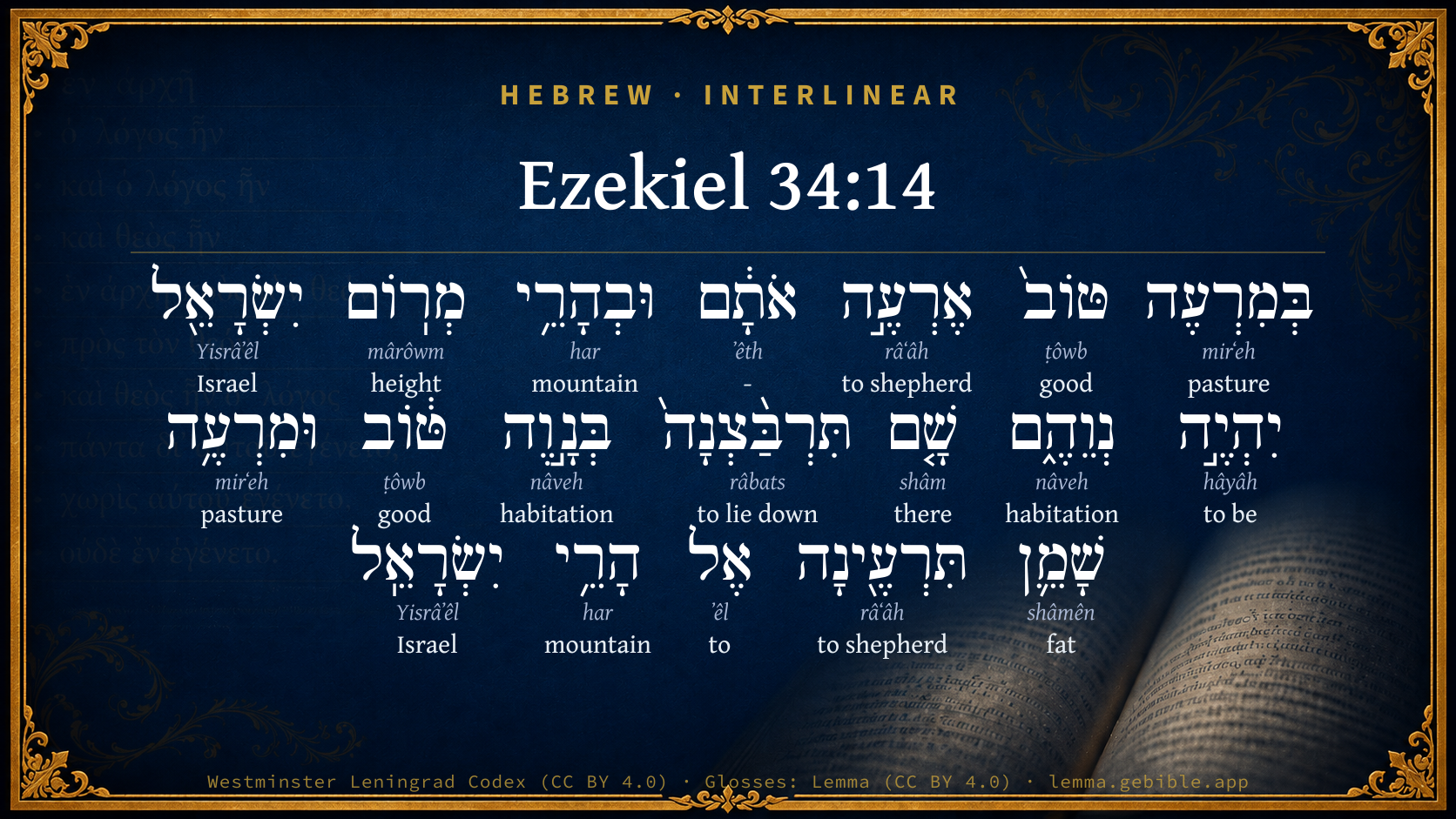
Hebrew (Westminster Leningrad Codex) Ezekiel 34:14 appears in the Hebrew Old Testament. The text above is from the Westminster Leningrad Codex. Each word links to its Strong’s number, a concise gloss, and parsing drawn from the Open Scriptures Hebrew Bible morphology. Click any word for its full Brown-Driver-Briggs (BDB) entry.
Download image
Cite this verse

Ezekiel 34:14 (World English Bible). Public Domain. Lemma interlinear Bible study tool, https://lemma.gebible.app/v/ezekiel/34/14.

Show BibTeX & RIS
BibTeX
RIS
English Translation
I will feed them with good pasture; and on the mountains of the height of Israel shall their fold be: there shall they lie down in a good fold; and on fat pasture shall they feed on the mountains of Israel.
World English Bible · Public Domain
Download a study sheet

One document with this verse’s original text, its word-by-word gloss line, the meaning frame, cross-references with their text, attributed commentary, and full source and license credits — printable, and it pastes into notes with its structure intact.

This verse Autodidact and up

Study sheet (.html) Plain text (.txt)

A passage Seminary Student

Up to 50 verses in one chapter. A passage sheet keeps up to 6 commentary sources and 12 cross-references per verse, in the order this page ranks them, and says so on the sheet whenever that leaves anything out. Ask for a single verse and you get the Autodidact verse sheet above.

Everything on this page stays free to read, with no account — the sheet is a download of what is already on screen, not access to it.

Want to remove ads? Support Godless Engineer
Compare translations 3

The same verse in 3 English versions, stacked beneath the original-language interlinear above. Click any original word for its lexicon entry.

Each is an independent rendering of the whole verse — the interlinear is not word-aligned to these translations.

Highlighted words mark where these versions differ — a whole-verse word diff, not a word-by-word alignment.

  • World English Bible Public Domain
    I will feed them with good pasture; and on the mountains of the height of Israel shall their fold be: there shall they lie down in a good fold; and on fat pasture shall they feed on the mountains of Israel.
  • King James Version Public Domain
    I will feed them in a good pasture, and upon the high mountains of Israel shall their fold be: there shall they lie in a good fold, and in a fat pasture shall they feed upon the mountains of Israel.
  • unfoldingWord Literal Text CC BY-SA 4.0
    I will put them in good pastures; the high mountains of Israel will be their grazing places. They will lie down there in good places for grazing, in abundant pastures, and they will graze on the mountains of Israel.

unfoldingWord Literal Text — © unfoldingWord, licensed CC BY-SA 4.0. Word-aligned USFM3 via Door43 (git.door43.org/unfoldingWord/en_ult).

Versions to compare (up to 4)

3 of 4 selected

Show all 18 translations

Every available English version of this verse, each an independent rendering of the whole verse.

  • World English Bible Public Domain
    I will feed them with good pasture; and on the mountains of the height of Israel shall their fold be: there shall they lie down in a good fold; and on fat pasture shall they feed on the mountains of Israel.
  • Berean Standard Bible Public Domain
    I will feed them in good pasture, and the lofty mountains of Israel will be their grazing land. There they will lie down in a good grazing land; they will feed in rich pasture on the mountains of Israel.
  • Majority Standard Bible Public Domain
    I will feed them in good pasture, and the lofty mountains of Israel will be their grazing land. There they will lie down in a good grazing land; they will feed in rich pasture on the mountains of Israel.
  • King James Version Public Domain
    I will feed them in a good pasture, and upon the high mountains of Israel shall their fold be: there shall they lie in a good fold, and in a fat pasture shall they feed upon the mountains of Israel.
  • American Standard Version (1901) Public Domain
    I will feed them with good pasture; and upon the mountains of the height of Israel shall their fold be: there shall they lie down in a good fold; and on fat pasture shall they feed upon the mountains of Israel.
  • Revised Version (1885) Public Domain
    I will feed them with good pasture, and upon the mountains of the height of Israel shall their fold be: there shall they lie down in a good fold, and on fat pasture shall they feed upon the mountains of Israel.
  • Geneva Bible (1599) Public Domain
    I will feede them in a good pasture, and vpon the hie mountaines of Israel shall their folde be: there shall they lie in a good folde and in fat pasture shall they feede vpon the mountaines of Israel.
  • Douay-Rheims (1899) Public Domain
    I will feed them in the most fruitful pastures, and their pastures shall be in the high mountains of Israel: there shall they rest on the green grass, and be fed in fat pastures upon the mountains of Israel.
  • Young's Literal Translation Public Domain
    With good pasture I do feed them, And on mountains of the high place of Israel is their habitation, There do they lie down in a good habitation, And fat pastures they enjoy on mountains of Israel.
  • Literal Standard Version CC BY-SA 4.0
    I feed them with good pasture, || And their habitation is on mountains of the high place of Israel, || There they lie down in a good habitation, || And they enjoy fat pastures on mountains of Israel.
  • Unlocked Literal Bible CC BY-SA 4.0
    I will put them in good pastures; the high mountains of Israel will be their grazing places. They will lie down there in good places for grazing, in abundant pastures, and they will graze on the mountains of Israel.
  • unfoldingWord Literal Text CC BY-SA 4.0
    I will put them in good pastures; the high mountains of Israel will be their grazing places. They will lie down there in good places for grazing, in abundant pastures, and they will graze on the mountains of Israel.
  • Darby Bible Public Domain
    I will feed them in a good pasture, and upon the high mountains of Israel shall their fold be: there shall they lie down in a good fold, and in a fat pasture they shall feed upon the mountains of Israel.
  • World Messianic Bible Public Domain
    I will feed them with good pasture, and their fold will be on the mountains of the height of Israel. There they will lie down in a good fold. They will feed on rich pasture on the mountains of Israel.
  • Webster's Bible Public Domain
    I will feed them in a good pasture, and upon the high mountains of Israel shall their fold be: there shall they lie in a good fold, and in a fat pasture shall they feed upon the mountains of Israel.
  • Free Bible Version CC BY-SA 4.0
    I will provide them with good pasture and places to graze in the high mountains of Israel. They will also be able to rest there in the good pasture and in the places to graze in mountains of Israel.
  • Bible in Basic English Public Domain
    I will give them good grass-land for their food, and their safe place will be the mountains of the high place of Israel: there they will take their rest in a good place, and on fat grass-land they will take their food on the mountains of Israel.
  • JPS Tanakh (1917) Public Domain
    I will feed them in a good pasture, and upon the high mountains of Israel shall their fold be; there shall they lie down in a good fold, and in a fat pasture shall they feed upon the mountains of Israel.

Literal Standard Version (2020), Covenant Press — licensed CC BY-SA 4.0. Text via the HelloAO Bible API (eBible.org). Unlocked Literal Bible (unfoldingWord) — licensed CC BY-SA 4.0. Text via the HelloAO Bible API (eBible.org). unfoldingWord Literal Text — © unfoldingWord, licensed CC BY-SA 4.0. Word-aligned USFM3 via Door43 (git.door43.org/unfoldingWord/en_ult). Free Bible Version, Dr. Jonathan Gallagher — licensed CC BY-SA 4.0. Text via the HelloAO Bible API (eBible.org).

Word by word

More ways to search: Search by grammar → Find every occurrence → Compare this word →

Practice this passage: Drill this verse → Learn its vocabulary →

שָׁמֵ֛ן
shâmên
H8082
“fat”
Adjective, Adjective, Masculine, Singular, Absolute
Part of Speech
Adjective
Type
Adjective
Gender
Masculine
Number
Singular
State
Absolute
Full BDB Definition

Origin: from H8080

TWOT: 2410a

fat, rich, robust - fat, rich (of food) - stout, robust (of men)
  1. בְּמִרְעֶה mirʻeh H4829 “in/at · pasture” Preposition + Noun, Common, Masculine, Singular, Absolute
  2. טּוֹב֙ ṭôwb H2896 “good” Adjective, Adjective, Masculine, Singular, Absolute
  3. אֶרְעֶ֣ה râʻâh H7462 “to shepherd” Verb, Qal, Imperfect, 1st Person, Common, Singular
  4. אֹתָ֔ם ʼêth H853 “- · them” Particle, Direct Object + Suffix, Personal, 3rd Person, Masculine, Plural
  5. וּבְהָרֵ֥י har H2022 “and · in/at · mountains of” Conjunction + Preposition + Noun, Common, Masculine, Plural, Construct
  6. מְרֽוֹם mârôwm H4791 “height of” Noun, Common, Masculine, Singular, Construct
  7. יִשְׂרָאֵ֖ל Yisrâʼêl H3478 “Israel” Noun, Proper
  8. יִהְיֶ֣ה hâyâh H1961 “to be” Verb, Qal, Imperfect, 3rd Person, Masculine, Singular
  9. נְוֵהֶ֑ם nâveh H5116 “habitation · their” Noun, Common, Both, Singular, Construct + Suffix, Personal, 3rd Person, Masculine, Plural
  10. שָׁ֤ם shâm H8033 “there” Adverb
  11. תִּרְבַּ֨צְנָה֙ râbats H7257 “to lie down” Verb, Qal, Imperfect, 3rd Person, Feminine, Plural
  12. בְּנָ֣וֶה nâveh H5116 “in/at · habitation” Preposition + Noun, Common, Both, Singular, Absolute
  13. טּ֔וֹב ṭôwb H2896 “good” Adjective, Adjective, Masculine, Singular, Absolute
  14. וּמִרְעֶ֥ה mirʻeh H4829 “and · pasture” Conjunction + Noun, Common, Masculine, Singular, Absolute
  15. תִּרְעֶ֖ינָה râʻâh H7462 “to shepherd” Verb, Qal, Imperfect, 3rd Person, Feminine, Plural
  16. אֶל ʼêl H413 “to” Preposition
  17. הָרֵ֥י har H2022 “mountains of” Noun, Common, Masculine, Plural, Construct
  18. יִשְׂרָאֵֽל Yisrâʼêl H3478 “Israel” Noun, Proper

About this verse

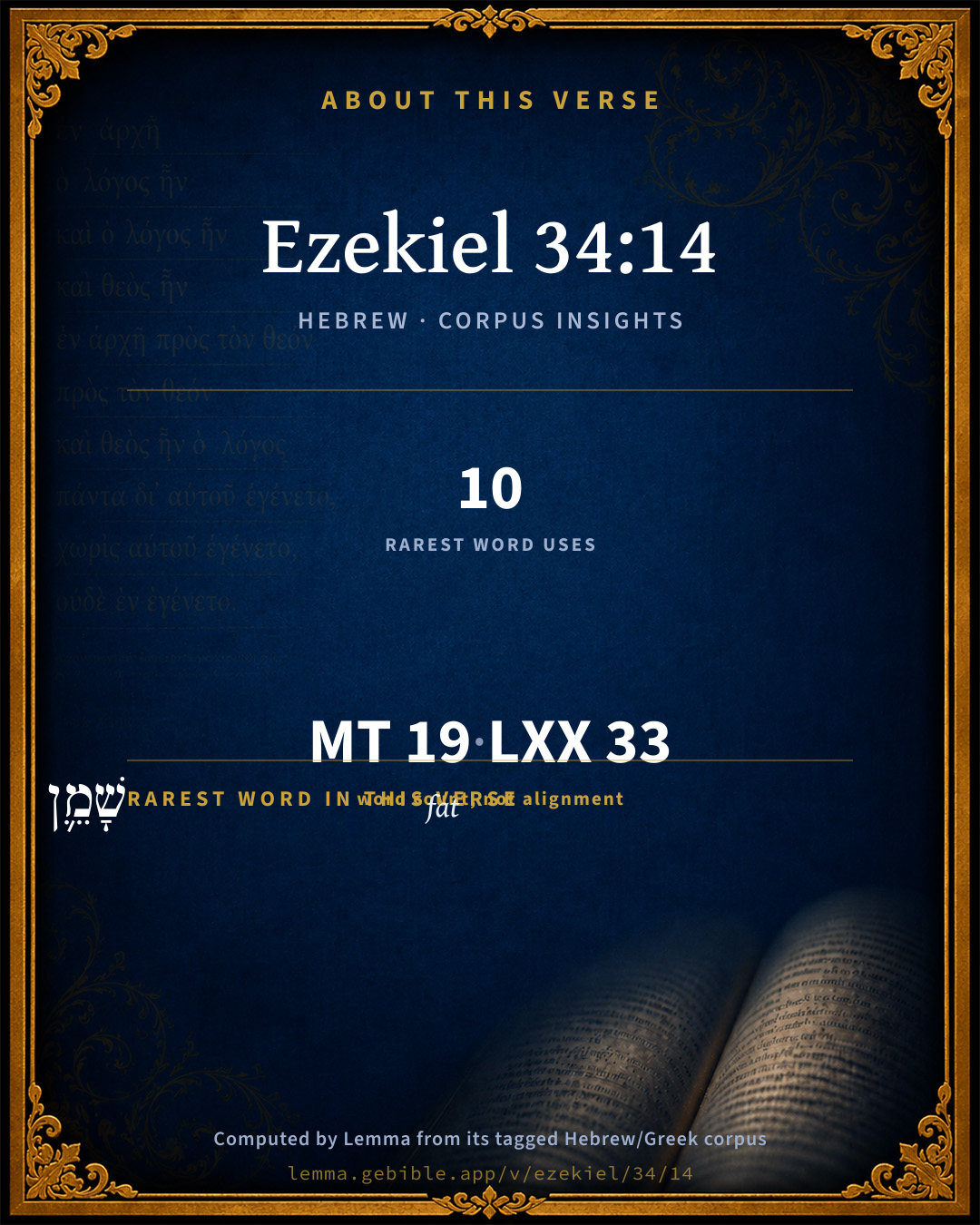
These counts appear in no published source. They are computed here, from the morphology-tagged text and Lemma’s own curated glosses. What Lemma adds →

19
words
13
distinct lemmas
Prophets
section

Notable vocabulary

The rarest word here is שָׁמֵ֛ן fat H8082 — appearing just 10 times in the whole Hebrew Bible.

Shared distinctive vocabulary

שָׁמֵ֛ן fat H8082 occurs in 10 verses of the Hebrew Bible. Also found in:

Grammatical profile

  • 4 verbs
  • 9 nouns
  • 3 adjectives
  • 1 preposition
  • 1 adverb
  • 1 particle

Verb forms

  • אֶרְעֶ֣ה Qal · Imperfect
  • יִהְיֶ֣ה Qal · Imperfect
  • תִּרְבַּ֨צְנָה֙ Qal · Imperfect
  • תִּרְעֶ֖ינָה Qal · Imperfect

Repetition

Words recur within this verse — often emphatic in Hebrew:

  • בְּמִרְעֶה pasture H4829 ×2
  • טּוֹב֙ good H2896 ×2
  • אֶרְעֶ֣ה to shepherd H7462 ×2
  • וּבְהָרֵ֥י mountain H2022 ×2
  • יִשְׂרָאֵ֖ל Israel H3478 ×2
  • נְוֵהֶ֑ם habitation H5116 ×2

Hebrew & Septuagint length

In English translation the verse runs 41 words from the Hebrew and 46 from the Septuagint (LXX English) — closely comparable.

A rough comparison of the two English renderings, which tokenize alike — not a word-level alignment.

Word counts can differ between the Hebrew and the Greek without any difference in meaning — e.g. the Hebrew direct-object marker אֵת has no separate Greek word, and Greek often adds the article ὁ.

In the original languages it is 19 Hebrew tokens and 33 Greek tokens — but the two are counted differently (Hebrew bundles its prefixes and suffixes into one token; the Greek is in lemma form), so that isn’t a like-for-like length.

Cross-references

12

Topical passages linked to Ezekiel 34:14 in the Treasury of Scripture Knowledge — connected by theme and wording, ordered by reader-vote popularity; previews shown in the World English Bible.

  • John 10:9 I am the door. If anyone enters in by me, he will be saved, and will go in and go out, and will find pasture.
  • Jeremiah 31:25 For I have satiated the weary soul, and every sorrowful soul have I replenished.
  • Psalms 23:1–2 Yahweh is my shepherd: I shall lack nothing.
  • Jeremiah 31:12–14 They shall come and sing in the height of Zion, and shall flow to the goodness of Yahweh, to the grain, and to the new wine, and to the oil, and to the young of the flock and of the herd: and their soul shall be as a watered garden; and they shall not sorrow any more at all.
  • Psalms 31:8–10 You have not shut me up into the hand of the enemy. You have set my feet in a large place.
  • Isaiah 25:6 In this mountain will Yahweh of Hosts make to all peoples a feast of fat things, a feast of wines on the lees, of fat things full of marrow, of wines on the lees well refined.
  • Isaiah 30:23–24 He will give the rain for your seed, with which you shall sow the ground; and bread of the increase of the ground, and it shall be fat and plenteous. In that day shall your cattle feed in large pastures;
  • Isaiah 40:11 He will feed his flock like a shepherd, he will gather the lambs in his arm, and carry them in his bosom, [and] will gently lead those who have their young.
  • Jeremiah 33:12–13 Thus says Yahweh of Hosts: Yet again shall there be in this place, which is waste, without man and without animal, and in all the cities of it, a habitation of shepherds causing their flocks to lie down.
  • Ezekiel 34:27 The tree of the field shall yield its fruit, and the earth shall yield its increase, and they shall be secure in their land; and they shall know that I am Yahweh, when I have broken the bars of their yoke, and have delivered them out of the hand of those who made slaves of them.
  • Ezekiel 36:29–30 I will save you from all your uncleanness: and I will call for the grain, and will multiply it, and lay no famine on you.
  • Revelation 7:16 They will never be hungry, neither thirsty any more; neither will the sun beat on them, nor any heat;

Cross-references courtesy of OpenBible.info (CC BY 4.0).

Hebrew and Greek witnesses Masoretic Hebrew ↔ Greek Septuagint

The same verse in the two great witnesses to the Old Testament, shown verse-for-verse.

These are two independent witnesses, not word-aligned to each other, and the Septuagint is shown in lemma (dictionary) form.

Hebrew Ezekiel 34:14 Masoretic · Westminster Leningrad Codex

בְּמִרְעֶה טּוֹב֙ אֶרְעֶ֣ה אֹתָ֔ם וּבְהָרֵ֥י מְרֽוֹם יִשְׂרָאֵ֖ל יִהְיֶ֣ה נְוֵהֶ֑ם שָׁ֤ם תִּרְבַּ֨צְנָה֙ בְּנָ֣וֶה טּ֔וֹב וּמִרְעֶ֥ה שָׁמֵ֛ן תִּרְעֶ֖ינָה אֶל הָרֵ֥י יִשְׂרָאֵֽל

I will feed them with good pasture; and on the mountains of the height of Israel shall their fold be: there shall they lie down in a good fold; and on fat pasture shall they feed on the mountains of Israel.

World English Bible · Public Domain

Greek LXX Ezekiel 34:14 Septuagint · lemma form

ἐν νομή ἀγαθός βόσκω αὐτός καί ἐν ὁ ὄρος ὁ ὑψηλός ἰσραήλ εἰμί ὁ μάνδρα αὐτός ἐκεῖ κοιμάω καί ἐκεῖ ἀναπαύω ἐν τρυφή ἀγαθός καί ἐν νομή πίων βόσκω ἐπί ὁ ὄρος ἰσραήλ

I will feed them in a good pasture, on a high mountain of Israel: and their folds shall be there, and they shall lie down, and there shall they rest in perfect prosperity, and they shall feed in a fat pasture on the mountains of Israel.

LXX2012 (modern English Septuagint) · Public Domain

On this verse, John Gill's Exposition discusses the Septuagint’s reading. Read the note in Commentary ↓

Hebrew: Westminster Leningrad Codex (CC BY 4.0). Greek: Septuagint (public domain); English from LXX2012 (modern English Septuagint) (Public Domain). How the Septuagint differs from the Hebrew →

Targum (Aramaic paraphrase)

1

The Targum is the ancient Jewish Aramaic paraphrase of the Hebrew Scriptures — an interpretive translation, not the Hebrew text itself. Onkelos (literal) and Pseudo-Jonathan (expansive) render the Torah, and Jonathan the Prophets. Coverage is partial: where no permissively-licensed English translation exists for a verse, only the Aramaic is shown. This is verse-level text, not a word-by-word alignment to the Hebrew.

  1. Targum Jonathan Prophets (Joshua–Malachi)
    בְּפַרְנוּס טַב אֲפַרְנֵיס יַתְהוֹן וּבְטוּר קוּדְשָׁא דְיִשְׂרָאֵל יְהֵיבֵית מֵישְׁרֵיהוֹן תַּמָן יִשְׁרוּן בַּאֲתַר דְיָאֵי וּפַרְנוּס טַב יִתְפַּרְנְסוּן עַל טוּרֵי יִשְׂרָאֵל:

    (no public-domain English translation for this verse)

    Targum Jonathan — Aramaic: “Mikraot Gedolot” (public domain). English: “Sefaria Community Translation” (CC0 1.0 (public-domain dedication)); “London "Chaldee Paraphrase," 1871” (public domain). Text via Sefaria.

Commentary

Notes on Ezekiel 34:14 from classic Christian and Jewish commentators (each source and its license shown beneath its notes). The classic Christian expositions comment on the surrounding passage and are grouped to its opening verse, so a note may address several verses; the Jewish commentaries on the Tanakh (Rashi and others) are per-verse, so they appear only where the commentator wrote on this verse.

Lemma curates 59 commentaries, every one of them public domain or Creative Commons licensed, each selected and text-cleaned for this edition rather than reprinted as found. About our sources →

The Cambridge Bible for Schools and Colleges

gen. ed. J. J. S. Perowne

14. Jehovah first seeks out his sheep (Eze_34:11), then he delivers them out of the places where they are scattered (Eze_34:12), then he leads them into their own land (Eze_34:13), where he feeds them upon the mountain heights of Israel (Eze_34:14-15).

The Cambridge Bible for Schools and Colleges (gen. ed. J. J. S. Perowne; Cambridge University Press, 1878–1918) — public domain. Text from a community e-Sword module.

John Gill's Exposition

I will feed my flock,.... This is repeated for the further confirmation of it, that it might be depended upon that the Lord would feed his people in the manner before promised; and it gives a reason why he would do it, because they were his flock; he had a right unto them, a property in them; they were separated and distinguished from others by him, as the church of God is; and which is also purchased by Christ, and gathered out of the world by his Spirit and grace; and therefore he will feed them, or take care that they shall be fed, Act 20:28,

and I will cause them to lie down, saith the Lord; in the good fold provided for them; where they have both rest and safety, and also plenty of suitable food; See Gill on Eze 34:14. The Targum is,

"I will govern my people, and will cause them to dwell safely, saith the Lord God;''

The Septuagint and Arabic versions add, "and they shall know that I am the Lord".

John Gill's Exposition of the Whole Bible (1746–1763) — public domain (CC PDM 1.0). Text via the HelloAO Bible API.

Trapp's Complete Commentary

John Trapp

Eze 34:14 I will feed them in a good pasture, and upon the high mountains of Israel shall their fold be: there shall they lie in a good fold, and [in] a fat pasture shall they feed upon the mountains of Israel.

Ver. 14. I will feed them in a good pasture.] Daily and daintily; feed them among the lilies; {Son 2:16 Psa 23:1-3} feed them with the flesh and blood of my dear Son {Joh 6:51-58}

There shall they lie in a good fold.] Having a blessed calm in their consciences, full of spiritual security, and freed from all annoyances {Mic 5:5}

John Trapp, A Commentary or Exposition upon All the Books of the Old and New Testament (1647–1656) — public domain. Text from a community e-Sword module.

Jamieson, Fausset & Brown

Robert Jamieson, A. R. Fausset & David Brown

good pasture-- (Psa 23:2).

high mountains of Israel--In Eze 17:23; Eze 20:40, the phrase is "the mountain of the height of Israel" in the singular number. The reason for the difference is: there Ezekiel spoke of the central seat of the kingdom, Mount Zion, where the people met for the worship of Jehovah; here he speaks of the kingdom of Israel at large, all the parts of which are regarded as possessing a moral elevation.

Jamieson, Fausset & Brown — Commentary Critical and Explanatory on the Whole Bible (1871) — public domain (CC PDM 1.0). Text via the HelloAO Bible API.

Matthew Poole's English Annotations

In a good pasture; in fat, sweet, plentiful pastures.

Their fold be; to rest in there for safety; they shall settle their habitations upon their return: or there my flock, my people, my church shall dwell and rest, where idolaters once had their high places; thus spiritually.

There they shall lie, & c.: this and what follows is a confirmation of what before was promised, and it is assured to them by the Lord, who himself will see all this be done.

Matthew Poole's English Annotations on the Holy Bible (1683–1685) — public domain. Text from a community e-Sword/MySword module.

The Pulpit Commentary

The mountain-height of Israel moral and spiritual elevation.

will feed them "upon the mountains of the height of Israel;" (literally, see Revised Version; see also Eze_17:23 and 20:40) i.e. upon the mountain-height of Israel; and the reference is to

I THE EXCELLENCY OF ISRAEL IN THE SIGHT OF GOD. The neglected and scattered sheep that had been untaught or misdirected by their rulers should be eared for by the Lord himself; they should be placed on the very summit of sacred privilege, they should be sheep feeding on the mountain-heights of the Holy Land. Mount Zion was "the holy mountain, (Eze_20:40) where the best spiritual pasture was to be had for the hungering heart of the devout Hebrew; but "everything in Israel had a moral elevation." At any rate, Israel in its best days, under David, Solomon, Jehoshaphat, Uzziah, Hezekiah, Josiah, attained to an elevation of knowledge and of character which was comparatively great and high. Its superiority to all surrounding nations was seen in:

1. Its knowledge of the living God. While they were worshipping gods of their own creation false, capricious, cruel, lustful the people of God were honoring One who was just, holy, kind, true, faithful; one who was worthy the deepest reverence, the fullest trust, the strongest affection that the human soul could offer; One whose service constituted the most lofty enjoyment and exerted the most elevating influence on the minds and lives of his worshippers.

2. Its morality. There are many passages in Scripture condemning immoralities among the Jews, and there were periods when Hebrew morality declined. In the time of our Lord it had sunk with the sinking of religion into formality and routine. Yet a historical comparison between the morale of the Jewish nation and that of all contemporary peoples would show that the children of Israel, in any period of their history, towered high and far above their neighbors. Comparatively speaking, they were true, and pure, and temperate, and just. To be taught and trained as was the Hebrew child in his home and in his school and in the sanctuary of God, was to ascend and to move along the "mountain-height of Israel." The very best and the saintliest men of Israel, whose names are held in highest honor by the good and pure of every land, were the mountain-peaks that did not rise straight and lonely from the deep valleys; they rose from the high elevation, the mountain-ranges of general national piety and purity. The idea is far more perfectly realized, and the prophecy finds its complete fulfillment in

II THE HIGHER EXCELLENCY OF THE CHURCH OF CHRIST. Here we stand on loftier ground. We have:

1. A still loftier conception of the character and the will of God. Learning of Jesus Christ, knowing God as revealed to us in him, we recognize a Divine Father, grieved with his children"s sin and departure from himself; yearning over them in their distance and their misery; seeking at his own infinite cost to save them; engaged through the centuries in the gracious and glorious work of redeeming the human race to holiness and happiness, to the kingdom of heaven.

2. A still higher morality. Sitting at the feet of the great Teacher, following in the steps of the Divine Exemplar, restrained and constrained by the influences of the Holy Spirit of God, we rise to and walk along the lofty mountain-range of Christian morals, breathing a Christian atmosphere, engaged with our Lord and Leader in his great work of grace and truth. With Christ"s own truth in our mind, with his example before our eyes, with his Spirit willing to dwell within and to inspire all that seek his presence and his power,

(1) how utterly unworthy of us is everything small and mean in feeling and in action!

(2) how it becomes us to take a high and noble course, to speak in an elevated strain, to breath a pure and bracing air, to do lofty and magnanimous deeds, as we move up the mountain-path to the heavenly places! C.

The Pulpit Commentary (1880–1919), ed. H.D.M. Spence-Jones & Joseph S. Exell — public domain. Text from a community e-Sword module.

unfoldingWord translationNotes

Door43 World Missions Community

General Information:

Yahweh continues giving Ezekiel his message to the leaders of Israel.

General Information:

Yahweh continues speaking of the people of Israel as if they were a flock of sheep. Here he speaks of himself as their shepherd who will take care of them. (See: Metaphor)

their grazing places

"places where they can eat"

abundant pastures

"lands that have a lot of grass and plants to eat"

graze

eat grass and other plants

I myself

The word "myself" adds emphasis. God would do this because the shepherds were not doing it. (See: Reflexive Pronouns)

will shepherd

"will feed and take care of"

will make them lie down

"will let them lie down"

the lost

The words "the sheep or goats" are left out of this phrase, but they are intended to be understood. AT: "the sheep or goats that are lost" (See: Ellipsis)

restore the outcast

"bring back those that others have chased away"

bind up the broken sheep

"wrap a cloth around any sheep's broken bone" or "wrap a cloth around any sheep's wound"

the fat and the strong

The word "sheep" is understood. AT: "the fat sheep and the strong sheep" (See: Ellipsis)

translationWords

declare

ewe

just

unfoldingWord translationNotes — © Distant Shores Media and the Door43 World Missions Community, licensed CC BY-SA 4.0. Source: git.door43.org/Door43/en_tn.

Lesson kit

Teaching starters — assembled from the data on this page, not authored interpretation. Every prompt links to the verse data it draws on. Edit before teaching.

Ezekiel, in the Prophets, opens this verse with 19 words (13 distinct Hebrew lemmas). Its most distinctive word is shâmên (“fat”). A historical commentator’s framing appears above. Read the whole chapter for the surrounding context.

Discussion questions

  1. What does “fat” (shâmên) contribute to the verse as a whole?
  2. How does Genesis 49:20, which shares the word «fat», read alongside this verse?
  3. What does the repetition of “pasture” (2× in this one verse) do in this verse?
  4. These translations render this verse differently. What is at stake in choosing one wording over another?
  5. «אֶרְעֶ֣ה» is a Qal Imperfect verb. How does that grammatical form shape the action described?
  6. Compare how The Cambridge Bible for Schools and Colleges and John Gill's Exposition read this verse. Where do they agree or differ?

Things to notice

Reading settings

Reading text

Shown beneath each verse's original-language words.

Old Testament
Old Testament edition

Read the OT as the Masoretic Hebrew (MT) or the Greek Septuagint (LXX).

English shown for the Greek Septuagint (in the Hebrew ↔ Greek comparison).

Comparing translations? Open the Compare panel on any verse page to stack up to four side by side.