Nahum 3:18

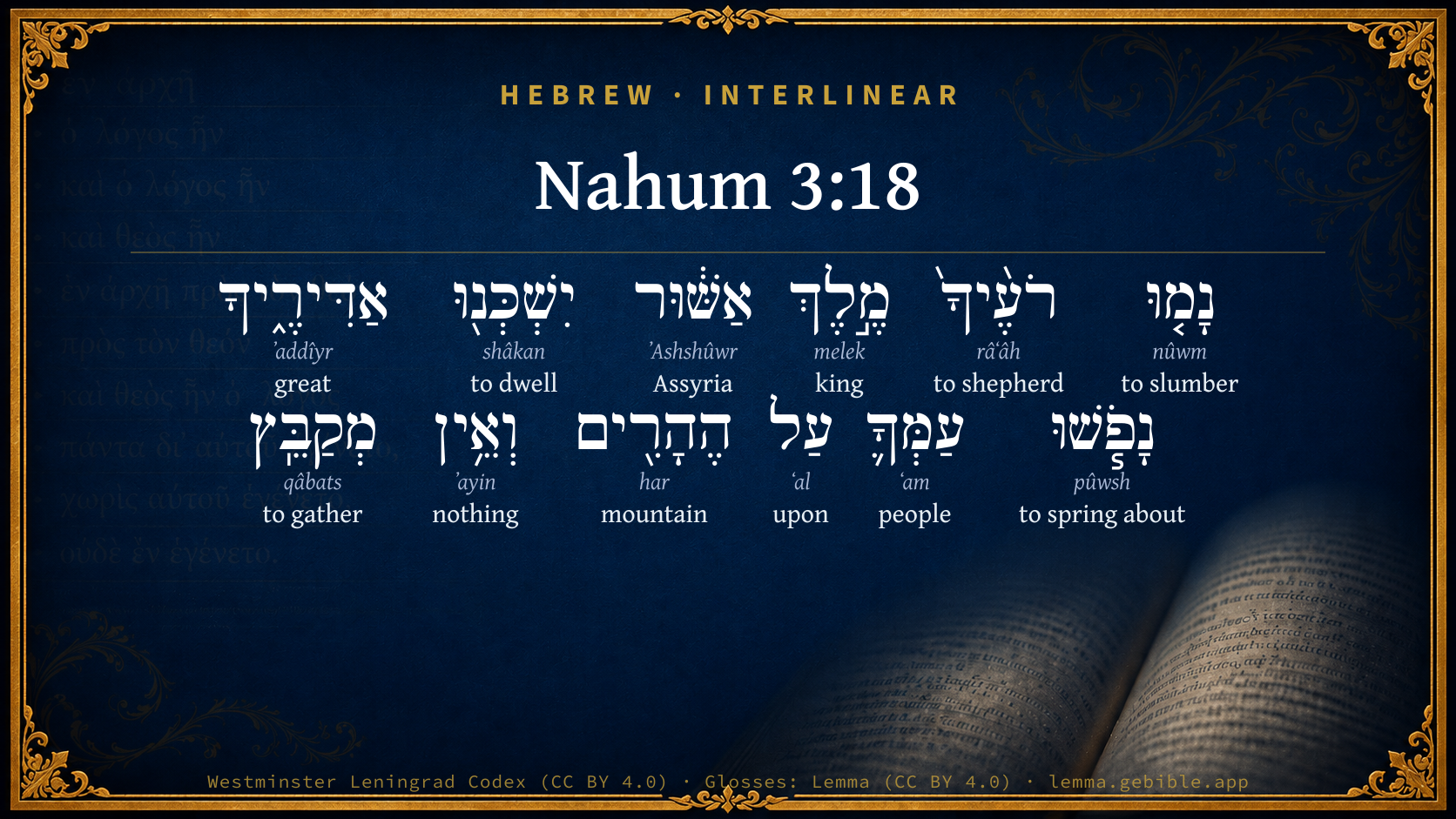
Hebrew (Westminster Leningrad Codex) Nahum 3:18 appears in the Hebrew Old Testament. The text above is from the Westminster Leningrad Codex. Each word links to its Strong’s number, a concise gloss, and parsing drawn from the Open Scriptures Hebrew Bible morphology. Click any word for its full Brown-Driver-Briggs (BDB) entry.
Download image
Cite this verse

Nahum 3:18 (World English Bible). Public Domain. Lemma interlinear Bible study tool, https://lemma.gebible.app/v/nahum/3/18.

Show BibTeX & RIS
BibTeX
RIS
English Translation
Your shepherds slumber, king of Assyria. Your nobles lie down. Your people are scattered on the mountains, and there is no one to gather them.
World English Bible · Public Domain
Download a study sheet

One document with this verse’s original text, its word-by-word gloss line, the meaning frame, cross-references with their text, attributed commentary, and full source and license credits — printable, and it pastes into notes with its structure intact.

This verse Autodidact and up

Study sheet (.html) Plain text (.txt)

A passage Seminary Student

Up to 50 verses in one chapter. A passage sheet keeps up to 6 commentary sources and 12 cross-references per verse, in the order this page ranks them, and says so on the sheet whenever that leaves anything out. Ask for a single verse and you get the Autodidact verse sheet above.

Everything on this page stays free to read, with no account — the sheet is a download of what is already on screen, not access to it.

Want to remove ads? Support Godless Engineer
Compare translations 3

The same verse in 3 English versions, stacked beneath the original-language interlinear above. Click any original word for its lexicon entry.

Each is an independent rendering of the whole verse — the interlinear is not word-aligned to these translations.

Highlighted words mark where these versions differ — a whole-verse word diff, not a word-by-word alignment.

  • World English Bible Public Domain
    Your shepherds slumber, king of Assyria. Your nobles lie down. Your people are scattered on the mountains, and there is no one to gather them.
  • King James Version Public Domain
    Thy shepherds slumber, O king of Assyria: thy nobles shall dwell in the dust: thy people is scattered upon the mountains, and no man gathereth them.
  • unfoldingWord Literal Text CC BY-SA 4.0
    King of Assyria, your shepherds are asleep; your nobles are lying down. Your people are scattered on the mountains, and there is no one gathering.

unfoldingWord Literal Text — © unfoldingWord, licensed CC BY-SA 4.0. Word-aligned USFM3 via Door43 (git.door43.org/unfoldingWord/en_ult).

Versions to compare (up to 4)

3 of 4 selected

Show all 18 translations

Every available English version of this verse, each an independent rendering of the whole verse.

  • World English Bible Public Domain
    Your shepherds slumber, king of Assyria. Your nobles lie down. Your people are scattered on the mountains, and there is no one to gather them.
  • Berean Standard Bible Public Domain
    O king of Assyria, your shepherds slumber; your officers sleep. Your people are scattered on the mountains with no one to gather them.
  • Majority Standard Bible Public Domain
    O king of Assyria, your shepherds slumber; your officers sleep. Your people are scattered on the mountains with no one to gather them.
  • King James Version Public Domain
    Thy shepherds slumber, O king of Assyria: thy nobles shall dwell in the dust: thy people is scattered upon the mountains, and no man gathereth them.
  • American Standard Version (1901) Public Domain
    Thy shepherds slumber, O king of Assyria; thy nobles are at rest; thy people are scattered upon the mountains, and there is none to gather them.
  • Revised Version (1885) Public Domain
    Thy shepherds slumber, O king of Assyria: thy worthies are at rest: thy people are scattered upon the mountains, and there is none to gather them.
  • Geneva Bible (1599) Public Domain
    Thy shepheardes doe sleepe, O King of Asshur: thy strong men lie downe: thy people is scattered vpon the mountaines, and no man gathereth them.
  • Douay-Rheims (1899) Public Domain
    Thy shepherds have slumbered, O king of Assyria, thy princes shall be buried: thy people are hid in the mountains, and there is none to gather them together.
  • Young's Literal Translation Public Domain
    Slumbered have thy friends, king of Asshur, Rest do thine honourable ones, Scattered have been thy people on the mountains, And there is none gathering.
  • Literal Standard Version CC BY-SA 4.0
    Your friends have slumbered, king of Asshur, || Your majestic ones rest, || Your people have been scattered on the mountains, || And there is none gathering.
  • Unlocked Literal Bible CC BY-SA 4.0
    King of Assyria, your shepherds are asleep; your rulers are lying down resting. Your people are scattered on the mountains, and there is no one to gather them.
  • unfoldingWord Literal Text CC BY-SA 4.0
    King of Assyria, your shepherds are asleep; your nobles are lying down. Your people are scattered on the mountains, and there is no one gathering.
  • Darby Bible Public Domain
    Thy shepherds slumber, O king of Assyria; thy nobles lie still; thy people are scattered upon the mountains, and no man gathereth them.
  • World Messianic Bible Public Domain
    Your shepherds slumber, king of Assyria. Your nobles lie down. Your people are scattered on the mountains, and there is no one to gather them.
  • Webster's Bible Public Domain
    Thy shepherds slumber, O king of Assyria: thy nobles shall dwell in the dust: thy people are scattered upon the mountains, and no man gathereth them.
  • Free Bible Version CC BY-SA 4.0
    King of Assyria, your shepherds are asleep, your princes are slumbering. Your people are scattered across the mountains and no one can gather them.
  • Bible in Basic English Public Domain
    Sorrow! how are the keepers of your flock sleeping, O king of Assyria! your strong men are at rest; your people are wandering on the mountains, and there is no one to get them together.
  • JPS Tanakh (1917) Public Domain
    Thy shepherds slumber, O king of Assyria, thy worthies are at rest; thy people are scattered upon the mountains, and there is none to gather them.

Literal Standard Version (2020), Covenant Press — licensed CC BY-SA 4.0. Text via the HelloAO Bible API (eBible.org). Unlocked Literal Bible (unfoldingWord) — licensed CC BY-SA 4.0. Text via the HelloAO Bible API (eBible.org). unfoldingWord Literal Text — © unfoldingWord, licensed CC BY-SA 4.0. Word-aligned USFM3 via Door43 (git.door43.org/unfoldingWord/en_ult). Free Bible Version, Dr. Jonathan Gallagher — licensed CC BY-SA 4.0. Text via the HelloAO Bible API (eBible.org).

Word by word

More ways to search: Search by grammar → Find every occurrence → Compare this word →

Practice this passage: Drill this verse → Learn its vocabulary →

נָפֹ֧שׁוּ
pûwsh
H6335
“to spring about”
Verb, Niphal, Perfect, 3rd Person, Common, Plural
Part of Speech
Verb
Stem
Niphal
Form
Perfect
Person
3rd Person
Gender
Common
Number
Plural
Full BDB Definition

Origin: a primitive root

TWOT: 1751 , 1752

to spring about - (Qal) to frisk, act proudly (figuratively) - (Niphal) to be scattered, be spread
  1. נָמ֤וּ nûwm H5123 “to slumber” Verb, Qal, Perfect, 3rd Person, Common, Plural
  2. רֹעֶ֨יךָ֙ râʻâh H7462 “shepherding · you” Verb, Qal, Participle Active, Masculine, Plural, Construct + Suffix, Personal, 2nd Person, Masculine, Singular
  3. מֶ֣לֶךְ melek H4428 “king of” Noun, Common, Masculine, Singular, Construct
  4. אַשּׁ֔וּר ʼAshshûwr H804 “Assyria” Noun, Proper
  5. יִשְׁכְּנ֖וּ shâkan H7931 “to dwell” Verb, Qal, Imperfect, 3rd Person, Masculine, Plural
  6. אַדִּירֶ֑יךָ ʼaddîyr H117 “great · your” Adjective, Adjective, Masculine, Plural, Construct + Suffix, Personal, 2nd Person, Masculine, Singular
  7. עַמְּךָ֛ ʻam H5971 “people · your” Noun, Common, Masculine, Singular, Construct + Suffix, Personal, 2nd Person, Masculine, Singular
  8. עַל ʻal H5921 “upon” Preposition
  9. הֶהָרִ֖ים har H2022 “the · mountains” Particle, Definite Article + Noun, Common, Masculine, Plural, Absolute
  10. וְאֵ֥ין ʼayin H369 “and · nothing” Conjunction + Particle, Negative
  11. מְקַבֵּֽץ qâbats H6908 “gathering” Verb, Piel, Participle Active, Masculine, Singular, Absolute

About this verse

These counts appear in no published source. They are computed here, from the morphology-tagged text and Lemma’s own curated glosses. What Lemma adds →

12
words
12
distinct lemmas
Prophets
section

Notable vocabulary

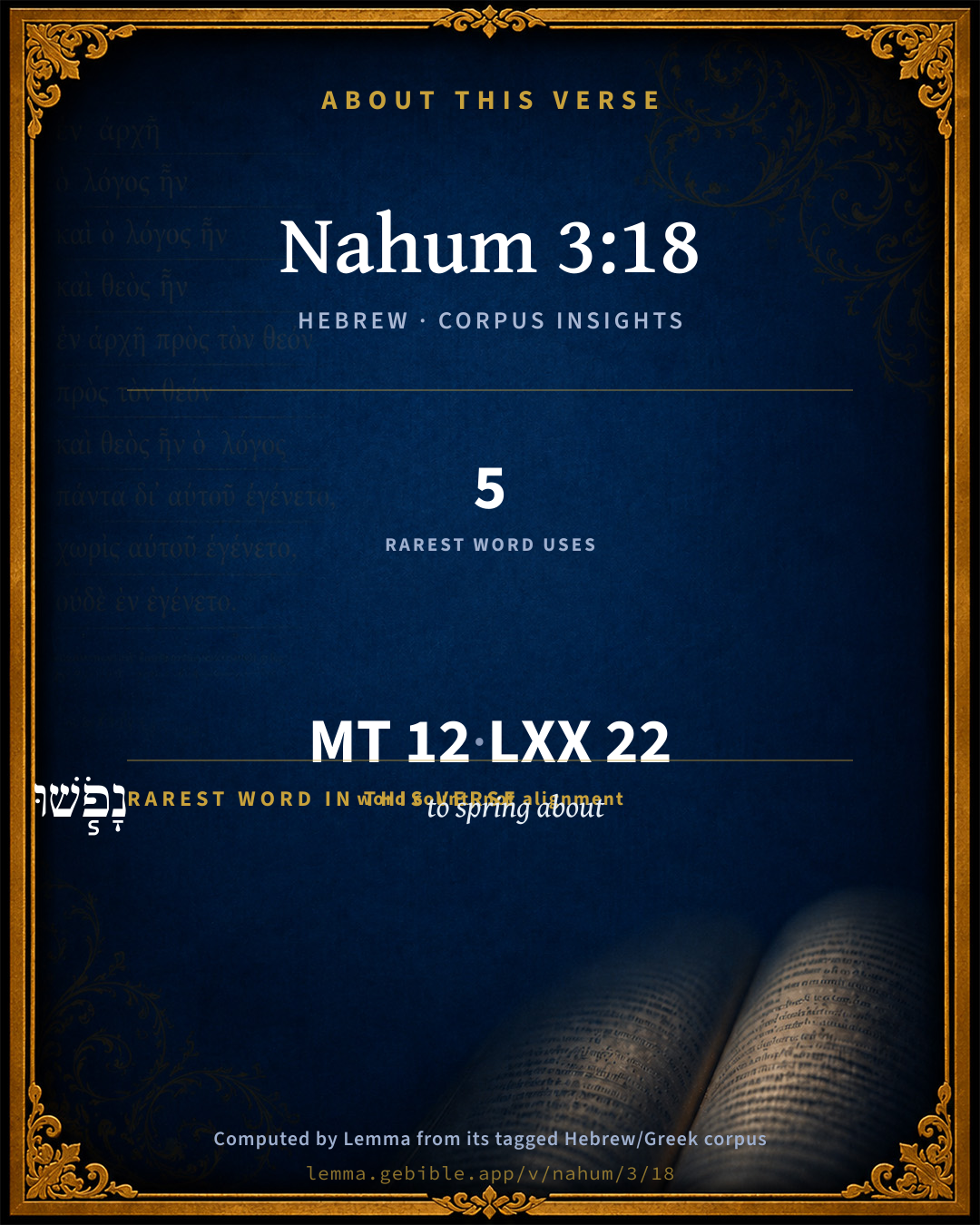
The rarest word here is נָפֹ֧שׁוּ to spring about H6335 — appearing just 5 times in the whole Hebrew Bible.

Shared distinctive vocabulary

נָפֹ֧שׁוּ to spring about H6335 occurs in 4 verses of the Hebrew Bible. Also found in:

Grammatical profile

  • 5 verbs
  • 4 nouns
  • 1 adjective
  • 1 preposition
  • 1 particle

Verb forms

  • נָמ֤וּ Qal · Perfect
  • רֹעֶ֨יךָ֙ Qal · Participle Active
  • יִשְׁכְּנ֖וּ Qal · Imperfect
  • נָפֹ֧שׁוּ Niphal · Perfect
  • מְקַבֵּֽץ Piel · Participle Active

Hebrew & Septuagint length

In English translation the verse runs 25 words from the Hebrew and 26 from the Septuagint (LXX English) — closely comparable.

A rough comparison of the two English renderings, which tokenize alike — not a word-level alignment.

Word counts can differ between the Hebrew and the Greek without any difference in meaning — e.g. the Hebrew direct-object marker אֵת has no separate Greek word, and Greek often adds the article ὁ.

In the original languages it is 12 Hebrew tokens and 22 Greek tokens — but the two are counted differently (Hebrew bundles its prefixes and suffixes into one token; the Greek is in lemma form), so that isn’t a like-for-like length.

Cross-references

13

Topical passages linked to Nahum 3:18 in the Treasury of Scripture Knowledge — connected by theme and wording, ordered by reader-vote popularity; previews shown in the World English Bible.

  • 1 Kings 22:17 He said, I saw all Israel scattered on the mountains, as sheep that have no shepherd: and Yahweh said, These have no master; let them return every man to his house in peace.
  • Psalms 76:5–6 Valiant men lie plundered, They have slept their last sleep. None of the men of war can lift their hands.
  • Isaiah 13:14 It shall happen, that as the chased roe, and as sheep that no man gathers, they shall turn every man to his own people, and shall flee every man to his own land.
  • Jeremiah 50:18 Therefore thus says Yahweh of Hosts, the God of Israel: Behold, I will punish the king of Babylon and his land, as I have punished the king of Assyria.
  • Jeremiah 51:57 I will make drunk her princes and her wise men, her governors and her deputies, and her mighty men; and they shall sleep a perpetual sleep, and not wake up, says the King, whose name is Yahweh of Hosts.
  • Exodus 15:16 Terror and dread falls on them. By the greatness of your arm they are as still as a stone; Until your people pass over, Yahweh, Until the people pass over who you have purchased.
  • Isaiah 47:1 Come down, and sit in the dust, virgin daughter of Babylon; sit on the ground without a throne, daughter of the Chaldeans: for you shall no more be called tender and delicate.
  • Isaiah 56:9–10 All you animals of the field, come to devour, [yes], all you animals in the forest.
  • Jeremiah 51:39 When they are heated, I will make their feast, and I will make them drunken, that they may rejoice, and sleep a perpetual sleep, and not wake, says Yahweh.
  • Ezekiel 31:3–18 Behold, the Assyrian was a cedar in Lebanon with beautiful branches, and with a forest-like shade, and of high stature; and its top was among the thick boughs.
  • Ezekiel 32:22–23 Asshur is there and all her company; her graves are round about her; all of them slain, fallen by the sword;
  • Nahum 2:5–6 He summons his picked troops. They stumble on their way. They dash to its wall, and the protective shield is put in place.
  • Revelation 6:15 The kings of the earth, the princes, the commanding officers, the rich, the strong, and every slave and free person, hid themselves in the caves and in the rocks of the mountains.

Cross-references courtesy of OpenBible.info (CC BY 4.0).

Hebrew and Greek witnesses Masoretic Hebrew ↔ Greek Septuagint

The same verse in the two great witnesses to the Old Testament, shown verse-for-verse.

These are two independent witnesses, not word-aligned to each other, and the Septuagint is shown in lemma (dictionary) form.

Hebrew Nahum 3:18 Masoretic · Westminster Leningrad Codex

נָמ֤וּ רֹעֶ֨יךָ֙ מֶ֣לֶךְ אַשּׁ֔וּר יִשְׁכְּנ֖וּ אַדִּירֶ֑יךָ נָפֹ֧שׁוּ עַמְּךָ֛ עַל הֶהָרִ֖ים וְאֵ֥ין מְקַבֵּֽץ

Your shepherds slumber, king of Assyria. Your nobles lie down. Your people are scattered on the mountains, and there is no one to gather them.

World English Bible · Public Domain

Greek LXX Nahum 3:18 Septuagint · lemma form

νυστάζω ὁ ποιμήν σύ βασιλεύς ἀσσύριος κοιμίζω ὁ δυνάστης σύ ἀποαἴρω ὁ λαός σύ ἐπί ὁ ὄρος καί οὐ εἰμί ὁ ἐκδέχομαι

Your shepherds have slumbered, the Assyrian king has laid low your mighty men: your people departed to the mountains, and there was none to receive them.

LXX2012 (modern English Septuagint) · Public Domain

On this verse, Whedon's Commentary on the Bible discusses the Septuagint’s reading. Read the note in Commentary ↓

Hebrew: Westminster Leningrad Codex (CC BY 4.0). Greek: Septuagint (public domain); English from LXX2012 (modern English Septuagint) (Public Domain). How the Septuagint differs from the Hebrew →

Targum (Aramaic paraphrase)

1

The Targum is the ancient Jewish Aramaic paraphrase of the Hebrew Scriptures — an interpretive translation, not the Hebrew text itself. Onkelos (literal) and Pseudo-Jonathan (expansive) render the Torah, and Jonathan the Prophets. Coverage is partial: where no permissively-licensed English translation exists for a verse, only the Aramaic is shown. This is verse-level text, not a word-by-word alignment to the Hebrew.

  1. Targum Jonathan Prophets (Joshua–Malachi)
    אִתְּבָרוּ גִבָּרָךְ מַלְכָּא דְאַתּוּר גְלוֹ עַם מַשִׁרְיָתָךְ אִתְבַּדָרוּ עַמָךְ עַל טוּרַיָא וְלֵית דְמַכְנִישׁ:

    (no public-domain English translation for this verse)

    Targum Jonathan — Aramaic: “Mikraot Gedolot” (public domain). English: “Sefaria Community Translation” (CC0 1.0 (public-domain dedication)); “London "Chaldee Paraphrase," 1871” (public domain). Text via Sefaria.

Commentary

Notes on Nahum 3:18 from classic Christian and Jewish commentators (each source and its license shown beneath its notes). The classic Christian expositions comment on the surrounding passage and are grouped to its opening verse, so a note may address several verses; the Jewish commentaries on the Tanakh (Rashi and others) are per-verse, so they appear only where the commentator wrote on this verse.

Lemma curates 59 commentaries, every one of them public domain or Creative Commons licensed, each selected and text-cleaned for this edition rather than reprinted as found. About our sources →

Trapp's Complete Commentary

John Trapp

Nah 3:18 Thy shepherds slumber, O king of Assyria: thy nobles shall dwell [in the dust]: thy people is scattered upon the mountains, and no man gathereth [them].

Ver. 18. Thy shepherds slumber, O king of Assyria] This apostrophe to the king is emphatic. He is given to know that his nobles and officers, Mic 5:4-6; Mic 7:14, his councillors of state, and greatest politicians, should be benighted, and not know what counsel to give or course to take. Or, they slumber, that is, they are dead, as Psa 77:6. And this is more agreeable to that which followeth:

Thy nobles shall dwell in the dust] The Vulgate hath it sepelientur, shall be buried. Others, iacebunt, shall lie on the ground, like beasts, through fear and consternation of mind: 1Sa 28:20, "Then Saul fell straightway all along on the earth, and was sore afraid."

Thy people is scattered upon the mountains] Diffused and dispersed abundantly; as sheep without a shepherd, whereof none being wiser than other, no man gathereth them into the sheep cotes of better order.

John Trapp, A Commentary or Exposition upon All the Books of the Old and New Testament (1647–1656) — public domain. Text from a community e-Sword module.

Joseph Benson's Commentary

Nah 3:18-19. Thy shepherds slumber, O king of Assyria — Thy rulers and counsellors are remiss, heartless, or dead. Thy nobles — Or valiant ones, shall dwell in the dust — These words are not in the Hebrew, but are supplied by our translators. The strict rendering of the Hebrew would rather be, Have lain down, as Grotius renders it; that is, have indulged themselves in ease, and not concerned themselves about the public affairs. The Vulgate, however, renders this former part of the verse, Thy shepherds have slept, thy princes shall be buried: understanding it, probably, of their being slain in battle, or having died through famine or pestilence during the siege. Thy people is scattered upon the mountains — Thy people, or common soldiers, for want of commanders, are scattered about, and there is no chief officer, or head commander, to collect them together. There is no healing of thy bruise — Or binding up of thy wound. Thy destruction is inevitable. The state of thy affairs is so bad, that there is no hope of recovering them. All that hear the bruit of thee — That is, the report of thee; (as the obsolete word bruit signifies;) all to whom the account of thy fall shall come; shall clap the hands over thee — Namely, for joy. For upon whom hath not thy wickedness, &c. — To whom hast thou not been injurious?

Thus it is evident, upon the whole of this prophecy of Nahum, that the entire desolation and complete destruction of Nineveh were most expressly and particularly foretold therein: yet one can hardly imagine any event more improbable than this was, at the time when Nahum predicted it. Surely there was no probability that the capital of a great kingdom, a city which was sixty miles in compass, a city which contained so many myriads of inhabitants, which had walls one hundred feet high, and so thick that three chariots could go abreast upon them, and which had one thousand five hundred towers of two hundred feet in height; surely there was no probability that such a city should ever be totally destroyed; and yet so totally was it destroyed, that authors are not agreed about its situation. From the general suffrage, indeed, of ancient historians and geographers, it seems to have been situated upon the Tigris; but yet no less authors than Ctesias and Diodorus Siculus represent it as situated upon the river Euphrates. Nay, authors differ, not only from one another, but also from themselves. For the learned Bochart hath shown, that Herodotus, Diodorus Siculus, and Ammianus Marcellinus, all three speak differently of it, sometimes as if it was situated upon the river Tigris, and sometimes as if upon the river Euphrates. So that, to reconcile these authors with themselves and with others, it is supposed by Bochart that there were two Ninevehs, and by Sir John Marshman that there were three; the Syrian, upon the river Euphrates; the Assyrian, upon the river Tigris; and a third, built afterward upon the Tigris by the Persians, who succeeded the Parthians in the empire of the East in the third century, and were subdued by the Saracens in the seventh century after Christ: but whether this latter Nineveh was built in the same place as old Nineveh is a question that cannot be decided. Lucian, who flourished in the second century after Christ, affirms, that Nineveh was utterly perished, and there was no footstep of it remaining, nor could one tell where once it was situated. And the greater regard is to be paid to his testimony, as he was a native of Samosata, a city upon the river Euphrates; and, coming from a neighbouring country, he must have known whether there had been any remains of Nineveh or not. “Even the ruins,” says Bishop Newton, “of old Nineveh have been, as I may say, ruined and destroyed; such an utter end hath been made of it, and such is the truth of the divine predictions! This, perhaps, may strike us the more strongly, by supposing only a parallel instance: let us, then, suppose that a person should come in the name of a prophet preaching repentance to the people of this kingdom, or otherwise denouncing the destruction of the capital city within a few years. I presume we should look upon such a prophet as a madman, and show no further attention to his message than to deride and despise it: and yet such an event would not be more strange and incredible than the destruction and devastation of Nineveh. For Nineveh was much the larger, and much the stronger and older city of the two; and the Assyrian empire had subsisted and flourished more ages than any form of government in this country; so that we cannot object the instability of the eastern monarchies in this case. Let us, then, since this event would not be more improbable and extraordinary than the other, suppose again, that things should succeed according to the prediction, the floods should arise, and the enemy should come, the city should be overflowed and broken down, be taken and pillaged, and destroyed so totally, that even the learned could not agree about the place where it was situated. What would be said or thought in such a case? Whoever of posterity should read and compare the prophecy and event together, must they not, by such an illustrious instance, be thoroughly convinced of the providence of God, and of the truth of this prophet, and be ready to acknowledge, Verily this is the word that the Lord hath spoken! Verily there is a God who judgeth in the earth!”

Joseph Benson's Commentary on the Old and New Testaments (1811–1818) — public domain. Text from a community e-Sword module.

Keil & Delitzsch

C. F. Keil & F. Delitzsch

Such an end will come to the Assyrian kingdom on the overthrow of Nineveh. Nah 3:18. "The shepherds have fallen asleep, king Asshur: thy glorious ones are lying there: thy people have scattered themselves upon the mountains, and no one gathers them. Nah 3:19. No alleviation to thy fracture, thy stroke is grievous: all who hear tidings of thee clap the hand over thee: for over whom hath not thy wickedness passed continually?" The king of Asshur addressed in Nah 3:18 is not the last historical king of that kingdom, but a rhetorical personification of the holder of the imperial power of Assyria. His shepherds and glorious ones ('addı̄rı̄m, as in Nah 2:6) are the princes and great men, upon whom the government and defence of the kingdom devolved, the royal counsellors, deputies, and generals. Mâmū, from nūm, to slumber, to sleep, is not a figurative expression for carelessness and inactivity here; for the thought that the people would be scattered, and the kingdom perish, through the carelessness of the rulers (Hitzig), neither suits the context, where the destruction of the army and the laying of the capital in ashes are predicted, nor the object of the whole prophecy, which does not threaten the fall of the kingdom through the carelessness of its rulers, but the destruction of the kingdom by a hostile army. Nūm denotes here, as in Psa 76:6, the sleep of death (cf. Psa 13:4; Jer 51:39, Jer 51:57 : Theodoret, Hesselb., Str., and others). Shâkhan, a synonym of shâkhabh, to have lain down, to lie quietly (Jdg 5:17), used here of the rest of death. As the shepherds have fallen asleep, the flock (i.e., the Assyrian people) is scattered upon the mountains and perishes, because no one gathers it together. Being scattered upon the mountains, is easily explained from the figure of the flock (cf. Num 27:17; Kg1 22:17; Zac 13:7), and implies destruction. The mountains are mentioned with evident reference to the fact that Nineveh is shut in towards the north by impassable mountains. Kēhâh, a noun formed from the adjective, the extinction of the wound (cf. Lev 13:6), i.e., the softening or anointing of it. Shebher, the fracture of a limb, is frequently applied to the collapse or destruction of a state or kingdom (e.g., Psa 60:4; Lam 2:11). נחלה מכּתך, i.e., dangerously bad, incurable is the stroke which has fallen upon thee (cf. Jer 10:19; Jer 14:17; Jer 30:12). Over thy destruction will all rejoice who hear thereof. שׁמעך, the tidings of thee, i.e., of that which has befallen thee. Clapping the hands is a gesture expressive of joy (cf. Psa 47:2; Isa 55:12). All: because they all had to suffer from the malice of Asshur. רעה, malice, is the tyranny and cruelty which Assyria displayed towards the subjugated lands and nations.

Thus was Nineveh to perish. If we inquire now how the prophecy was fulfilled, the view already expressed by Josephus (Ant. x. 2), that the fall of the Assyrian empire commenced with the overthrow of Sennacherib in Judah, is not confirmed by the results of the more recent examinations of the Assyrian monuments. For according to the inscriptions, so far as they have been correctly deciphered, Sennacherib carried out several more campaigns in Susiana and Babylonia after that disaster, whilst ancient writers also speak of an expedition of his to Cilicia. His successor, Esarhaddon, also carried on wars against the cities of Phoenicia, against Armenia and Cilicia, attacked the Edomites, and transported some of them to Assyria, and is said to have brought a small and otherwise unknown people, the Bikni, into subjection; whilst we also know from the Old Testament (Ch2 33:11) that his generals led king Manasseh in chains to Babylon. Like many of his predecessors, he built himself a palace at Kalah or Nimrud; but before the internal decorations were completely finished, it was destroyed by so fierce a fire, that the few monuments preserved have suffered very considerably. His successor is the last king of whom we have any inscriptions, with his name still legible upon them (viz., Assur-bani-pal). He carried on wars not only in Susiana, but also in Egypt, viz., against Tirhaka, who had conquered Memphis, Thebes, and other Egyptian cities, during the illness of Esarhaddon; also on the coast of Syria, and in Cilicia and Arabia; and completed different buildings which bear his name, including a palace in Kouyunjik, in which a room has been found with a library in it, consisting of clay tablets. Assur-bani-pal had a son, whose name was written Asur-emid-ilin, and who is regarded as the Sarakos of the ancients, under whom the Assyrian empire perished, with the conquest and destruction of Nineveh (see Spiegel in Herzog's Cycl.). But if, according to these testimonies, the might of the Assyrian empire was not so weakened by Sennacherib's overthrow in Judah, that any hope could be drawn from that, according to human conjecture, of the speedy destruction of that empire; the prophecy of Nahum concerning Nineveh, which was uttered in consequence of that catastrophe, cannot be taken as the production of any human combination: still less can it be taken, as Ewald supposes, as referring to "the first important siege of Nineveh, under the Median king Phraortes (Herod. i. 102)." For Herodotus says nothing about any siege of Nineveh, but simply speaks of a war between Phraortes and the Assyrians, in which the former lost his life. Nineveh was not really besieged till the time of Cyaxares (Uwakhshatra), who carried on the war with an increased army, to avenge the death of his father, and forced his way to Nineveh, to destroy that city, but was compelled, by the invasion of his own land by the Scythians, to relinquish the siege, and hasten to meet that foe (Her. i. 103). On the extension of his sway, the same Cyaxares commenced a war with the Lydian king Alyattes, which was carried on for five years with alternating success and failure on both sides, and was terminated in the sixth year by the fact, that when the two armies were standing opposite to one another, drawn up in battle array, the day suddenly darkened into night, which alarmed the armies, and rendered the kings disposed for peace. This was brought about by the mediation of the Cilician viceroy Syennesis and the Babylonian viceroy Labynetus, and sealed by the establishment of a marriage relationship between the royal families of Lydia and Media (Her. i. 74). And if this Labynetus was the same person as the Babylonian king Nabopolassar, which there is no reason to doubt, it was not till after the conclusion of this peace that Cyaxares formed an alliance with Nabopolassar to make war upon Nineveh; and this alliance was strengthened by his giving his daughter Amuhea in marriage to Nabopolassar's son Nebuchadnezzar (Nabukudrossor). The combined forces of these two kings now advanced to the attack upon Nineveh, and conquered it, after a siege of three years, the Assyrian king Saracus burning himself in his palace as the besiegers were entering the city. This is the historical kernel of the capture and destruction of Nineveh, which may be taken as undoubted fact from the accounts of Herodotus (i. 106) and Diod. Sic. (ii. 24-28), as compared with the extract from Abydenus in Euseb. Chron. Armen. i. p. 54; whereas it is impossible to separate the historical portions from the legendary and in part mythical decorations contained in the elaborate account given by Diodorus (vid., M. v. Niebuhr, Geschichte Assurs, p. 200ff.; Duncker, Geschichte des Alterthums. i. p. 793ff.; and Bumller, Gesch. d. Alterth. i. p. 316ff.).

The year of the conquest and destruction of Nineveh has been greatly disputed, and cannot be exactly determined. As it is certain that Nabopolassar took part in the war against Nineveh, and this is indirectly intimated even by Herodotus, who attributes the conquest of it to Cyaxares and the Medes (vid., i. 106), Nineveh must have fallen between the years 625 and 606 b.c. For according to the canon of Ptolemy, Nabopolassar was king of Babylon from 625 to 606; and this date is astronomically established by an eclipse of the moon, which took place in the fifth year of his reign, and which actually occurred in the year 621 b.c. (vid., Niebuhr, p. 47). Attempts have been made to determine the year of the taking of Nineveh, partly with reference to the termination of the Lydio-Median war, and partly from the account given by Herodotus of the twenty-eight years' duration of the Scythian rule in Asia. Starting from the fact, that the eclipse of the sun, which put an end to the war between Cyaxares and Alyattes, took place, according to the calculation of Altmann, on the 30th September b.c. 610 (see Ideler, Handbuch der Chronologie, i. p. 209ff.), M. v. Niebuhr (pp. 197-8) has assumed that, at the same time as the mediation of peace between the Lydians and Medes, an alliance was formed between Cyaxares and Nabopolassar for the destruction of Nineveh; and as this treaty could not possibly be kept secret, the war against Assyria was commenced at once, according to agreement, with their united forces. But as it was impossible to carry out extensive operations in winter, the siege of Nineveh may not have commenced till the spring of 609; and as it lasted three years according to Ctesias, the capture may not have been effected before the spring of 606 b.c. It is true that this combination is apparently confirmed by the fact, that during that time the Egyptian king Necho forced his way into Palestine and Syria, and after subduing all Syria, advanced to the Euphrates; since this advance of the Egyptian is most easily explained on the supposition that Nabopolassar was so occupied with the war against Nineveh, that he could not offer any resistance to the enterprise of Necho. And the statement in Kg2 23:29, that Necho had come up to fight against the king of Asshur on the Euphrates, appears to favour the conclusion, that at that time (i.e., in the year of Josiah's death, 610 b.c.) the Assyrian empire was not yet destroyed. Nevertheless there are serious objections to this combination. In the first place, there is the double difficulty, that Cyaxares would hardly have been in condition to undertake the war against Nineveh in alliance with Nabopolassar, directly after the conclusion of peace with Alyattes, especially after he had carried on a war for five years, without being able to defeat his enemy; and secondly, that even Nabopolassar, after a fierce three years' conflict with Nineveh, the conquest of which was only effected in consequence of the wall of the city having been thrown down for the length of twenty stadia, would hardly possess the power to take the field at once against Pharoah Necho, who had advanced as far as the Euphrates, and not only defeat him at Carchemish, but pursue him to the frontier of Egypt, and wrest from him all the conquests that he had effected, as would necessarily be the case, since the battle at Carchemish was fought in the year 606; and the pursuit of the defeated foe by Nebuchadnezzar, to whom his father had transferred the command of the army because of his own age an infirmity, even to the very border of Egypt, is so distinctly attested by the biblical accounts (Kg2 24:1 and Kg2 24:7; Jer 46:2), and by the testimony of Berosus in Josephus (Ant. x. 11, 1, and c. Ap. i. 19), that these occurrences are placed beyond the reach of doubt (see comm. on Kg2 24:1). These difficulties would not indeed be sufficient in themselves to overthrow the combination mentioned, provided that the year 610 could be fixed upon with certainty as the time when the Lydio-Median war was brought to a close. But that is not the case; and this circumstance is decisive. The eclipse of the sun, which alarmed Cyaxares and Alyattes, and made them disposed for peace, must have been total, or nearly total, in Central Asia and Cappadocia, to produce the effect described. But it has been proved by exact astronomical calculations, that on the 30th September 610 b.c., the shadow of the moon did not fall upon those portions of Asia Minor, whereas it did so on the 18th May 622, after eight o'clock in the morning, and on the 28th May 585 (vid., Bumll. p. 315, and M. v. Niebuhr, pp. 48, 49). Of these two dates the latter cannot come into consideration at all, because Cyaxares only reigned till the year 594; and therefore, provided that peace had not been concluded with Alyattes before 595, he would not have been able to carry on the war with Nineveh and conquer that city. On the other hand, there is no valid objection that can be offered to our transferring the conclusion of peace with the Lydian king to the year 622 b.c. Since, for example, Cyaxares became king as early as the year 634, he might commence the war with the Lydians as early as the year 627 or 628; and inasmuch as Nabopolassar was king of Babylon from 625 to 605, he might very well help to bring about the peace between Cyaxares and Alyattes in the year 622. In this way we obtain the whole space between 622 and 605 b.c. for the war with Nineveh; so that the city may have been taken and destroyed as early as the years 615-610.

Even the twenty-eight years' duration of the Scythian supremacy in Asia, which is recorded by Herodotus (i. 104, 106, cf. iv. 1), cannot be adduced as a well-founded objection. For if the Scythians invaded Media in the year 633, so as to compel Cyaxares to relinquish the siege of Nineveh, and if their rule in Upper Asia lasted for twenty-eight years, the expedition against Nineveh, which led to the fall of that city, cannot have taken place after the expulsion of the Scythians in the year 605, because the Assyrian empire had passed into the hands of the Chaldaeans before that time, and Nebuchadnezzar had already defeated Necho on the Euphrates, and was standing at the frontier of Egypt, when he received the intelligence of his father's death, which led him to return with all speed to Babylon. There is no other alternative left, therefore, than either to assume, as M. v. Niebuhr does (pp. 119, 120), that the war of Cyaxares with the Lydians, and also the last war against Nineveh, and probably also the capture of Nineveh, and the greatest portion of the Median conquests between Ararat and Halys, fell within the period of the Scythian sway, so that Cyaxares extended his power as a vassal of the Scythian Great Khan as soon as he had recovered from the first blow received from these wild hordes, inasmuch as that sovereign allowed his dependent to do just as he liked, provided that he paid the tribute, and did not disturb the hordes in their pasture grounds; or else to suppose that Cyaxares drove out the Scythian hordes from Media at a much earlier period, and liberated his own country from their sway; in which case the twenty-eight years of Herodotus would not indicate the period of their sway over Media and Upper Asia, but simply the length of time that they remained in Hither Asia generally, or the period that intervened between their first invasion and the complete disappearance of their hordes. If Cyaxares had driven the Scythians out of his own land at a much earlier period, he might extend his dominion even while they still kept their position in Hither Asia, and might commence the war with the Lydians as early as the year 628 or 627, especially as his wrath is said to have been kindled because Alyattes refused to deliver up to him a Scythian horde, which had first of all submitted to Cyaxares, and then fled into Lydia to Alyattes (Herod. i. 73). Now, whichever of these two combinations be the correct one, they both show that the period of the war commenced by Cyaxares against Nineveh, in alliance with Nabopolassar, cannot be determined by the statement made by Herodotus with regard to the twenty-eight years of the Scythian rule in Asia; and this Scythian rule, generally, does not compel us to place the taking and destruction of Nineveh, and the dissolution of the Assyrian empire, as late as the year 605 b.c., or even later.

At this conquest Nineveh was so utterly destroyed, that, as Strabo (xvi. 1, 3) attests, the city entirely disappeared immediately after the dissolution of the Assyrian kingdom (ἡ μὲν οὖν Νῖνος πόλις ἠφανίσθη παραχρῆμα μετὰ τὴν τῶν Σύρων κατάλυσιν). When Xenophon entered the plain of Nineveh, in the year 401, on the retreat of the ten thousand Greeks, he found the ruins of two large cities, which he calls Larissa and Mespila, and by the side of the first a stone pyramid of 200 feet in height and 100 feet in breadth, upon which many of the inhabitants of the nearest villages had taken refuge, and heard from the inhabitants that it was only by a miracle that it had been possible for the Persians to conquer those cities with their strong walls (Xenoph. Anab. iii. 4, 7ff.). These ruined cities had been portions of the ancient Nineveh: Larissa was Calah; and Mespila, Kouyunjik. Thus Xenophon passed by the walls of Nineveh without even learning its name. Four hundred years after (according to Tacitus, Annal. xii. 13), a small fortress stood on this very spot, to guard the crossing of the Tigris; and the same fortress is mentioned by Abul-Pharaj in the thirteenth century (Hist. Dynast. pp. 266, 289, 353). Opposite to this, on the western side of the Tigris, Mosul had risen into one of the first cities of Asia, and the ruins of Nineveh served as quarries for the building of the new city, so that nothing remained but heaps of rubbish, which even Niebuhr took to be natural heights in the year 1766, when he was told, as he stood by the Tigris bridge, that he was in the neighbourhood of ancient Nineveh. So completely had this mighty city vanished from the face of the earth; until, in the most recent times, viz., from 1842 onwards, Botta the French consul, and the two Englishmen Layard and Rawlinson, instituted excavations in the heaps, and brought to light numerous remains of the palaces and state-buildings of the Assyrian rulers of the world. Compare the general survey of these researches, and their results, in Herm. J. C. Weissenborn's Ninive u. sein Gebiet., Erfurt 1851, and 56, 4.

But if Nahum's prophecy was thus fulfilled in the destruction of Nineveh, even to the disappearance of every trace of its existence, we must not restrict it to this one historical event, but must bear in mind that, as the prophet simply saw in Nineveh the representative for the time of the power of the world in its hostility to God, so the destruction predicted to Nineveh applied to all the kingdoms of the world which have risen up against God since the destruction of Asshur, and which will still continue to do so to the end of the world.

Keil & Delitzsch — Biblical Commentary on the Old Testament (1861–1891) — public domain (CC PDM 1.0). Text via the HelloAO Bible API. (Old Testament only.)

Tyndale Open Study Notes

Tyndale Open Resources

3:18 shepherds: With the leaders gone, Nineveh’s people would be scattered like sheep. • lie dead (literally sleep; see John 11:11-14): Assyria’s leaders, asleep during Nineveh’s crisis, would sleep in death. By contrast, Israel’s Shepherd does not slumber (Ps 121:3), and he will gather Israel’s lost sheep (Jer 23:3; Ezek 36:35).

Tyndale Open Study Notes — © Tyndale Open Resources, licensed CC BY-SA 4.0. Text via the HelloAO Bible API.

Geneva Bible (1599)

Geneva Bible translators

Thy princes and counselors.

Geneva Bible (1599) marginal notes — public domain. Text via Bolls.life.

Jamieson, Fausset & Brown

Robert Jamieson, A. R. Fausset & David Brown

Thy shepherds--that is, Thy leaders.

slumber--are carelessly secure [MAURER]. Rather, "lie in death's sleep, having been slain" [JEROME] (Exo 15:16; Psa 76:6).

shall dwell in the dust-- (Psa 7:5; Psa 94:17).

thy people is scattered--the necessary consequence of their leaders being laid low (Kg1 22:17).

Jamieson, Fausset & Brown — Commentary Critical and Explanatory on the Whole Bible (1871) — public domain (CC PDM 1.0). Text via the HelloAO Bible API.

Adam Clarke's Commentary

Verse 18. Thy shepherds slumber] That is, the rulers and tributary princes, who, as Herodotus informs us, deserted Nineveh in the day of her distress, and came not forward to her succour.

Diodorus Siculus says, lib. ii., when the enemy shut up the king in the city, many nations revolted, each going over to the besiegers, for the sake of their liberty; that the king despatched messengers to all his subjects, requiring power from them to succour him; and that he thought himself able to endure the siege, and remained in expectation of armies which were to be raised throughout his empire, relying on the oracle that the city would not be taken till the river became its enemy. See Clarke on Na 2:6.

Adam Clarke's Commentary on the Bible (1810–1826) — public domain. Text from a community e-Sword/MySword module.

John Calvin's Commentaries

He confirms the preceding verse, and says that there would be no counsel nor wisdom in the leading men: for the shepherds of the king of Assyria were his counselors, in whose wisdom he trusted, as we know that kings usually depend on their counselors: for they think that there is in them prudence enough, and therefore they commit to them the care of the whole people. But the Prophet ridicules the confidence of the king of Assyria, because the shepherds would not have so much vigilance as to take care of themselves, and of the people, and of the whole kingdom. He speaks in the past tense, either to show the certainty of the prediction, or because the change of tenses is common in Hebrew. Lie still, he says, shall thy mighty men; that is, they shall remain idle; they shall not be able to sally out against their enemies, to stop their progress. They shall then lie still: and then he says, Scattered are thy people פוש, push, is not to scatter; hence I doubt not, but that there is a change of letter, that ש, schin, is put for ץ, tzaddi; and I am surprised that some derive the verb from פוש, push, when, on the contrary, it is from פוף, puts, and the change of these two letters is common in Hebrew. Thy people then are dispersed on the mountains and there is no one to assemble them

By these words the Prophet means, that such would be the scattering of the whole kingdom, that there would be no hope of restoration; There will then be none to assemble them He had said before that the chiefs or mighty men would be still. Though it would be needful to go forth to check the progress of their enemies; yet he says, They shall idly lie down: He refers here to their sloth. But the people who ought to be quiet at home, as being weak and feeble, shall be dispersed on the mountains, and no one will be there to gather them It follows —

John Calvin's Commentaries (1540-1563) — public domain. Text from the Calvin Translation Society English edition (1840s-50s) via the Christian Classics Ethereal Library (ccel.org). Calvin's coverage is partial (roughly two-thirds of the Bible); uncommented books and verses are honest gaps, never fabricated. The 19th-century editor's footnotes and remarks are omitted so the notes are faithfully Calvin's own voice.

Ellicott's Commentary for English Readers

(18) Shepherds—i.e., chief officers, as in Mic_5:2 and passim. Their sheep are “scattered upon the mountains and none attempts to gather them.” So Micaiah announces to Ahab, “I saw all Israel scattered upon the hills as sheep that have not a shepherd” (1Ki_22:17).

Thy nobles shall dwell.—Better, thy mighty men are lying still.

A Bible Commentary for English Readers, edited by Charles John Ellicott (1878–1897) — public domain. Text from a community e-Sword module.

The Cambridge Bible for Schools and Colleges

gen. ed. J. J. S. Perowne

18. Thy shepherds slumber] i.e. the leaders and rulers. It is most suitable to the connexion to take slumber (which is the ordinary word for sleep) to mean, are sunk in death—Psa_13:3, “Lest I sleep the sleep of death.” Psa_76:5; Jer_51:39; Jer_51:57.

shall dwell in the dust] dwell, R.V. are at rest. The text reads dwell, but change of one letter gives lie down, i.e. sleep; 1Ki_1:21; Isa_14:18. So Sept., followed by Wellhausen. The leaders are fallen, and the people scattered upon the mountains. This is more natural than to suppose that “slumber” and “sleep” refer to slothful inactivity on the part of the Assyrian leaders. Nineveh was defended for two years against the Medes.

The Cambridge Bible for Schools and Colleges (gen. ed. J. J. S. Perowne; Cambridge University Press, 1878–1918) — public domain. Text from a community e-Sword module.

John Gill's Exposition

Thy shepherds slumber, O king of Assyria,.... Who this king of Assyria was is not easy to say; some think Esarhaddon, who is the last of the kings of Assyria the Scriptures speak of; according to Diodorus Siculus (n), Sardanapalus was the last of these kings, and in him the Assyrian monarchy ended; though, according to Alexander Polyhistor (o), Saracus, perhaps the Chyniladanus of Ptolemy, was king when Nineveh was destroyed: it is very likely that Sardanapalus and Saracus design the same person, though set at a great distance by historians; since the same things are said of the one as of the other; particularly that, when they saw their danger, they burnt themselves and theirs in the royal palace at Nineveh; nor is it probable that the same city with the empire should be destroyed and subverted twice by the same people, the Medes and Babylonians, uniting together; and it is remarkable that the double destruction of this city and empire is related by different historians; and those that speak of the one say nothing of the other: but this king, be he who he will, his case was very bad, his "shepherds slumbered"; his ministers of state, his counsellors, subordinate magistrates in provinces and cities, and particularly in Nineveh; his generals and officers in his army were careless and negligent of their duty, and gave themselves up to sloth and ease; and which also was his own character, as historians agree in; or they were dead, slumbering in their graves, and so could be of no service to him:

thy nobles shall dwell in the dust; be brought very low, into a very mean and abject condition; their honour shall be laid in the dust, and they be trampled upon by everyone: or, "they shall sleep" (p); that is, die, and be buried, as the Vulgate Latin renders it: or, "shall dwell in silence", as others (q); have their habitation in the silent grave, being cut off by the enemy; so that this prince would have none of his mighty men to trust in, but see himself stripped of all his vain confidences:

thy people is scattered upon the mountains, and no man gathereth them; like sheep without a shepherd, which being frightened by beasts of prey, run here and there, and there is none to get them together, and bring them back again; so the subjects of this king, being terrified at the approach of the Medes and Babylonians, forsook their cities, and fled to the mountains; where they were scattered about, having no leader and commander to gather them together, and put them in regular order to face and oppose the enemy. So the Targum interprets it

"the people of thine armies.''

(n) Bibliothec. l. 2. p. 109, 115. (o) Apud Syncell. p. 210. (p) "dormiunt", Piscator; so Ben Melech interprets it, "the rest of death." (q) "Habitarunt in silentio", Buxtorf, Drusius.

John Gill's Exposition of the Whole Bible (1746–1763) — public domain (CC PDM 1.0). Text via the HelloAO Bible API.

Albert Barnes' Notes on the Bible

Thy shepherds - that is, they who should counsel for the people’s good and feed it, and “keep watch over their flocks by night,” but are now like their master, the “King of Assyria,” are his shepherds not the shepherds of the people whom they care not for; these slumber, at once through listlessness and excess, and now have fallen asleep in death, as the Psalmist says, “They have slept their sleep” Psa 76:6. The prophet speaks of the future, as already past in effect, as it was in the will of God. All “the shepherds of the people” , all who could shepherd them, or hold them to together, themselves sleep “the sleep of death;” their mighty men dwelt in that abiding-place, where they shall not move or rise, the grave; and so as Micaiah, in the vision predictive of Ahab’s death, “saw all Israel scattered on the hills, as sheep that have not a shepherd” 1Ki 22:17, so the people of the Assyrian monarch shall be “scattered on the mountains,” shepherdless, and that irretrievably; no man gathers them.

Albert Barnes' Notes on the Bible (1834–1885) — public domain. Text from a community e-Sword/MySword module.

Haydock's Catholic Bible Commentary

Slumbered. They have not guarded the flock. (Calmet)

George Leo Haydock (1774–1849), Haydock's Catholic Family Bible and Commentary, 1859 edition — public domain. Excludes Psalms (Douay-Rheims chapter numbering differs from Protestant) and Deuterocanonical books (Catholic canon only).

Matthew Poole's English Annotations

Thy shepherds, subordinate magistrates, rulers, and counsellors, or officers set over the kingdom, slumber; are remiss, or mistake, or are heartless or dead, they cannot or will not mind the public concerns.

O king of Assyria; his name I meet not with; Asaradinus, or, as the Scripture calls him, Esarhaddon, may possibly be the name and man intended.

Thy nobles, the brave, valiant, and famous men,

shall dwell in the dust; either be buried as dead, or lie in the dust as faint and weary, or be trampled on as worthless and useless.

Thy people, thy citizens and subjects in their great numbers, is scattered, partly through fear, shame, and astonishment, partly by violence of the invading enemy, upon the mountains, where is neither safety, nor provision against danger and want.

No man gathereth them; no one that will concern himself to preserve thy dispersed ones; so thou and they are left hopeless and ruined, for the shepherds are some dead and cannot, the rest slumber and will not, lay to heart their condition.

Matthew Poole's English Annotations on the Holy Bible (1683–1685) — public domain. Text from a community e-Sword/MySword module.

Whedon's Commentary on the Bible

Daniel D. Whedon

18. Whither they will go is here stated.

King of Assyria — Since the city is thought of as destroyed she can no longer be addressed; therefore the prophet turns to the king either as an individual or as a personification of the remnant of the Assyrian power. In view of the fact that throughout the rest of the chapter Nineveh is addressed, some consider the transition to the king strange, and they consider the words a later insertion, but for the reason just stated it seems quite natural that the king should be addressed. Marti thinks that the words are a corruption from the original “woe unto thee.”

Shepherds… nobles — The rulers and heads of the people.

Slumber… shall dwell in the dust [“are at rest”] — A euphemistic description of the slumber and sleep of death. For the use of the first verb in this sense compare Jer_51:57; Psa_76:5, etc. The second verb means literally to dwell; a slight change, favored by LXX., would give “lie down,” that is, in rest or sleep. With the leaders dead, the people scatter like a flock of sheep without a shepherd (Zec_13:7; 1Ki_22:17), and there is no one to gather them. As a matter of fact, the destruction of Nineveh in 607-606 marked the dissolution of Assyria; the Scythians and Chaldeans divided the empire between them.

In Nah_3:19 a the prophet repeats that the condition is hopeless; the hurt (Lam_2:11; Psa_60:2) is incurable; they cannot recover from the blow by their own efforts (Jer_14:17; Jer_30:12), and no one is anxious to become their physician; on the contrary, all rejoice and glory in the misfortune that has befallen them.

Clap the hands — An expression of joy (Isa_55:12), here of malicious joy. The rejoicing is universal, because all have suffered from the oppression and violence of Assyria.

With the threats of Nahum compare Zep_2:13-15.

Daniel D. Whedon (gen. ed.), Commentary on the Old and New Testaments (1874–1909) — public domain. Text from a community e-Sword module.

The Pulpit Commentary

Thy shepherds. The princes and counsellors, on whom the safety of the state depends. Slumber. Sleep the sleep of death slain in the war. (Psa_76:6) O King of Assyria. The power and evil of Nineveh personified, not any particular king. Shall dwell in the dust; are lying, or are at rest, in death; Septuagint, Ekoimise toustav sou , "Put to sleep thy mighty men" (comp. Euripides, "Hec.," 473, where koimizein is used in the sense of "to slay"): Vulgate, sepelientur. Is scattered upon the mountains. Their shepherds being dead, the flock, the herd of common people, is scattered abroad and perishes, because no man gathereth them there is no one to collect them. "The mountains" referred to are those which shut in Assyria on the north.

The Pulpit Commentary (1880–1919), ed. H.D.M. Spence-Jones & Joseph S. Exell — public domain. Text from a community e-Sword module.

John Wesley's Explanatory Notes

Thy shepherds - Thy rulers and counsellors. Slumber - Are remiss, heartless, or dead. No man gathereth - No one will concern himself to preserve thy dispersed ones.

John Wesley, Explanatory Notes Upon the Whole Bible (1754–1765) — public domain. Text via the GEBible commentary corpus.

unfoldingWord translationNotes

Door43 World Missions Community

your shepherds are asleep; your rulers are lying down resting

These two lines share similar meanings. Nahum speaks of the leaders of Assyria as if they were shepherd who are to care for their sheep. He speaks of the shepherds and rulers dying as if they had fallen asleep. AT: "your leaders who are like shepherds are dead; your rulers are all dead" (See: Parallelism and Metaphor)

Your people are scattered on the mountains

Nahum speaks of the people of Nineveh as if they were sheep that scatter after the shepherds have died. AT: "Your people are scattered like sheep on the mountains" (See: Metaphor)

No healing is possible for your wounds. Your wounds are severe

Nahum speaks of the certainty of the destruction of Nineveh and the defeat of its king as if the king had suffered an incurable wound. (See: Metaphor)

No healing is possible for your wounds

The word "healing" can be translated with a verbal phrase. AT: "No one is able to heal your wounds" (See: Abstract Nouns)

Who has escaped your constant wickedness?

This rhetorical question emphasizes the negative answer that it anticipates. All of the nations that were near Assyria had suffered because of Assyria's constant wickedness. AT: "No one has escaped your constant wickedness." (See: Rhetorical Question)

translationWords

king

Assyria

shepherd

cure

joy

evil

unfoldingWord translationNotes — © Distant Shores Media and the Door43 World Missions Community, licensed CC BY-SA 4.0. Source: git.door43.org/Door43/en_tn.

Rashi

Rabbi Shlomo Yitzchaki (Rashi)

Your leaders slumber Heb. נָמוּ, an expression of slumber

are at rest—They cannot stand up.

are scattered Heb. נָפָשׁוּ, like נָפֹצוּ, as all letters emanating from one source are interchangeable. “Zayin,” “shin,” “sammech,” and “tzaddi” all emanate from the tip of the tongue and the bottom of the teeth.

Rashi on the Tanakh — English translations: “The Judaica Press complete Tanach with Rashi, translated by A. J. Rosenberg” (CC BY 4.0); “Pentateuch with Rashi's commentary by M. Rosenbaum and A.M. Silbermann, 1929-1934” (public domain); “The Metsudah Tanach series, Lakewood, N.J” (CC BY 4.0); and “The Book of Joshua, Metsudah Publications, 1997” (CC BY 4.0). Text via Sefaria.

Lesson kit

Teaching starters — assembled from the data on this page, not authored interpretation. Every prompt links to the verse data it draws on. Edit before teaching.

Nahum, in the Prophets, opens this verse with 12 words (12 distinct Hebrew lemmas). Its most distinctive word is pûwsh (“to spring about”). A historical commentator’s framing appears above. Read the whole chapter for the surrounding context.

Discussion questions

  1. What does “to spring about” (pûwsh) contribute to the verse as a whole?
  2. How does Jeremiah 50:11, which shares the word «to spring about», read alongside this verse?
  3. These translations render this verse differently; the difference is in the English rendering, not the original. What questions does that raise?
  4. «נָמ֤וּ» is a Qal Perfect verb. How does that grammatical form shape the action described?
  5. Compare how Trapp's Complete Commentary and Joseph Benson's Commentary read this verse. Where do they agree or differ?

Things to notice

Reading settings

Reading text

Shown beneath each verse's original-language words.

Old Testament
Old Testament edition

Read the OT as the Masoretic Hebrew (MT) or the Greek Septuagint (LXX).

English shown for the Greek Septuagint (in the Hebrew ↔ Greek comparison).

Comparing translations? Open the Compare panel on any verse page to stack up to four side by side.